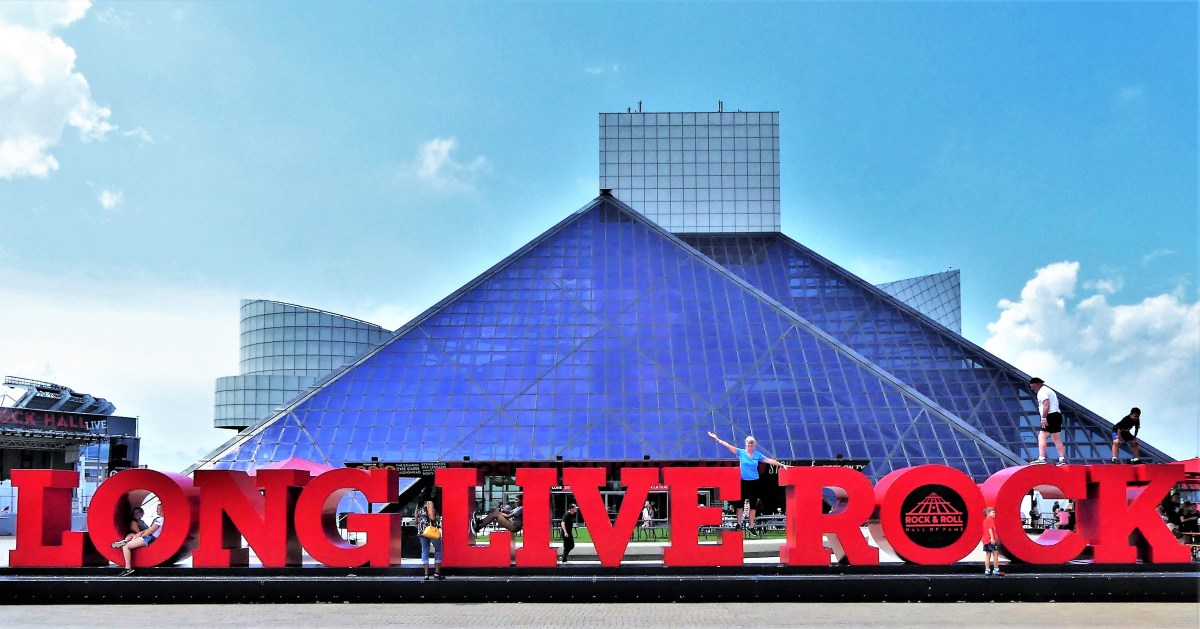
The sole reason Leah and I traveled to Cleveland was to visit the Rock and Roll Hall of Fame, period…
and it didn’t disappoint.
Classic rock music filled the cavernous lobby…
and lighter-than-air concert props hung from cables…
Pink Floyd’s planePhish’s weinerU2’s cars
It was a crusty carnival atmosphere on the outside, but we were there for the gooey goodness of the center.
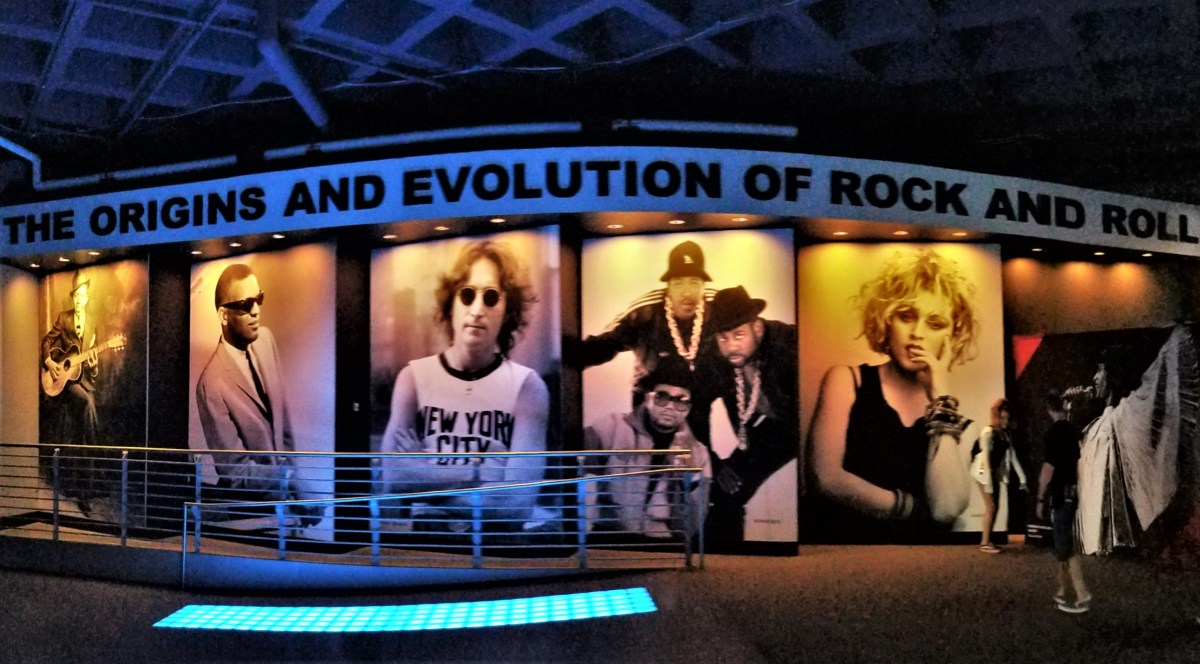
Inside was like a multi-media circus. There was so much information and memorabilia organized on the walls, on the ceilings, and inside floating kiosks that whiplash seemed inevitable. And the Hall was buzzing: with so many tourists, campers, musicians, and music enthusiasts, that at times it felt like a mosh pit, as I moved from one area to another.
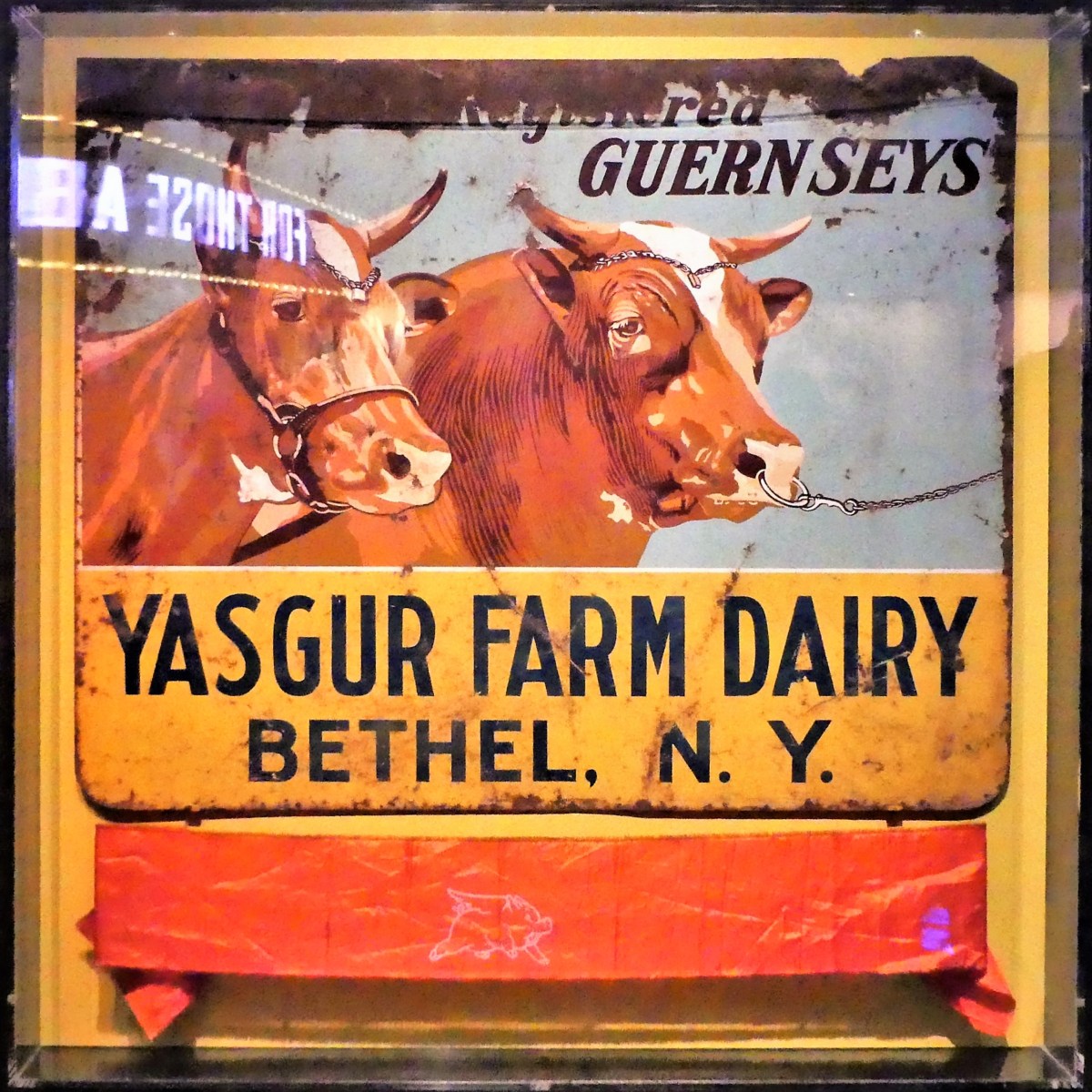
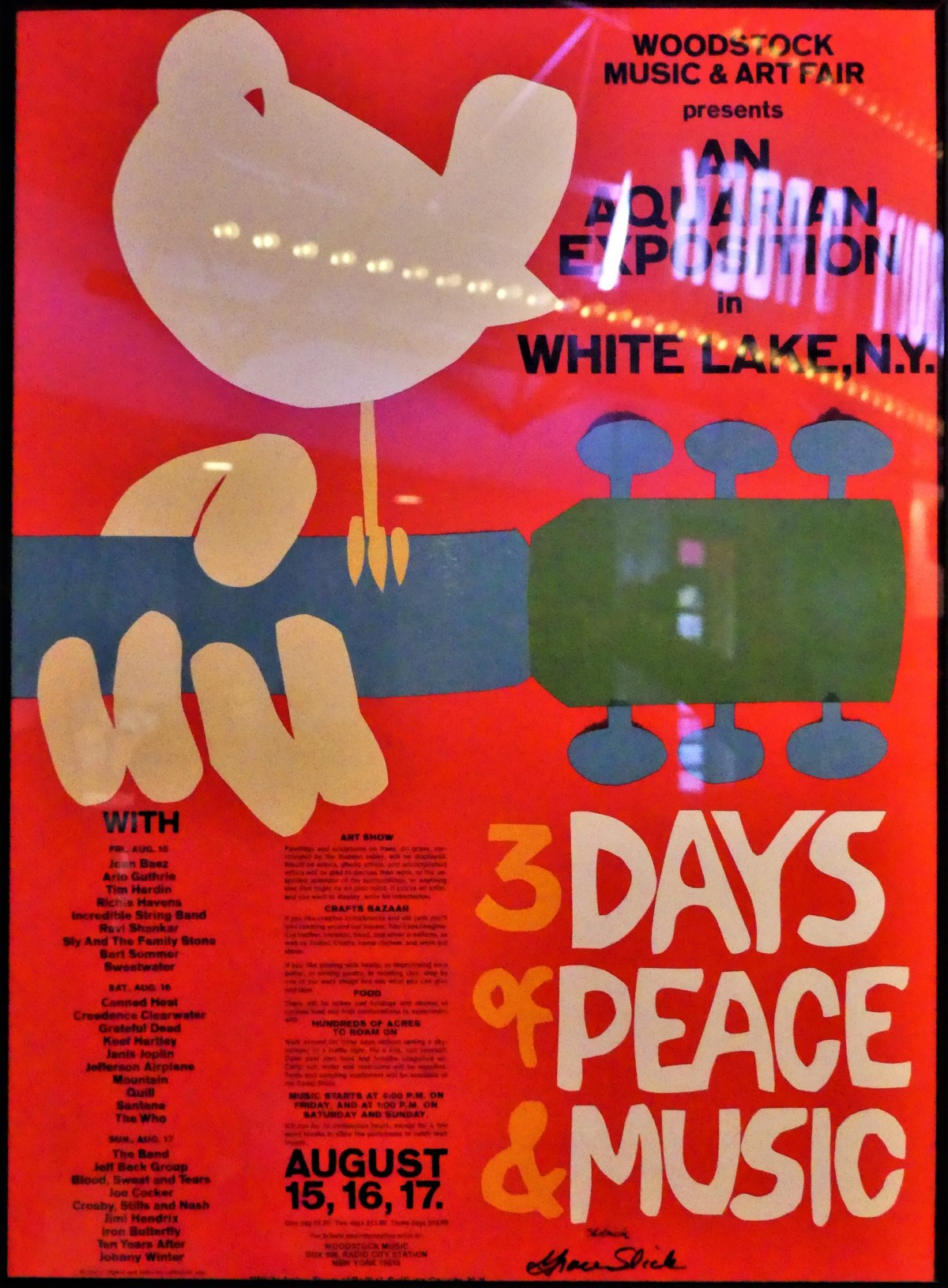
To be expected, there was a tribute to Woodstock…
and Dick Clark…
a salute to the 2019 inductees…
and the icons of rock: Elvis,
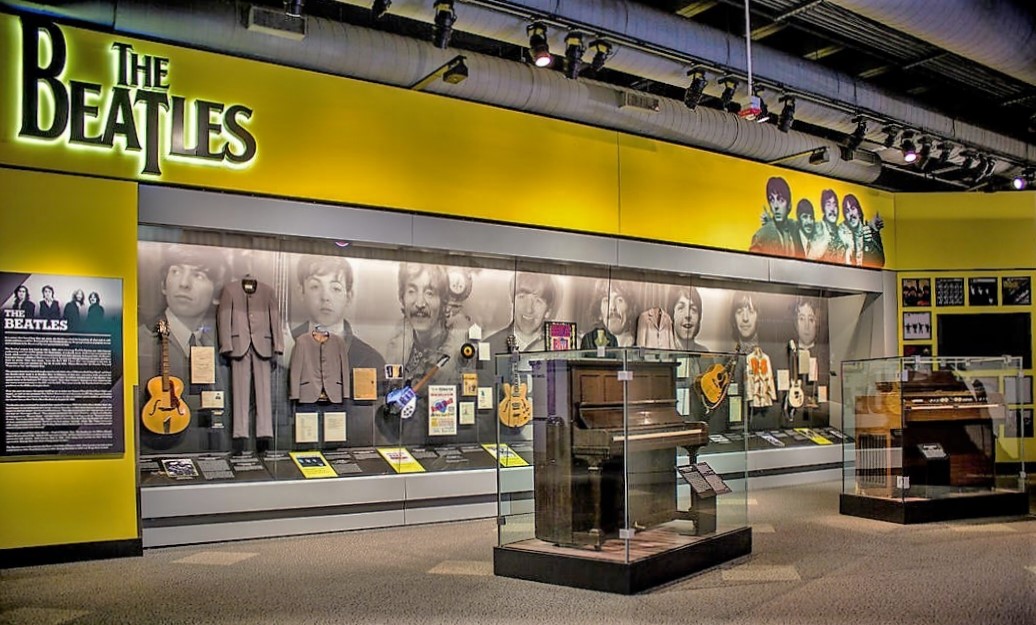
The Beatles,
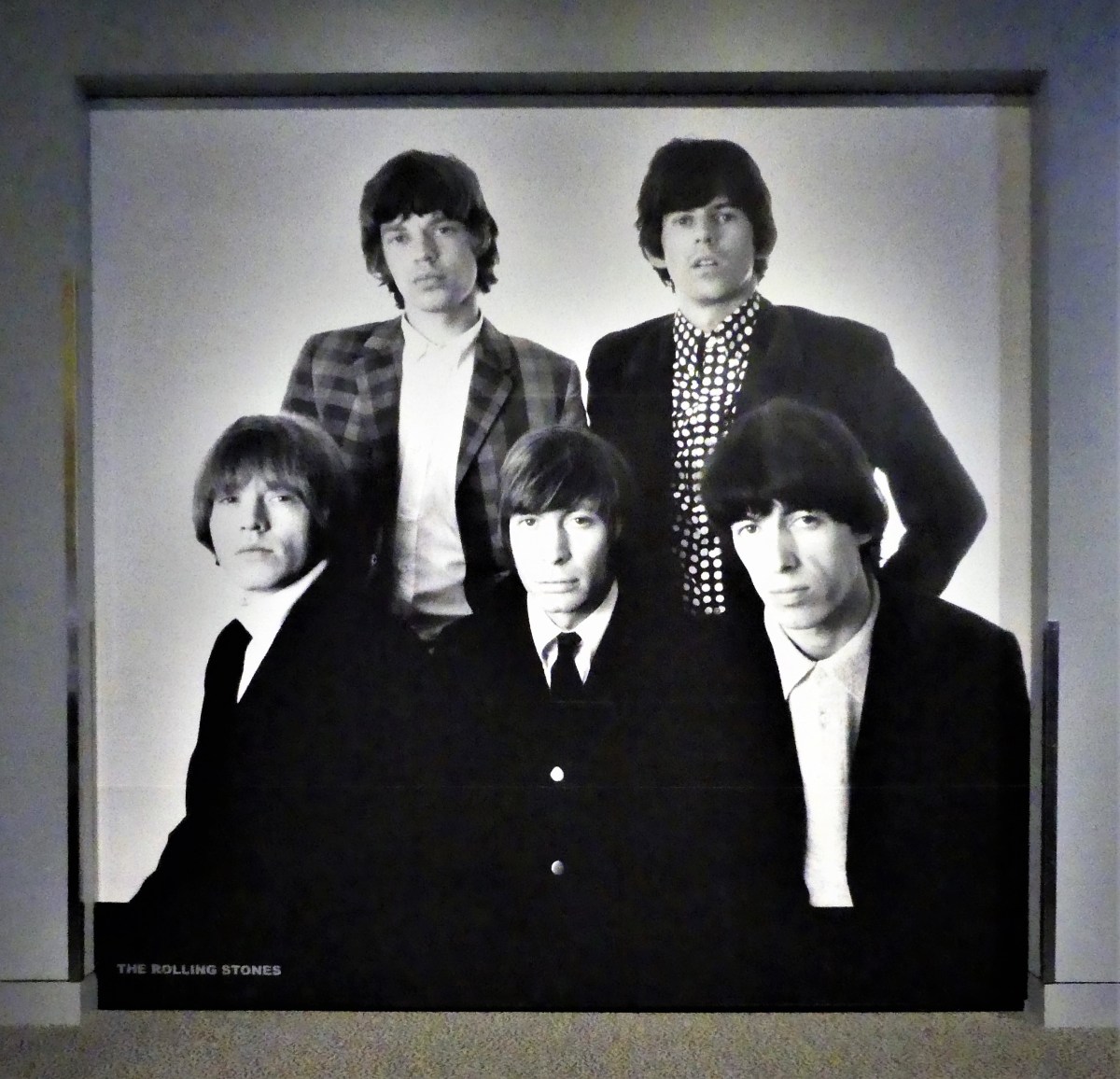
The Rolling Stones,
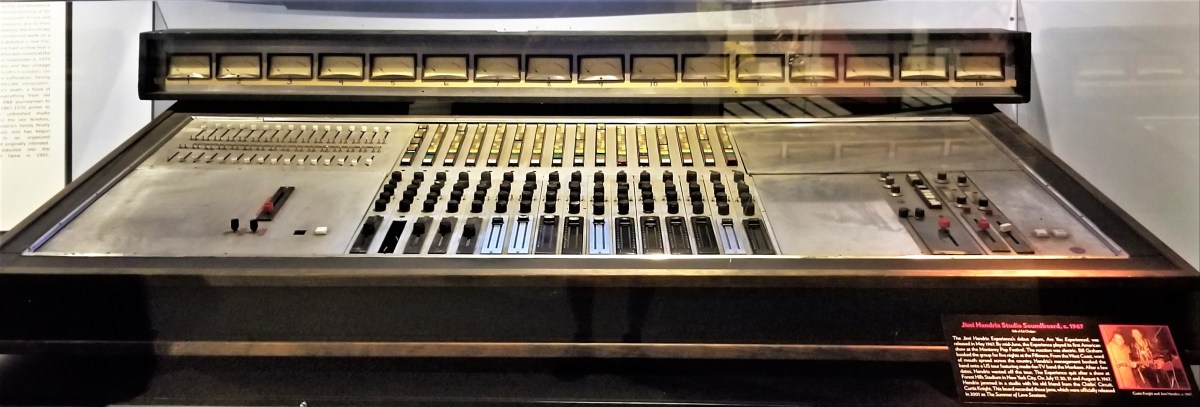
and Jimi Hendrix, to name a few.
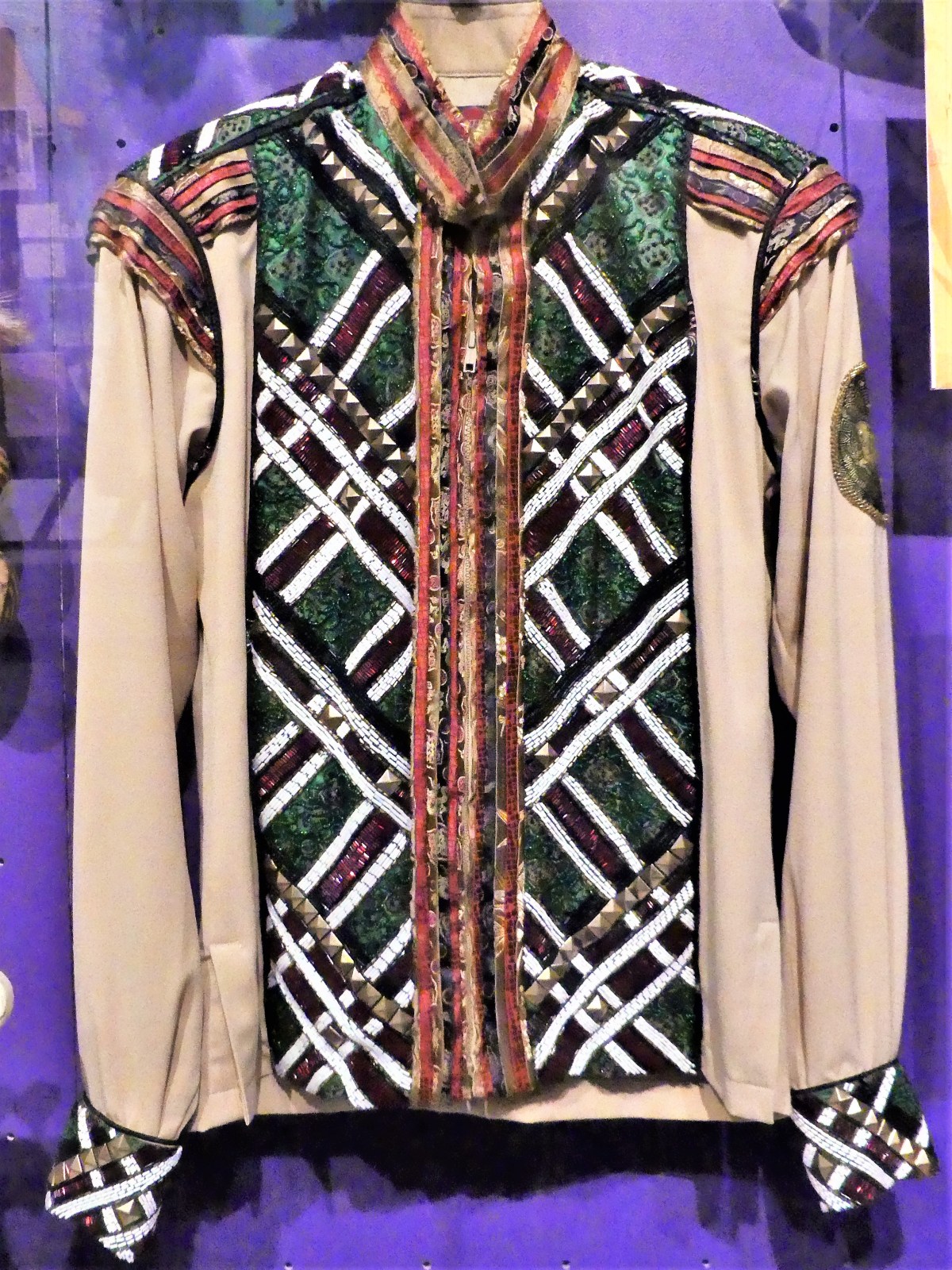
There was plenty of concert apparel to gush about…
Tom PettyMichael JacksonStevie Wonderand Elton John
And there were interactivities to capture one’s creativity, like Garage Band.
Most importantly, when the last lyric was sung and the last chord was strummed, it was time to shop!
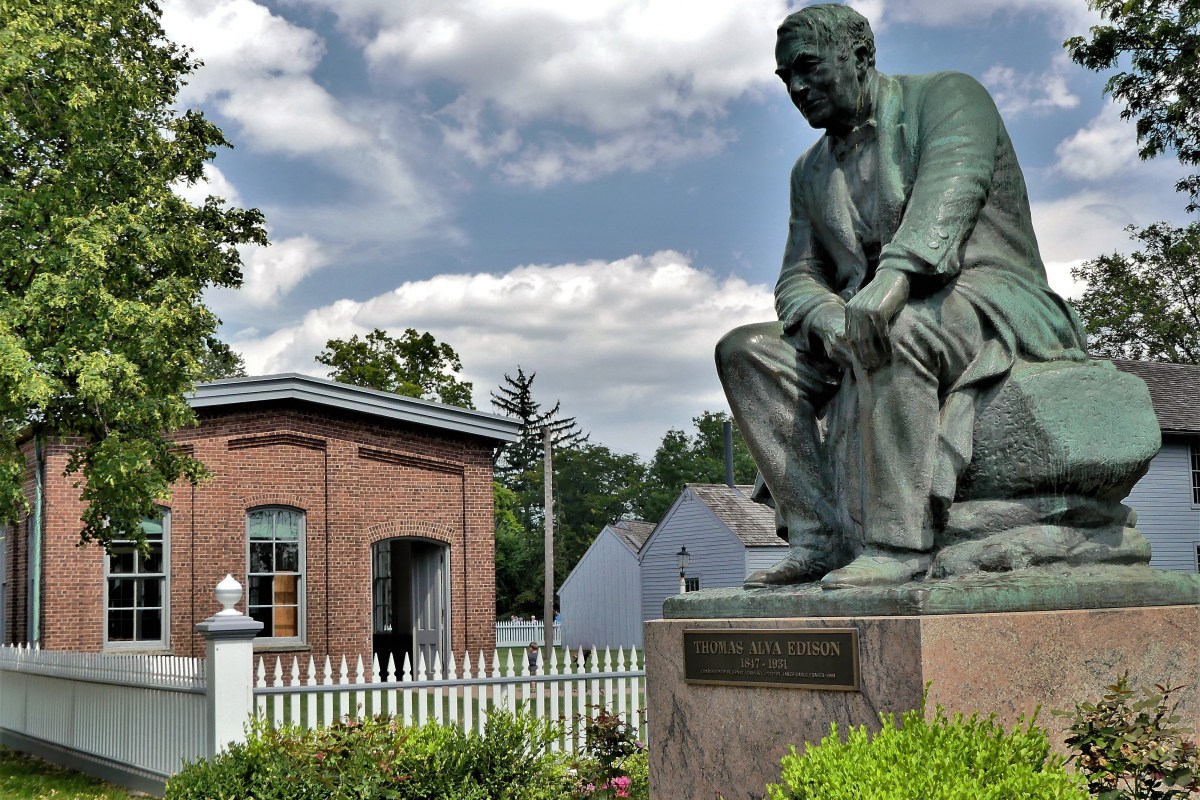
Henry Ford and Thomas Edison–the two men are inextricably linked in so many ways that it defies kismet. Both were iconic inventors and visionaries with a twist of genius; both were titans of industry; they were best friends; they were neighbors; they were presidents of each other’s mutual admiration society; and they were both anti-Semitic.
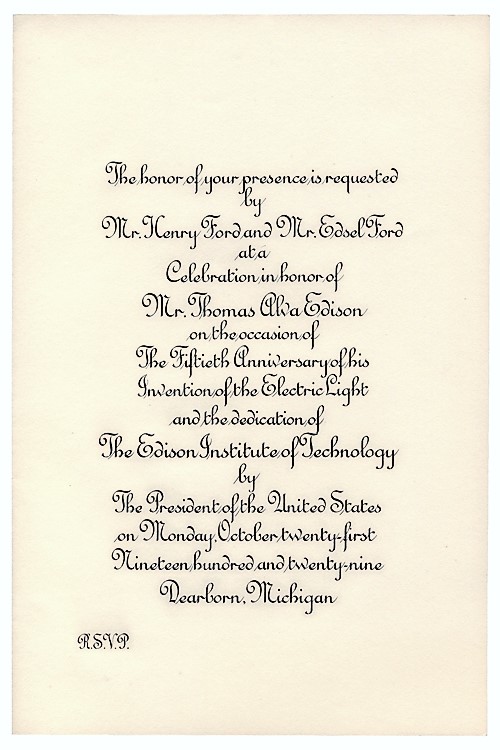
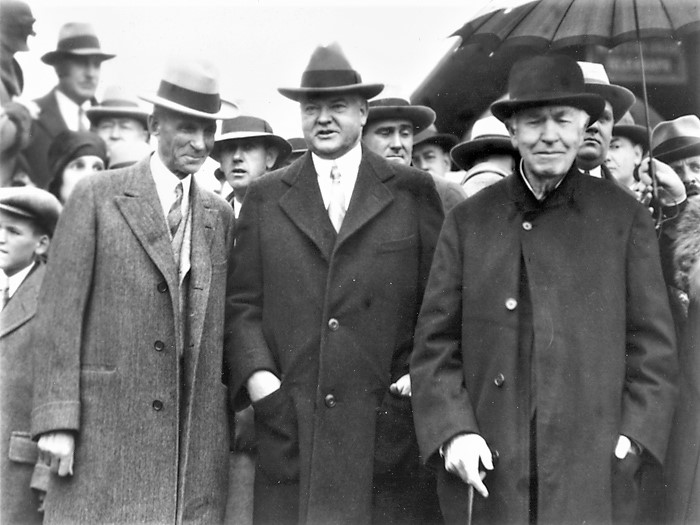
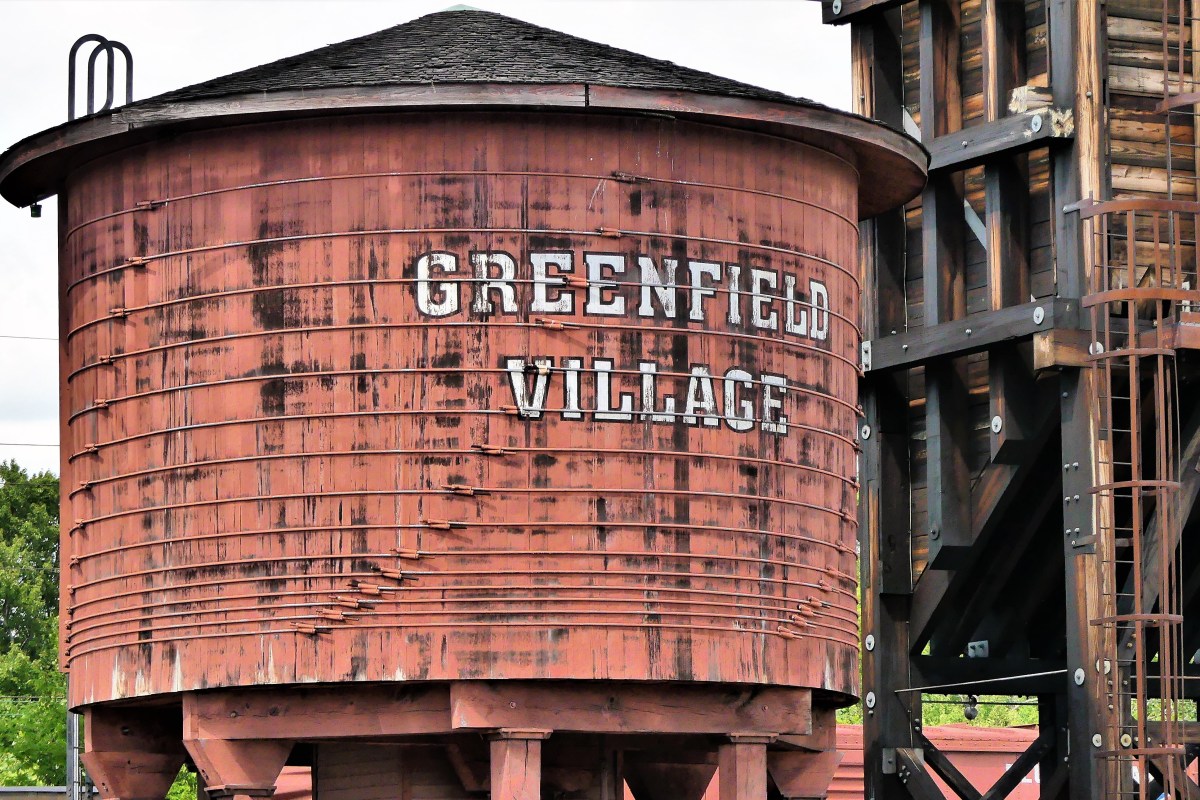
On October 21, 1929–two days before the stock market crash–invitees arrived at Greenfield Village to celebrate the 50th anniversary of the electric light, and Ford’s dedication of Greenfield Village to Edison.
The Henry Ford
The event was a who’s who of dignitaries and celebrities, with the likes of Will Rogers, Marie Curie, Charles Schwab, Adolph Ochs, Walter Chrysler, John D. Rockefeller, Jr., J.P. Morgan, George Eastman and Orville Wright, etc.
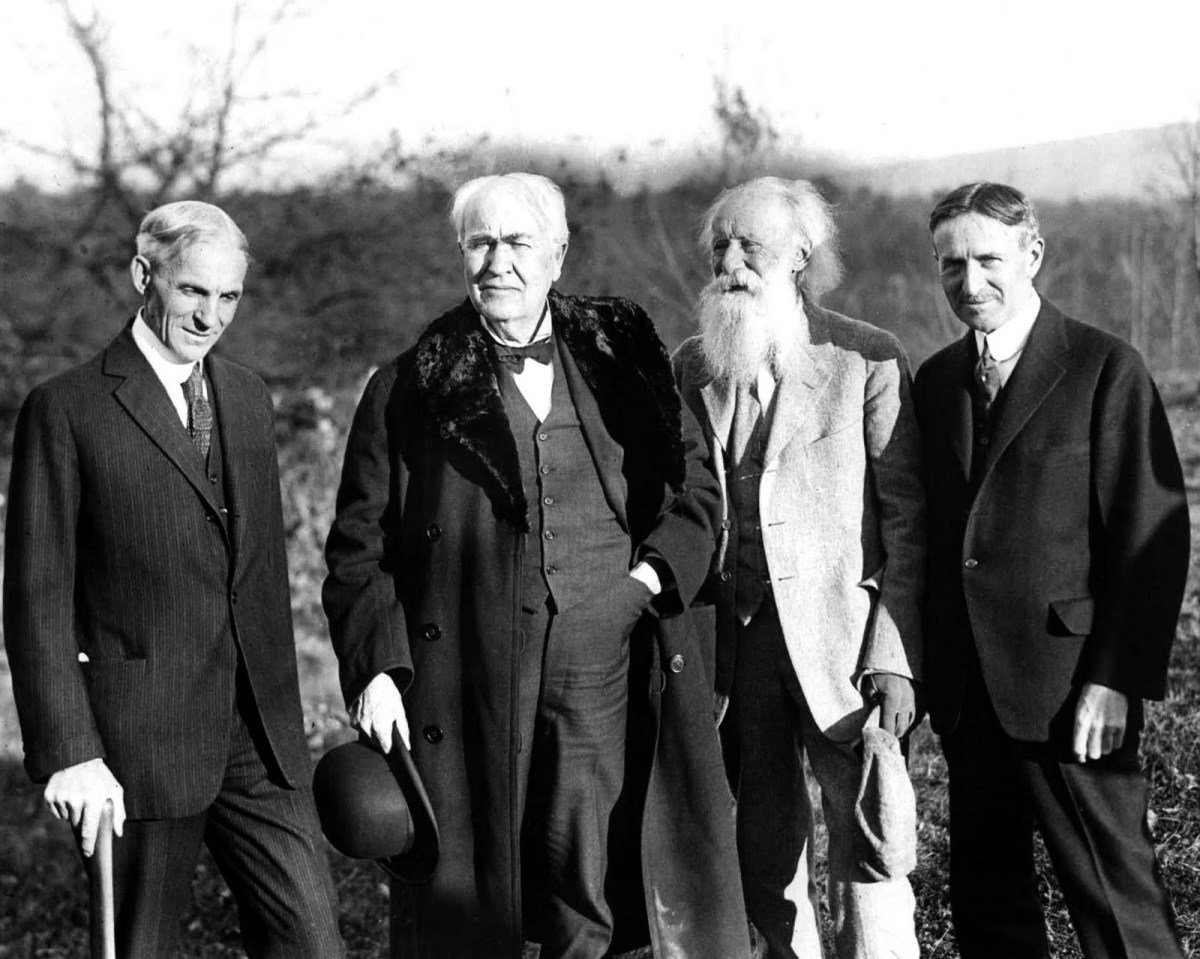
Henry Ford, President Herbert Hoover, Thomas Edison–The Henry Ford
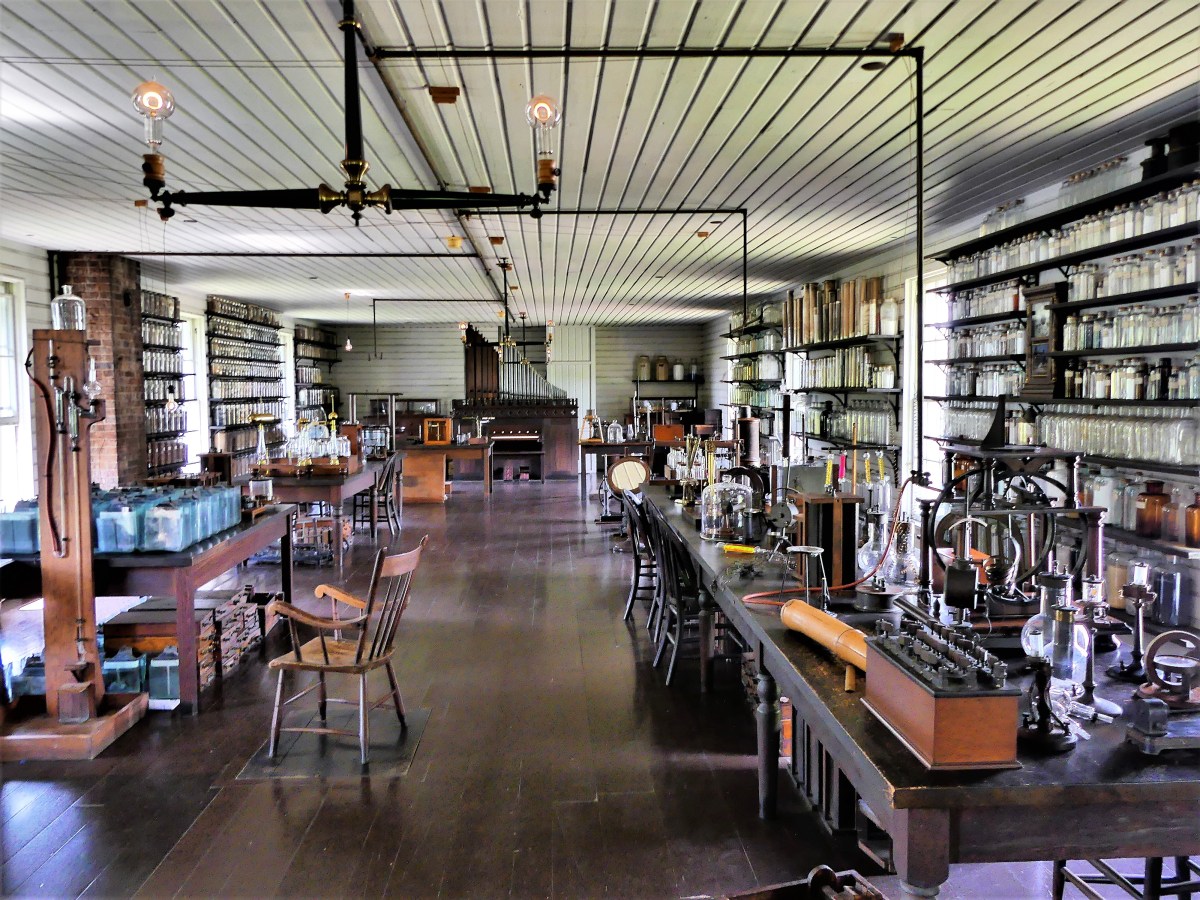
All gathered inside Edison’s reconstructed Menlo Park laboratory…
to witness the symbolic relighting of an incandescent lamp made famous a half century earlier, and credited with changing the world.
Later, Ford ordered the armchair where Edison sat during the ceremony to be nailed in place for all time, and never to be sat in again.
It remains in the exact same place, today.
Greenfield Village was dedicated to Edison that evening as the Edison Institute of Technology. Henry Ford had prepared all year for this public relations bonanza by bringing Menlo Park, NJ to Dearborn, MI.
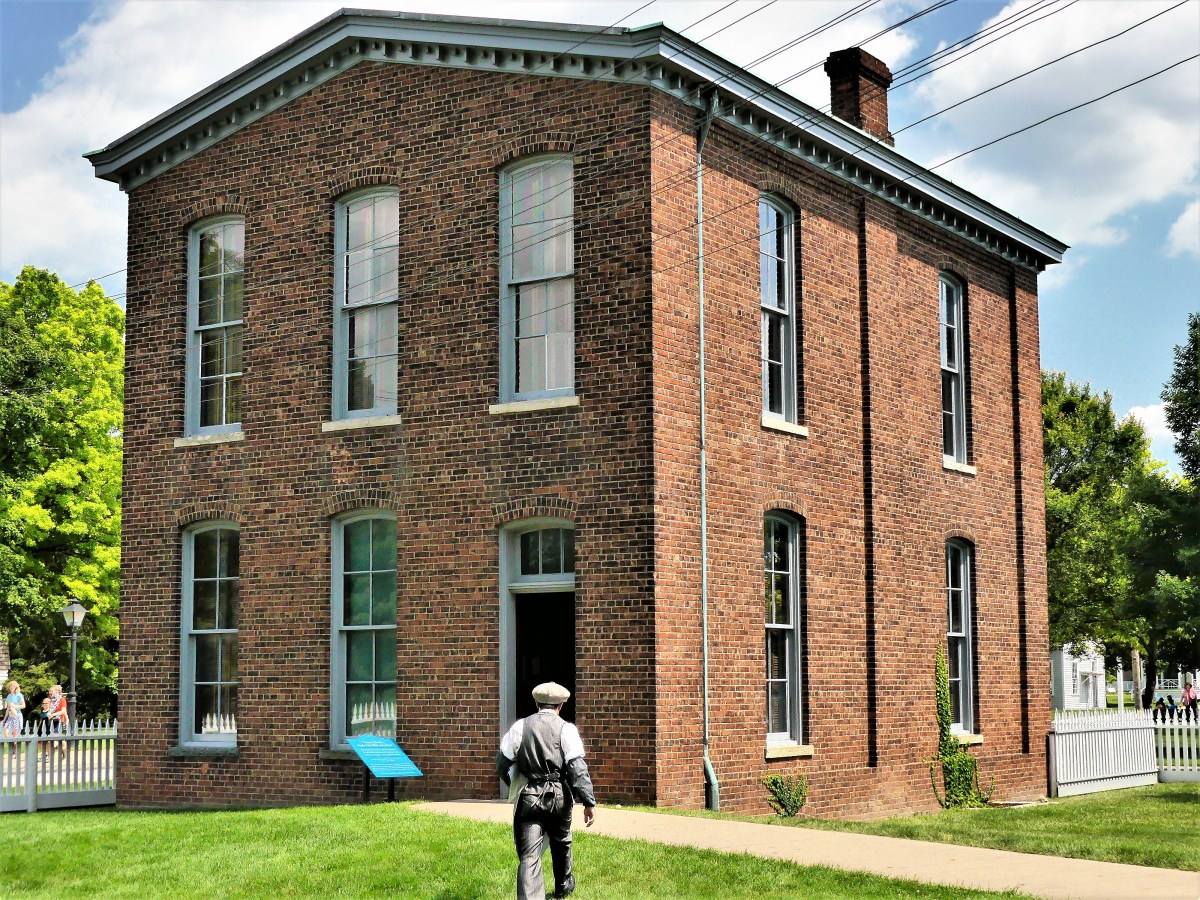
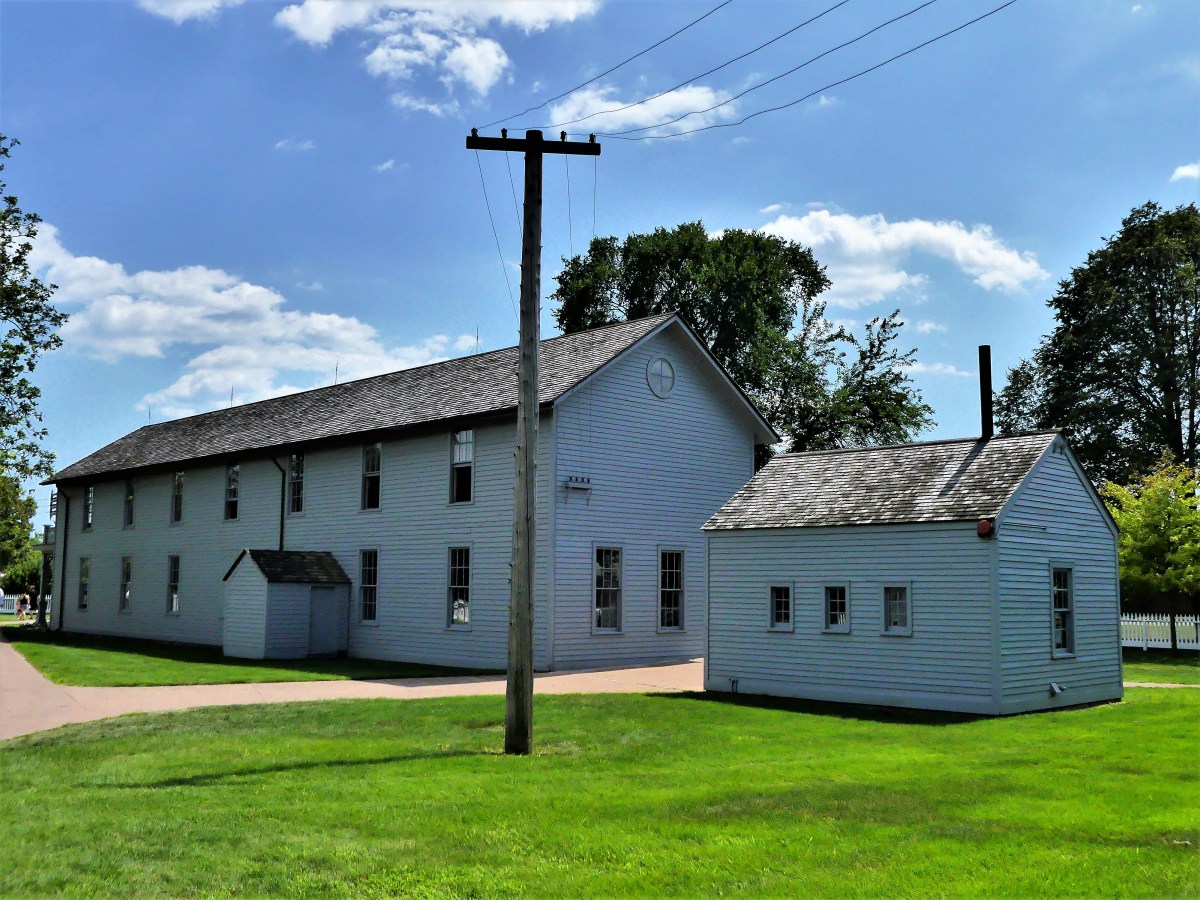
Ford incorporated Edison’s machine shop…
and years later, he built a facsimile of Edison’s first power plant.
Although Ford was 16 years Edison’s junior, and Edison had been Ford’s employer for a time, they became bossom buddies by the time World War I erupted. Ford’s acceptance of a 1914 invitation to Edison’s winter retreat in Ft. Myers sealed the deal.
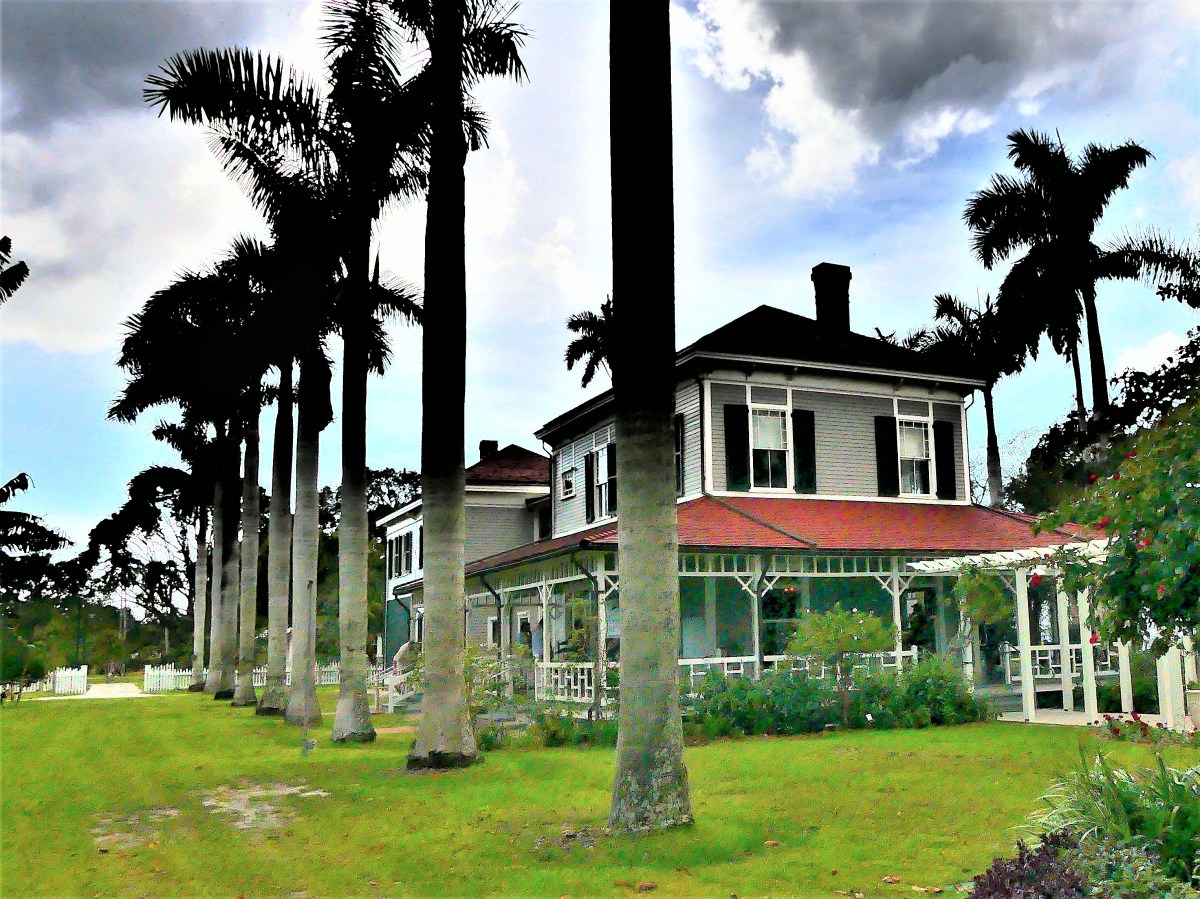
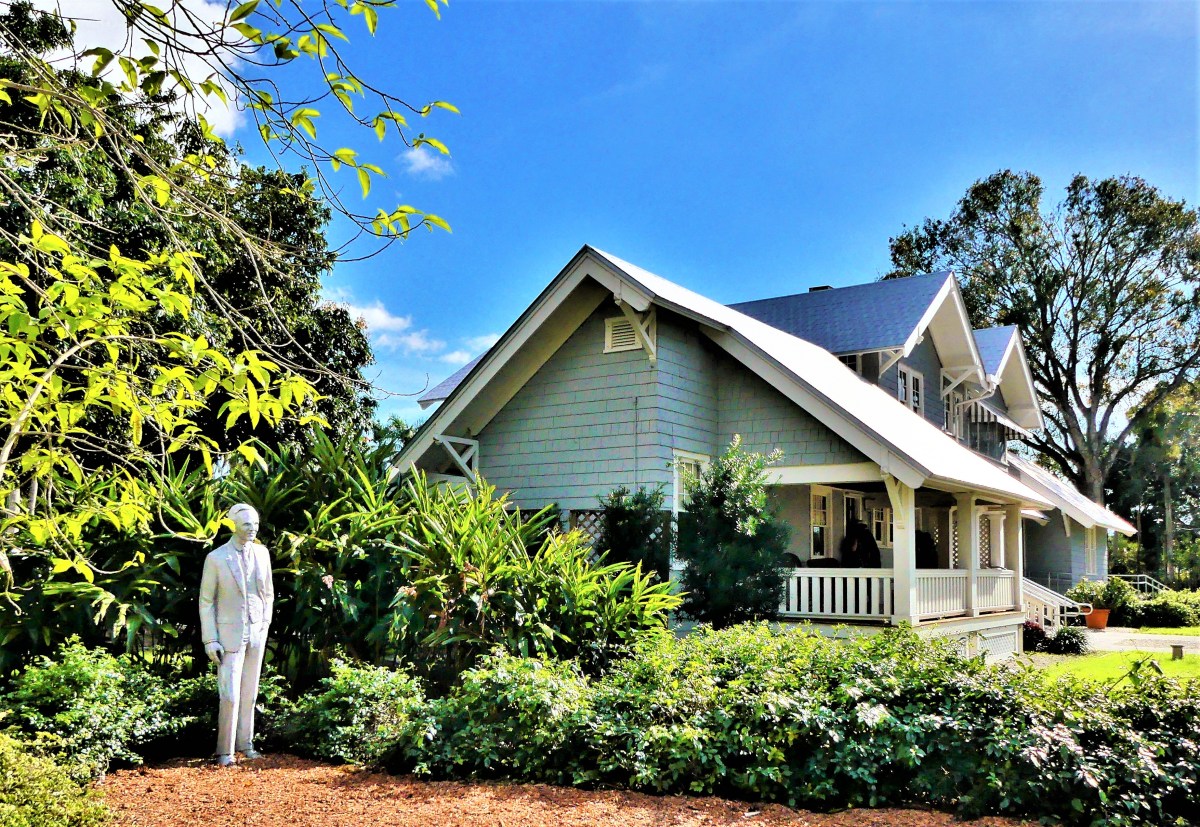
Two years later, Ford purchased The Mangoes beside Edison’s SeminoleLodge, and they became Floridian neighbors.
They took public vacations together, inviting John Burroughs and Harvey Firestone along for the ride–usually to the mountains or parts of rural America. The press corps were encouraged to follow their every move, dubbing them “The Vagabonds.”
While roaming the country, Ford was always eager to share his anti-Semitic views around the campfire, blaming the Shylock bankers in Germany as the root cause of the war, and Jews in America as the source of economic anxiety–all of which was propagandized in the Dearborn Independent, a newspaper published by Ford and used to expose his “truths” about the Jewish threat.
While Edison’s anti-Semitism was never as overt as Ford, it became clear that he harbored similar sentiments, and used his motion picture company to propagate Jewish myths and stereotypes. Cohen was a recurring dislikeable character in his early short films…
While Jean Farrell Edison, the granddaughter and heiress of Thomas Edison’s fortune was funding the Institute for Historical Review (an organization that promotes Holocaust denial), Henry Ford II had distanced himself from his grandfather’s vitriol by offering philanthropic support for Detroit’s Jewish community, as well as renouncing the Arab League’s boycott of Israel after Israel achieved statehood in 1948.
And how would Henry Ford react to Mark Fields’ appointment as Ford Motor Company’s CEO in 2014, or Bill Ford’s dedication of Ford’s first technology research center opening in Tel Aviv this year?
Likewise, Edison might pale upon discovering that the motion picture industry exploded in Hollywood with studios founded by: Carl Laemmle, Sam and Jack Warner, Sam Goldwyn and Louis B. Mayer, William Fox, and Adolf Zukor.
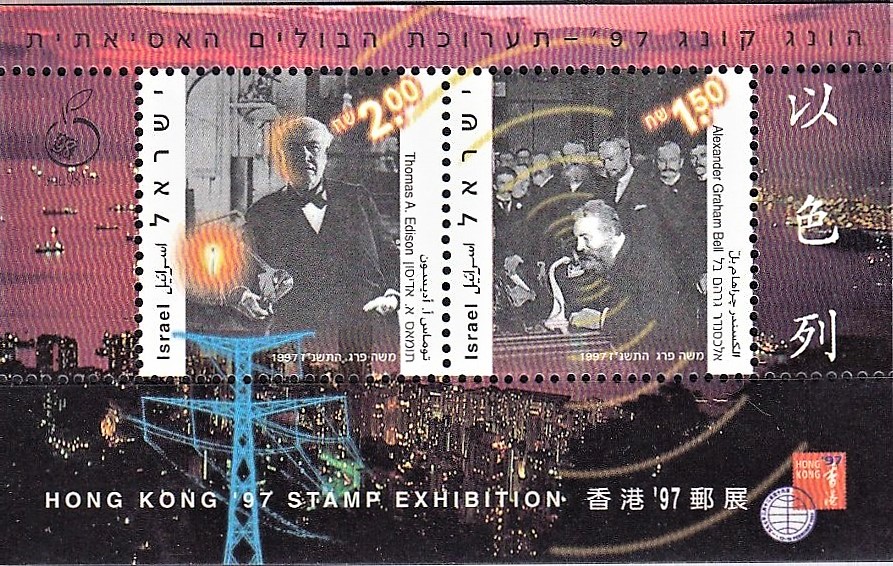
Paradoxically, in 1997, the Israeli Postal Authority memorialized Edison with a stamp.
Yet, a bigger question remains… How is it that we live in a world that continues to embrace an ancient hatred that modern-day leaders are unwilling to disavow?
Typically, most people with a predilection for collecting turn to everyday items, such as stamps, figurines, sports memorabilia, books, shoes, or records to name just a few obsessions. But not Henry Ford. By virtue of Ford’s bottomless budget, and his insatiable curiosity, his path to collecting took him through time itself, because Henry Ford collected significant relics of history and personal sentiment, and planted them across 80 acres in Dearborn, Michigan.
He called it Greenfield Village, making it the largest museum of its kind in the world.
Greenfield Village originally operated as an experimental school known as Edison Institute in 1929 (as a nod to his dearest friend) before opening to the public as an outdoor museum in 1933.
Ford, mused, “I am collecting the history of our people as written into things their hands made and used…. When we are through, we shall have reproduced American life as lived, and that, I think, is the best way of preserving at least a part of our history and tradition…”
There are over 100 original or replicated buildings filled with hundreds of thousands of artifacts and Americana intended to preserve authenticity. Additionally, costumed spokespeople throughout the complex tell antecdotes of historical nature, fully re-enacting an experience that captures an earlier time in America.
If there was a homestead that had historical value or childhood sentiment to Henry Ford, and it stood in the way of progress, then Henry seized the moment and had the house razed and moved to Michigan for restoration.
As excerpted from Telling America’s Story–A History of the Henry Ford:
In 1919, a road improvement project in Ford’s hometown of Springwells Township, Michigan (now the city of Dearborn), meant his birthplace would need to be either moved 200 yards from its original location – or destroyed.
Ford decided to move the house and restore it to the way it looked at the time of his mother’s death in 1876, when he was 13 years old. Ford personally took charge of the birthplace restoration, meticulously recreating the details of the house down to the original or similar furnishings.
For example, Ford remembered sitting by a Starlight stove in the dining room as a child. After 18 months of searching, he discovered the exact make and model on a porch in Stockbridge, Michigan, which he purchased for $25 and loaded into his car for the journey back to Dearborn. And when he couldn’t find the precise pattern of dishes his mother had used, he had the original site of his birthplace excavated and had replicas made from the pottery shards found.
Ford dedicated the restoration of his childhood home to his mother’s memory and her teachings, particularly noting her love of family, her belief in the value of hard work, in learning “not from the school books but from life,” and her belief in trusting one’s intuition. His mother had encouraged his early tinkering and youthful inventions, and he felt sure she had set him on his unique path in life.
The rest is history…
And it’s all organized into seven historic districts: Working Farms;
Liberty Craftworks;
Henry Ford’s Model T;
Railroad Junction;
Main Street;
Porches & Parlors;
and Edison at Work, which is a future subject unto itself.
As one might expect, walking through history can be exhausting. Leah’s iPhone calculated that we hiked nearly 5 miles around the village in 3 hours, although there was still so much more to see and do. However, it was a hot and humid day, and apropos to Henry Ford, we simply ran out of gas and steam.
Or, to bastardize a famous Edison quote, we were inspired while we perspired!
Every 52 seconds, another Ford F-150 rolls off the line at The Rouge Complex in Dearborn, Michigan, making it the world’s best selling truck, and generating over $28 million in daily revenue. The Henry Ford Museum offers an elective tour of the Rouge as part of its a la carte admission package.
For Leah and me, it was never a consideration. We elected to take the tour to see how our beloved truck was assembled.
The self-guided tour consists of five parts:
The Legacy Theater, offering a short film charting the Rouge’s 100-year history–from Model A to present.
The Manufacturing Innovation Theater, a special effects homage to Ford’s F-150 truck, from vision to conception;
The Observation Deck Tour, with views of Ford’s 10-acre living roof of sedum and associated rainwater reclamation system, which provides a cost-savings of $50 million in annual maintenance.
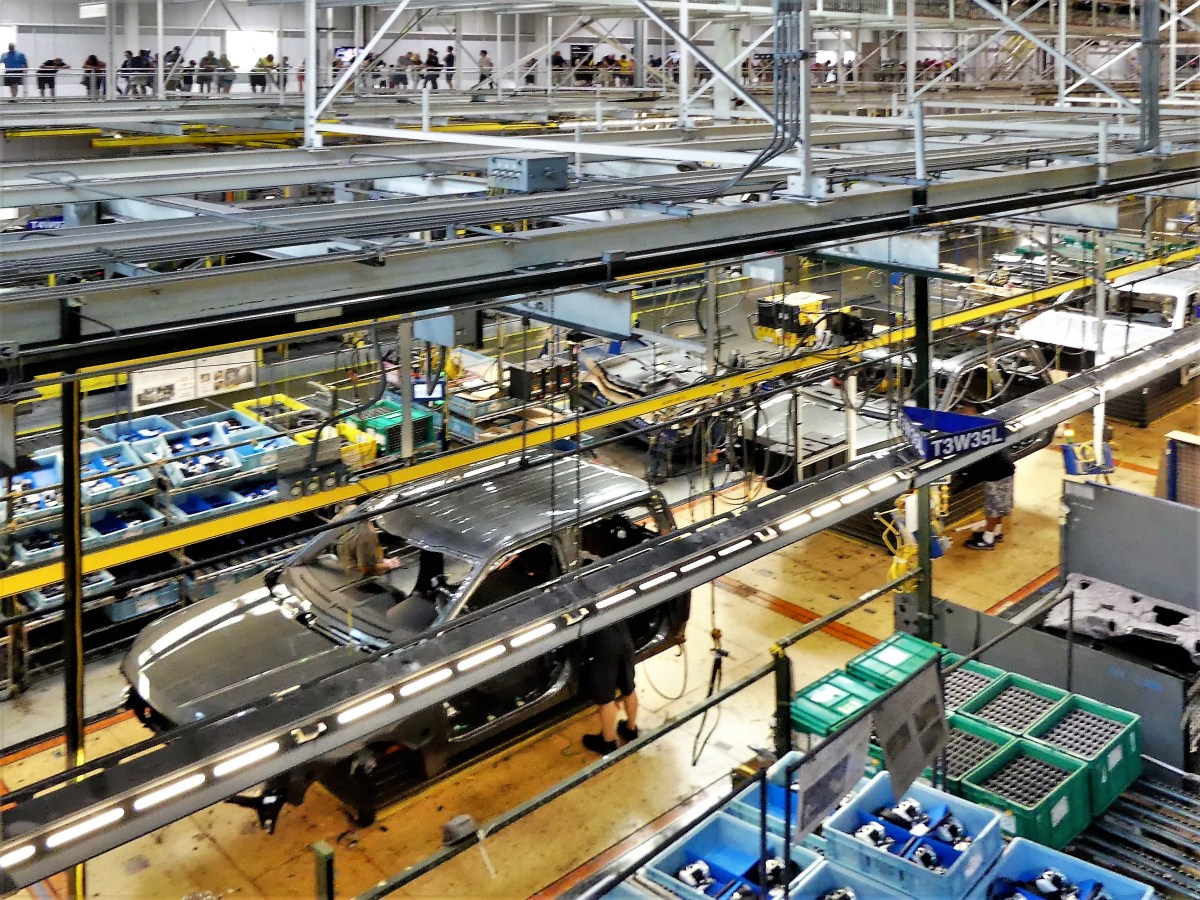
The Assembly Walking Plant Tour, which carries observers along a catwalk above the production floor for a birds-eye view of the final assembly of an F-150;
and, The Legacy Gallery, which showcases some of the legendary cars manufactured at the Rouge.
To be clear, there is a strict no photography policy during the film presentations and assembly plant portion of the tour. However, being the renegade that I am, I was determined to capture a few frames as I walked the perimeter of the production walkway…but in a covert fashion.
The line never stopped moving with the exception of lunch at noon. It was an industrial pas de deux of human labor and robotic engineering, with components arriving from overhead conveyors and snatched for assembly.
My camera hung casually around my neck as I moved from station to station, where I’d stealthly point my lens in a general direction, always avoiding factory workers, yet hoping to record this dynamic performance. Along the way, I was mindful of patrolling docents, who were fountains of statistical information, but also doubled as picture police.
While I admit to taking a foolish risk, I also confess to the challenge of shooting blindly with the notion that something sublime might materialize.
Somehow, I can’t imagine I’m the only one who sneaks a shot or two! You out there, you know who you are, and you know what I’m talking about.
Nevertheless, I’ll surrender my digital files if I have to, but I will not surrender my ride.
Detroit has been working overtime on a public relations campaign to scrub the grime off its tarnished reputation and buff the rentability of its landmark towers. A downtown resurgence is helping to restore the luster of a once-burgeoning city that grew into an industrial and economic juggernaut during the first half of the 20th century, but became a municipal pariah after accruing $20 billion of debt since the 1950s.
In its heyday, Detroit was a magnet of opportunity, attracting new residents from all American sectors with the promise of manufacturing jobs. Consequently, its population swelled to 2 million.
The collapse of the city’s automobile industry was the catalyst for Detroit’s demise. Racial tensions culminated in riots in 1967 that led to a mass exodus, and Detroit shrank to a third of its size. Vacant lots and abandoned buildings became the norm. Ultimately, the city went bankrupt in 2013–the largest debt of its kind for an American city.
Today, Detroit is rebounding, but not without new growing pains. City leaders hope to strike a balance between renewed economic confidence and building a future that is more inclusive of long-term residents who have suffered the most.
As it’s explained by Pete Saunders for Forbes Magazine:
…A partnership between city and state government, business leaders and the city’s philanthropic community led an innovative effort to restructure the city’s debt, estimated at $19 billion.
Private investment in downtown Detroit, already on the upswing prior to the bankruptcy filing, continued to trend upward. Last fall’s opening of Little Caesar’s Arena, part of the larger District Detroit business and entertainment area, the construction of a landmark mixed use development on a former iconic department store site, and the recent acquisition by Ford Motor Company of Michigan Central Station all demonstrate the accelerated pace of development in the city.
Detroit’s Midtown area, also just north of downtown and home to many of the city’s arts and cultural institutions and Wayne State University, has been the site of dozens of new mixed use developments with hundreds of new units designed to attract Millennial urban dwellers.
The city’s former warehouse district on the east riverfront is attracting development attention for high-end condos and apartments with downtown and waterfront views.
Detroit’s Corktown neighborhood, the city’s oldest neighborhood and one that’s grown in trendiness over the last half-decade, is set to receive more investment in commercial and residential development, pushing its recent successes to the next level.
Detroit’s development resurgence is being tied together by a brand-new streetcar line that opened last year, the QLine. The 3-mile streetcar connects downtown with the adjacent neighborhoods where activity is taking place, and there are hopes that the line could expand further outward and gain additional branches.
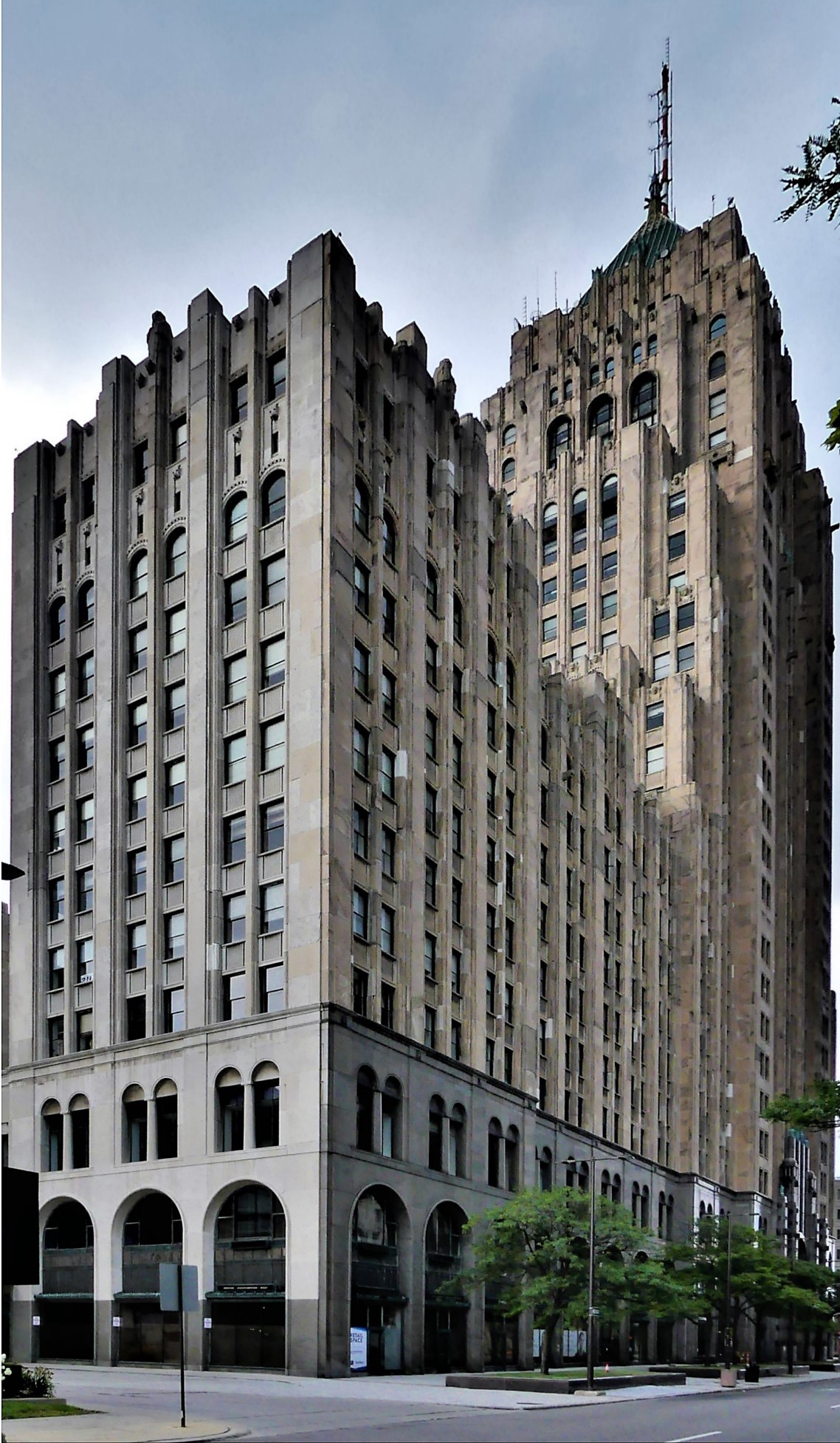
Leah and I took a walk around downtown to see for ourselves. First, we stopped at an Art Deco-styled landmark building celebrating its 90th anniversary.
A short walk to the Detroit River brought us face to fist with an homage to Joe Louis.
Nearby, the Spirit of Detroit was undergoing a makeover.
We crossed E. Jefferson to arrive at Hart Plaza to gaze at Michigan’s Labor Legacy.
Walking a short distance to the Detroit River brought us views of Windsor, Canada as once imagined by slaves making their escape through the Underground Railroad.
In the distance, stands the Ambassador Bridge–the busiest crossing between U.S. and Canada–with 10,000 commercial vehicles making the trip daily.
Beyond Dodge Fountain, the GM Renaissance Tower rises from the International Riverfront.
A walk along the riverwalk delivered us to the GM Wintergarden, where a life-sized model of a Chevy Silverado was made entirely of Legos.
It took 18 master builders over 2,000 hours and 334,544 “bricks” to complete. At 3,307 lbs., the sculpture stands at half the curb weight of its legitimate counterpart.
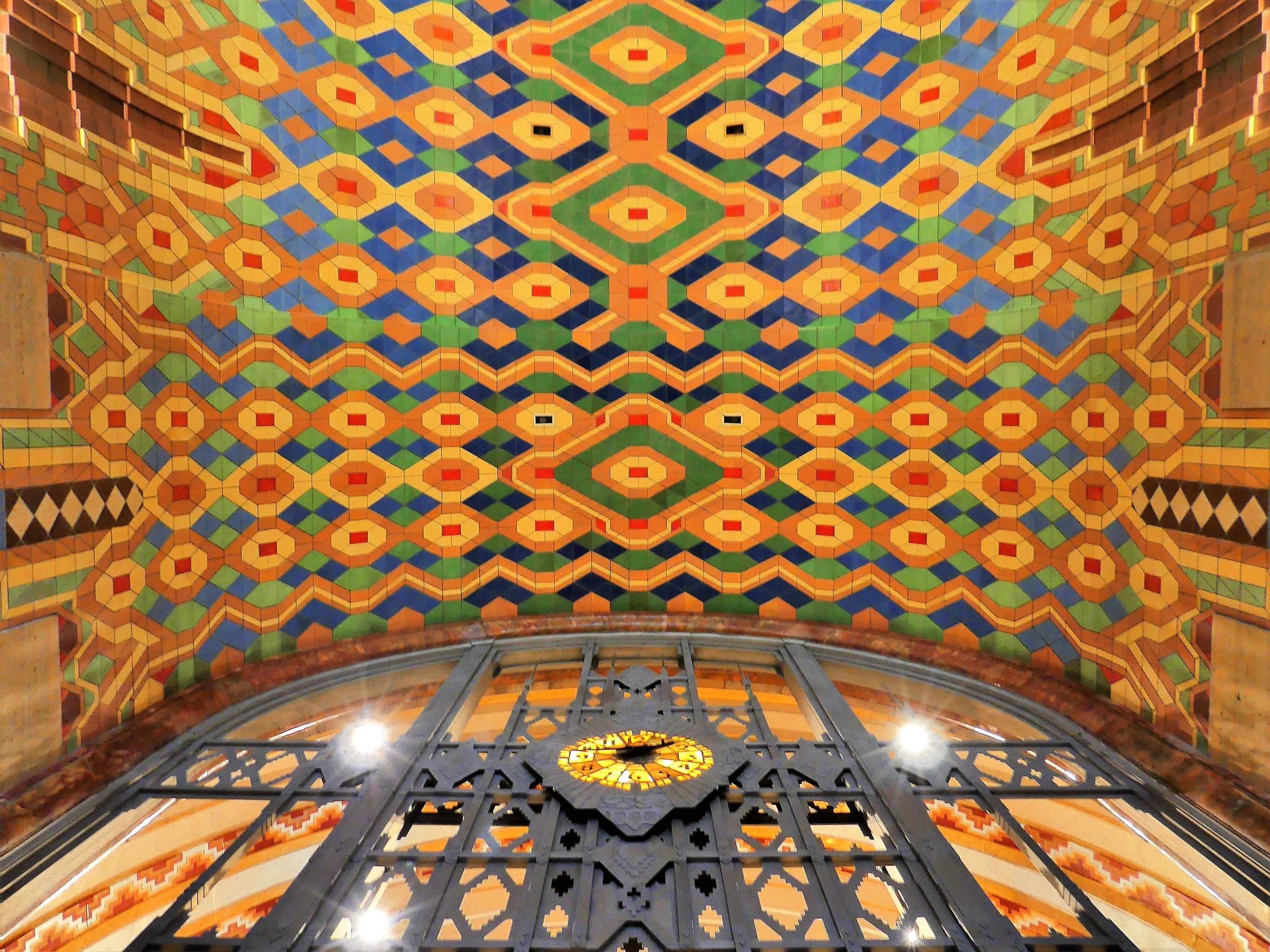
Equally as impressive, and no less the engineering feat, the Fisher Building has been referred to as “Detroit’s largest art object.”
Finished in 1928, the 30-story building was financed by the Fisher family from the sale of Fisher Body Company to General Motors.
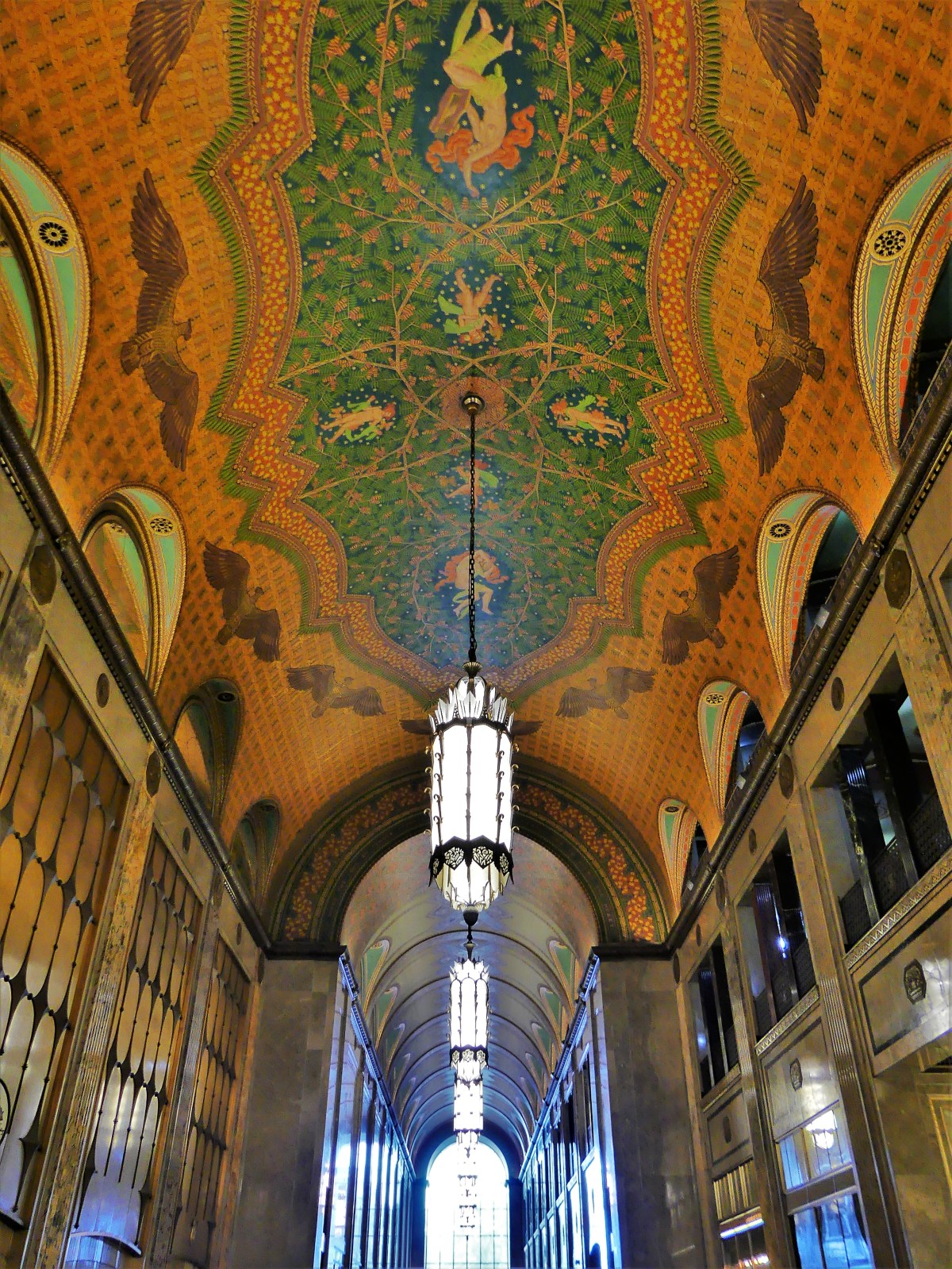
Albert Kahn’s opulent 3-story barrel vaulted lobby…
decorated in paint…
and marble by Géza Maróti is considered a masterpiece.
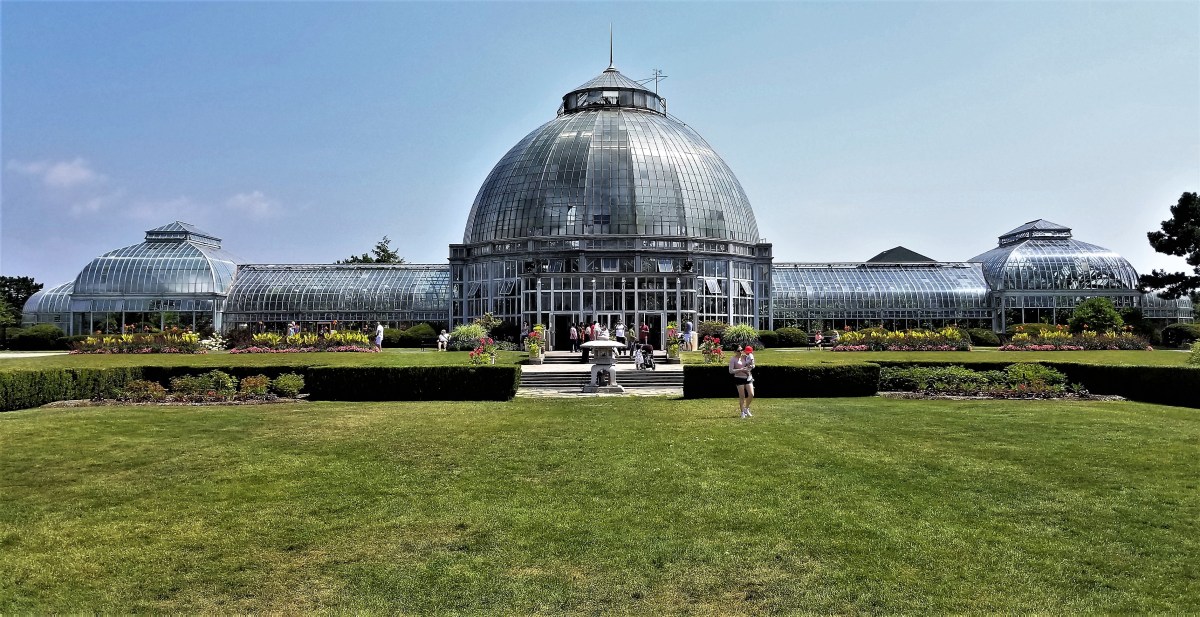
Alfred Kahn also spent time up river on Belle Isle (an island park originally designed by Frederick Law Olmstead in the 1880s), where he designed America’s first Aquarium and Conservatory in 1904.
Another part of Detroit’s revitalization effort included the construction of Ford Field, the domed home of NFL’s Detroit Lions,
conjoined with Comerica Park, home to baseball’s Detroit Tigers.
Detroit has been hailed as The Comeback City, emerging from Chapter 9 with a new vibe that seems to be drawing people back to a city that was broke and broken, and considered unliveable only six years ago. With continuing investment and broad community suport, the prospects for Detroit are bright,
Leah and I are winding down our Great Lakes circumnavigation 200 miles south of Lake Erie, where a hundred or more local and distant celebrants have gathered in Ligonier, PA to party with Tiff and Jim on their 25th wedding anniversary.
Appropriately, it was Ligonier and the surrounding Laurel Highlands where Leah and I broke our Airstream cherry. It was the cusp of winter/spring; it was the day after Leah’s 60ish birthday; and it was my first day of retirement.
We dug ourselves out of a major New Jersey snowstorm, and loaded up the Airstream and the F-150 with a year’s worth of gear and courage. Our maiden voyage left us white-knuckled as we precariously cruised the backroads to find Tiff and Jim’s country house in darkness. That was 29 months ago.
Today, we are seasoned road warriors who have grown in confidence, and somehow avoid repeating our original mistakes. Instead, we make new mistakes, which keeps us on our toes.
Circling back to Ligonier after three months of Great Lakes coastal roads has also given me time to reflect on the places I traveled, the things I’ve seen, and the moments I captured.
What follows is a snapshot retrospective along our route:
Niagara Falls, Ontario–Victoria AvenueWawa, Ontario–Young’s General StoreSt. Ignace, Michigan–Castle RockFort William, Ontario–Mount McKayDuluth, Minnesota–Canal ParkEldes Corner, Minnesota–Jay Cooke State ParkCarlton, Minnesota–Buffalo Valley RV CampgroundEsko, Minnesota–East Highway 61Bayfield, Wisconsin–Howl Adventure CenterBayfield, Wisconsin–1st StreetMunising, Michigan–The DogpatchSturgeon Bay, Wisconsin–N. 3rd AvenueEllison Bay, Wisconsin–WI-42Egg Harbor, Wisconsin–WI-42Baraboo, Wisconsin–Devil’s Doorway, Devil’s Lake State ParkBaraboo, Wisconsin–Circus WorldWisconsin Dell, Wisconsin–BroadwayPlain, Wisconsin–Ederer Dairy SupplyMilwaukee, Wisconsin–Lakefront BreweryHighland Park, Illinois–Ravinia FestivalNiles, Illinois–Leaning Tower of NilesGrand Rapids, Michigan–Frederik Meijer Gardens and Sculpture ParkTraverse City, Michigan–Warehouse DistrictDearborn, Michigan–Ford Rouge FactoryDetroit, Michigan–Heidelberg ProjectDetroit, Michigan–Comerica ParkCleveland, Ohio–Rock and Roll Hall of FameBellefontaine, Ohio–S. Main StreetPittsburgh, Pennsylvania–Andy Warhol Museum (Keith Haring)Pittsburgh, Pennsylvania–Mattress Factory (Yayoi Kusama)Pittsburgh, Pennsylvania–PNC Park (Willie “Pops” Stargell)Ligonier, PA–Fort Ligonier
This is only the beginning for us. Stay tuned for more travel follies…
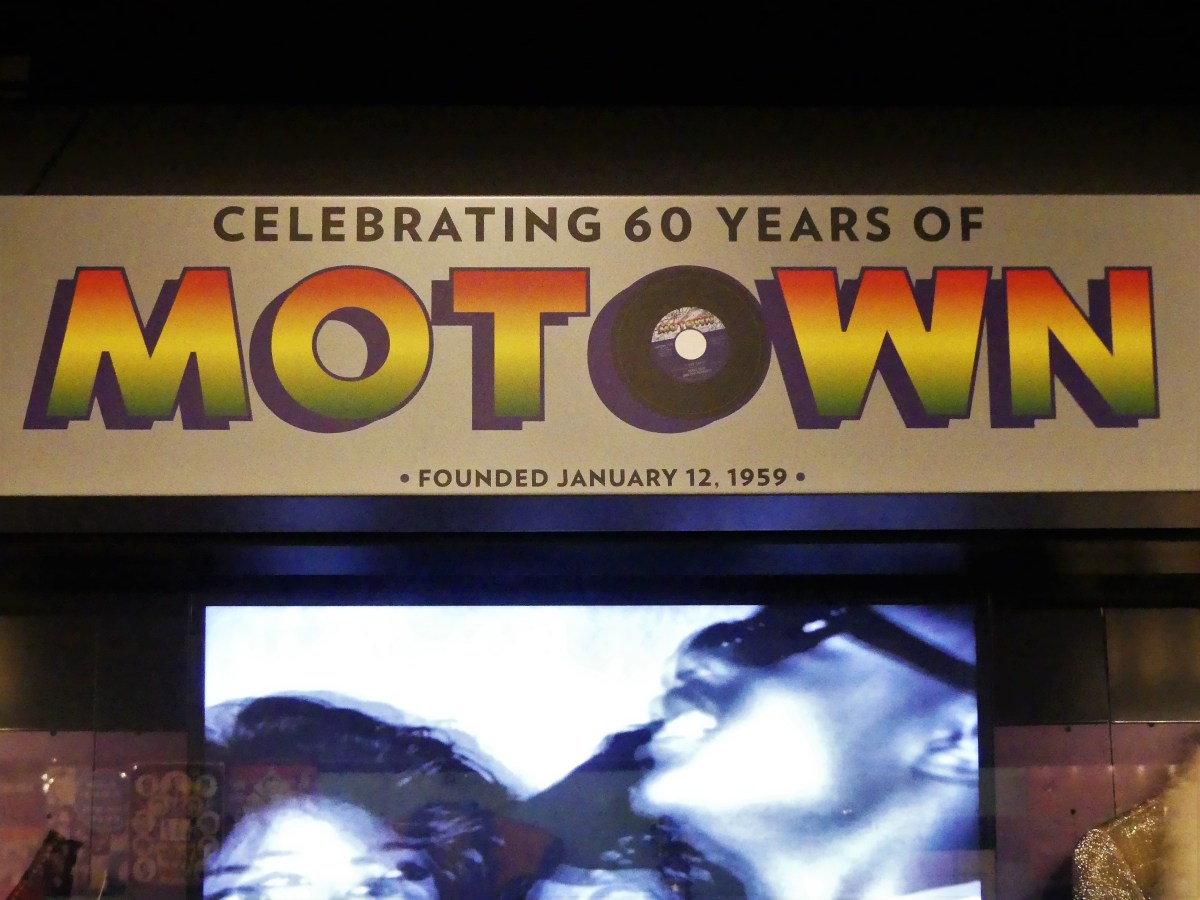
Leah and I were looking forward to touring Hitsville, USA after determining that a visit to Detroit was an essential part of our Great Lakes adventure.
Once we arrived at Motown Studios, I sensed a different kind of energy around me. Almost immediately, I found parking for the F-150 just beyond the funeral parlor’s yellow lines, and saw it as an omen of sorts for something good.
The scene around the house pulsed with enthusiasm and excitement. The crowd was as mixed as a casting call for Felinni’s Amarcord, yet everyone shared a common connection to the music, which made for instant bonding.
A like-minded gentleman of similar age joined me as I read the commemorative plaque, and I turned to him.
“Do you realize that we are the generation of those spider things?” I joked.
“Tell me about it!” he shrugged. “I got memories fitting that thingagmajig into the record hole just so I could stack my 45’s on the record player.”
“Amen!” I replied.
We shook hand and moved on.
Fans from across the country and around the world made the pilgrimage to celebrate the soundtrack to America’s social, political, and cultural consciousness.
Leah took a trip to the box office, while I attempted a portrait of Hitsville Chapel, all the while dodging families posing for selfies on the steps.
Leah returned without tickets. To our disappointment, the 5pm tour was sold out…weeks ago. It never occurred to us to secure tickets beforehand.
“Let’s go inside,” I suggested. “We’ve come this far. Maybe there’s something to see, or something we can do to fix this fiasco.”
The front door opened to an overflowing gift shop doing brisk business, but we weren’t there to buy souvenirs (at least not right away). We were there to relive our childhoods.
I walked around the backside of the shop, where I found the exit to the exhibition.
So close, yet so far…to the Rock and Roll Hall of Fame, 173 miles east of us…
Rock and Roll Hall of Fame display
to catch up on nifty artifacts.
Stevie Wonder costume/Fan magazine (from Rock and Roll Hall of Fame collection)
“I think I can get us in,” Leah announced.
“Really!?” I mused. “And how are you gonnna manage that?”
“I think I can convince the guard to feel sorry for us, and he’ll let us in,” she boasted.
“Just like that!?” I laughed.
“You’ll see,” she insisted.
I think the security guard of 25 years has probably heard every sob story imaginable, except for Leah’s. To be expected, Leah’s story had little impact on his decision, but he must have been moved somewhat.
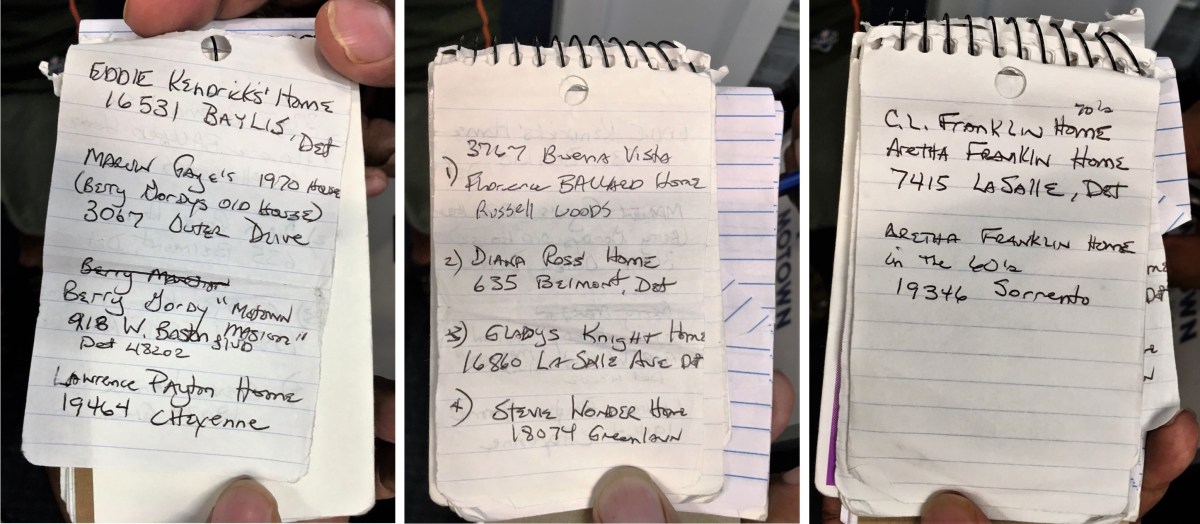
He withdrew a tattered writing pad from his shirt pocket. “Y’know, over the years, I collected the addresses of some Motown legends, and I don’t really show it aroun’, but I’m gonna make an exception in your case, ’cause you came all this way for nothin’.”
“And all these addresses are in Detroit?” I asked.
“Yup!” declared security.
Wanting clarification, “and they’re real?”
“Yup, but do me a favor and keep it on the QT, OK? I don’t want the neighbors hassled and all,” he advised.
Cool! While we had lost the grand prize, it seemed, at the very least, that we were leaving with parting gifts. With addresses in hand, Leah and I decided to regroup and return the following day to play “private investigator.”
When plotting addresses on GPS, it became clear to us that many of the homes were within a ten-mile range of each other, so off we went on our real estate scavanger hunt of once-lived-in homes of America’s greatest rhythm and blues, and soul singers.
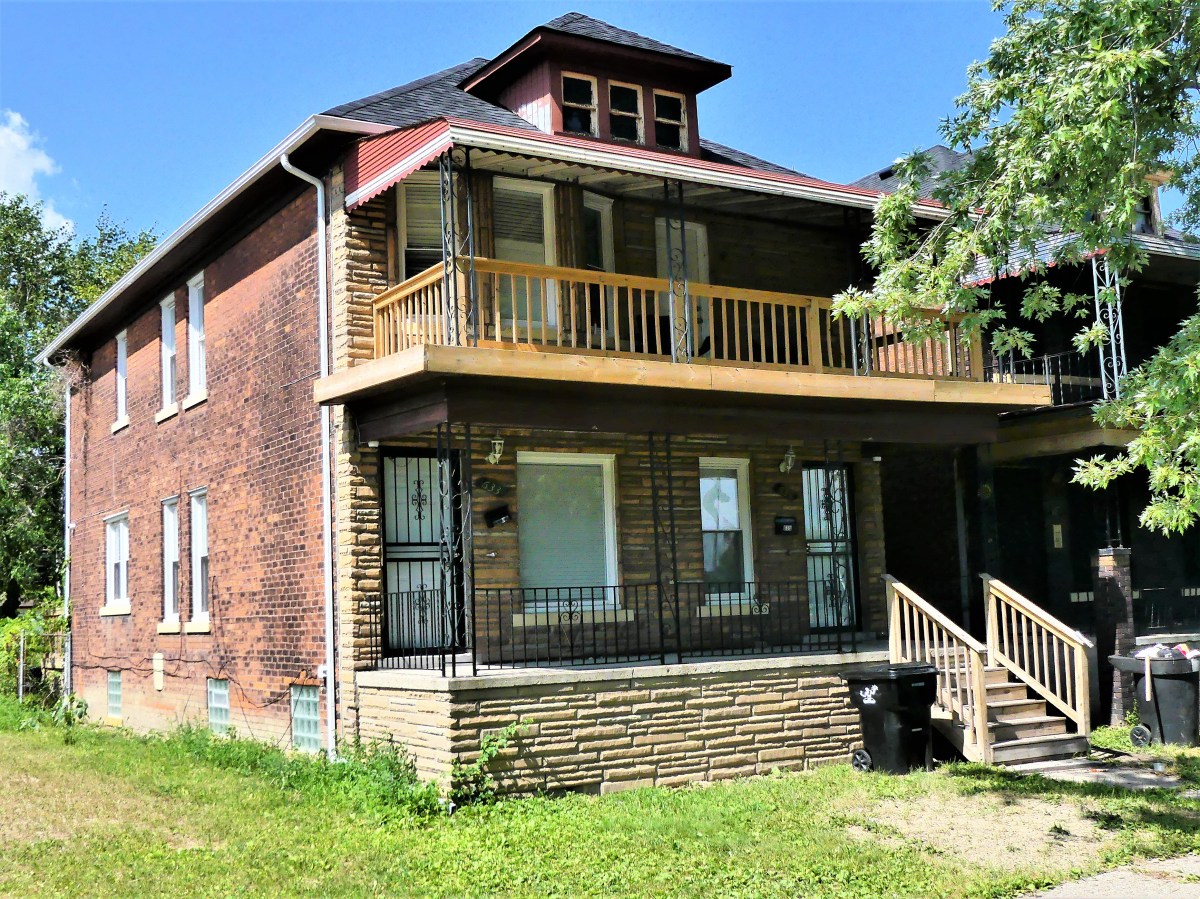
We started our tour at Florence Ballard’s home in Detroit’s largest historic district, Russell Woods. Florence was a founding member of the Supremes, who passed in 1976.
In her early years, Diana Ross lived with her family on the top floor of this duplex, just north of Arden Park.
It turns out, it was only five miles away from Berry Gordy, Jr.’s home, until he sold it to Mavin Gaye in the ’70’s…
and moved to a 10,500 sq ft Italianate mansion in Detroit’s Boston-Edison historic district with 10 bedrooms, 7 baths, a 4,000 sq ft pool house, and a 5-car carriage house.
Nearby, Gladys Knight lived in a 4 bedroom, 3.5 bath Tudor in Detroit’s Martin Park neighborhood.
Around the corner, lived Temptation’s co-founder and lead singer, Eddie Kendricks in a 4 bedroom, 2 bath 2,300 sq ft house.
And only a couple of miles away in the Bagley neighborhood lived Stevie Wonder in a 3 bedroom, 2.5 bath gabled house.
By now, I was fading from driving through Detroit traffic; and I was losing interest in photographing the rest of the listings. Additionally, I considered that crawling to a stop in front of someone’s house, double-parking, and positioning a camera through the window probably looked suspicious and creepy to any onlookers.
The following afternoon, the day of our departure, a home in Detroit’s Chandler Park section exploded–14 miles east of our recent real estate sweep.
One firefighter was injured in the blast. The Fire Marshall determined that a gas leak was to blame, but arson investigators are on the scene.
“Y’think this was an omen, too?” Leah mused.
“Nah! Just a coincidence!” I answered.
(Or maybe the beginning of another impossibly flaky, half-baked conspiracy theory!)
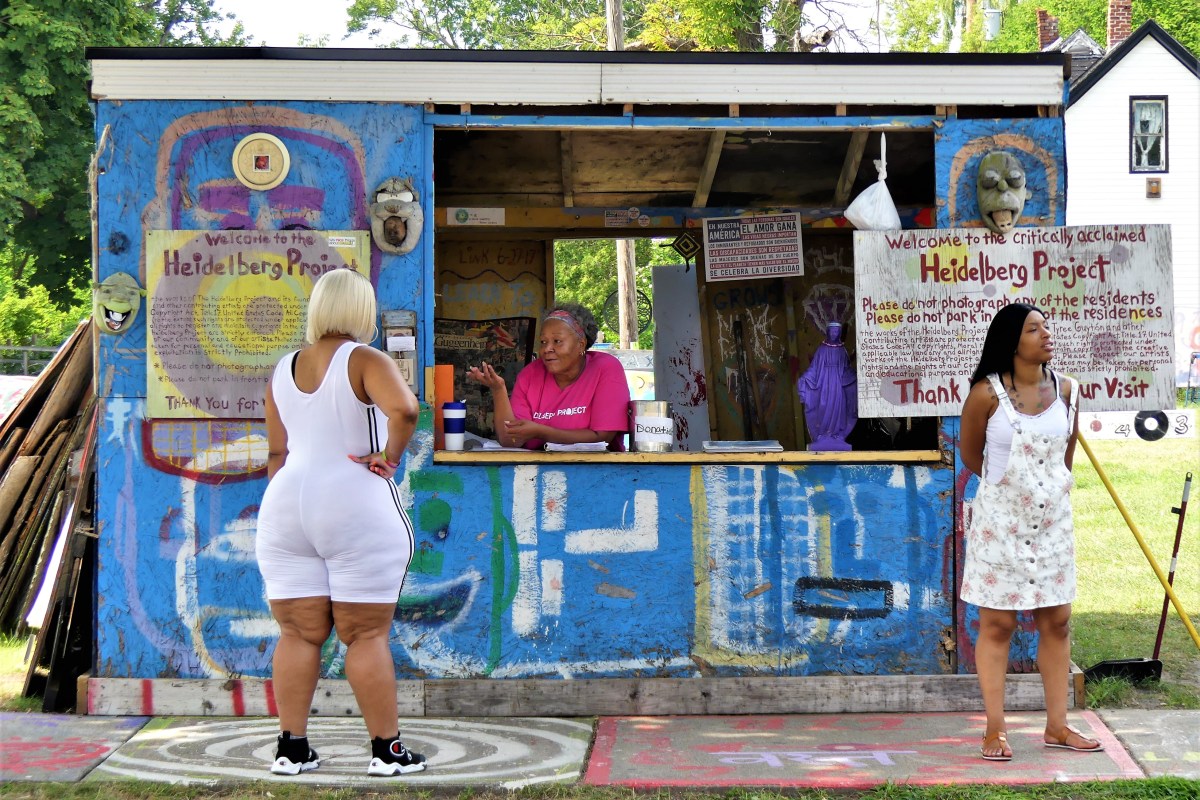
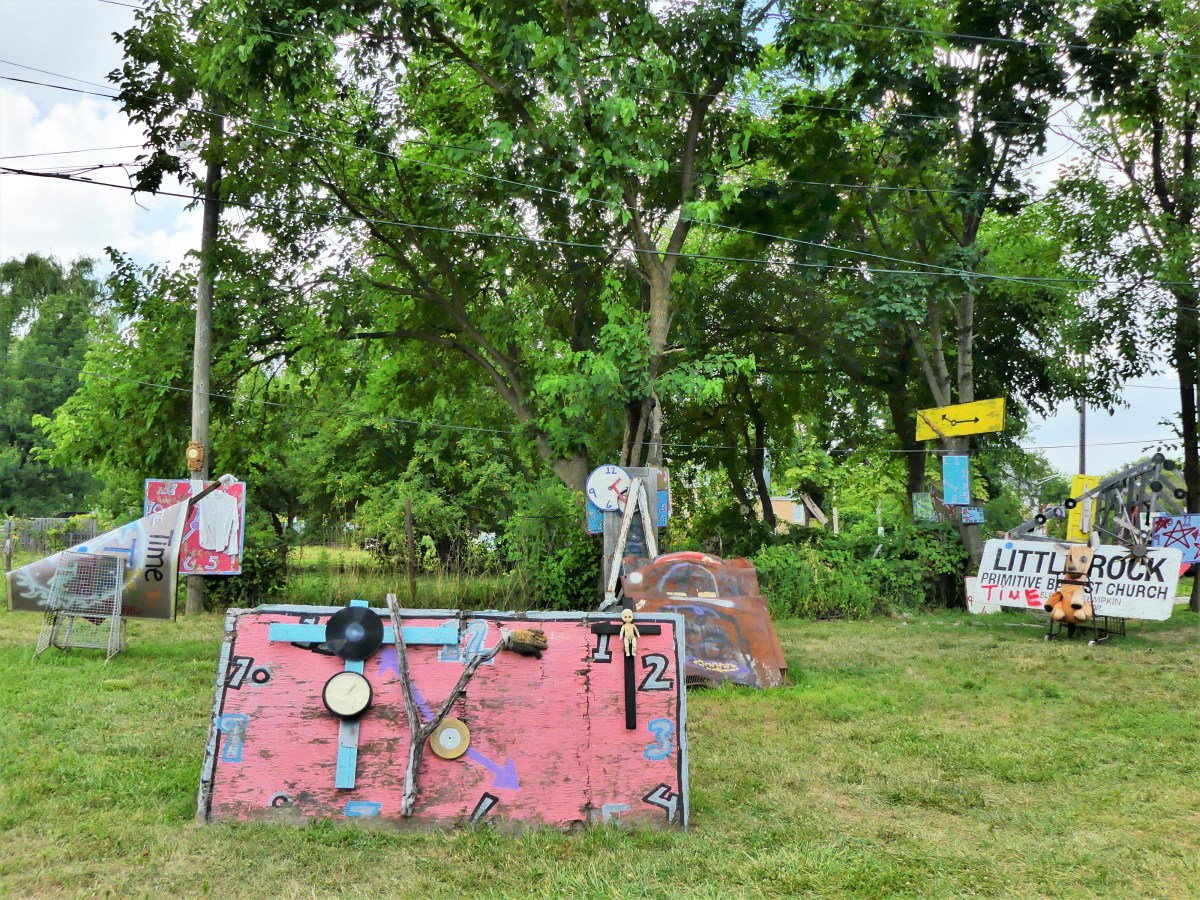
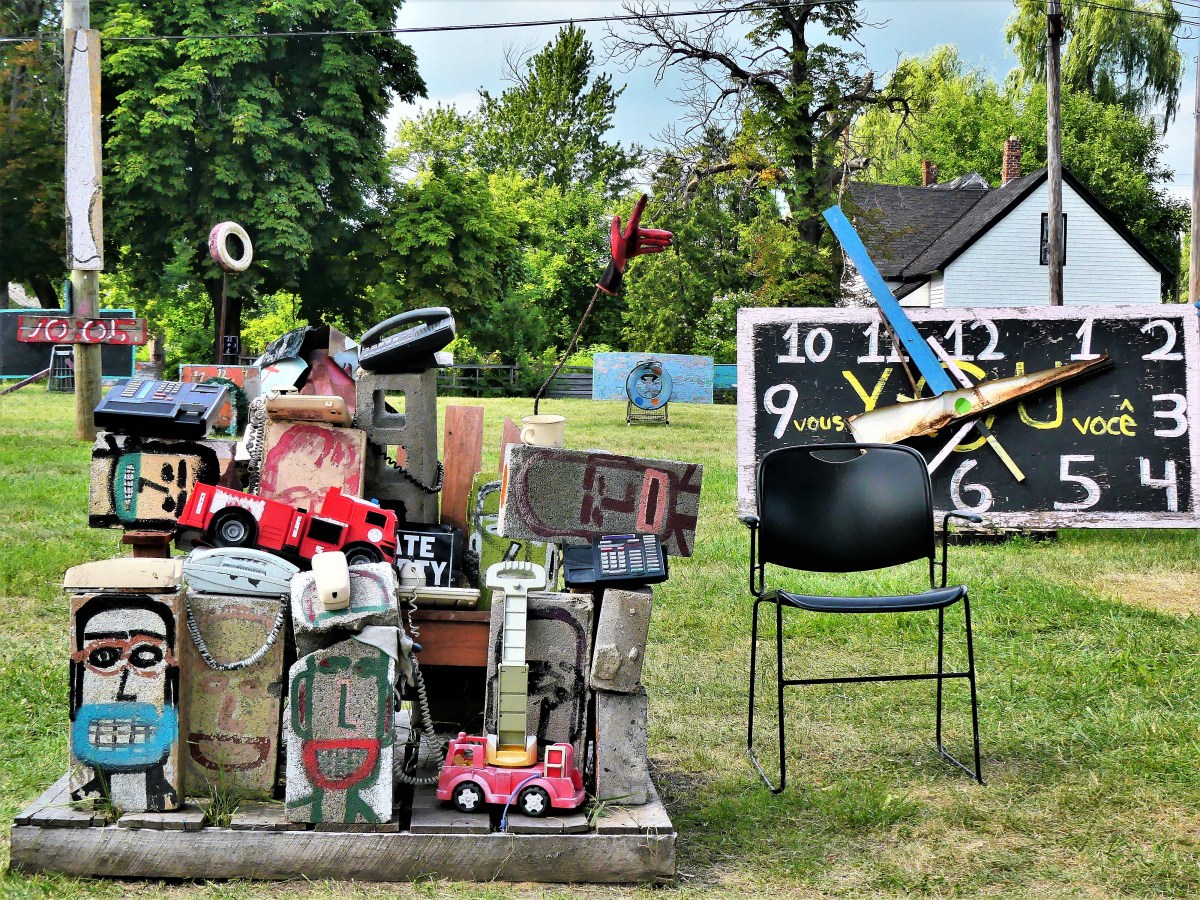
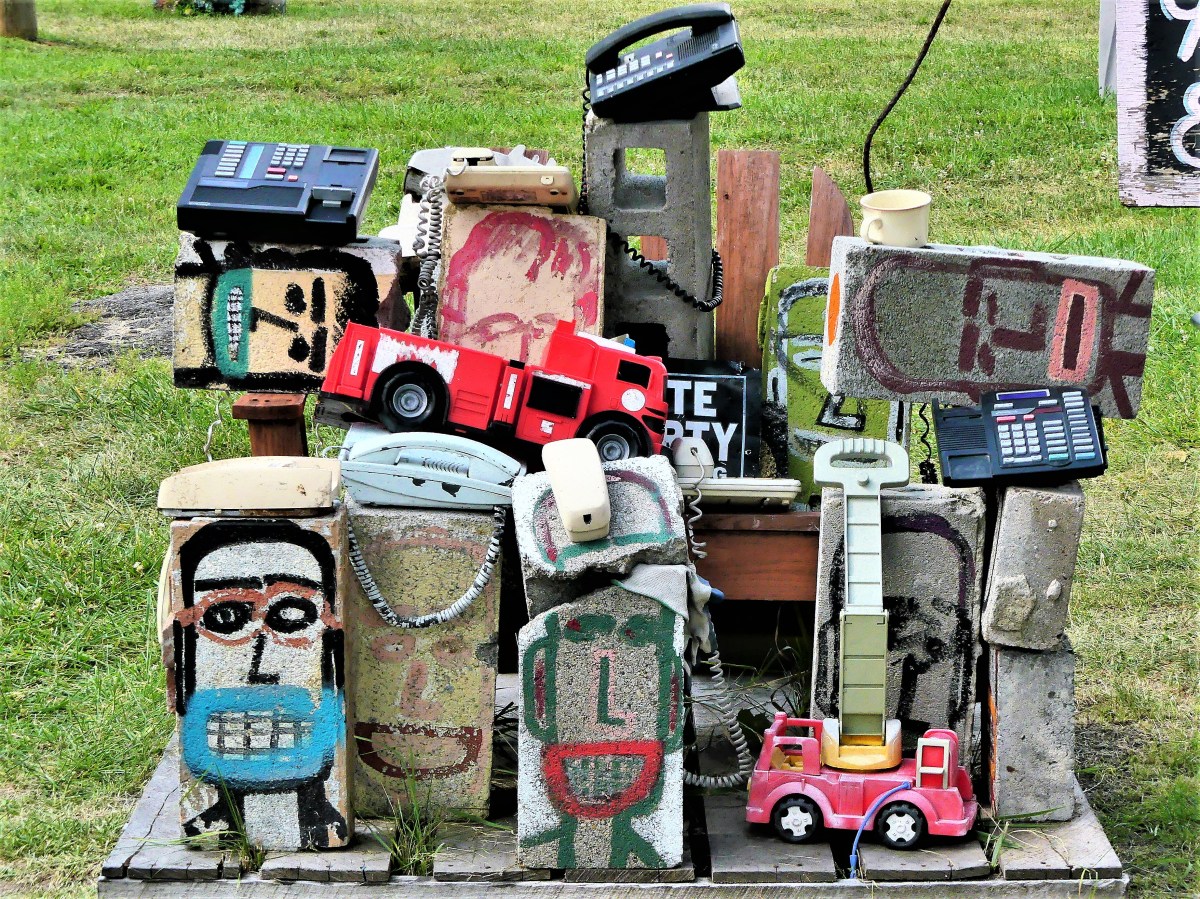
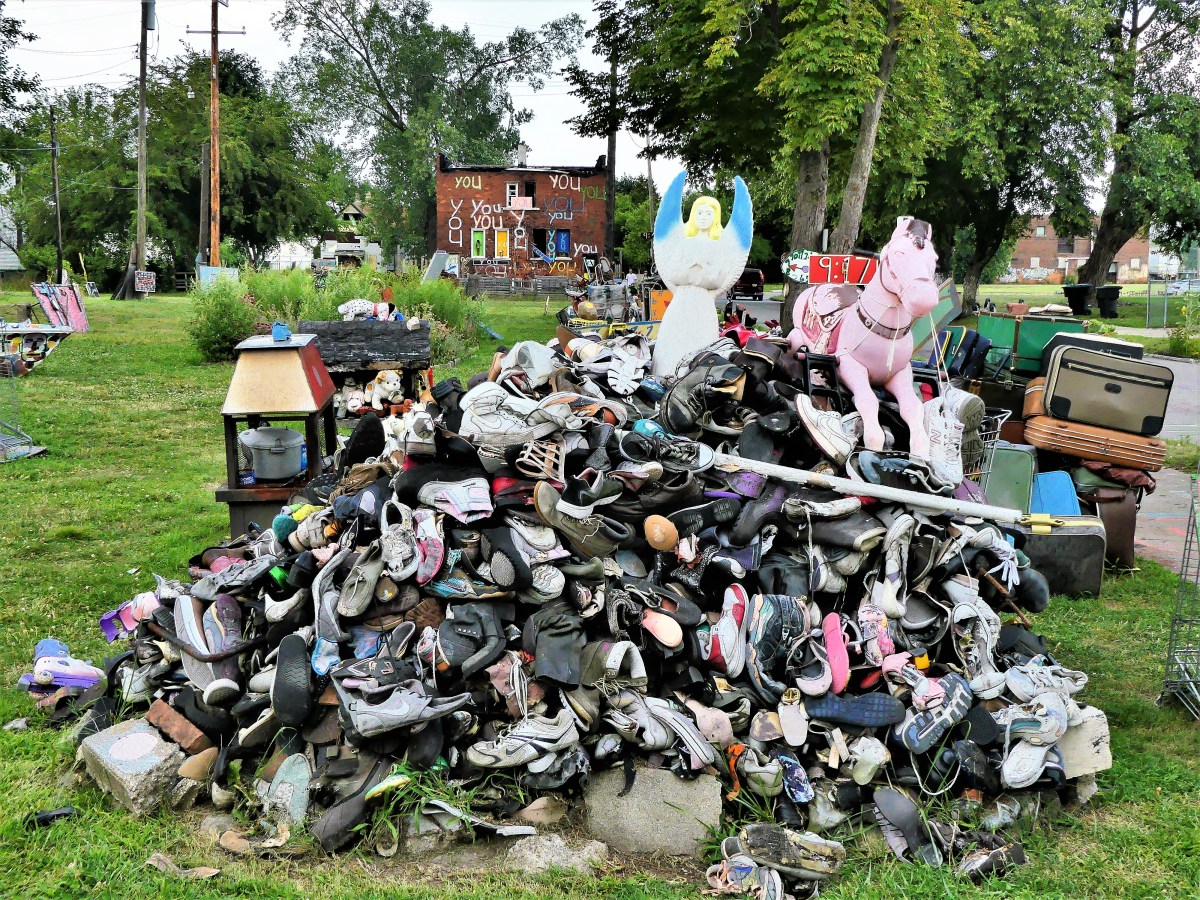
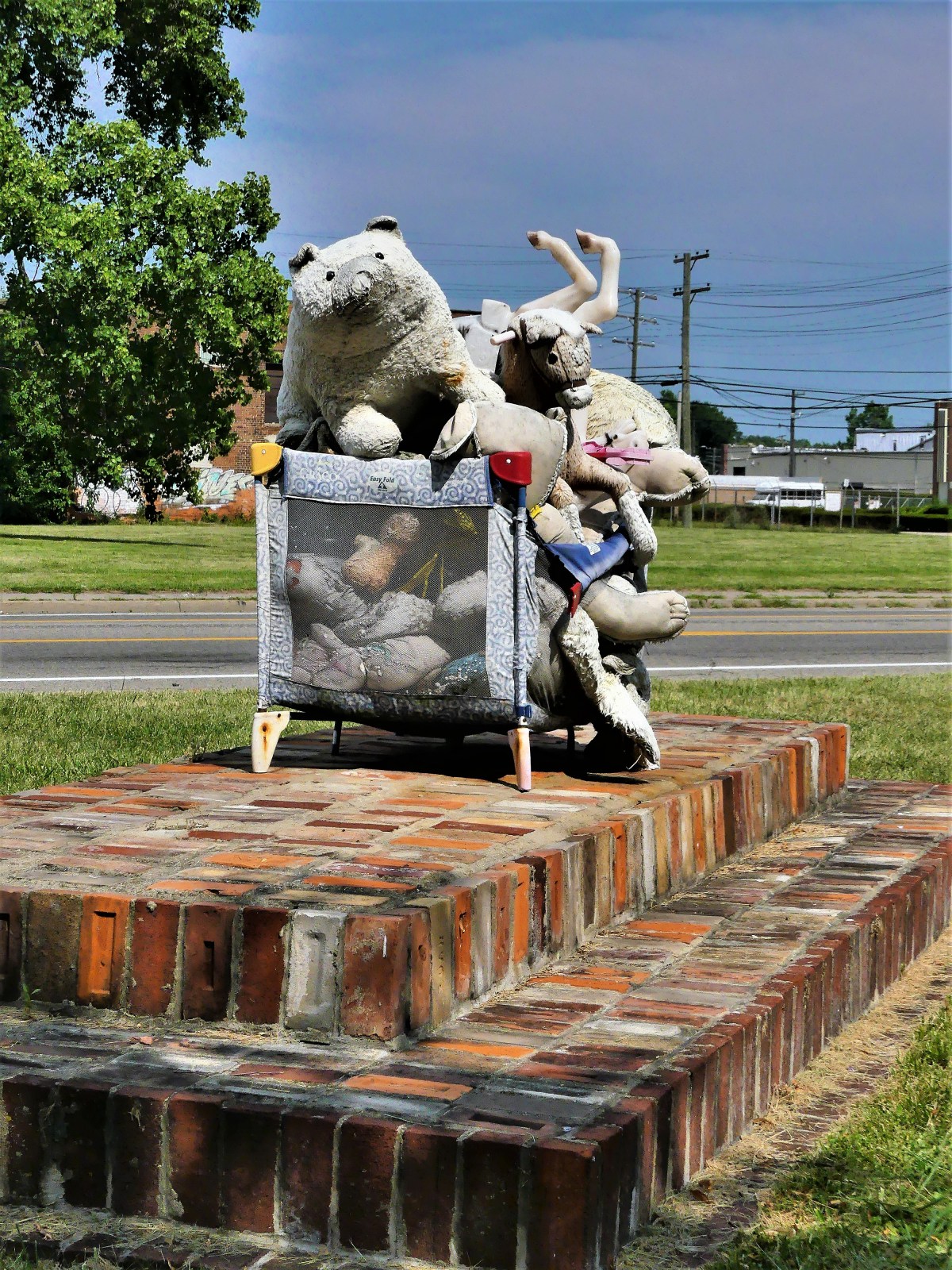
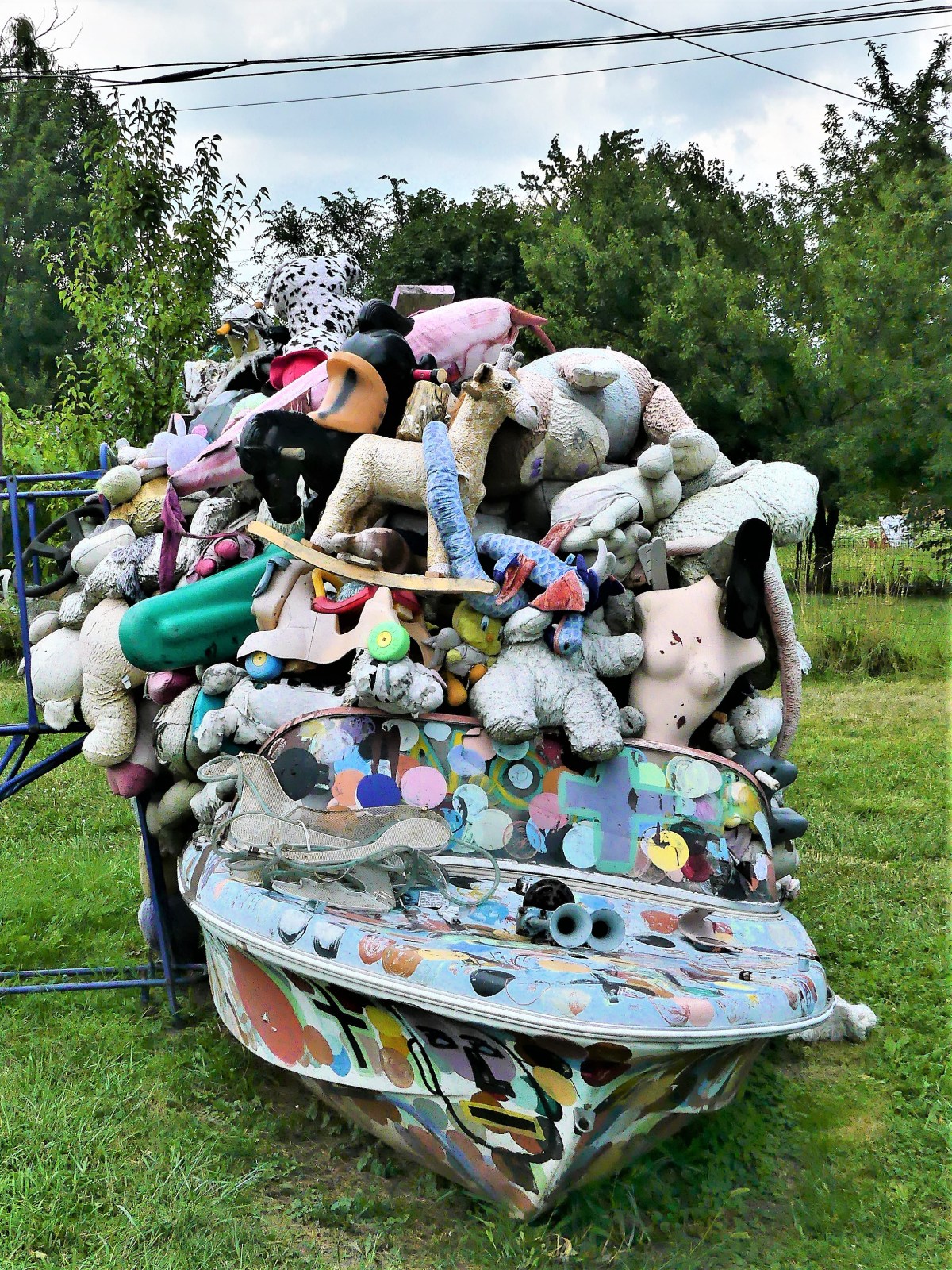
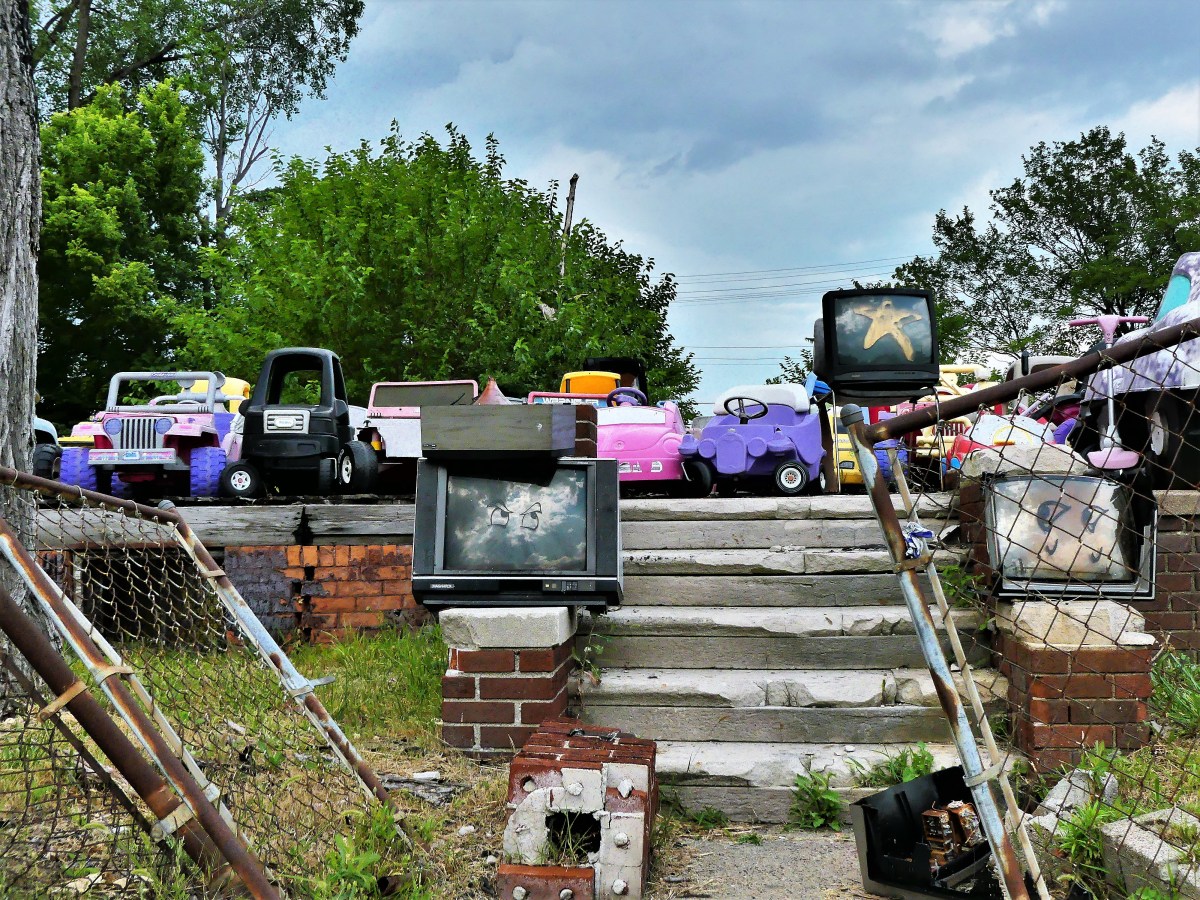
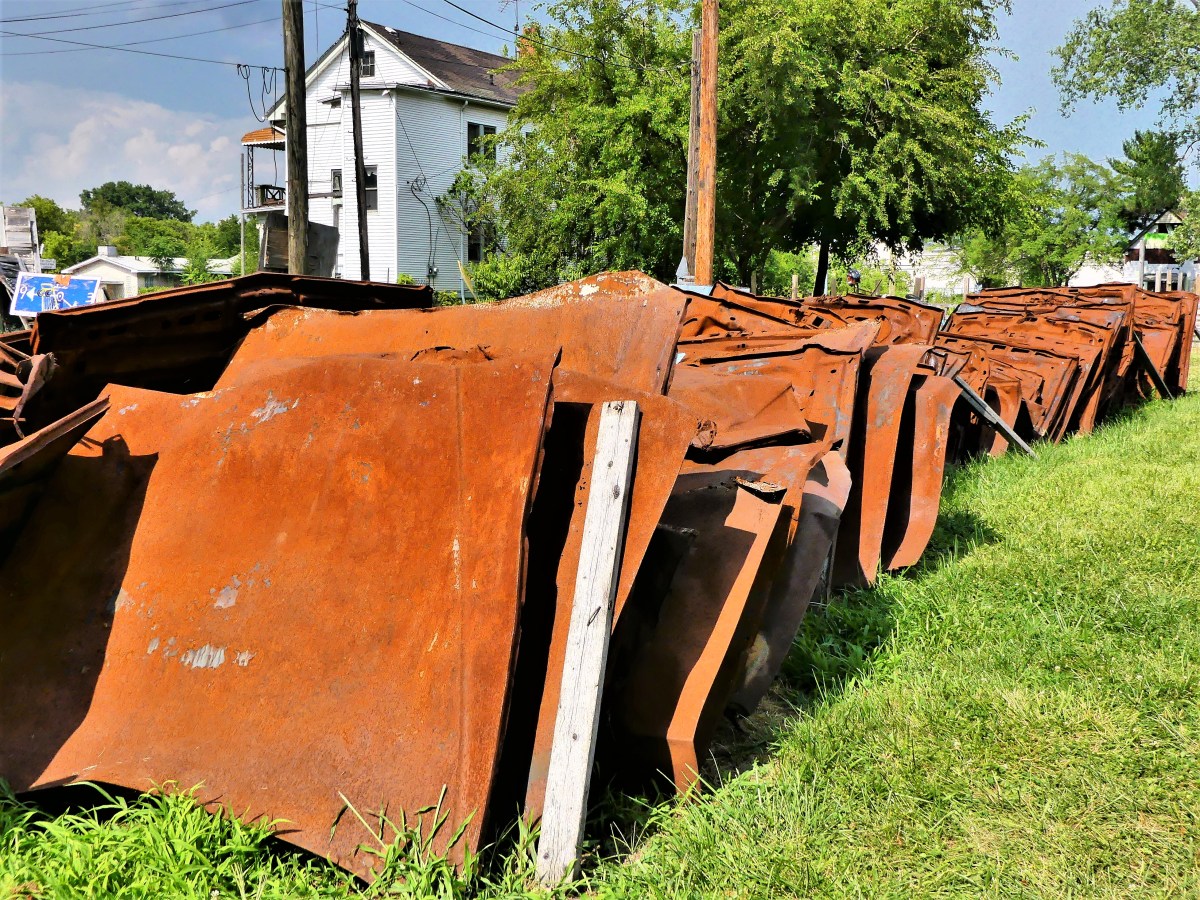
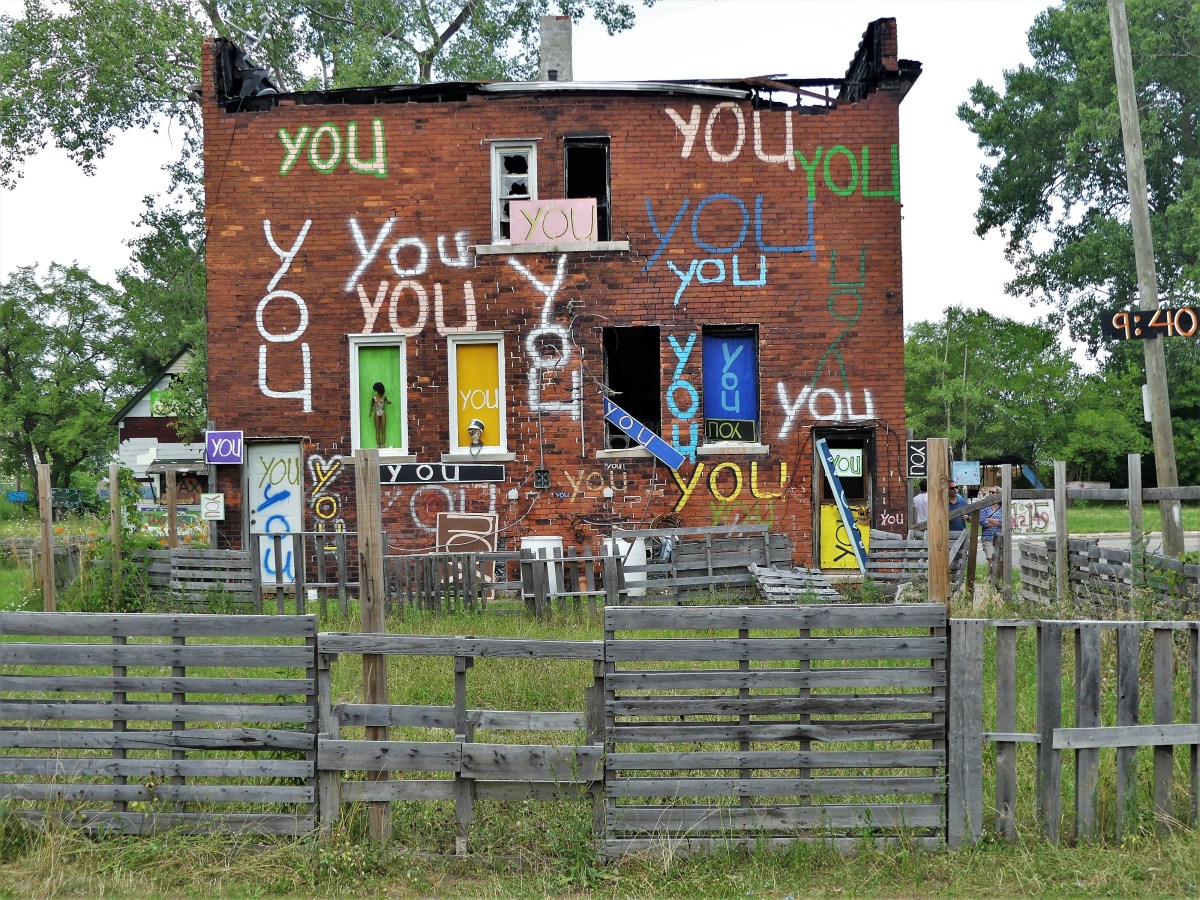
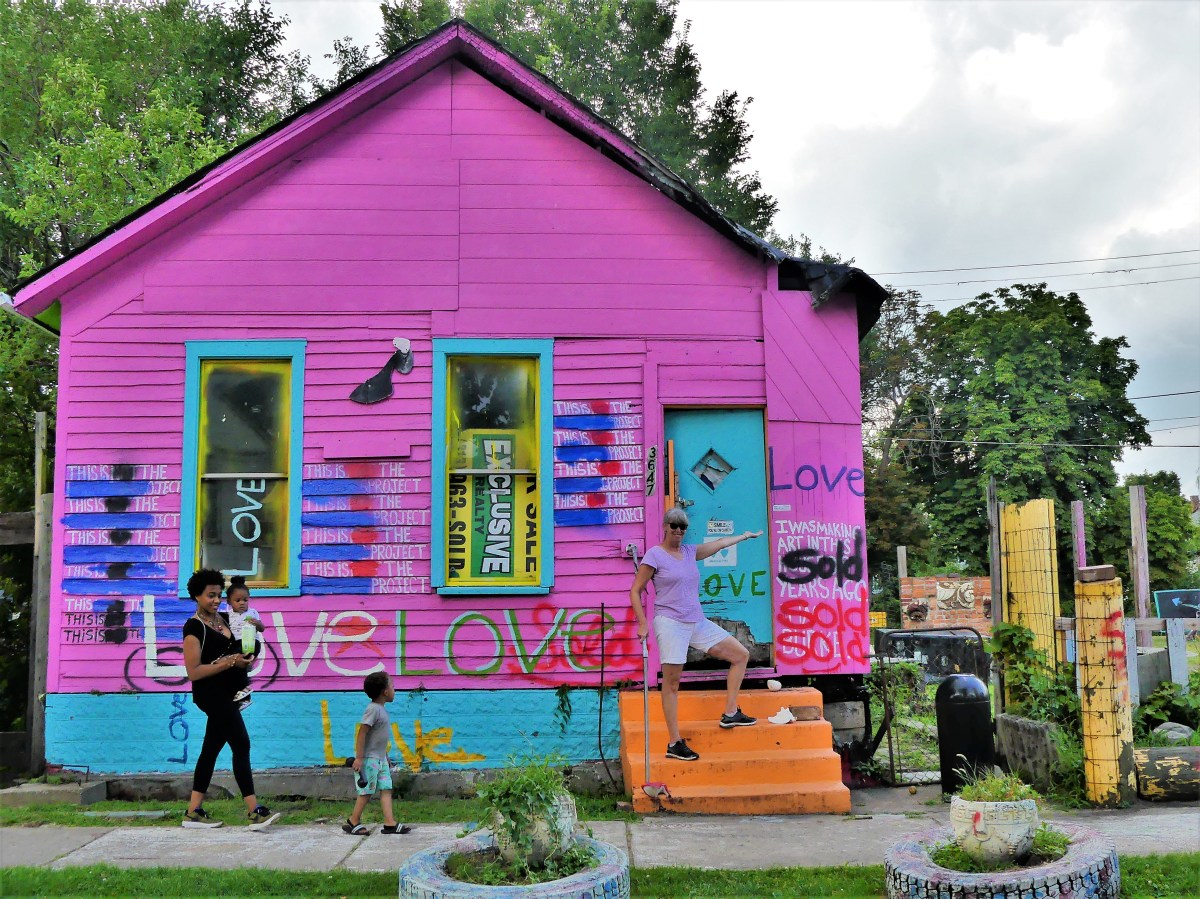
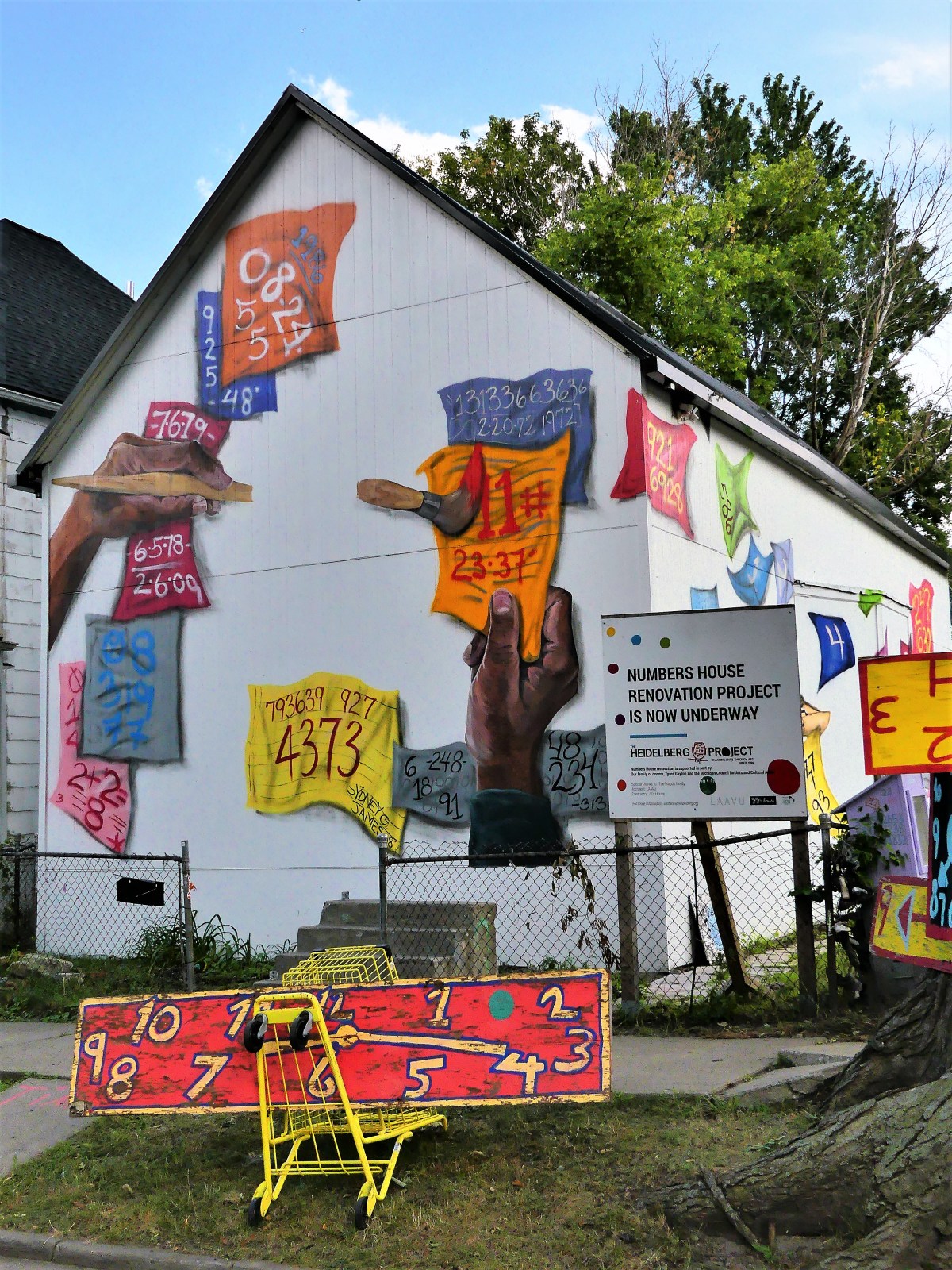
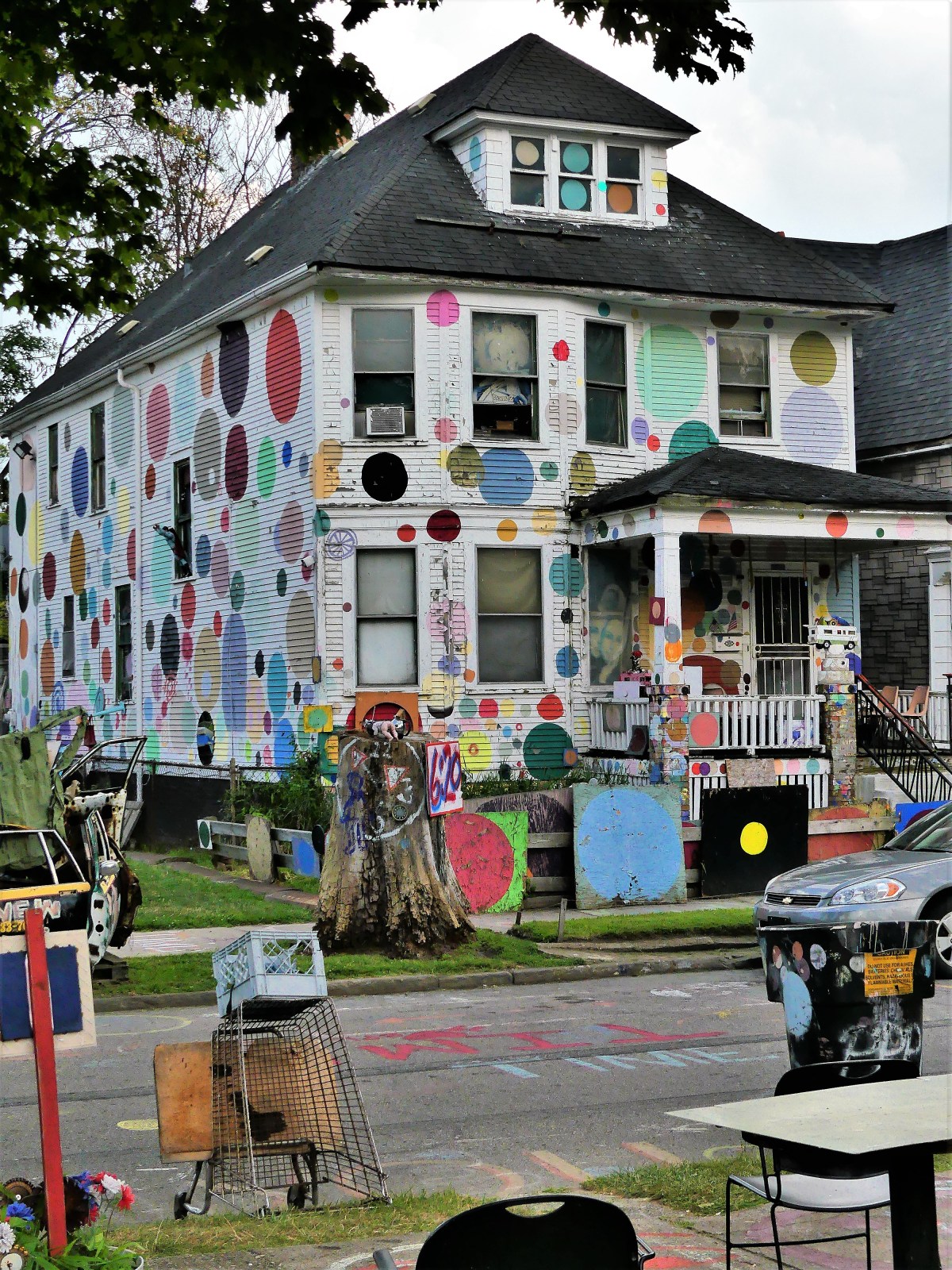
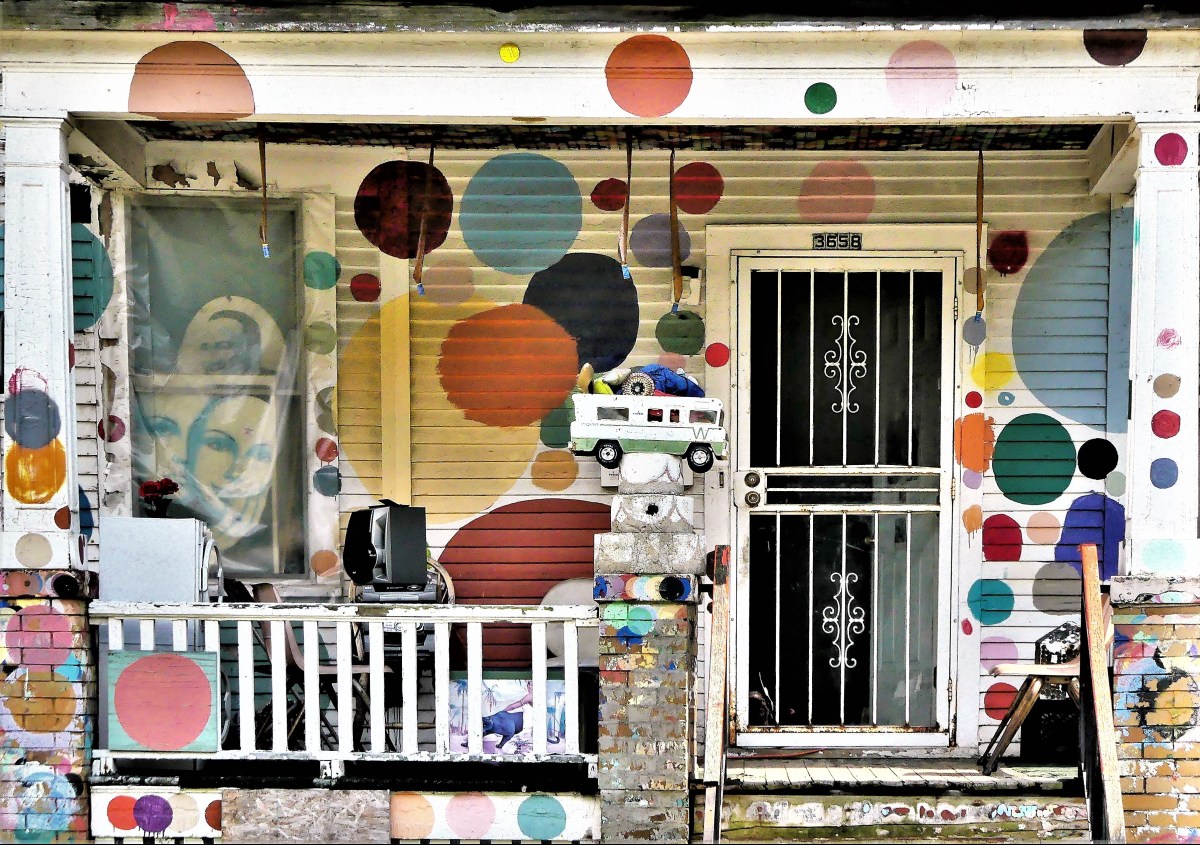
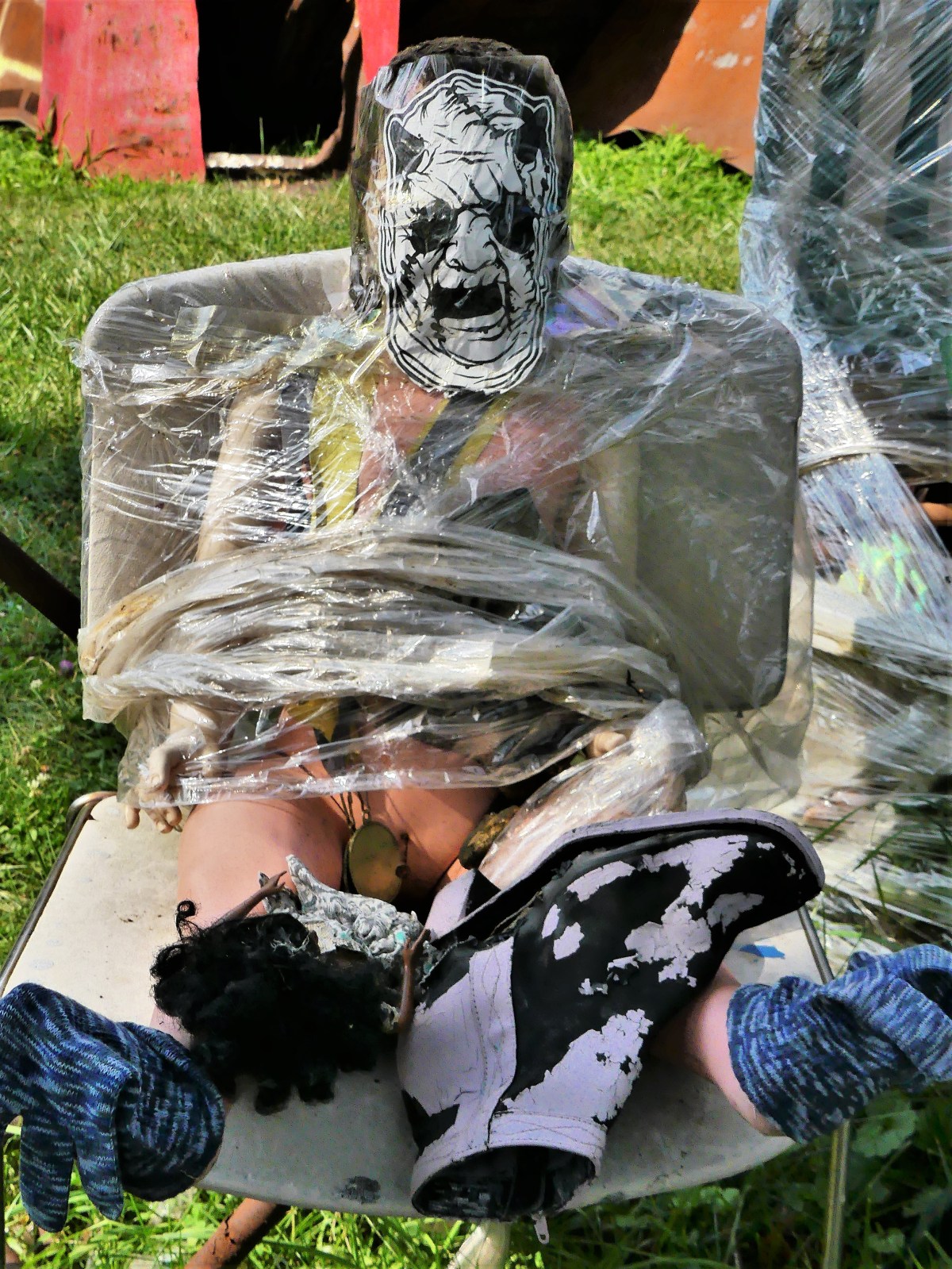
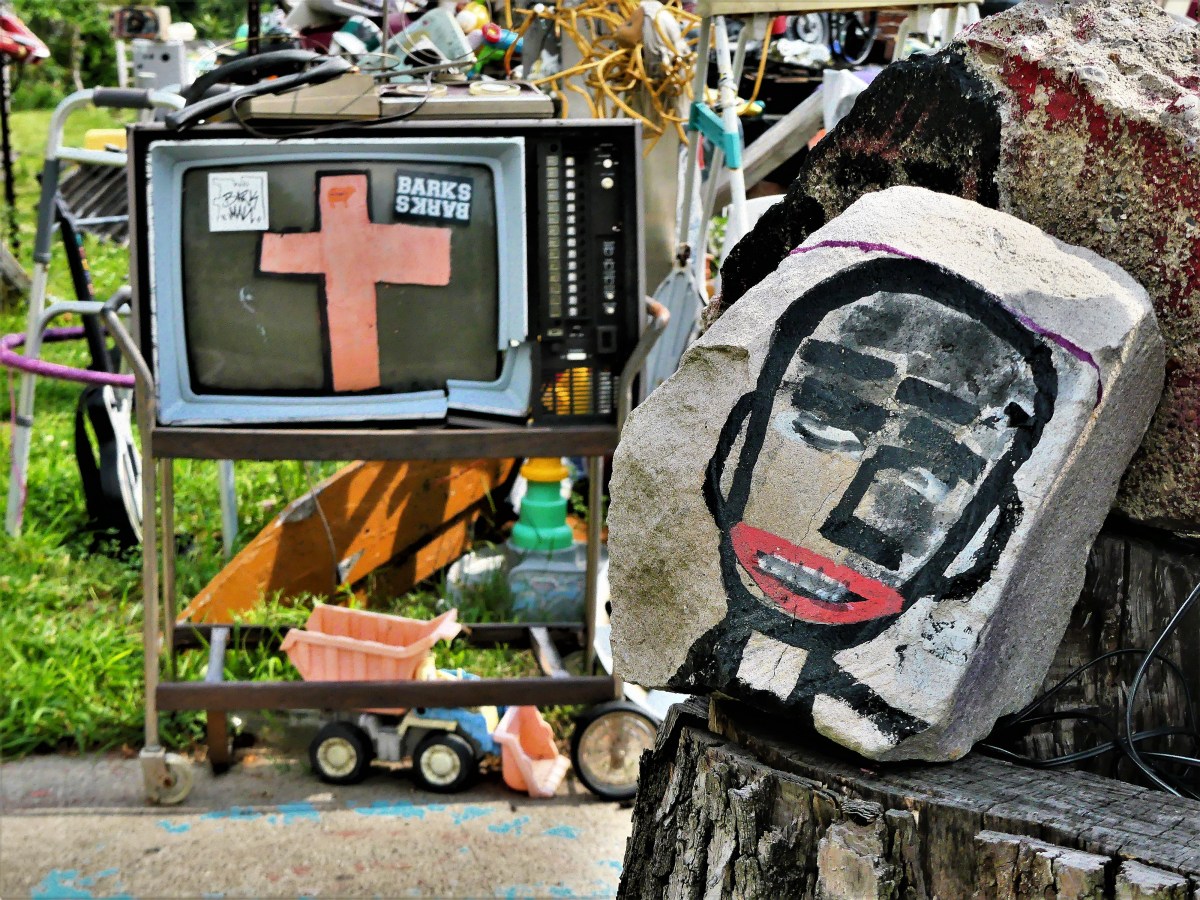
At first glance, the large number of vacant lots between derelict buildings on Heidelberg Street in Detroit, MI resembles a crooked smile through a handful of broken teeth. The gaps are filled with collections of discarded remnants from everyday life that could easily be mistaken for a flea market on crack. But first impressions are completely unjustified, and there is a purpose to the madness…to be discovered over time.
In 1986, Tyree Guyton returned to his childhood neighborhood in Detroit’s East Side, only to find a ghetto ravaged by drugs and poverty so severe that it touched his soul and roused his spirit. With encouragement from Grandpa Sam Mackey, he vowed to fight back with a paintbrush and a broom, which would eventually carry him on a celebrated journey–fighting his way through local partisan politics to national prominence.
To his credit, Guyton recruited sympathetic volunteers to change the face of their community, and after a massive clean-up, he incorporated the wreckage gathered from vacant lots, converting his neighborhood into an urban sculpture installation that has garnered world-wide attention.
For 30 years, Heidelberg Street has been a grass roots, work-in-progress. The HP (r)evolution continues today through personal donations and strong foundation support–providing funding for transformative paint-overs, and the acquisition of border properties to replace the homes lost to arson.
During my visit, I crossed paths with several photographers who felt as I did–that we had walked into someone’s wild dream, and we were there to interpret his dream through our cameras.
However, should the art critics and cognescenti remain unmoved, or the public dismisses Guyten’s art as junk, there is more to the story at the end of the day. When all the visitors return to their homes, the residents of Heidelberg Street stay behind knowing that their plight has been replaced by pride and opportunity.
Within a span of five days, Leah and I had occasion to enjoy the Chicago Symphony Orchestra (CSO) and the Grand Rapids Symphony (GRS), but in a nontraditional manner with uncommon overtones.
Dan Akroyd set the scene for our future expectations at the Ravinia Festival in Highland Park IL, the CSO summer residency.
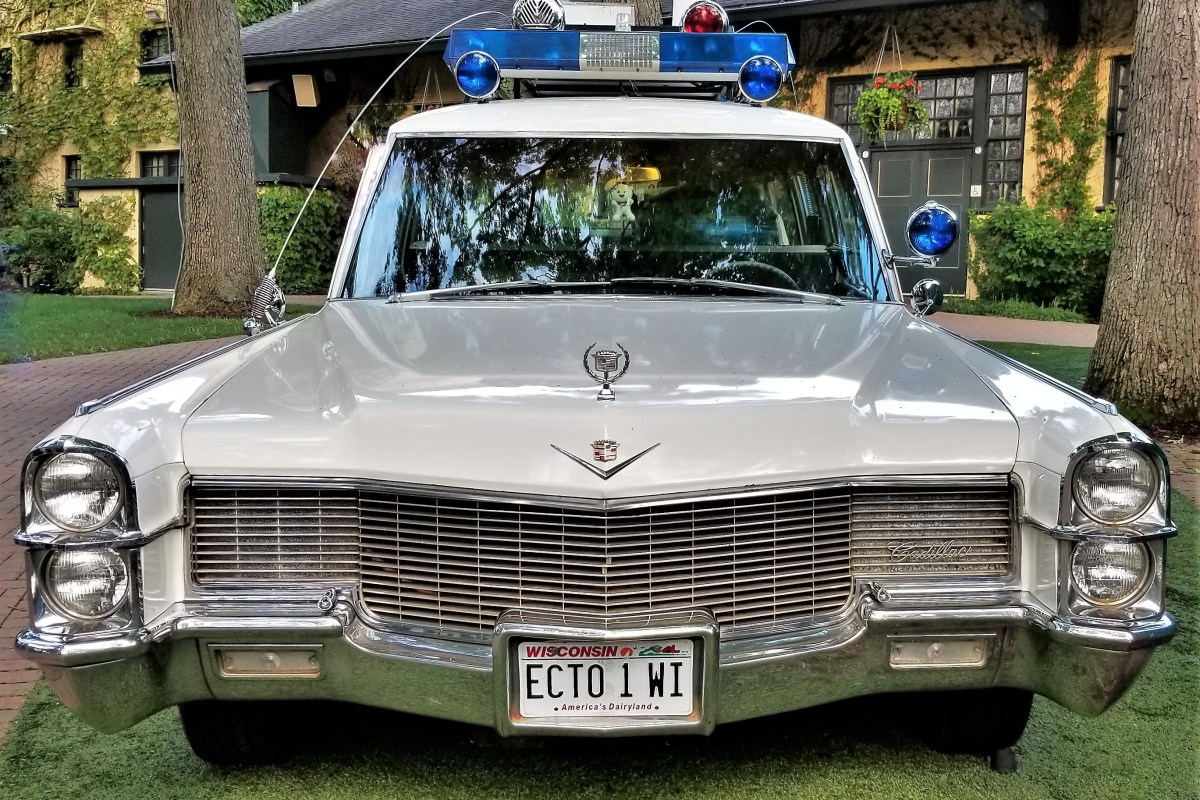
To be sure, it was a carnival atmosphere, with popcorn and green slime for sale. The Windy City Ghostbusters were on board, protecting their ride
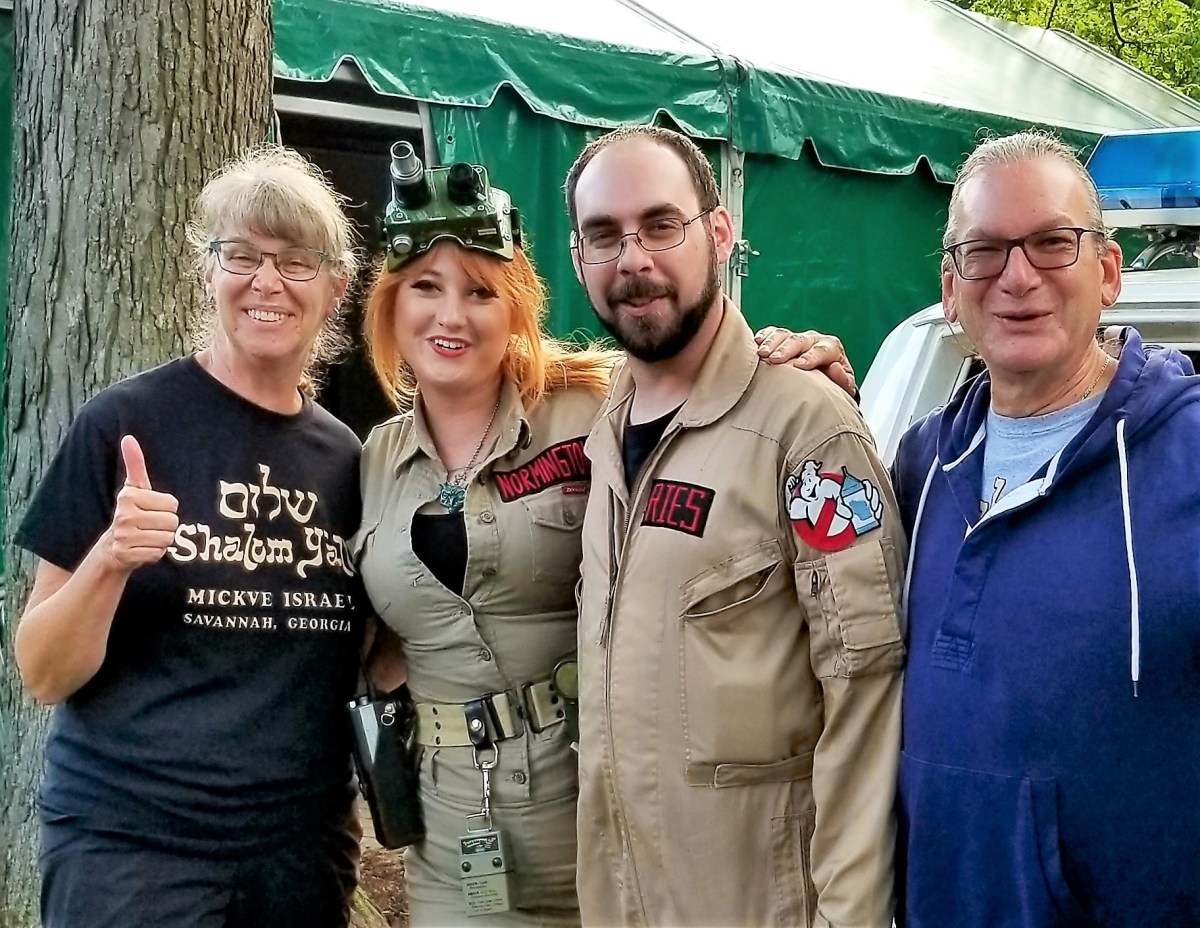
and providing plenty of photo ops…
with props.
Meanwhile, the CSO was warming up on stage…
waiting for dusk and the arrival of their guest conductor, Peter Bernstein, son of legendary composer and Oscar-winner, Elmer Bernstein, who wrote the original score to Ghostbusters.
Happily, the orchestra never missed a beat, synchronizing perfectly with the film. While the band played on and the Ghostbusters faced their ectoplasmic foes, we enjoyed a picnic on the lawn with my niece Rachel and her partner, Kevin. Thanks, guys.
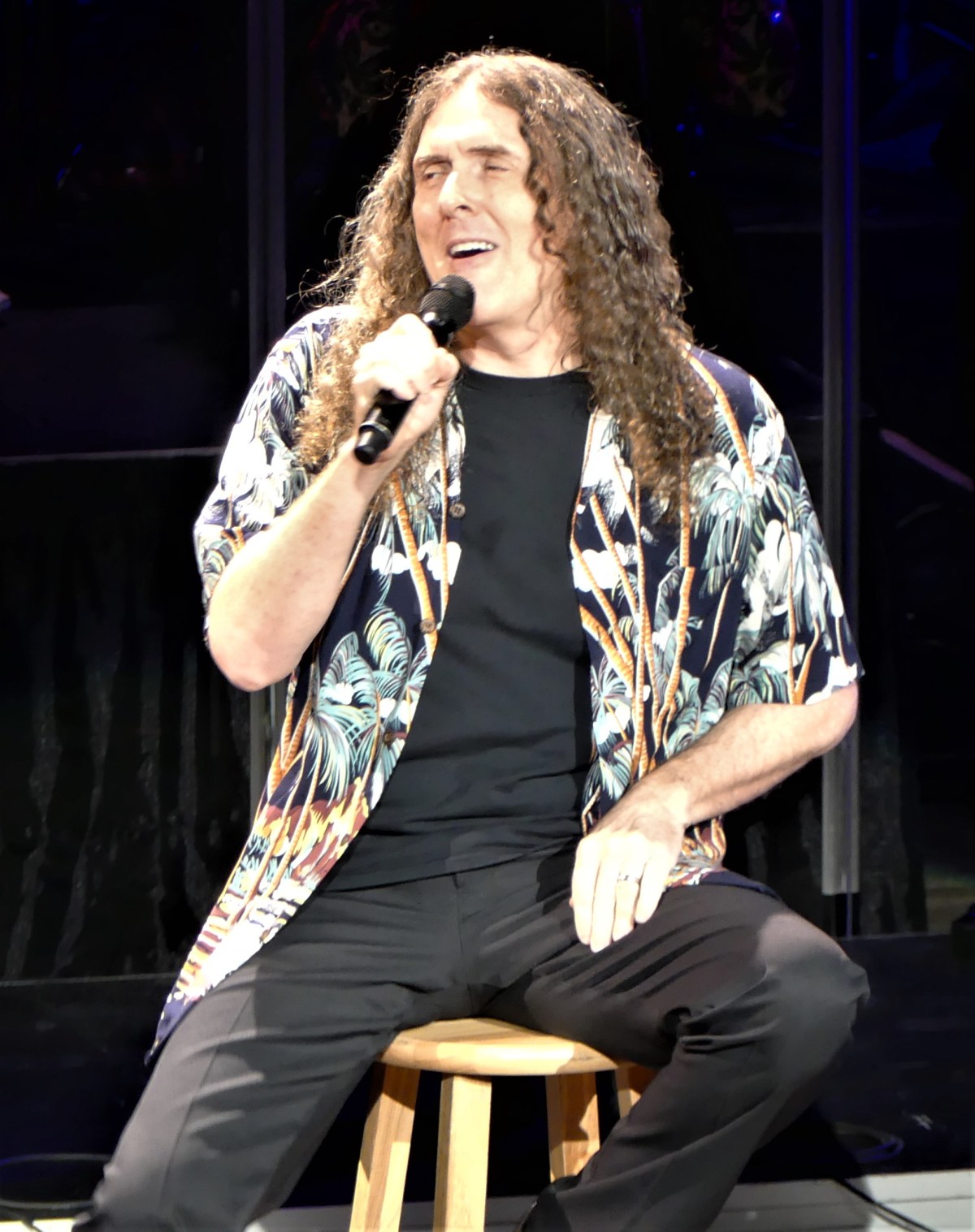
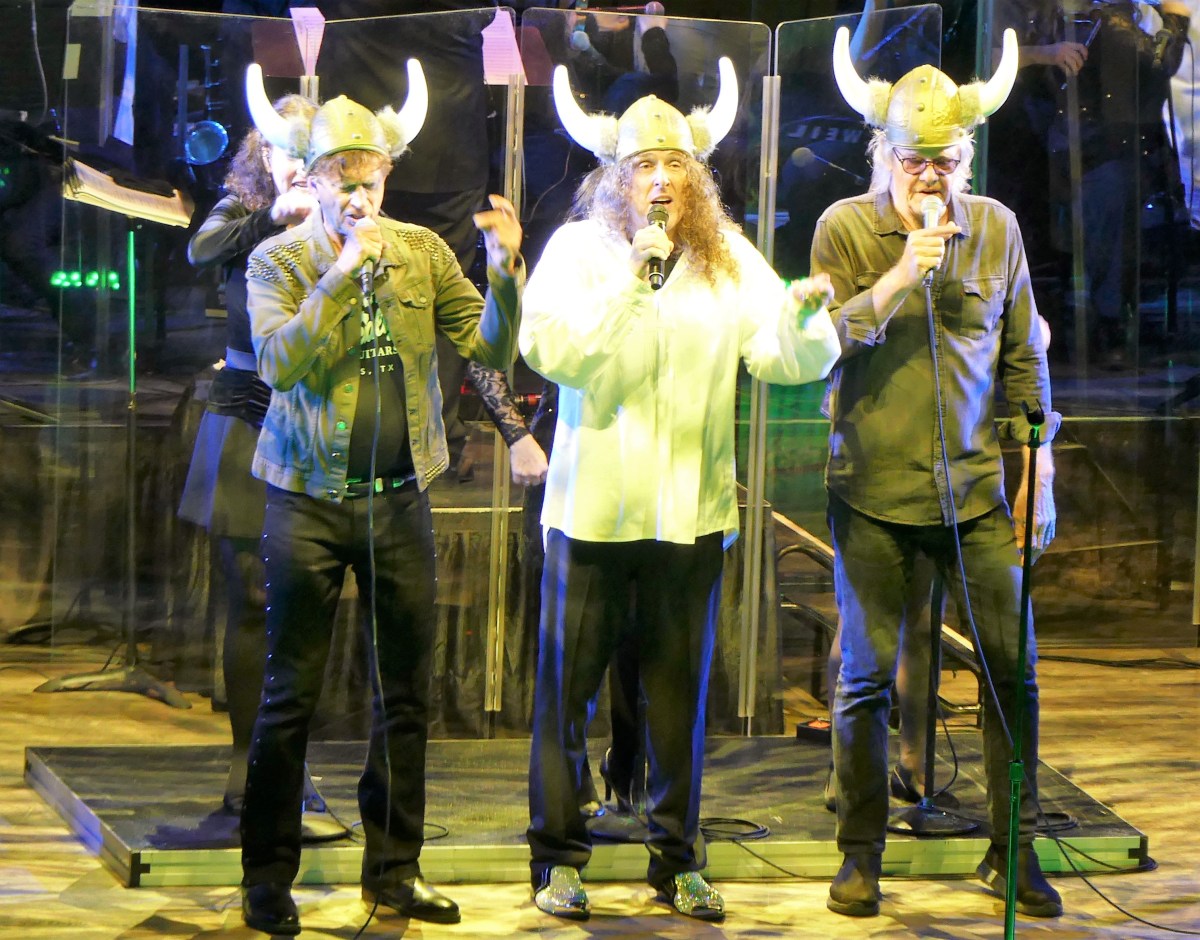
Days later, we traveled to Grand Rapids, MI for “Weird Al” Yankovic’s Strings Attached tour. Unlike last year’s stripped-down tour (seeParody Paradigm), and stripped of shtick, this concert promised to be vintage “Weird Al”–the parodies, the costumes, the MTV videos, and 41 pieces of symphonic punctuation.
The GRS opened the show with 20 minutes of John Williams’ cinema overtures from Raiders of the Lost Ark, Superman, and Star Wars…
to set the mood for a sell-out crowd that was every bit as white and nerdy as “Weird Al.”
It was the largest collection of ugly Hawaiian shirts I’d ever seen.
And some fans decided to elevate their look with shiny accessories.
The band was tight; the parodies are clever; the singing was splendid; and the GRS added an extra richness to the event. “Weird Al” showcased a deep catalogue of “funny,” paying homage to Don Pardo,
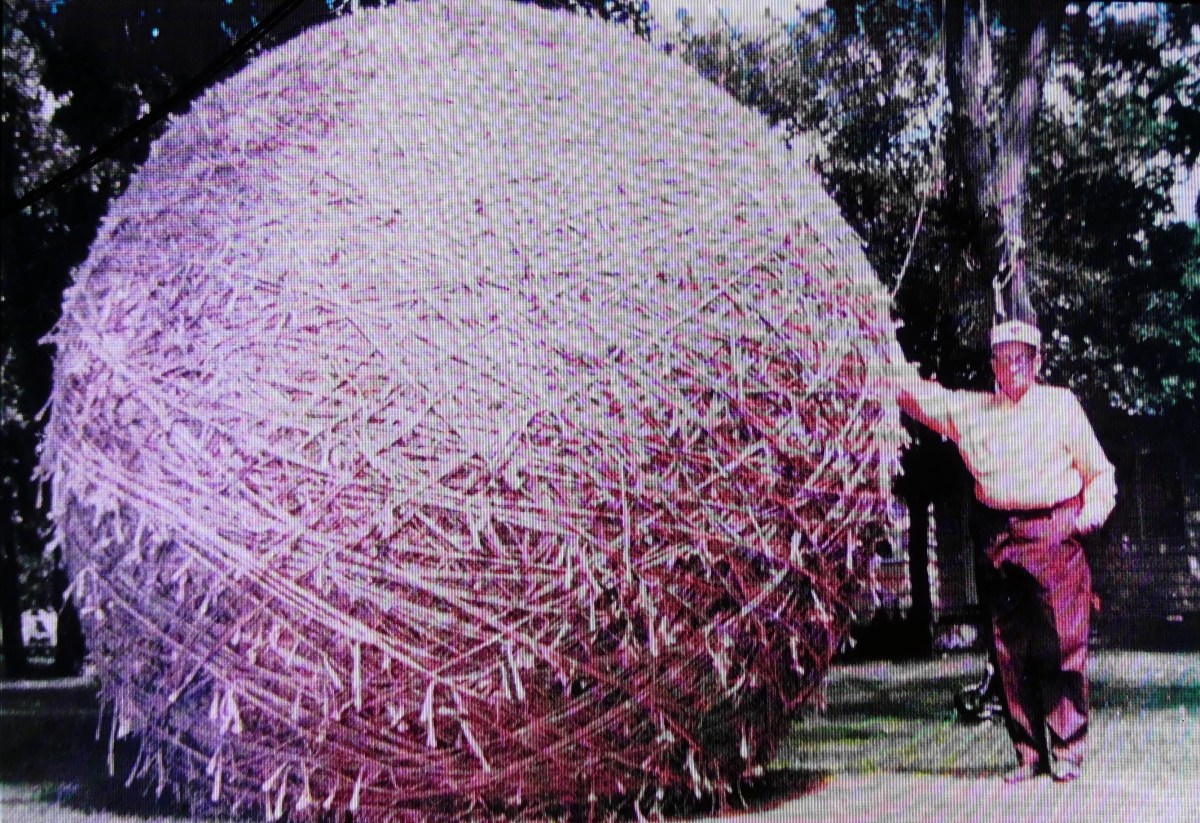
a twine ball from Minnesota,
weasel stomping,
Devo,
Nirvana,
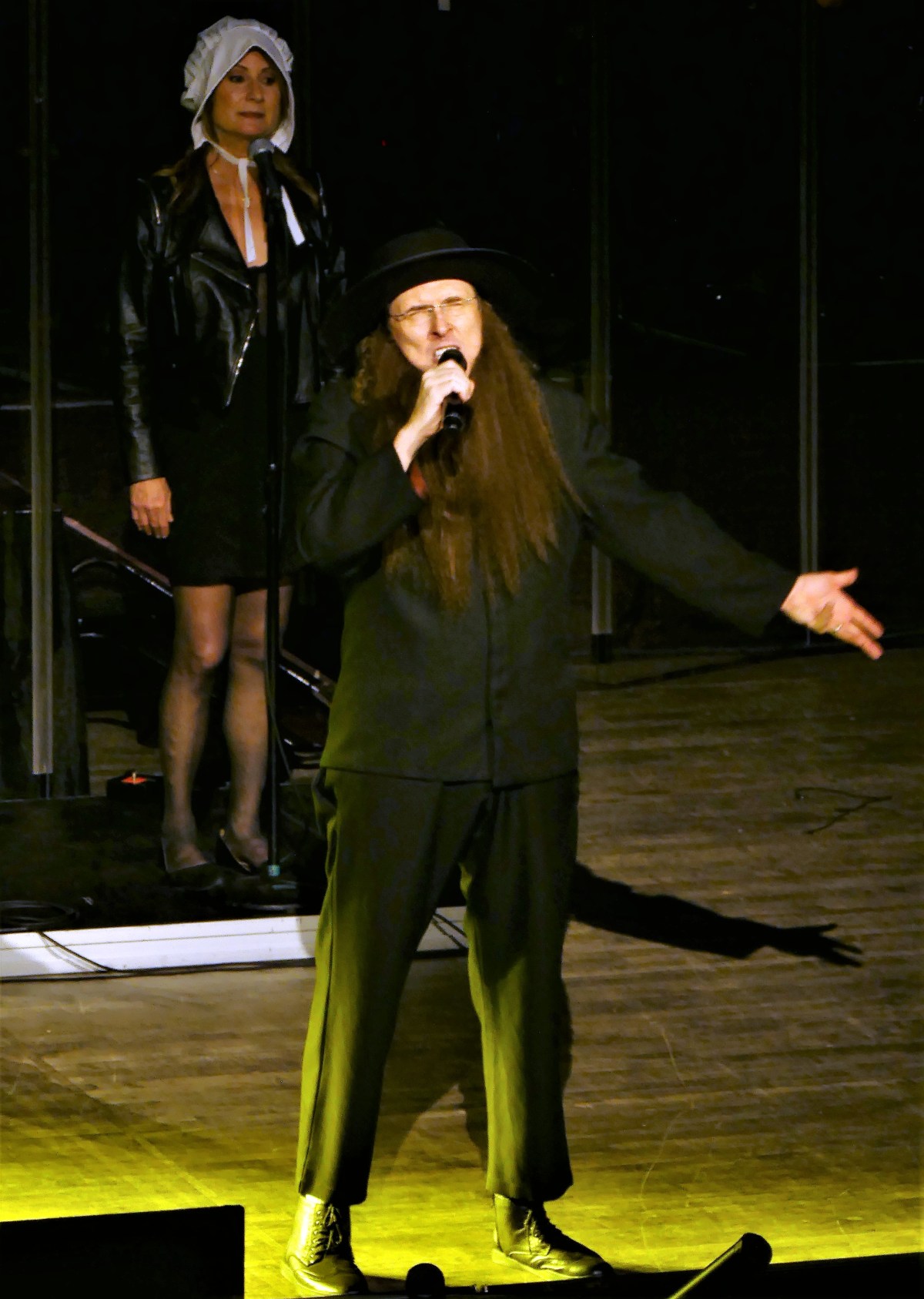
and sending up Coolio with an irreverent Amish rap.
The crowd was treated to a crowd-favorite Star Wars encore, á la Don McClean’s American Pie (The Saga Begins),
and the Kink’s Lola (Yoda).
The audience was on its feet by the end of the show, and so was the orchestra,
because their job was done and it was time to leave.
Leah and I caught up with the Associate Concertmaster as she exited the DeVos Performance Hall stage door.
“Great show, tonight,” I offered.
“Thank you. It was lots of fun,” she said.
“Did you have much practice time with the band?” I asked.
“Not really,” she admitted. “Just a couple of sessions.”
“That’s all!? You guys nailed it,” I gushed. “Any after-party plans?”
Crossing the street–“A glass of milk, and bed,” she sighed. “I’m glad you enjoyed it”–and she was gone.
We had come to Milwaukee to drink some beer, eat some cheese curds and absorb some culture, and Milwaukee didn’t disappoint us.
Once home to the Big Four: Miller; Pabst; Shlitz and Blatz–Milwaukee was considered the brewing capital of the nation during much of the 20th century. However, after sell-off and consolidation, only MillerCoors remains as Milwaukee’s master brewer.
Nevertheless, there are plenty of reminders of the good ol’ days scattered around town…
For instance, on W. Wisconsin Avenue sits the Pabst Mansion.
In 2015, Pabst returned to the city with a scaled-down version of itself, manufacturing only craft beers, like many of its competitors in the region.
Likewise, the Schlitz Brewery has been converted into an office park.
But a new generation of brewers is doubling down on craft beers, with special attention going to Lakefront Brewery for its laid-back vibe and its innovative spirit, which instilled brothers Russ and Jim Klisch to brew Doors County cherry beer and the nation’s first gluten-free beer.
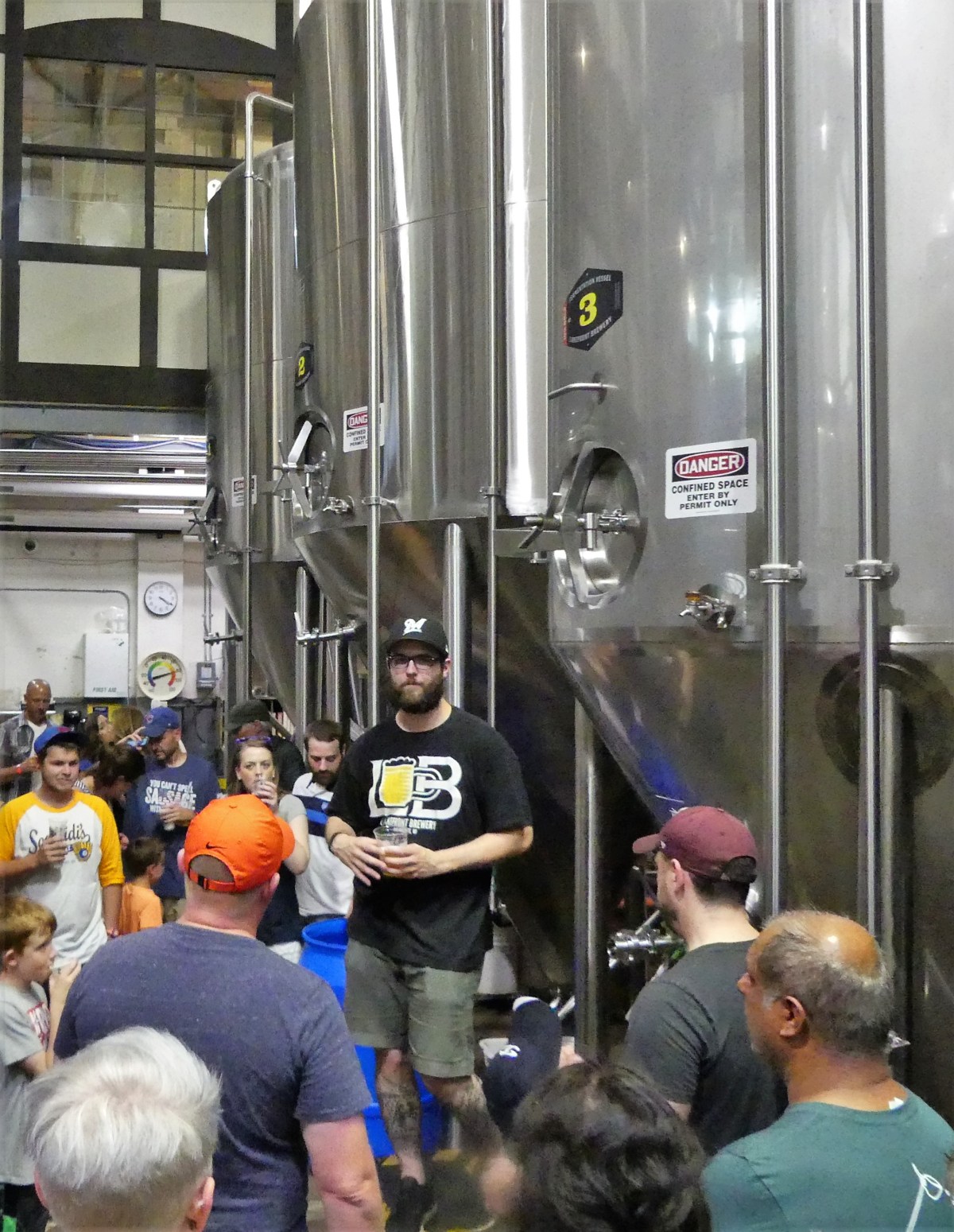
Leah and I sat in the Beer Hall noshing on fish tacos and award-winning cheese curds while waiting for the brewery’s 4 pm tour.
Eleven bucks buys an 8 oz. plastic cup and four wooden tokens good for four pours from start to finish of the humorous, 45-minute tour–very different from other tours I’ve taken (see Supreme Ruler of Beers and Eco-Beer), where beer sampling follows the tour as a time reward.
At the conclusion of the tour, we gathered around the bottle conveyor,
and we sang…
Additionally, the plastic cup can be exchanged for a free beer glass at the gift shop.
It was our good intention to attend Gallery Night directly after the beer tour…
but drinking beer interfered with our plan, so it would have to wait until Gallery Day.
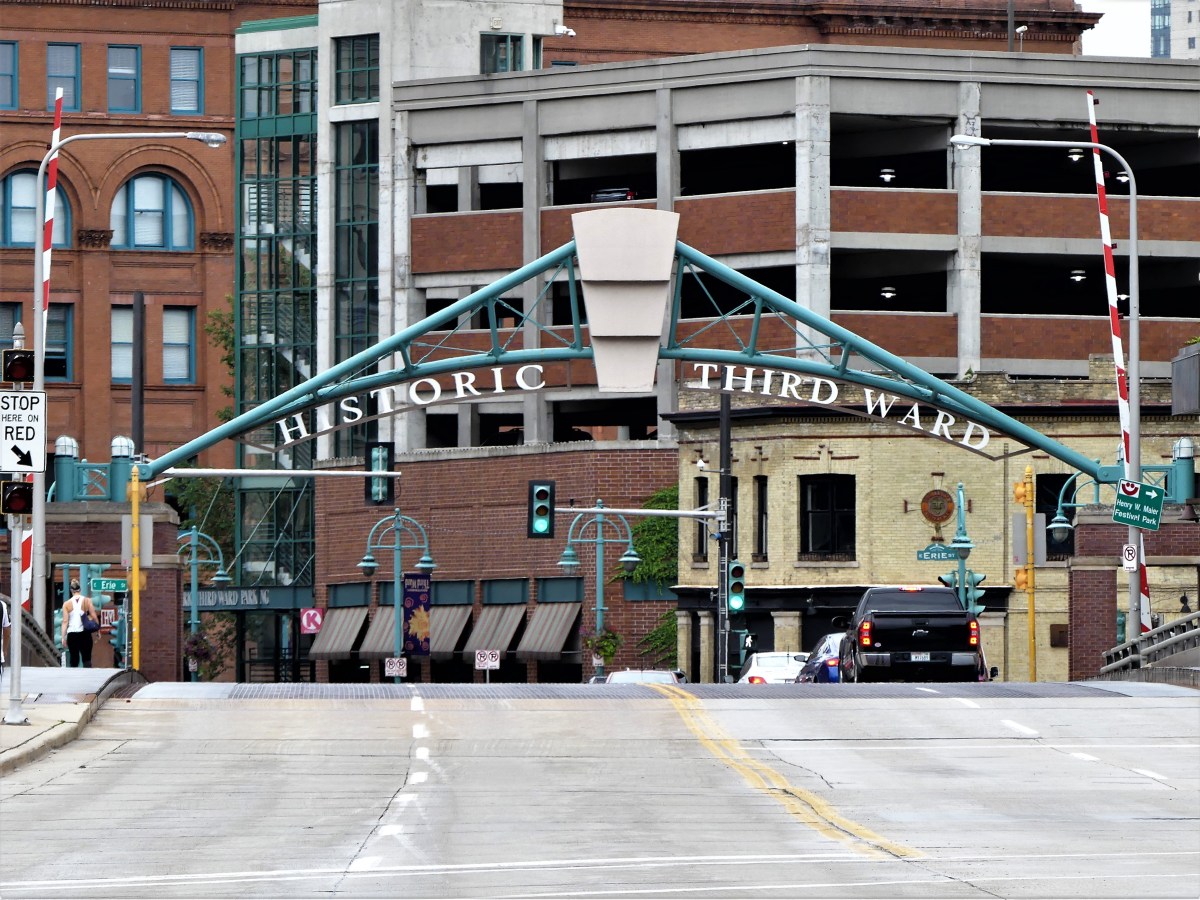
The following day we drove to the Historic Third Ward, and roamed through six floors of the Marshall Building inspecting a variety of syles and mediums of different artists.
Unfortunately, the clouds rolled in and it rained like there was no tomorrow. We waited out the deluge at a nearby Shake Shack until a break in the weather, and crossed over to Walker’s Point to satisfy our random craving for novelty, humor, and are you kidding me?
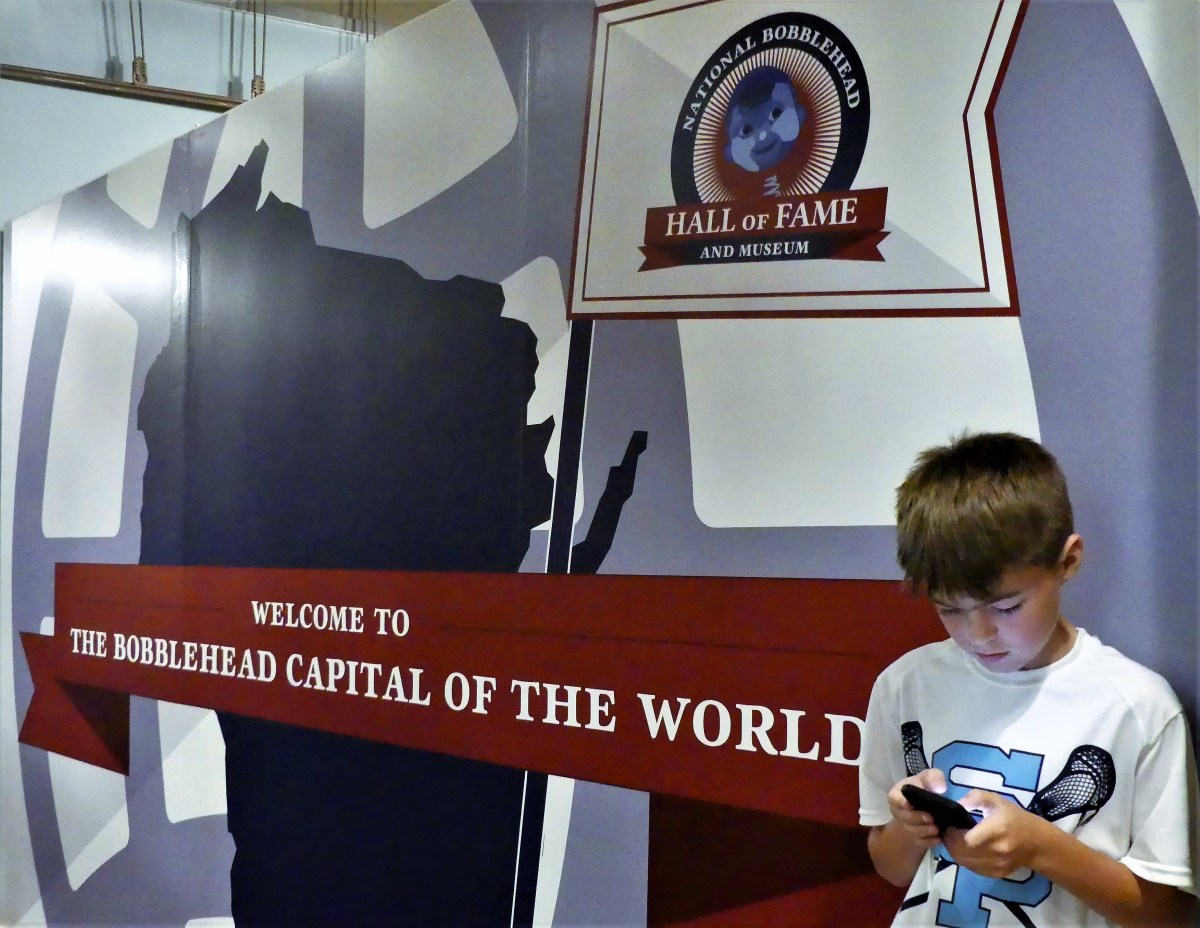
As of February 2019, there’s a new museum in town, and it’s head and shoulders above the rest. It’s also a nerdatorium for dads…
and their kids.
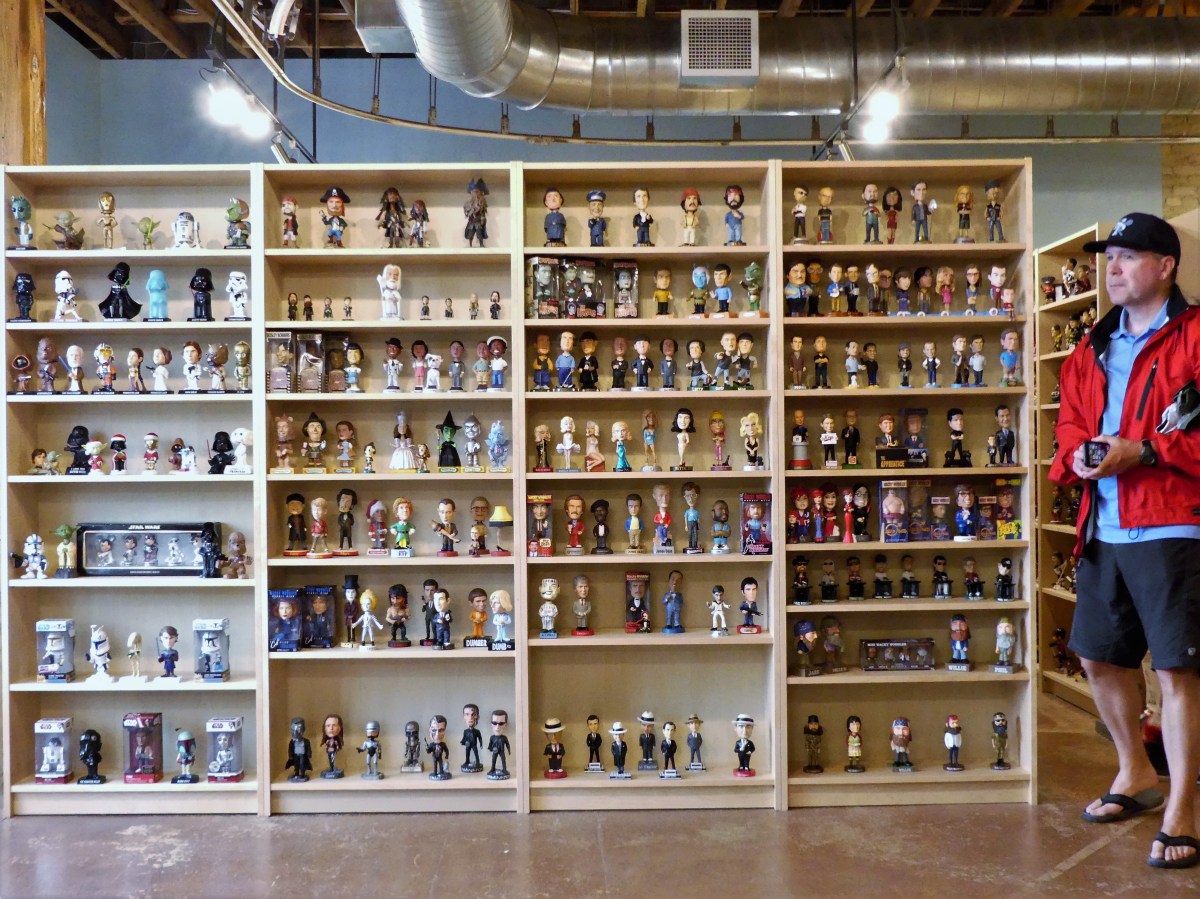
The National Bobblehead Hall of Fame and Museum definitely checks the excess box with a collection of 6,500 figurines on display, covering a wide swath of popular culture,
featuring sports and mascots,
fantasy,
and politics.
The Hall of Fame Bobbleheads line the windowsills.
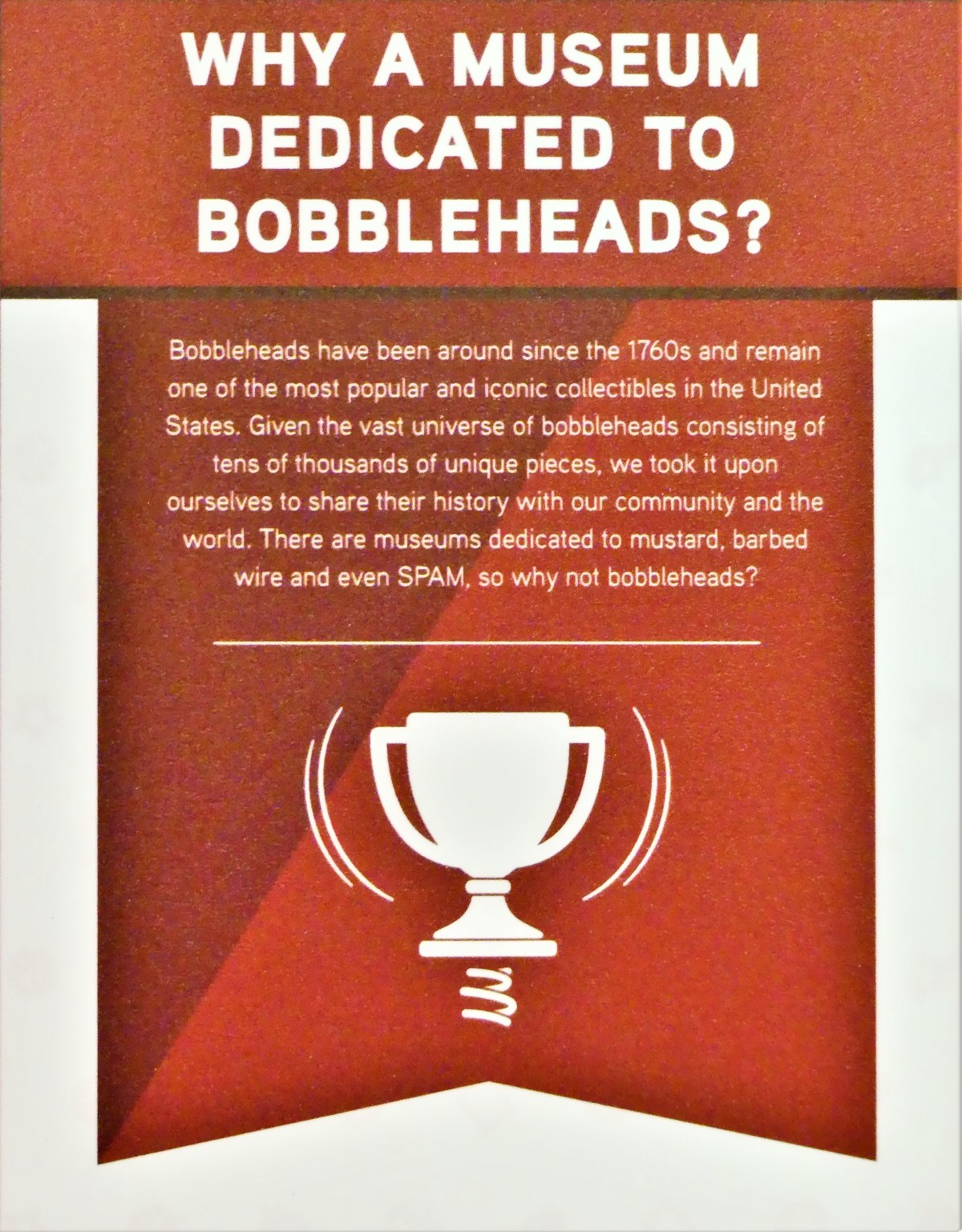
Shaking my head in disbelief, I asked myself, “Why?”…and patiently waited for a sign to give me guidance!
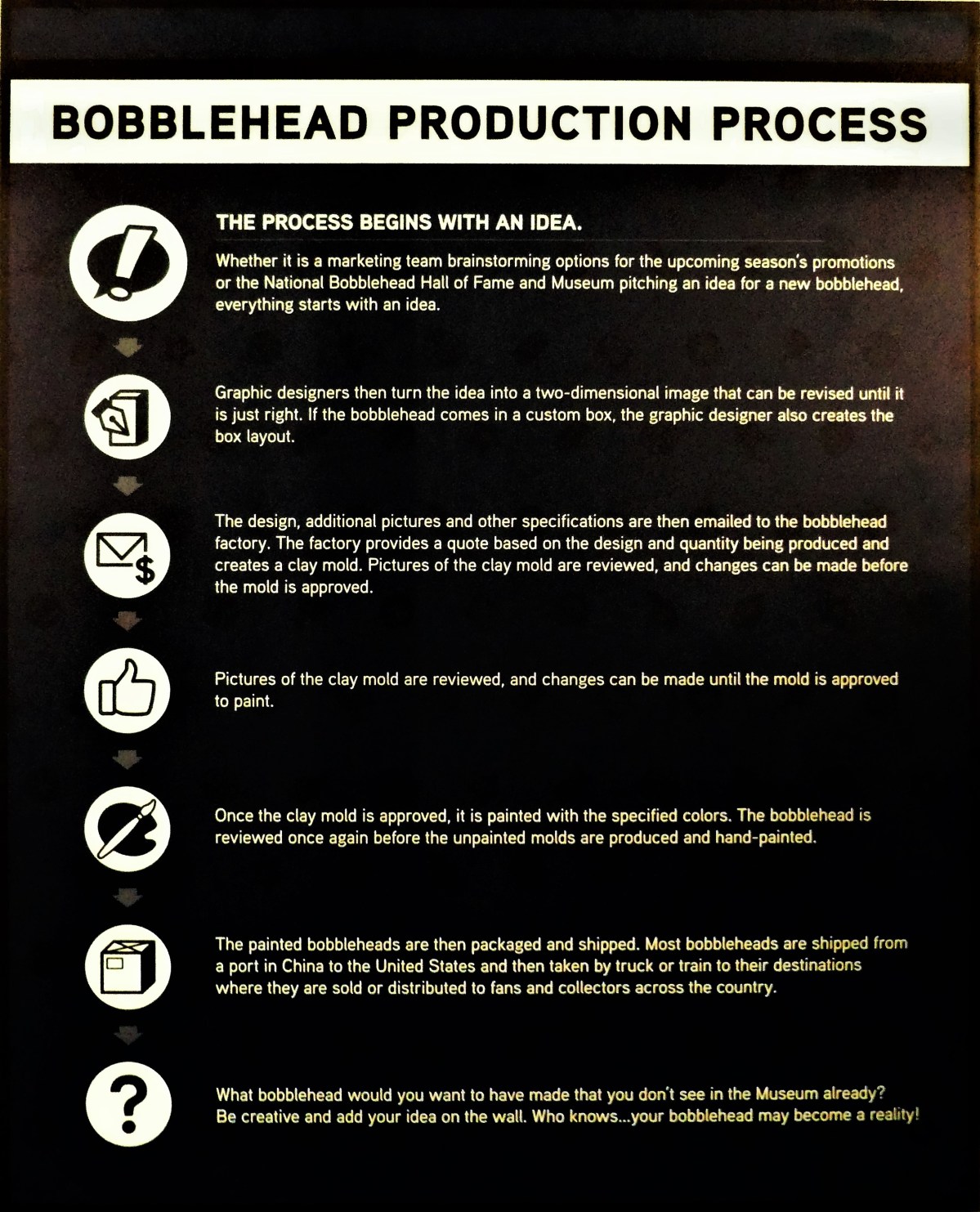
For the overly curious, the bobblehead production process is explained step by step…
However, the bobblehead timeline gave insightful commentary and instant credibility to museum founders Brad Novak and Phil Sklar.
This slideshow requires JavaScript.
There’s little doubt that I’ll be raising a glass or two of Lakefront’s Riverwest Stein Amber Lager every January 7 to celebrate.
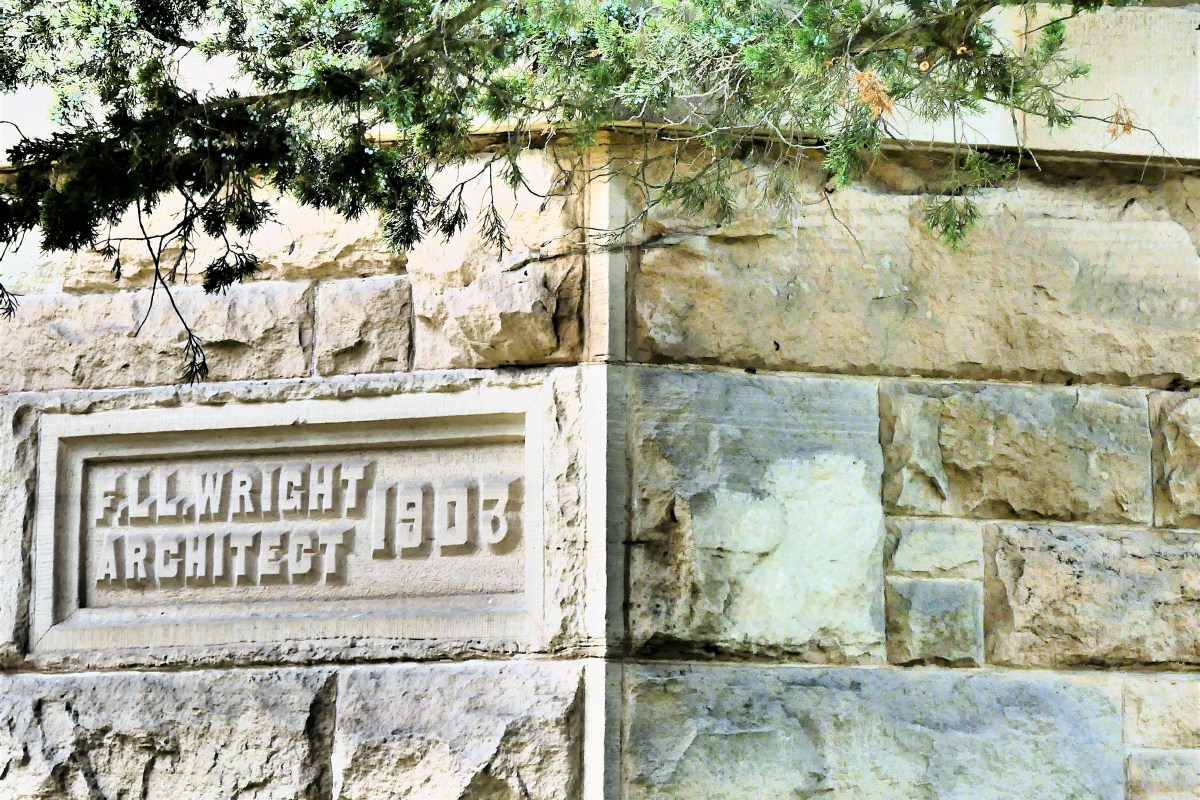
There’s very little to write about Frank Lloyd Wright that scholars haven’t already written.
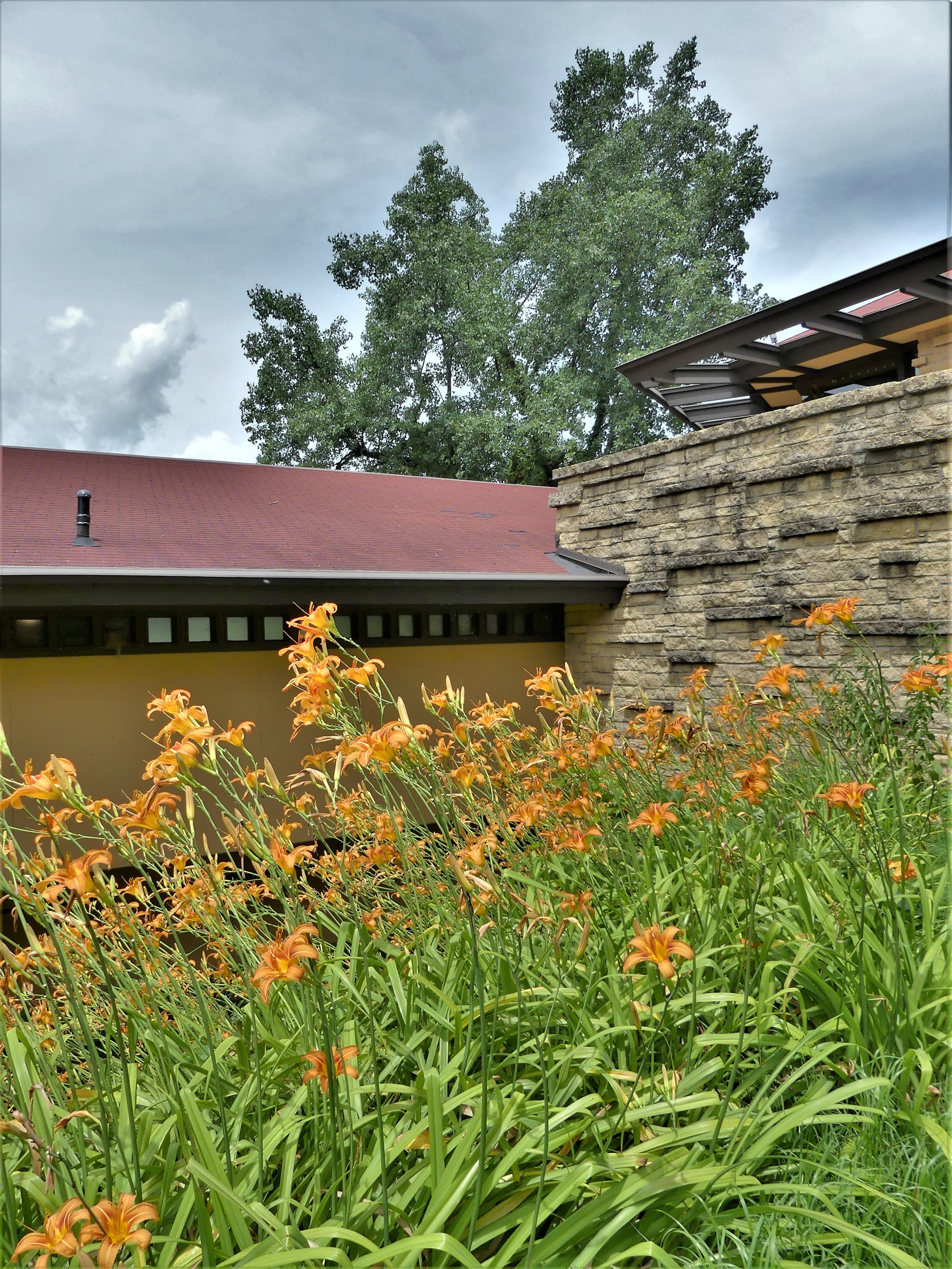
His affinty for nature, his indefatigable energy, his genius for design, his eagerness to experiment, his immense ego, his appetite for women, his dedication to family–it’s all been revealed and discussed in numerous books and lectures. But it’s also apparent from walking through his Taliesin estate in Spring Green, Wisconsin.
Leah and I would have preferred the immersive, 4-hr Estate Tour, but when I checked on-line for tickets, only one ticket was available when I needed two. It seems that no tour exceeds 21 people, matching the number of seats on the shuttle. Instead, we opted for the 2-hr Highlights Tour.
We boarded the bus at the Visitor Center–
orginally designed by Wright in 1953 as a restaurant and “gateway” to Taliesin, but Wright’s death in 1959 stalled any further construction until his former apprentices completed the building in 1967.
The ride took us past Midway Barn, Uncle John’s farming complex,
on the way to Hillside, the site of the home school he built for his Aunts Jane and Ellen Lloyd Jones.
Currently, the building is occupied by a time-shared architecture “Fellowship”–funded by the Taliesin Foundation–that occaisionally gathers in the Assembly Hall,
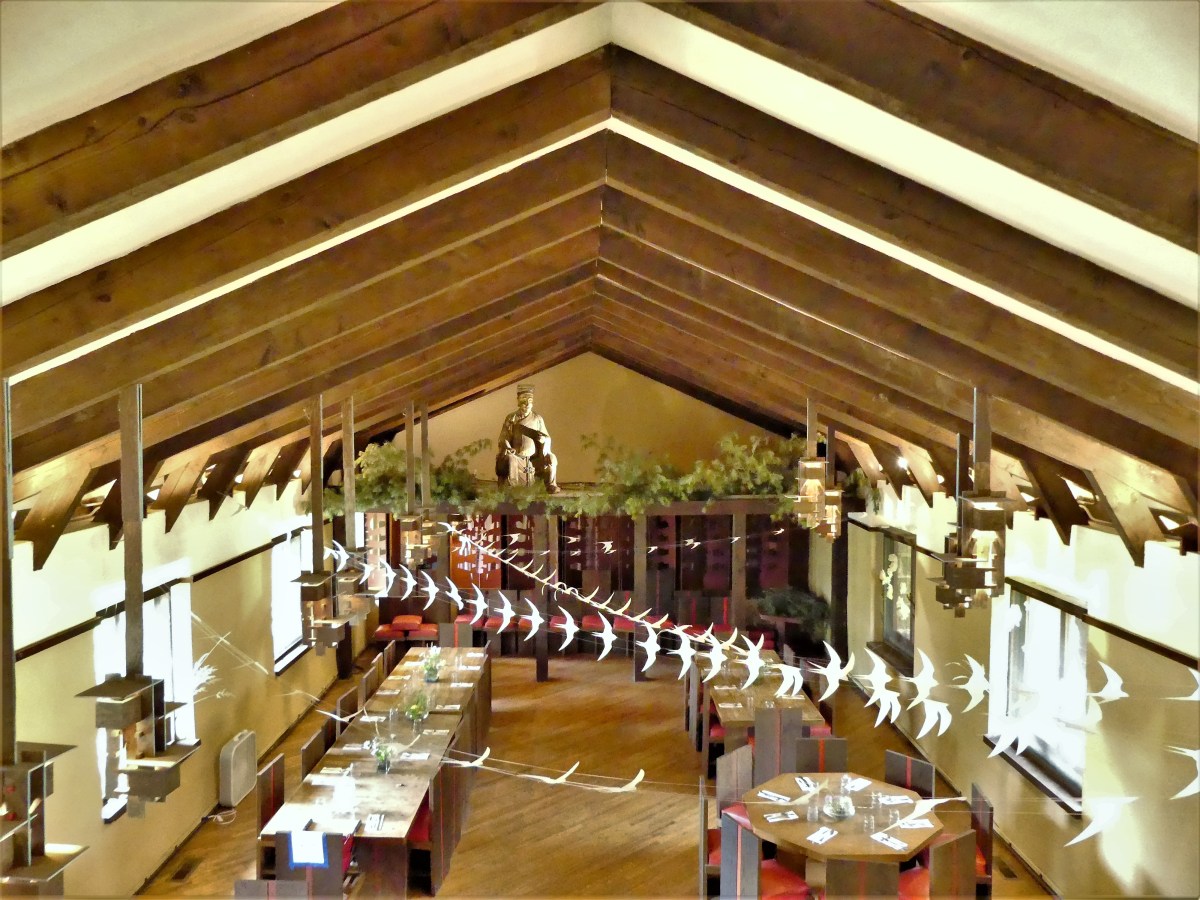
and takes meals in the Fellowship Dining Room,
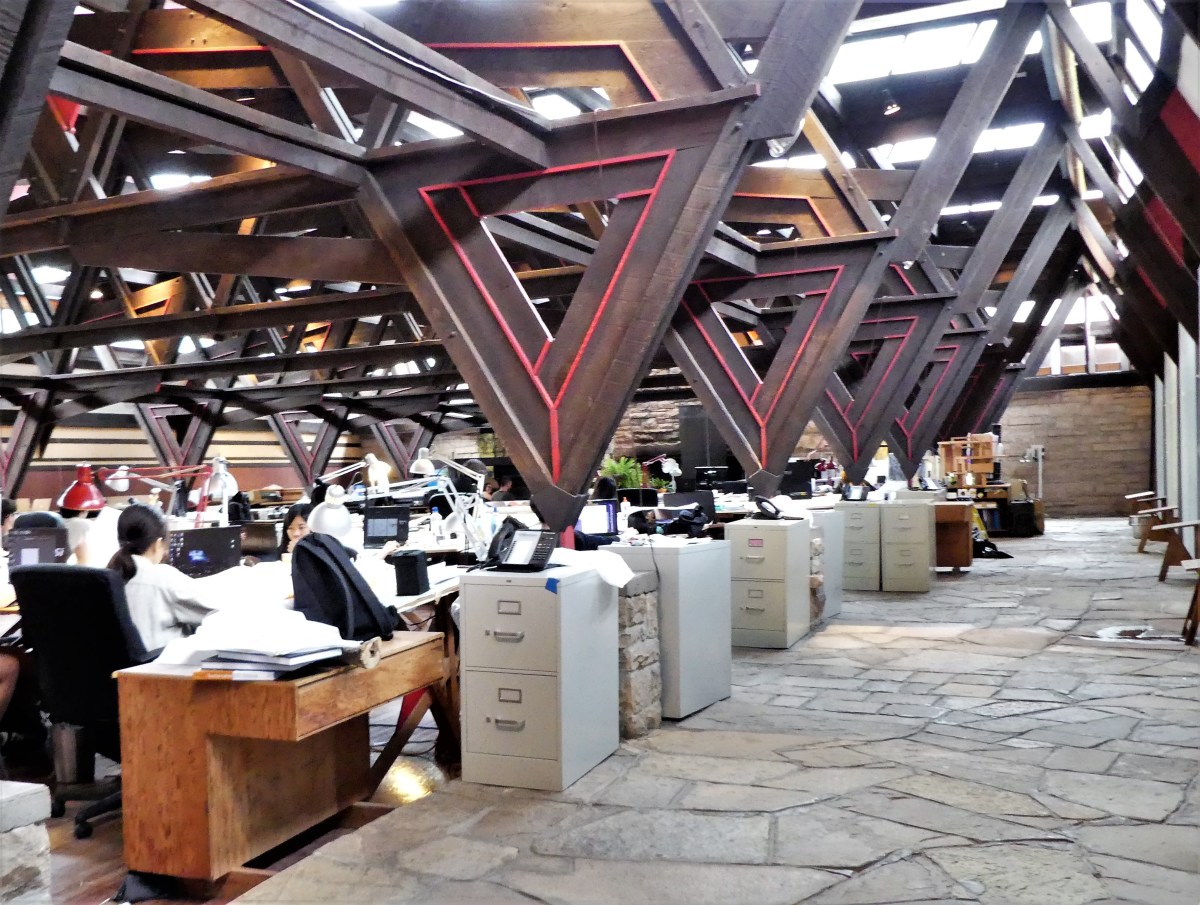
before returning to the 5,000 sq. ft. “abstract forest” Drafting Studio.
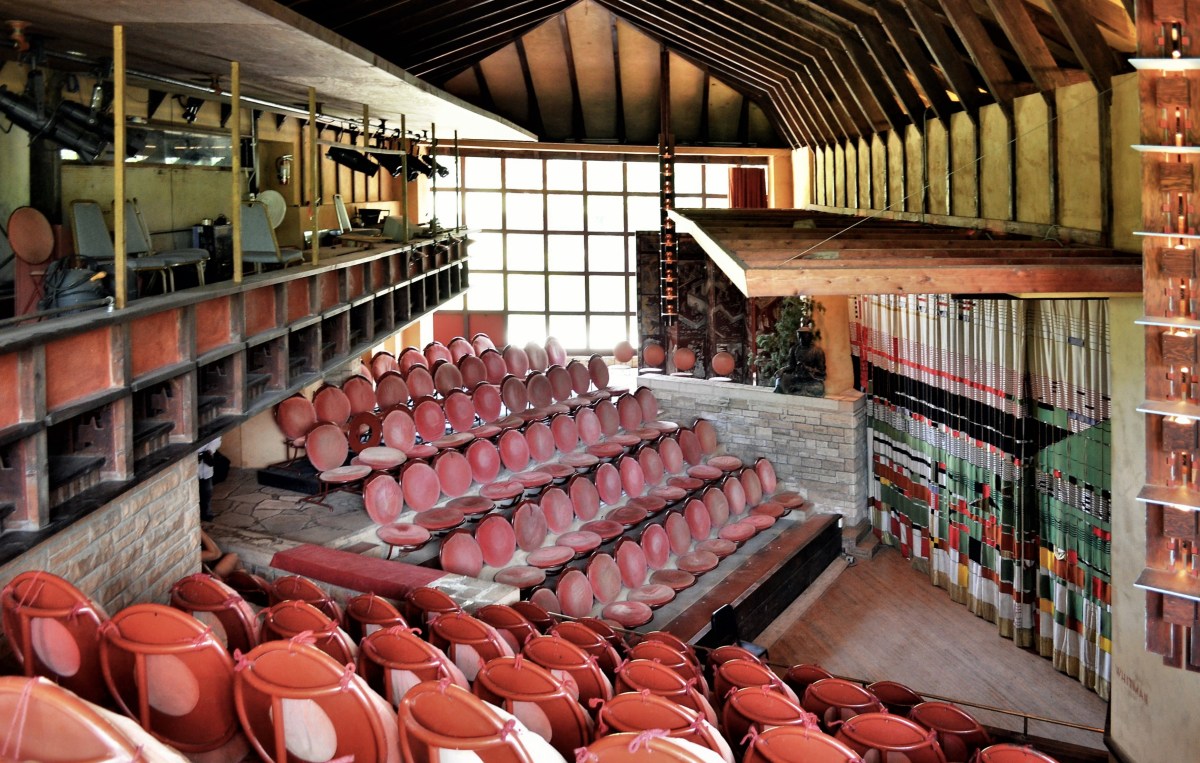
We finished up at Wright’s intimate, 120-seat Hillside Theater–originally intended as a gymnasium, but converted by Wright to a cultural space after determining that the arts were more important than sports–
and reboarded the bus for a brief blast of air conditioning and quick trip to Wright’s home studio,
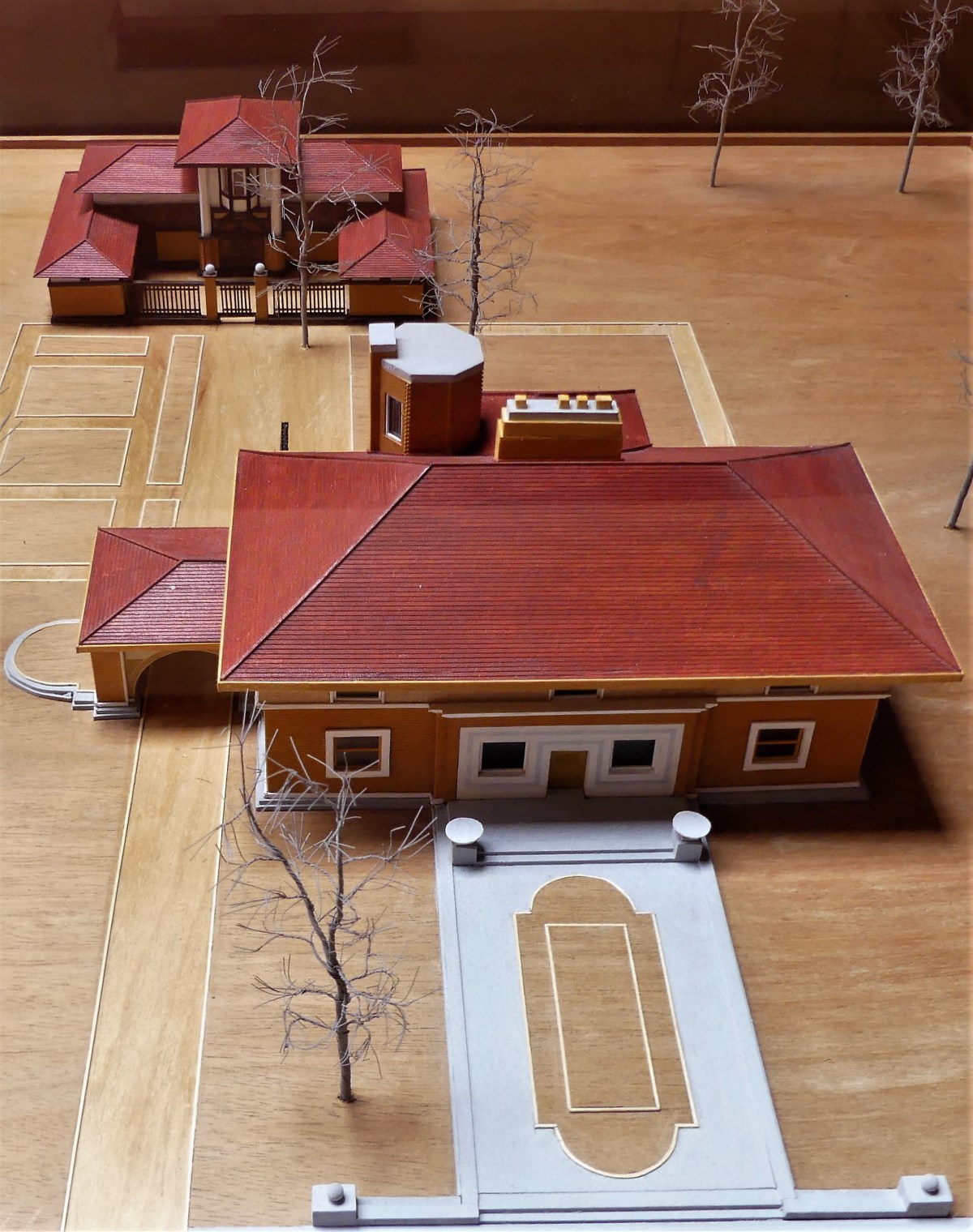
where we browsed through a drafting room filled with “Usonian” models, like the Willey House from 1934,
and assorted personal artifacts.
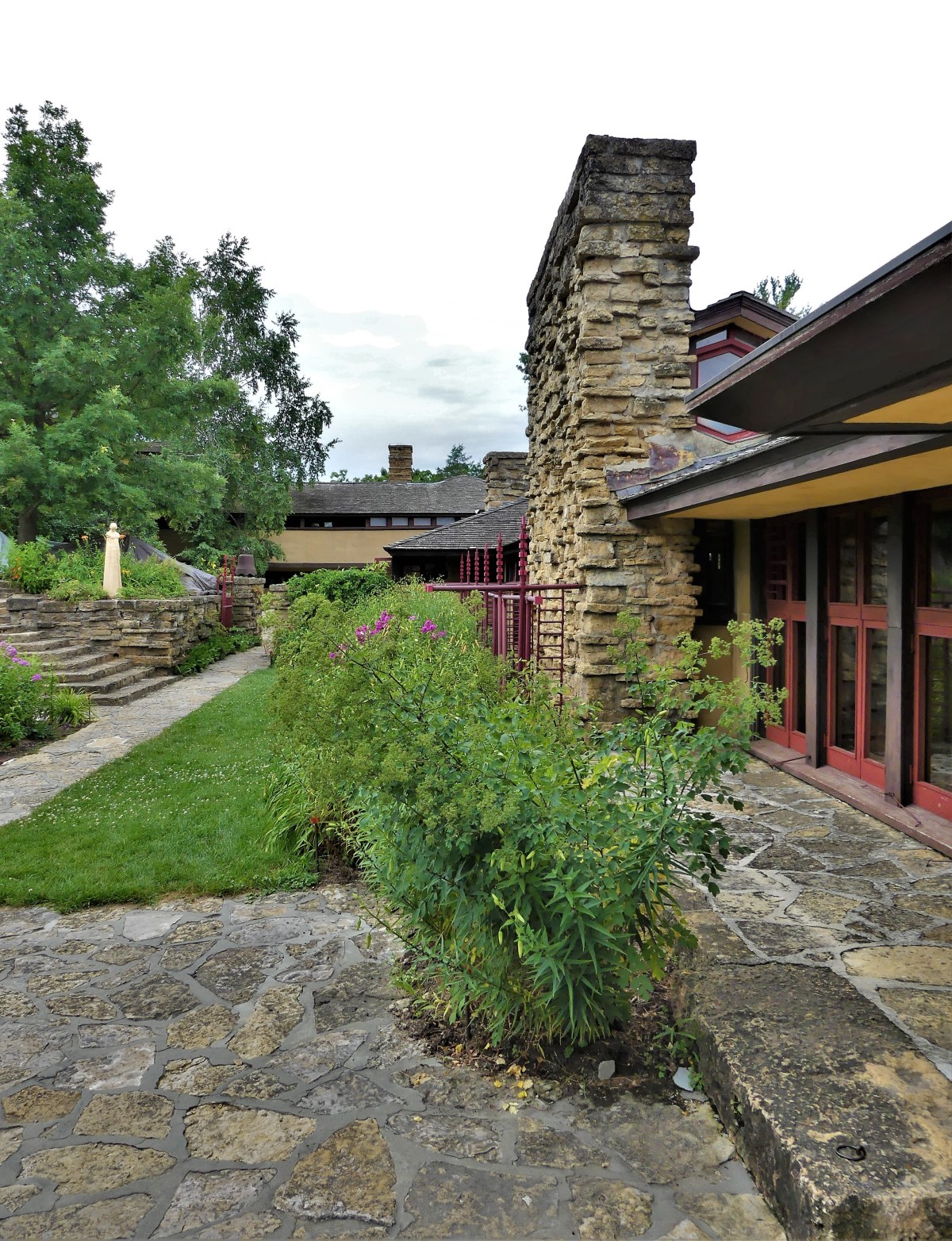
The house was noticably cooler, thanks to geothermal plumbing installed during the third re-build. We rounded the studio from the outside,
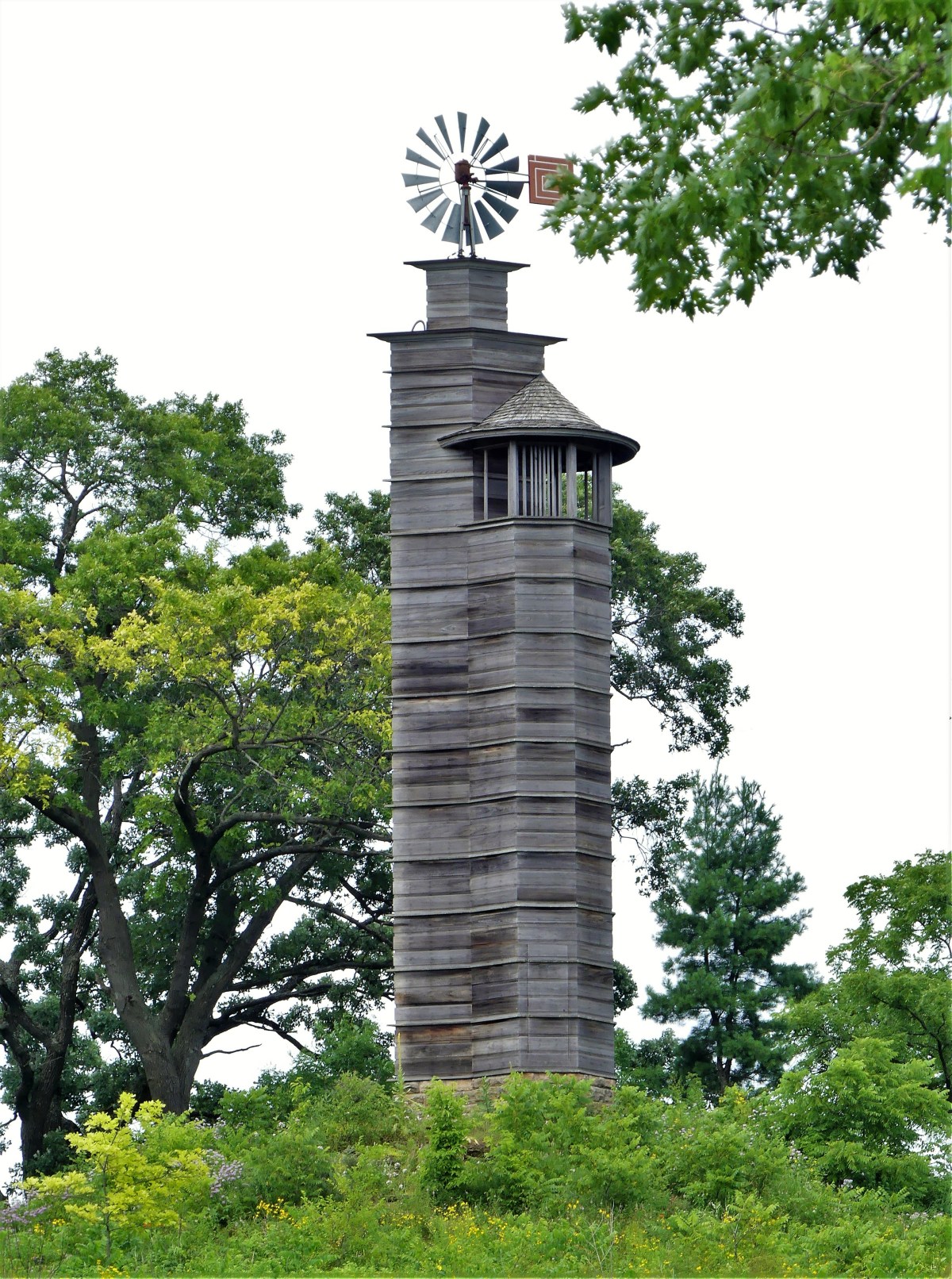
walked across a mound with views of the restored Romeo and Juliet windmill,
and traversed the gardens,
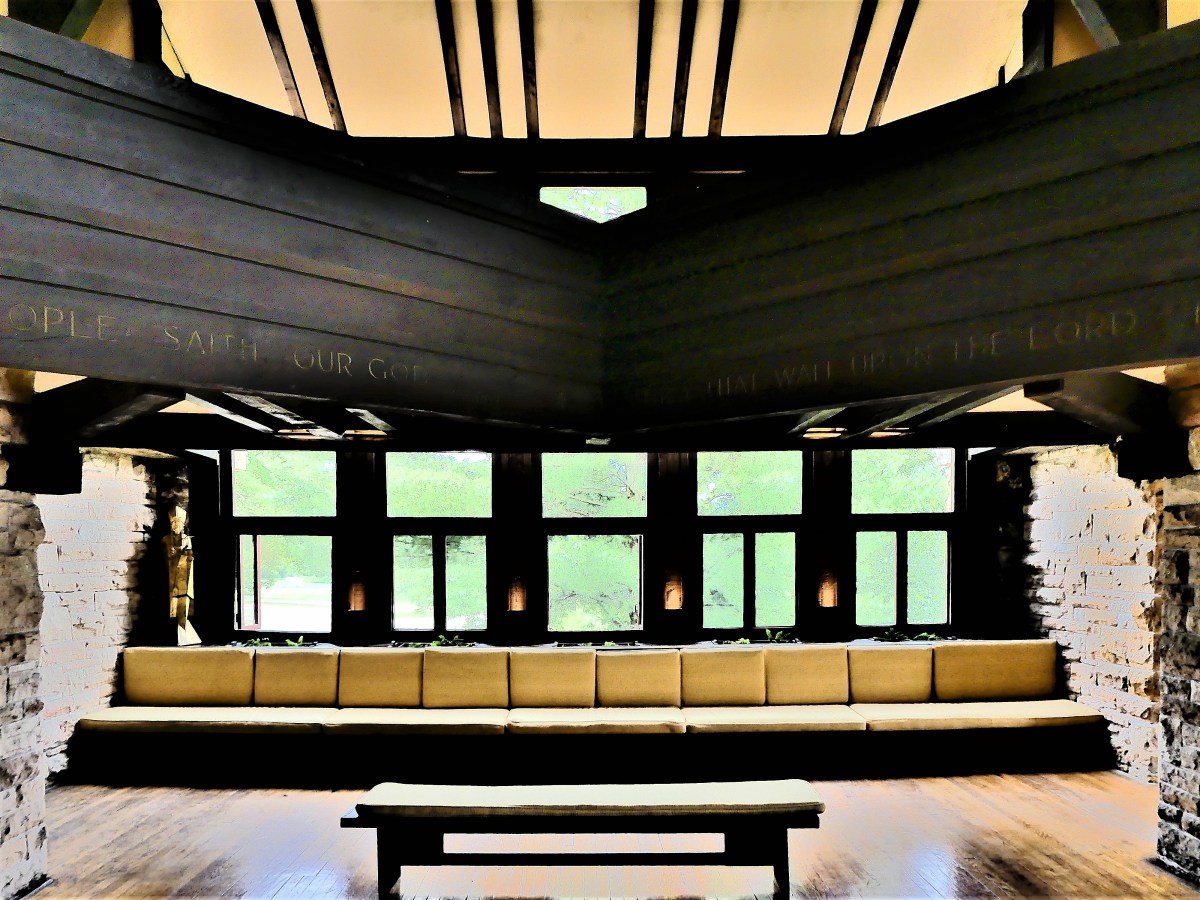
before re-entering the house through the expansive living room,
filled with wonderful flourishes, like glass-cornered windows (which Wright would ultimately perfect at Fallingwater)…
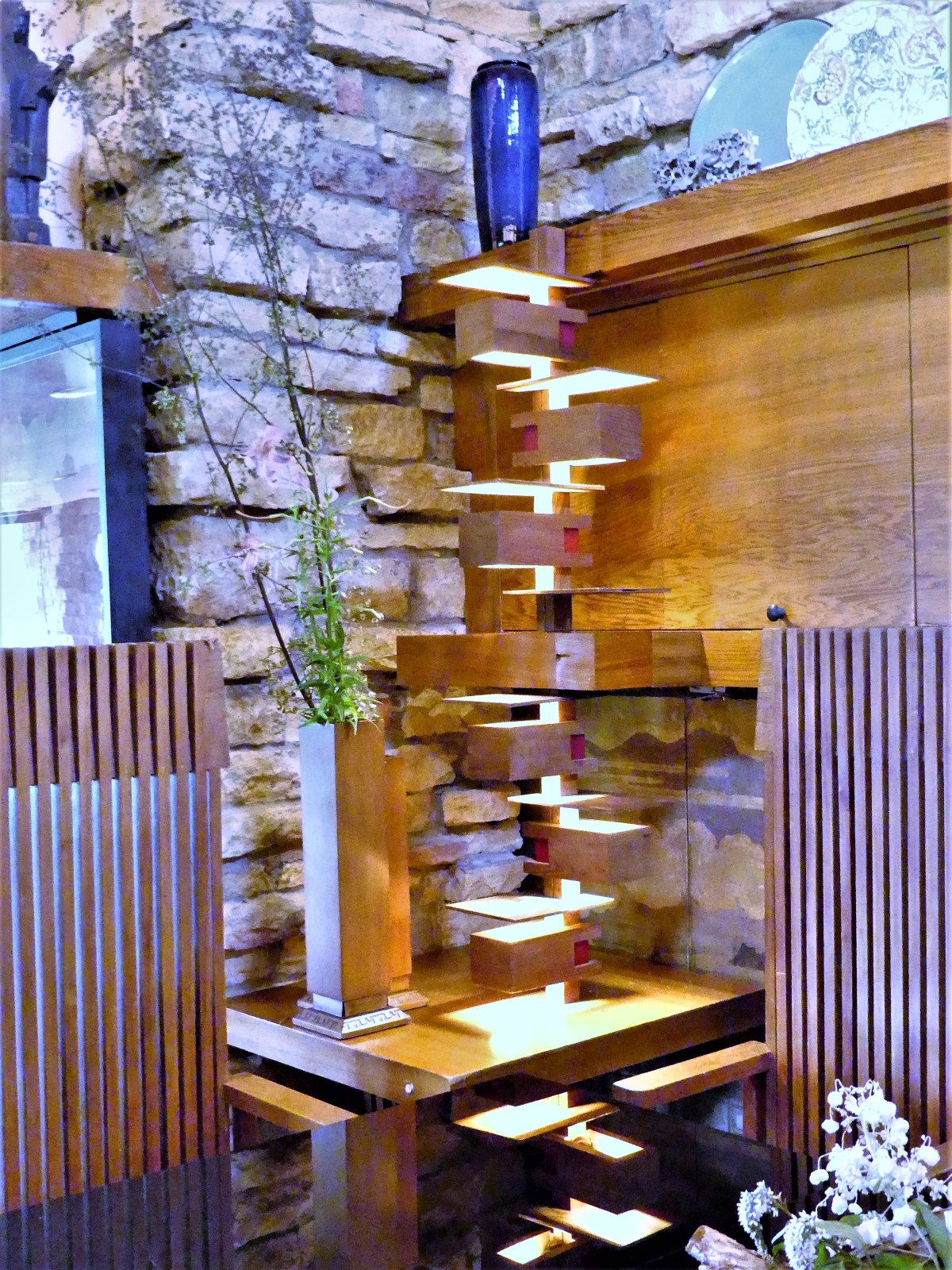
built-in table lamps,
and integration of sculptures that survived the previous two house fires.
Roaming through Wright’s personal bedroom (because he was an insomniac), we discovered no door, a wall of windows without window treatments, and original electric- blue shag carpeting.
The terrace offered glorious views of the Wisconsin River and Tower Hill State Park,
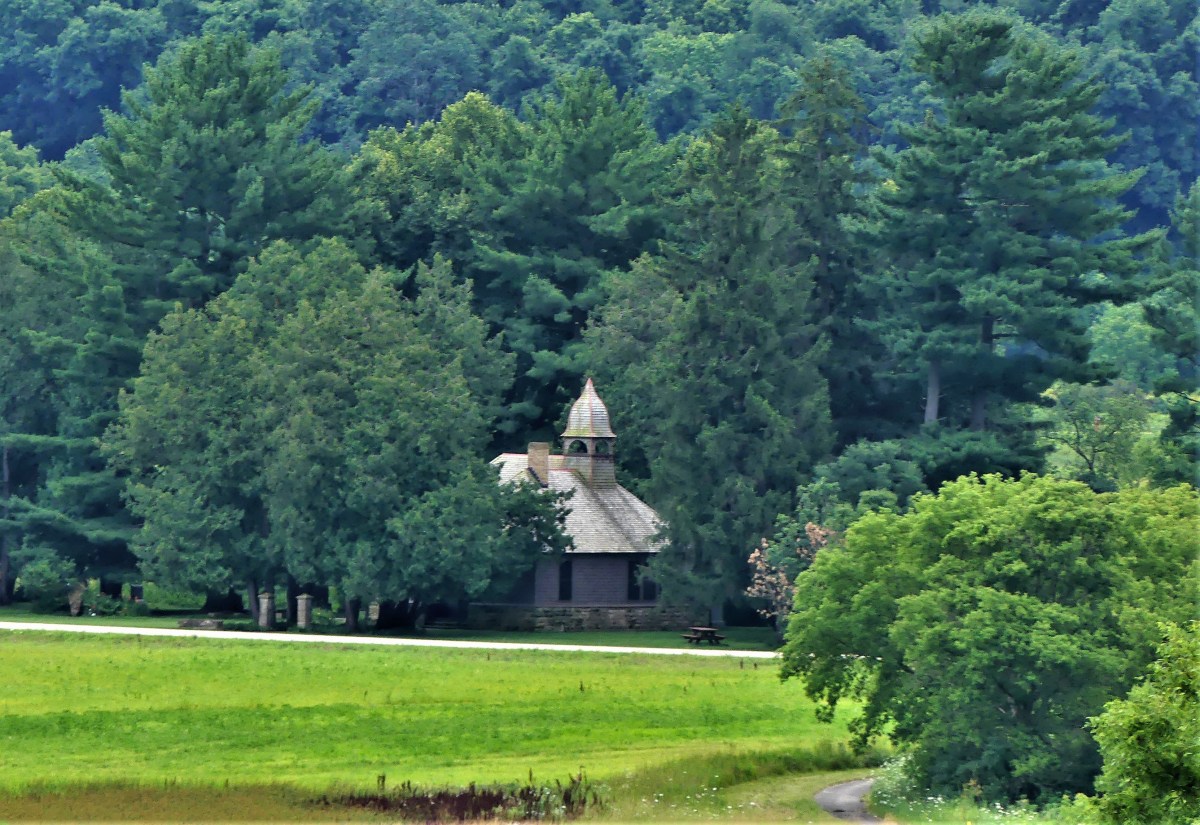
and Unity Chapel in the distance–
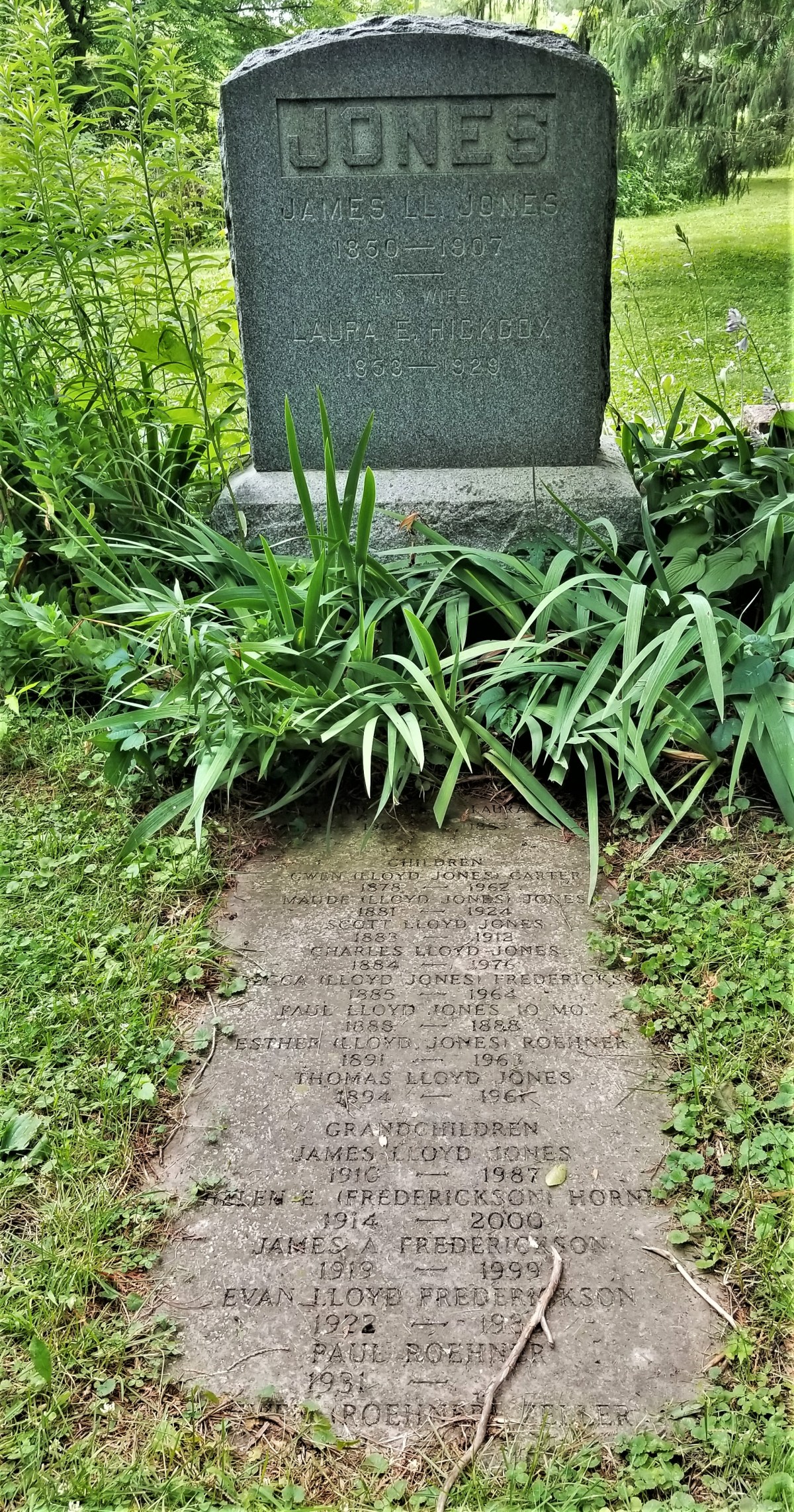
the site of Wright’s maternal family’s burial plots, his stone marker, and his empty grave.
As our driver passed Wright’s man-made falls,
our docent passed along a local story of intrigue and scandal:
During March 25, 1985, under cover of darkness, Frank Lloyd Wright’s body was exhumed from his Unity Chapel resting place by his oldest granddaughter, Elizabeth Wright Ingraham, and moved to a burial site at Taliesin West, in Scottsdale, Arizona.
She claimed to be fulfilling the dying wishes of her grandmother and Wright’s widow, Olgivanna Lloyd Wright, whose ashes were united with her husband’s within a memorial wall overlooking Paradise Valley. The event sparked outrage around the globe from associates and friends who argued that the architect would have desired to spend eternity at Unity Church with his family.
Even now, Spring Green residents hope that one day their favorite son will get his ash back to Wisconsin.
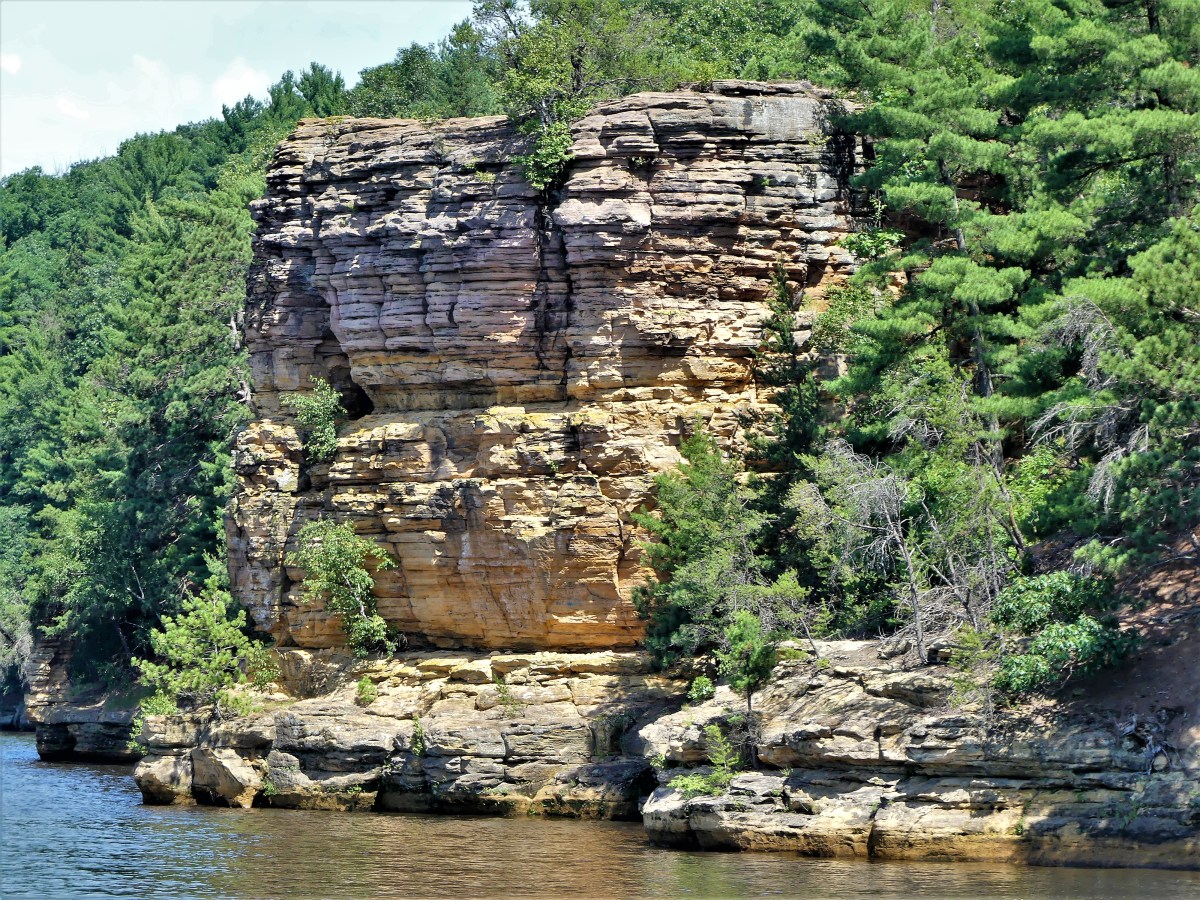
Long before kitsch and water parks ruled the region, visitors from around the world traveled to the Dells to marvel at the iconic sandstone formations carved by a glacier that plowed through Wisconsin approximately 15,000 years ago–leaving behind a 5-mile gorge struck from rock that’s older than anything on earth.
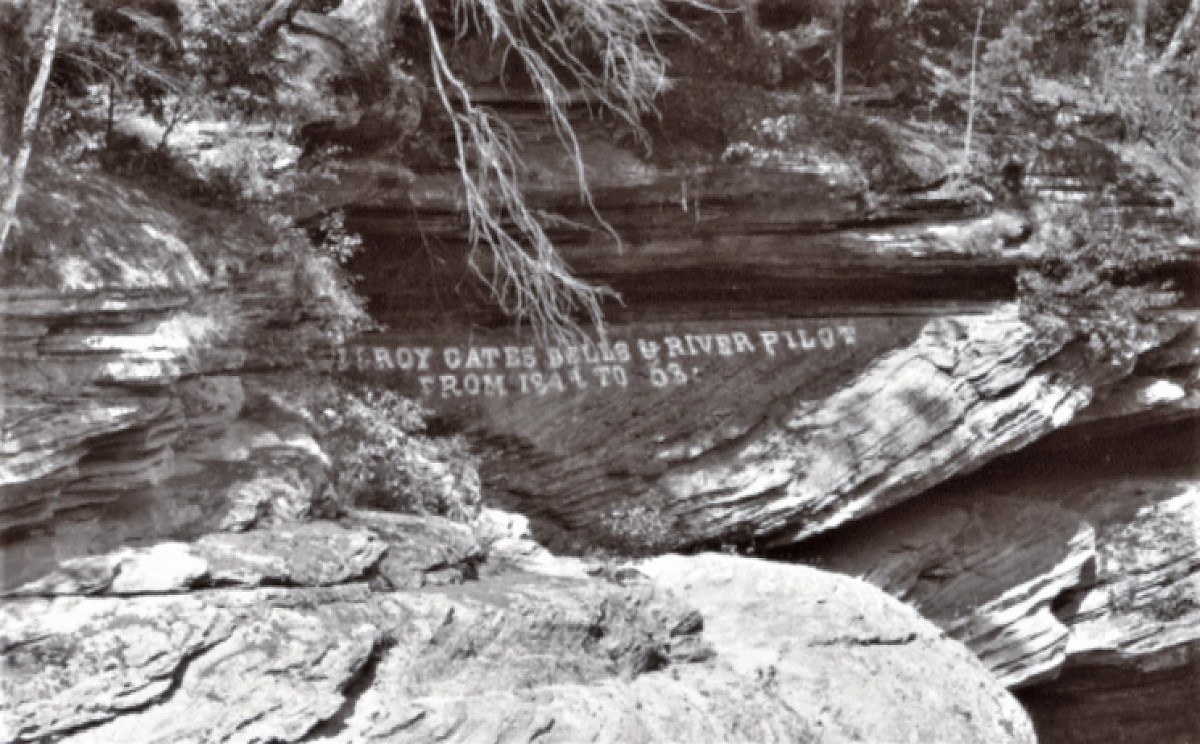
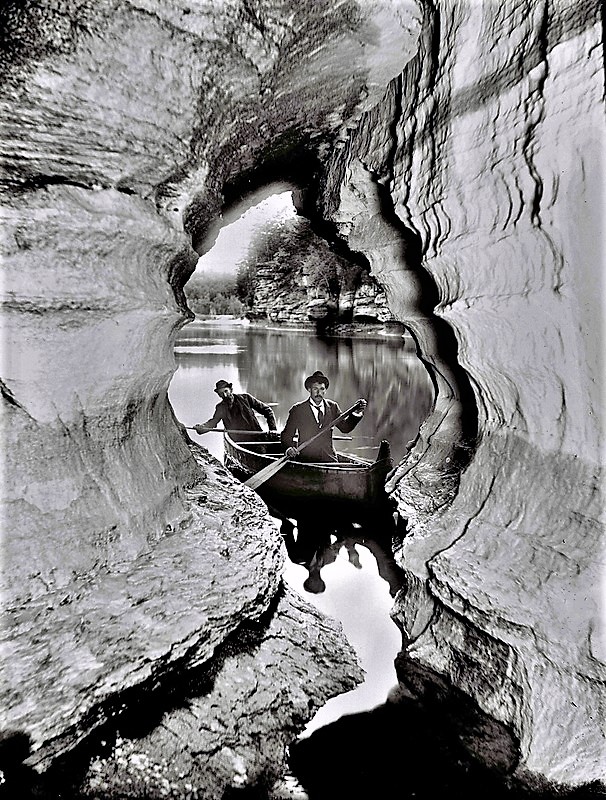
Word of this discovery spread quickly, attracting Leroy Gates, a lumber rafter with a notion that promotion would bring tourism to the river he loved, and earn him a buck or two to boot. In 1856, Gates offered the first guided boat tours of the Dells of Wisconsin, and made sure everyone knew it.
Supposedly, Gates and his associate guides would sit under umbrellas sipping lemonade, while the guests would paddle their boats up river to destined attractions…
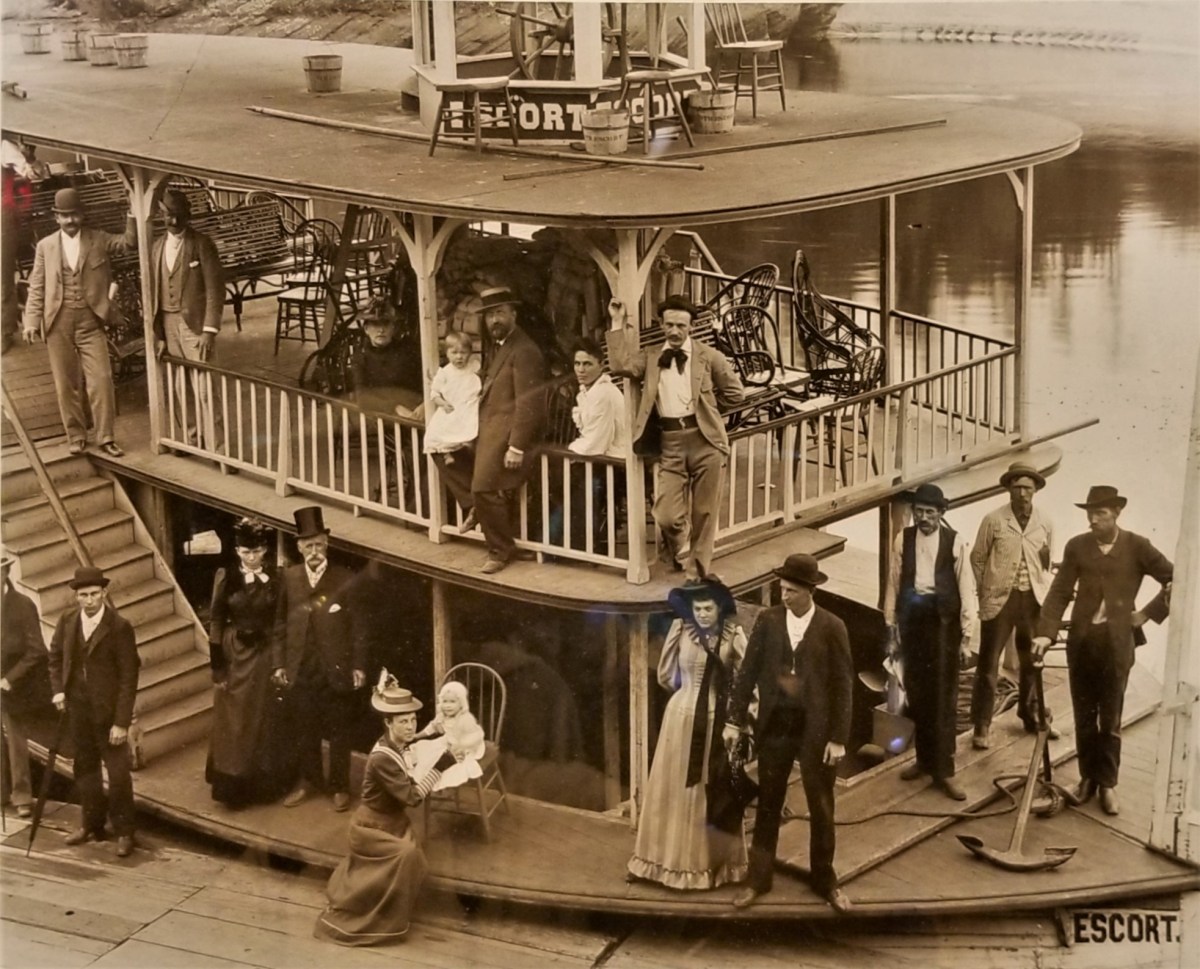
until steamboats took over in 1873.
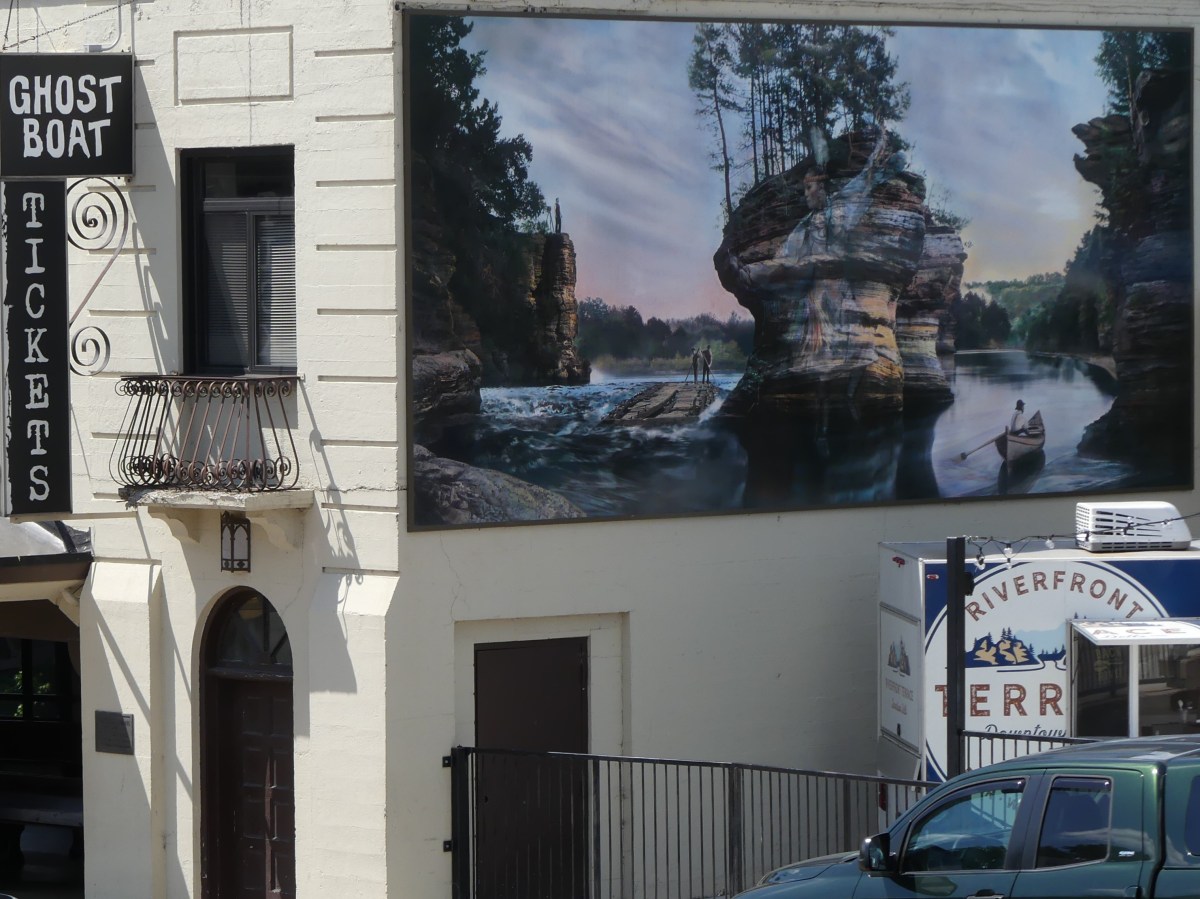
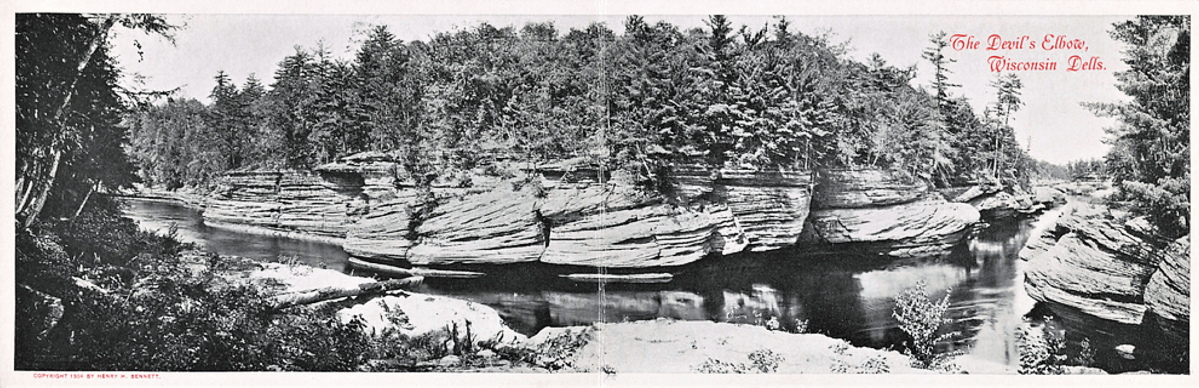
Fortunately, landscape photographer H.H. Bennett was there to capture it all–taking souvenir photos of the tourists, and landing a place in history as “the man who made the Wisconsin Dells famous.”
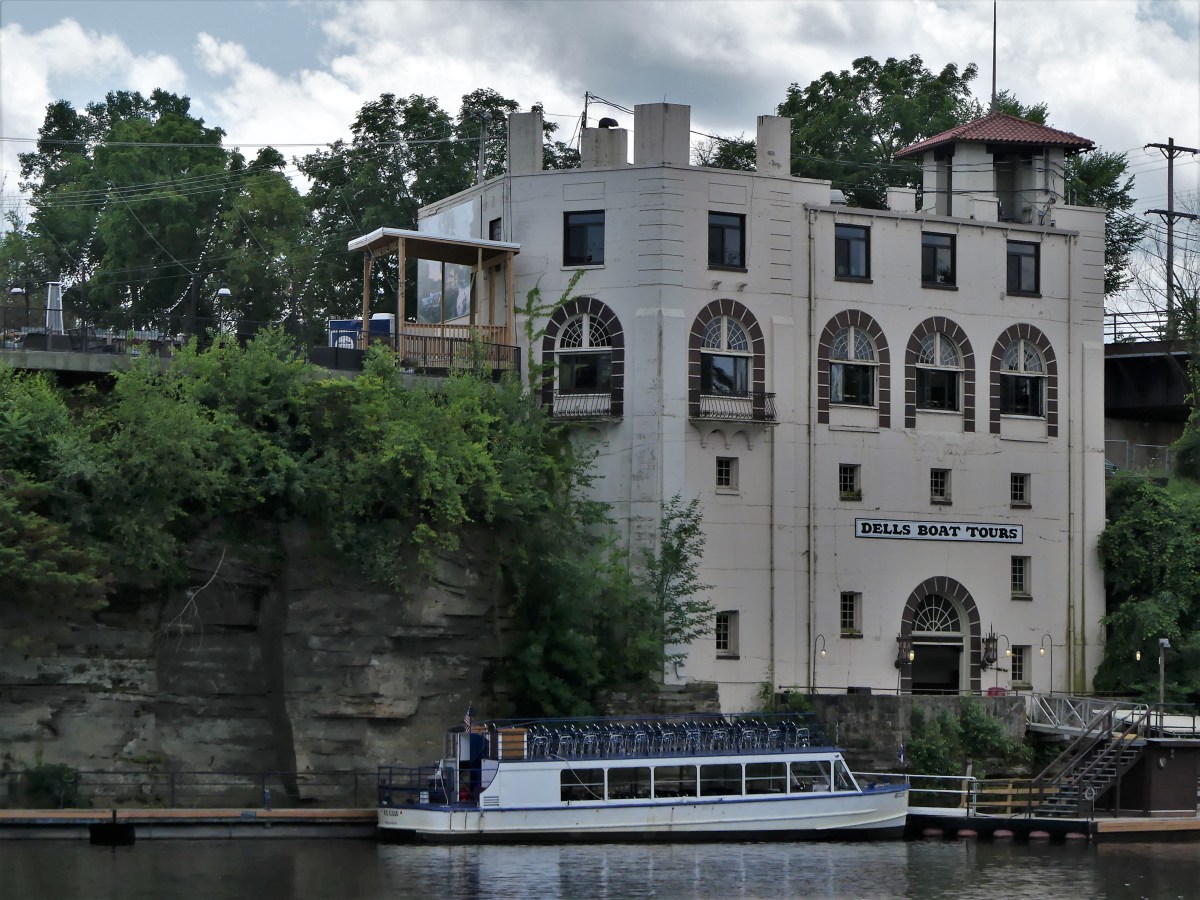
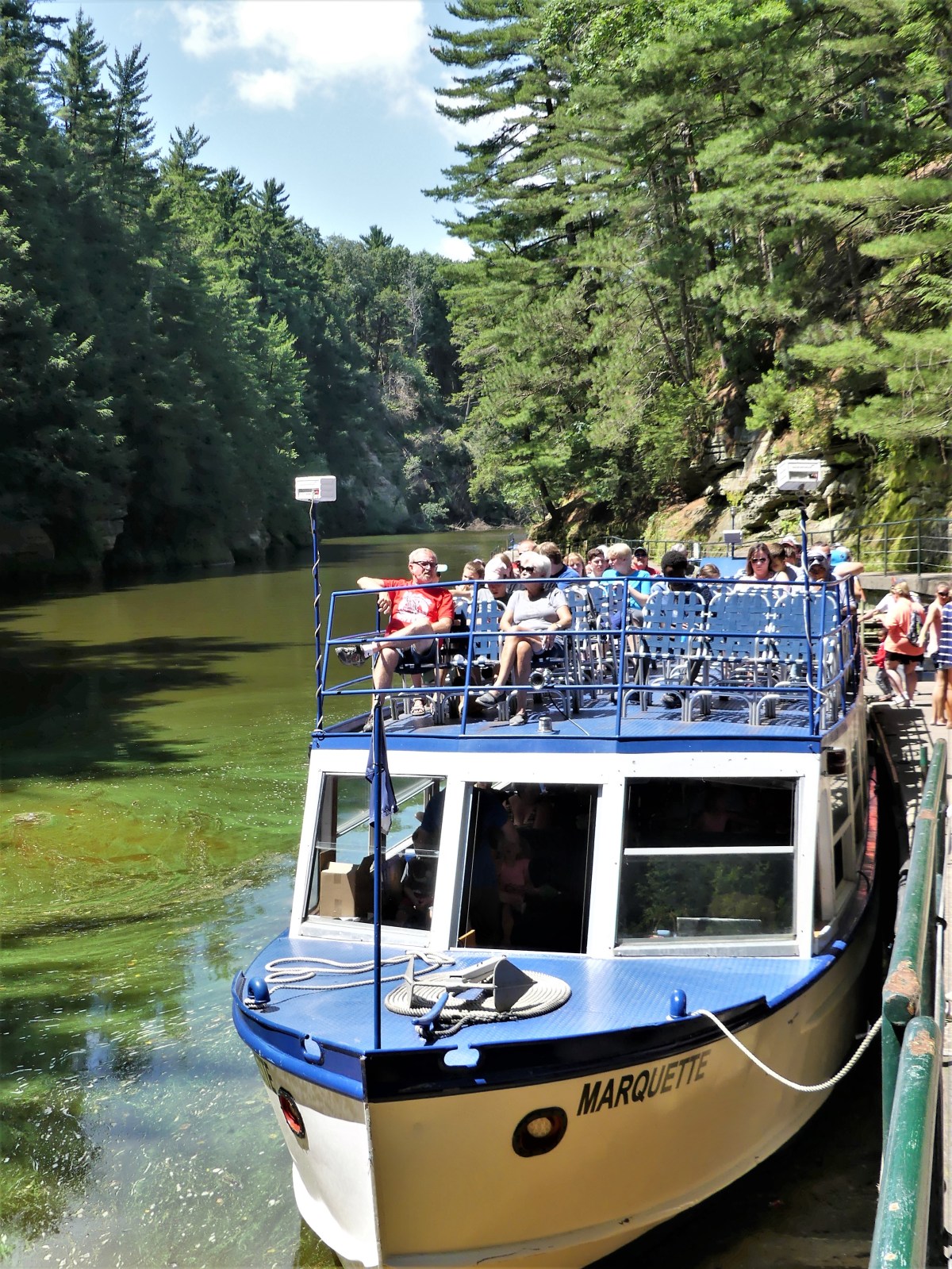
Today, Dells Boat Tours continues the tradition on the river…
with a fleet of 17 vessels that carry half a million passengers year after year.
Captain Bob piloted our riverboat north through the Upper Dells,
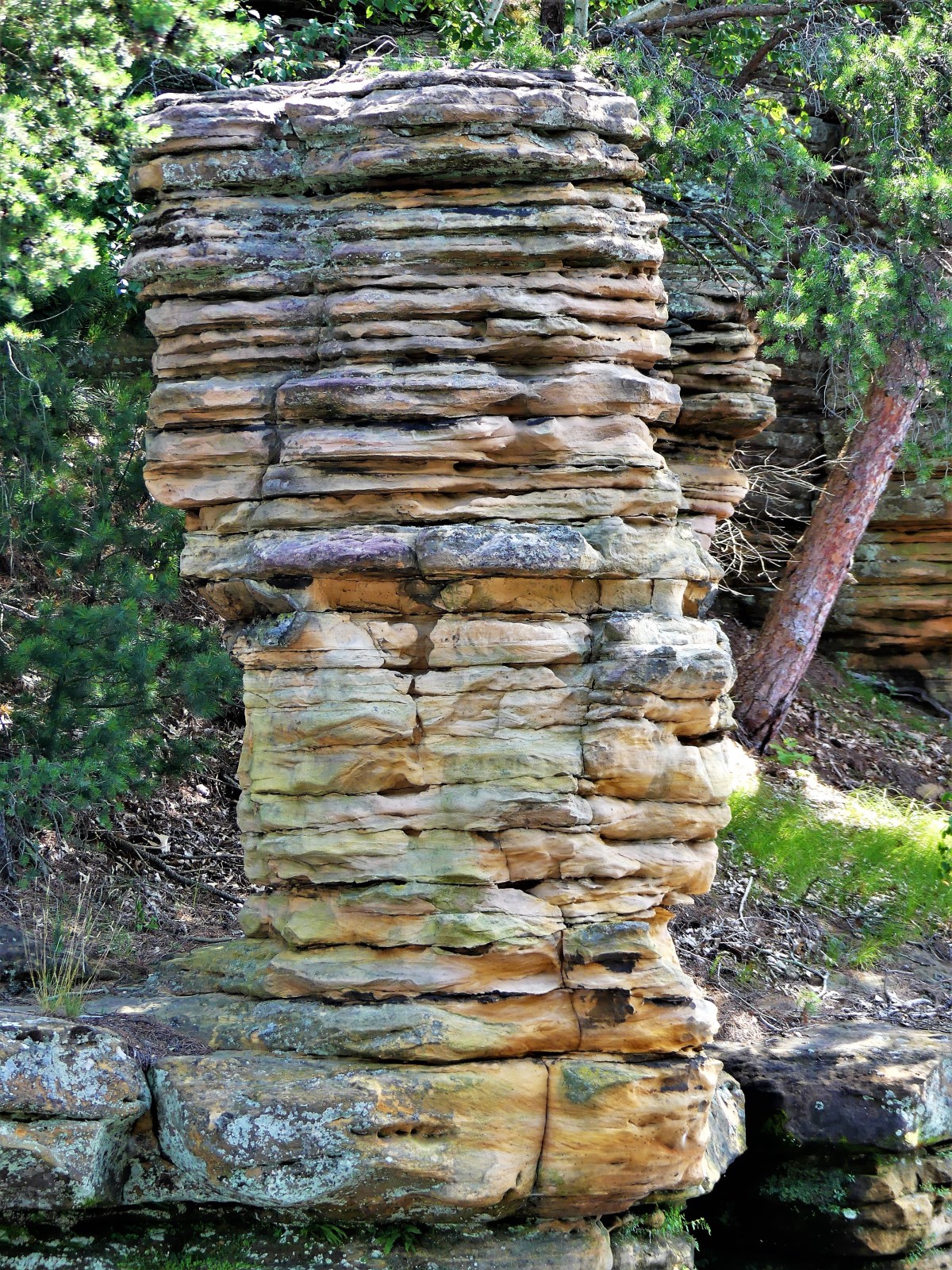
while First Mate Abby called out the names of rock sculptures famously characterized by H. H. Bennett:
Black Rock’s profileChimney RockHigh RockAlligator RocksRomance Cliffs
After manuevering through the Devil’s Elbow…
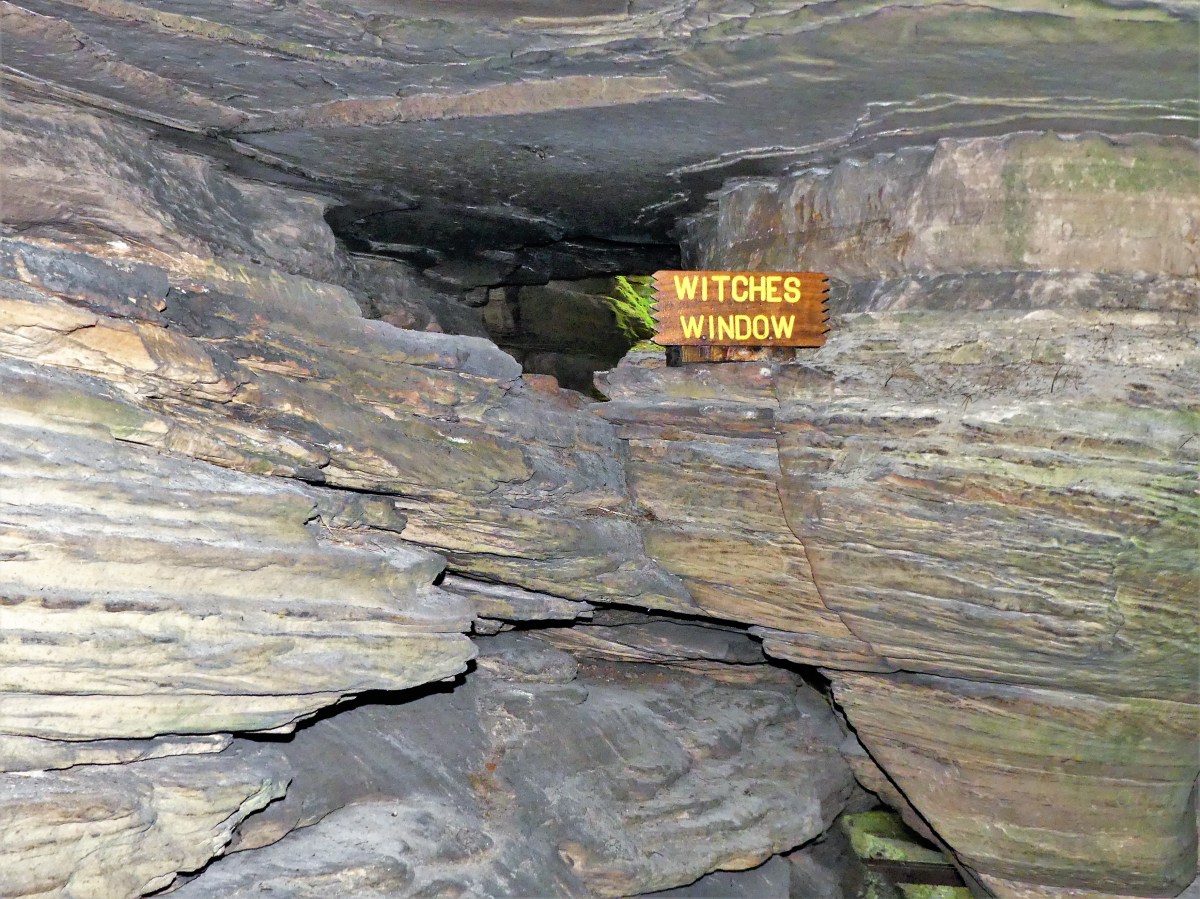
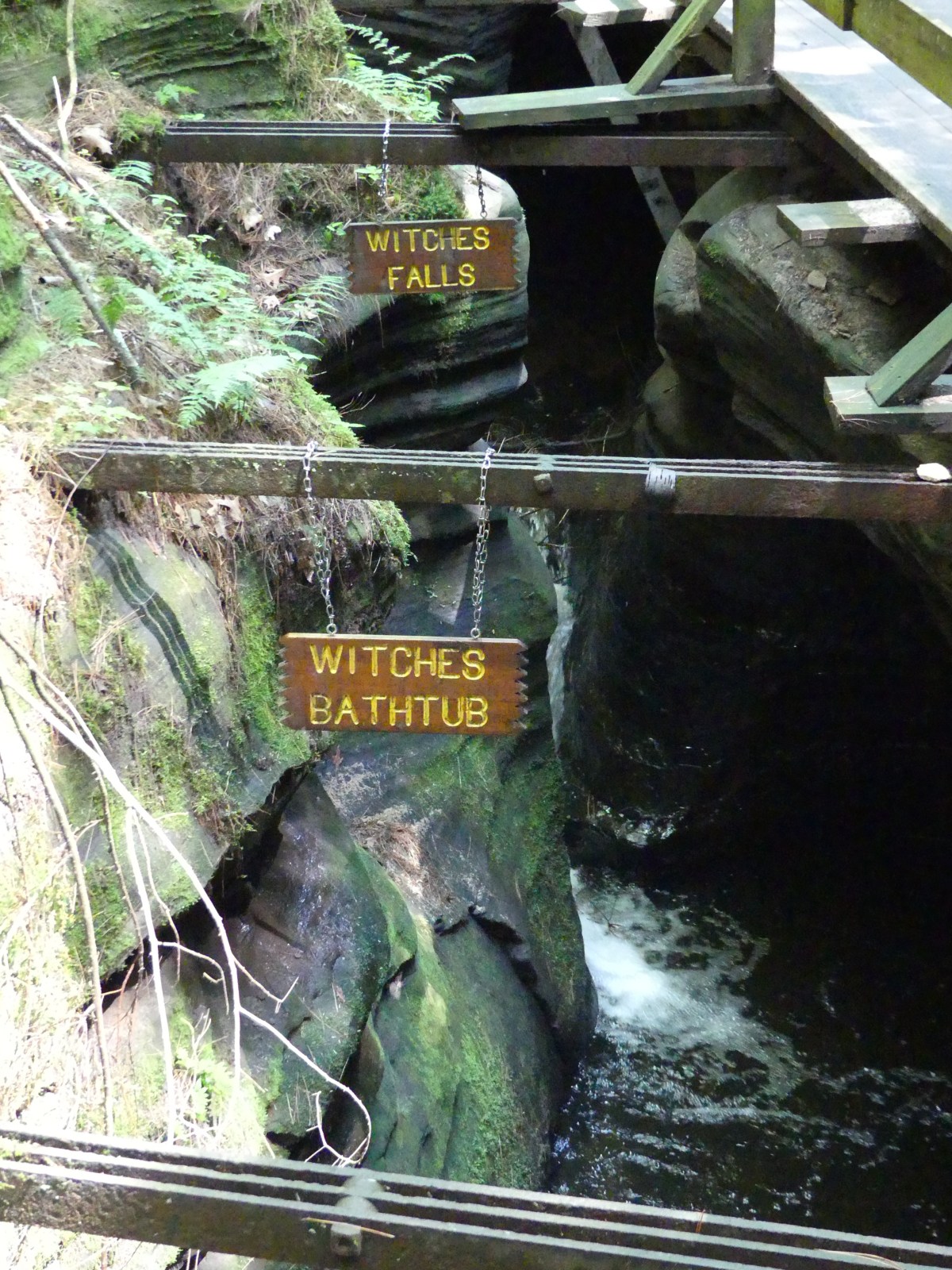
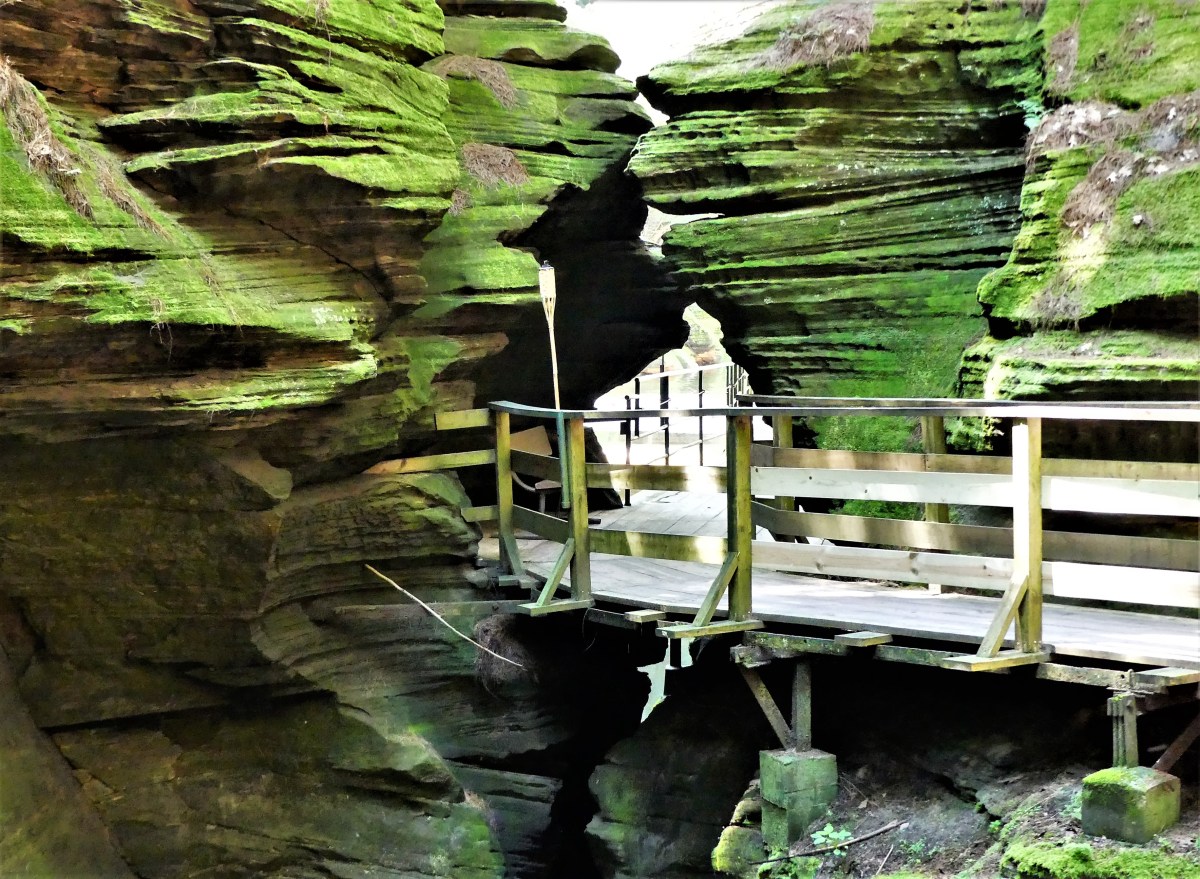
Captain Bob turned into a slot canyon discovered–and affectionately named Witches Gulch by Bennett. Apparently, the name was intended to be sinister and provocative. His strategy was reinforced by similar names inside the canyon, such as:
Whirlpool ChambersWitches WindowWitches Bathtub and Witches Falls
Eventually, Bennett built a tie-up dock, threaded a boardwalk through the canyon walls, and created a photography concession at the terminus. We were about to see why, as Captain Bob eased toward the mooring.
Abby tied up the riverboat,
and we walked the boards,
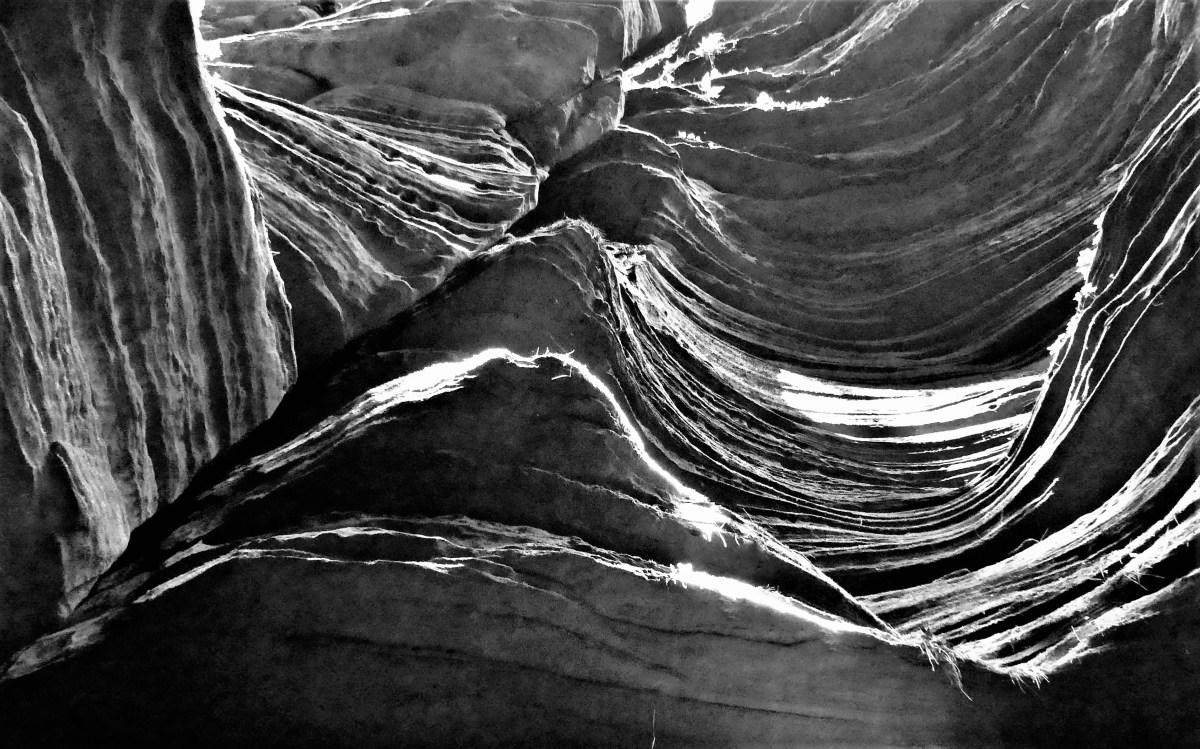
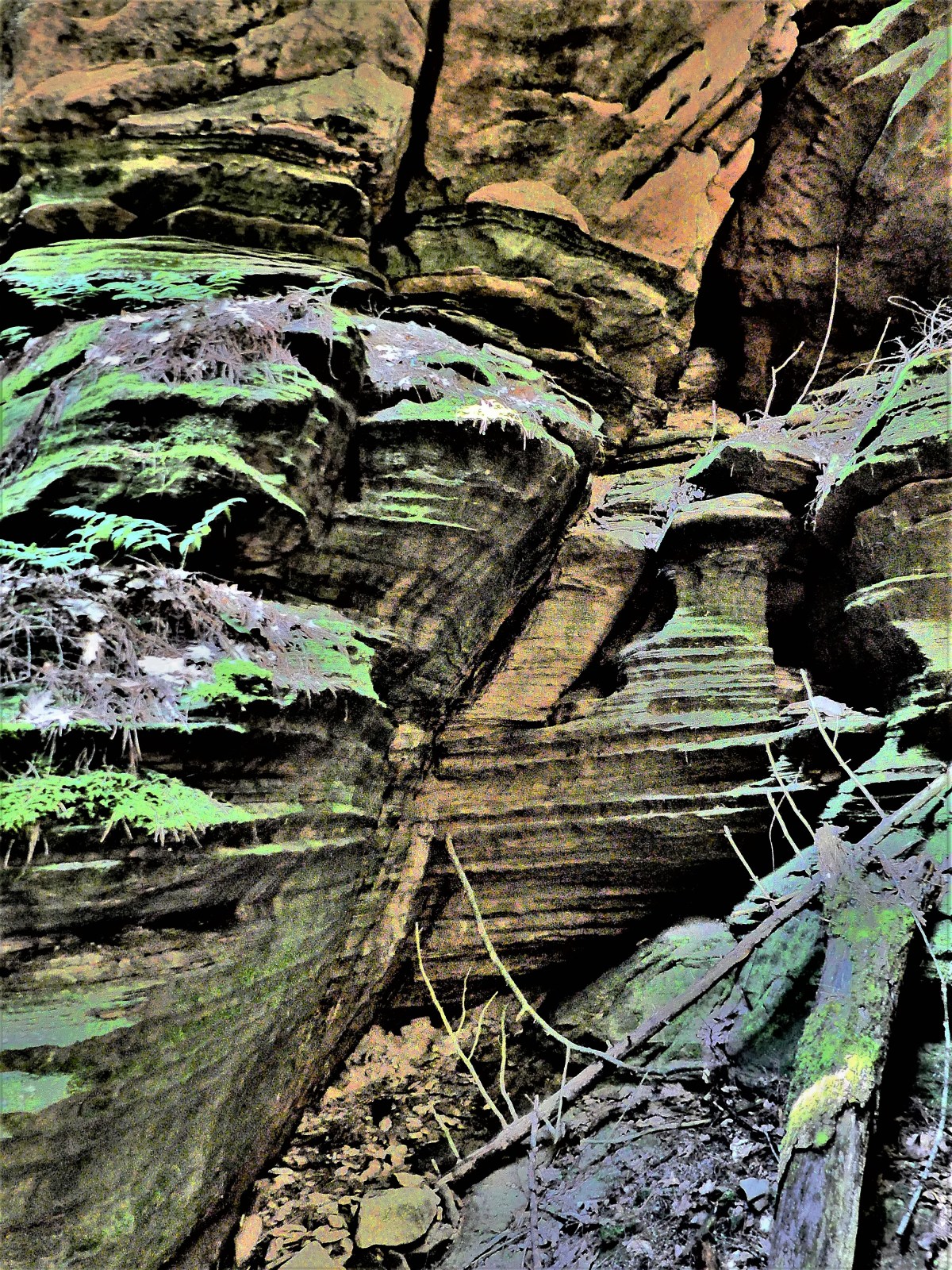
for a closer look at the beauty of ancient splittered sandstone turned emerald,
and the waves of light and darkness.
The Winnebego Gatekeeper and His Dog
Next, we cruised across the Wisconsin River to the western shoreline to visit the Dells’ most precious formation,
Stand Rock
made famous by H.H. Bennett’s photograph of his 17-year old son, Ashley leaping onto the column from a neighboring cliff in 1886.
Leaping the Chasm
We gathered under the rock for an equally impressive demonstration by a trained German Shepherd from Juneau County…
that jumped the 5-foot gap without hesitation.
We completed the trail back to the boat, passing other impressive formations along the way…
ToadstoolCave LipsThree Tongue Cave
until it was time to reboard the Marquette and return to the tour operator’s dock. As we cruised back under sunny skies, boat traffic on the river had blossomed.
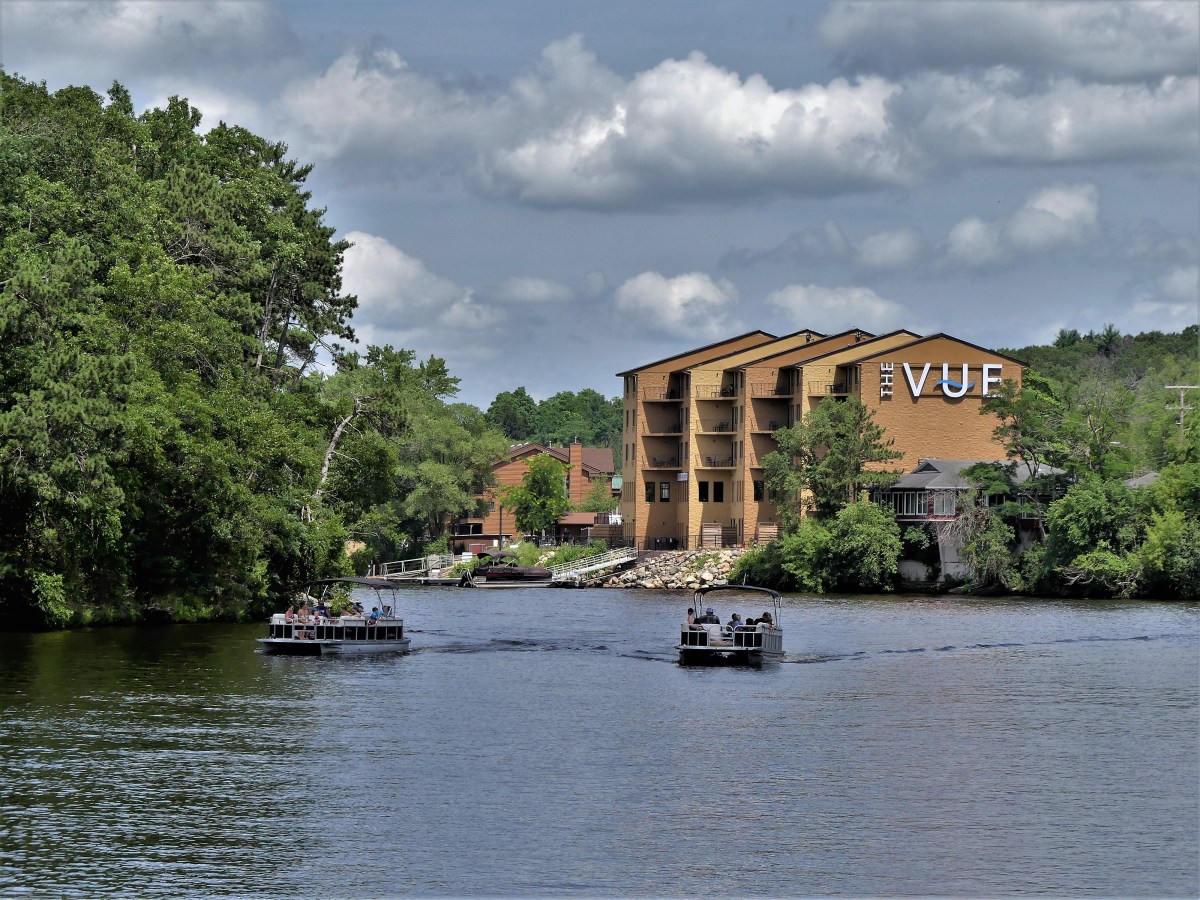
Locals were enjoying the river to beat the heat,
which was way better than any water park would ever be.
Many in the tourism industry descibe Door County as the mid-western equivalent of Cape Cod, and they make a valid point. If Cape Cod is the crooked finger beckoning the Atlantic Ocean, then Door County is Wisconsin’s thumb poking the western side of Lake Michigan. Both peninsulas offer a laid-back vibe, with historic beachtown pearls bordering sandy, rocky beaches.
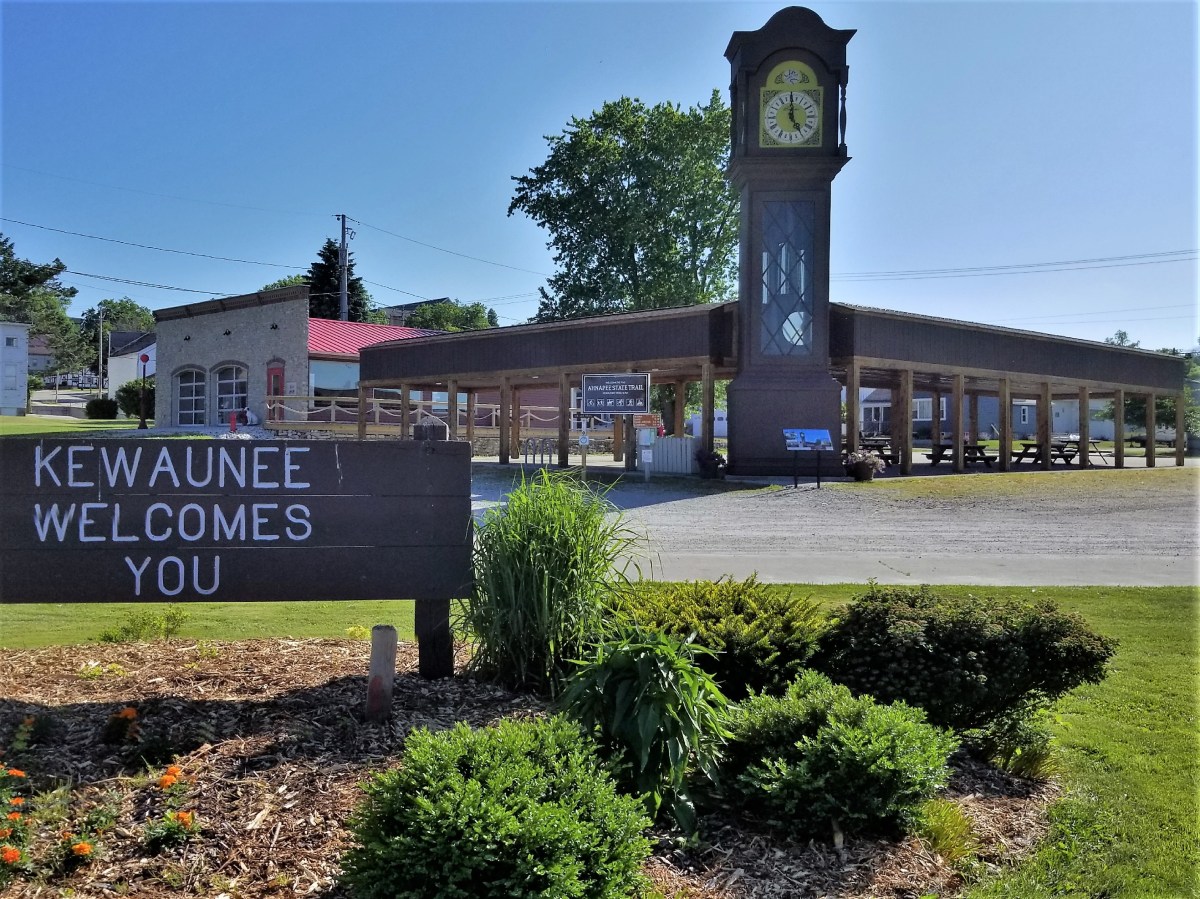
We began our tour by exploring our home base in Kewaunee, a southern border town below the county line.
We knew nothing about the clock, so it took us by surprise. At noon, it chimed over and over again, then played a “bell” rendition of Amazing Grace.
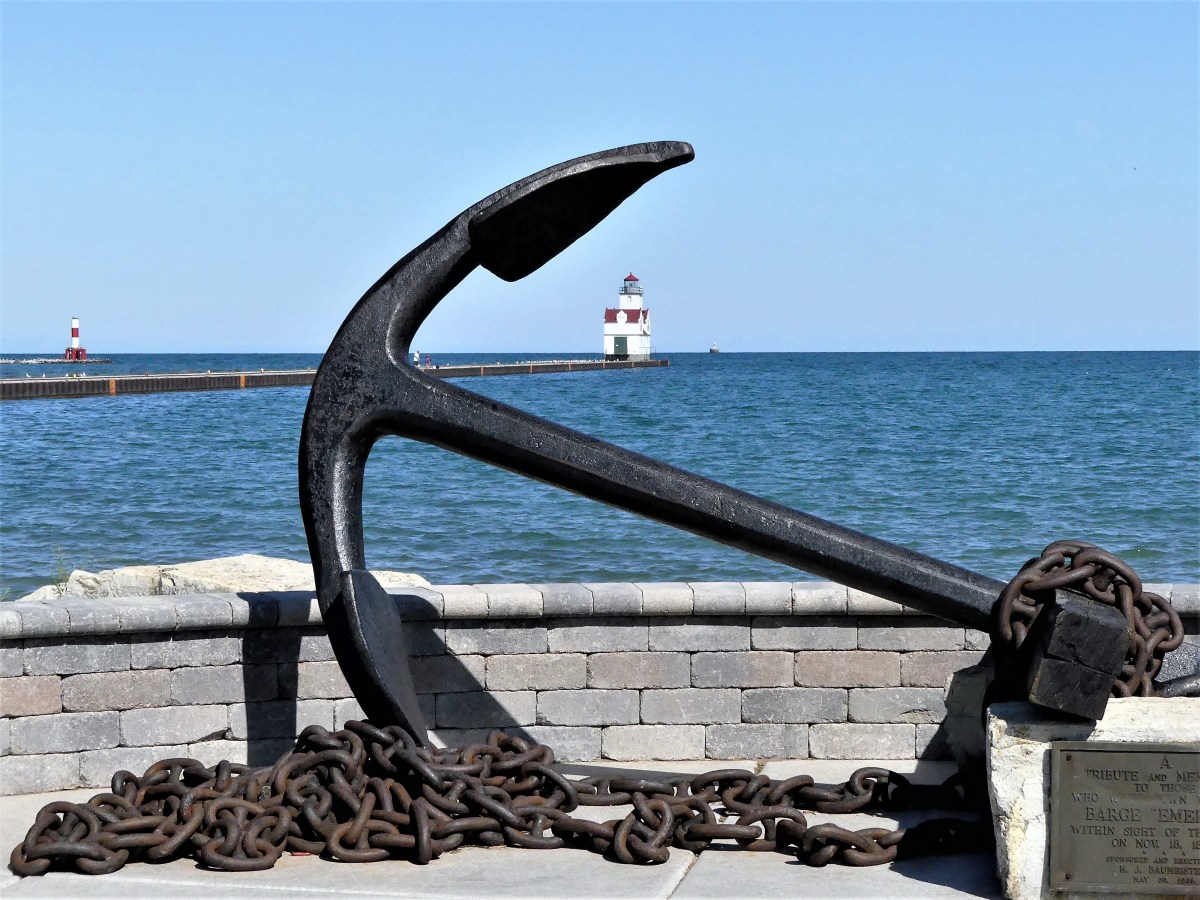
A short walk to the waterfront brought us to the Ludington. Retired in 1998, the tug saw action during the D-Day invasion at Normandy by pushing barges of ammunition across the English Channel, and later as a construction tow for the Army Corps of Engineers.
Like most newcomers, we got our coastal orientation by walking out to Pierhead Light,
but following the path was like a twisted game of minefield hopscotch.
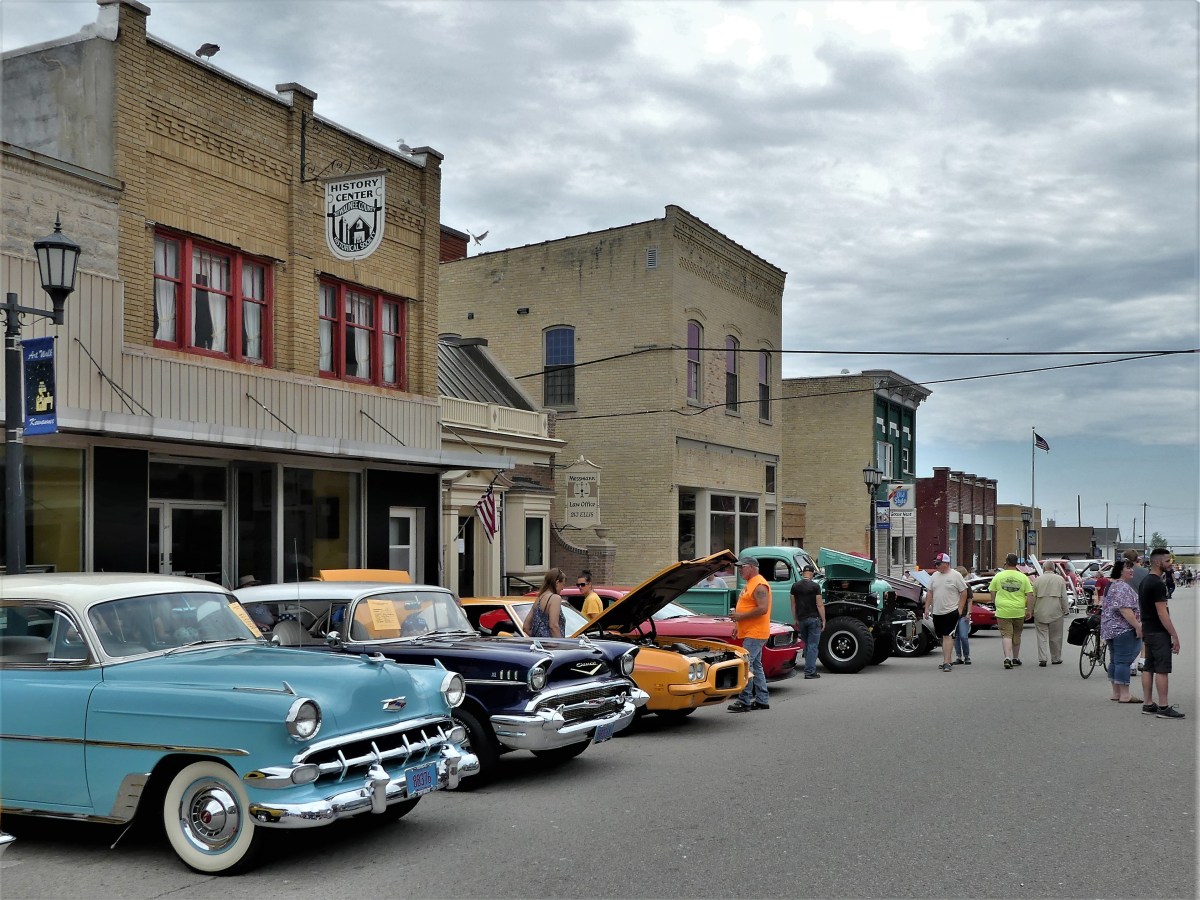
Ellis Street was closed to traffic for a smallish classic car show that appealed to locals, auto enthusiasts from Green Bay, and bloggers…
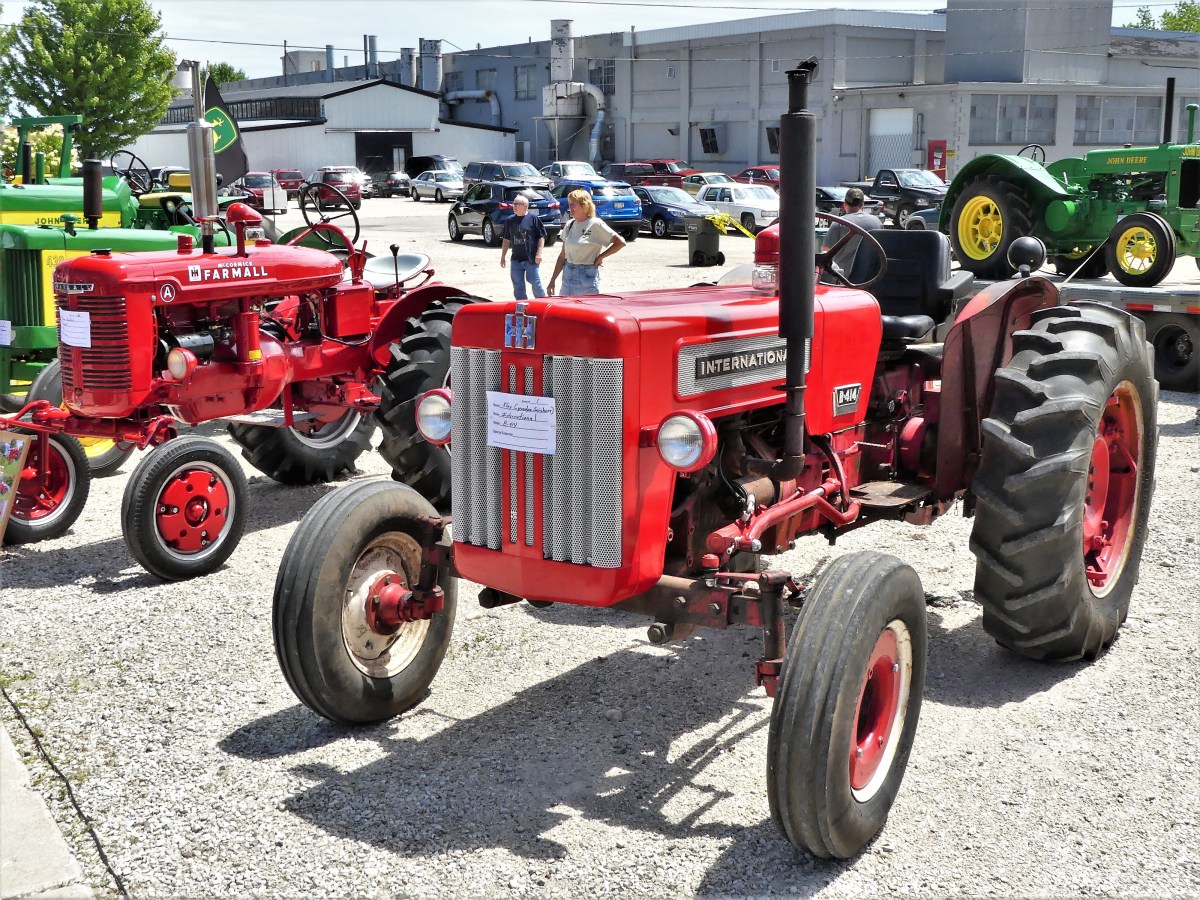
with plenty of space for antique tractors and snowmobiles in the parking lot.
Further up the coast sits Algoma, a town with a Crescent Beach Boardwalk that parallels an arc of sand and polished stones, and the Algoma Pierhead light that welcomes hundreds of roosting gulls at any time.
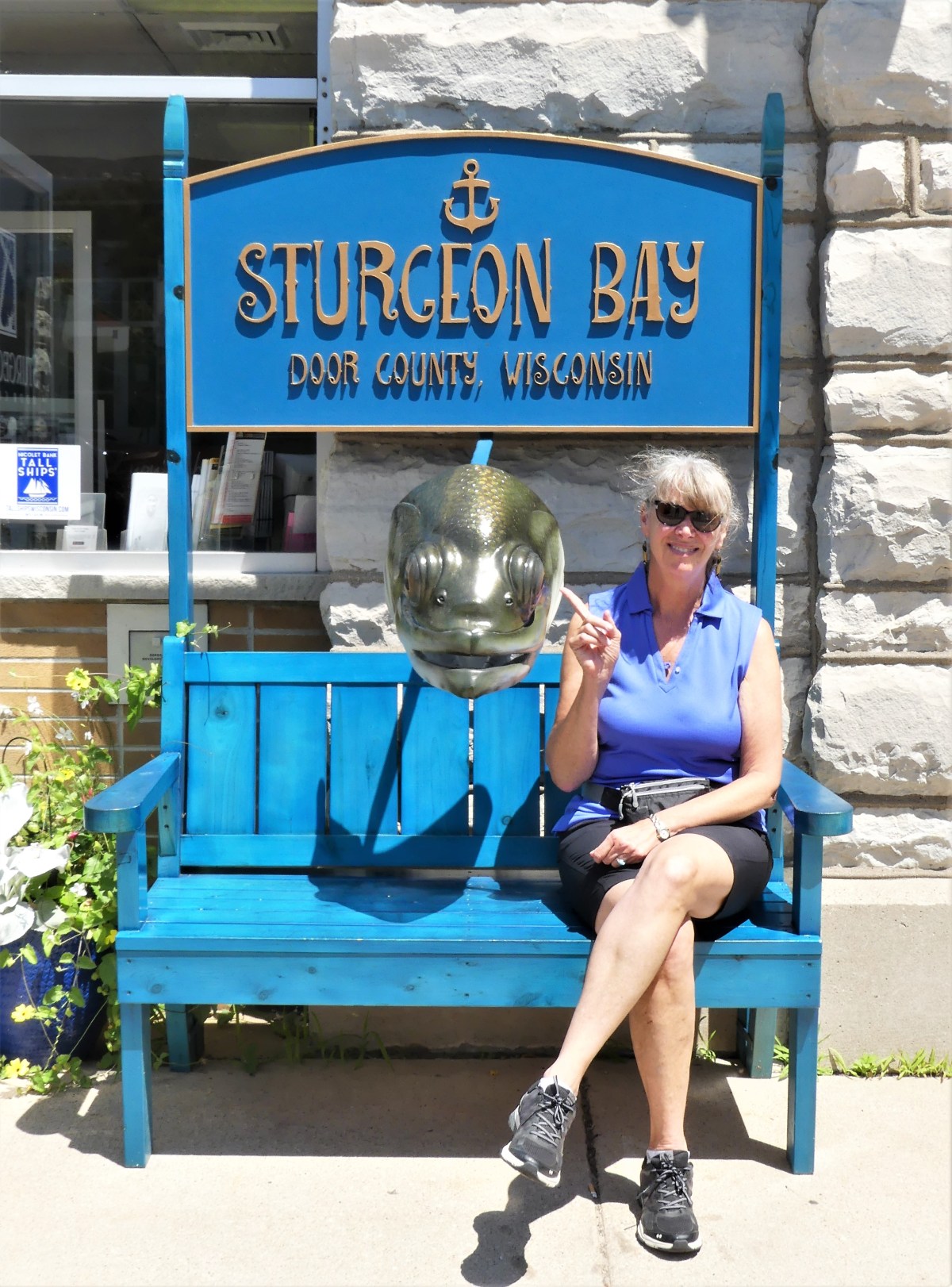
With so much ground to cover and little time to spare, we detoured along the coastal county roads to Sturgeon Bay, a town with a rich ship-building legacy and a lust for shopping. While not my favorite activity, we parked the F-150 and strolled the sidewalks, passing through galleries and home furnishing boutiques.
Local artists brought their imagination and decorating prowess to town, converting plain Adirondack-style chairs (or created a chair/bench of their own) for the inaugural CHAIRies, a public art project on display at most downtown corners, and a nod to the bountiful cherry groves scattered throughout the peninsula.
Continuing north, Jennifer (GPS) directed us to Cave Point County Park, the only county park within a state park (White Dunes State Natural Area).
Diving into Cave Point’s roiling water is a well-known proving ground and badge of courage for daring teenagers…
who are fortunate to clear the cliffs or avoid the crashing waves.
Riding north on WI-57, we cut through the middle of Door County’s thumbnail, and headed for Northport, known for ferry service to Washington Island at the tip of the peninsula. and the gateway to Death’s Door, a legendary passageway with a washing- machine turbulence that has shipwrecked many 19th century schooners.
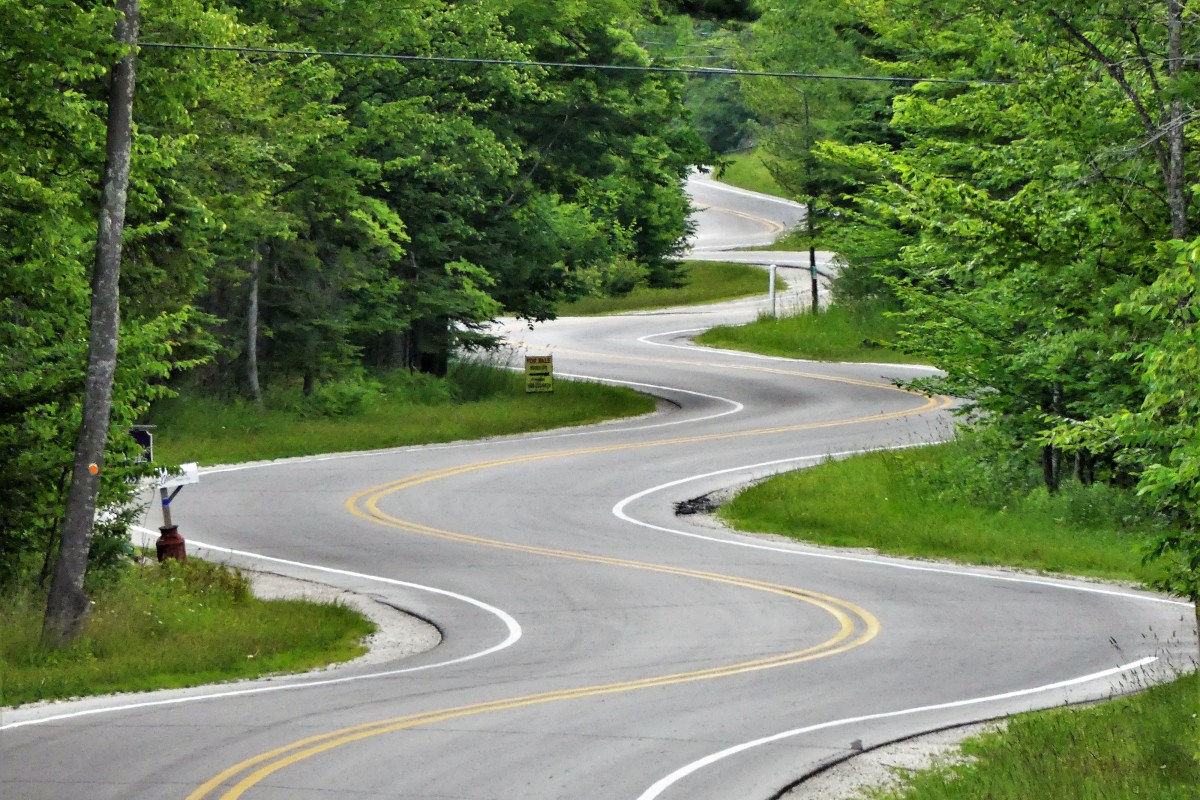
We rushed along WI-42 from Northport down Green Bay’s sidelines, needing to reach the Airstream end zone after a long day of driving, but deliberately slowing around a bendy stretch of road nearby.
Then we were dodging and weaving our way through a variety of pedestian-rich towns at 10 mph, absorbing the downtown charm of Ellison Bay, Sister Bay, Ephraim, and Fish Creek from the front seat of our truck.
We vowed that we would return the following day for a glorious sunset dinner, as we settled on leftover pizza and samosas under a cloudy sky.
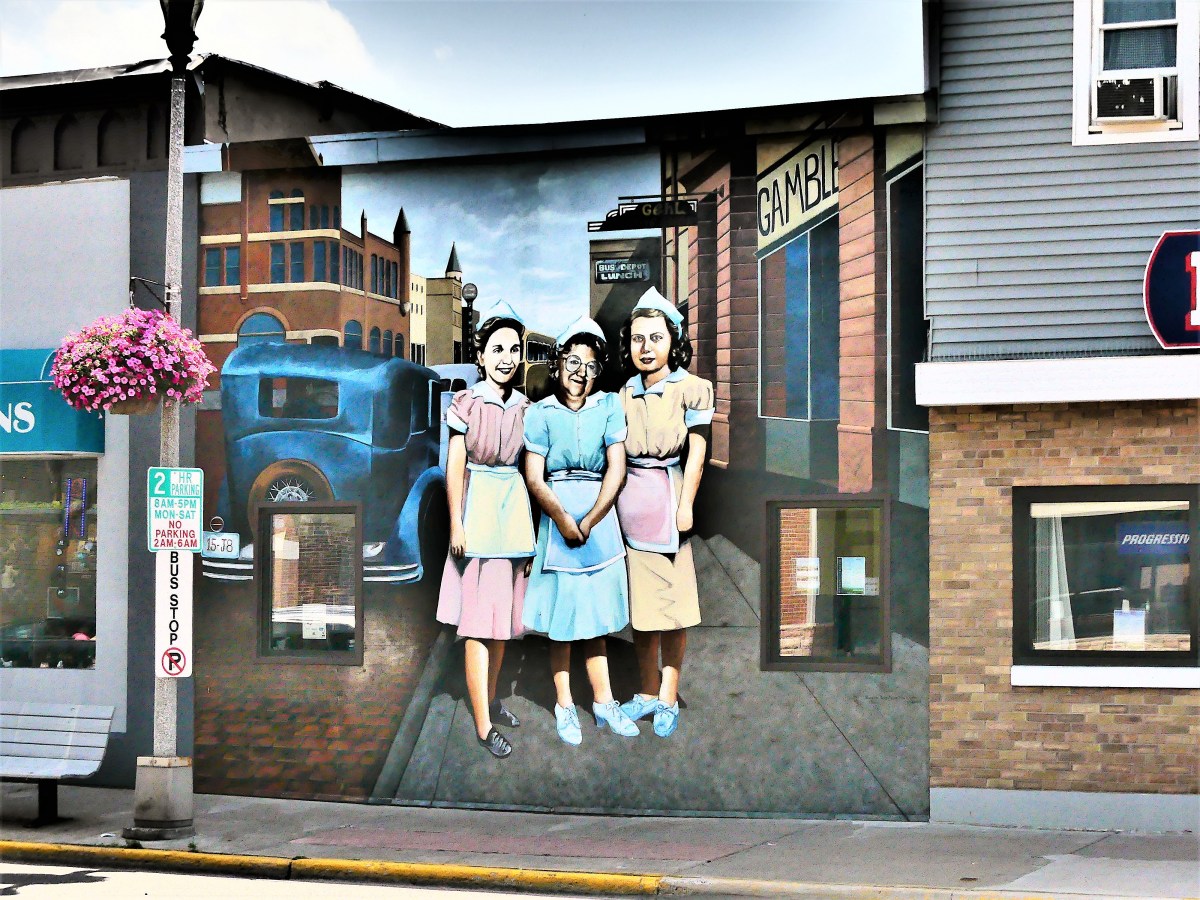
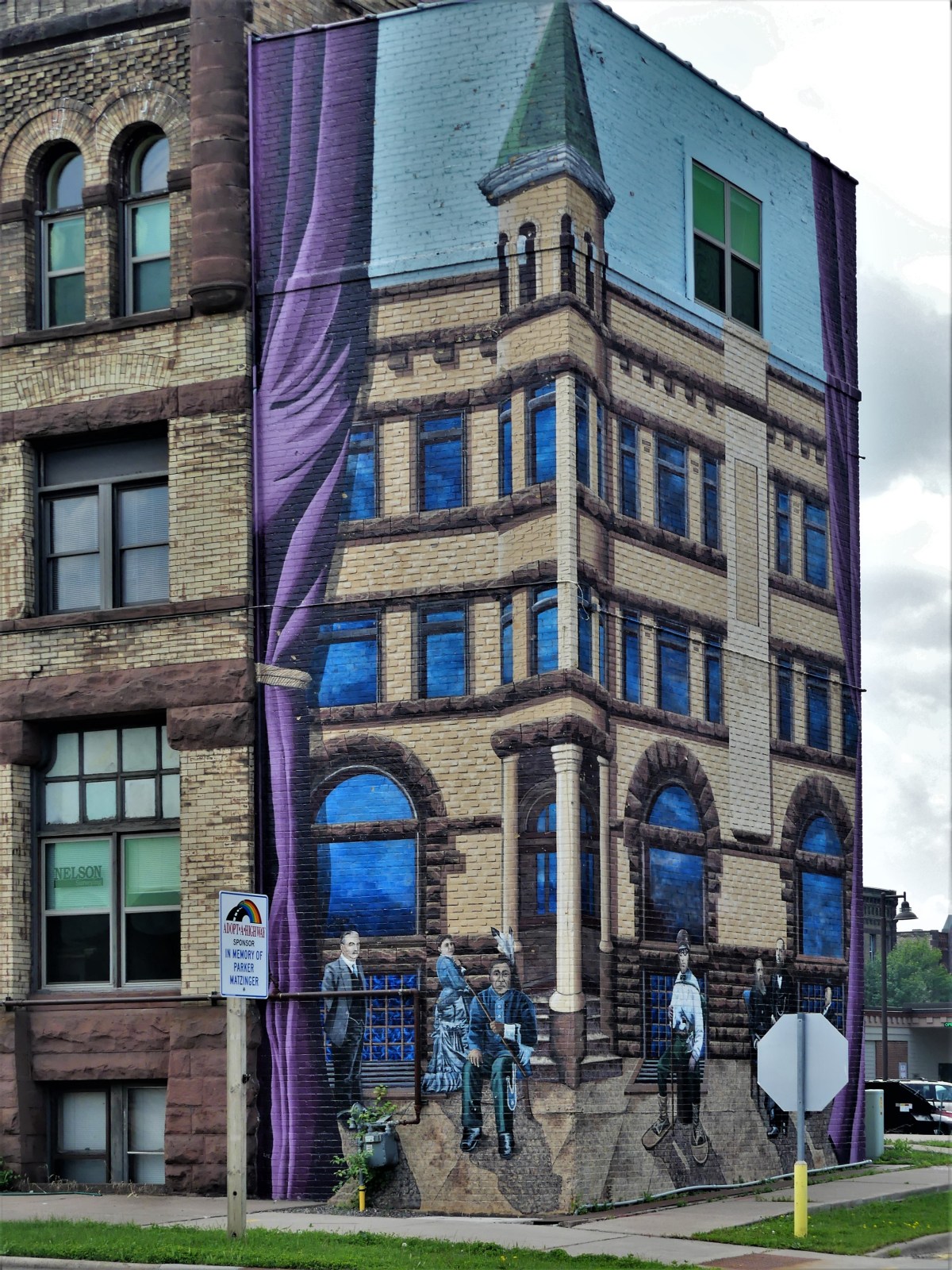
While staying in Bayfield, Leah and I learned of Ashland’s Mural Walk. While only a half-hour from our camp site, we were so preoccupied with three full days of hiking, biking, and kayaking around the Apostle Islands, that time became a factor.
When asking around about the murals’ merits, someone local described the trip as “interesting”, so we decided to make an informed opinion for ourselves. Since Ashland was on our way from Bayfield to Munising, we boarded the Airstream, checked out of Apostle Island Area Campground, and followed GPS to Ashland Mural Walk. An actual POI pinged when I asked Jennifer (our GPS coach) for the route.
We had completed a previous mural walk inPalatka, Florida, also a county seat, and found it odd that their murals were in better shape than the town. We wondered if this was also the case in Ashland.
Ashland’s history dates to 1500, when the Ojibwe stayed on Chequamegon Point. A century later, they were followed by French fur trappers, European traders, and Jesuit missionaries. By mid-1800’s, Ashland’s first settlement was established, and the town prospered as a major quarry and port with rail service to Chicago.
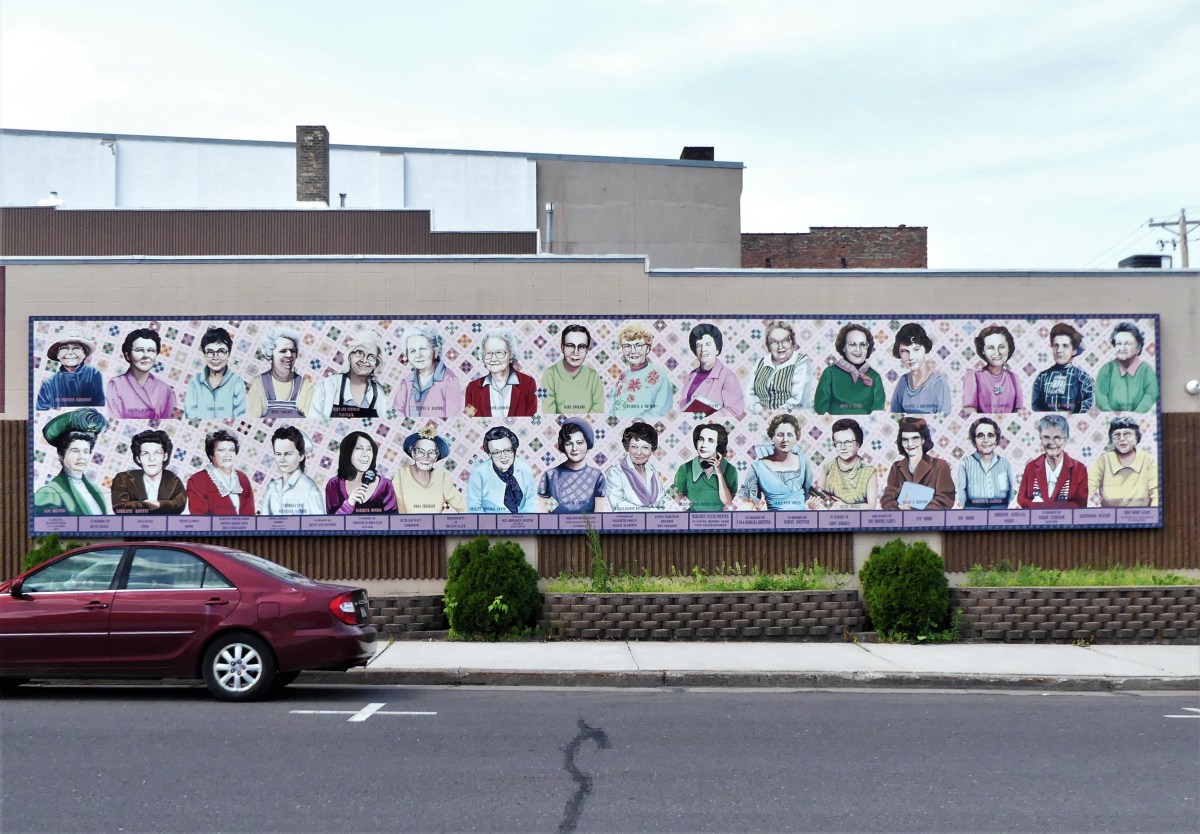
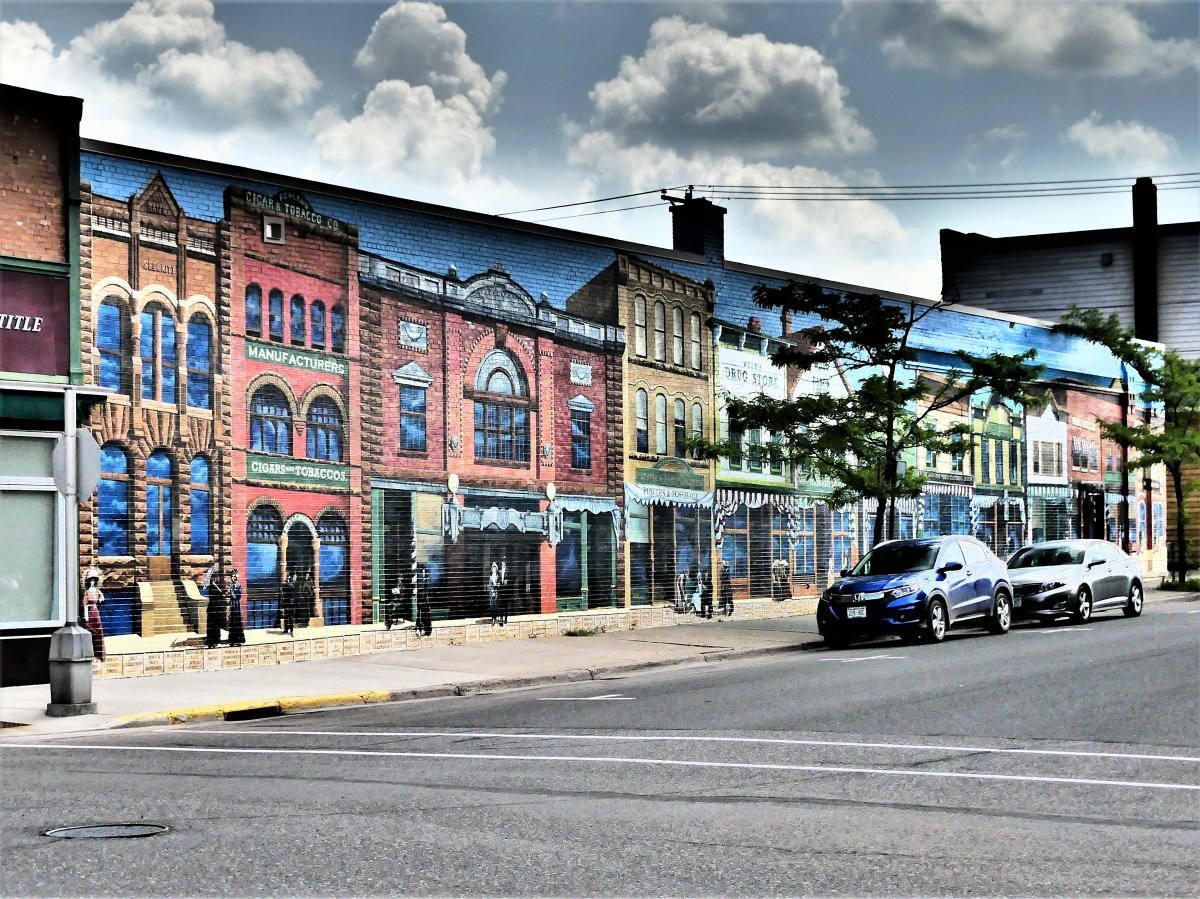
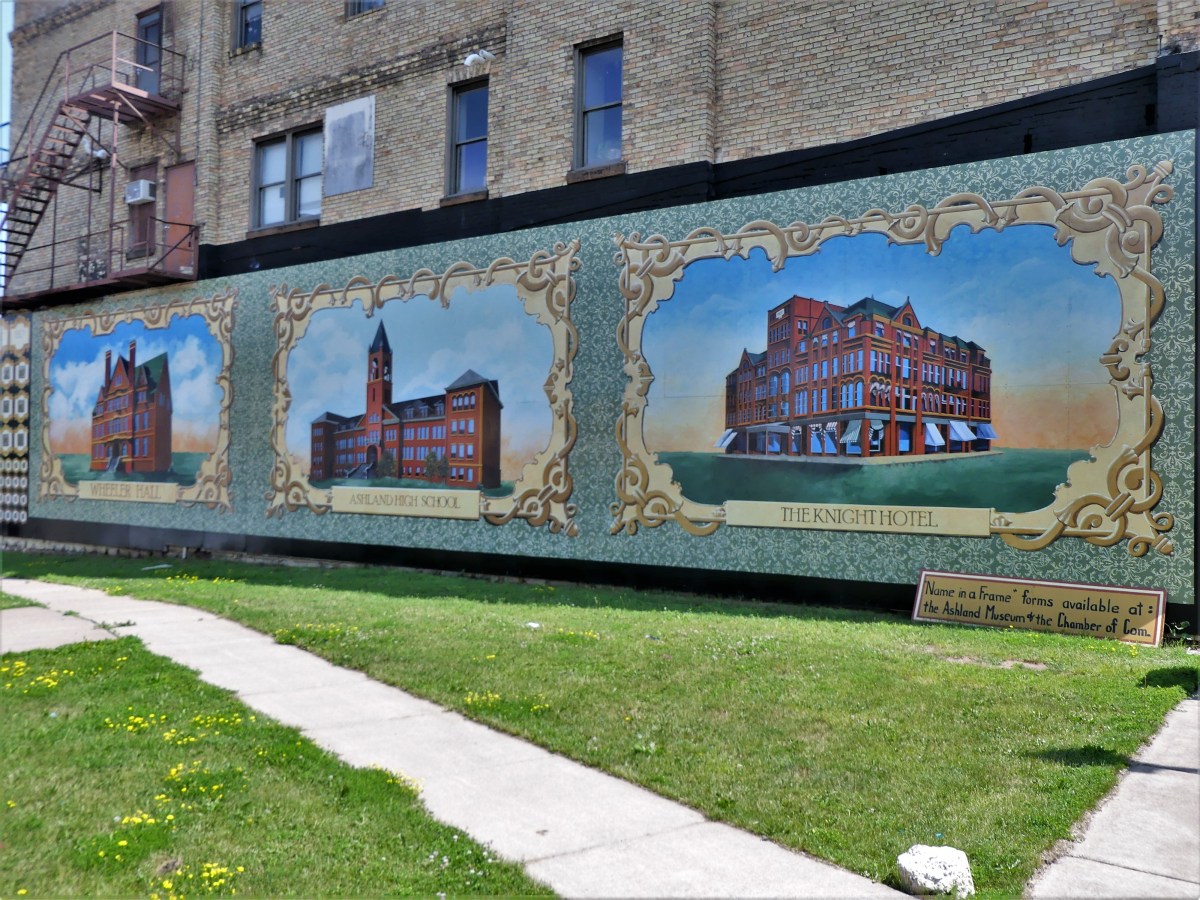
Thanks to mural artists Kelly Meredith and Susan Prentice Martinsen, Ashland’s murals are a pleasant recapitulation of their proud history and their community spirit.
The murals have been beautifying downtown for twenty years. But Ashland wasn’t content to rest on its murals. Since 2017, decorative mosaic containers have been popping up on Main Street, turning trash to treasure.
There are 18 murals located around an 8-block radius of Main Street’s business district.
Leah and I gave ourselves an hour to see as many as we could (we found 12), but a 4-hour drive to Musining still loomed large, so six were left undiscovered.
For additional information on mural titles, descriptions, and locations, or to see what we missed, aMural Walklink is provided.
Seemingly, Duluthians have only two seasons: winter and summer. During the 2018- 2019 weather calendar, city residents shoveled snow from October 10 to May 9, breaking a record dating back to 1884. Temperatures were moderate for the remaining months of the year.
But when the last snow melted, the Northlanders traded their shovels and skis for bicycles and hiking shoes–eager to take advantage of the wealth of recreational resources in the vicinity. Leah and I sampled some of the more popular options during our recent visit.
The 70-mile Hinkley-Duluth segment of the Munger State Trail offers hiking, biking, in-line skating and snowmobiling on a fully paved road, cut through a forested ridge that follows a busy railway.
Leah and I cycled a scenic 8-mile stretch from Buffalo Valley Camping (our temporary home) to the Carlton terminus,
where the trail parallels Forbay Lake…
until it crosses a nearby St. Louis River dam release.
Lunch at Magnolia Cafe in Carlton gave us the energy we needed to pedal back to camp. Kudos on the cold-brewed coffee and gluten-free chocolate chip cookies.
With our energy restored, we drove to Duluth in search of craft beer. Despite a population center under 90,000, Duluth has earned a reputation as Minnesota’s capital of craft beer, boasting more than a dozen production facilities in the area that are eagerly taking advantage of Lake Superior’s pristine waters.
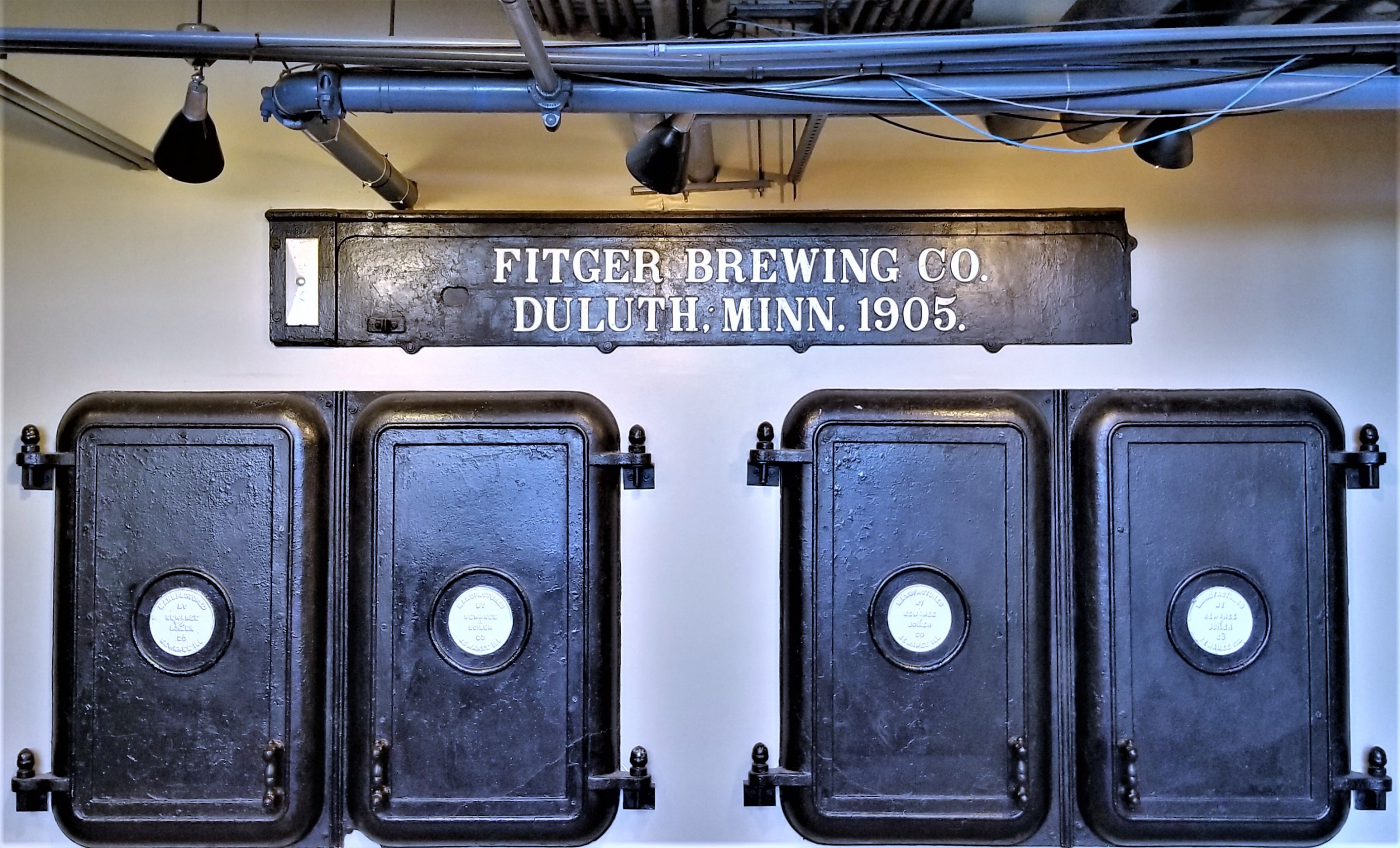
Fitger’s Brewhouse is the oldest and perhaps the most famous active brewery,
dating back to 1881…
with over 100 original recipes…
still brewed at its present location along the Lakewalk.
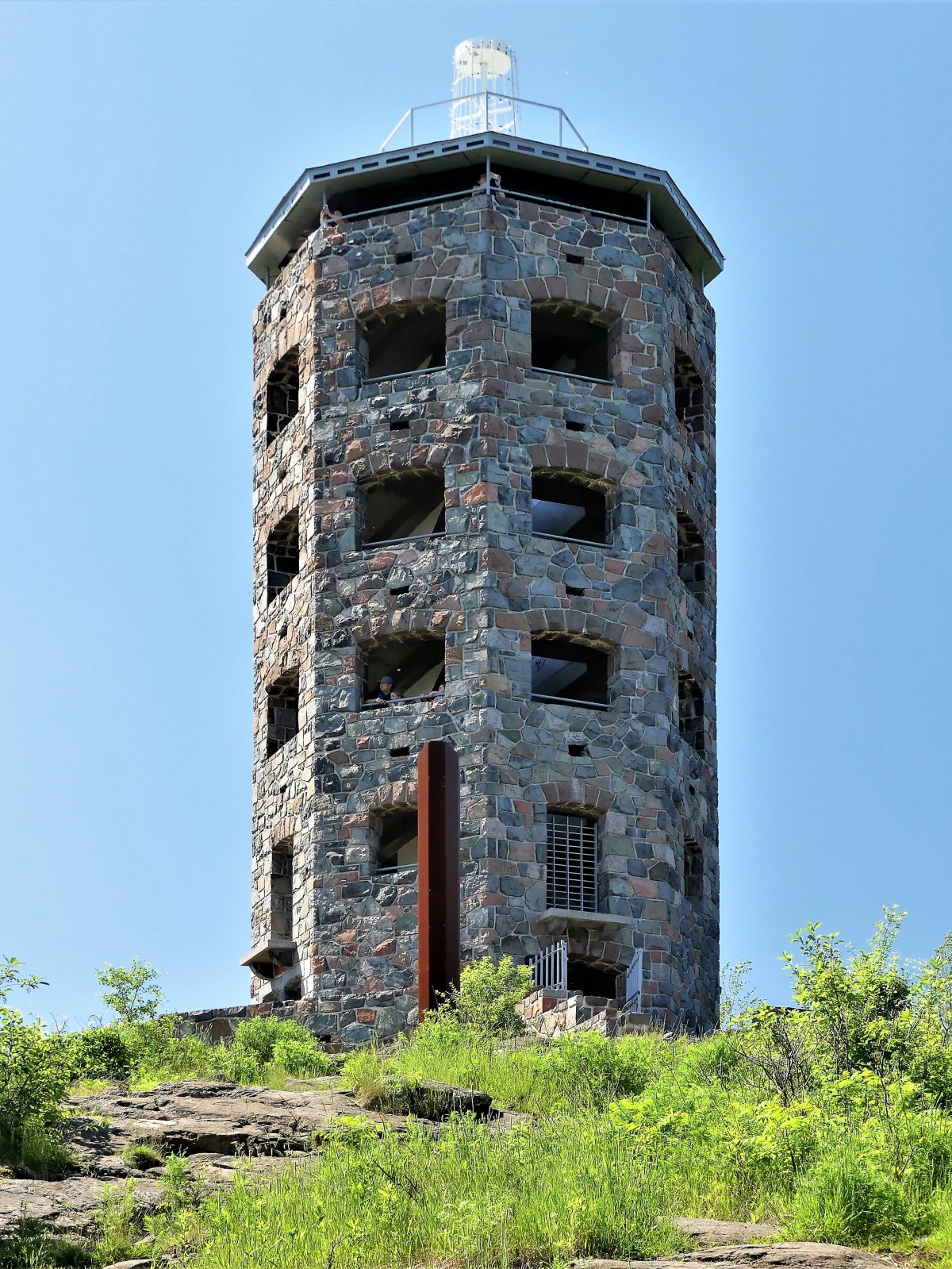
For views of the city, nothing beats Enger Tower, the highest point in Duluth,
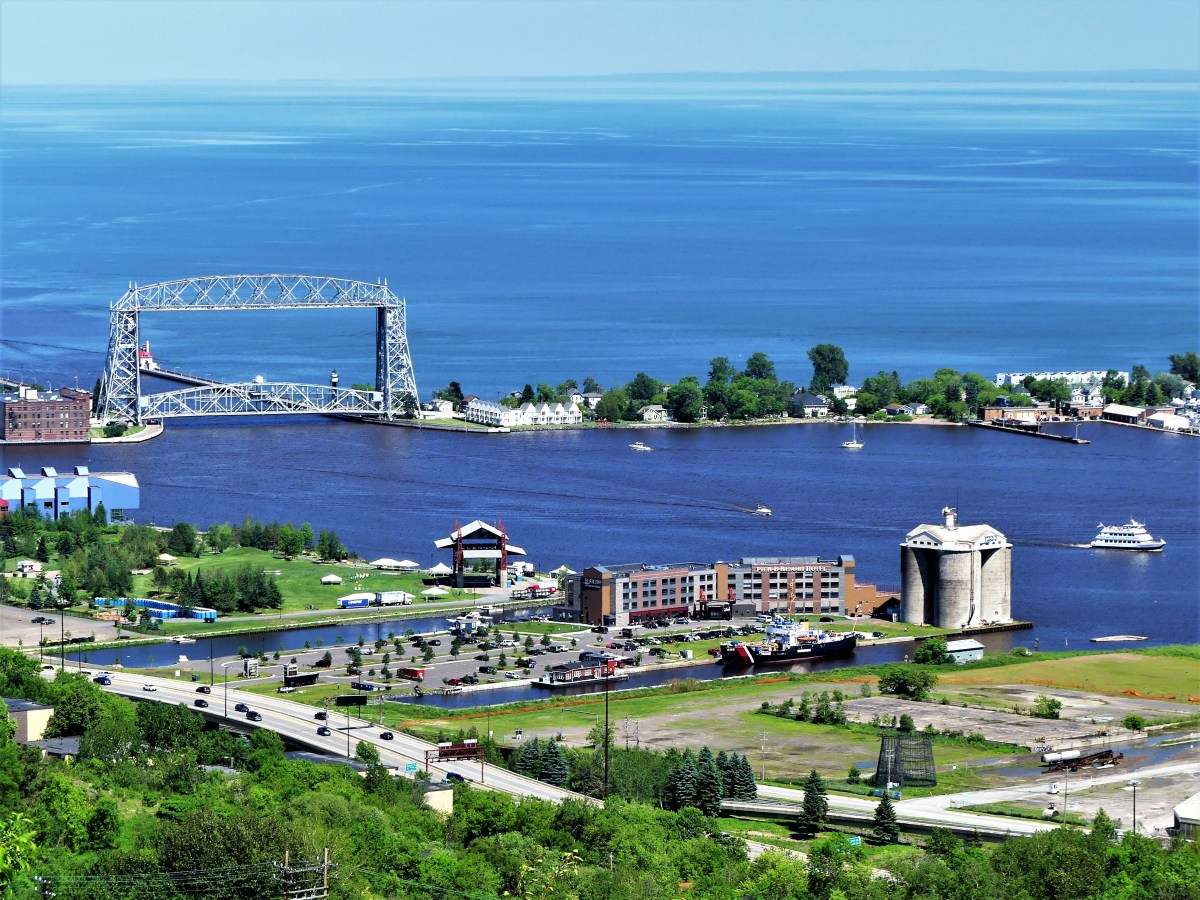
and no better place to see where the city opens up to the sea,
while revealing its industrial underbelly.
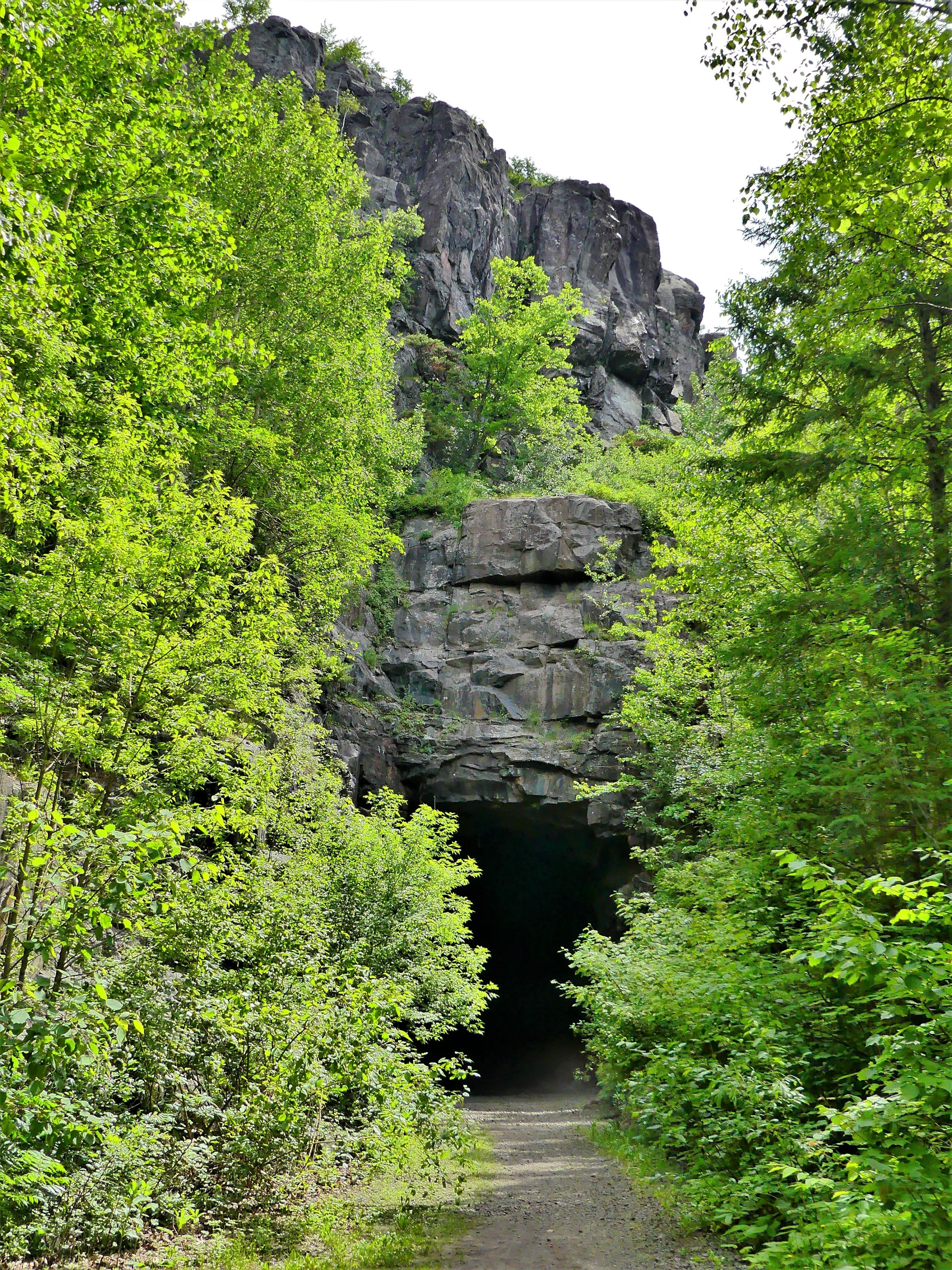
The following day, we were looking for a short but moderate morning hike. All internet indicators pointed to Ely’s Peak, a popular trail reached by following the abandoned Duluth, Winnipeg, and Pacific (DWP) railroad corridor to the entrance of a 1911 railroad tunnel.
The trail was named after Rev. Edmund Ely of Massachusetts,
whose mission was converting the Fond Du Lac Native Americans during the mid-1800s.
From the tunnel to the top and back is 1.8 miles. The loop takes hikers on a 300 ft. ascent offering far-reaching views of the Fond du Lac Reservation and beyond.
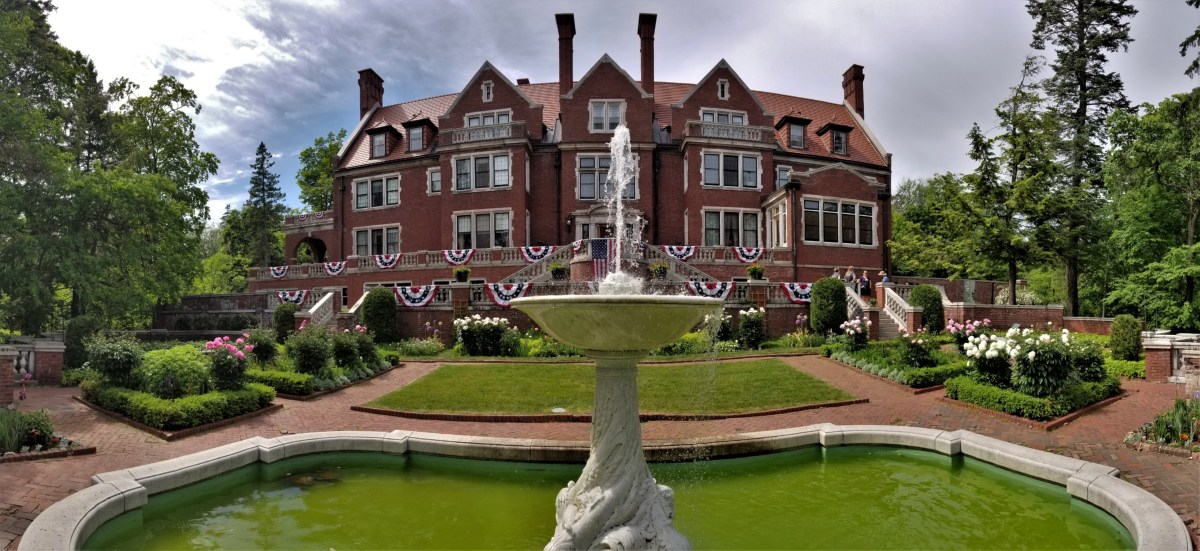
We spent the afternoon touring Glensheen, a 20,000 sq ft. Beaux-Arts-styled mansion surrounded by a 12-acre estate…
built beside Lake Superior between 1905 and 1908 by Clarence Johnston, Sr…
for Chester Adgate Congdon and family.
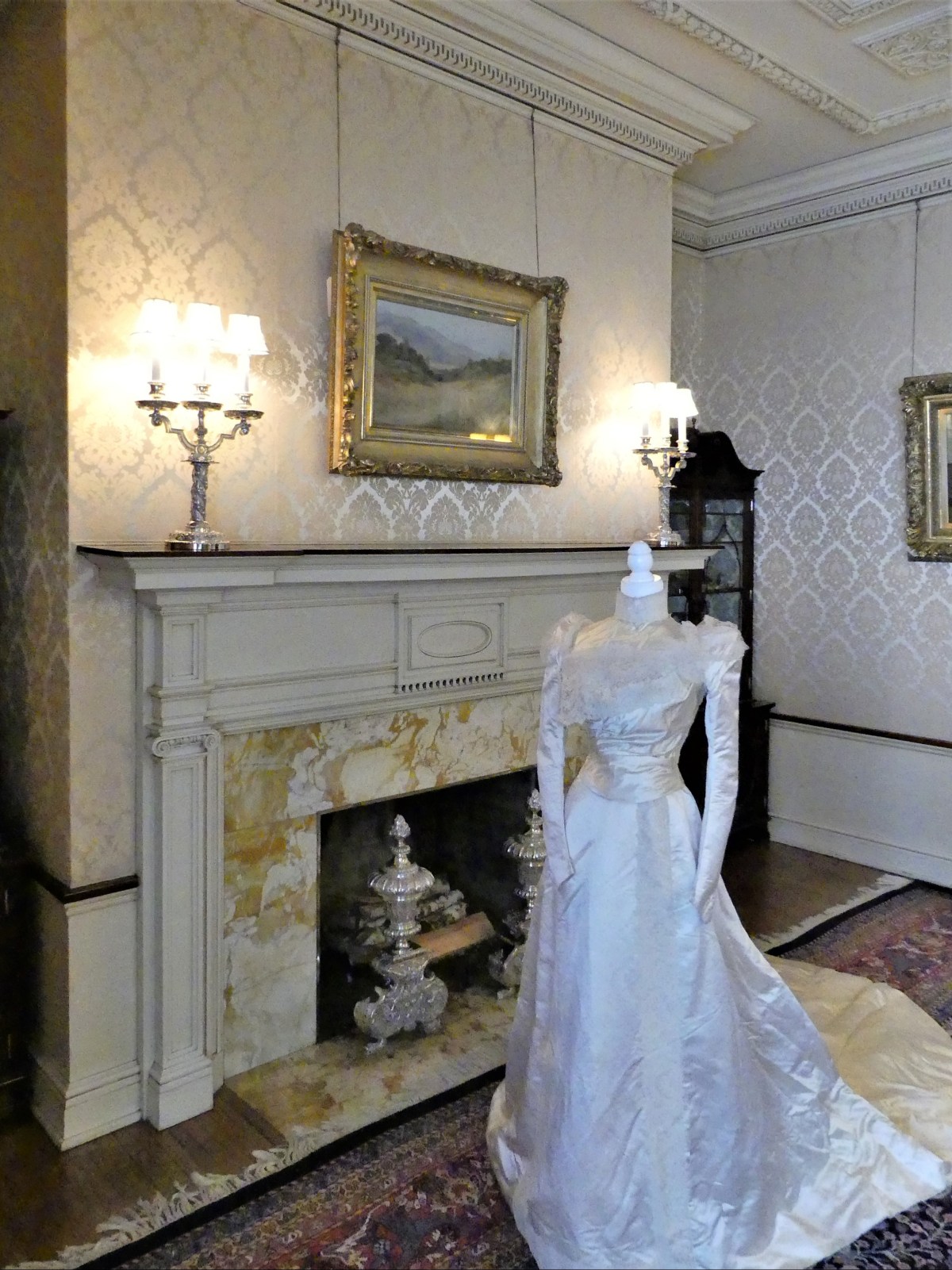
The 39-room historic mansion is reknown for its design and craftmanship of the day…
and that almost nothing from William French’s orginal interior design has changed in 110 years–down to the furniture placement…
and the accessories that adorn the house.
But the most unusual part of the tour was what Nick, our docent would not share with the group when asked about the murders of Elisabeth Congdon and her private nurse, Velma Pietila.
Instead, we were referred to a brochure card with a disclaimer and few details.
It was a brutal crime that was sensationalized by the media, and still remains unsolved.
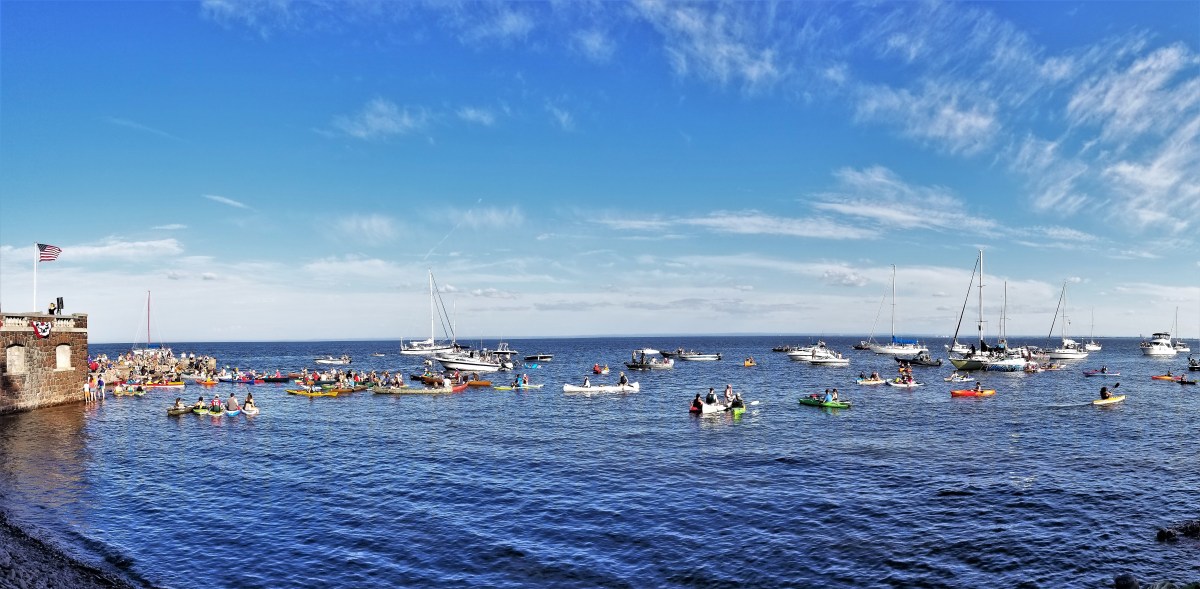
Leah and I concluded our day sitting in stadium chairs by the Glensheen boathouse pier, noshing on local food truck fare while listening to Charlie Parr, a local folk singer performing an evening of Minnesota moonshine music to kick off the 5th season of Concerts on the Pier.
It was the perfect way to end the day:
enjoying the sunshine and the breeze coming off the lake;
meeting and appreciating new people around us;
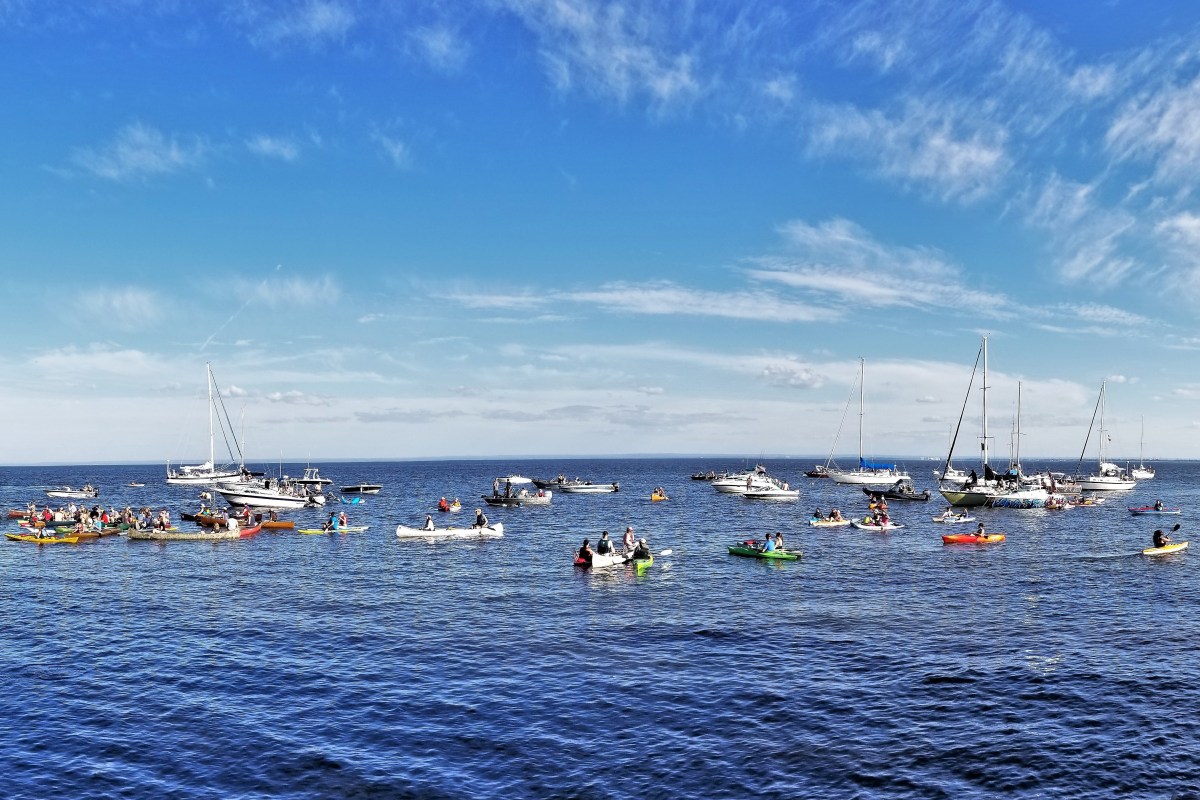
watching a mish-mash of vessels manuevering through an ad hoc harbor;
and being interviewed by Ryan Juntti, for WDIO’s 6:00 PM News.
Although it’s been two years since Leah and I visited Mt. Rushmore, what could be more American than re-posting this visit on Independence Day?
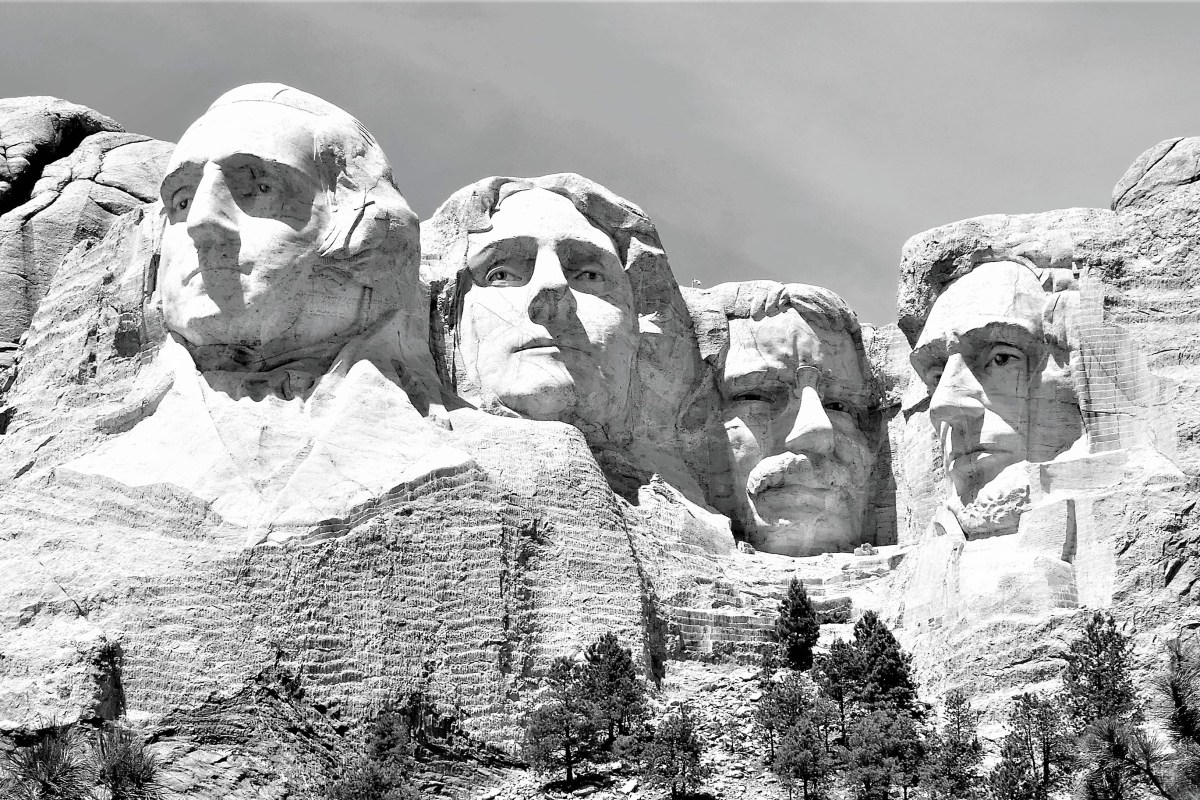
There’s no better way to celebrate the 4th of July, than a trip to Mount Rushmore and the Crazy Horse Memorial. Sure, the crowds were large; that was to be expected. But once the cars were garaged, the pedestrian traffic was easy to negotiate. And with everyone looking up at the mountain, the Presidents’ faces and intentions were never obstructed.
It was also a time to celebrate family. There were plenty of kids riding in strollers, hanging from moms in carriers, or balancing on dads’ shoulders. Generations of families–many of them immigrants–had gathered to pay homage to the principles of freedom that make our country a beacon for the oppressed and downtrodden.
Seniors were being escorted through the Avenue of Flags by their grandchildren. Extended families organized group pictures at the Grand View Terrace, unified by their love of democracy and their reunion T-shirts.
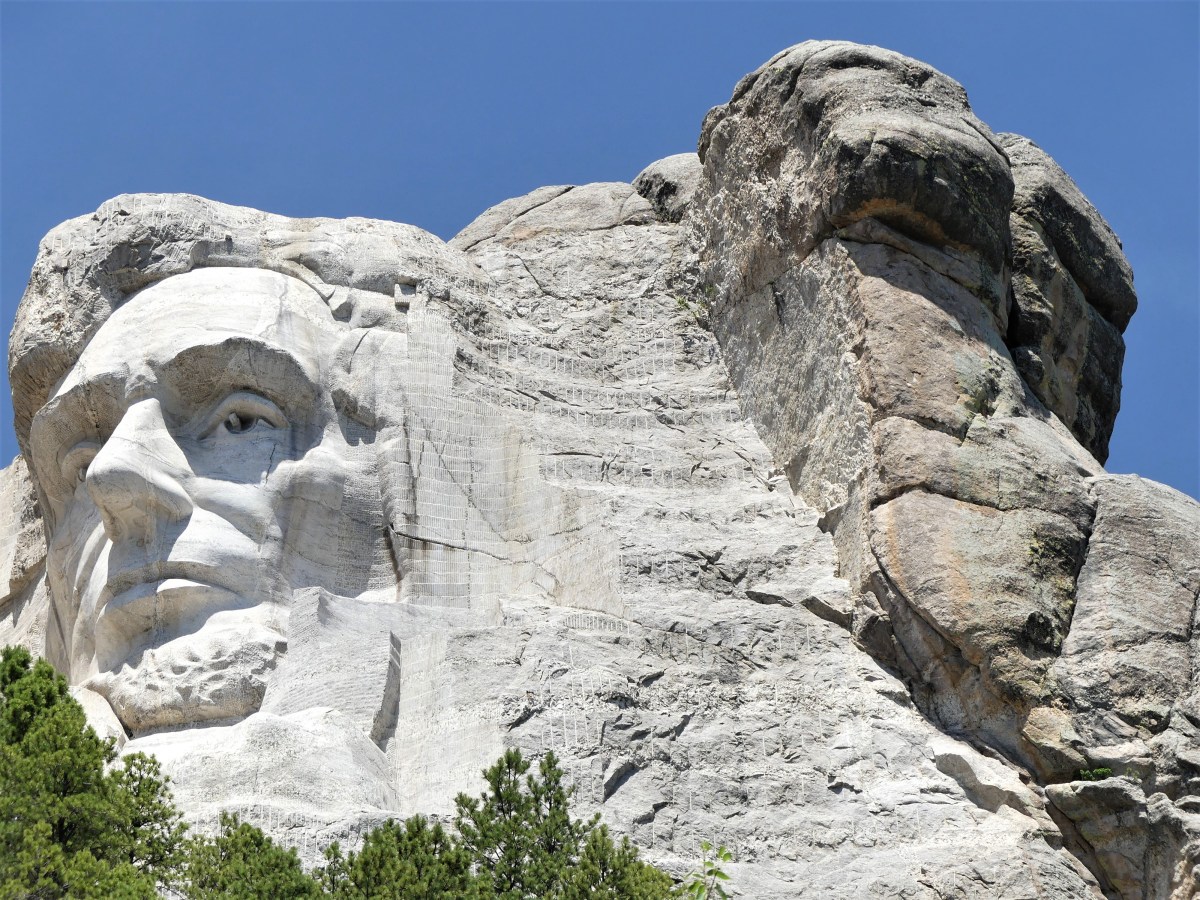
All expressed awe at Gutzon Borglum’s grand vision and remarkable achievement–the transformation of a mountain into a national symbol visited by approximately 3 million people every year.
The 14-year process of carving the rock began with dimensionalizing the Presidents’ portraits through Plaster of Paris masks, on view at the sculptor’s studio-turned-museum.
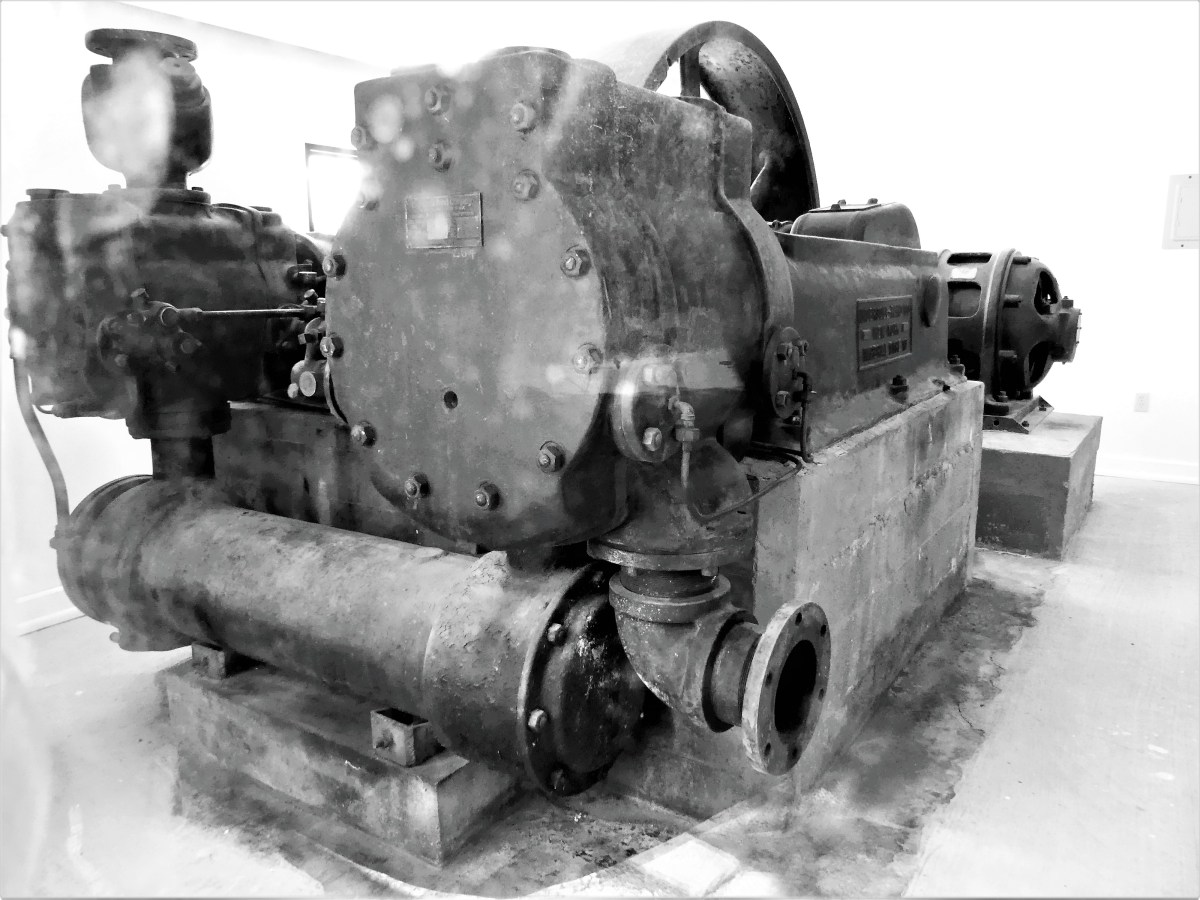
Additional exhibits detail the construction of the memorial, and the tools used by workers, like the original Rand & Waring compressor, which powered the jackhammers for all the finishing work.
A little known fact is that Mt. Rushmore was once intended to be a tribute to the “Five Faces of Freedom,” but funding ran short when the Congressional appropriation approached $1 million during the Great Depression. Hence, the unfinished carving of the Great Ape to the right of Lincoln serves as a reminder that we are never far from our true ancestors.¹
No less ambitious, and equally as impressive, the Crazy Horse Memorial is a work-in-progress located 16 miles away in the heart of the Black Hills–considered sacred land by the Lakota people.
Conceived by Korczak Ziolkowski in early 1940s,
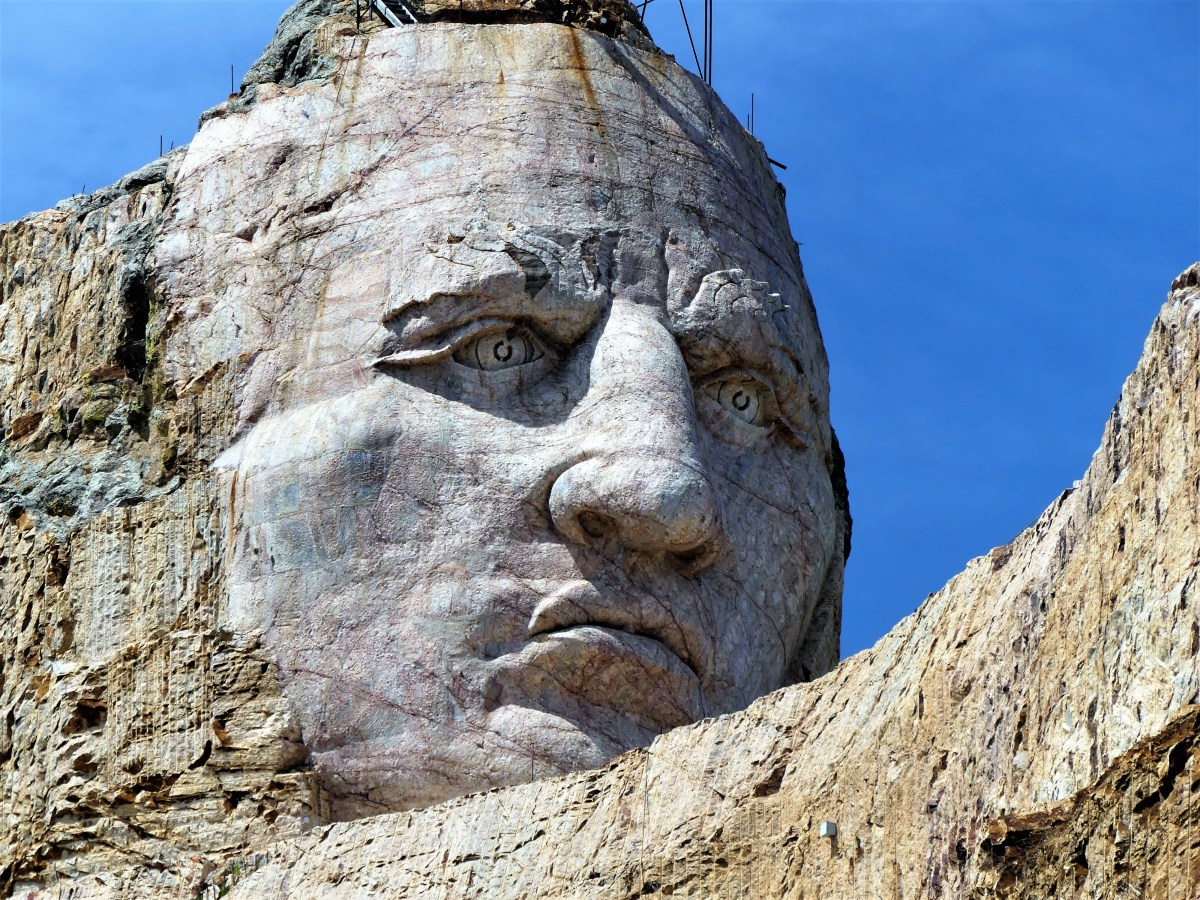
the memorial, when completed will stand 563 ft. by 641 ft. across, and is expected to be the largest sculpture in the world. Already, the completed head of Crazy Horse measures 60 feet tall…
…twice the size of any of the presidents at Mt. Rushmore. While the first blast was conducted on the mountain in 1947, the current prospects for the memorial are to complete the outstretched arm during the next twelve years. There is no completion date available for the finished carving, which has been financed entirely by private funding since its inception.
Mt. Rushmore was created by a Danish American. Crazy Horse was created by a Polish American. And visitors to both destinations manifest the melting pot that has brought us all together as Americans. It’s our diversity that makes us strong, our ambition and determination that makes us great, and our compassion and sacrifice that make us whole.
These are the values reflected from the faces we’ve immortalized in stone. Yet, we would honor them more by living according to these principles.
Happy Birthday, America!
¹ Just kidding, but the photograph is real and has not been retouched.
After one month of travelling along Lake Ontario, Lake Huron, and Lake Superior in Canada, we crossed the border into Grand Portage, Minnesota to continue our Great Lakes circumnavigation through the States. We made Duluth our first stop.
Our reservations, made months ago, took us to Jay Cooke State Park–about 10 miles south of Duluth– where we planned to camp five nights through July 4th, but not without sacrifices.
RV enthuthiasts would agree that a level pull-through site with electric, water, and sewer is the norm for comfortability. But a site that also offers cable TV service with highspeed internet is the Holy Grail. Sadly, Jay Cooke was offering us a back-in site with 30 amp service only…for three nights. The other two nights, we were assigned to a primitive site inside the park with no amenities. This was the best Jay Cooke State Park could offer, considering the popularity of the park and high demand for the holiday week.
Originally, we called around to other area campgrounds and RV parks hoping for better accomodations, but found no availability anywhere else. By default, we accepted our fate and placement at Jay Cooke, and considered ourselves fortunate to find any place at all to park our Airstream during Independence Day festivities.
We crossed the border into Central Time, and surrendered an extra hour of daylight in exchange for arriving at the park office during operating hours, and giving Leah one last chance to modify our reservation.
Not a chance; the park was completely booked! We were directed to site 38 for three nights, and redirected to site 66 for the balance of our time.
After 40 minutes of queueing to fill our tank with fresh water, we eventually found site 38 down a very narrow access road lined with crowded spruce trees. No matter how many times I tried, and I tried, I couldn’t swing 28 feet of Airstream plus bicycles into a shallow site without sacrificing my truck to the evergreens. Simple physics wouldn’t allow it.
Leah sought a refund, while I investigated last-hope possibilities, nearby.
As if by magic, I called Darren at Buffalo Valley RV Camping, only a few miles away, who minutes ago received news of a cancellation. And just like that, we had a new address…with electricity AND water.
The following day, Leah and I strolled along the first two miles of Duluth’s 7.5 mile Lakewalk, stretching from Canal Park through Leif Erikson Park to Lester Park.
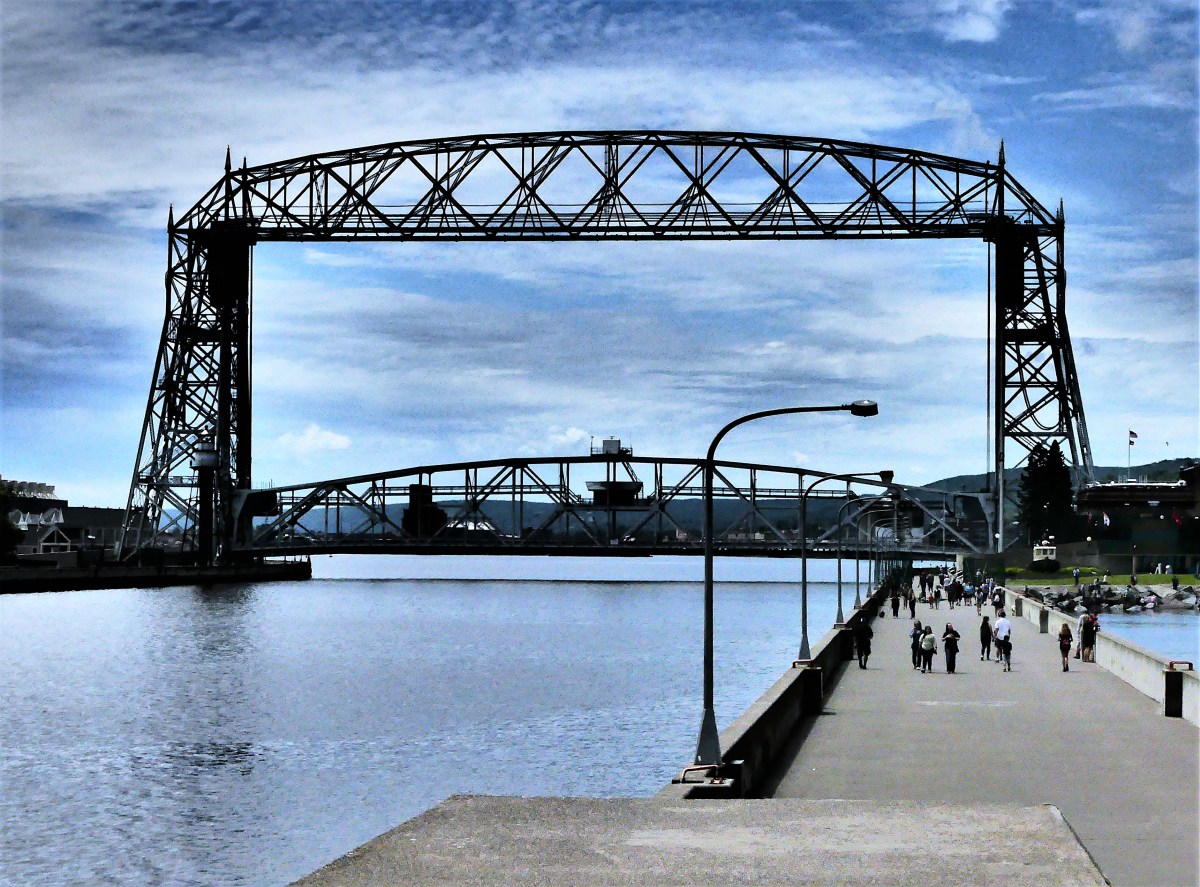
Starting out at Canal Park, I was drawn to Duluth’s iconic Aerial Lift Bridge that guards the entrance to Superior Bay,
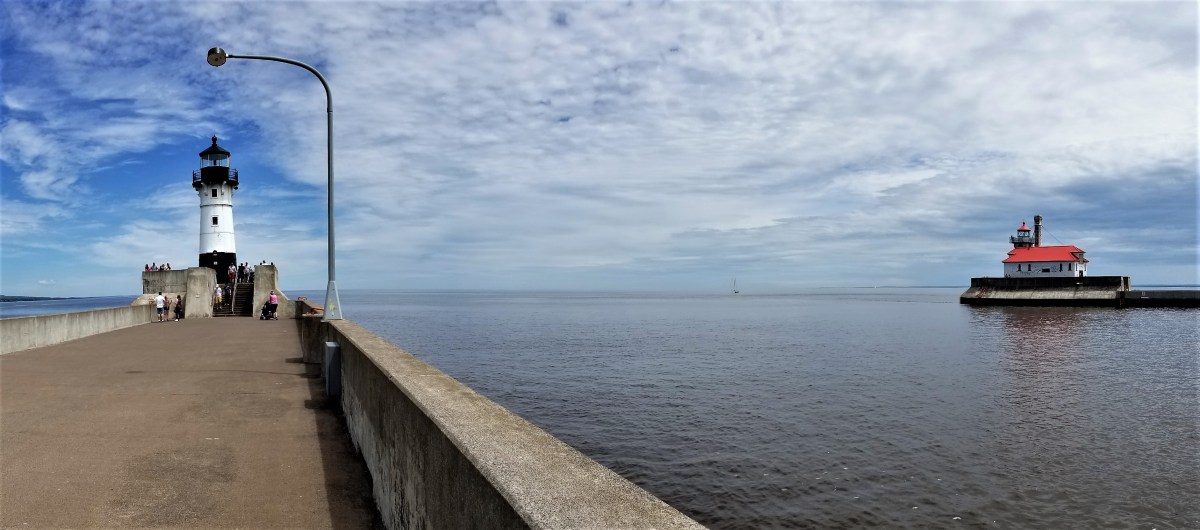
supported by two sentry lighthouses that jet out to meet Lake Superior.
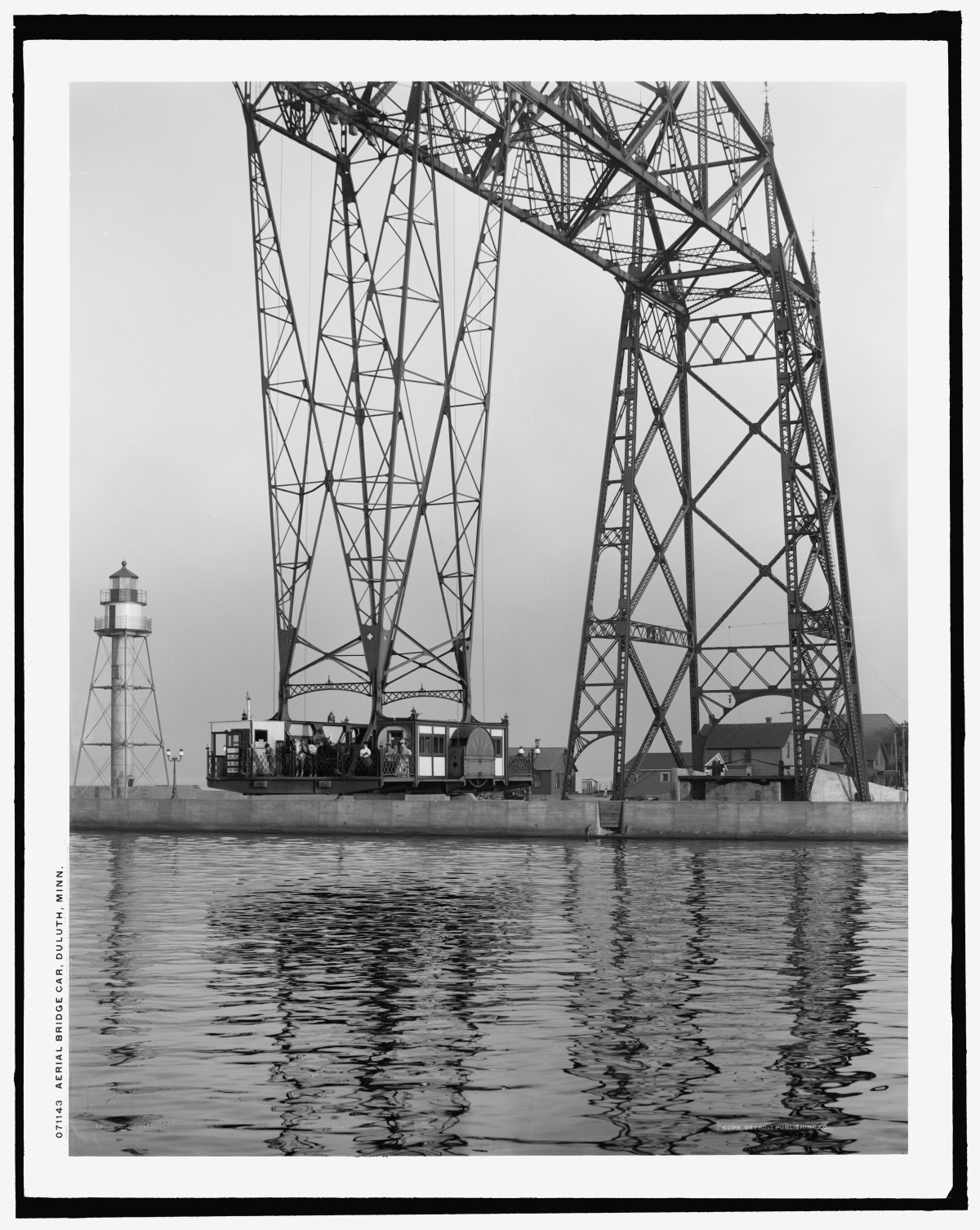
Originally conceived as America’s first transporter bridge in 1905, passengers and freight were ferried across in a large gondola.
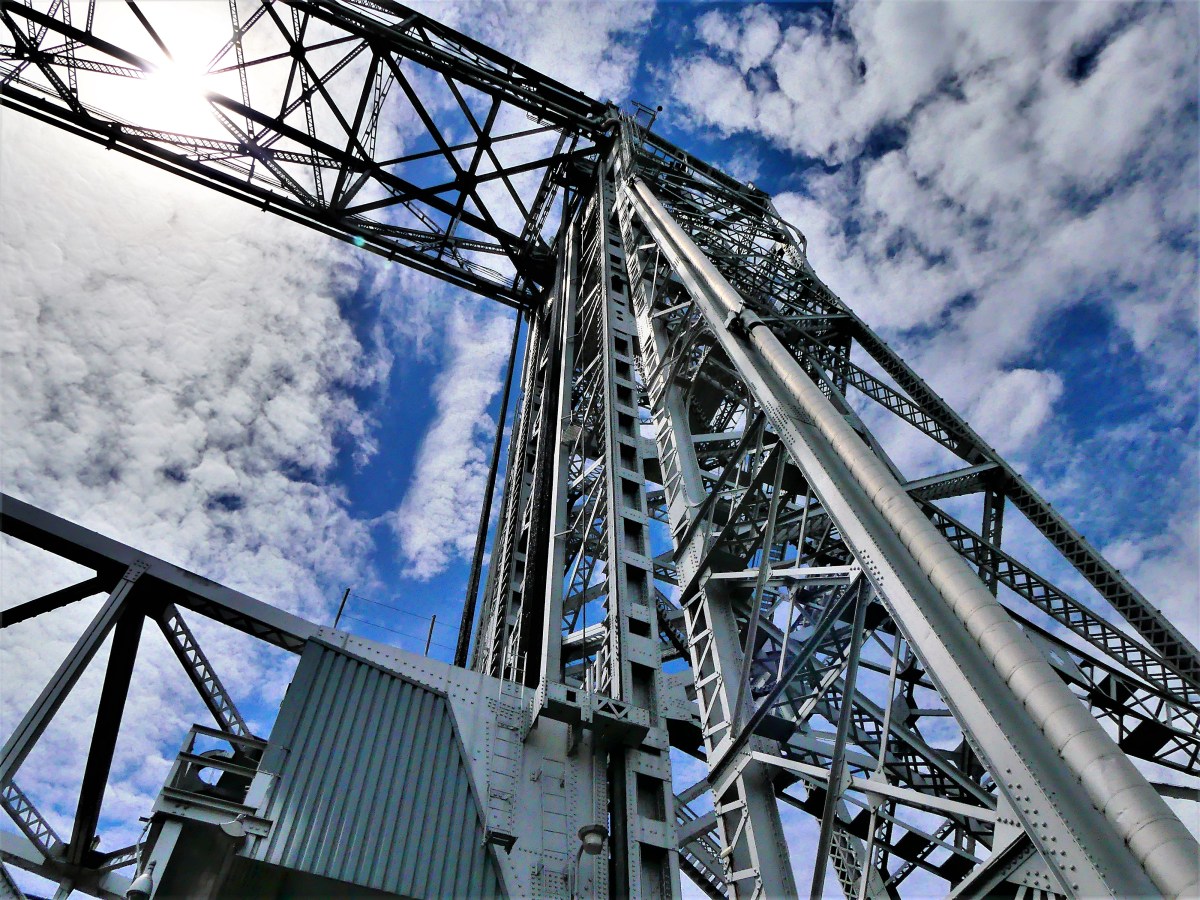
In 1930, the bridge was reimagined with a vertical lift,
and continues to operate much the same way to date.
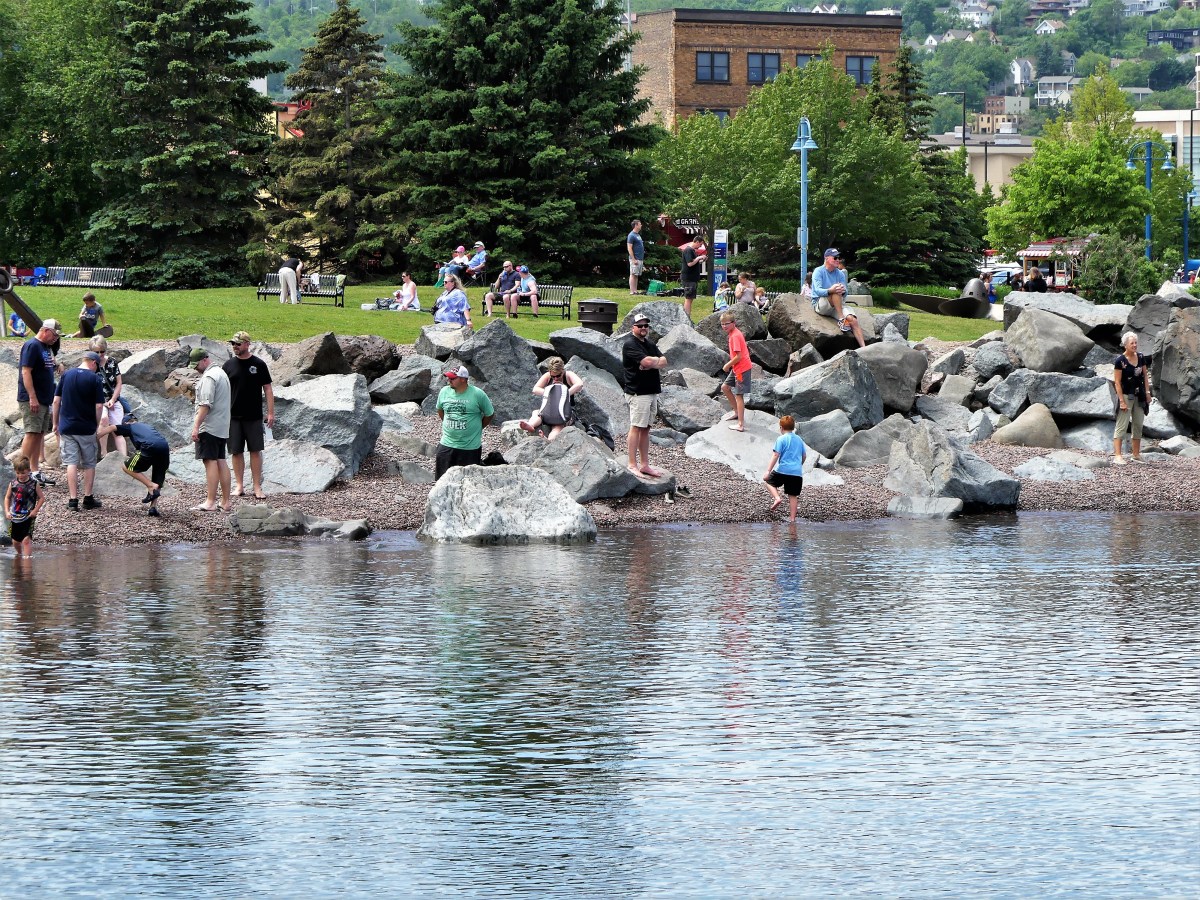
The warm air prompted scores of beachcombers to scramble across the rocks in search of beach glass,
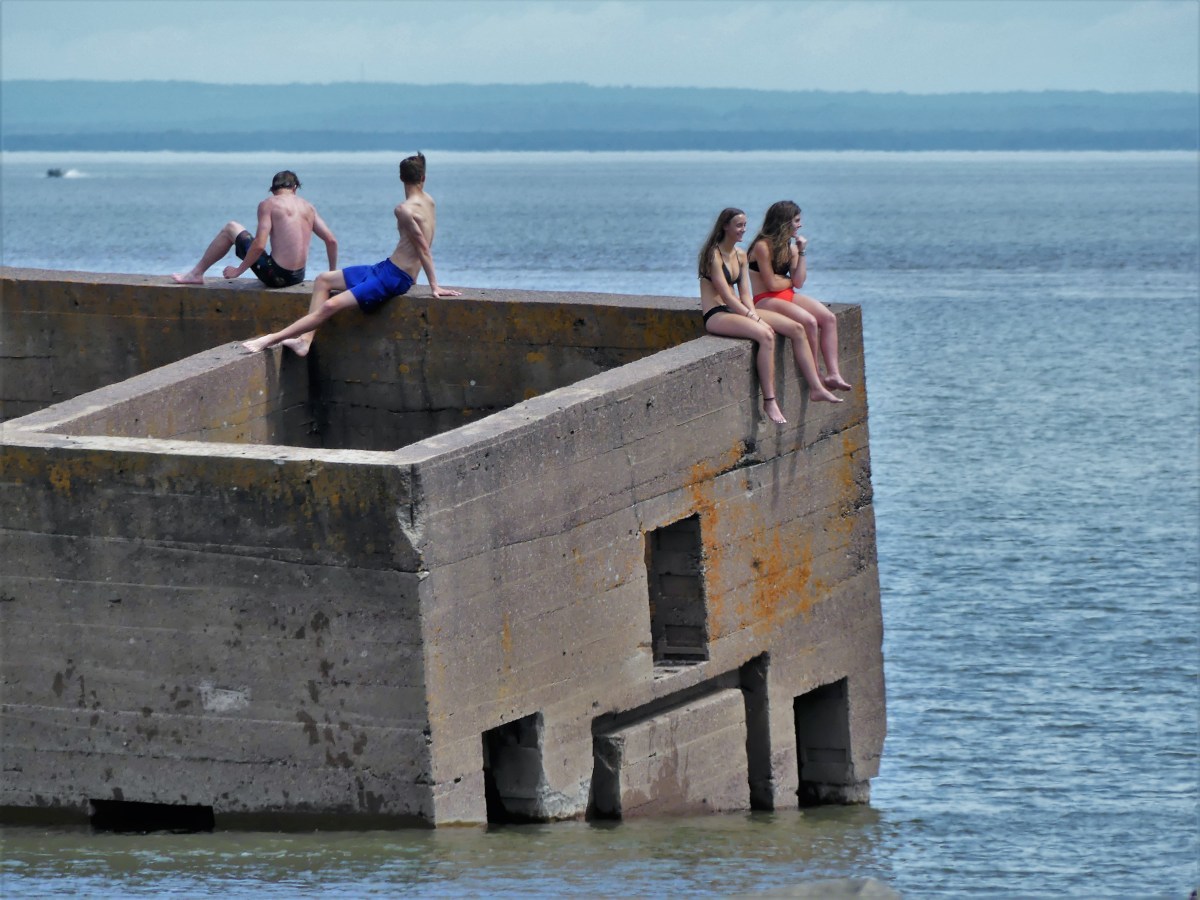
while a few brave souls channeled their inner polar bear by swimming out to “the cribs” in frigid water.
We followed the Lakewalk to Fitgers with a few notable detours along the way.
Free samples were irresistable at Rocky Mountain Chocolate Factory, and star-gazing at Duluth Trading Company…
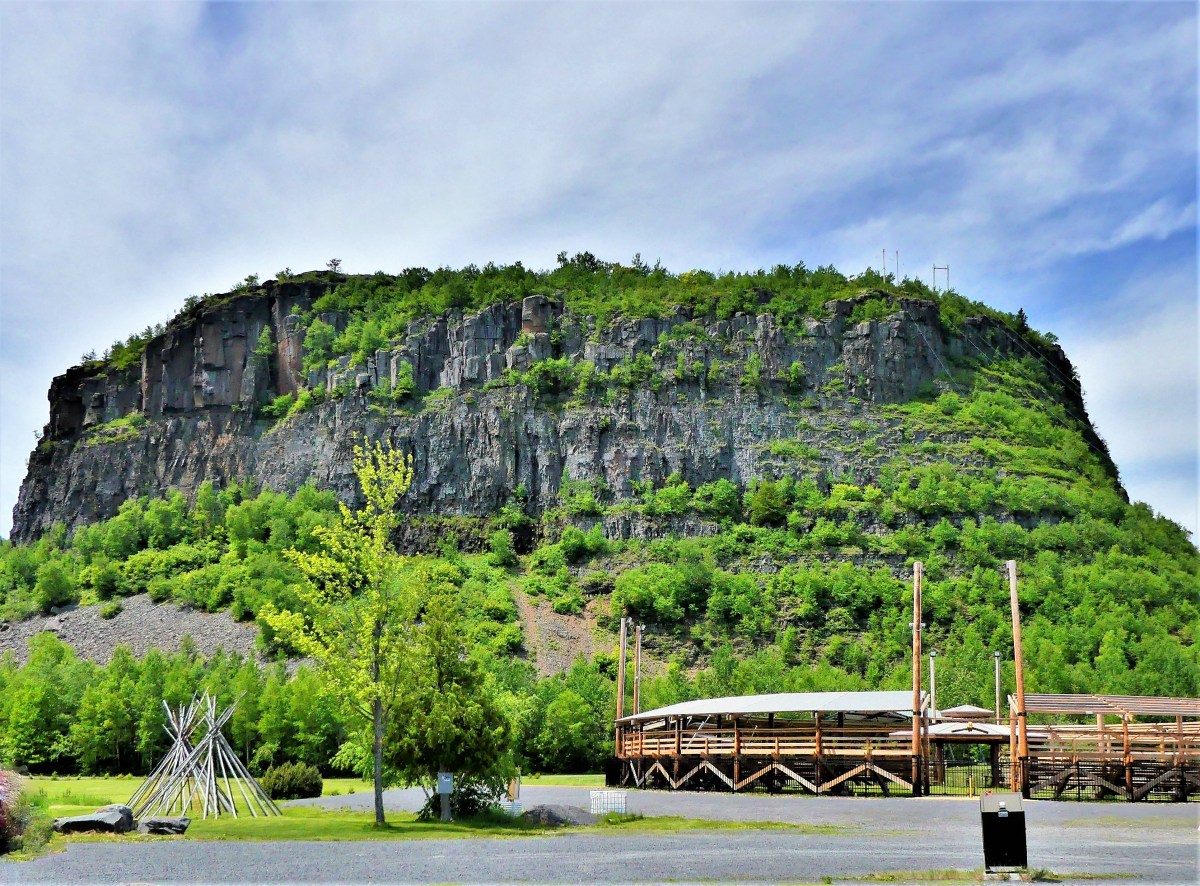
From a distance, Mt McKay is imposing, rising 1200 ft over Lake Superior and making it the largest of the Nor’Wester mountains. It gets its name from William Mackay, a Scottish fur trader from the mid-1800s, who lived for a time in the Fort William vicinity.
However, the Fort William First Nation, descendents of the Chippewa tribe, call the mountain Anemki Wajiw (ah-NIM-ih-key waw-JOO), meaning Thunder Mountain,
and consider it sacred land.
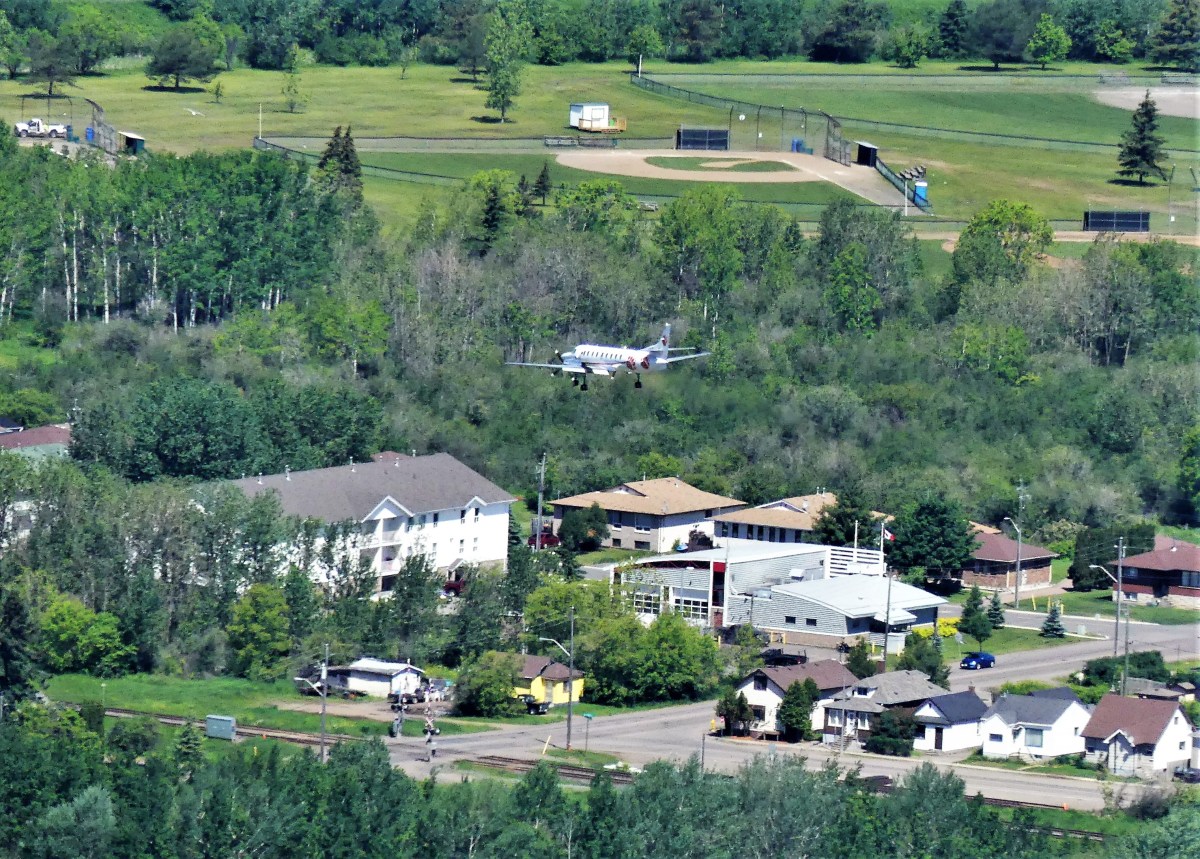
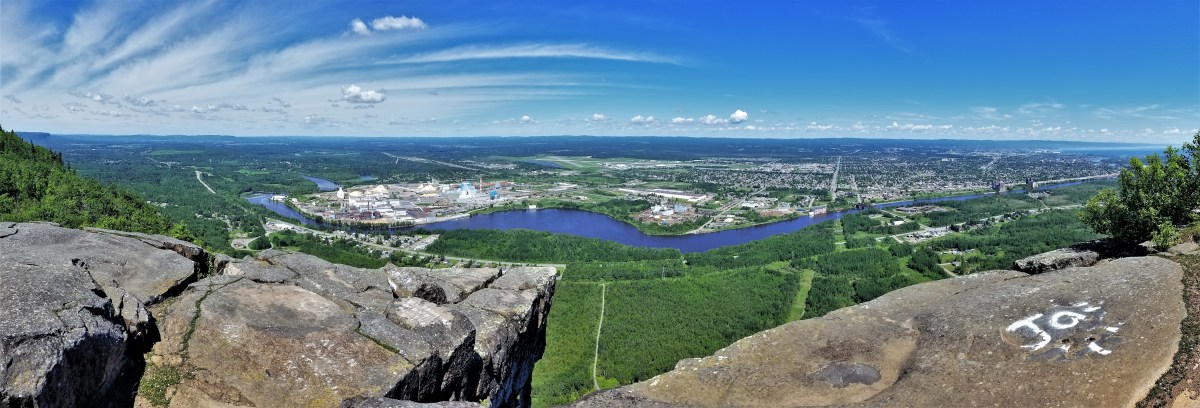
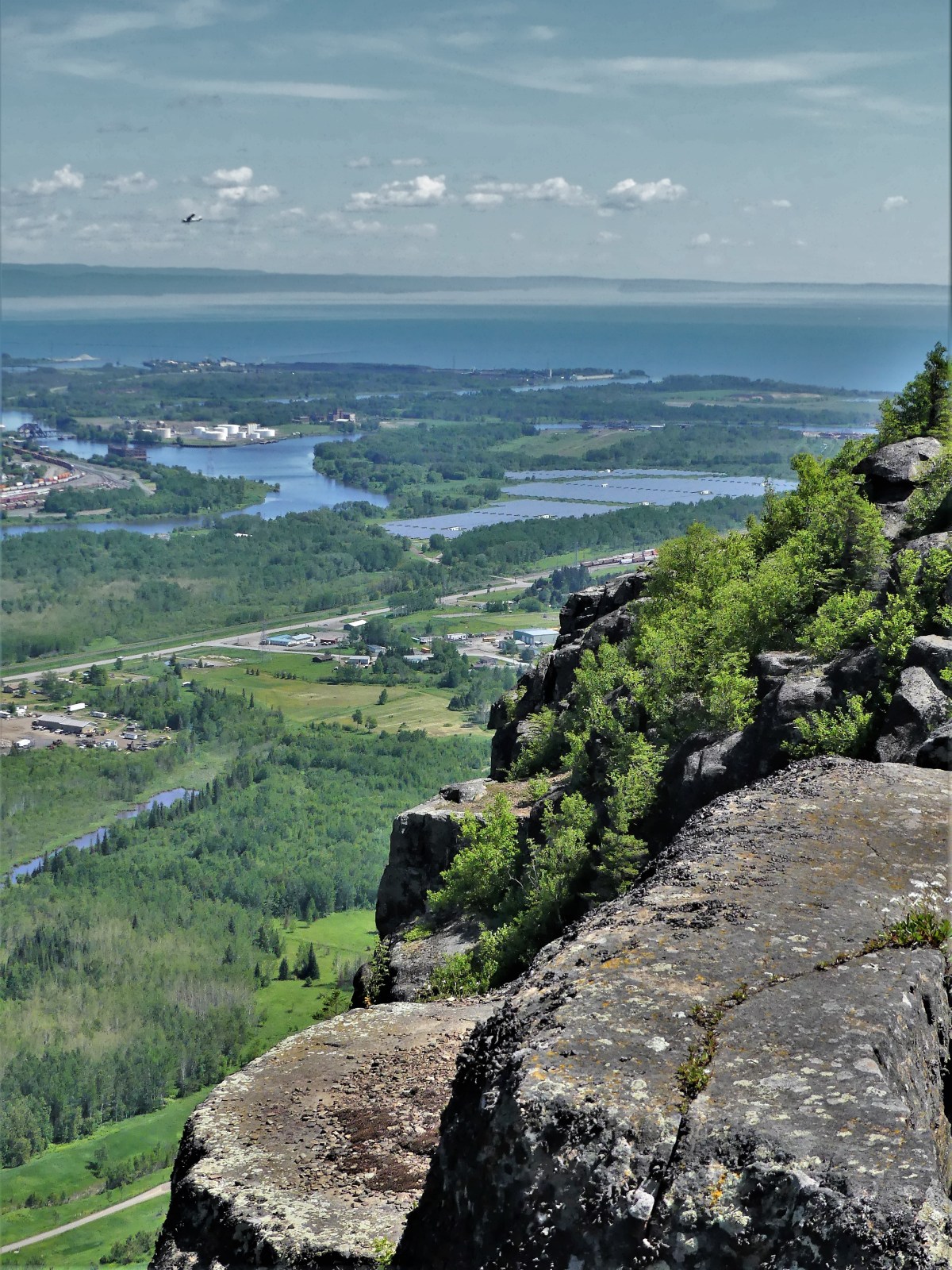
Mt McKay is a prominent landmark of the Fort Williams First Nation reserve, and offers sweeping views of Thunder Bay…
from its boardwalk overlook on the eastern plateau…
and beyond…
Leah and I drove up Mission Road to a toll house, where a First Nation member collected $5.00. She advised us to hike the western trail to the flat cap for more commanding views, and encouraged us to return in 3 days to witness a powwow of the Lake Superior chapters. She also offered a menu and invited us to visit her lunch counter in town.
The trail was narrow, steep and challenging with shards of shale scattered over rocky formations. We took our time.
After a weary climb of 40 minutes, we welcomed the cooler air around us as we crossed onto a plate of volcanic rock formed over 1,100 million years ago.
The bright sun promised a crisp and dazzling vista,
but it also seemed to energize the horse flies that soon regarded me as bait.
That’s when I knew it was time to retreat to the bottom of the hill, oh-so-gingerly over long drops onto loose shale.
Once we landed at the trail head, I had decided (after checking with Leah) that we should attend the powwow on Satuday.
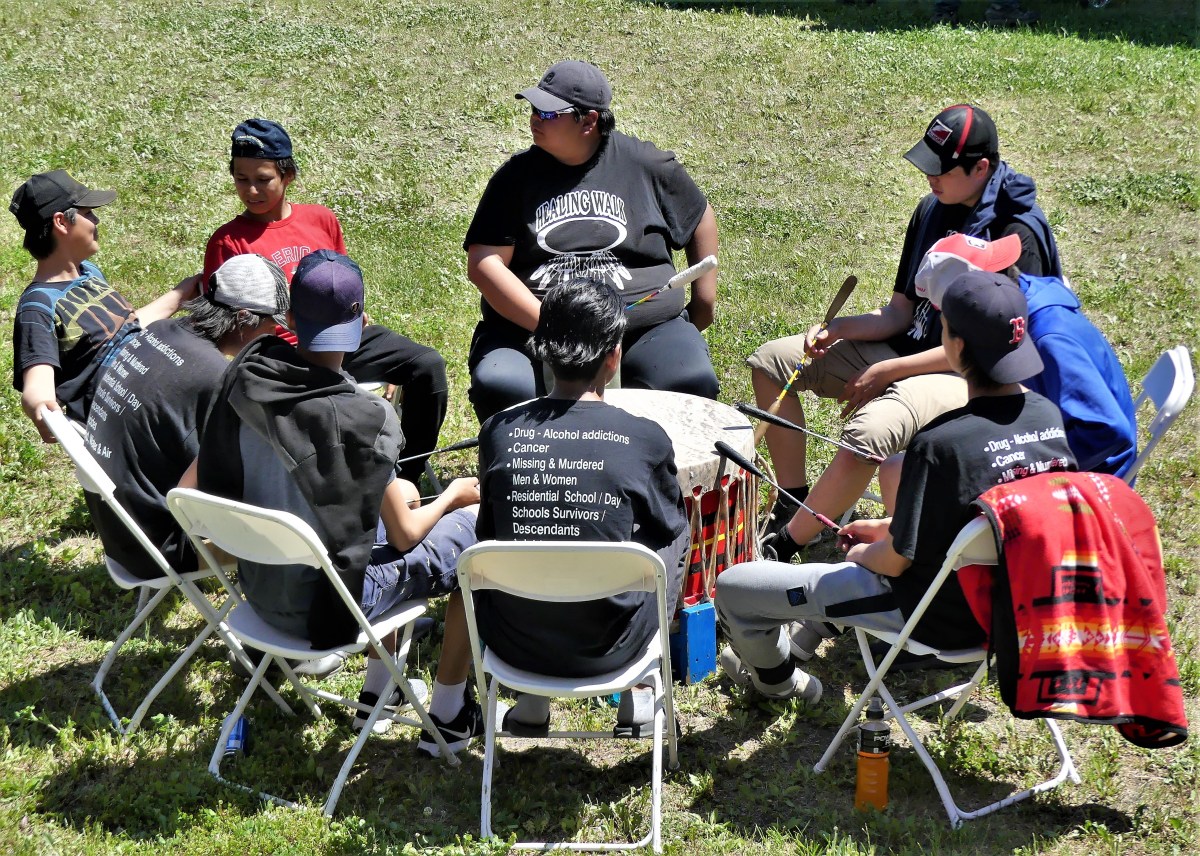
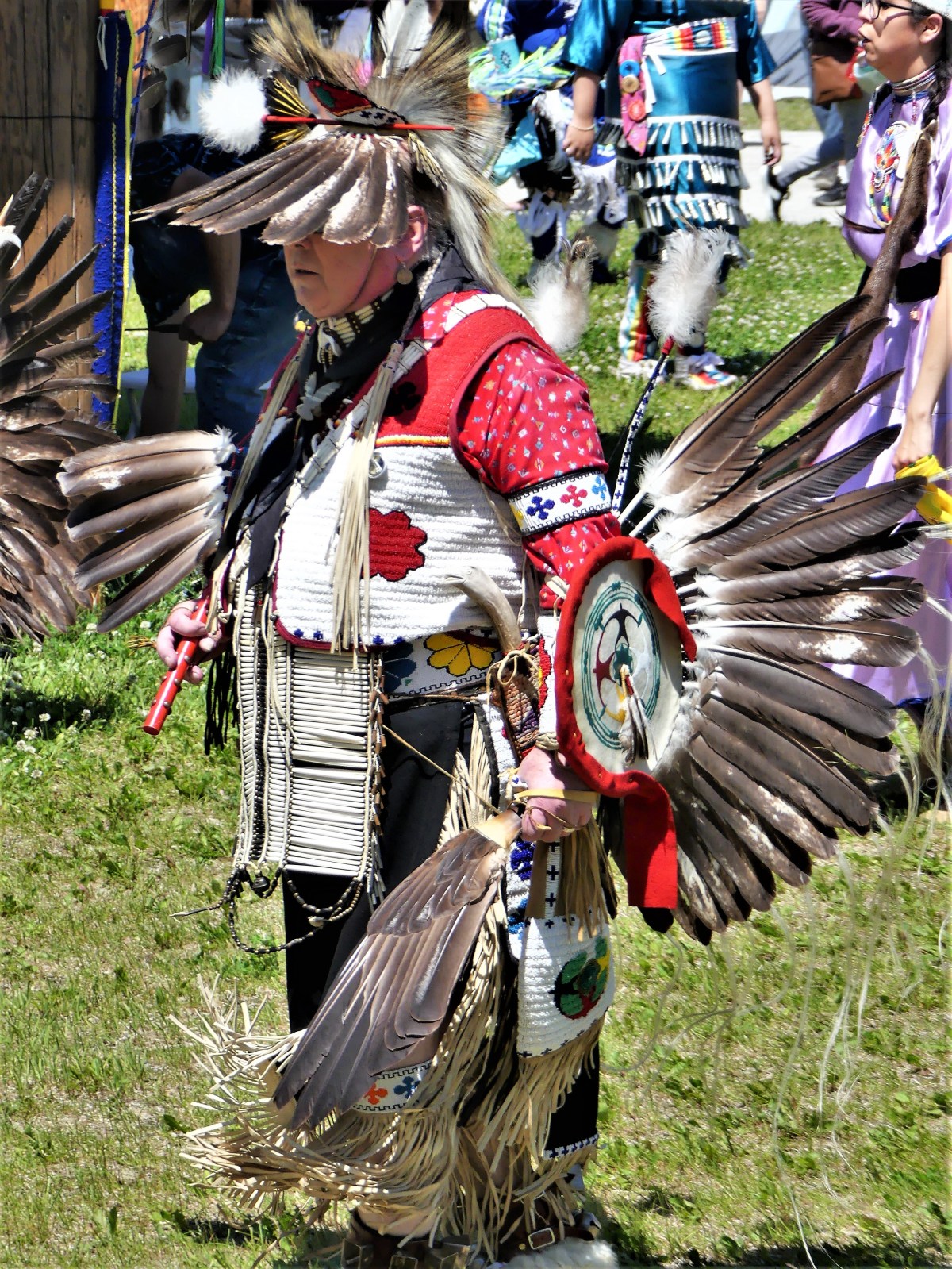
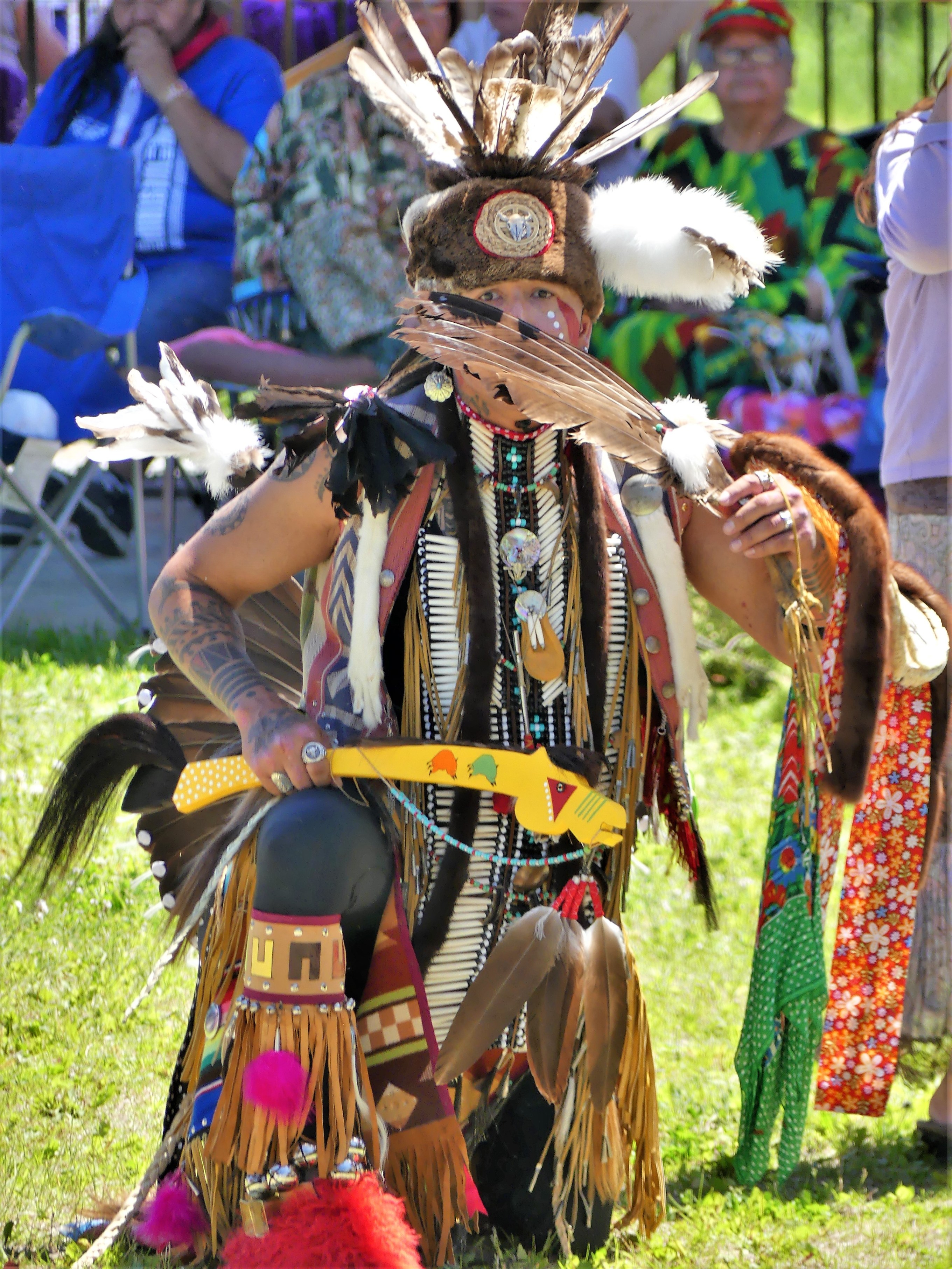
On the day of the powwow, we looked for news on the internet. and it was everywhere. The council was expecting over 5,000 attendees over two days with plenty of drumming and dancing. Food tents and crafts stalls would round out the affair. The rules were simple: No Alcohol. No Drugs. No hiking. Have a Safe Time.
We drove to Fort Williams First Nation ice arena, where we met a yellow school bus that shuttled us the rest of the way. Only three days ago, the area was empty and quiet, but today, it looked like a parking lot next to a fairground with fringe tents and trailer camping.
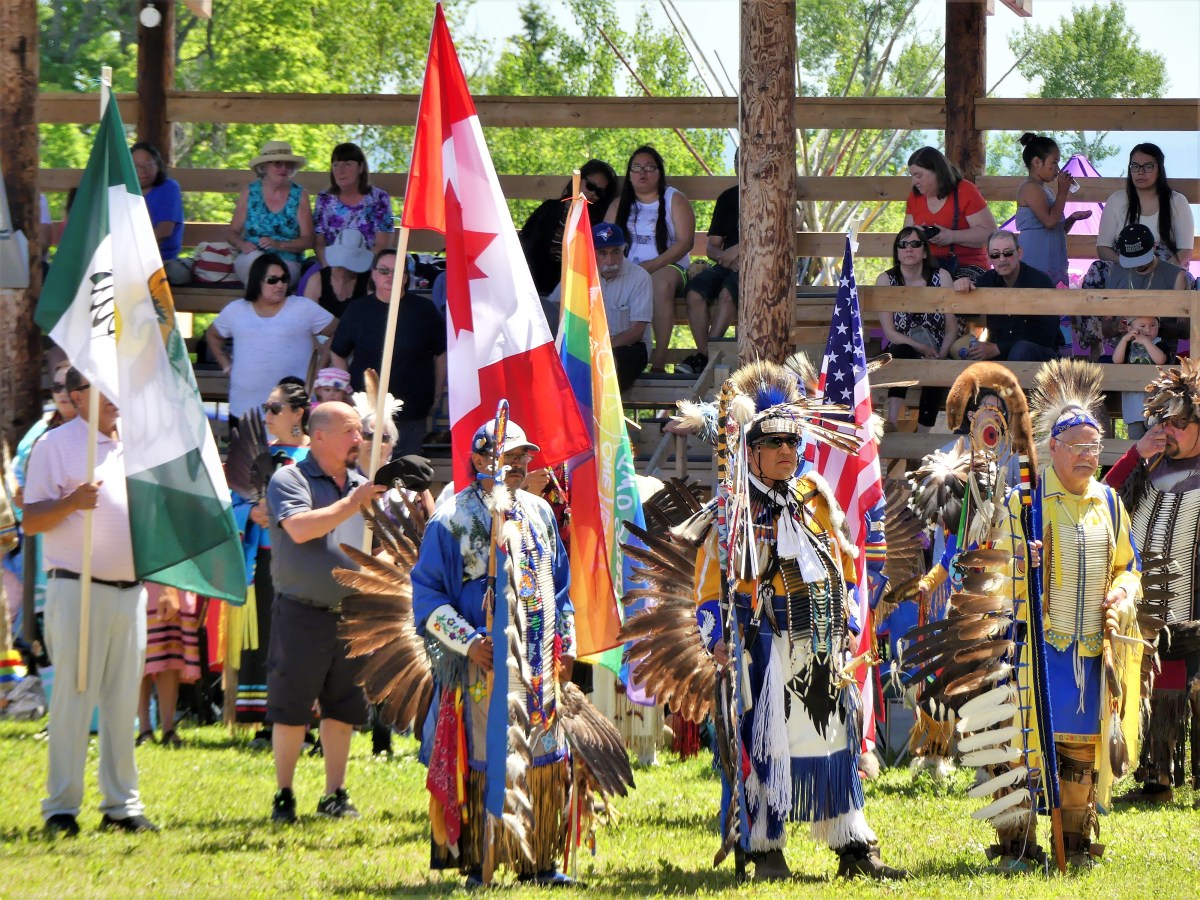
Participants were gathering inside the spirit circle and adjusting their costumes, while spectators were filling the grandstands, and the royalty was assembling in anticipation of the welcoming ceremony.
It was a colorful and festive affair. A steady drum beat managed by eight drummers, accompanied a caterwauling chant of guttural highs and lows and occasional shrieks.
After a prolonged opening procession and invocation, Chiefs and Elders presented flags,
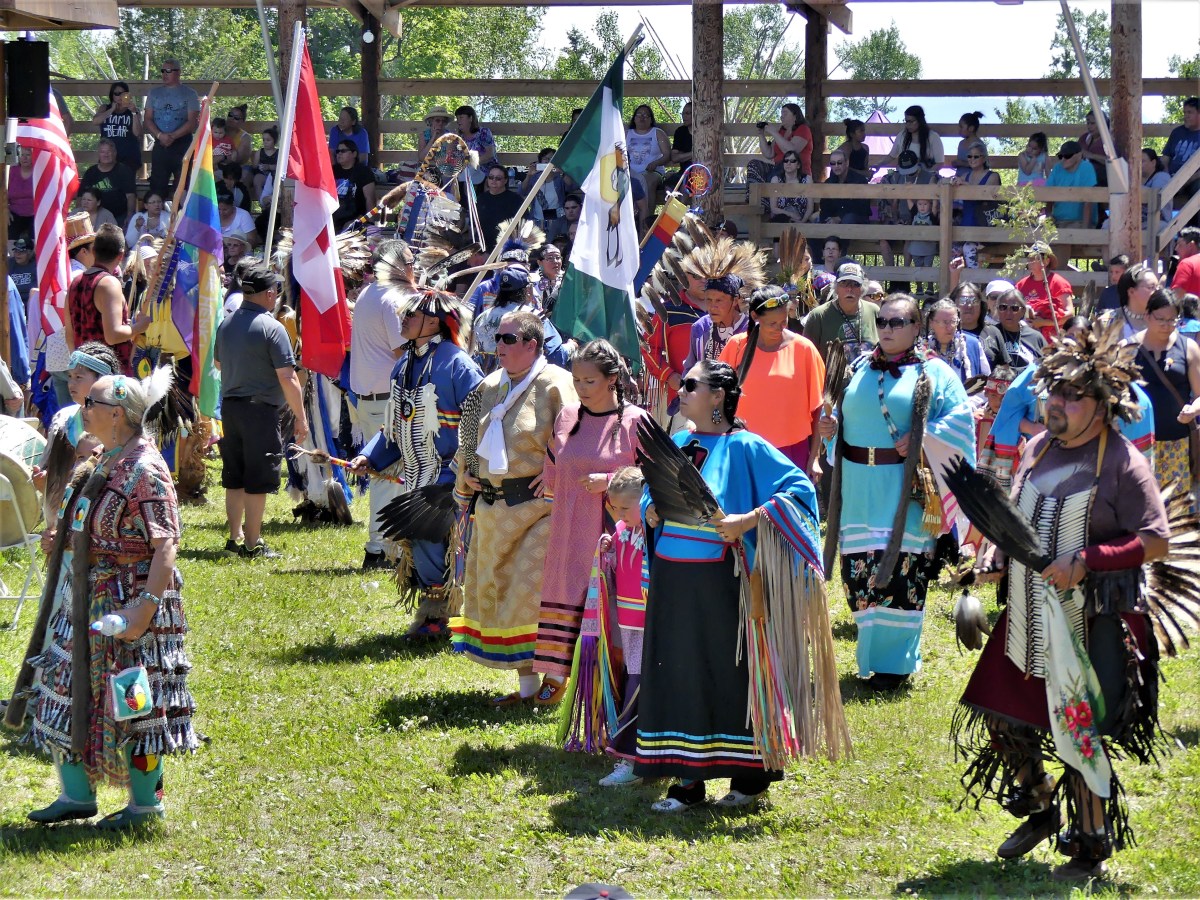
and then it was time to drum and sing and dance again. Grass dancers followed Elders…
who were followed by family members…
who also danced several times around the pavillion with their children…
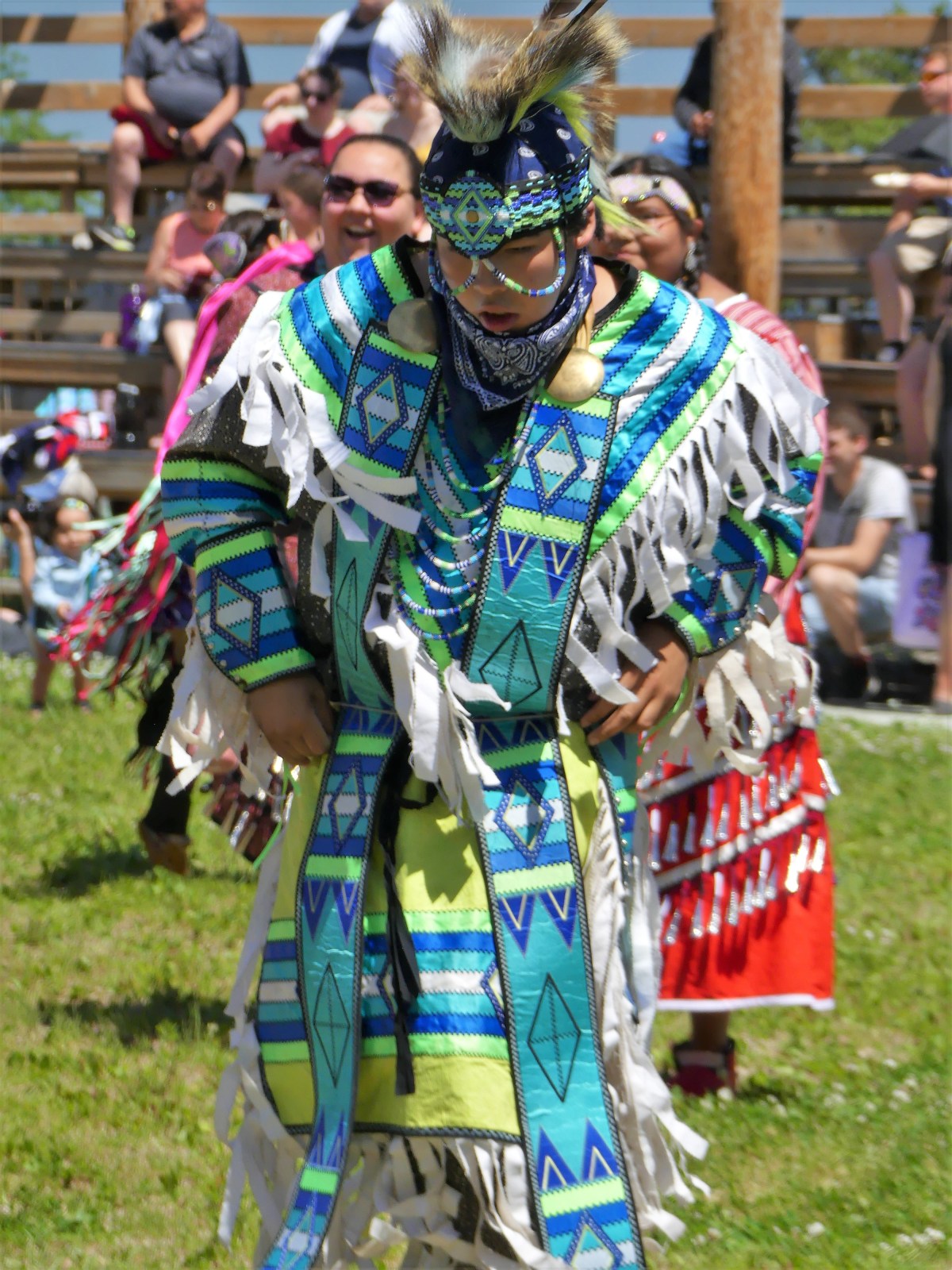
showing off their feathers,
their elaborate ceremonial costumes…
and their elaborate moves…
After a couple of hours, Leah and I returned to the boardwalk for a stroll to the memorial,
where we discovered a trail to the right that hugged the cliff around the plateau. We hiked further along, scouting for poison ivy as we walked, and came to a clearing where three girls in training bras were sneaking cigarettes around a slab of concrete.
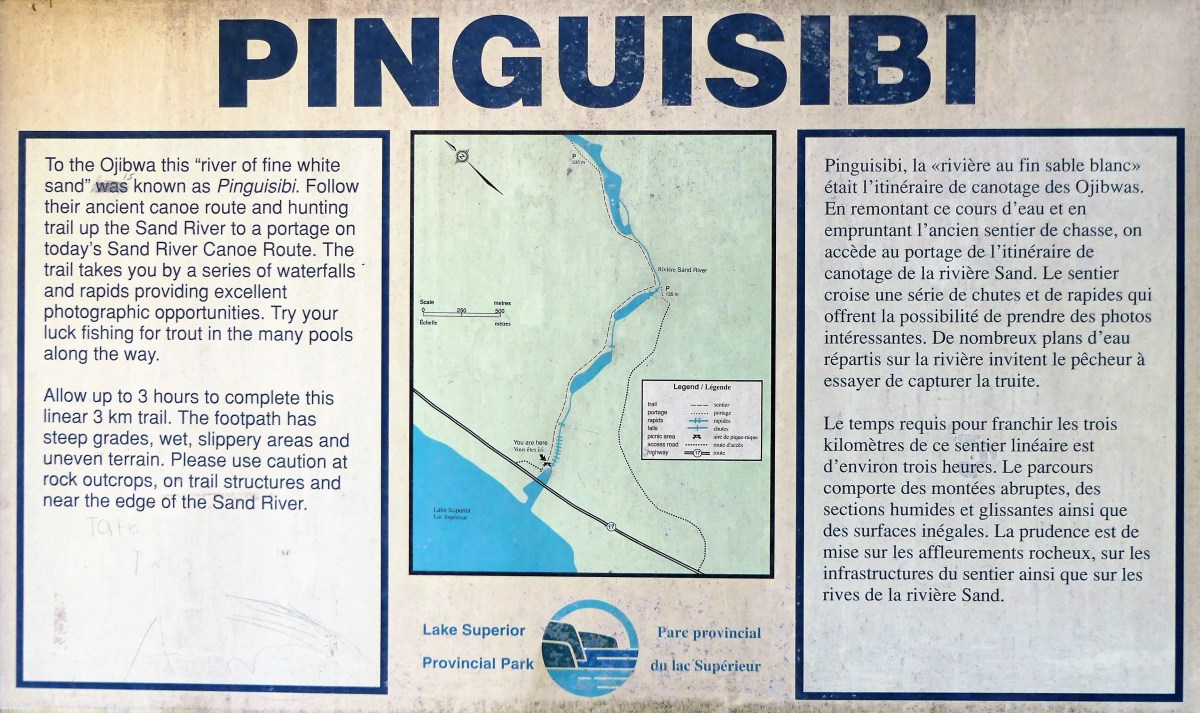
It was an amusing irony and signaled our time to return to the ice arena. The school bus that brought us circled the field–collecting passengers–and momentarily paused at a graphic display of Ojibwe insight and life lessons:
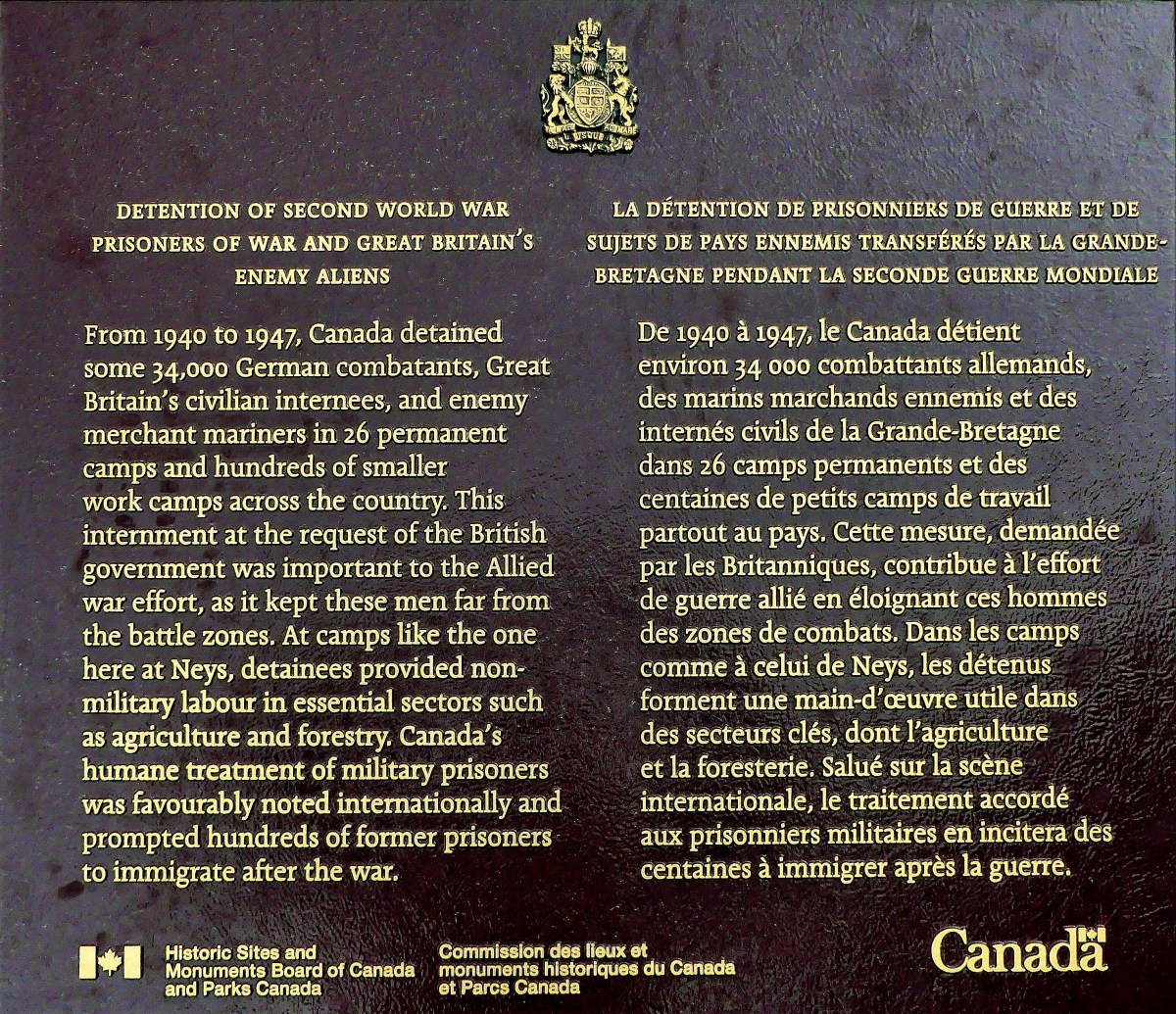
A high probability of intermittent rain had been forecasted throughout the day, which gave us very few options. Although we were snug in our pull-through campsite overlooking the northern boundary of Lake Superior from Neys Provincial Park in Ontario, Canada, we were looking forward to exploring the stark coastal beauty of an area once known from 1941 to 1946 as Neys Camp 100–an internment facility for German POWs and Japanese Canadians.
Kreigsmarine and Luftwaffe prisoners of war arriving at Neys, ca. 1941
Prevailing wind from the west had whipped up whitecaps across the water, and threatening skies promised to restrict our outdoor time, but we were determined to make the most of current conditions: buggy, chilly, yet dry.
A short walk to the Visitor’s Centre for sight-seeing suggestions proved useless since the door was locked–maybe from campground inactivity, I surmised. There was, however, an interesting park bench design overlooking the lake by Sean Randell.
With 144 sites covering 4 areas, Leah and I spotted less than a dozen occupied sites. Many of the seasonal campers left their trailer set-ups behind for greater comforts nearby. With electricity only provided at less than half the sites, we had the showers practically to ourselves.
We were determined to get a hike in, so we selected the 1 km Dune Trail loop for its brevity (in case of sudden rain), and our fascination with sand dunes by the lake. We followed each other single file through a skinny path snaking through a plantation of red pines and a forest floor of lichens, mosses, and herbs. But we never found the dunes–only rolling mounds of sand over soil. We began the hike with an interpretive trail guide corresponding to 7 markers, but mosquitoes quickly put an end to that. We found ourselves marching through the forest just to complete the loop. The roundtrip walk to the trailhead proved to be longer than the entire trail.
With a faint drizzle falling, we planned a 35-mile drive to Terrace Bay, following TransCanada Highway 17 west around the top of Lake Superior, but the truck refused to start. Earlier in the week, I was stuck in a parking lot under similar circumstances, but Leah located a Samaritan willing to give me a battery boost. Today, however, was a different mater. After shlepping a spare battery around America for tens of thousands of miles, I finally got a chance to use it.
The battery installation set us back half an hour. And then the sky opened up the moment I dropped the hood and climbed inside the cab. It was an auspicious moment in my life!
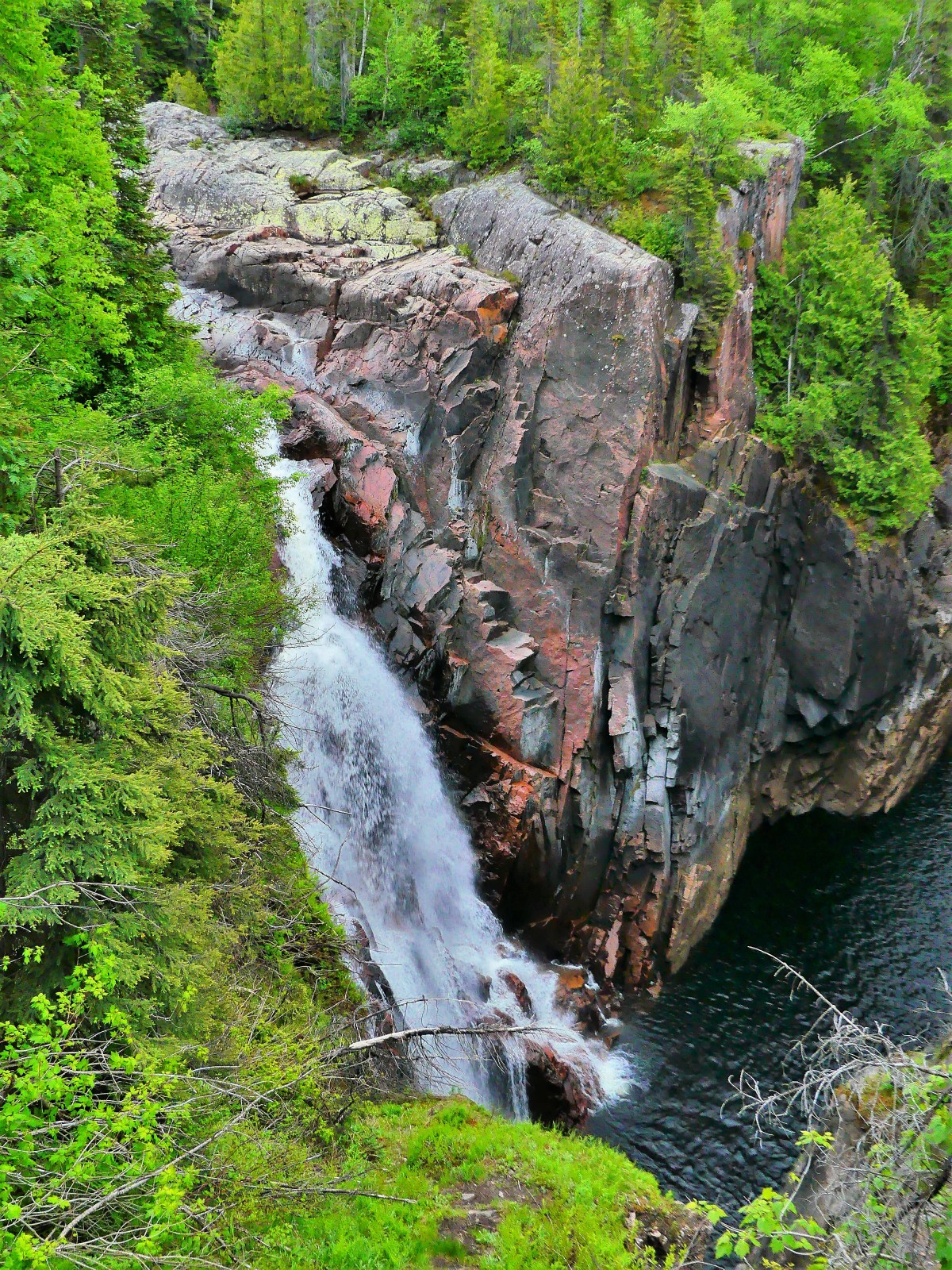
We finally arrived at Terrace Bay (pop. 1100) and descended an elaborate boardwalk to a high viewing platform that distanced us from Aquasabon Fall’s 100-ft. drop,
and the granite gorge that carries the spill water to Lake Superior.
Back at the boardwalk entrance, I stood alongside a millennial male. We were studying an oversized graphic together about the geological properties and commercial significance of the Falls.
My neighbor had a cat perched on his shoulder wearing a harness with a leash. Suddenly, a light rain began to fall, spooking the cat. It leapt to the ground, surprising the host. He had control for a moment, but it squirmed out of his arms, and wriggled free of its harness. He dove for the hind legs, but the cat was too fast. It bolted 50 yards to the trees, and disappeared in the brush with his girlfriend chasing after it and screaming its name. We briefly watched in amusement, wondering if the cat would reconnect with its owners, but we had our doubts.
While in town, we filled the truck with $130 Canadian of gas, and searched for a lunch spot, but ended up at a Chinese Canadian restaurant in a strip mall just to use the internet. I had fried chicken balls (no joke), and Leah ordered dry-rubbed spare ribs. The food was as disappointing as a dead car battery and tasteless as a lost cat in the woods.
A stubby white lighthouse planted in front of the strip mall parking lot offered a view of Lake Superior. To Leah’s amazement, I passed on a picture of the tower and a view from the bridge.
The ride back to Neys was rainswept and uninteresting except for a cow moose that galloped across TransCanada Highway 17, followed closely by two calves. They hurdled the guard rail and instantly disappeared into the forest. Maybe they’ll discover the cat.





























































































































































































 Streaming thru America