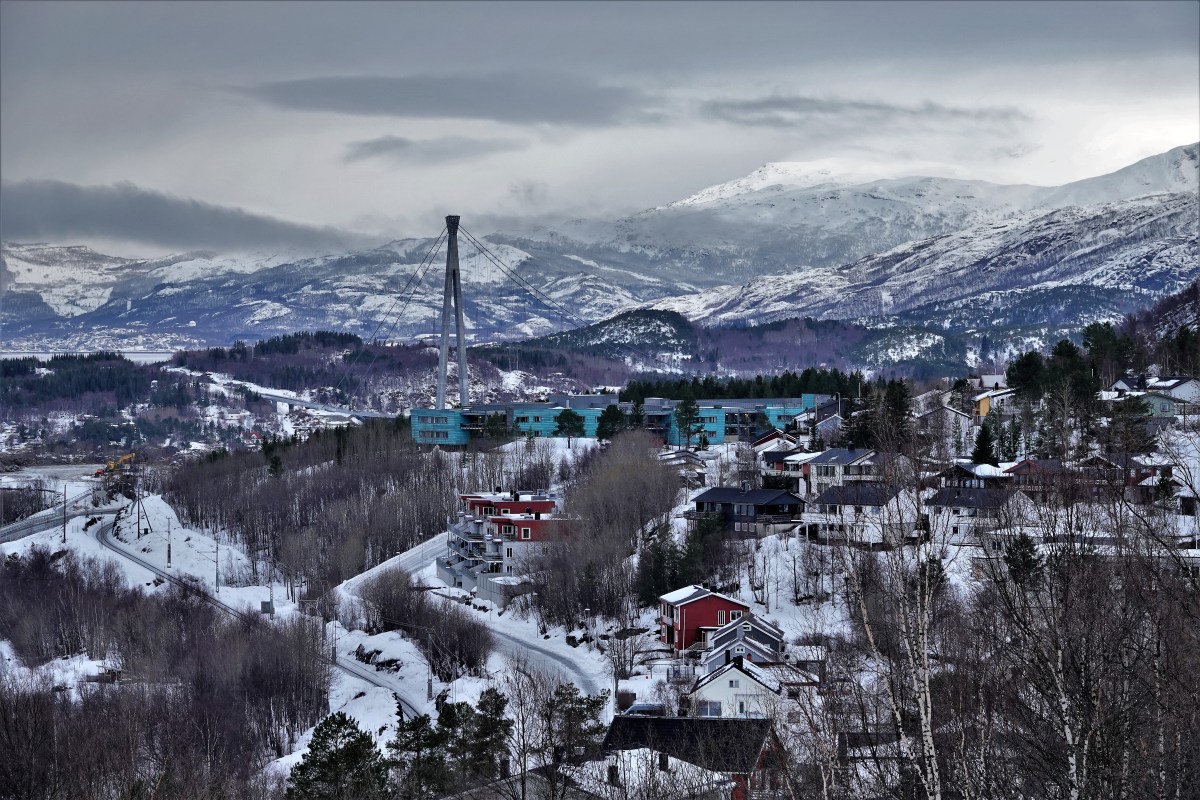
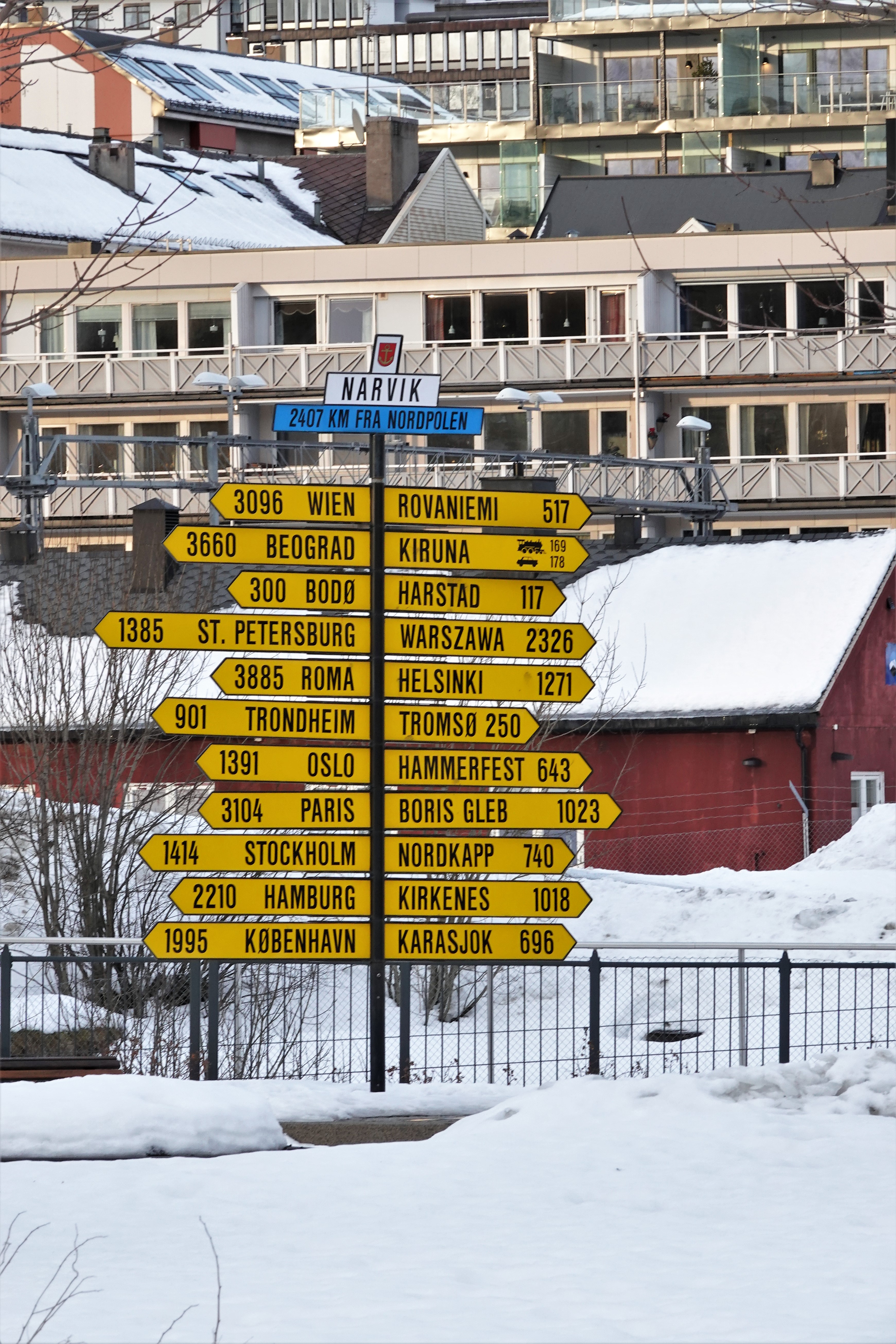
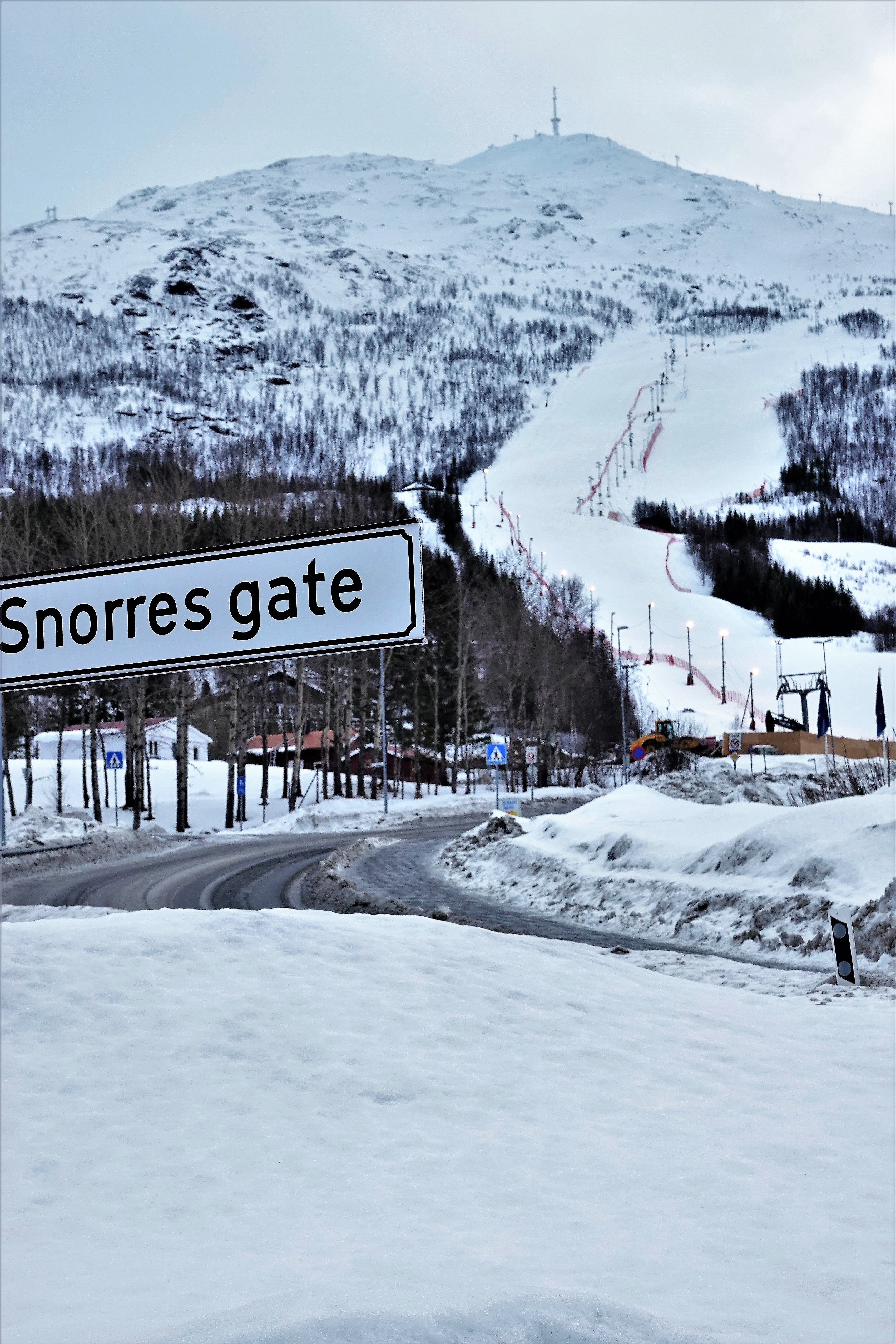
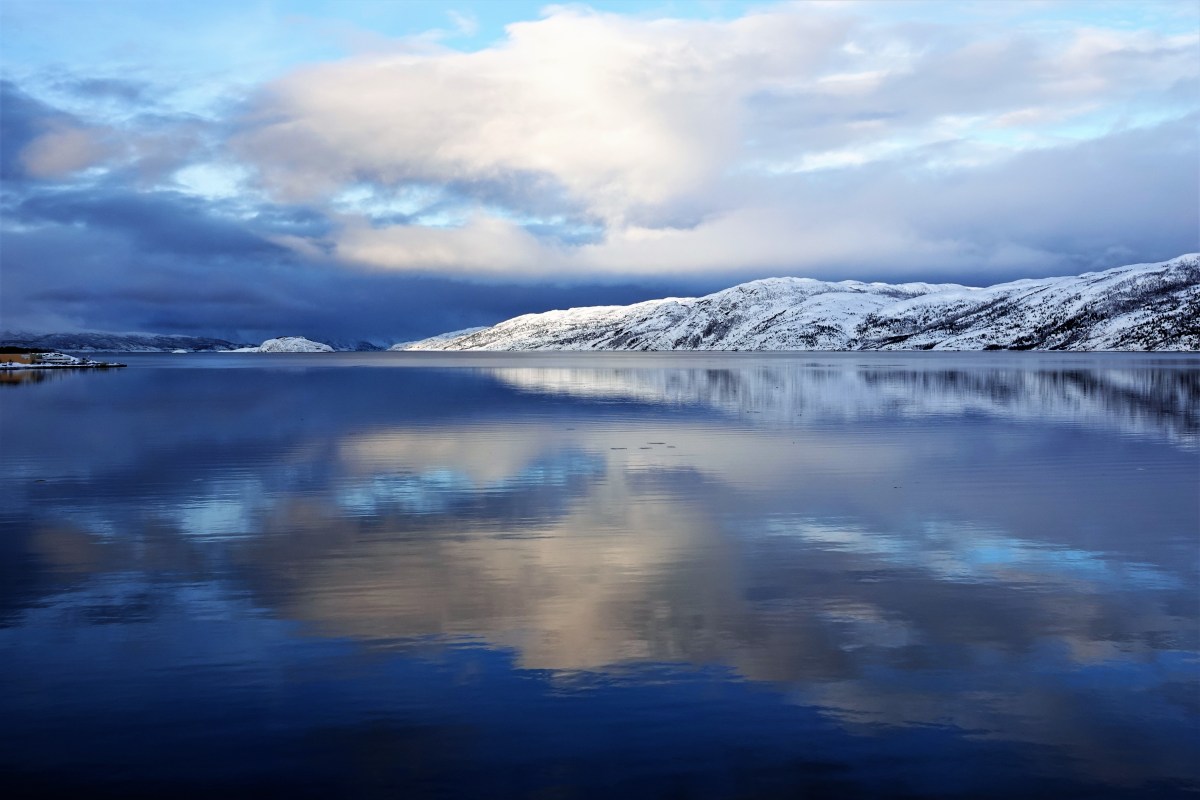
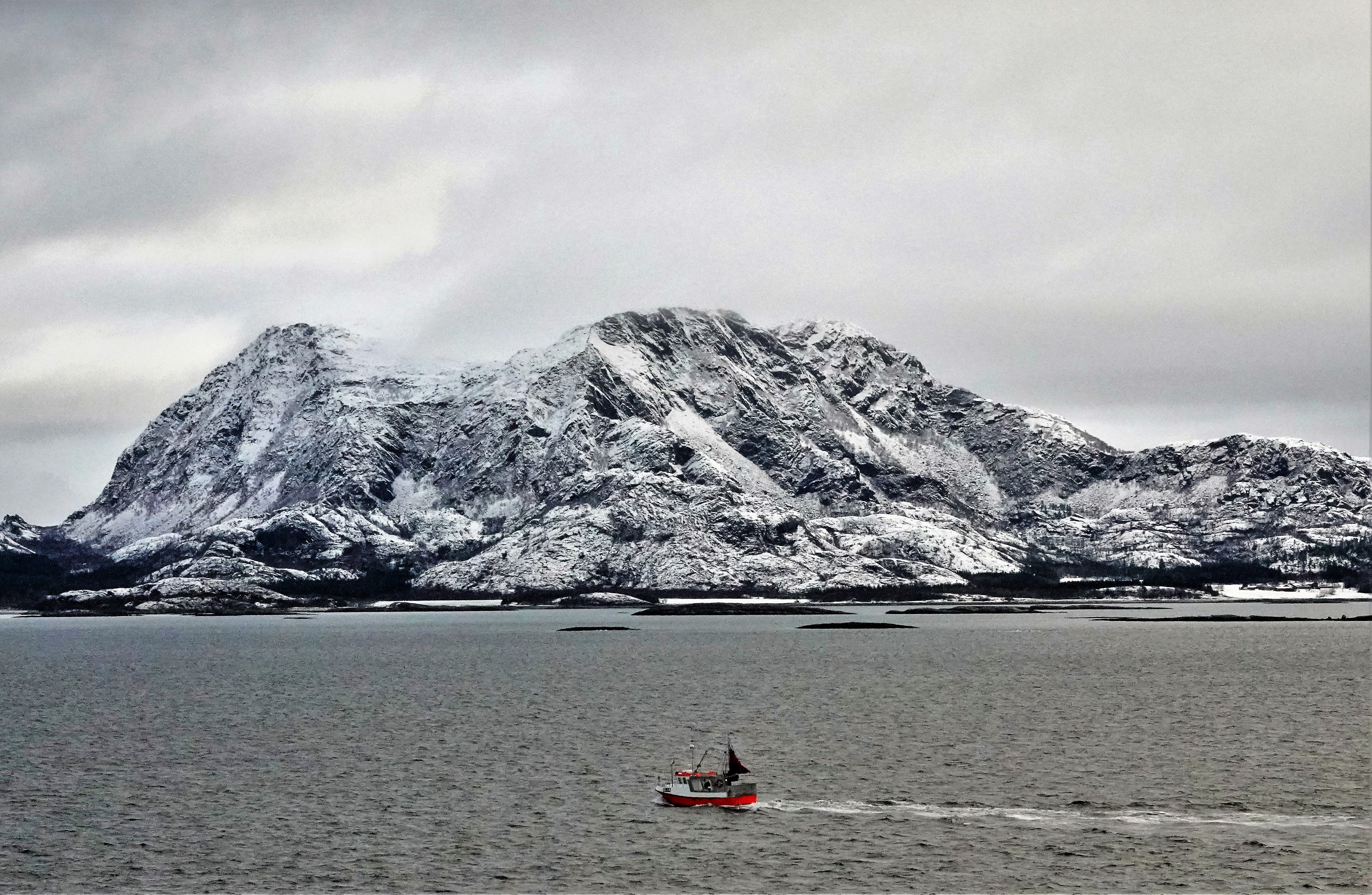
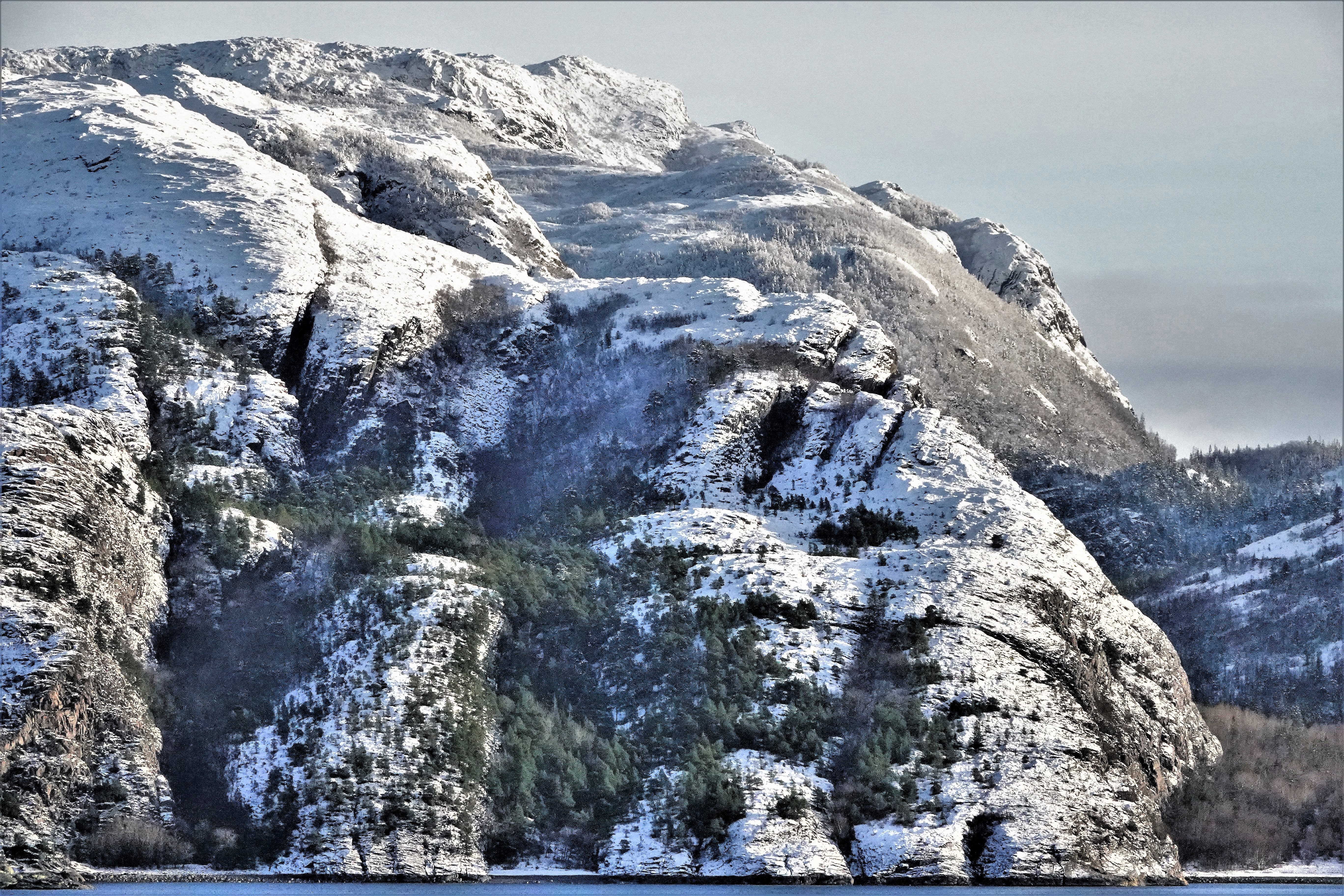
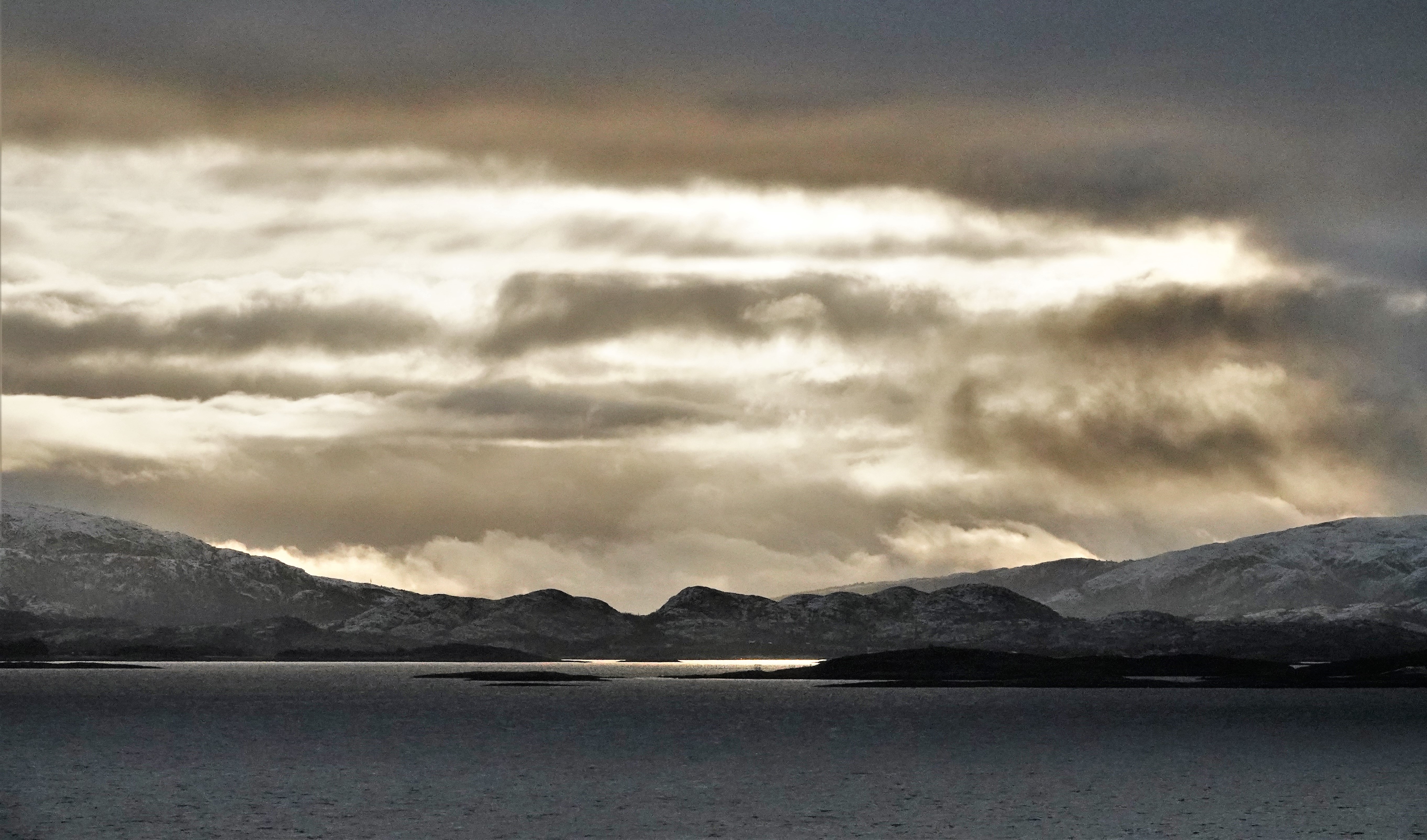
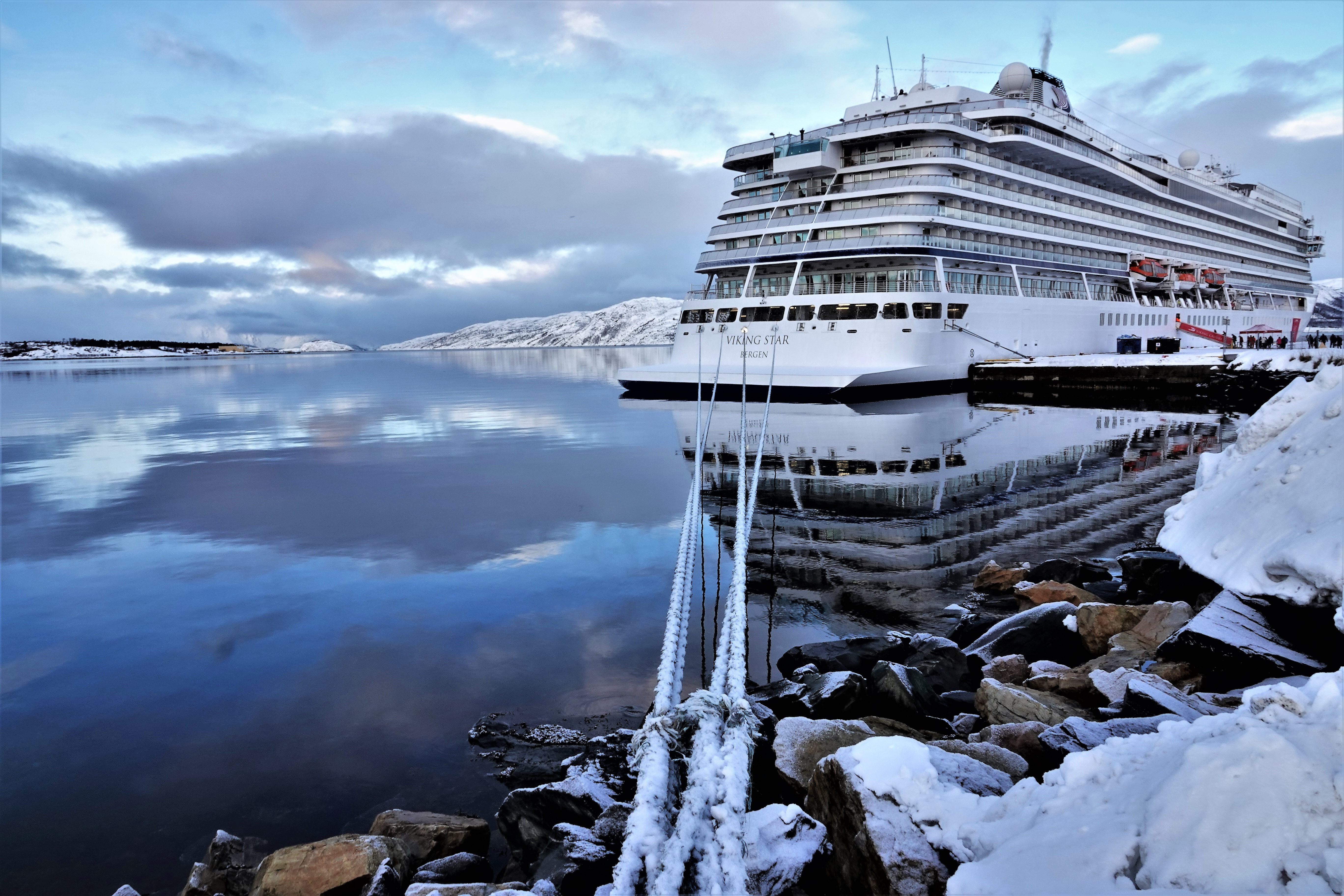
On our way to Bergen, Norway, the Viking Star docked at Narvik–a mountainside town reknown for its urban off-piste skiing,
and notable for its ice-free harbor,
which was of strategic importance during World War II…
for transporting iron ore that’s been mined from the world’s largest underground reserve in Kiruna, Sweden since 1898.
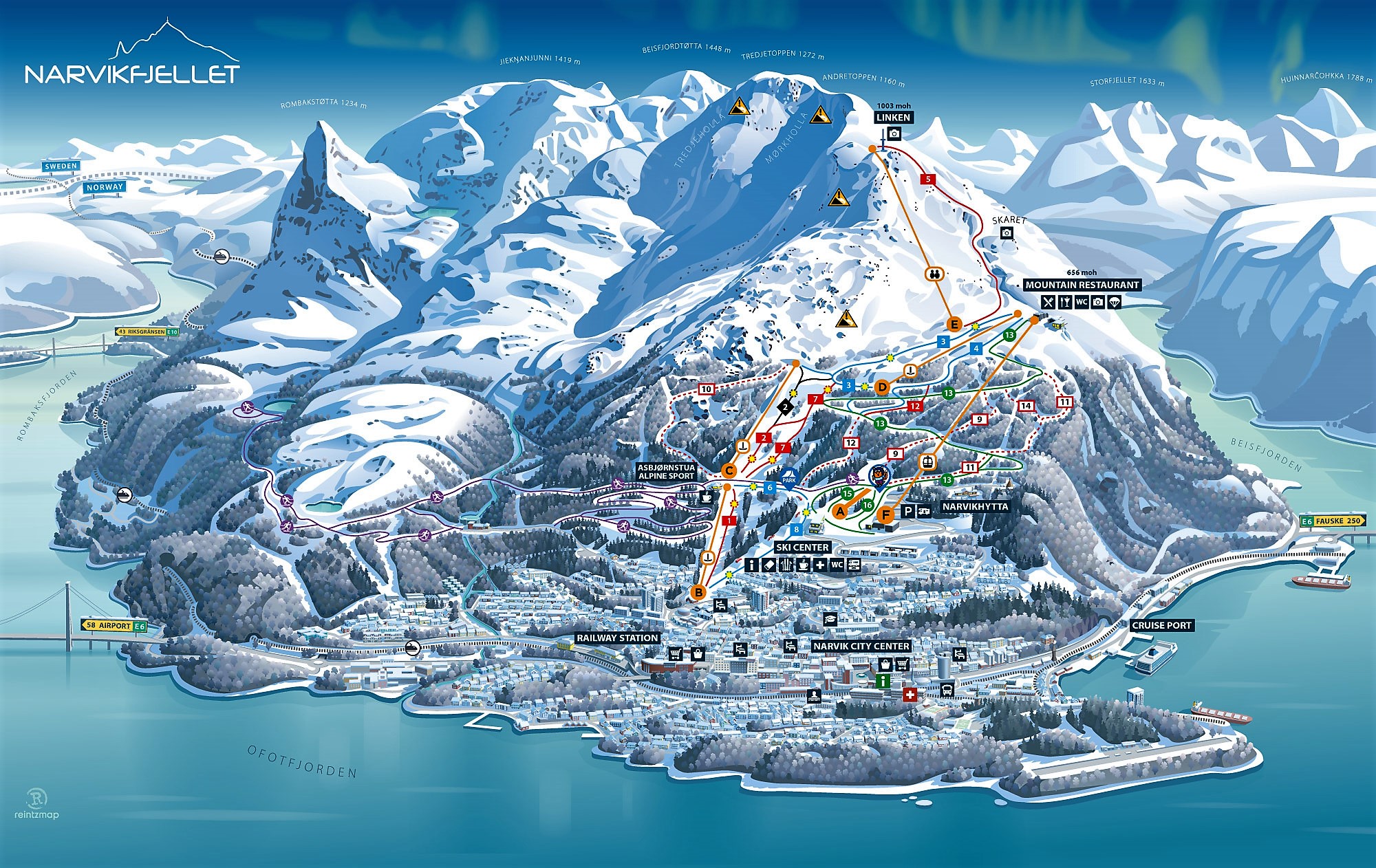
Leah and I had hoped to ride the cable car to the mountain restaurant to enjoy the view, but on this particular day, the mountain was closed because of nasty weather.
Instead, we braved the treacherous icy streets…
and climbed the hills for views of distant shores,
clusters of urban housing,
public art,
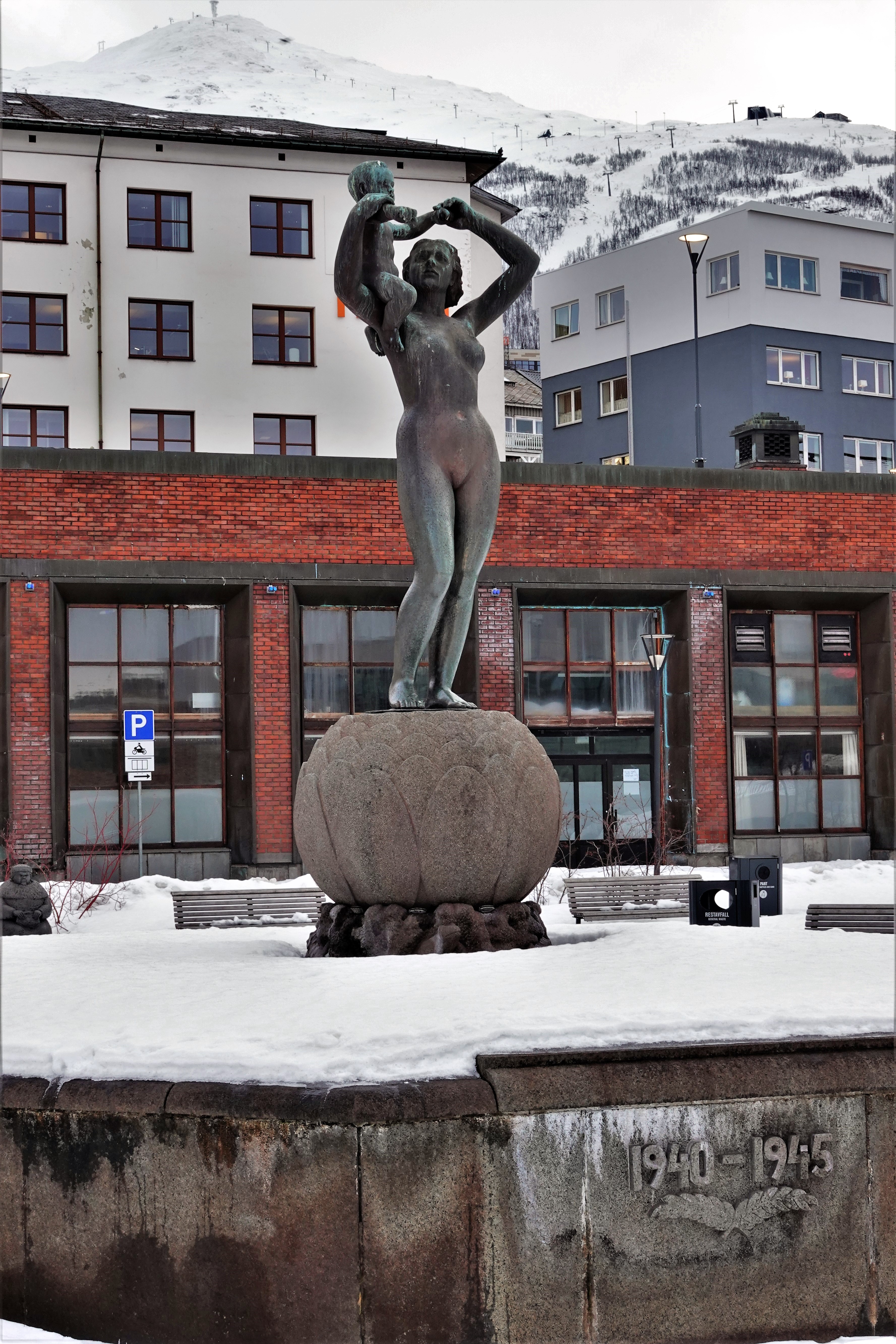
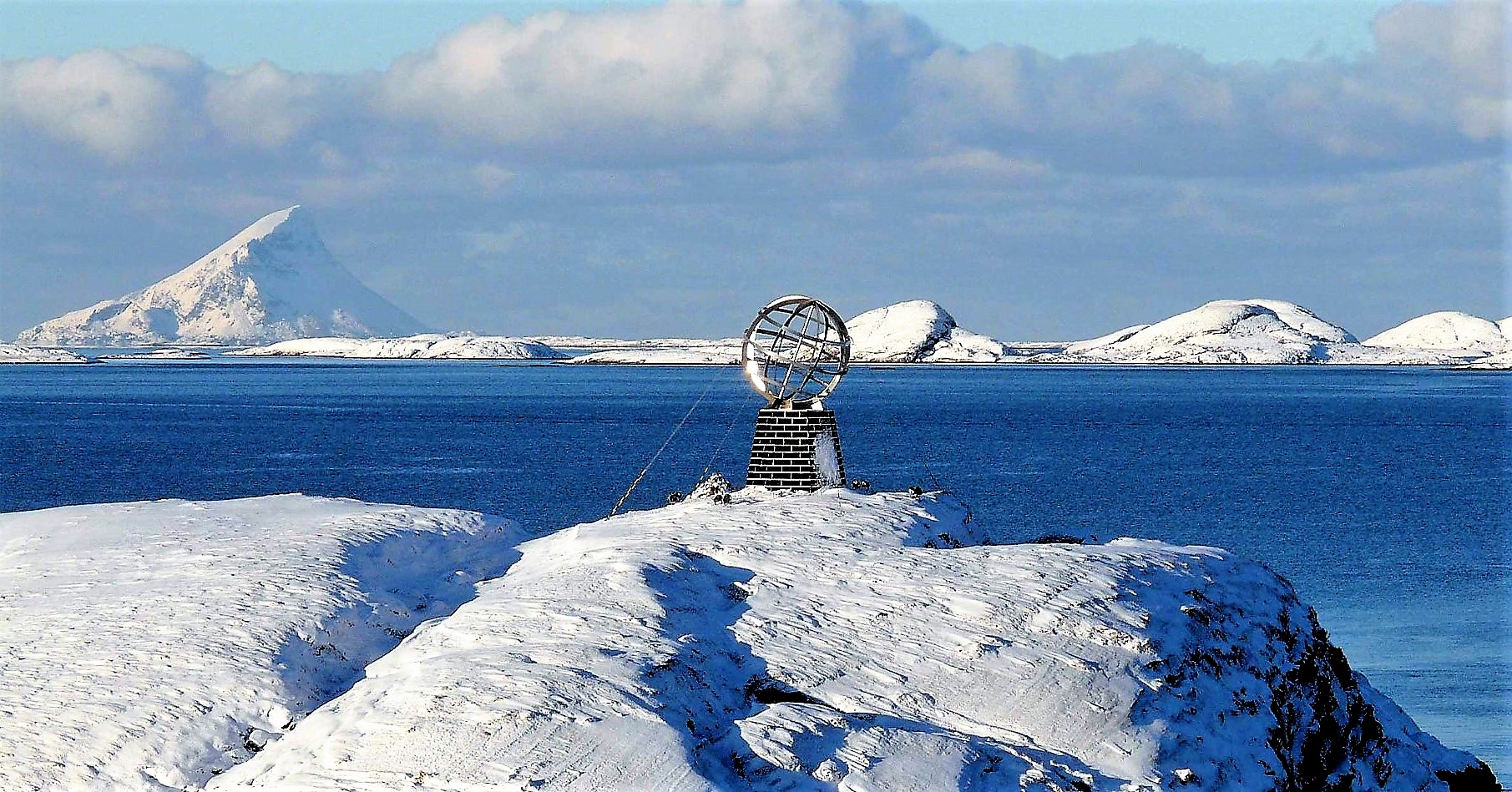
and commemorative sculpture, such as the National Monument of Freedom.
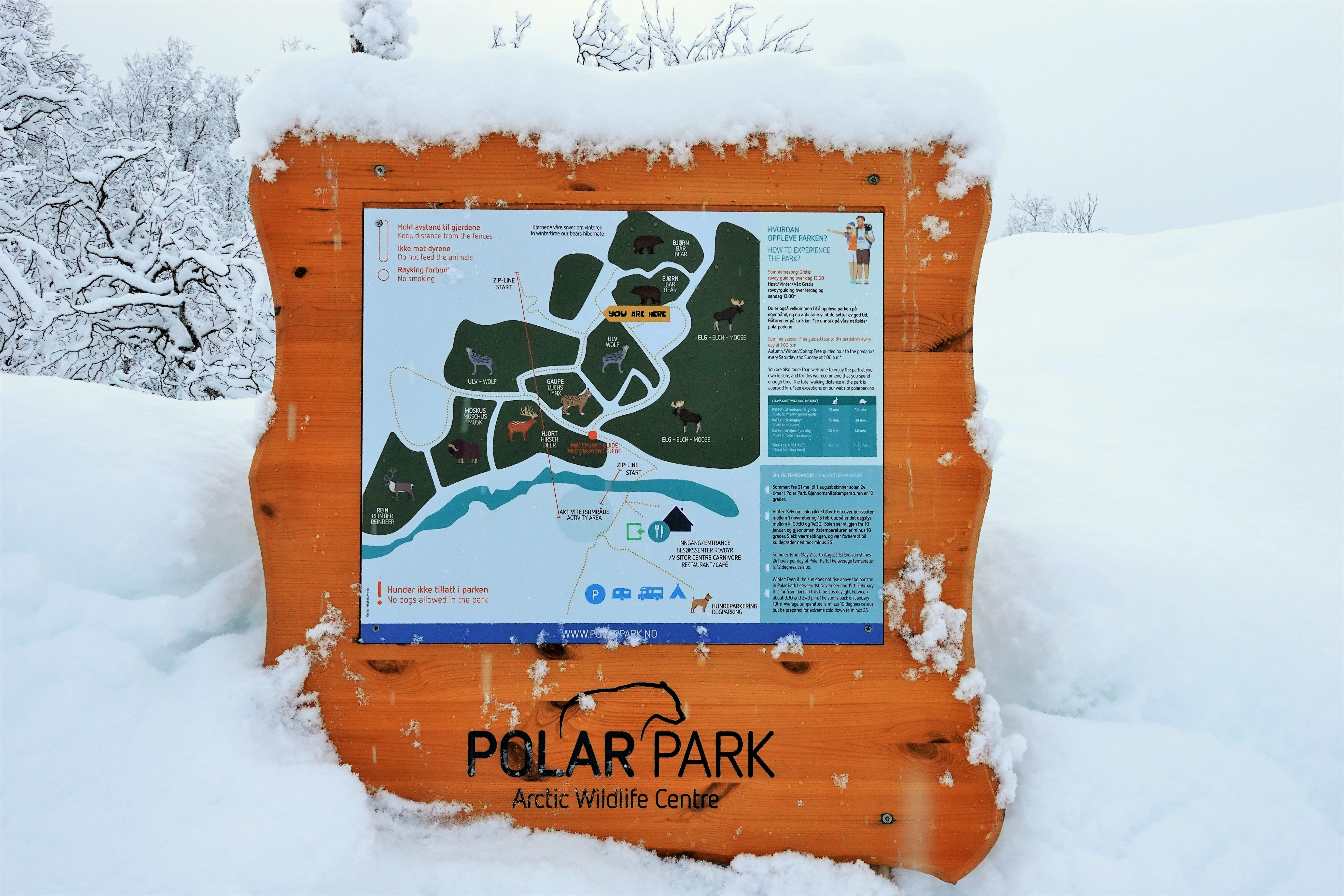
Expanding our horizons, we boarded a bus bound for Polar Park,
the world’s northernmost animal sanctuary,
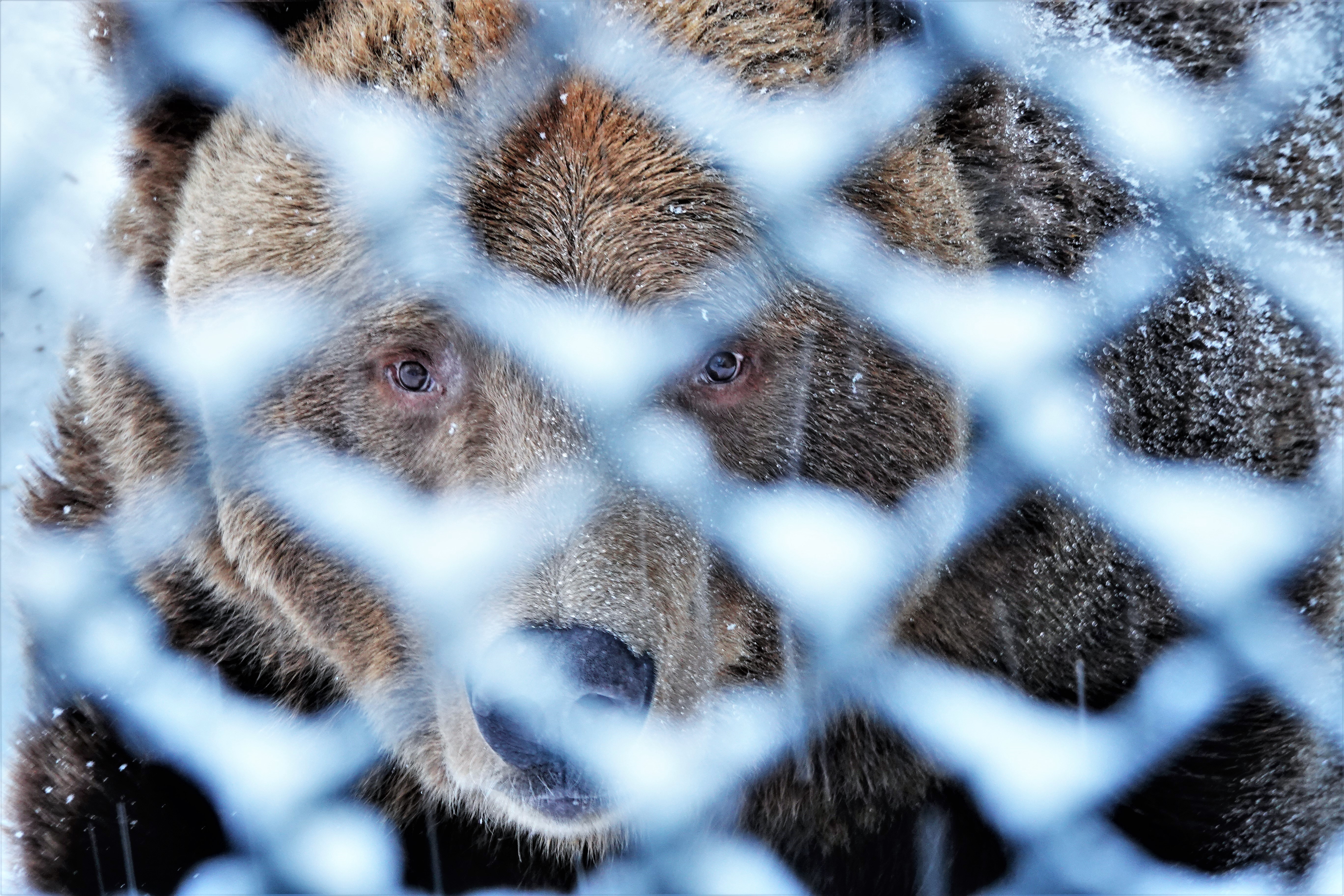
and home to Norway’s large predators such as bears,
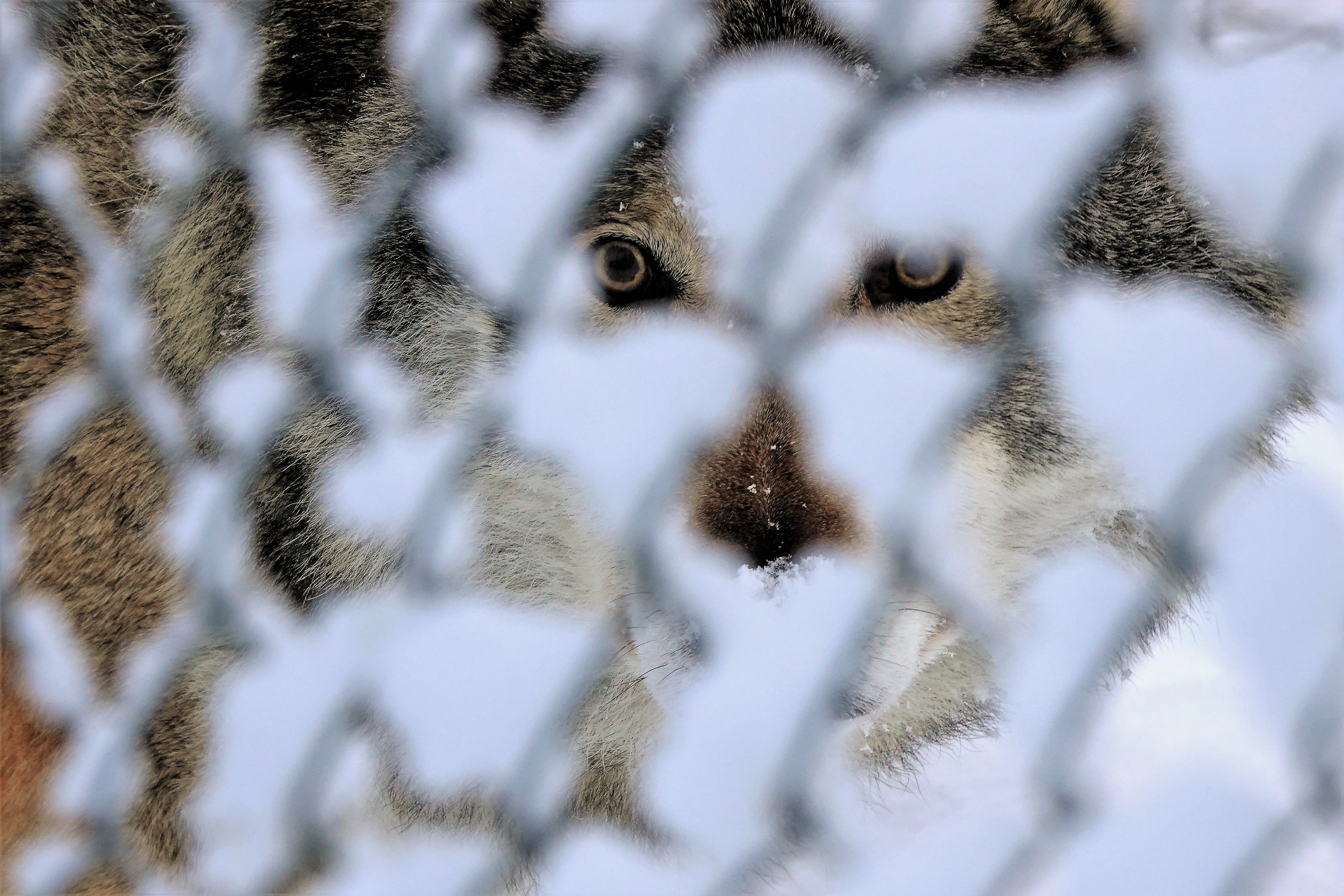
wolves,
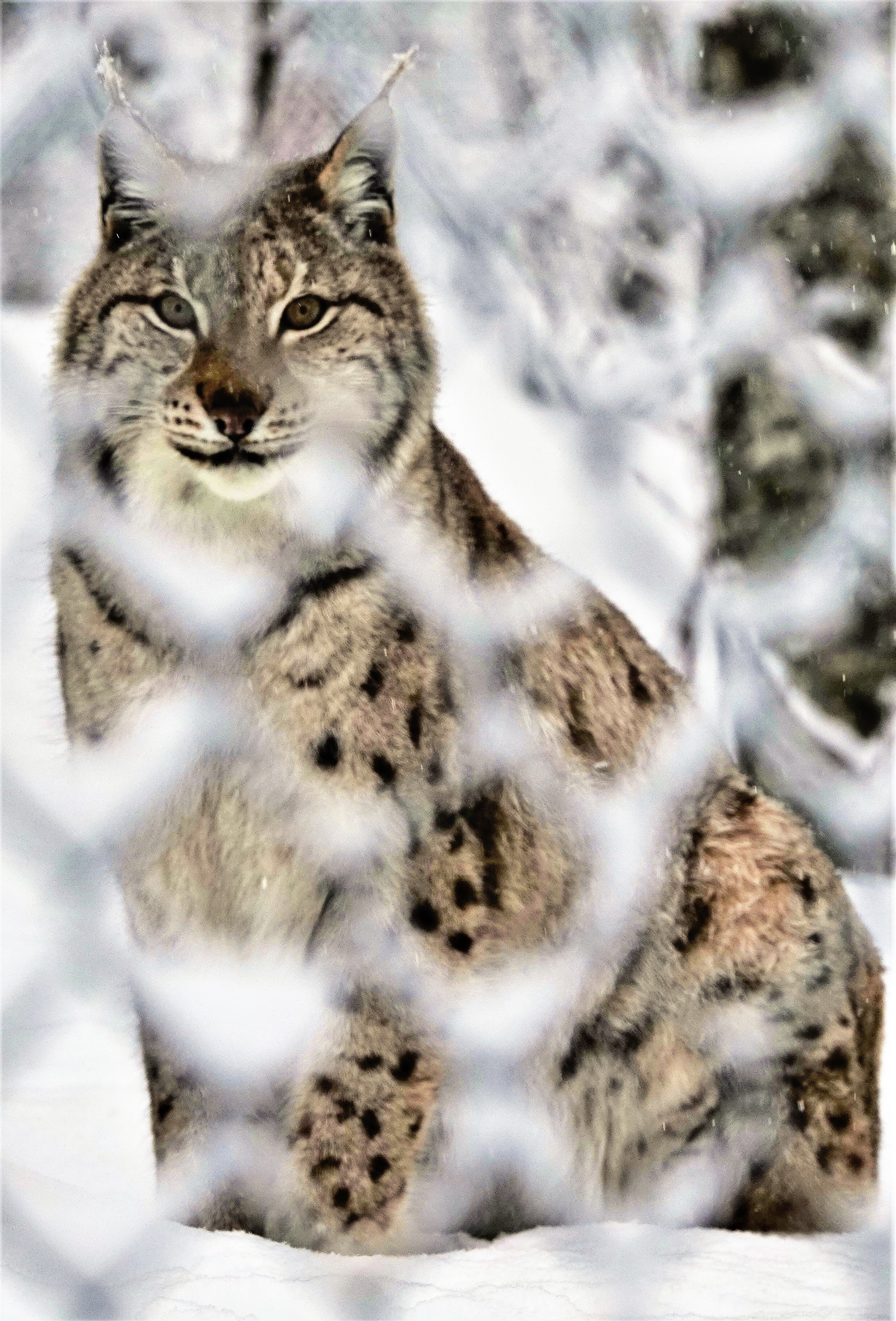
and lynx.
Although the animal habitats are vast,
and the wildlife seem well-cared for, it’s impossible to look past the fencing and not think of Polar Park as a winter zoo.
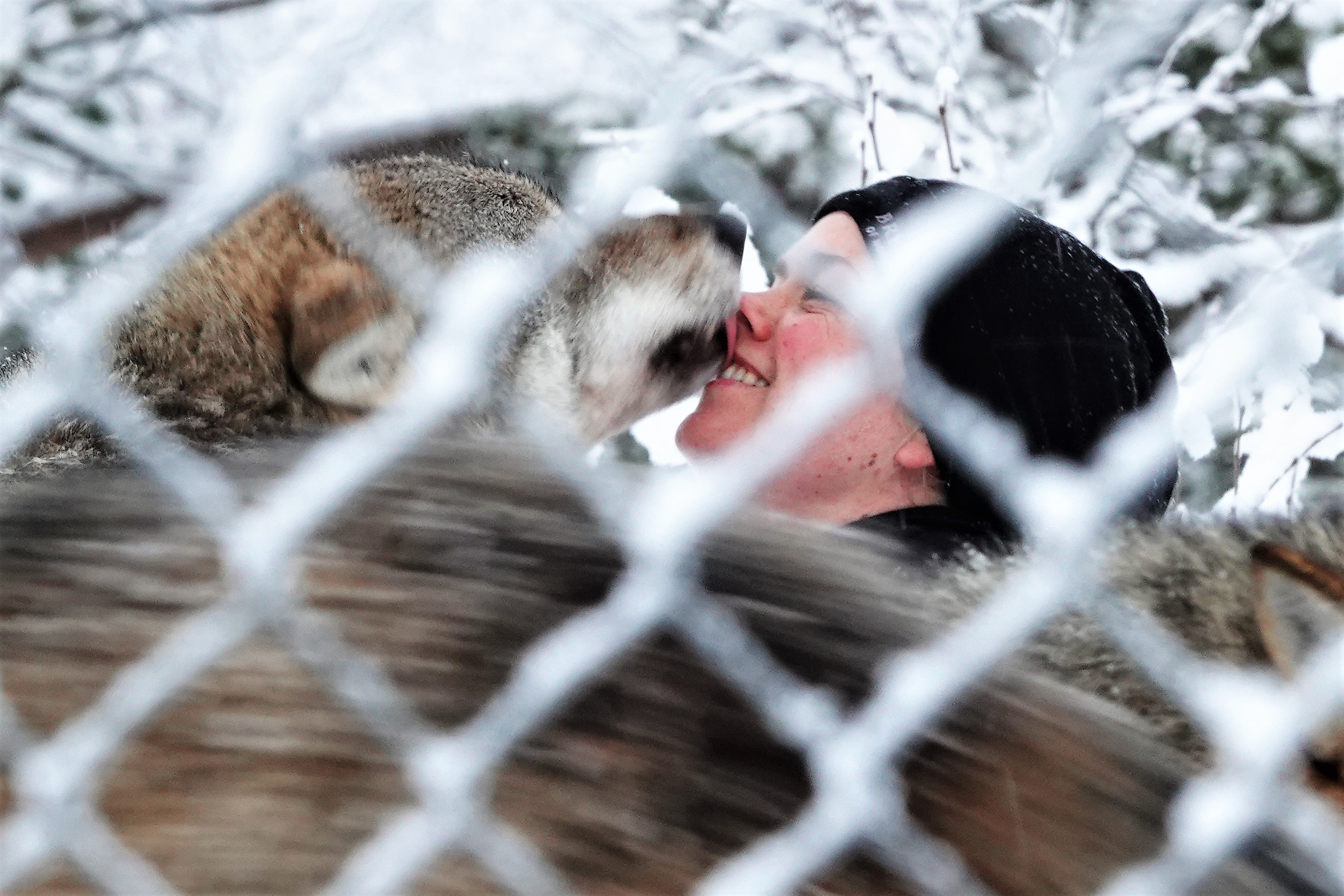
The wolves have been humanized since their arrival in 2006,
and available for kisses and snuggles, albeit for an extra fee.
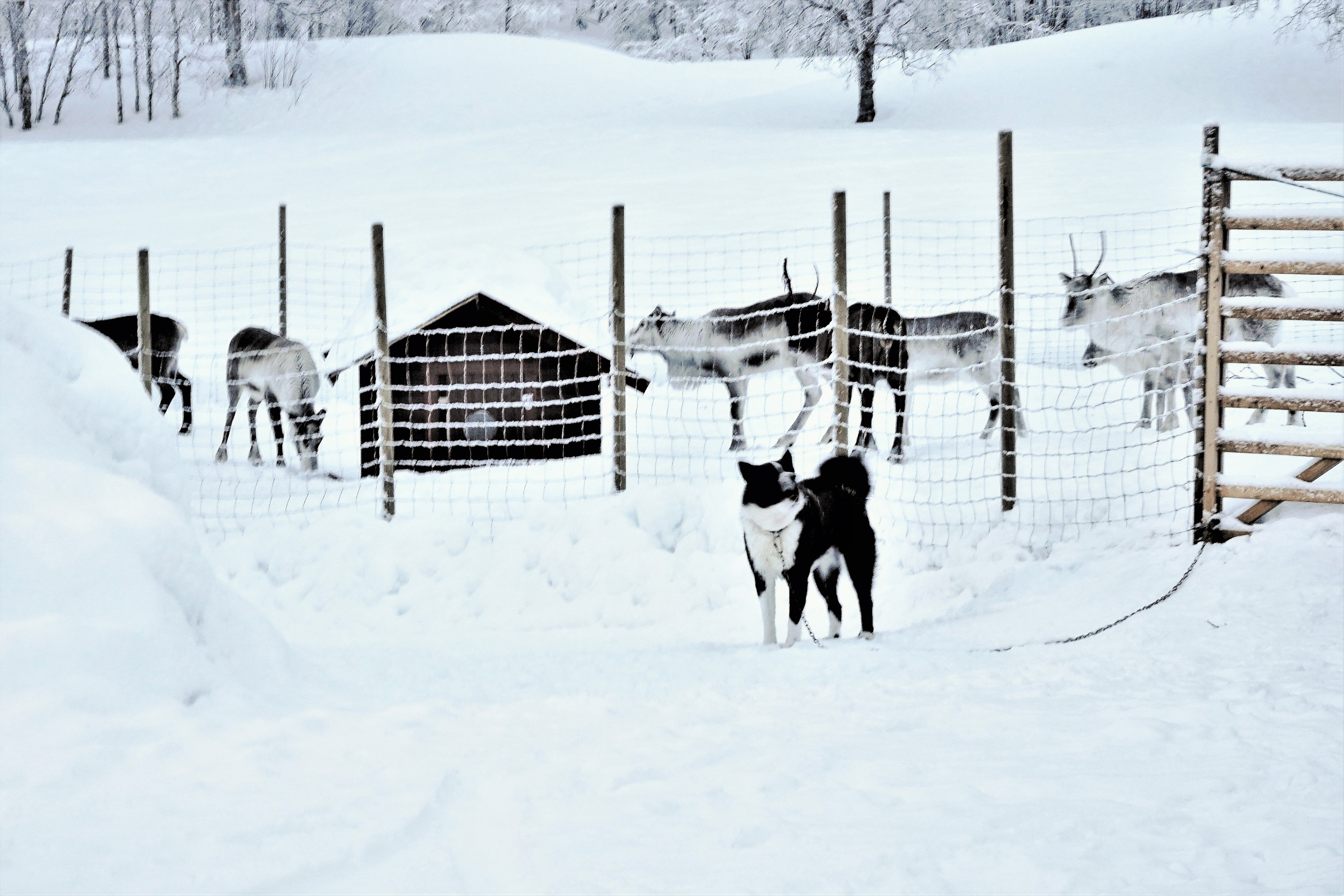
All things considered, I’d rather take my chances petting the barking dog that guards the reindeer down the road.
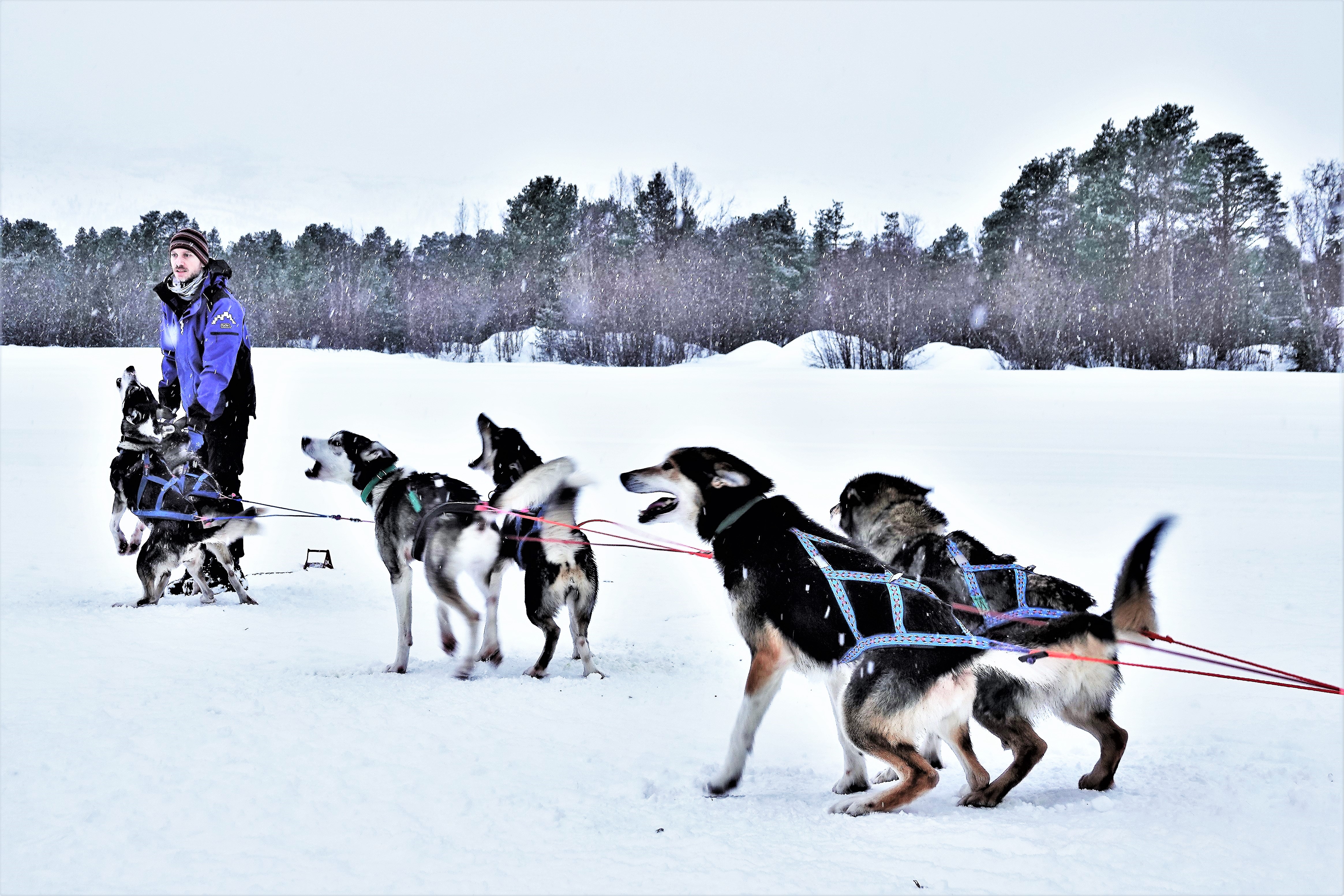
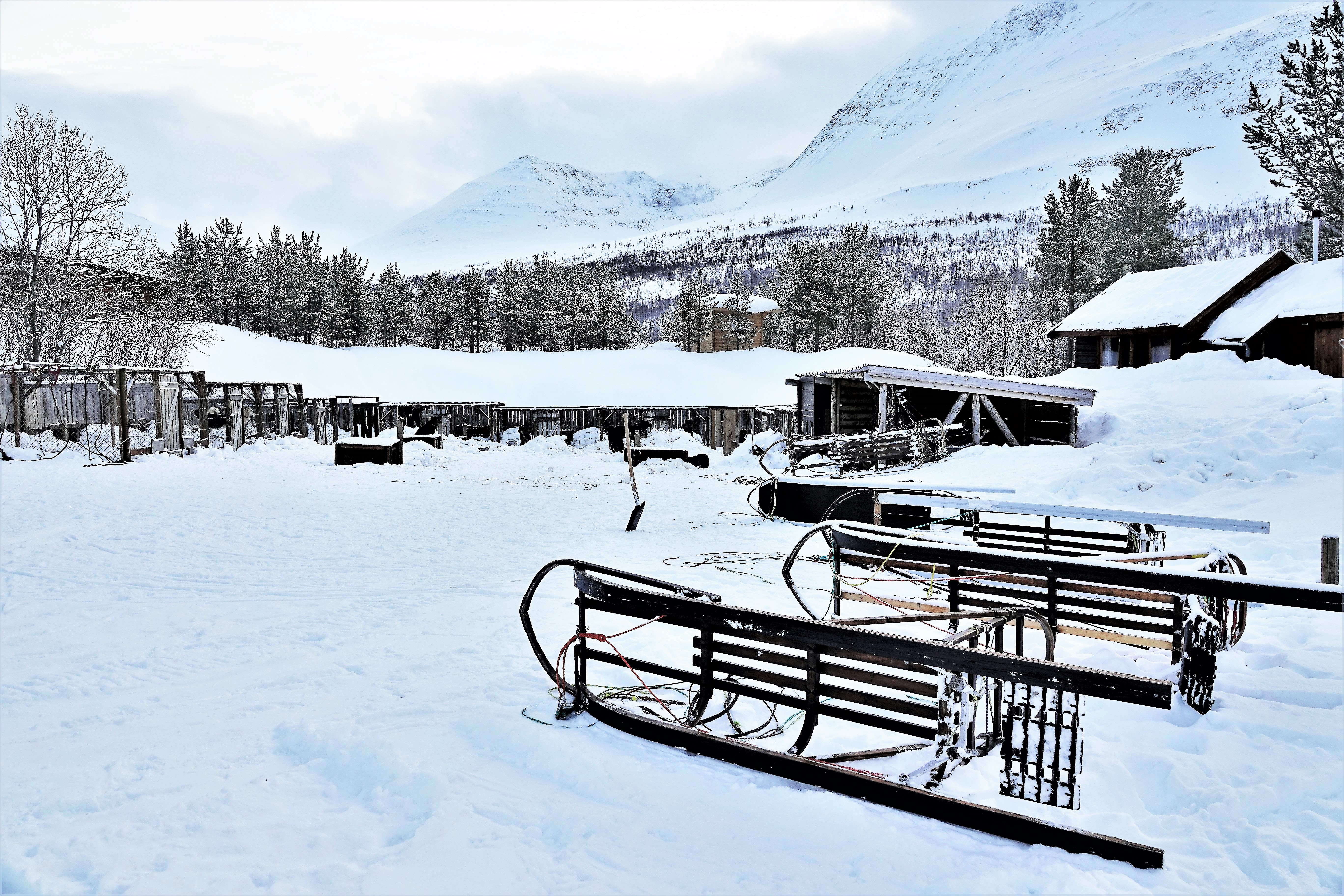
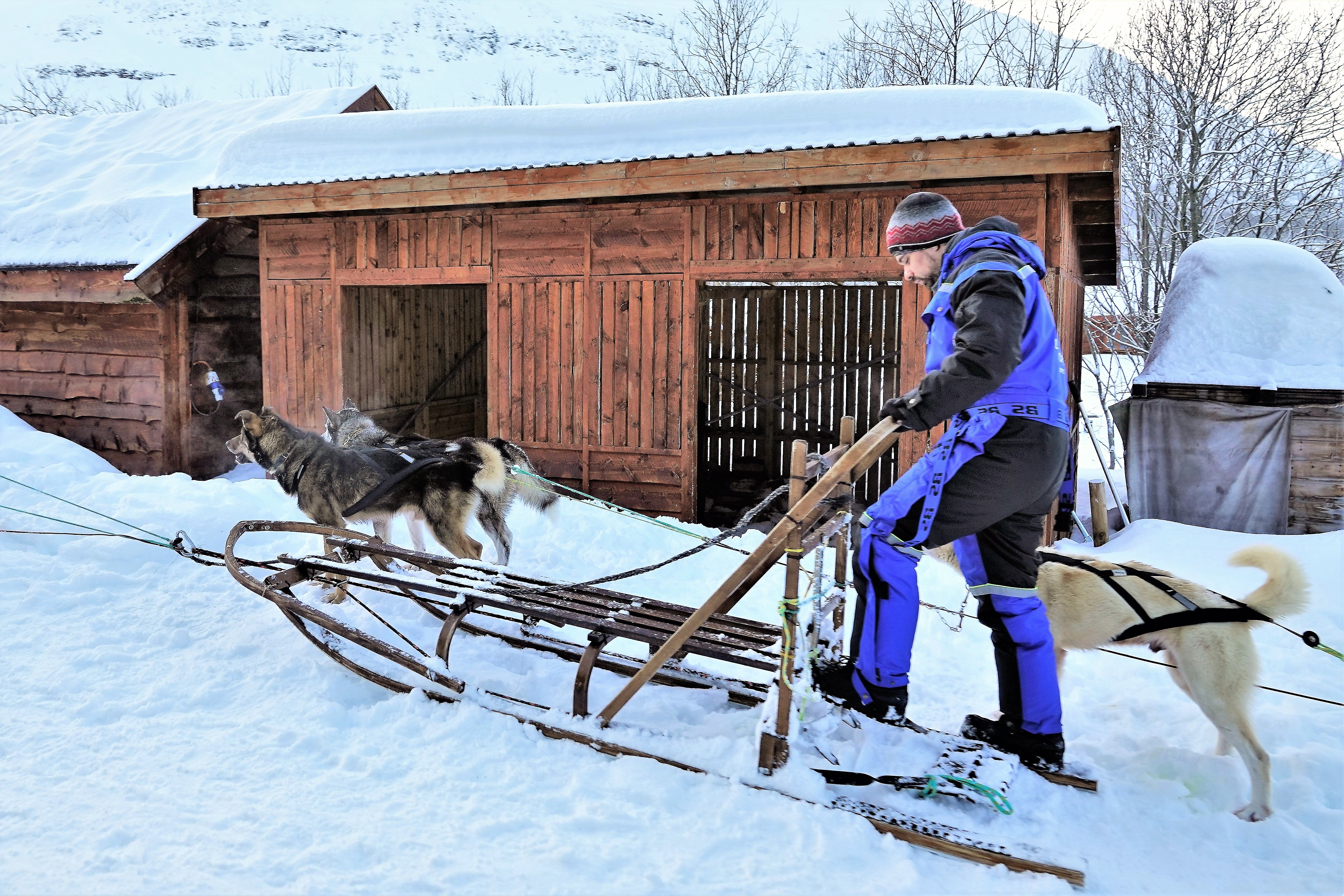
Tucked into the Alta valley, lies a kennel of 98 Alaskan huskies that are so eager to pull a sled, that a team of six can pull their anchor out of the ground.
So much so that it took a Holmen Husky trainer to restrain them.
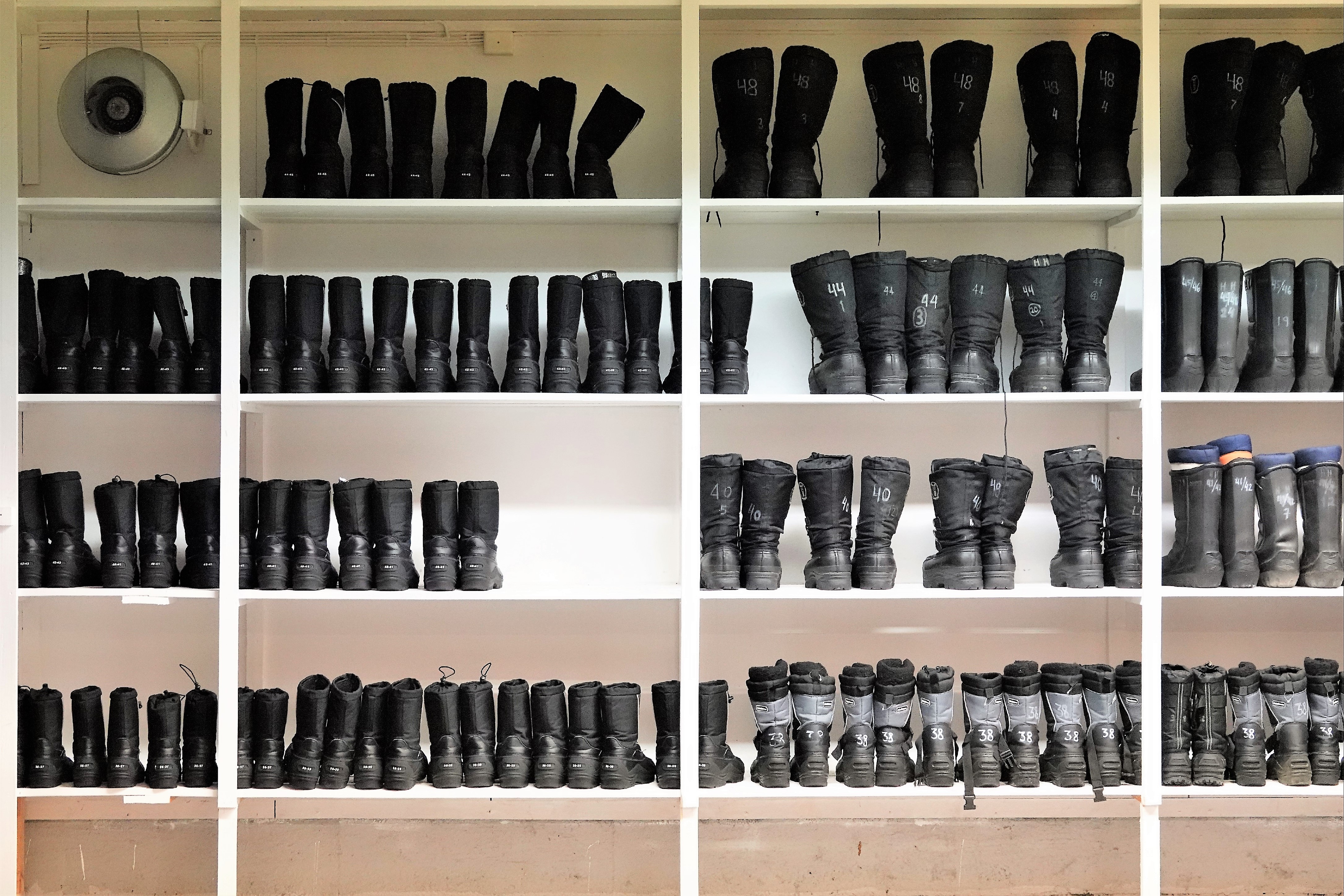
It was that kind of energy that had Leah and me so hyped to run the dogs on the trail, but only after properly outfitting ourselves…
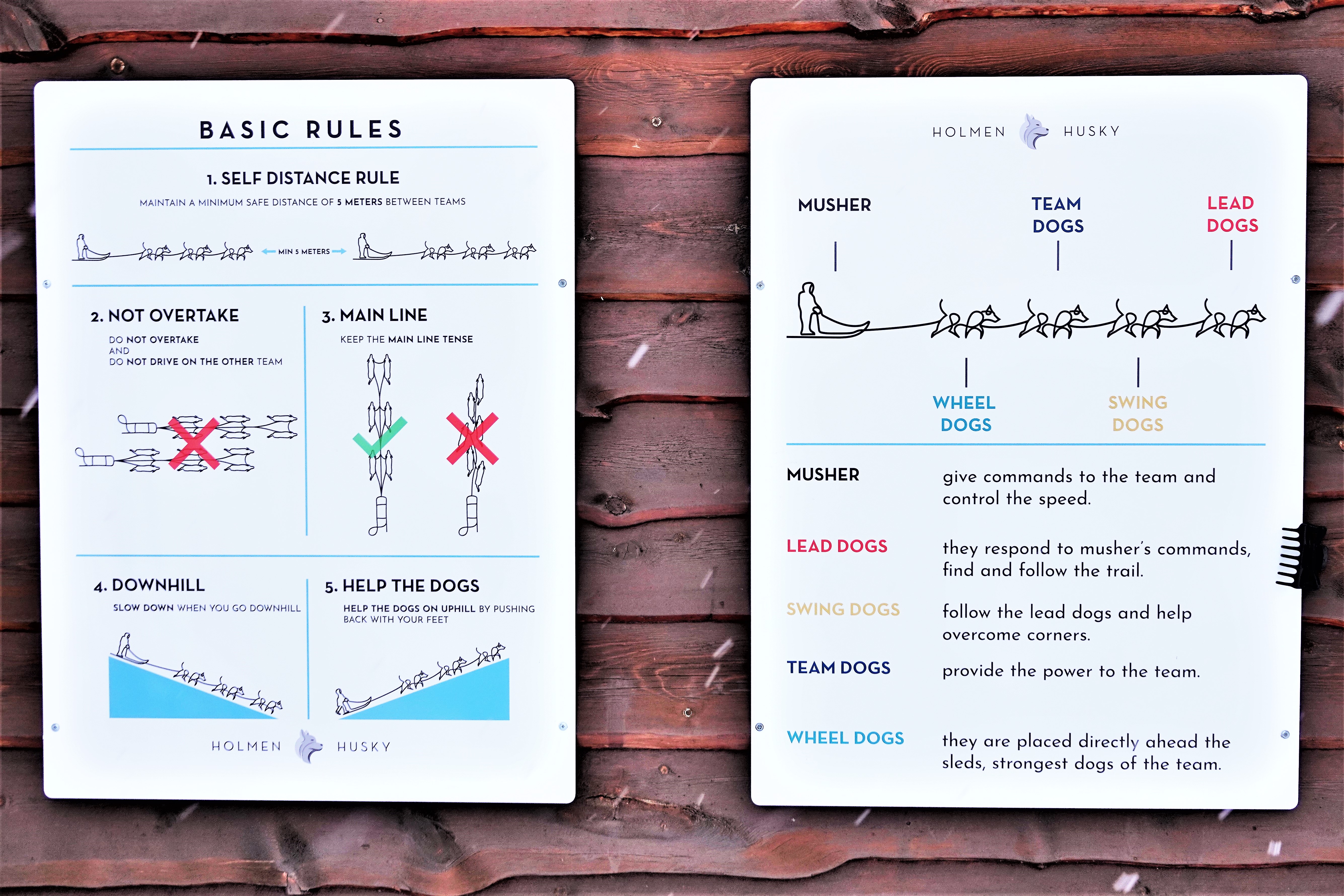
and learning the intricacies of mushing, as explained by Vicki from UK.
Most importantly, after witnessing the huskies’ enthusiasm, we focused on how to brake and when to brake!
After a visual review of the basic rules…
we were appointed to our teams.
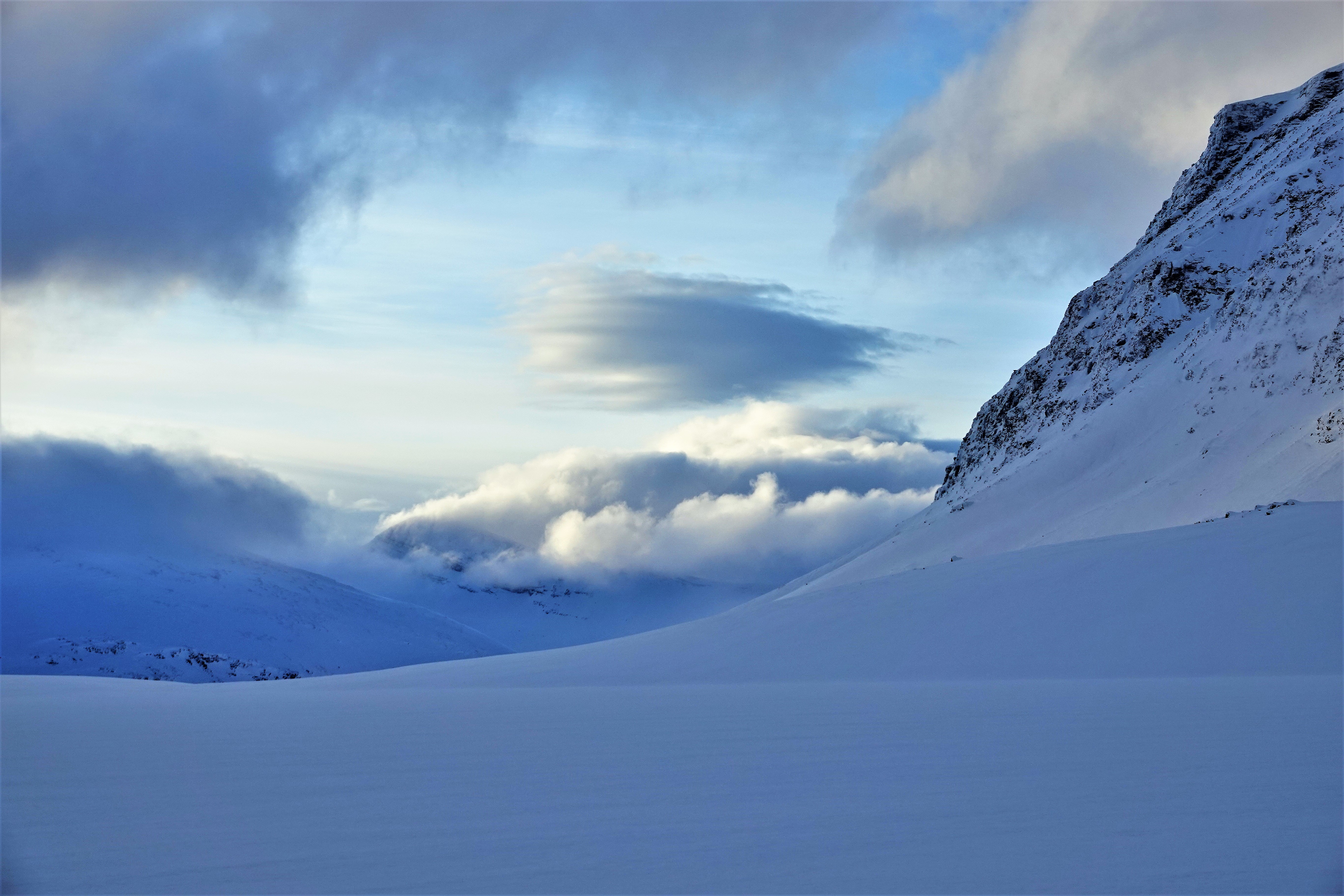
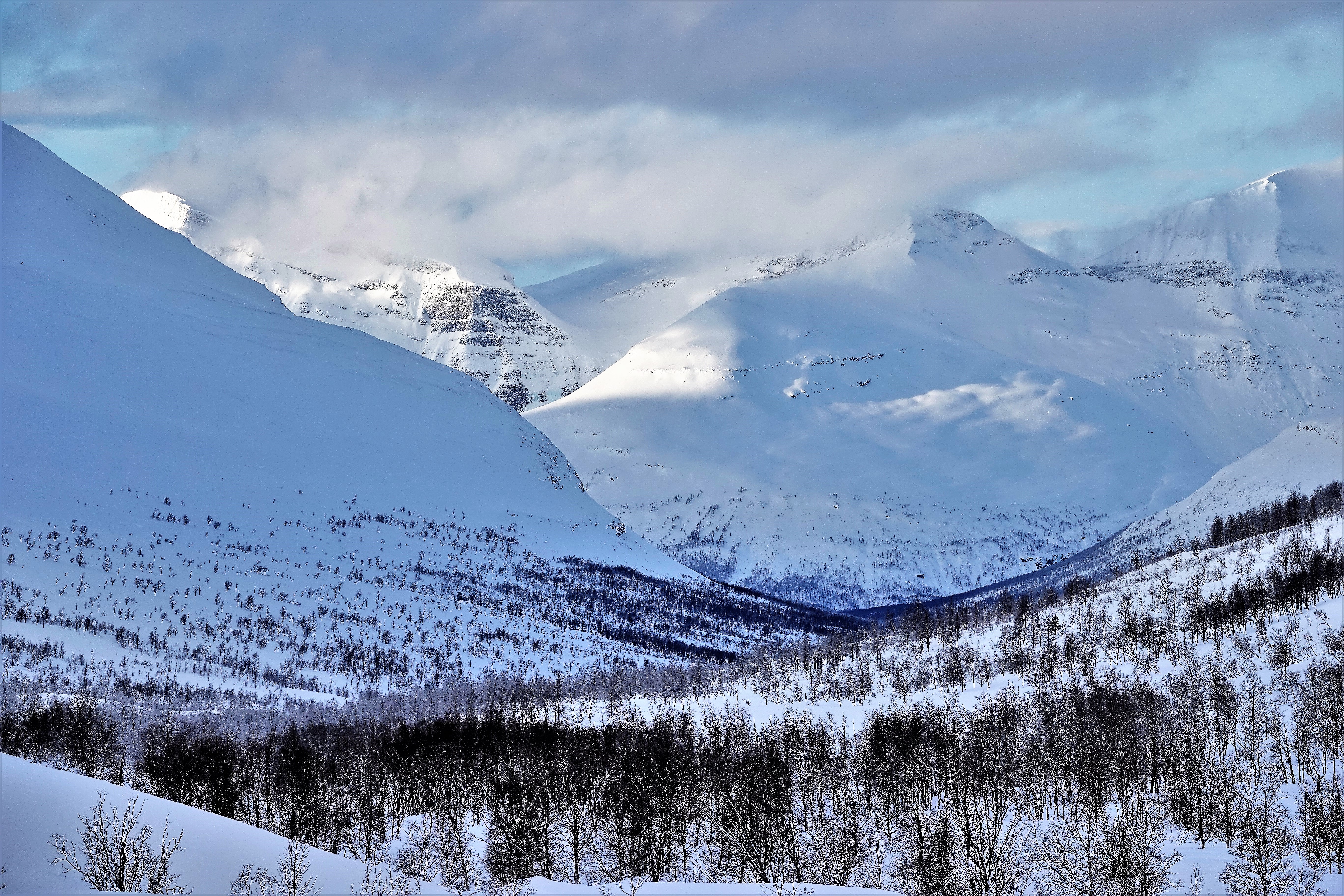
For the next 90 minutes, we rode through birch forests as the snow gently fell.
Keeping our distance between sleds was our biggest challenge, as the dogs were more than up to the task of hauling a 25 kg /55 lb sled…
with two passengers.
When occasional braking was necessary to prevent our sled from overtaking the sled ahead, the lead dog always turned to us, as if to say, “Why are you slowing me down?”
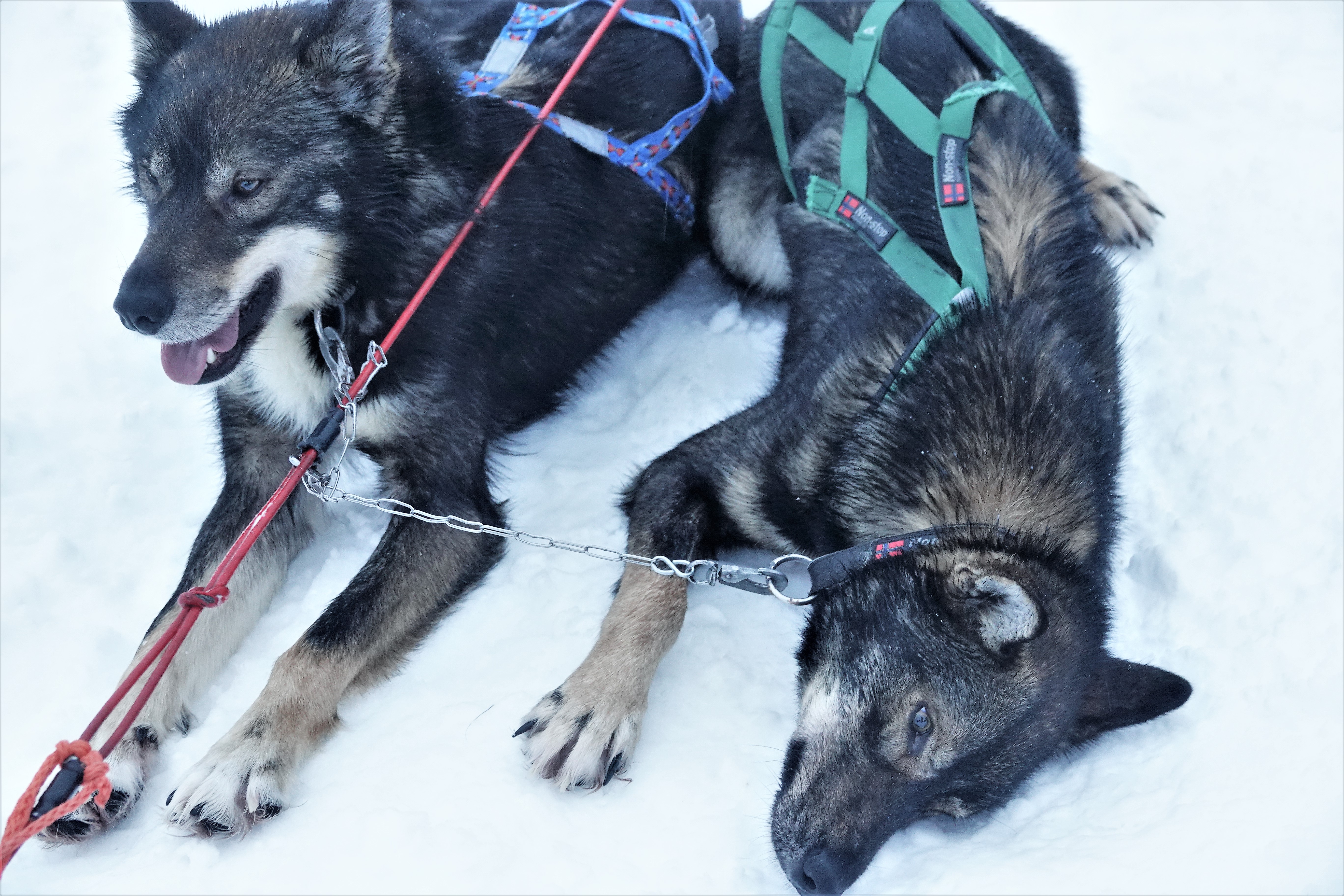
And when Duke, one our wheel dogs sensed that his partner Nola wasn’t carrying her weight, he let her know about it.
Bred for speed and endurance, Holmen’s sled dogs can manage 10 to 14 miles per hour, and may travel over 90 miles in a 24-hour period, pulling up to 85 pounds apiece!
The Holmen dogs are happiest when they are working, and even more so when they are racing.
When our run was over, it was time to time to relax…
to pose…
and to cuddle.
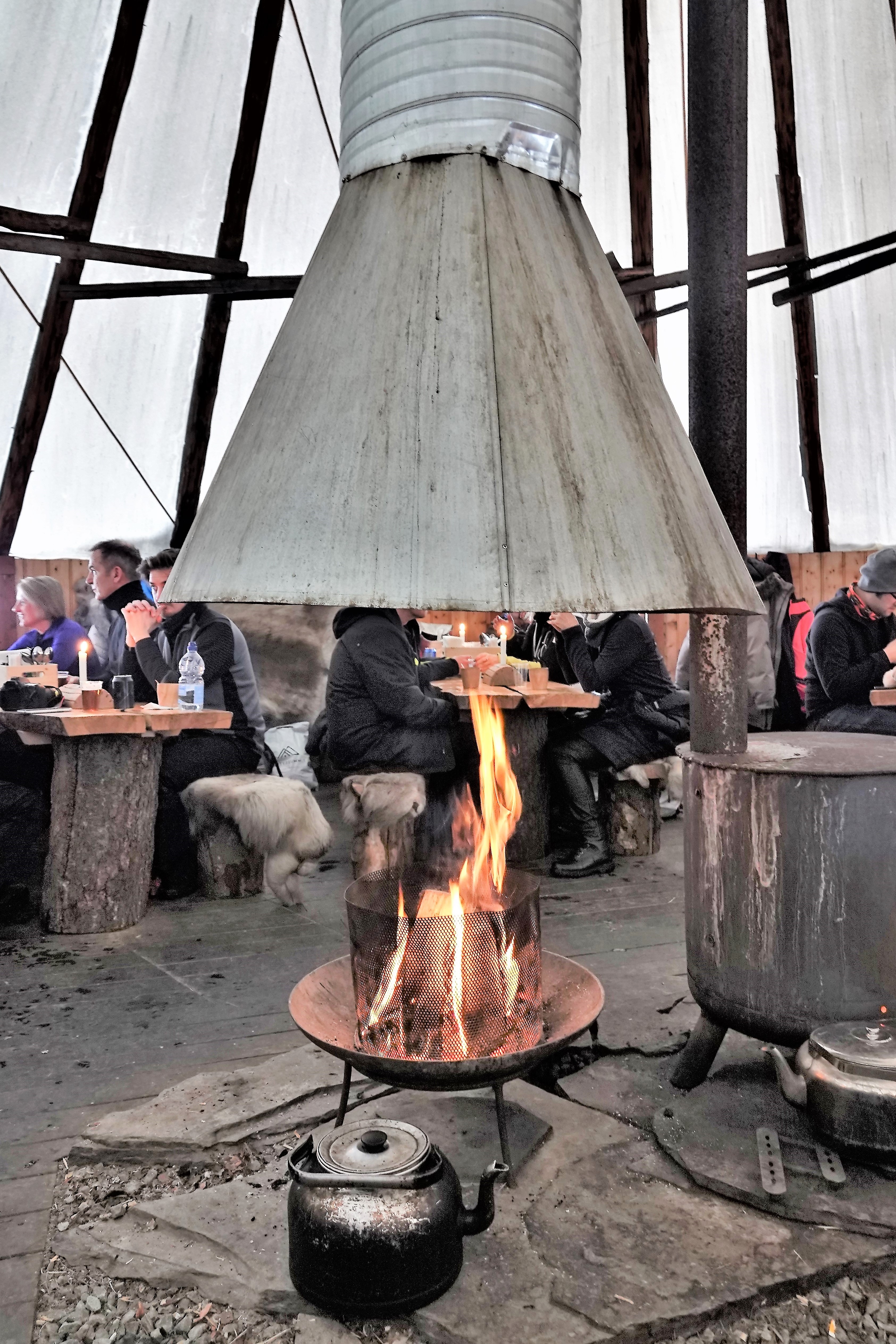
A fire, a biscuit, and some blueberry tea was the perfect nosh after our wintry mush.
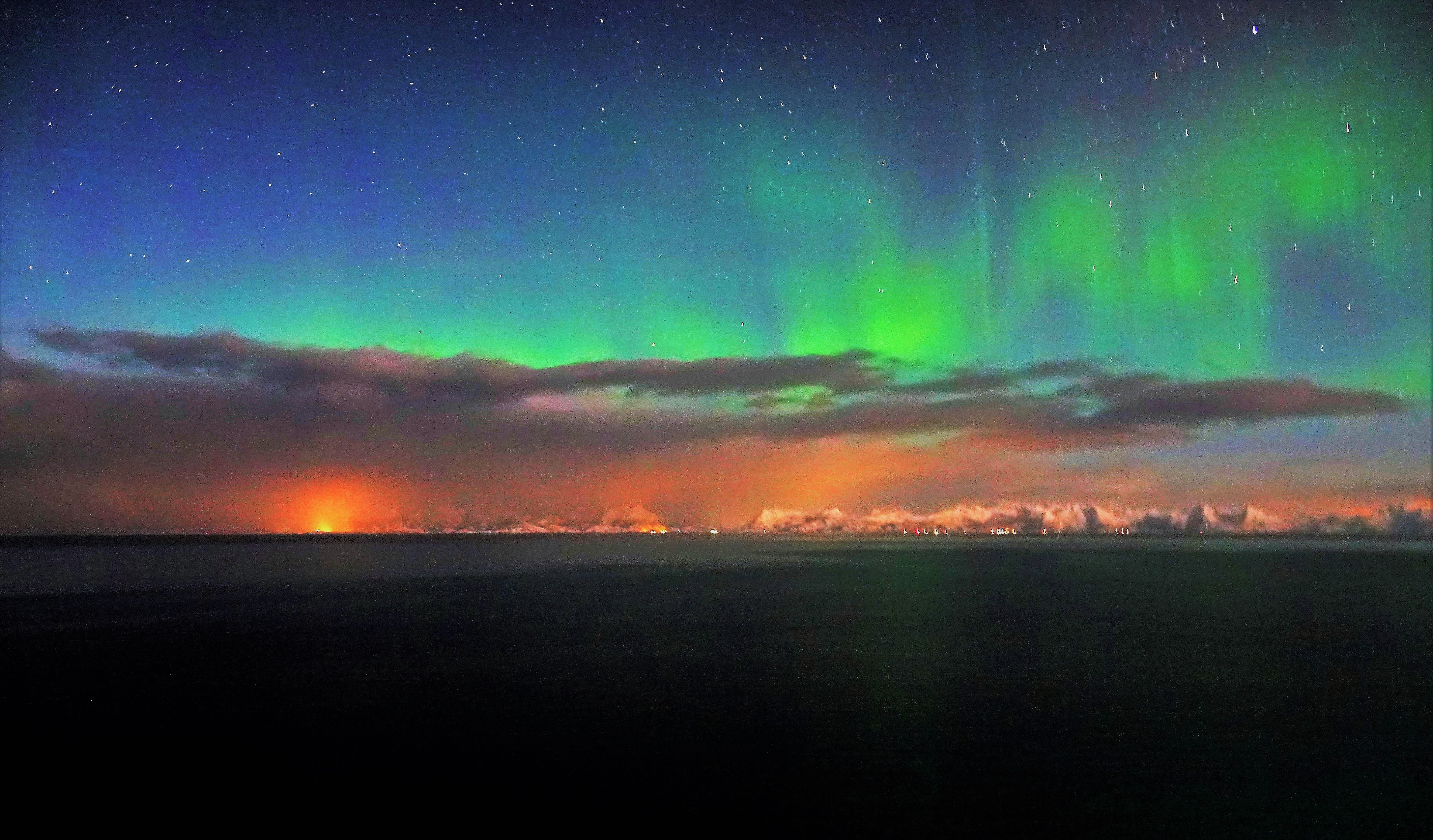
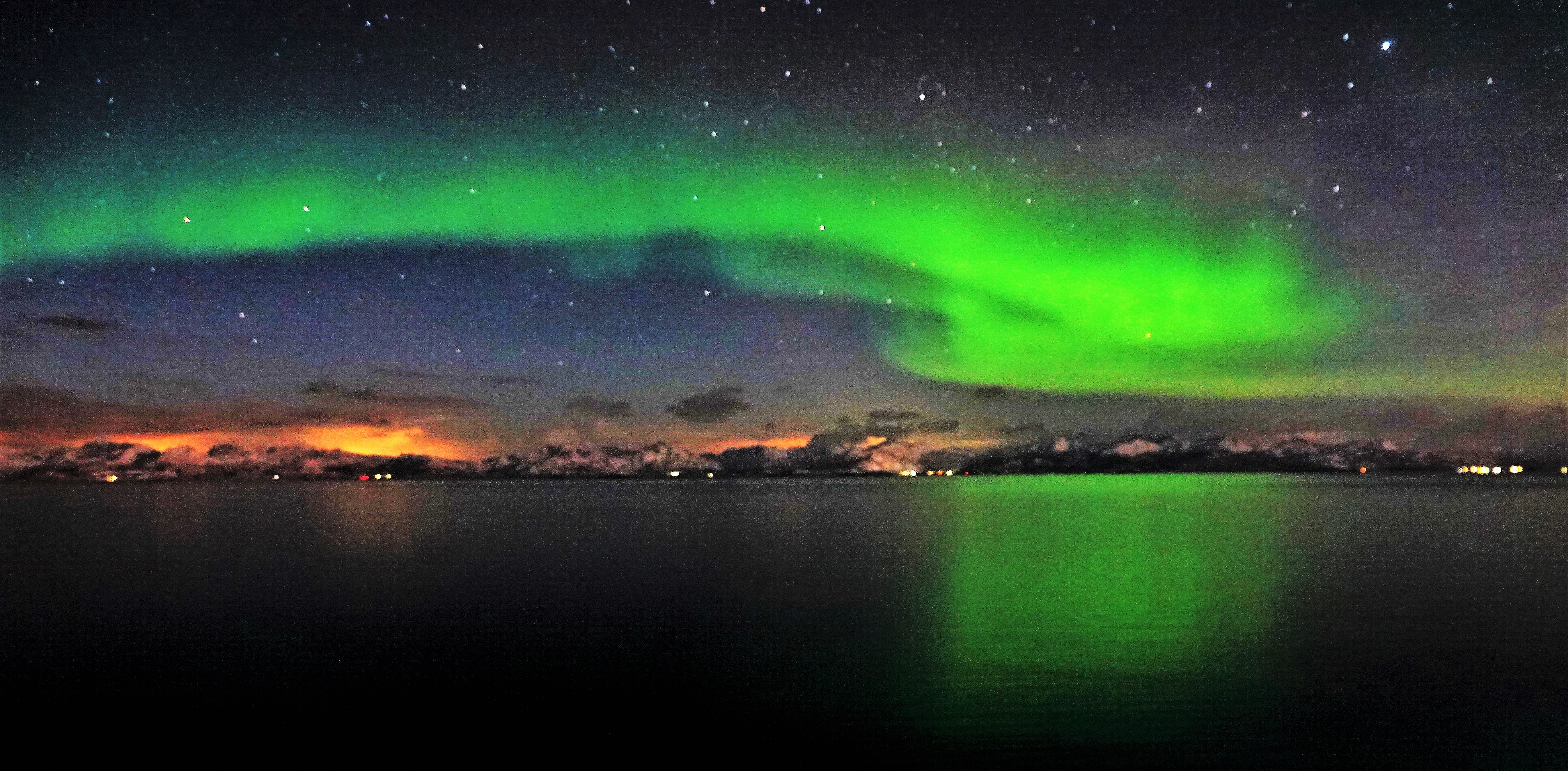
But doggone it, there would be no Northern Lights tonight!
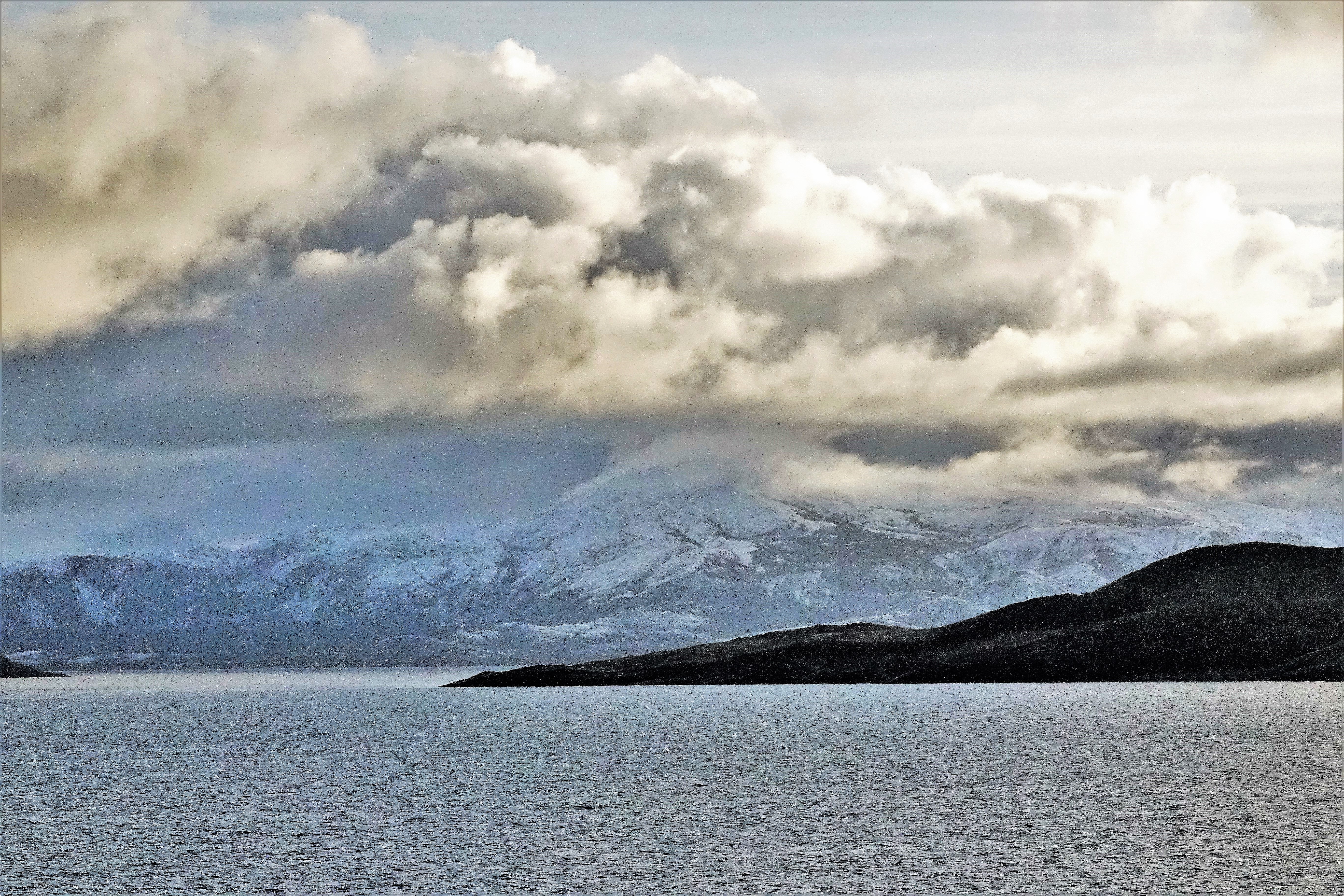
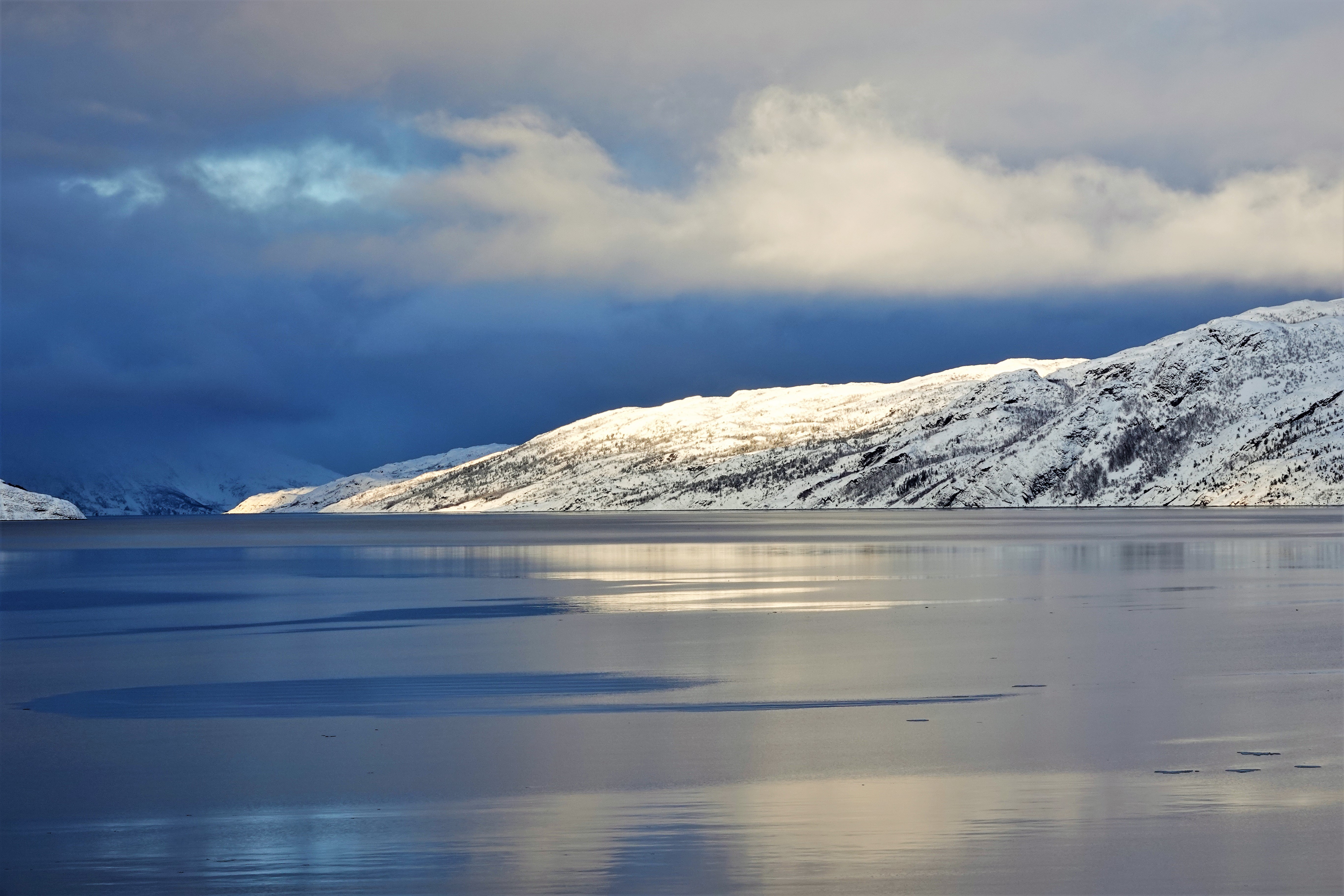
Our quest to chase Aurora Borealis continued aboard the Viking Star, cruising northbound through Finnmark, the heart of Norwegian Lapland,
and on to Alta, our northern-most destination inside the Arctic Circle.
Leah and I were praying for clear skies plus a surge in solar activity–given Alta’s reputation as the Town of the Northern Lights and home to the world’s first Northern Lights Observatory (1899) for conducting scientific research.
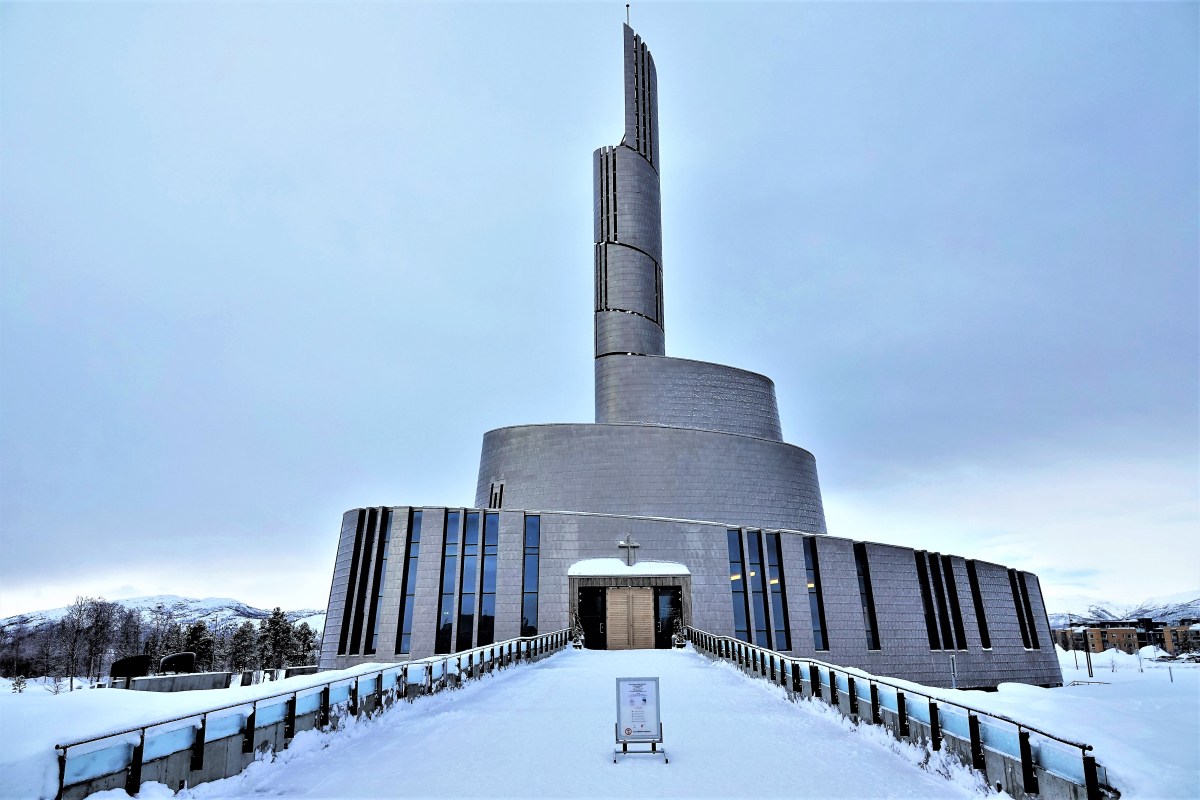
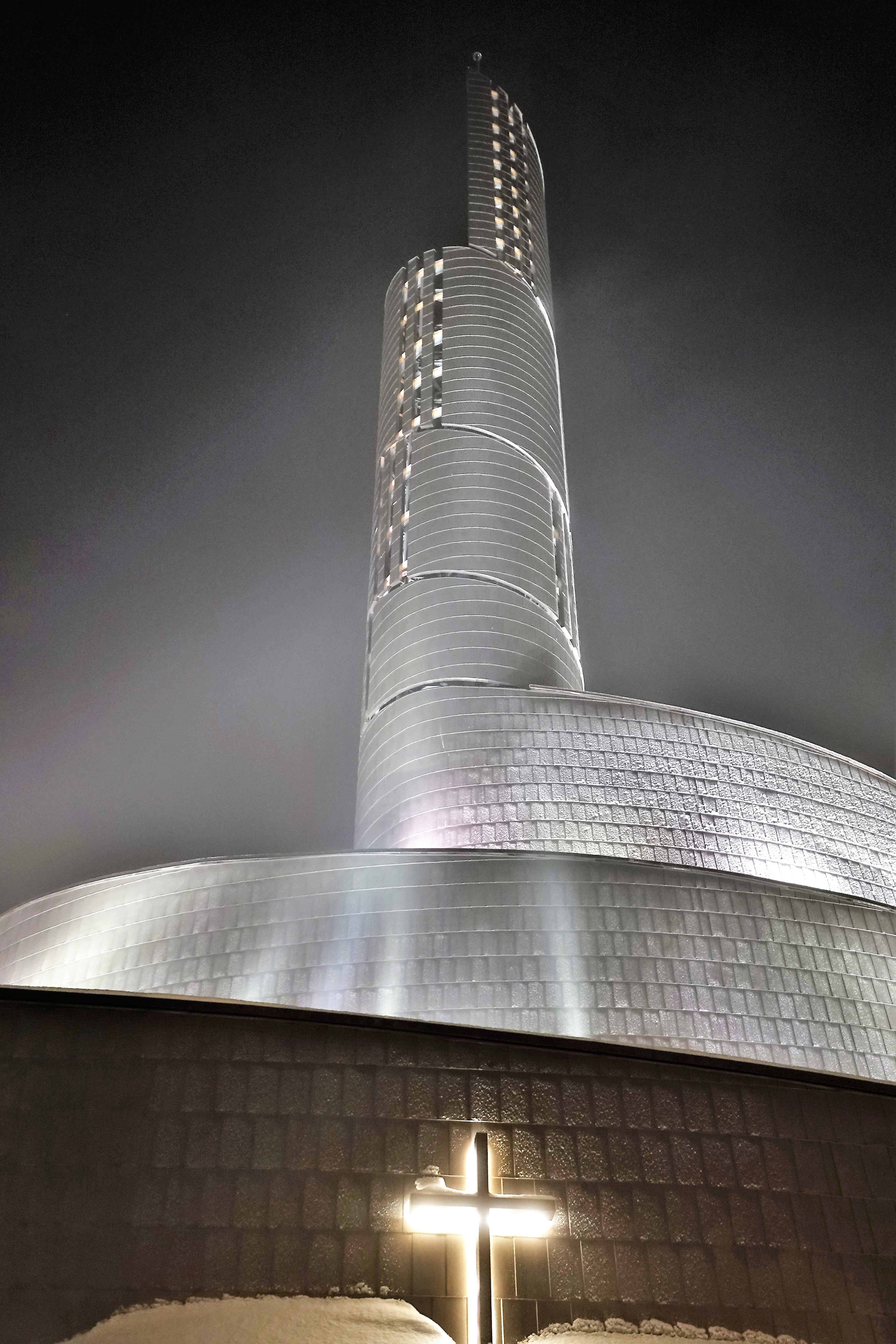
To that end, we mounted a pilgrimage to the Cathedral of the Northern Lights to increase our chances of an anticipated sighting. However, on this temperate night, an unexpected veil of dew painted the town, offering up a cathedral bathed in shimmery titanium,
lunging 47 meters (154 ft) toward an elusive phenomenon.
To the townsfolk, this sanctuary is as much a tourist attraction as it is a church.
It represents “a landmark, which through its architecture symbolizes the extraordinary natural phenomenon of the Arctic northern lights,” according to John F. Lassen, partner of Schmidt Hammer Lassen–a Danish design firm that collaborated with Scandinavian firm Link Arkitektur to win the city council’s design competition in 2001.
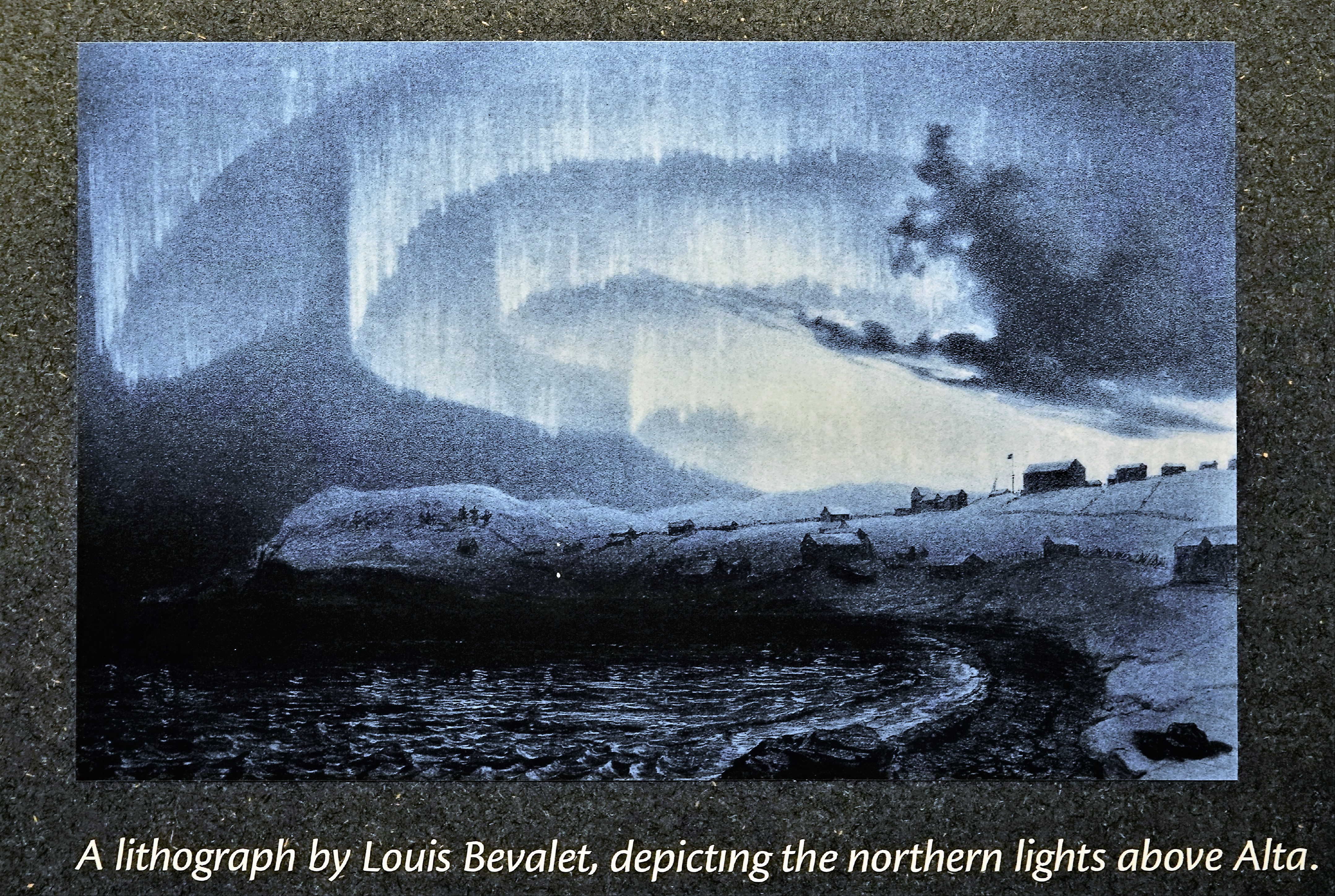
And there is much to appreciate about the design–outside and in. The exterior’s circular body mimics a magic curtain of light once illustrated by Louis Bevalet in 1838.
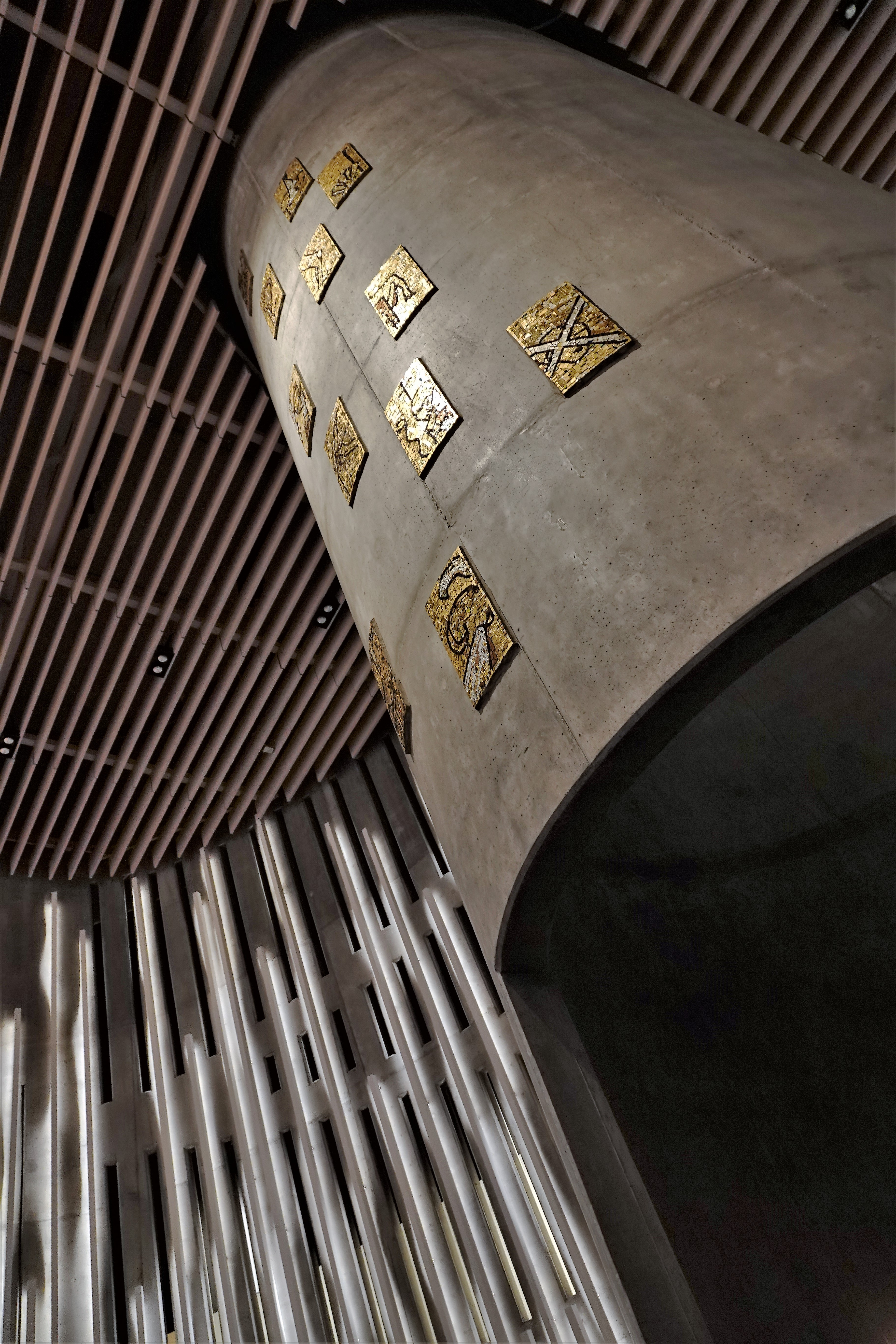
And the interior lighting resembles the long shafts of light associated with the Aurora.
Religious overtones are emphasized through the metal mosaics representing Twelve Disciples…
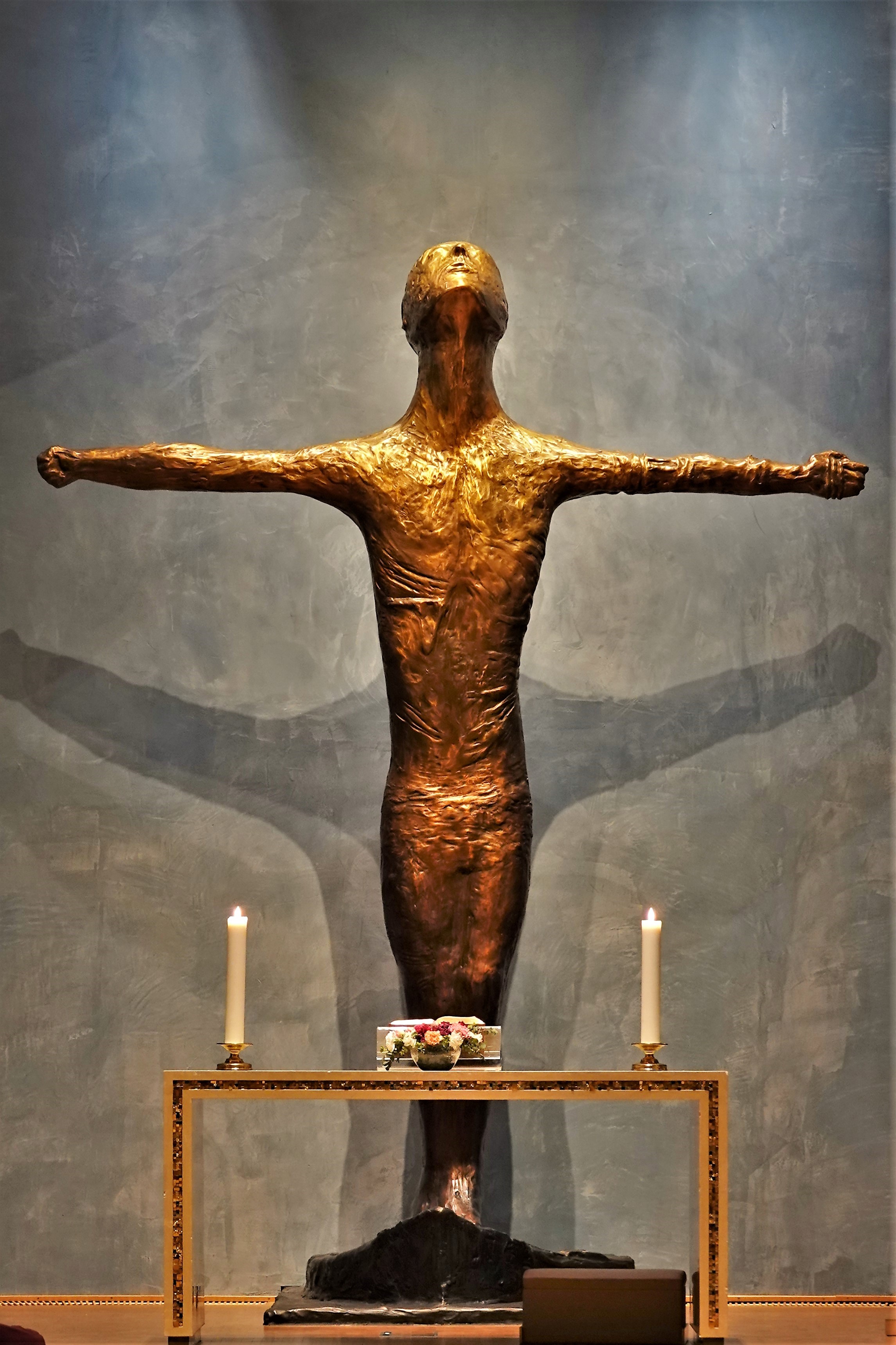
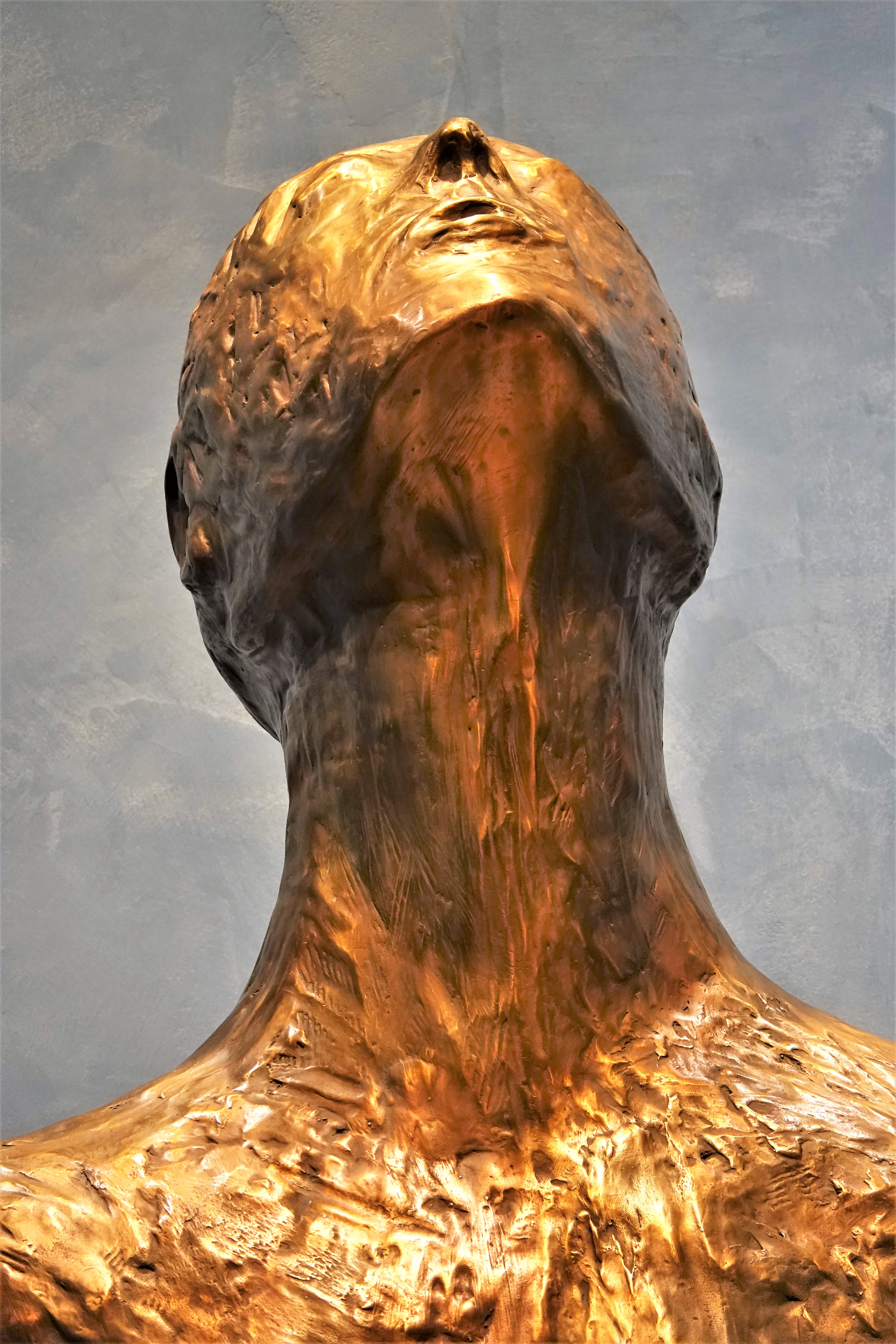
and the 4.3 meter (14 ft) modernist bronze of Christ searching the blue-glazed heavens, imagined by Danish artist Peter Brandes. While some worshippers may claim that a hidden face lives in the outstretched neck of the subject,
the illusion is subject to personal interpretation.
Consecrated in 2013, the Cathedral of Northern Lights functions as Alta’s parish church of the Church of Norway, yet remains an open forum for assembly and performance.
One-year after the first benediction, the concrete walls had settled and the pipe organ was installed. The dynamic acoustics attracted notable talent and filled all 350 seats.
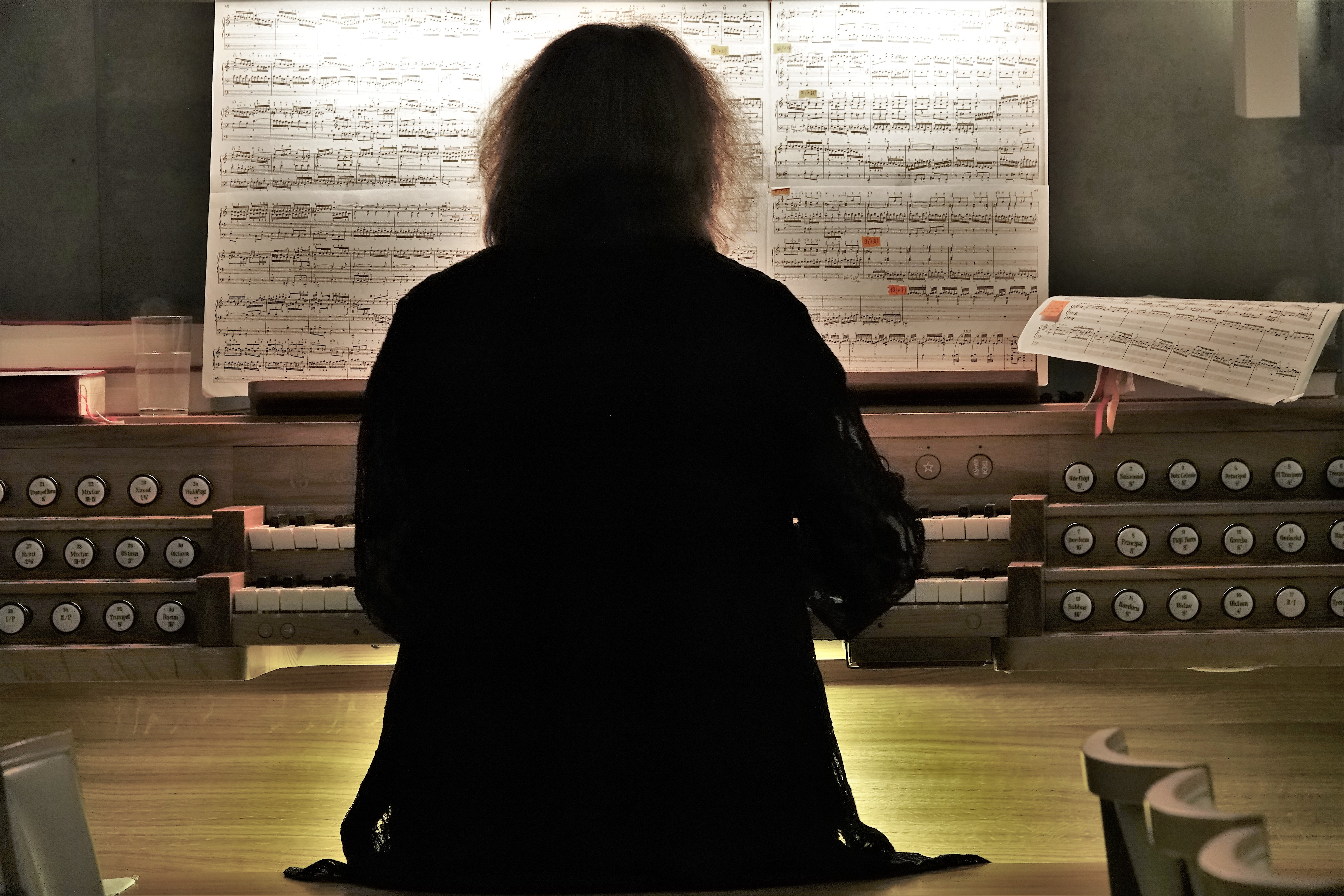
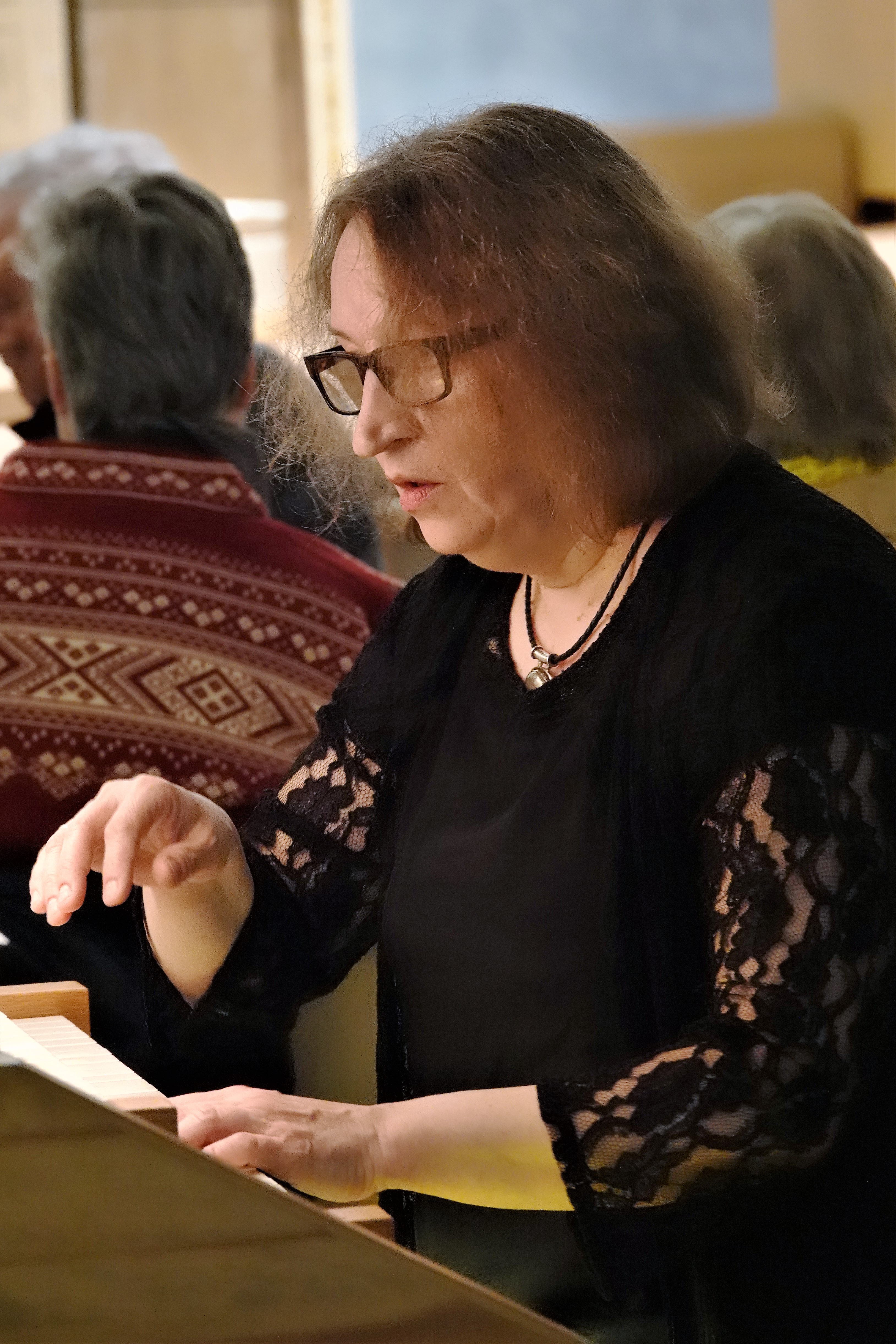
Leah and I attended an organ recital by Irina Girunyan,
master organist.
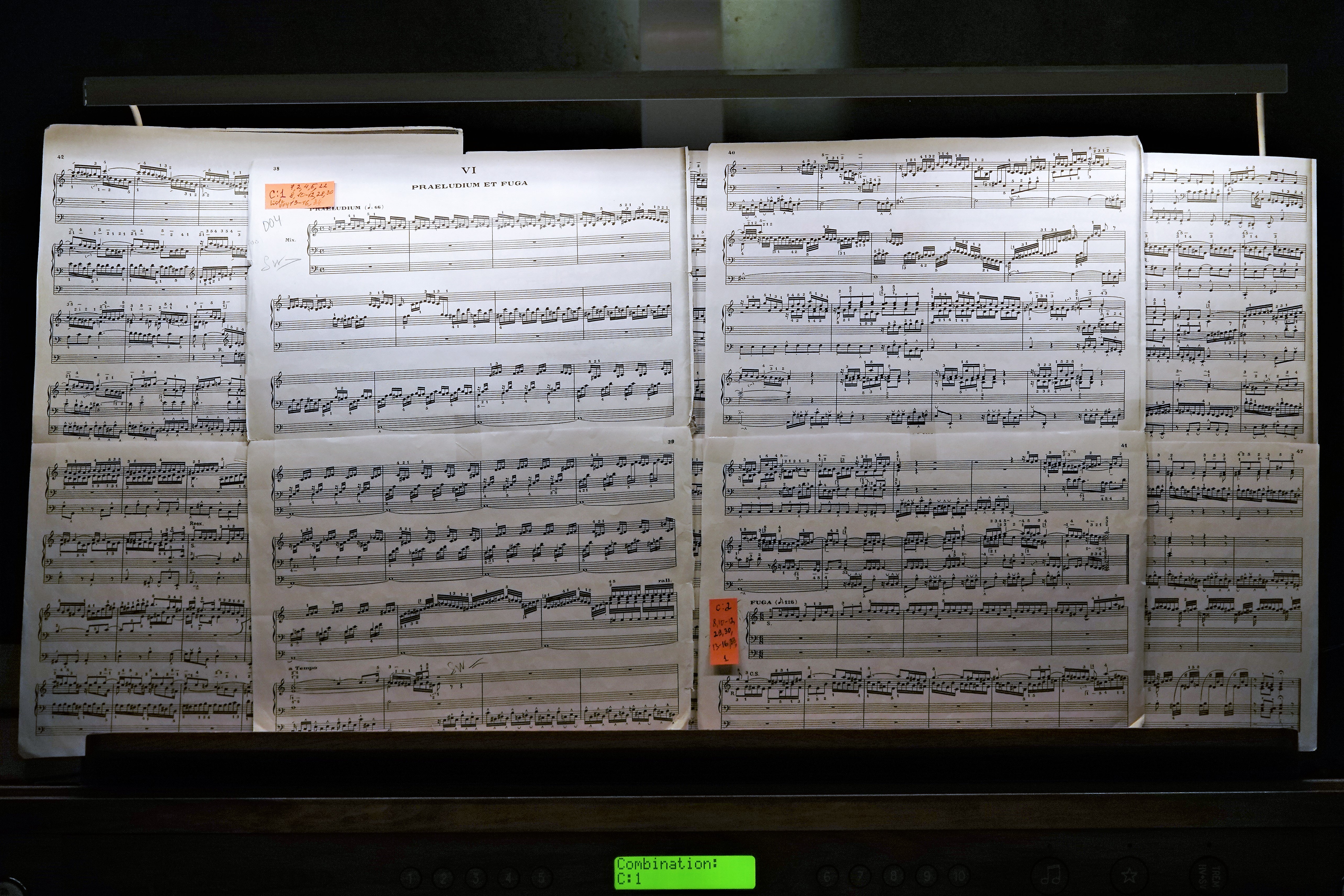
While following a complex score for hands and feet,
Irina skipped and fluttered her way through an evocative program of classical and contemporary music.
The ethereal sound from 1800 pipes and 26 stops was heavenly,
and left me yearning for another reminder.
The titanium-clad Cathedral of the Northern Lights (Photo: Adam Mørk/schmidt hammer lassen)
Whenever I’m traveling with Leah, the driving usually falls to me. Don’t get me wrong; I’m not complaining. In fact, I enjoy driving as much as Leah prefers being the passenger. I figure our roleplay has lasted us through nearly sixteen years of togetherness and over 200,000 miles of highways and byways.
Over the years, we’ve worked out a reliable system where she tells me what to do and I’m inclined to ignore her.
Well, not exactly…
But ours is a predictable pas de deux that’s always destined for Bickerville.
For instance, if we’re traveling on the Interstate, Leah’s likely to order: “Slow down! You’re driving too fast.”
Typically, I’ll answer, “Okay,” and resume my present speed. I know it irritates her when I don’t accept her advice because she tells me so. Yet after a time, all is forgiven–but never forgotten. She never hesitates bringing it up again and again at my earliest convenience.
Similarly, if we’re driving in traffic, I’m likely to hear, “Why do you have to be on his tail all the time?” Her remark always seems to shift into hyperbole.
But I don’t blow a gasket. I simply suggest that if I was that close to him, I’d be able to read his license plate.
Then before too long, I’ll receive another Leah alert: “Slow down! You’re driving too fast.”
Occasionally, I’ll remind her, “You’re welcome to drive yourself, if you don’t like the job I’m doing.”
More often than not, she’ll respond with, “That’s okay. I’m good.”
But patterns are made to be broken. The chance of snowmobiling across the Arctic Circle brought a different scenario I didn’t see coming.
We arrived from Tromsø to Camp Tomak by the busload…
to participate in sledding for the day–either by dog…
or by engine.
After gearing up for Arctic climate…
we were ready for our safety and operations briefing.
That’s when Leah determined that she had no interest in driving, and even less interest in riding behind me.
“There’s no way I’m I getting on this machine with you,” she insisted.
“Why not?” I asked. “It’ll be fun!”
“Because I have no interest in getting hurt or dying,” she expressed.
“Neither do I!” I objected.
“And what if you should roll over?” she predicted. “I think I’d rather ride with Jan.”
Jan, our guide interceded and accepted to buddy-up with Leah. At first, I was insulted that she didn’t trust me–that she imagined I would risk our lives and limbs–until I realized what a huge favor she had done for me.
Without Leah behind me, I was free from scorn and criticism.
The snowscape was endless.
The cliff face was frozen.
The Nordic sky was vast.
And the scenery was breathtaking.
The guests had good reason to be giddy.
When the sun set behind the mountain,
we retired to the Sami tent for warmth, reindeer stew and tea.
Naturally, I thanked Jan for his hospitality and counsel.
“That was absolutely liberating,” I gushed. “I owe you big time for taking Leah along. Maybe you’d like to take her home with you,” I jested.
We shared a laugh together, but Leah wasn’t having any of it.
“Keep it up and you’ll be sleeping with Olaf,” she warned.
Our raison d’être for making this pilgrimage to Norway’s wintry Arctic Circle and beyond was to catch a glimpse of the elusive Aurora Borealis. Leah’s extensive web browsing helped us determine the best location and time of year when solar activity would peak,
and Tromsø seemed to be a worthy contender for Northern Lights activity.
Hence, our excursion to track the Northern Lights had been booked months ago using a local outfitter who would drive us a reasonable distance away from city lights to improve our viewing potential.
We met Mag, our guide behind the Scandic Hotel, not far from the city square where earlier in the day the Samis were preparing for a weekend of Nordic games in celebration of their indigenous culture, including the reindeer race championship as the main event.
Our plush mini-bus departed at 8:00 PM with 12 world citizens aboard–representing China, India, Brazil, Argentina, and Florida–all with an equal fascination for Northern Lights, and all bundled up, since we planned on sky-watching for 3 hours in frozen surroundings.
Of course, there was no guarantee that the weather would cooperate (nullifying any opportunity of seeing the Lights), but with passports in hand, our guide was prepared to drive us across the Swedish or Finnish border if need be, should our original destination in the direction of Overgård be too clouded over.
As he drove, Mag would occassionally crane his neck skyward, peering through the windshield in search of a sign. After an hour, he steered the van off the highway into a remote turnoff, and signaled that we had arrived.
He admitted that tonight would be tricky because of the full moon and passing clouds…
but if we trained our eyes across the horizon, we might pick something up.
I planted my tripod and waited…and waited…and waited…
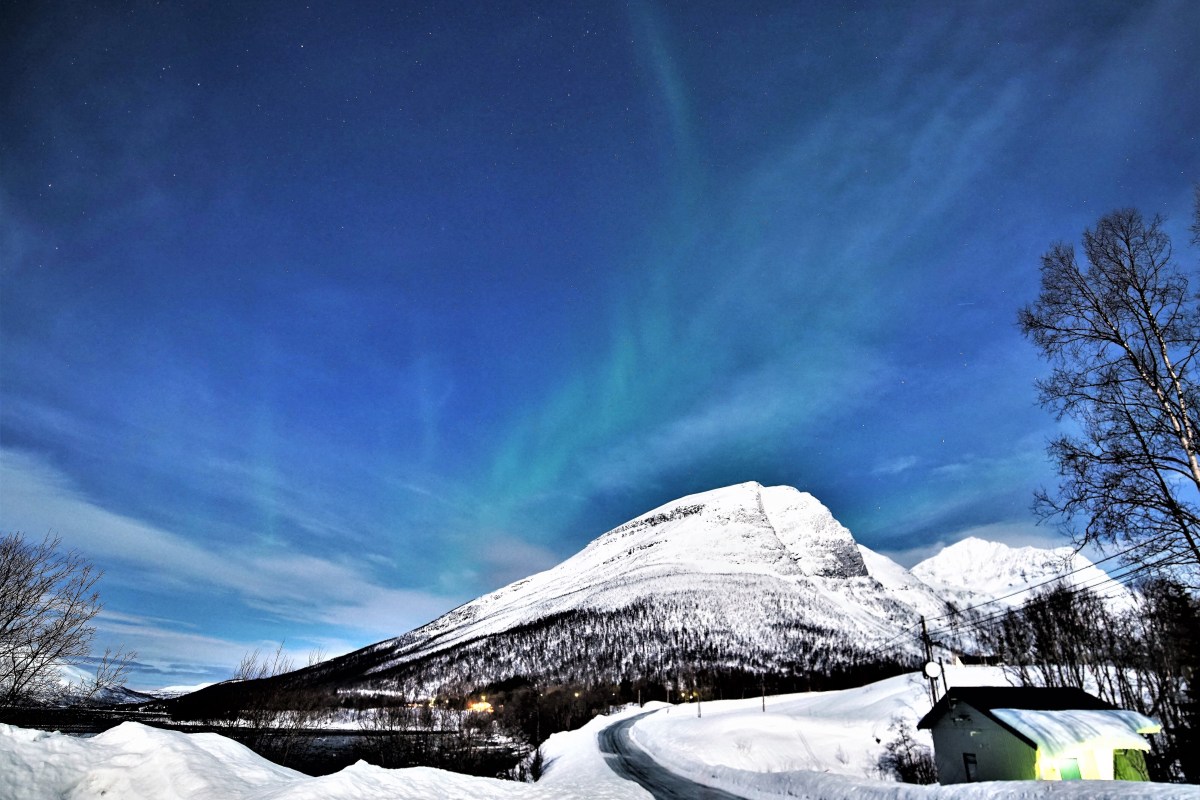
“There!” shouted Mag, “over the mountain.”
I panned my camera in his direction, and took a timed exposure, still uncertain of what I was shooting, and waited for results.
Mag was right! Something was there, but it was barely perceptible.
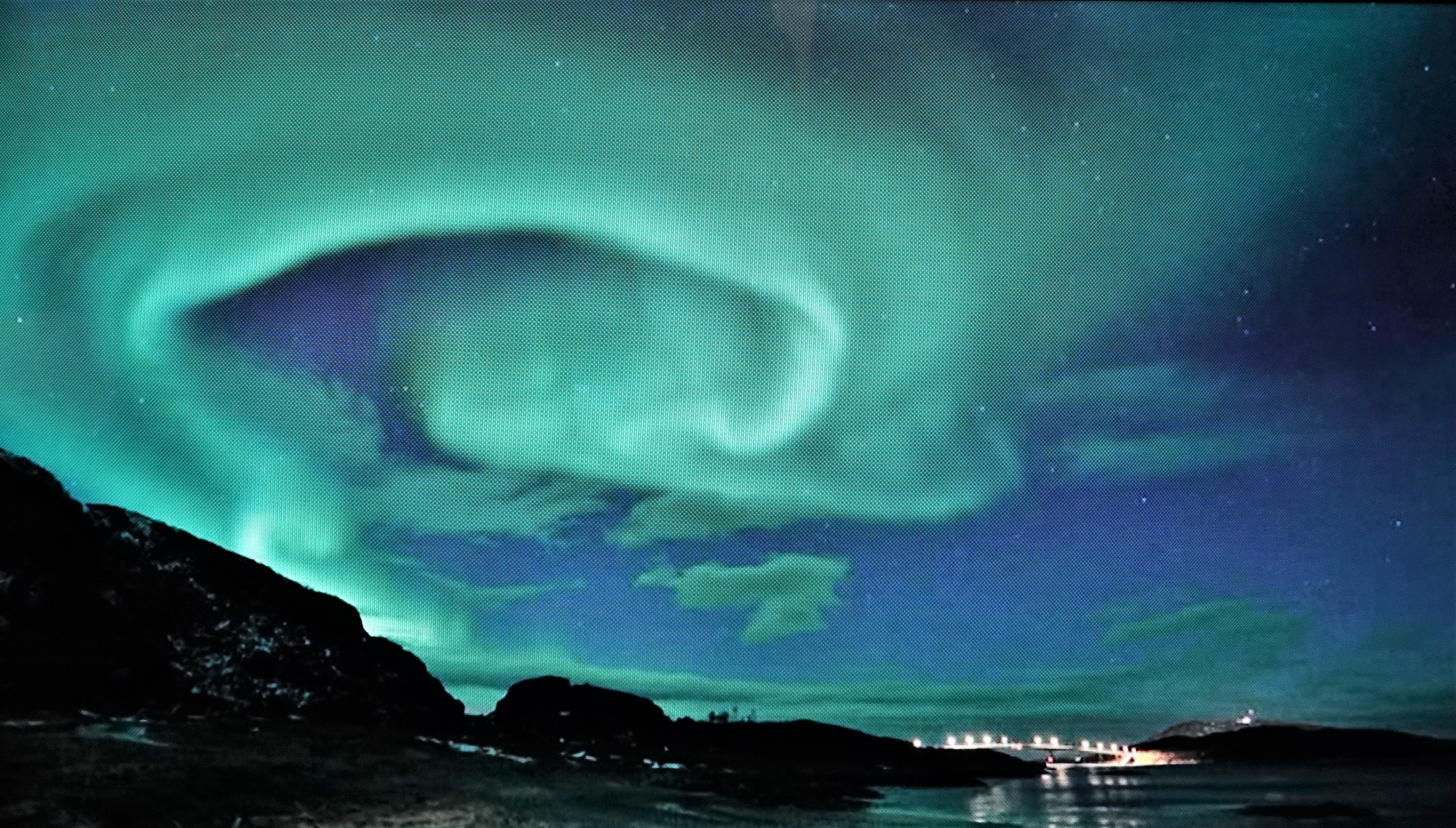
But who was I to judge? It’s just that I was looking for something more spectacular. Where were the crazy colors I craved, like the grand arc I recently recorded from a slideshow monitor?
“Be patient,” he advised. “There’s something going on here. But the lights are fickle, and it’s too early to tell if the activity is significant or not.”
After making some exposure adjustments, I waited again…until I recognized a dim shadow moving across the horizon…[CLICK]…
I was feeling somewhat gratified that I discovered the aurora on my own, but still, my Impression Meter was registering Underwhelmed, while my Expectation Meter was to set to Light Show!
Others among us wondered aloud if we should move to another location.
But Mag countered, “We could spend more time driving in the mini-bus, or we could continue to search the sky where we are standing. But I can guarantee that the sky we have here is the same sky we will find elsewhere.”
Perhaps if I looked in a different direction…[CLICK]…
By now, only the hardcore remained outdoors, while Leah and half the others had retreated to a heated van. Hot chocolate and biscuits were passed around to reinvigorate us and keep our numbing fingers nimble.
The clock continued ticking and our time was coming to an end. Even though the solar activity in the sky was nominal, we were still standing under a full moon on a starry night with a beautiful backdrop.
But then…[CLICK]…
our brightest sighting of the night!
The hour ride back was quiet. Most were asleep. But in my mind, I was calculating how many more opportunities we’d have to see the lights once again.
Leah and I eagerly anticipated our arrival to Tromsø. For one, we were bored of cruising, having spent two consecutive days at sea after missing the port of Bodø because of high winds and rough seas (seeOrder of the Blue Nose).
But Tromsø, for us, provided the needed adrenelin rush to jumpstart our Norway adventure. Now that we finally arrived at the Gateway to the Arctic, we could participate in many of the off-the-ship excursions within our reach, like snowmobiling through white-carpeted mountain passes, and searching for the Northern Lights.
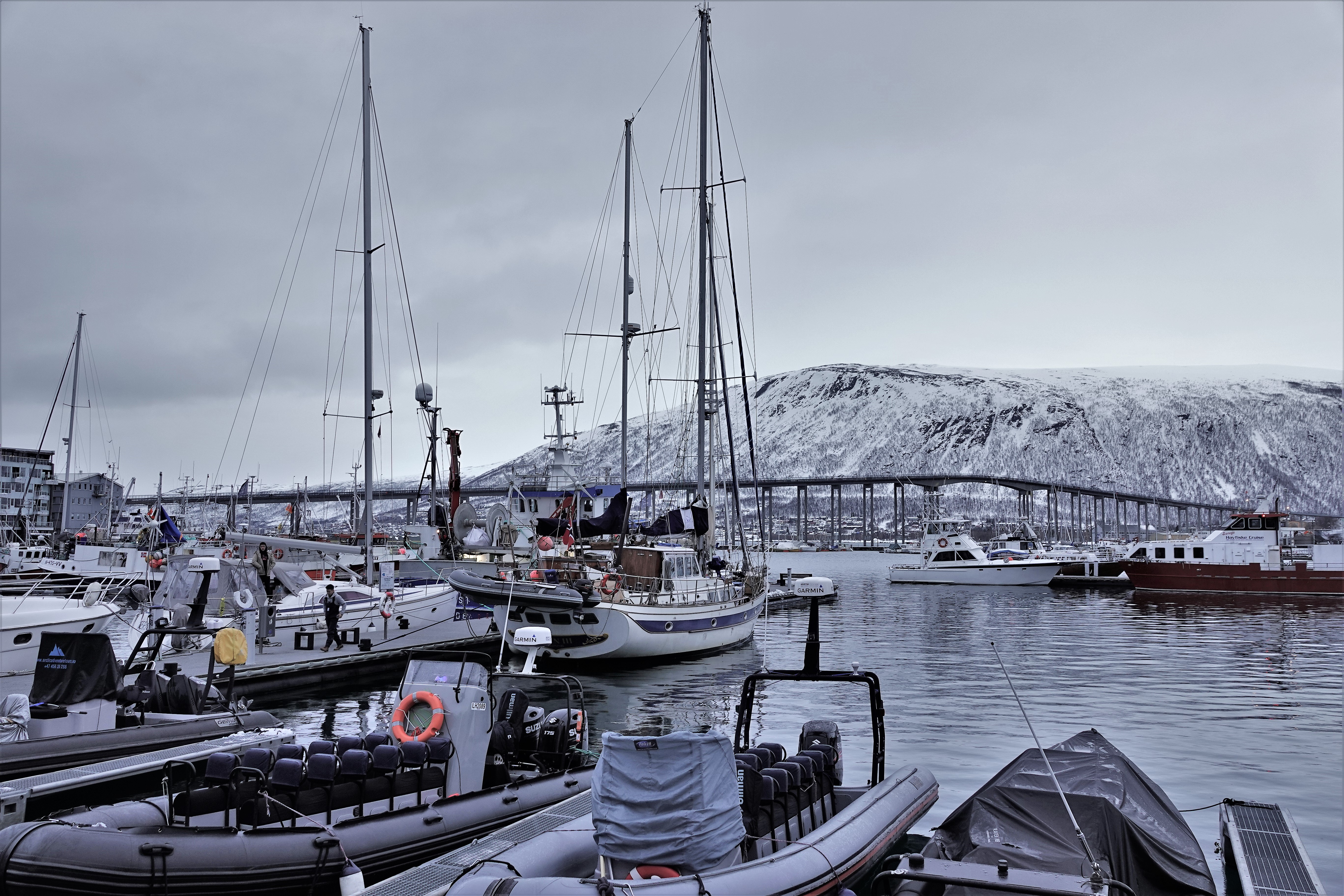
The Viking Star gently glided past Polaria’s domino-stacked building as Captain Nilsen steered us through the harbor on our way to docking.
While waiting for the local authorities to clear our vessel, I had an opportunity to photograph our new surroundings from our stateroom veranda, looking from stem…
to stern.
But one building that piqued my interest sat off the port side of the ship, nestled in the snowy foothills of Tromsø Sound–the Arctic Cathedral. Absolutely stunning!
Strikingly modern, the church was designed by architect Jan Inge Hovig and built in 1965. It’s roof structure was formed by concrete sheathed in aluminum panels,
as opposed to Tromsø’s other landmark church, the Tromsø Cathedral. Located in the center of town on the spot of Tromsø’s first church built in 1252, this cathedral was finished in 1861, and remains Norway’s only cathedral made of wood.
Leah and I crossed the Tromsø Bridge by bus for a closer look.
Likened to the Sydney Opera House, the exterior of the Arctic Cathedral is simple in shape and style,
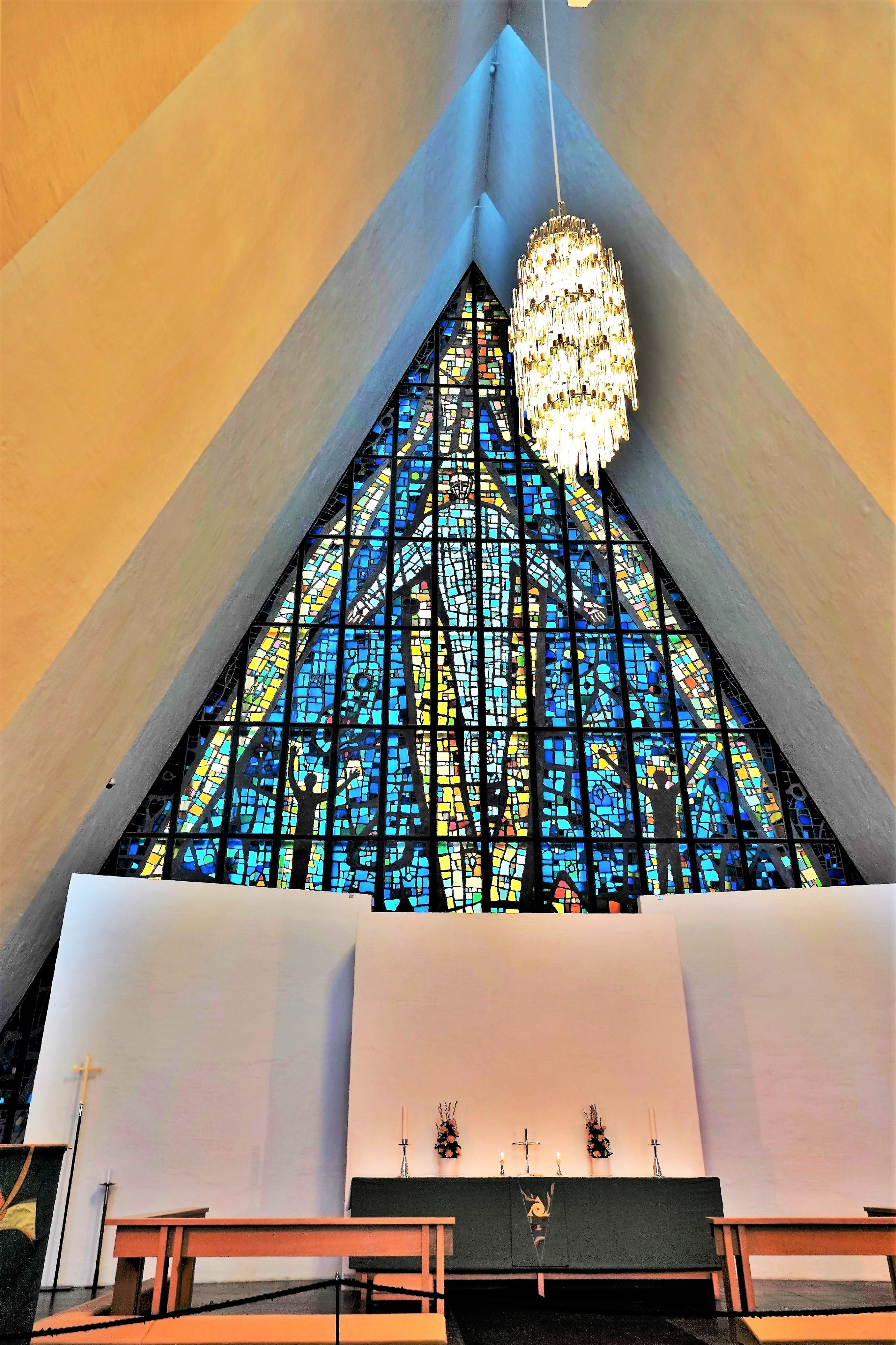
while the interior design is modestly appointed to accentuate: the large prism chandeliers;
the sparse altar rail and pulpit; and the grand glass mosaic commissioned by artist Victor Sparre–depicting three rays of light emanating from God’s hand: one through the form of Jesus, one through woman and one through man.
The western wall of the sanctuary is complemented by Grönlunds Orgelbyggeri’s organ, built in 2005.
The Star of David radiating through the eastern wimdow symbolizes a spirit of inclusiveness and community acceptance. (Just kidding)
The organ was built in the French Romantic tradition, and was adapted to the cathedral’s architecture, providing illusions of sails and ice floes. The organ comprises 2940 pipes, measuring from 32 feet (9.6 m) to just 5 mm. Much of the woodwork is solid pine with bellows made of reindeer hide.
It’s a pity I never heard it played, as I’m certain the cathedral’s vaulted vortex provides impressive acoustics.
Back at the Viking Star, after a brief bout of daylight (6hrs, 15min.)…
I returned to my veranda to record the Arctic Cathedral bathed in moonlight…
and I imagined I heard Grieg’s Song of Norway playing from its soaring arches.
Captain Terje Nilsen of the Viking Star personally delivered the unfortunate news over the ship’s PA system during breakfast.
“Because of high winds, we will be cruising past the port of Bodø, and continuing onto Tromsø. I apologize for the inconvenience, but the weather is just not safe for us to make a landing.”
Of course, we were disappointed.
Bodø is a charming alpine village north of the Arctic Circle and home to Saltstraumen, the world’s largest maelstrom. Additionally, Leah and I had booked an excursion to Kjerringøy, and would have enjoyed hiking through this preserved trading post dating back to the 1800s.
But Captain Nilsen wasn’t kidding. If the gusting winds and pounding seas were any indication of what was witnessed as the Hurtigruten ferry attempted docking in Bodø, then I couldn’t imagine the Viking Star following suit–certainly not with so many passengers unable to handle the rough crossing from Tilbury, England.
Nevertheless, passengers were invited to the pool deck following breakfast to celebrate a longtime maritime tradition of crossing the Arctic Circle.
While Paulo serenaded us with folk classics and Beatles covers of Here Comes the Sun, and I’ll Follow the Sun, (ironic, don’t you think),
the crew assembled to initiate each of us into the Order of the Blue Nose.
Our Cruise Director, Brensley Pope took the microphone to give some background:
Good afternoon Ladies & Gentlemen and welcome! We have entered through the Arctic Circle, and it is time to make our journey official by welcoming you to the Order of the Blue Nose! First, a little history.
The word “arctic” comes from the Greek word arktikos: “near the Bear, northern” The name refers to the constellation Ursa Major, the “Great Bear”, which is prominent in the northern sky.
The region north of the Circle, known as the “Arctic” covers roughly 4% of the Earth’s surface.
The position of the Arctic Circle coincides with the southernmost latitude in the Northern Hemisphere at which the sun can remain continuously above or below the horizon for a full twenty-four hours; hence the “Land of the Midnight Sun.” This position depends on the tilt of the earth’s axis, and therefore is not a “fixed” latitude. The Arctic circle is moving north at a rate of 15 meters per year, and is currently located at 66 degrees 33 minutes North latitude.
Captain Terje Nilsen interupted, “I believe that’s enough history for now…”
The crowd responded with laughter. And then it became official with his declaration…
Hear ye… hear ye….
Whereas by official consension, our most honorable and well-beloved Guests have completed successful passage through the Arctic Domain. We do hereby declare to all in attendance and that those who possess the courage to take the Aquavit cleanse shall be marked accordingly, with the prestigious Order of the Blue Nose.
(Applause)
Captain Nilsen continued…
This is to certify that you all have been formally and officially initiated into the Solemn Mysteries of the Ancient Order of the Chilly Deep, and should wear your blue noses proudly! With the order of myself, the Captain, I command all subjects to Honor and Respect those onboard Viking Star as one of our Trusty Blue Nose family.
We officially welcome you to the Blue Nose Order! Skol!
I got my blue nose and drained my shot glass of chilled Aquavit. Was I now a proud member of a society of alcoholics and sun worshippers?
But I wasn’t alone.
Lines formed from both sides of the pool deck for distinguished crew members to efficiently annoint all worthy passangers with a blue-tinted dab of meringue.
What follows is a small sample of inductee’s portraits–some more enthusiastic than others…
United in singular purpose, we now shared a common bond.
To validate our accomplishment, each of us received a certificate of achievement validated by Captain Nilsen.
Soon after, while walking about the jogging track in whipping winds after a filling lunch, I caught a glimpse of what made this affair so special.
Having pre-booked Rødne’s 3-hour scenic cruise through Lysefjord–Western Norway’s most picturesque passage–
Leah and I were on an impossible mission to view Preikestolen (Pulpit Rock), considering the current gray skies and dismal forecast. Reknown for its views, and famous for its cliffhanger scene in Mission: Impossible–Fallout, we considered Preikestolen a must-see.
On the bright side, there was plenty of legroom aboard Rødne’sRygerdronningen, a 297-passenger, high-speed catamaran that carried only 24 guests this particular day, many with camera lenses as long as my arm.
We pushed off at 11:00 am sharp,
easing out of the harbor’s protected waters,
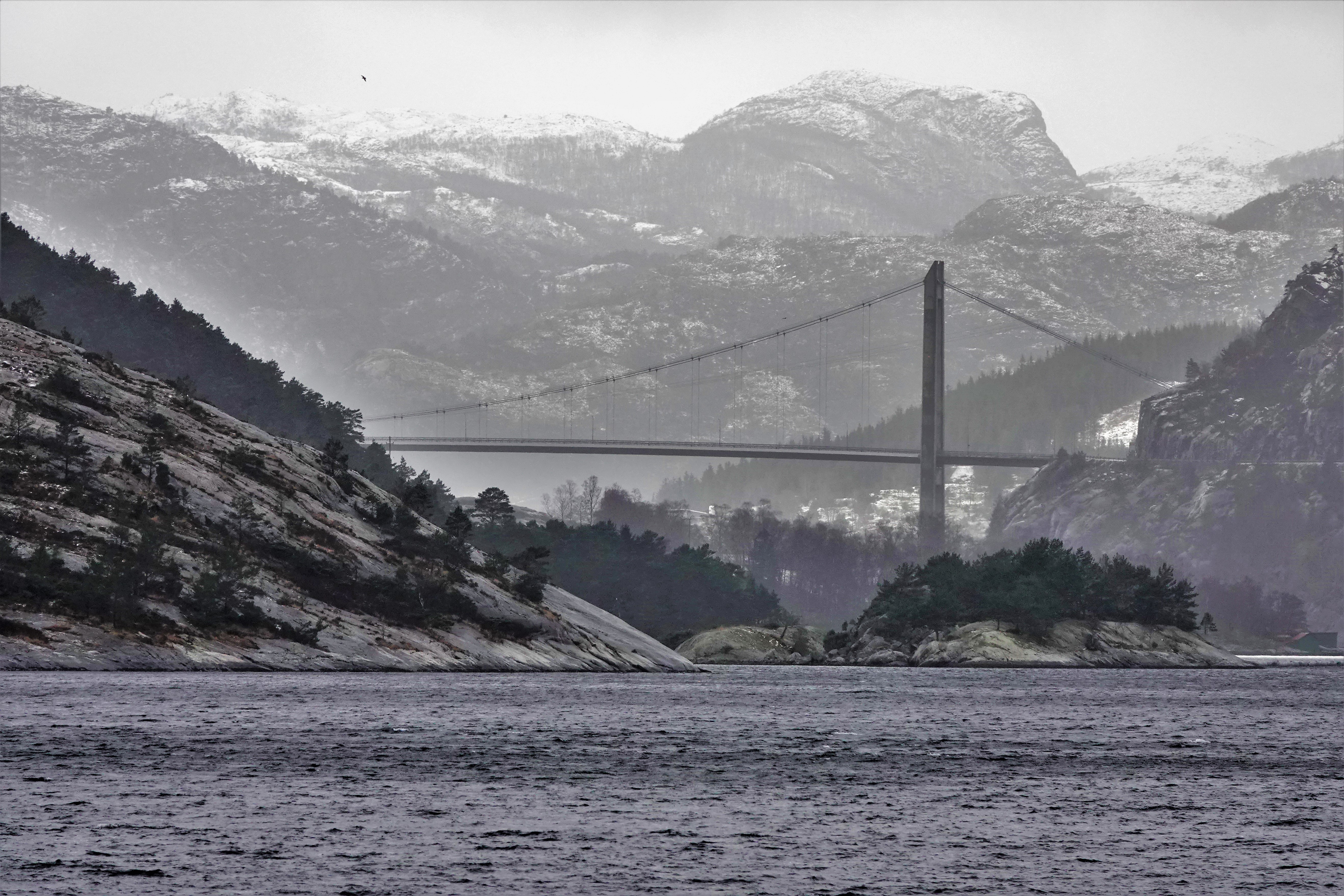
and beyond the bridge,
where it became perfectly clear to us that this was a perfect day for seabirds,
but less so for Leah–who required a double dose of dramimine to deal with the swells propagating across the horizon.
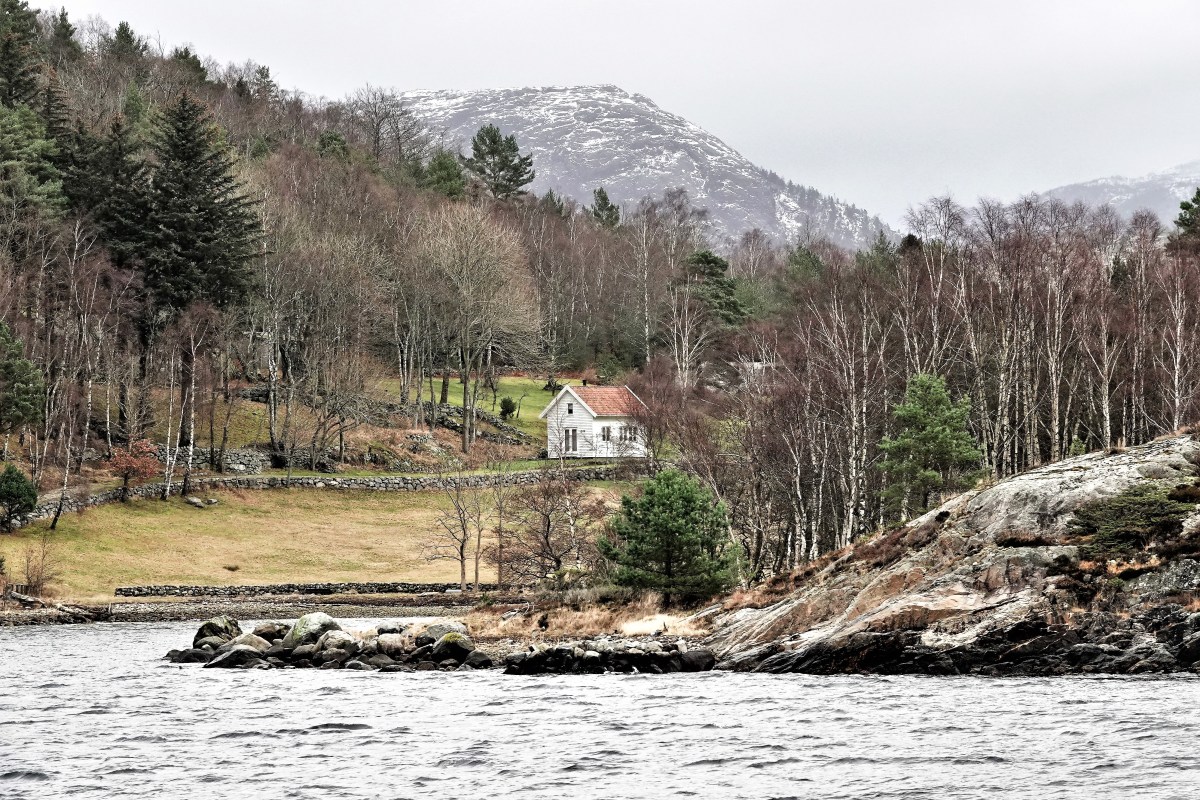
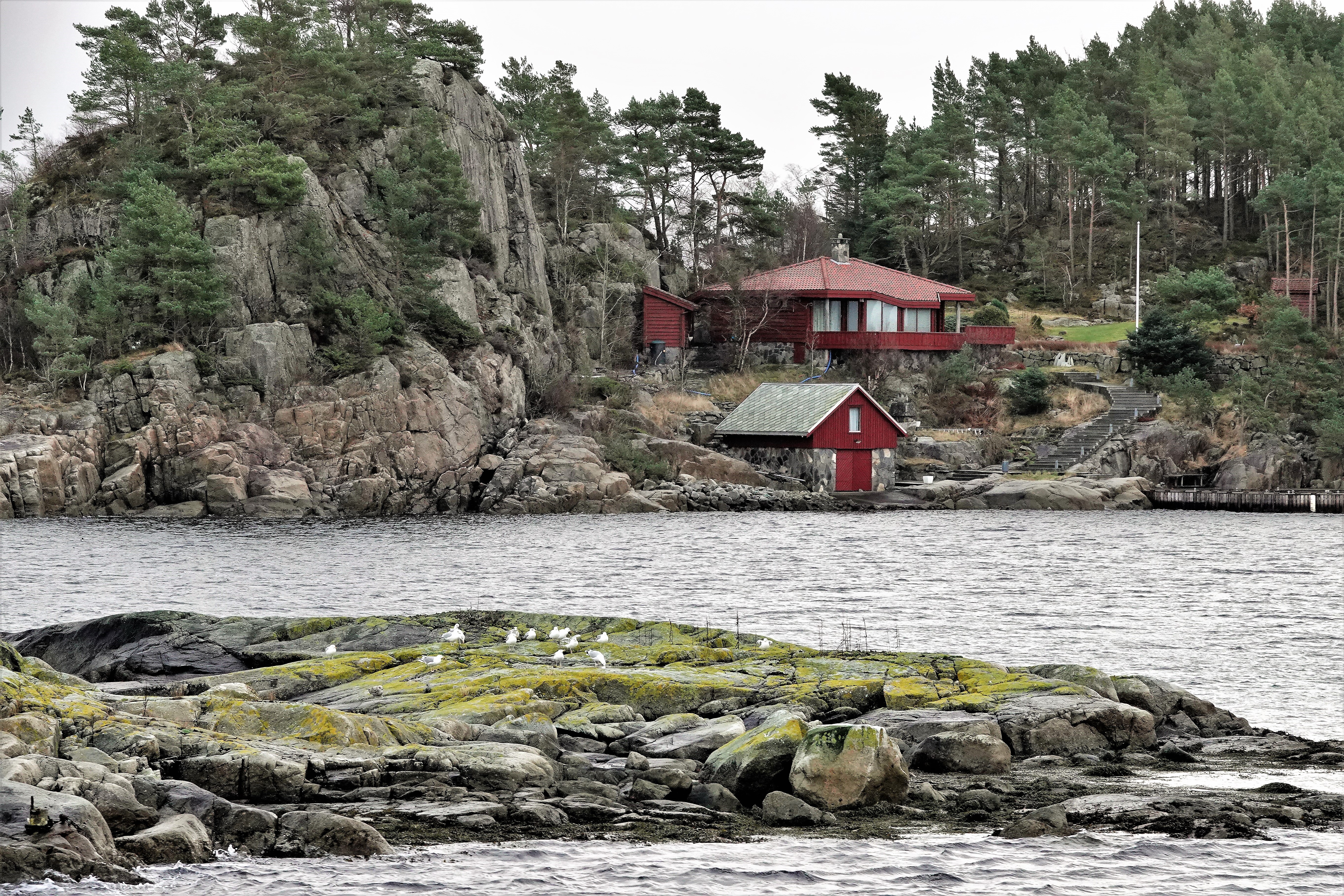
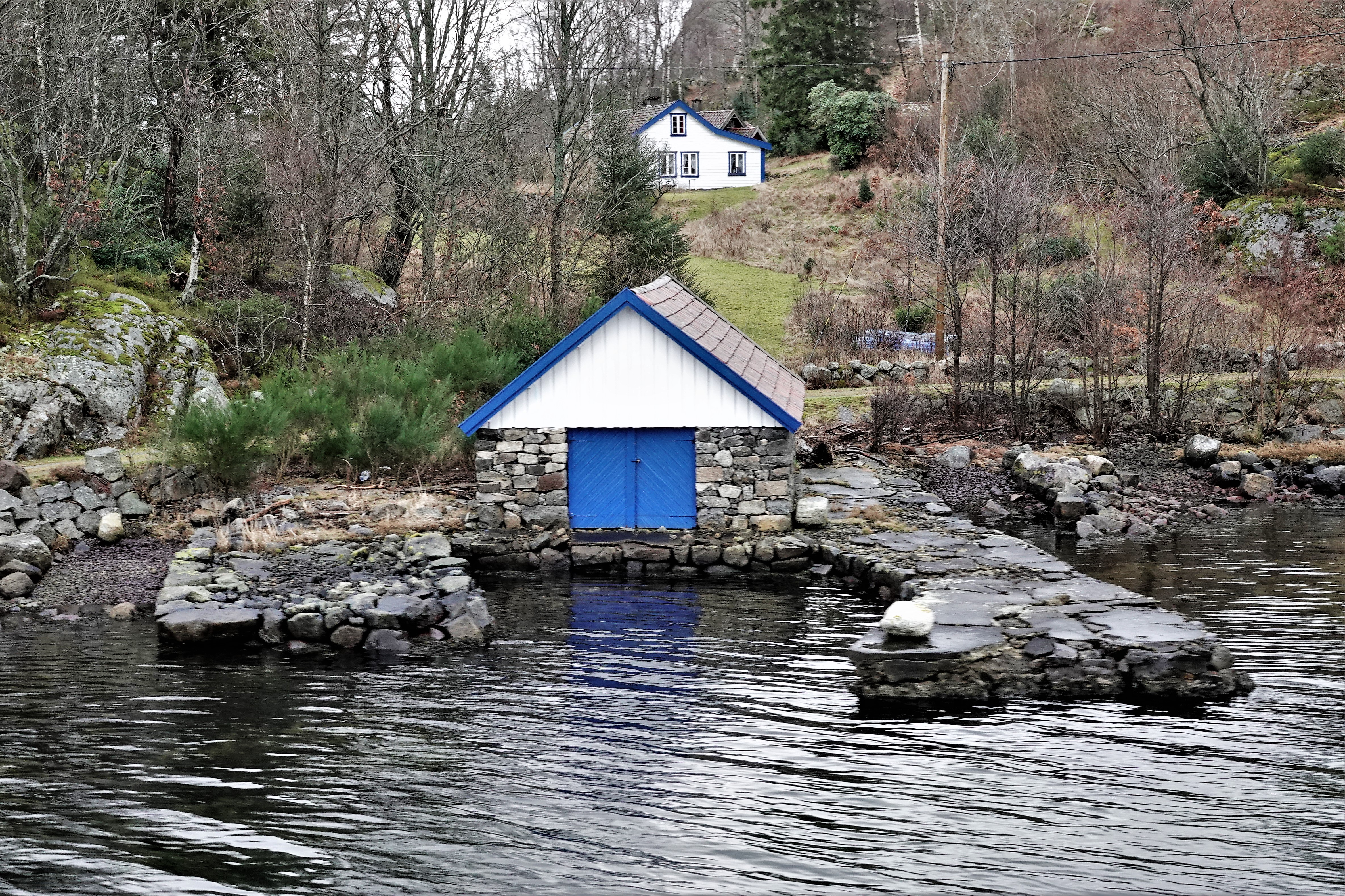
Along the journey, we passed scores of coastline cottages,
whose owners regulary commute to town by boat during the summer months…
unless they have the means to vacation in Rogaland all summer long.
Midway through our voyage we passed under the Lysefjord Bridge–gateway to Lysefjord–
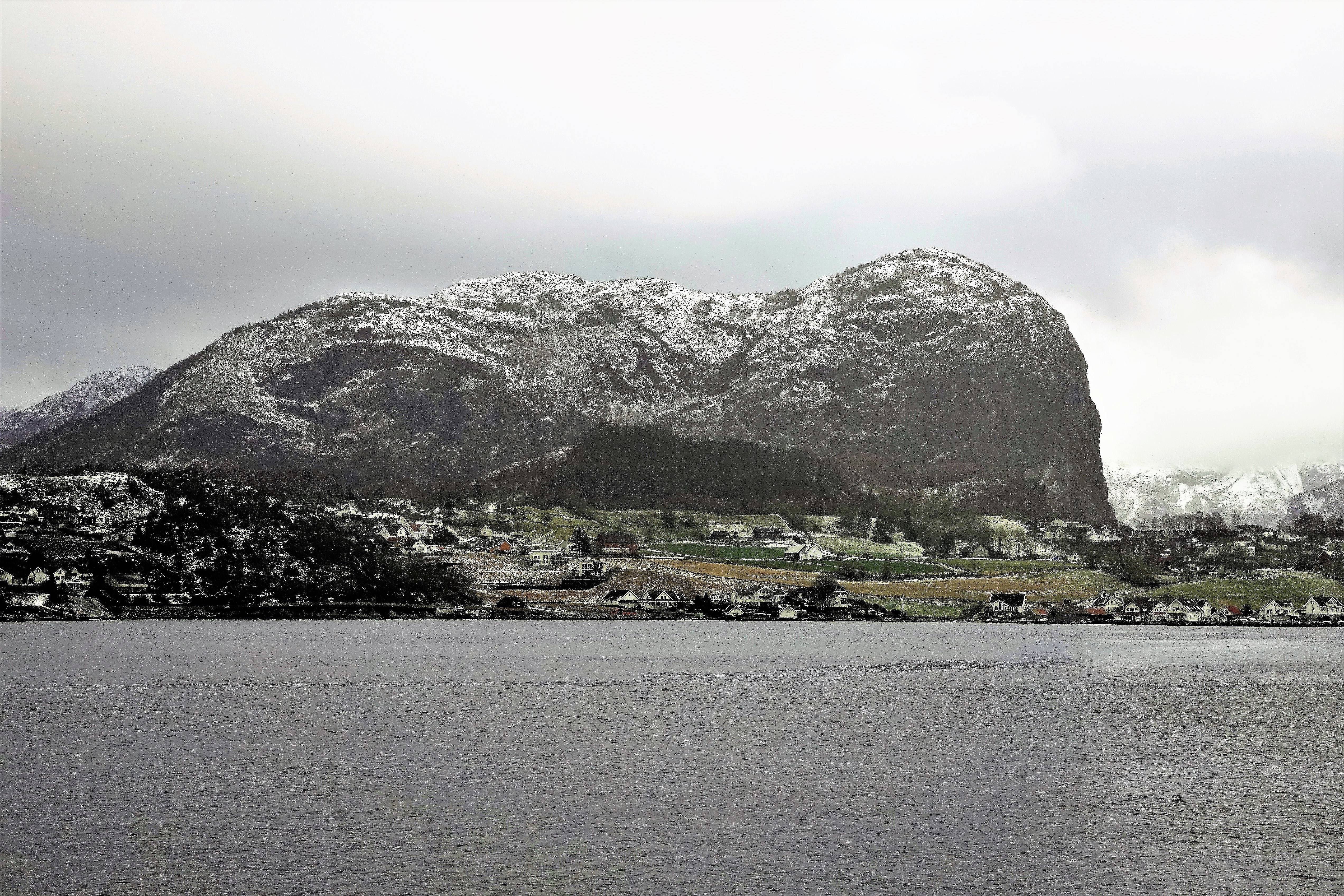
connecting Forsand with Oanes, a small farming village on the coastline,
that’s dwarfed by an imposing edifice.
We eased into the fjord,
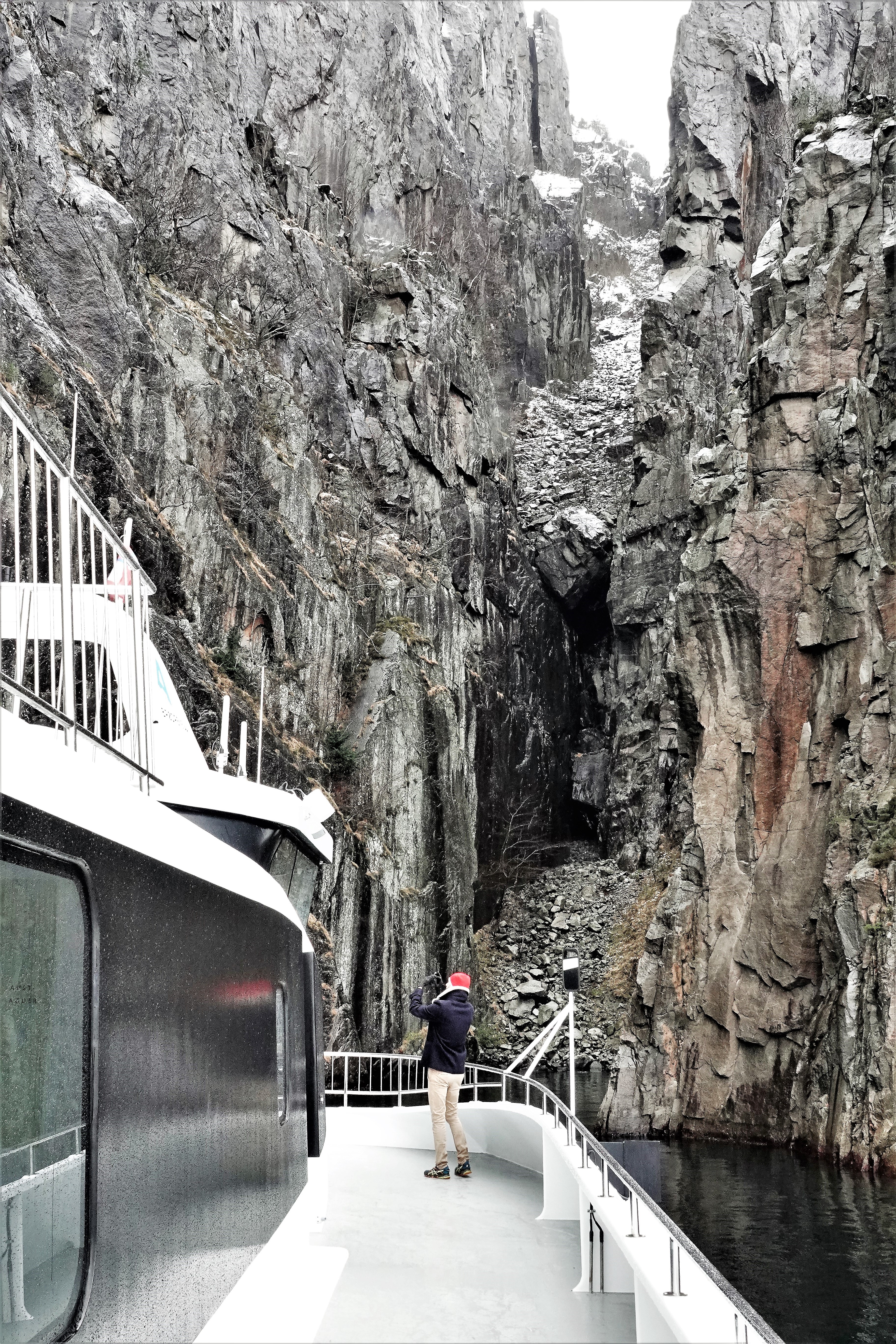
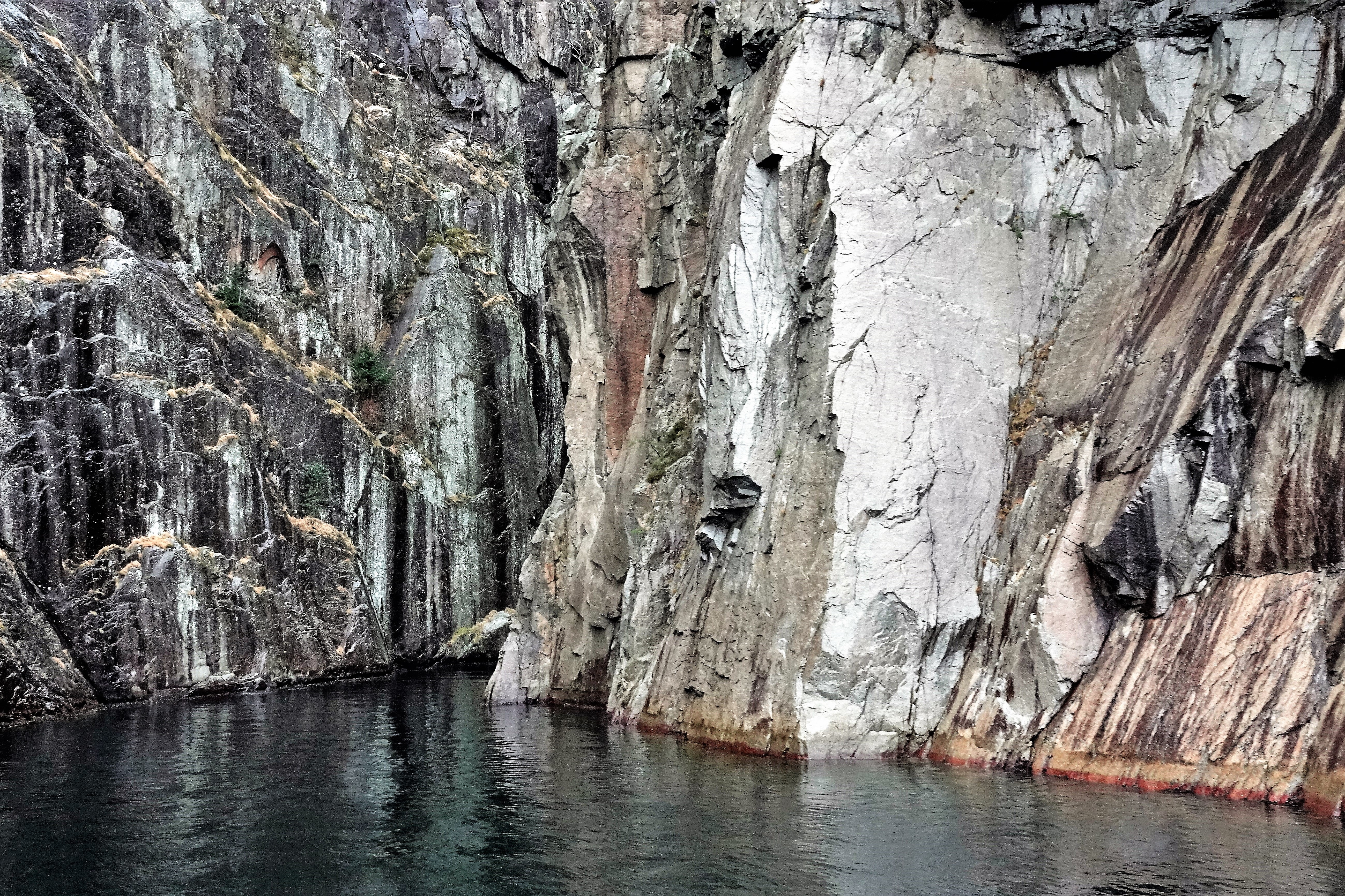
flanked by looming walls of granite…
until the captain navigated the bow of the ship within a hair’s breath of the Vagabond’s Cave.
Legend has it that the cave was named after a group of vagabonds who used the shelter as a hideout for months, trying to escape the police.
As we backed out of the grotto to pursue a course to Pulpit Rock, the weather turned to sleet and snow, shrouding the cliff’s signature square flat top, 604 meters above the fjord, and driving most of the passengers indoors.
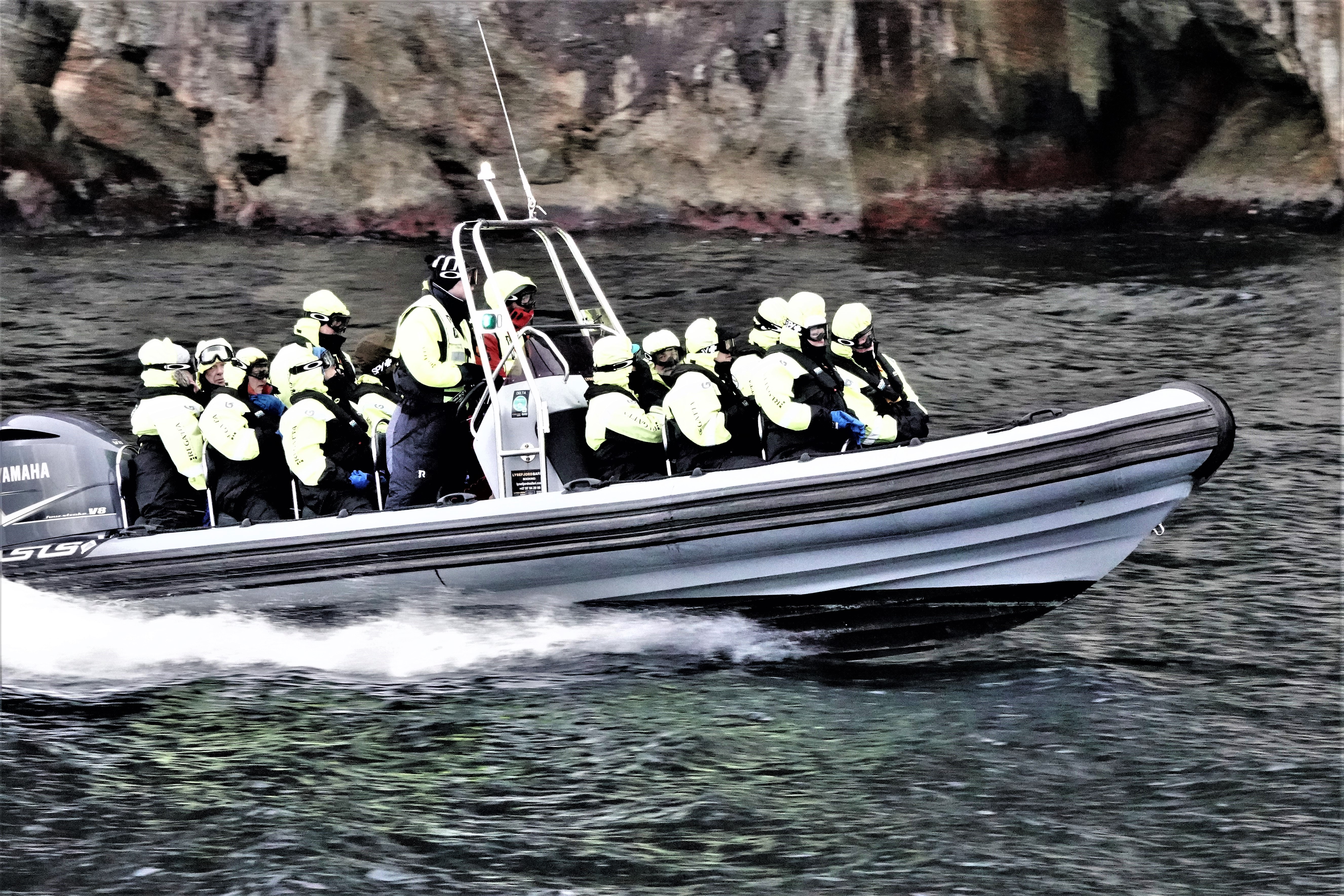
But there were some intrepid sailors who were undeterred, because they had little choice in their RIB (rigid inflatable boat).
We followed at our own pace…
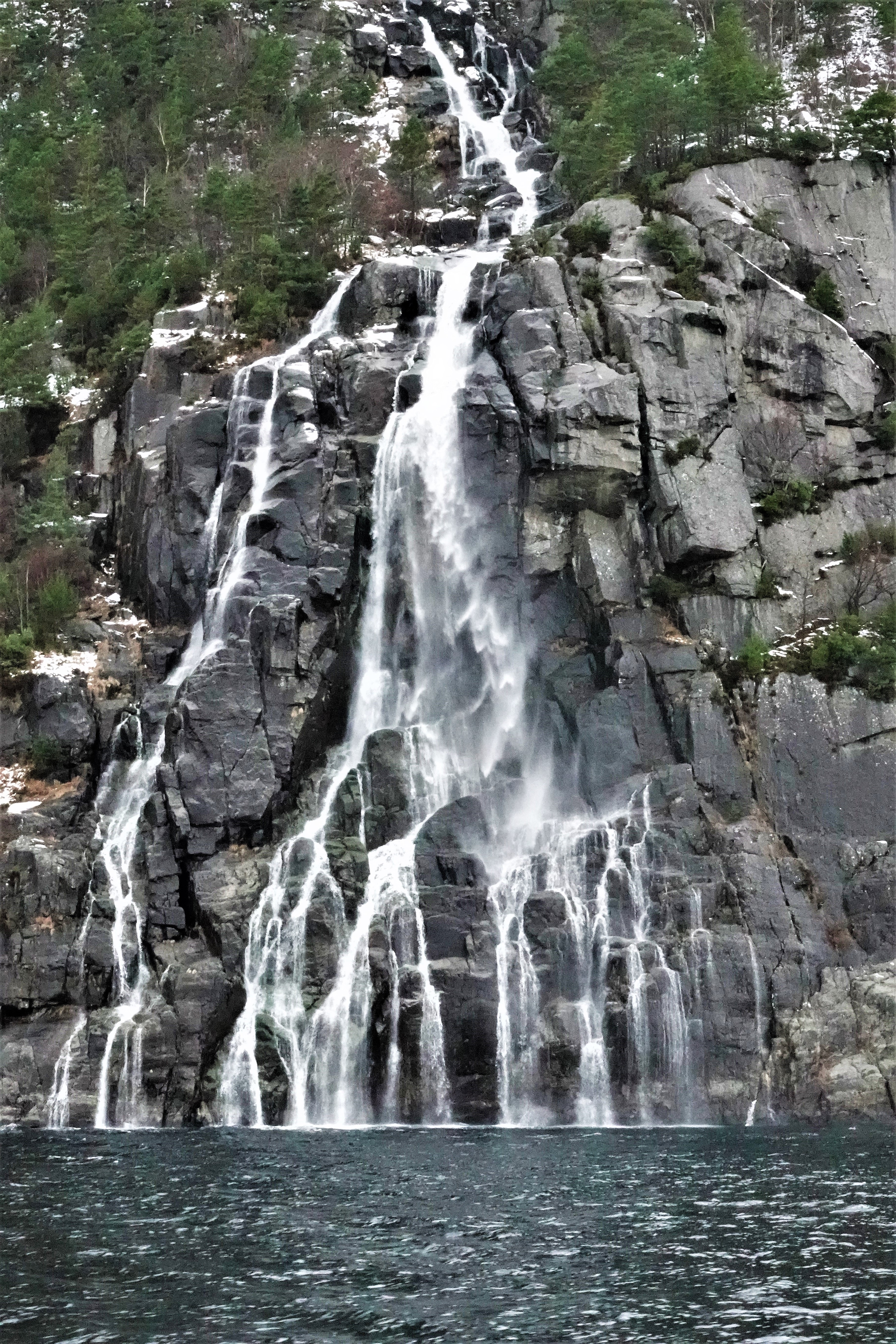
until we reached Hengjane Waterfall, cascading 400 meters (1312 ft) into the fjord.
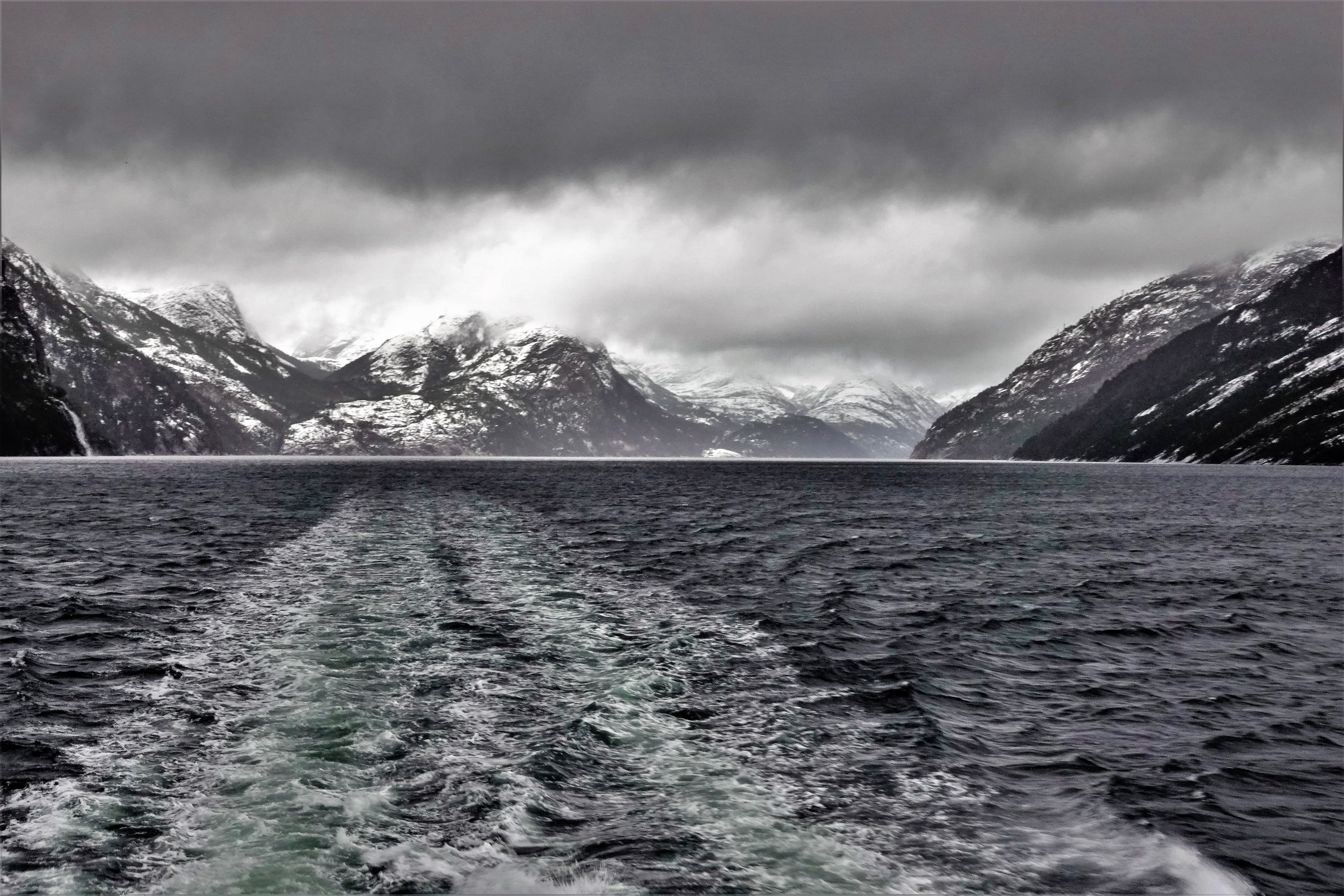
Soon after, we U-turned to retrace our wake before returning to Skavanger.
Marie-Charlotte van Kerckhoven was among the few passengers on board. While nursing a hot coffee, Leah and I heard about her hiking expedition to the top of Pulpit Rock the day before. Braving freezing temperatures and two feet of snow, she and her hiking buddy made the ascent to the 25 by 25 meters flat top in 4 hours.
She was happy to share her view,
and even happier to report that here was no trace of Tom Cruise ever being there.
Leah and I crossed a rocky North Sea from Tilbury, England aboard Viking Star (more on this Viking ocean liner later),
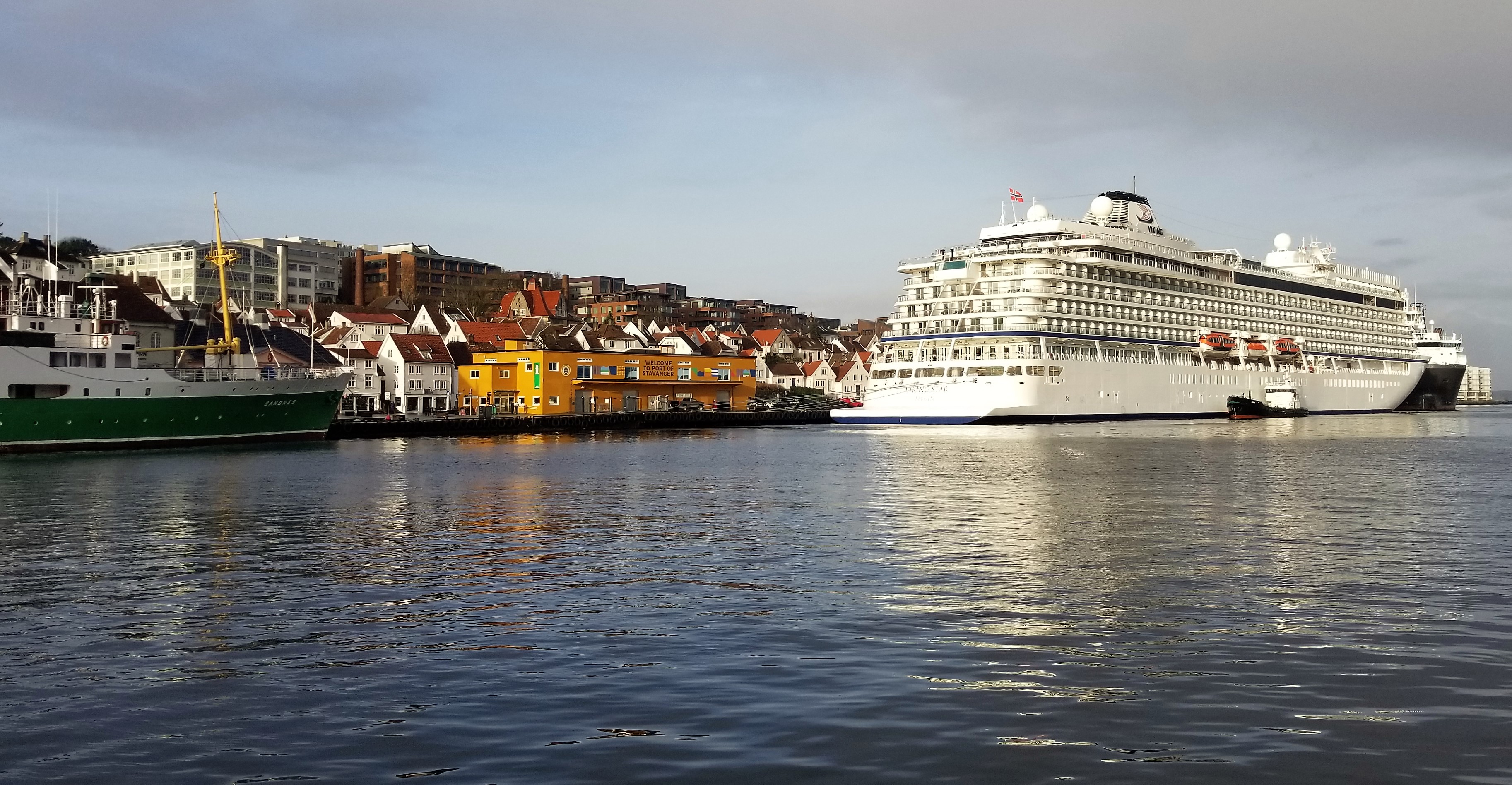
and docked at Stavanger Port on an overcast morning.
Stavanger is Norway’s third largest region, and best known as the European capital for the oil and gas industry–which explains the town’s Norwegian Petroleum Museum, and its unusual derrick-like design on the city’s waterfront.
Stavanger is also a popular tourist hub, as it’s the gateway to the fjords. To that end, Leah and I had booked an off-ship excursion to Rogaland to cruise through Lysefjord in search of Preikestolen, better known as Pulpit Rock.
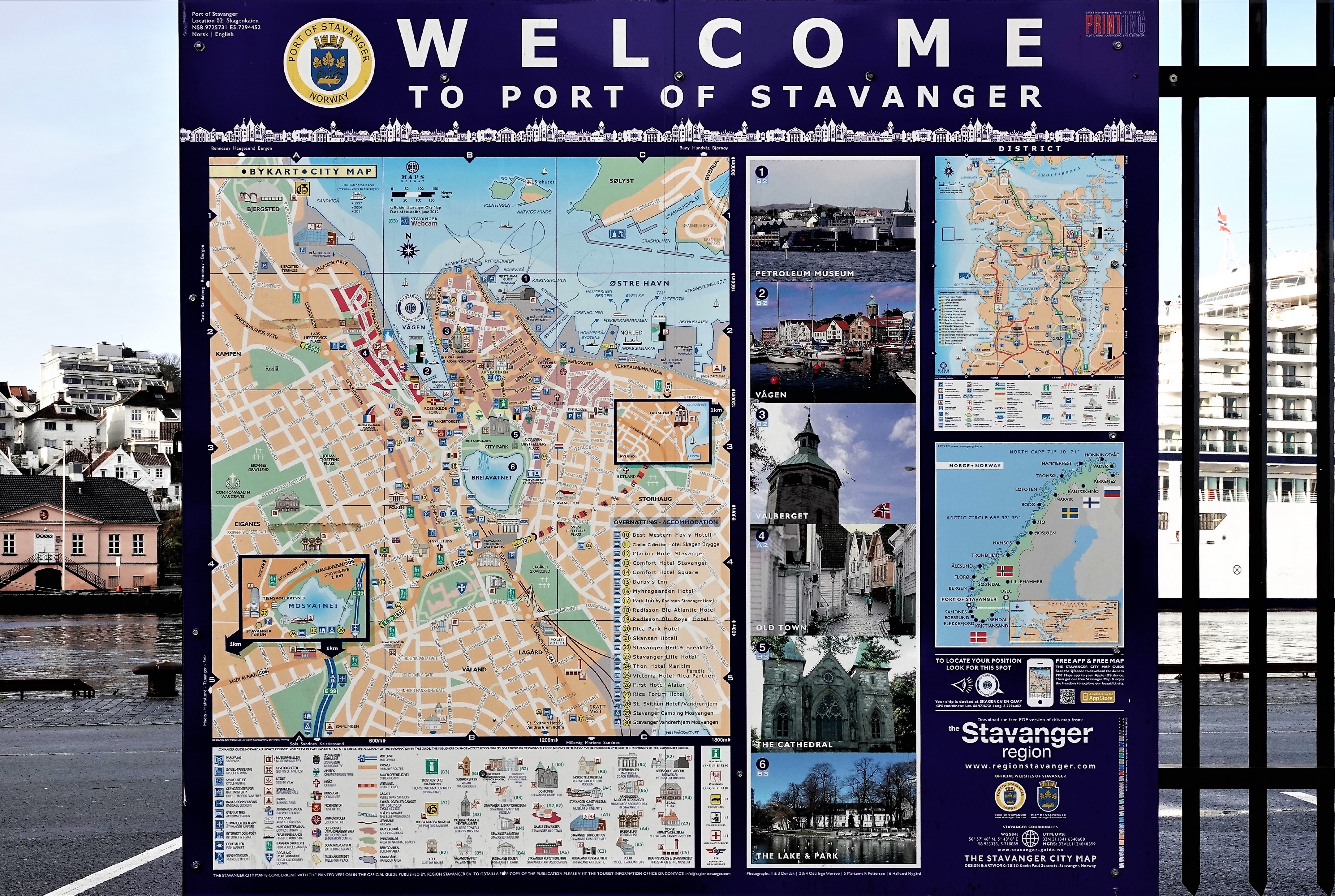
But with some time to kill before our departure, we disembarked early to stroll along the harbor plaza to find our bearings, and regain our sea legs after a day and a half of cruising.
The plaza was sleepy for an early Wednesday morning, but it was refreshing to have the place to ourselves.
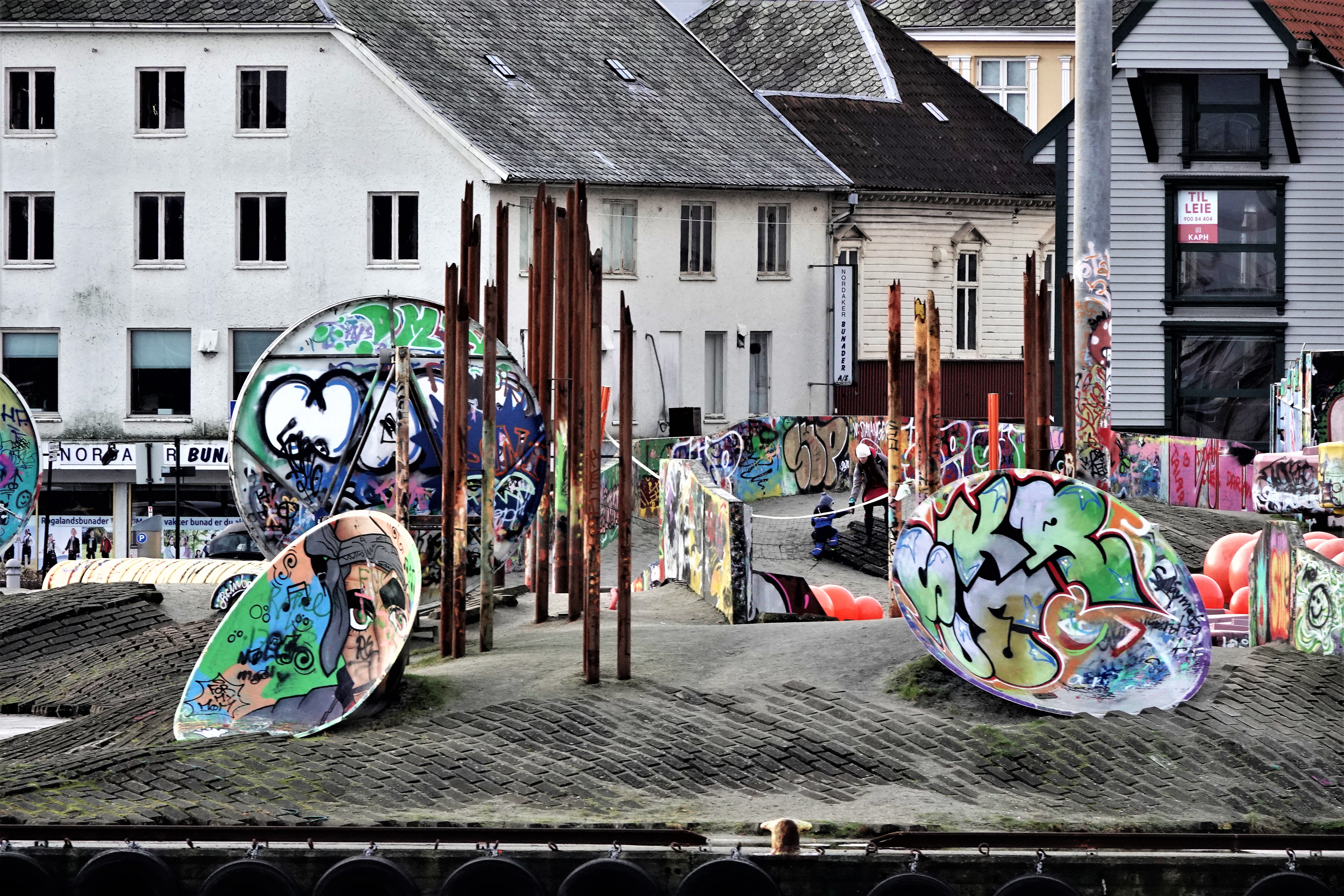
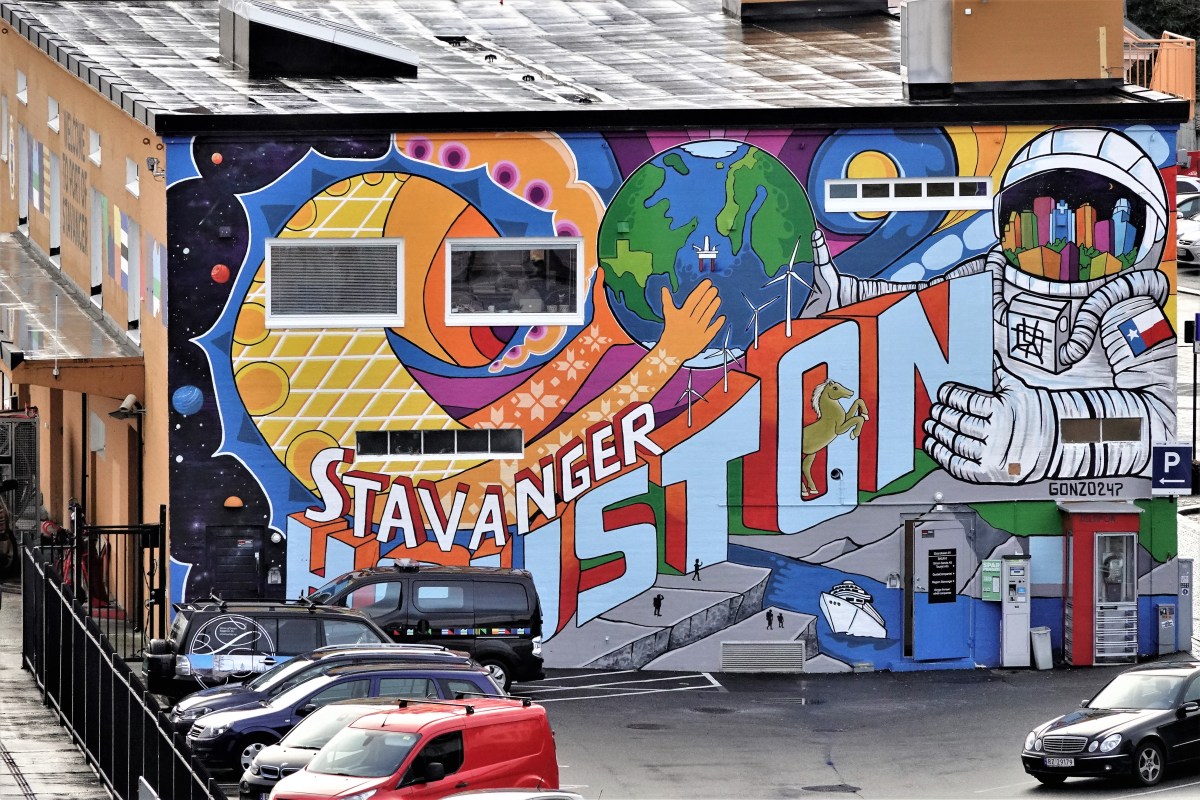
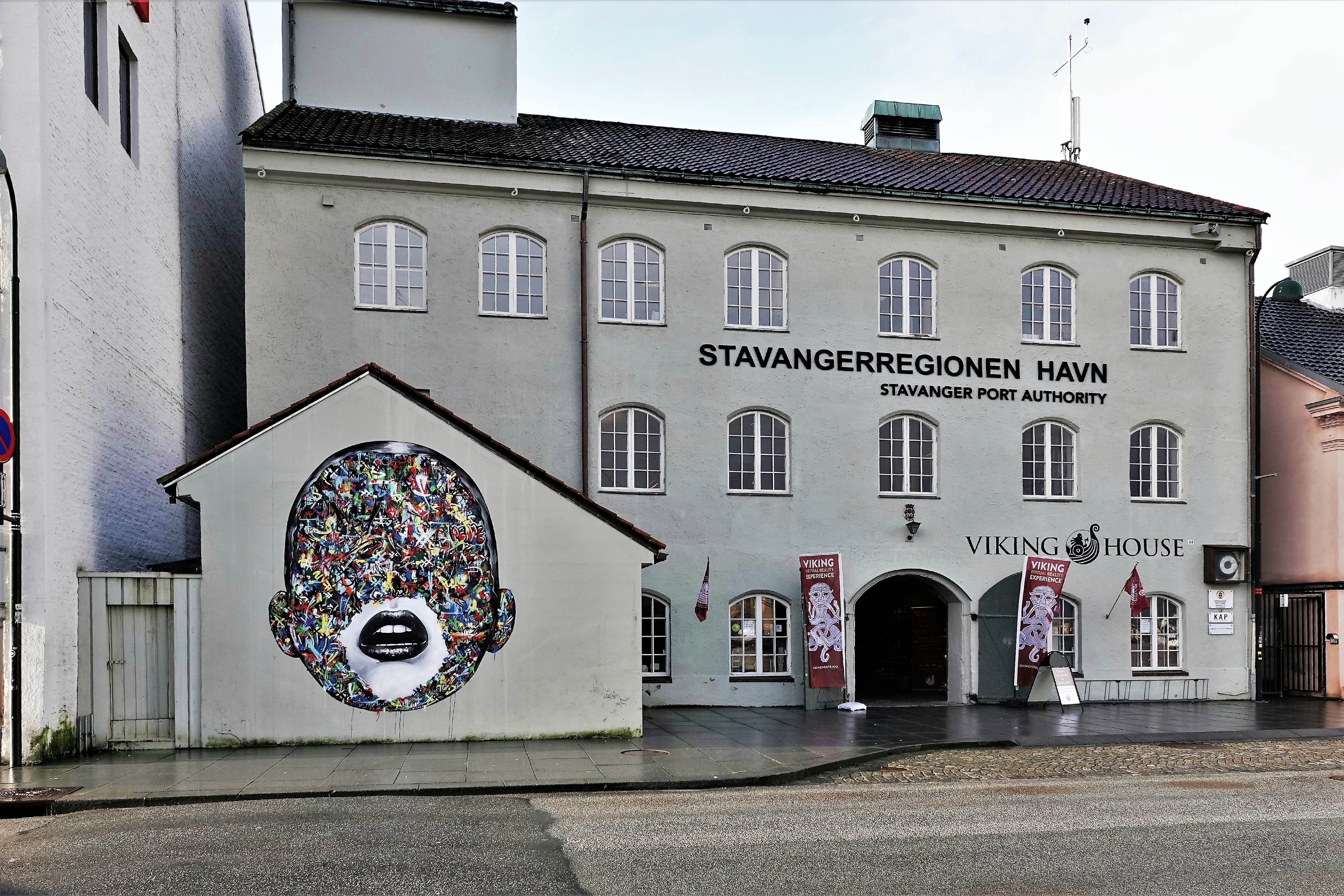
We could enjoy the local art (that celebrates the shrimping industry)…
without concern for another’s footsteps.
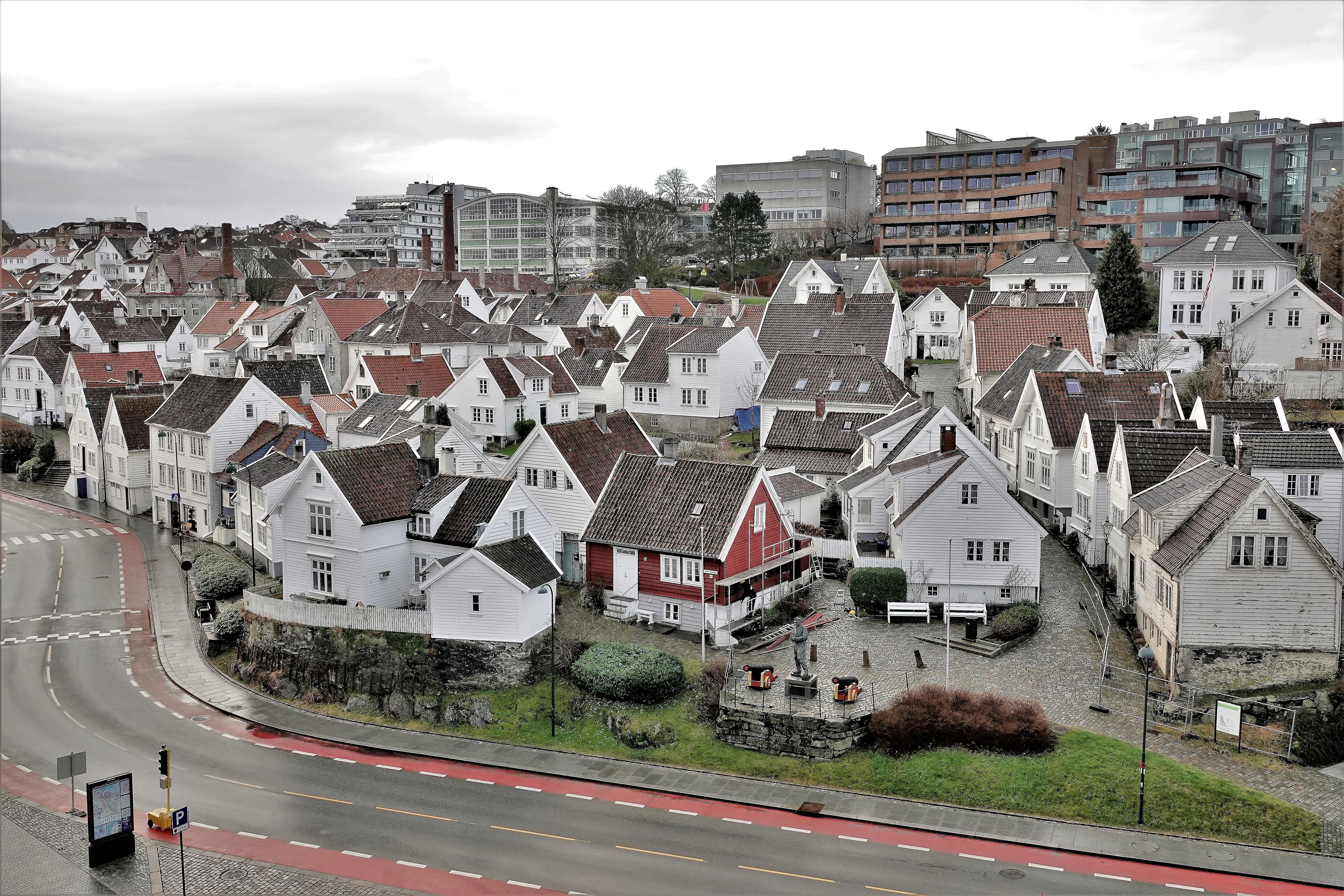
We opted to tour the Gamle Stravanger (Old Town), where 173 wooden buildings from the turn of the 18th century have been preserved…
down to the cast bronze utility plate covers.
A casual walk along Old Town’s winding roads of white cottages…
Leah and I were in search of a London eyrie for dramatic views, but refused to pay £27 to see the skyline from top of the Eye at 135 meters.
While I’m sure that the views are impressive from the top-most bubble, we were less than interested in a vew from a carnival ride.
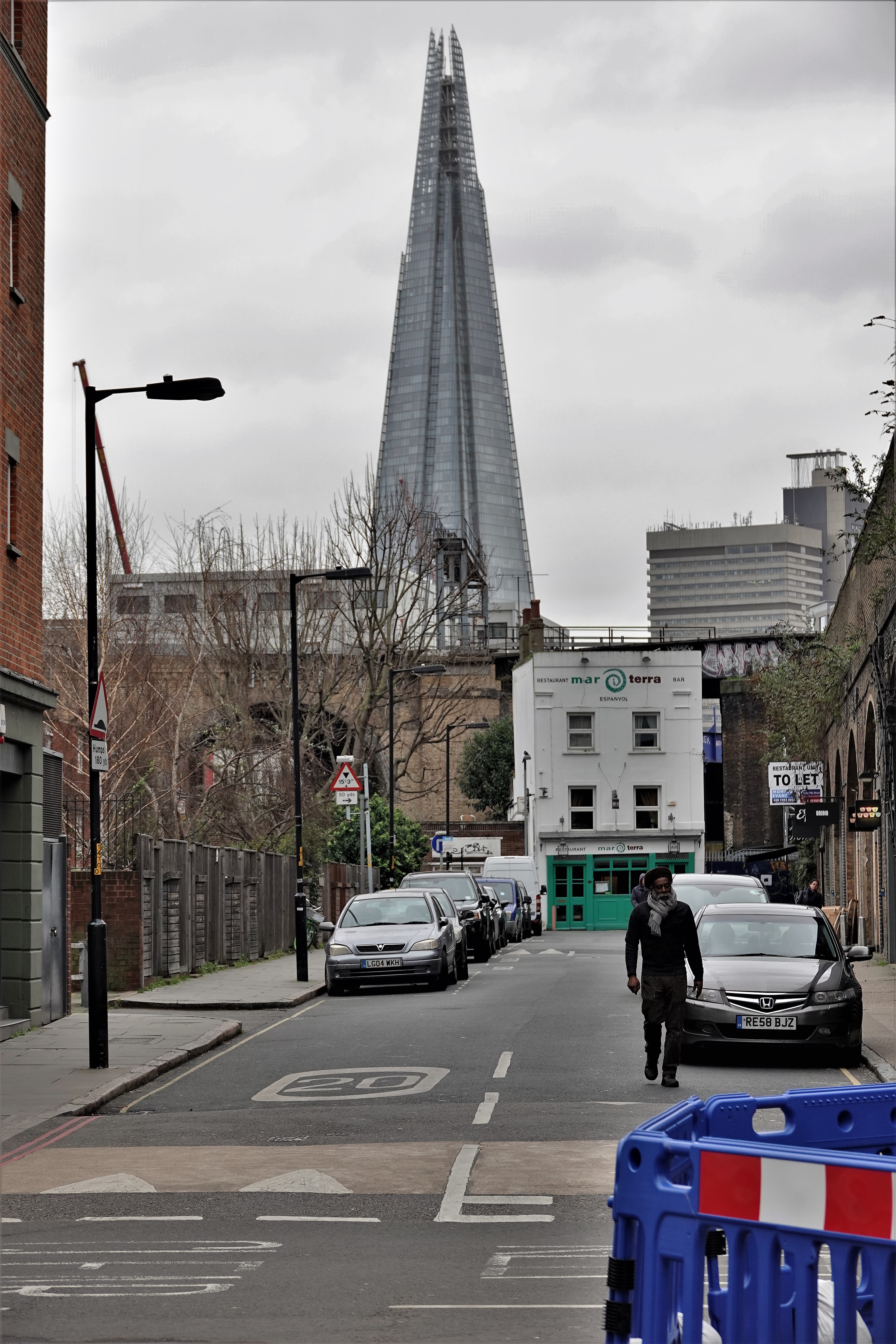
Then we considered The Shard–London’s tallest building, rising 310 meters,
Inagurated on July 5, 2012, it’s observation deck on the 72nd floor commands 360° views of the city, and dominates the horizon from all parts.
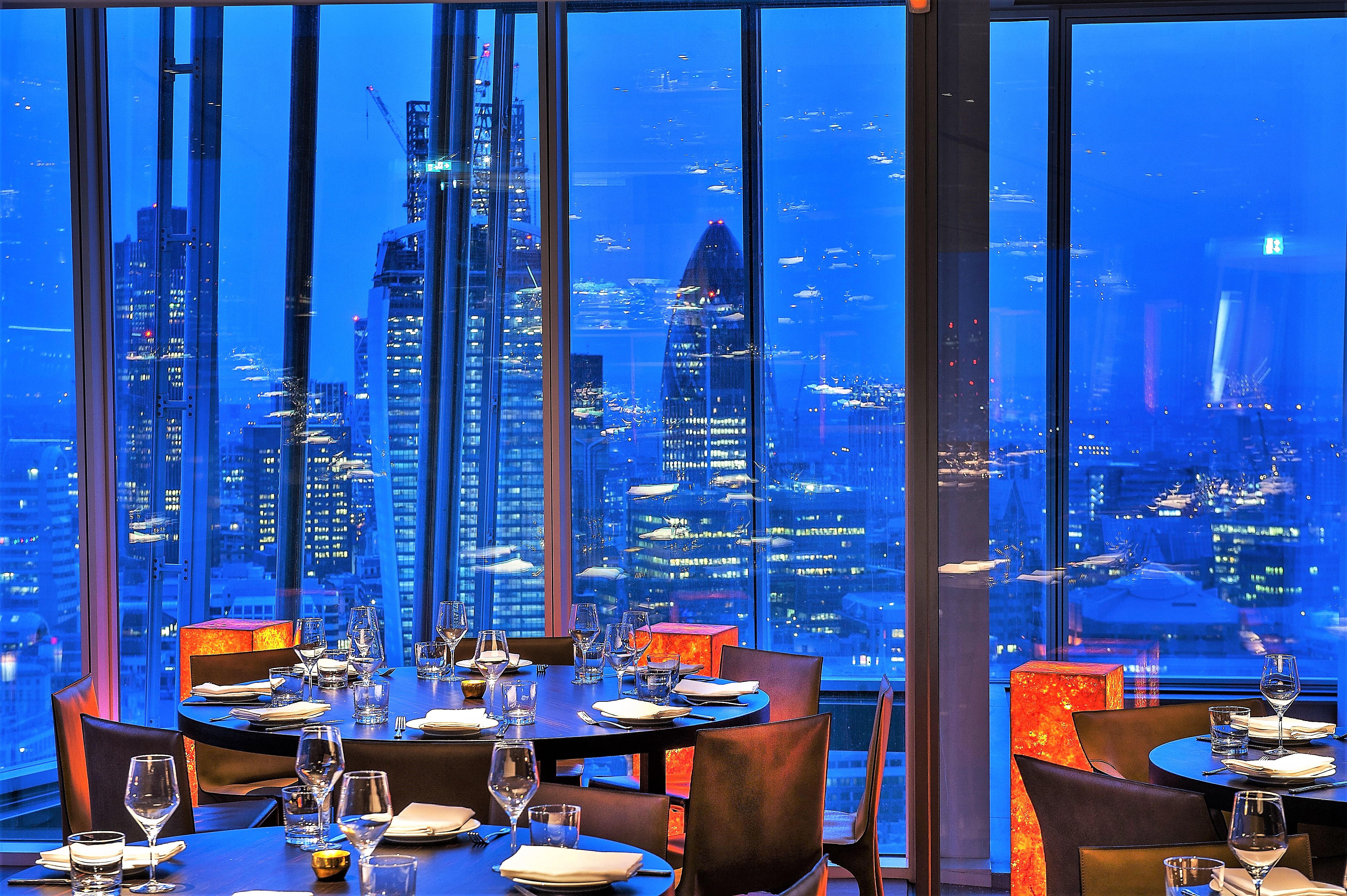
But again, £25 for a timed ticket? I don’t think so! But there is a cheaper way…by having a drink at Rainer Becker’s Oblix on the 32nd floor.
Just walk around the corner, enter through the attended doors, endure the TSA-type security, and wiz up the elevator, where an icon-rich, interpretive map of London confuses and delights simultaneously.
We arrived late afternoon on a clear Saturday, and the bar was packed with fashionistas and millenial posers.
We parked ourselves at a long table that we promised to surrender at 4:30 pm, if only to secure a seat and a stylish waitress dressed in black.
I nursed a valencia orange Ketel One vodka with blood orange, peach & hibiscus at £14.50, but it was a bargain,
if for no other reason than to capture unparalleled views,
people watch,
and enjoy a great cocktail at half the price of The Shard’s regular admission.
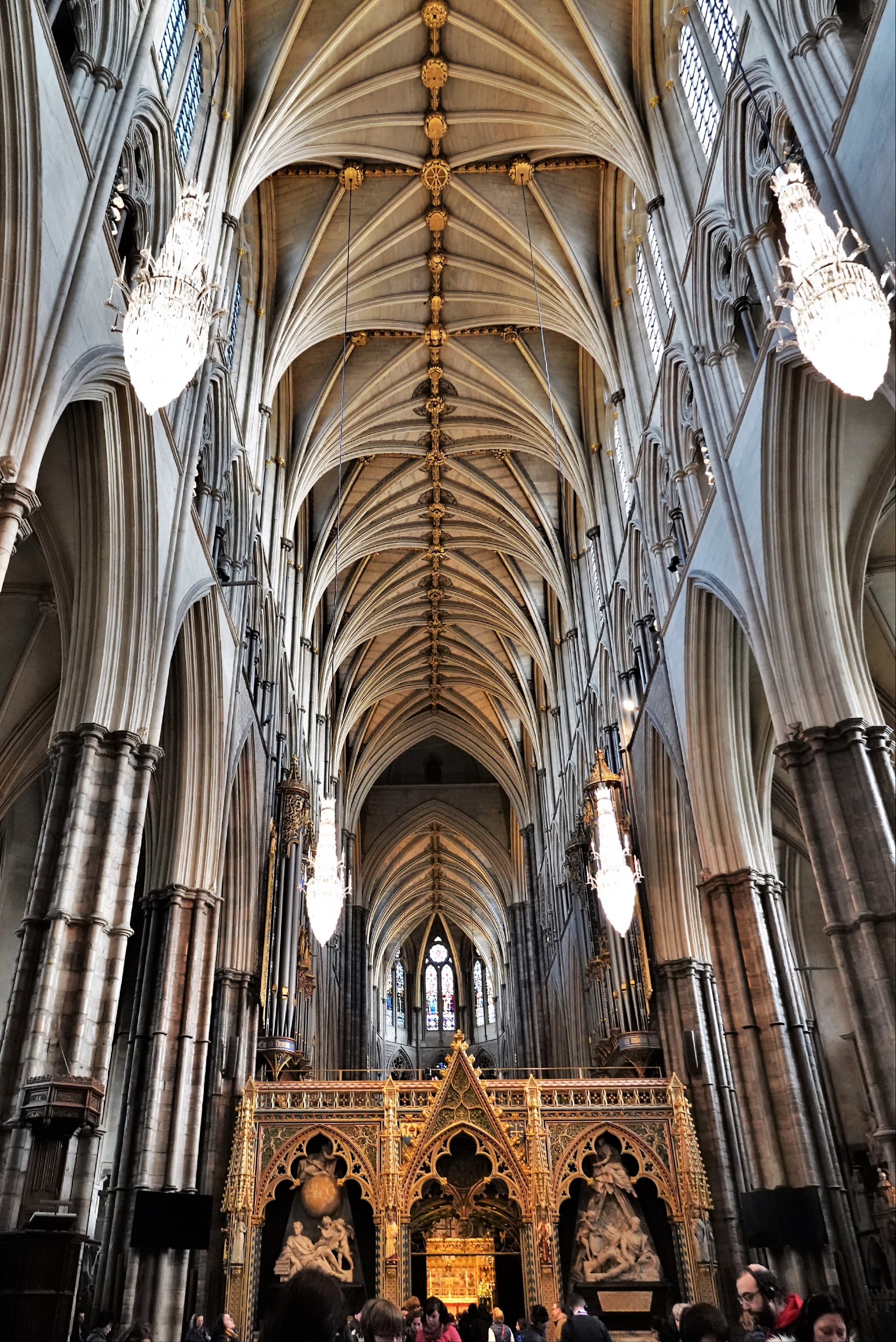
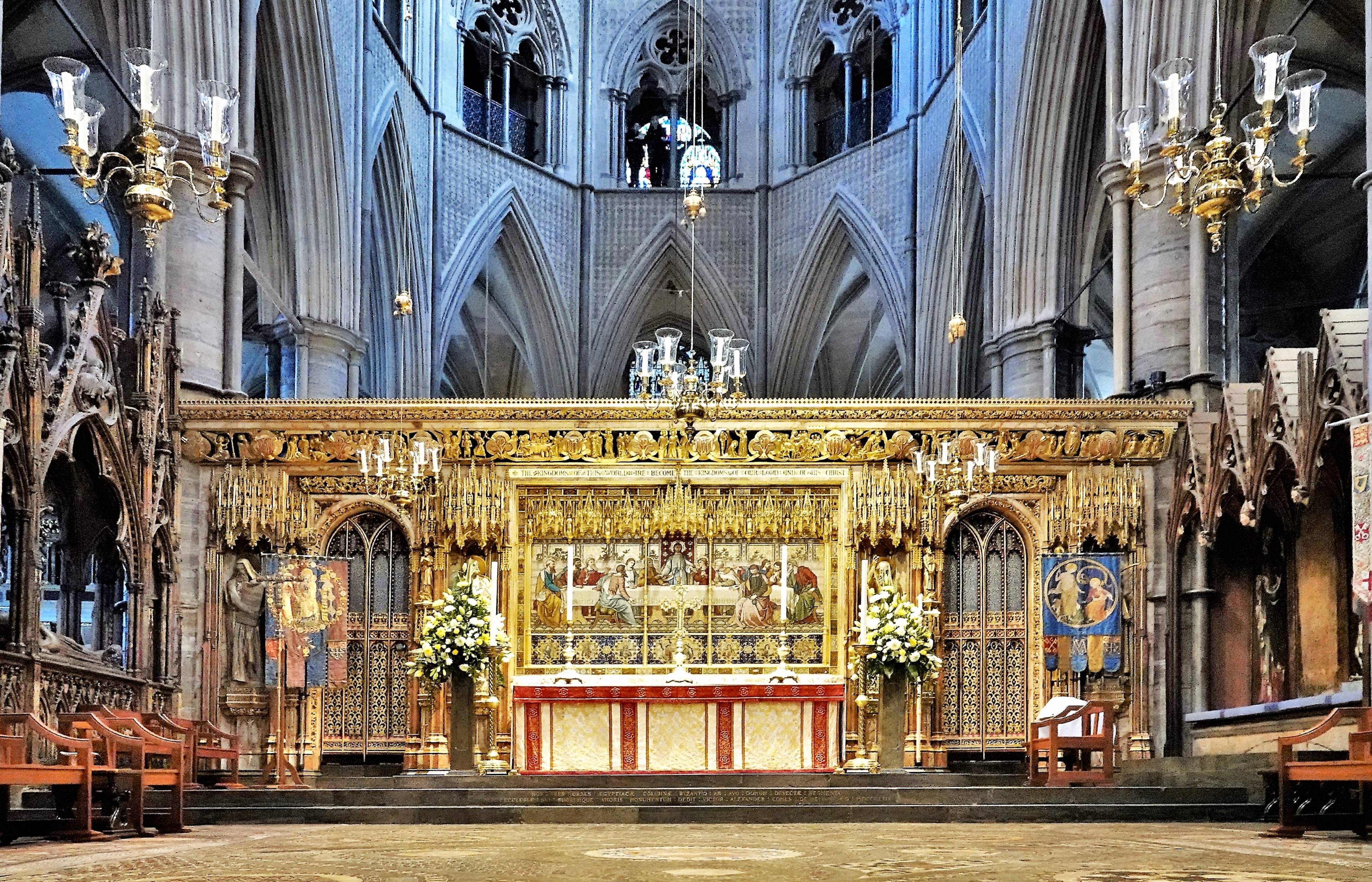
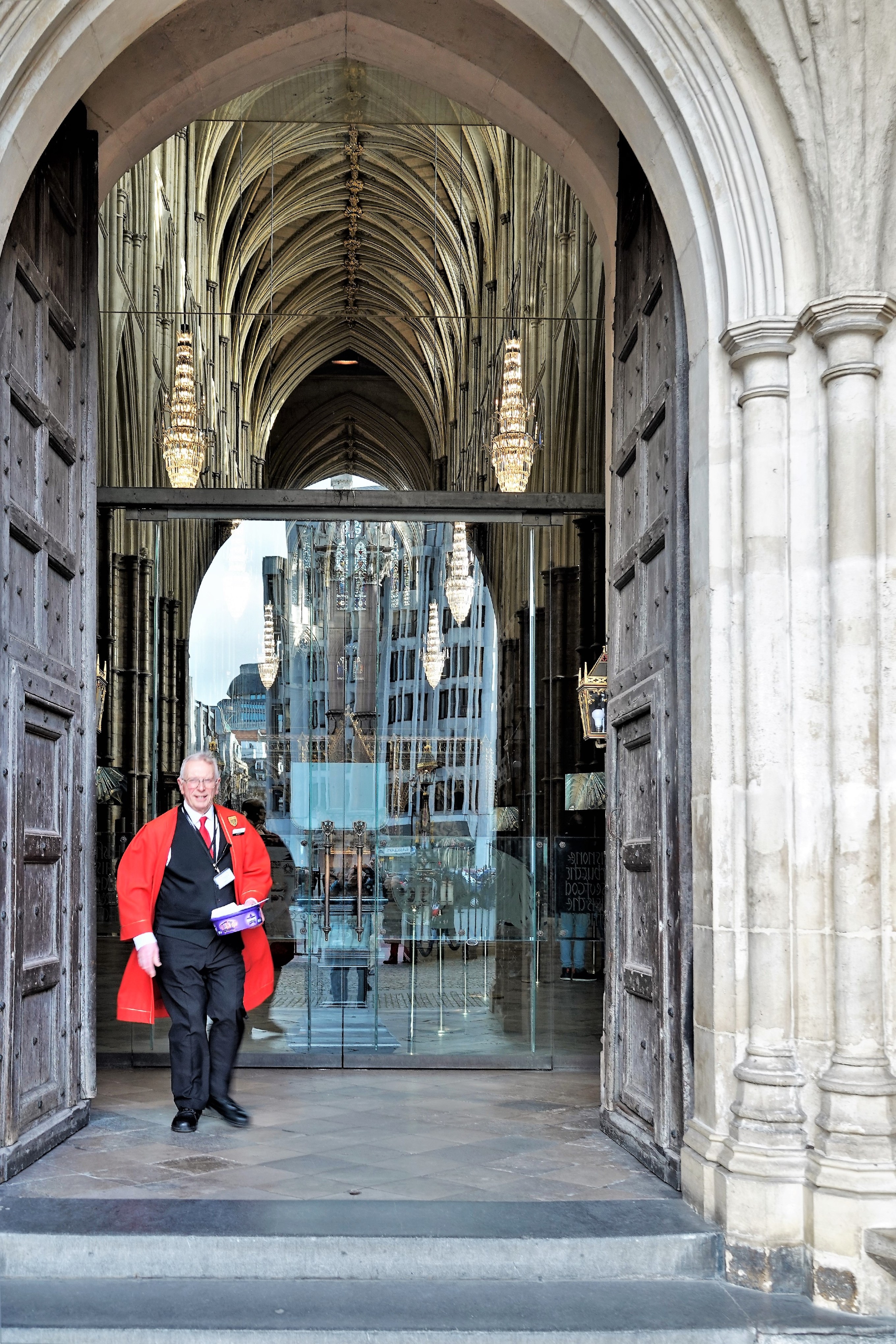
Our time in London was limited–only two days to explore the sights. With so much to see and so little time, Leah and I buckled down for a tour of London’s greatest hits, which easily includes a visit to Westminster Abbey, England’s Gothic royal church, and familiar site for British coronations and weddings, and national celebrations dating back to the 11th century.
We walked around the massive structure until we found the gate entry. Signage informed us that access to this London landmark would set us back 23£ ($30 with current exchange rates), but seniors were entitled to a 3£ discount.
The price seemed steep, but the opportunity to walk through history doesn’t come along every day.
There is a strict NO PHOTOGRAPHY policy inside, which the church keepers will tell you is for the benefit of giving their guests an experience without distraction, and to perserve the solemnity of a working house of worship.
Nevertheless, we walked through the transepts and chapels listening to interactive video recordings while admiring the captivating architecture and memorials, and reflecting on the notion that Charles Darwin and Isaac Newton lie beneath our feet.
But with a newly purchased camera dangling around my neck (Sony RX10 IV), I couldn’t resist the urge.
I had to see what this camera could reproduce in low light…
using advanced stabilization software for hand-held shots…
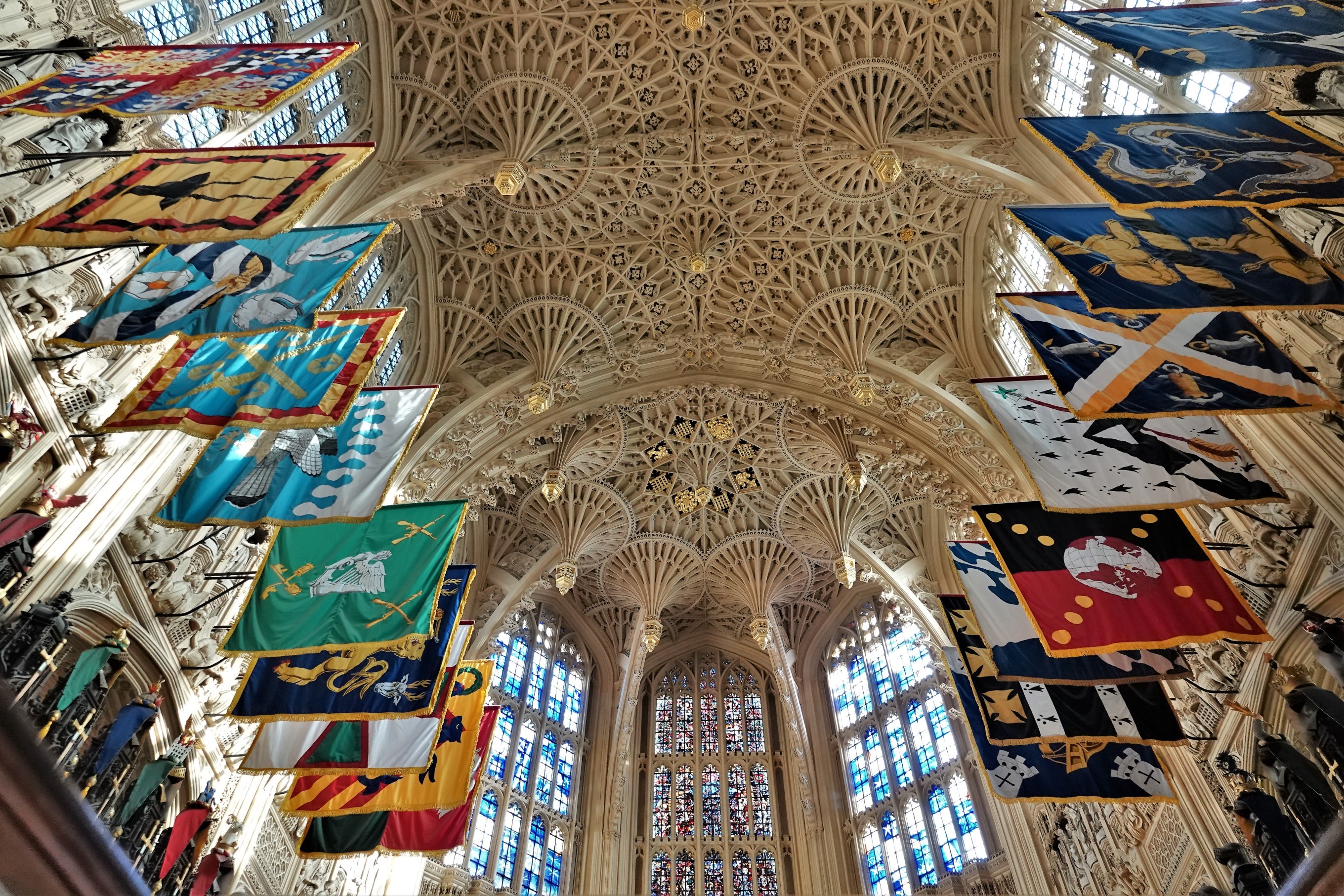
until I was admonished by an Abbey marshal in Henry VII’s Lady Chapel while capturing an overhead view from a polished mirror.
My bad! He wouldn’t leave my side until I reversed the shade and capped my lens. Even then, I could feel his eyes trained on me as I walked around the royal tombs acting as contrite as I could possibly be.
Fortunately, photography IS allowed in the College Garden,
the Cloisters,
and the Chapter House.
As we prepared to leave through the Great West Door, Leah and I walked past the Grave of the Unknown Warrior toward the Coronation Chair behind glass, I was so tempted to surreptitiously point and shoot…but thought better of it. Lesson learned.
As serendipity would have it, the Marshal and I reunited outside, and all was forgiven.
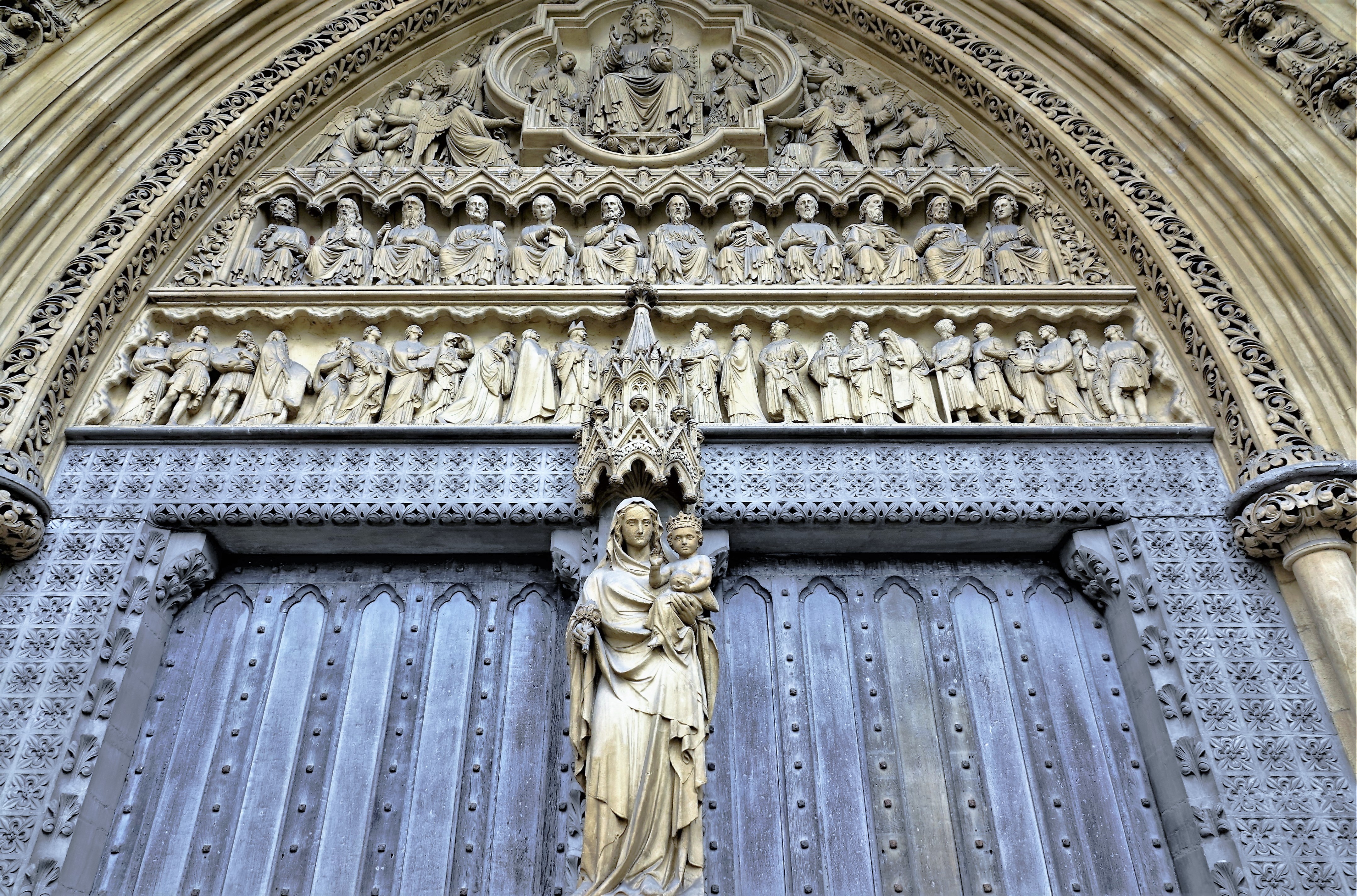
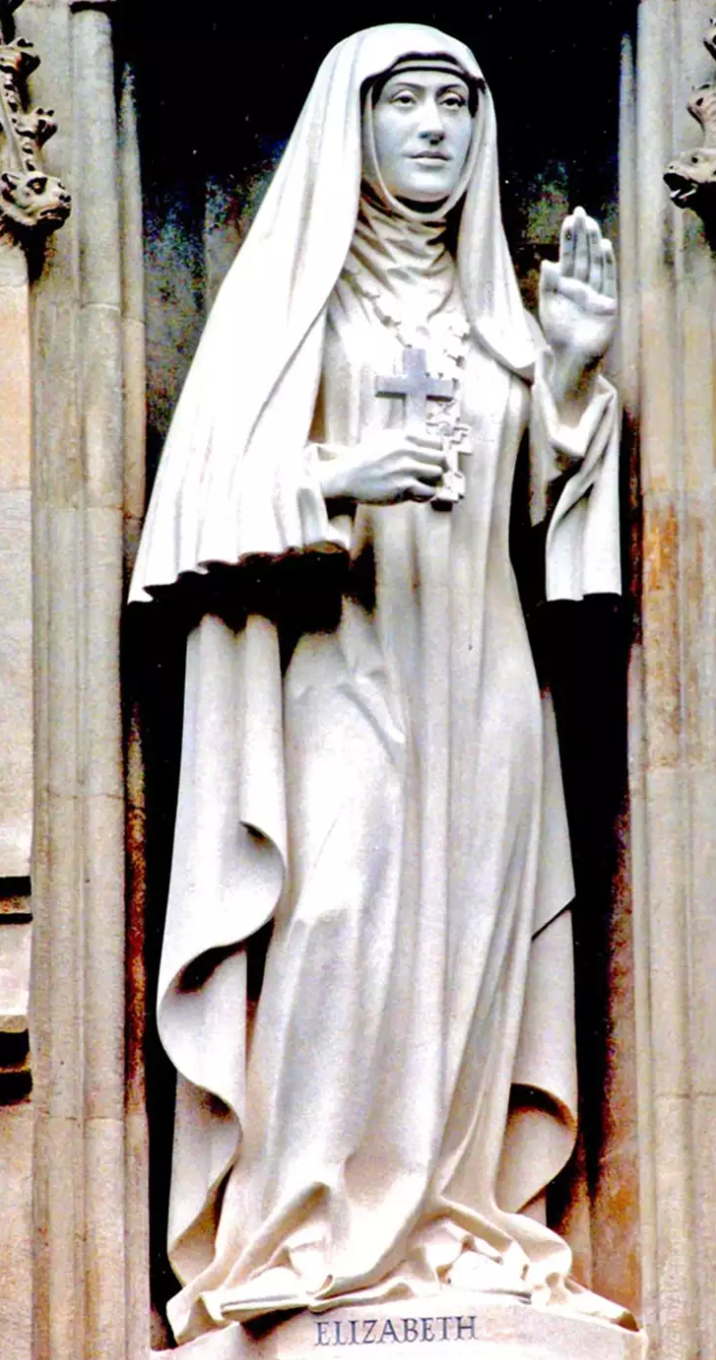
We parted as friends, and I believe I was absolved for my vainglory sin. He used our final moments together to tell us the tale of Grand Duchess Elizabeth Feodorovna, his favorite modern martyr, whose ediface adorns the Abbey’s Great West Door.
According to Marshal John…
Elizabeth of Hesse-Darmstadt was born on 1st November 1864. She was named after Elizabeth of Hungary (1207-1231), a Catholic saint of her own family. Her mother died when she was a child, and she came to England to live under the protection of her grandmother, Queen Victoria. If her childhood was Lutheran, the religious culture of her adolescence was distinctively Anglican. In 1884 Elizabeth married Grand Duke Sergei Alexandrovich, the fifth son of Tsar Alexander II of Russia. Elizabeth found Orthodoxy increasingly absorbing, and in 1891 she adopted the faith.
Although her life had assurance and all the comforts of eminence, it rested on fragile foundations. The Tsarist state maintained its grip over a changing society by repression. Talk of revolution persisted, and grew louder. Acts of terrorism mounted. On 18th February 1905, the Grand Duke Sergei was assassinated.
This marked a turning point in Elizabeth’s life. Now she gave away her jewellery and sold her most luxurious possessions, and with the proceeds she opened the Martha and Mary home in Moscow, to foster the prayer and charity of devout women. Here there arose a new vision of a diaconate for women, one that combined intercession and action in the heart of a disordered world. In April 1909 Elizabeth and seventeen women were dedicated as Sisters of Love and Mercy. Their work flourished: soon they opened a hospital and a variety of other philanthropic ventures arose.
In March 1917 the Tsarist state, fatally damaged by the war with Germany, collapsed. In October, a revolutionary party, the Bolsheviks, seized power. Civil war followed. The Bolshevik party was avowedly atheistic, and it saw in the Orthodox Church a pillar of the old regime. In power, it persecuted the Church with terrible force. In time, hundreds of priests and nuns were imprisoned, taken away to distant labour camps, and killed. Churches were closed or destroyed. On 7th May 1918 Elizabeth was arrested with two sisters from her convent, and transported across country to Perm, then to Ekatarinburg, and finally to Alapaevsk. On 17th July the Tsar and his family were shot dead. During the following night Elizabeth, a sister from SS Mary and Martha named Varvara, and members of the royal family were murdered in a mineshaft.
In the Soviet Union Christianity survived in the face of periodic persecution and sustained oppression. But Elizabeth was remembered. In 1984 she was recognized as a saint by the Russian Orthodox Church Abroad, and then by the Moscow Patriarchate in 1992.
I’m certain that Saint Elizabeth, in her charity, would have pardoned me too.
GPS was set to Zona Arqueológica de Tulum, but upon arrival, the crossover was still under construction. Following signs to the next Retorno, I backtracked to a bustling turnoff. This looked nothing like the Tulum I remembered from 5 years back. Heck, Tulum used to be all jungle 20 years ago!
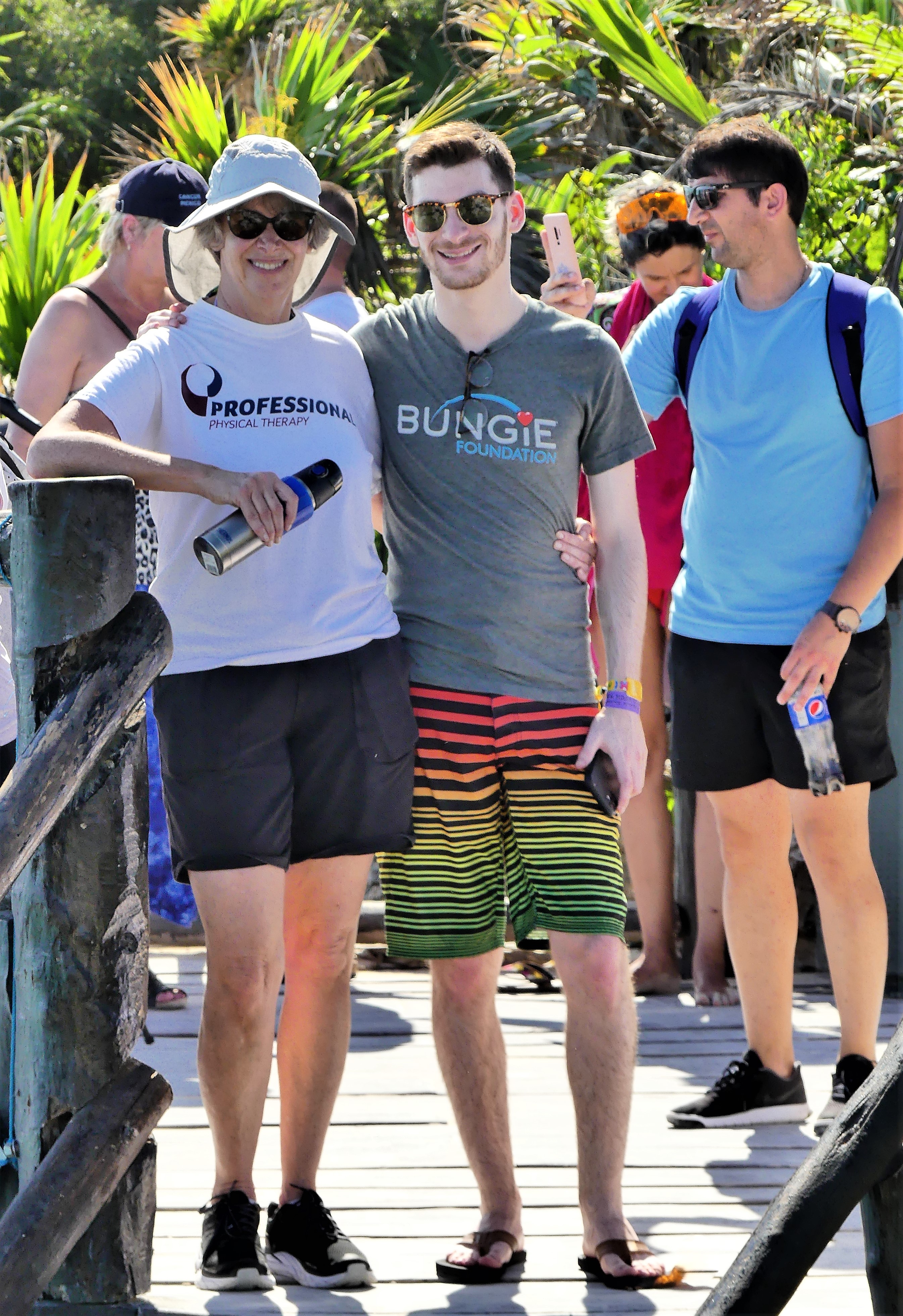
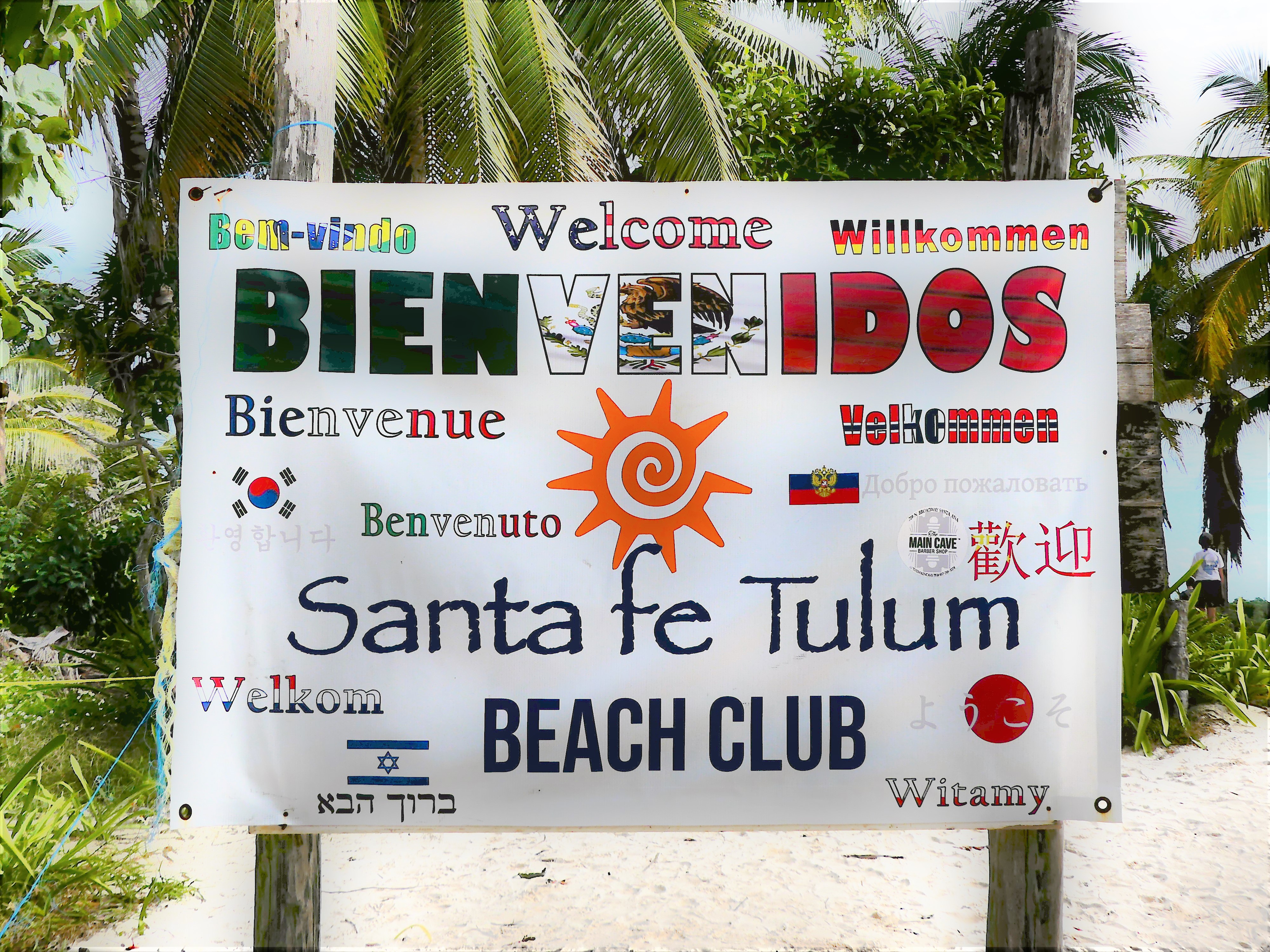
But now, it resembled a spider web of agents in uniformed shirts carrying clipboards and shouting directions in Spanglish. Our rental car was stopped short of the road to the ruins, where we were met by Freddy, a representative for Santa Fe Beach Club, whose job it was to redirect us to his business.
According to Freddy, my choices were limited since cars could no longer advance. Either I could park nearby for $20 and walk 1 km to the ruins, or pay $40 a head, granting us: closer parking; National Park entrance passes; access to the Beach Club–including toilet and shower provisions, one drink (choice of water, soda, or cerveza), and a half-hour water tour, followed by reef snorkeling (all gear provided).
“No way!” everyone voiced emphatically.
All of us were content to walk to the ruins for a fraction of the cost. As I prepared to park in an already overcrowded lot, Freddy offered us a winning alternative: the same all-inclusive package reduced to $27 per person–a 33% discount–traditionally offered to Mexican residents. Score! and lesson learned. Always negogiate the price!
While the ruins piqued their interest, the prospect of snorkeling atop the Mesoamerican Barrier Reef (largest reef system in the Western Hemisphere) sounded especially promising to Noah and Nate. After I revised our initial itinerary–which would have included a stop at Yal-ku in Akumal, with snorkeling in a brackish lagoon surrounded by sculptures–I sensed their enthusiasm to swim in the Caribbean.
I followed Freddy’s directions to Tulum’s Hotel Zone, and turned into a narrow seaside road, offering access to scores of Tulum’s boutique hotels and yoga retreats. Unfortunately, Tulum’s current popularity may prove unsustainable, as it’s recent explosion of tourism and new resort construction have overtaken the town’s current infrastructure capacity, turning it into a eco-nightmare.
Nevertheless, developers continue to exploit the bohemian chic of Tulum. Despite government crackdowns (knowingly rife with corrupt officials), illegal projects continue, laying waste to precious jungle habitats that were once home to endangered jaguars and sea turtles.
We drove to the término, reaching our destination…
and luckily found a coveted parking spot along the mangroves by the beach entrance.
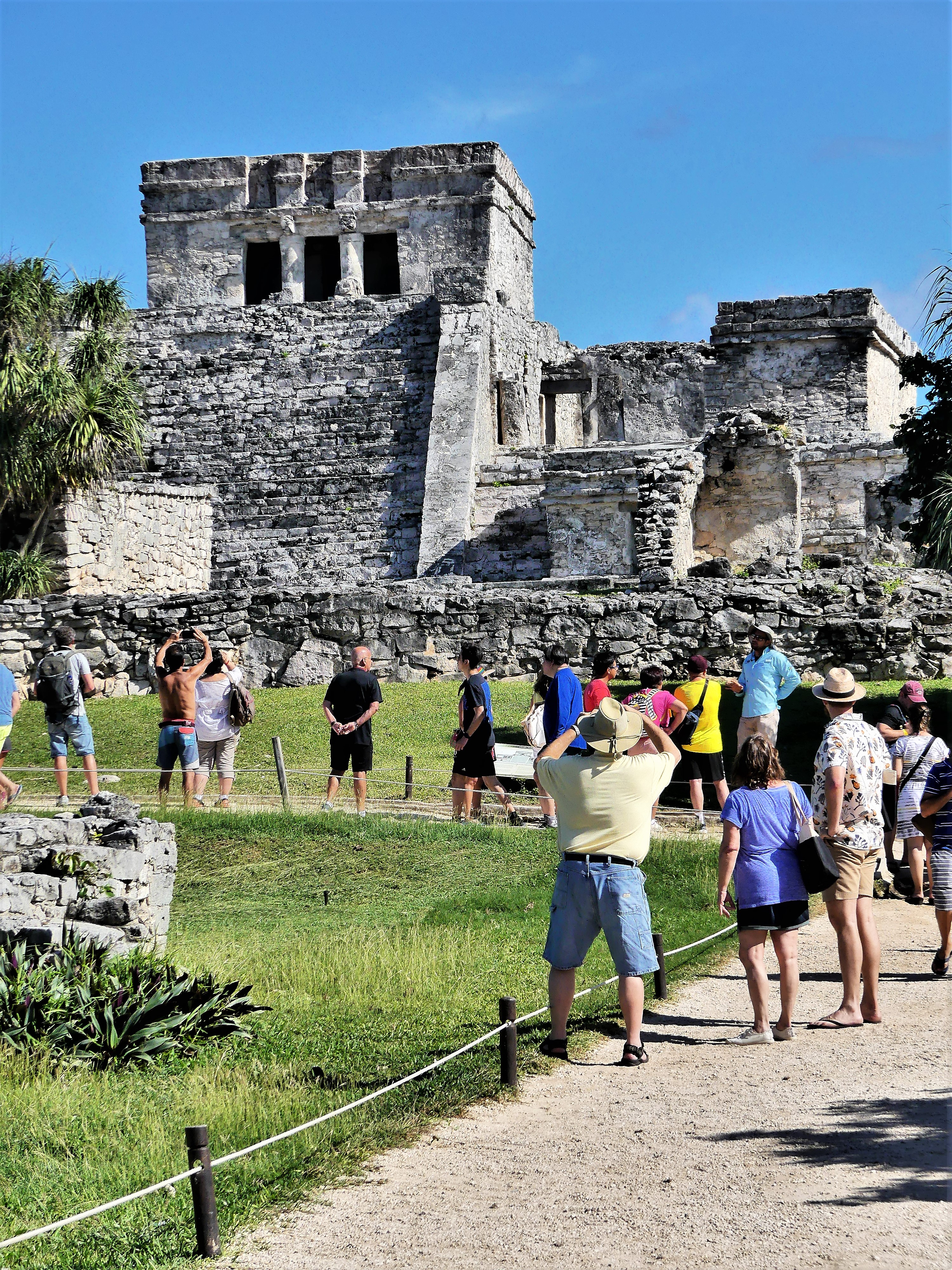
We walked the remaining half mile to the National Park on a rutted lane shared by cyclists, and local vendors selling water and trinkets.
Ordinarily, the surroundings are packed with tour groups and spectators, but we arrived on a calm day, without the usual hubbub.
In fact, the landscape was relatively quiet, and devoid of humanity…
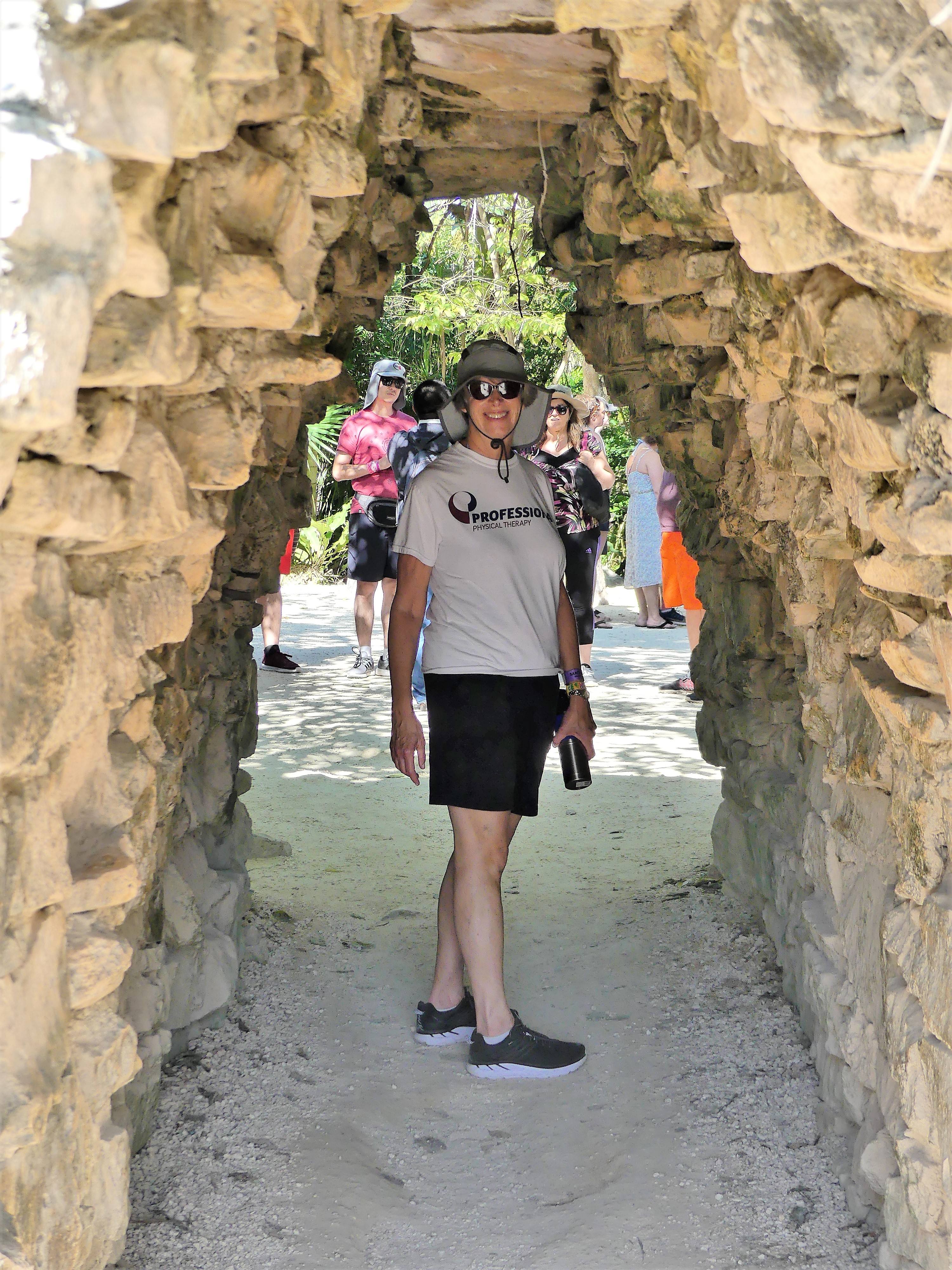
except when I wanted an isolated picture of family.
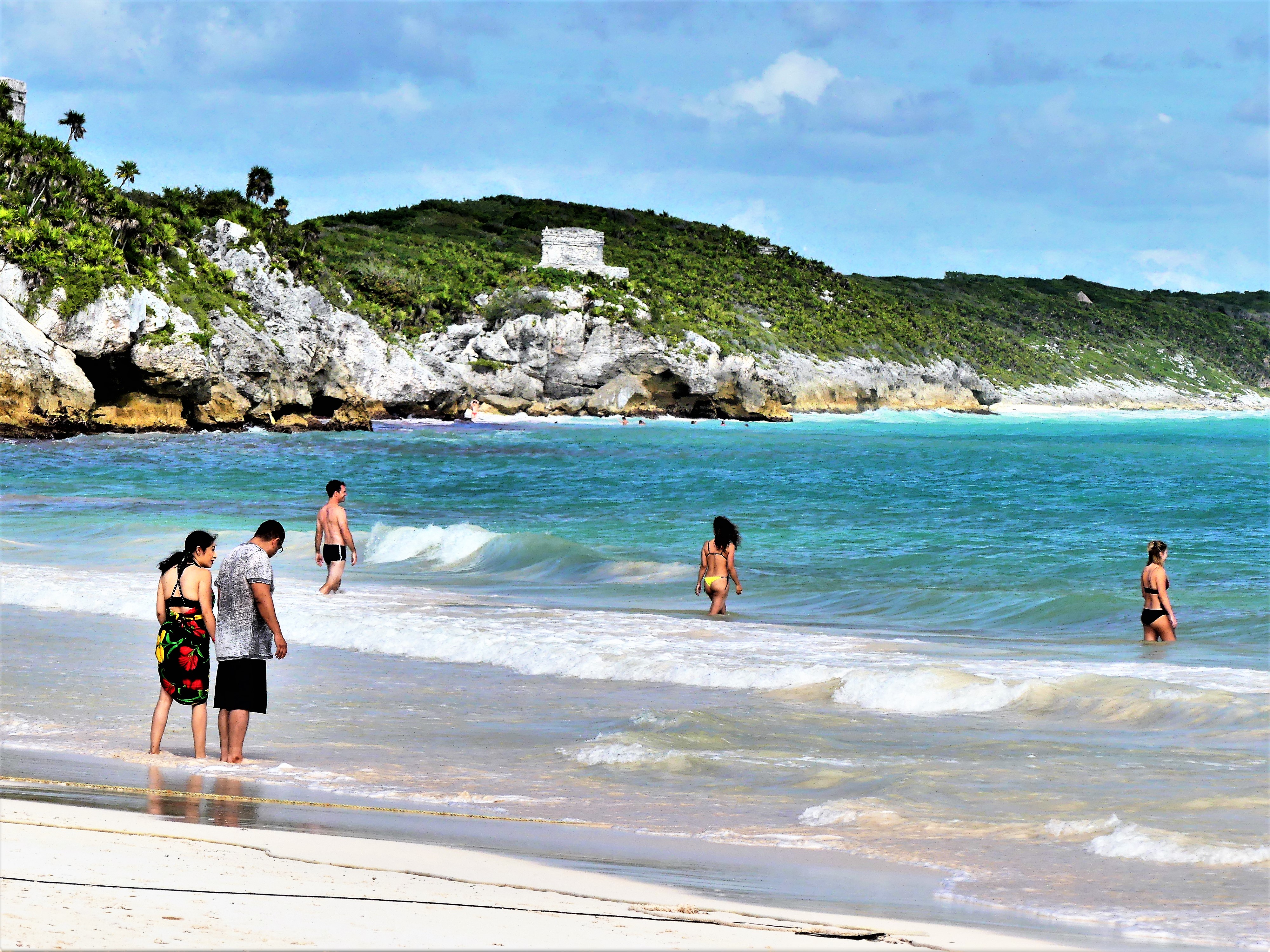
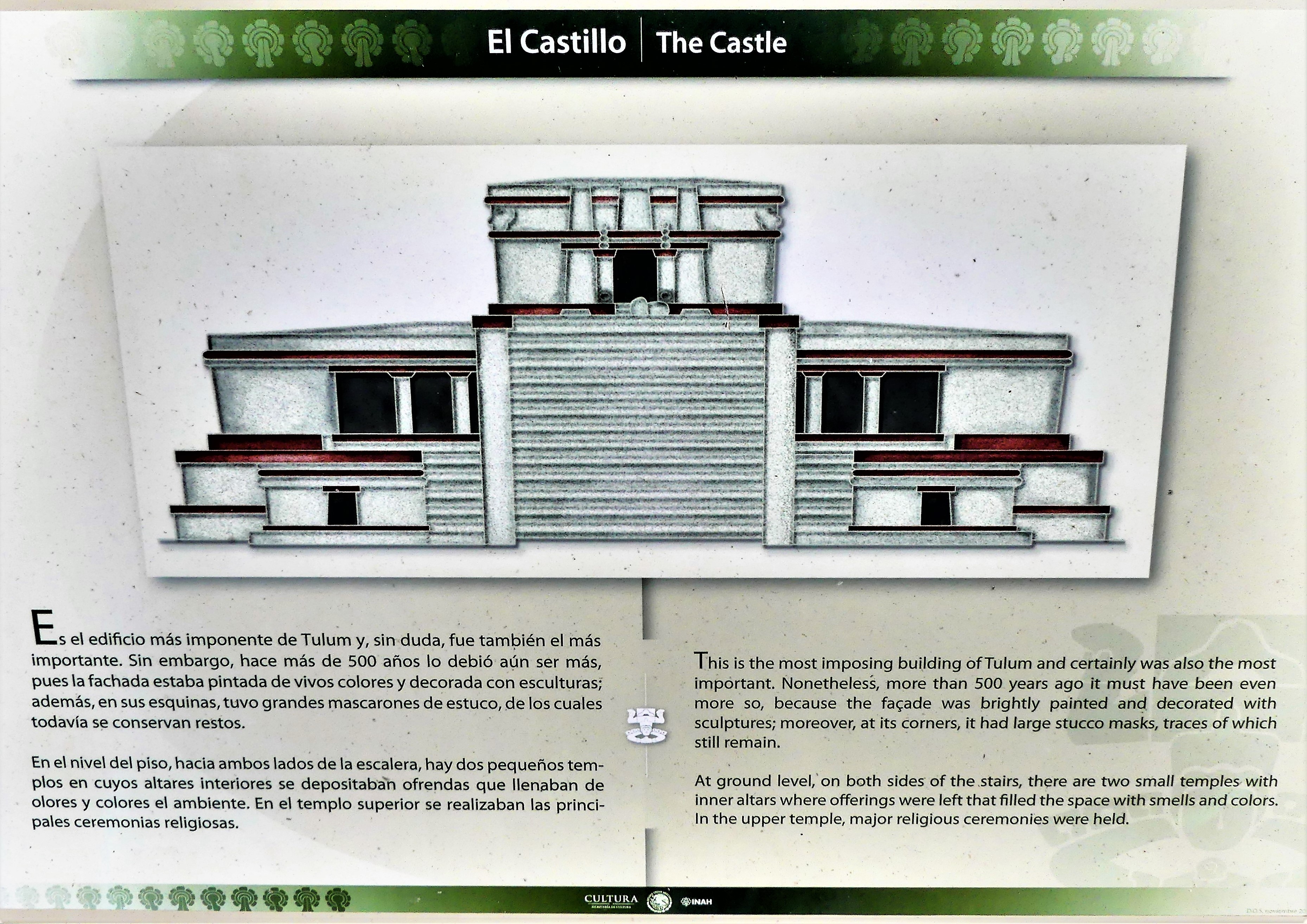
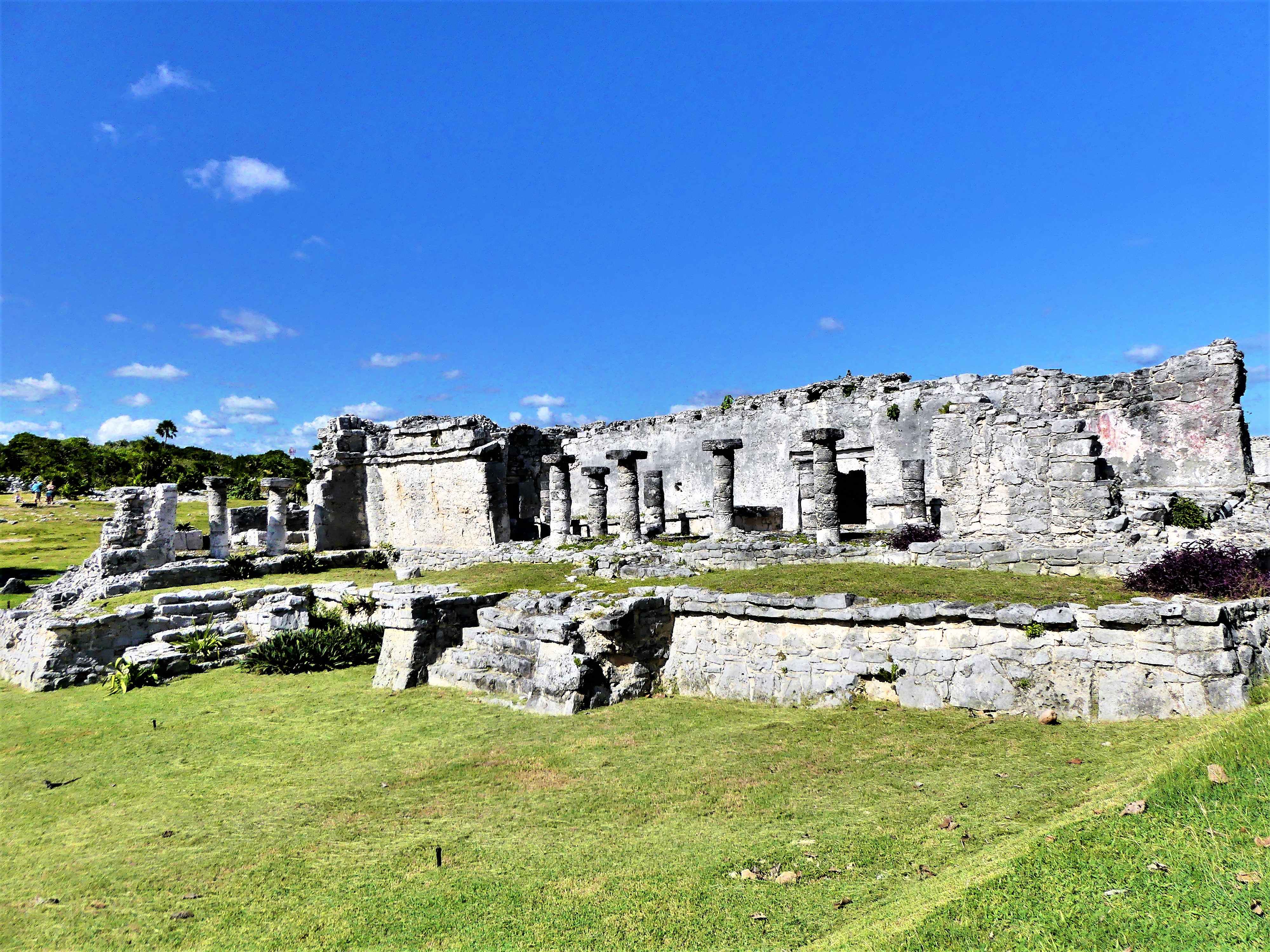
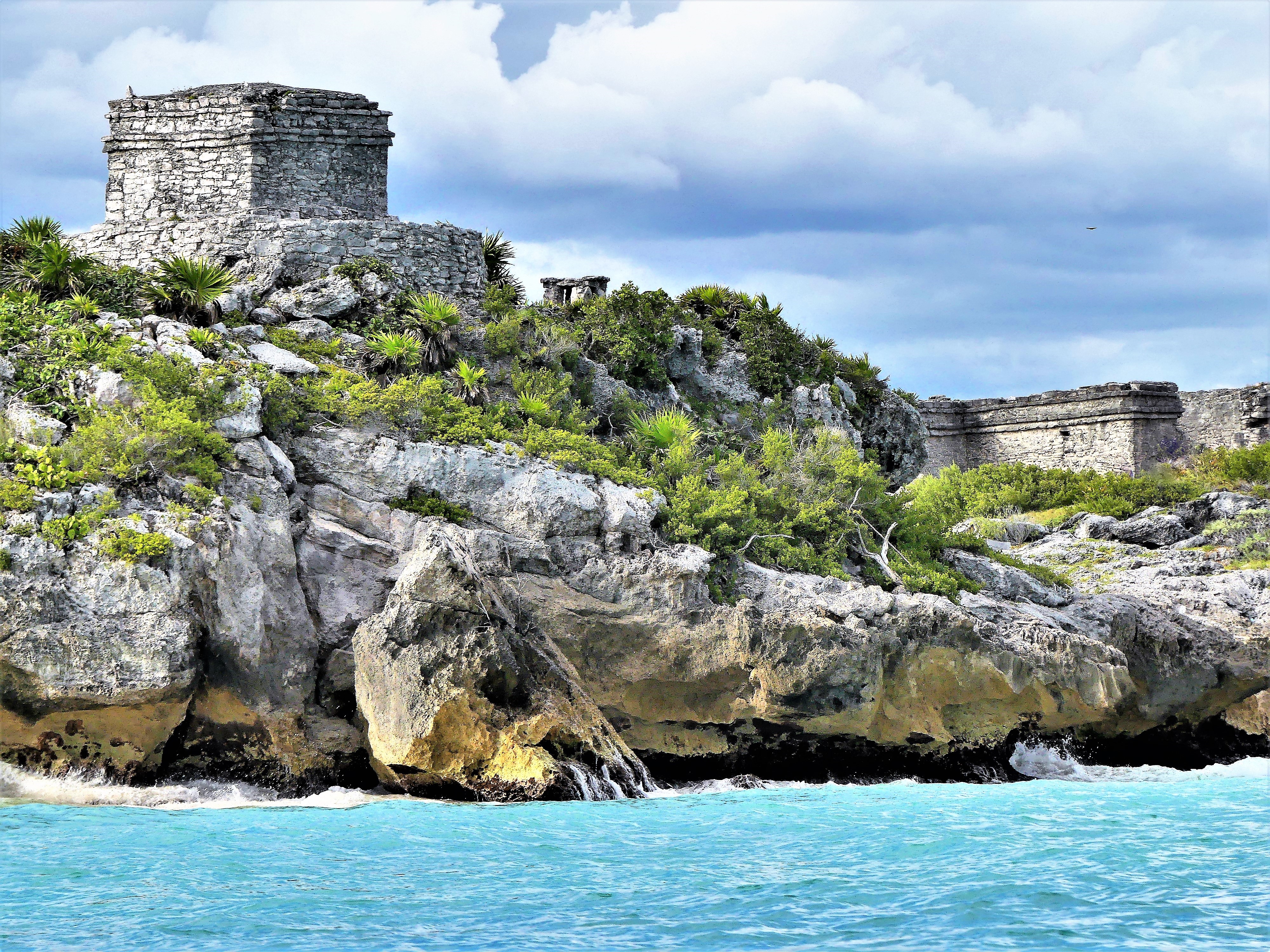
After meandering through 13th century wreckage for more than an hour, we turned our attention to the beach, where the turquoise water looked so inviting.
Ruins Beach is accessible from the cliffs above, but 500 meters south, lies Sante Fe Beach, one of Tulum’s original hangout spots before the tourism boom…
and that was our next destination.
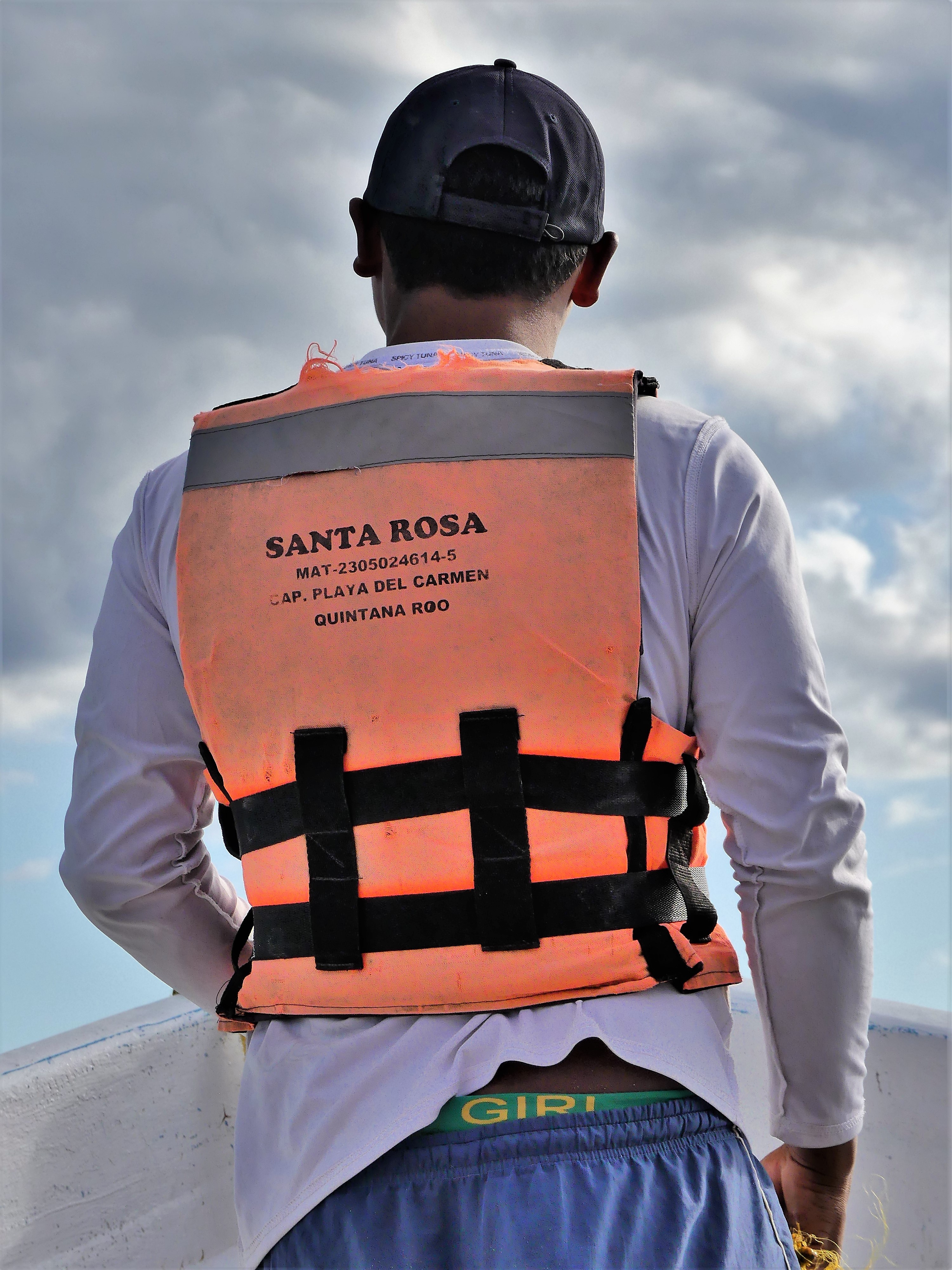
Per Freddy’s instructions, we sought out Captain Harrison, and lounged on PVC beach chairs under a delapidated canopy, waiting for our excursion on Brenda or half a dozen skiffs just like her.
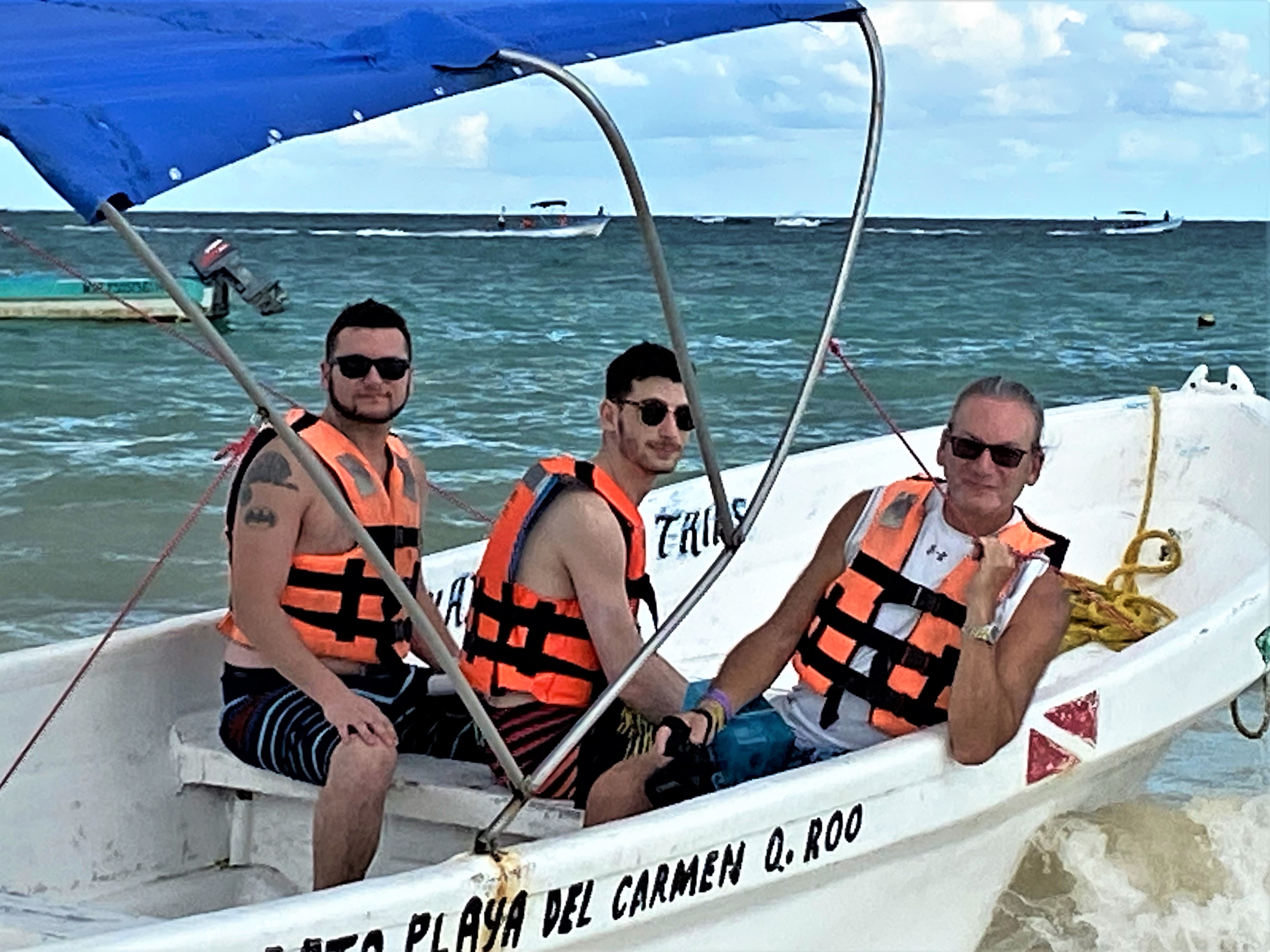
Leah stayed on land after realizing her bonine fix had worn off, but Noah, Nate and I eagerly climbed aboard.
Our captain motored out to open water,
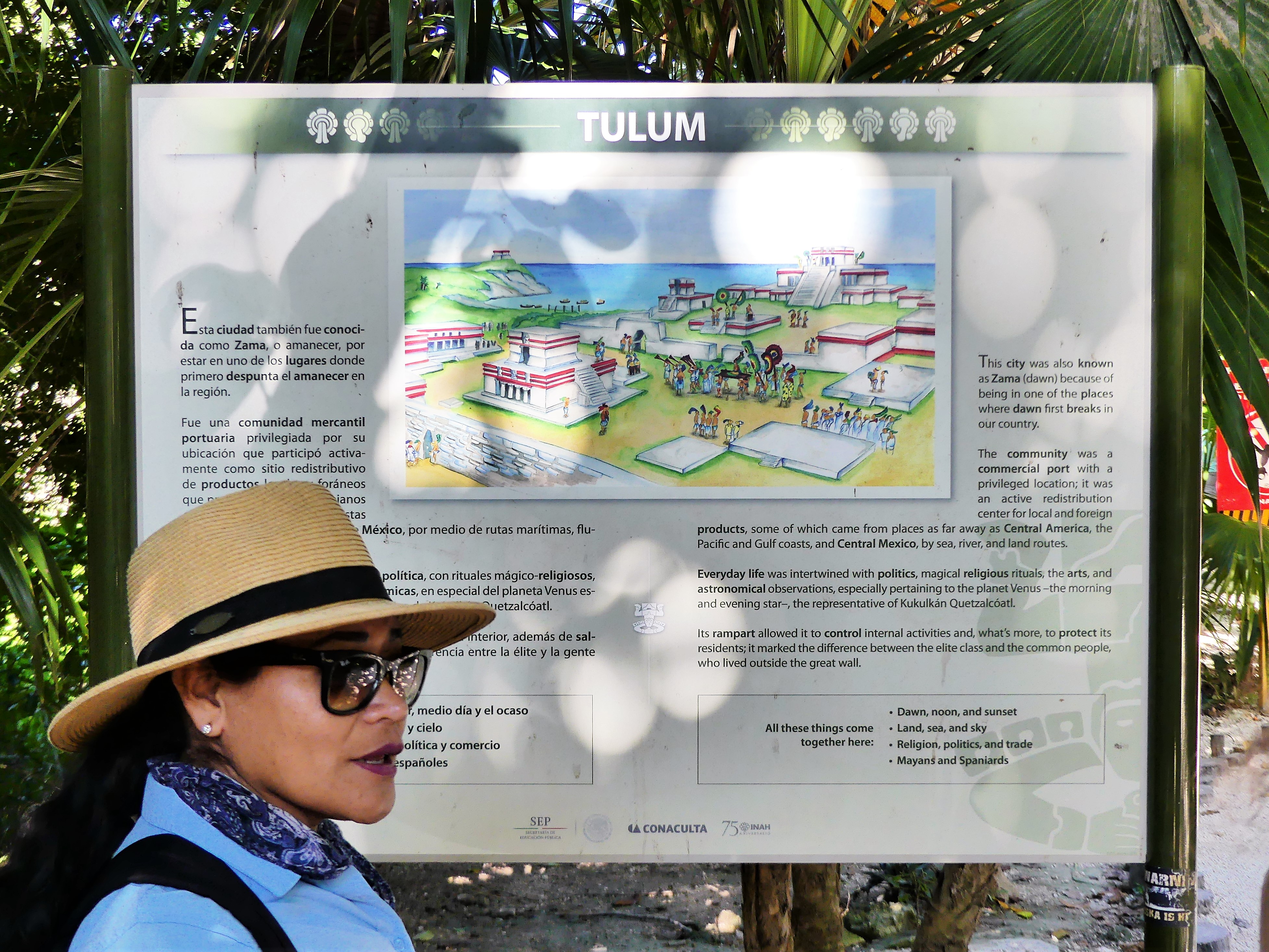
and offered a summarized history of the Mayans, and importance of Tulum…in Spanish.
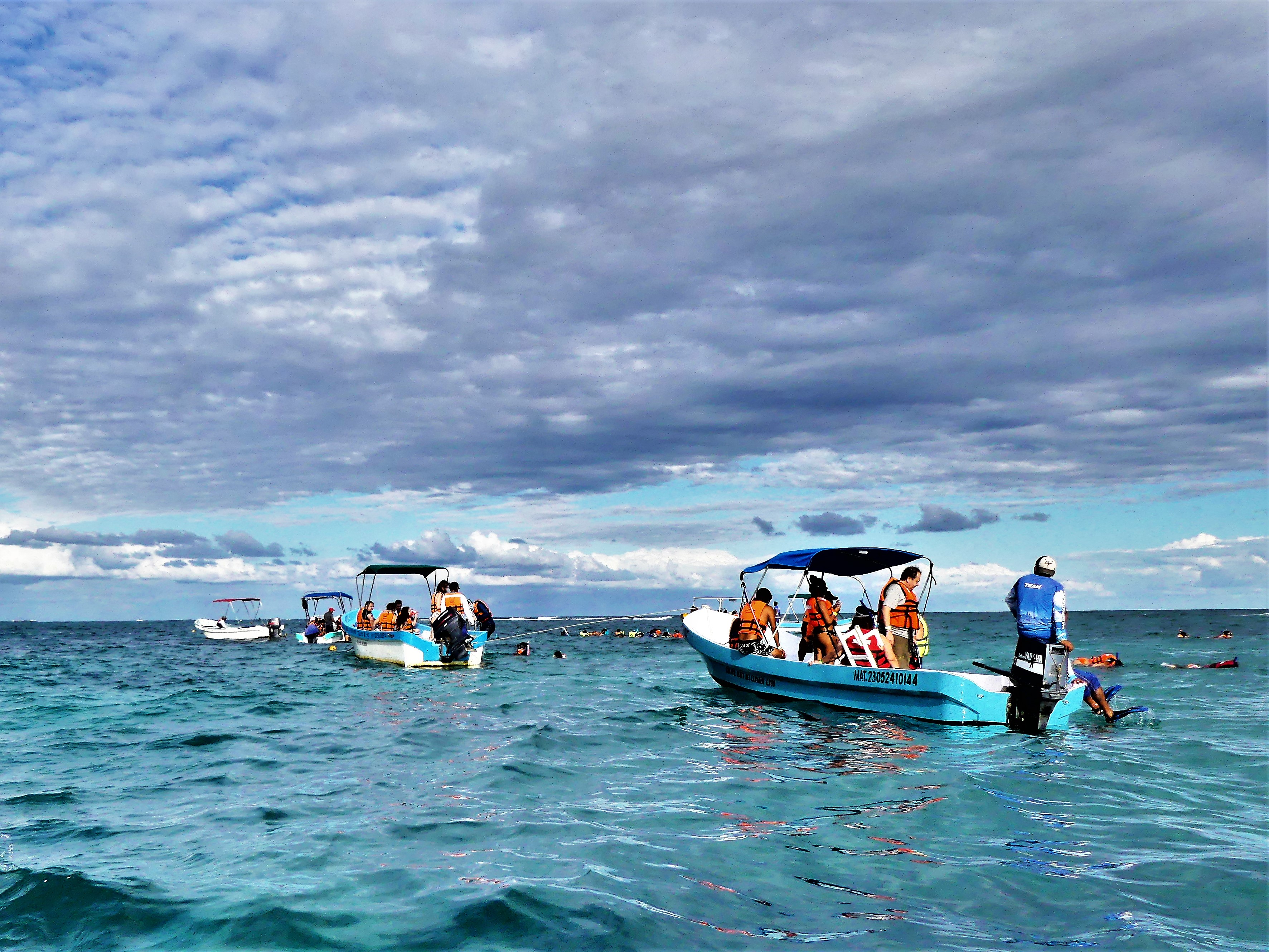
Soon, we headed for the reef, where others had formed a floatilla of snorkelers.
Noah and Nathan eagerly jumped overboard for an under-the-sea swim…
while I remained on the surface, shooting pelicans…
and keeping track of my sons.
Once ashore, it was time for a beer and a shower. Despite the primitive outdoor plumbing on the beach, we concluded that $27 a head was a better bargain than any of us could have ever imagined for a family vacation adventure.
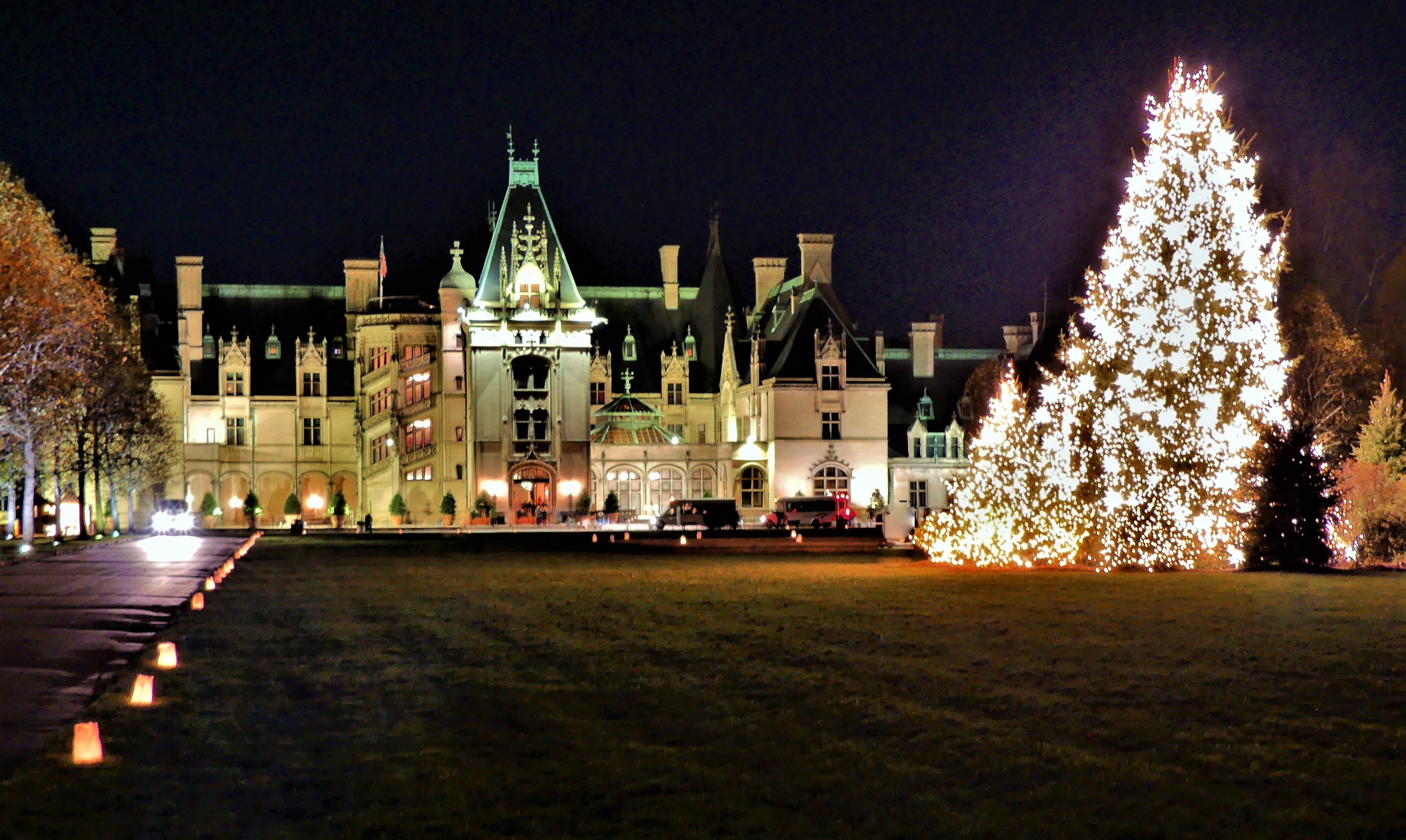
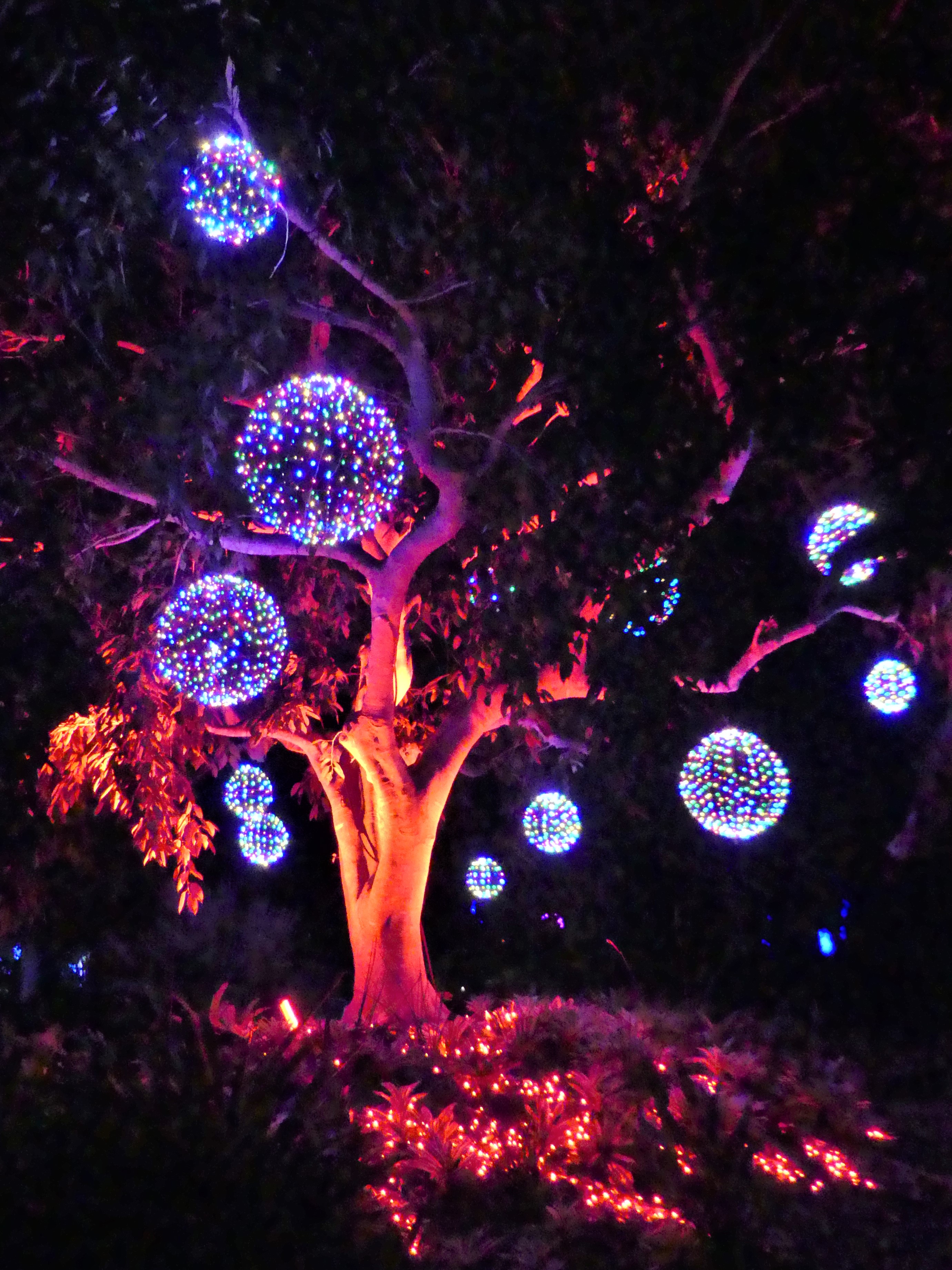
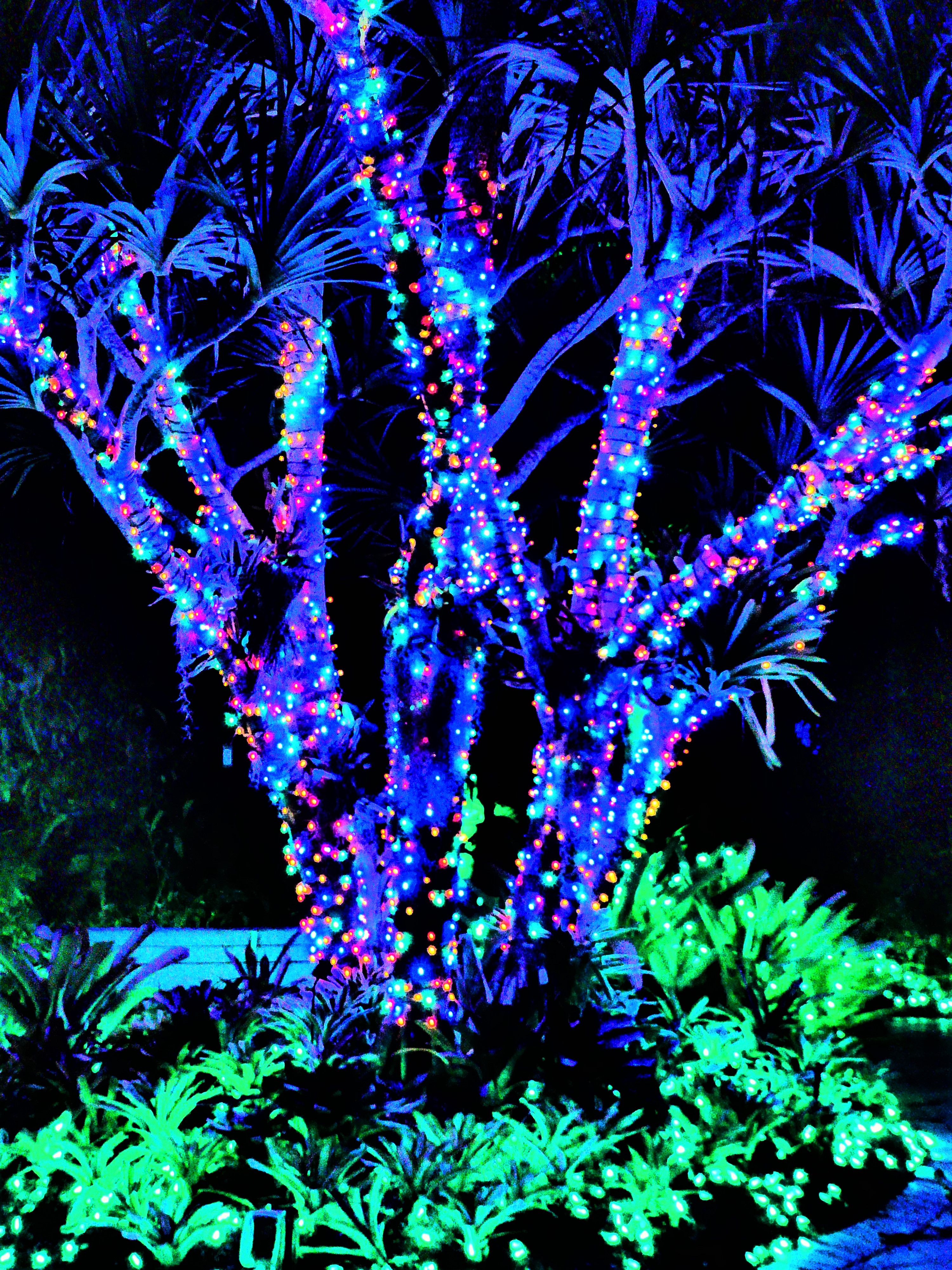
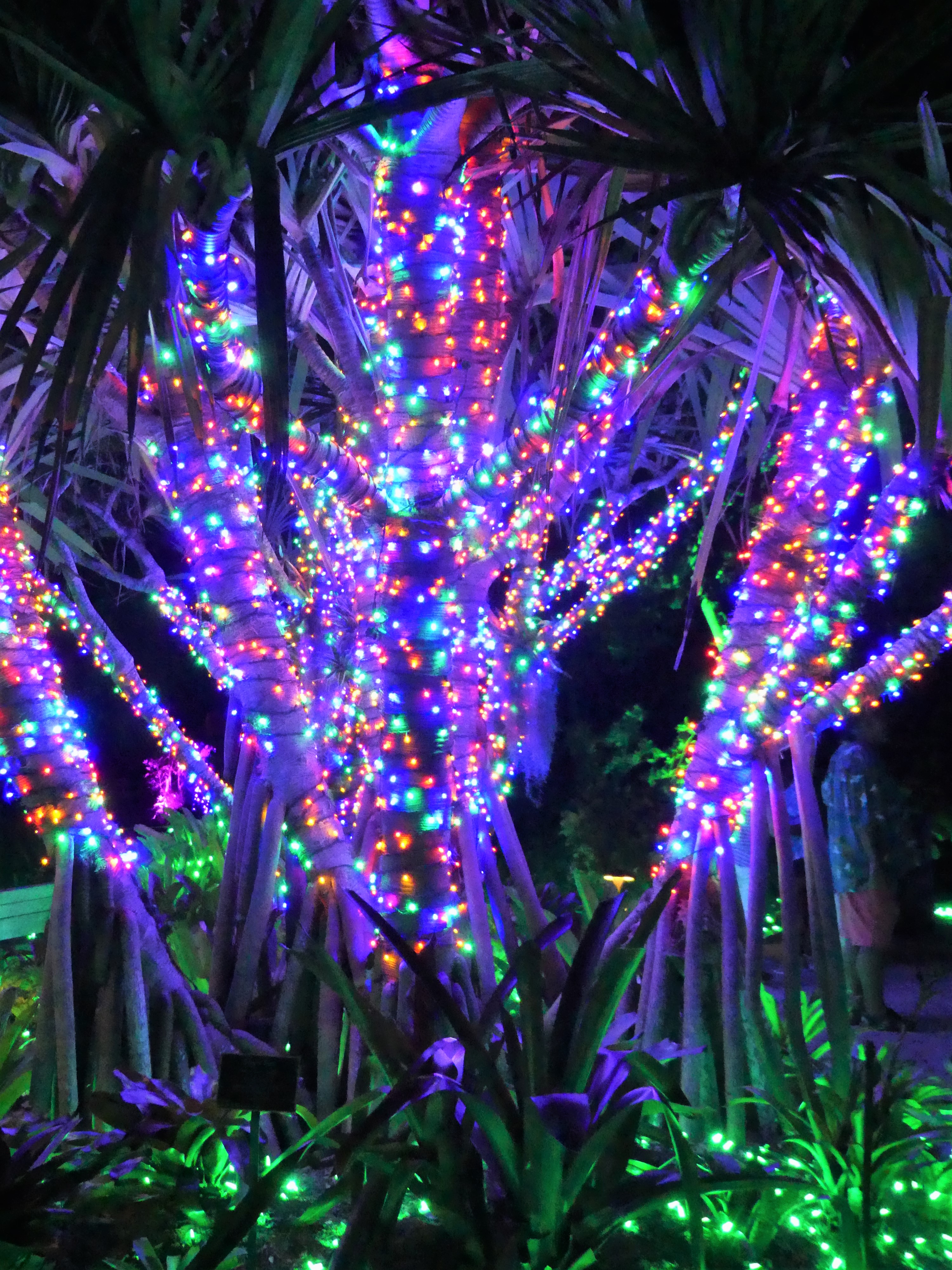
For some reason, thousands of lights wrapped around sultry-weather palm trees…
don’t suggest Christmas or winter wonderland to me in quite the same way as a traditionally decorated evergreen.
A live oak decorated with oversized ornaments comes close,
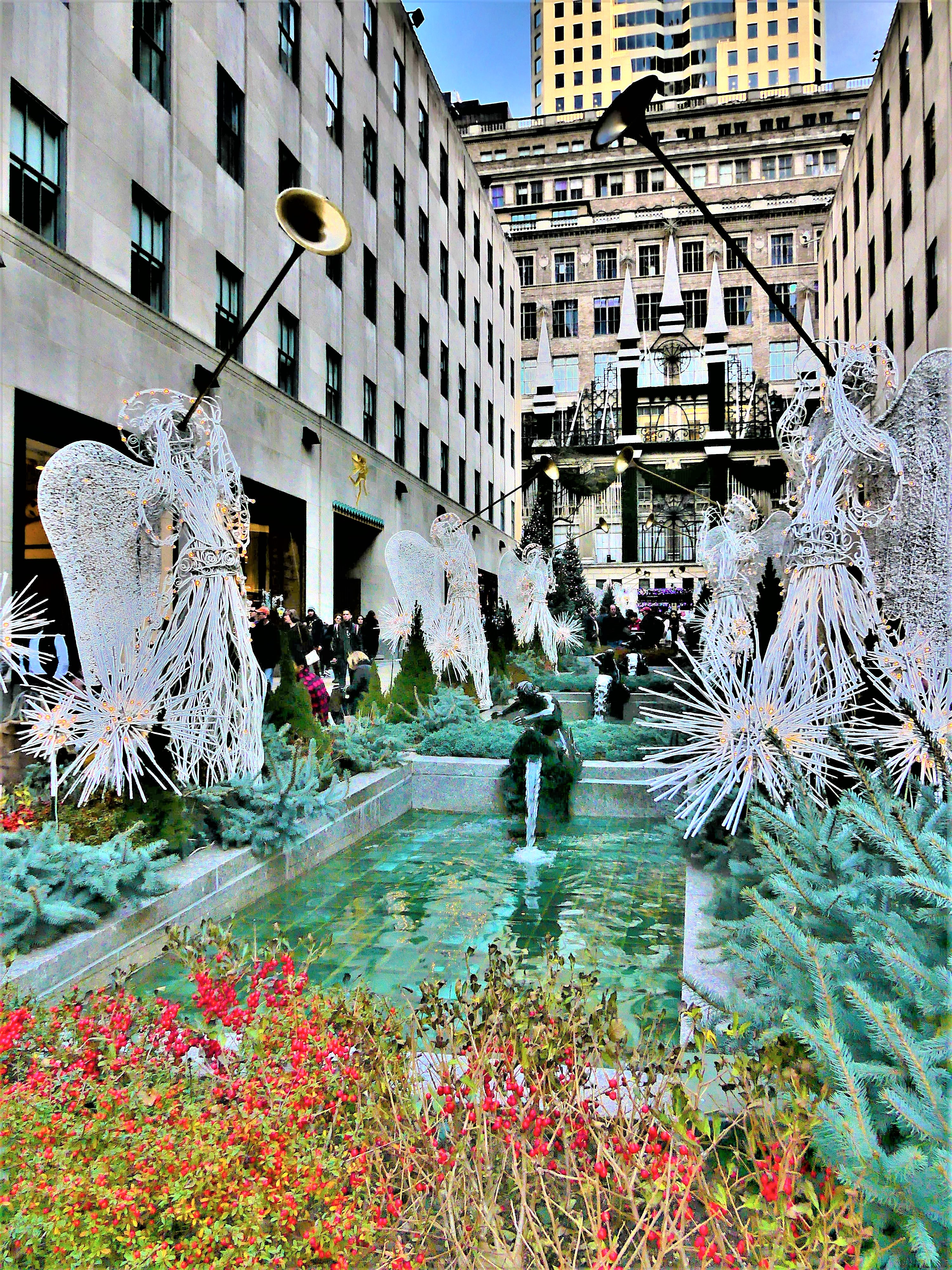
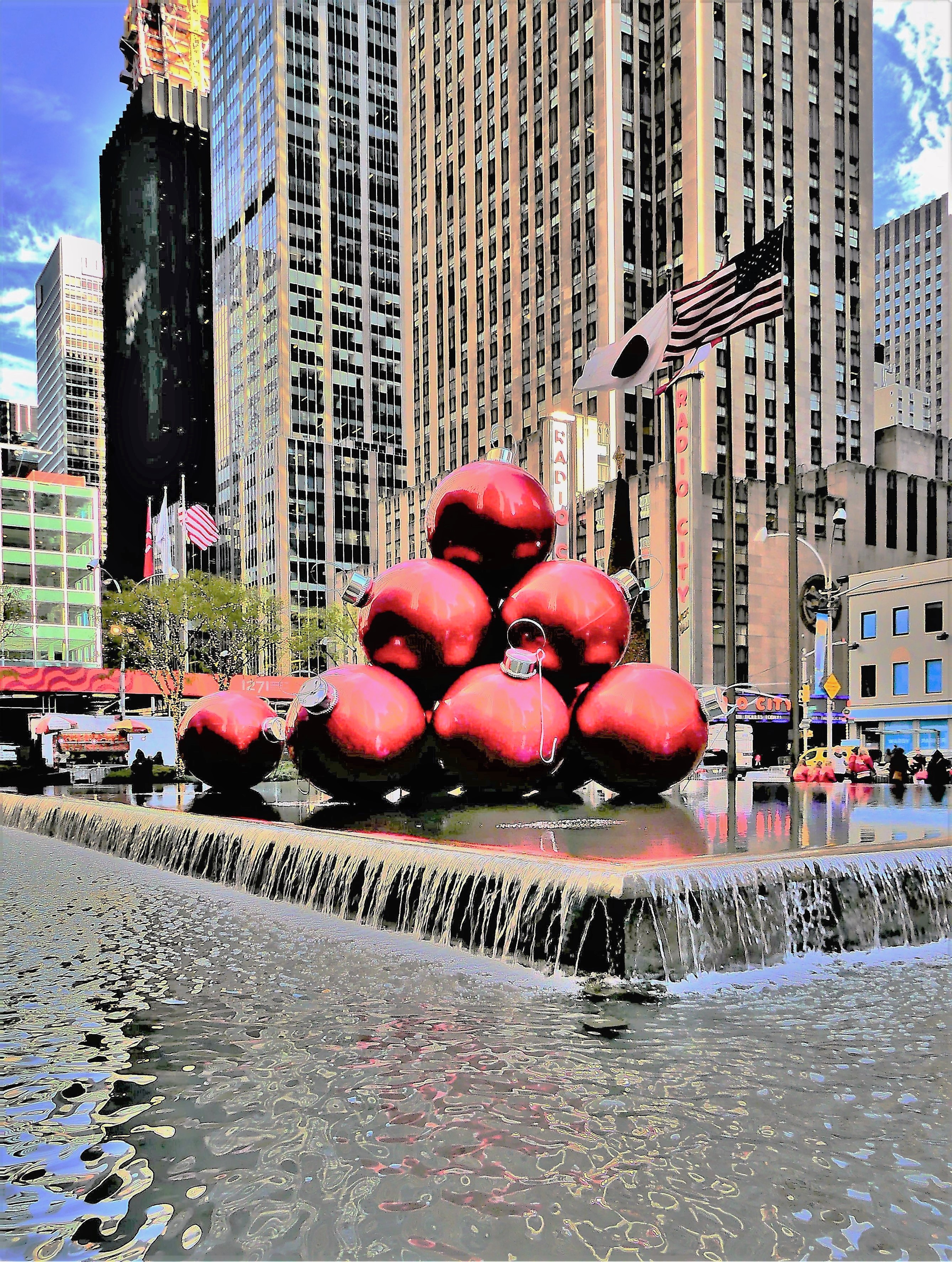
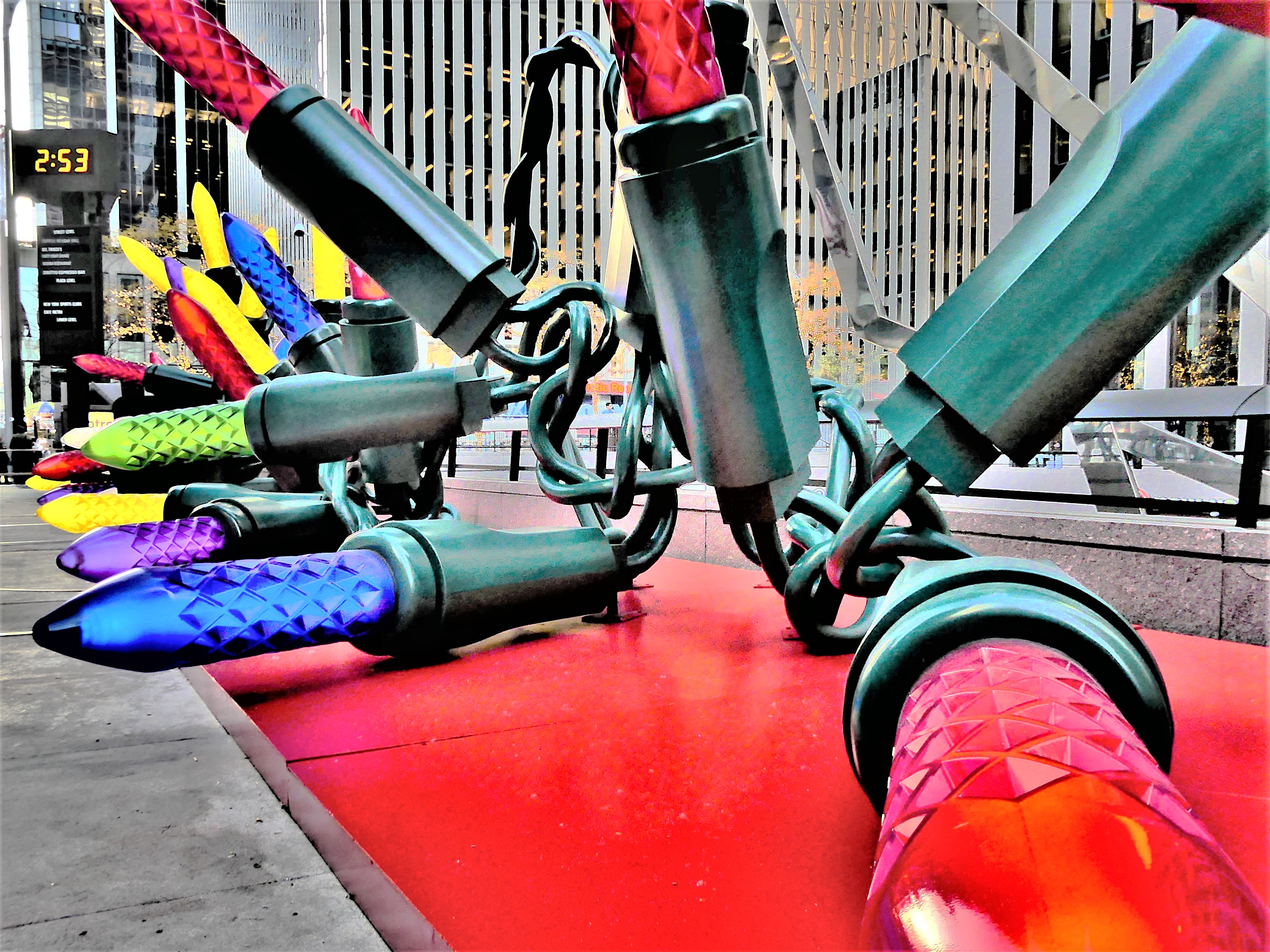
but it’s still no match for the festive vibe that envelopes New York City during the holidays,
where everything is bigger…
and brighter.
Not that there’s anything wrong with lit palm trees.
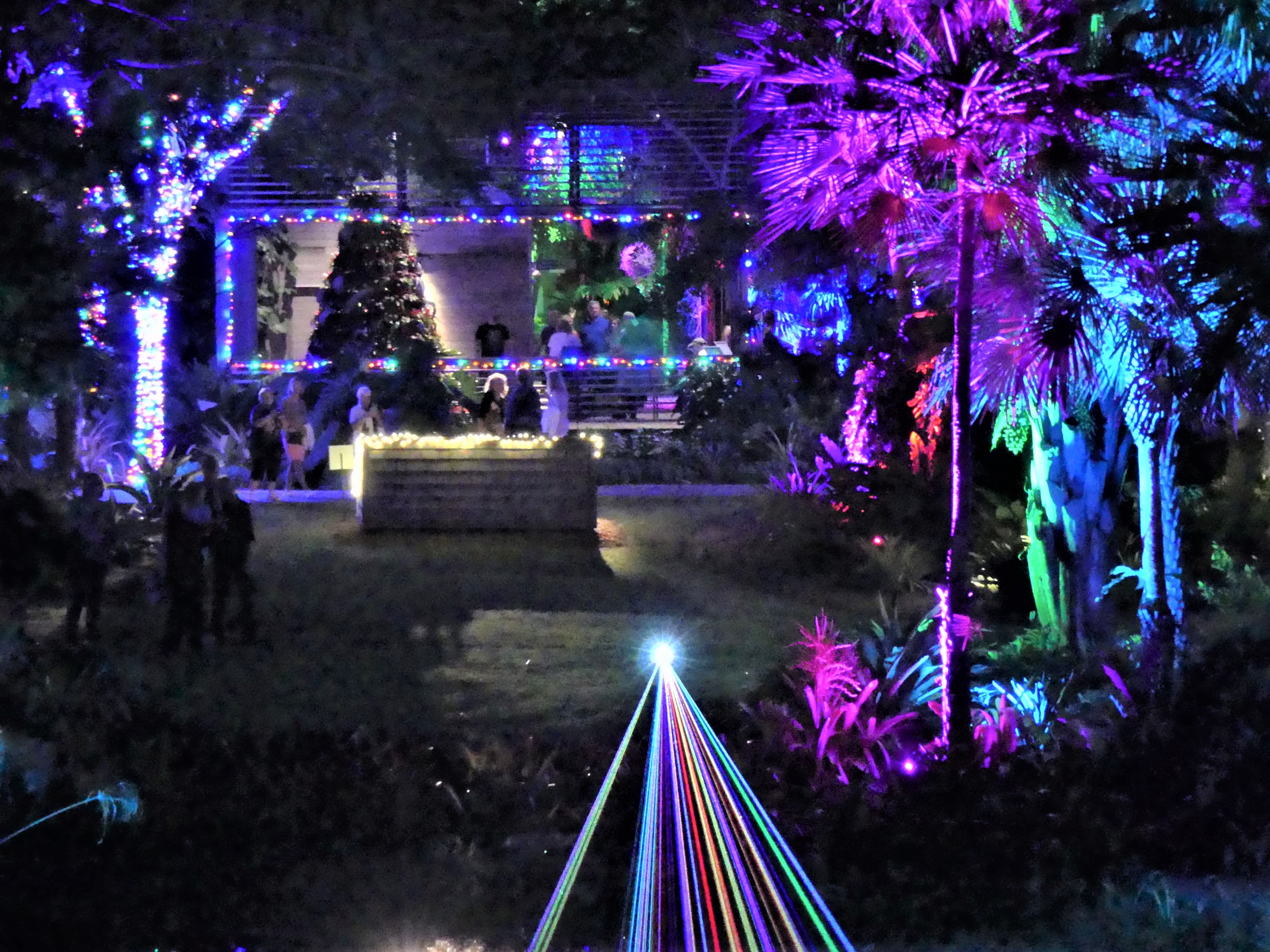
Nevertheless, there is a tradition in Naples, Florida that dates back to 2009, when tiki torches first illuminated the town’s 170-acre botanical gardens.
Since then, the holiday light show has evolved to “to accentuate the plants themselves and their textures, silhouettes and natural beauty,” according to Ralph Klebosis, event productions manager.
While some of the displays were fascinating unto themselves…
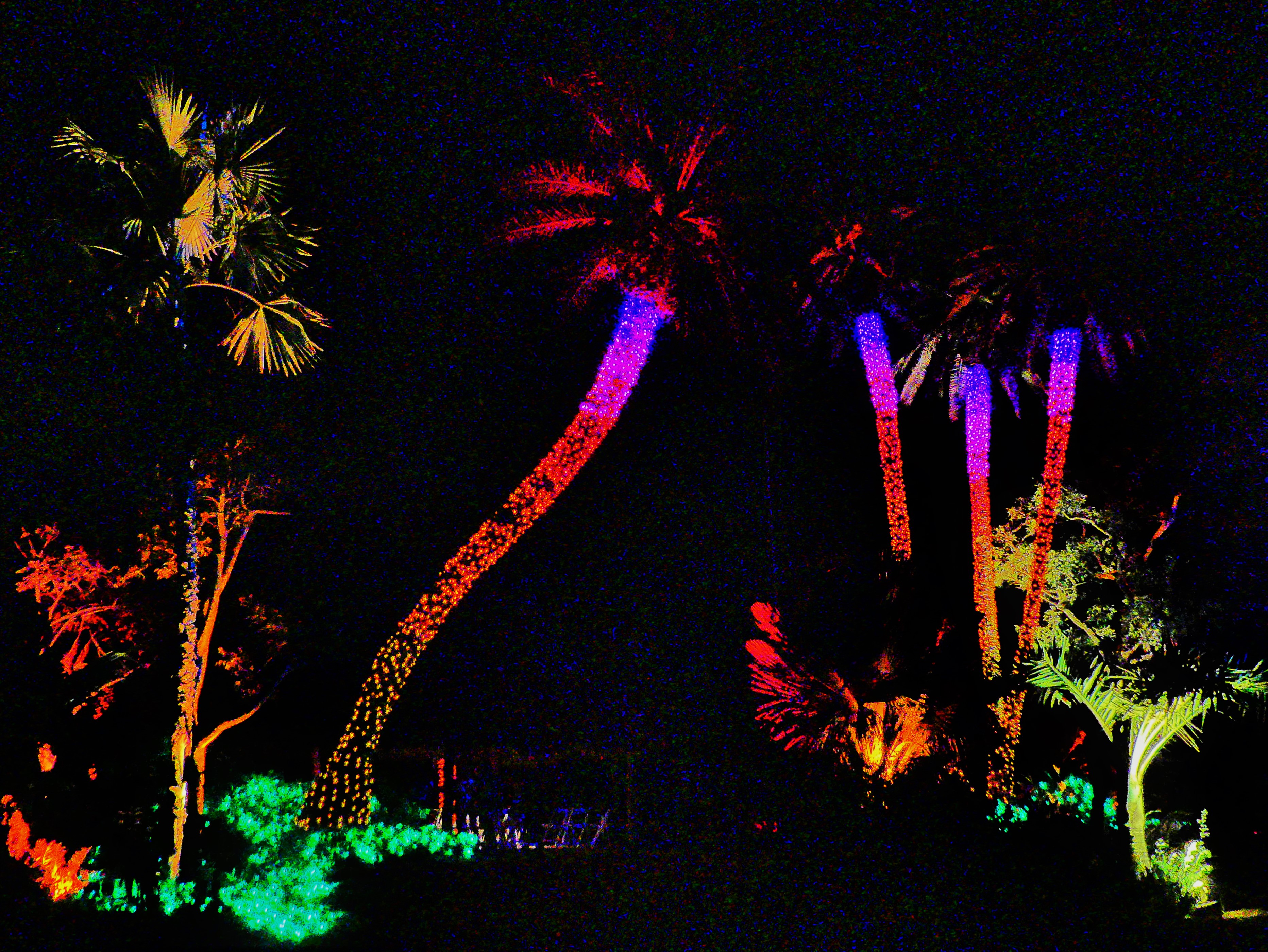
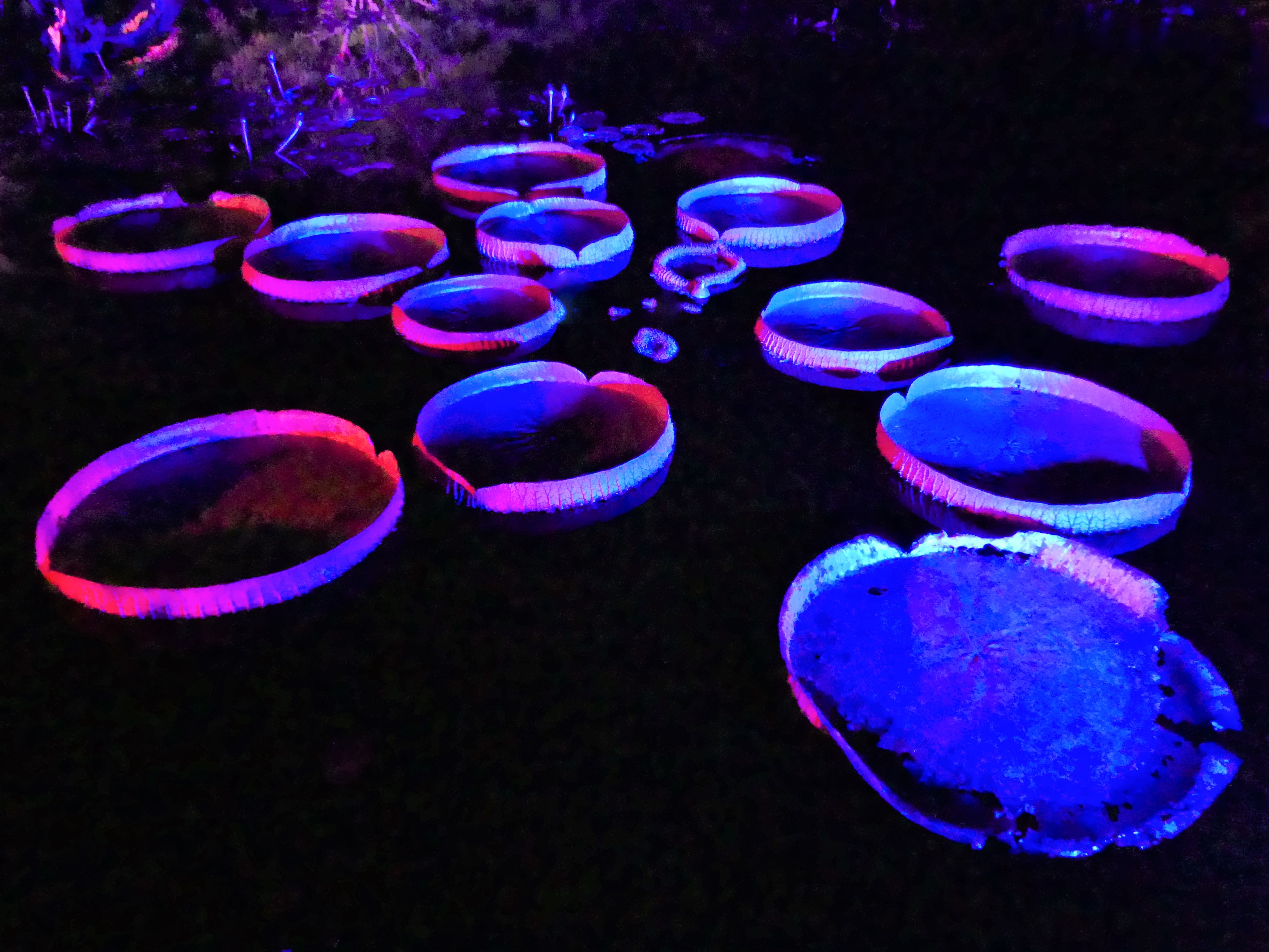
photographing the event pulled me in a completely different direction after I noticed a pulsing plant projector.
If this event is about night lights, then why not capture the light source and paint with it, I mused? And so I did. The images are a product of serendipity, and represent a different take on Nights of Light.
All the same, artificial light could never improve on Mother Nature!
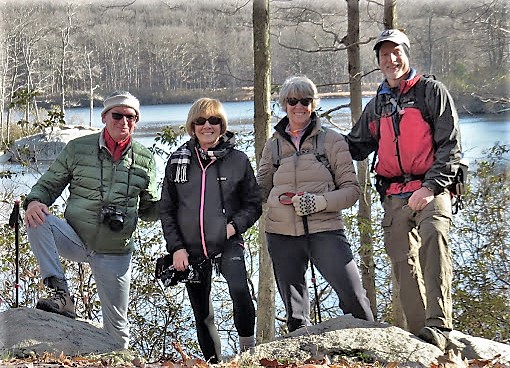
The four of us (Doug, Arlene, Leah and I) have been hiking together for nearly 15 years.
We bonded as regulars of Harriman Hikers–a 45 year-old organization of singles from New York and New Jersey who continue to gather every Sunday, year-round, rain or shine at Ramapo College to hike Harriman State Park, along with other trails in Wawayanda State Park, Norvin Green State Forest, Ramapo Reservation and the southern Hudson Valley.
I met the Harriman Hikers through Leah just a few months into our courtship, and accepted an invitation to hike with her group. I felt confident that sufficient time had passed after rehabilitating a broken leg and torn knee caused by a Kamakazi snowboader 6 months earlier.
Big mistake! These were dedicated hikers who had mapped out a grueling 12-mile hike of steep ascents and descents, leaving me noticeably lame at the end of 6 hours in the woods. I thought that Leah might have to carry me out.
As time passed, my stamina improved, as did my personal relationships within the group. Over time, Leah and I strayed from the pack and blazed our own trail, hiking different destinations at our own convenience with Doug and Arlene, who initially met through Harriman Hikers and eventually married.
Since moving from New Jersey to St. Augustine, Leah and I have maintained a long distance relationship with Doug and Arlene, and we were eager to reprise our traditional Thanksgiving hike together…especially after over-eating with family the night before!
It was time to return to Harriman. We arranged to meet at the Lake Skannatati parking lot located off Seven Lakes Drive. Fortunately, the temperature was more conducive to hiking than the prior year (see Becoming My Parents).
As always, it was great catching up with familiar faces in familiar places. We leisurely looped around the mounds of granite…
…traveling 5.66 miles over 3:42:26,
and reached the ridgeline approximately one hour into the hike. The wind was brisk at the clearing, but the view from the top of the hill was worthy of the chill.
And the warmth of our friendship carried us the rest of the way.
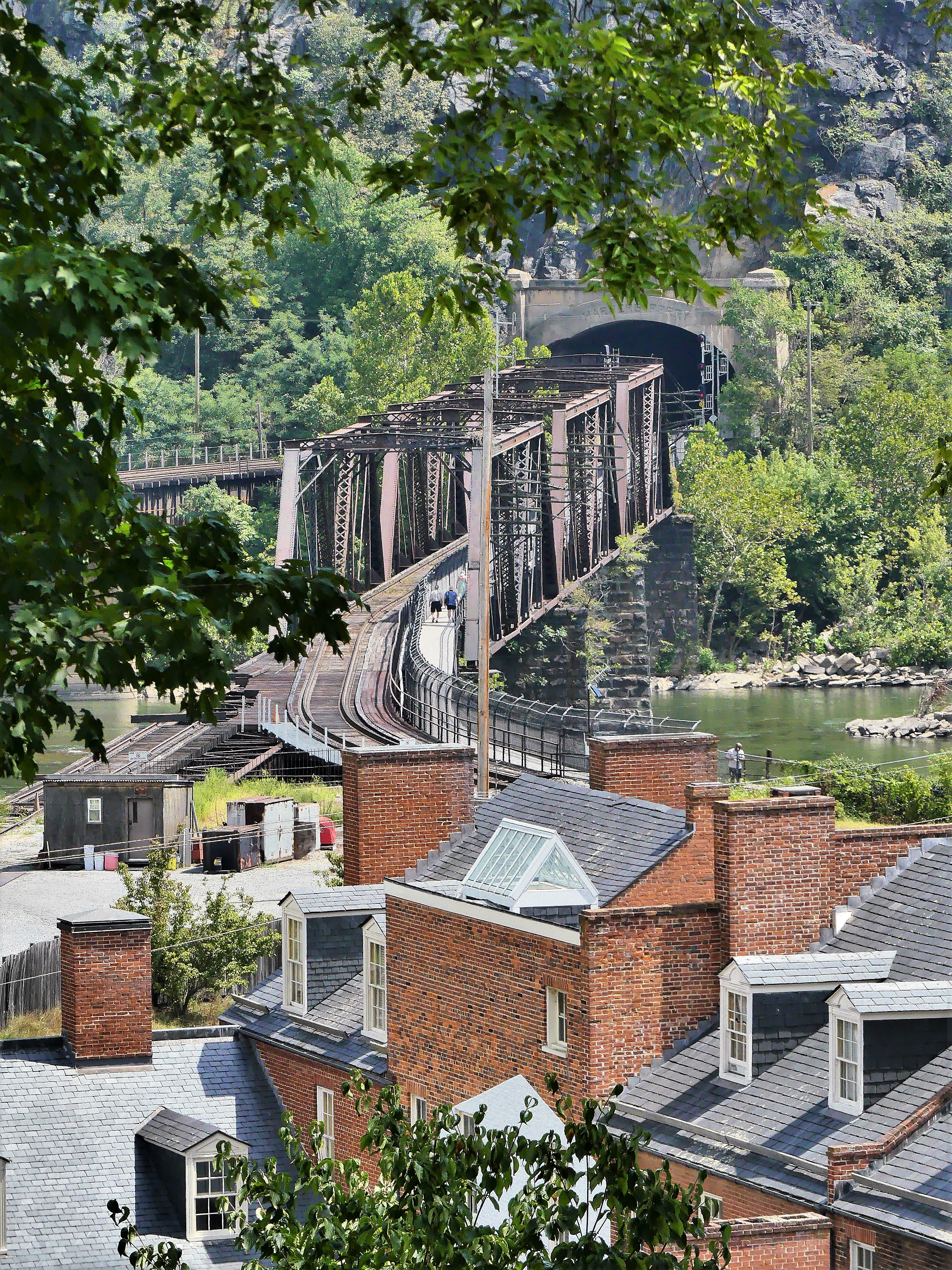
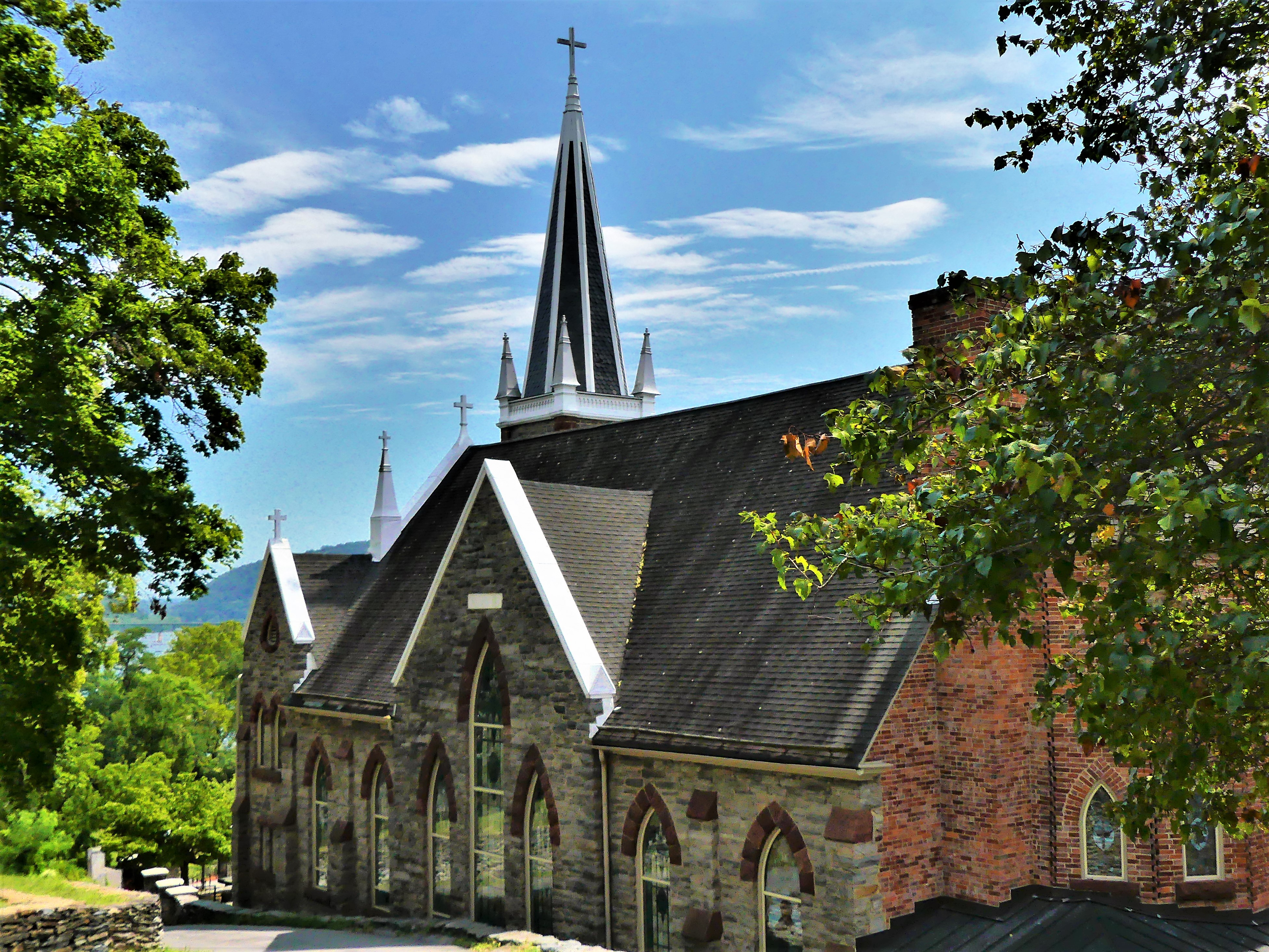
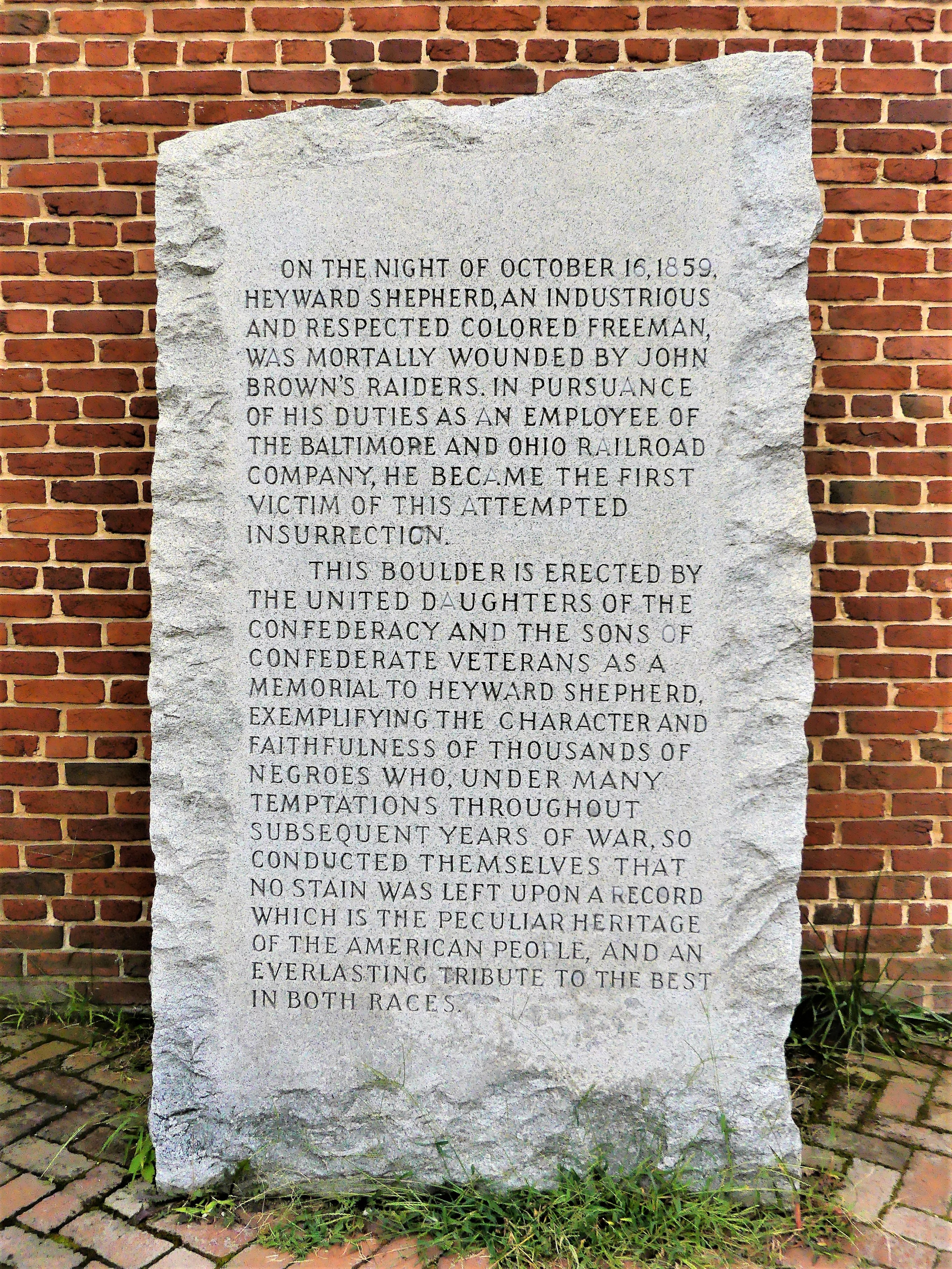
One hundred and sixty years ago, John Brown and his abolitionist brigade played a pivotal role in American history by raiding the South’s largest federal armory in Harpers Ferry with the intention of fueling a rebellion of slaves from Virginia and North Carolina, and envisioning a subsequent society where all people–regardless of color–would be free and equal.
The initial siege caught U.S. soldiers off guard and the armory and munitions plant were captured with little resistance. Brown’s marauders took sixty townsfolk hostage (including the great grandnephew of George Washington), and slashed the telegraph wires in an attempt to isolate the town from outside communication.
However, a B&O passenger train, originally detained at the bridge, was allowed to continue its journey to Baltimore, where employees sounded the alarm and troops were immediately dispatched to quell the insurrection.
In another of Brown’s miscalculations, the local militia pinned down Brown’s insurgents inside the engine house while awaiting reinforcements,
yet newly freed slaves never came to his rescue.
Ninety U.S. Marines under Colonel Robert E. Lee’s command arrived by train the next evening and successfully stormed the stronghold the following day. When the dust had settled, ten of Brown’s raiders were killed (including two of his sons),
five had escaped, and seven were captured, including John Brown.
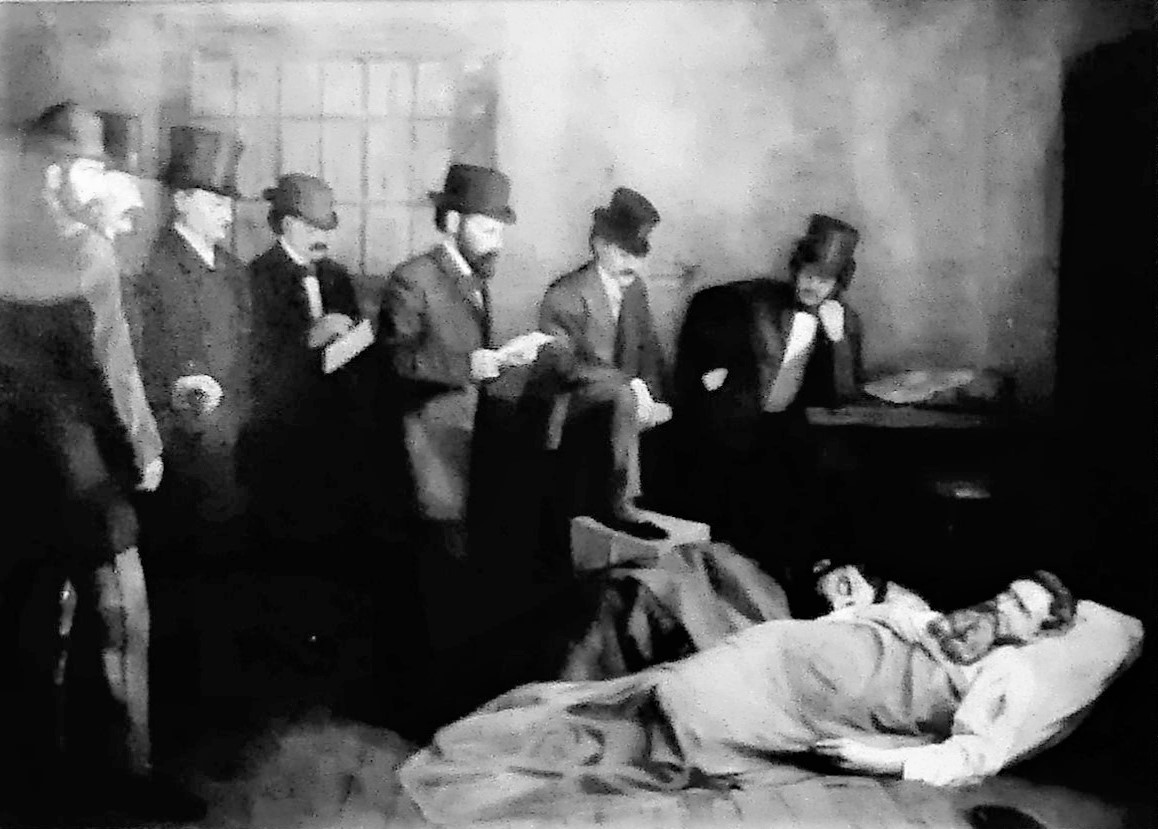
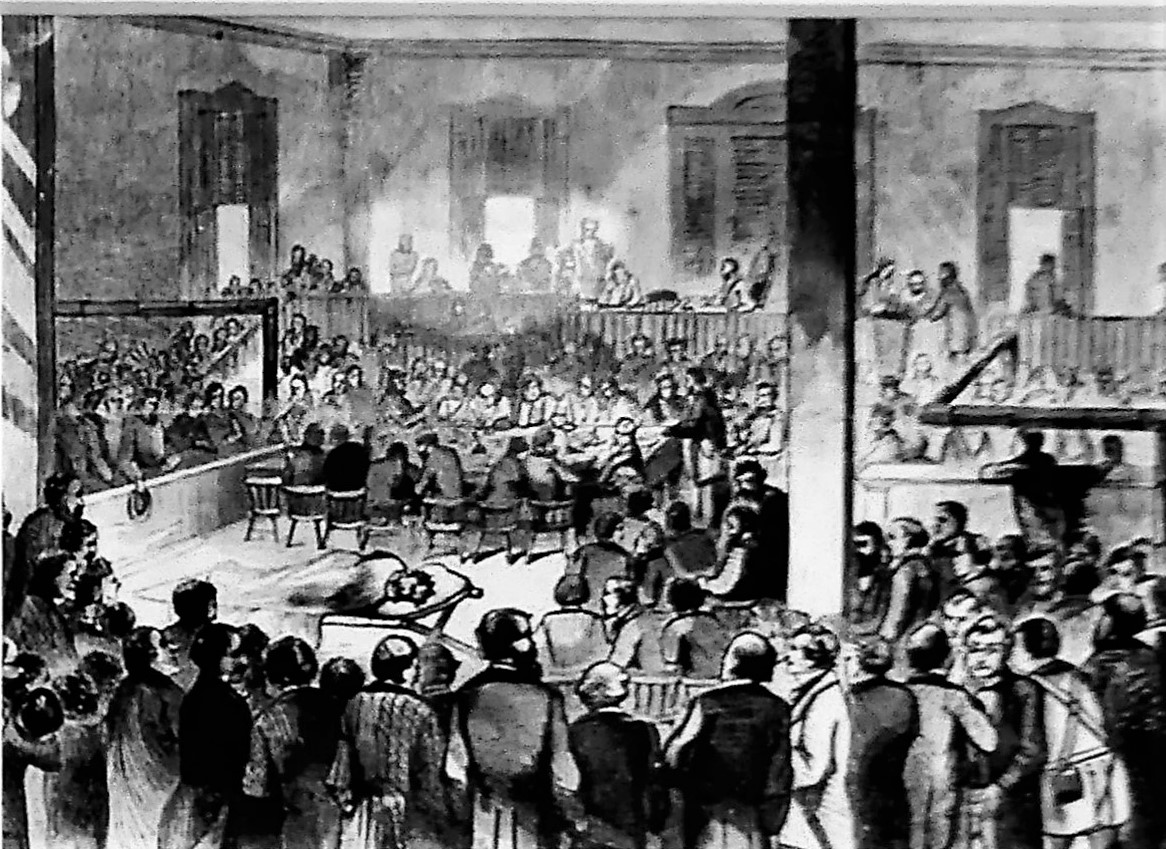
John Brown was quickly tried and convicted of treason against the Commonwealth of Virginia.
Just before his hanging on December 2, 1859, Brown prophesied the coming of civil war: “I, John Brown, am now quite certain that the crimes of this guilty land will never be purged away but with blood.”
How right he was! To the North, Brown was a martyr; to the South, he was a traitor. To a fractured and fragile country, he was the first American to be sentenced and executed for treason.
John Brown’s raid and subsequent trial hardenened the separatism between the country’s abolitionist and pro-slavery factions,
…and advanced the disparate and insurmountable ideologies of the North and the South, until only the Civil War could satisfy the issue and begin healing the nation.
The term treason has been loosely bandied about of late and with tremendous fanfare, albeit little distinction. It’s become a familiar talking point for Donald Trump, whose insulting language and hyperbolic demagoguery continue to rouse his supporters as it diminishes the civility of our national conversation.
Bold and courageous public servants and patriots who are honor bound to defend democracy have been branded as traitors and accused of treasonous behavior because they dare to speak out against corruption and wrongdoing inside the White House.
And the implications are worrisome, for the stakes are high. In a country that values free speech, treason is not about displaced loyalties; it has nothing to do with political dissent; and it has no standing in speaking truth to power. Treason is about pledging allegiance to power and greed instead of American values, like diversity and unity.
As before, politics continues to polarize the nation,
while our Legislative Branch of government seeks a constitutional remedy against the Executive Branch through an impeachment process. And once again, ideological differences have fostered veiled threats of civil war.
If history is to be our guide, then John Brown must be our beacon. During his sentencing he lamented, “…had I so interfered in behalf of the rich, the powerful, the intelligent, the so-called great, or in behalf of any of their friends…and suffered and sacrificed what I have in this interference, it would have been all right; and every man in this court would have deemed it an act worthy of reward rather than punishment.”
Sounds remarkably familiar.
More than ever, we must steer through political currents, and find our way around deception, obfuscation and misdirection if our democracy is to stay afloat.
Leah and I were yearning for a satisfying hike through the mountains of New Mexico that we’d yet to explore. While we were happy hiking the Tecolote Trail in the Sandia Mountains–which offered pleasant panoramas of the desert floor stretching nine miles to South Mountain, and views of Sandia Crest that had us wishing we could stay longer–
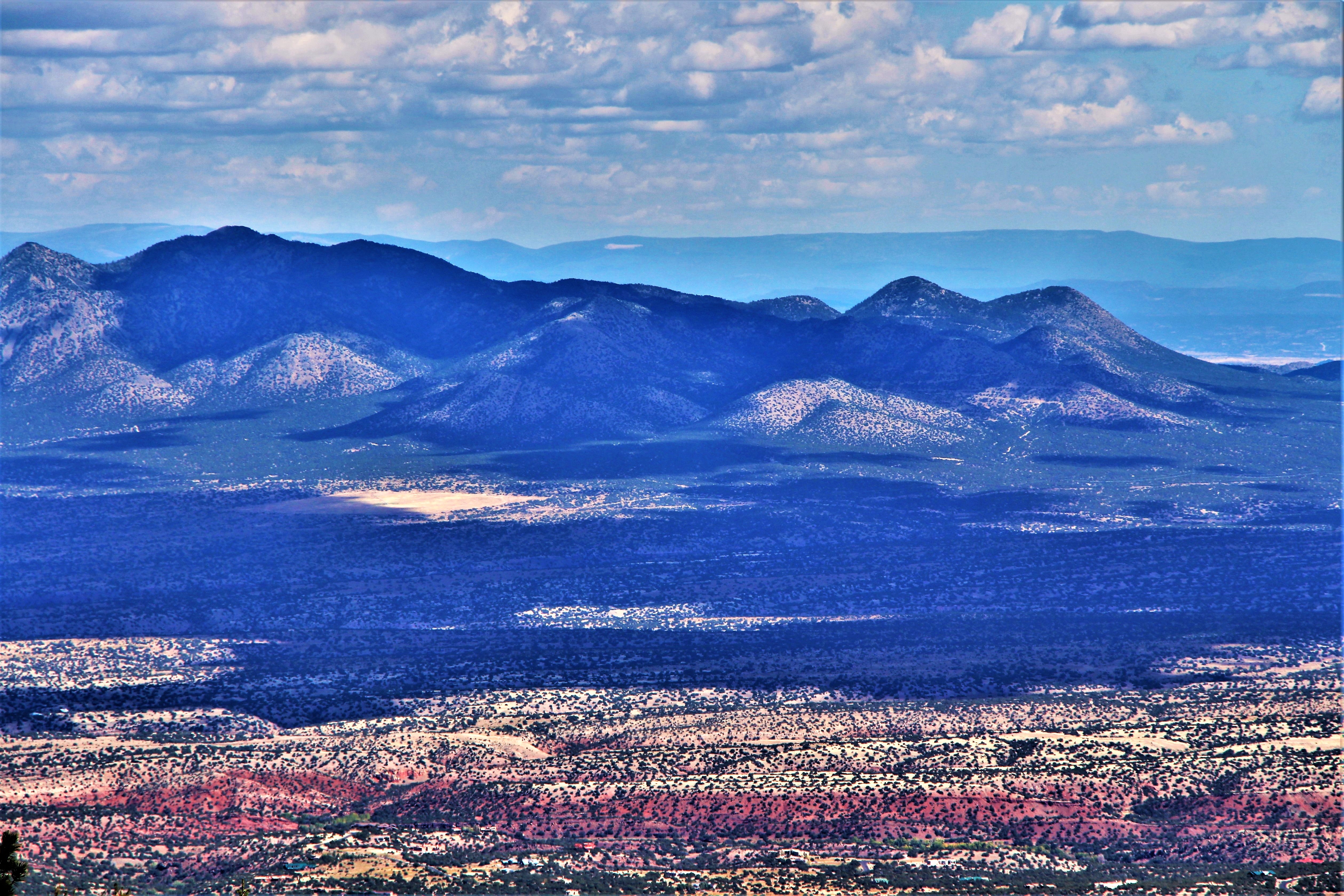
…the whipping wind that swept across the overlook killed any notion of lingering along the mesa top to enjoy the spots of fall color that recently dotted the evergreen terrain.
However, the following day, a stroll through Albuquerque’s Old Town…
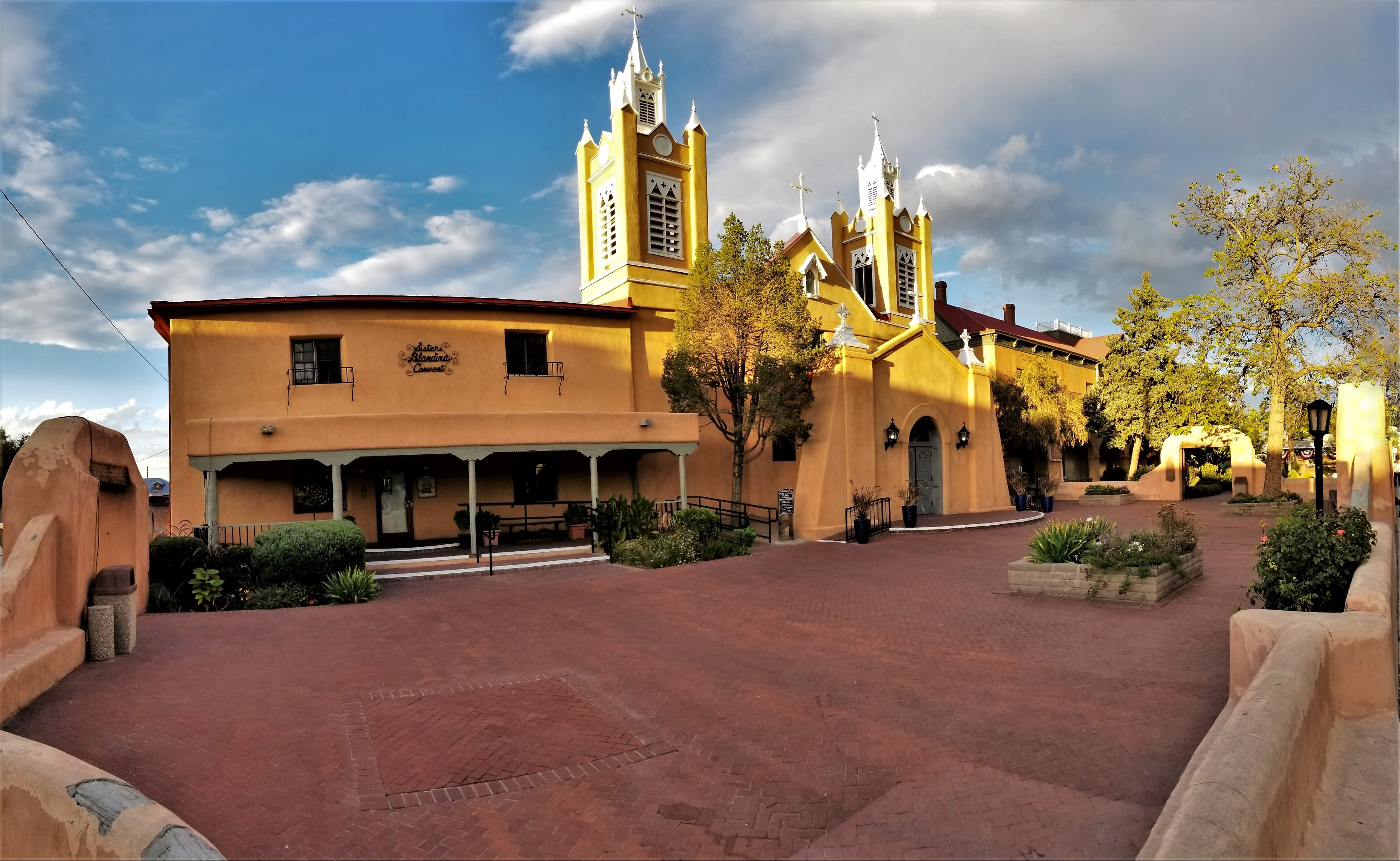
brought us to a photography gallery that showcased Southwestern landscapes and introduced us to Tent Rocks.
“That place looks cool. We should go there,” I asserted.
“I agree, but how do you know if we can even get there from here?” Leah questioned.
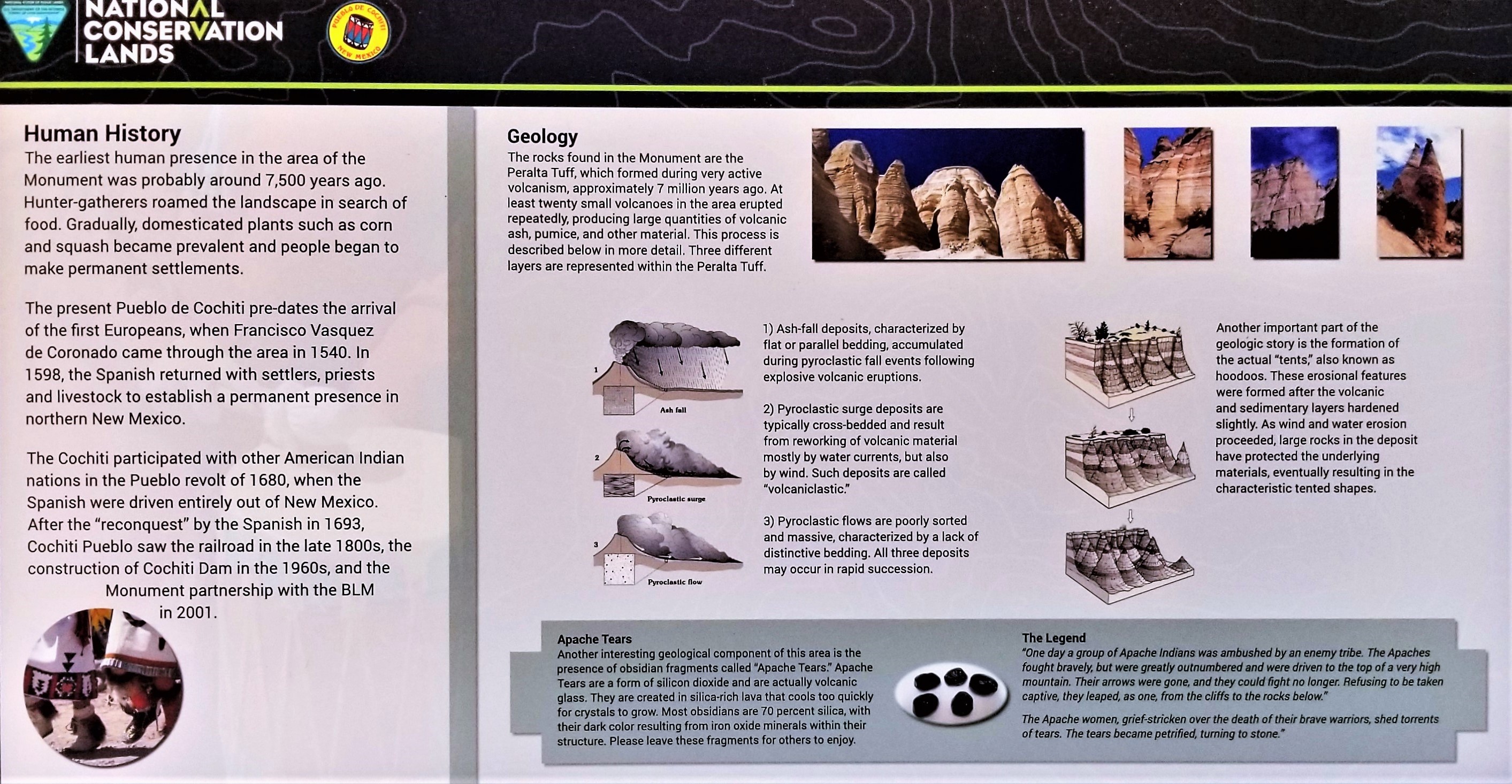
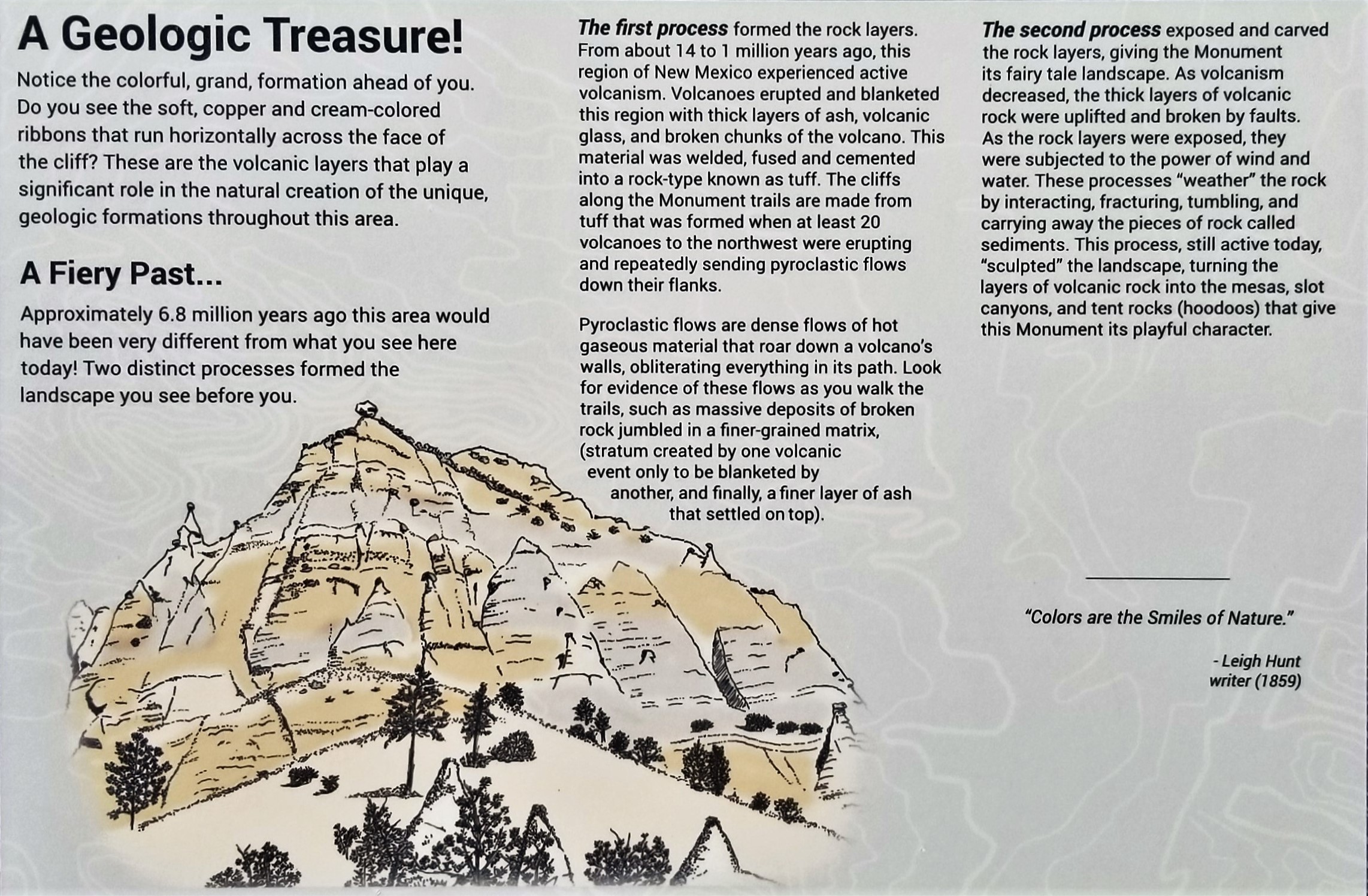
After consulting Google, I learned that Tent Rocks was a National Monument located within the Pueblo of Cochiti, only an hour north of Albuquerque.
The following day, riding north on NM-14 (part of the scenic and historic Turquise Trail National Scenic Byway), we took a left turn onto NM-301, a rutted, dusty road connecting to NM-22.
We approached the earthen wall of the Cochiti Dam, a controversial water management project approved by Congress in 1960, and finished in 1975 by the U.S. Army Corps of Engineers.
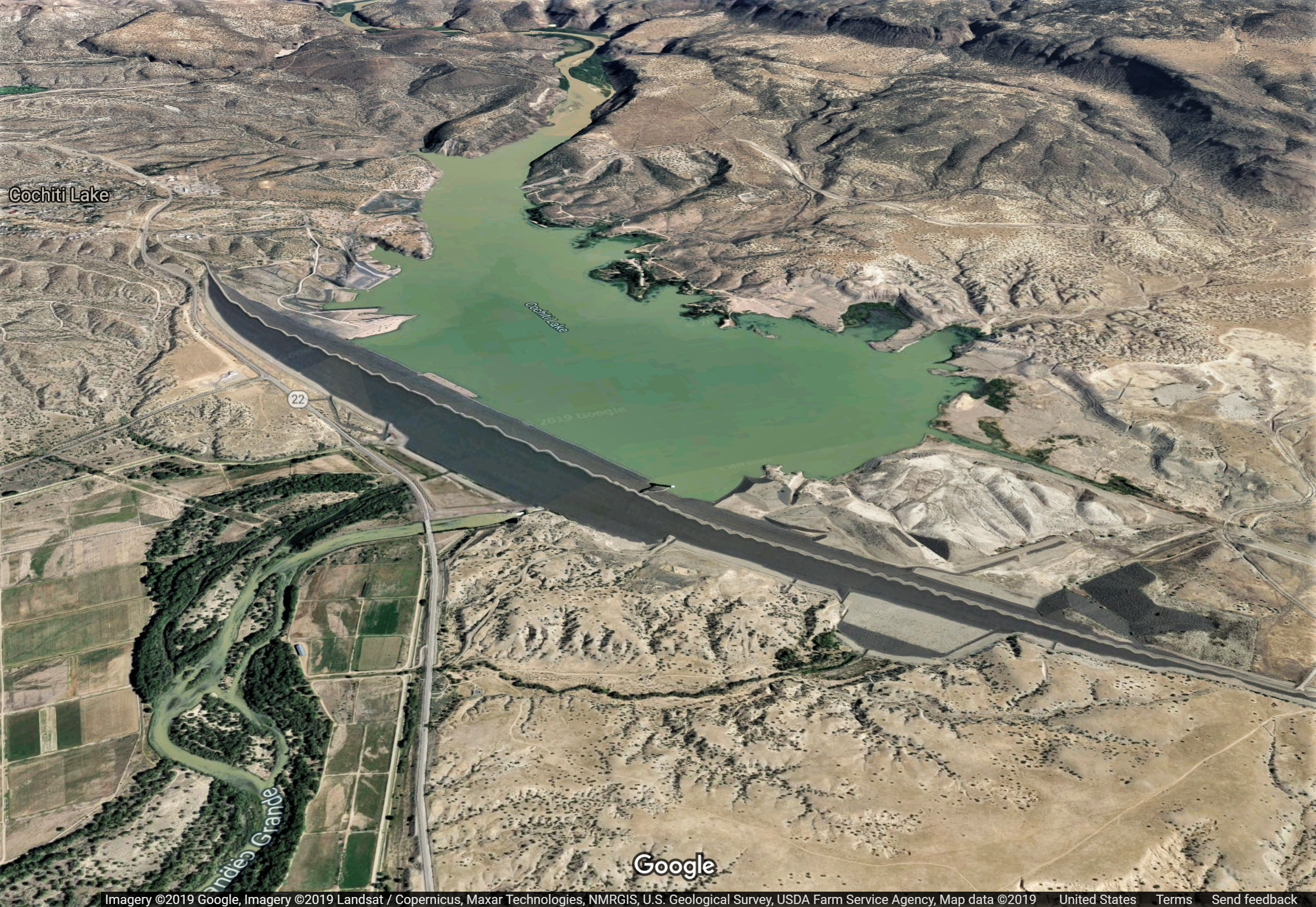
Stretching 5 miles across the desert, and rising 250 feet above the Rio Grande, the resultant lake flooded sacred lands and fields belonging to local tribes for centuries.
We continued west on NM-22 for two miles before arriving at Kasha-Katuwe Tent Rocks National Monument. We pulled up behind seven parked cars–each one waiting to pay five bucks to the BLM park ranger stretching his legs beside the fee station. Our SUV idled a minute or two, but the line was at a standstill.
The sign post beside us forecasted a 30-minute wait-time from our current position.
“I’m gonna take a walk,” and Leah was out of the car, working her way to the front of the line.
The news arrived in under a minute…offering a Trail Guide.
“All 94 parking spaces are taken,” Leah explains with a hint of exasperation. “They probably arrived when the gates opened at 8am.”
“Okay. So that was two hours ago,” I respond, admitting the obvious. “It says here on the map that the trail is 1.5 miles in and out, so hopefully, a lot of people should be on their way out by now.”
“How long do you think we’ll have to wait here?” asks Leah.
“According to the sign, it’s a 30-minute wait,” I assert.
“Smartass!” she hurls.
After 20 minutes of anticipation, I noticed movement in the ranks! Two cars in front gave up the wait and U-turned, leaving us in sixth place.
Silly people. If only they had waited a few minutes longer. Soon after, a rash of cars passed us on the way out, and we were on our way, cruising through four miles of dip-after-dip, tribal land road, before reaching the parking zone.
While Leah and Carrie (Leah’s daughter) waited in line for the only outhouse in the vicinity, I caught up on my reading at the trailhead.
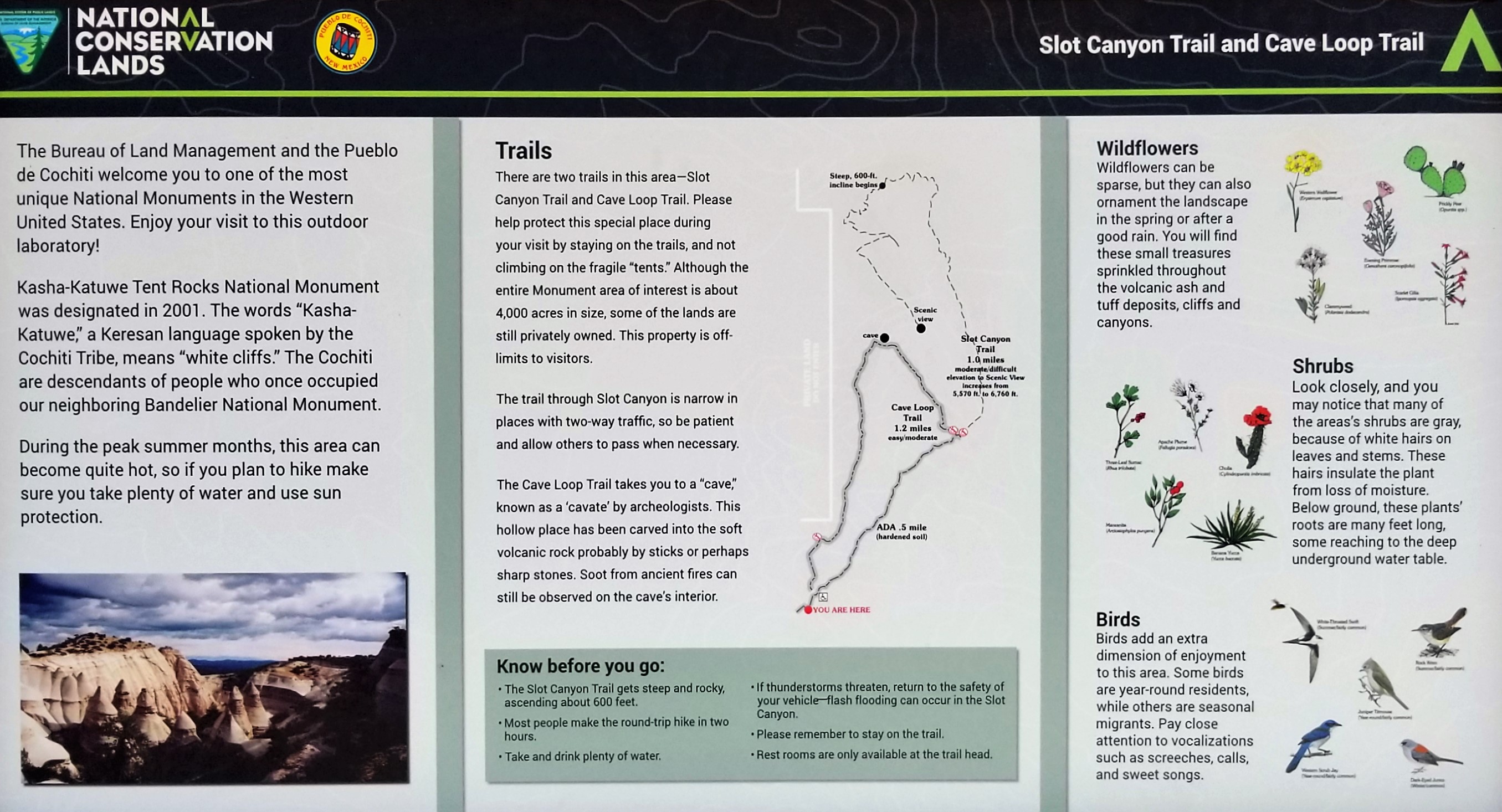
As interested as I was to learn about New Mexico’s volcanic eruptions and its pyroclastic flows, I was itching to get on the trail and weave through the slot canyon.
The canyon walls were so narrow in places, that only one person could navigate the labyrinth at a time.
It reminded me of the way that road crews monitor traffic on a one way road…
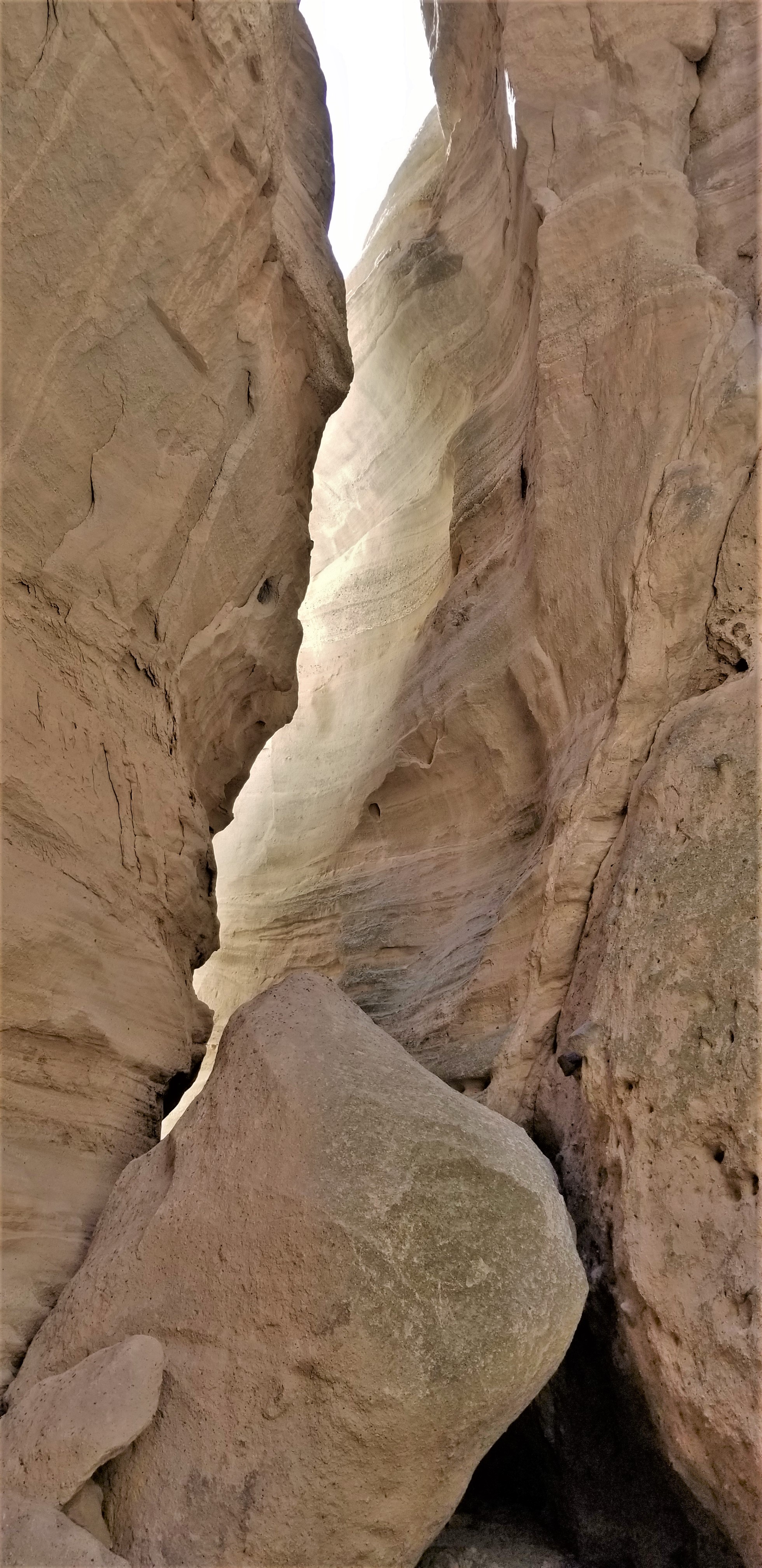
…and it was vaguely reminiscent of a similar protocol at the fee station and toilet.
Of course, with so many early hikers already on the trail and now turning back, it made for several occasional stops, and many pleasant exchanges along the way.
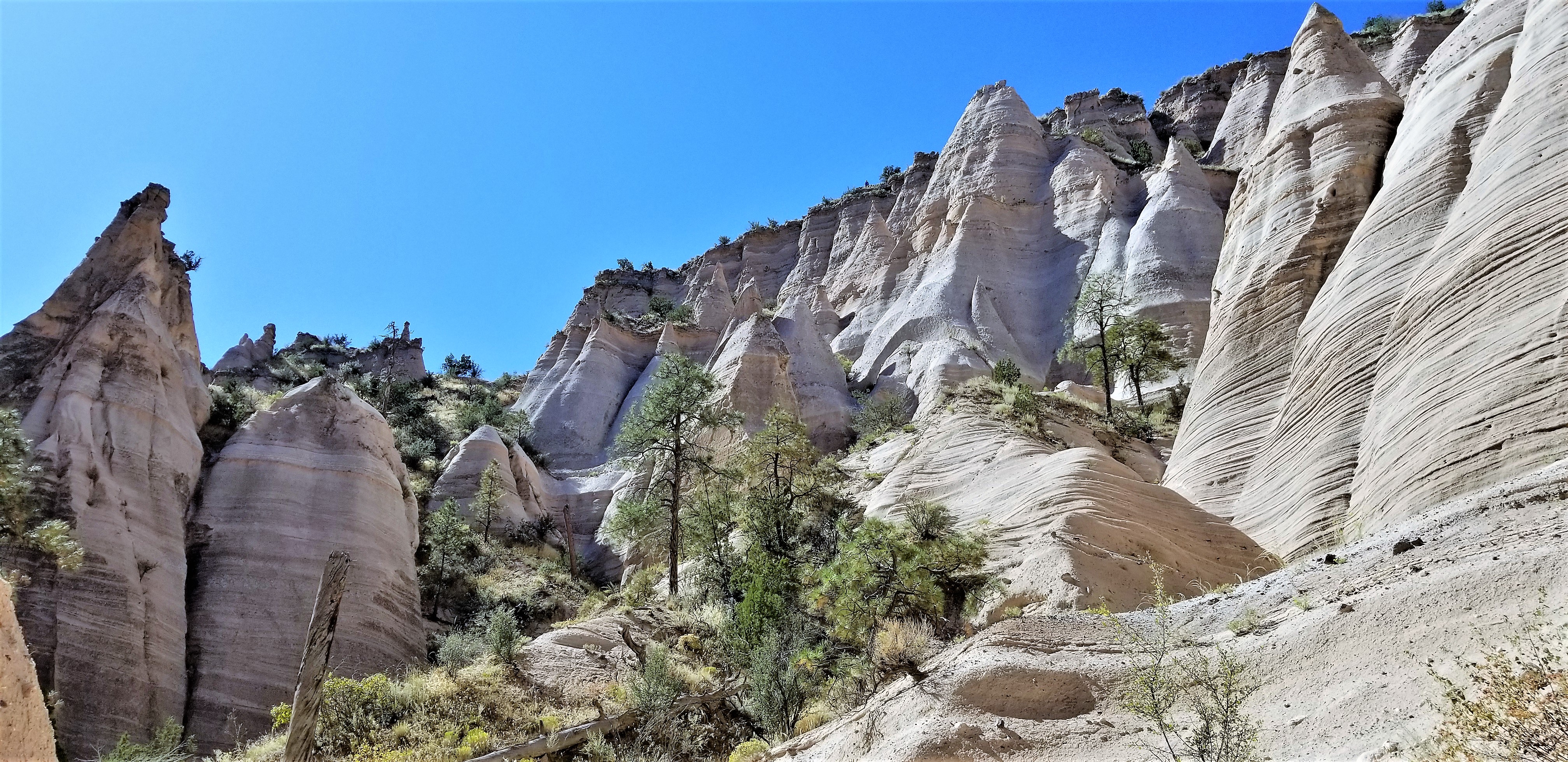
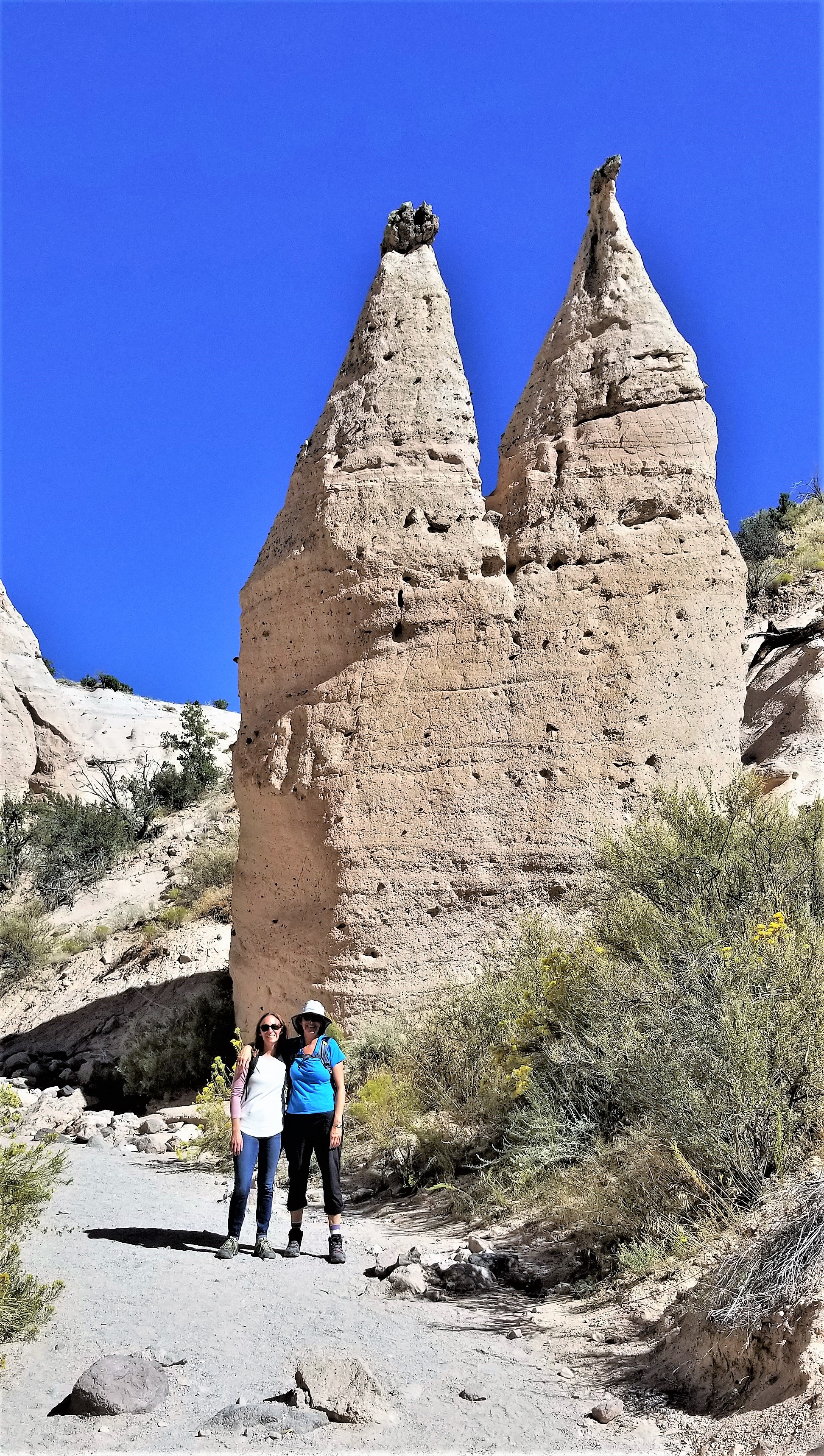
However, when the canyon finally opened up, we were greeted with a greater appreciation of what seven million years had done to the place.
Even the trees seemed magical, managing to stand in the shadow of such uncertain footing.
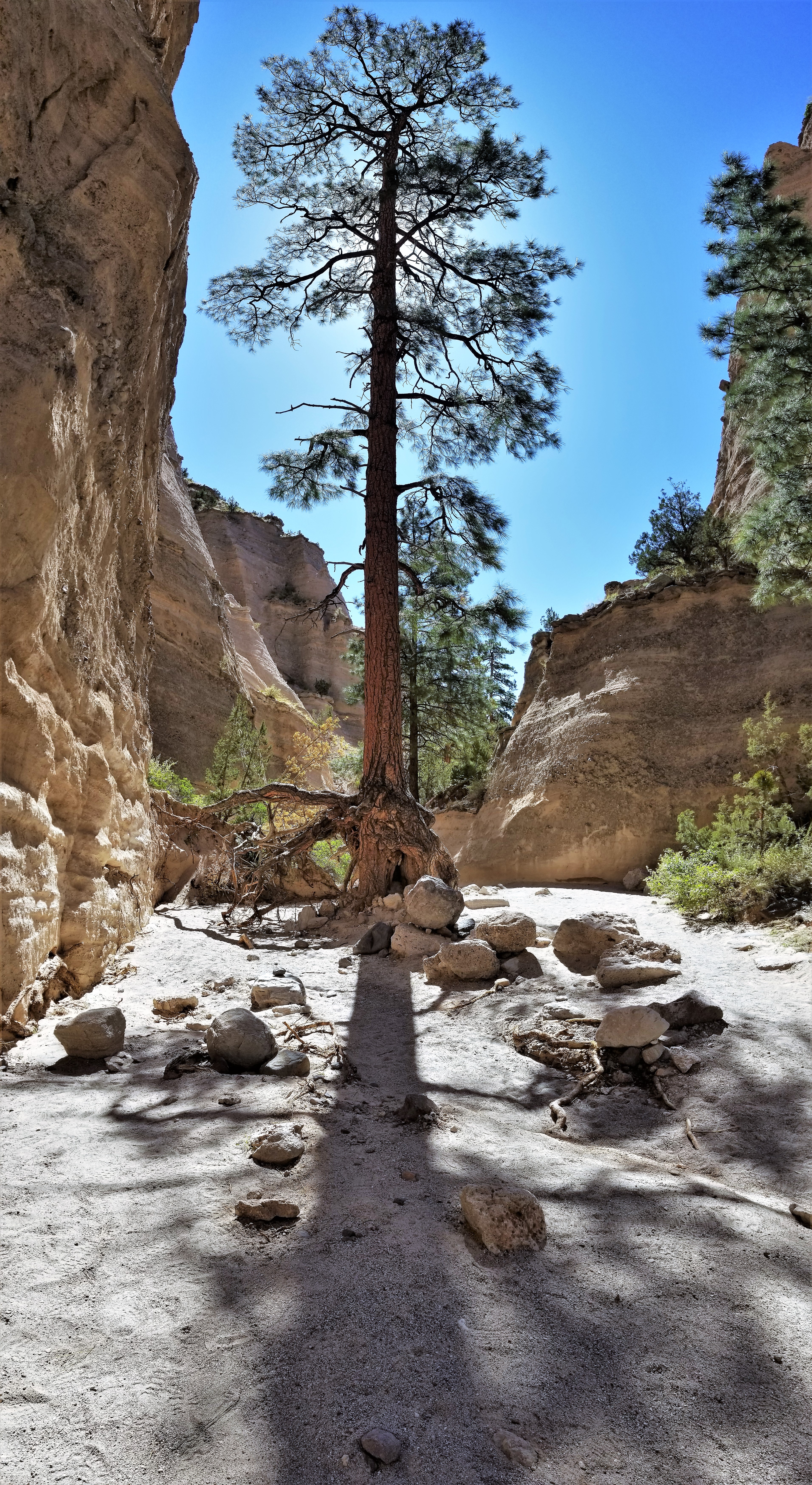
Once we reached a clearing in the trail, we began our 630-foot ascent to the mesa top, giving us a better perspective of our lair,
and freeing us from all obstructions,
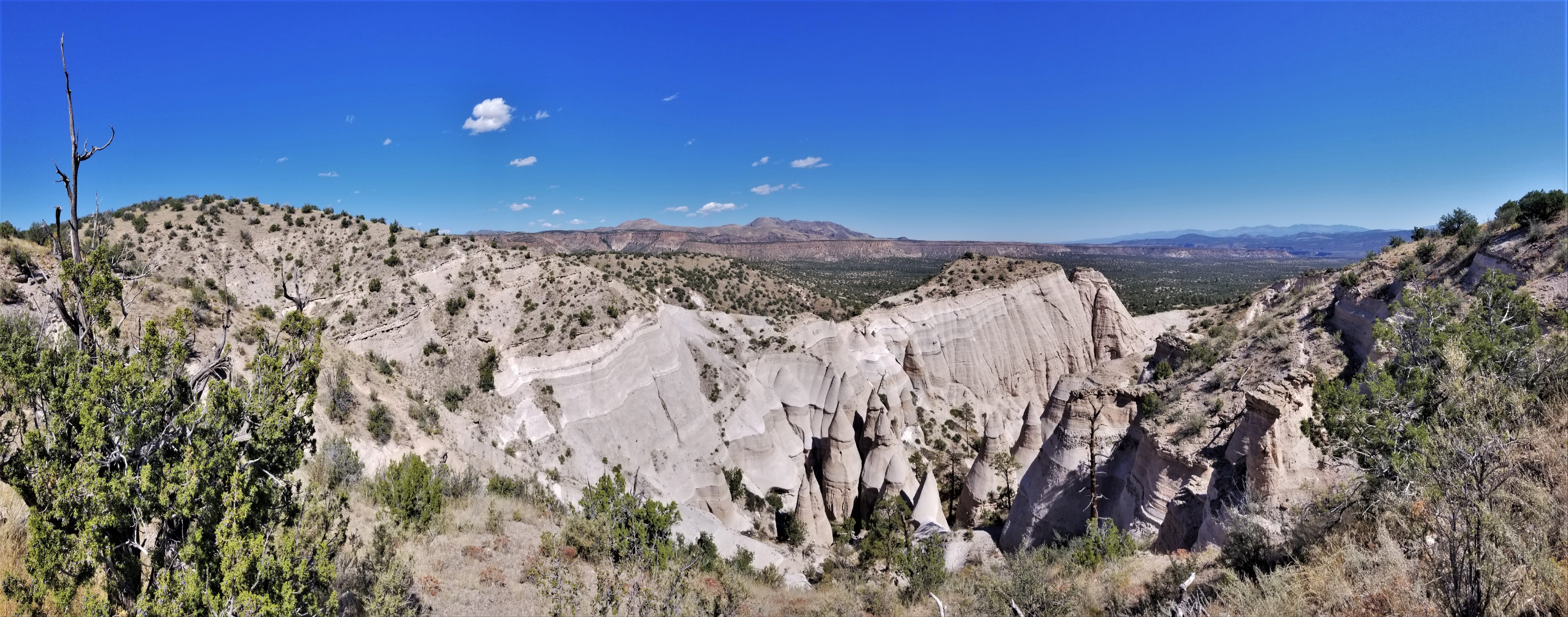
until we could gaze across the Jemez Mountains,
and remind ourselves, once again, why it’s always a good idea to wait one’s turn in line.
“$450 for a balloon ride?! You’ve got to be kidding” I exclaim to the Rainbow Ryder rep on the phone.
“That’s the price, sir. We are the exclusive balloon ride provider for Balloon Fiesta, unless you’re willing to fly outside the ‘Albuquerque Box’,”she managed.
“What’s the ‘Albuquerque Box’?“I ask.
“It’s a weather phenomenon peculiar to Albuquerque,” she points out, “where the lowest winds move in one direction, while the higher winds are moving in the opposite direction. That way, our pilots can take advantage of the different air currents–by floating higher or lower, and returning you close to your original launch point.
*courtesy of Drumlineramos
“Uh, Ohh-kay,” I shrug, “and that’s worth $450?”
“That’s the rate for a balloon ride during Balloon Fiesta, sir. And I only have a few openings left for Saturday and Sunday,” she warns.
“Your price is sky high,” I offer, “so I’m gonna have to think about it.”
And the call is over.
I turned to Leah. “Looks like my balloon ride went from bucket list to “fuck-it” list.”
And that was a drag, since Balloon Fiesta is the largest gathering of hot-air balloons in the world, with more balloons lifting off together (mass ascension) than anywhere.
Leah sensed my disappointment. “Maybe it’s cheaper if you found an outfitter outside the box. Would you still be interested?
“I think I could manage to get excited,” I lamented.
After a flurry of phoning and pricing, I secured a dawn launch on Saturday for $250 with World Balloon, albeit on the northwest side of town, miles away from the Fiesta.
Launch day bears all the markings for a picture-perfect take-off: early air temperature hovers in the mid-40’s; the wind is streaming from the north at 8 mph; and the sky is clear as shimmering water.
A group of fifty men, women, and children are sub-divided into five, and assigned to a pilot and his balloon crew. Each chase van carries two wranglers, ten passengers, and a trailer packed with gear. We congregate at a barren football-sized lot, and watch as five balloons are prepared for flight.
Baskets are unloaded,
and assembled.
The burners are tested.
With dawn breaking over the horizon, the balloon is unfurled, and rigged to the basket.
An industrial fan blows cold air into the mouth of limp polyester, and behold, the balloon takes shape.
Roy aims the burner flame into the mouth to heat the air,
and eventually expands the envelope to fullness.
The buoyant balloon rights itself,
and the six of us scramble inside to bid adieu to terra firma, and gently float away…
…one step ahead of a second balloon.
All the while, balloons below…
…are preparing to follow our Airstream (wink wink, nod nod).
Our pilot, Roy pulls on the burners,
carrying us to 5000 ft. above the treetops,
where a birds-eye view of the valley below,
reveals a cityscape punctuated by fantastic dots of floating colors.
Yet closer inspection reveals the full dimension of a multi-colored mushroom gliding through an azure sky.
After forty-five minutes of soaring and dipping through neighborhoods–arousing excitable dogs,
and adoring children–
Roy is tasked with finding a landing site along our flight path–wide open and away from wires–and accessible to the chase team who’s been following us since our launch. After a few false starts, we locate a large house devoid of landscaping, and gently settle back to earth.
However, a chain-link fence lines the perimeter, and a locked gate gives us no way out. A woman from Birmingham, AL vaults over the side of the basket and runs to the front door to alert the owners to unlock the gate, but nobody’s home.
So it’s back in the air, with the van in pursuit, until we mobilize at a strip mall.
After a quick exchange of passengers (six out and four in), our balloon is re-released with its second set of aeronauts,
drifting higher into the blue yonder.
Fifty minutes later, the vacant parking lot beside the church provides the perfect setting for a second re-entry.
Whereupon, the balloon is quickly collapsed,
and folded,
and packed away, until next time.
Back at base camp, it was time for a champagne toast, and a recitation of the balloonist’s prayer:
The winds…
I loved it, and I’d do it again. I guess that makes me a balloonatic.