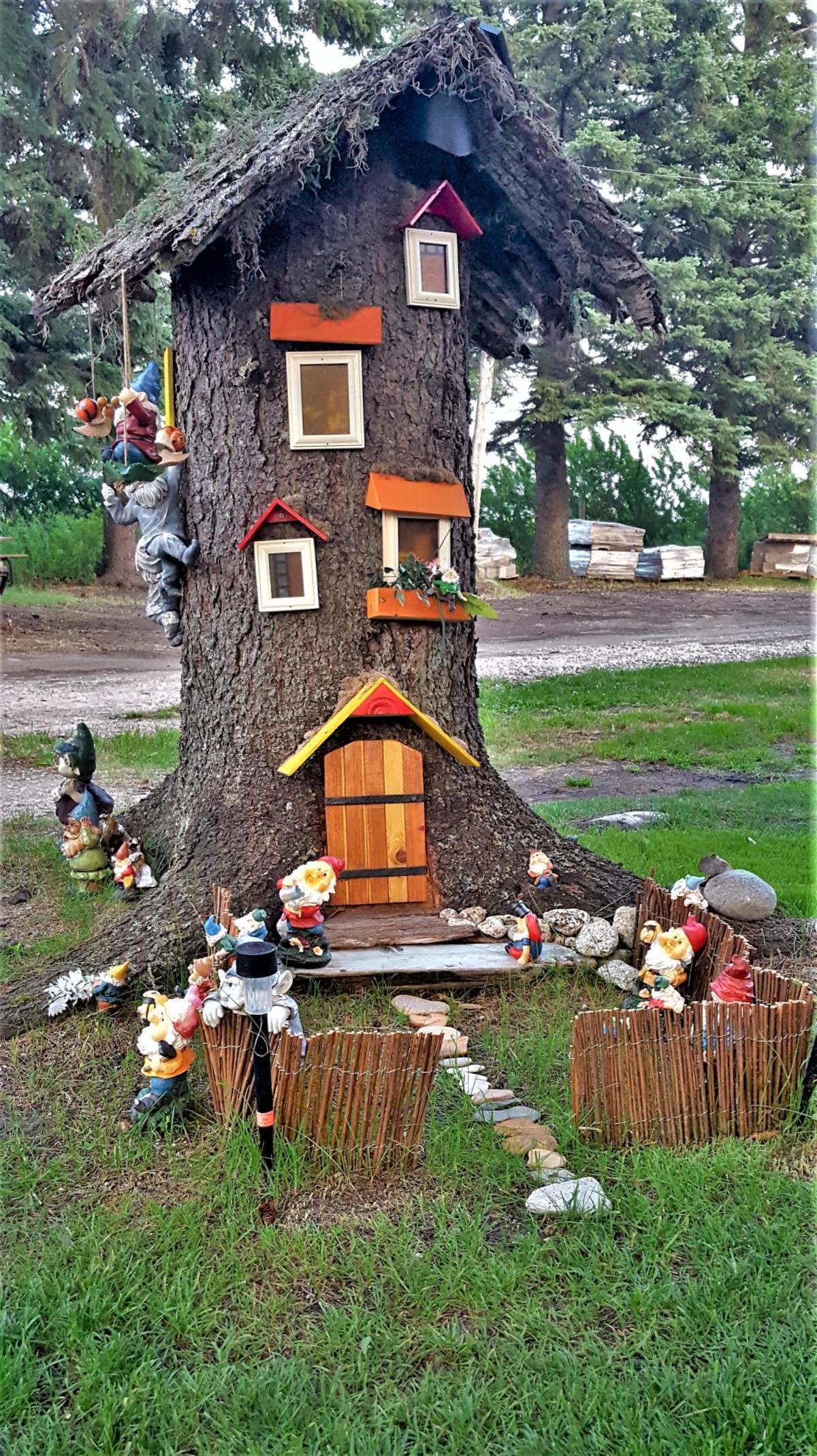
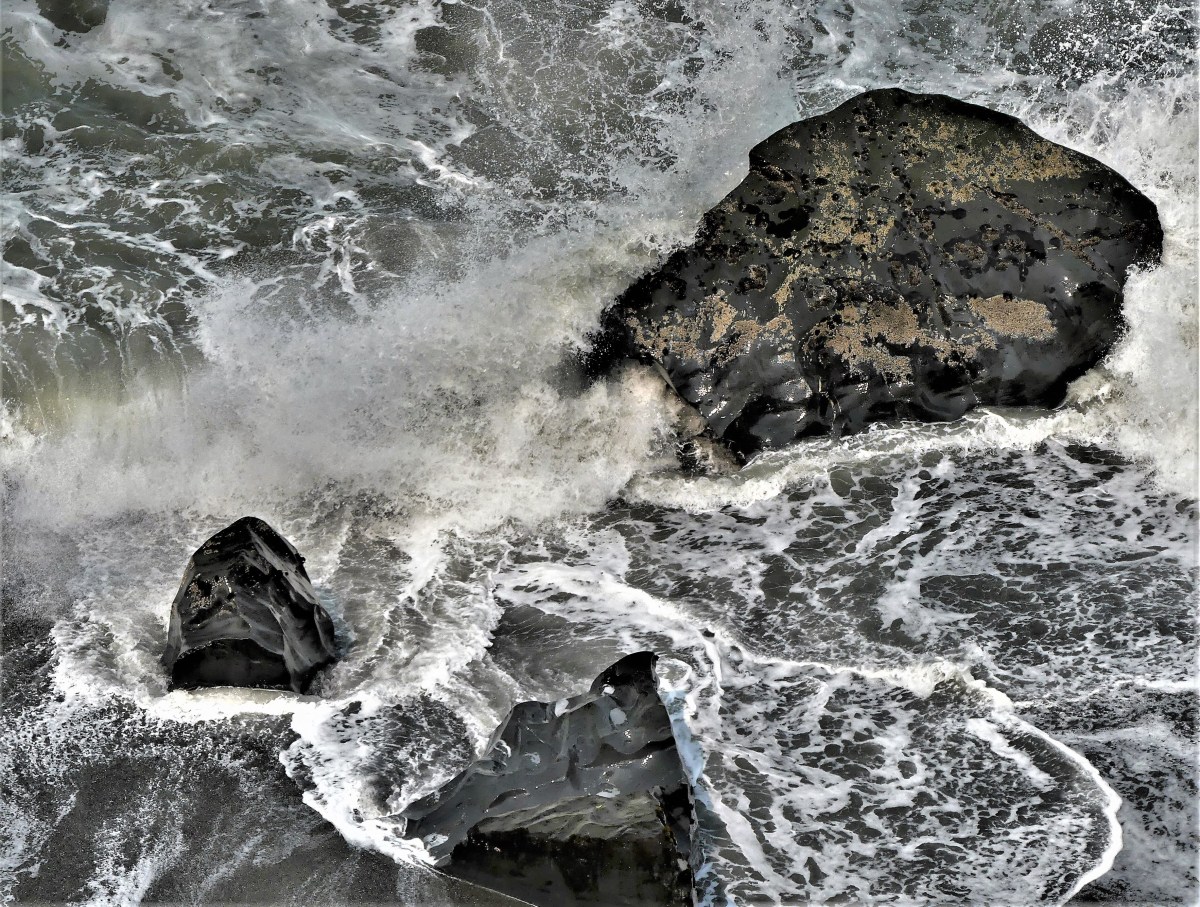
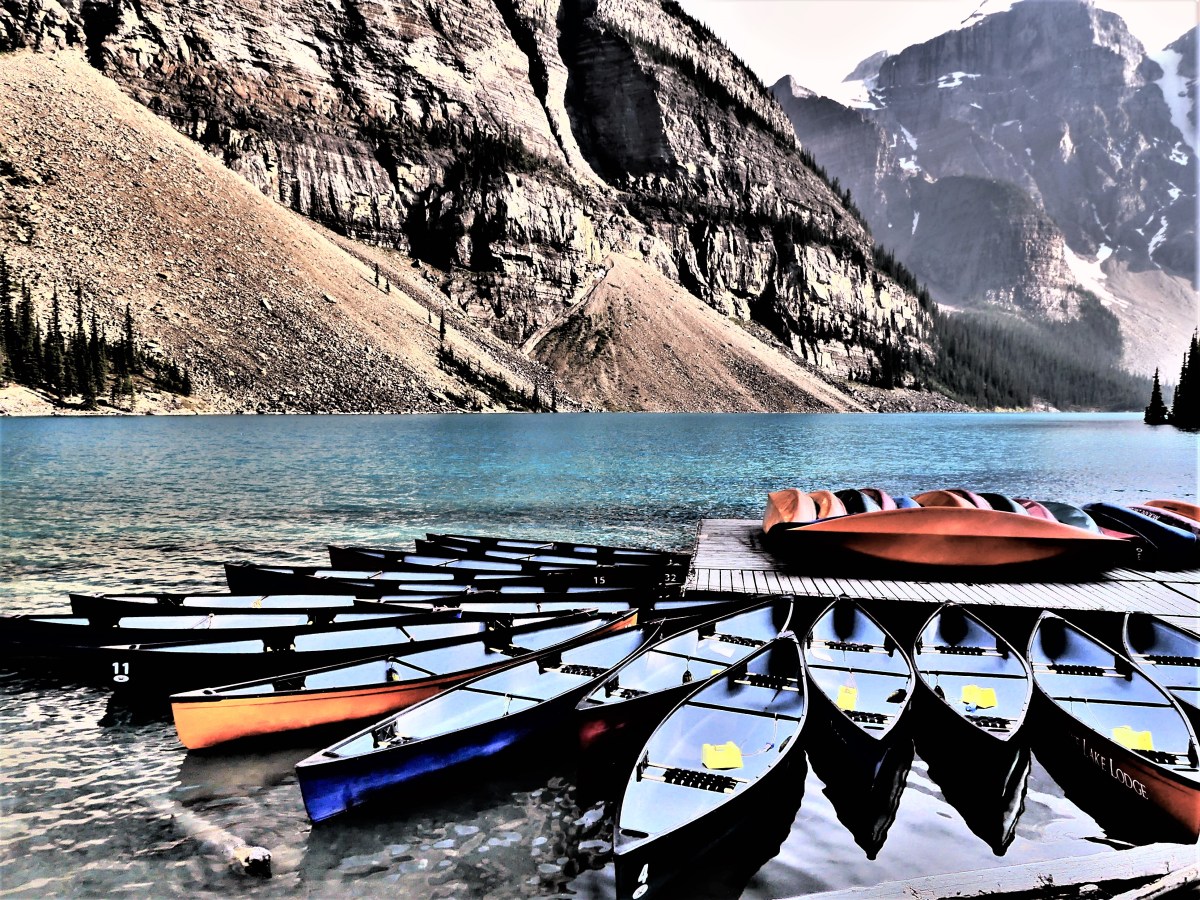
Is it deep in the forest where redwoods are burled?Or far in the garden protected by gnomes?Could it be by the ocean, where waves crash the rocks?Or how ’bout the notion of boats by the dock?And why not the castle that touches blue air?Or maybe the hassle of crowded Times Square?Could I hike to the mountains, reaching higher and farther?Or lounge by a fountain with views of the harbor?Might I stroll through a villa, grapes ready to prune?Or sip sasaparilla at a Western Saloon? Can I conquer the valley’s remote isolation?And weave through an alley of tombs and cremation?
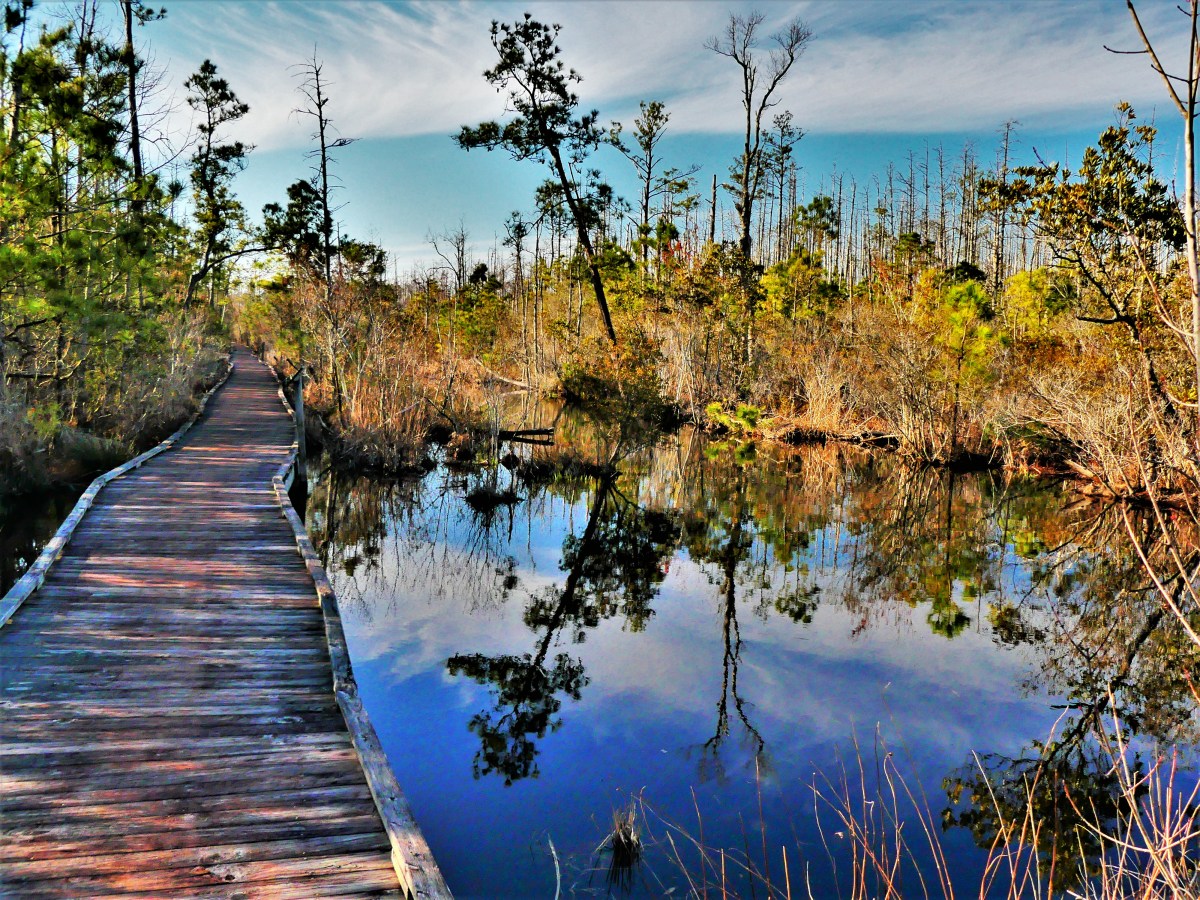
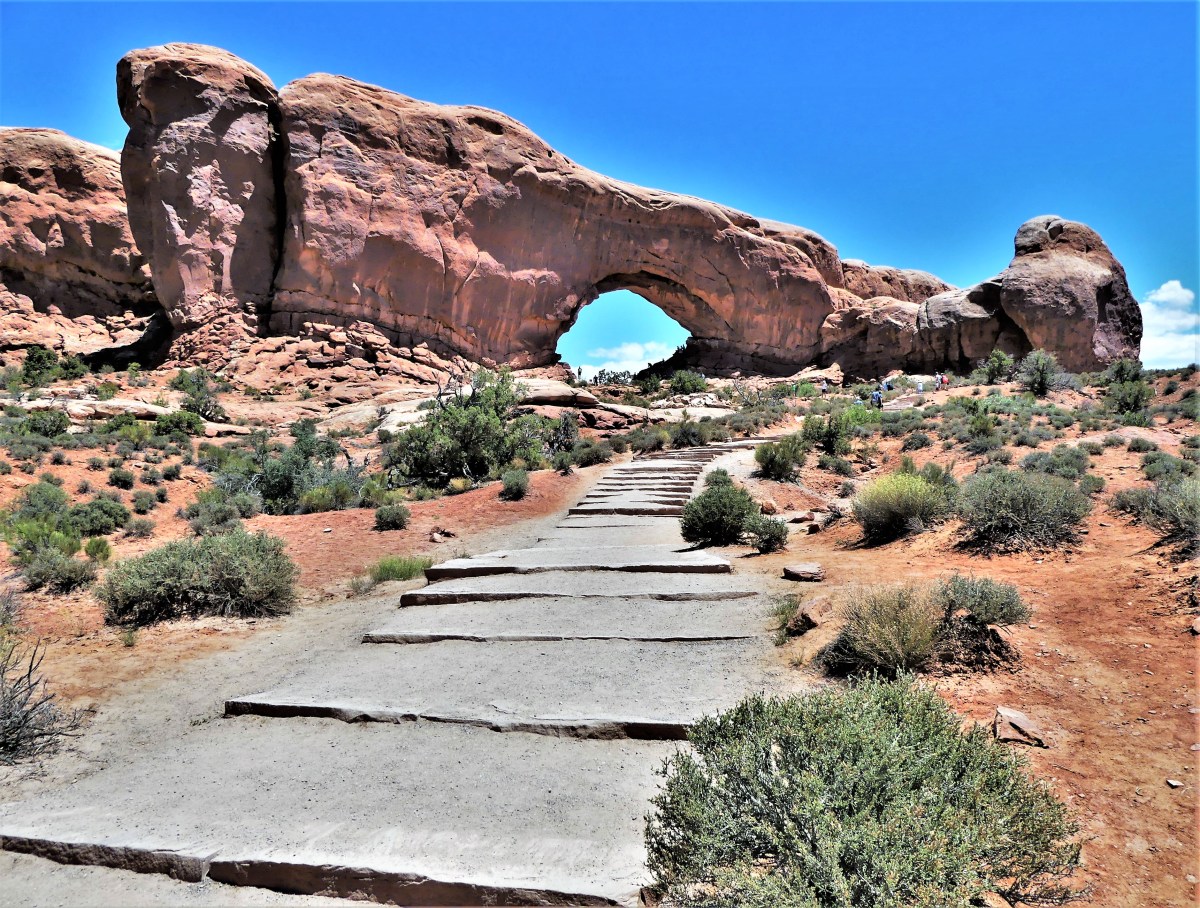
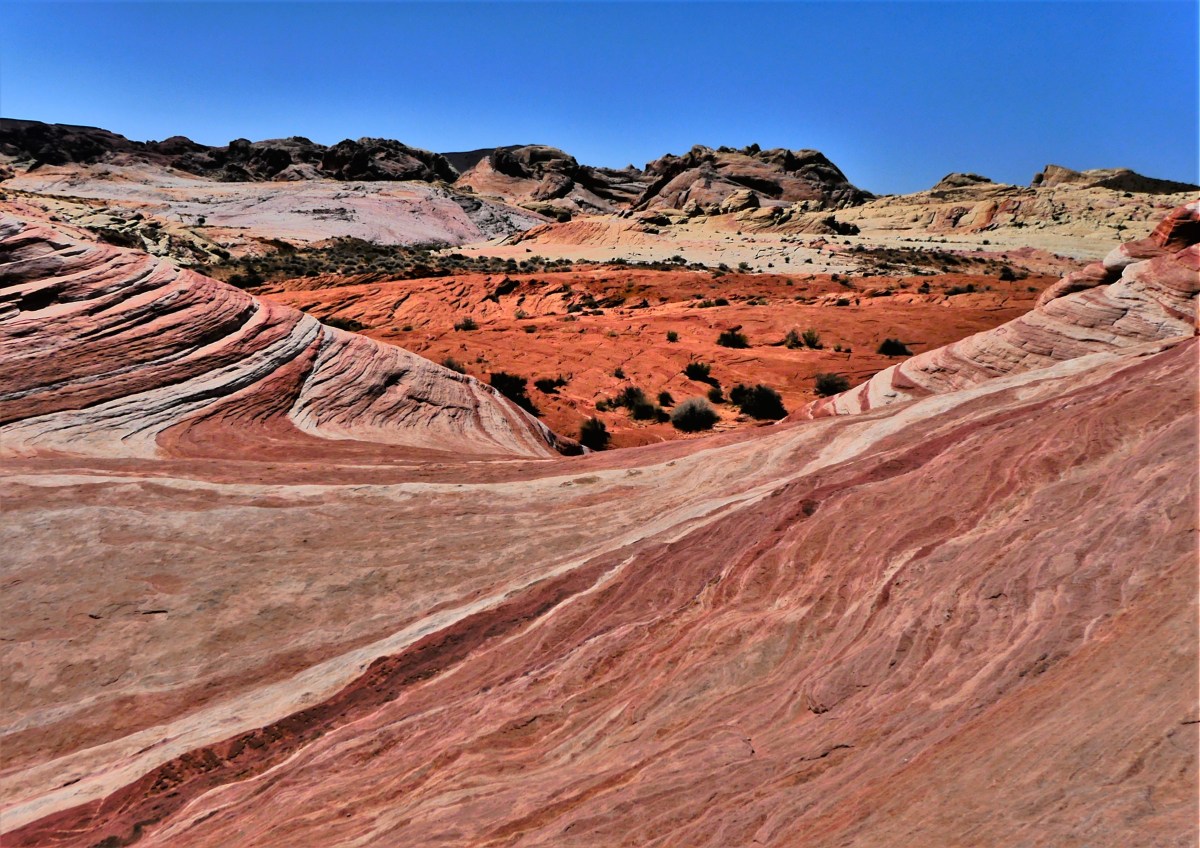
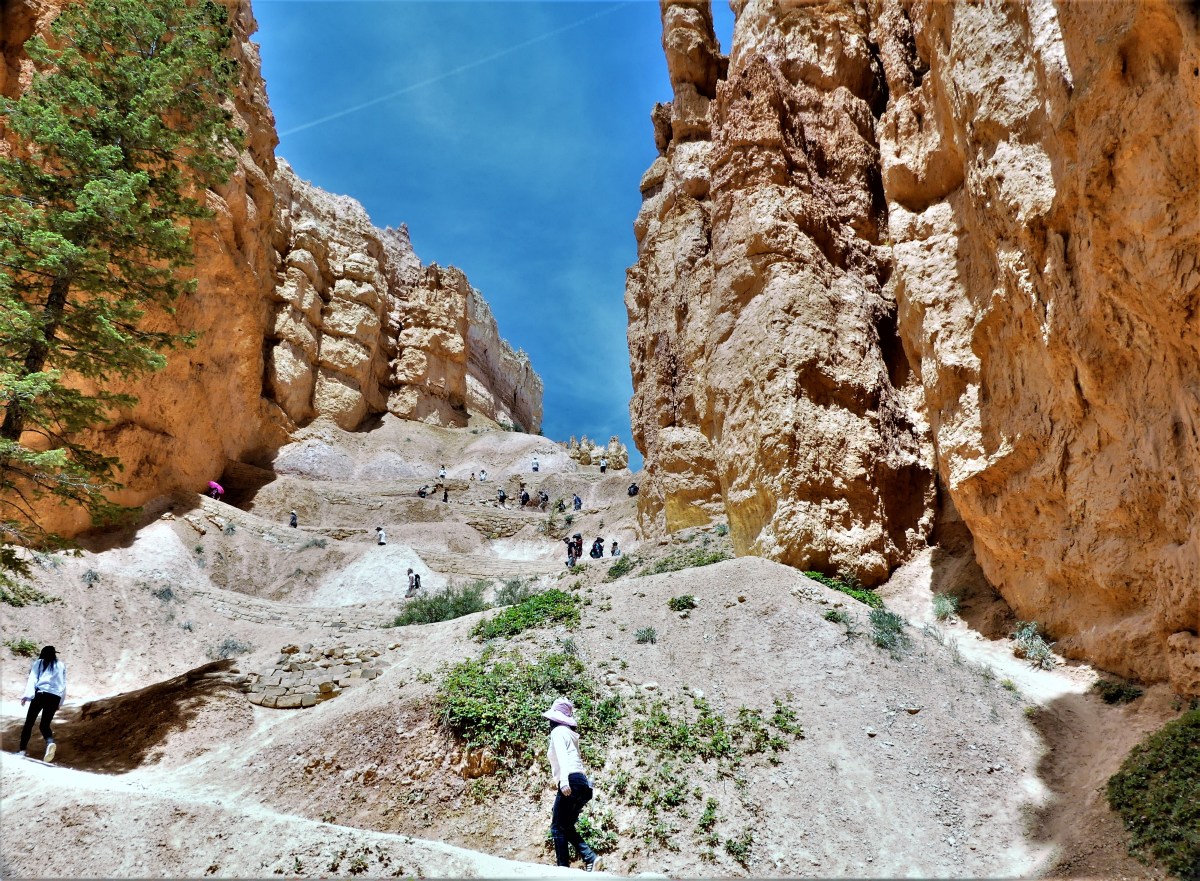
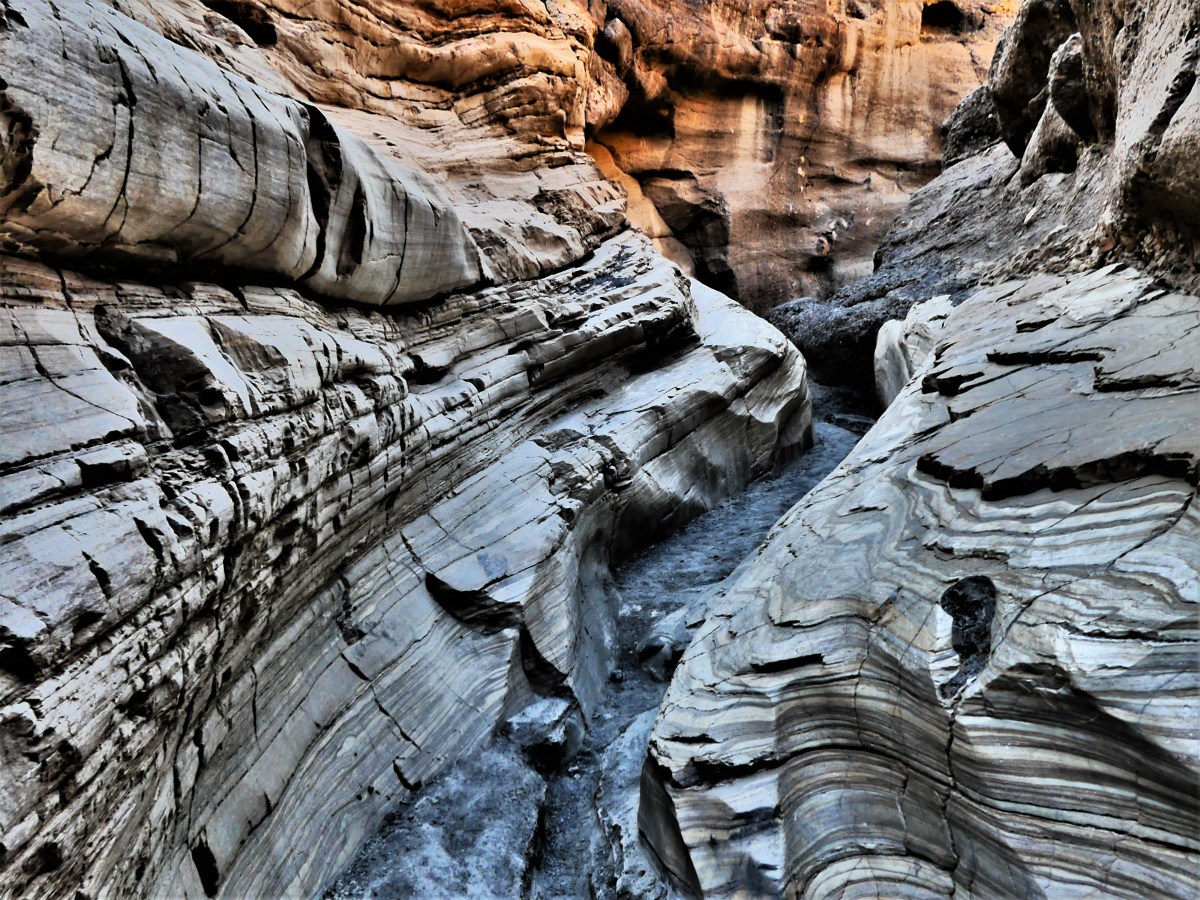
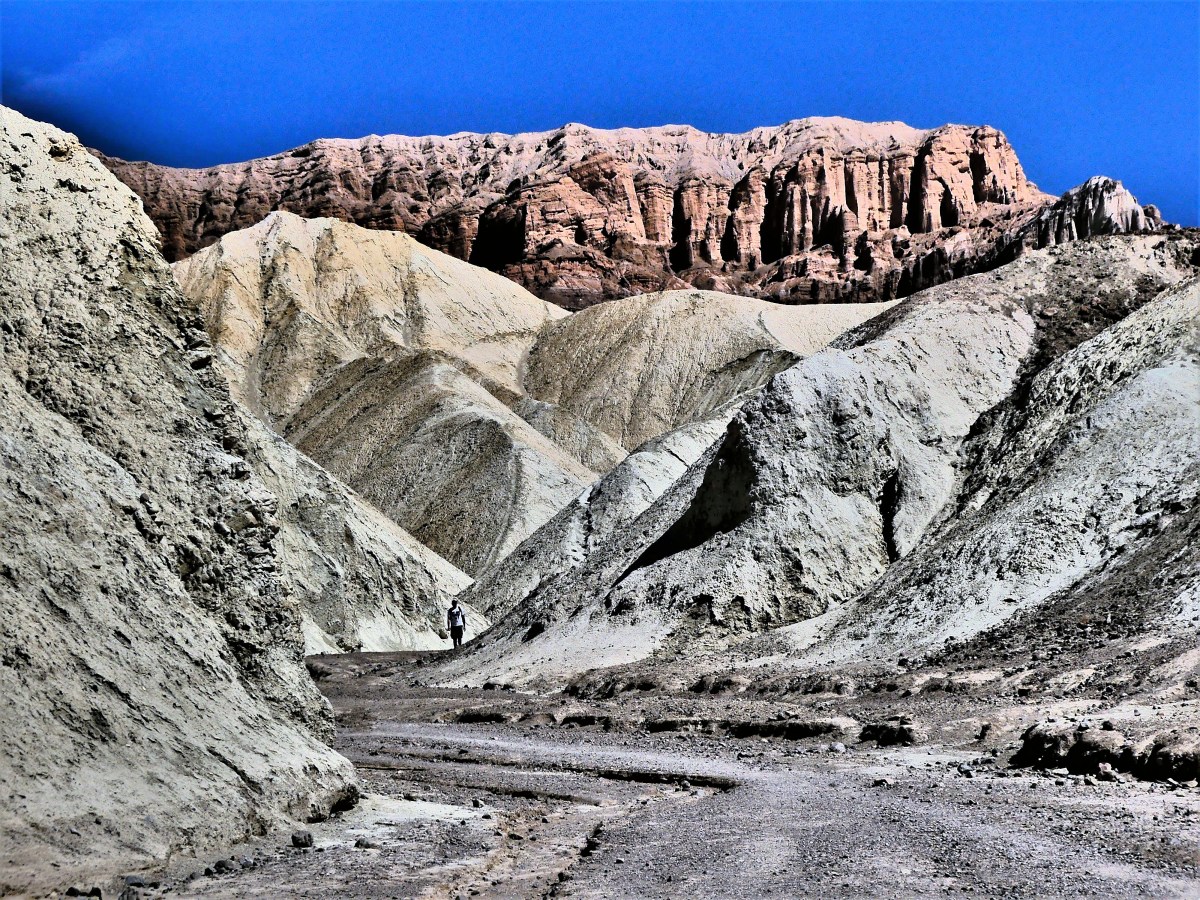
Valley of Fire–White Dome TrailValley of Fire–Fire Wave TrailPalo Duro Canyon–Big Cave TrailBryce Canyon–Hoodoo Amphitheater TrailDeath Valley–Charcoal Hives–Wildrose Mountain TrailDeath Valley–Fall Canyon TrailDeath Valley–Golden Canyon Trail
and from tree bark…
Yosemite–Cedar Grove Trail
…to tree roots…
Athabasca Falls Trail
…to pavement.
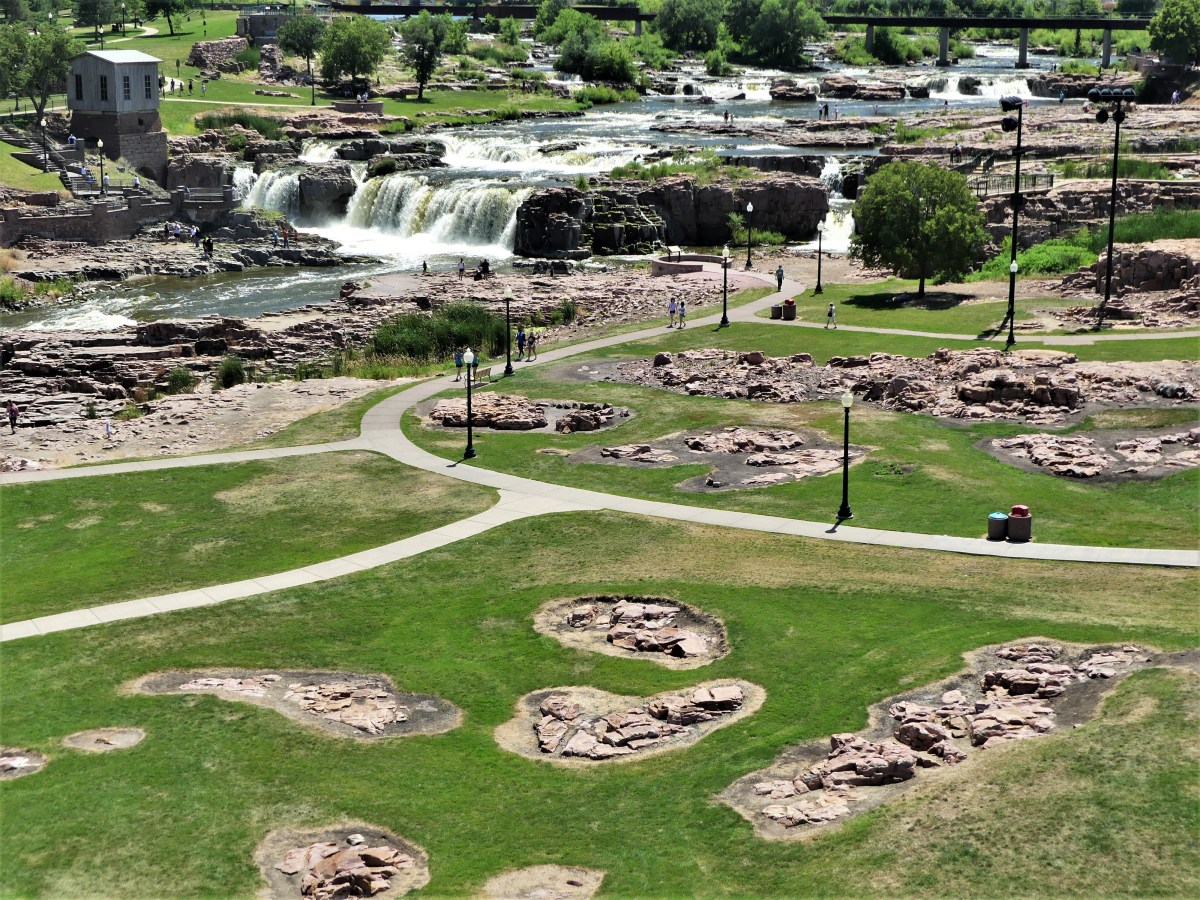
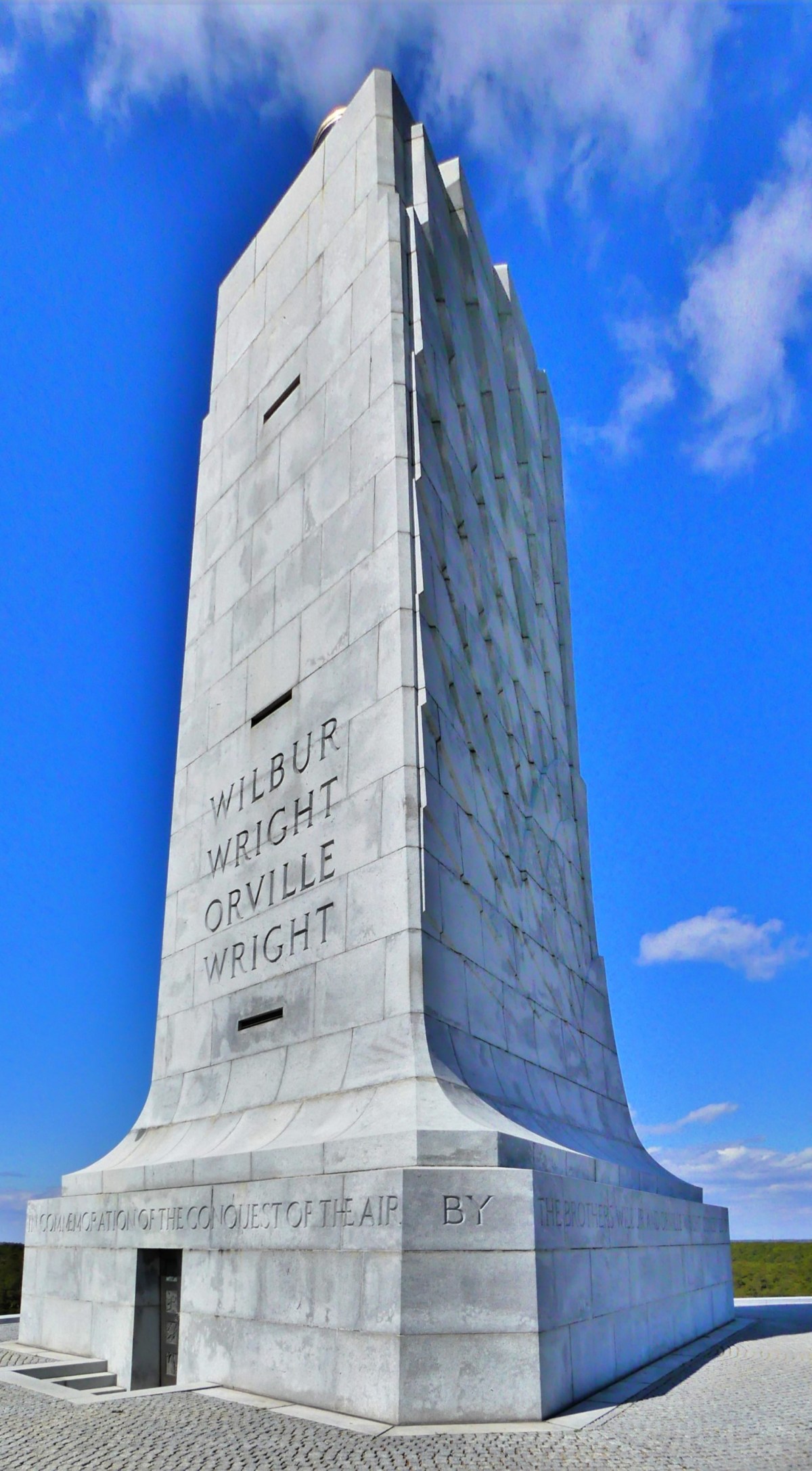
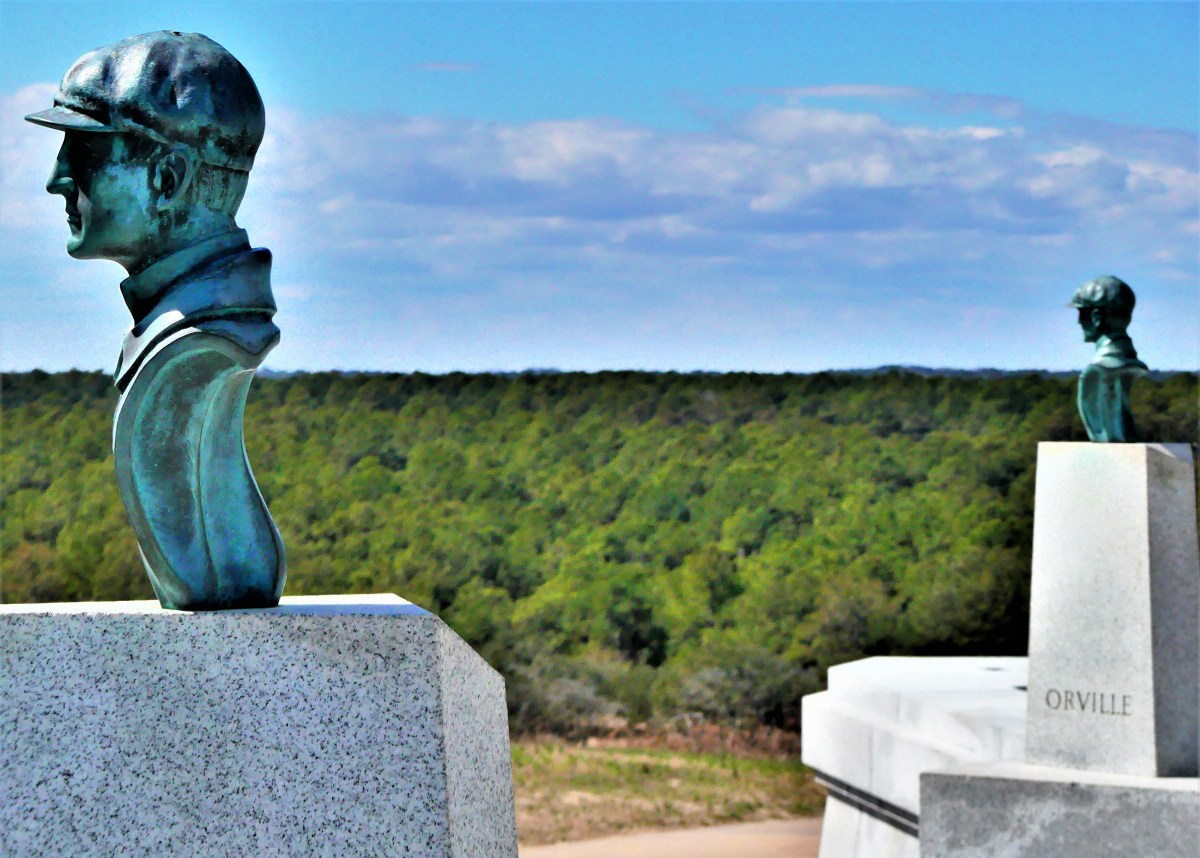
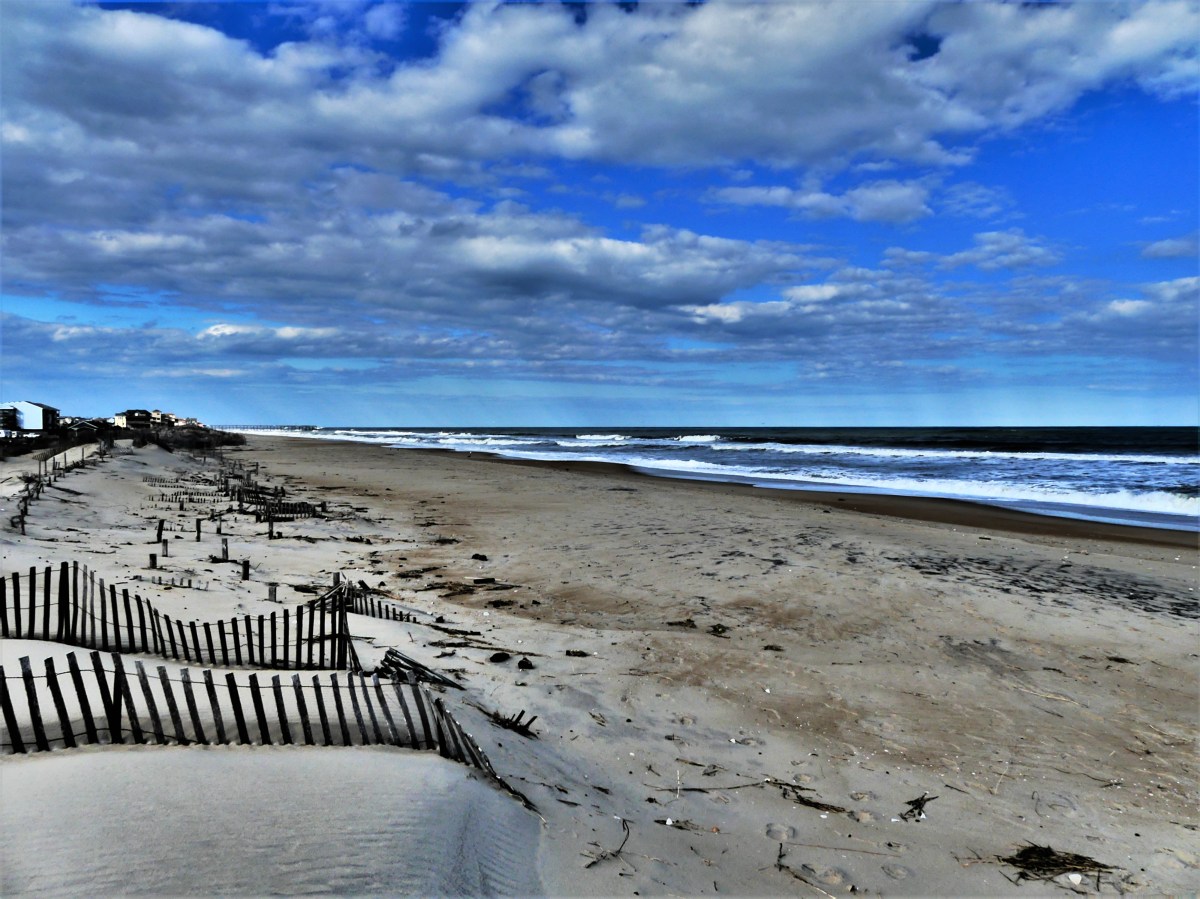
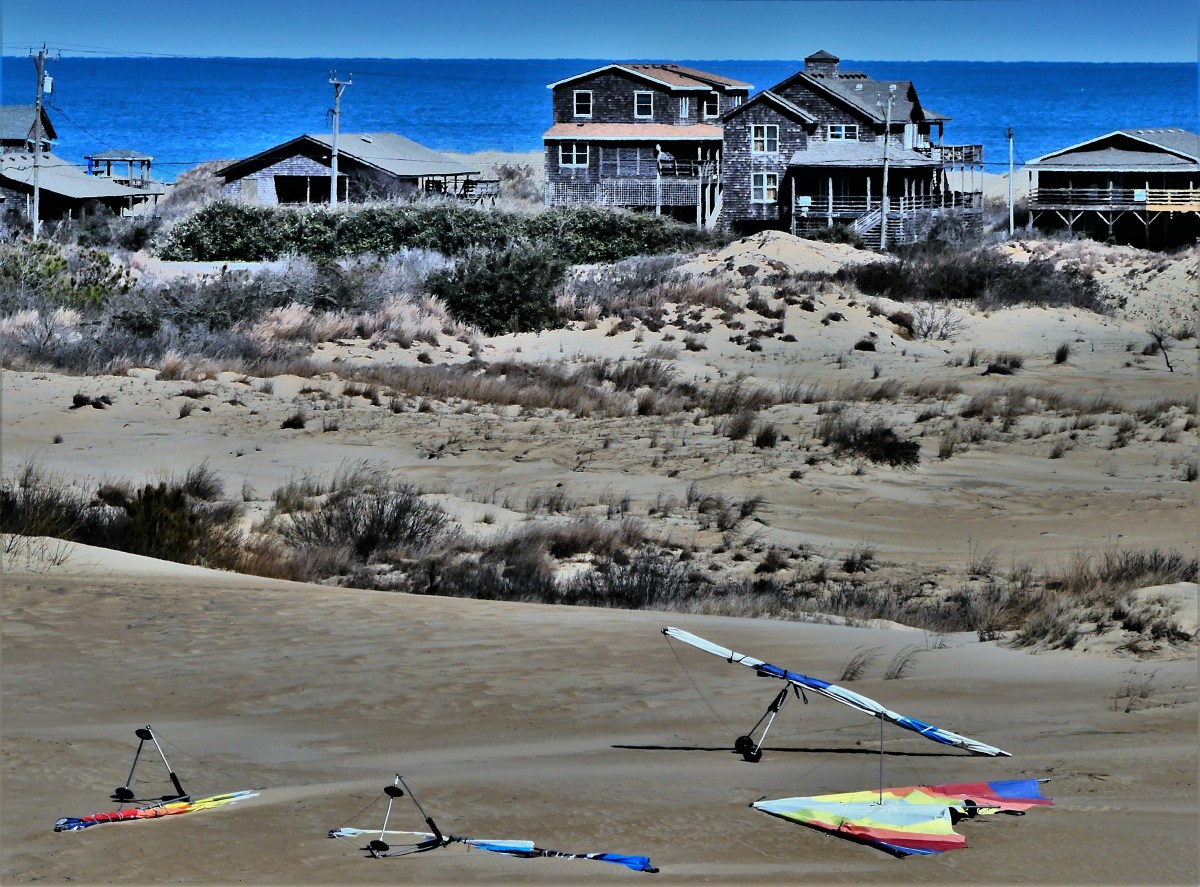
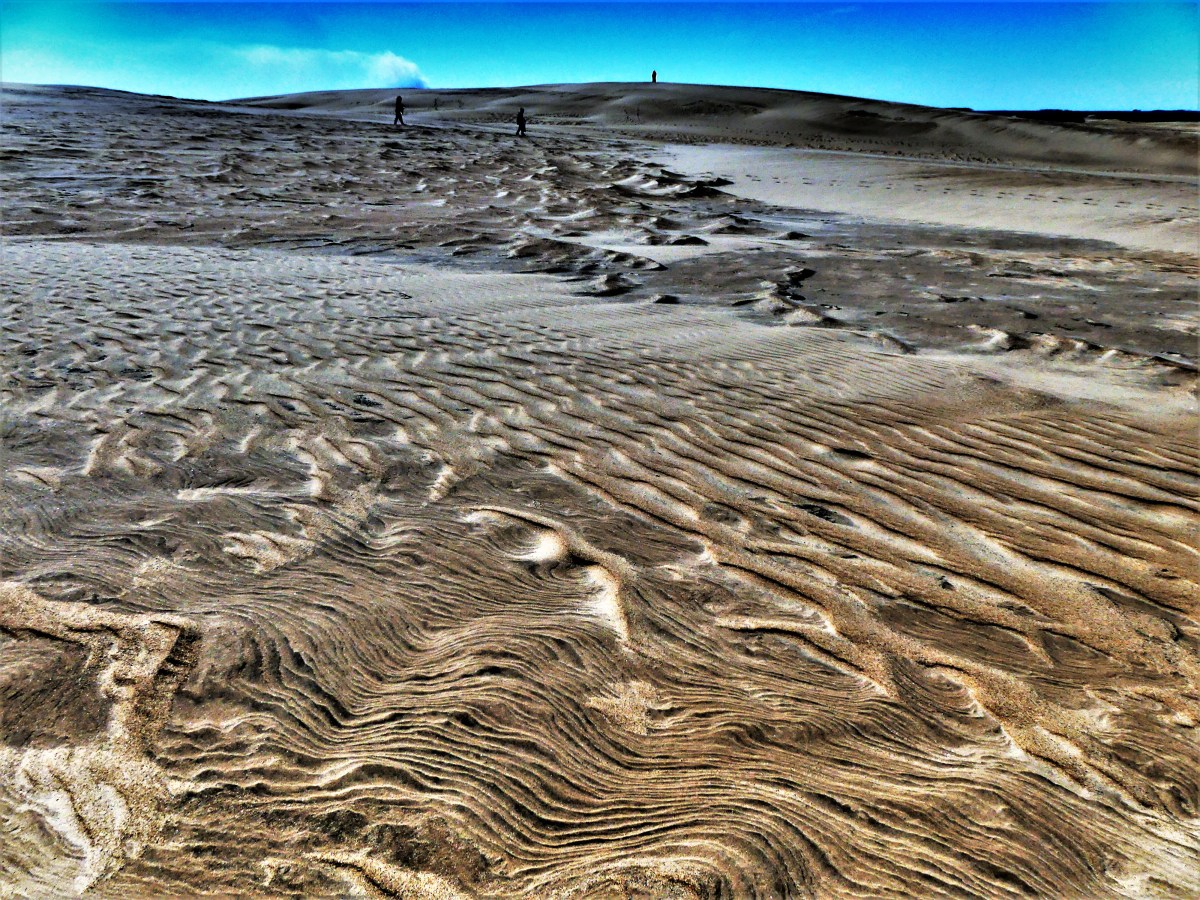
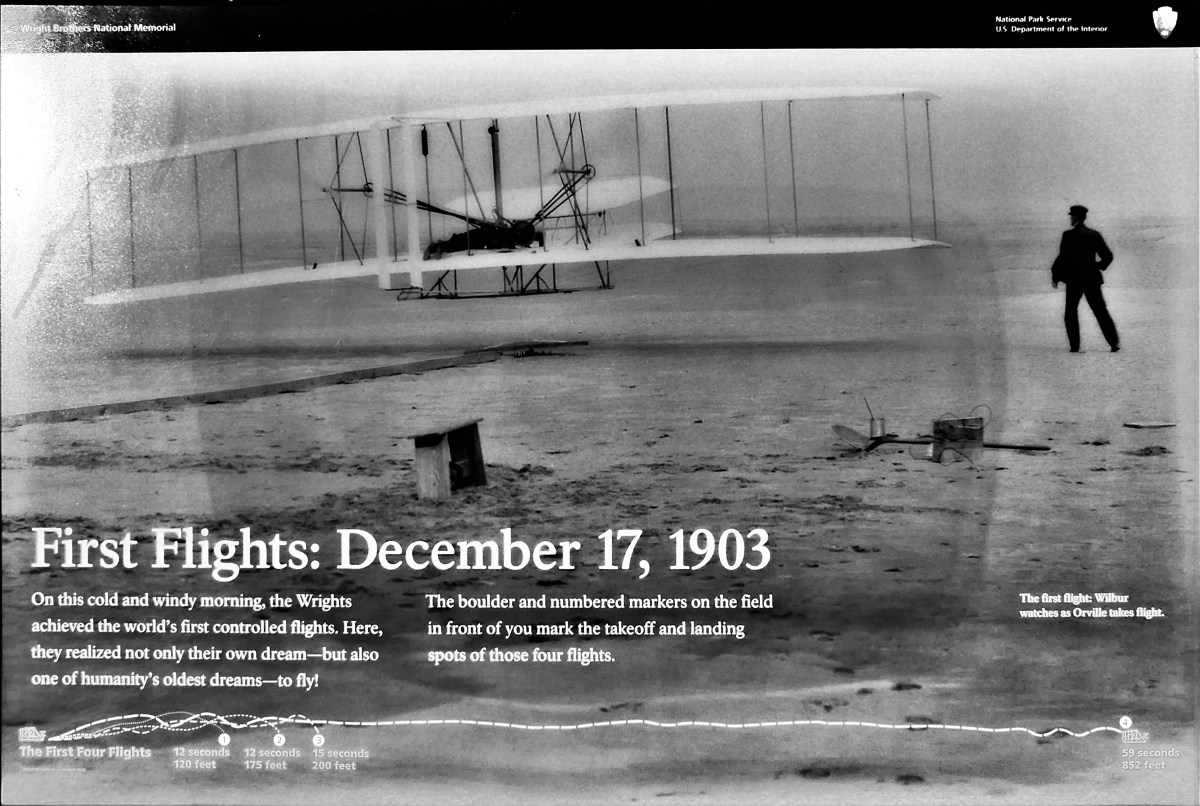
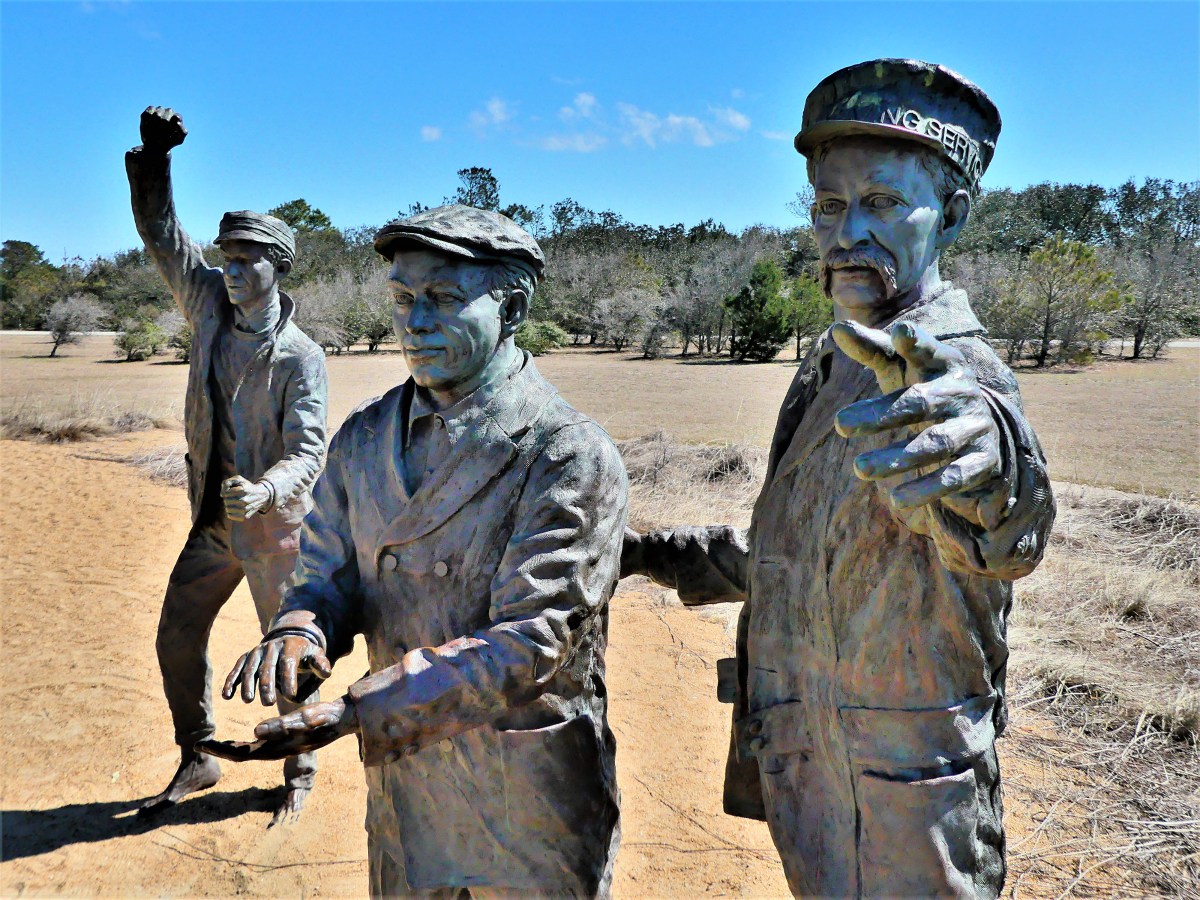
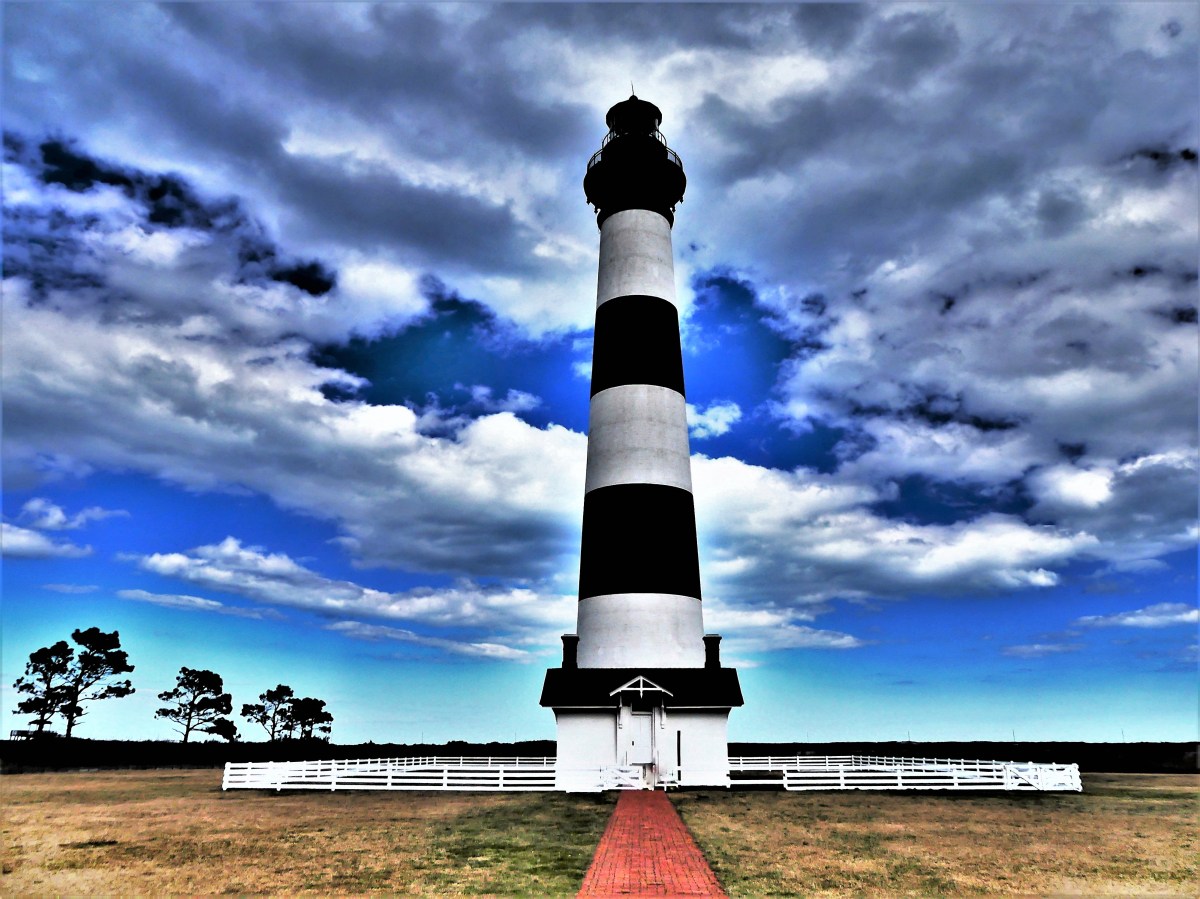
Sioux Falls–Falls Park TrailKill Devil Hill–Wright Brothers Memorial Trail
But in the end, regardless of the pot of gold at the end of the rainbow,
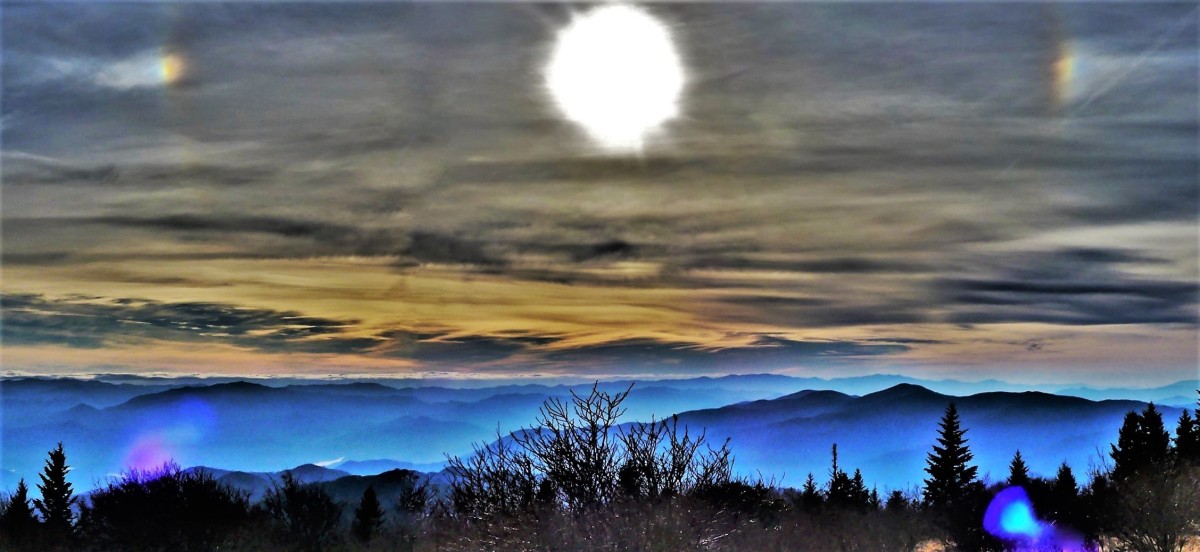
Great Smoky Mountains NP–Andrews Bald–Parhelic Circle with Sun Dogs
it’s the journey to get from here to there that matters most–because it’s the journey that builds character, and defines us like the lines on the palms of our hand.
To be sure, one of our many objectives while streaming thru America was spotting and capturing photos of as much wildlife as serendipity would allow, for it’s rarely nature’s way for wildlife to wander into my camera frame and pose at will. So the game of being at the right place at the right time, and putting ourselves in position to witness the spectacle of earth’s mighty creatures became somewhat of an obsession.
Yet, seemingly, whenever Leah and I set out to search for a particular species, we invariably turned up empty. For instance, lying low at Yellowstone’s Lamar Valley for a chance encounter with bighorn sheep escorting their new babes down from Mt. Washburn at the beginning of summer season never happened, despite a solid hour of wait time, and occasional reassurances from park rangers that the prospect was highly likely since no wolves had been sighted in the meadow where the mares prefer to congregate to lick the salt from the rocks by a Yellowstone River runoff.
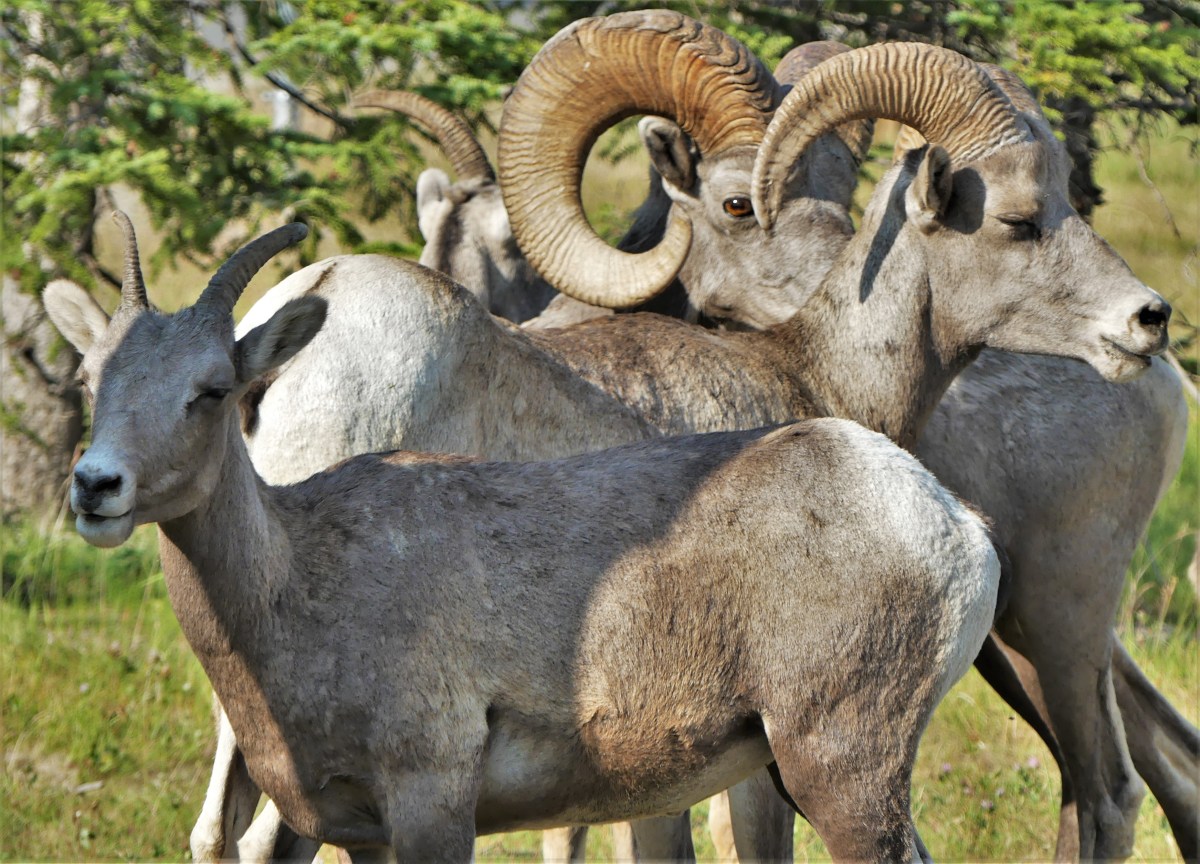
Instead, when we were least expecting them, we’d found them gathering by a trailhead parking lot in the Canadian Rockies,
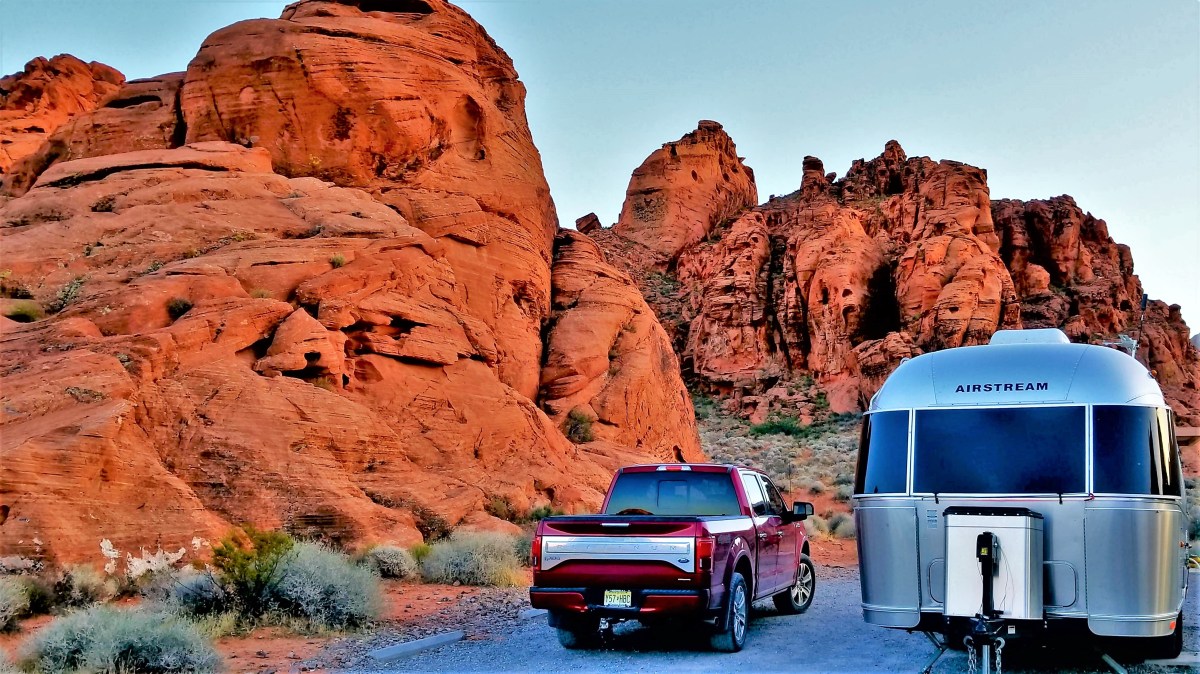
and worshipping the moon on the cliffs of Muddy Mountain while returning from a hike through Nevada’s Valley of Fire.
and surveying the brutal Badlands while cruising the Loop Road in our air-conditioned F-150.
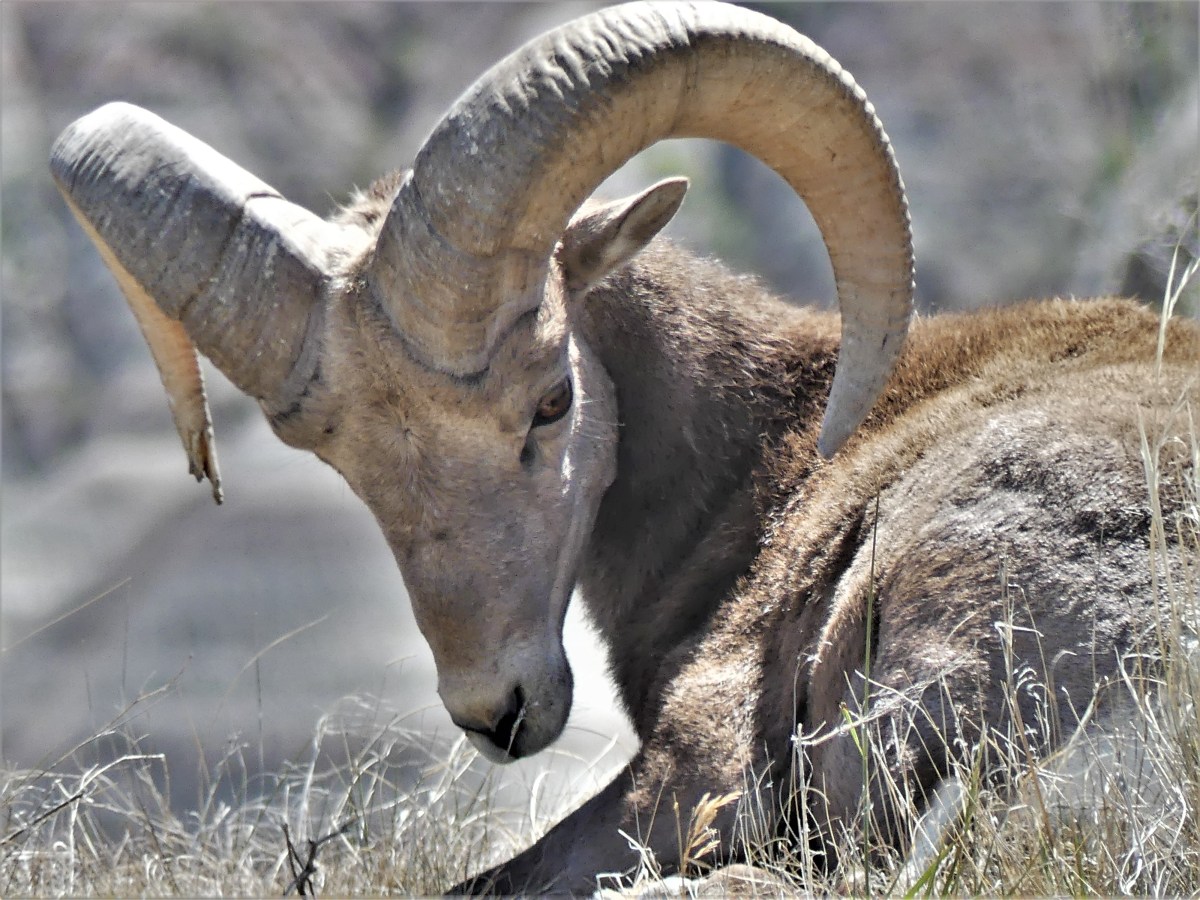
Related cliff dwellers included mountain goats from Glacier National Park…
and the Columbia Icefields of Alberta.
In the early months of our journey, our frustrating search for elusive alligators along the bayou and delta landscape led us to create a call that crocodilia were apt to ignore: “Here, gator, gator, gator!” (see Where Have all the Gators Gone?)
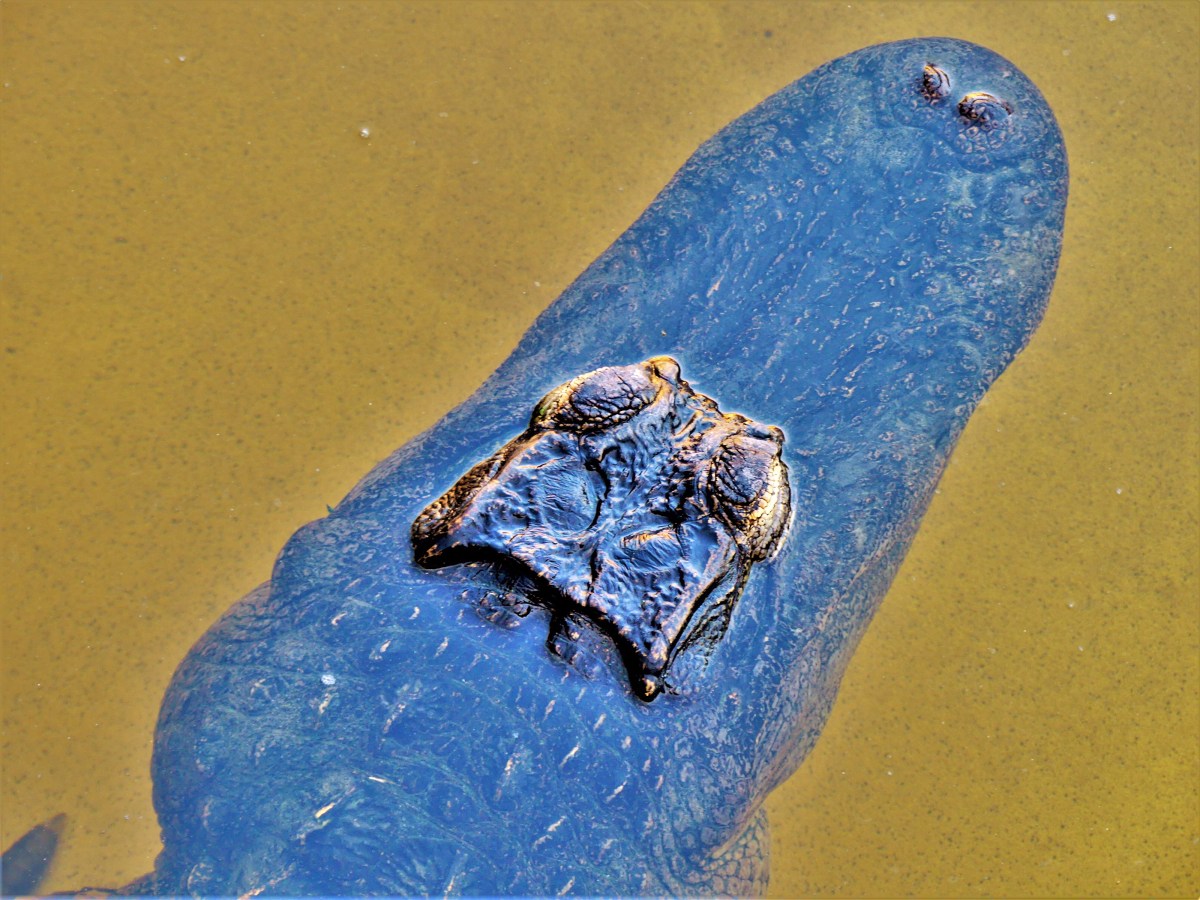
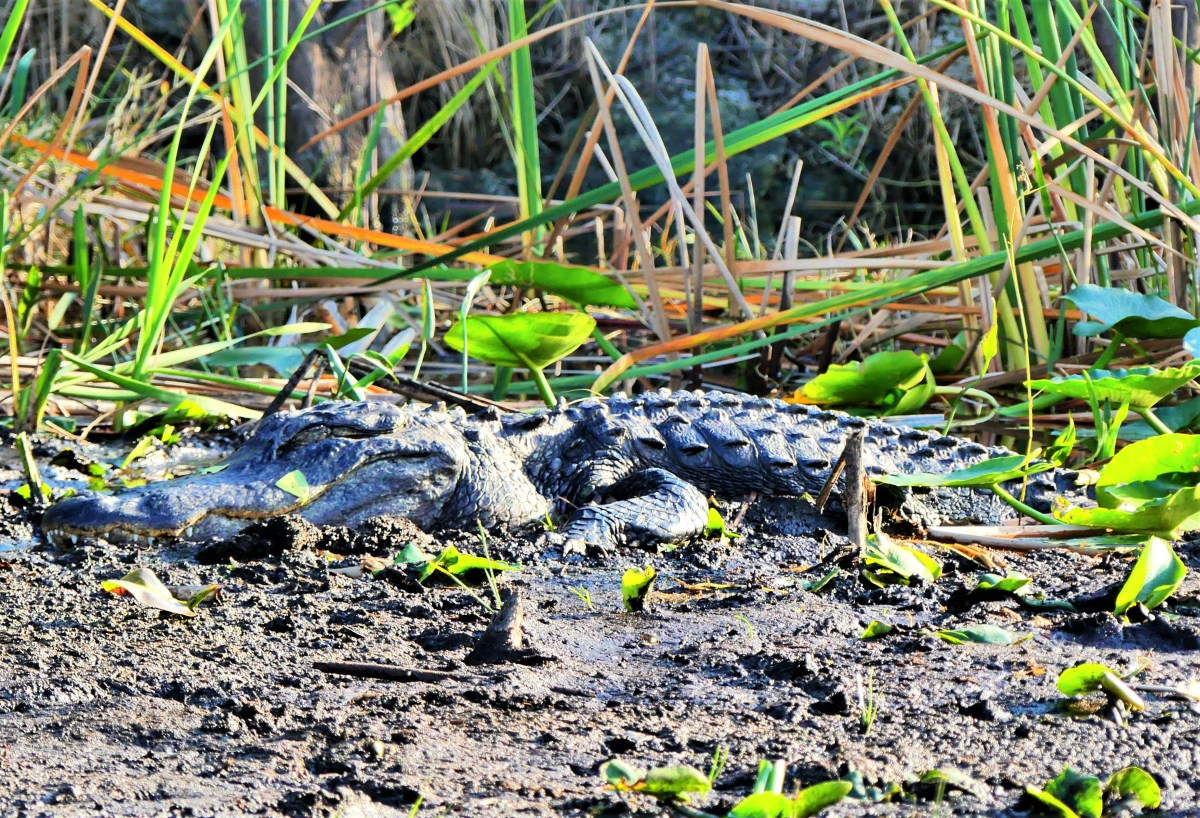
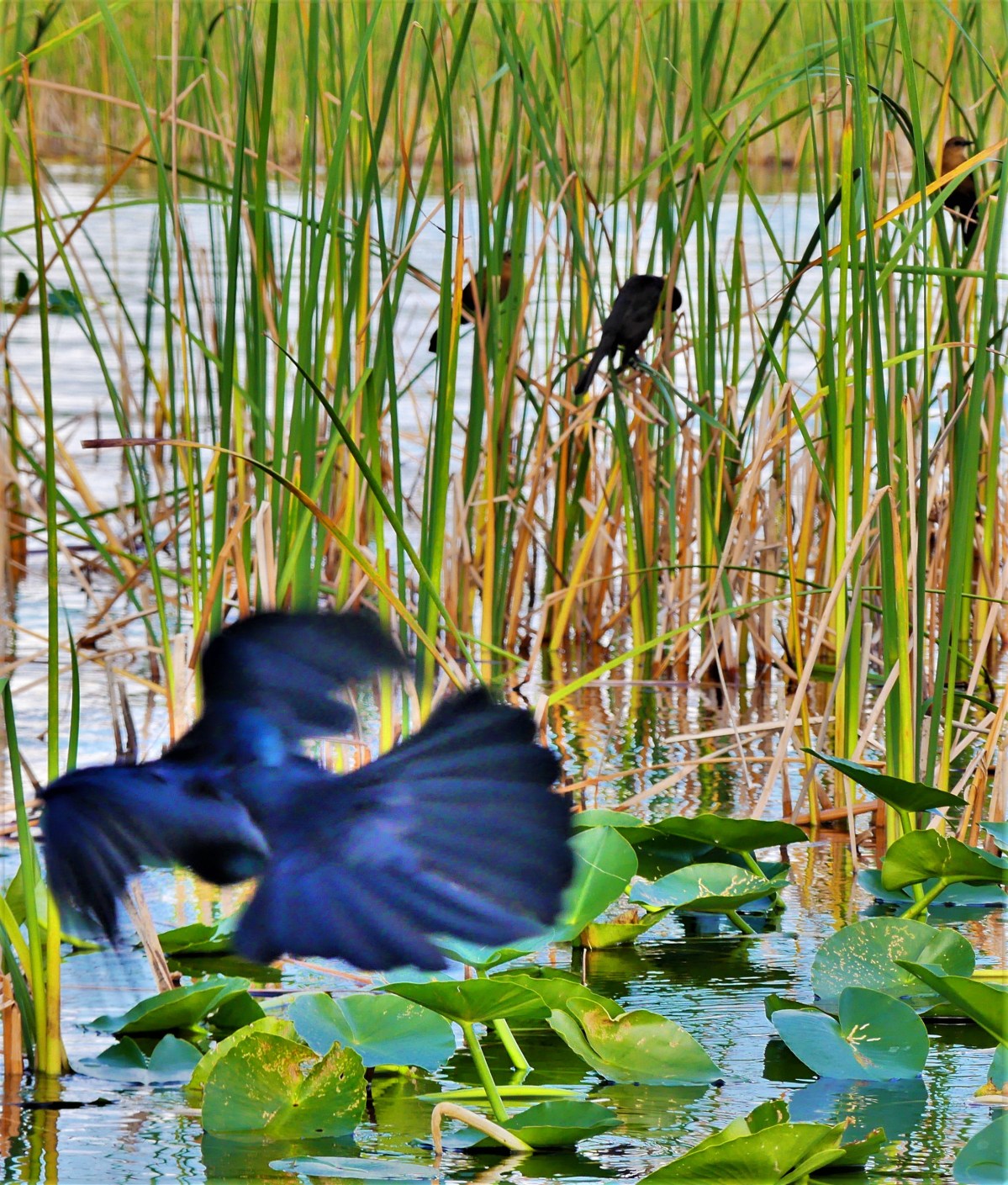
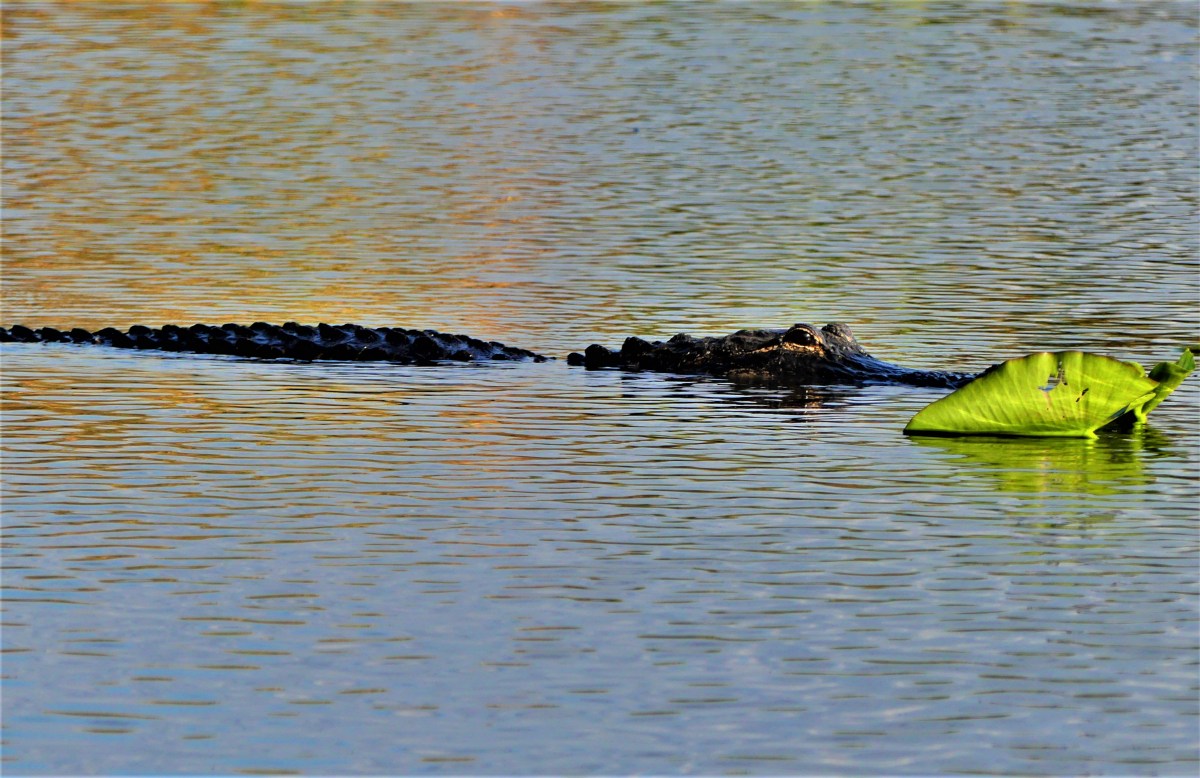
However, we would not be denied while airboating through the Florida Everglades…
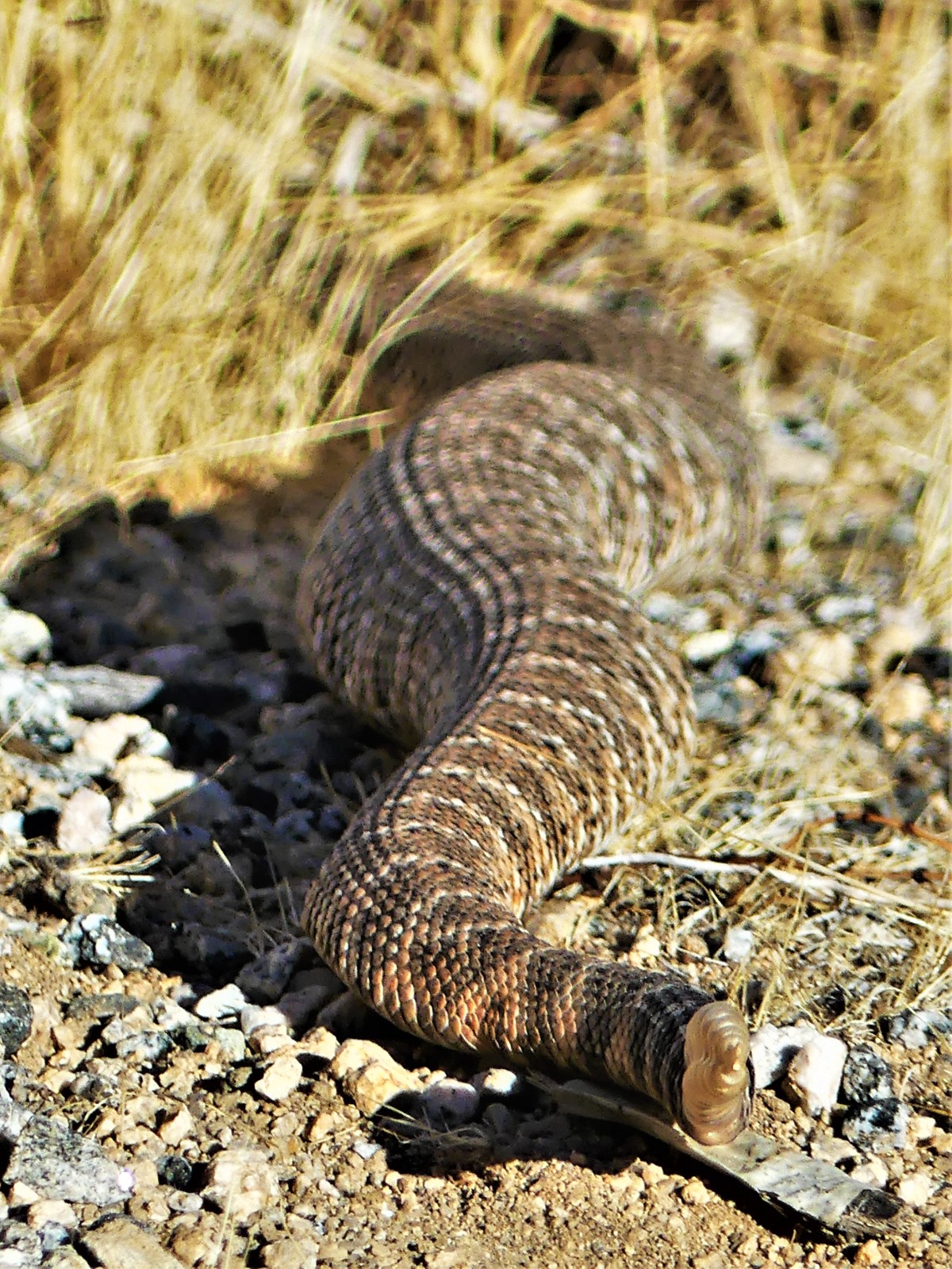
Lesser evasive reptiles encountered along the way ranged from a bloated rattler…
and a horned toad camouflaged against a terrain of cholla cacti within Joshua Tree…
to a greater earless lizard basking on a Big Bend boulder…
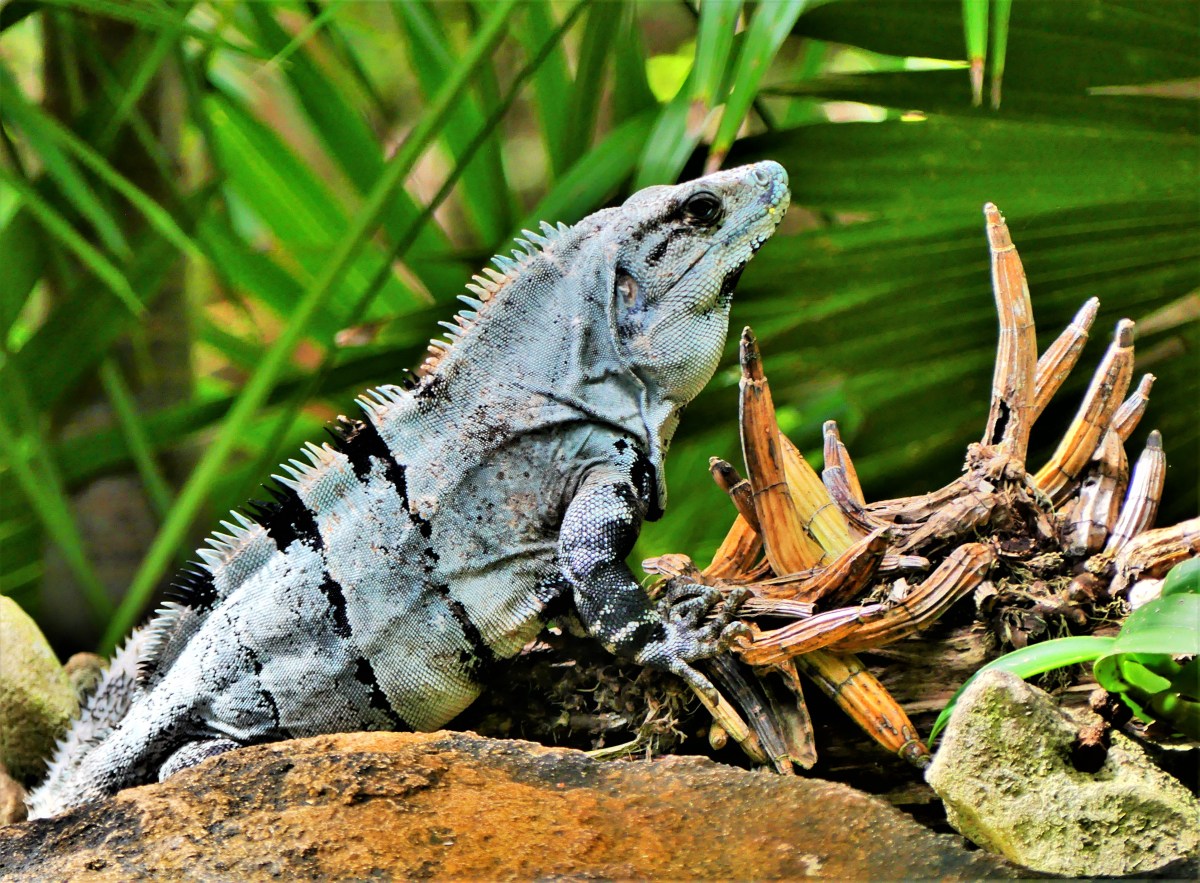
a lounging iguana from the tropics of Quintana Roo…
and an angry gopher tortoise from Hobe Sound.
On the other hand, squirrels and chipmunks were ubiquitous throughout the entirety of our trip…
and never shy, if there was the faintest chance they could scavenge a meal discarded by humans.
Although, their close cousin, the prairie dog was less apt to wander from the safety of its network of burrows at Prairie Dog Town in Theodore Roosevelt National Park.
Equally as omnipresent, and just as opportunistic were the many ravens that crossed our paths: from Bryce Canyon;
to Arizona’s Painted Desert;
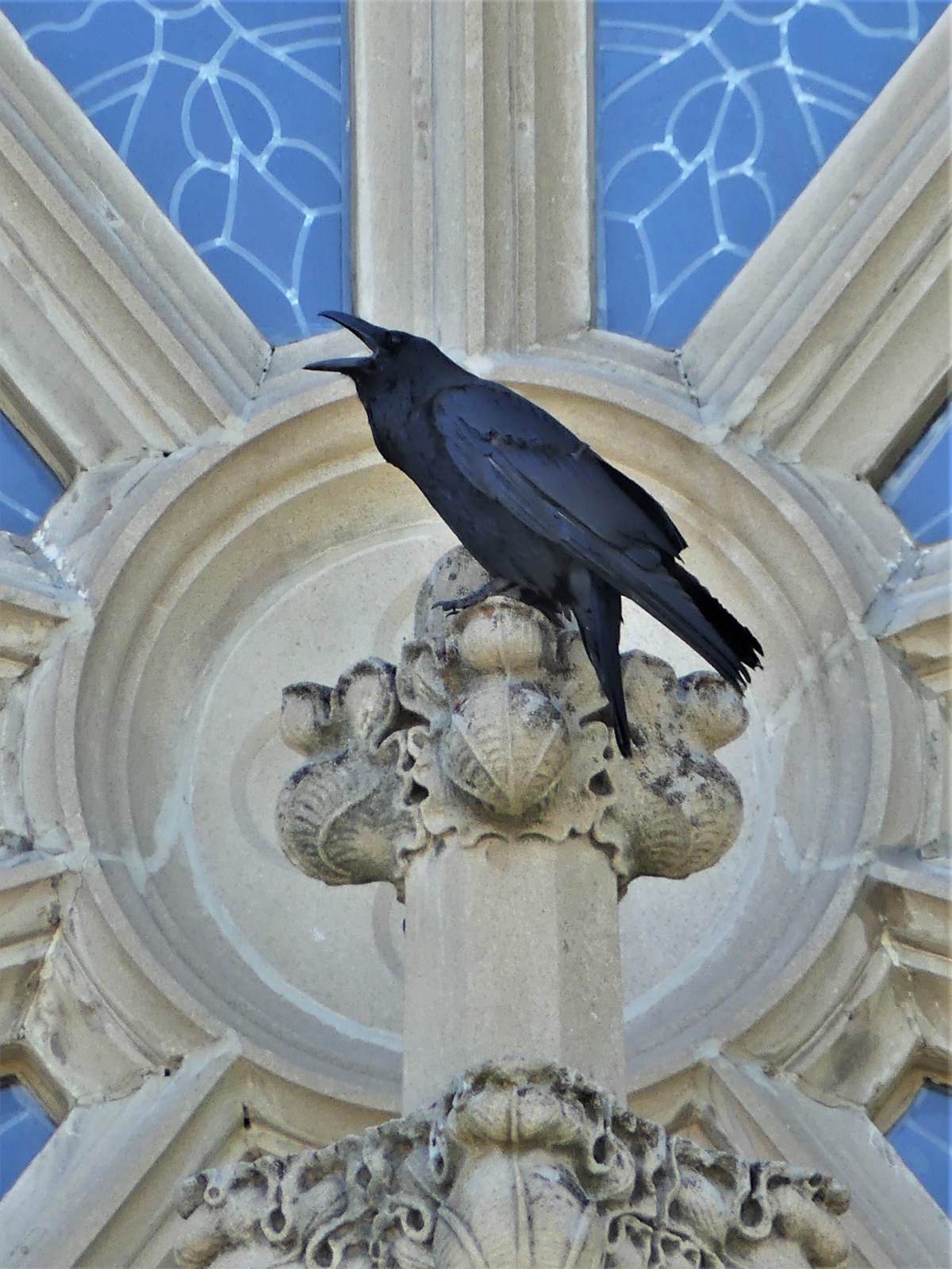
to the perch atop the Cathedral of St. Helena.
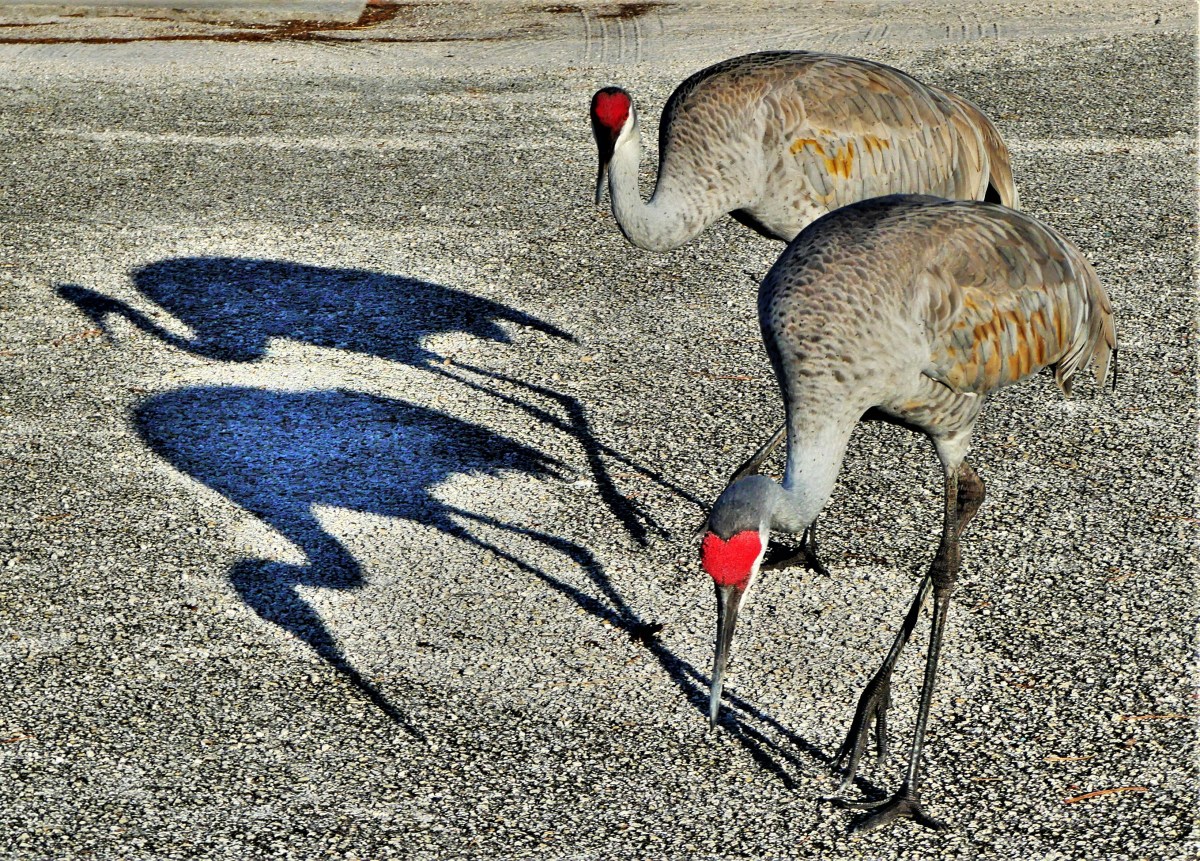
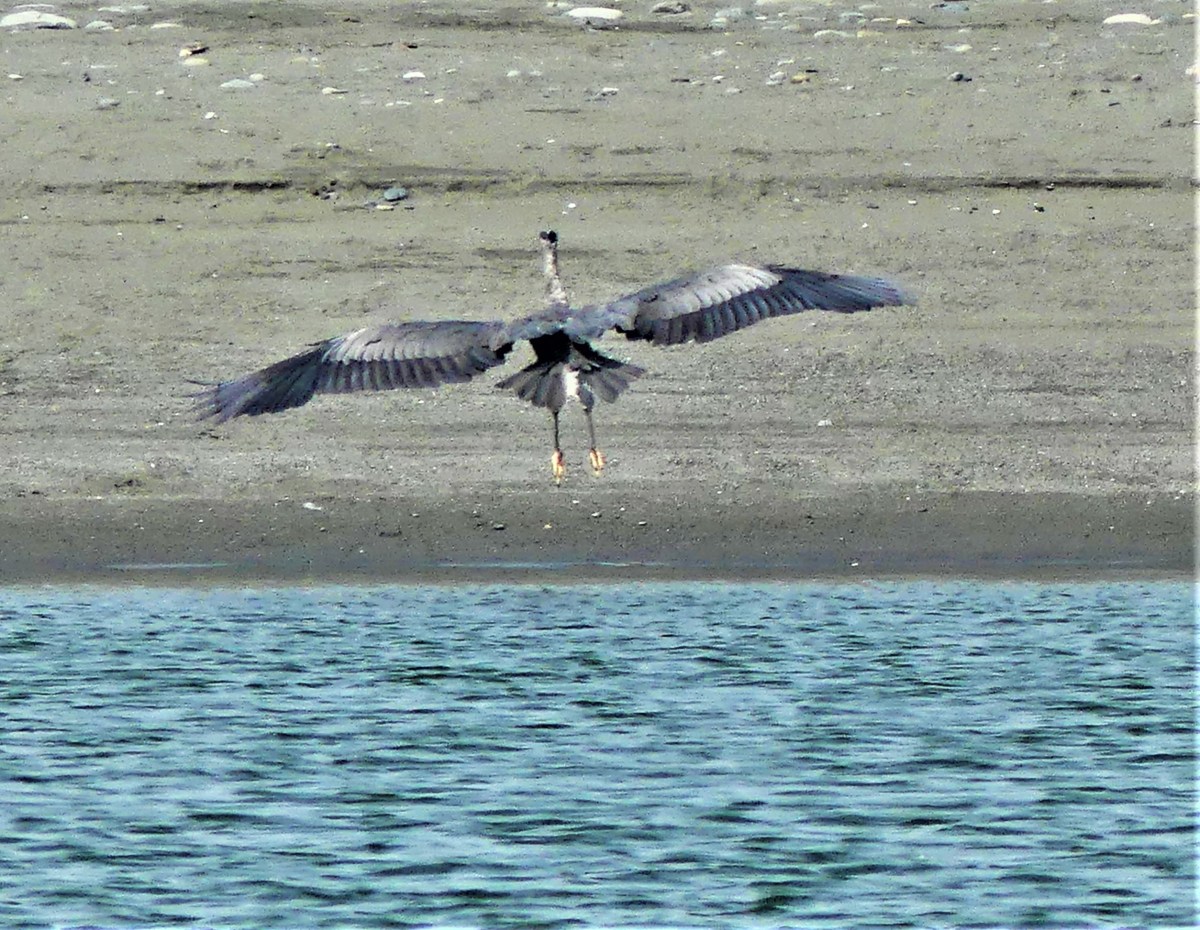
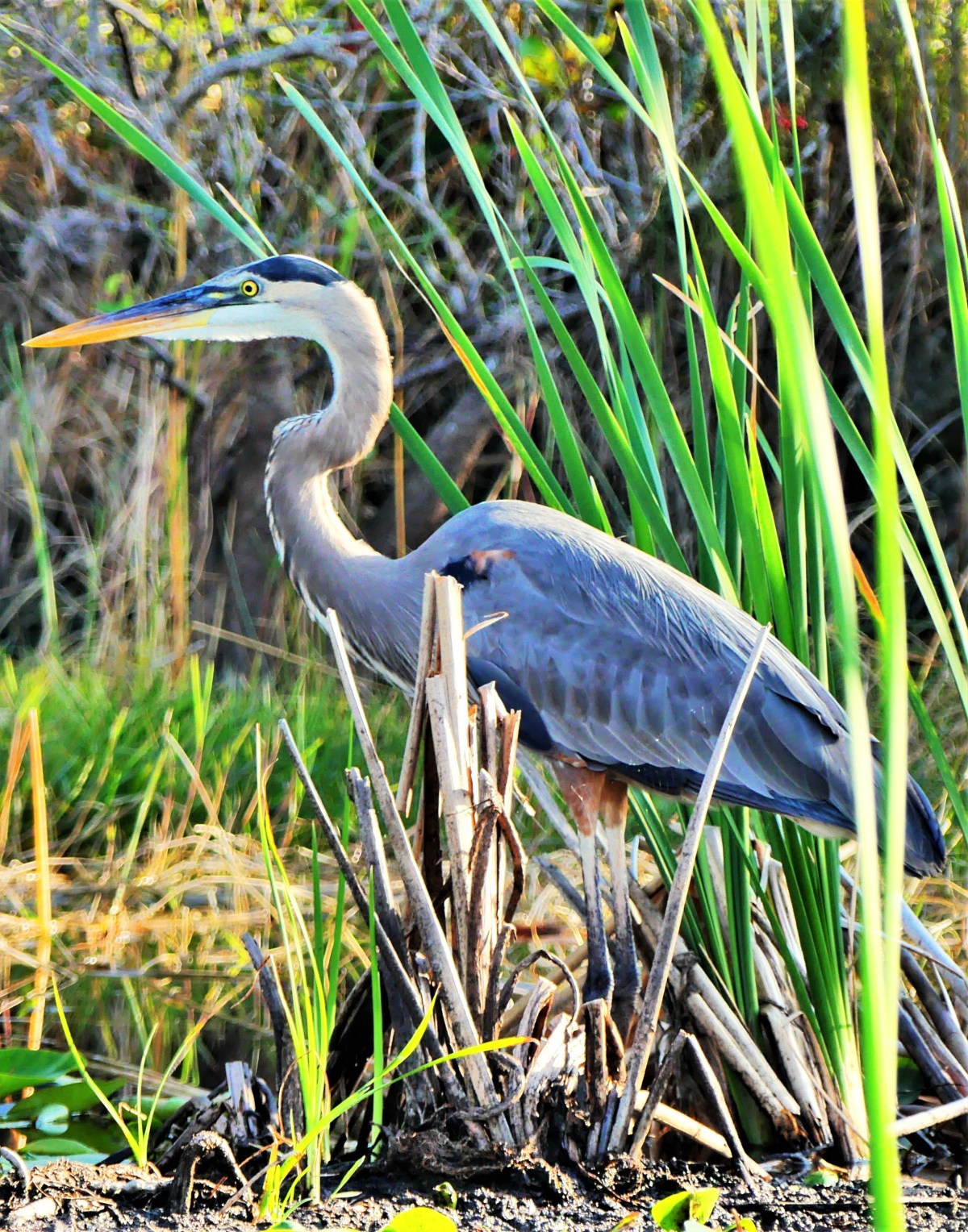
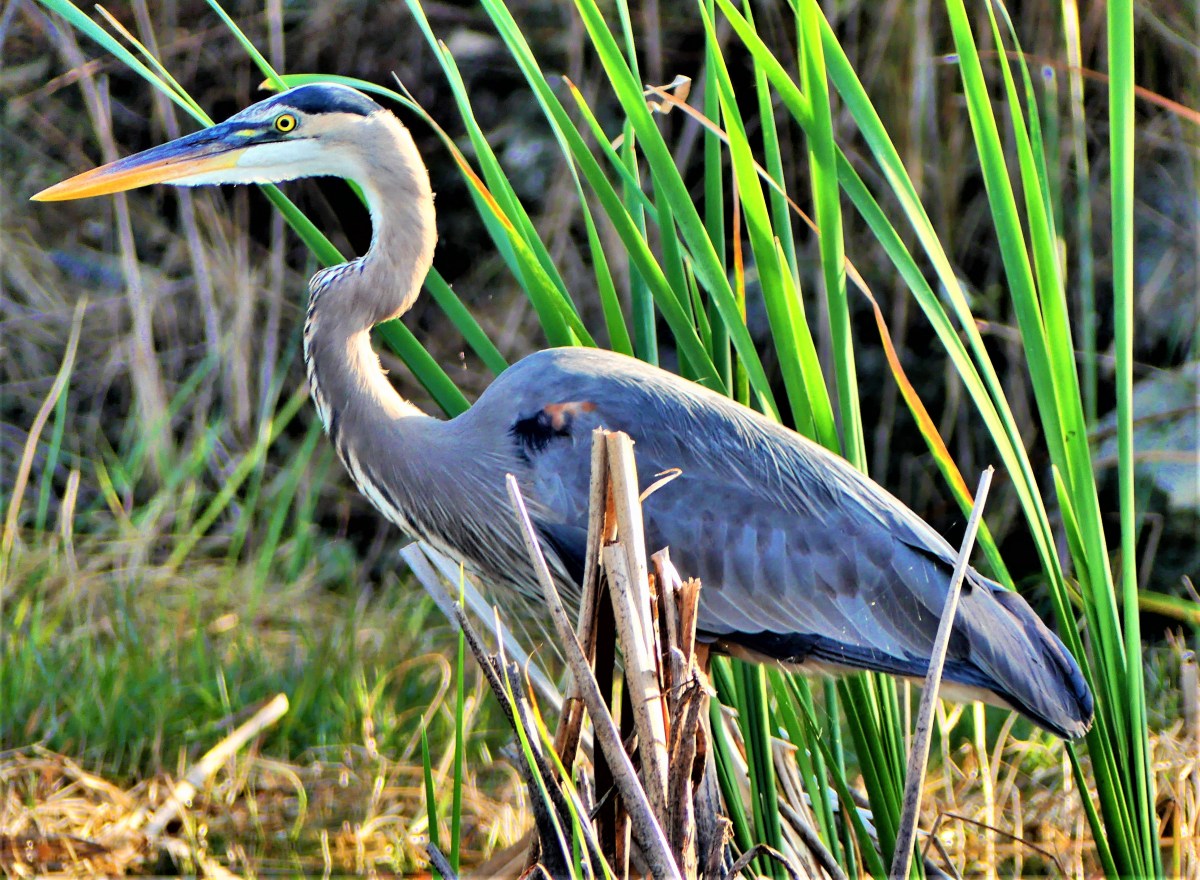
Other fowl that caught our attention included a variety of cranes and herons from multiple coastal habitats…
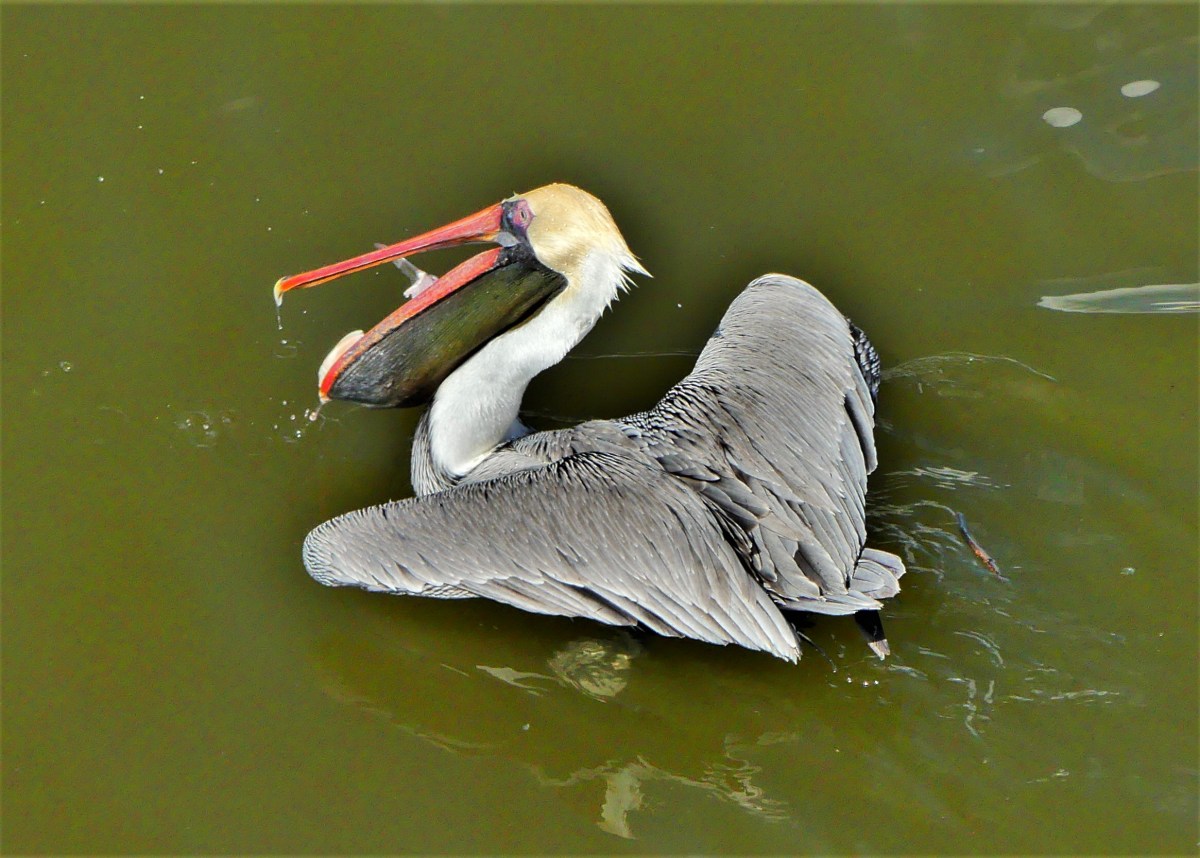
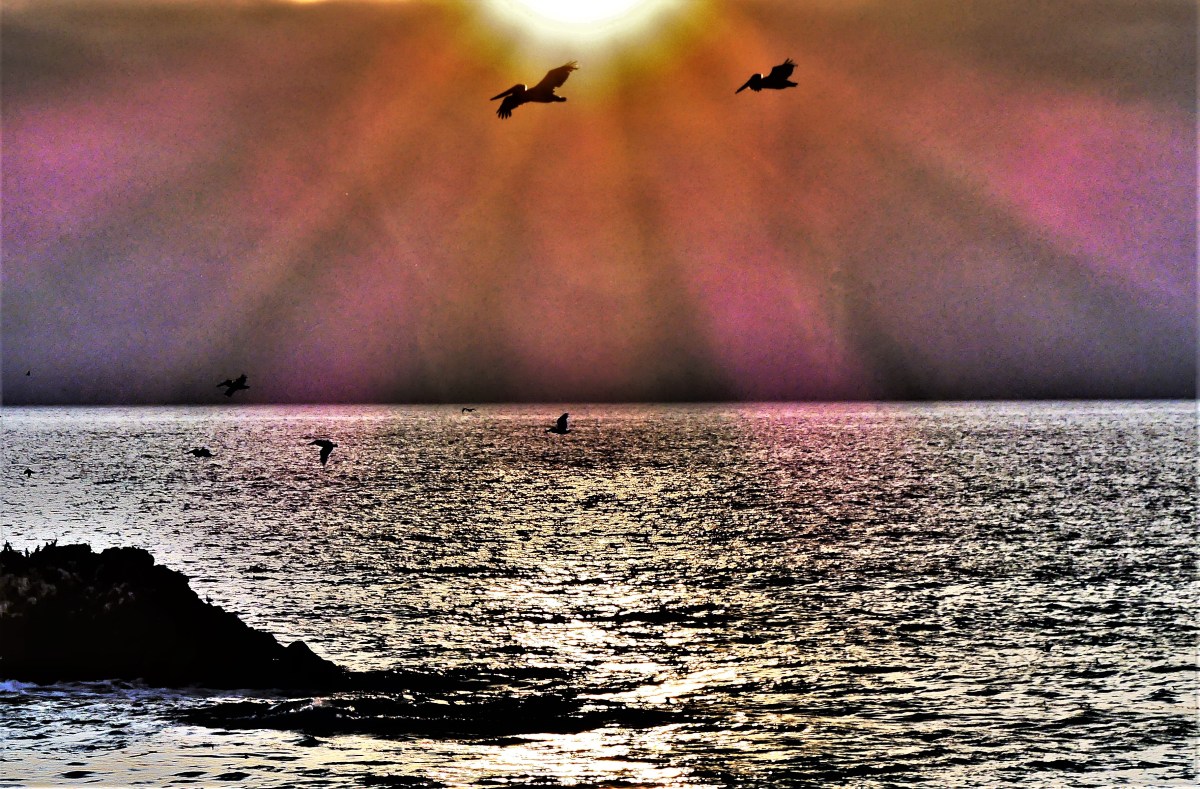
and pelicans fishing from the Gulf of Mexico…
to the Pacific Ocean.
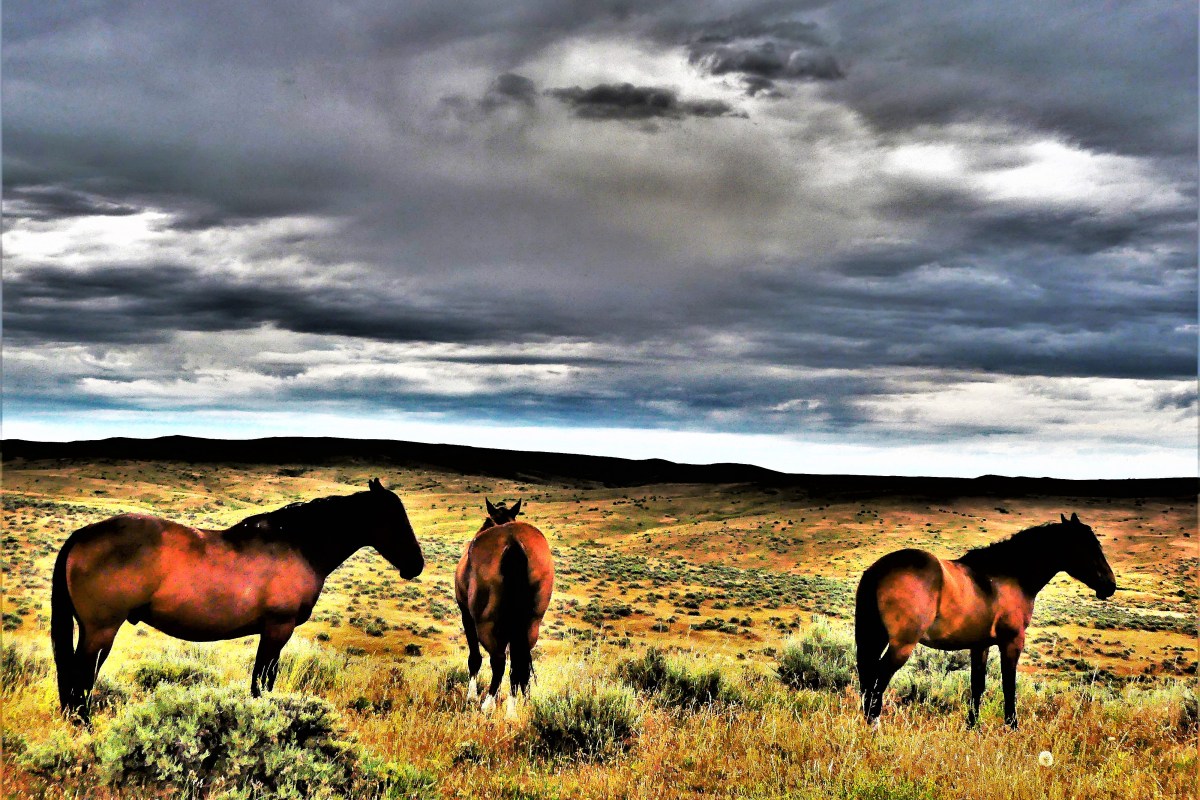
But what really captured our imagination were the wild horses that always stood out in a crowd;
the Yellowstone black bear that we’ve never grown tired of beholding;
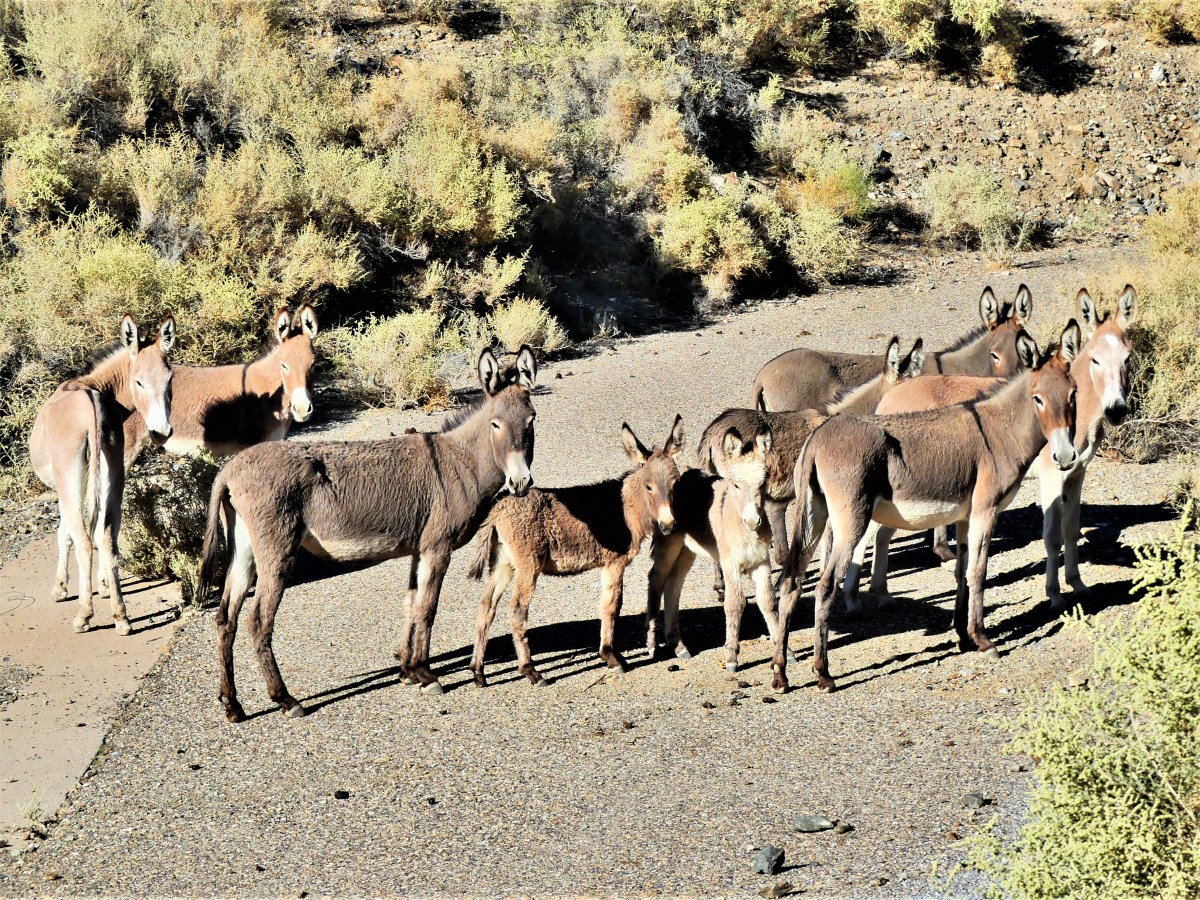
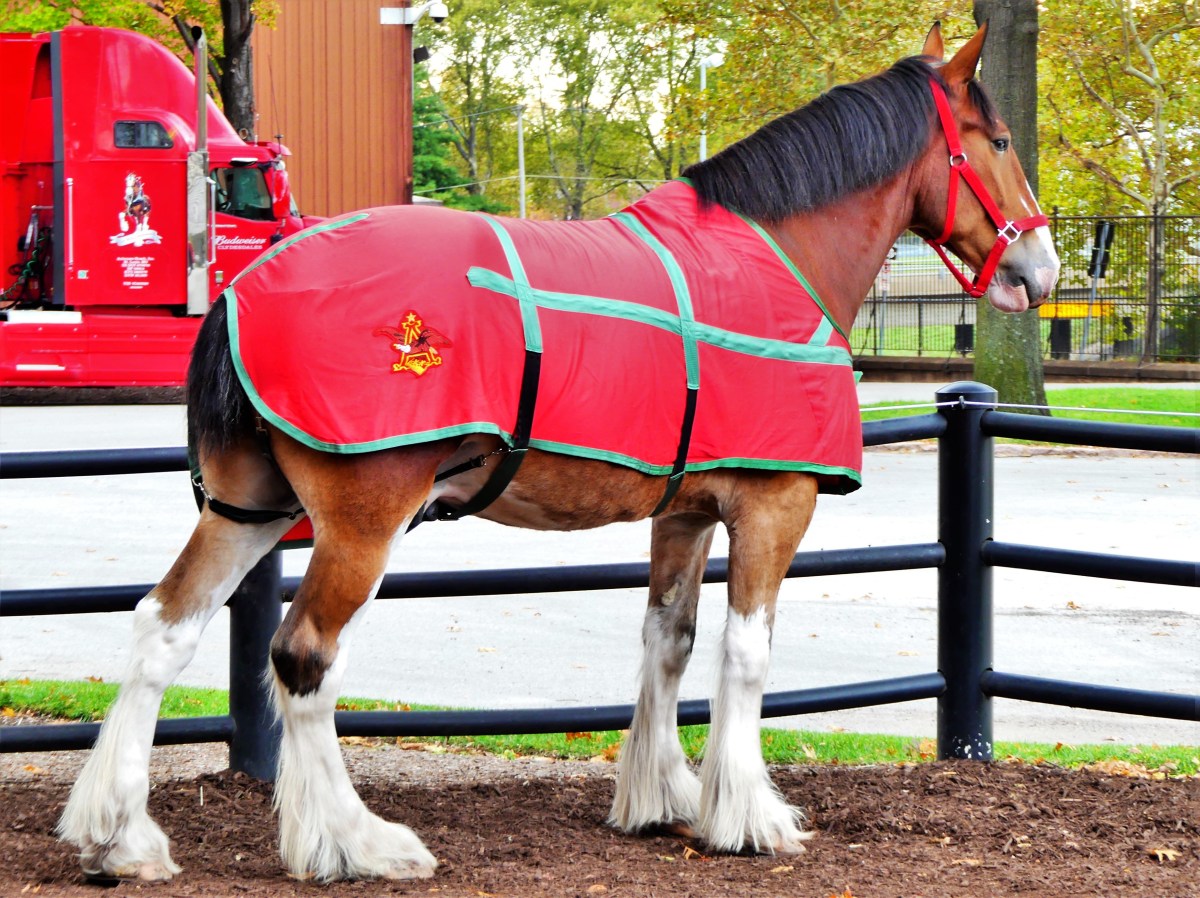
and the beasts that have defined our heritage as a nation–whether it was the descendants of Death Valley’s Twenty Mule Team…
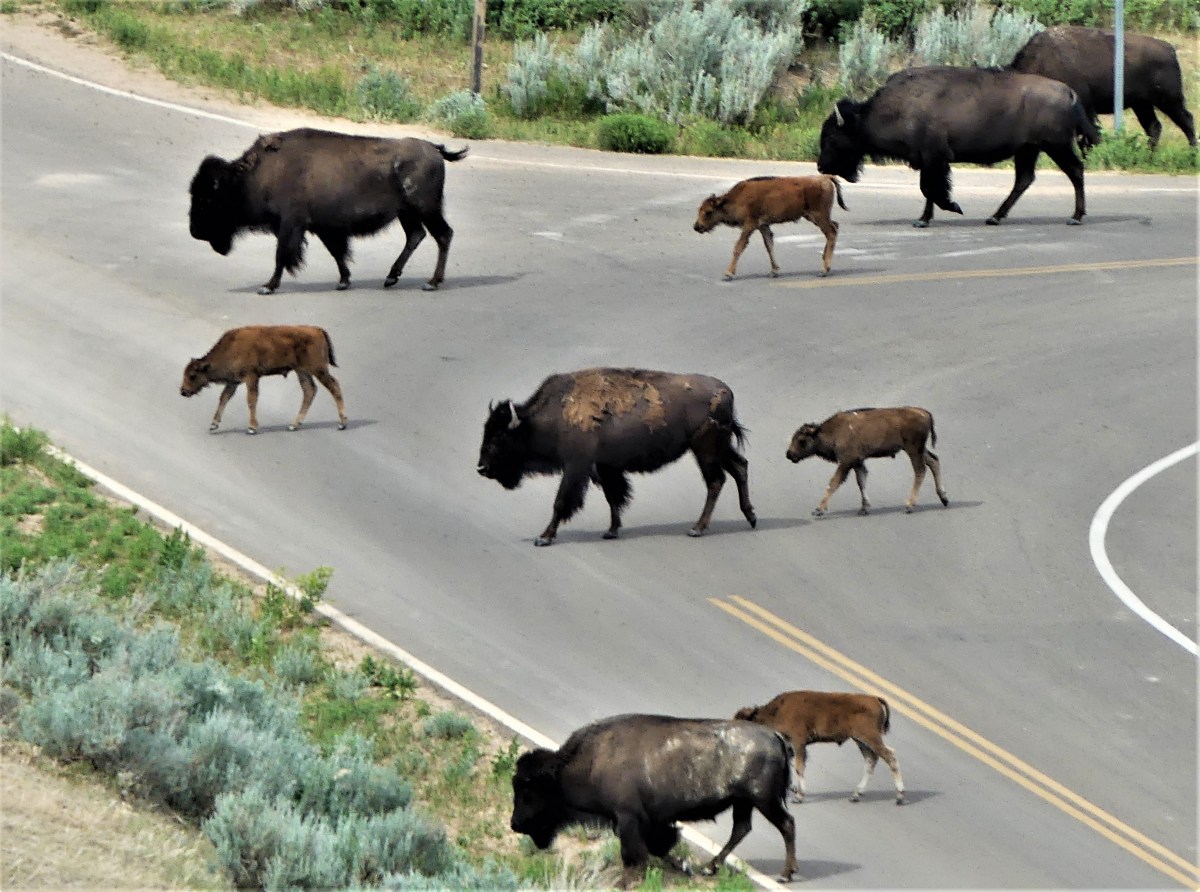
or the mighty bison on the open range.
Yes, the animal world is prolific; it’s divided between domestic…
and wild;
common…
and sublime.
But regardless of the patience required to collect this anthology of imagery, it pales in comparison to the understanding and energy that must be required to keep our environment intact. Of the approximately 2 million animal species identified on our planet, over 16,000 species are rapidly dwindling, due largely in part to habitat destruction and climate change.
According to Endangered Earth,
“There are now 41,415 species on the IUCN (International Union for Conservation of Nature) Red List, and 16,306 of them are endangered species threatened with extinction. This is up from 16,118 last year. This includes both endangered animals and endangered plants.
The species endangered include one in four mammals, one in eight birds, one third of all amphibians and 70% of the world’s assessed plants on the 2007 IUCN Red List that are in jeopardy of extinction. The total number of extinct species has reached 785 and a further 65 are only found in captivity or in cultivation. In the last 500 years, human activity has forced over 800 species into extinction.”
We must be resolute and vigilant as conservationists and global citizens to ensure that future generations share the same joy of experiencing wildlife in their lifetime, lest we only have these and other photographs to offer them by default.
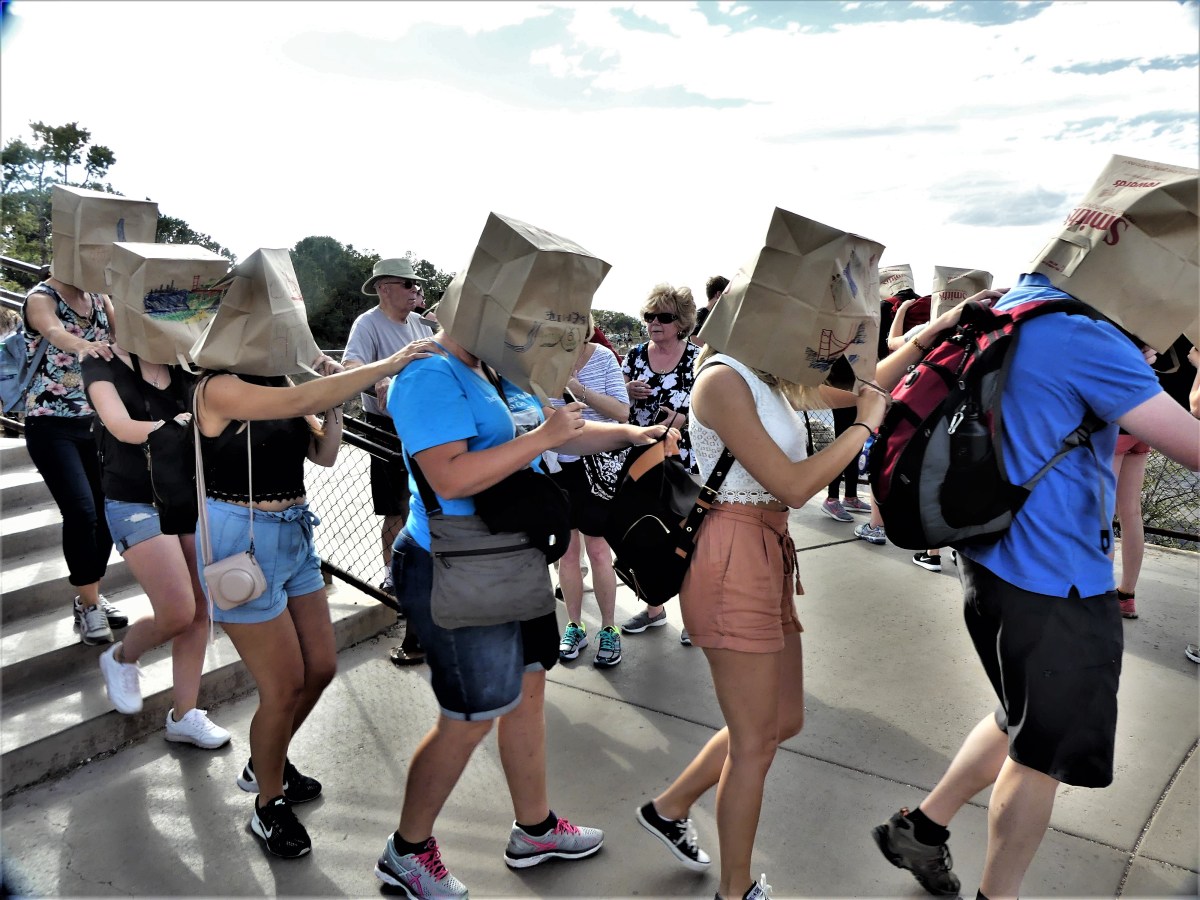
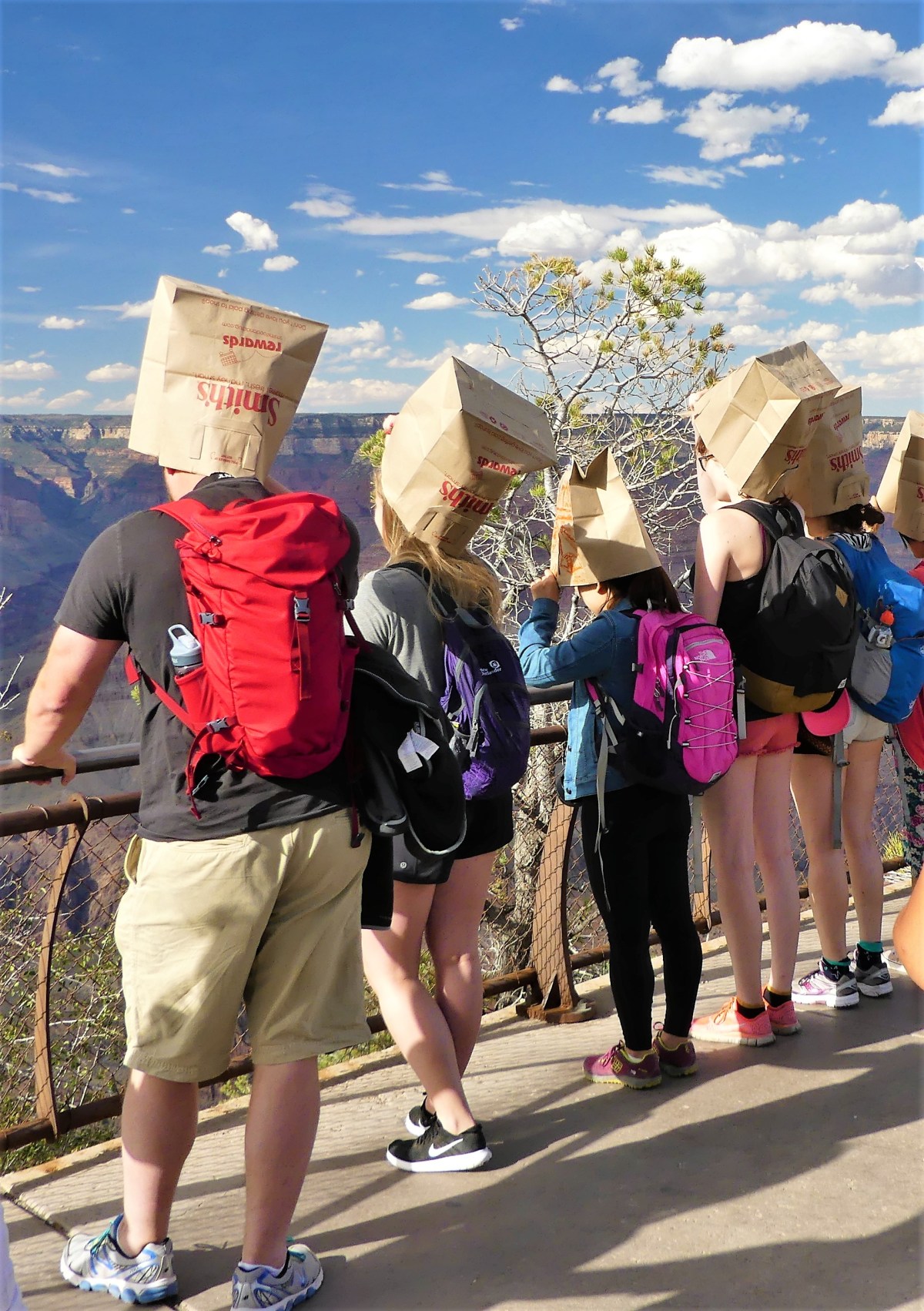
Six million visitors a year gravitate to Grand Canyon National Park, hoping for a visceral connection with one of the Seven Natural Wonders of the World. They come to contemplate the Canyon’s enormity and marvel at nature’s possibilities. They come to walk the rim; hike the trails; or ride a mule/bike/train. Others may be inclined to climb the observation tower; watch a tribal ceremony; or dine at El Tovar. But no matter what the activity, It seems that EVERYBODY has arrived with a camera to document every moment of their Canyon experience as if it was a sacred rite.
Long lens, zoom lens, tripod, mono-pod, selfie-stick, large format, DSLR, compact, bridge, Polaroid, point-and-shoot, GoPro, iPads and iPhones–irrespective of the expense or complexity of the equipment–somebody is taking a picture of something or someone, almost always.
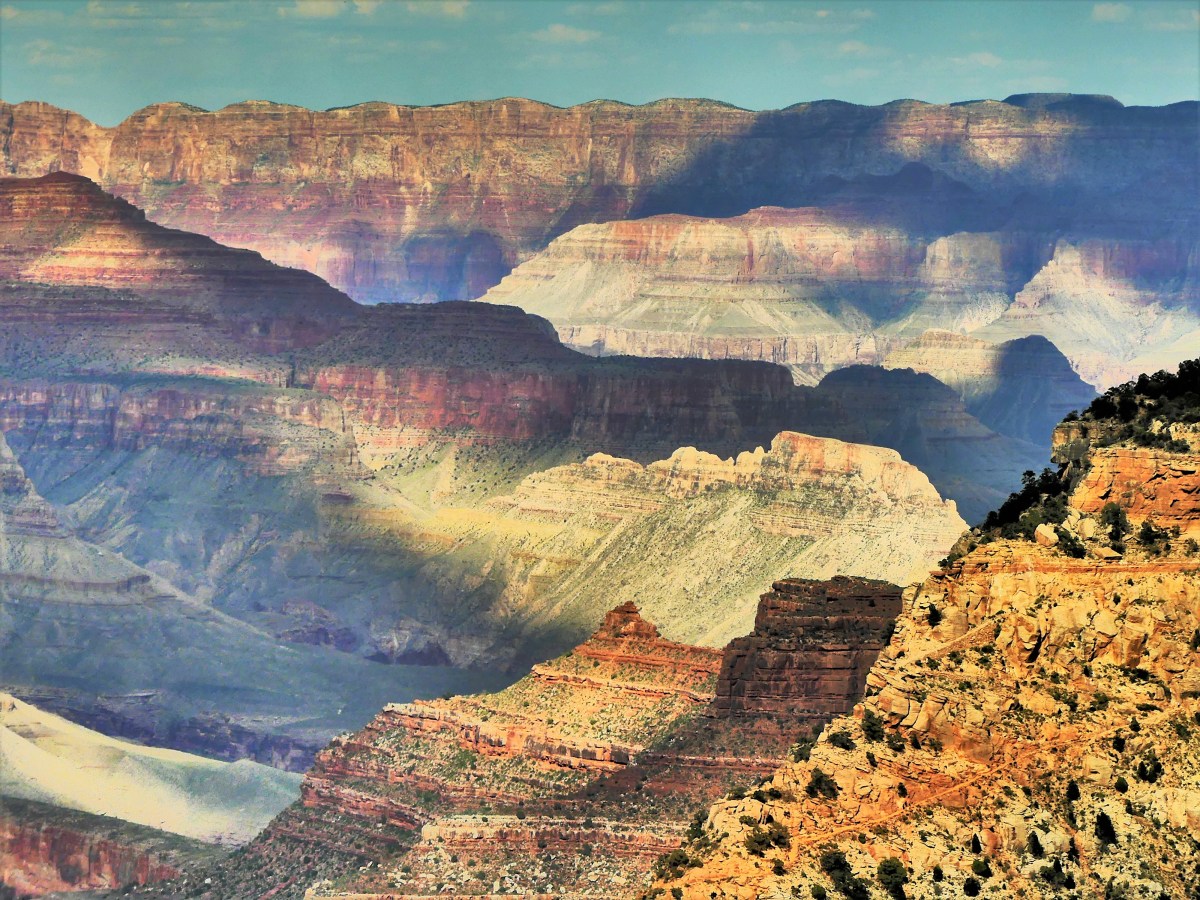
While not the world’s grandest canyon by size (Kali Gandaki Gorge in Nepal is nearly four times deeper, and Capertee Valley in Australia is longer and wider), The Grand Canyon more than makes up the difference in its spectacular and overwhelming beauty–so much so, that on average, 12 people will lose their life every year while posing or composing a photograph.
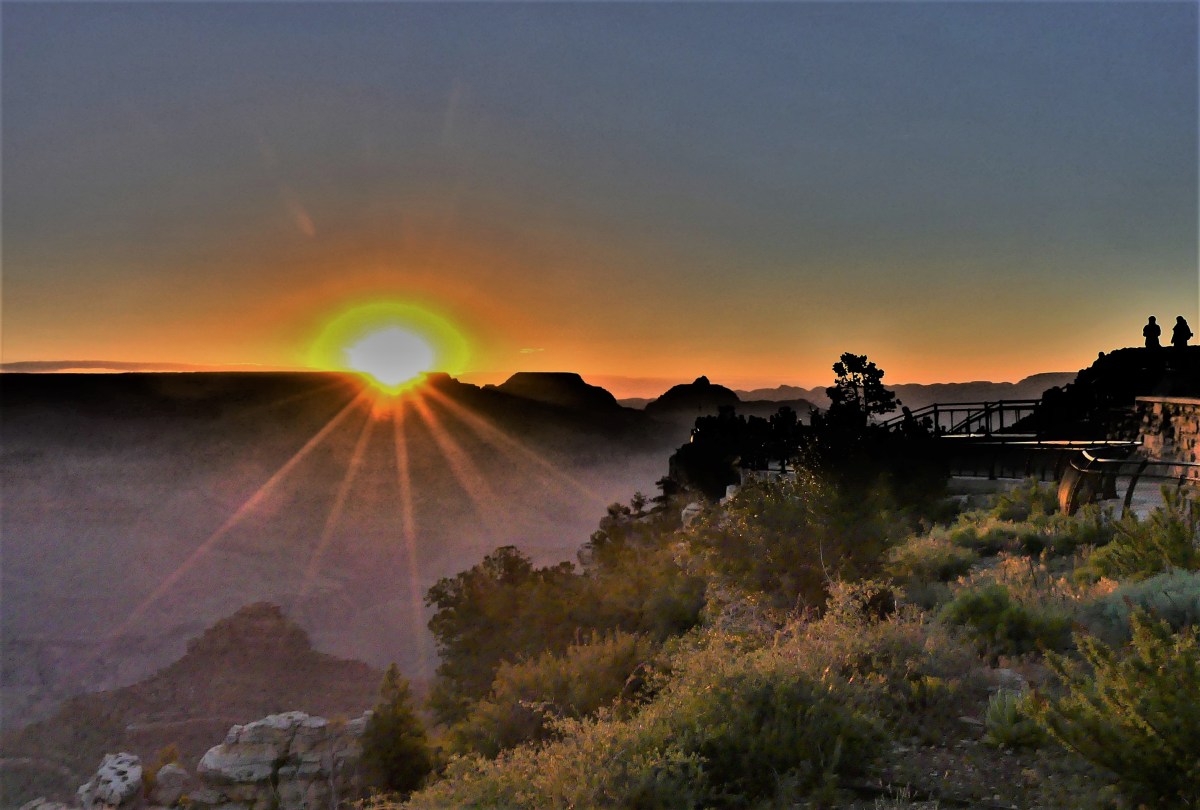
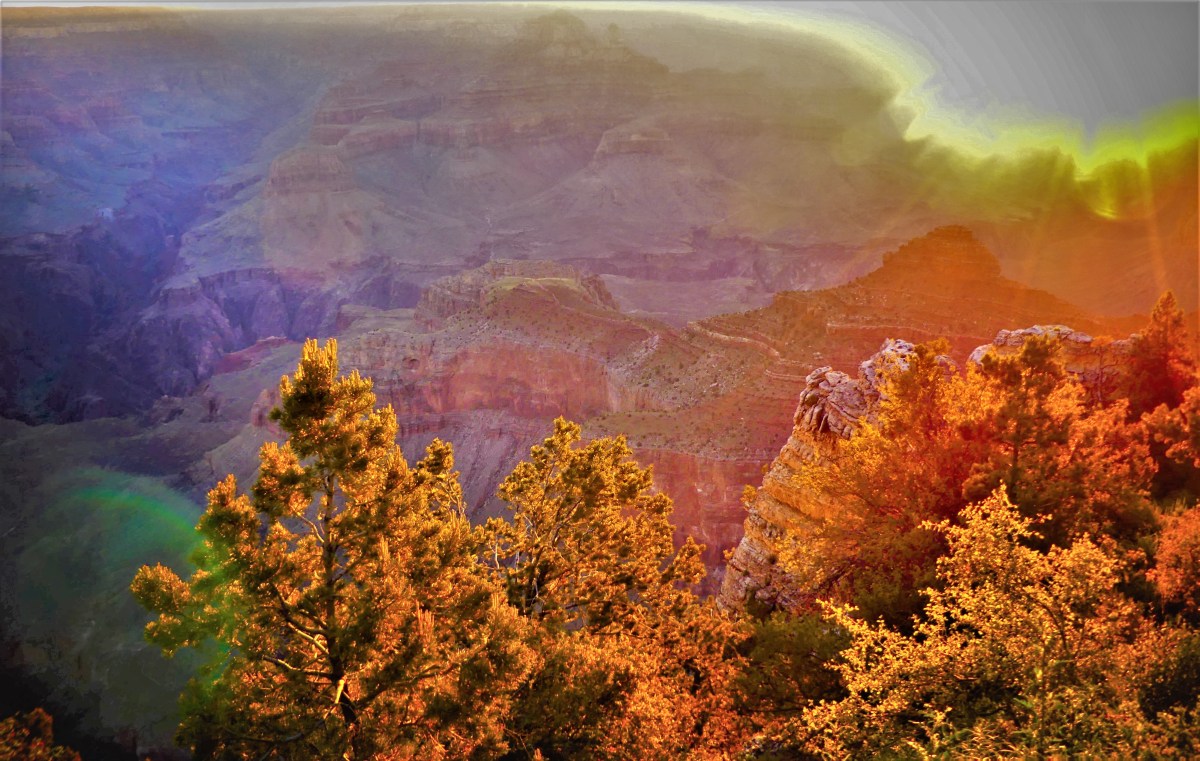
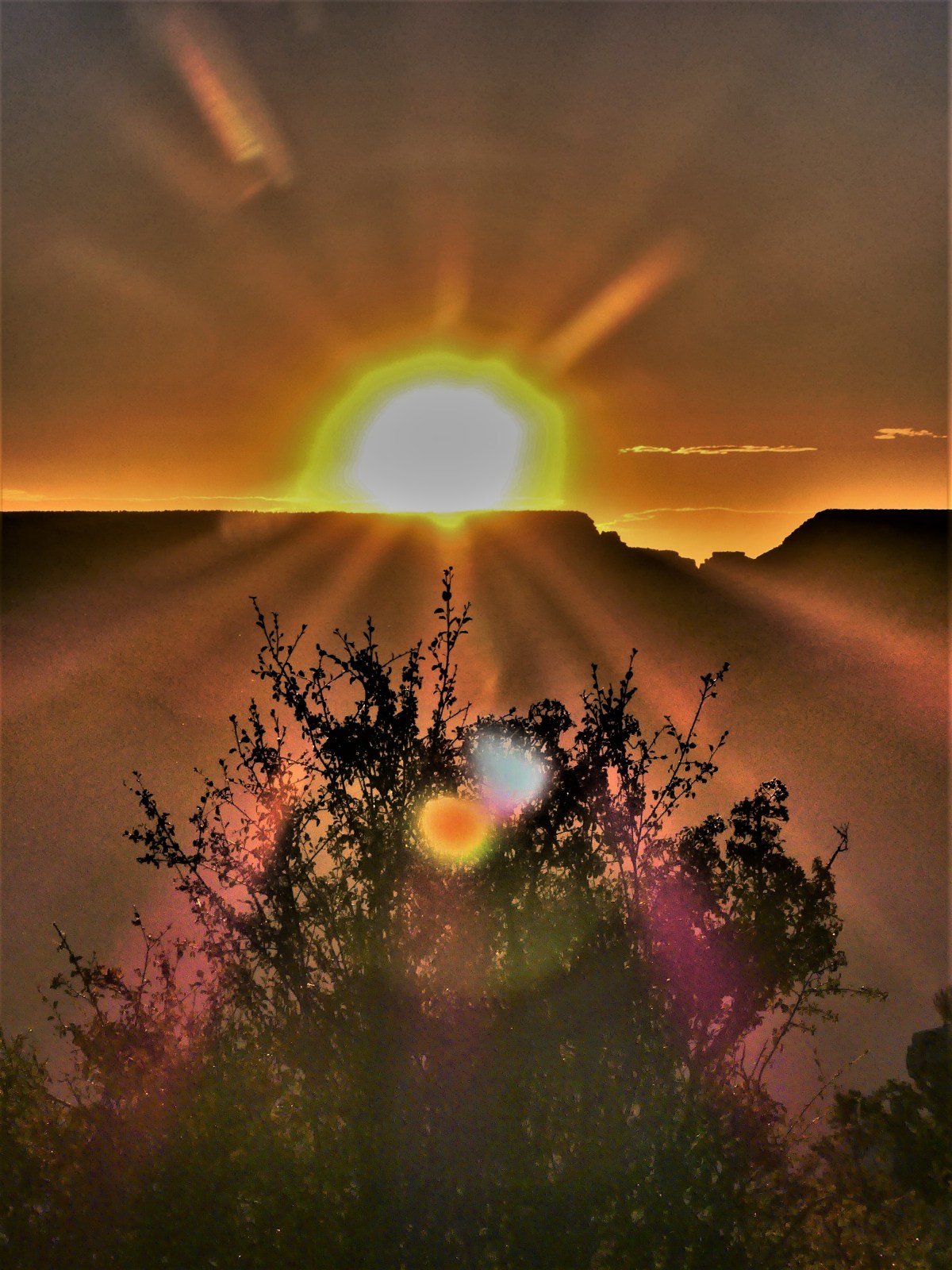
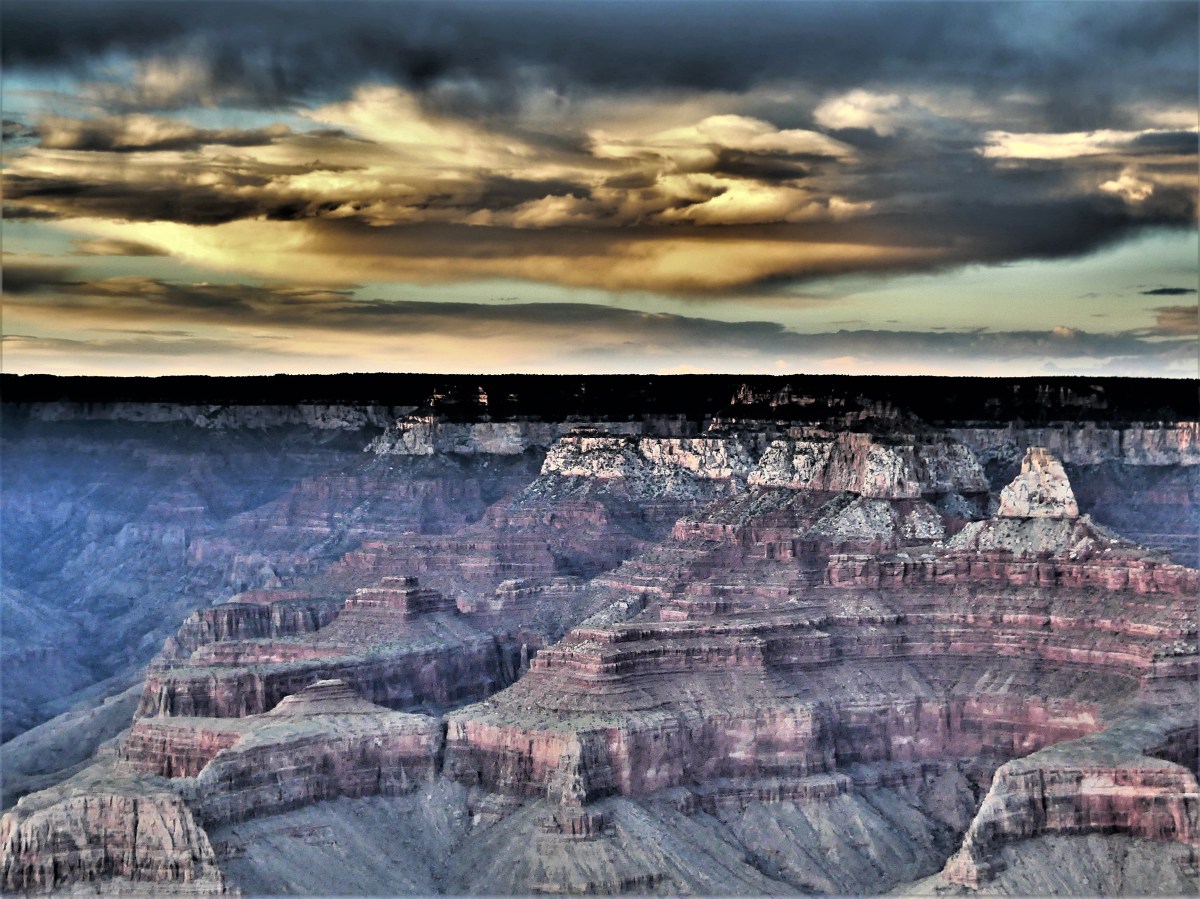
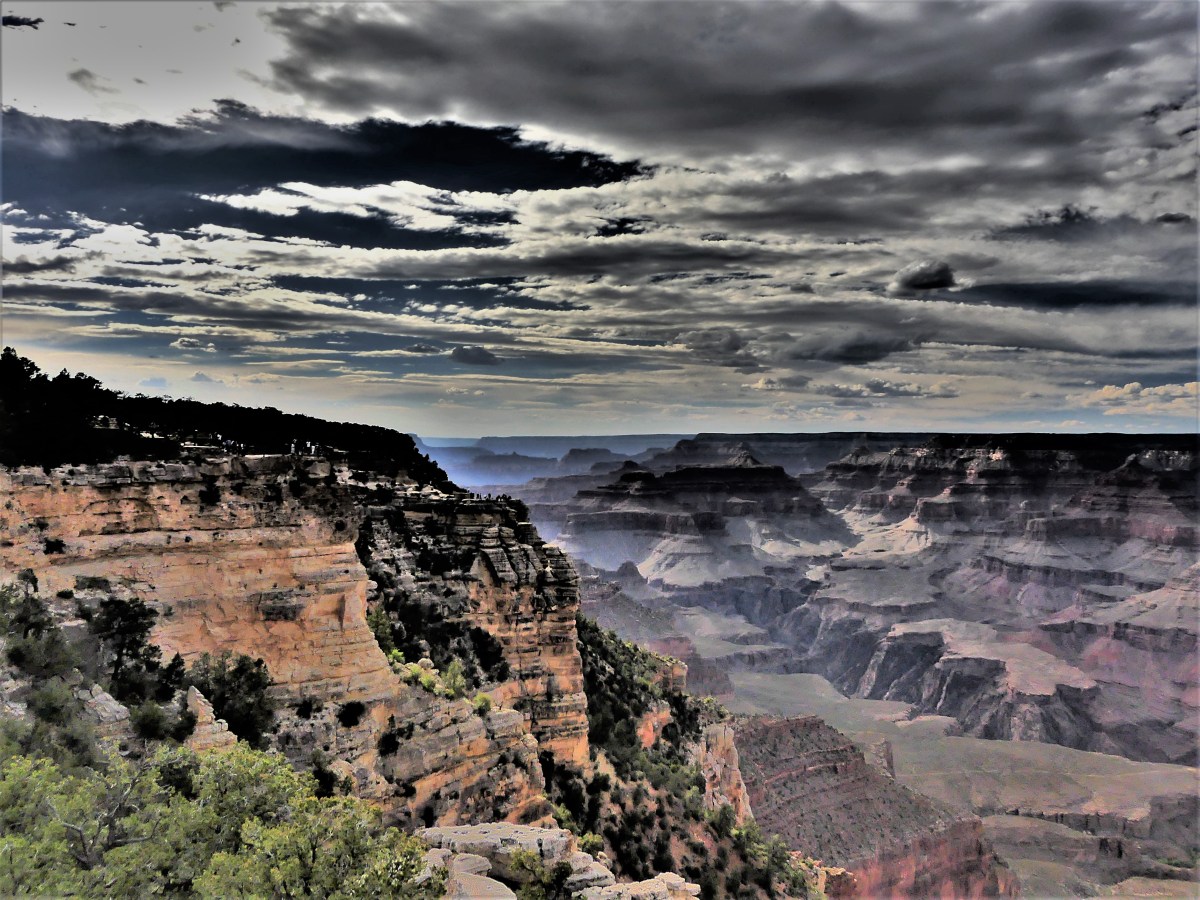
While the scenery is certainly breathtaking, I am more than satisfied to experience the canyon from a less risky perch, and push the photographic envelope in ways that are more within my control–like, capturing a sunrise/sunset sandwich–where different day-parts are recorded–from dawn (at approximately 5:15 am) to dusk (at approximately 7:45 pm).
5:15 am5:20 am5:22 am5:23 am5:24 am5:25 am5:27 am8:00 am Colorado River9:00 am10:00 am11:00 amNoon1st time seeing the Grand CanyonWaiting for the countdownThe big reveal at 2:00 pm5:00 pm7:00 pm7:10 pm7:20 pm7:25 pm7:30 pm7:35 pm7:40 pm (fire-haired face mid-frame)7:45 pm
It’s been 48 hours since arriving home after one year of steadily moving about the country. However, now that I’m physically situated in one place, it seems my mind continues to wander, yearning for places I’ve been or yet to experience. I fear I’m going through wanderlust withdrawal.
The feeling is eerily reminiscent of adjusting to the constant sway aboard a boat–to where I’ve finally gotten my sea legs–yet after docking, the motion of the ocean has robbed me of my equilibrium. Nothing seems normal to me. I still feel adrift, like a bobbing buoy.
Perhaps it’s some sort of jet lag (without the jet), or some kind of Post-Travel Stress Disorder, where my internal GPS continues to send rerouting instructions with every step taken, redirecting my brain and body back to the Airstream presently parked in Lakewood.
Acclimating to everyday life has been challenging, as I’ve yet to re-establish my new old routine, or shake off unsettling circadian rhythms of disorientation. Already, I’ve forgotten which cabinet holds the coffee mugs, or where to find the bottle opener, or what it was like to sleep on a king-sized mattress. Even after unpacking, I’m likely to open the wrong dresser drawer to find my socks.
Of course, it’s only been two days since landing, so I’m certain the confusion will abate and I will eventually adjust to a different way to fill my day without hesitation. But in the meantime, I will travel to my favorite places through my photographs, and dream about the possibilities.
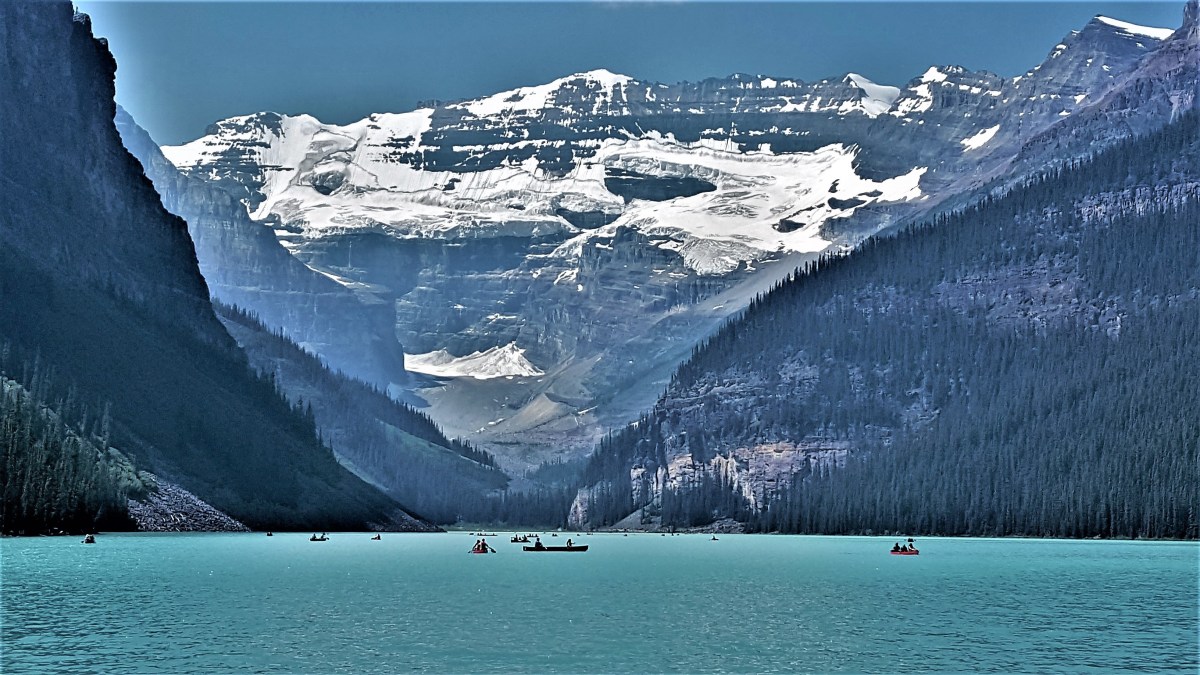
One special destination–among more than a hundred visited in the past year–that still resonates to my core is reliving the beauty of Banff.
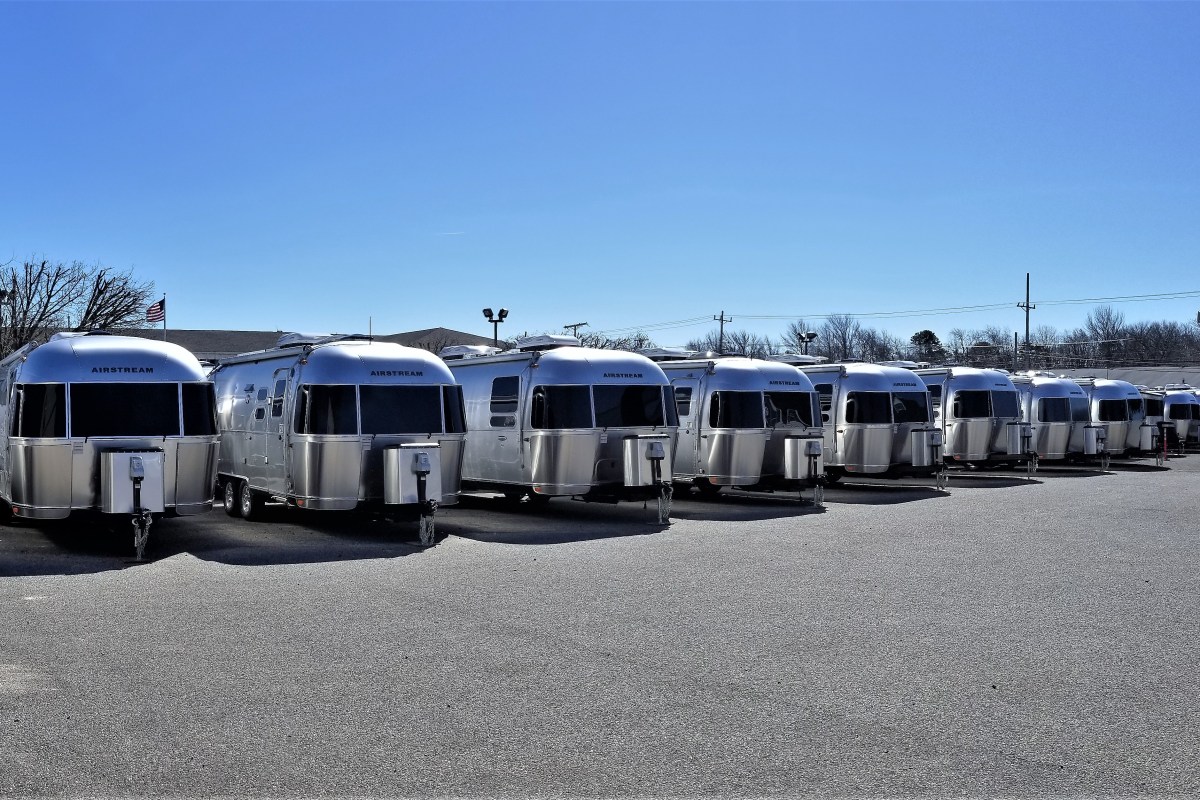
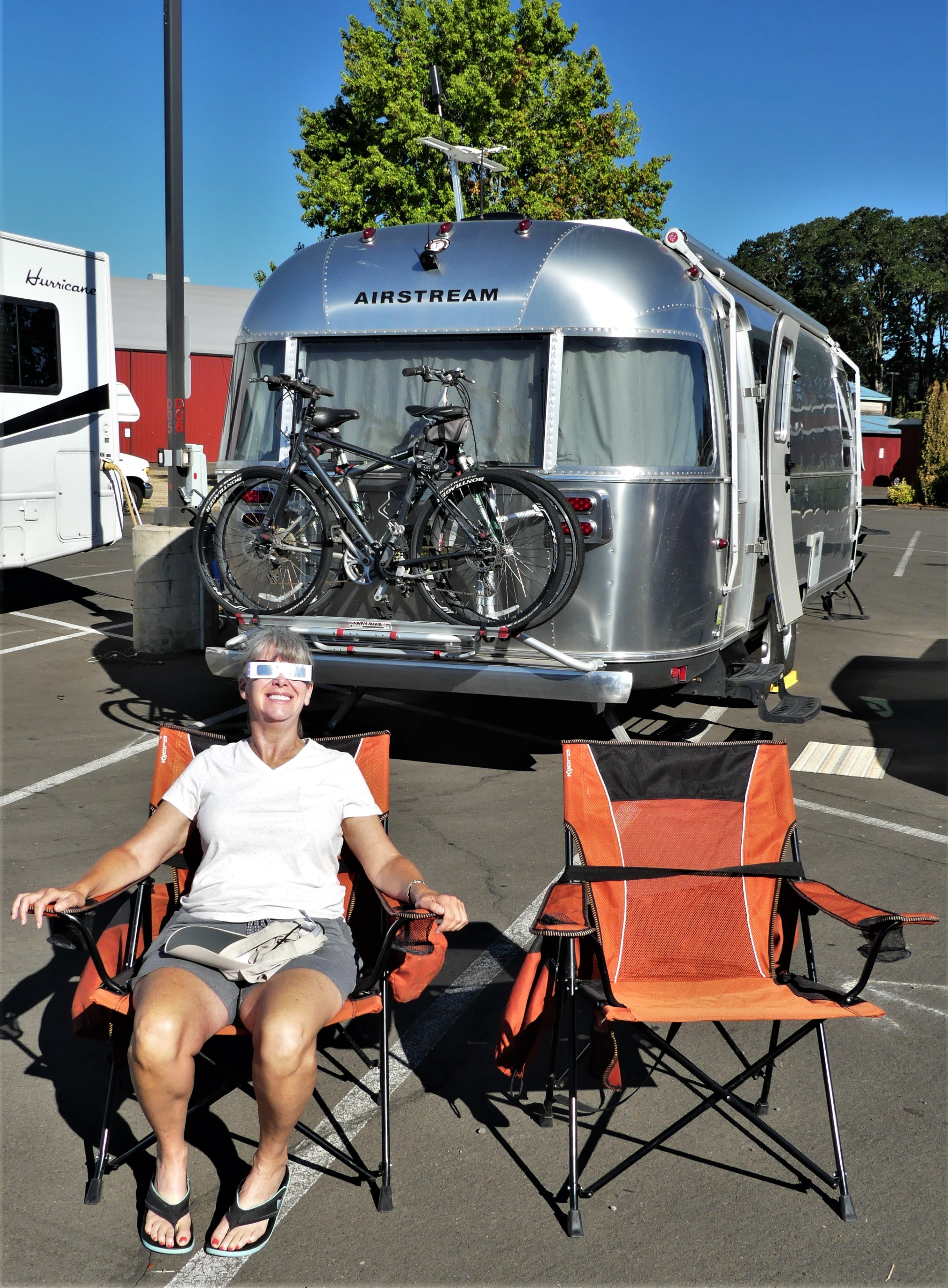
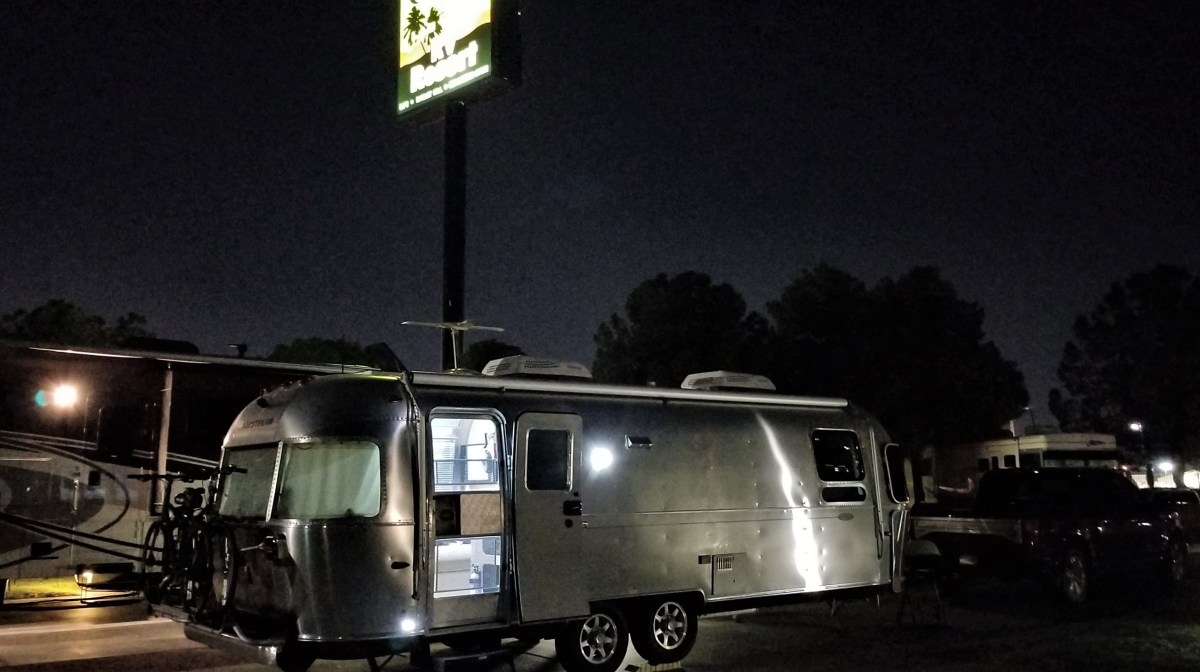
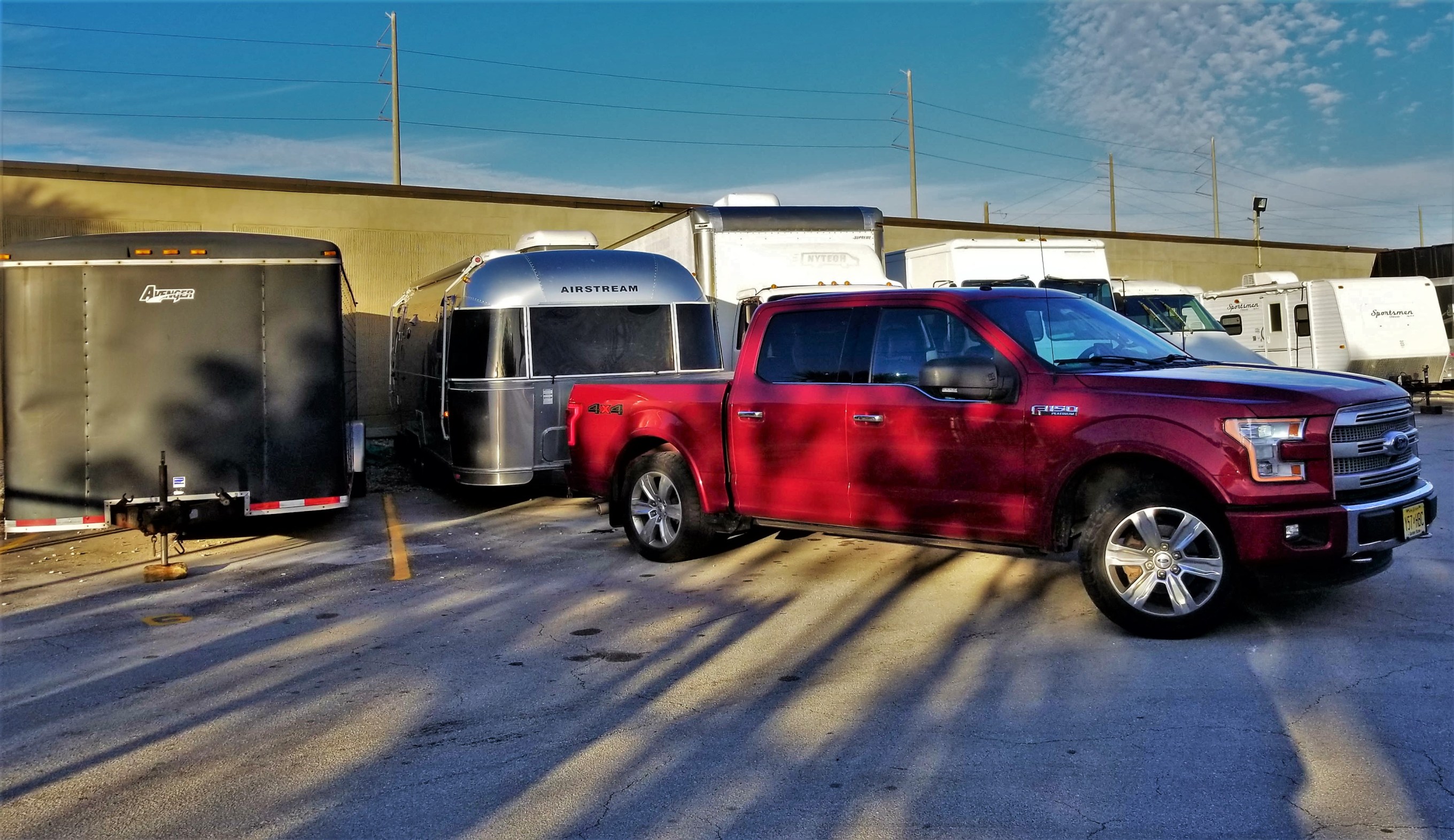
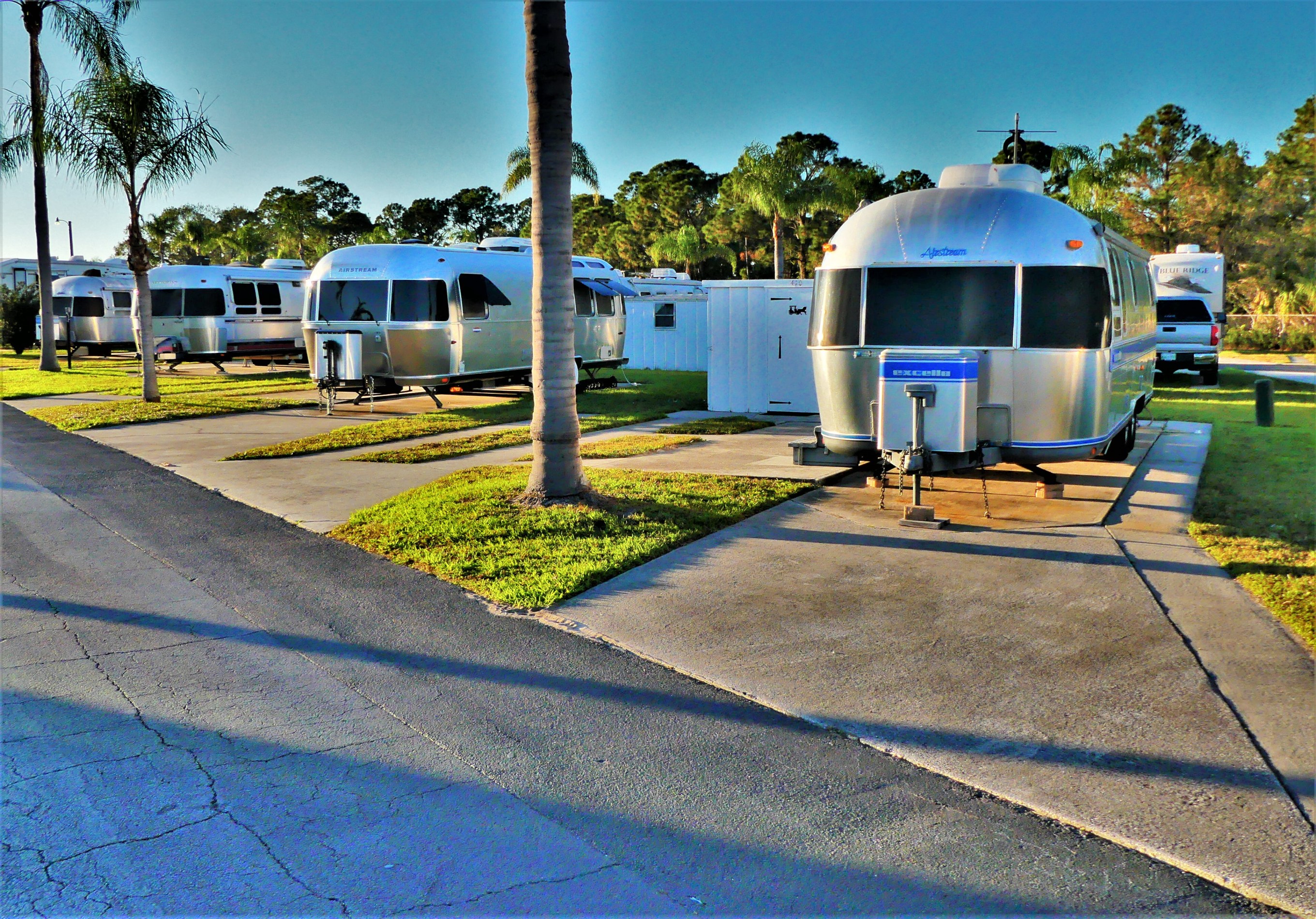
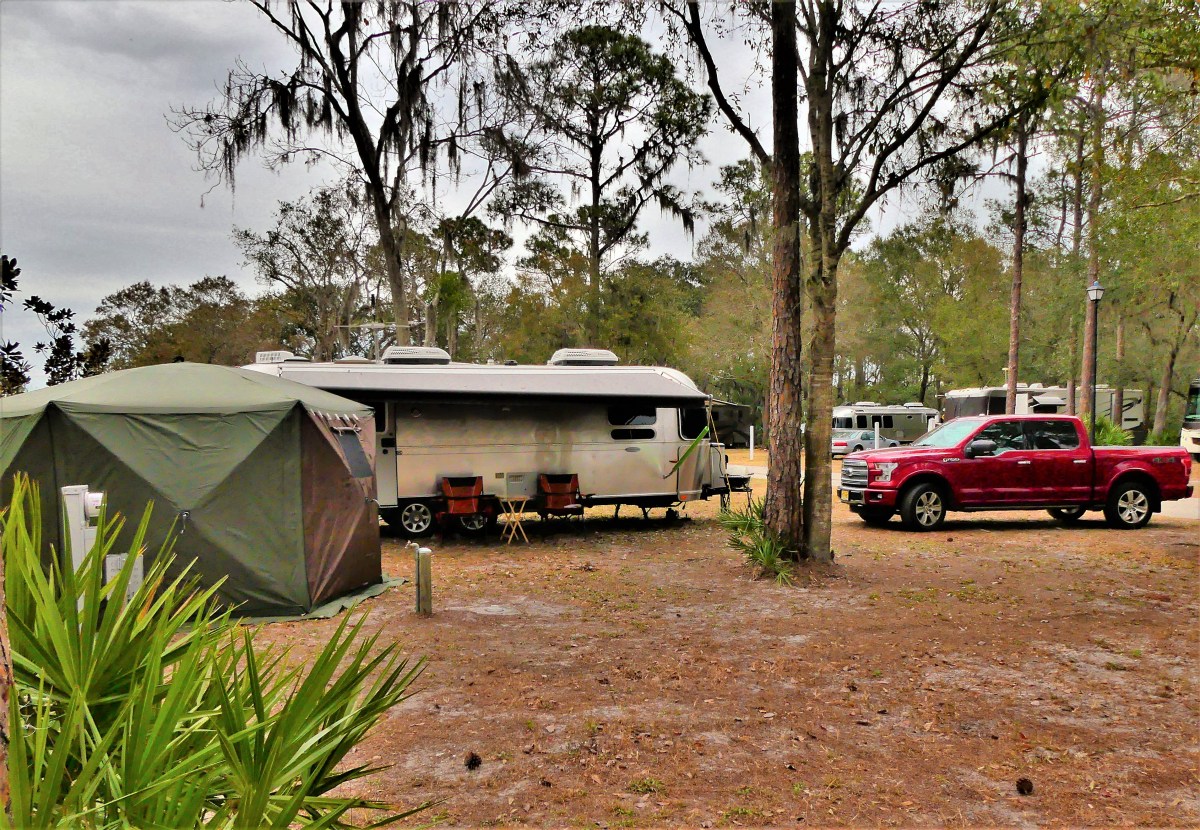
We pulled the Airstream onto Colonial Airstream’s parking lot in Lakewood NJ, on St. Patrick’s Day, ostensibly marking our one-year anniversary Streaming thru America, and my one-year anniversary of blogging with WordPress under the same moniker.
This has been a journey of a lifetime after a lifetime of journeys. It seems that everything I’ve done up until last year’s departure has prepared me for this adventure: as a NYC taxi driver, I honed my driving skills; as a restaurateur, I learned to cook using simple ingredients to create meals with complex flavors; as a camper, I grew up with an appreciation of nature and an affinity for adventure; as a producer, I perfected a perspective for planning and budgeting; as a carpenter, I mastered my mechanical skills; and as a special educator, I learned how to gain acceptance with the many special people we’ve met along the way.
This has also been a trip of numbers. As road warriors, Leah and I have traveled to 127 destinations: covering a total of 44,600 miles (5,500 flying miles) to thirty-six U.S. States; one Mexican State (Quintana Roo); and four Canadian Provinces (Manitoba, Saskatchewan, Alberta, and British Columbia).
Cost-wise, Leah acted as bursar for the trip, and took responsibility for all data entry into a categorized spreadsheet. Using round numbers, our largest expense was campground fees at nearly $13,000. We stayed at a smattering of National Parks (only because gaining online reservations are fiercely contested up to a year in advance), a few State Parks, a handful of Provincial Parks, some County and City Parks, predominantly private RV parks (many Good Sam and KOA affiliates), and an occasional Walmart parking lot when we were transitioning between longer distances. As a rule, we rarely travelled further than a tankful of gas, or the rough equivalent of 400 miles.
Entertainment was our second leading expense at approximately $10,000, which covered films, concerts, shows, tours, park fees, and ample opportunities for sampling the best food of the area, from fine dining to dive bars.
Next, we spent nearly $8,000 purchasing food and groceries–including paper products, personal hygiene, and liquor–with the lion’s share spent at Walmart and Costco.
And our last largest expense was for gasoline and liquid propane, which ran us close to $8000. We made 115 trips to the pump for 3300 gallons of gas, yielding an average of 11.8 miles per gallon from coast to coast to coast, while towing mileage topped out at 10.1 MPG.
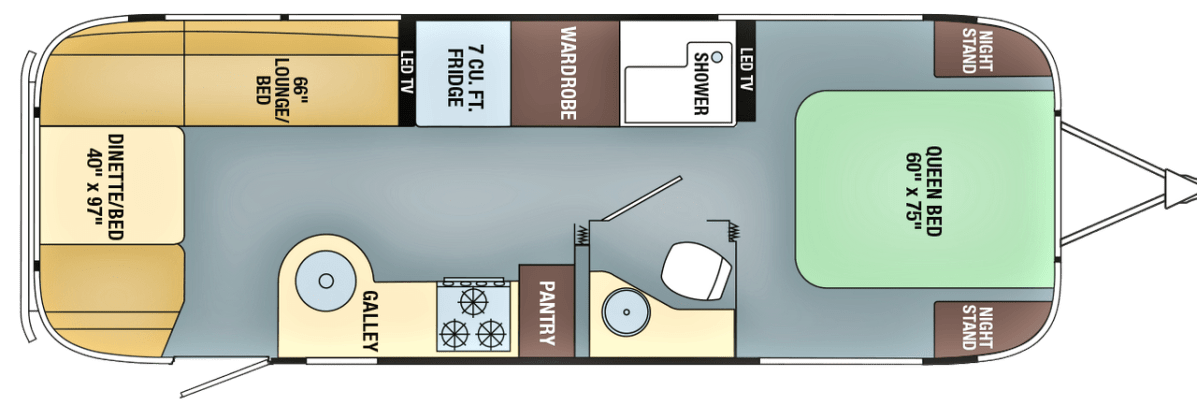
Living aboard the Airstream for a year was also an exercise in living with less. At 240 square feet from stem to stern…
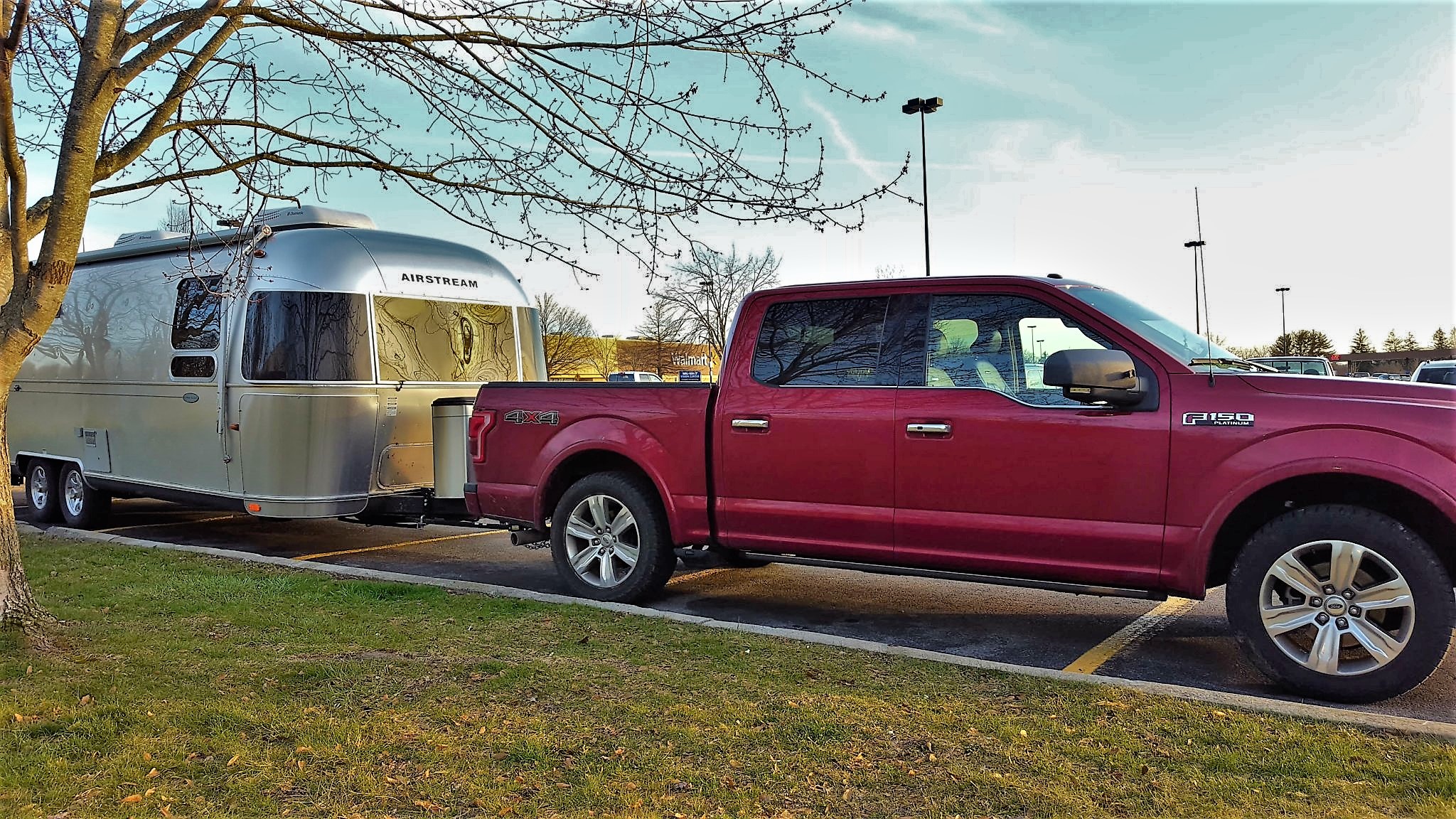
and cargo limited to a folded rear seat and 52.8 cu. ft. of storage behind the cab of our Ford F-150 pickup…
we learned to live efficiently, but never uncomfortably.
Leah and I scaled down to a small wardrobe of layering, using a combination of casual sportswear, appropriate outerwear and a wide variety of outdoor footwear to address most weather conditions.
The galley held two pots, two pans, two mix bowls, and Corel for four; a drawer of utensils and a drawer full of cooking and kitchen gadgets; a traditional assortment of spices and herbs; one presspot (mine), one two-cup percolator (Leah’s) and two coffee mugs; a tiny toaster, a hand mixer, a built-in microwave, a compact vacuum, and a VitaMix–my biggest indulgence for emergency frozen margaritas.
Electronics included: two mounted LED TVs, two tablets, one laptop, a color compact HP printer, a Kindle, a pair of UE Booms, Jaybird wireless earbuds, a Lumix DMZ-FZ300 for photography, and a tangle of cables and charging accessories.
The truck bed was home to a couple of stadium chairs, a CLAM screen enclosure, a 2000-Watt Honda generator, a hefty tool chest, and a portable Weber grill.
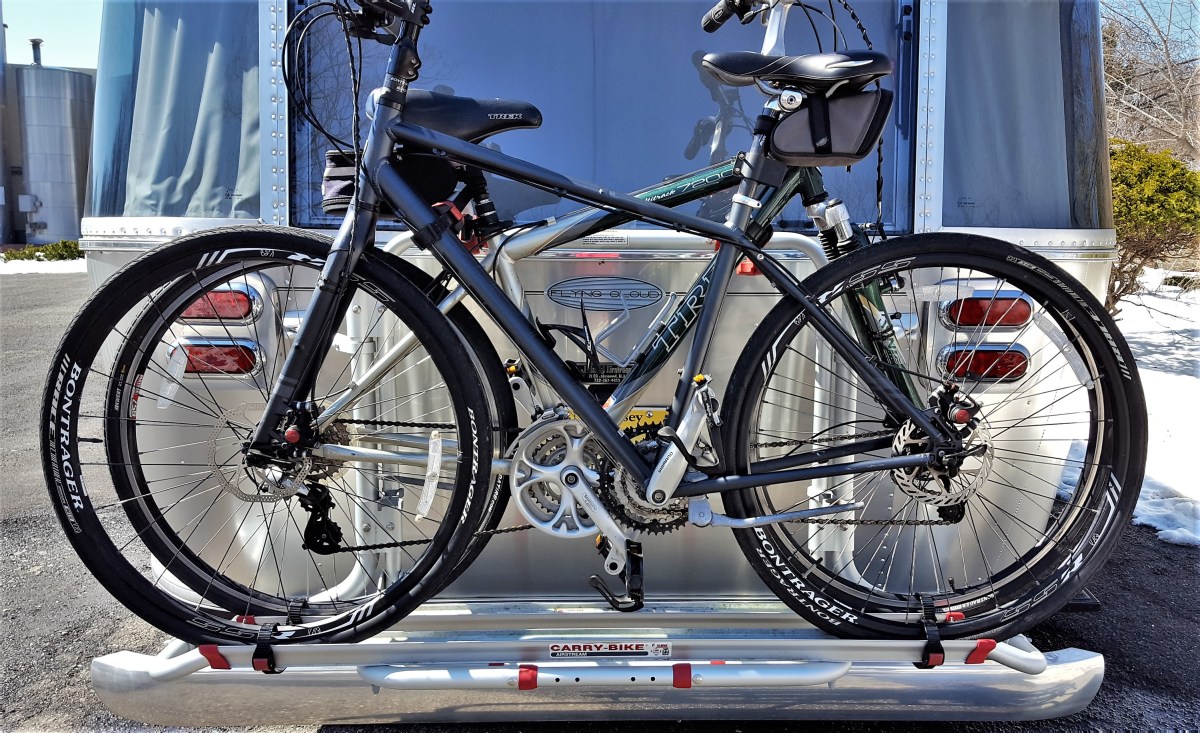
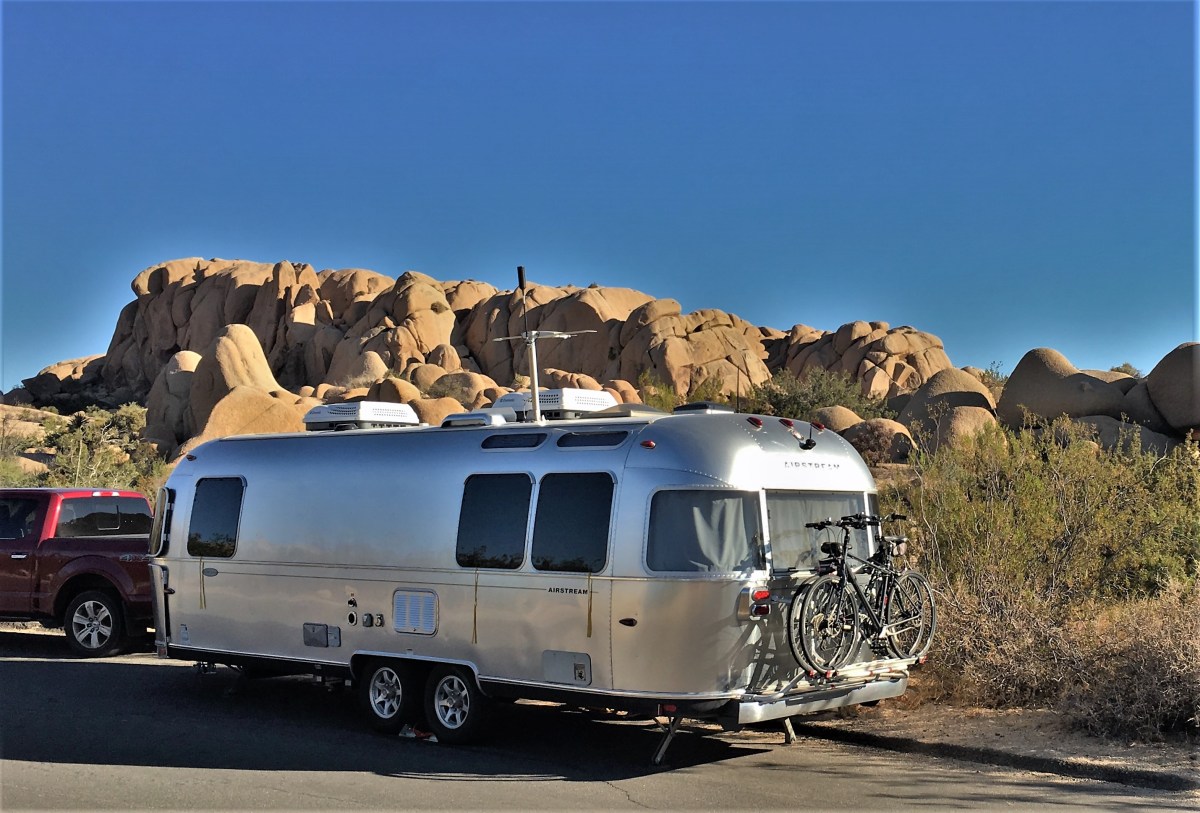
Our bicycles clung to the backside of the Airstream, tied to a Fiamma rack.
Getting along for 365 days was our biggest experiment, and a wild card for this trip’s success. While there was no denying our compatibility, we would often joke if we would still be smiling and talking to each other by day 365.
Our roles were defined early on, seemingly divided along gender lines: I did the routing, navigation and driving, the setups and breakdowns at RV sites, and all the general maintenance; while Leah acted as cleaning commando (inside and out) and laundry lieutenant. Invariably, Leah prepared a simple breakfast and packed a light lunch, while I played chef de cuisine for dinner.
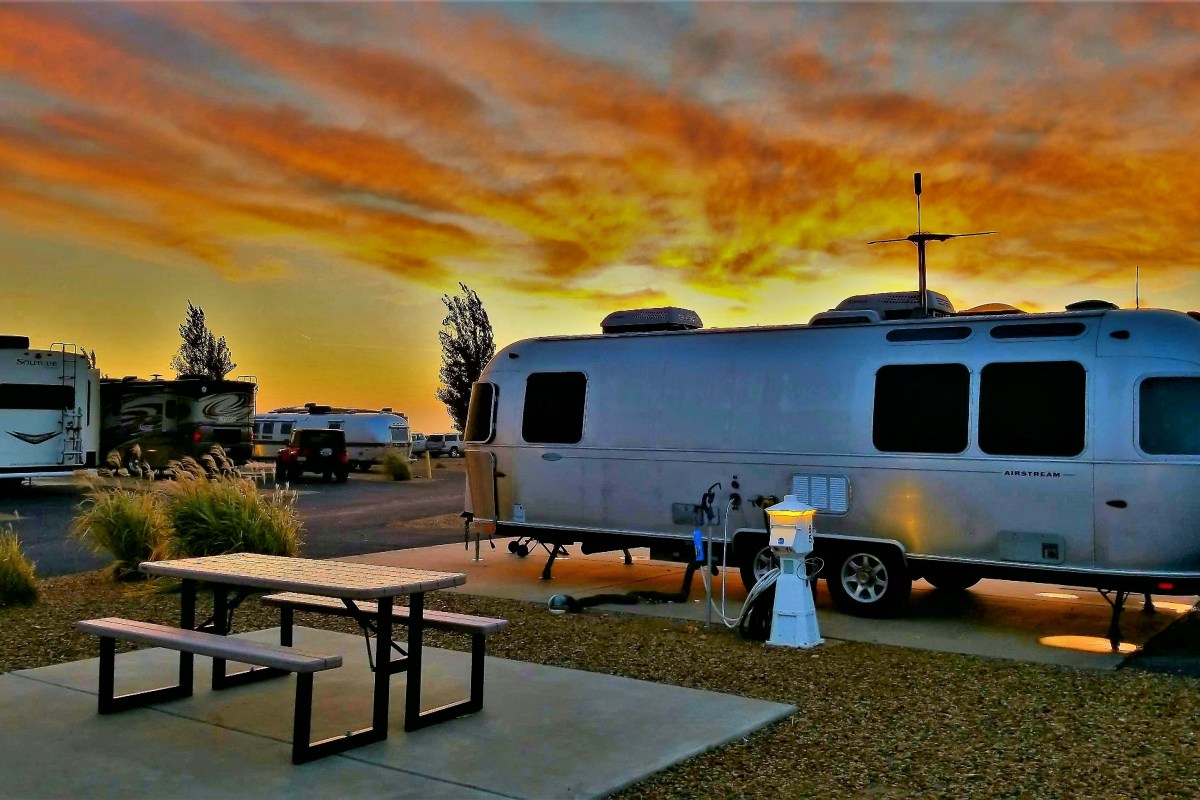
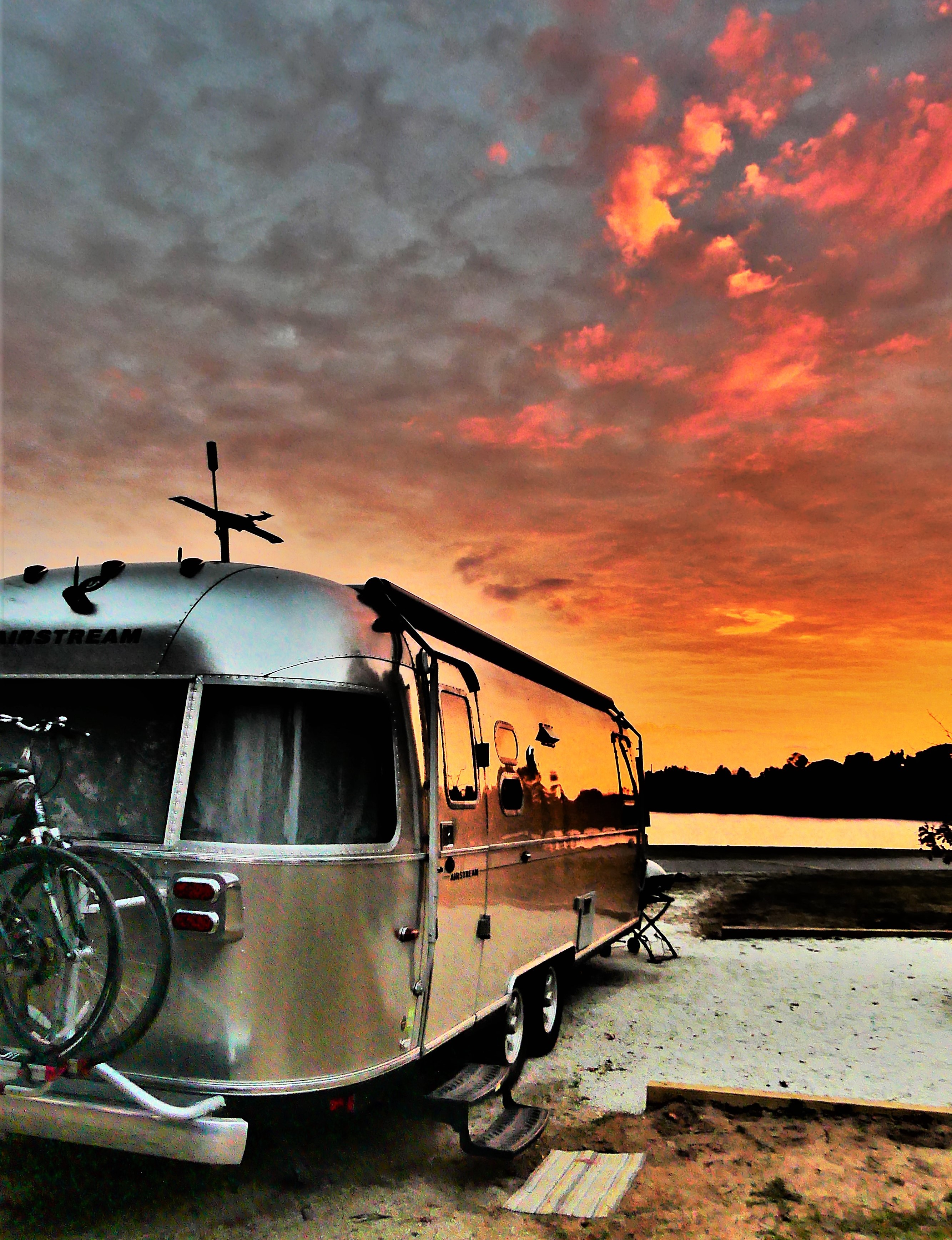
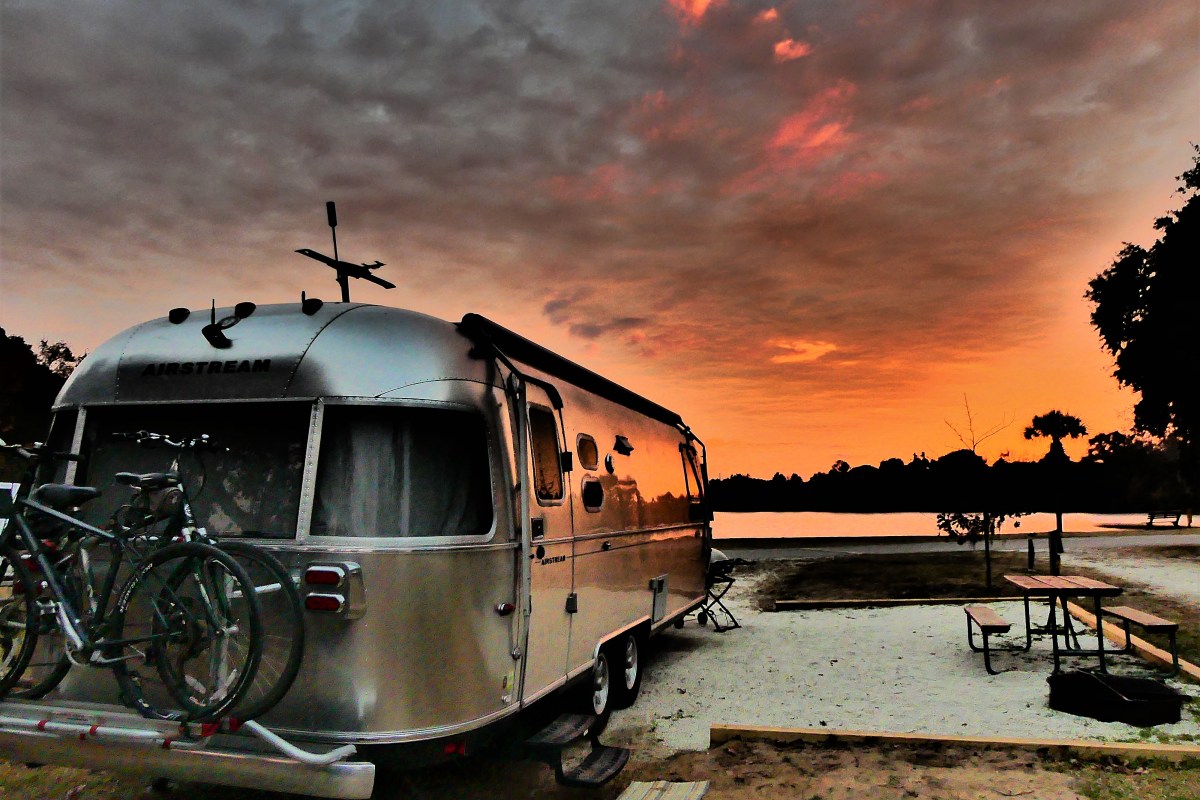
Although our living quarters were tight, our door usually opened onto something spectacular, from sunrises…
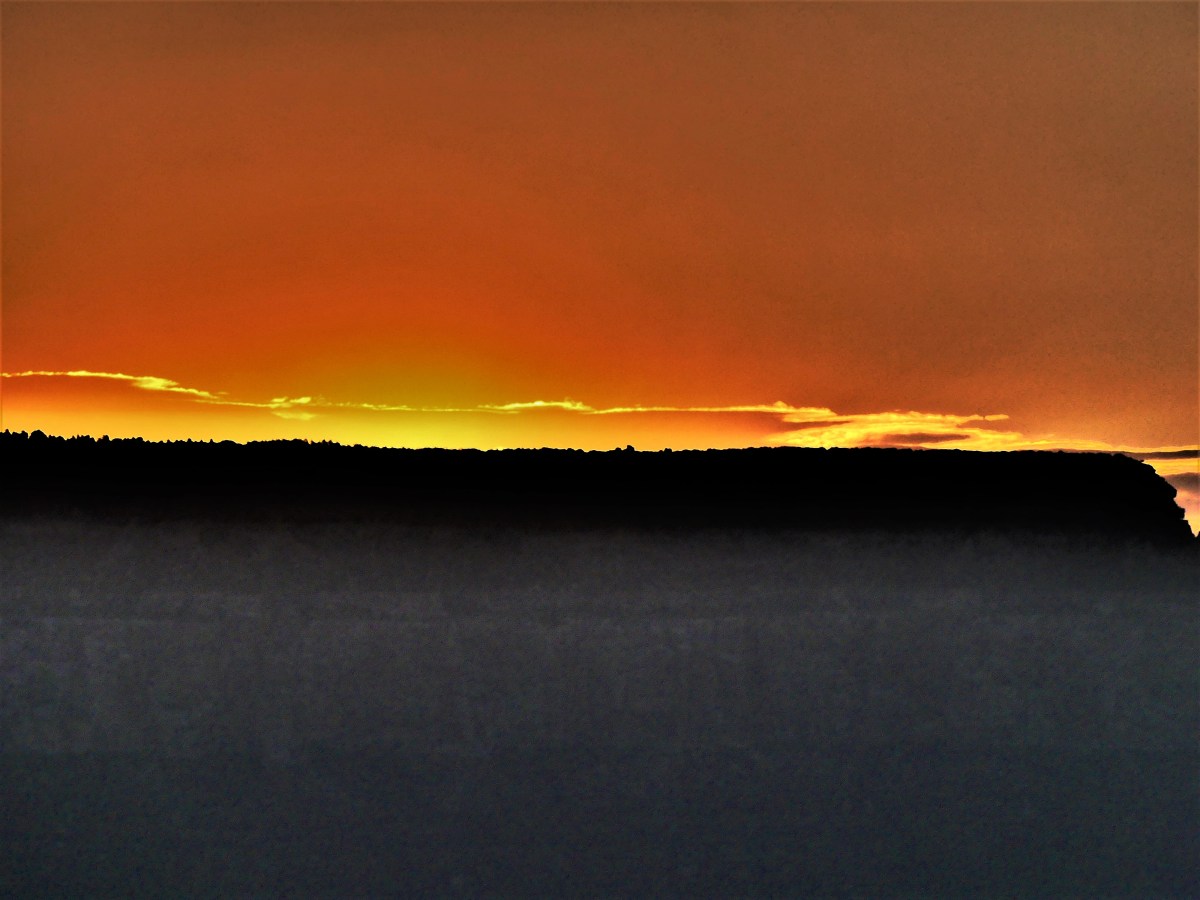
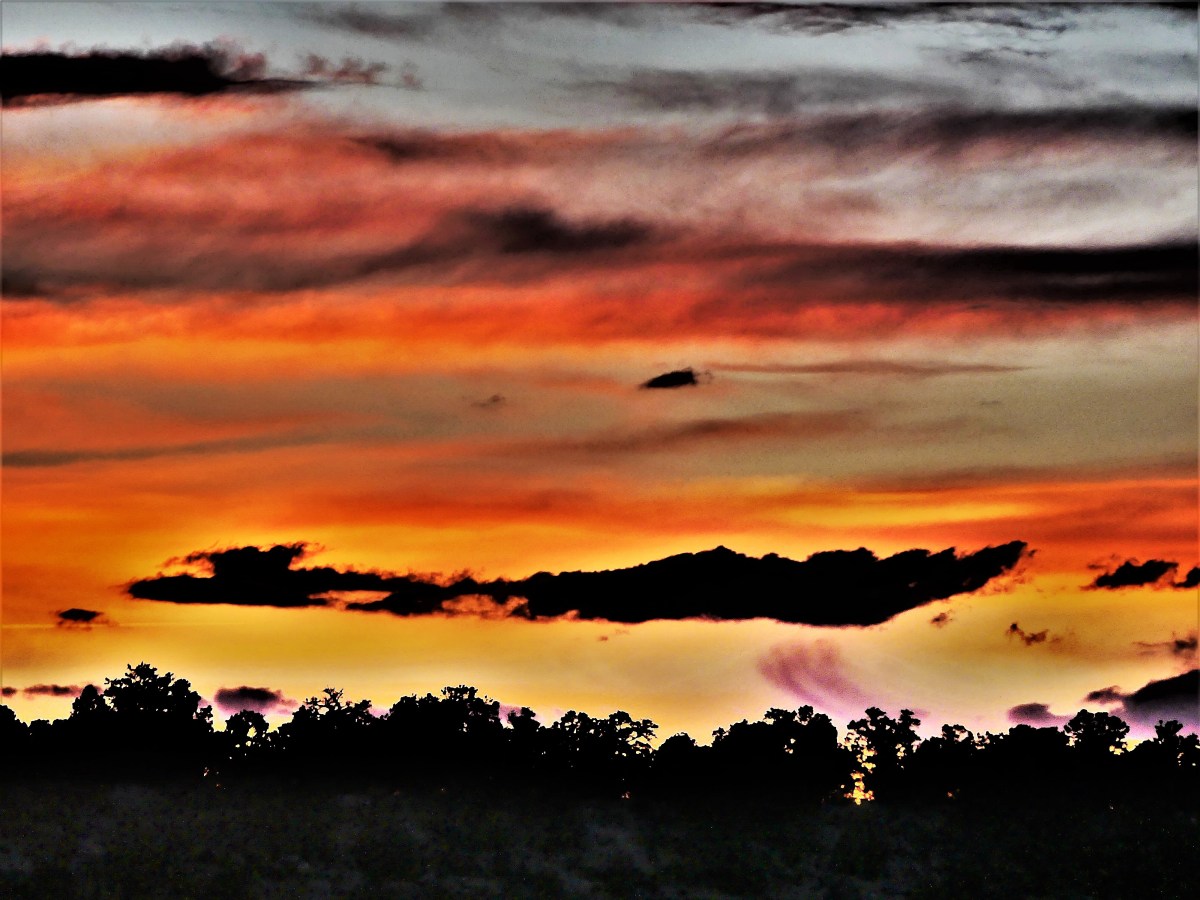
to sunsets…
so most of days were spent exploring the extraordinary.
We brought along a cribbage board and backgammon set, thinking that when our conversation ran dry, we could always resort to games, but when it was the two of us together lounging in our lair, we either stretched out along the dinette streaming Netflix when internet allowed, or sought alone time at opposite ends of the trailer, separated by a sliding screen or a swinging lavatory door.
Our queenish-sized platform bed was roomy and comfy. And the only times we slept apart was for five days when I was fighting the flu. Otherwise, our sleeping cycles alternated between retiring together, or more often than not, Leah retiring early while I night-owled to edit photography du jour, or posted to my blog.
Although this blog is by no means the end, it has been a means to an end. Streaming thru America has given me a springboard to dive into my desire to write consistently for a audience bigger than one, and a jump-start to reinvigorating my passion for photography. Combining my writing and photography in a travel blog has been reaffirming and therapeutic, and the motivation I needed to pump out 160 posts of 100,000 words and 2800 photos along the way.
What started as a forum for family and friends has grown organically to a following of 1900 plus fans through WordPress and social media, with viewers from 140 countries along for the ride. I am awed and humbled every day that people from all over world find value in my words and pictures. And I am determined to keep going.
Long before we started out, Leah had already decided on our exit strategy–that once we’d completed our trip, and our Airstream had served its purpose, we’d put it on the selling block. But I had a different vision–that this trip would lay the foundation for future trips around the continent. While it would never be as epic as this particular journey, I could nonetheless foresee regional trips to faraway fields and streams for a month or two or three.
However, after shoving off and putting hundreds of miles behind us, the new and scary gave way to familiar and fearless, and Leah was hooked.
As it happens, there were so many destinations that we short-changed in favor of keeping the whirlwind spinning (see An Olympian Apology), not to mention sections of the country that we bypassed all together, that today we feel compelled to prepare preliminary plans to patch the holes in our past itinerary.
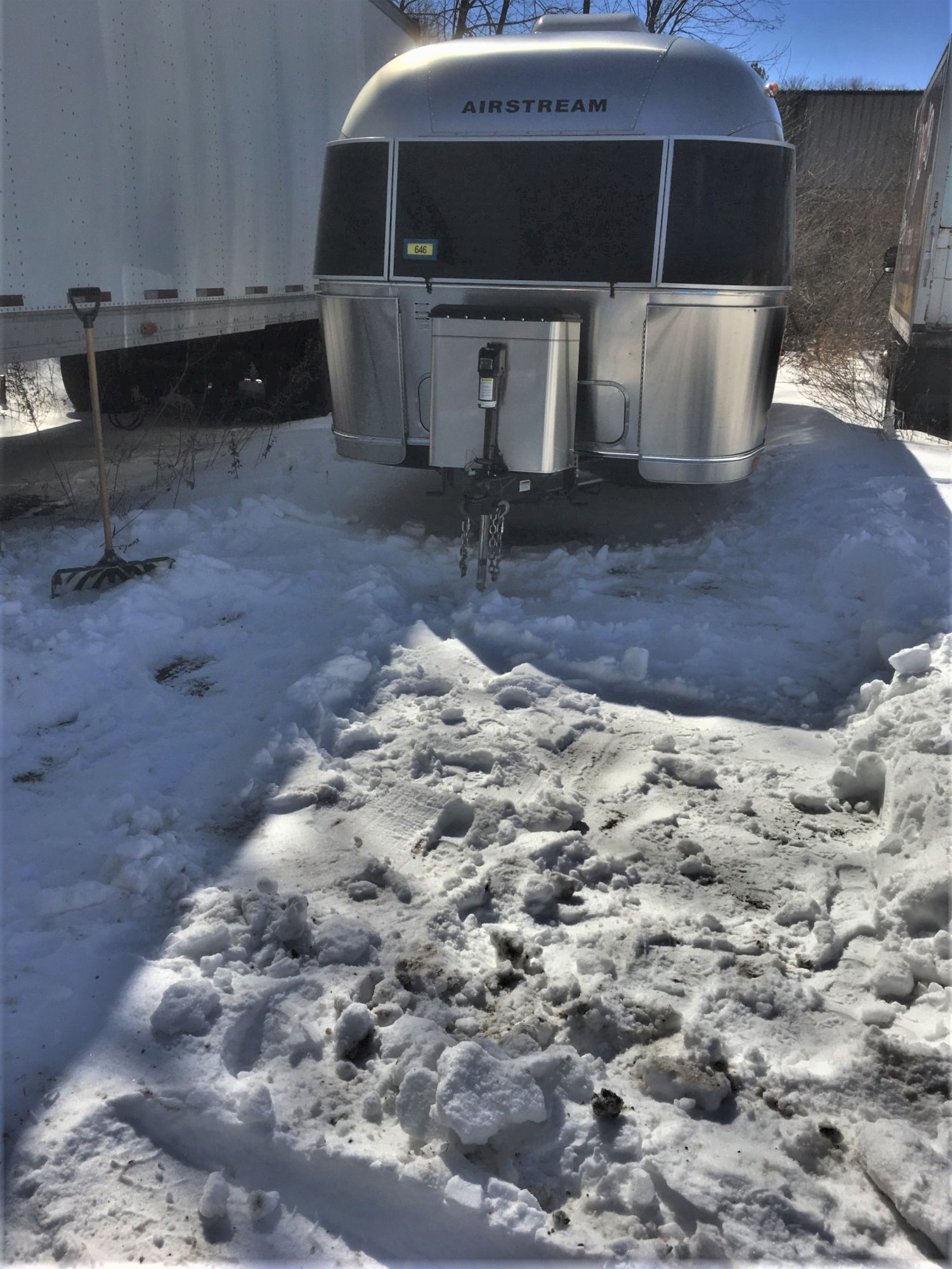
For now, the Airstream sits in the dealer’s lot awaiting its spring maintenance, although the fourth nor’easter forecasted to hit this area in as many weeks makes us yearn for the Texas heat spell we endured last April (see “We’re on the Road to Nowhere”).
When we return to Towaco, we’ll have a house to sell and a household to pack away for our anticipated move to St. Augustine (see Finally!). Then, in a few months, we’ll recapture the glory of living as seasoned road warriors, as we savor the feeling of hauling our reconditioned Airstream through the Shenandoah Valley and over the Blue Ridge Mountains to a long-term storage solution in Charlotte NC.
And before too long, it will be time to hitch up the Airstream like old times, and follow the road on a new course and a new adventure.
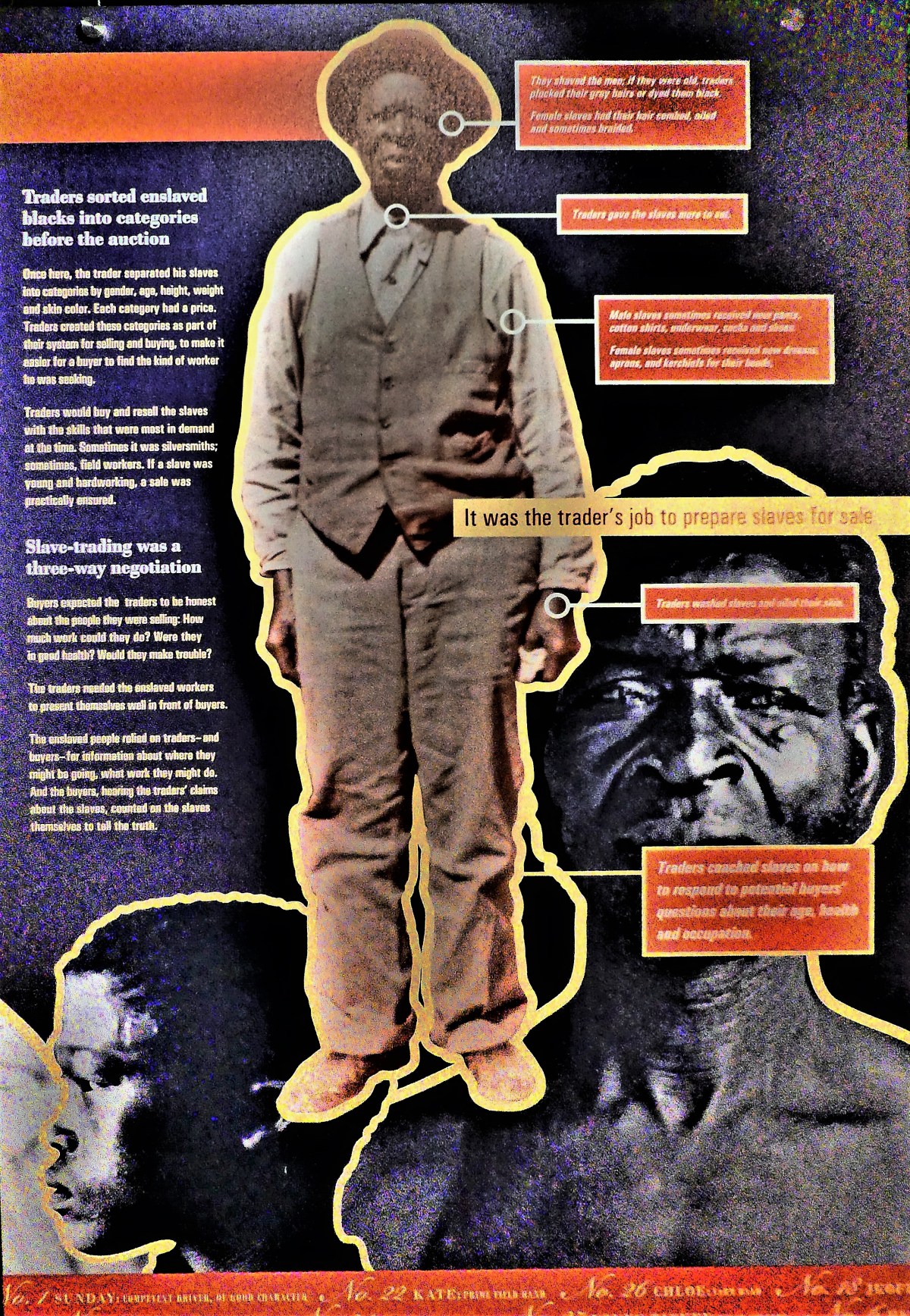
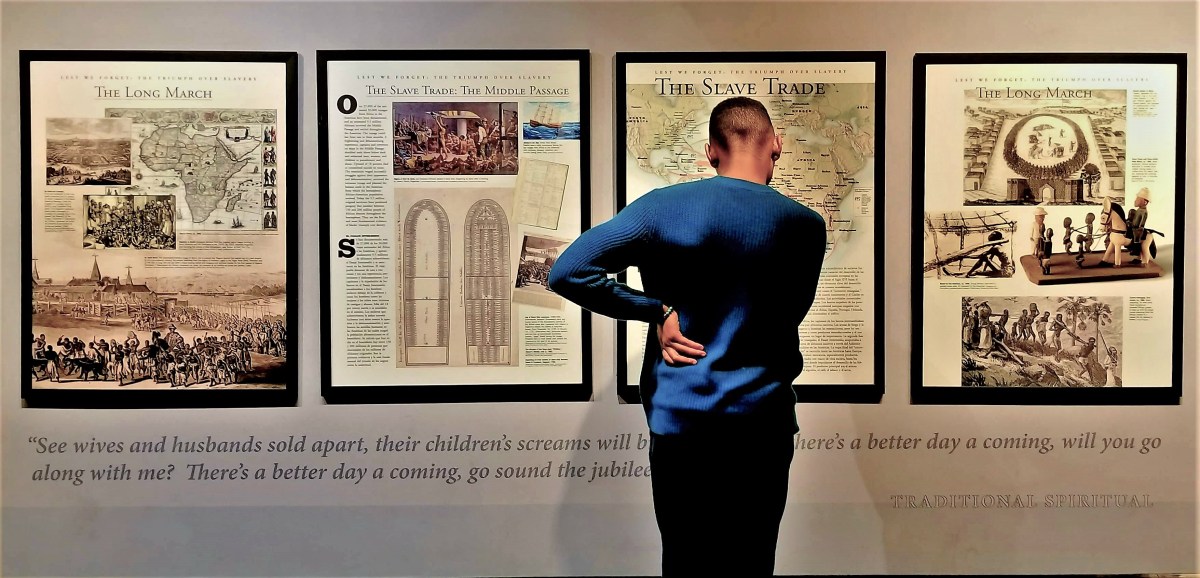
and stripped naked of everything except the courage they needed to accept their new fate.
As families in West Africa, they relied on each other, but far from home on distant shores those bonds were broken. Husbands and wives, sons and daughters, brothers and sisters were separated and independently prepped for sale, bringing new meaning to groomedfor success.
The slave mart in Charleston, was the go-to destination…
for traders to wrangle the best price,
as human beings resigned themselves to their new owners and an unfathomable situation.
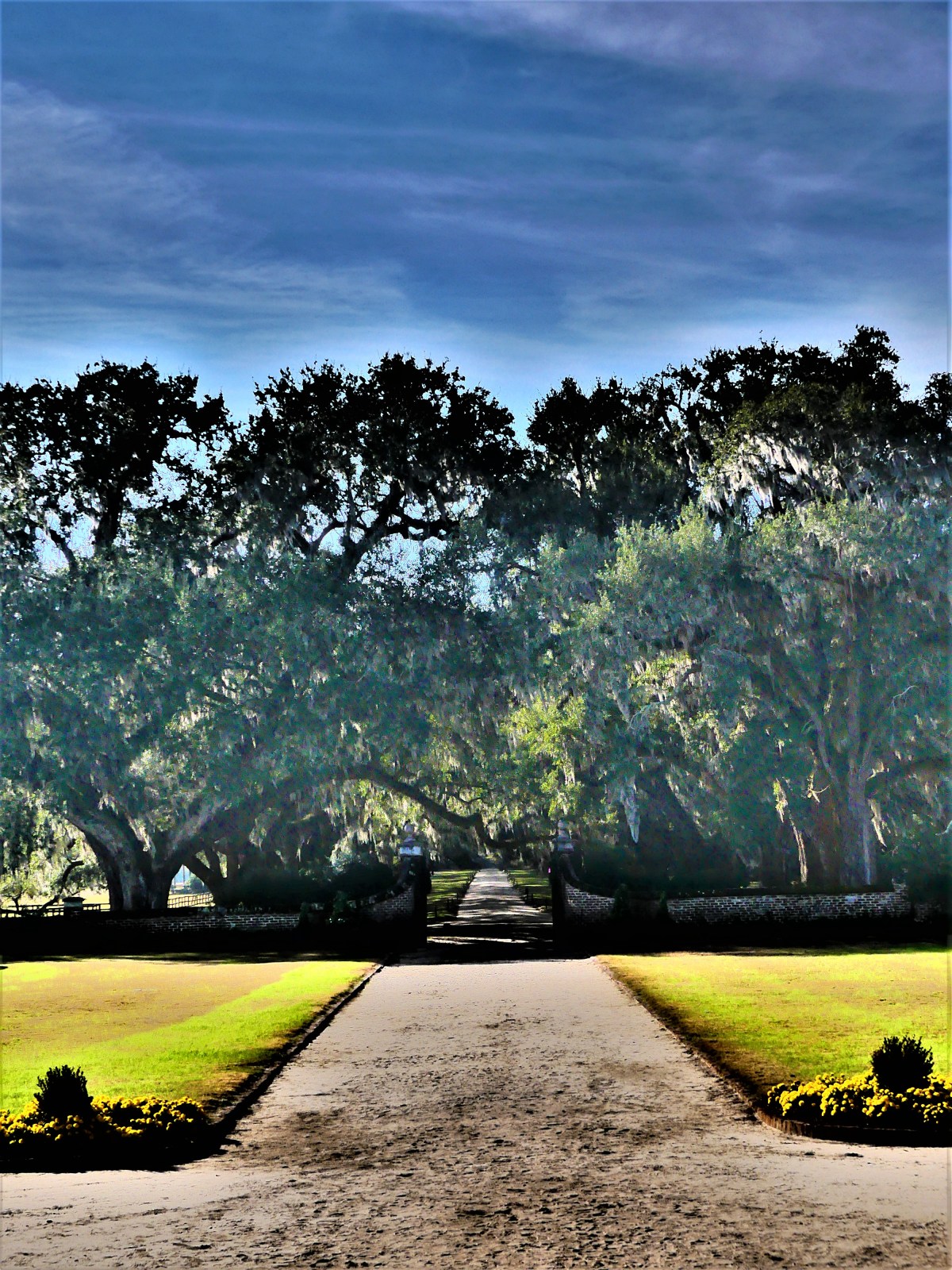
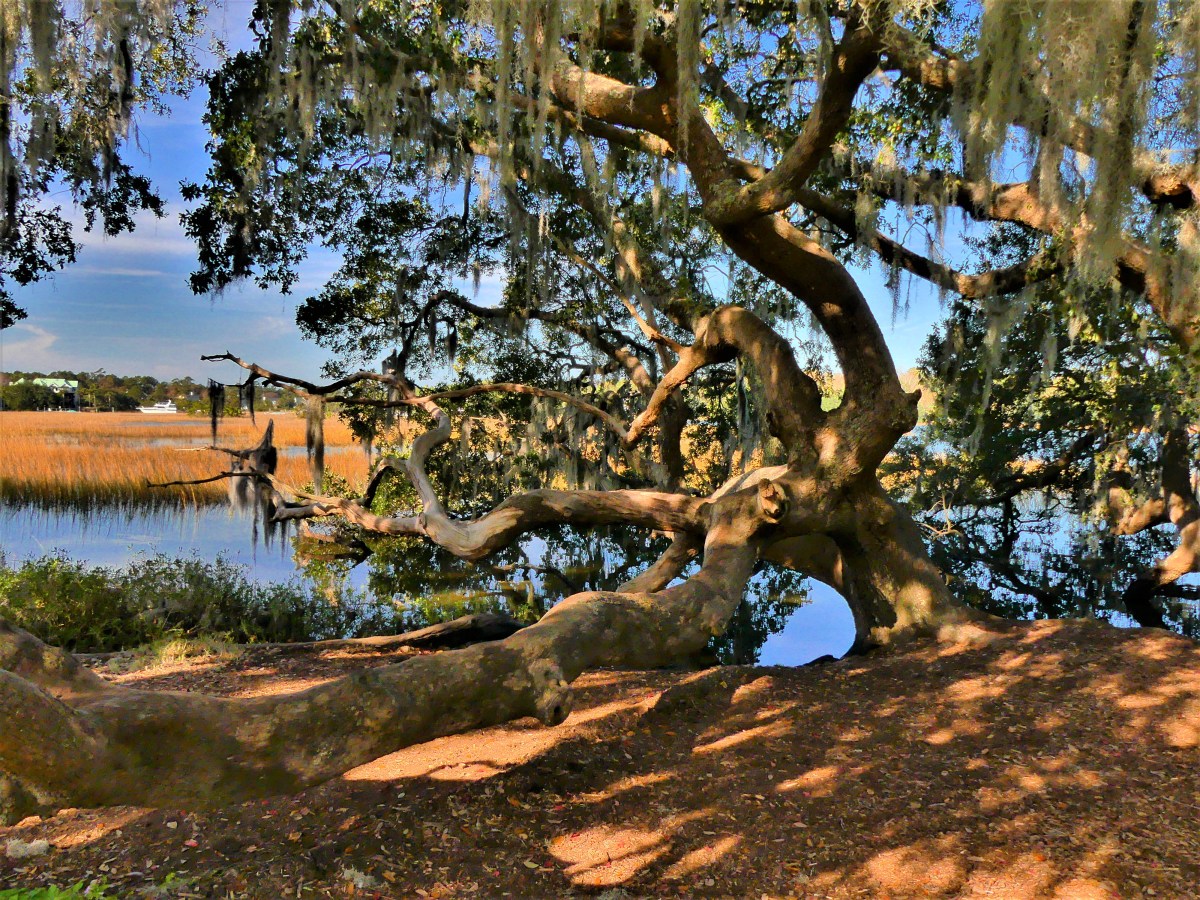
Imagine the shock and despair they must have felt, rolling down the Avenue of Oaks at Boone Hall Plantation for the first time in slave carts,
wondering about the cluster of buildings by the side of the road…
that would become their future shelter…
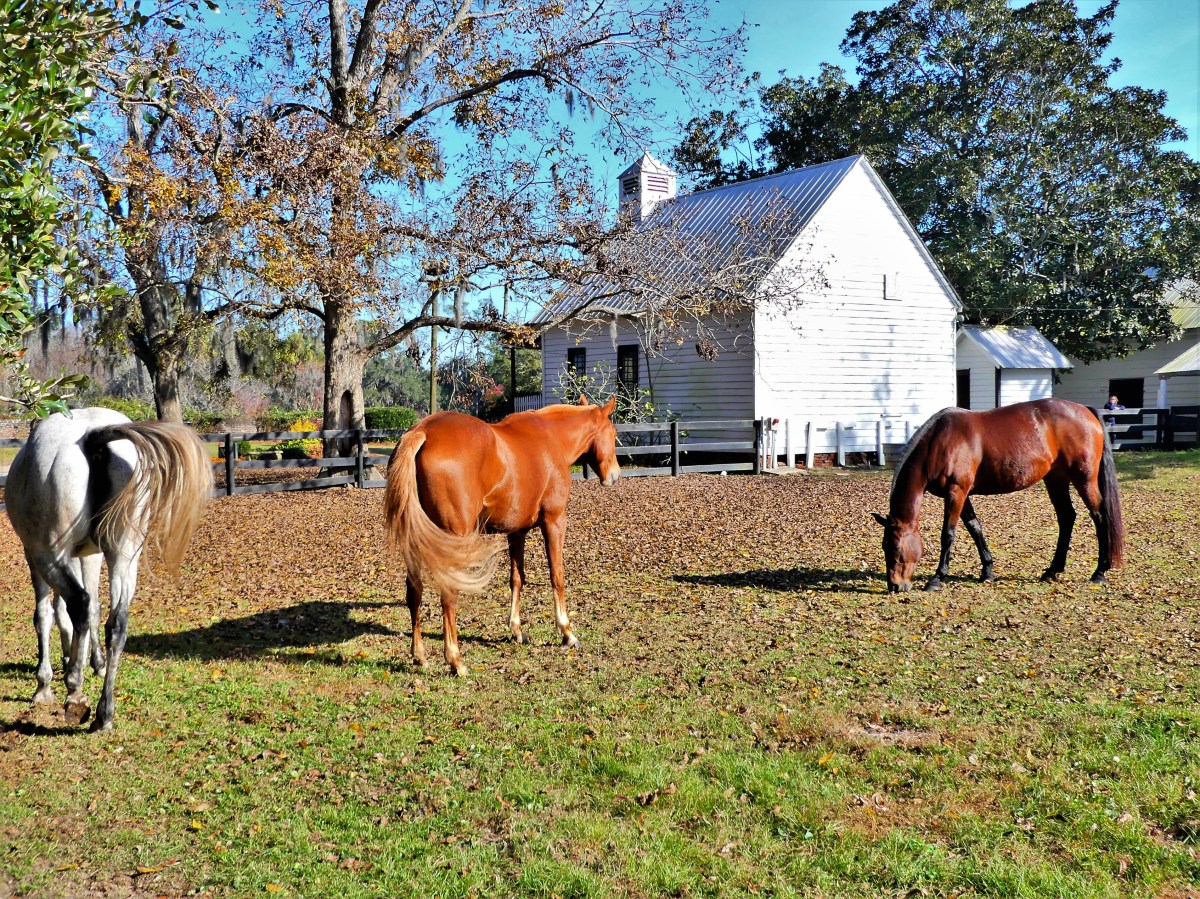
as they approached the paddock…
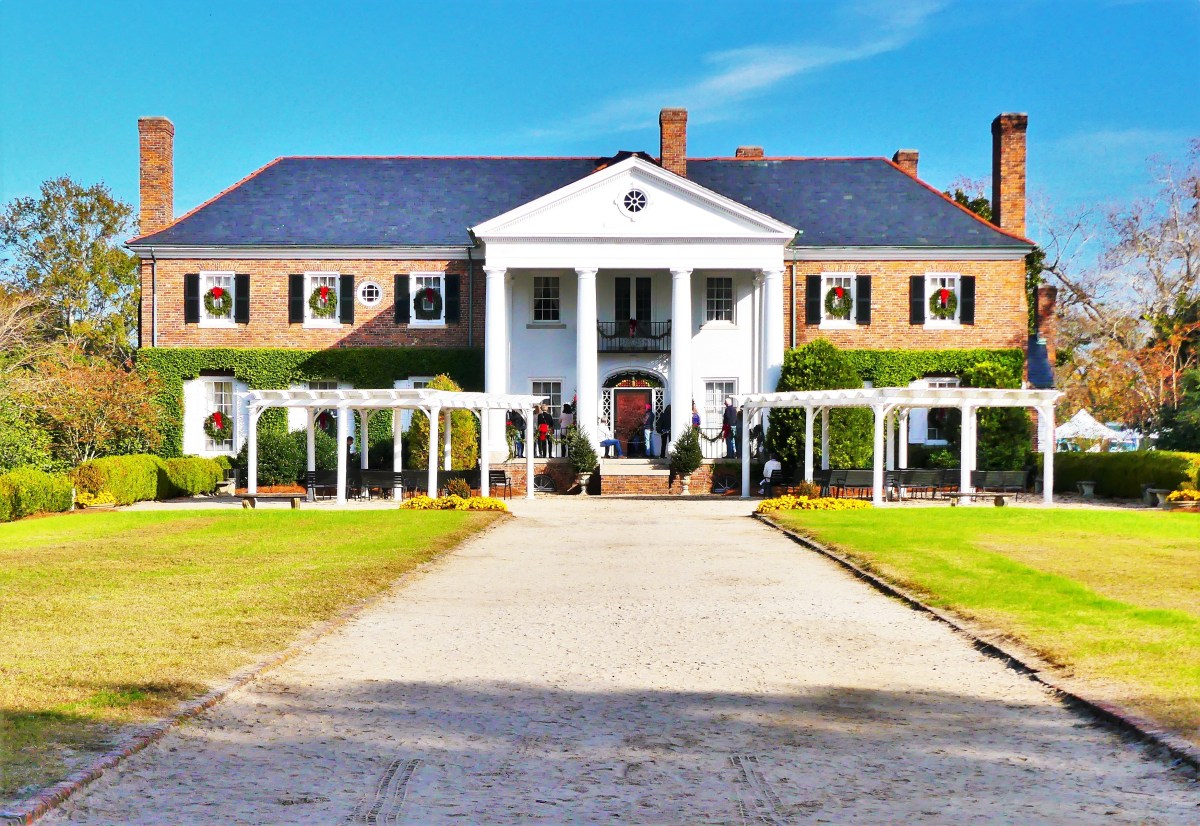
and the manor house.
Boone Hall Plantation of Mount Pleasant, SC continues today as one of America’s oldest working farms, still producing crops after nearly 340 years of activity.
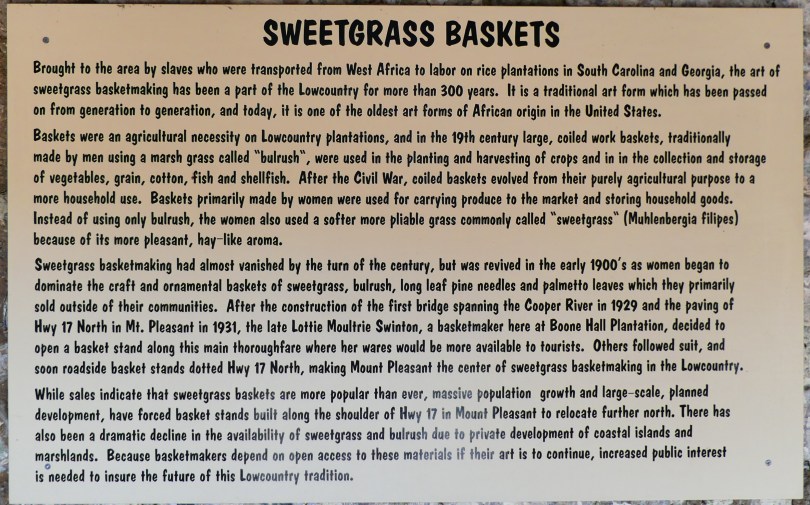
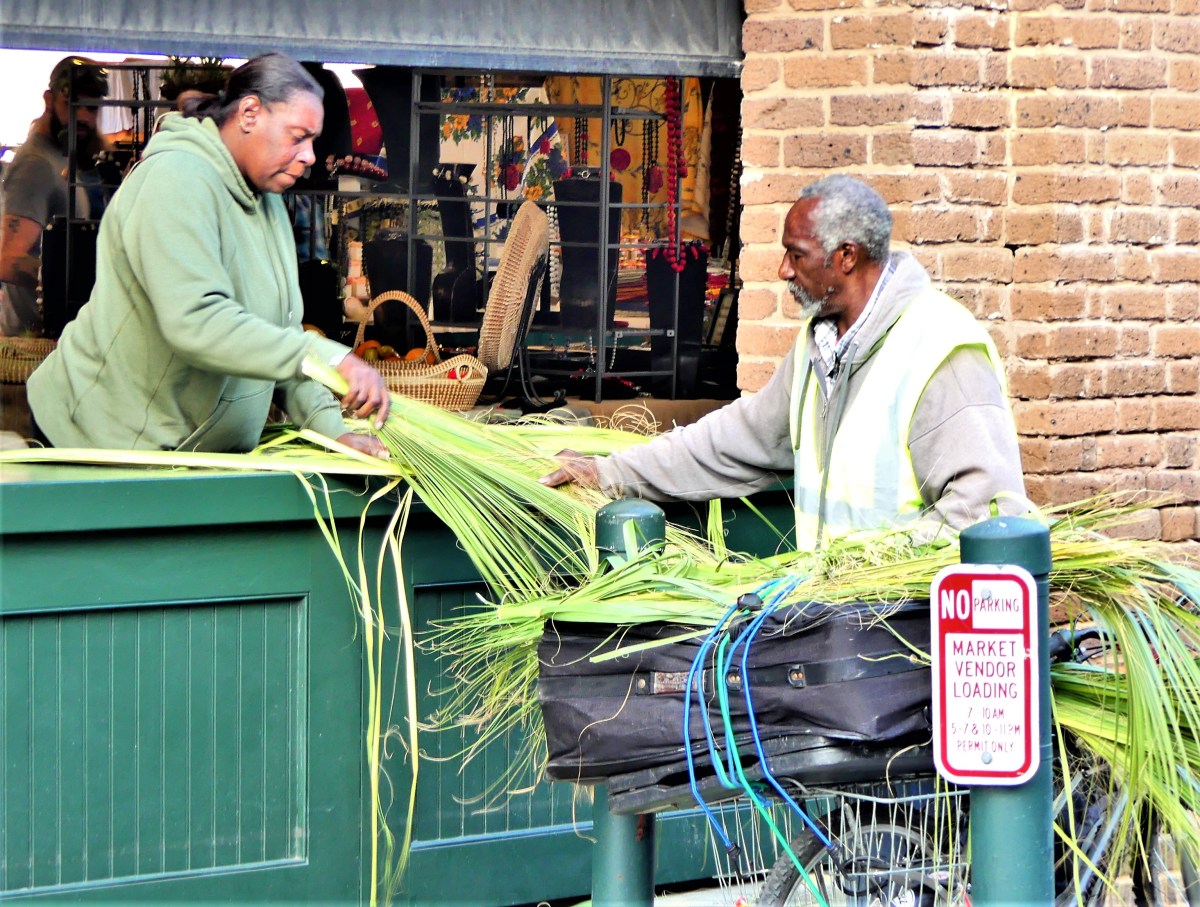
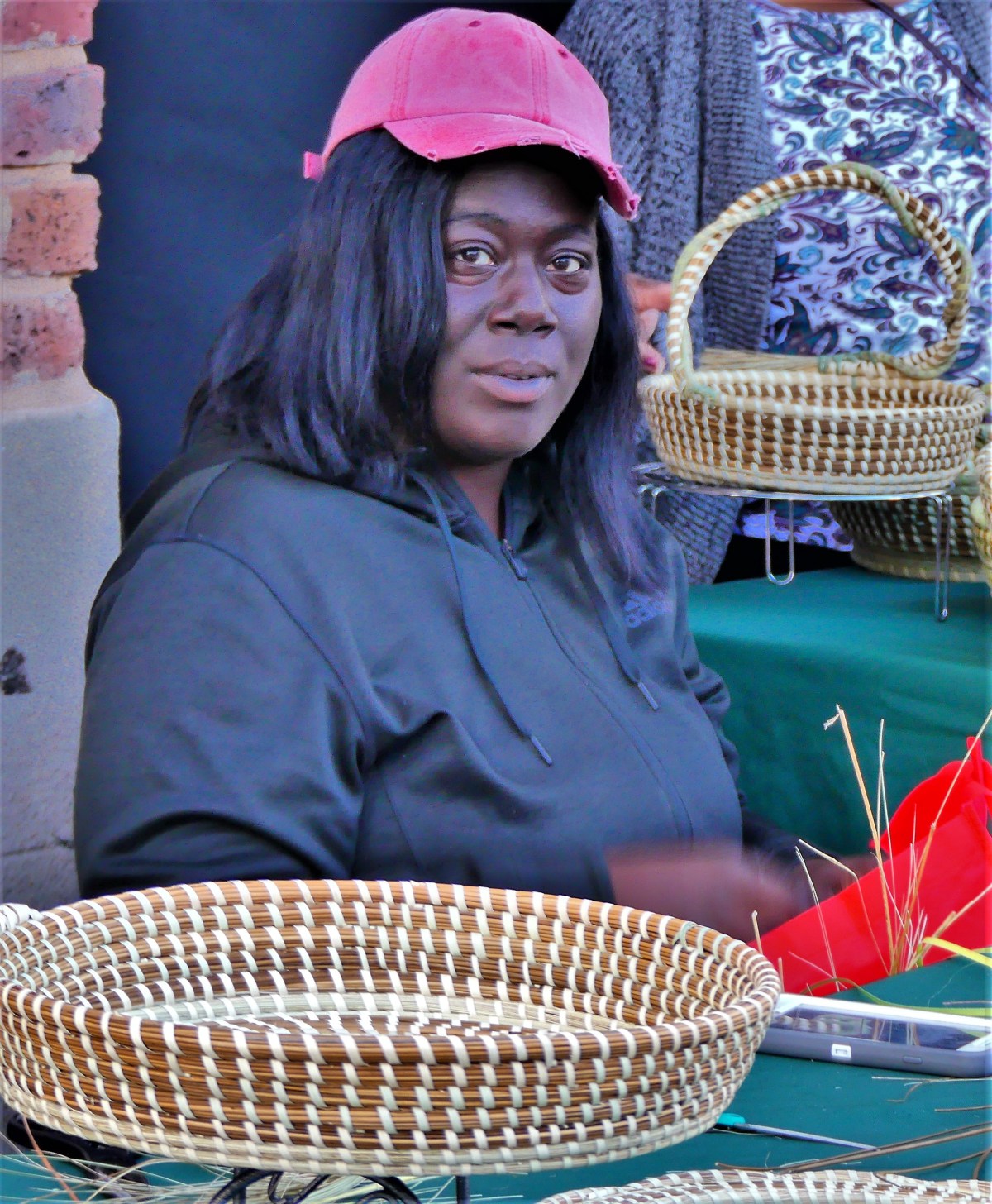
Also noteworthy, Gullah-Geechee heritage continues with sweetgrass basket-coiling skills that have sustained through five generations of descendants of slaves.
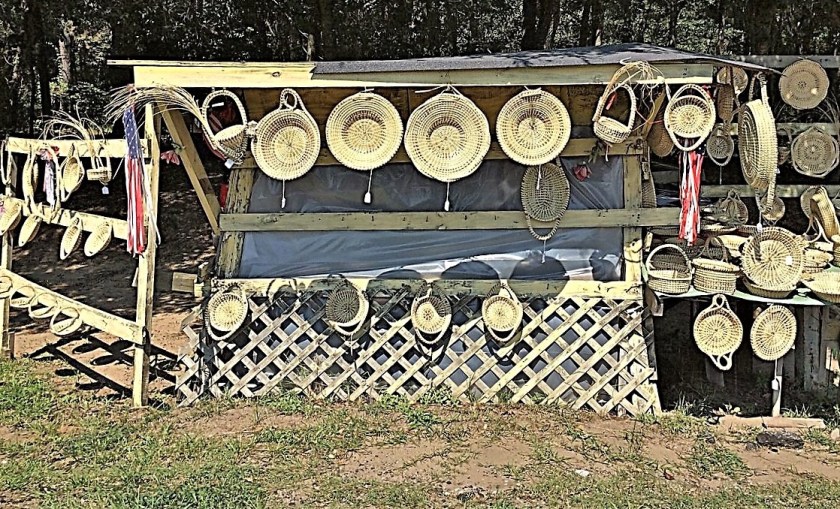
Original roadside stands from the “hayday” of basket production still dot the Route 17 landscape, luring everyday customers and tourists to inspect the wares.
However, the trend has traveled to the Charleston City Market,
where the demonstration of sweetwater basket-making is routine…
and sales are brisk,
with up to 300 weavers who remain dedicated to the craft.
At this time, dwindling supplies of lowcountry sweetgrass are protected, and can only be harvested by bonafide ancestors…
guaranteeing a steady stream of basketry to remind us how sweet the courage of a people can be, and how crooked their path to freedom.
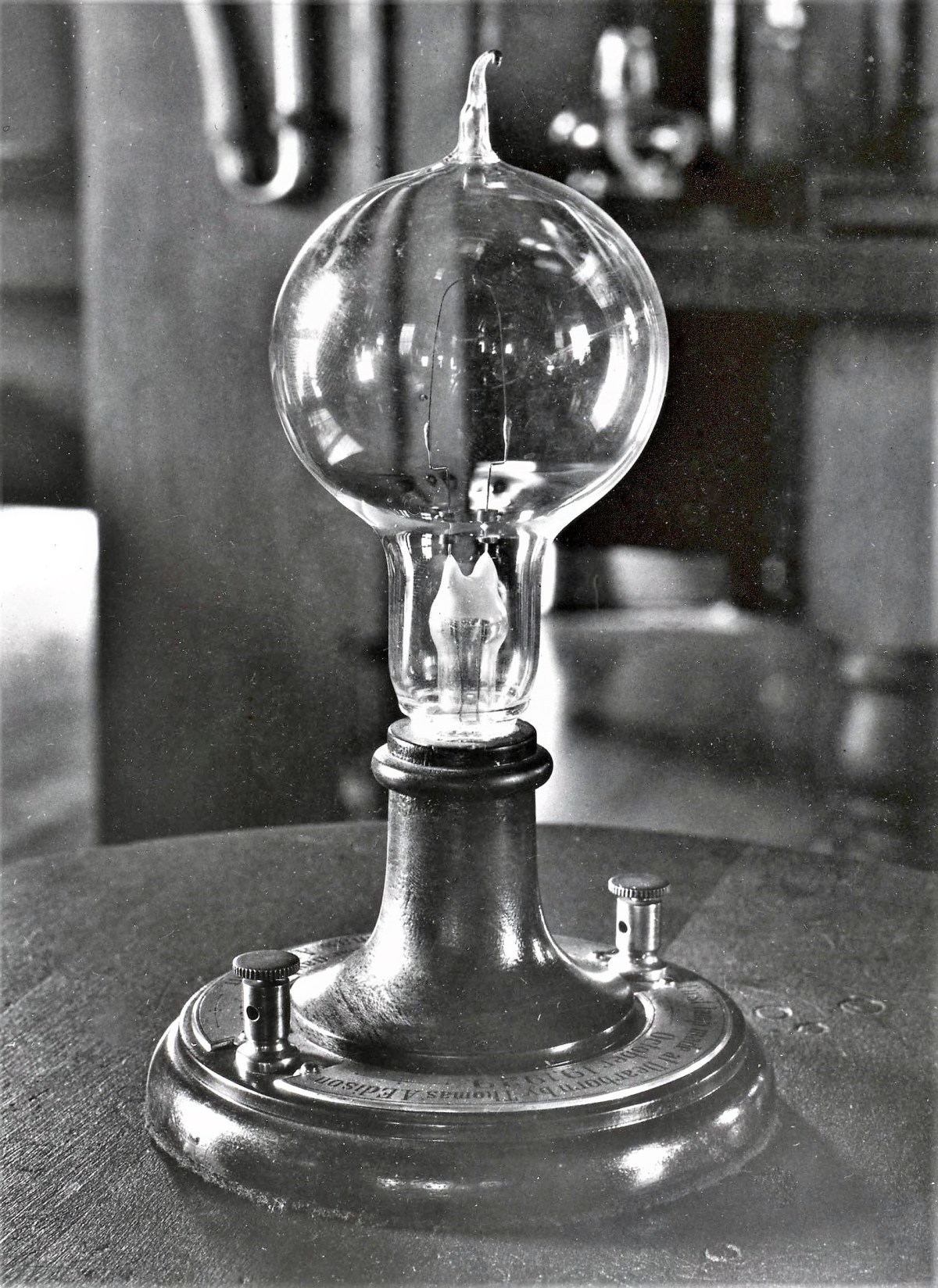
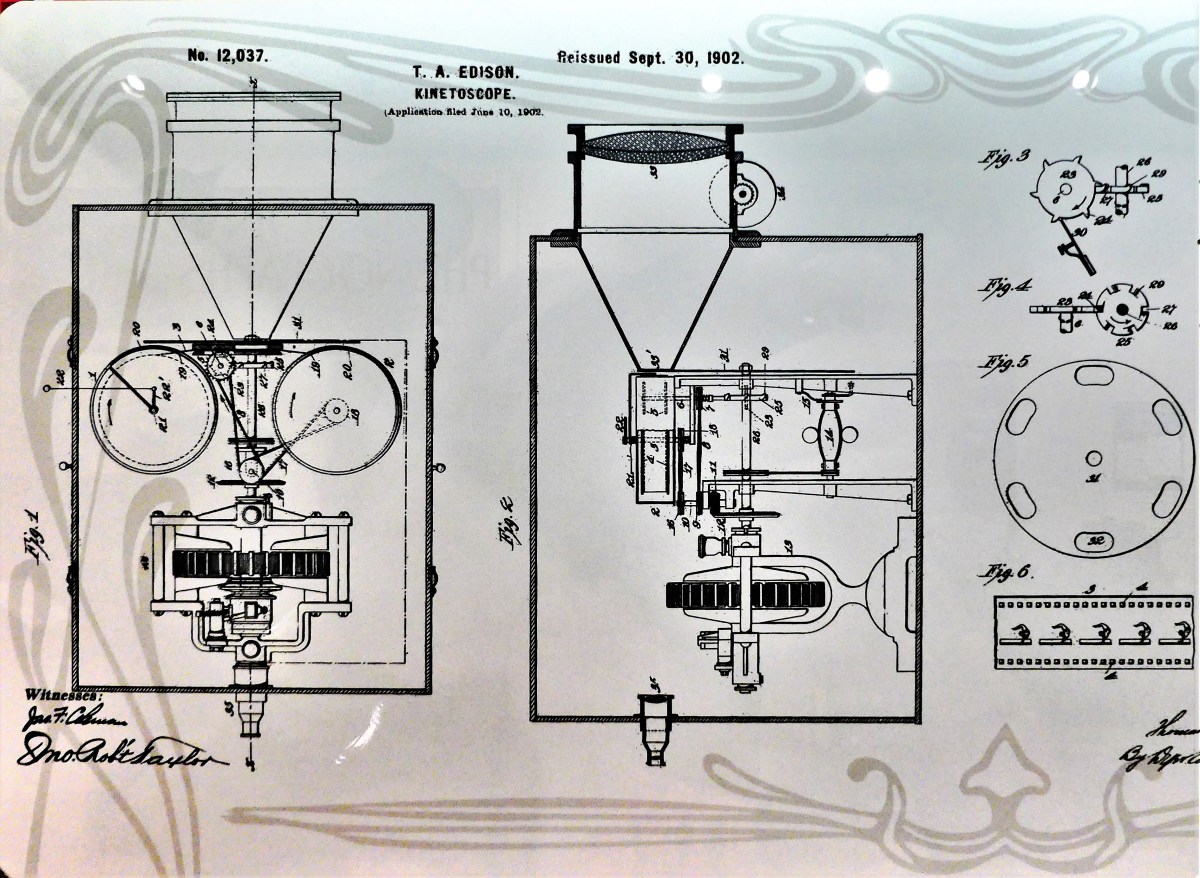
Every student of science, history and commerce knows the importance of Thomas Edison’s contributions (2332 worldwide patents),
and how through his imagination and industry…
Kinetoscope Projector
he single-handedly reshaped the 20th century.
No less famous and equally as successful, Henry Ford’s lifetime commitment to automotive innovation was without peer.
Now put the two titans together…
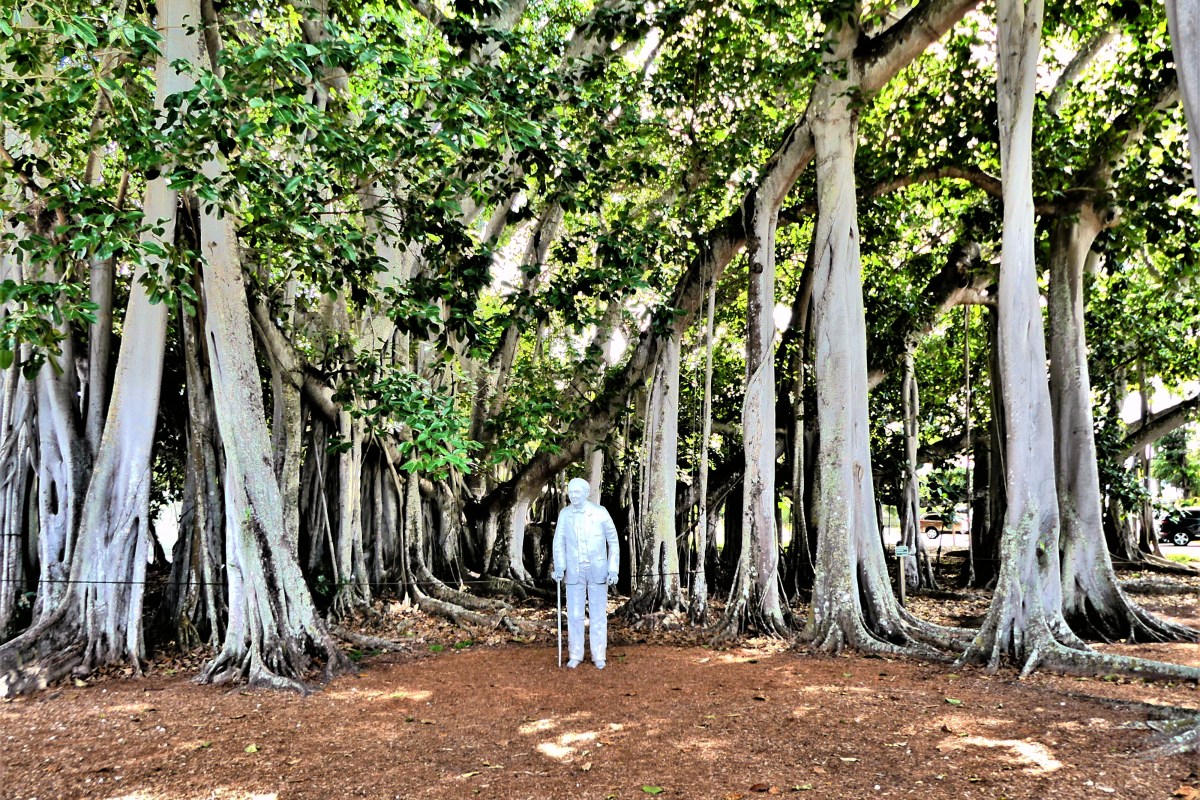
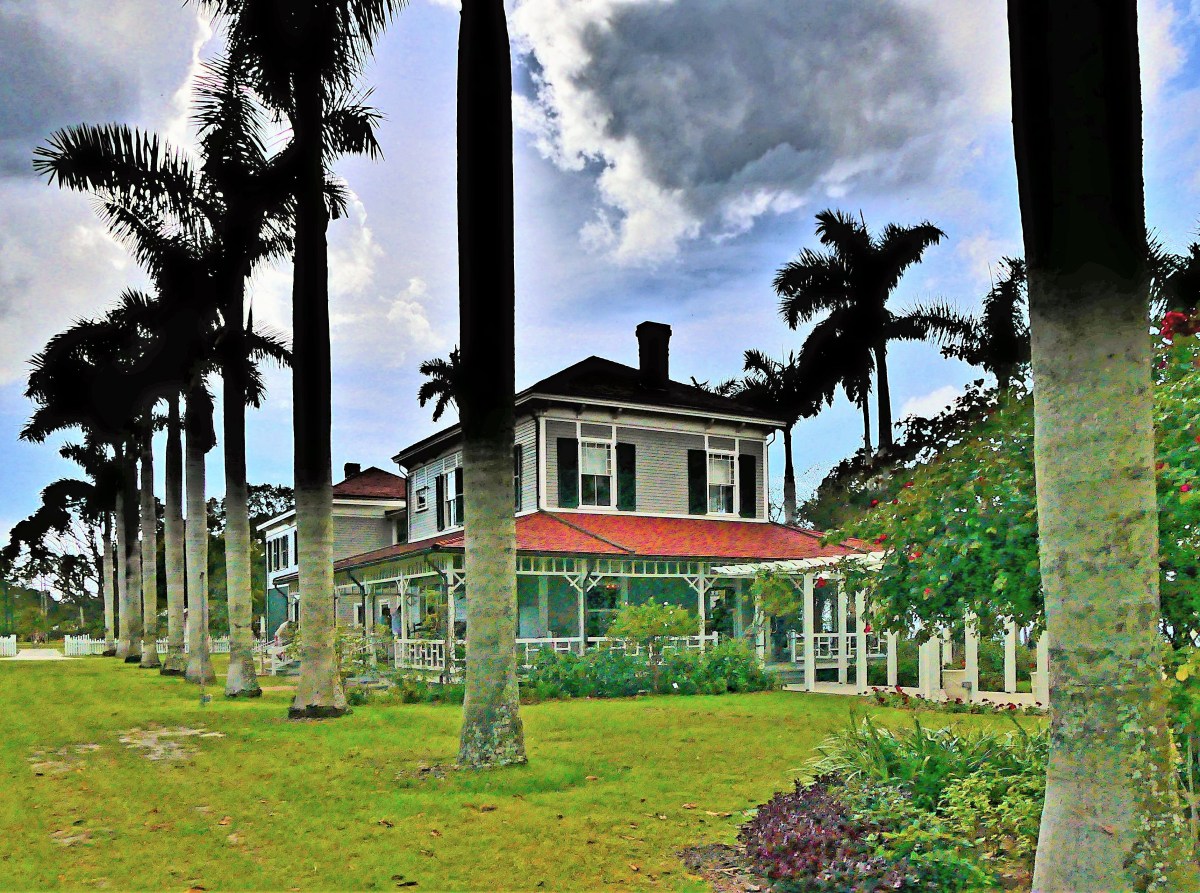
as next-door neighbors within their Ft. Myers, FL winter compound…
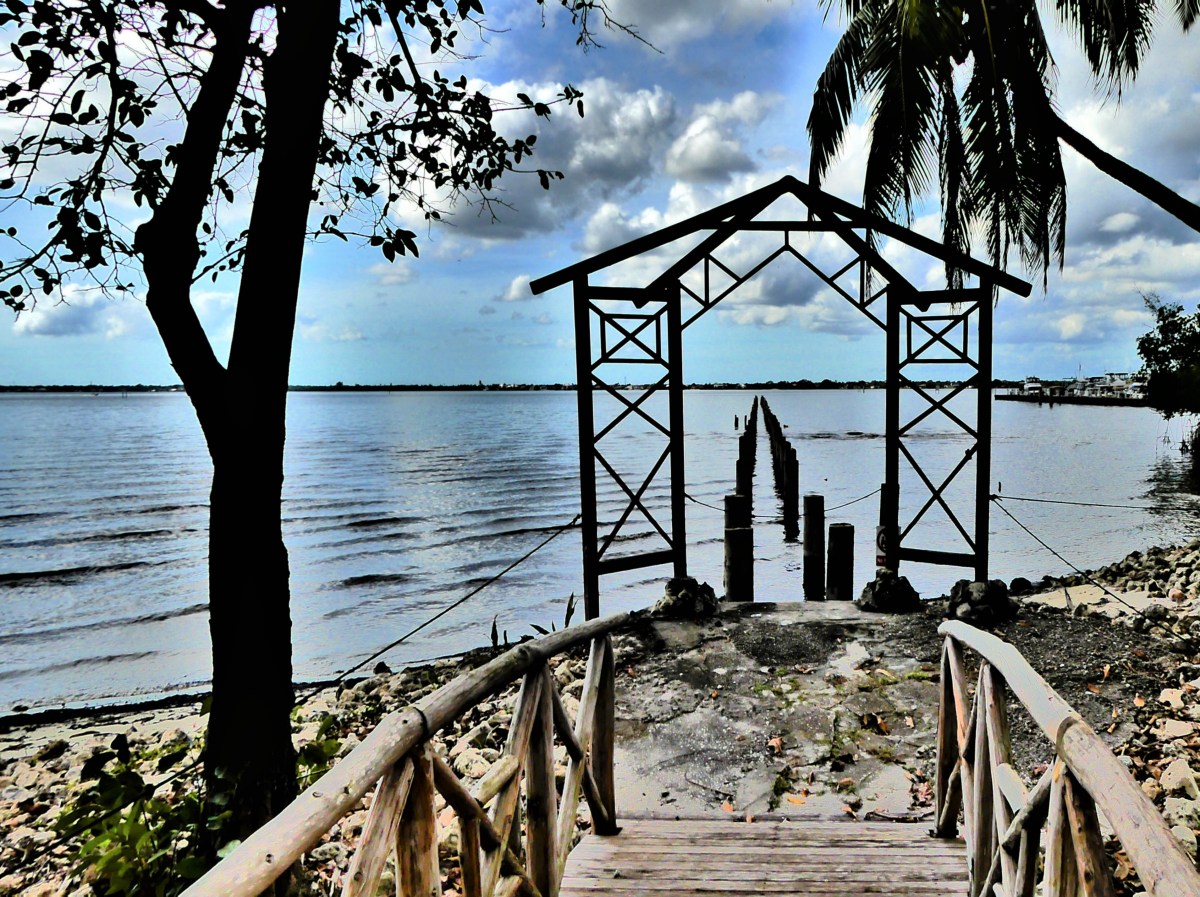
beside the Caloosahatchee River…
and the sum exceeds the parts. Adding John Burroughs, the nation’s leading naturalist and conservationist of his time to the party,
Edison, Burroughs, Ford
resulted in the birth of the car-camping movement in America as we know it today: motoring across the country in search of fulfilling outdoor recreation and adventure.
Better known as The Vagabonds, the caravan later included tire magnate, Harvey Firestone, who would travel with the pack across America for the next ten years, taking vacations in an elaborate Packer and Ford motorcade that always included Edison’s battery of batteries to light the campsite,
a Ford chuckwagon attended by Firestone’s personal chef,
and a pack of newspapermen and paparazzi who would record The Vagabond’s every step and conversation.
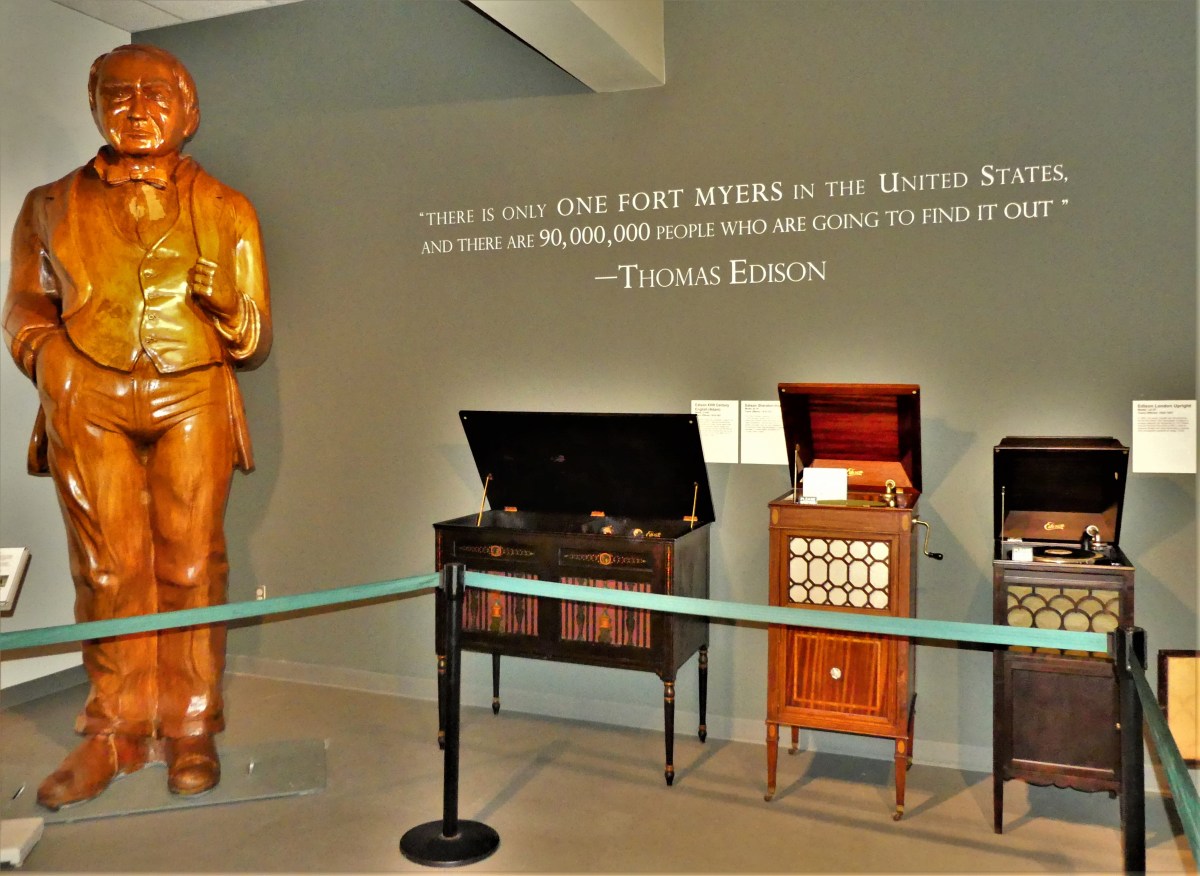
Edison’s inventions are presented in historical perspective in a comprehensive on-site museum space that credits Ft. Myers as an inspirational Eden for Edison’s genius.
Additionally, by recreating his West Orange, NJ laboratory in Ft. Myers,
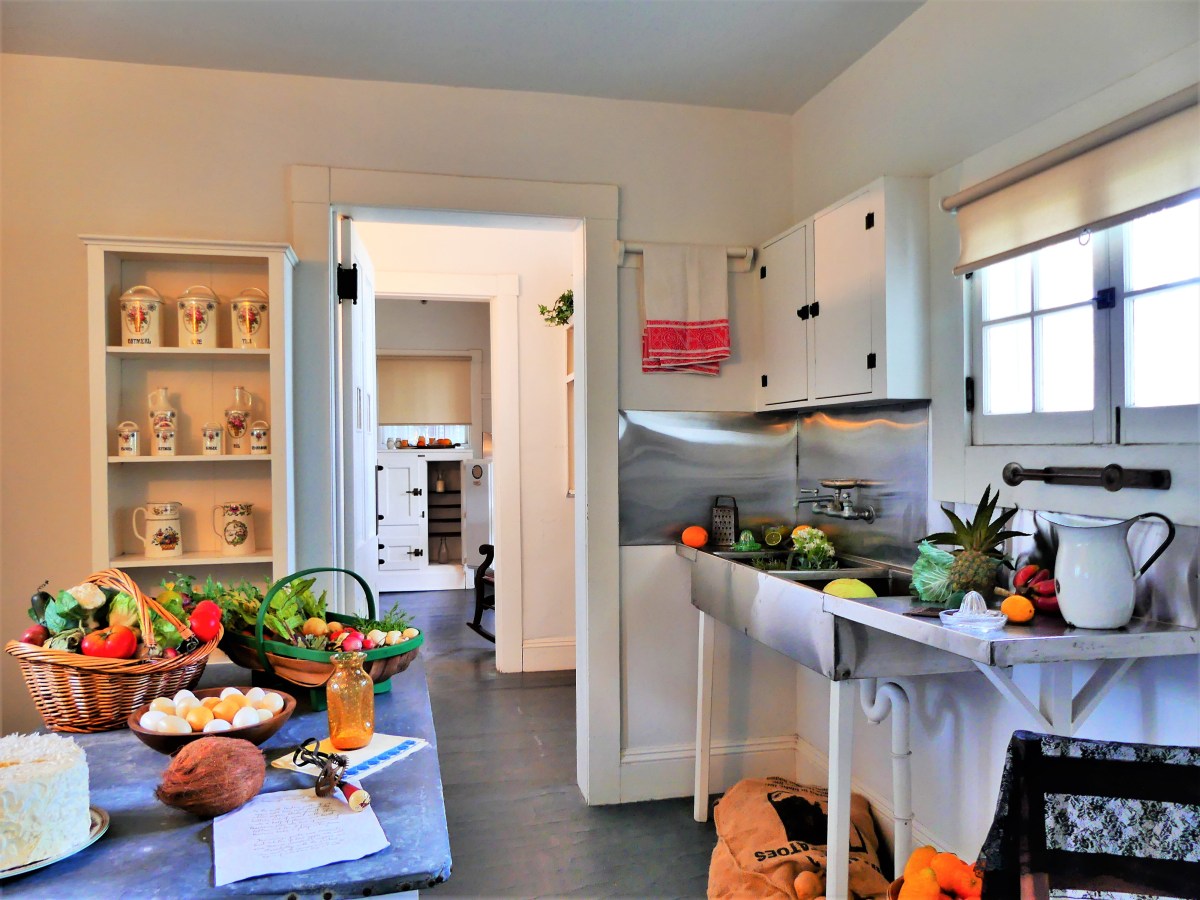
Edison could work uninterrupted throughout the year, never missing an opportunity to tinker or embellish on an idea, while enjoying the comforts of a home…
and grounds…
that he designed in 1886,
and Mina attended until his death in 1931.
Henry Ford acquired the neighboring bungalow known as The Mangoes in 1916,
and the two titans drove each other to continuing heights of excellence in achievement.
But of all their noticeable accomplishments, their mutual love of country living coupled with the enormous publicity generated by their expeditions most certainly inspired an army of auto owners and outdoor enthusiasts to follow their example.
Thus, The Vagabonds paved the way for the popularity of motor camping, and gave rise to a recreational industry that advances the dream of this sojourner’s lifestyle: where the highway is my lifeline and my Airstream is my cradle.
Note: Historic photos courtesy of Edison and Ford Winter Estates collection.
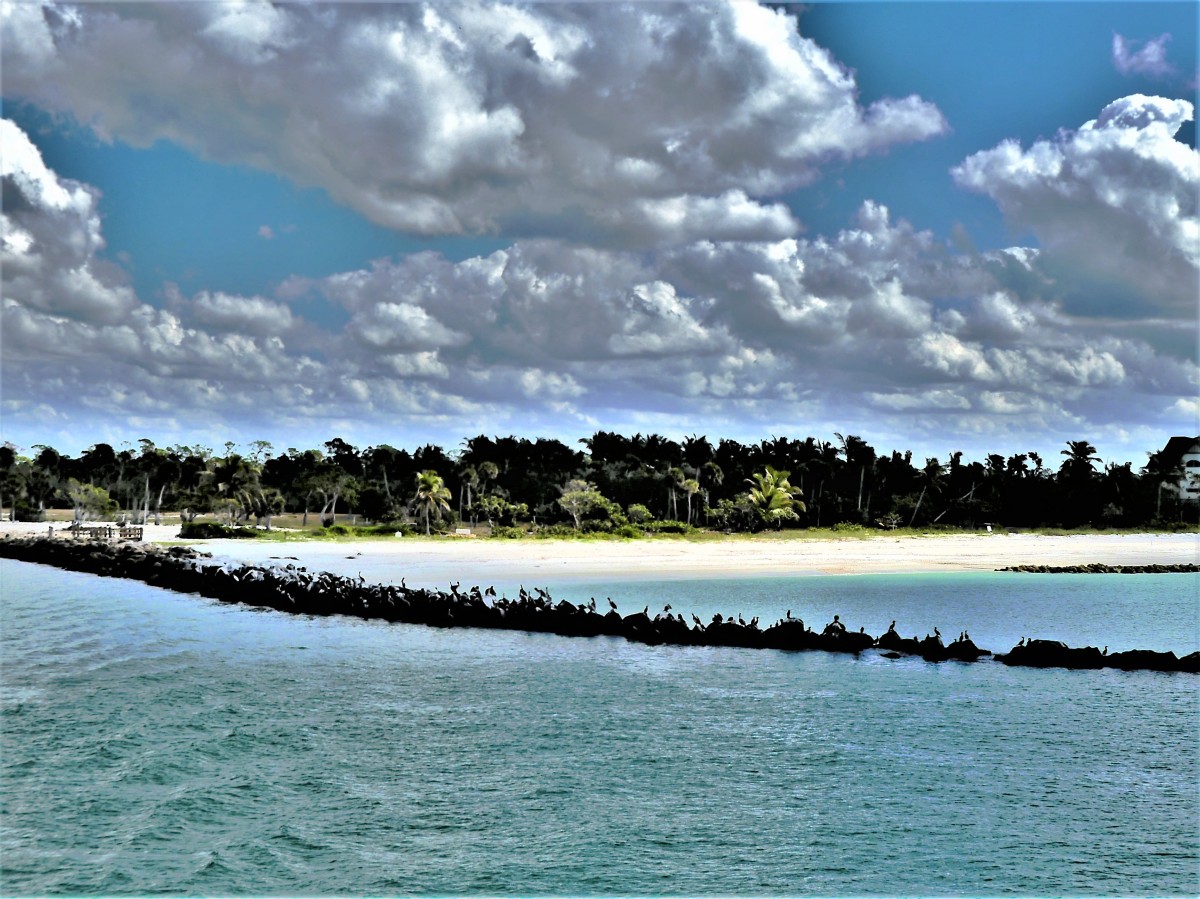
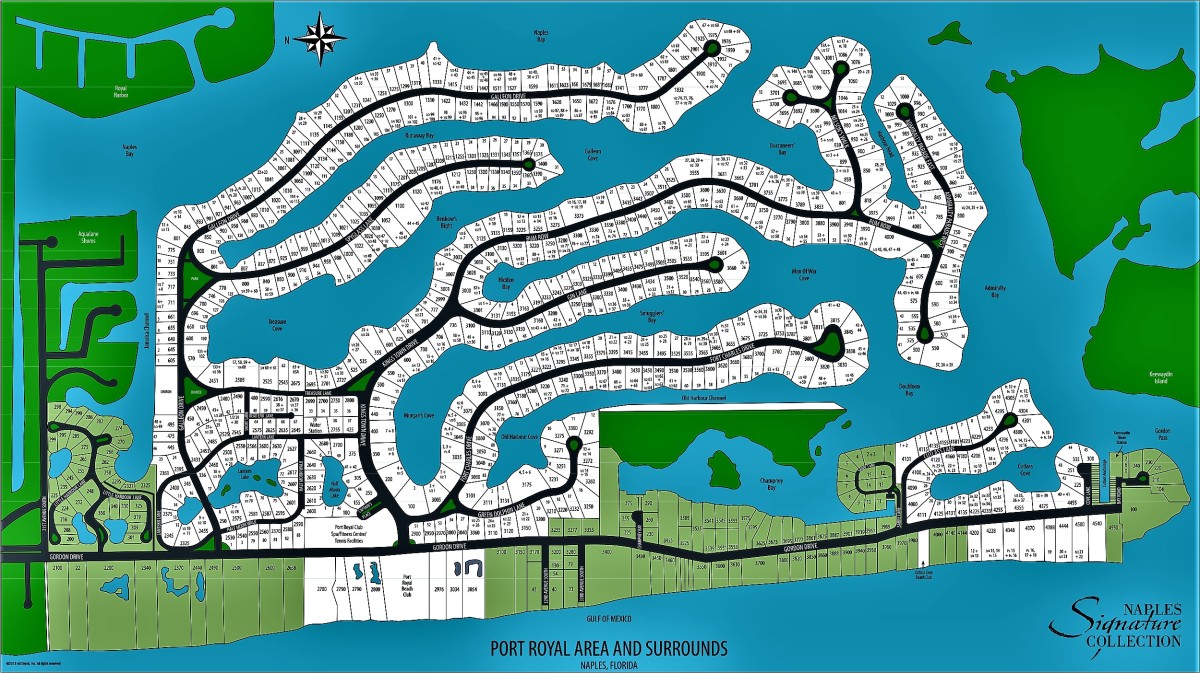
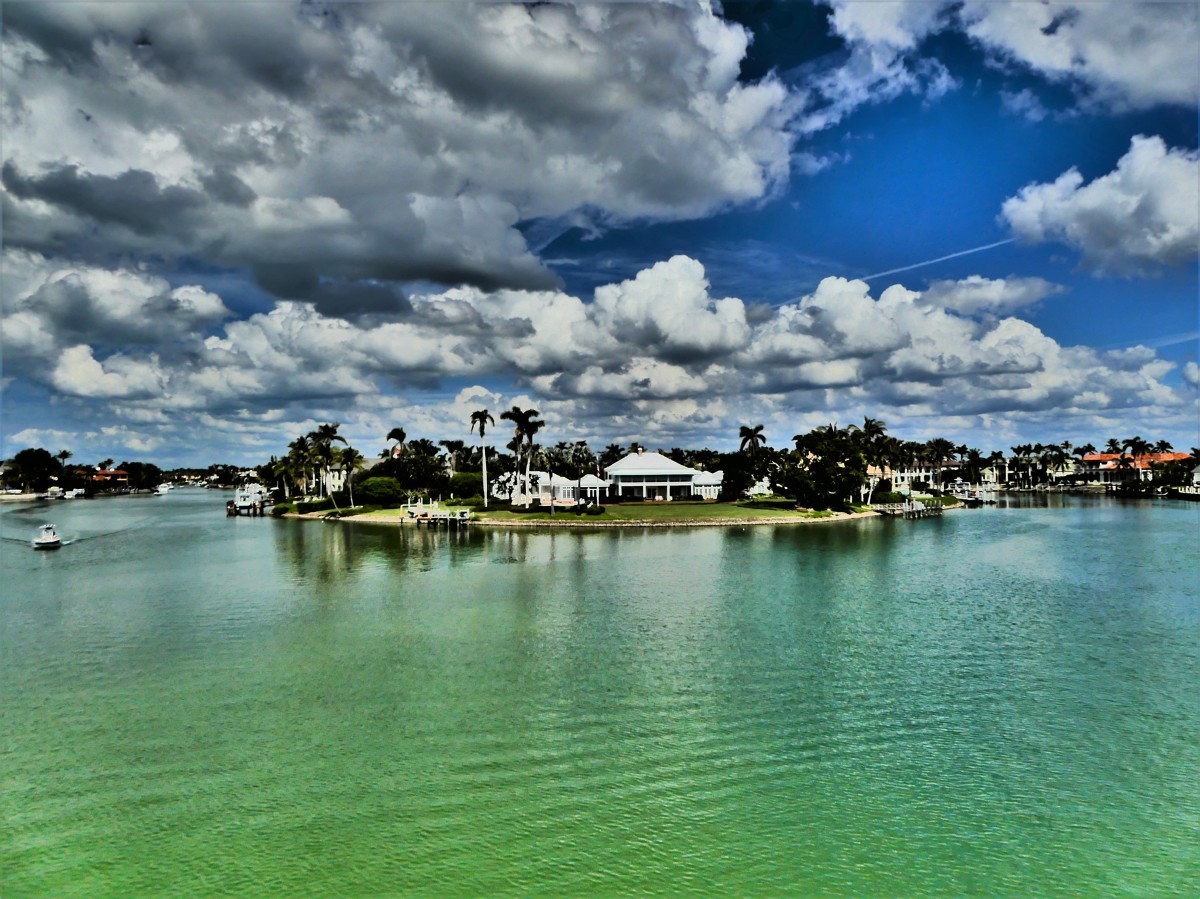
Apparently, the citizens of Naples, FL have the deepest pockets of any town in America thanks to the highest concentration of billionaires who own part-time residences along the deep water coastline of Port Royal.
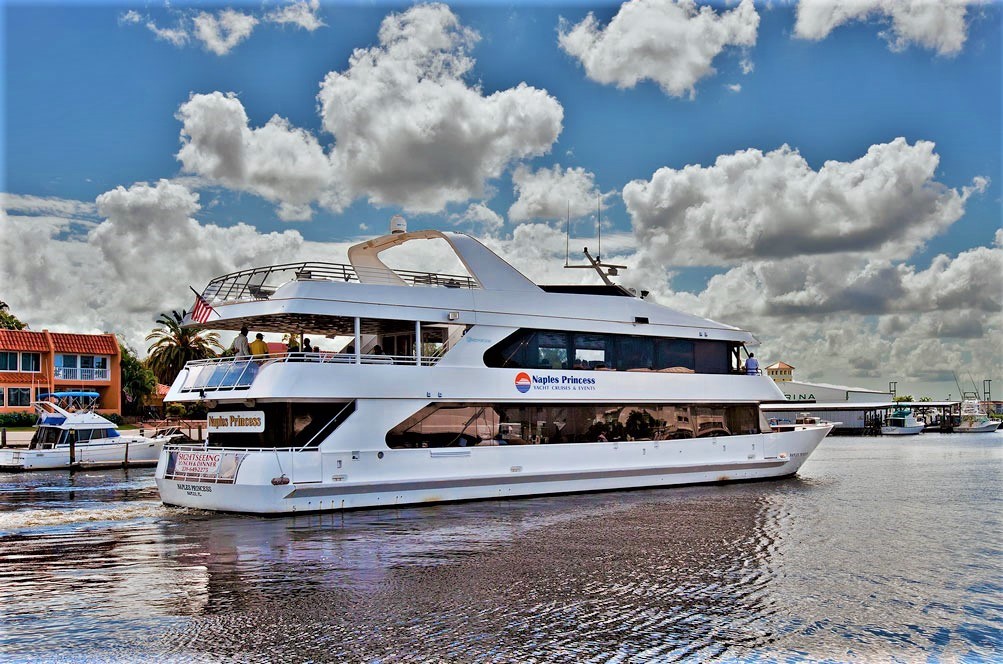
Such was the claim of First Officer Owen, who was overheard aboard the top deck of the Naples Princess…
during a two-hour pleasure cruise from the top of Naples Bay, past Bayview Park,
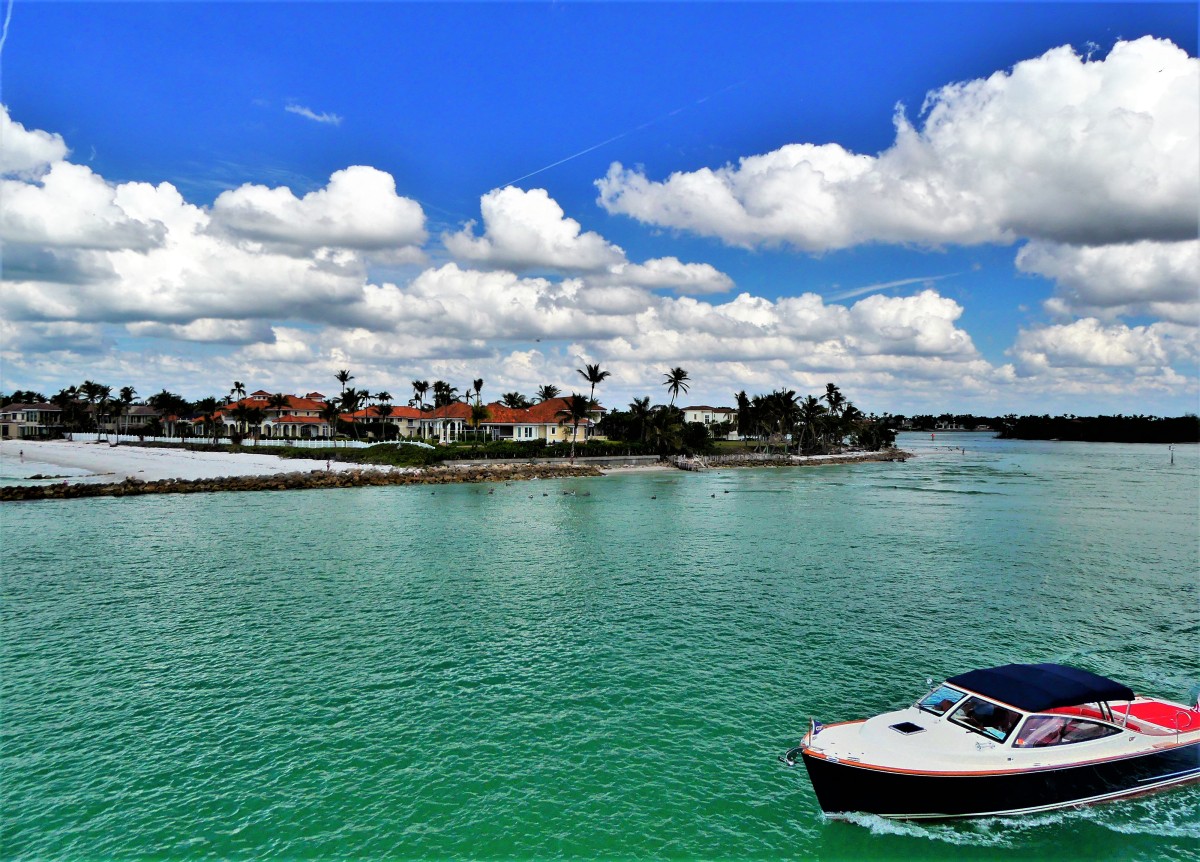
and through the channels of decadence bound by the beach on the Gulf of Mexico…
and Keewaydin Island.
John Glenn Sample came to Naples in 1938 with a vision that would compete with Henry Flagler’s development of Palm Beach during the early 1900’s. Unimpressed by the titans of industry who would flock to the East Coast of Florida to sip fine whiskey and smoke Cuban cigars against a backdrop of crashing waves, Sample determined that the tranquil surf and serene surroundings of the Gulf Coast was better suited for peace and relaxation.
Not to be outdone by the co-founder of Standard Oil, Sample gobbled and cobbled two square miles of mangroves and marsh along Naples Bay for $13,700. During the 1950’s, Sample exhausted the $3.5 million he earned from the sale of his Chicago advertising agency by bringing heavy earth-moving equipment and dredging machinery to town, and subsequently rearranged his property into fingers reaching out to deep water access amid the warm currents of the Gulf of Mexico.
Early on, Sample priced his Port Royal lots between $7,500 and $12,000, and spec homes were priced between $22,000 and $25,000. By the 1960’s, Port Royal lot prices had ballooned to $30,000 and Port Royal homes were selling for $60,000.
Yet despite premium prices, Sample was holding out on hawking his holdings; the litmus test to buy property from Glenn Sample was that he must like you, because selling to a buyer was much more than “show me the money!” A prospective homeowner/neighbor had to supply letters of recommendation, and pass the like-mindedness quotient.
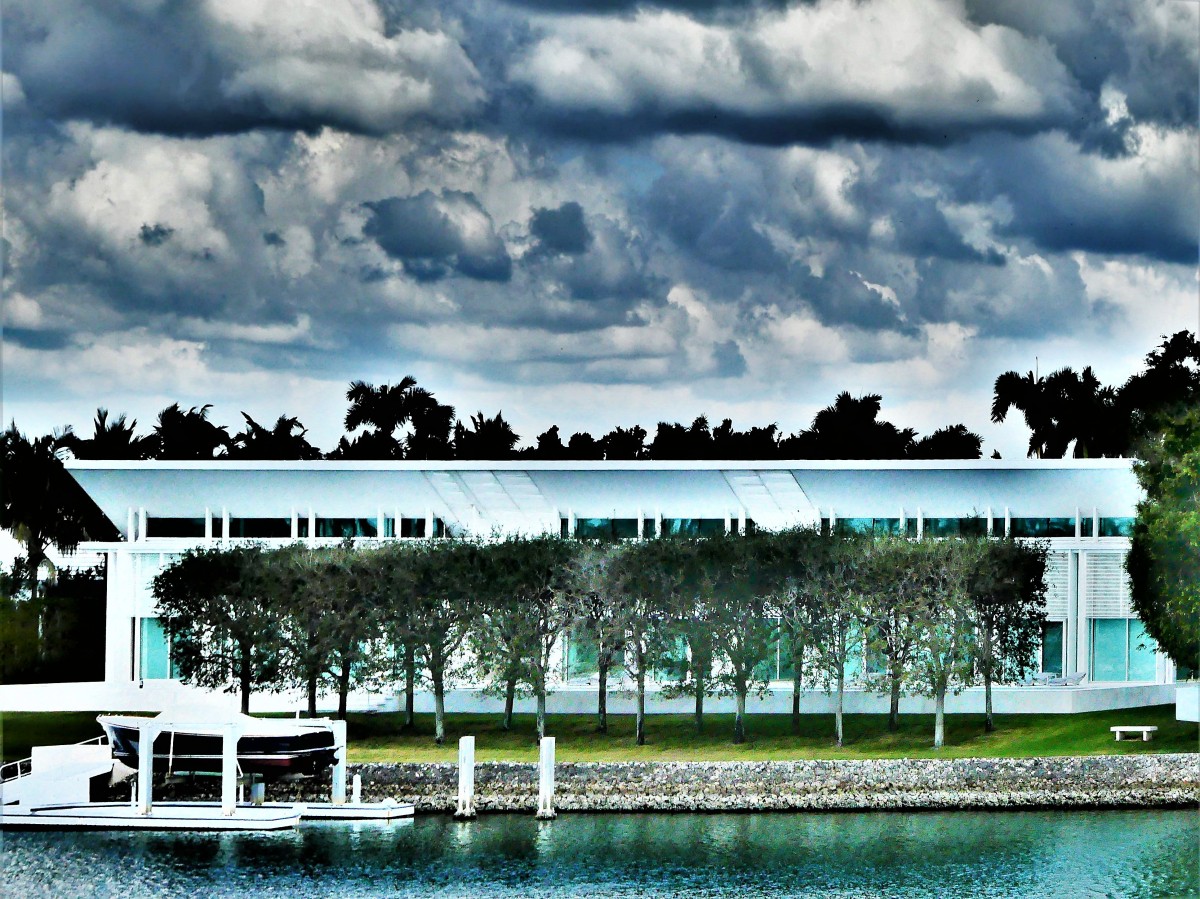
Today, only a few of the original 3,000 square foot homes remain, having been replaced by maximum-sized mansions of shimmering glass and steel.
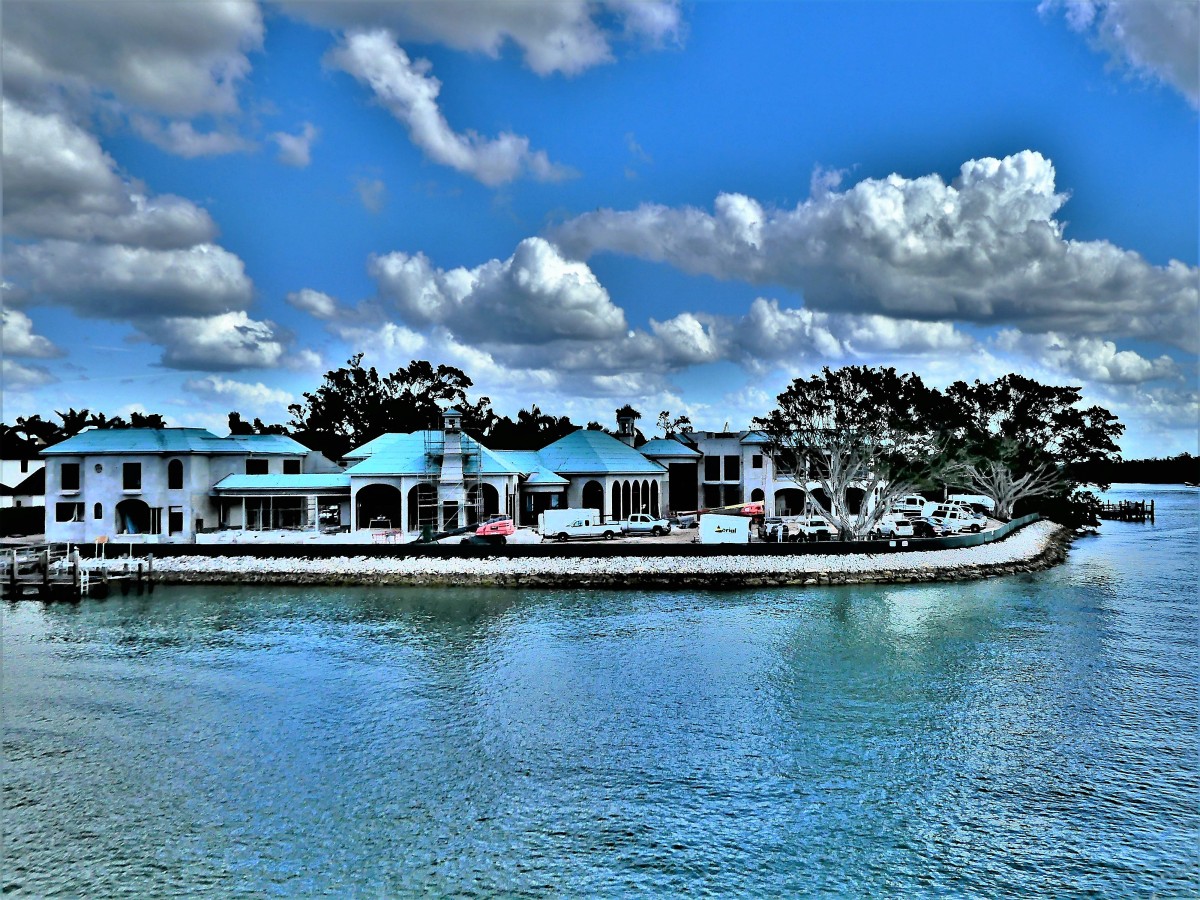
And of those still standing and available as teardowns for $4M, they are being replaced by new construction that defies understanding–exceeding unimaginable dimensions, and approaching $100M to complete.
Port Royal royalty includes celebrities from sports fame, media, and entertainment. Generational offspring of corporate giants who colonized the enclave (Briggs-Stratton, Kodak, Collier Publishing, etc.) continue to live a life of quiet luxury, as does the former treasurer of Estonia who proudly flies his country’s flag.
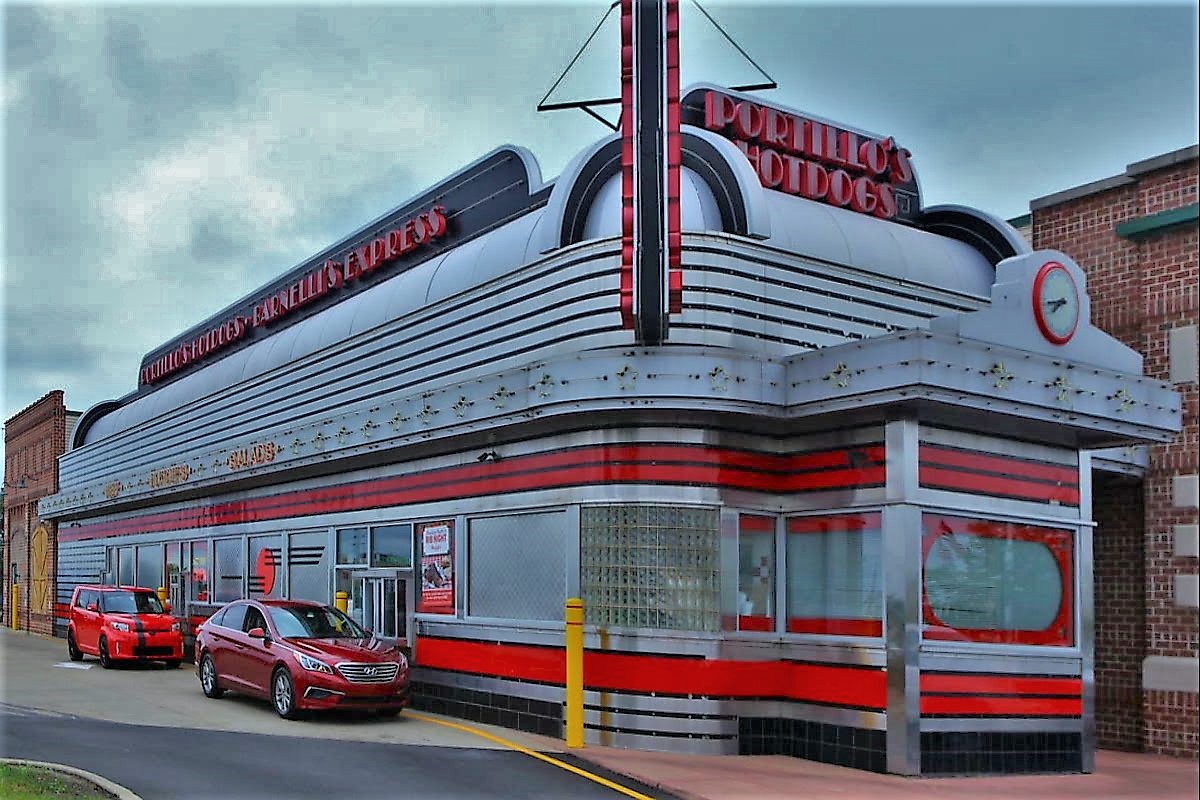
But of all known Port Royal billionaires (there are many property owners who cloak their identities behind holding companies), none is more deserving than Dick Portillo, better known as Chicago’s King of Hot Dogs.
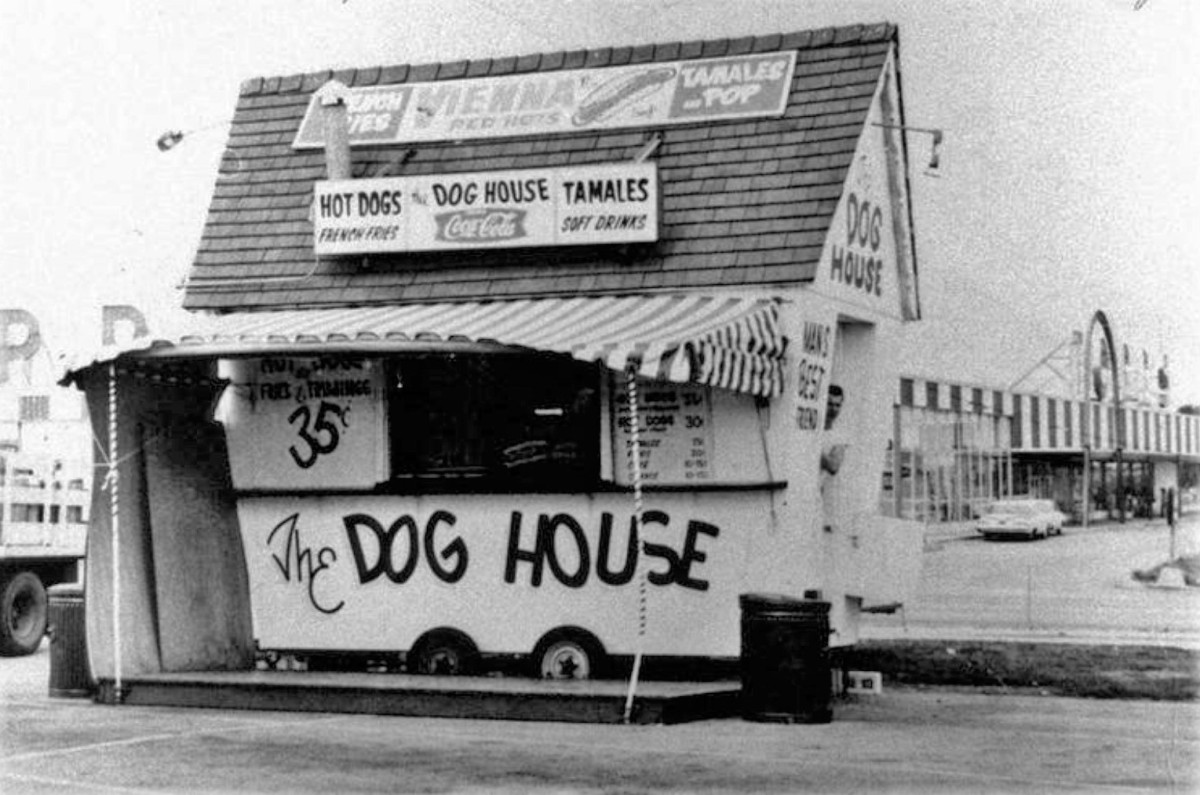
Starting out in 1963 with $1100 in savings intended as a down payment for a house, Portillo convinced his wife to invest in a small trailer called The Dog House on North Avenue in Villa Park. Running water came from a garden hose attached to another building.
Not knowing how to cook, Portillo learned the business by visiting competing restaurants with his two young children in tow and asking questions until he perfected his technique and grew the business: to his first drive-thru in 1983; to offering nationwide shipping to all 50 states; to 38 locations in Illinois, Indiana, Arizona and California;
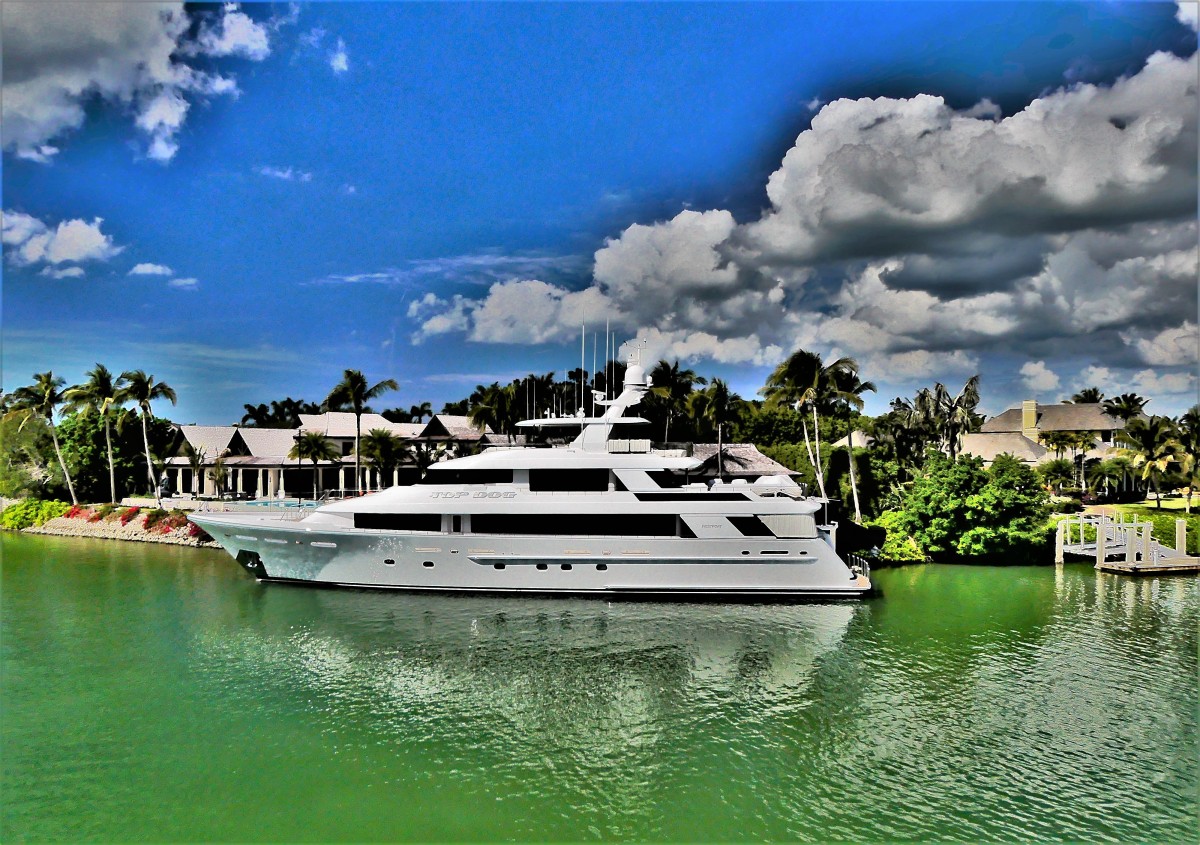
to eventually selling to Boston-based Berkshire Partners in 2014 for $1B, and acquiring an anchor for his $10,500,000 Westport yacht.
For the past eleven months, I have suffered from an acute case of Restless Body Syndrome (RBS)–unable to stay in one place for more than an average of three to four days. And to my knowledge, there is no known antidote for this kind of wanderlust.
While there is much to be said for having a home with all the trappings of comfort and familiarity (for which I am grateful), I nevertheless feel a natural compulsion to feed my travel addiction–at times surrendering to the physical and psychological cravings of visiting someplace new on a regular basis.
Fortunately, there are hundreds of support groups around the country–known as RV parks and resorts–that are very accepting of those among us who are afflicted with RBS, and assuage us with electric, water and sewer, and occasionally, high-speed internet.
A ten-step program has been developed by self-help travel gurus to combat the irritation associated with RBS:
Subscribe to Travel and Leisure, and National Geographic.
Leading pharmaceutical firms have been quietly conducting cutting-edge research to advance a cure for RBS. And there is widespread speculation that a vaccine is being developed for the travel bug.
Additionally, Congress is contemplating passage of the Rio Grande Act, whereby an extremely narrow Wal-Mart will be built along the entire Texas-Mexico border for RBS out-patients to shop, duty-free.
Until then, I offer my services as your tour guide for a random retrospective of my many homes from March 2017 to present.
Towaco, NJLigonier, PALewisburg, WVNew Orleans, LASan Antonio, TXBig Bend NP, TXGrand Canyon NP, AZZion NP, UTEstes Park, COWest Yellowstone, MTBanff NP, Alberta, CANCorvallis, ORKlamath, CAHat Creek, CAQuincy, CALas Vegas Massacre, NVValley of Fire, NVJoshua Tree, CAMt. Pleasant, SCDelray Beach, FLMelbourne, FLBradenton, FL
We were breezing through National Park Highway with the winds of Rainier at our backs,
heading through Ashford, WA on the way to Mt. St. Helens (see: Beauty and the Beast),
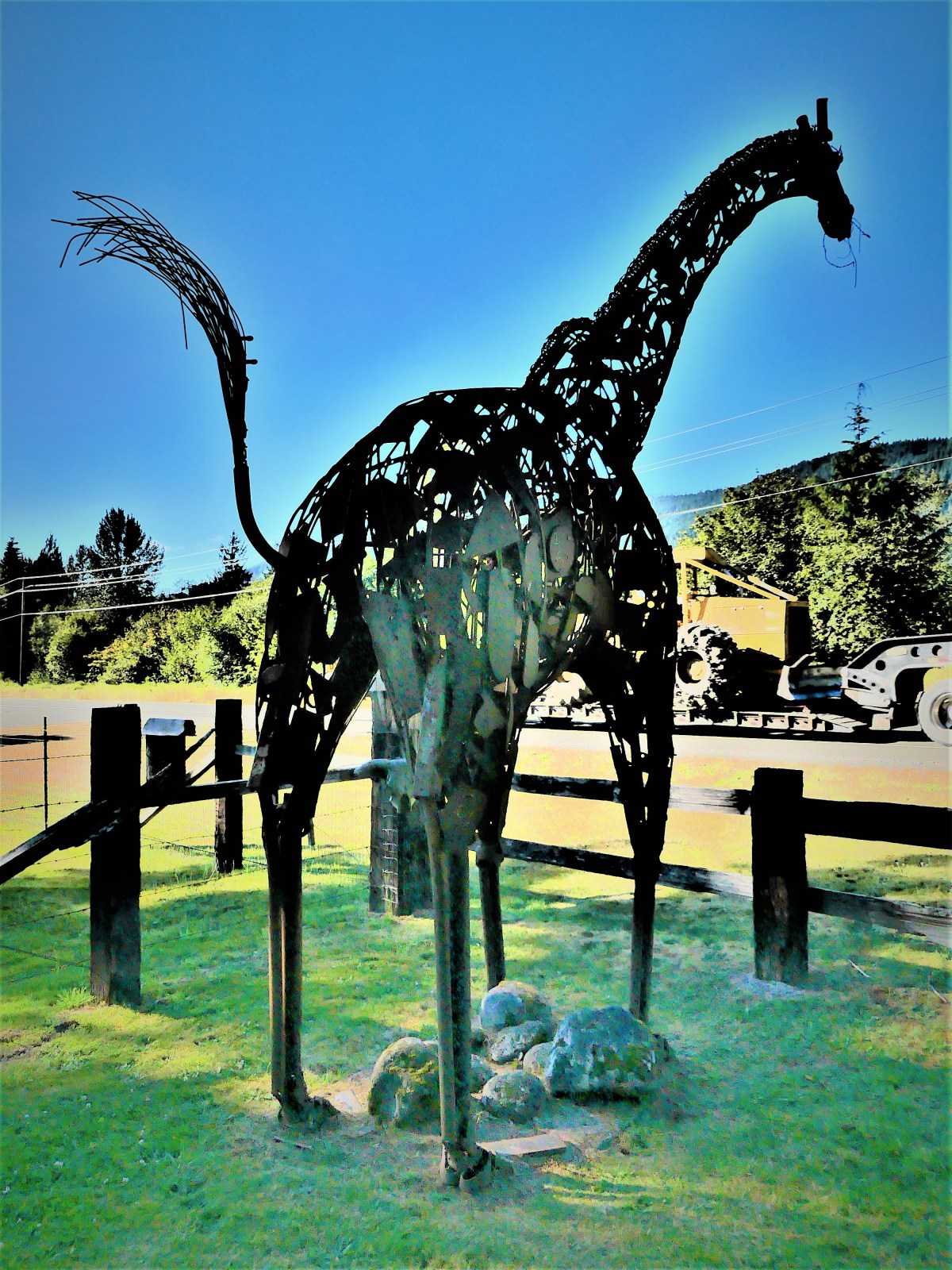
when the sight of a 17-foot grazing giraffe (Aspen Zoe) craning over a split-rail fence caught our attention,
causing us to catch a second look.
The open field before us provided a perfect pedestal for oversized sculptures.
The allure of a hidden sculpture garden amid the cedars and firs of the Cascades was galvanizing, and had us hooked.
Oscar–18-feet long by 12-feet high
We felt magnetically drawn to the magical monstrosities, and compelled to turn into the gravel driveway for a closer look, sharing the parking lot with The Angel from Hell.
The gatekeeper was generous, allowing us passage,
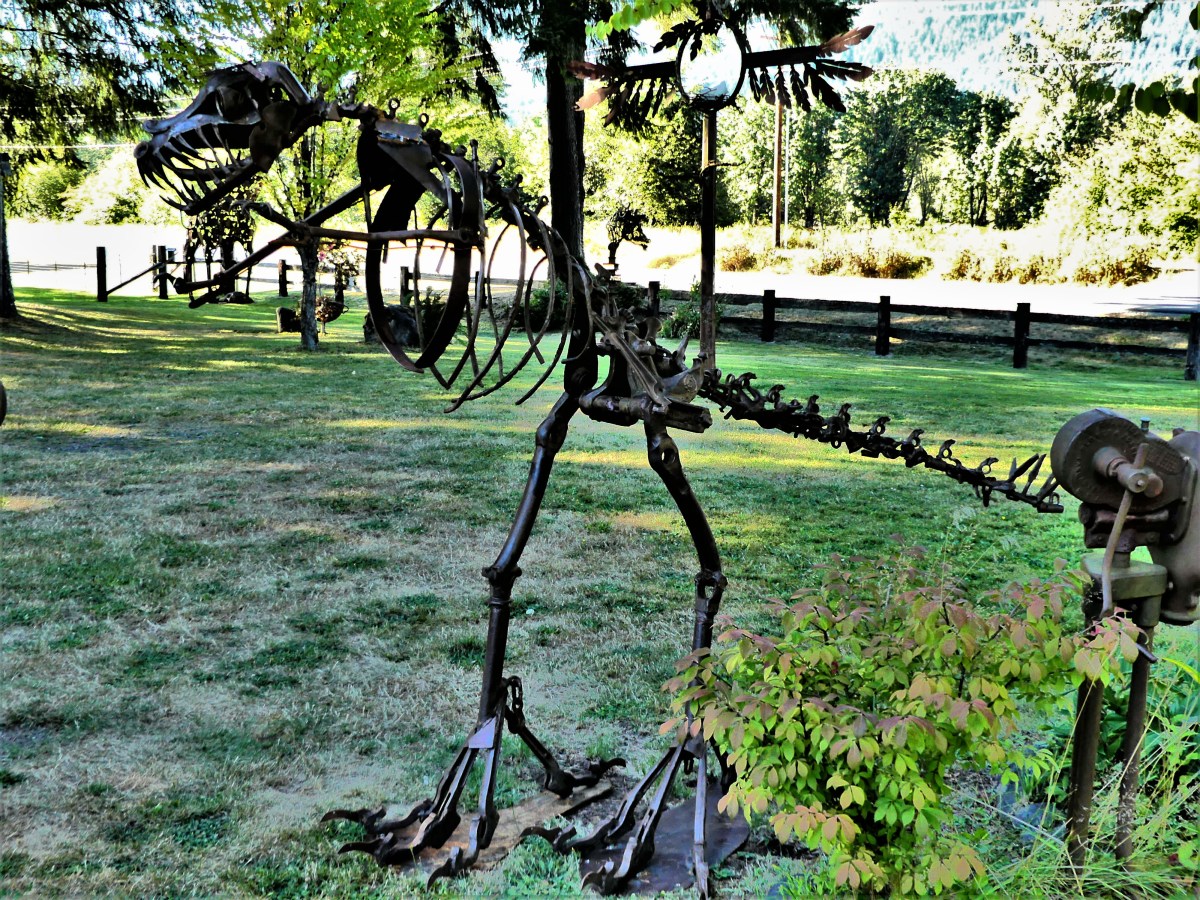
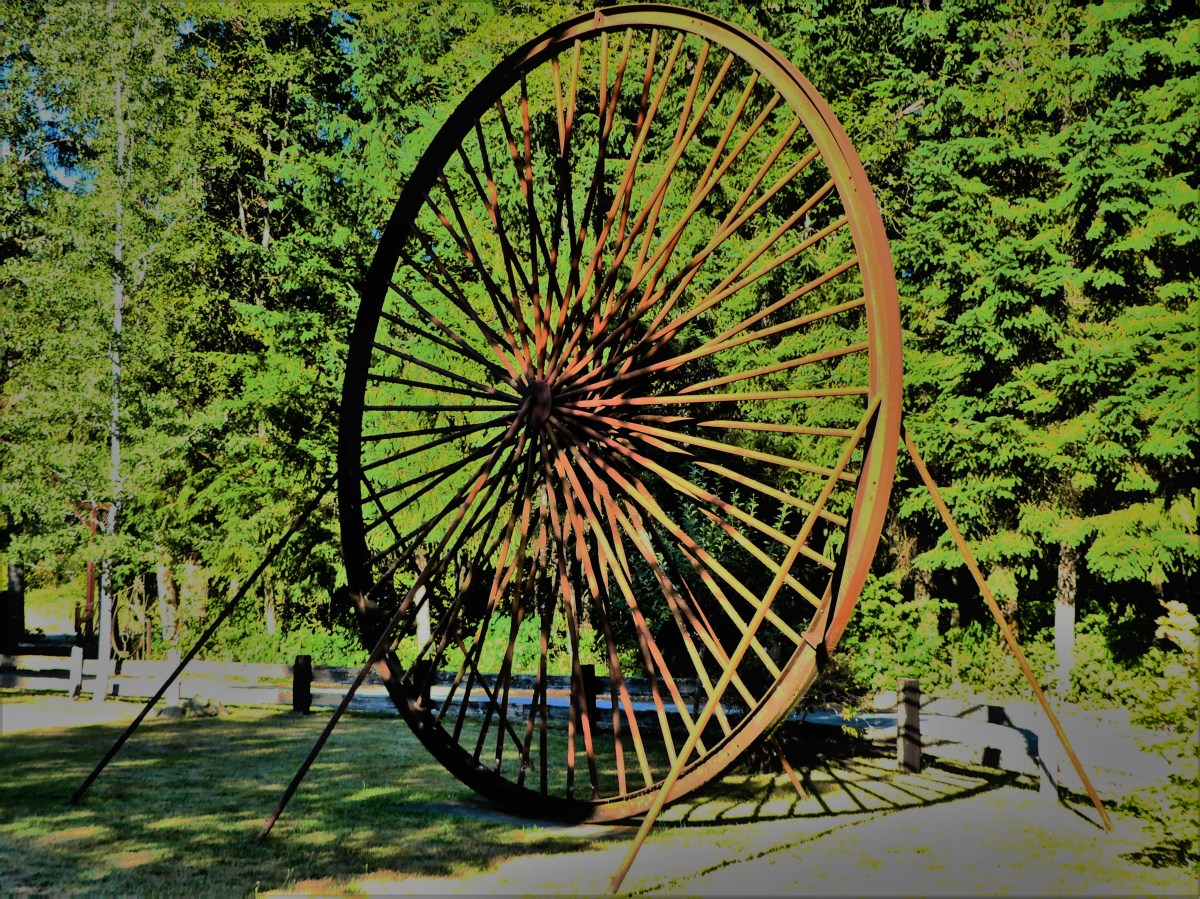
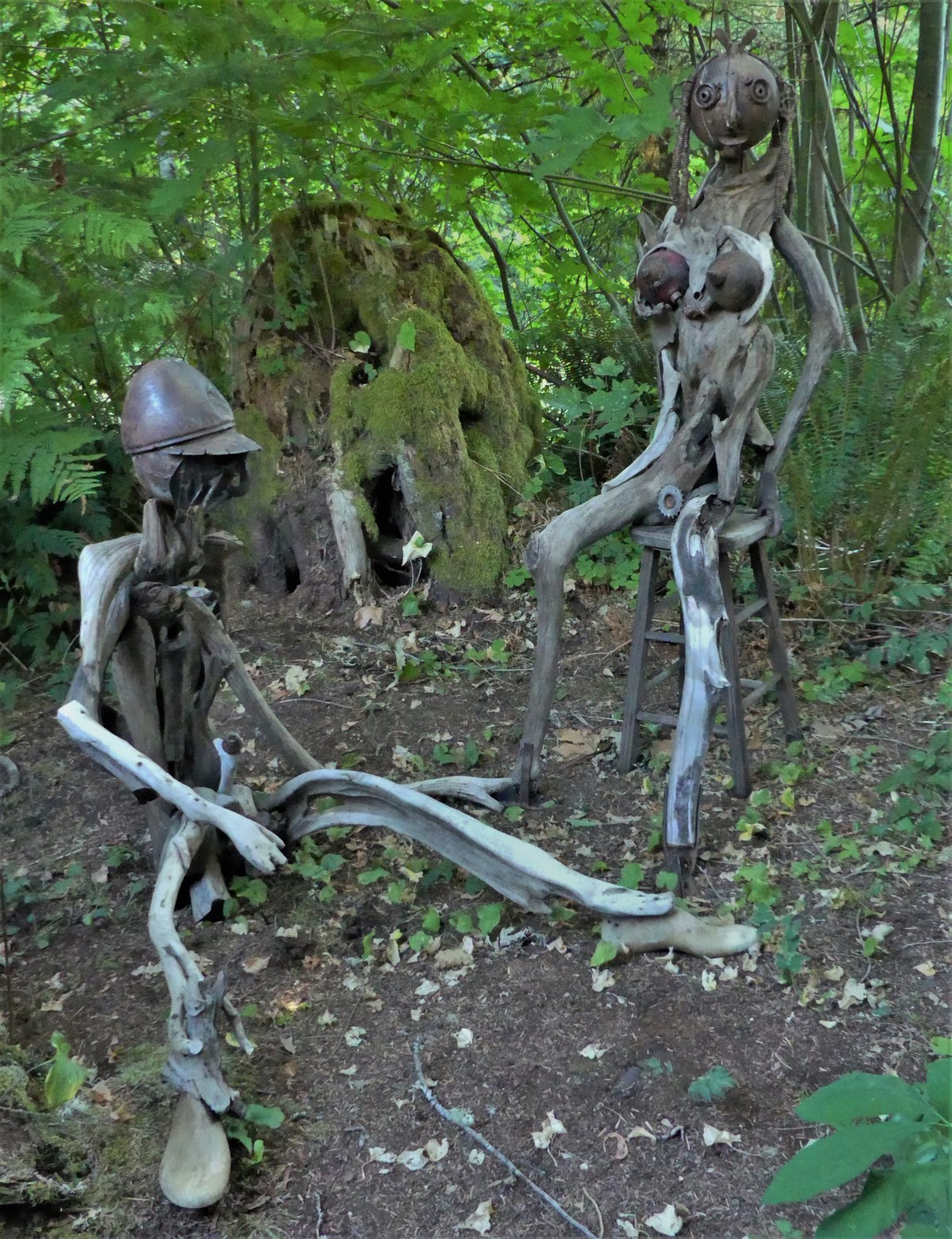
and we were free to roam through Recycled Spirits of Iron Sculpture Parkfor a small donation.
I turned to Leah, pointing to the bird…
“Check it out. Toucan get in for the price of one!” I mused.
“Your jokes are a bit rusty,” she retorted.
“True,” I countered, “but at least I beaked your interest.
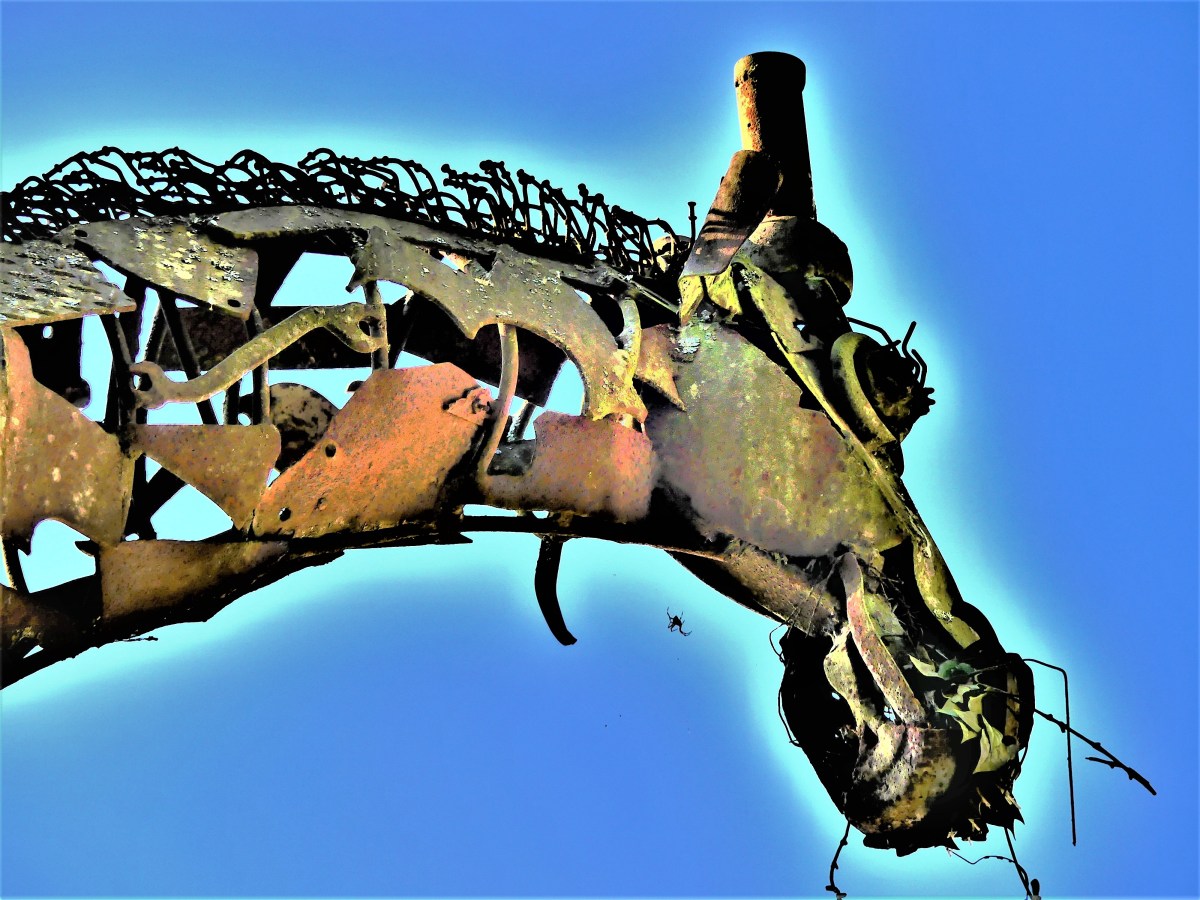
We paused at our first fish-out-of-water encounter to admire the mechanical calculus of mashing a gearhead, cogs and sprockets together with a wheel here, and a drain cover there, and accented with a fan blade for a fin, and a saw blade for a snout, wrapped around an exoskeleton of grating.
“How many horseshoes do you think it took to fabricate the skin?” Leah wondered aloud.
We stepped around for a different perspective.
“Why don’t you ask the artist,” volunteered a robust woman wearing a calico print apron and approaching us from the porch. Indicating afar with her pointer finger, “That’s my husband on the tractor out there, just about finishing up the front yard cut. He’d be happy to meet-cha by the garage, cuz he loves talking about his art.”
Dan Klennert was hungry for conversation, and passionate about his process of collecting junk.
He walked us through the nerve center of his creative cocoon, where all things junk were separated according to subject and size, and stacked in stalls that reached to the rafters.
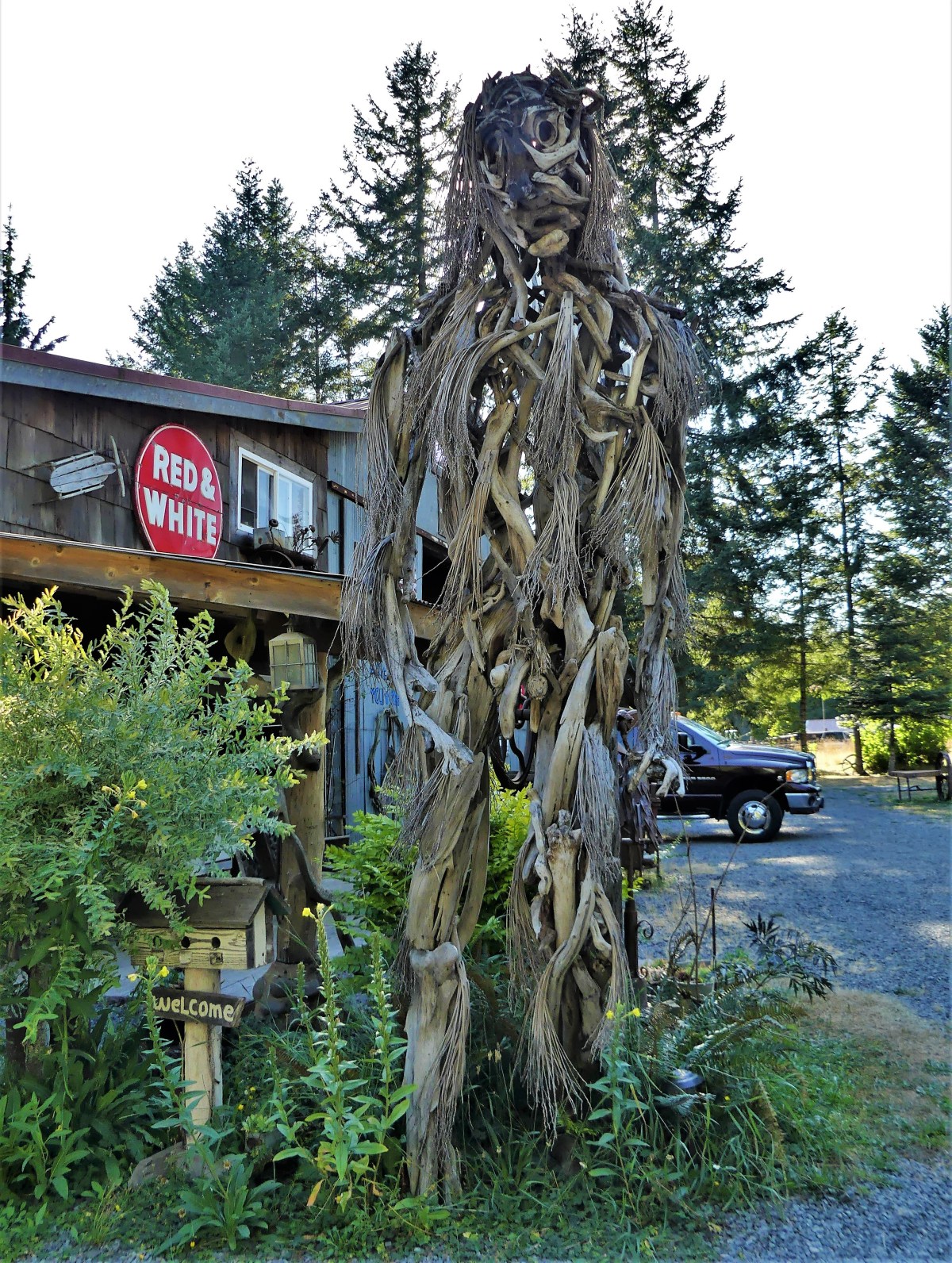
There are scores of “works in progress” scattered throughout the warehouse that originated on the whim and inspiration of a stray piece of driftwood, or the basin of a wheelbarrow, or the rotary cage of a lawnmower.
Dan is a junk whisperer of sorts. As he sifts through new collections of scrap that he regularly inherits from area farmers and ranchers, he gets a “tingle of inspiration” when he comes across something special.
“This here’s gonna be a whale,” Dan claims, showing us the sweep of the bough with the sweep of his hand. “And this eagle I got started on, I’m still waitin’ on the perfect piece that gonna be his wings.”
“I grew up in a small town called Crookston, MN,” he recalls, “and as a kid, I loved to draw. When I was seven, my family moved to Seattle. That’s when I started pulling my red wagon around the neighborhood, and collecting things from junk piles. I wasn’t much of a student then, but Friday was always my favorite day of the week, because Friday was art day at school.”
Dan became a mechanic by age 22 and learned from a foreman “how to glue two pieces of metal with a welder.”
“I found a way to put together the two things I loved most, scrounging and art,” confides Dan.
Leah and I continued our tour of the property, where the playful…
and the whimsical…
intercepted with the spiritual…
the arcane…
and the carnal…
Adam and Eve
But it’s safe to say that Dan Klennert has found his Eden on earth. His four-acre niche has given him a place to park the variations of a mechanical mind that melds an anchor to a sprinkler to imagine a snail, as he earnestly nudges the nuance of ex-nihilo–creation out of nothing.
It’s hard to imagine going away to a resort to relax, and then being sidelined because of a cold. But after a day of Ubers, planes, and transport vans, we finally arrived at Hacienda Tres Rios–north of Playa del Carmen on the Riviera Maya–for a week of fun,
and all I could muster was a trip to the hotel convenience store for antihistamine pills before I was ready to collapse. It seems that running around the continent for nearly ten months had compromised my resistance, and was now threatening to compromise my vacation.
Saturdays at the resort have always been a busy day of transitioning, as the staff warmly welcomes new arrivals with chocolate-covered strawberries and mimosas, while firmly ushering last week’s guests through the check-out process and out the door.
After checking in, we killed time at the buffet, waiting for our room to be ready. It was an excellent opportunity to people-watch and predict who among us would be the chosen people we see again and again throughout the week. Of course, it’s always the loudest guests who make a lasting impression, and this week would be no exception. Sitting at the farthest end of the room, three overweight, middle-aged woman were easily heard above the dining room din, kibitzing with the waiter, and on their way to getting shit-faced with yet another round of drinks.
Eventually, a bellman escorted us to our accomodations–a top floor room with an ocean view, or so we were told.
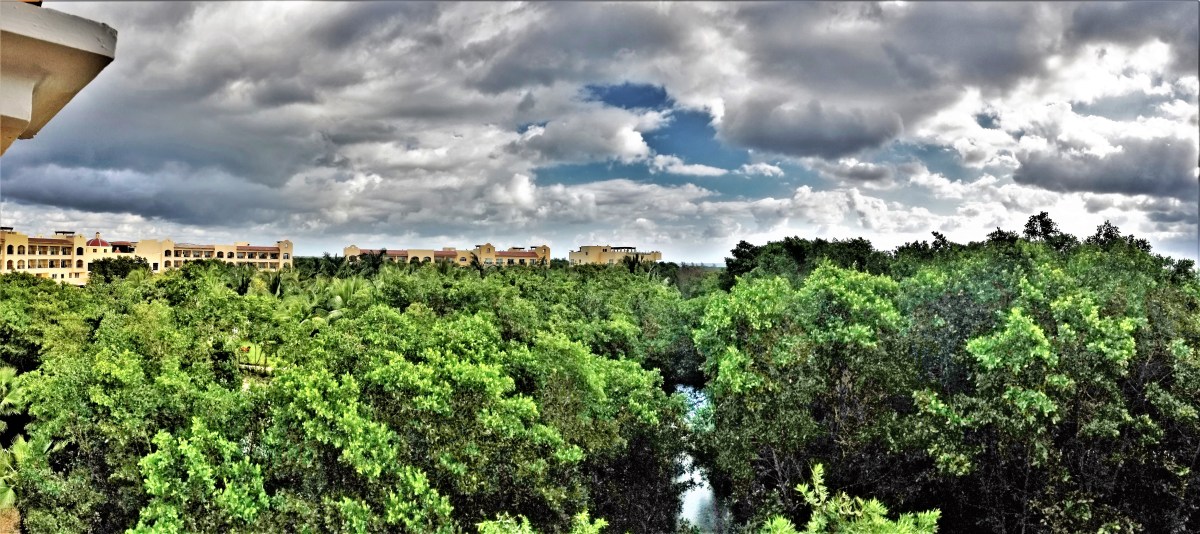
Standing on the balcony, I strained my eyes past the clearing where the last building stood, and that’s when I discovered the deception; the hotel had determined that the miniscule ribbon of gray beyond the mangrove canopy qualified as a view of the ocean.
But I was in no shape to argue. All I could think about was getting into bed with a small hope of shaking this nasty hand that was reaching past my scratchy throat and squeezing my sinuses. That’s when our next-door neighbors arrived, and headed straight for the balcony. I immediately recognized the drunken cackling and the pitchy singing. Standing on my side of the dividing wall, I peered around the other side unnoticed to have a peek, and sure enough, each one held a drink in one hand and a lit cigarette in the other, confirming my worst nightmare.
“This can’t be happening!” I quickly re-entered the room, and shut the terrace door to keep the cigarette smoke from seeping through the opening. “With 272 other rooms spread out through the resort, this is where they’re staying?” I moaned in resignation.
“Well, not if I have something to say about it,” declared Leah.
She grabbed the phone, and dialed the front desk downstairs.
“Tell them about the smoking,” I coached, “because obnoxious is too subjective.”
Leah asserted, “I’m calling from 1307. We just arrived, and already the cigarette smoke from the people next door is drifting into our room from the balcony, and it’s intolerable. So you need to find us another room.”
“I’m very sorry that you are being inconvenienced, ma’am” the desk clerk regretted, “but we are unable to accomodate you because of the volume of registrations at the moment. However, if you could be patient with us, we should be able to make other arrangements tomorrow after check-out time, when we’ve had a chance to review our room inventory,” the advised.
“What time, tomorrow?” Leah zeroed in.
“If you come to the desk at 9:00 am, we will be happy to help you,” she elaborated.
Meanwhile, a slurred rendition of Shape of You vibrated through the shared door between the rooms.
“Damn! I used to like that song,” I aired, “and now it’s ruined forever.”
The clatter of their high heels on marble floors resonated throughout the night, and imprinted on my sinus headache. As I lay awake in bed with a box of tissues by my side, I wondered how many costume changes they could go through in one evening, and cursed the day Ed Sheeran had become popular.
A new day for a fresh start, Leah and I packed the last of our belongings and shlepped our bags to the front desk. We previewed a room on the top floor of another building and unconditionally accepted the exchange.
Not too shabby–an ocean view with a whirlpool tub on our new balcony, and a chance to reboot our vacation. Ahhhh…
…choo!
Feeling sick and tired of feeling sick and tired, Leah and I consulted the concierge to schedule enough activities through the week to balance my boredom with my recovery.
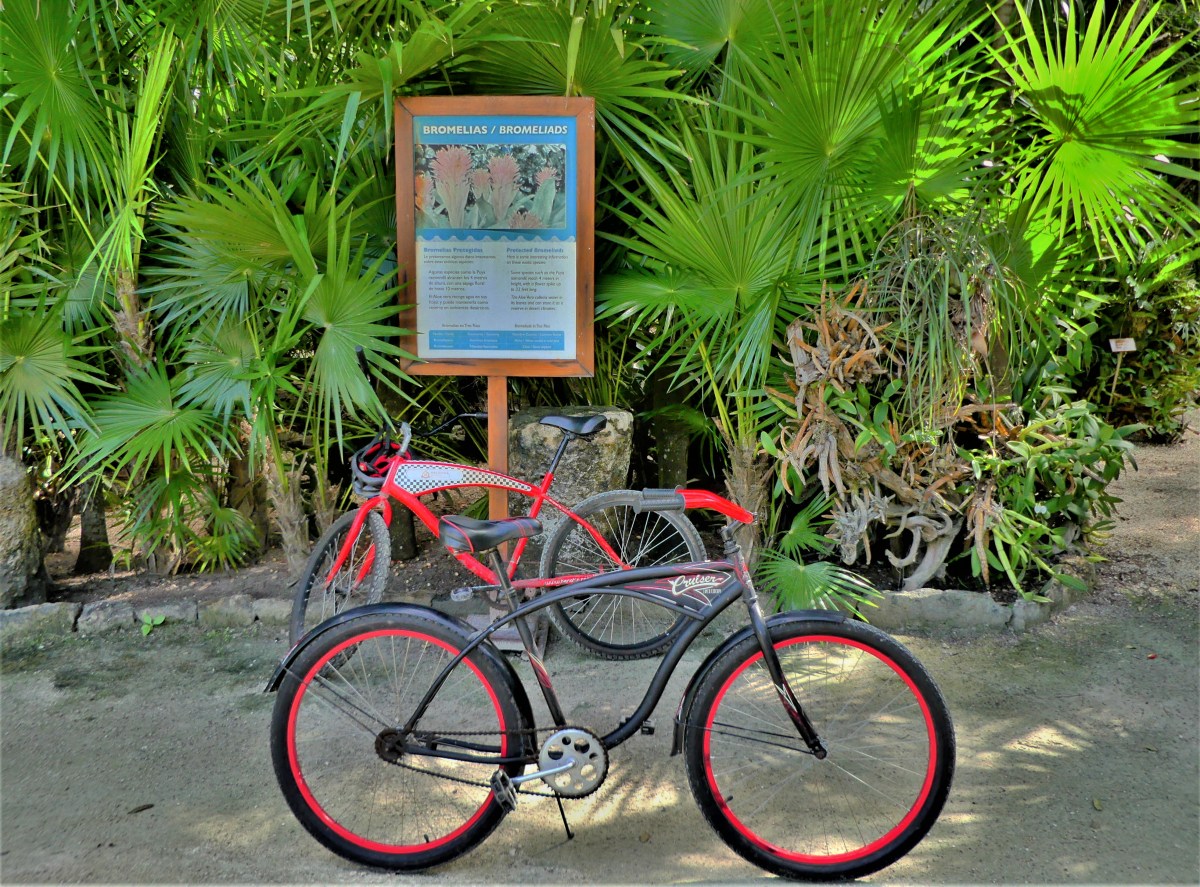
After settling into room 4302, we met up with Salvador, our trail guide who escorted us through the Nature Park on mountain bikes.
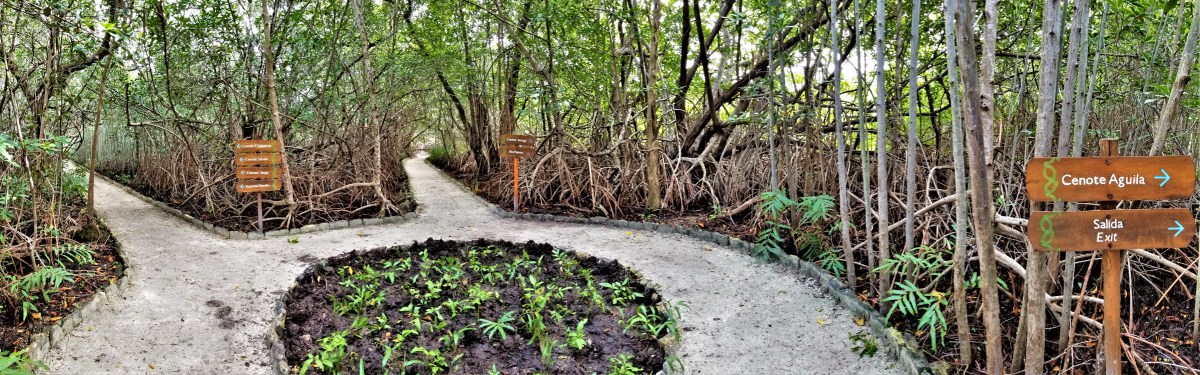
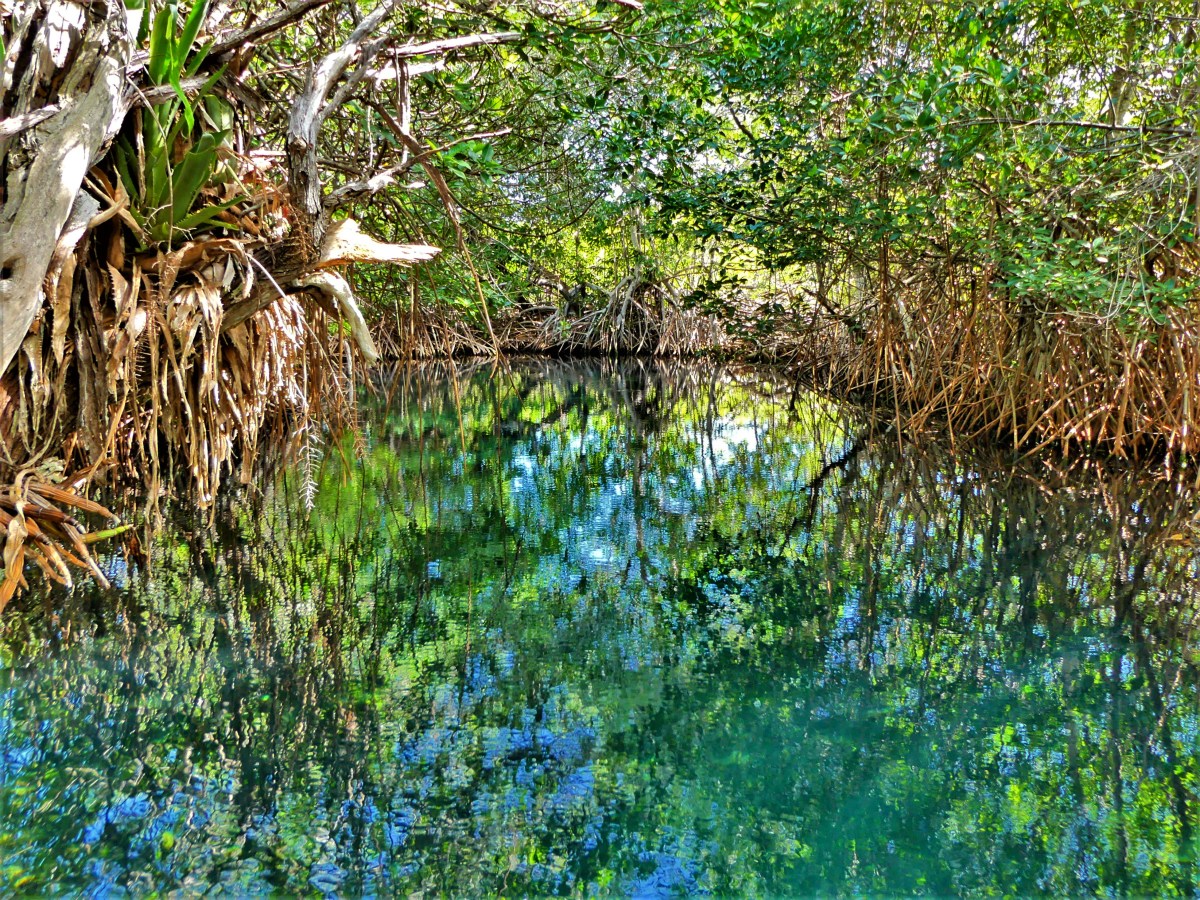
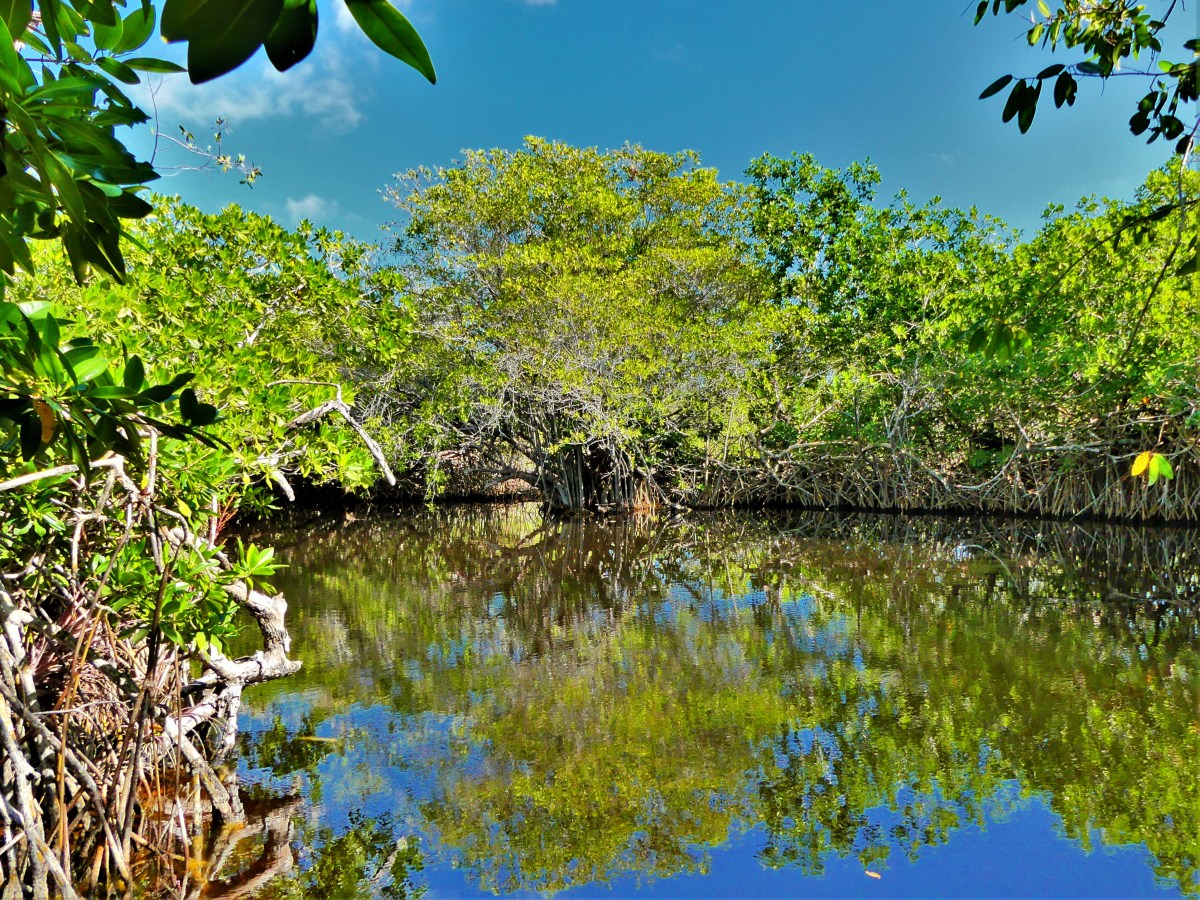
We wove our way around the mangrove forest through a labyrinth of sandy trails recognizing white, red, black, and buttonwood mangroves–the four distinctive varieties that flourish in this tropical environment. On the way to the many cenotes,
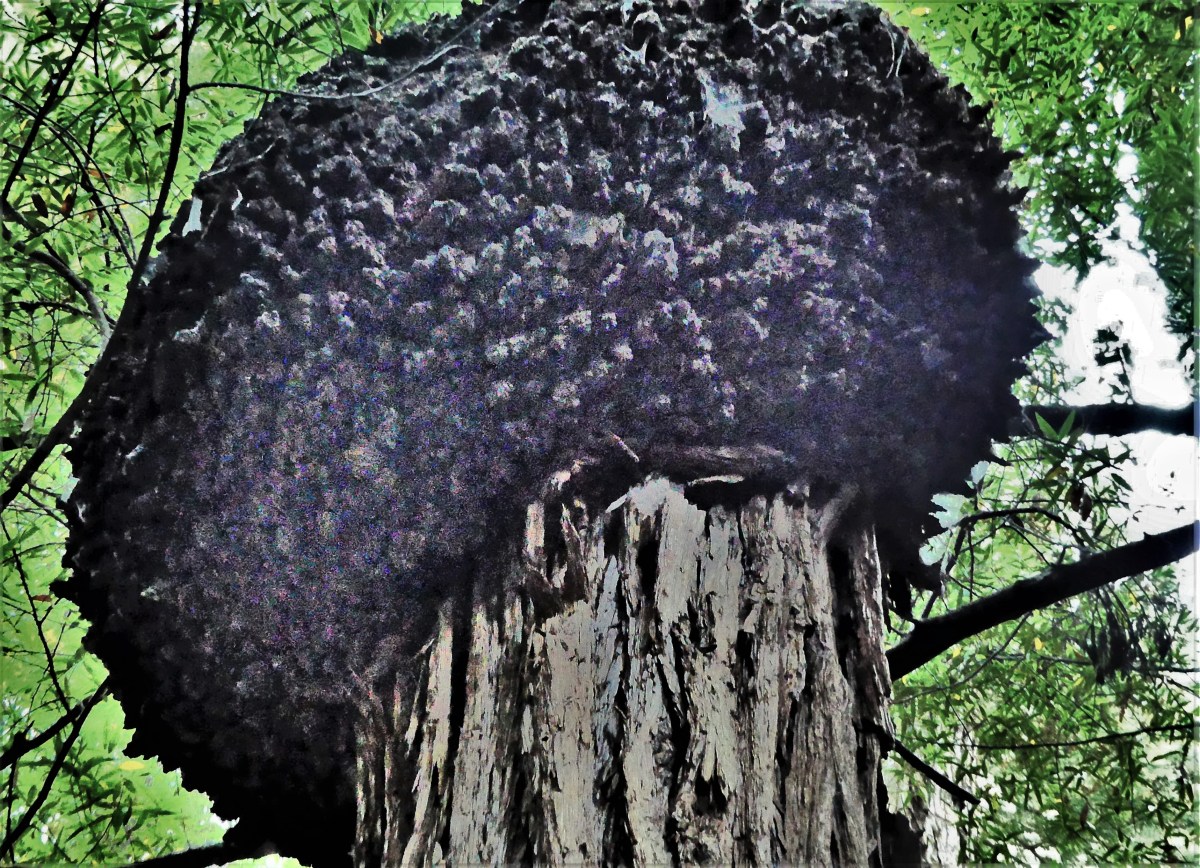
we identified a plethora of termite burls, several songbirds, a vulture and an iguana.
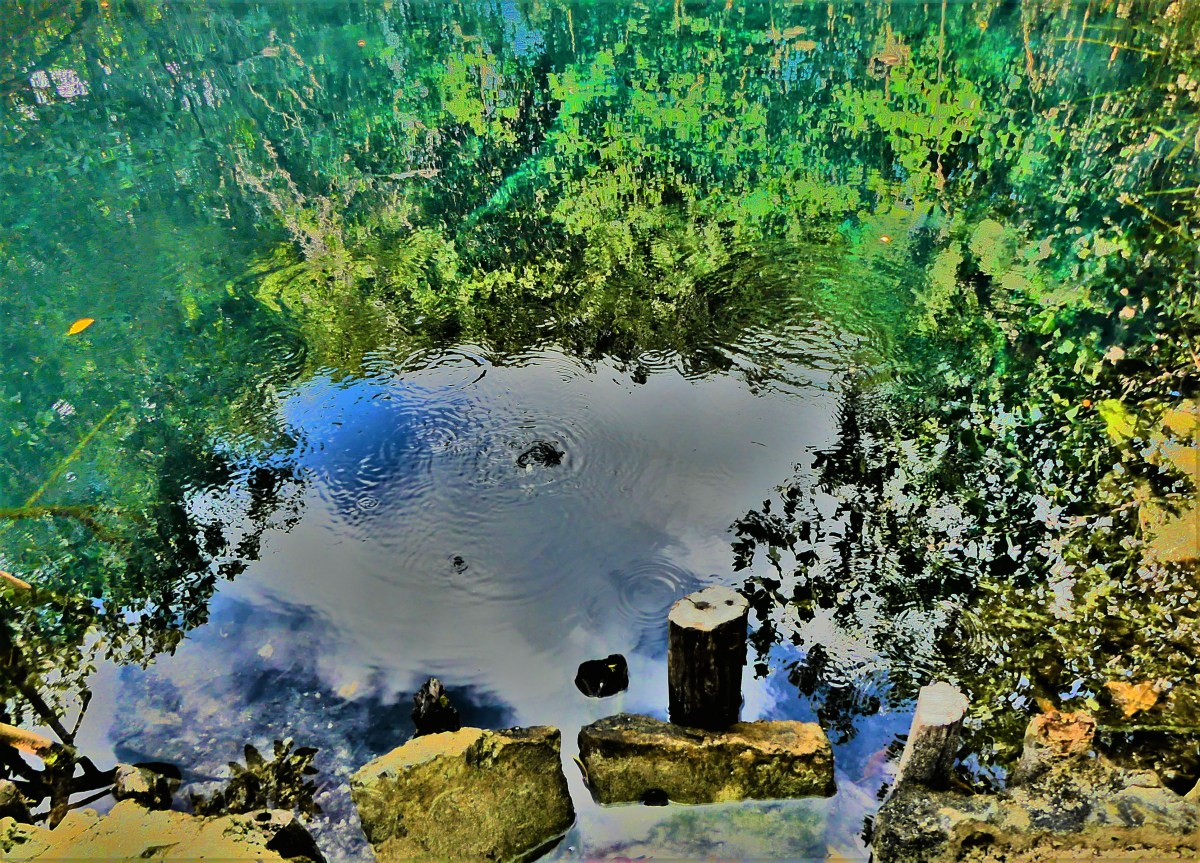
Of the ten cenotes on the property, we visited Cenote Tortuga;
Cenote Hondo;
Cenote Viejo;
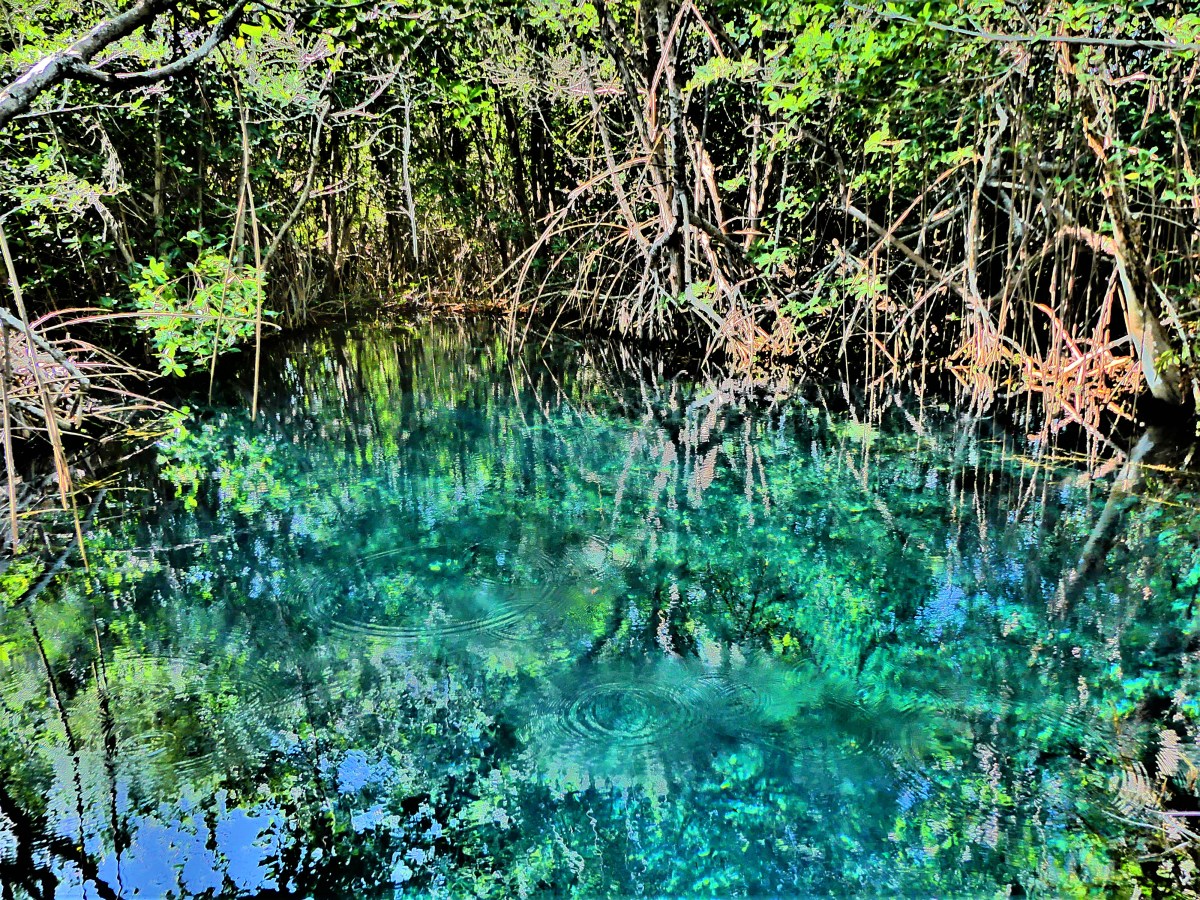
and Cenote Orchideo…
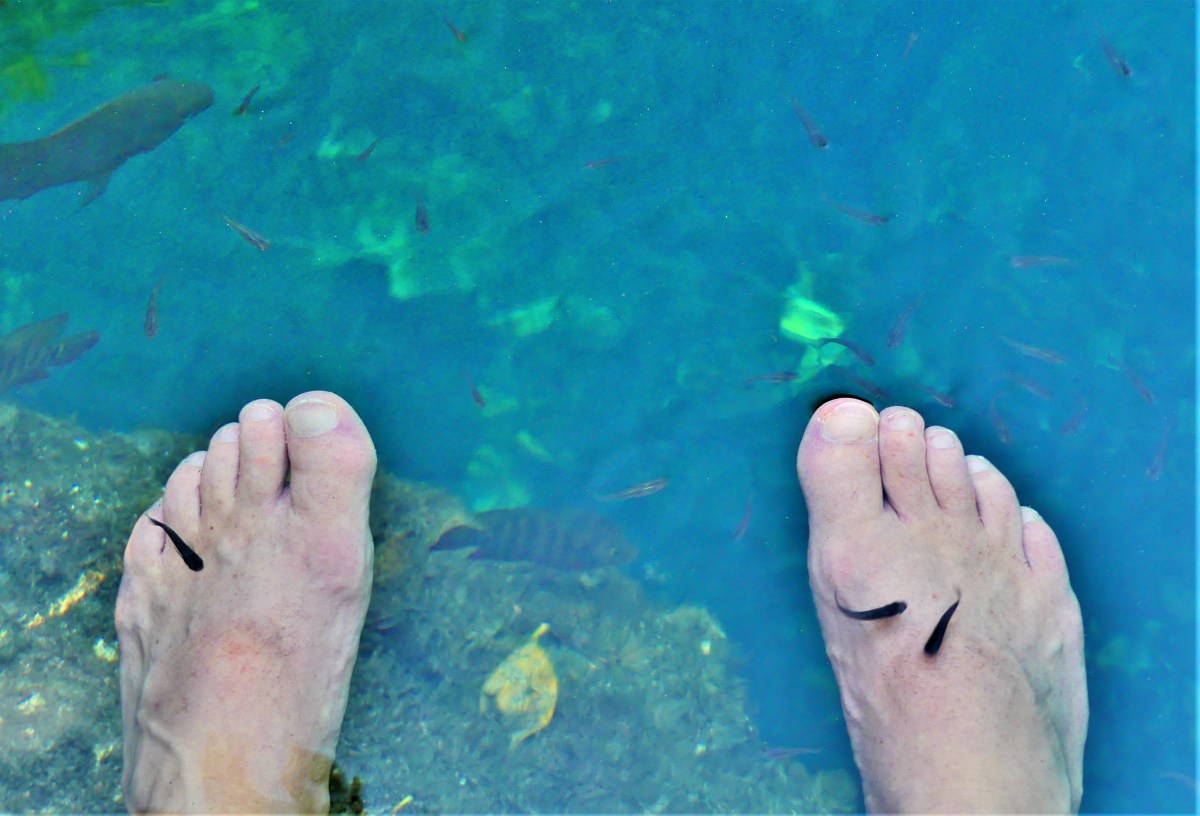
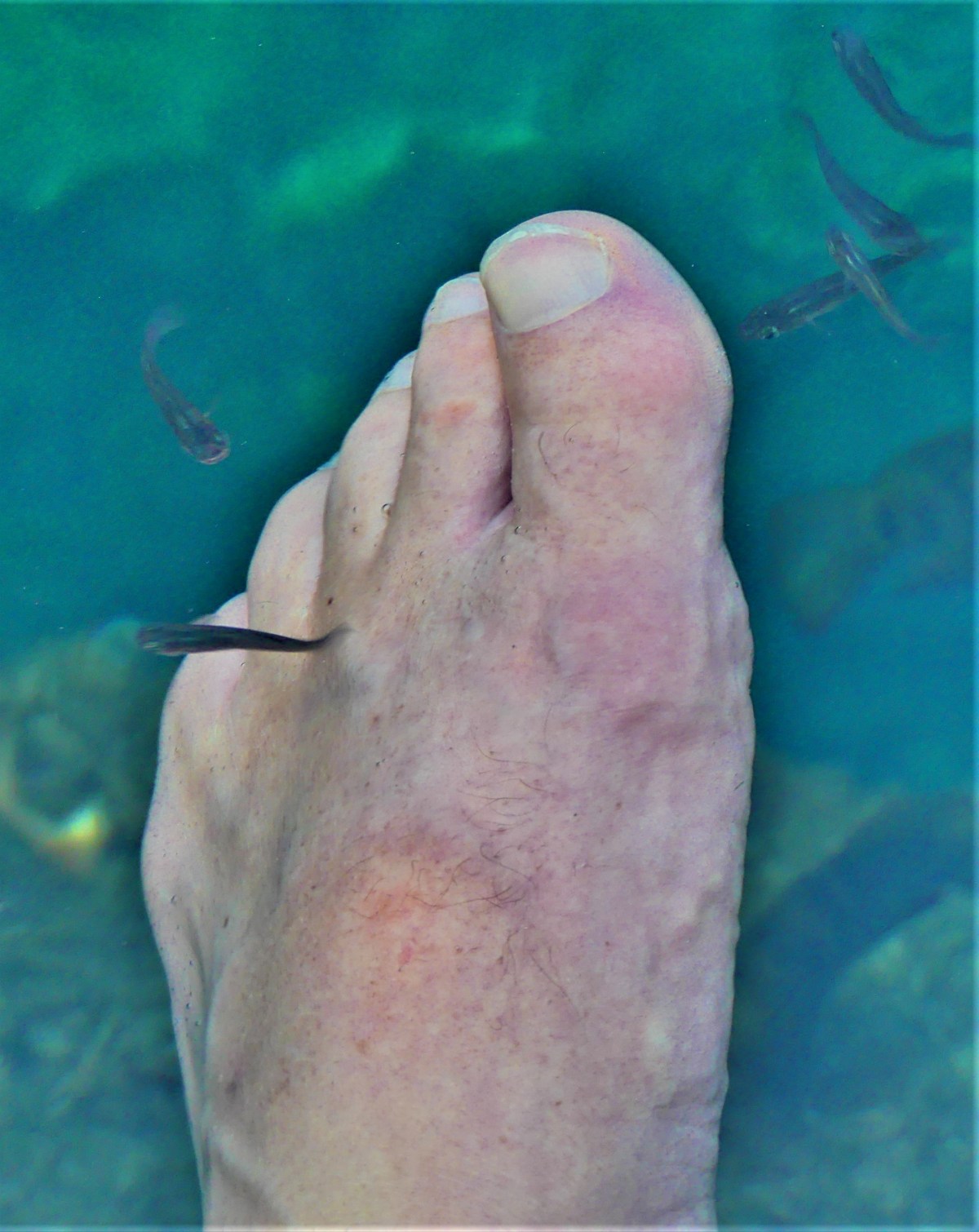
where we were greeted by a small school of Garra Rufa,
eager to perform ichthyotherapy for free.
On Monday, we spent our morning with sales agent, Ricardo (At Your Service, Too), and our afternoon with Manuel, who guided us from Cenote Aguila,
down the Rio Selva…
to the ocean.
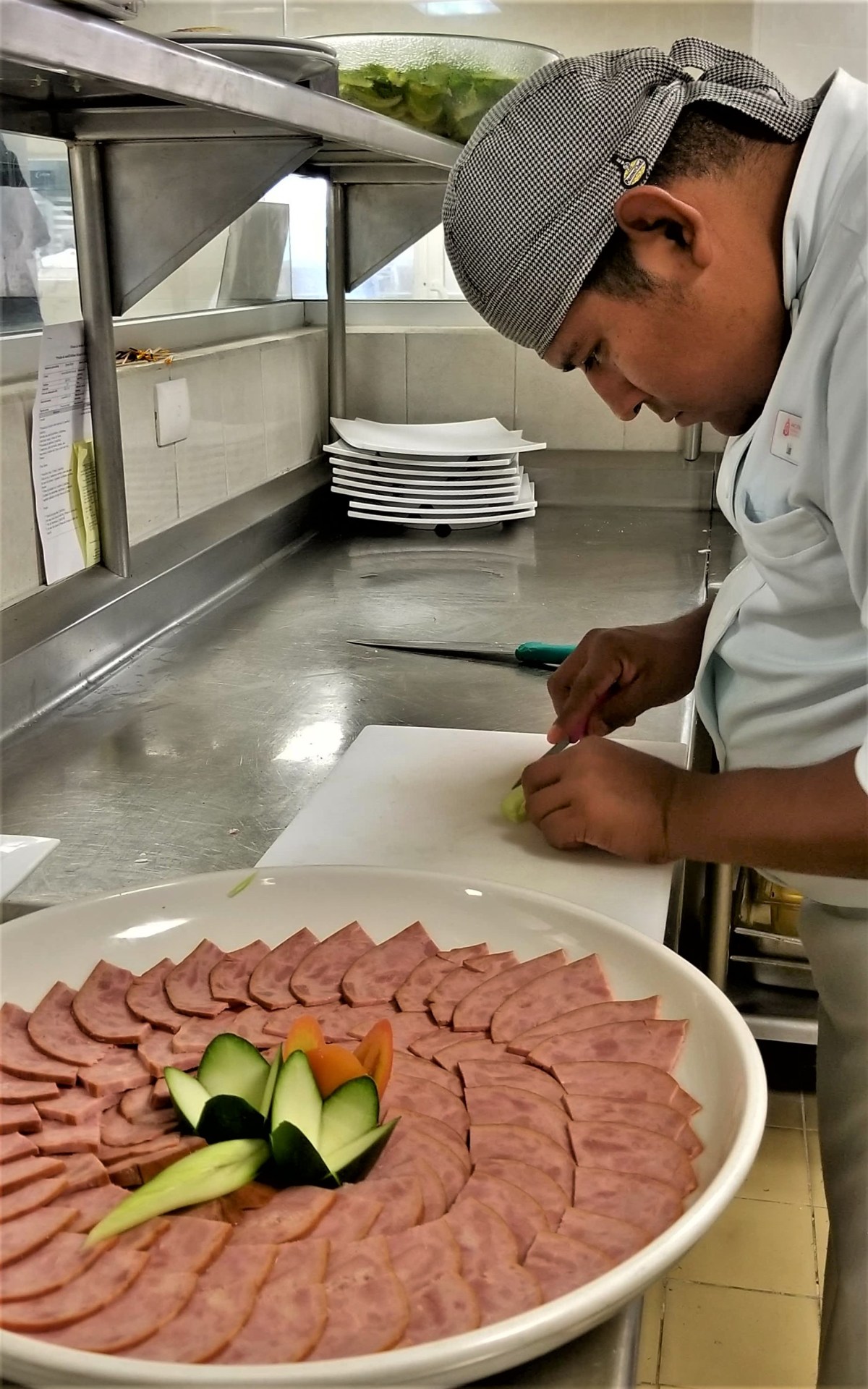
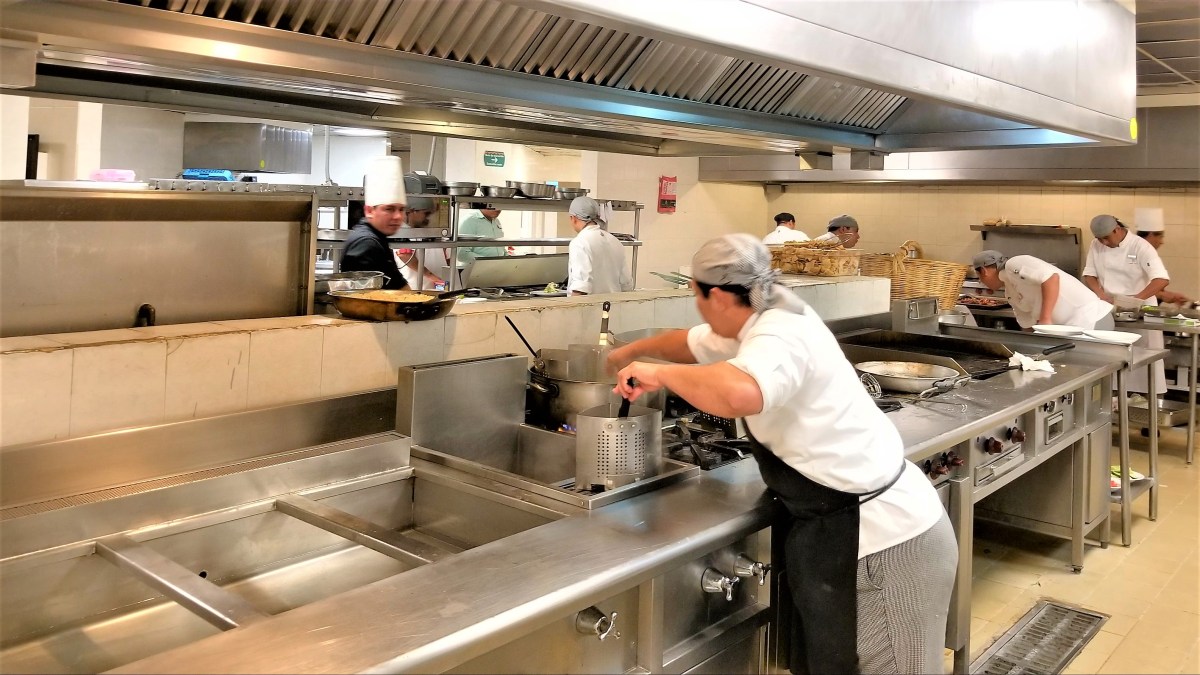
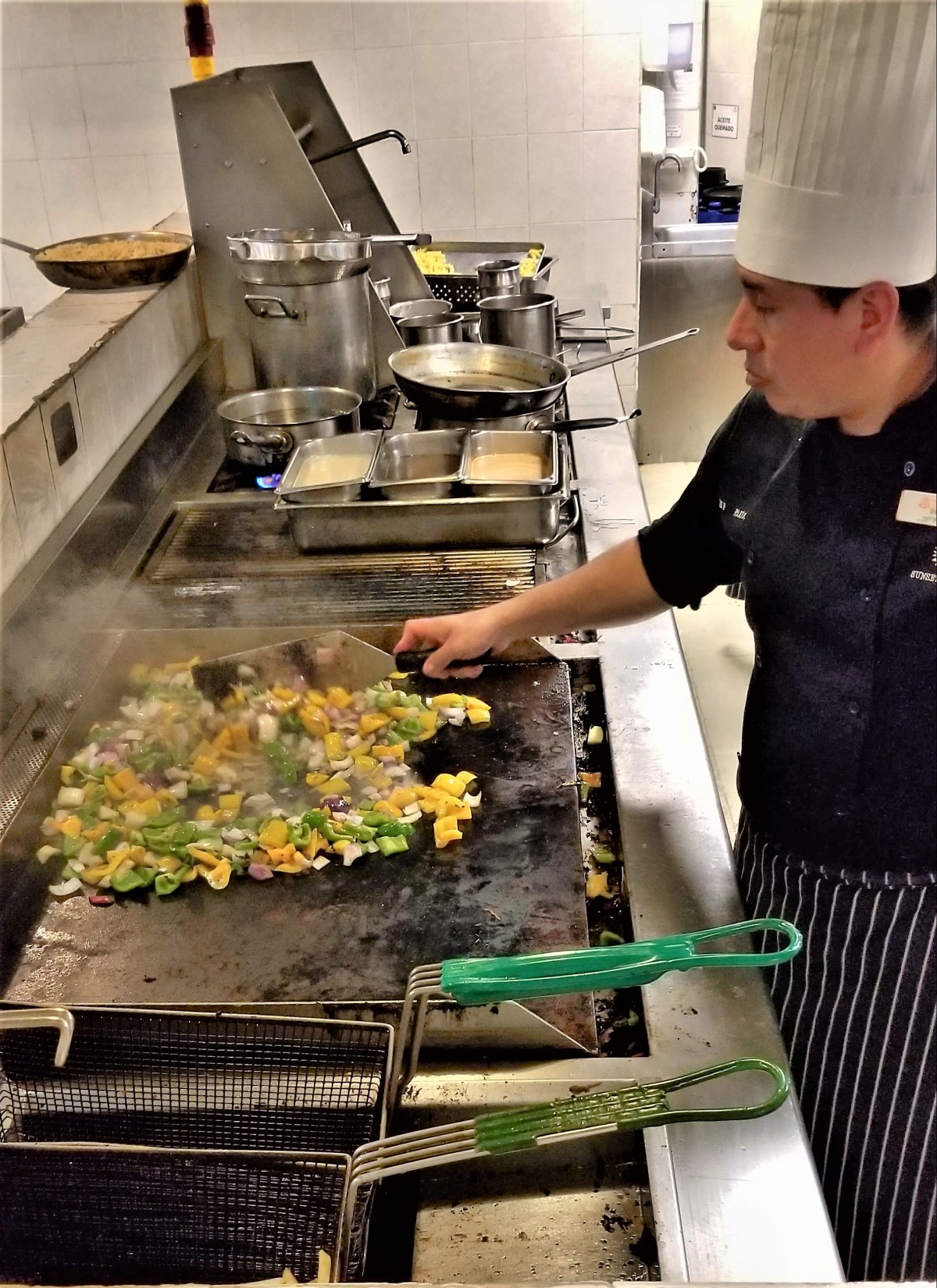
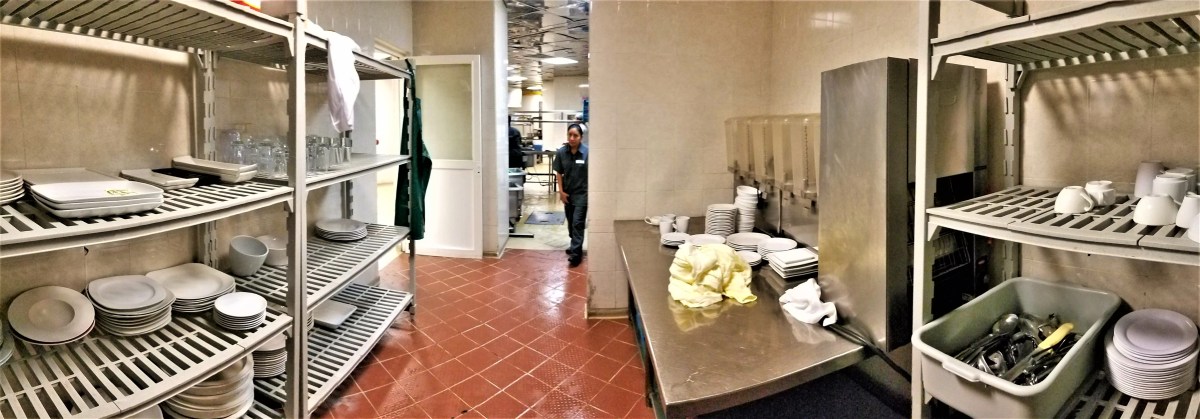
On Tuesday, we took a behind-the scenes-tour of the kitchen with Celia, the kitchen supervisor. She invited us into her casa to showcase the operation and preparation of all food within the hotel:
by the numbers…Walk-inFish PrepButcheringDeli and garnishBakerySoupsPastaGrilling and fryingBartendingChina and crystal
Celia’s staff works hard–six ten-hour days every week–and is committed to ensuring a healthy and tasty experience with fresh ingredients and a variety of international cuisines. She acknowledges us by placing her hand on her heart–a sanitary salute of sorts to thank us for the opportunity to serve.
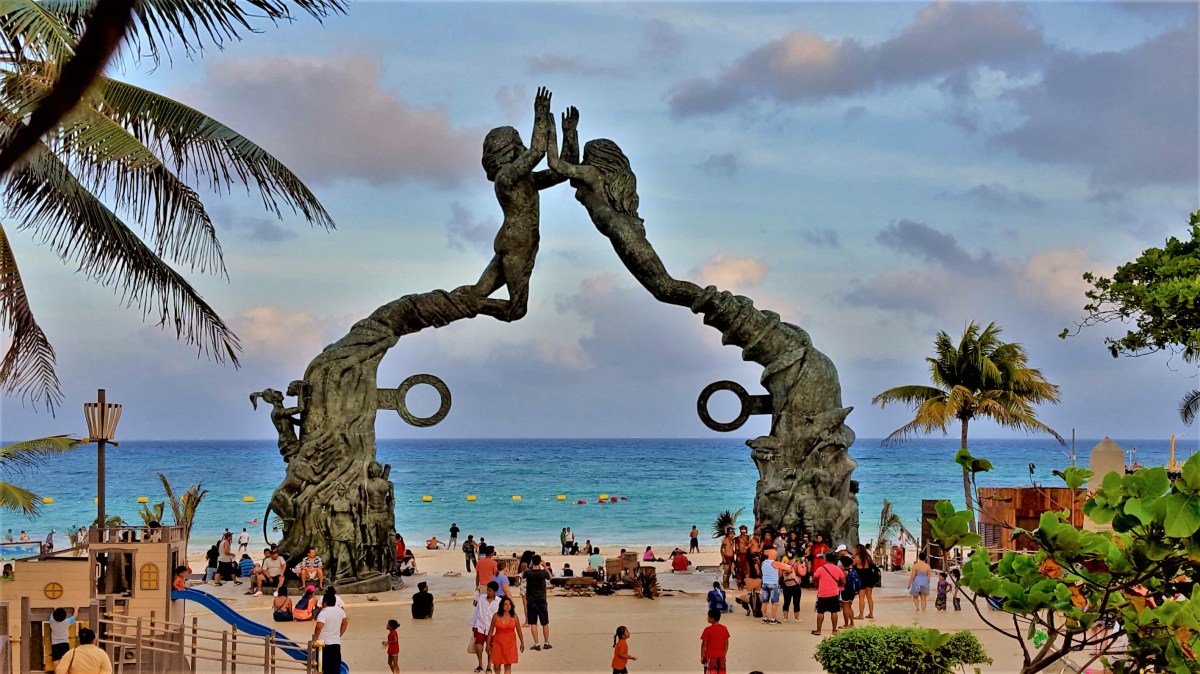
On Wednesday, we travelled by hotel shuttle to Playa del Carmen,
for a stroll up and down 5th Avenue–a pedestrian marketplace stretching 20 blocks, and lined with fashionable shops,
Where’s Leah?
eateries, tequilarias, t-shirt mills, modern malls, massage stations, tchotchke kiosks, tourist stands, Mom-and-Pop Mexicana, and pharmacias, etc.
I’ll have a week’s worth of Cialis, and a half-pound of hard salami, por favor.
By Thursday I was dying. After five days of dosing Sensibit D (an antihistamine decongestant), my body had betrayed me, turning my free-flow nose into a gripping sinus headache.
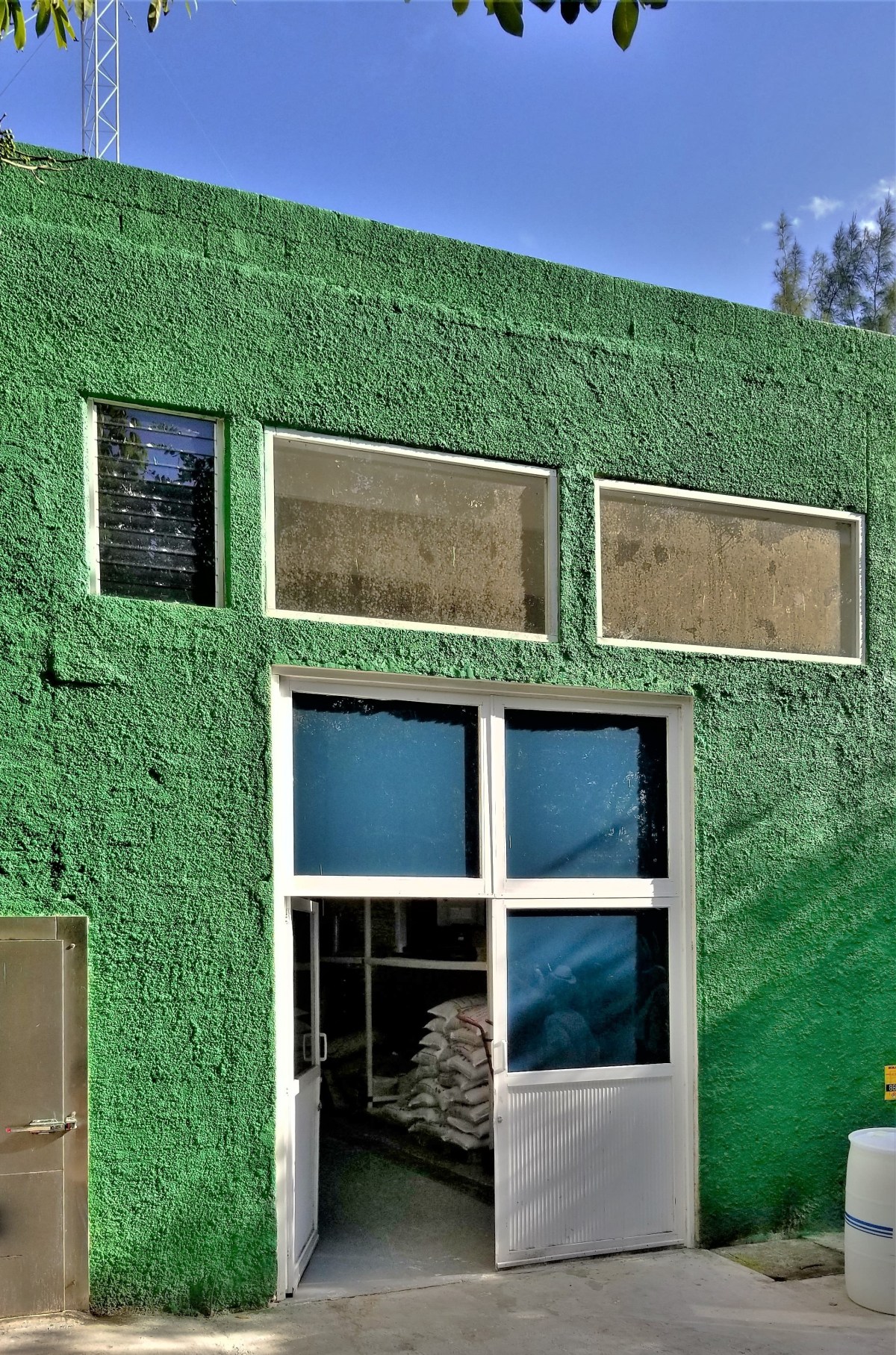
But that didn’t stop me from touring the Cancun Brewery with Leah and The Ed Sheeran Trio. Hiding behind the green wall of an unassuming building,
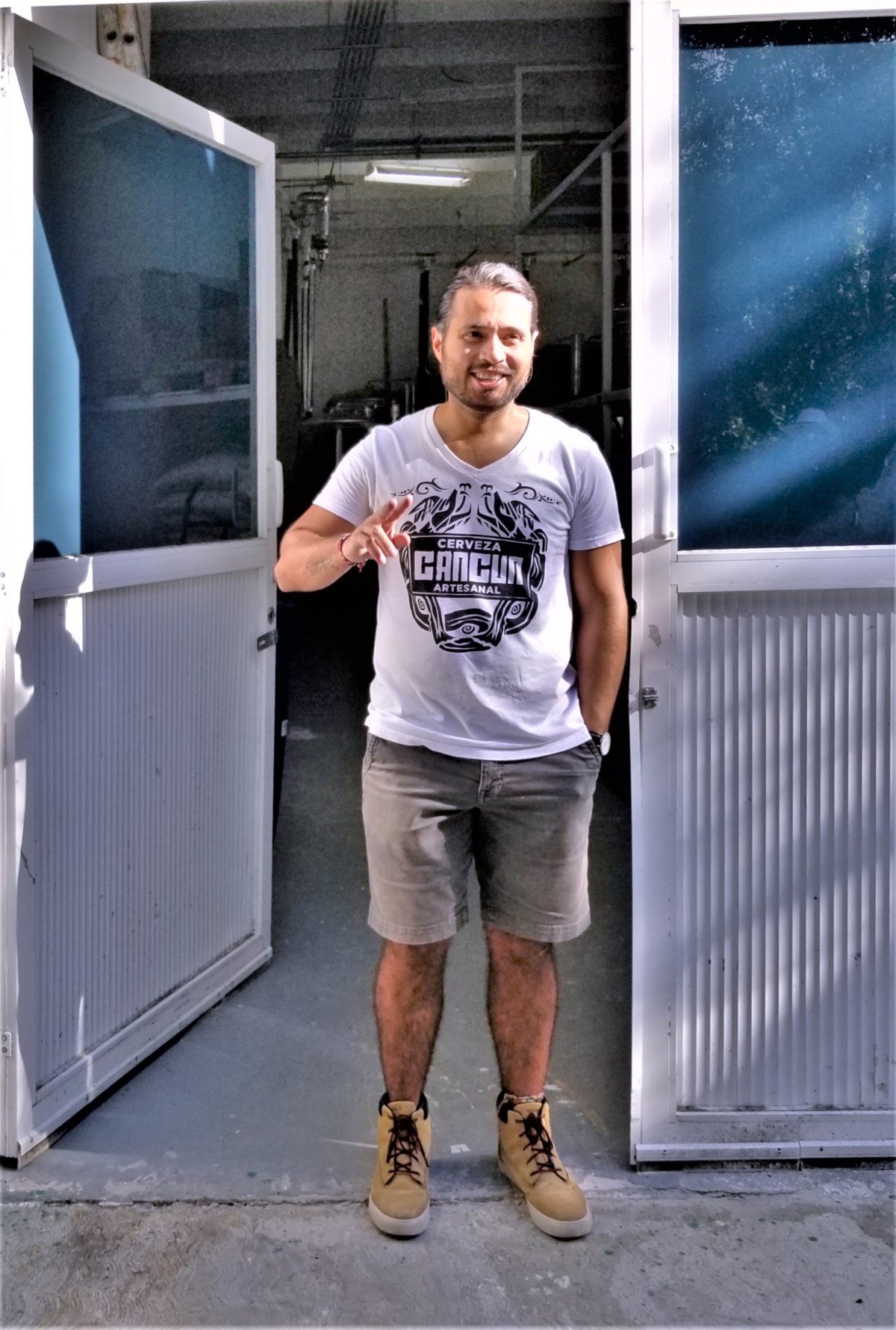
a shiny brewery has taken shape in the middle of Tres Rios jungle. According to Brandon, brewmaster from Michigan,
a Sunset Group partner bartered a warehouse, utilities and unlimited clean water in exchange for craft beer supplied to all Sunset Group hotels.
Additionally, production runs of Pale Ale, Hefeweizen, and Pilsner are crafted in short batches of kegs and cans to satisfy Riviera Maya’s thirst from Cancun to Tulum.
To some extent, I felt sorry for Brandon, as he was peppered with ridiculous comments, questions, and suggestions from my ex-neighbors, yet good-naturedly responded to everything that came his way. Then I stopped myself when I realized that here is a guy who otherwise, would still be living in Michigan, but instead comes to work in shorts and flip flops, and gets to drink cerveza for a living.
Adios, Cancun Beer.
Friday was a good day to lay low and do nothing in preparation of an early departure on Saturday.
Lounging by the pool, I reflected on the past week, thinking about the activities I’d missed out on: snorkeling at Yal-ku in Akumal; diving Santa Rosa reef at Cozumel; and exploring the ruins of Coba or Tulum. While all of that would have made for an exciting itinerary, it wouldn’t have made for a relaxing vacation, and maybe that’s what my body was really craving.
Every day discovering something brand new
The sun felt good on my face, as I moved in and out of consciousness–half awake, half-asleep–my body floating through a cenote abloom with fragrant orchids,
In the distance, a hypnotic song was playing–a lilting melody of love that grew louder and louder with every new verse–until I snapped awake. The Three Little Mermaids were at it again, wading in the pool with a drink, and killing me softly with an execution of Shape of You.
No matter. It was time to rise, and the perfect segue to a late-afternoon hot-stone massage we had scheduled as our reward for enduring Ricardo’s two-hour spiel (At Your Service, Too).
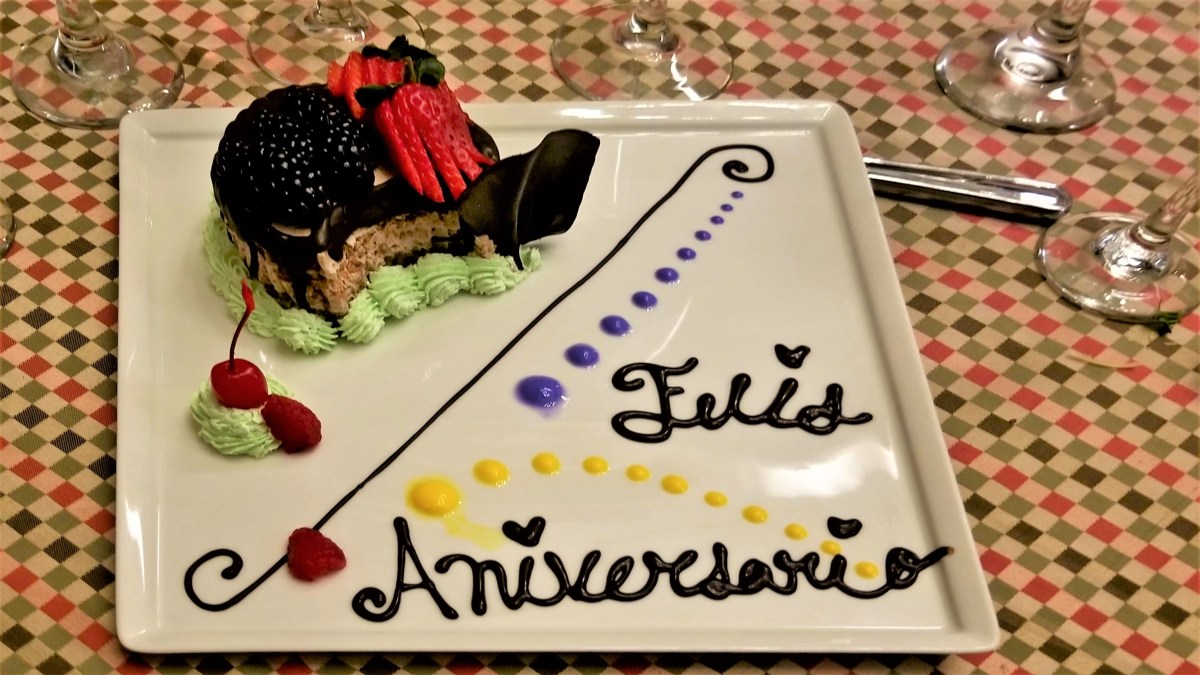
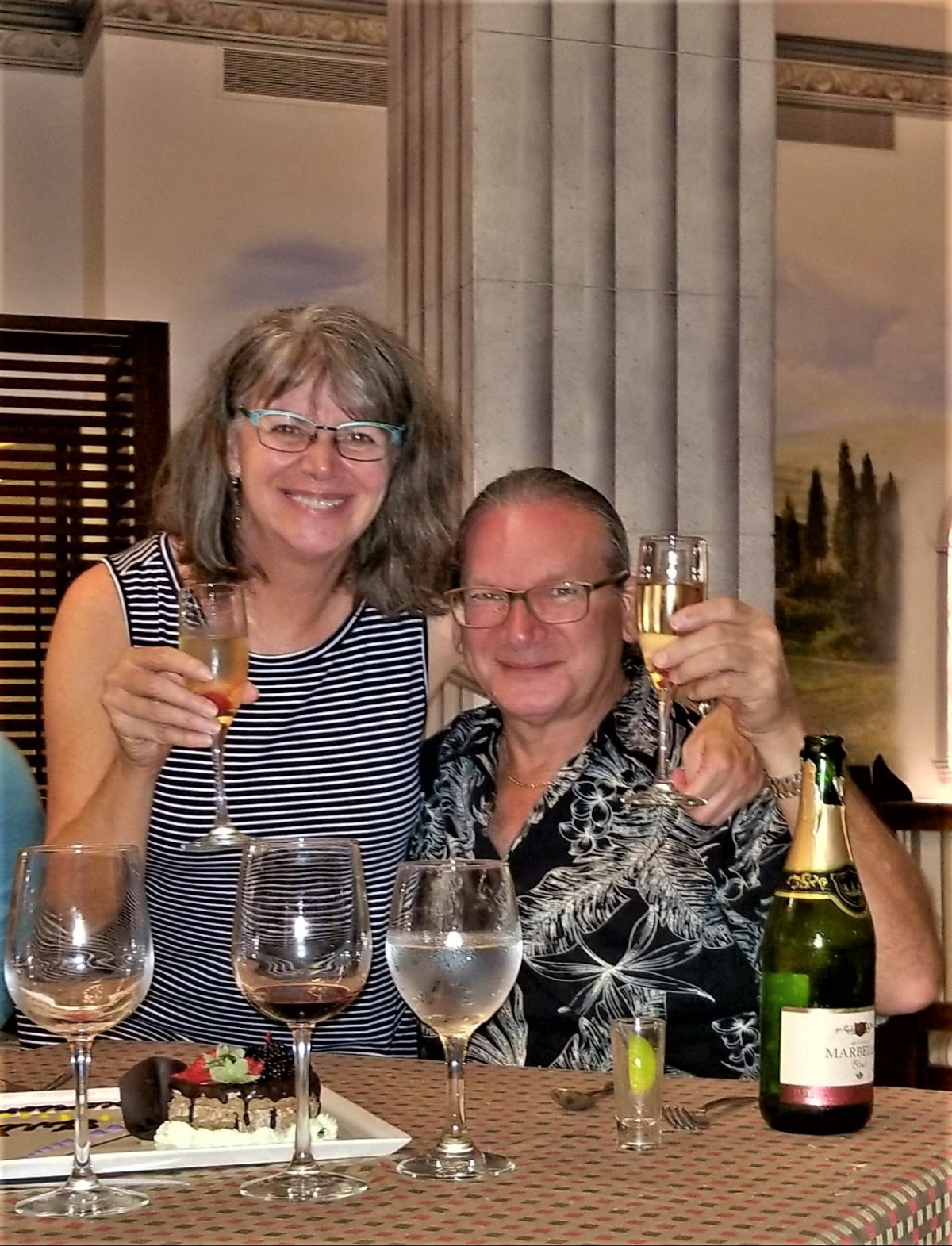
By evening, we were totally relaxed and ready to celebrate our mock 13th anniversary over a langoustine dinner and a special treat from the pastry chef.
It was everything I needed to forget about the miserable cold that plagued me through this vacation.
Many have asked, “Why on earth do you call it a vacation, when you’ve been on a vacation for the past ten months?”
To which I answer, “Who cares what it’s called!”
Come on now, follow my lead I may be crazy, don’t mind me…
Leah and I sat in beautifully hand-carved, yet wildly uncomfortable rattan chairs over a Mexican buffet breakfast that could best be described as Meh-ican. Sitting across the table from us was Ricardo, a familiar host and representative of the developer, who was writing upside down with his Mont Blanc pen, while presenting all kinds of facts and figures about the local hospitality game.
“40,000 hotel rooms in Cancun and 40,000 hotel rooms in all of Riviera Maya stretching from Puerto Morales to Tulum,” he regaled, “and here we are, at Tres Rios, right in the middle of this amazing paradise.”
Ricardo was finding his groove. He was flashing pages of a promotional real estate magazine and rattling off stat after stat as he actively drew a map of the Quintana Roo coastline on the backside of a resort brochure. For every detail added, Ricardo would reinforce his point by circling the Riviera Maya caption at the top of his masterpiece, until it resembled a paddleboard floating on a cartoon sea. With bold retraces and multiple underscores from his pen, he emphasized the unprecedented low, low prices that wouldn’t last unless we acted today!
Ricardo’s presentation was polished and professional, needing only one new breath of air every five minutes or so to sing the virtues of founding membership privileges, and the accorded rights and benefits granted to ground-floor go-getters who were willing to take advantage of a great deal when they saw one.
Ricardo has been honing his razor-sharp delivery skills for the past 25 years, having moved from Jalisco in search of an opportunity, and finding sponsorship with the Sunset Group, a controversial band of land speculators and developers from Mexico, who have since built four resorts from Cancun to Playa by selling timeshares to curious vacationers who couldn’t resist the notion that a Mexican vacation would fulfill their sun-starved lives.
Hacienda Tres Rios has become their biggest venture to date. Once an active Nature Park, the preserve fell on hard times after the devastation of Hurricane Wilma in 2005, and ultimately closed. In exchange for the right to convert the dormant property into a resort, the Secretariat of the Interior secured a commitment from Sunset Group to restore the mangrove habitat and preserve the original eco-park concept.
Ten cenotes (some fresh water, and some brackish) are scattered throughout the property, with miles of bicycle paths carved into the jungle, providing access to swimming and snorkeling, while a short hike to Cenote Aguila offers a chance to kayak or snorkel down Rio Selva to the sea.
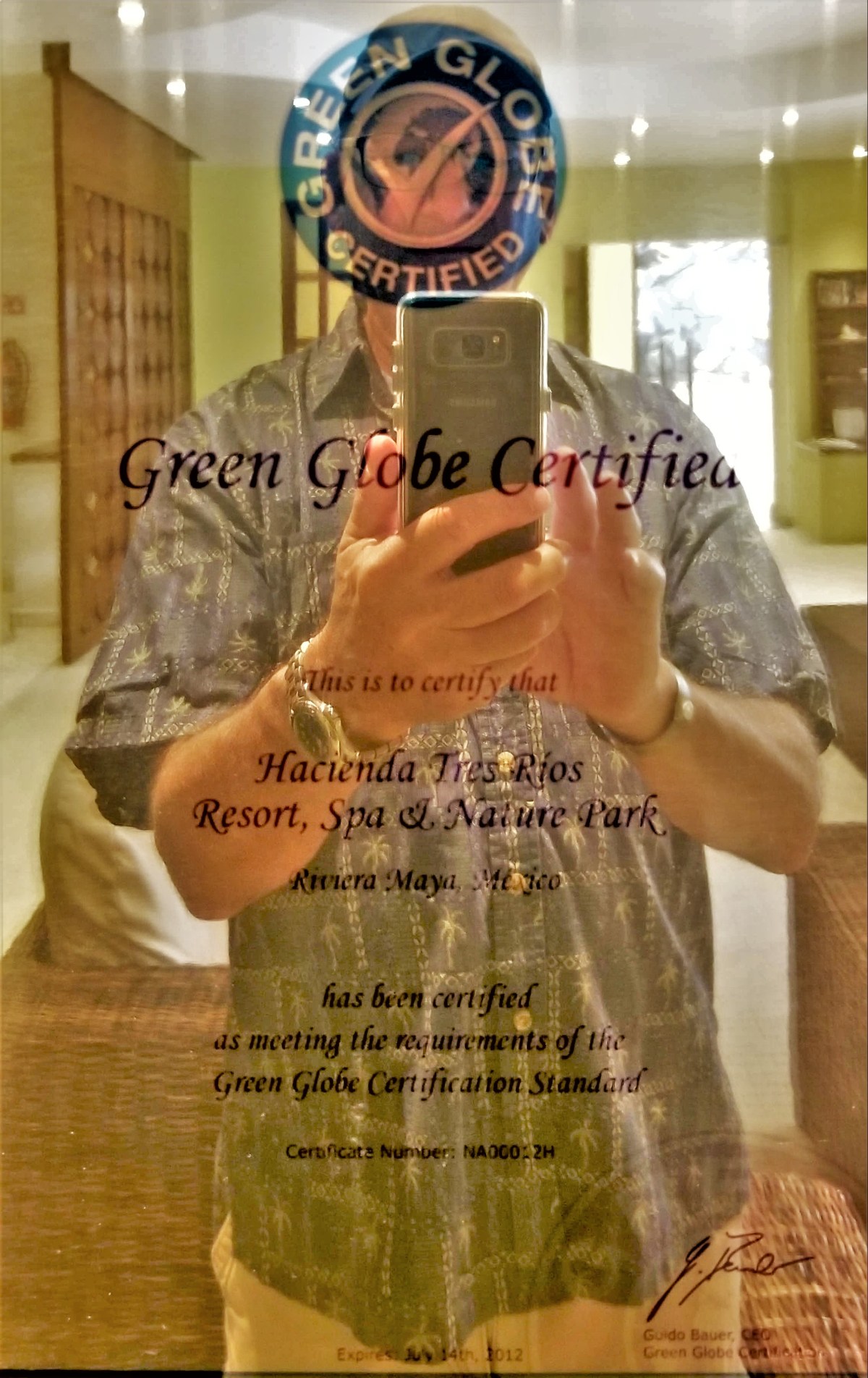
Subsequently, steps have been taken towards self-sufficiency: with completion of a mangrove and orchid nursery, a water desalination plant and inverse osmosis system, solar panel installations for sustainable energy production, and a local farm-to-table concept that cultivates flowers, fruits and vegetables for all resort restaurants. Sunset World has transformed Tres Rios into Mexico’s first green resort years later, and is now the standard-bearer of all future hotel development in the vicinity.
As members of a sister resort in Playa del Carmen, Leah and I were invited ten years ago to inspect the property at Tres Rios and sample the spa hospitality. We returned the same evening to enjoy a Mexican fiesta on the beach, but not before we were spritzed with organic mosquito repellant, which really seemed to keep the bloodsuckers away. It was great fun at the time, and seemed like an experience worthy of repeating.
Subsequently, Ricardo and I negotiated on a one-bedroom suite for a one-week share that for many different reasons has been visited only four times in the past ten years.
Today, the Sunset organization prepares to finance Phase Two at Tres Rios, promoting luxury interval ownership, and beyond (future development of single unit residencies, and a marina with ocean access), so Ricardo sits across from us, giving his all–dazzling us with his artful cartography and adroit calligraphy–with every intention of leveraging our single week of ownership into a one-month obligation, which will help to defray the cost of the elaborate June Quinceañera his daughter has been planning for nearly a year.
But Leah and I never had any intentions of upgrading. Never. We were there for the sole purpose of exchanging our two hours of attendance for an hour of spa treatments. While our massages are presented as a gift for our precious time, realistically, it’s little more than a simple lure that’s part of a much larger marketing strategy.
It was a monumental match of wills: Ricardo’s relentlessness versus our resilience. After an obligatory walk-thru of the newly appointed model apartment (which was roomy, luxurious, and fashionable) we moved through a display and awards room to reach an open conference room populated with small tables surrounded by high-back leather chairs. This was to be the setting for Round 3. While the chairs were more comfortable, the air temperature inside was rather chilly, prompting a request from Leah for a blanket before she bolted.
When Ricardo sensed that things weren’t going his way, he called for an assist from Patrick, his manager, who from gracious introductions revealed himself to be a 40-year old Irishman with a Mexican accent. The sales pitch devolved even farther after he further explained his unusual heritage: his Irish father met his Mexican mother while vacationing. They subsequently married; lived in Dublin until Patrick turned four; and under duress from his mother, his father returned to Mexico, where Patrick was schooled and his parents eventually divorced, although on good terms.
His father currently lives in Ireland, where he crafts granite fountains with Mexican stylings, and has sold one of his designs to Bono for his home on Killiney Hill. The conversation turned to our love of U2’s music, our mutual excitement of seeing them entertain live on stage, and Patrick’s fascination with my look-alike appearance to Bono.
Out of the corner of my eye, I knew that Ricardo was defeated. Unable to participate in our repartee, he sat silently and sulked, perhaps wondering if he could ever recover. I signaled to Patrick that we were passing on the offer, and just like that, the transaction was finished and so was Ricardo’s energy.
In a last ditch attempt to win the sale, he severely undercut his original bid. And like a Hail, Mary pass floating into the endzone, he threw in all kinds of extras with no charge to us, but we stood strong; we would not be swayed.
In the end, we shook hands as friends–Ricardo, the fallen gladiator, vanquished in the sales arena, and me, the victor with my wallet still intact.
The descendents of the Mayans are a happy people. Who wouldn’t be, with 300 days of sunshine per year, average temperatures of 75°F/24°C during winter,
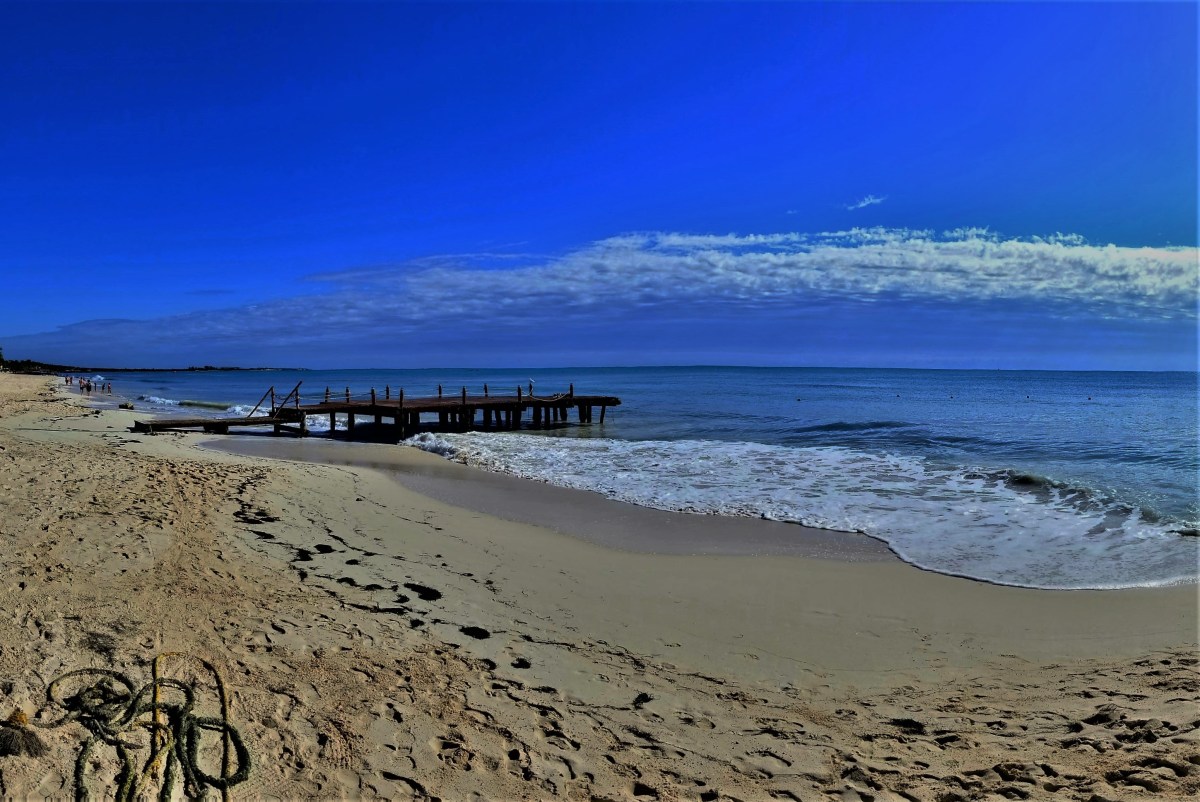
and ocean swimming available all year round in turquoise waters that hover between 79°F/26°C and 84°F/29°C.
Of course, it was only a matter of time before money interests would step in to capitalize on a tropical paradise that was ripe for the picking.
Today, Cancun International Airport connects with 122 airports around the world, bringing over 5 million tourists to the Riviera Maya in 2017, and making Playa del Carmen and Tulum the fastest growing cities in Mexico.
But it all started from humble beginnings. Some say that Jacques Cousteau, the celebrated oceanographer first realized the potential of this area in the early 1960s. After anchoring the Calypso off the nearby island of Cozumel, he shot a documentary film that captured the wealth of sea-life thriving across the Palancar reef, the second largest coral reef biome on the planet, which resulted in an unintended flood of underwater activity from diving enthusiasts around the world, thus becoming the premiere scuba destination in the Western Hemisphere.
My earliest experience in the Yucatan Peninsula dates back to June 16, 1975, when I bounced across cratered jungle roads from Merida to Chichen Itza and Uxmal in a battered VW beetle, in search of Toltec truths once touched upon in college curriculum. This excursion/honeymoon–an elaborate anthropology and archeology tour arranged by a Mexican travel agency that rented cars and booked hotels–came with a fine-print disclaimer that later took on significant ramifications when our Bug broke down on the edge of a coastal clearing that became a colossal construction zone known as Cancun.
At first, the challenge of finding someone/anyone who could speak English was resolved after discovering the bilingual General Manager of the Sheraton Hotel (Cancun’s first and only hotel at the time) sitting in the town’s only restaurant enjoying his tamales. He negotiated a time for us to use one of two known local telephones connected to civilization–one in the restaurant, the other in the pharmacia–so we might call the Meridan agency to report our breakdown.
Several construction contractors were already patiently waiting their turn to call Mexico City for payroll and supplies, all the while drinking shots of tequila and trading gossip while their road crews were laboring 24/7 to carve the future streets of Cancun. The drone of heavy machinery and the scent of hot diesel hung in the humidity amid the occasional peal of electronic church bells tolling away the hours.
Eventually, our Sheraton translator secured a line to Merida, where we further learned that we were responsible for the VW no matter what. The car had to be repaired; it could not be abandoned, and no replacement would be available.
The new challenge was to identify a Mayan mechanic in the middle of nowhere who was VW savvy, and had a surplus of makeshift parts that could be gerryrigged to fix a transmission stuck in reverse. By now, the moon was rising over the mangroves, with little chance of making Akumal by daybreak.
The GM excused himself to network around the restaurant on our behalf, while we finished our simple meal, and to our astonishment located a local Mexican versed in lawn mower repair who offered to examine our 1965 Clasico.
Amazingly, we were on the road by 4:00 am, barreling through the dark night, charging toward our next reservation south of border, trying to make up for lost time, when I reflexively slammed on the brakes in just enough time, with just enough road to spare, and just enough tread to wear, to come bumper to bovine, narrowly avoiding a black cow lounging in the middle of a two-lane highway.
Steering clear of the cow provided an adrenaline rush that would last throughout the day, notwithstanding the bottle of Tequila we drained after finally arriving at the Place of the Turtles by dawn.
Once we checked into our room, we spent the entire day at the beach, watching in awe as leatherback hatchlings emerged from the sand and found their way to the sea.
That’s the moment I feel I fell in love with the Mexican Caribbean, and continue to return to this day.
Riddle: What does the Trump administration and the Army Corp of Engineers have in common?
Answer: Both tried to drain the swamp and both failed miserably!
At one time, four thousand square miles of southern Florida was regarded as a vast and untapped resource,
but not because of its natural beauty and bounty.
Rather, the Everglades was long considered an uninhabitable and hostile environment filled with horrible reptiles,
hordes of mosquitoes, and enough sawgrass to cut a man to shreds;
yet, nonetheless worthy of future cultivation and commerce, if only the rich underlying soil could be reclaimed.
By the middle of the 19th century, political dreams and aspirations begat studies and commissions which begat a Congressional resolution that decreed that draining the swamp would result in enormous land improvement, incentivizing developers and homesteaders to relocate to Florida.
After the Civil War, Hamilton Disston, a Pennsylvania real estate magnate bought 4 million acres at 25 cents an acre, and began dredging canals through the mangrove forests with the intention of lowering the levels of the wetlands by reducing the basin of the Caloosahatchee and Kissimmee Rivers.
While the canals never drained the Everglades, the publicity spawned newcomers to the area, who willingly paid Disston $5 per acre–establishing towns like Fort Myers on the west coast and Ocala in central Florida.
Oil tycoon, Henry Flagler took notice, and seized the opportunity to buy large tracts of coastal land to build a railroad, eventually reaching Miami, and encouraging further growth and tourism to fill his grand hotels, from St. Augustine to Palm Beach and beyond.
Fast forward to the 1930s, when the Army Corps of Engineers, under the direction of Herbert Hoover, built a dike four stories high, and 66 miles long on the southern edge of Lake Okeechobee–controlled through a system of channels, locks and levees–shifting the focus from drainage to flood control, in response to deadly storm surge caused by massive hurricanes.
The dike was so successful at holding back groundwater, that 1 million acres of Everglades, now parched and leached with ocean water burned in 1939 after an epic drought. Top soil quickly decomposed from bacteria now exposed to air, causing homes erected during the building boom to lose their foundations, only to be replaced by stilts.
A series of pump stations were built in the 1950s, designed to release water in drier times, or remove and pump it to the Atlantic or Gulf of Mexico in times of flood.
And so it went throughout decades of mismangement: one problem after another led to one fix after another, with little regard for conservation.
Although Everglades National Park was dedicated in 1947 to preserve a fragile ecosystem that was suffering from explosive growth and systematic water diversion, the Army Corp of Engineers continued to build water conservation areas bordered by canals for intended sugarcane production and thriving population centers, again depriving the Everglades of water, and further shrinking a vanishing ecosystem.
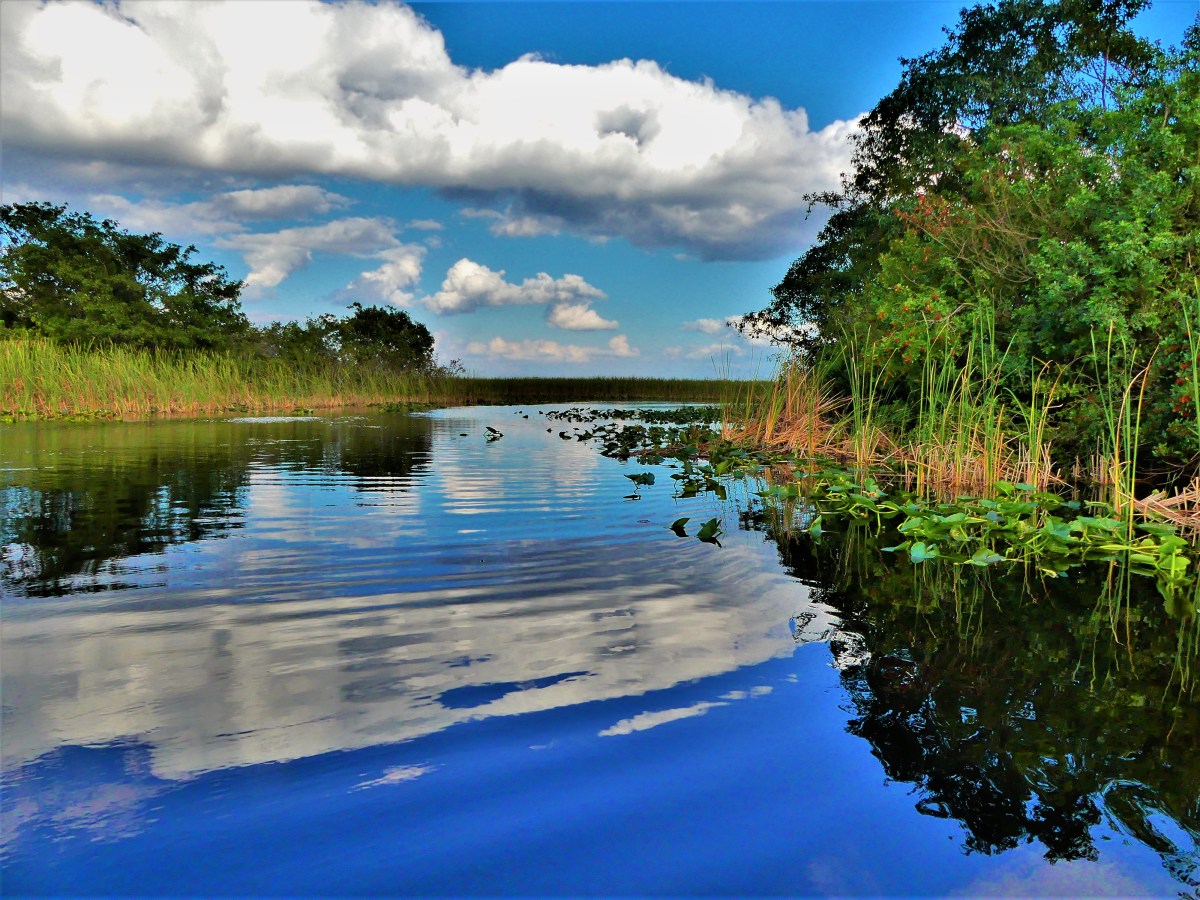
Today, the Everglades is widely known as a network of wetlands,
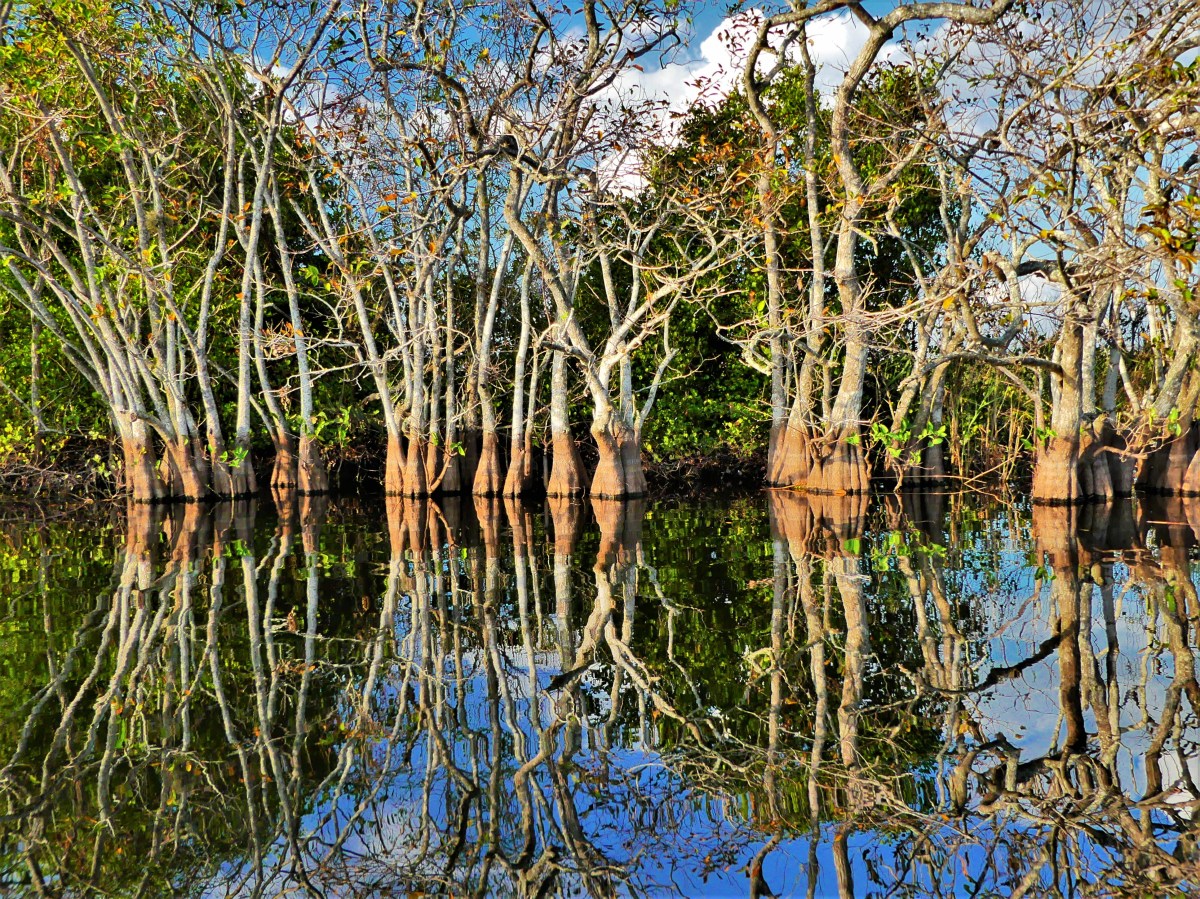
and forests,
not a swamp as was once thought–although it flows almost imperceptibly at three feet per hour out of Lake Okeechobee–and is home to threatened species such as the Florida panther, the American crocodile, and the West Indian manatee. Congressional appropriations are currently earmarked only for environmental projects, with high priority given to restoring the natural flow, but not without political sleight of hand and conservation controversy.
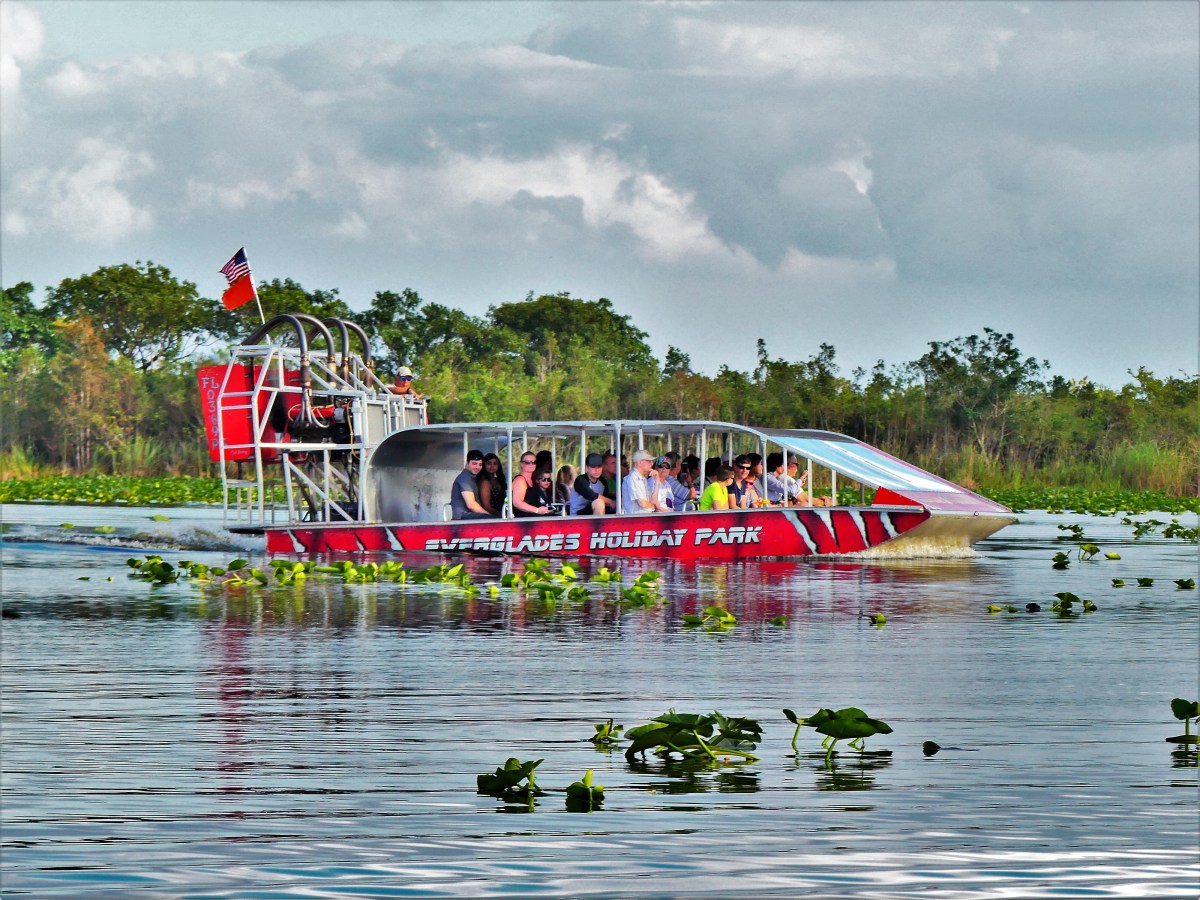
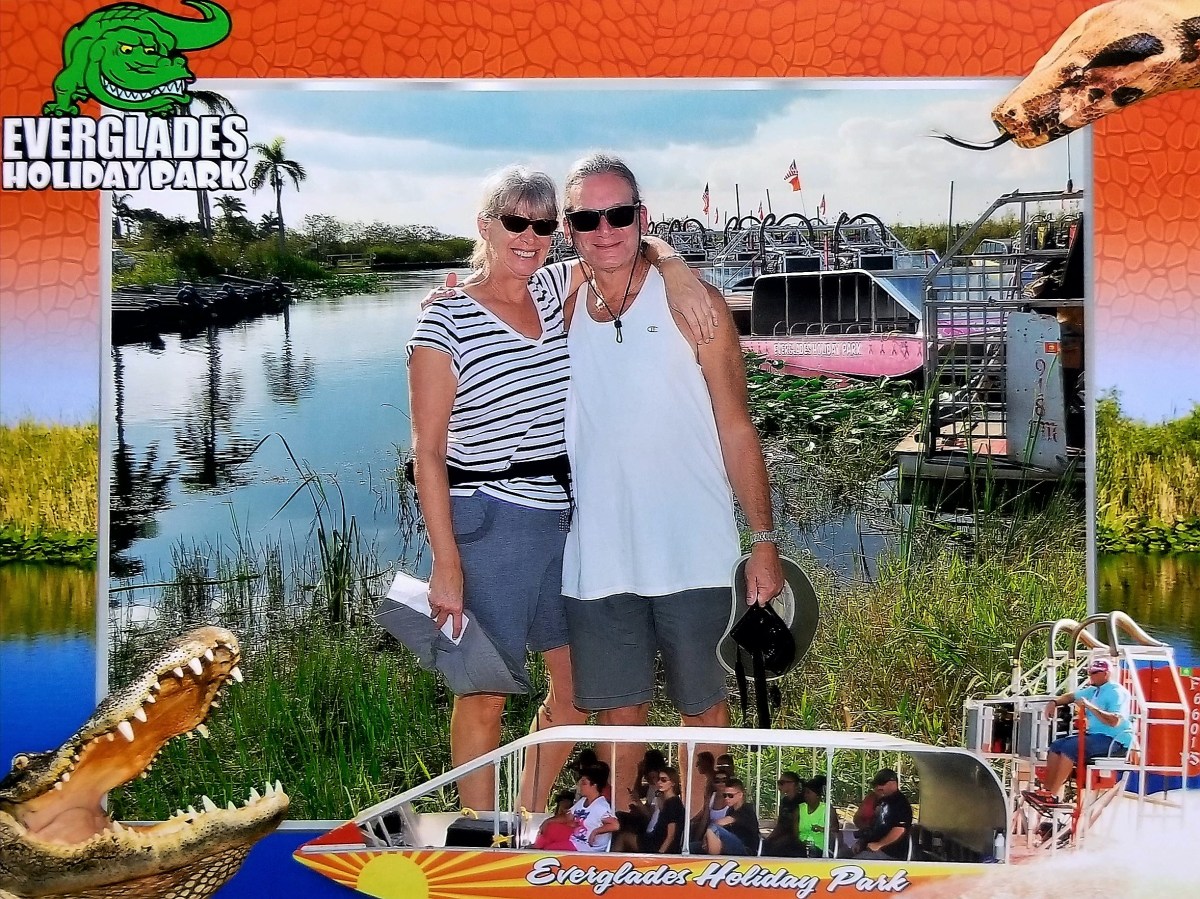
On a recent visit to the Everglades Holiday Park, part of Broward County Parks,
Leah and I took an airboat ride through the canals…
But not this time around. Happily, Captain MJ knew exactly where to find them–on the mud flats…
and in the water…
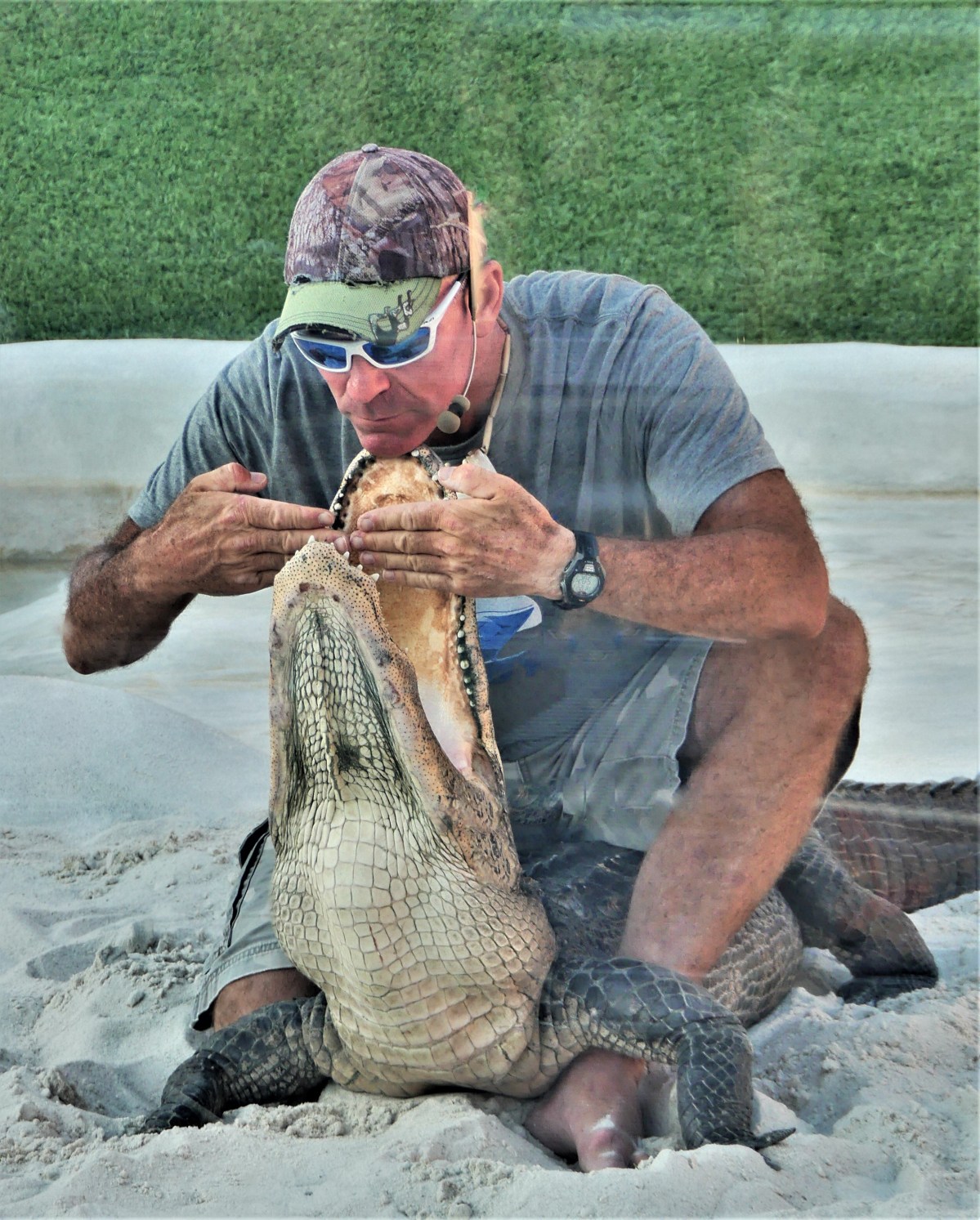
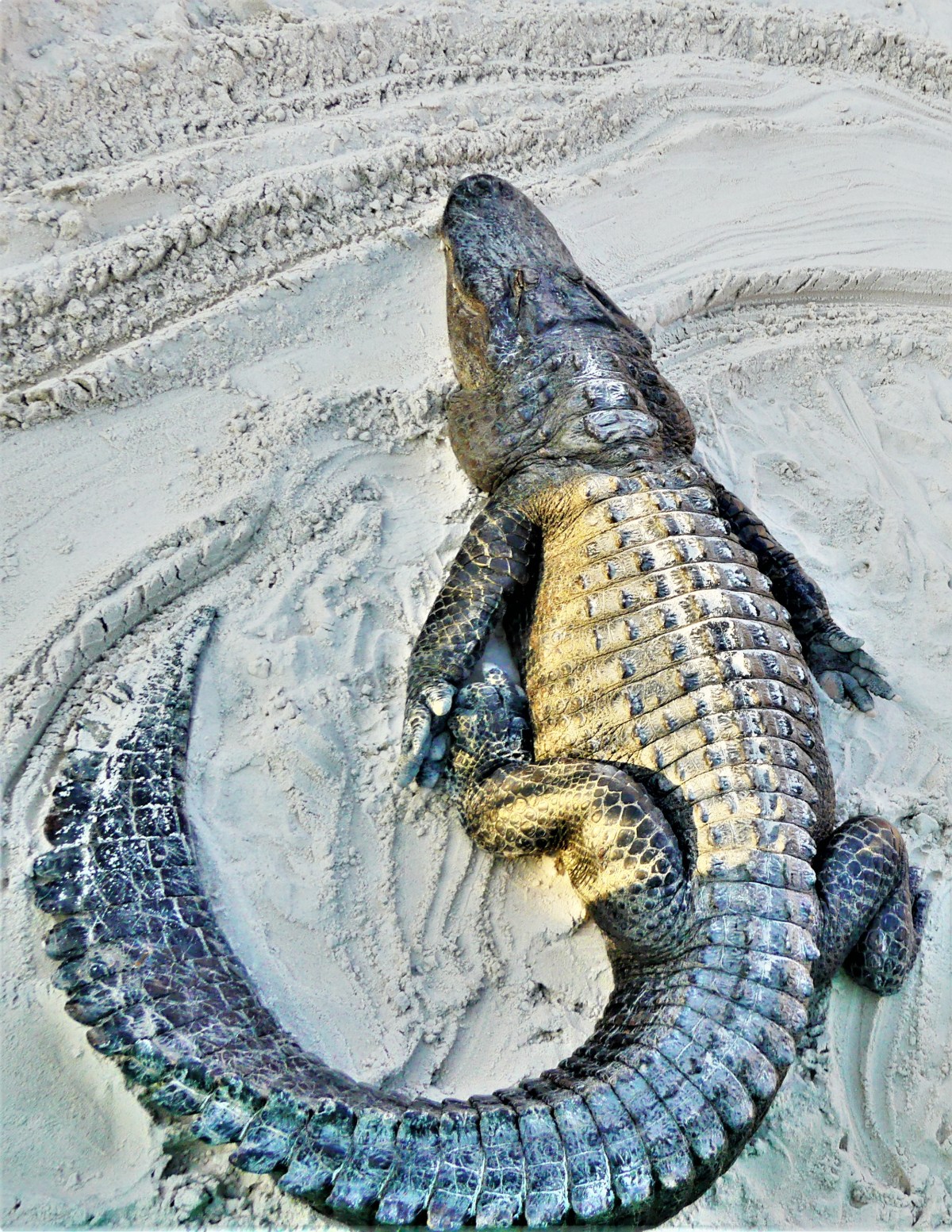
Afterwards, we marveled at the stories of Paul Bedard, a bouny hunter and trapper who has made a commitment to rescue as many alligators as possible…
from golf courses, backyards, and swimming pools.
At the end of the show, we dismissed the notion of having our picture taken with a baby gator, but couldn’t help but be amused by those who patiently waited their turn.
Alternately, while walking through the park, our thoughts returned to Donald Trump,
who pledged to drain the political landscape of government corruption, “and make our government honest again–believe me.”
Yethecontinues to enrich himself at the taxpayers expense: with extended stays to golf properties he still owns; and by championing the Republican tax bill–which guarantees his family millions of dollars saved from pass-through deductions, a top-rate tax reduction, and an expanded estate-tax exemption.
No less guilty are three of Trump’s lieutenants: Tim Price, disgraced and outed Secretary of the Department of Health and Human Services, Treasury Secretary Steve Mnuchin, and EPA Administrator Scott Pruitt…
all accused of using government funds for personal travel on outrageously expensive non-commercial flights.
Which begs the question: How can they be trusted to swim through the Everglades without harming their own environment?
Now that Leah and I are nine months into Streaming thru America, a familiar question often arises from family, friends, and fellow bloggers: “What’s your favorite place, so far?” It still remains the most difficult question to answer. Here’s why:
We’ve covered over 32,000 miles to 104 distinct destinations–with amazing views of beaches, mountains, prairies, canyons, and deserts. We’ve toured cities and suburbs, villages and vicinities, parks and plantations, graveyards and ghost towns.
Thus far, we’ve crossed the country from the Atlantic to the Pacific and back; we’ve traveled as far north as Jasper National Park in Alberta, Canada to the southern edge of Florida within the Everglades; We’ve ascended Trail Ridge Road to the Rocky Mountain tundra at 12,183 feet to the salt flats of Death Valley’s Badwater Road at 282 feet below sea level.
Having slogged through Los Angeles and Miami traffic, we’ve also driven hours through remote regions without a soul in sight. We’ve cursed the crowds at Yellowstone and Zion, and celebrated the isolation of Black Canyon of the Gunnison and Theodore Roosevelt National Parks. We’ve witnessed numerous national monuments, and bore witness to monumental tragedy in Las Vegas.
While we’ve camped at some of the fanciest and most expensive RV parks in the country, we’ve also boondocked at Walmart parking lots, always meeting new people from around the world, yet reminiscing with old neighbors we discovered at a scenic overlook in North Dakota.
Despite having written over 80,000 words and shared over 2,500 photographs of our adventures this year, I feel compelled to answer that one nagging question, but forgive me if I pause for a moment longer to filter all the information collected to date…
The one location that stands out over all the others is Valley of Fire State Park–16-miles outside of Overton, Nevada–as much for the solace and cleansing it brought us after the Las Vegas massacre, as for it’s raw and natural beauty.
And from this experience, I’ve reluctantly selected one photograph that captured my imagination and exemplified my feelings–two days after the world grappled with senseless inhumanity.
May 2018 bring us closer together as we work to build bridges between communities, and discover a path to peace and tolerance.
As if straight out of a horror film, our Airstream has been overrun by ghost ants. This wasn’t the first time we’ve seen bugs in the trailer, because bugs are an undeniable consequence of living outdoors, and a way of life. However, while occasional spiders, love bugs, moths, gnats, no see-ums, and mosquitoes have all managed to infiltrate our home at one time or another, it’s not until recently, that so many unwelcomed six-legged insects have made themselves comfortable without an invitation.
Long considered a well-established resident of South Florida and other tropical and subtropical environs, Tapinoma melanocephalum workersare thought to have illegally immigrated from Asia or Africa–where to this day, as an affront to our democracy–they continue to worship their queen, while spreading their vermin and contaminating our food.
Despite their small stature, at 1.3 to 1.5 mm long, I’m certain that had there been a border wall to protect us from this infestation, these pests would never have gone on to infiltrate the foundation of our trailer, and rob us of our American dream.
And had the FBI taken notice and properly profiled these larvae from the beginning, none of this would have ever happened. To be sure:
They have 12-segmented antennae with the segments gradually thickening towards the tip. Antennal scapes surpass the occipital border. Head and thorax are a deep dark brown with gaster and legs opaque or milky white (Creighton 1950). The thorax is spineless.
The gaster (swollen part of abdomen) has a slit-like anal opening which is hairless. (Smith and Whitman 1992). The abdominal pedicel (stalk-like structure immediately anterior to the gaster) consists of one segment which is usually hidden from view dorsally by the gaster (Creighton 1950). Stingers are absent.
The small size, combined with the pale color, make ghost ant workers hard to see (Smith and Whitman 1992).
At the very least, these ants have been extremely annoying, invading every part of the Airstream in a matter of days. We discovered them in the kitchen, in the bathroom, in the closet, in the bedroom, and ON MY PILLOW! EWW! Leah has been reflexively swatting phantom bugs from her arms and legs at the the very thought of our new colonists.
Quickly, ants were now to blame for every miscellaneous skin bump, itch, or irritation on her body.
While camping at John Dickinson State Park in Jupiter, it was hard to ignore the many ant hills throughout the sites. I backed the Airstream into stall #43, and soon located several small cones of sand with limited ant traffic. Being careful to not disturb them, I thought they might return the favor, but the ants had a different agenda.
“Oh my God!” shrieked Leah. “They’re everywhere! They have to be stopped!”
Leah laid into the ants like they were ISIS terrorists. Her flip-flop was a particularly effective weapon in her campaign to eradicate the enemy. WHACK! WHACK! WHACK!
“Gotcha!” she bellowed.
She came down hard on the ants, but there was no quit in their little legs as they they rebounded in their crazy dance, scurrying around in all directions at once, before darting into their hiding places–provoking her ire and igniting her wrath.
“We’ve got to do something!” she vowed.
A trip to the garden section of Home Depot offered several interesting choices that promised instant relief, but we opted for Raid. Somehow, the notion of killing ants with a lightning bolt stirred our sado-masochistic sensibilities.
After returning to the Airstream, Leah tore into the packaging with a vengeance. Out popped eight plastic bait traps, looking like a mini Buster Keaton pork pie hats.
Declaring all-out war on ants, we strategically scattered them around the Airstream, often debating the locations of the most effective kill zones. For the most part, I acquiesced to Leah’s judgement, so long as I secured rights to wage war in the bathroom, which I considered my domain.
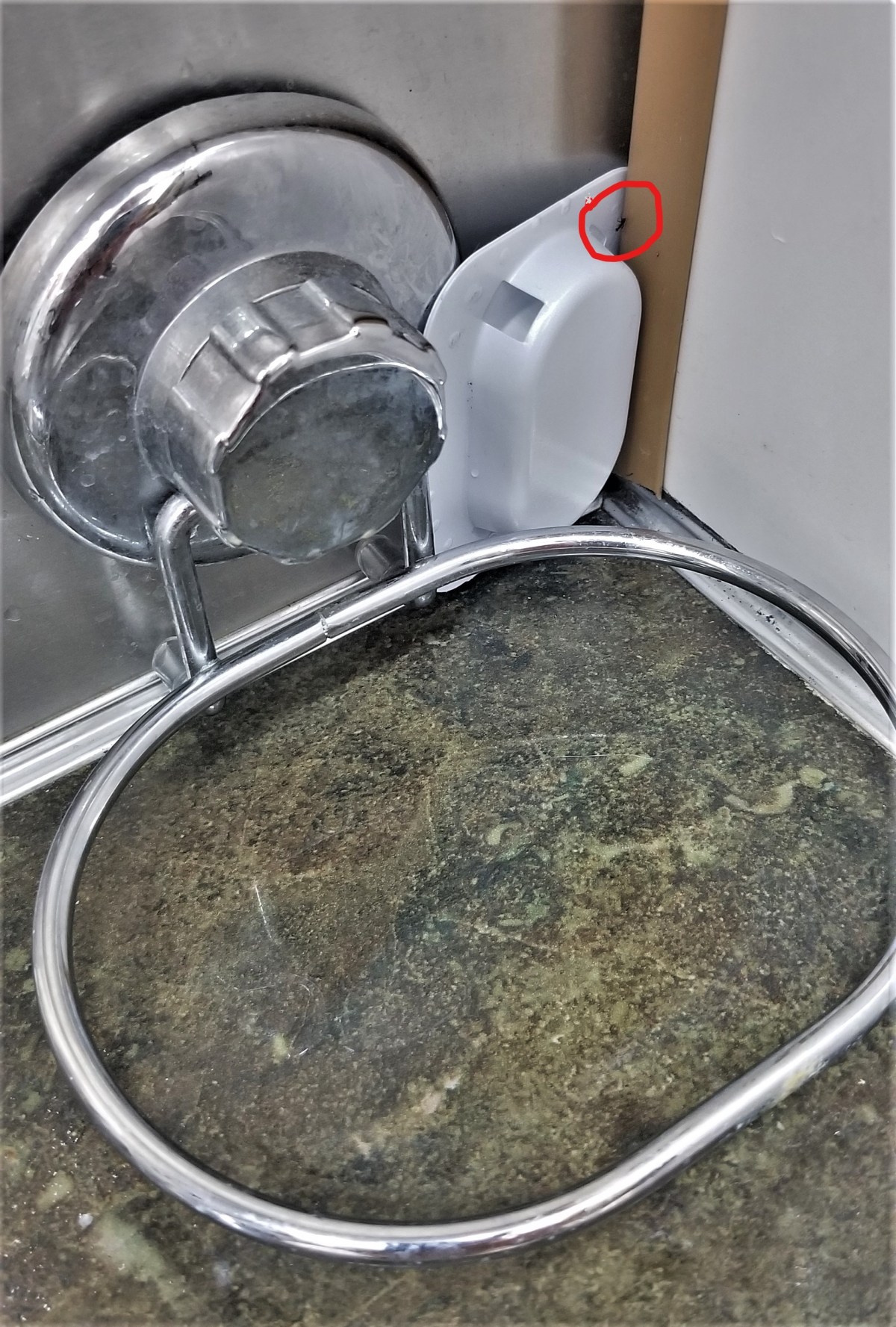
I closely observed the ants racing inside the aluminum channel along the wall, and knew exactly what I had to do. I wedged one of the little white poison pucks behind the soap dish, and waited for the feeding frenzy. After a minute or so, a curious ant came to inspect the trap, as if the Sirens were luring it to its certain death…
…and swallowed it whole.
“Yes!” I exclaimed. “One by one, you will eat the poison and die!”
I launched into my end-zone victory dance with a firm belief that we were now winning the war on ghost ants like never before. And that there will be so much winning, that we will tire of winning so much.
**Feature Image: Ghost ant worker, lateral view. Drawing by Division of Plant Industry**














































































































































 Streaming thru America