Hot Tub!

After four months of establishing St. Augustine roots, and putting our house in order, it was time to satisfy our hot tub craving–a thought bubble Leah and I had discussed since settling down to our slice of paradise.

The notion of chilling in a hot tub had become my oxymoronic fantasy, while “a soak and a toke, so long as we don’t go broke” had become my new mantra.

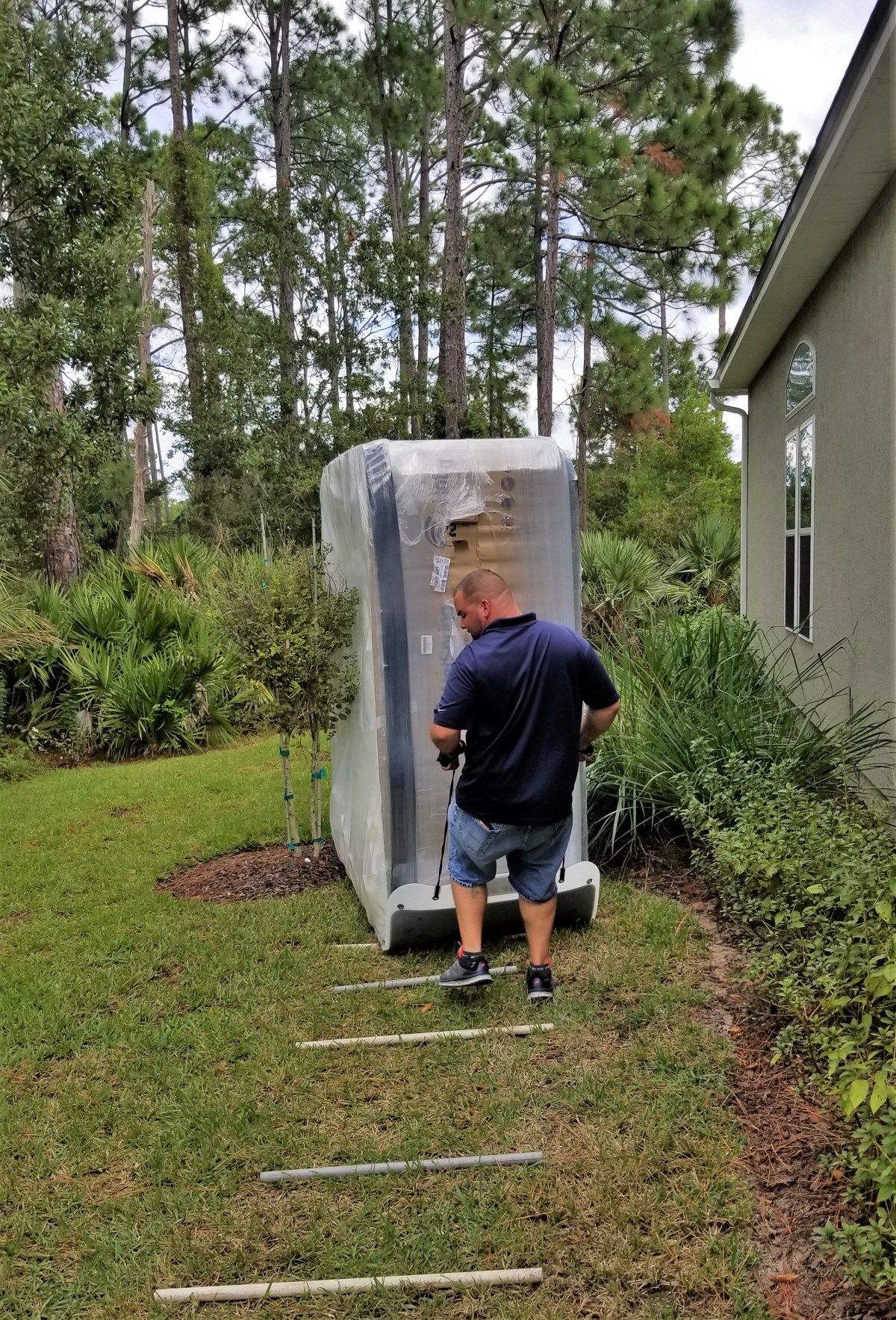
pushing to the rear

Armed with a wellspring of research, we felt well prepared to test the waters, and immersed ourselves in the retail market. Our first inclination was shopping for value, so we patiently waited for Costco’s sale.

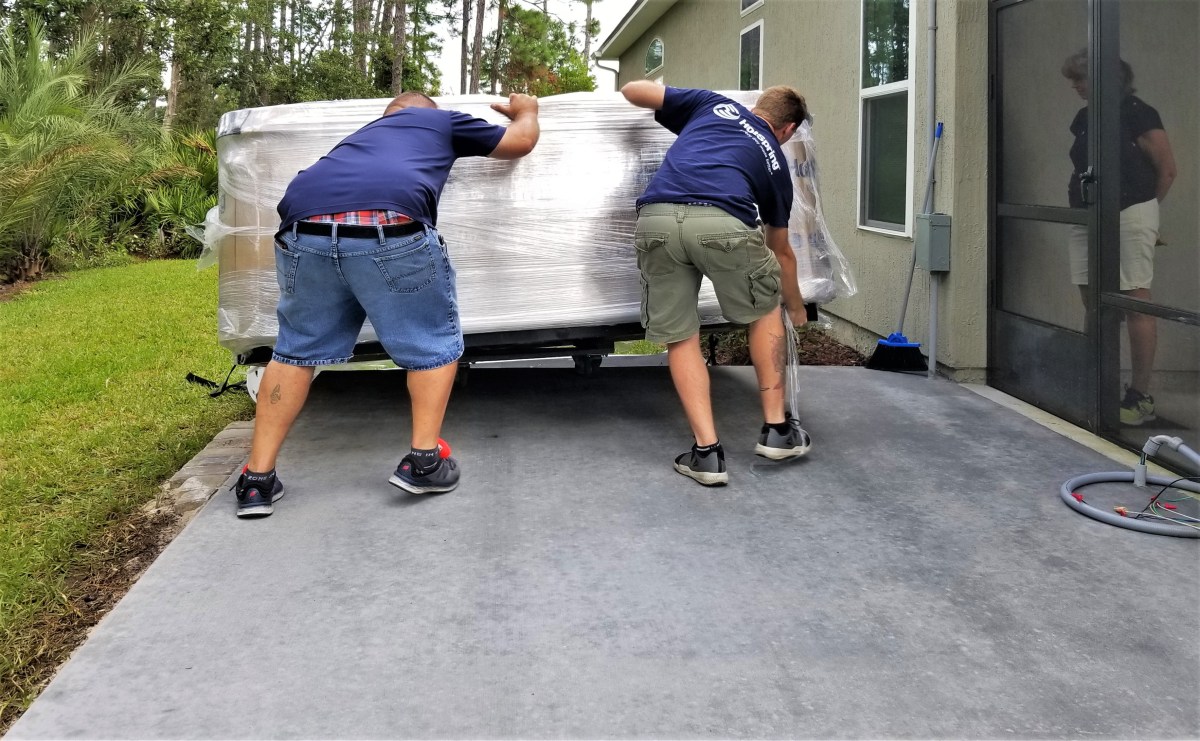
dragging the tub.jpg

In the meantime, we diligently sifted through their online sales brochures to review the specs of different tubs at different price points, and screened all the consumer comments through a pro/con filter.

sled ride

While there were many features to whet our appetite, we were nonetheless hesitant about Costco’s “ship it, and forget it” policy, fearing it could backfire into a “ship it, and regret it” experience. Having a transit outfit willing to drop a half-ton pallet at our curb and jet away without concern raised a red flag for us, possibly setting us up for a moving and installation watershed moment.

on the slab

While we could easily hire a third-party to get the hot tub up and running, a catalog of complaints citing broken pumps, leaky tub molds, and buggy software, albeit warrantied, left us feeling lukewarm about this kind of investment.

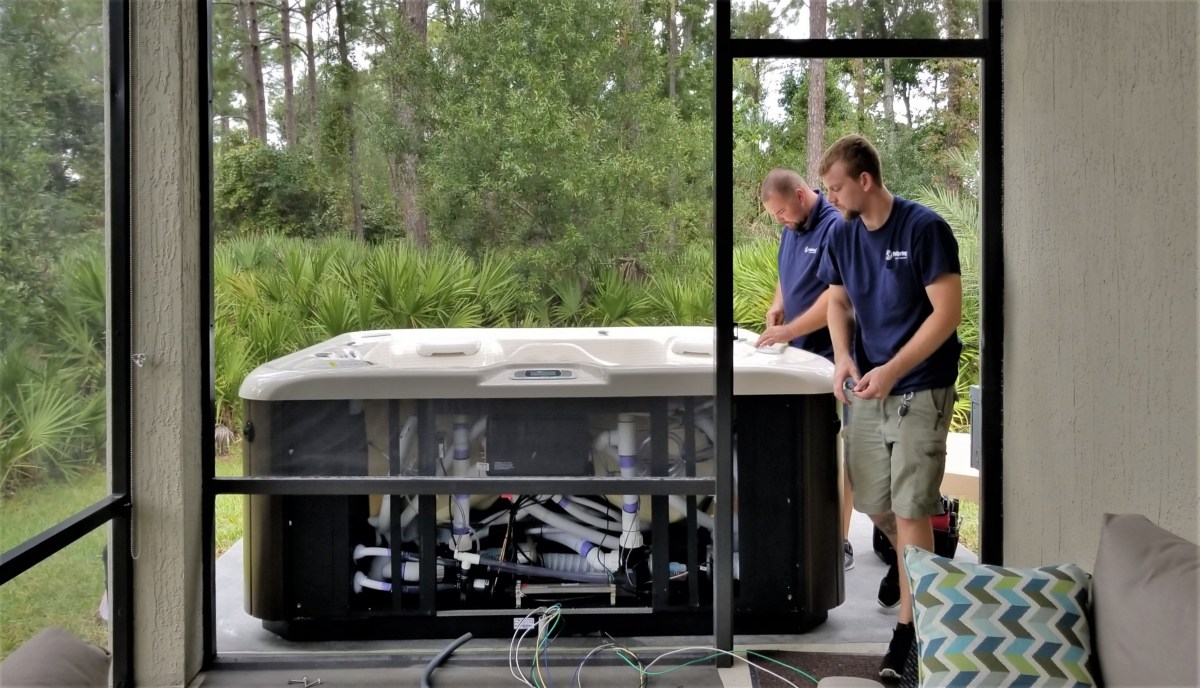
lining up the connection

So we went back to the well, and drew up a list of likely successors.

shimming for level

We received a call from a ThermoSpa agent less than microseconds after filling out an online form and hitting the <ENTER> button. He was quick to tout the health benefits of his product, but balked each time we asked about price, promising a more in-depth analysis within the confines of our home.

hooking up power

“It seems like a lot of work, but I’m very excited about you bringing over a sample for us to try,” I taunted.

“Unlikely,” he countered. We sell direct from our manufacturer, which is how we manage to keep our costs low and pass the savings on to you, but I have videos of our construction process that will demonstrate the merits of our brand, and I have videos of several models fully operational.

I, too was direct. “But I’m not buying a video,” I stated, “so goodbye.”

hooking up power

That’s when Leah determined that we had to get our feet wet, and truly test the waters. We visited a couple of second-generation dealers hawking Dimension One and Hot Springs spas from their local showrooms to better visualize our options.

installing speakers

To their credit, each shop owner invited us to take the plunge before we took the plunge. Of course, we were knee deep in questions, and they were awash with answers.

full moon (2)

Ultimately, after much haggling, we selected a Hot Springs model for its five-year warranty, its installation coverage, and its assortment of desirable bells and whistles…

Leah approves

…and Leah couldn’t be happier.

The Poshest Campus in America

In 1888, Henry Flagler of Standard Oil fame opened the Hotel Ponce de Leon (a.k.a the Ponce) in downtown St. Augustine to the delight of many fortunate Northerners, who eagerly took up tropical residency in one of 450 rooms during the winter season.

Ponce de Leon Hotel panorama

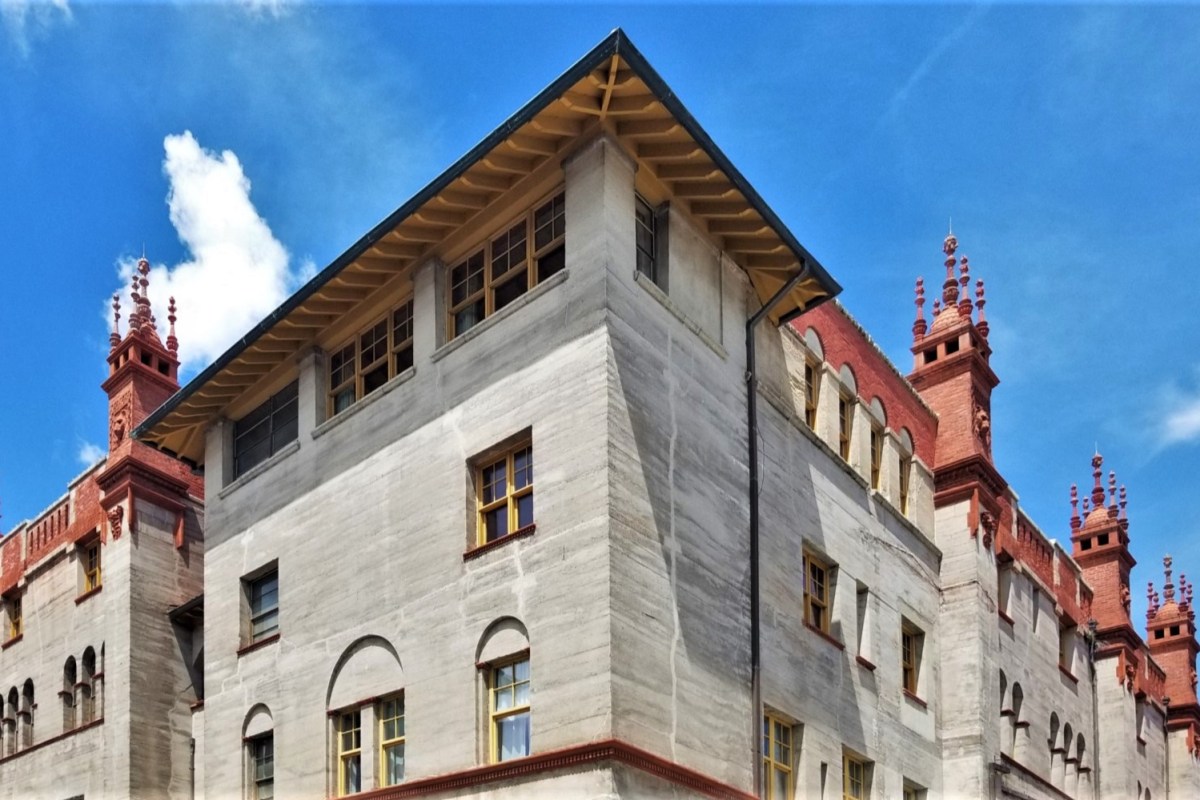
The elaborate Spanish Renaissance design was designed by the renown firm of Carrère and Hastings, with terra-cotta flourishes provided by Emmanuel Louis Masqueray.

exterior detail

Construction consisted of poured concrete over a coquina base–a new-fangled technique that laid the groundwork for future prominent buildings throughout the country.

Hotel explanation

Louis Comfort Tiffany and Company was responsible for the interior design, using the ballroom ceiling as an inspired palette for his signature “Tiffany blue”,

Mantle (2)

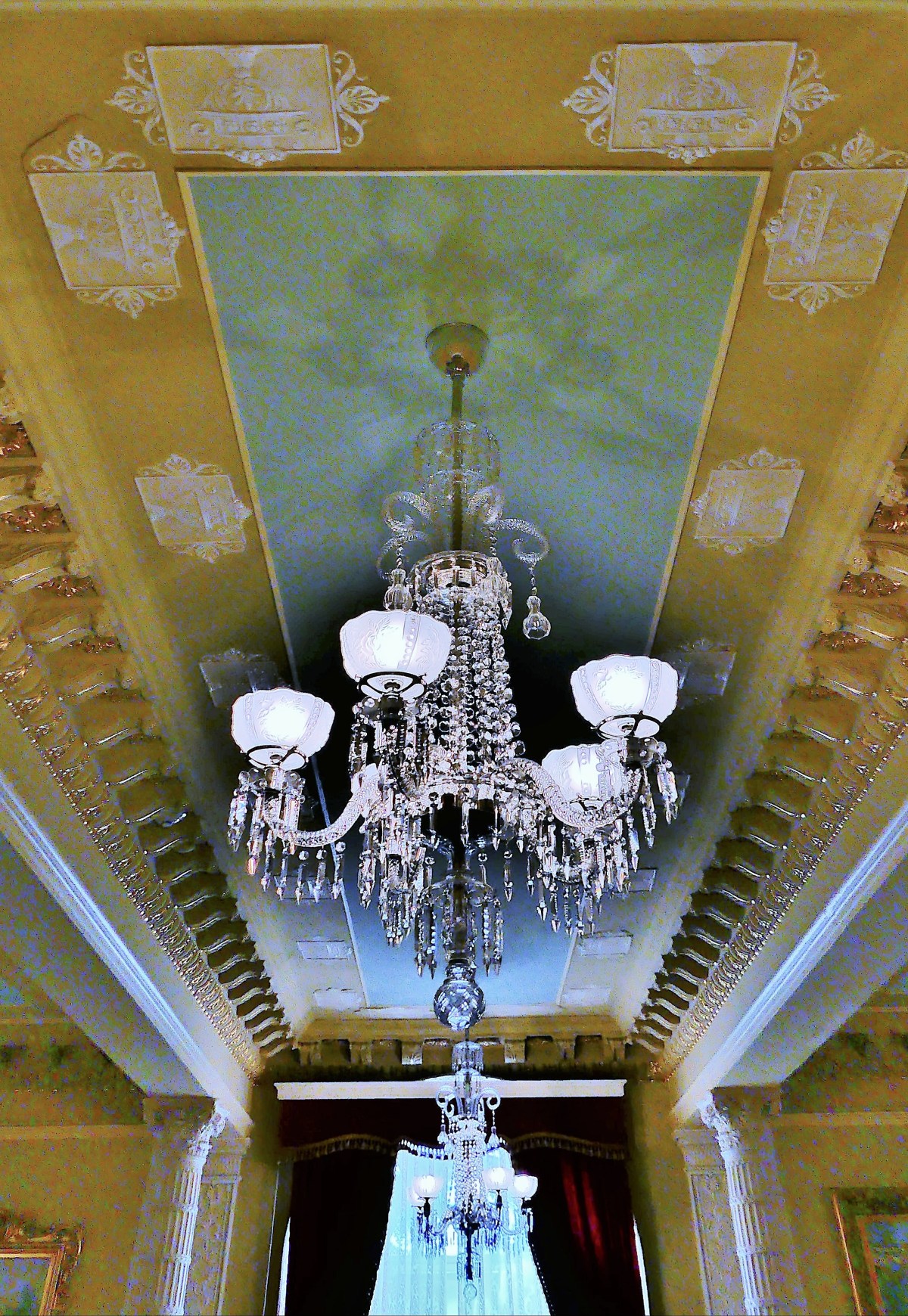
and an anchor for a complement of Austrian crystal chandeliers.

Parlor Chandelier

For three and one-half months and the princely sum of $4,000 ($100K by today’s count), Flagler’s pampered guests enjoyed uncommon luxury for their time, which included private bathrooms, building-wide electricity supplied by Edison’s on-site DC dynamos (another first for a hotel), gourmet meals, and nightly entertainment.

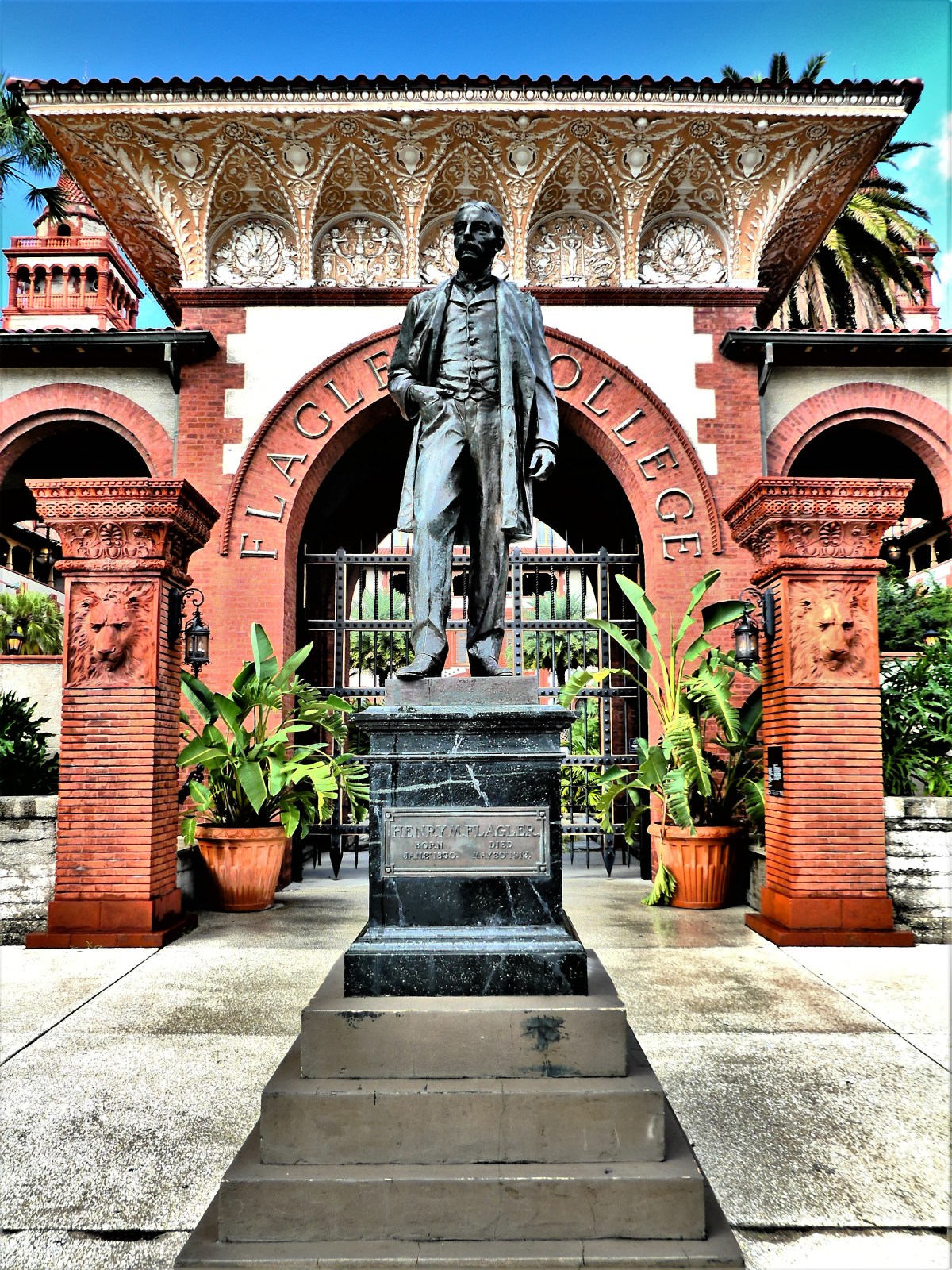
Upon entry through the Beaux-Arts gateway,

entry and statue

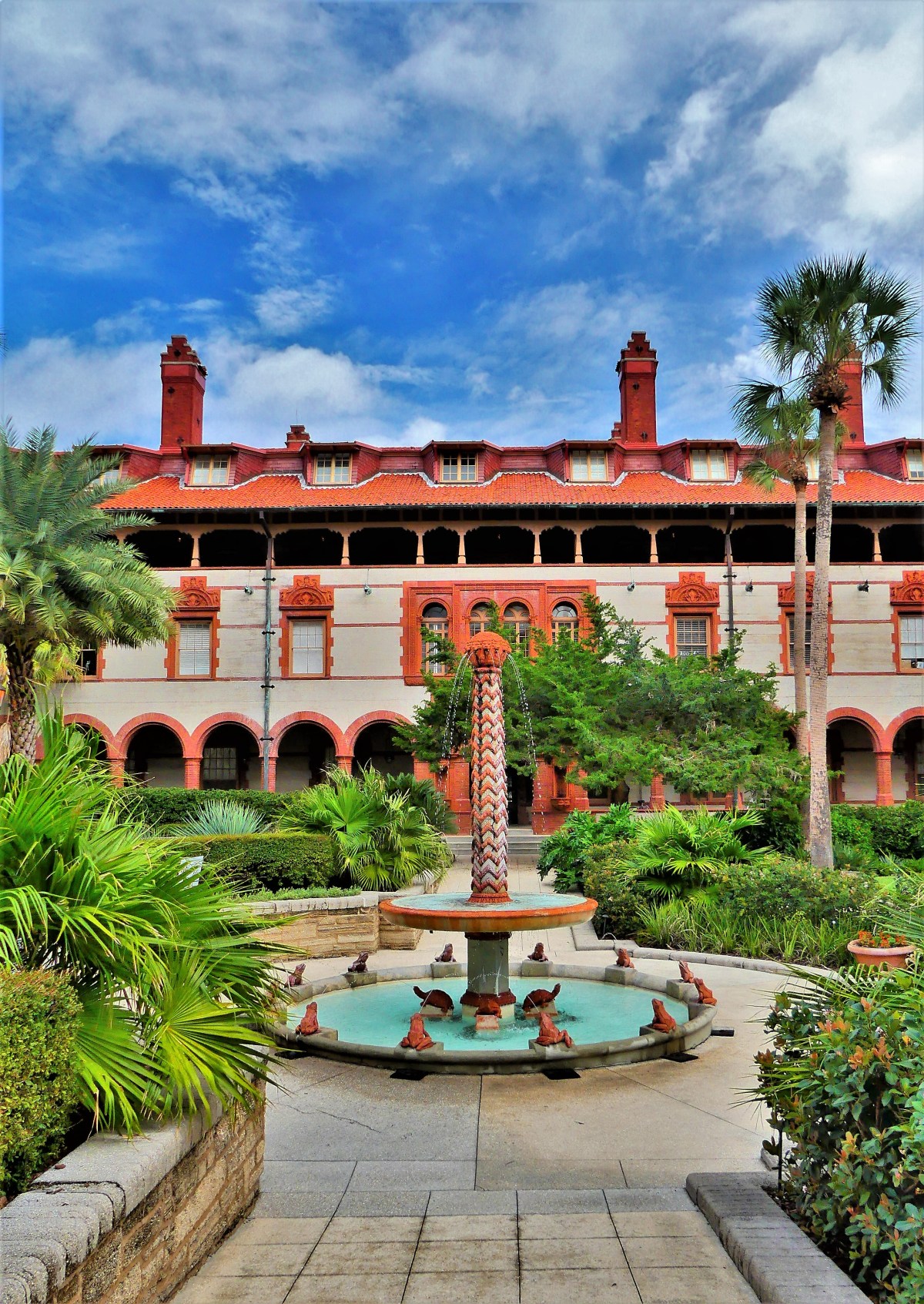
guests would cross the courtyard gardens past the playful sundial fountain

sundial fountain.jpg

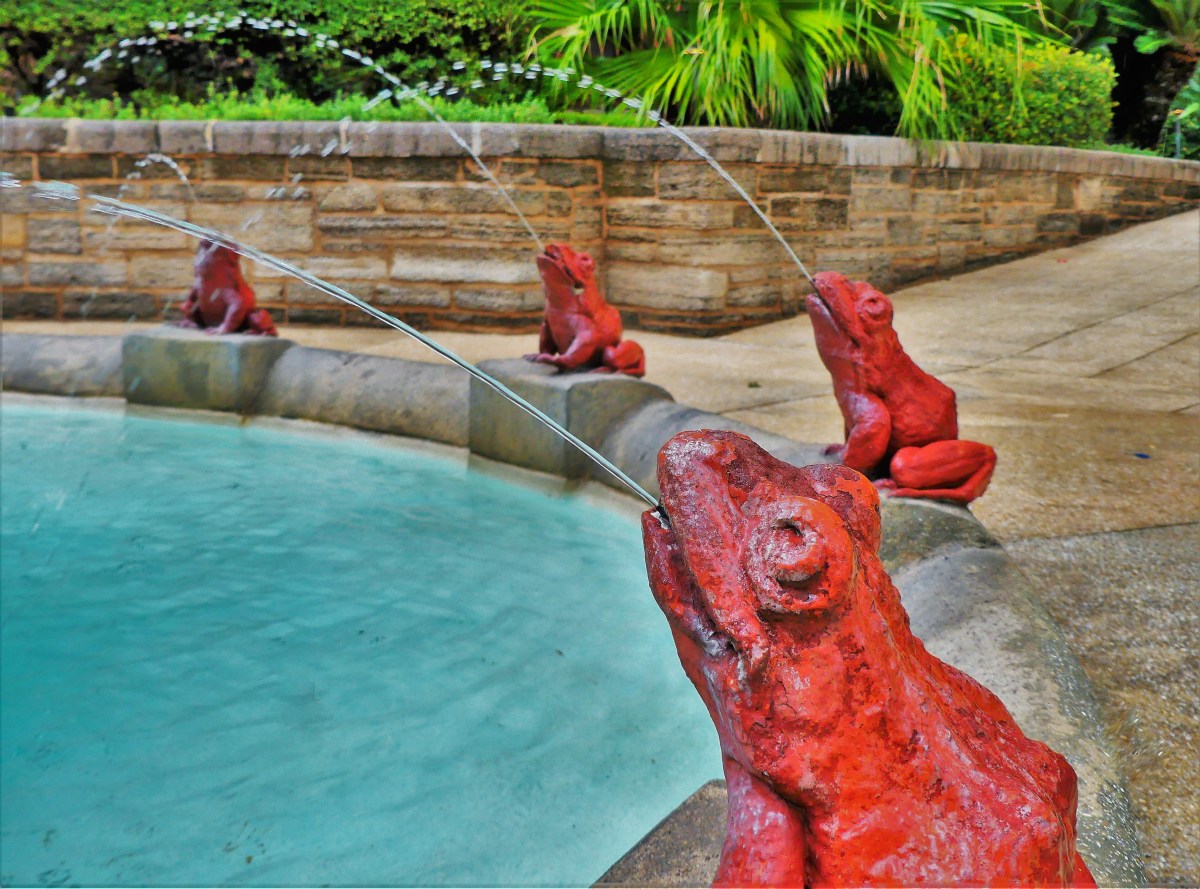
adorned by twelve spitting terra-cotta frogs.

spitting frog fountain (3)

Guests would continue through the hotel doors…

entrance (2)

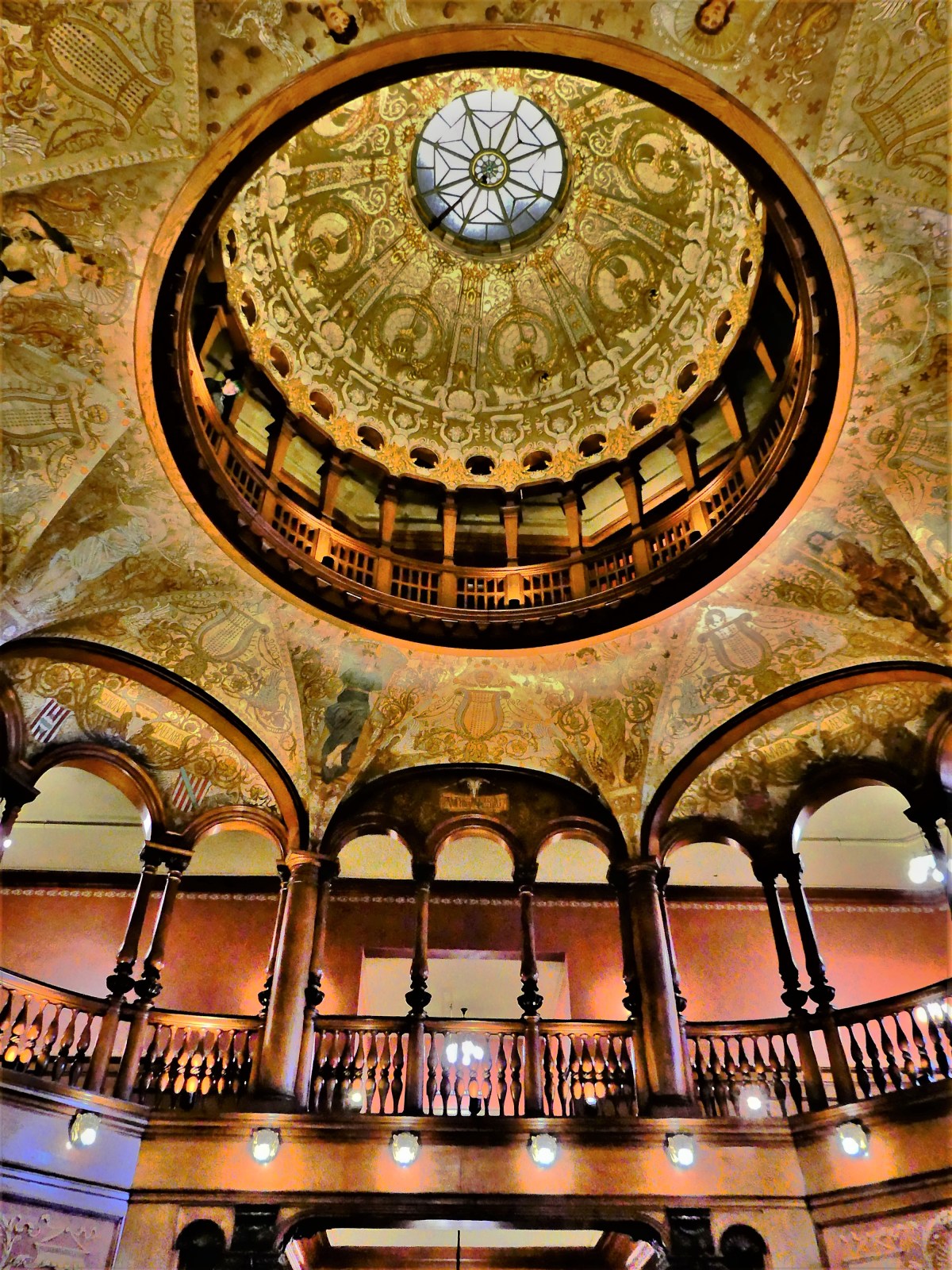
to gaze at the legendary rotunda:

The grand entranceway of the historic Ponce de Leon has been called the most elegant room in St. Augustine. The ornate Rotunda has captivated guests and visitors since the debut of the hotel on January 10, 1888. Richly decorated, the three-and-half story dome displays spectacular murals by George Willoughby Maynard and brilliant gilding that warms dimly lit spaces.

The Rotunda is the pivotal point of the Hotel Ponce de Leon’s floor plan, the crossing of the main north-south and east-west axes. In this central location hotel guests arrived, departed, socialized, waited for their carriages, or strolled to other areas of the hotel complex. The Rotunda linked the private guest room wings…to the public spaces of the hotel.

Rotunda

At the first floor level, eight caryatids (robed figures of women) carved in oak support the 80-foot dome and shape the octagonal plan of the Rotunda. Around the ornate wooden pillars, mosaic tile floors, marble and dark oak baseboards, large fireplaces, and gilded walls create the exotic atmosphere of this room. Hidden from view is a structural dome piercing the rooftop that shields a solarium. Originally balconies accessed from the solarium hosted tropical roof gardens and a breathtaking view of St. Augustine. In 1893, lion heads with electric lights were added at the mezzanine level.

carved column

On the plaster walls of the dome at the second floor level, noted muralist George Maynard painted eight elaborate female figures representing the four elements – Fire, Earth, Air and Water – and the four stages of Spanish exploration – Adventure, Discovery, Conquest and Civilization. Around these principal figures are many layers of symbolism, rendered by Maynard in meticulous detail. In 1897, ten years after their completion, Maynard reproduced these murals in the Thomas Jefferson Building of the Library of Congress.

Rotunda explanation

Presently, the ballroom at the west end serves as an orientation facility for guided historic tours and a ceremonial setting for faculty,

parlor left

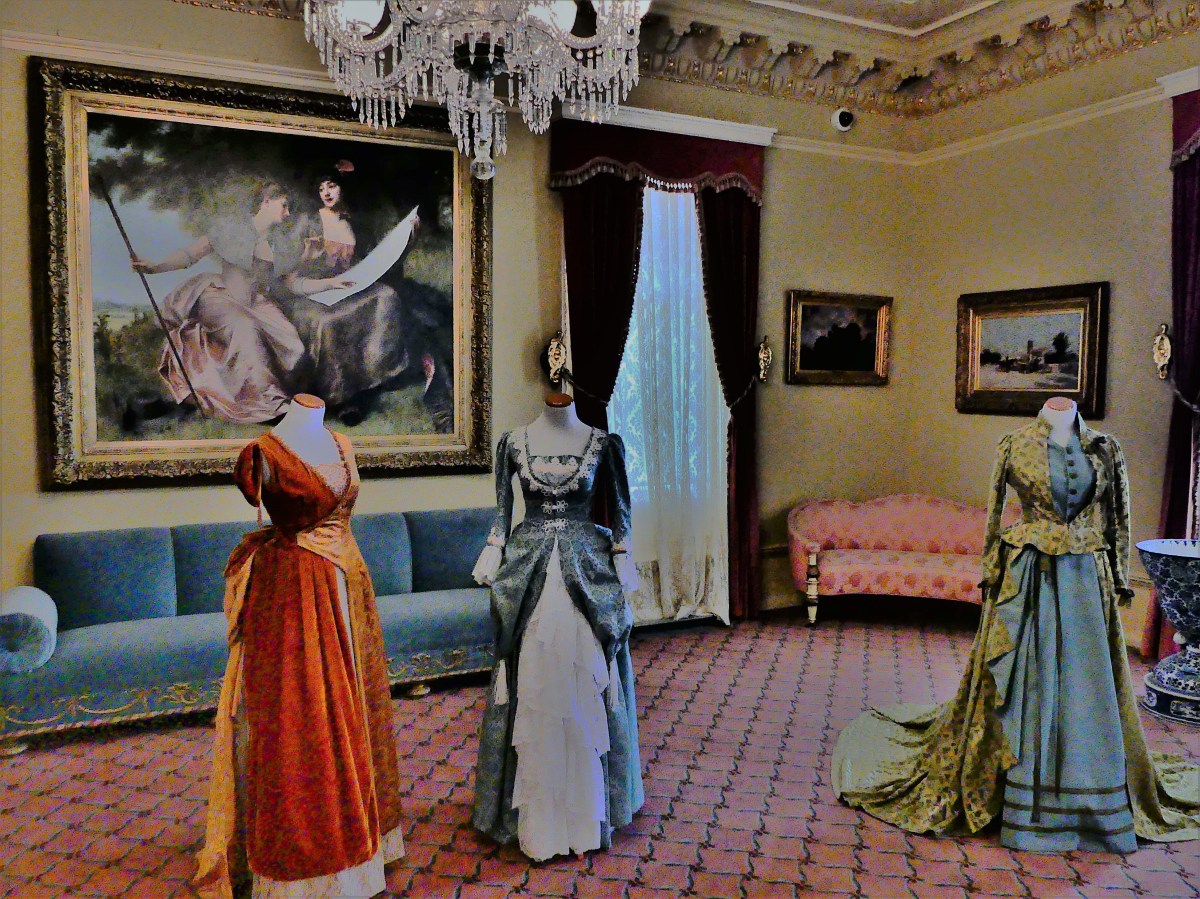
but also houses a selection of relics from a bygone era in an adjoining parlor,

Parlor right

with an emphasis on fine art,

mural

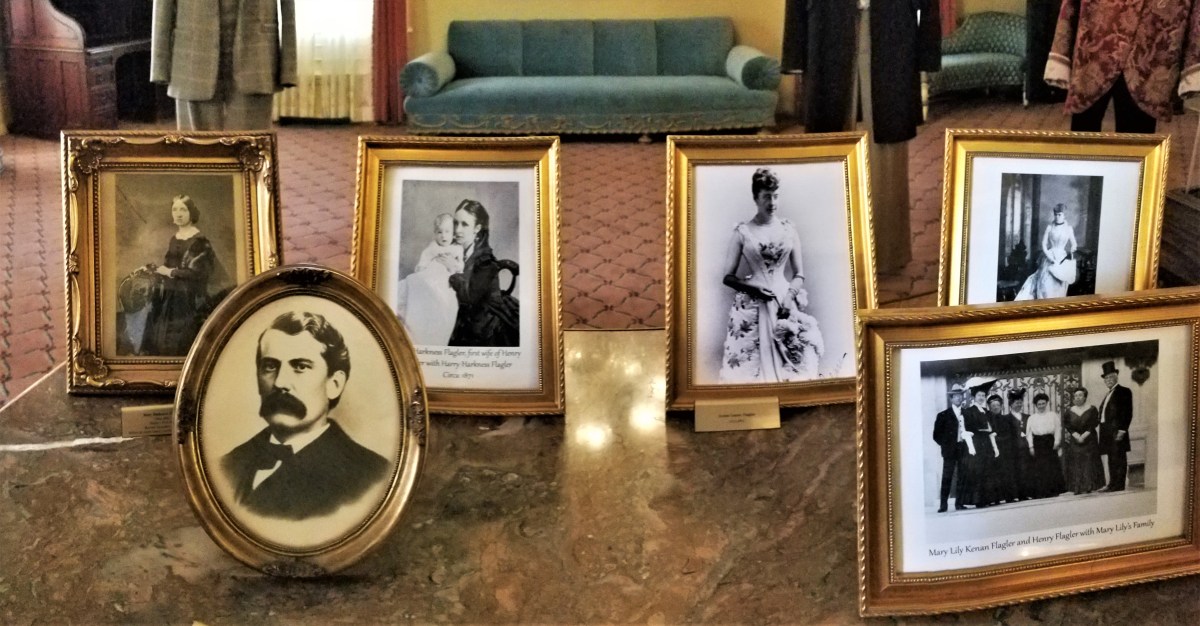
and family life.

Flagler family

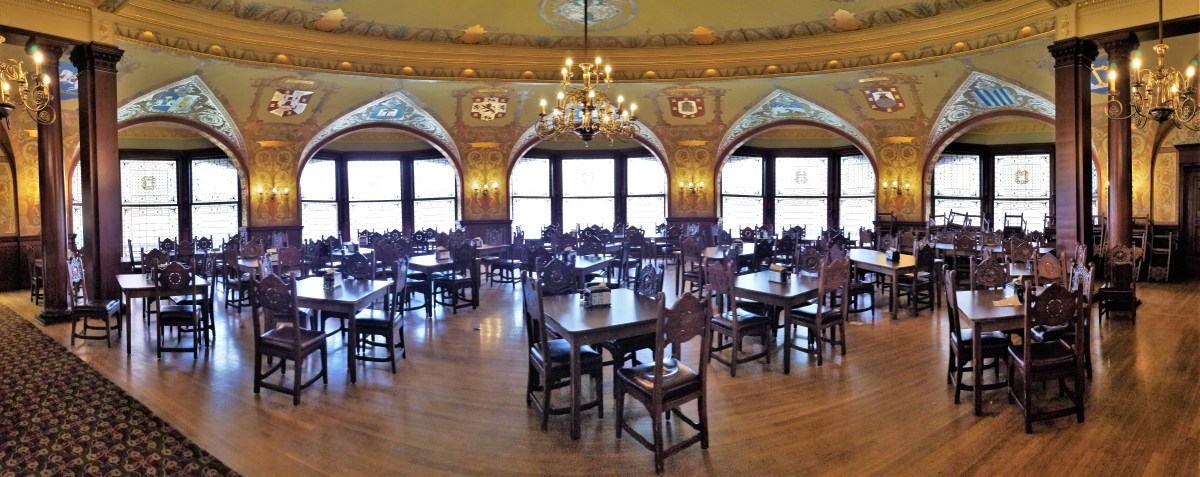
At the north wing of the hotel, the cavernous dining hall commands attention for its opulence and splendor.

Dining room panorama

Ten barreled bay windows are panelled in Tiffany stained-glass,

Dining Hall explanation

and believed to be part of the world’s largest private collection–making it worthy of safeguarding by forming a sandwich of bullet-proof glass on the outside,

Tiffany window

and unbreakable acrylic on the inside.

[Diners sat beneath a quad of]…graceful angels that represent the four seasons, and a majestic Spanish galleon under full sail–an artistic rendition of the ship that brought Ponce de Leon to Florida in search of the Fountain of Youth.

Dining room ceiling

[Again], the majestic ceilings were the work of George Willoughby Maynard, the nation’s foremost muralist of the time. Full-length female figures were the focal point of this room. The ceilings hold Spanish crests and coats of arms intermingled with colorful proverbs.

DR ceiling detail

The hotel was commandeered by the federal government during World War II, and used as a Coast Guard training facility. When the building was decommissioned by the Coast Guard after the war, hotel operations resumed, but sales and travelers were never as robust as before.

The Ponce made history again on March 31, 1964, when the dining room was chosen by black students from Richard J. Murry Middle School as the site for a mass sit-in, which ended in police violence and arrests, ultimately resulting in Senate passage of the landmark Civil Rights Act of 1964.

The Ponce closed its doors in 1967, only to reopen the following year as the centerpiece of the newly endowed Flagler College, where the newly restored Ponce continued its service to historic St. Augustine as a residence hall and campus cafeteria for freshman girls.  

Flagler College (2)

Presently, tuition, room and board totals $30,000, which in the scheme of things, seems like an unlikely bargain at today’s prices for yesterday’s glamor. 

(The building was added to the U.S. National Register of Historic Places in 1975, and was awarded National Historic Landmark status on February 21, 2006.)


Old Bagelsides

While enjoying my morning breakfast, and catching up on some classic poetry, I decided on a mash-up, which seemed entirely appropriate at the moment.

Inspired by Oliver Wendell Holmes’ Old Ironsides*

So, eat my toasted bagel now!
Soon may I reach thru wrap.
‘Cause many a tooth awaits to chew
this morsel from the sack;
Inside, I whiffed the buttered carbs
And yearned the content’s nut;–
But the paper bag in my eager hand
Revealed a tear somewhat!

My meal, once hot from oven’s heat,
Which baked the risen dough,
Where yeast was bubbling through the mix,
And grains were ground. Ergo,
Constant kneading the rubb’ry mass
And proof the crusted skin,
The bagels of the batch shall rise–
The essence of a win!

Oh, woeful that my ragged bag
erodes against my touch;
Construction dooms my marv’lous meal,
And so, becomes my crutch;
Drops through the rip, my toasted roll
Damn every filthy crime!
And gift it to the trove of germs—
The goodness and the grime.

*


Old School

Follow my blog with Bloglovin

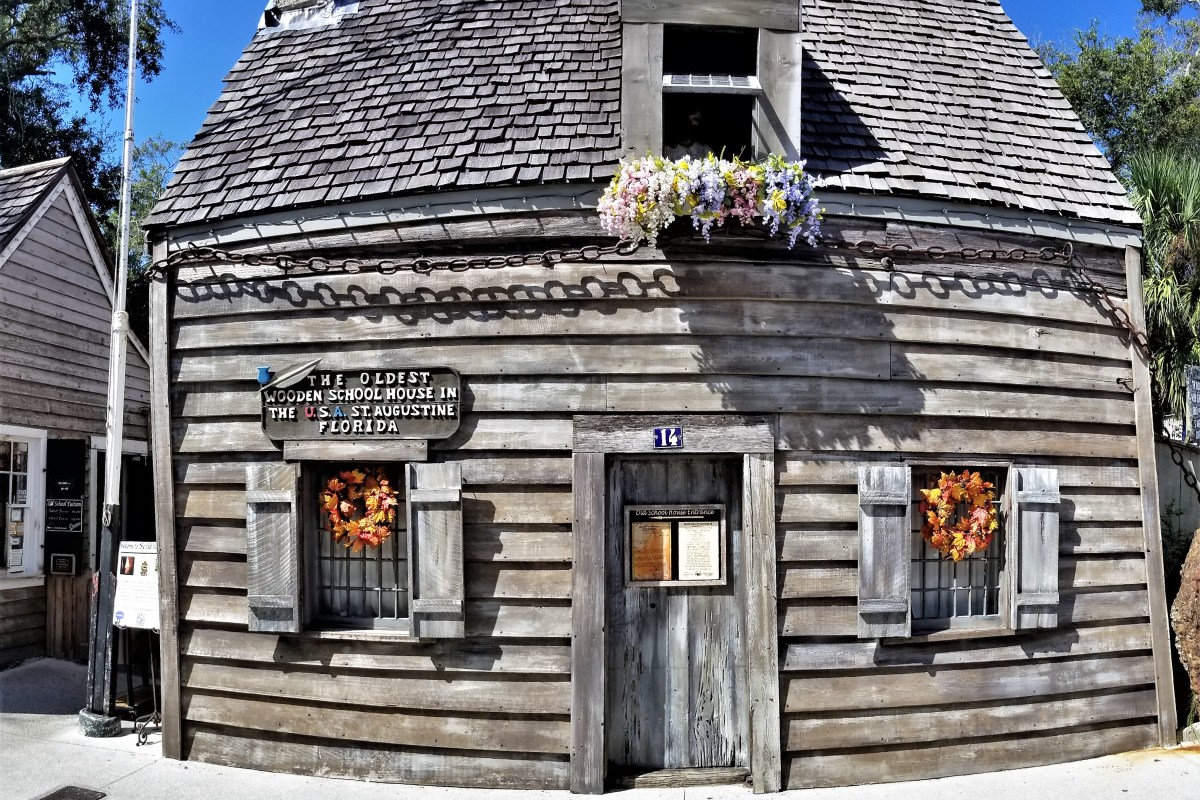
It’s my understanding that there’s an outstanding stand-alone wooden schoolhouse still standing in the middle of St. Augustine’s historic district, that by today’s standards, stands to be the oldest wooden schoolhouse in America, notwithstanding the claims of contenders with similar standing, which stands to reason.

panoramic exterior

For instance, the Voorlezer House is an ancient clapboard-framed structure located in Staten Island’s historic Richmond Town. It was built in 1695 by Dutch settlers as a church, school and residence for the voorlezer (one whose semi-official duties included local law, education and religion). By virtue of its vintage, it gets high marks as the nation’s “oldest school house”.

Voorlezer's House (2).jpg
Voorlezer’s House, December 1938 (credit: Museum of the City of New York)

However, naysayers may say its multi-purposefulness disqualifies its “oldest school house” credential, while other “arcaneologists” would point to percentages of original materials retained as the gold standard for proper certification.
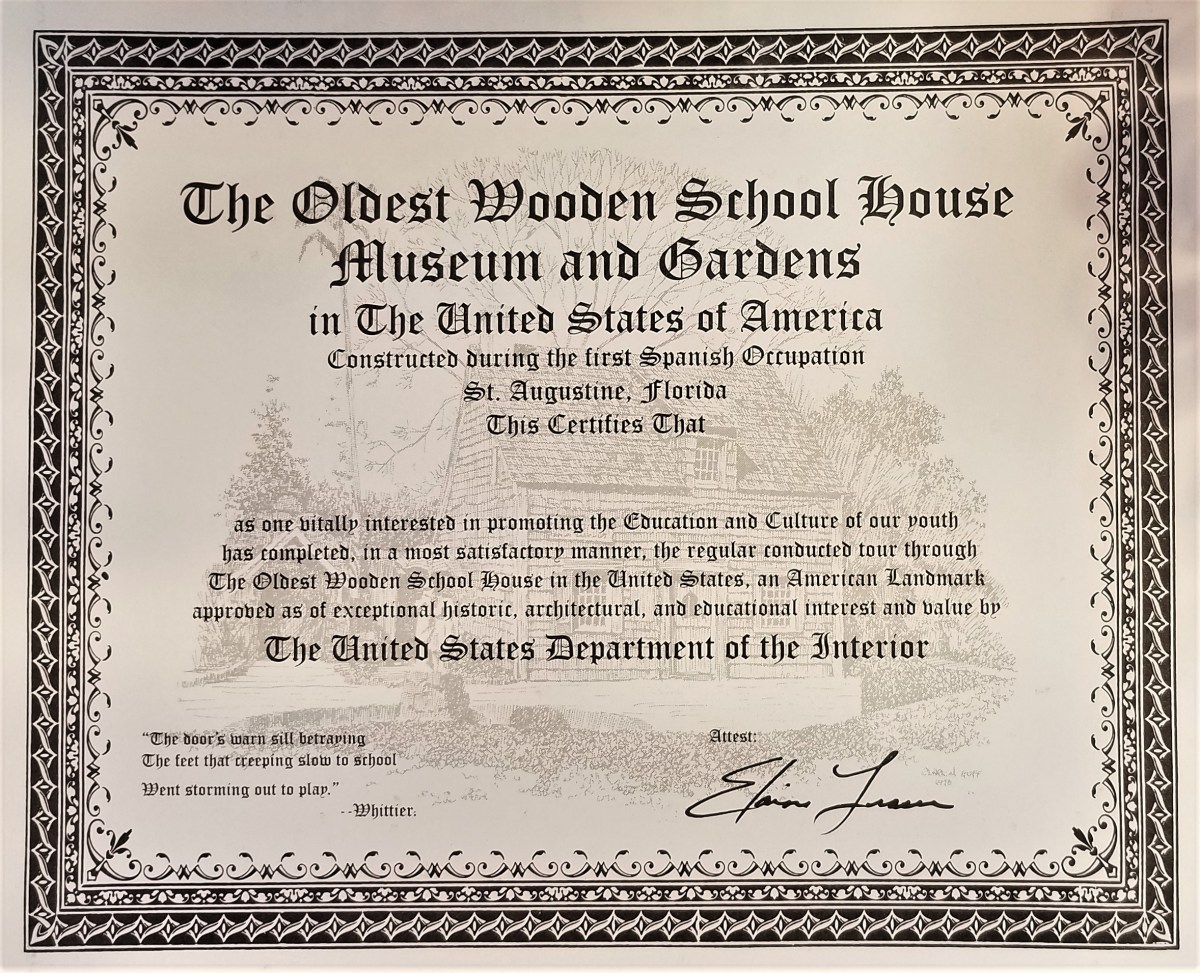
Nevertheless, St. Augustine, by virtue of its “first city” status, arguably possesses a legitimate rite for rating rotting relics, and maintains that the honor of “oldest wooden school house” resides at 14 St. George Street.

Certificate

At the very least, this much I know to be mostly true with questionable certainty:

Welcome

Upon close inspection, the main building has been wrapped in a rusted iron chain since 1937 to keep it from blowing away in case of a hurricane. An anchor was added in 1939 for added insurance.

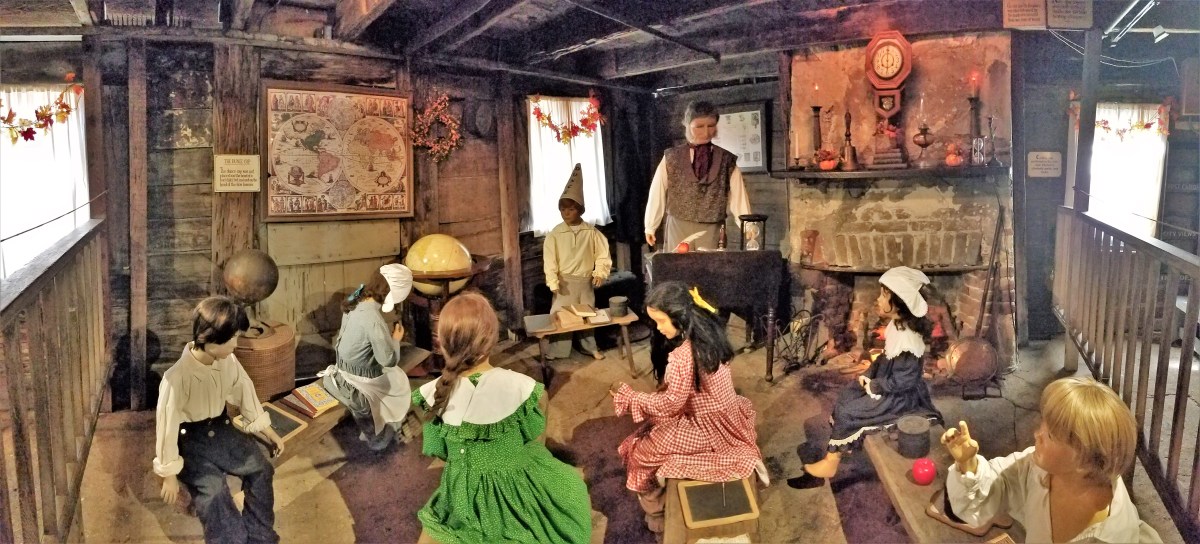
The one-room classroom was originally accessed from street level,

classroom

where stairs led to the School Master’s private residence one floor above.

parabolic upstairs

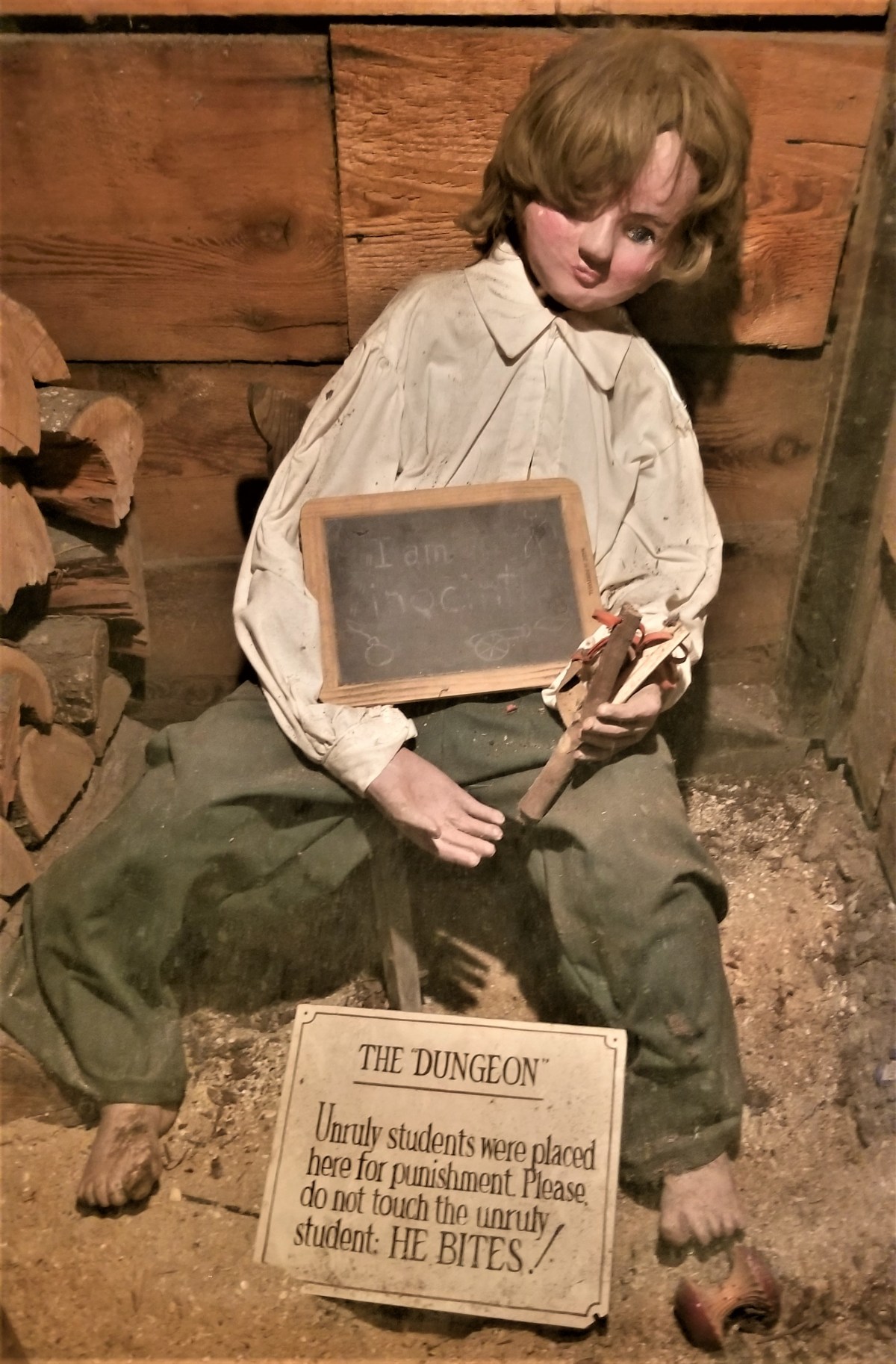
Primitive behavior modification techniques took place under the stairs, in what became know as the school Dungeon,

i am inocint

where recalcitrant children found themselves quarantined for an assortment of offenses.

no smoking

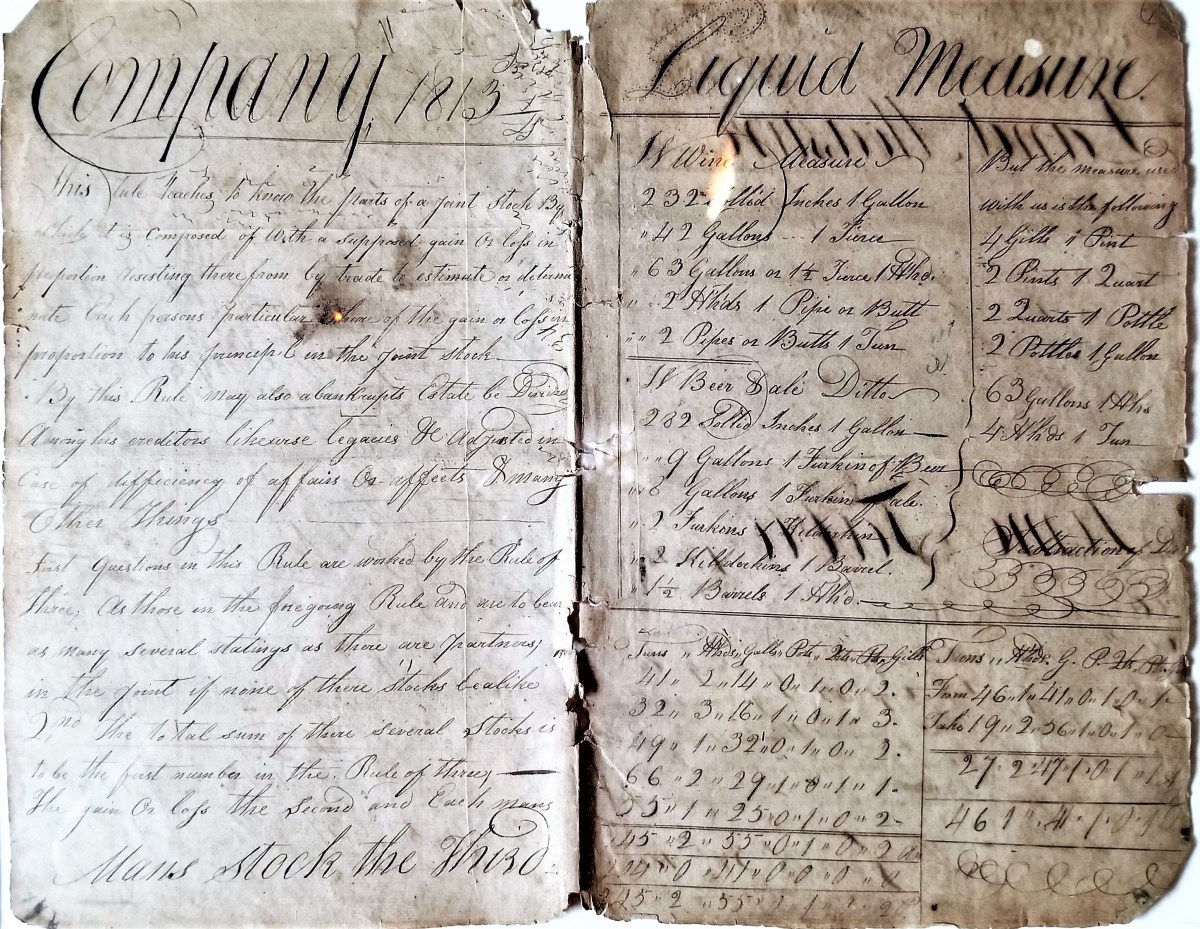
Yet despite the occasional unruly student, the clapboard walls around the room offered strong evidence of learning…

lesson plans (2)

math lesson

achievement…

Class of 1864a (2)

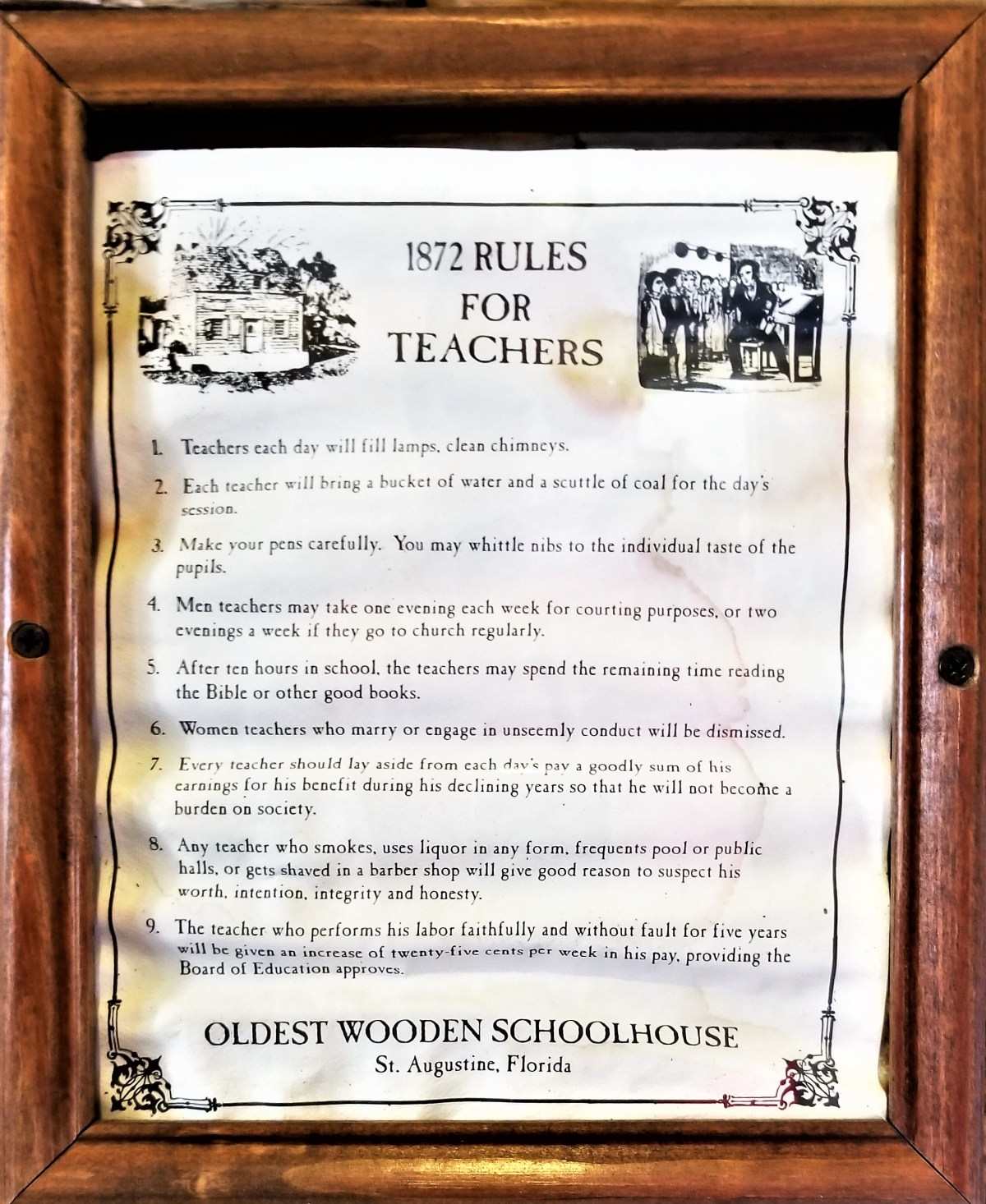
discipline…

Rules for Teachers (2)

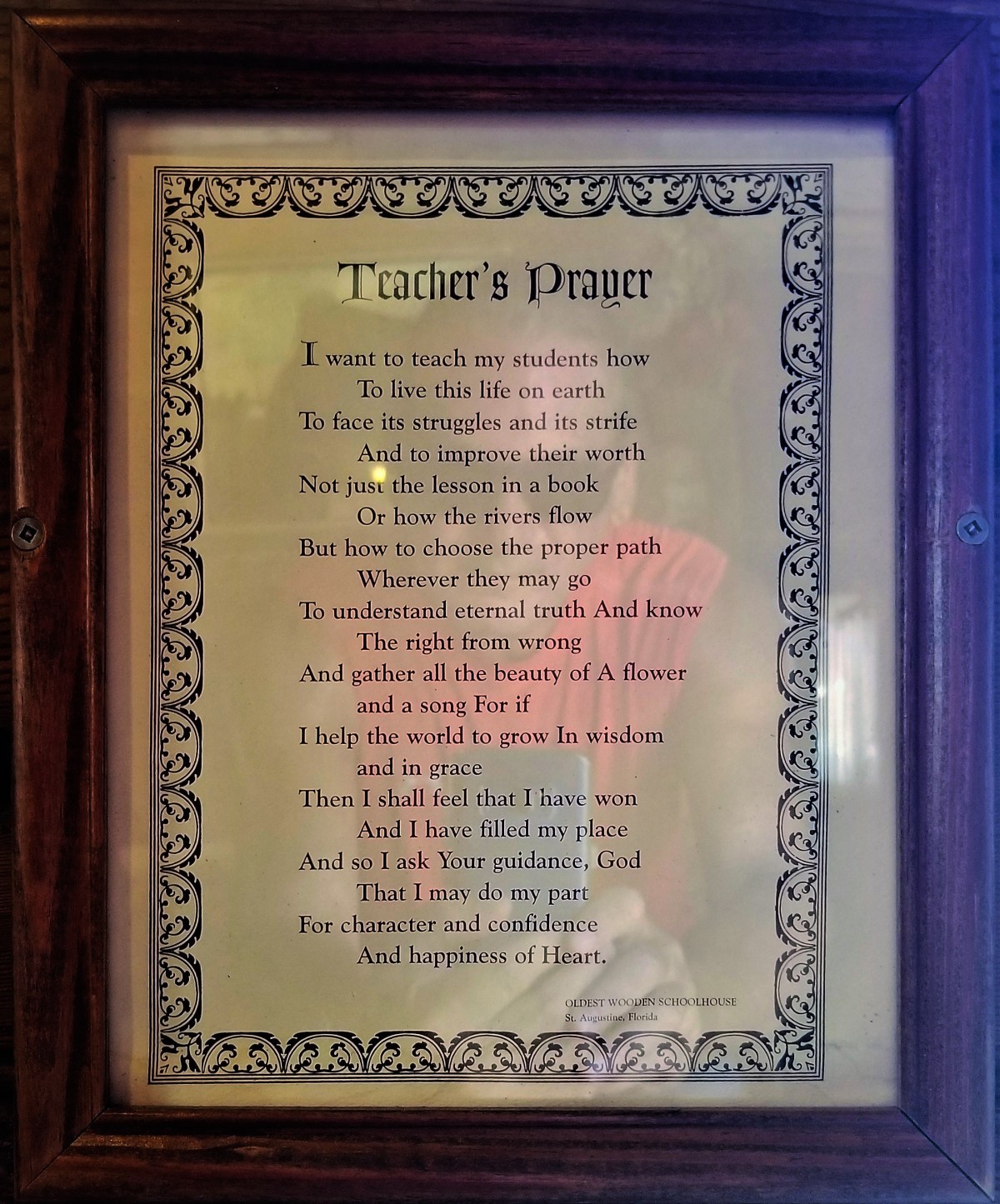
and dedication.

Teacher's Prayer

Located around the back,

school garden

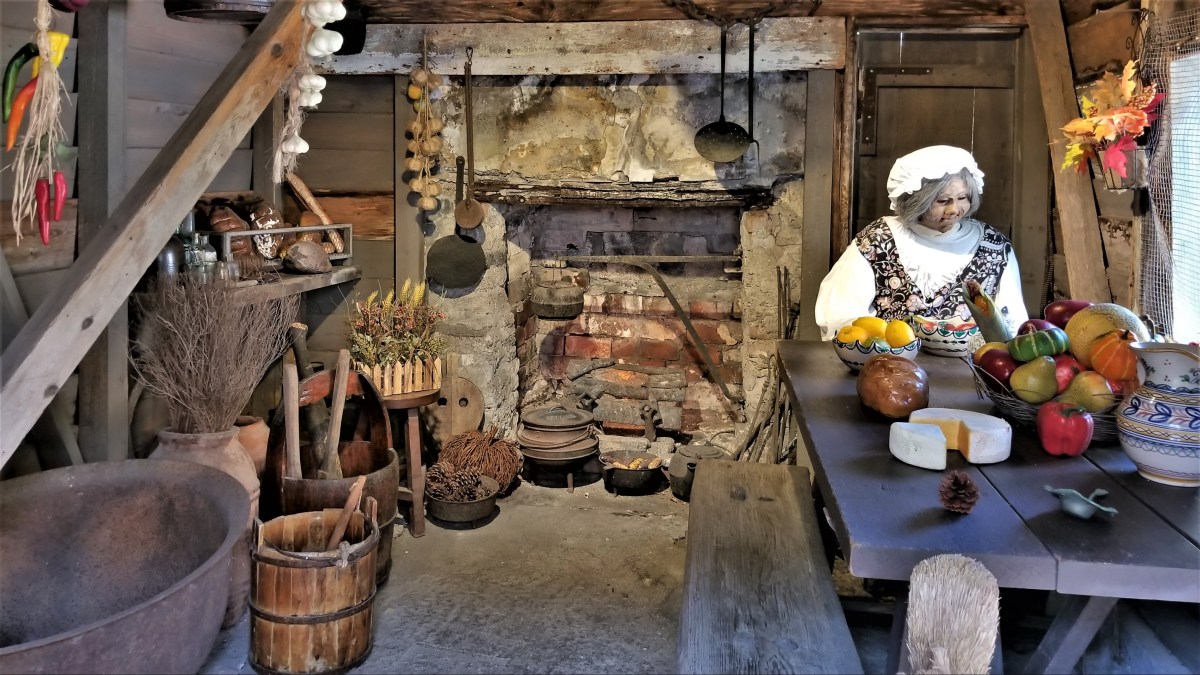
the detached kitchen offered healthy school lunches…

kitchen

…cultivated by kids…

kids rock

…from garden to table.

monumental tykes

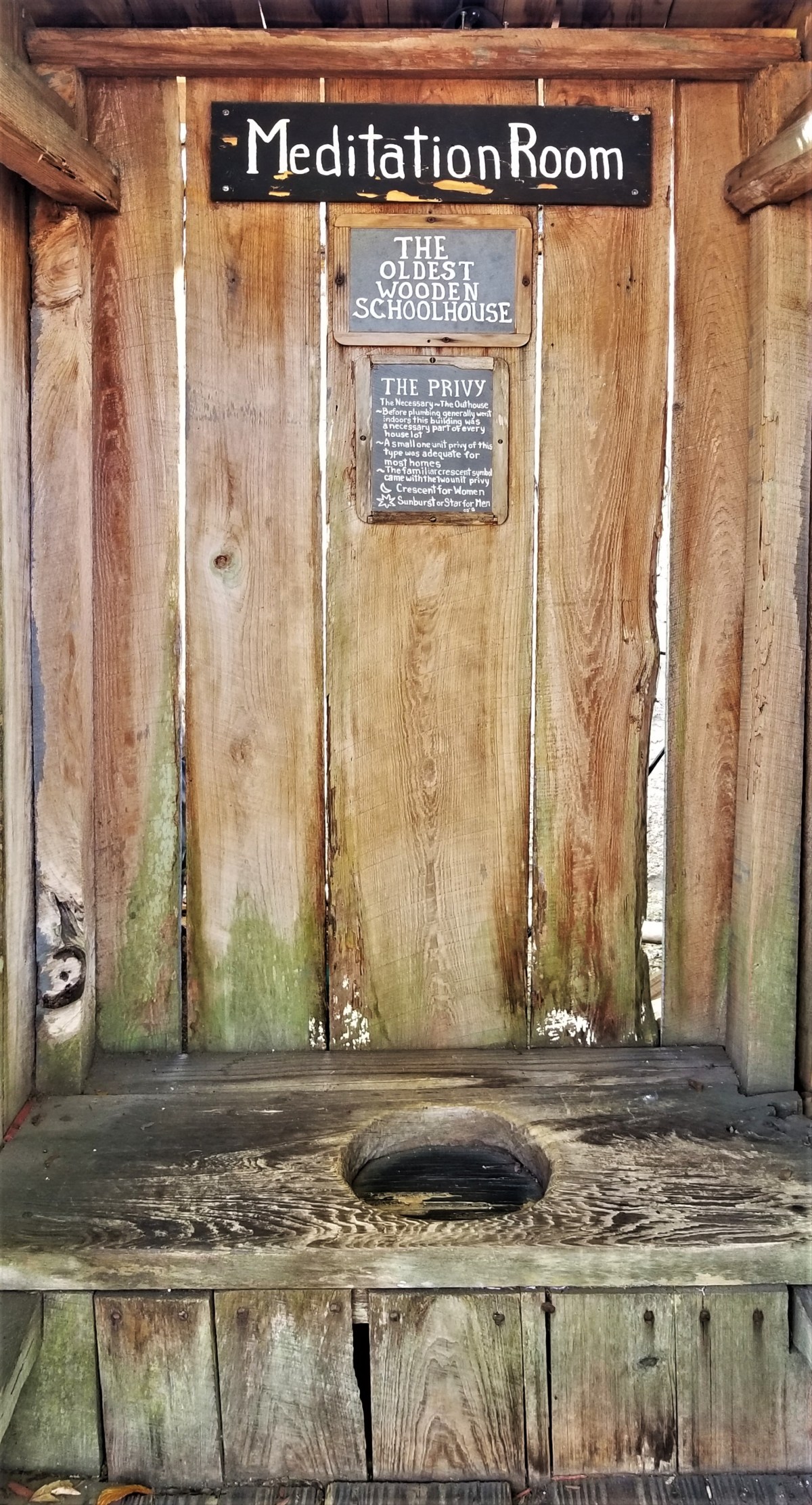
Also in the schoolyard stands the rebuilt potty house–perfect for serious homework.

potty

And when the last bell tolls and class is finally dismissed,

school bell

it’s reassuring to know that when kids learn their ABCs, regardless of schoolhouse pedigree, it can ultimately result in a lifetime love of learning.

reading bench

Uncertainty: Chapter Sixteen

Uncertainty: Chapter Sixteen

Frohe Weihnachten, Oberpräsident,” echoed Max, with a doff of his cap.

“And a Merry Christmas to you as well, Herr und Frau Köhler,” greeted Terboven, while keeping his horse on pace with the wagon as it rolled toward the Bahnhof entrance. “And what business brings you to town on such a fine morning?”

“I’m surprised you need to ask, Herr Terboven!” I asserted. “One only needs to look at this magnificent Tannenbaum on the platz as an answer to your question.”

Aha1! he exclaimed. “I have to agree with you. I too am drawn to it. It fills me with a great sense of Stoltz2 whenever I gaze upon it. In fact, it transcends its simple purpose of being a tree among trees in a forest that few would ever notice, let alone appreciate. But out here, on the platz, it becomes a sacred symbol to our Fatherland. This splendid tree personifies the strength and perfection that is Germany, and stands as a testament to the powerful bond that exists between the citizens of Germany and their love of Führer. Heil, Hitler!”

I sensed Terboven waiting for the requisite “Heil, Hitler” response, but he was met with uncomfortable indifference.

“Wouldn’t you agree, Herr Köhler?” he asked, looking miffed and wanting more than a tacit understanding. Max pulled the reins on Shaina Maidel and slowed the wagon to a full stop. Terboven circled around the wagon, and pulled his horse up beside Max.

“Forgive me, meine Oberpräsident, for having a wandering mind, but when I look upon this mighty tree, all I can see is eighty years of slow and steady growth cut down in fifteen minuten3 by your men. If I close my eyes, I am left to imagine the tree still standing in the feld. But in reality, there is a gap in the landscape that matches the hole in my heart from the sadness I feel.”

Ja, but it is a noble sacrifice for the Reich, Herr Köhler. Is it not?” baited Terboven.

“It is, Herr Terboven,” I interjected, “and I have brought my beautiful nieces–who happen to be hiding in the back of the wagon–to show them the beauty that Gott has created, and the precious gift their Onkel has given to the town.

Max turned in his seat to roust the girls under their blanket. “Are you ready for your surprise, meine darlings?” he called out.

Berte and Eva slowly revealed themselves–lifting the blanket from their huddled mass–and carefully pulled themselves up to face the Tannenbaum directly.

“There it is, girls! What do you think?” Max asked, grinning.

Onkel Max, it’s so beautiful,” gushed Berte, to the edge of exaggeration.

Wunderbar, Onkel Max! It’s the most beautiful tree I think I’ve ever seen,” Eva overstated.

Bitte, can we get a closer look, Tante Ilse?” begged Berte.

“Can we?” chimed Eva.

“Where are your manners, children?” I scolded. “How do you address this fine officer?”

Frohe Weihnachten, sir,” curtsied Berte.

Frohe Weihnachten,” mimicked Eva, clinging to Berte.

Heil, Hitler,” chirped Terboven, with a tip of his hat.

I signaled my approval. “Much better, girls,” I lauded.

“Now climb down from there,” I advised, “and be very careful not to catch a nail with your fancy new Christmas outfits.”

_________________________

My heart was racing. With everybody watching, I approached Shaina Maidel, wanting to say goodbye without arousing suspicion, but I couldn’t find the right words.

“Thank you for taking me to the Bahnhof,” I whispered.
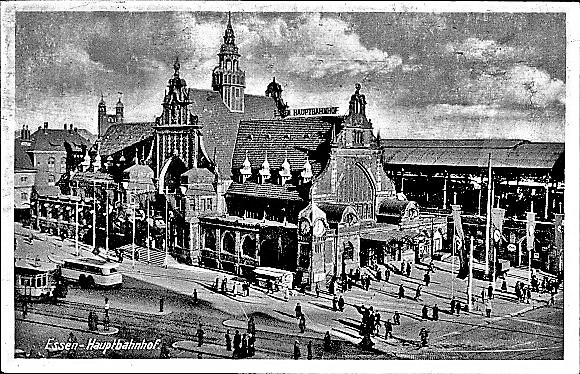
Hauptbahnhof postcard (3)

I gently stroked her muzzle and looked into her deep brown eyes. She nuzzled against my shoulder in response, and nudged the paper sack in my hand.

“I know what you want,” I predicted. I opened the sack and withdrew an apple for her to see. “Is this what you want?” I teased.

Shaina Maidel tossed her head and whinnied. I took a bite and offered her the rest. The apple was gone in a flash, but she was back to nibble at my palm.

“You’re welcome,” I offered, and walked back to Tante Ilse. A wave goodbye to Onkel Max…

“I will wait for you on the south side of the station,” he announced,

…and the three of us walked to the Bahnhof, arm-in-arm. Gott sei Dank, our backs were turned, because I couldn’t hold back the tears any longer.

_________________________

“Ride with me, Herr Köhler. I will escort you to the other side,” I offered.

Essen-Hauptbahnhof_von_Süden_um_1920 (3)

It was better for the horses to be on the other side of the Bahnhof and away from the pedestrians and automobiles that were constantly in motion on the north side. Besides, there was something that was bothering me about Max Köhler’s attitude and answers that demanded more time to assess. Perhaps, a few more questions were in order to satisfy my curiosity.

“It’s really unnecessary, Oberpräsident. There’s no need to go out of your way. I believe I’ve already taken up too much of your time,” he indicated.

Unsinn5!” I replied. “It’s no trouble, I assure you. Besides, I have an hour of time to kill before my wife and daughter return from the holiday performance under Ihre Tannenbaum6.”

“Very well…if you must,” remarked Herr Köhler.

_________________________

Children of all ages and levels of anxiety were being processed alphabetically at a long table inside the terminal staffed by Kindertransport agents. I directed Berte and Eva to the P-Q-R-S line, where a volunteer was waiting and eager to assist us.

“Family name, bitte,” she requested.

“Strawczynski, S-T-R-A-W-C-Z-Y-N-S-K-I,”provided Berte.

“Given names?” she asked.

“I’m Berte, and this is my shvester, Eva,” reported Berte.

The agent sorted through stacks of name cards with hanging string, conveniently organized in boxes under the table, until she came across the two designated for Berte and Eva.

“Are you the girl’s mother?” she asked, pursuant to releasing the name cards.

Nein. I’m the Tante,” I lied.

“Do you have travel papers for the kinder?” she inquired.

_________________________

While in transit to the south side, I attempted to manuever around a menacing squad of Hitler Youth–intentionally crossing in front of Shaina Maidel with designs on annoying her–but the moment they spotted Terboven, their behavior was beyond reproach. They quickly filed past the wagon and aligned in a perfect row with arms extended in a synchronized salute. “SIEG HEIL!”

“What a nuisance,” I spoke under my breath.

Terboven dutifully returned the salute. “What wonderful kinder we have in the service of the Reich,” he boasted to me.

“May I see your papers, Herr Köhler?…Just a formality,” explained Terboven.

“If you must,” I accepted without objection.

I rummaged inside my coat pocket until they were available, and handed them over. After a cursory examination, Terboven held them up to the light, and returned them intact.

“Did you find what you were looking for?” I asked, innocently. My response was intended as a rhetorical question, but I think it may have come across sarcastically.

“I see you have no children, Herr Köhler. Why don’t you tell me about Frau Köhler, bitte,” he directed. “And tell me when you discovered she was a Jüdin!”

_________________________

“Oh meine Gott! What are you doing here?” I couldn’t believe my eyes, I was so ecstatic. I surrounded Toni Ehrlich and Sully Greenberg with both arms. All of us came together for a group hug, but found the hanging  name cards to be an annoyance around our necks.

“You have no idea how much I missed you!” I sighed.

I sensed Eva was feeling left out of our close circle, until she spotted Sully’s shvester, Rosa in the background, and the two of them enjoyed their own special reunion.

“Where have you been?,” asked Toni. “Sully and I were so worried about you.

“It’s true,” sounded Sully. “It’s as if you and your mishpucha disappeared.”

“We did,” Eva broadcasted, still locked in Rosa’s embrace. “We were in hiding.”

“Eva! You  promised Eema that you’d never tell!” I admonished.

“But these are our friends, Bertie, and I’ll bet that we’re all traveling to Holland together,” she predicted, which spurred all of our friends to nod in agreement.

“Don’t you see, Bertie? This is Abba’s final surprise!”

_________________________

I spotted Tante immediately from her red beret, but I wasn’t sure if she could see me. She was weaving through the crowd on the platform like a ballet dancer, gracefully dodging the grown-ups who were frantically searching the long line of railcar windows for a final glimpse of the other half of their heart. We exchanged a wave when our eyes finally locked, and her face quickly changed from sad to glad.

I followed Rosa Greenberg to car number three, where the seven and eight-year-olds were sitting. At first, I thought it unfair to be sitting with the younger children, since I was almost nine, but after Bertie and I were sorted by age, and separated at boarding, I was delighted to sit with my friend, Rosa.

We found seats together by the window facing the platform, where I could see Tante standing with scattered groups of moms and dads united in their grief, and fighting to grapple with sending their children off to an uncertain future. I could also see Onkel Max in the distance. He was standing on the wagon, wildly gesturing to the officer on the horse who appeared to be pointing a gun at Shaina Maidel.

_________________________

“What are you doing? What do you want?” I implored.

Terboven’s weapon was drawn, and pointed directly at Shaina Maidel.

“I want the truth…” insisted Terboven. “…but all I get is Lügen8!

As Terboven’s anger was building, his volume increased. “I ask about Deine Frau9, and you lie. I ask about the kinder, and you lie. I ask about your allegiance to the Reich, and you lie! Lies, LIES, and more LIES! WHEN DO I GET THE TRUTH!”

“But I’ve been telling you the truth,” I cried.

_________________________

Gotteniu10! Onkel Max is in trouble,” I blurted. The steam whistle blared and the railcar lurched forward. I never heard the shot, but Shaina Maidel crashed to the ground, tipping the wagon and throwing Onkel Max off-balance, and flying through the air.

I remember screaming, but I don’t remember anything after that…

…until I woke up in Holland…

…without my coat.

The End of Part One


Part Two: Holland


1Of course!
2I see!
3pride
4minutes
5Nonsense
6your fir tree
7Jewess
8lies
9your wife

10Oh God!

Uncertainty: Chapter Eleven

Uncertainty: Prologue
Uncertainty: Chapter One
Uncertainty: Chapter Two
Uncertainty: Chapter Three
Uncertainty: Chapter Four
Uncertainty: Chapter Five
Uncertainty: Chapter Six
Uncertainty: Chapter Seven
Uncertainty: Chapter Eight
Uncertainty: Chapter Nine
Uncertainty: Chapter Ten


Uncertainty: Chapter Eleven

“My name is Menil, and I am a simple man, one hundred percent. There is not much to my story with the exception of three evident truths…”

“For one, I am neither German or Polish. I am ‘stateless’.”

“I earned this elusive title nearly twenty years ago after crossing into Germany to avoid conscription in the Polish Army. My decision was guided by my faith in Hashem, and grounded in my need to escape further anti-Semitic prosecution. Consequently, I forfeited my Polish citizenship, and automatically became a political refugee. While it was difficult starting out with so little in a new country with Rochel, my bride, it never deterred me from achieving my dream of building a prosperous business and raising a beautiful family. With Rochel by my side, we were unstoppable…until the Nazis decidedly interfered with our plans.”

“Another thing about me…I am neither a resident or a citizen. I am considered an ‘undesirable’ and ‘enemy of the state’.”

“I’m told by the Third Reich that my very existence is a direct threat to the government, and Hitler’s notion of Aryan perfection–along with anyone else who happens to be a Jehovah’s Witness, a homosexual, a gypsy, or a mental patient. As an ‘enemy of the state,’ I must surrender everything that I have ever worked for, and I am to be treated as a common criminal. And what are my choices for committing racial treason? Either I hide underground like a rat or face the likelihood of prison…or worse.”

“Lastly, I am no longer a tailor or a businessman. I am just a humble Jew, meyn Got.”

“When the Nazis see me, that is all they can see. After the Reichstag1 enacted the Nuremberg Laws on September 15, 1935, I became a stranger in a strange land. The Nazis could no longer see me as a man of substance or purpose. All they see is a Jew, nothing more: someone who is defined by the heritage of his parents and his parents’ parents; someone who is worthy of only ridicule and hate; and someone who is an age-old scapegoat for Hitler’s propaganda machine.”

“And what’s my take on all that I am? I ask because by looking at me, no one could ever predict these details about me. I certainly don’t appear ‘stateless’. My German is impeccable; I once owned property in the center of town; and I had the respect of the business community and the congregants who davened with me in shul.”

“No one would ever confuse me for an ‘enemy of the state’. I’m not an activist like some of the Zionists I know. I never go to meetings, and I don’t protest in the streets or sign petitions with my real name.”

“Most interestingly, I don’t particularly look Jewish. At least I don’t think so. My pale skin, green eyes, moderate nose and thinning hair makes me more likely to be mistaken for a goy. Berte, too. Her looks definitely come from my side of the family. Her blond hair and blue eyes alone have made her the envy of every Aryan parent. Eva, on the other hand, is the polar opposite. Her alluring looks come from Rochel’s side: black hair and dark mysterious eyes–the kind that draw you in.”

“Rochel has always hocked2 me that I’ve been living in denial, but there is no denying these three facts about me, one hundred percent. And regardless of how I present to the world, the Nazis have managed to remind me of ‘what’ I am on a daily basis. Of course, one needn’t look any further than my identity papers.”

“Passports are curious things. As an official travel document, it reveals our personal information: name, birthdate, country of origin, and a photograph of our likeness. To the average yutz3 or shmo4, a passport is a certified registration of identity and nationality for the primary purpose of international travel, but to a Jew, it’s meaningless and a curse. So there can be no confusion, all Jewish passports have been stamped with an identifying “J” in red letters.”

German Passport (2)

“In August ’38, the Reichstag passed the “Executive Order on the Alteration of Family and Personal Names,” which now requires Jewish men and women bearing first names of “non-Jewish” origin to adopt additional names: “Israel” for men and “Sara” for women. So now, I’m officially Menil “Israel” Strawczynski. How do you like that?!”

“Naturally, all of this nonsense is beside the point, because leaving Germany by normal means of passport and visa issuance is nearly impossible following the horror of Kristallnacht. Already, most countries around the world no longer want Jewish immigrants or refugees inside their borders–which they’ve made very clear by tightening entry regulations and keeping the numbers down for people like us.”

I shrugged. “Unfortunately, it’s much too late in the day for Rochel or me to formally cross the border to Venlo, but that doesn’t mean we can’t send the kinder ahead of us…We just have to figure out a way we can all reunite on the other side.”

Shaina Maidel whinnied and shook her head. She nudged my shoulder.

“I apologize. I don’t mean to kvetch5, but you’re such a good listener!”

I picked myself up from the bale beside the stall opening, and brushed the hay from my tush6. I grabbed the lantern and an apple to feed her from a nearby bushel basket.

“You’ve been very helpful,” I offered with the treat, and she snatched it from my palm.

“Now I understand why Bertie loves you so much. Good Night, Shaina Maidel.”


1Parliament of the Third Reich
2nagged
3fool
4jerk
5complain

6buttocks

Uncertainty: Chapter Ten

Uncertainty: Prologue
Uncertainty: Chapter One
Uncertainty: Chapter Two
Uncertainty: Chapter Three
Uncertainty: Chapter Four
Uncertainty: Chapter Five
Uncertainty: Chapter Six
Uncertainty: Chapter Seven
Uncertainty: Chapter Eight
Uncertainty: Chapter Nine


Uncertainty: Chapter Ten

Menil and I huddled under the blankets for warmth and held each other close. Yet we froze in fear of being discovered like two teenage lovers in the backseat of a Duesenberg automobile. We had heard a loud noise, and instinctively clung to each other in the back of the van, reacting to the present danger with the same heightened awareness as if we were hiding under Ilse Köhler’s kitchen floor. 

An hour earlier, we thought we had found the perfect spot to find some alone time…away from the kinder. But leave it to Berte to pick the same place at the same time as Menil and me. Vey iz mir!1 We lay very still and quiet on our mattress of worsted wool–eavesdropping on Berte’s confession–until I could’t bear another minute of her unhappiness, and thought I would plotz2. It broke my heart hearing Bertie pouring her heart out to Shaina Maidel.

We held our breath as she dragged her feet past the van, and we let out a collective *sigh* the moment we heard the barn doors close behind her.

Gottenyu!3 I don’t think I could have gone any longer,” I confessed to Menil.

“Me either,” he snickered. “That had to be the most uncomfortable half-hour of my life.” He took back his arm and flexed it back and forth, trying to restore some feeling.

His nervous laughter reminded me of the time he accidentally pinned Dr. Krupp’s hoyzen4 legs together while marking a cuff, and the steel scion nearly broke his neck trying to step off the tailor block.

I jabbed him playfully with my elbow. “That’s not what I meant, and you know it! Your tokhter5 is struggling, and all you can do is laugh!?”

“Of course she’s struggling. We’re all struggling, Rochel! Because none of this makes any sense!” he stated. “This is all my fault. I should have listened to my shvester6 from Pittsburgh in ’35, when she said to me, ‘Menil, it’s not getting any better. You need to get out while you still can!'”

“She begged me to leave, and I wouldn’t have any of it. She could have sponsored all of us in America, and I was an idyot7 not to listen to her.”

I tried to reassure him. “Menil, it’s not your fault. We both agreed to stay here as long as we felt safe.” I hugged him tight so he would know.

“I wanted to believe our life in Essen was a blessing, and we were deserving of it after the way we struggled in Lodz. Gott sei dank!8, we have a successful business, and a beautiful family, and we can raise our girls to honor HaShem’s9 commandments. Even with the meshugenah10 Nazis in Essen, was our life so terrible?”

“Of course not!” I declared. I ran my fingers through his thick sandy hair and kissed him deeply. When I pulled away, I noticed that his smile and his swagger had returned.

“You see! So I was right!…Back then, there was no good reason to leave all of this behind. And for what?–an uncertain future in America?” he questioned.

However, in 1937, anti-Semitism intensified in Essen. Hitler Youths were constantly marching in the streets; more Jews were being beaten and harassed for being Jewish; and more laws were enacted that discriminated against Jewish merchants, doctors, lawyers and teachers. It became obvious to me and the girls that things were getting worse, yet whenever I often brought it up to Menil, he always thought things would eventually return to normal.

I’d tell him he was living “in denial,” but he always answered back with, “I have no immediate plans of moving from Essen or Egypt.”

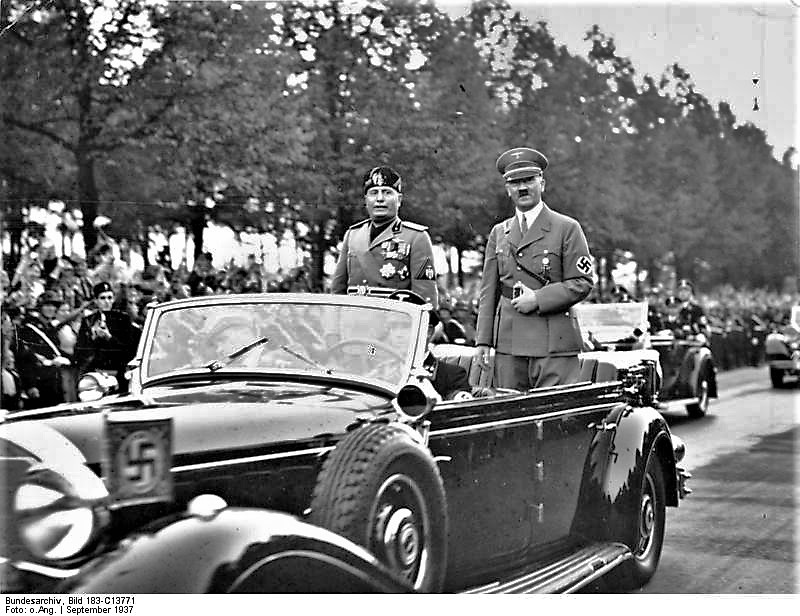
The final affront for me was on September 27th that year, when Mussolini and Hitler rode down the center of town in his motorcade. Thousands of cheering people lined the street and saluted “Seig Heil”11 and “Heil, Hitler.”12 

Berlin, Benito Mussolini, Adolf Hitler

I was standing at the cross walk with Berte and noticed a frail woman in a wheelchair who failed to salute the Führer13 when he passed. That’s when a marching Brownshirt broke ranks and humiliated the old woman, forcing her to raise her arm. And when she couldn’t, he forced her to support her arm with the other arm. And when all strength failed her and her arms collapsed, he beat her and her attendant to the ground with a rubber truncheon while others looked on indifferently.

Maybe that’s when Menil finally came to his senses. We planned and practiced for the eventual day when our mishpocha could start over in the Nederlands. But we missed our one chance to cross the border together when it mattered, and now we’re in the van inside the barn at the farm, waiting to come up with another solution, because the Nazis are becoming more serious with each passing day, and it scares me.

“Max and Ilse have been telling us that people we used to know around our neighborhood are quickly disappearing. Families are being arrested and deported to concentration camps, and all the Jewish-owned shops are now reopening with Swastika flags flying on the outside. I feel like our life here is over…” 

Depression took hold, and grief overcame me. I buried myself in Menil’s arms. “…after all the hard work we put into it,” I sobbed. 

Menil consoled me, stroking my arms and back with his strong and nimble hands. “It’s all going to work out, Rochel. You’ll see. Bertie’s absolutely right. There’s no going back, and there’s no future staying here any longer,” he said with a hint of resignation. “We need to find another way out of Germany, but I’m not so sure we can do it as a family.”


1Woe is me!
2overcome by strong emotion
3Dear God!

4pants
5daughter
6sister
7idiot
8Thank God!
9The Lord
10crazy
11Hail Victory
12Hail, Hitler
13Leader

Tied Pools

Henry Flagler’s Hotel Alcazar opened its doors in 1888 to fête the upper crust who rode his rails to St. Augustine to escape the harsh northeastern winters.

Designed in the Spanish Renaissance Revival style, the hotel was an elegant getaway that boasted every convenience and amenity for its guests, including the world’s largest swimming pool at 120 feet long by 50 feet wide, and depths ranging from 3 feet to 12 feet.

pool history

The pool was constructed as the centerpiece of the hotel casino annex that also featured a workout room, therapeutic baths, a steamroom, and bowling lanes. An artesian well fed a constant flow of fresh sulphur water to the pool to sustain moderate temperatures and assure clarity. The roof featured louvered glass panes that opened for ventilation.

bathing-pool-casino_0 (3)

The hotel was shuttered in 1932, and laid dormant until Otto C. Lightner purchased the building in 1947 to showcase his extensive Victorian Era arts collection.

Today, the Lightner Museum is listed on the National Register of Historic Places, and the pool is home to Café Alcazar, a subterranean eatery serving lunch off the deep end.

deep poolside (2).jpg

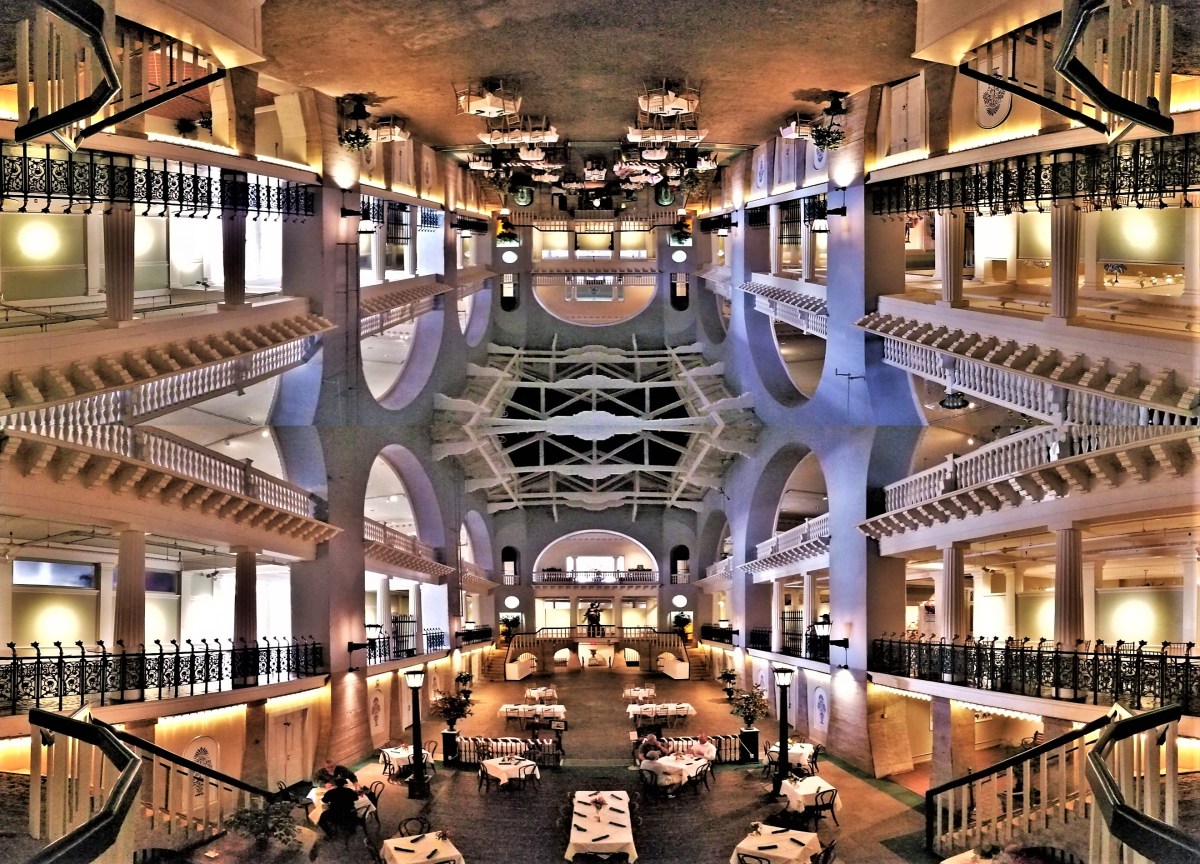
The moment I entered the room, I felt I was in the middle of a Downton Abbey episode. It was easy to imagine a tony troop of aristocrats parading in their top hats and arm length evening gloves.

After surveying the room, I had a notion to create an Escheresque puzzle that could tease the viewer into questioning whether the following composition is a mirror image of itself, or a pool reflection, or both.

Or is it just a deception?

There are subtle clues in plain sight that may aid in deciphering the composition. The proof is in the putting.

fool pool1a (2)

Happy hunting!

Uncertainty: Prologue

Uncertainty: Prologue

The crash of shattered glass from the haberdashery shop below, and the chorus of discordant shrieks that followed was enough to drive Eva into Berte’s bed. With the covers pulled over their heads, the two sisters — almost four years apart — huddled together in darkness, listening in silence to a din of destruction coming from the street outside their bedroom window.

At once, the printed ponies on the quilt came to life from the flickering light that shone through the fabric that momentarily managed to insulate them from the unknown and the unthinkable, and they delighted in the illusion until Eema barged in and broke the spell.

“Mach schnell1, girls!” she commanded, the urgency quaking in her voice, “Grab a sweater and your dress coats. We have to move quickly. It’s not safe here.”

“Where are we going, Eema2?” asked Berte, peering out from under the blankets, but Eema was already out the door screaming something inaudible to Abba3 down the hall.

“Look Bertie!” Eva was tugging on Berte’s pajamas from behind.

“Not now, Eva! We have to listen to Eema.”

“But Bertie, the shul’s4 on fire!”

They ran to the window looking out from Ribbeckstrasse — their attention drawn to the commotion across the street.

Essen Synagogue (2)
Neue Synagogue burning, Photo Archive Ruhr Museum (photographer unknown)

Flames were darting through the top floor windows while white smoke billowed from the stone arches surrounding the facade. People gathered to gaze at the spectacle — as if in a trance — but nobody lent a hand to douse the blaze.

The Neue5 Synagogue of Stalerstrasse was Essen’s cultural and social epicenter for the 4500 Jews in town. The imposing freestanding stone monument with four striking copper cupolas was consecrated in 1913 from Edmund Körner’s designs,

Neue Synagogue (2)
Neue Synagogue, Essen (Ruhr Museum)

and considered to be one of Europe’s largest and architecturally significant synagogues of all time. Built to accommodate 1,400 worshipers, Bertha often kvelled6 at the size of the sanctuary. She marveled at the symmetry of the polished organ pipes above the altar, and how its acoustics would carry her from her seat beside Eema in the women’s gallery to the soaring dome high above her — as distant as the sky — where she could still hear the whispers of the men cloaked in talllit7 who were davening8 on the floor below.

INTERIOR (2)
Neue Synagogue interior, Beth Hatefutsoth Photo Archive

Eema also adored the Neue Synagogue, although she claimed that Piotrkow’s Wielka Synagogue9 outside Lodz easily rivaled its beauty and immensity.

Wielka Synagogue (2)
Great Synagogue, Piotrkow Trybunalski, Poland

It was there, at the August Oneg Shabbat10of-the-month social, that Eema first met Abba. The year was 1914, and Menil Strawszinski and Rochel Kolski were teenagers at the time. As the daughter and son of textile workers, their families thought Menil the perfect button to Rochel’s bow, and arranged a meeting for them at the Great Synagogue that night. However, they found themselves in the midst of a regional struggle for Lodz, with Nicholas II and Wilhelm II threatening the peace.

During the Oneg celebration, a gang of Russian Imperial soldiers entered the synagogue under the guise of conducting a mission to uncover the whereabouts of a hidden telephone with a direct link to the German command. Unable to substantiate their claim, the soldiers ransacked the room and roughed up several of the members who dared to interfere with their “investigation”. Menil’s pride was wounded, but most of all, his bruises and bloody nose were a reminder of the capricious violence that surrounded them.

Turmoil in Lodz continued under German occupation from 1915 until the end of the war, when the Polish state was re-established on November 11, 1918 and Poland’s independence was restored. But peace was ephemeral. Soon after, military conflict resumed when Polish armies pushed hard against Ukraine’s eastern borders — intended as a bulwark against future encroachment by the Soviets, who viewed Poland as a pathway to sowing seeds of communism in vulnerable post-war Germany.

On New Year’s Day, 1919, Menil turned 21, and two months later became eligible for compulsory conscription when the Sejm of the Republic of Poland enacted the Provisional Statute on Mandatory Military Service for all male citizens. With anti-Semitism flourishing through the ranks of the armed forces, and an uncertain future awaiting him at the Ukrainian frontline, Menil knew what he had to do. With their parents’ blessings, and a modest nadn11 of a sewing machine and seven bolts of wool fabric from the Kolski’s, Menil and Rochel were married in a quiet Jewish ceremony, and boarded a train to Essen, where a second cousin, once removed could offer them a fresh start.

Menil and Ruchel’s migration to North Rhine-Westphalia was typical of thousands of other Jewish Poles who fled a fragile and defeated Eastern European landscape, hastened by the political instability and famine created by The Great War and the Russian Revolution.

Breadline in Piotrkow (2)
Breadline in Piotrkow

They arrived in Essen — under an opportunistic umbrella of social acceptance and religious tolerance — eager to capitalize on a climate of post-war possibilities, with hopeful prospects of putting down roots. Living by Jewish tenets of hard work and the value of education, coupled with their Christian neighbors’ encouragement and cooperation, the Jews of Essen seamlessly assimilated into a world of German mercantilism, and became an accepted part of Germany’s middle class.

At first, Menil worked two years for his second cousin as a pattern cutter and a tailor, while Rochel helped with the books and ordered the notions, but their dream was always to open their own retail shop in the city center. Their break came when Moishe Samuels invited Menil to his shop on Ribbeckstrasse to help him cut custom suits for the famed Hirschland family, a leader in Essen’s Jewish community and the world of finance. In fact, it was Isaac Hirschland, the family elder, who originally recommended the location down the road where the Neue Synagoue would subsequently be built.

After two years of working for Moishe and living in a small one-room flat above the store, Menil and Rochel arrived at the crossroads of their future. Moishe Samuels passed away after a prolonged battle with liver cancer, and Menil and Rochel acquired the business from his widow. They expanded into ready-to-wear menswear and boys clothing, with an emphasis on custom tailoring, and became the first in the area to showcase double-breasted jackets as part of their fashion line — all of which guaranteed the store’s success for years to come.

Not that there weren’t setbacks. The rising tide of German nationalism — as a response to communist rhetoric and activity — catapulted the National Socialist German Workers’ Party into power in 1933, resulting in an anti-Semitic city manifesto calling for random arrests of Jewish citizens, Jews to be fired from their jobs (regardless of their prominence), and Jewish-owned businesses to be boycotted.

München, Hitler bei Einweihung
Hitler and NSDAP-Reichsschatzmeisters Franz Xaver Schwarz, Hauptarchiv der NSDAP (Bild 119)

Strawszinski’s Haberdashery survived an initial wave of Nazi attacks on Jewish merchants, but repeated discrimination and Nazi-sponsored decrees took its toll on Menil’s bottom-line. His customer base was slowly shrinking, his supply lines were becoming unreliable, and his shipments were being poached by corrupt officials. There were times when Menil and Rochel felt like giving up, but where could they go? Everything that was theirs was invested in the shop, and now they had a family to consider.

Berte had just turned seven — the year Hitler was elected as Chancellor — and Menil cherished her with all his being. She would pretend to help him around the shop after school — dusting the mannequins, picking up loose pins, and sweeping the floor. She was his shaina maidel12Just last year, she had requested that he buy her a horse for her sixth birthday, and he couldn’t disappoint her. They drove to a local barn on the edge of town, and he let her pick out whichever one she wanted. Of course, Menil had already made the necessary arrangements with the farmer ahead of time, so Berte’s pick was limited, but she had to have the chestnut mare with the white face, and she named her Shaina Maidel.

Eva, on the other hand, was still in diapers at age 3, and clung to Rochel as if her life depended on it. There was no putting her down for fear of a crying storm that would only abate when she was back in Rochel’s arms. Menil and Eva had a different kind of bond. He felt he knew her heart better than anyone, even Eema. Maybe it was because they shared the same birthday. Or maybe it was because she always knew how to grab Abba’s attention when he was unhappy, and cheer him up. But oy13the crying! Gott sei Dank14, Berte could console Eva long enough to allow Eema to light and bless the Shabbos15 candles.

It was 1938. Strawszinski’s Haberdashery had managed to survive, and even boasted a modest 15-year anniversary celebration, but now the store was being looted by a riotous mob, and the shul was burning.

Tears welled up in Eva’s eyes, and her voice quivered. “Why isn’t anybody putting out the fire? And where are we going to pray on Shabbat?”


1hurry up
2mother
3father
4synagogue
5new
6expressed pride
7prayer shawls
8praying
9The Great Synagogue
10Sabbath celebration
11dowry
12pretty girl
13Oh, my!
14fortunately
15Sabbath

Depth of Focus

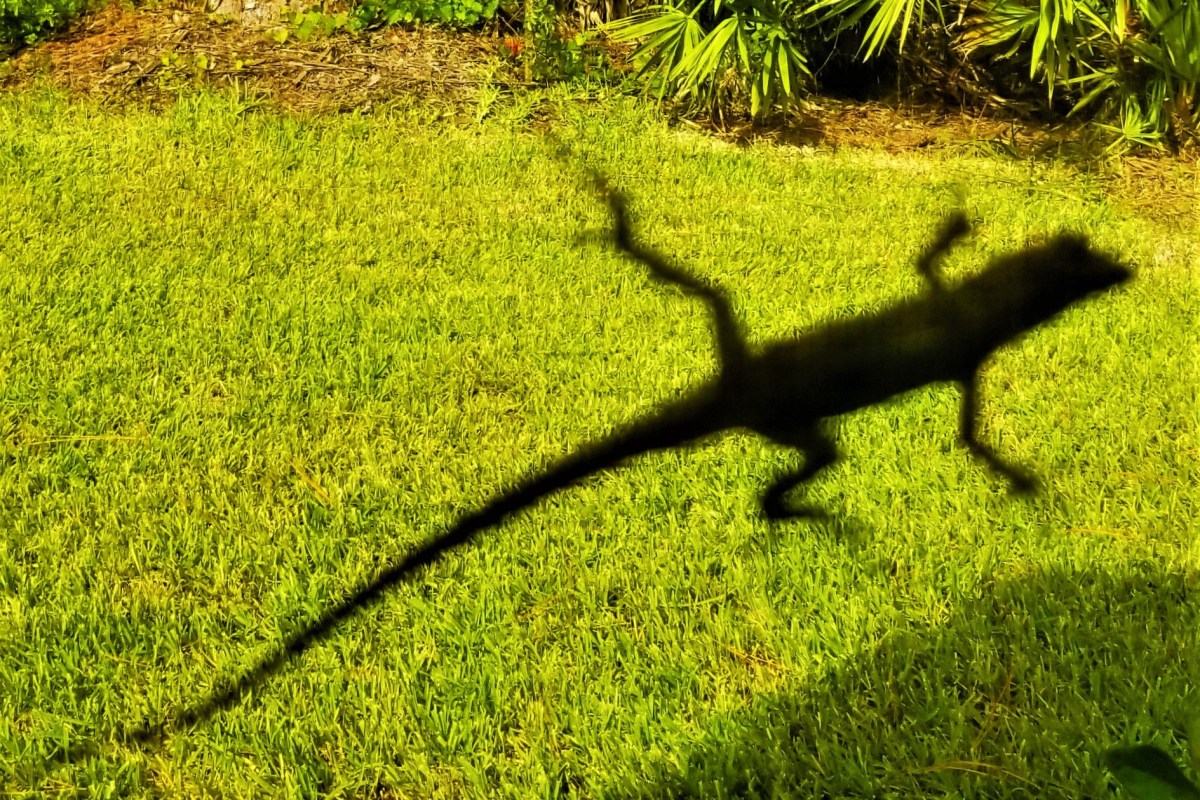
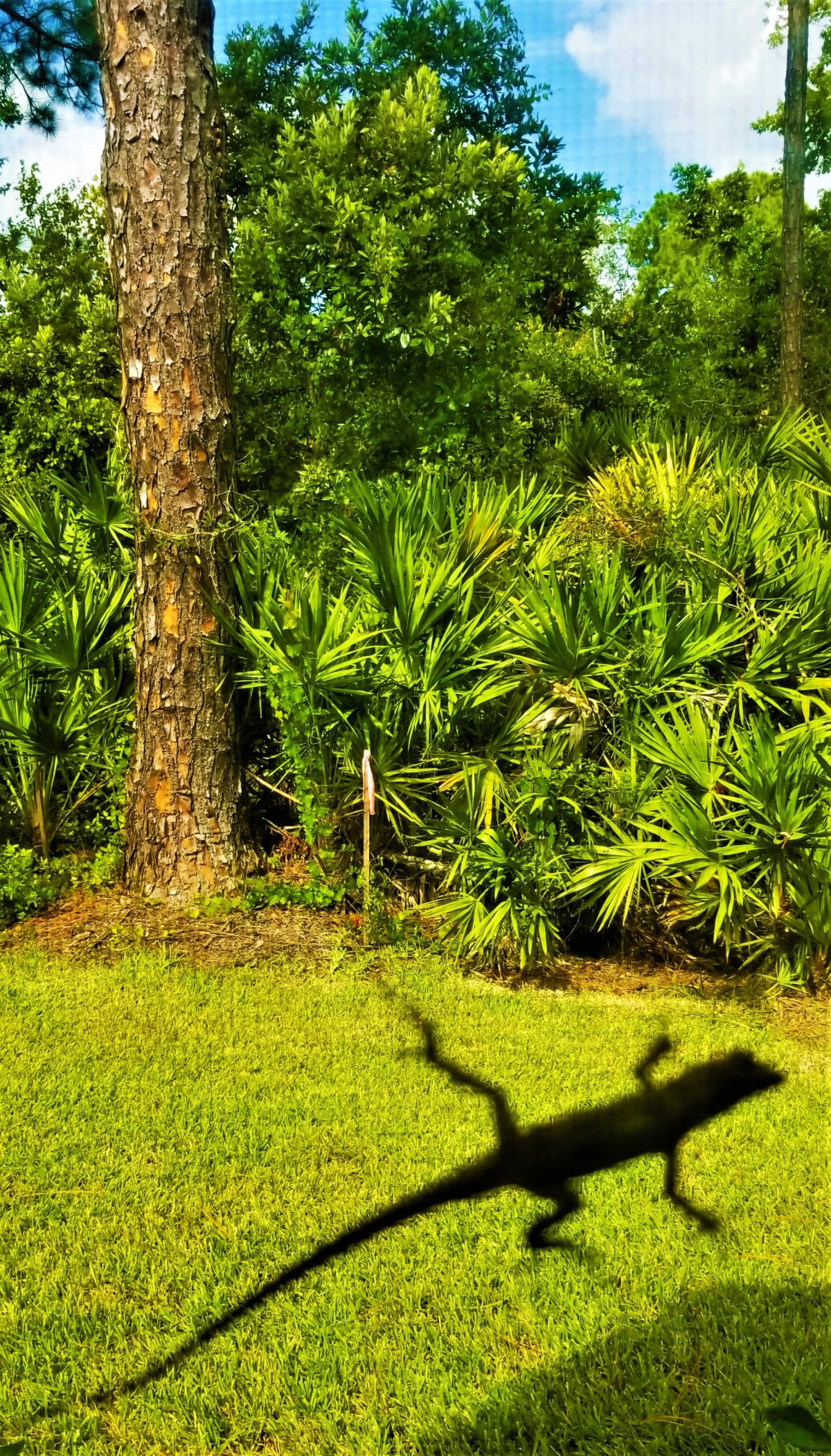
What appears to be a giant reptile hovering high above my yard,

casting a scary shadow across my sun-drenched grass…

20180815_110549 (4)

is no more than a harmless lizard and an optical canard,

revealed by pulling focus on the screen beyond my window glass.

20180815_110830 (4) (1)

Nighttime Sun Worshippers

Taking nothing away from Comic Con, the assembly of tailgaters along Florida Route-401 at Port Canaveral was probably one of the largest collection of early morning geeks ever recorded. It was a carnival atmosphere, with fellow space cadets gathered from around the world to witness one of science’s greatest guilty pleasures–a space launch from Cape Canaveral Air Force Station.

But this was to be no ordinary launch. This time around, the payload carried atop the United Launch Alliance Delta IV Heavy rocket has been 60 years in the making, named for Eugene N. Parker, a pioneer astrophysicist who predicted the existence of solar winds in a 1958 paper presented to an editorial panel who flatly rejected his claim.

Dr. Parker--Joshua Lott for The New York Times
Photo credit: Joshua Lott for the New York TImes

Four years later, NASA’s Venus probe (Mariner 2) measured interplanetary energy particles that eventually vindicated Dr. Parker’s belief.

The Parker project was conceived for NASA by engineers at John Hopkins Applied Physics Lab in 2005, later amounting to costs running $1.5 billion in order to investigate the nature of our star, and gain an up-close understanding of solar winds.

Originally, Leah and I were on the fence about whether we should make the 2-hour trek from St. Augustine for the launch last night. After all, we’d been burned earlier in the year when we attempted to catch a SpaceX Falcon 9 rocket lift-off (T Minus 3 Days and Holding) during January’s Florida freeze-out.

But this time around, it was personal. Leah’s family had traveled to Florida’s Space Coast from Albuquerque last week (Tourist Attractions) with the intention of watching the Parker Solar Probe launch, only to be disappointed when the on-again-off-again mission was scrubbed for the third time on August 4, when a loose piece of foam was discovered inside the fairing. Daniel’s family was to be NASA’s guests to acknowledge SolAero’s design and fabrication of the probe’s photovoltaic assembly. Leah and I were to be tag-alongs.

Although we had no official invitation for this morning’s event, Leah and I were still determined to bear witness as a tribute to Daniel’s work. We departed at 11:30 pm, and made easy time on I-95S, cruising down the interstate to an uncertain destination. NASA had delivered a 65-minute window for the 3:33 a.m. launch, so we would pad our arrival time in anticipation of getting situated.

We knew we had arrived when we discovered a cluttered roadside collection of vehicles illegally parked along a shoreline clearing with an ersatz view of the gantry in the far distance.

Google map.png

The eight miles separating us from the rocket would be as close as we could get, since access to the base was restricted and blockaded by a fleet of sheriff cars.

sheriff patrol (2)

After a couple of runs up and down the strip, I wedged the F-150 into a narrow gap of parked cars, barely touching the inside road line, but nevertheless legitimate enough to get a pass from the deputy.

I found a vacancy among the scores of tripods already populating the tall grass beside the rocky beach, and staked my claim–although I felt totally inadequate and out-classed–while surrounded by all the super-duper telephoto lenses, and suffering from an acute case of optics envy.

In preparation of the big moment, amateurs and pros alike fussed and fawned over their equipment, changing batteries, polishing lenses, accessorizing camera bodies with autodrives and cable releases, and participating in riveting discussions on ISO vs. aperture vs. shutter speed.

Yet nothing could compare to the mobile telescope for astrophotography that occupied the largest footprint of our makeshift parking lot.

electronic camera

Even its imaging display seemed more complicated than it had to be.

monitors

While it was impossible to compete with all the big boys and their toys, I took a practice shot after setting up, although I knew the lighting would never compare to the day for night exposure once the rocket thrusters lit up the sky.

Zoomed to the max at 600mm, the ISO set at 200, the aperture set at ƒ/8, and a 1 second exposure, my Lumix FZ300 captured this shot of the gantry 8 miles away.

Parker Probe

I reckon that if the atmospheric conditions had been less humid, the image would have been crisper-looking.

There was nothing more to do except wait…

The 3:48 am goal had come and passed without results.

The revised launch time was pushed to 3:53 a.m. The countdown resumed at T-minus-four, and again–for some unknown reason–the launch was suspended while engineers determined the fate of the rocket.

When NASA calculated to green-light the launch at 4:28 a.m., the buzz around us was that this would finally be the moment. Nobody would dare admit aloud or to themselves that this was just another dress rehearsal.

We mostly waited in silence for the next half-hour. The sound of jumping fish in the darkness was a pleasant distraction from the drone of distant internet reporting from a fan’s elaborate sound system.

And then the moment all of us dreaded…with under one minute before the serious countdown:

“Hold, hold, hold!” announced an engineer from Launch 37 Command Center.

The rocket’s helium pressure system had tripped an alarm, taking the launch back to T-minus-four. The 65-minute launch window was quickly closing with ten minutes left, leaving insufficient time to troubleshoot the red flag and light this candle.

The mission was aborted and a collective sigh crossed the highway.

Leah and I drove back home with the sun rising over Matanzas River as we approached St. Augustine. My sole consolation was knowing that besides driving roundtrip for a still picture of a rocket strapped to a gantry in the distance, all I had to do was unmount my camera and fold up my tripod, while somebody else had to wrap up and tow away that enormous mobile telescope.

We slept until noon.

Flight officials determined that in 24 hours they would try all over again.

And when that happens, it will be without us. Instead, I’ll be watching NASA’s live stream of the launch at 3:31 a.m. from my armchair:

…maybe…

…if I can keep my eyes open.

Zzzzz…

P.S. The Parker Solar probe successfully launched on time:

https://amp-space-com.cdn.ampproject.org/v/s/amp.space.com/41454-nasa-parker-solar-probe-launches-to-sun.html?amp_js_v=a2&amp_gsa=1&usqp=mq331AQCCAE%3D&jwsource=em

…and I got to see it…

…from my TV monitor!

Tourist Attractions

When showing family the sights of St. Augustine the first time around,

there are so many tried and true options that abound.

Naturally, driving onto Vilano Beach becomes the main outdoor attraction,

where short legs wade long lengths across silky, sandy satisfaction.

wading out

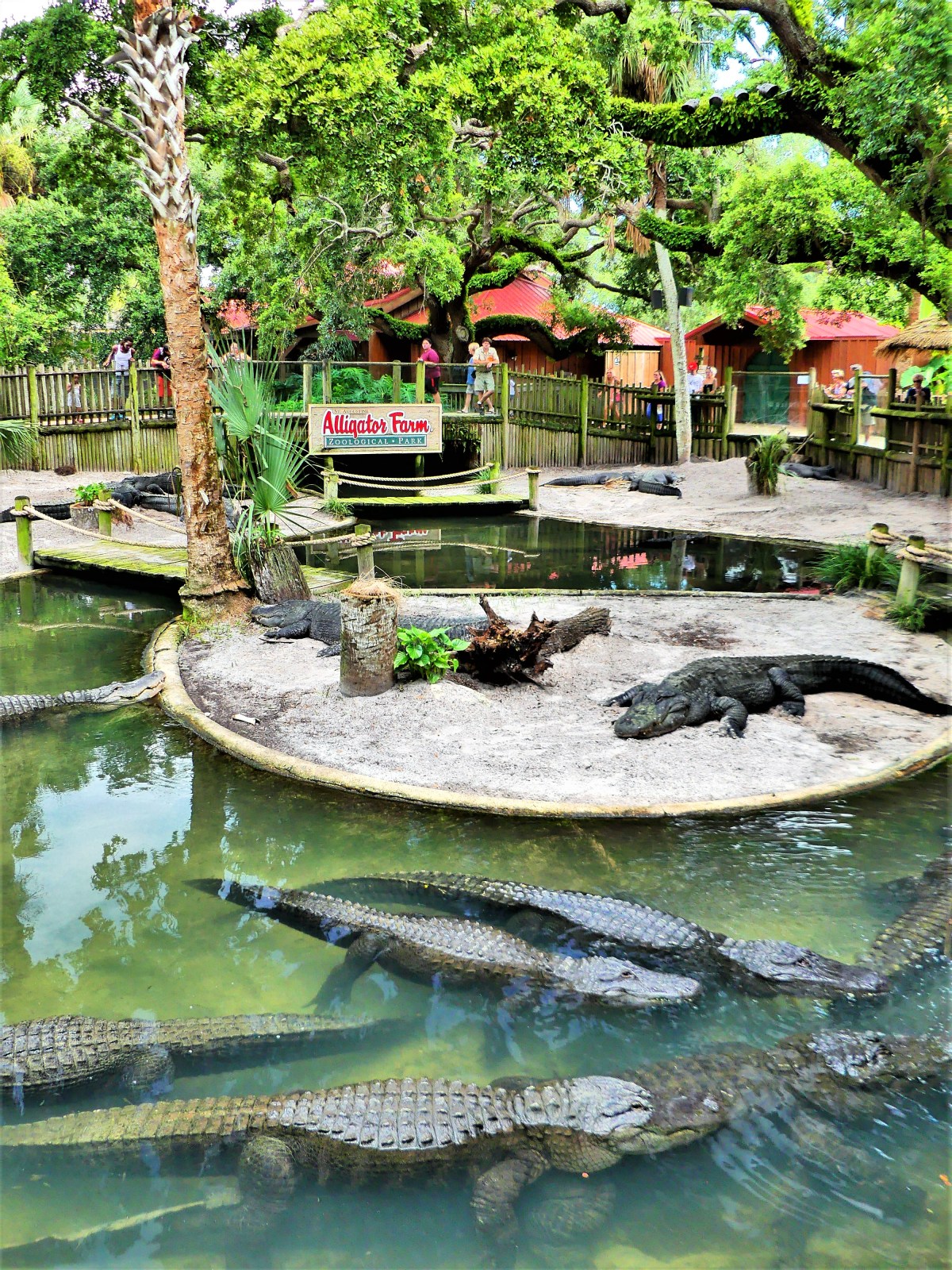
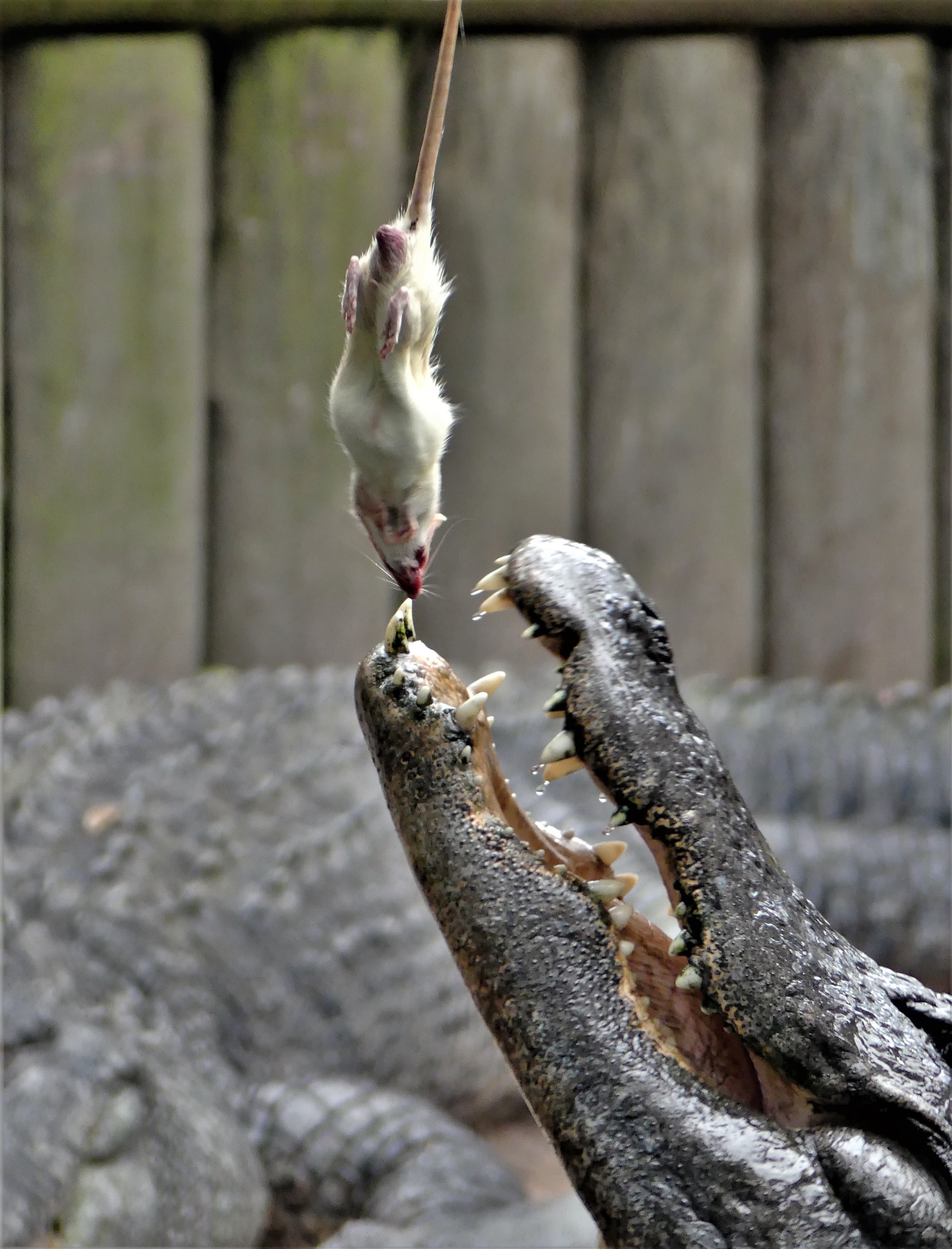
The Alligator Farm is another familiar and likely choice,

where eager grandchildren are apt to rejoice…

Alligator lagoon.jpg

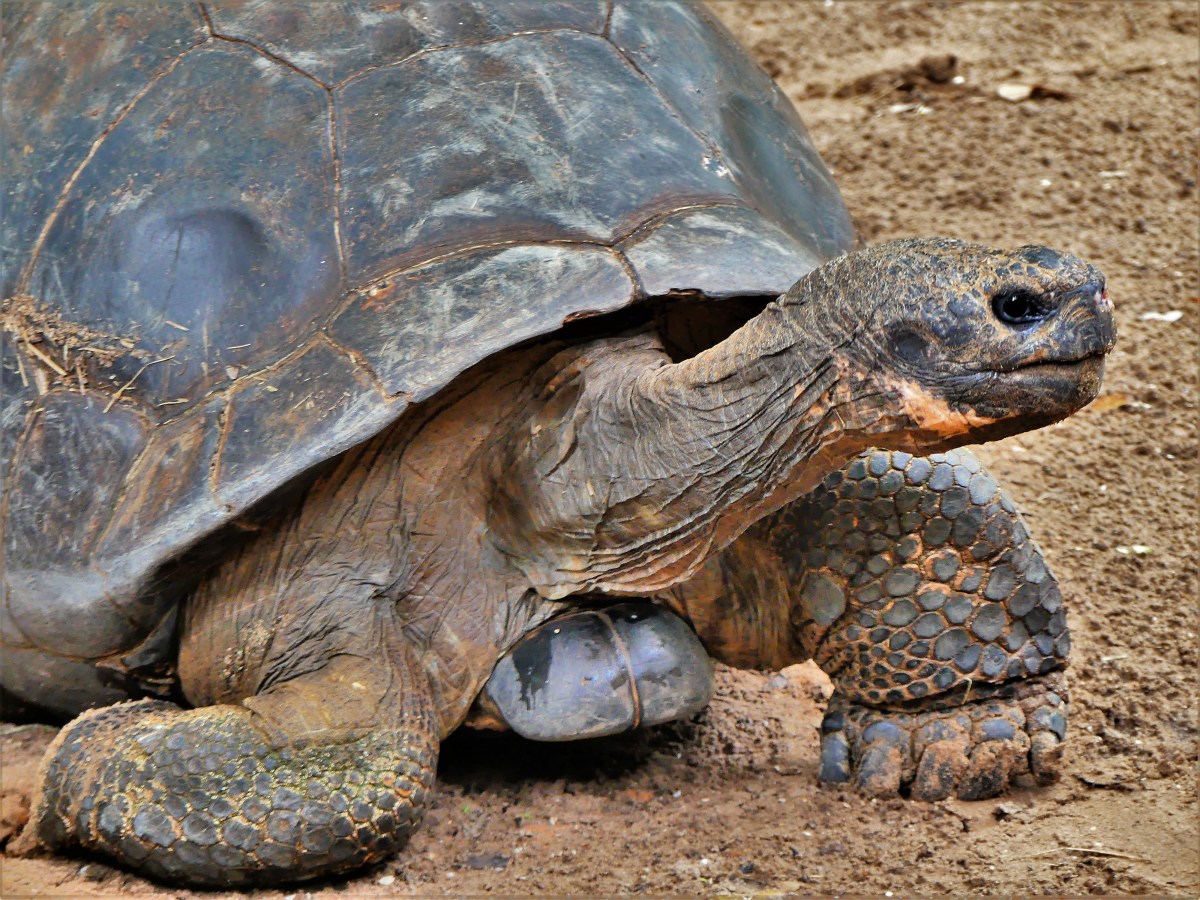
at a place where rescued reptiles and denizens…

Maximo (2).jpg

Galapagos tortoise1.jpg

albino alligator.jpg

savor a seasonal delicacy,

so good!

yum!.jpg

and feathered friends…

heron

are likely to take up full-time residency.

pretty bird

stork

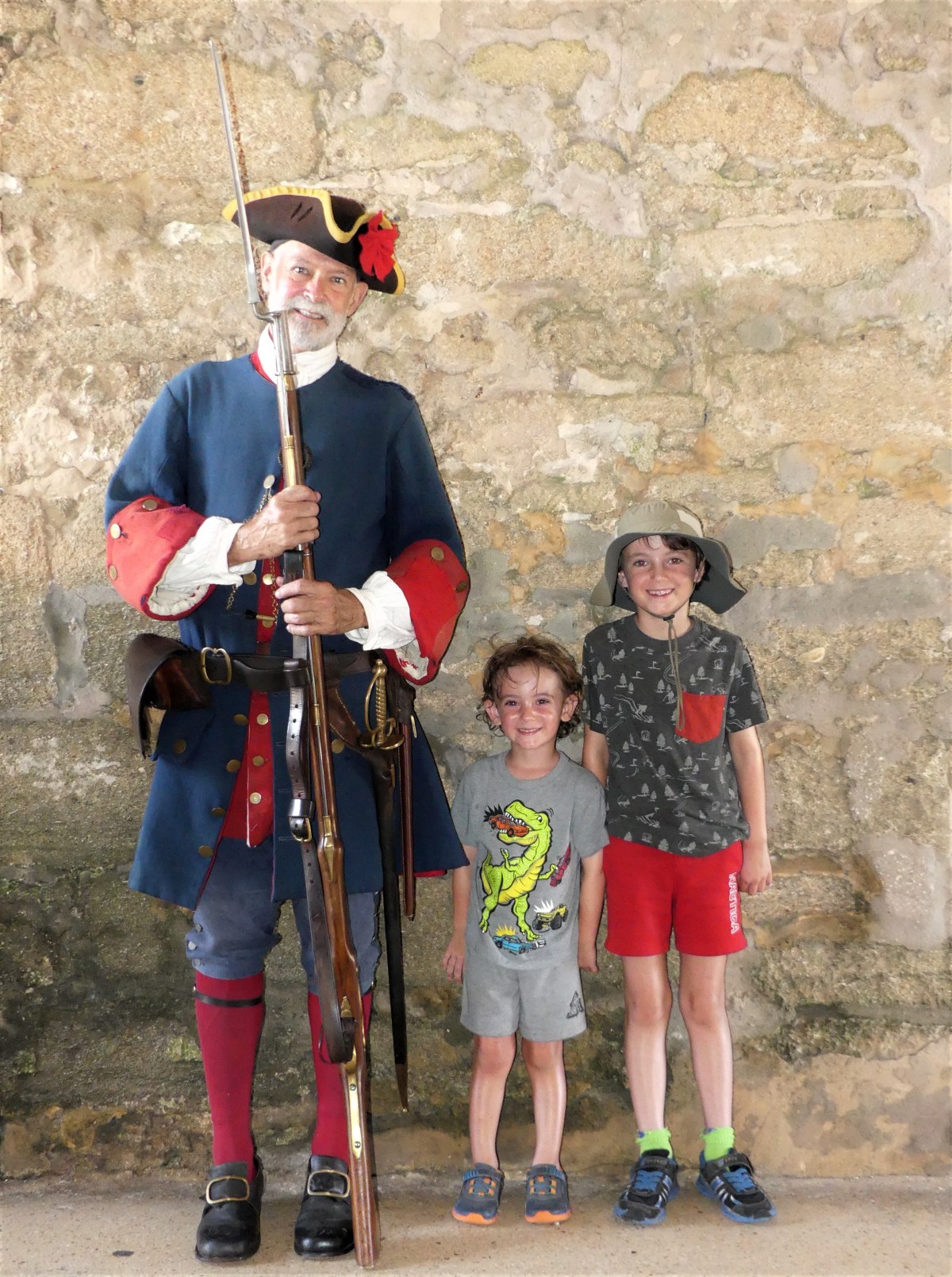
The Castillo de San Marcos gunnery platoon…

soldier and kids.jpg

castillo model

provides a cannon blast from the past very close to high noon.

cannon blast

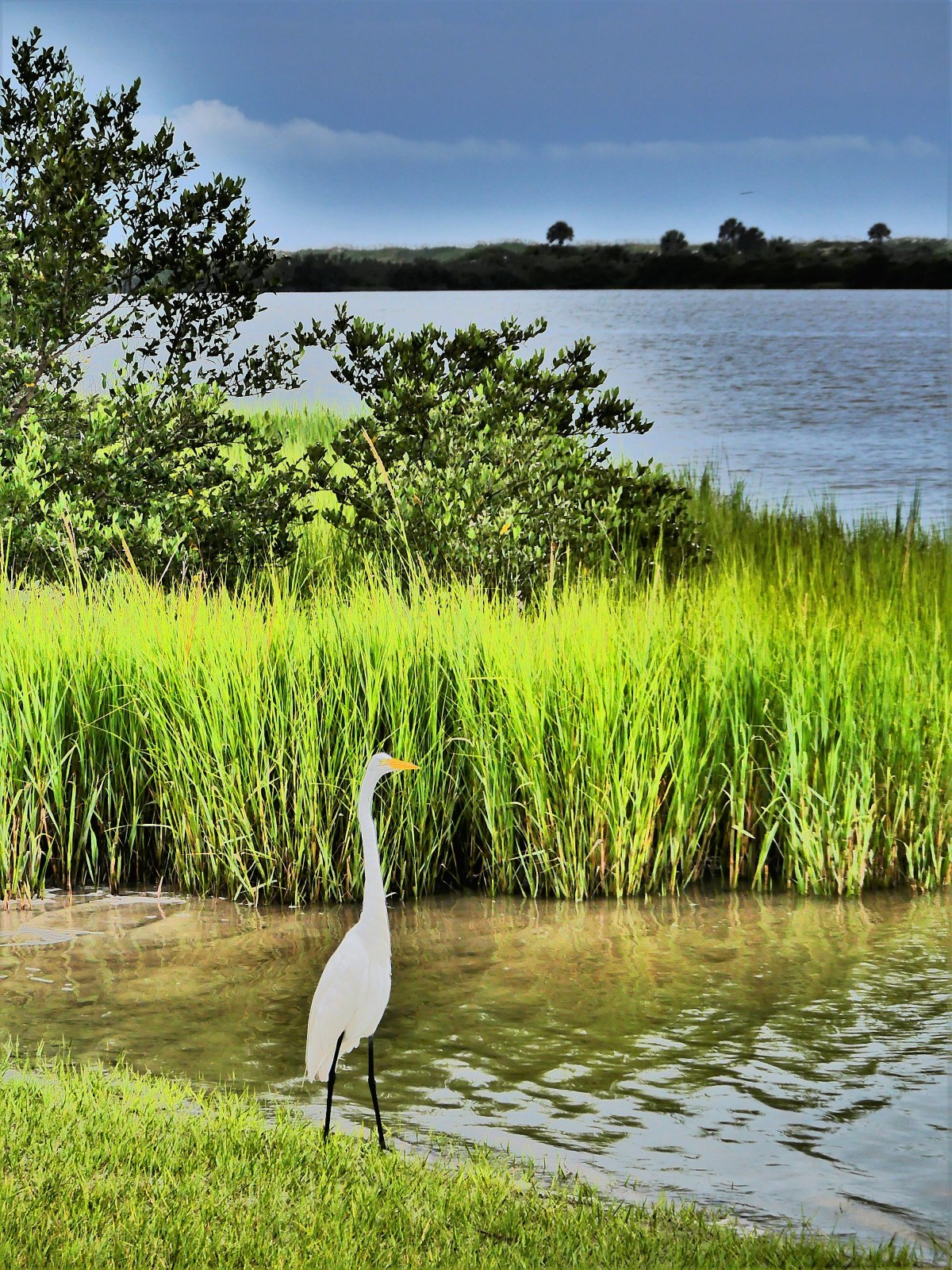
And Anastasia Beach State Park’s estuarine channel

egret on the shore1.jpg

offers a vigorous workout with a kayak paddle.

Carrie, Devin, Dan and bird

The Aikens, Grammy, and Kayak

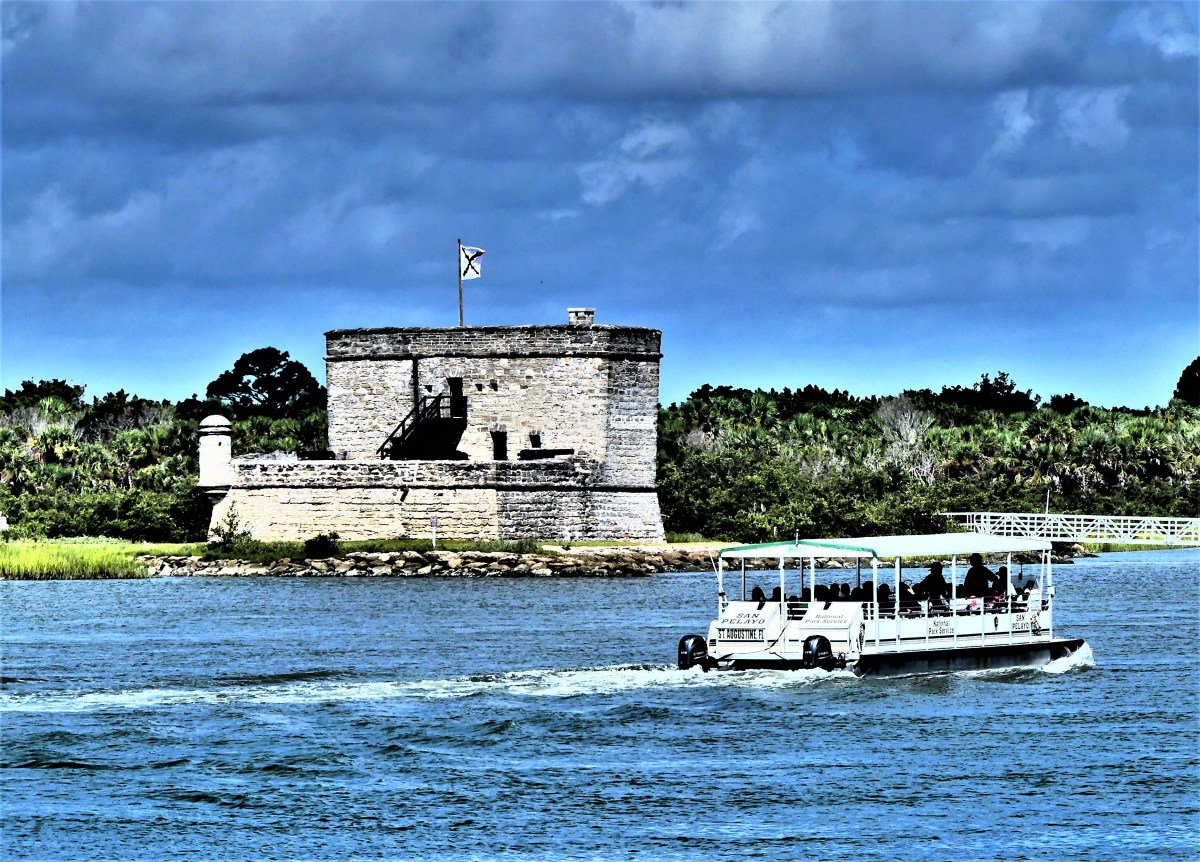
Or how ’bout a free ferry crossing Matanzas Bay…

ferry crossing.jpg

to inspect Fort Matanzas,

inside out

and its cannon array.

Fort Matanzas gun station.jpg

Then again, not withstanding the two-hour drive to Kennedy Space Center,

Kennedy wall.jpg

there’s a universe of exhibits to explore,

a walk on the moon

ISS.jpg

and The World’s Largest Space Shop to enter.

spaceman and kids

But when summer’s heat and humidity just…won’t…allow…another…step,

and when it’s subsequently rainy–as most afternoons are likely to get–

the chosen activity must absolutely meet

the standards of two curious kids, and satisfy their sweet teeth.

hairnet family

Happily, such a happening exists for the young and the grown,

and can be found at the artisan chocolatier, Whetstone.

Whetstone greeting.jpg

The tour informs you of its elaborate process and technique…

chocolate process

But realistically, we came for the chocolate samples we could eat.

Yet unlike the follies of Lucy and Ethel…

our guide served five tastings,

and each one was special.


For seven days our family wandered throughout St. Augustine town,

with plenty leftover to experience for the next time around.

Moon over Madeira

The tree frogs are out in full force at nightfall.


A cacophonous chorus of tens of thousands of croaking creatures bask in the sticky humidity after a brief, familiar rainfall.

They sing a familiar refrain a capella with a delicate vibrato…

To celebrate the moon’s debut over a thick glade of pines, live oaks, and palmetto.

Moon over Madeira

Rock of Aged

“Let’s get this shuttle moving!” shouts a middle-aged surfer dude in an orange muscle shirt at the volunteer driver of the tram parked curbside at the farthest reaches of Anastasia State Park’s parking lot by the beach.

“First of all, I’ve got plenty of empty seats to fill, with plenty of people still on their way. And secondly, you should have thought about getting here earlier pal, ’cause I been here since 5:30 transporting people to the concert. So stop complaining that I’m the one who’s making you late!” the driver retorts.

“Well asshole, I have no intention of missing the opening number because of you,” he bellows.

“You’re welcome to get off my ride anytime and call an Uber if you want, but otherwise, I suggest you shut the fuck up, and sit the fuck down, and wait patiently like the rest of these folks,” the driver threatens.

According to Joe and Jenny, who had come from Gainesville in celebration of their 10th wedding anniversary, the passengers on the tram were stunned into silence after this fiery exchange. The moment Leah and I took our seats on the tram, the mood seemed unusually somber for a group of mostly baby boomers who were on their way to attend a sold-out performance of Steve Miller Band with Peter Frampton at St. Augustine Amphitheater.

This was to be our maiden concert at the amphitheater–having purchased tickets over three months ago–knowing that we were taking a chance with the rainy summer weather, but choosing to risk it all for just a few hours of iconic rock and roll nostalgia.

At last the day had come, and despite the iffy forecast through late afternoon, the overcast sky had held firm, and it wasn’t long before we were on our way, barreling along the service roads…

shuttle (2).jpg

to the back door entrance of the amphitheater.

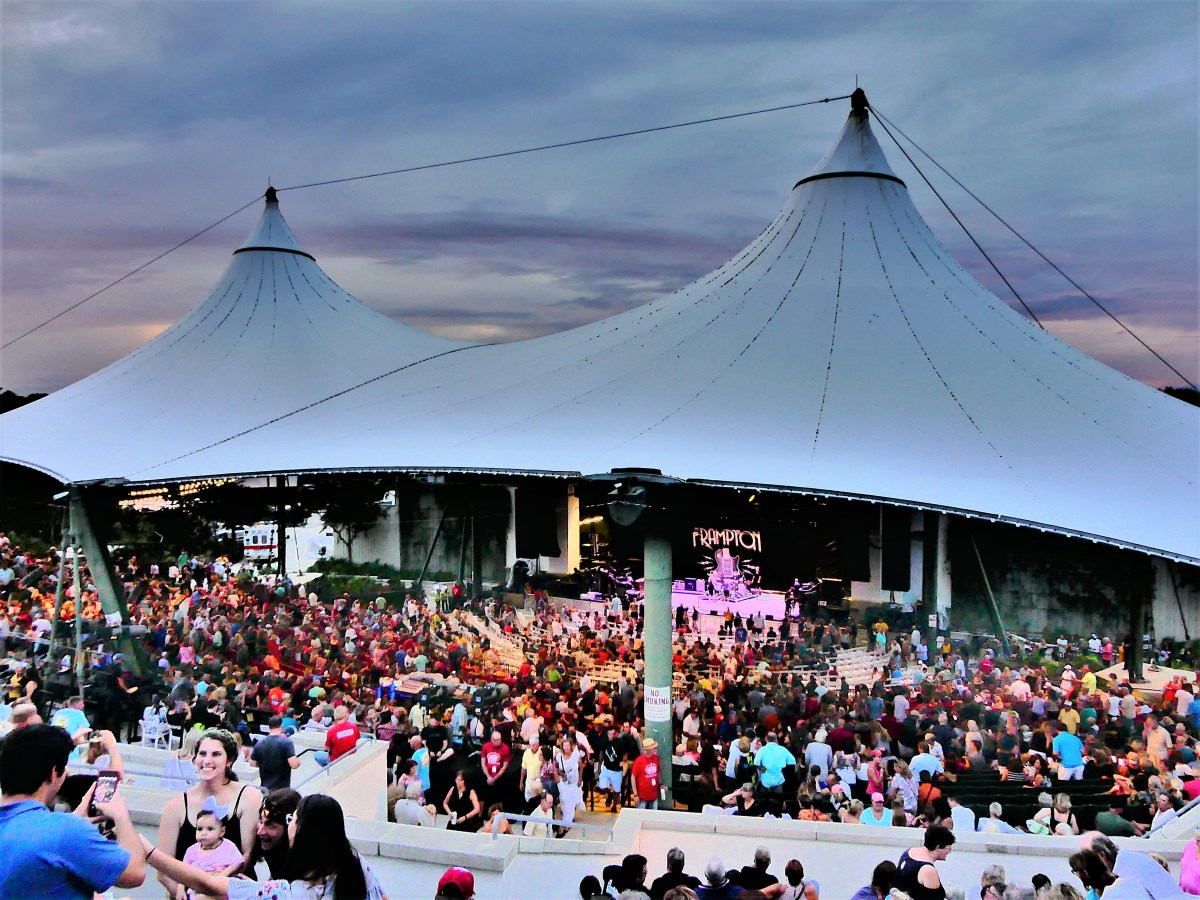
It was 7:05pm and the opening power chords of Something’s Happening were already resonating through the thick air. We bypassed the crowded concessions…

beer beer bar bar

and settled into our seats…

tent and stage.jpg

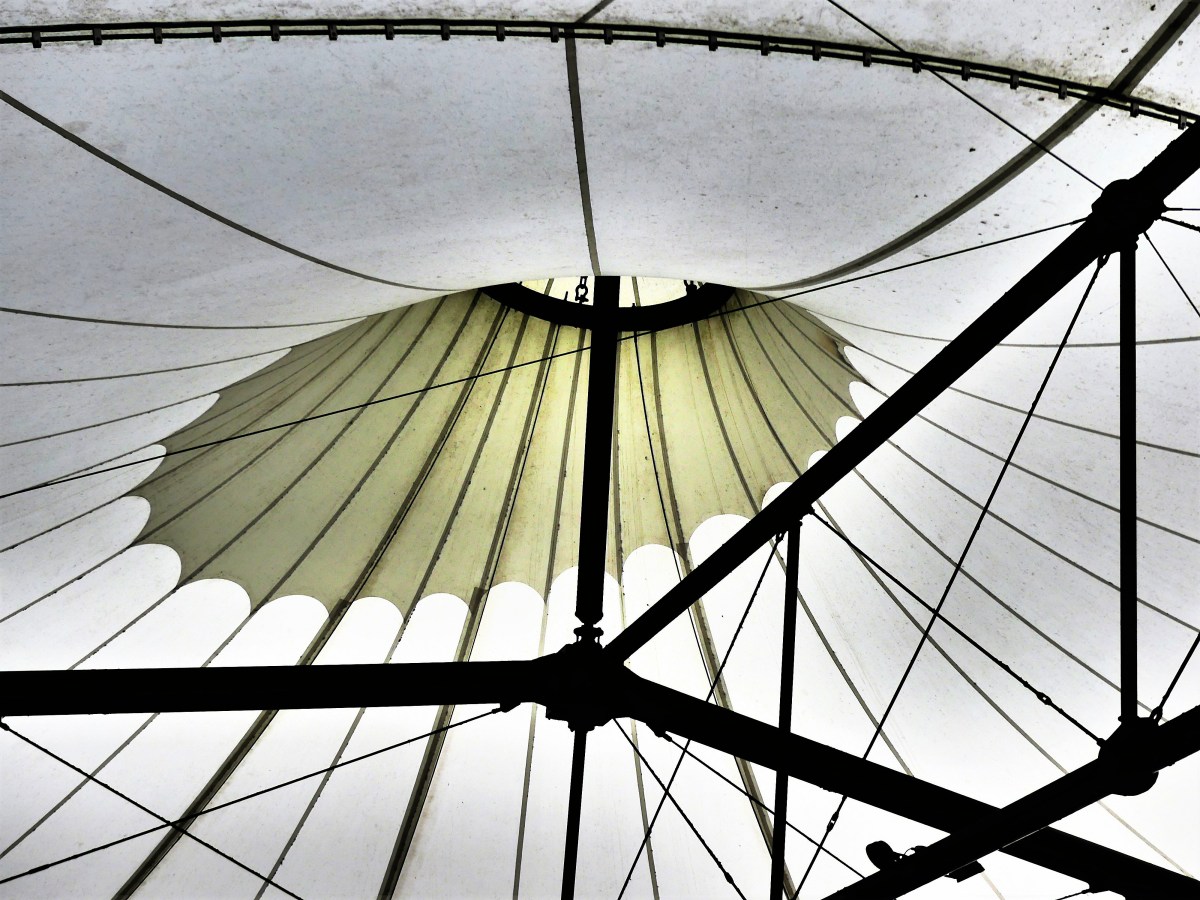
under the big top…

tent2

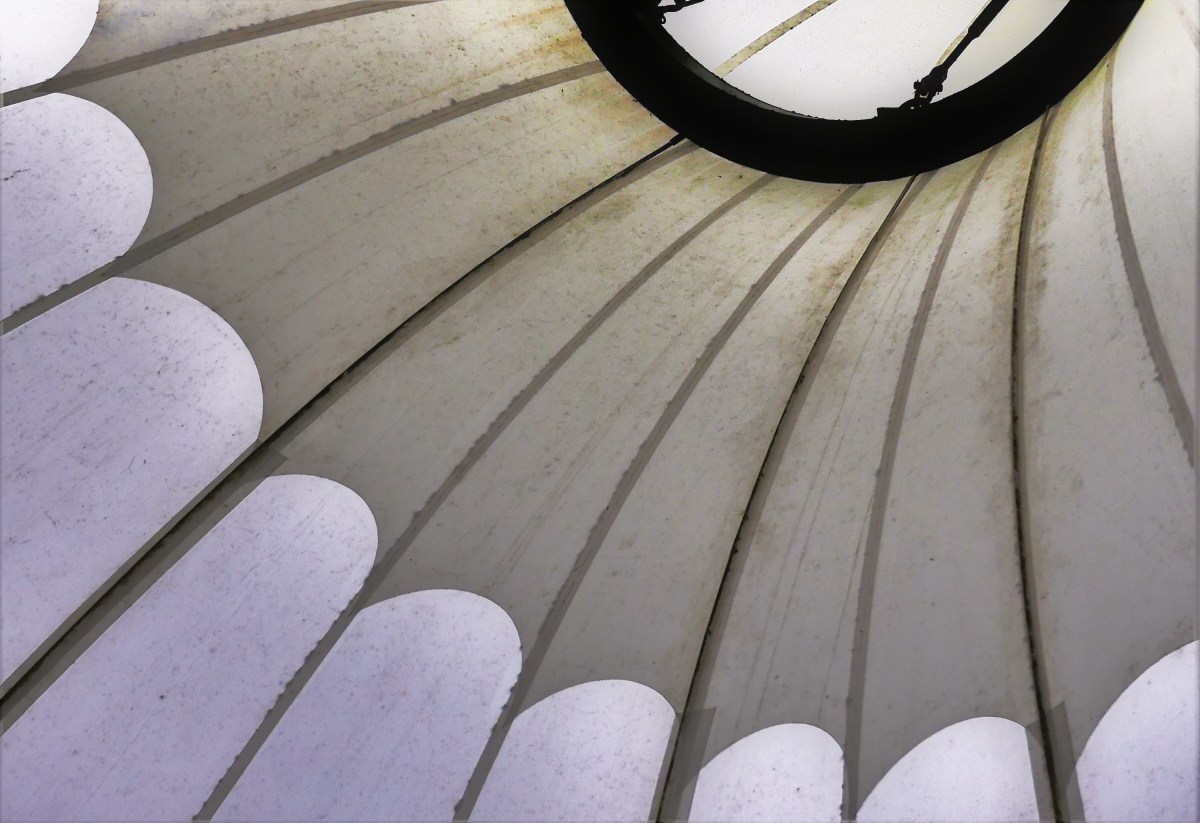
tent canopy

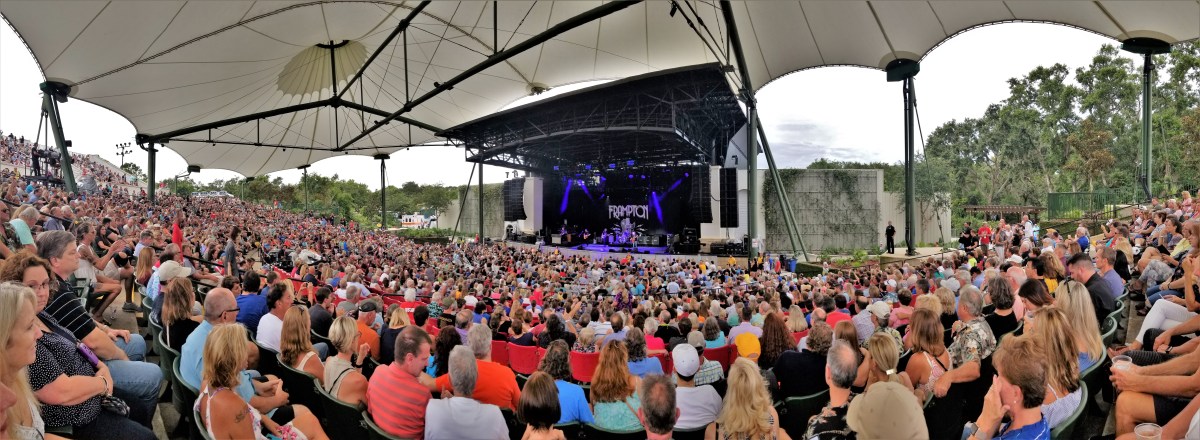
to lose ourselves in Frampton’s guitar licks.

amphiteater panorama.jpg

From the start of the evening, Frampton established a smooth repartee with his exuberant audience–thankful for the fans who’ve stuck with him through thick and thin.

At 72, Frampton has seen his share of sunsets in your eyes and lines on [his] face, affably referencing his musical longevity during the interludes between songs, and reflecting on the passage of time through his career–from his chart dominance to his subsequent free fall to his eventual resurrection.

The devotees in attendance who may have missed the ’70s, seized this downtime as the perfect opportunity for a bathroom break, but not without escaping playful ridicule from Peter..

“I wish I could pee. I really do,” quipped Frampton. Now I can only pee on Monday, Wednesday, and Friday… with the help of Flomax.

He’s willingly traded his teen-idol, cascading hair locks and bare-chested pop star status for a musician’s bald/bold appreciation of his instrument, and aptly demonstrated his guitar prowess throughout his set list:

  • Something’s Happening
  • Lying
  • Lines on My Face
  • Show Me the Way
  • Black Hole Sun
  • (I’ll Give You) Money
  • Baby, I Love Your Way
  • I Want You To Love Me
  • Do You Feel Like We Do

But the literal centerpiece was Black Hole Sun–“the best song [he’s] never written”–performed as an instrumental from the 2007 release of his Fingerprints album that garnered Grammy acclaim.

As if channeling Chris Cornell on the anniversary of his birth, July 20,

Black Hole Sun

Frampton commanded the stage with a mindful intent of demonstrating his guitar virtuosity,

Frampton makes a face.jpg

and he deftly acquitted himself in the eyes and ears of his audience.

And when the last shred had been wrung from his beloved Gibson, the crowd let him know how much they were with him and how much they cared.


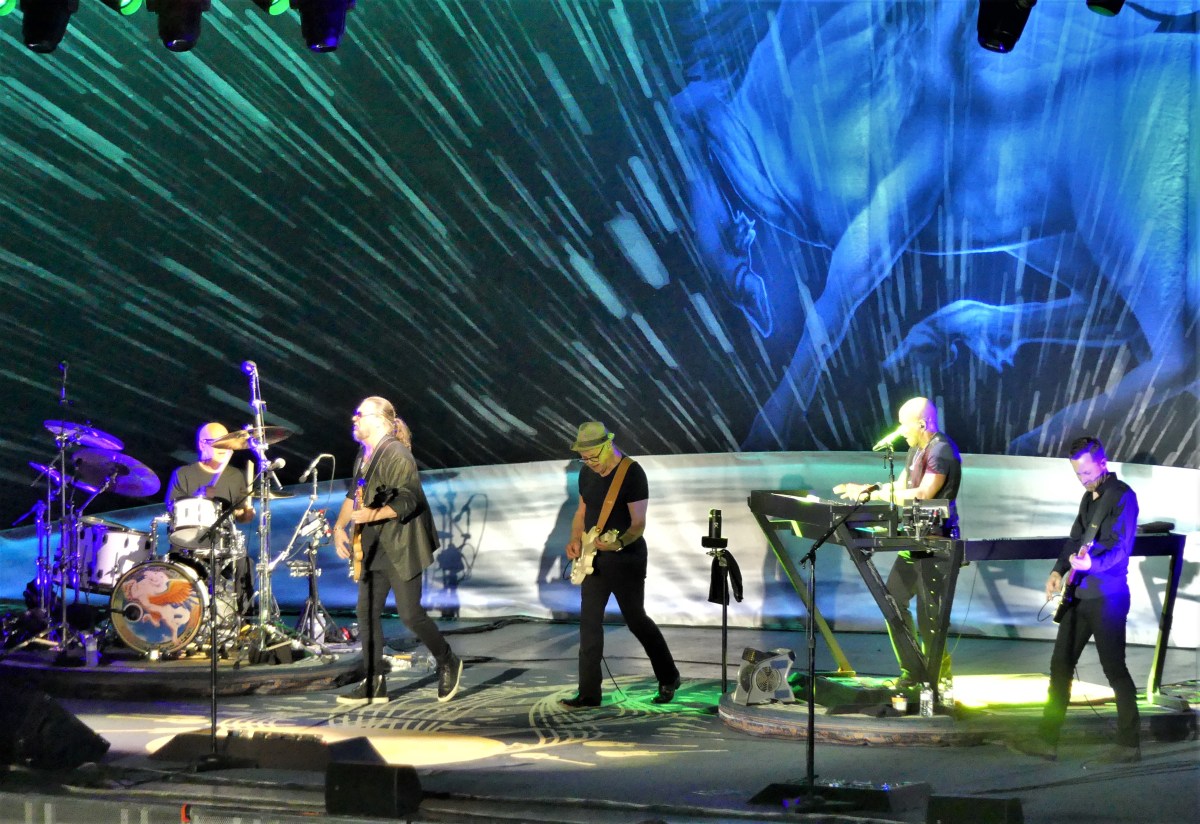
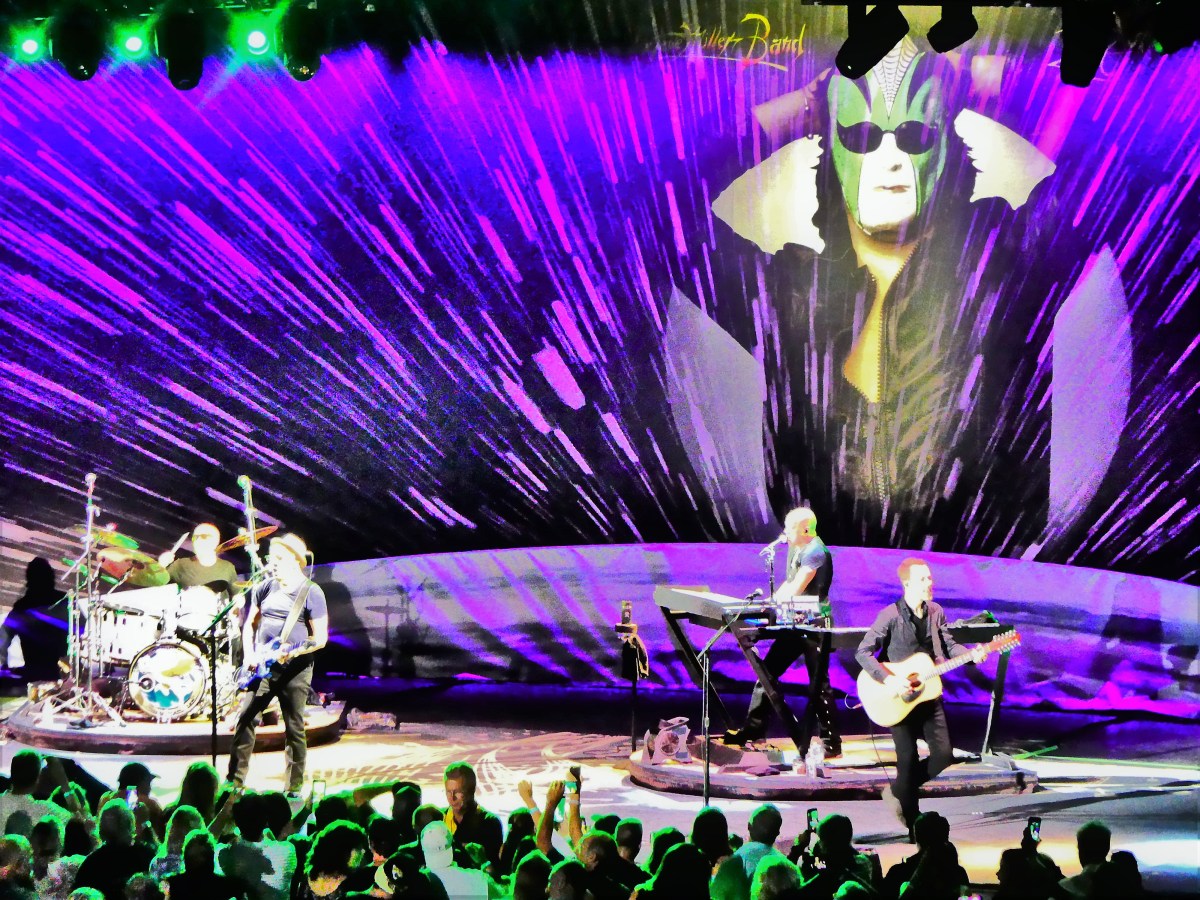
After a half-hour intermission to reset the stage, the evening continued with Steve Miller and his band.

Steve Miller Band1

With a few exceptions, Steve Miller’s set list mimicked his multi-platinum Greatest Hits album, spanning the mid to late 70’s, and nobody in the crowd was disappointed, because they had come to sing along and Dance, Dance, Dance.

Set list

  • The Stake
  • True Fine Love
  • Abracadabra
  • Living in the U.S.A.
  • Space Cowboy
  • Take the Money and Run
  • Jackson-Kent Blues
  • Stranger Blues
  • I Want to Make the World Turn Around
  • Wild Mountain Honey
  • Dance, Dance, Dance
  • Serenade
  • Space Intro
  • Fly Like an Eagle
  • Swingtown
  • Rock’n Me

bass drum.jpg

From his early overture into blues-infused rock, to experiments in psychedelia, to a catchy collection of counter-culture anthems with mainstream melodies, Miller captured the songbook for a new generation of America in flux.

Steve Miller vocals.jpg

Midway through his set, Miller evoked a memory from 1965 that took him from San Francisco to New York for a performance of The Mother Song on NBC’s Hullabaloo with The Four Tops and The Supremes.


As Miller recounts, the $250 he earned from the gig gave him the confidence to shop for a new guitar at Manny’s Music, a cherished, legendary music instrument store located in mid-town Manhattan. Unfortunately, he discovered there was nothing he could afford. Rejected and dejected, he headed for the door, whereupon he discovered a cluttered barrel of buried guitars standing neck up with a posted sign: “Your Pick–$125.”

One guitar called to him–a 19-string sitar-guitar that he had to have. Along the way, Miller explained some of its unusual features: spool-like knobs, 3 pick-ups, and a mirror on the backside.

sitar guitar mirror.jpg

Of course, after 53 years it’s still in his possession, despite an offer of $125,000 from a bigwig music producer. This tale has been repeated at similar events for years and years–with fluctuating asking prices–but the audience was hooked on every word and ate it up.

sitar guitar

“Whadaya think? Should I consider selling it?” he petitioned the crowd.

Naturally, the crowd answered back with a resounding, “HELL NO!”

Miller put the instrument to good use in a soulful rendition of Wild Mountain Honey.

Thereafter, with each new tune, the audience responded with greater enthusiasm and a deeper appreciation of his classic hits.

The band returned with a raucous 4-song encore (if you consider Threshold to be a song rather than an intro)…

I'm a Joker

  • The Joker
  • Jungle Love
  • Threshold
  • Jet Airliner

And in an instant, the show was over. We were transported back to the here and now–no longer celebrating the soundtrack of our salad days from high school or college, but always reminded that “time keeps on slippin’, slippin’, slippin’ into the future.”

Ironically, I spotted the belligerent surfer dude from before, who had embarrassed himself aboard our tram. Folks were filing past him to the exits, yet he seemed frozen in place–as if locked in a trance–holding onto a past that he was so impatient to embrace.

Doot-doot-doo-doo, tick-tock-tick…

Doot-doot-doo-doo, tick-tock-tick.

Obscured by Clouds

On a hot and lazy weekend afternoon, a dip in Madeira’s community pool seemed like a winning idea to escape the heat, but to my surprise (and delight), no one else was there to take advantage of the water. Having the pool to myself was a blessing, if only the oncoming clouds that were assembling could keep their distance.

“You’re welcome to join me,” I offered Leah earlier. However, Leah had settled for the comforts of air conditioning and a Kindle moment.

“Y’know, it’s supposed to rain,” she forecasted.

“But it’s a swimming pool, and wet is wet,” I theorized with authority.

The expectation of rain is ever-present during Florida summers, and today was no exception. In the distance, despite the stillness of the air, the clear sky was yielding to a dark mass creeping in my direction and threatening to blanket the sun.

I floated on the water–as if in a trance–listening to the foreboding rumble, and watching the evolving cauliflower clouds occasionally glow with the flickering incandescence of faraway lightning.

In no time, the war clouds were upon me, but the sun would not surrender gently.

clouds and treetops

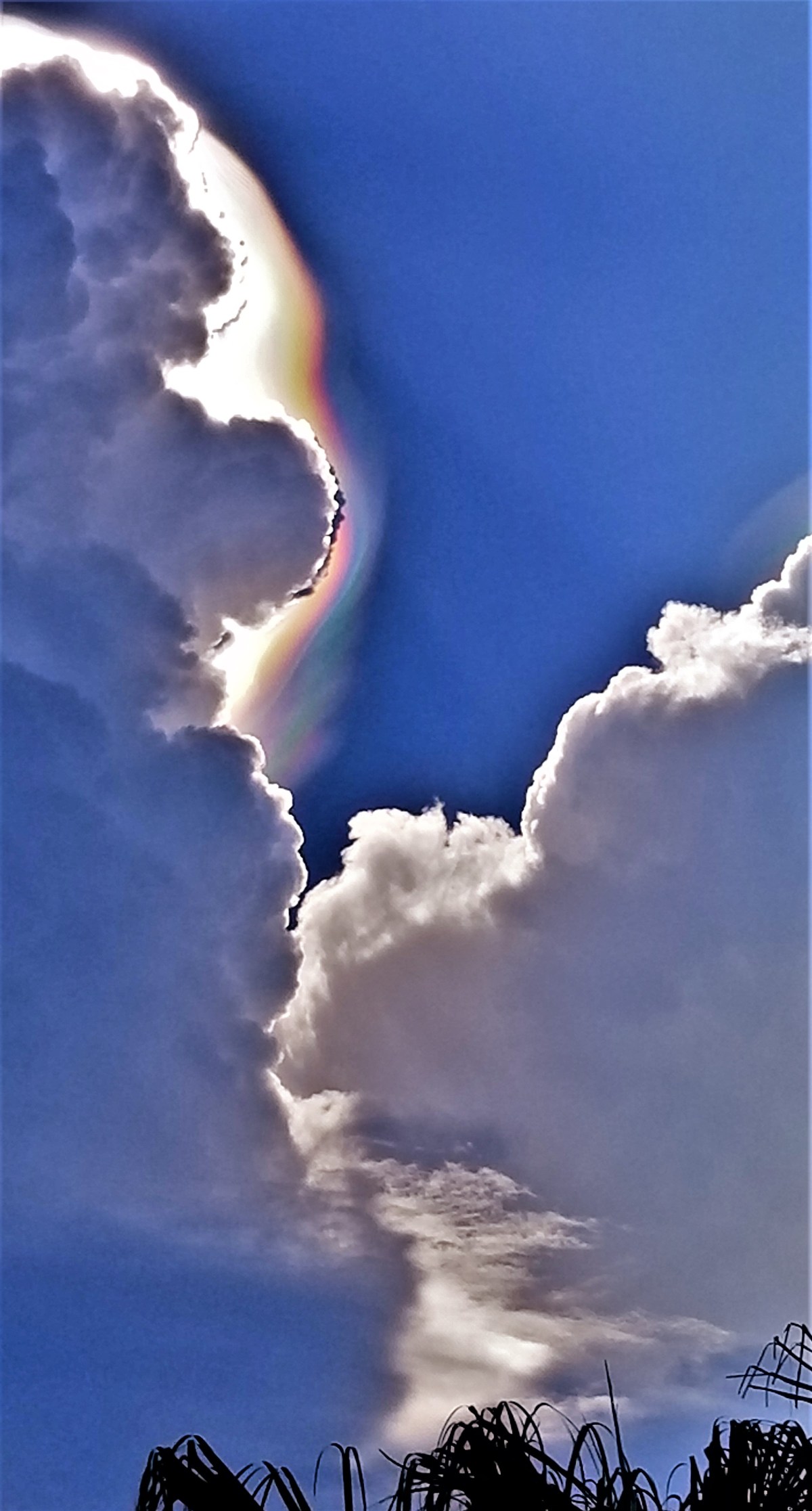
I cursed my misfortune for not having my camera with me as the billowing thunderhead gradually edged out the sun–it’s luminescence taking on an eerie beauty.

cloudy but colorful

However, my Samsung Galaxy was with me and it would have to suffice.

colors behind the clouds (2)

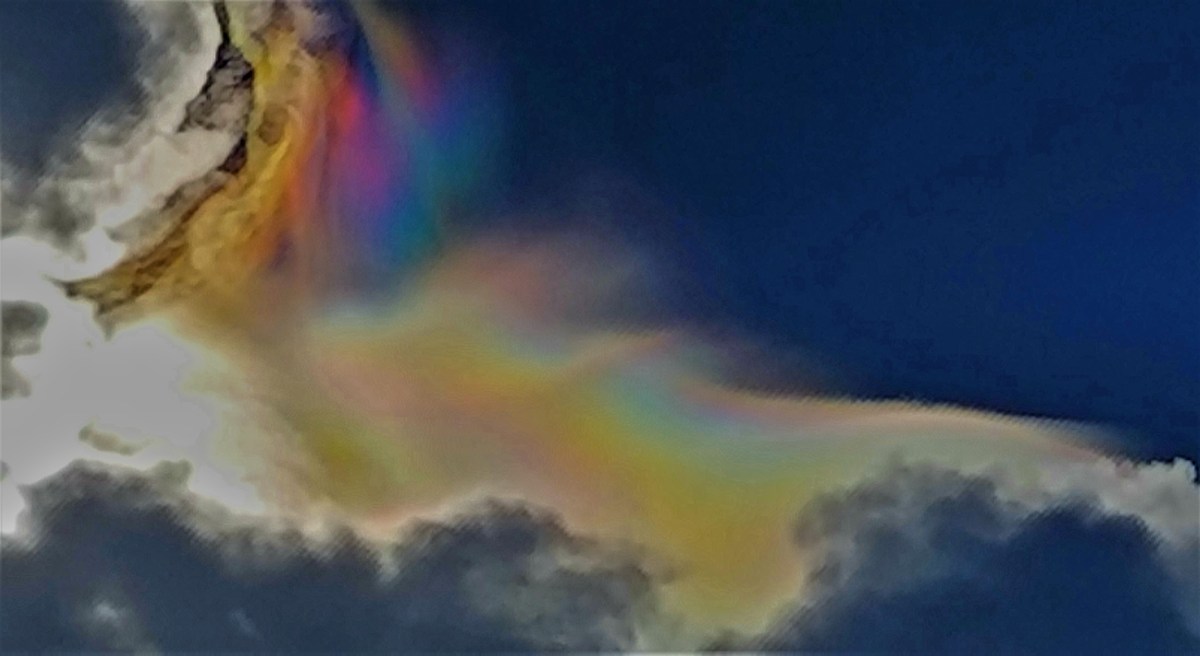
While it wasn’t my first choice for resolution, the camera phone adeptly managed to capture the nuance of color radiating beyond concealment…

obscured by clouds

until the sun was vanquished and the rainbow had retreated.

Once I managed to locate and retrieve the files uploaded to Google cloud storage, the captured skyscapes were no longer obscured by clouds.

Well Done!

Long before we established Florida residency, our water bills were ridiculously high, averaging $500 per month. Leah and I immediately suspected that during our three-month absence–between closing and occupancy–the irrigation system zoned around our yard was bleeding us dry. Was this truly to be the continuing cost of keeping our flower beds wet and our lawn green? And if so, was this property threatening to become our Waterloo?

No doubt, our water usage was worthy of an investigation, but the city water department was dismissive–offering precise and up-to-date historical data of our consumption–so we turned to our long-distance neighbors for perspective and to the builder for relief, while wondering which direction to go.

A plea for answers and advice via social media prompted a measured response from Lisa and Greg, new community Facebook pals, who offered to monitor the irrigation interface over a time for evidence of any irregularities or abnormalities.

Greg’s systems check of our Rain Bird controller soon revealed a broken drip head now gushing water, and a twice-a-week watering cycle (as planned) irresponsibly programmed to repeat twice a day by the original landscapers.

Rain Bird

Greg recommended shutting down the timer, and offered to manually manage the irrigation zones in accordance with the forecasted rainfall.

We were indebted to Greg and Lisa for their vigilance, and dutifully took over on water watch for the month of June and thereafter. A new appeal to the utility office revealed a literal disconnect between our residential meter and parallel irrigation meter, resulting in unnecessary sewer charges every time we watered our lawn. Yet despite our conservation efforts, our newest utility bill was only reduced by 10%. It was time for a new strategy; we would dig an artesian well, and feed our grass and plants with our own well water.

Of course, the process demanded that we file a permit with the city; petition the architecture committee of our Home Owners Association for permission; find a reputable well digger; wait for the job to be scheduled (weather permitting)…and continue to pay exorbitant water bills in the meantime.

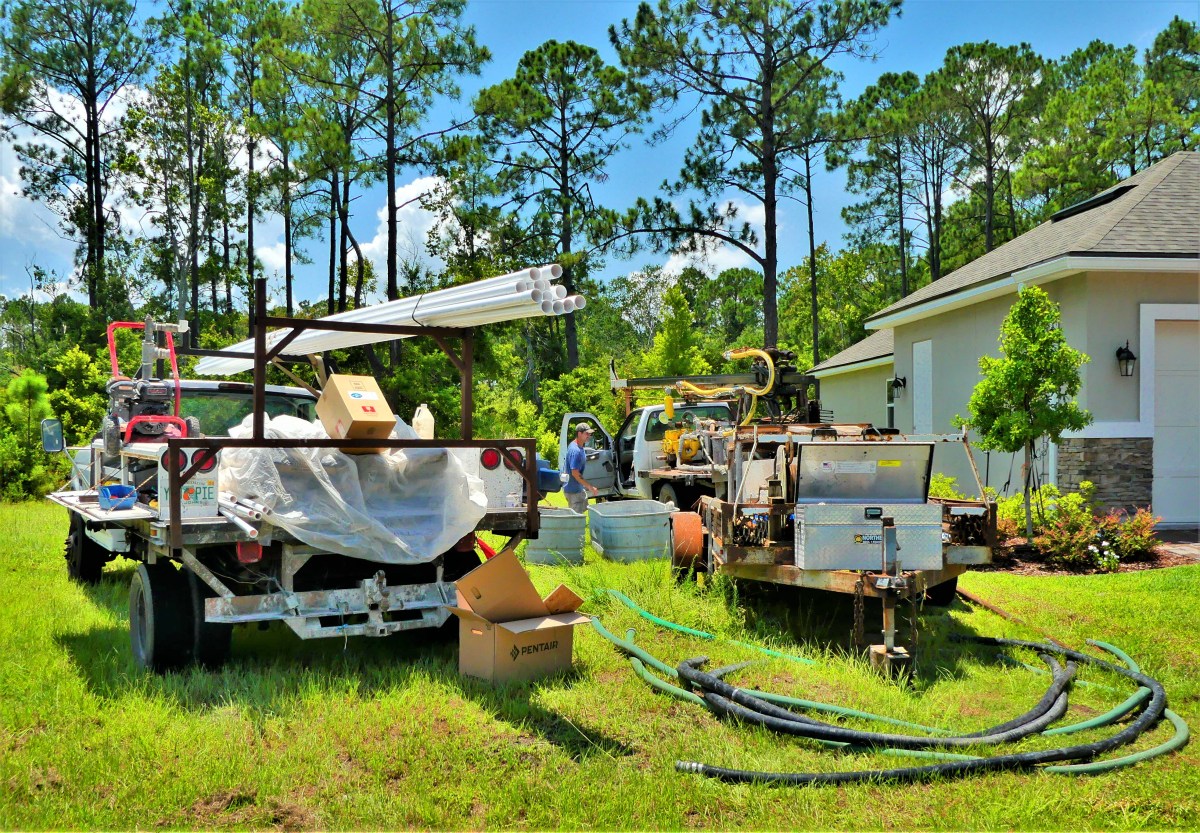
Finally, three months from our earliest consideration, the drilling equipment appeared one late morning in our yard without warning.

preparation

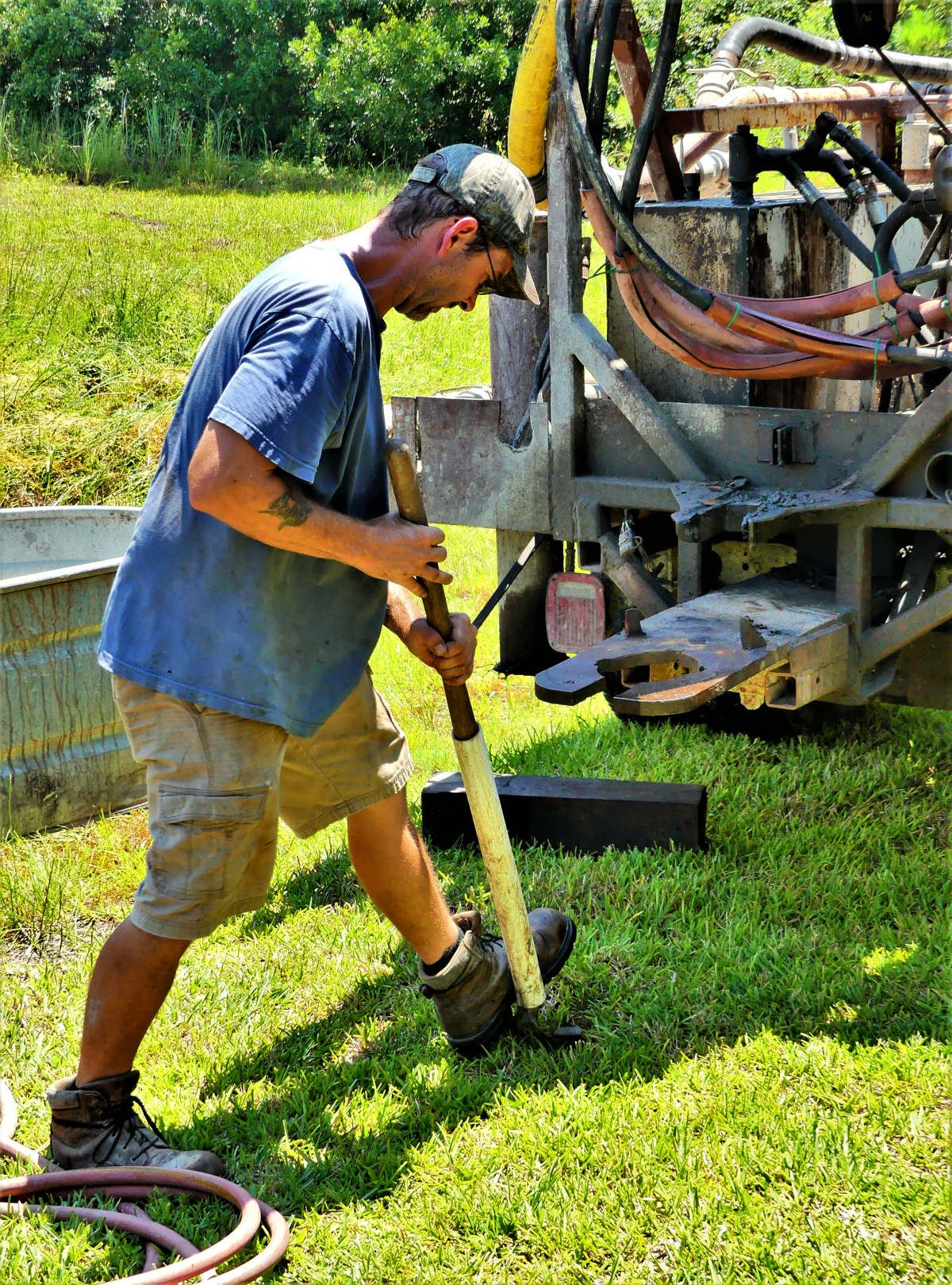
Using the Eenie Meenie Miney Moe method, Robbie determined where to place the wellhead…

drilling site

without benefit of knowing how deep or how difficult the drilling would get, although the placement of other artesian wells within our community (a retired golf course from the 1950s) informed that 250 feet was a worthy depth to plumb before groundwater made its way to the surface.

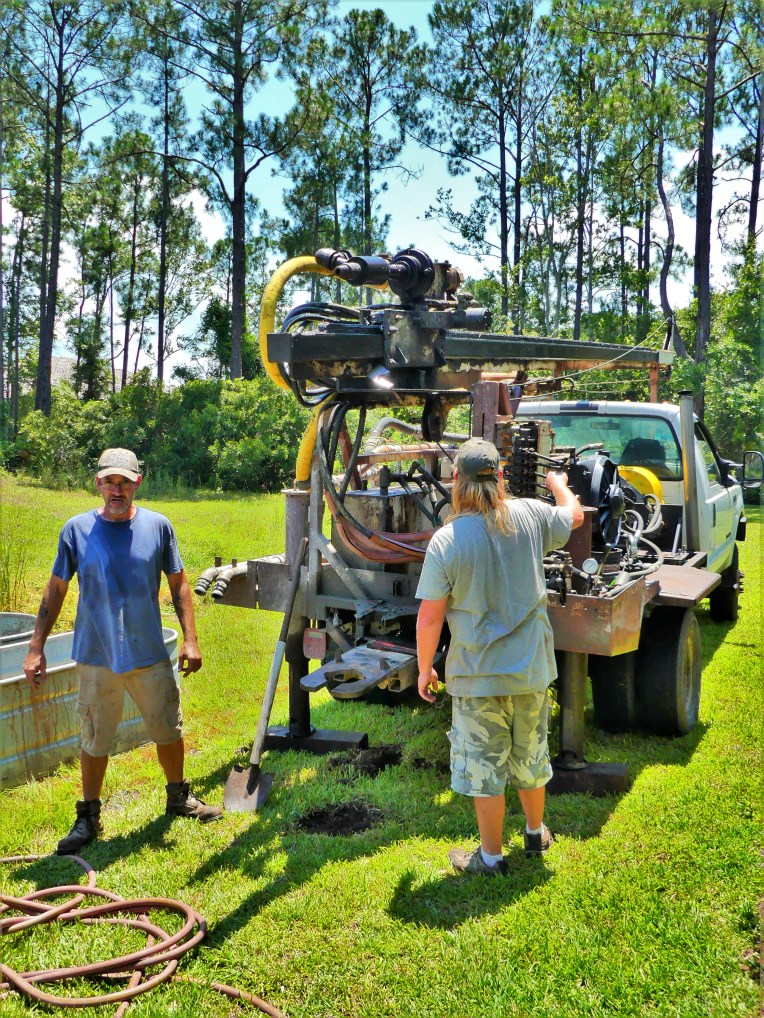
Once Eric deployed the truck jacks,

about to raise the drilling mast

the drill mast was ready to raise.

raising the drilling mast

Eric and Robbie assembled the debris pump…

evacuation pump

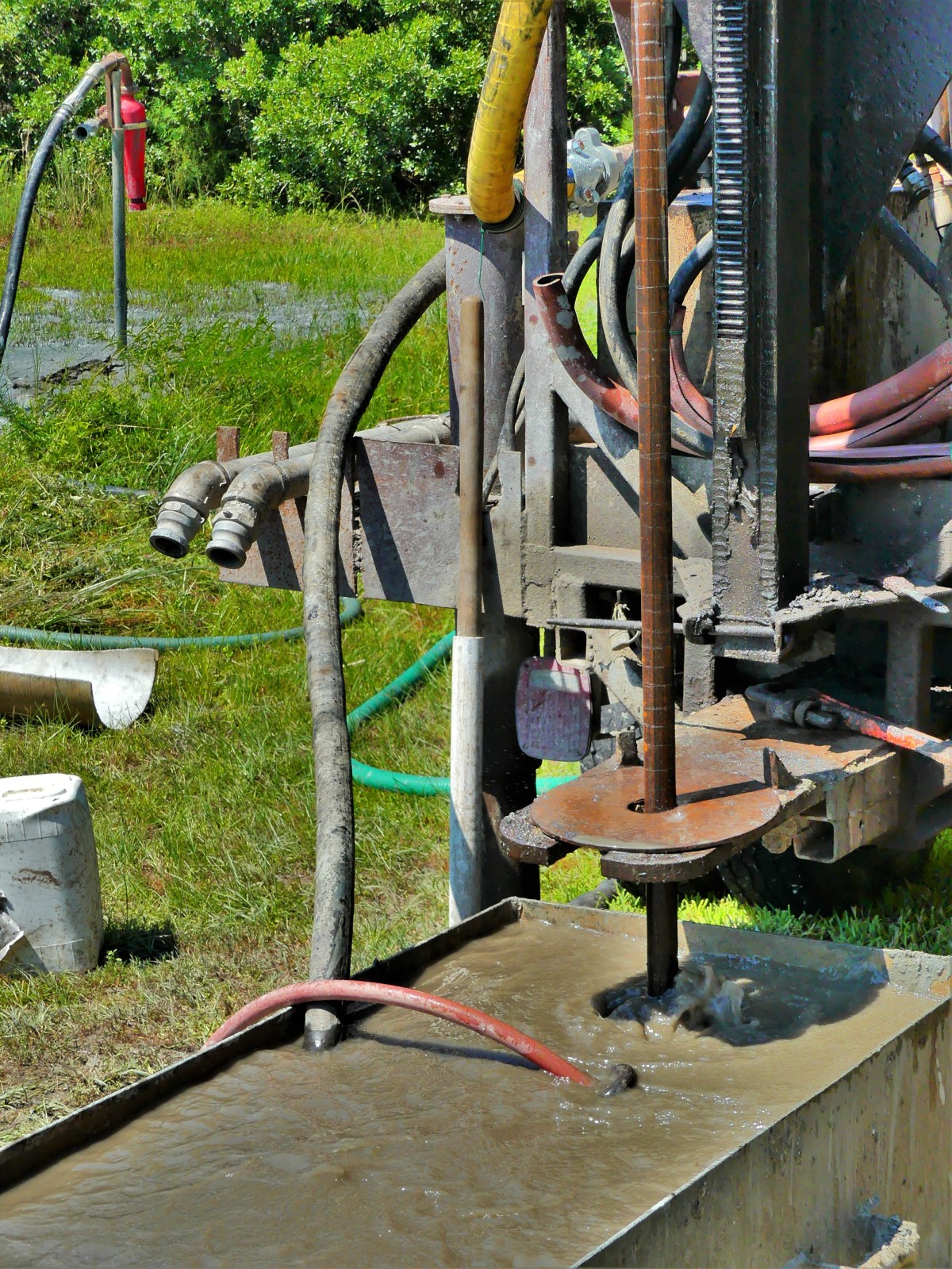
and the mud tub (for lubricating the drill head) was aligned over the designated wellhead…

setting the mud tub

well ahead of tomorrow.

The generator started cranking at 9am. By 11am the drill rod had blazed through 95 feet of clay and sand.

sifting the clay

By the end of the day, the drill had chewed through 14 feet of shell and shale (and probably some shark teeth and fossils) to a depth of 195 feet…

drilling thru cap rock

eventually reaching a ledge of limestone cap rock at 225 feet.

drill rigging

The boring rods were replaced with PVC pipe, and anchored in place with cement.

The next day saw slow but steady progress, as a slimmer rod and bit sank into the hole to chip away at the more resistant stone.

While Eric sat on a 5-gallon bucket monitoring the levels with a cigarette balanced on his lower lip,

setting up the pump.jpg

Robbie pre-wired the pump, and cut off power to the panel at 11:15am to make the connection. I was stepping out of the shower at the time when the lights went dark, the AC had paused, and Agent Strzok’s House Inquisitors were no longer embarrassing themselves on my bedroom TV. It was eerily quiet except for the growl from a nearby generator.

It took me a moment to figure out that this was not part of a rolling blackout to cool down an overloaded town grid. Nor was it the drill guys in the yard, who would have been lit up after accidentally severing my buried power cable.

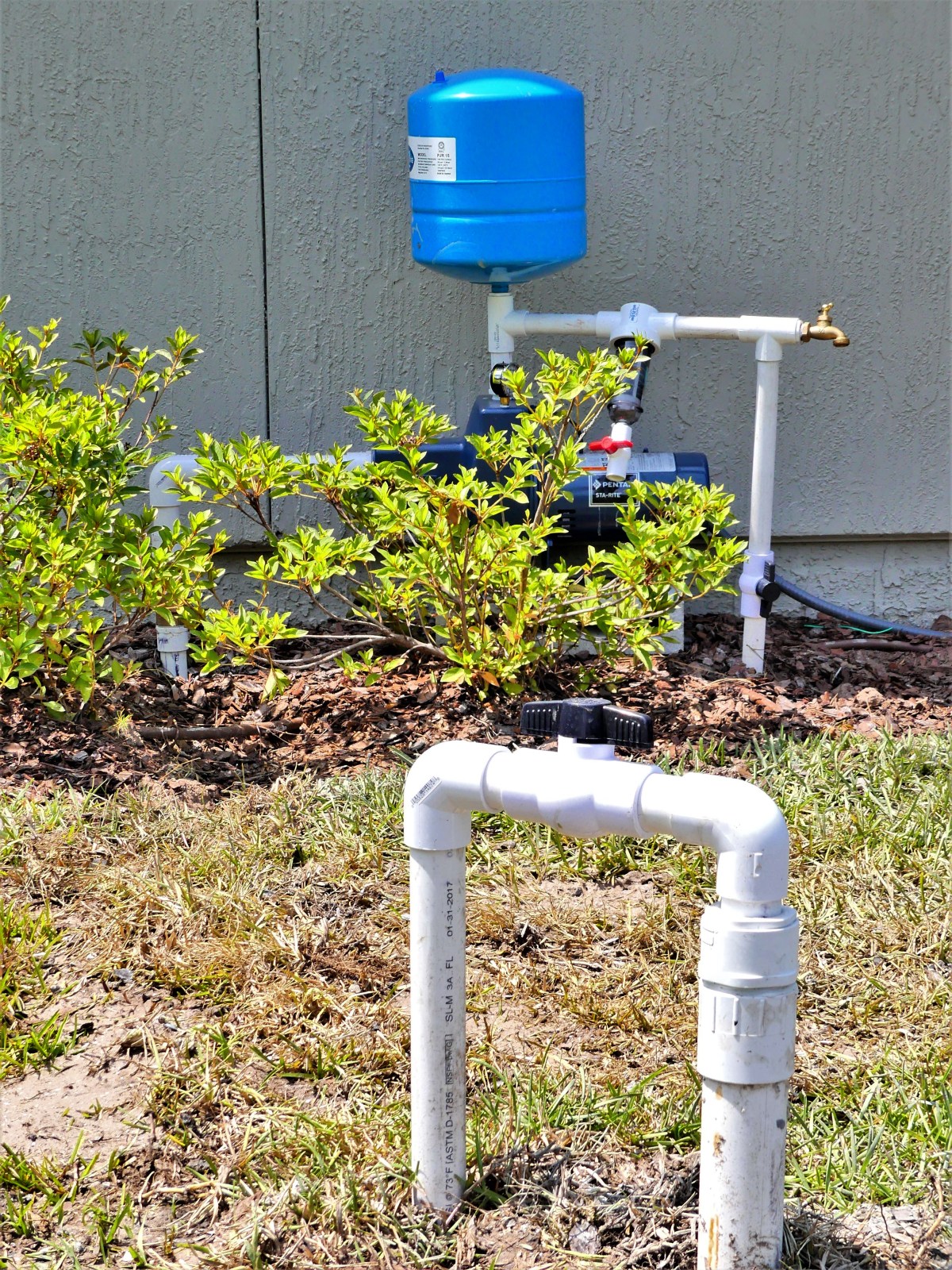
It would take three additional hours to grind through another 15 feet of compacted limestone until fresh groundwater eventually flowed to the surface. Robbie dug a trench to the pump, and tied into the irrigation backflow, protecting us against future contamination and eliminating our dependence on costly city irrigation water.

ready to pump

All that was left to do was pay the well digger, and put the water to good use.

Although we’ve recently received June’s water bill crediting the city’s bogus charge for superfluous sewer usage, we will anxiously await the next billing cycle, already knowing that the grass is always greener on the other side.


Rack ’em Up!
Yesterday’s adventure had me scouring the neighborhood for a ladder that was tall enough to reach our 14 foot-high dining room ceiling.

An email alert to our newly adopted community produced immediate fruit, but none of the produce was ripe for the climbing. Of the many responses, either the ladders were too short, or it was the wrong type (extension variety instead of A-frame)–nothing that would allow me to swap out a newly delivered lighting fixture in time for the scheduled delivery and installation of a long-awaited pool table the following day.

high ceilings (2)

While I struck out on ladders, it was a fine way to meet some of my neighbors, and learn about the joys and hazards of living in St. Augustine.

I  discovered that two hurricanes within an 11-month period (Matthew and Irma) after a 62-year respite (Dora in 1964) left our neighborhood shaken, but not stirred, with rising water from the Intracoastal Waterway barely penetrating the fence-line perimeter, while gale-force winds and blowing debris delivered negligible roof damage to a few homes, leaving our Madeira community relatively intact.

Additionally, the close proximity to the St. Johns County government complex and the beauty of sharing the same electrical grid resulted in a near, immediate restoral of power.

Meanwhile, it was beginning to feel like I was sitting behind the eight ball, but things have a way of working out when working tirelessly to carve out one’s little slice of heaven on earth.

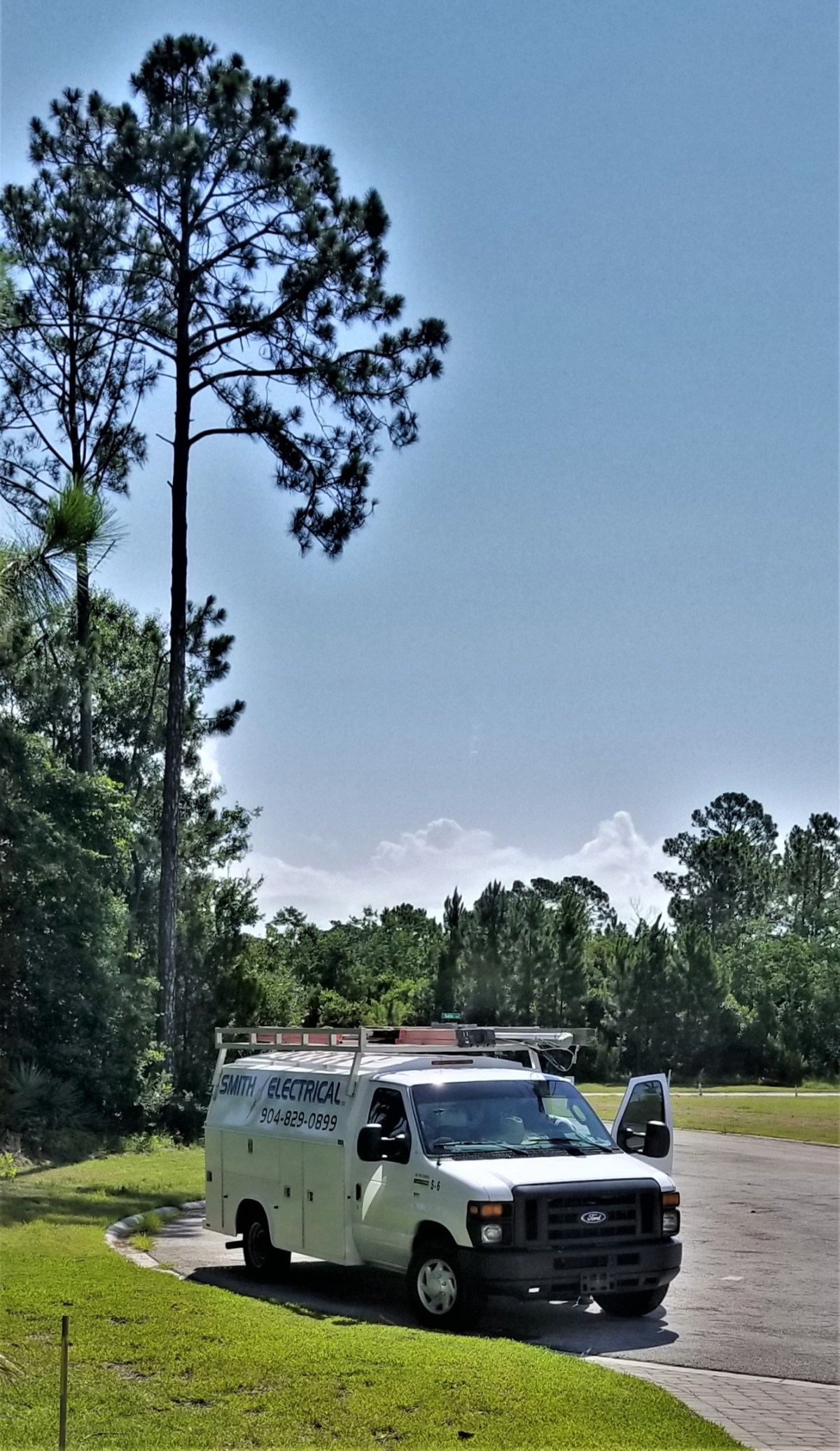
Fortunately, a last-minute phone call to Smith Electric produced instant results. A crew arrived hours later…

Smith Electric

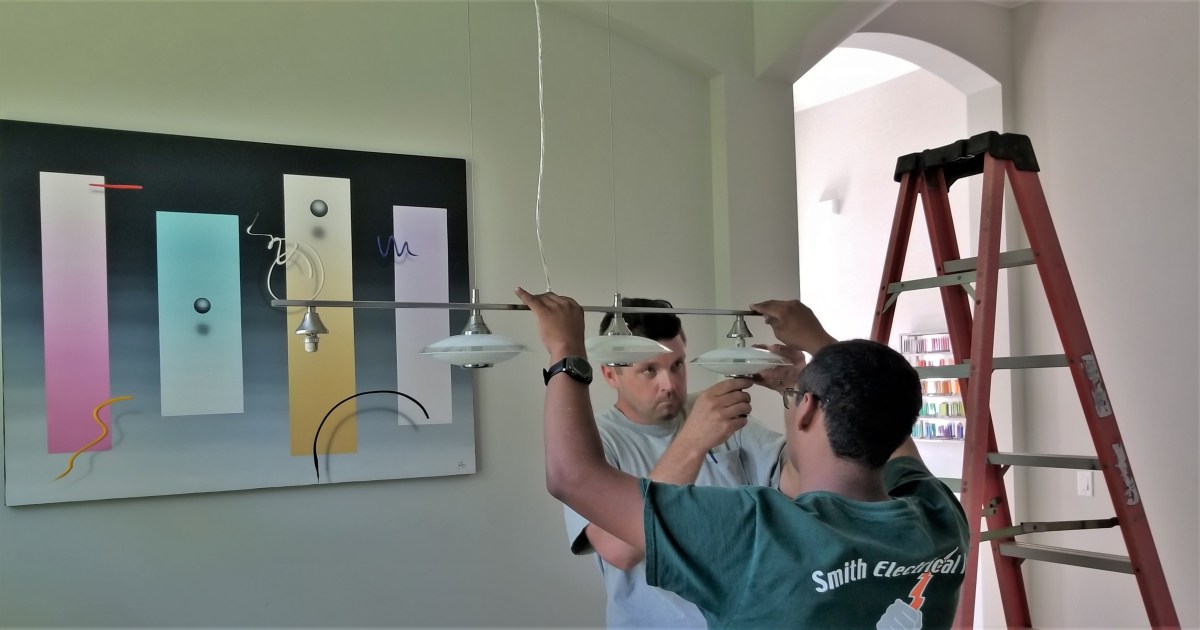
with an 8-foot step-ladder and a 6 foot 7 inch electrician to dismantle the existing fixture…

out with the old

and prepare the connections…

preparing the connections

to hang and balance the replacing fixture…

attaching globes

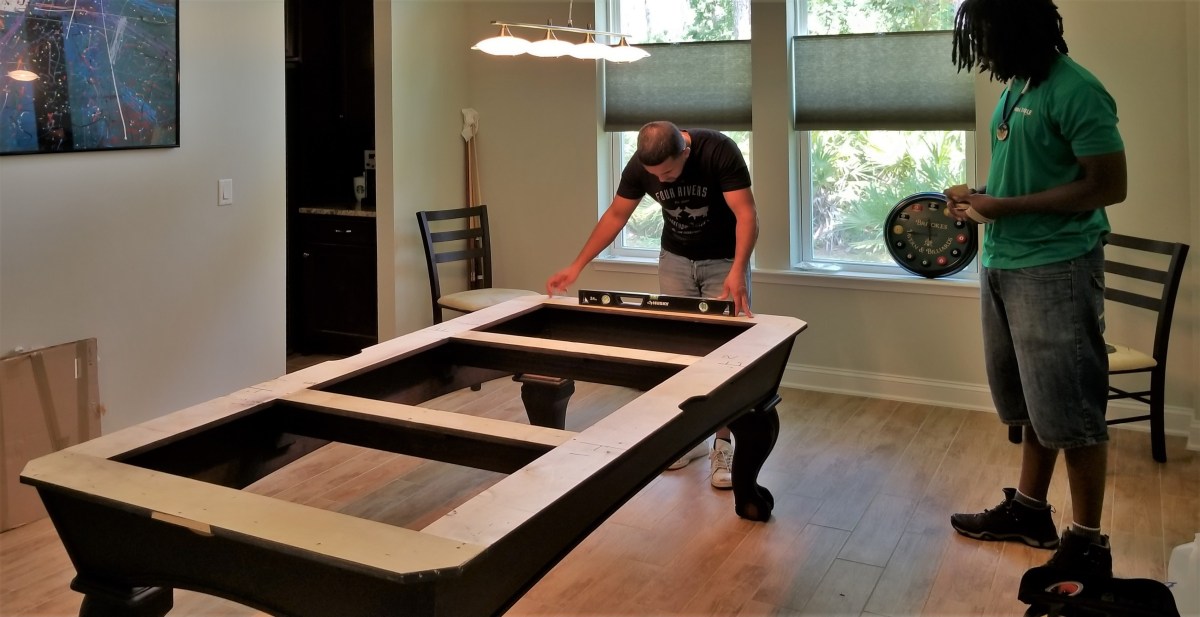
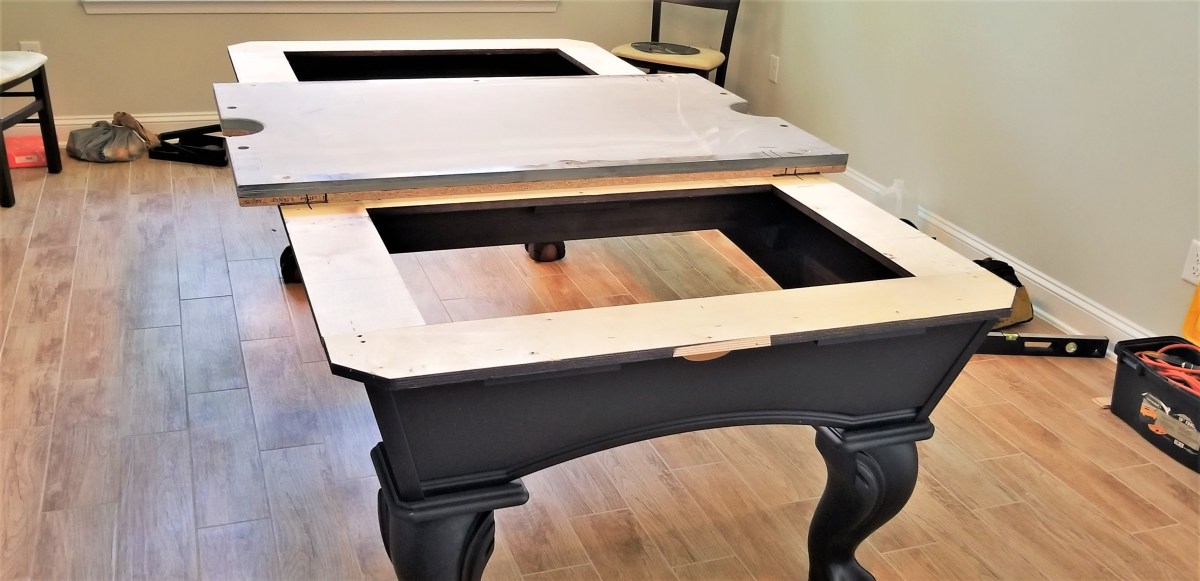
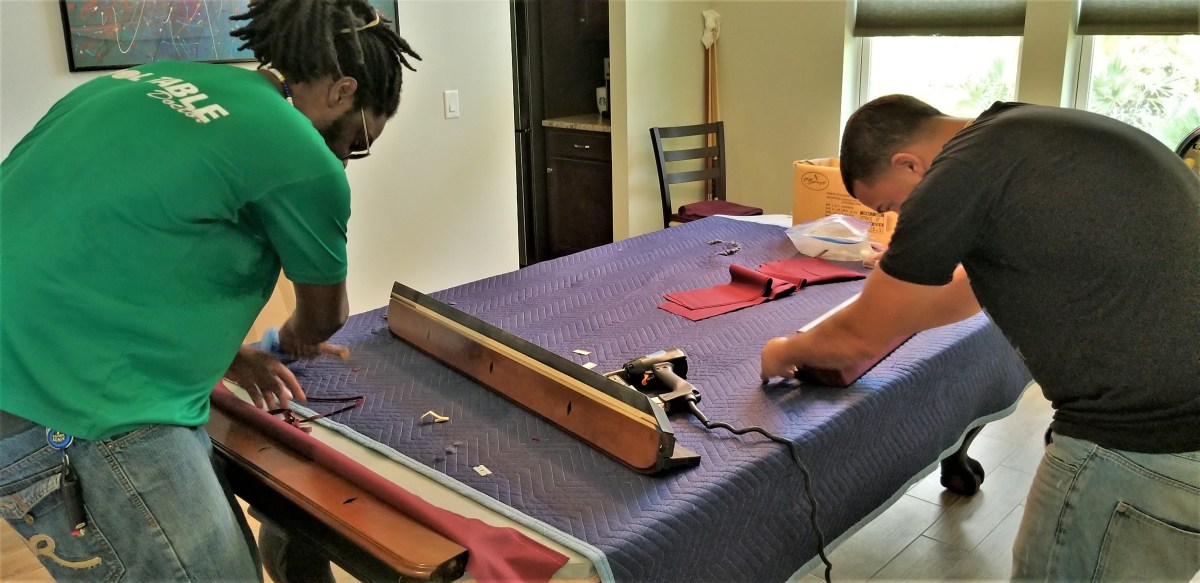
on the heels of the Pool Table Doctor’s arrival.

leveling the frame

Paul made quick work of placing and leveling the base;

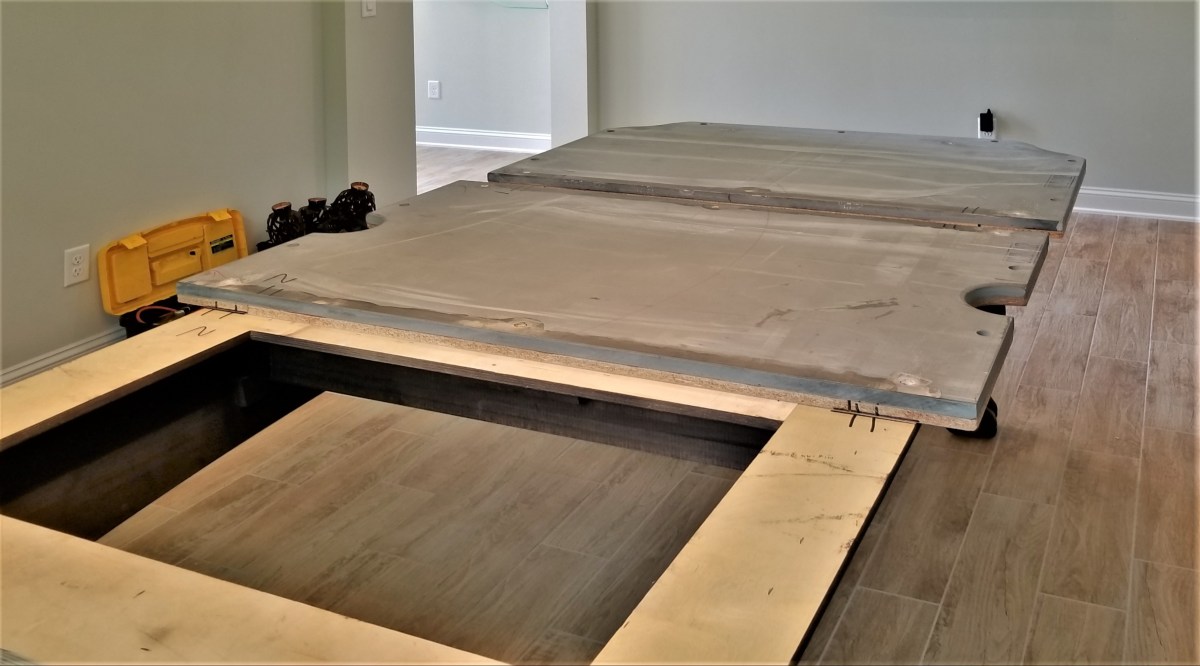
positioning the slate slabs

stacking the slate slabs;

2 slabs.jpg

and shimming the playing surface.

leveling the slate

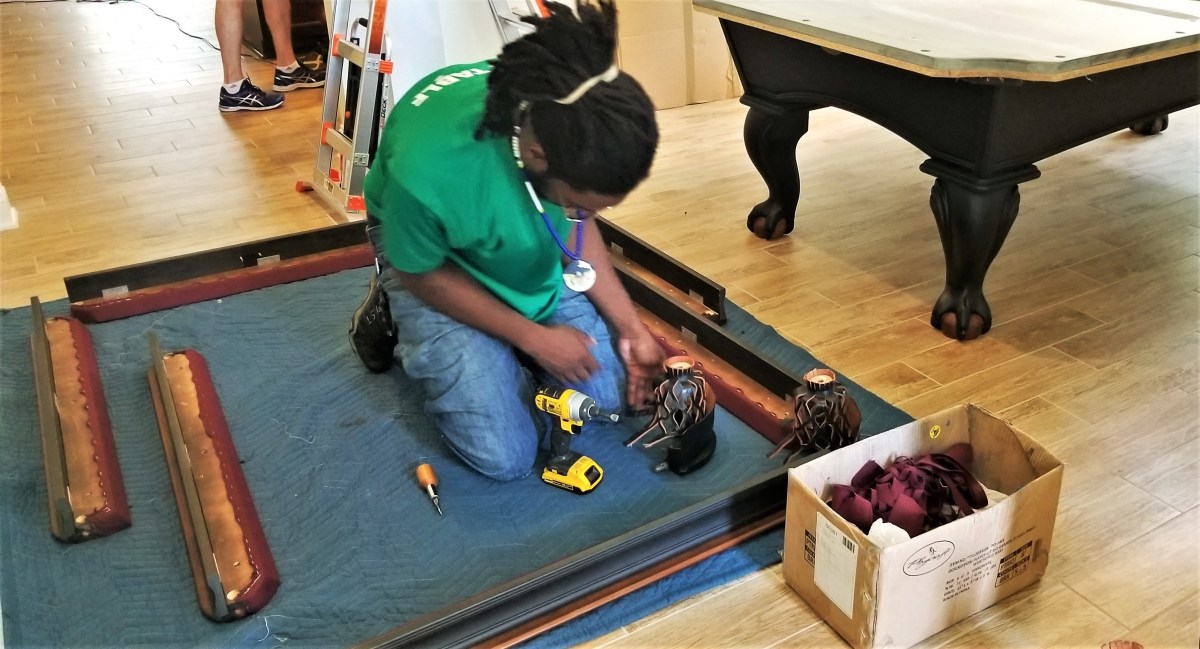
Joaquin was nearby, building the rails and pockets…

building rails and pockets

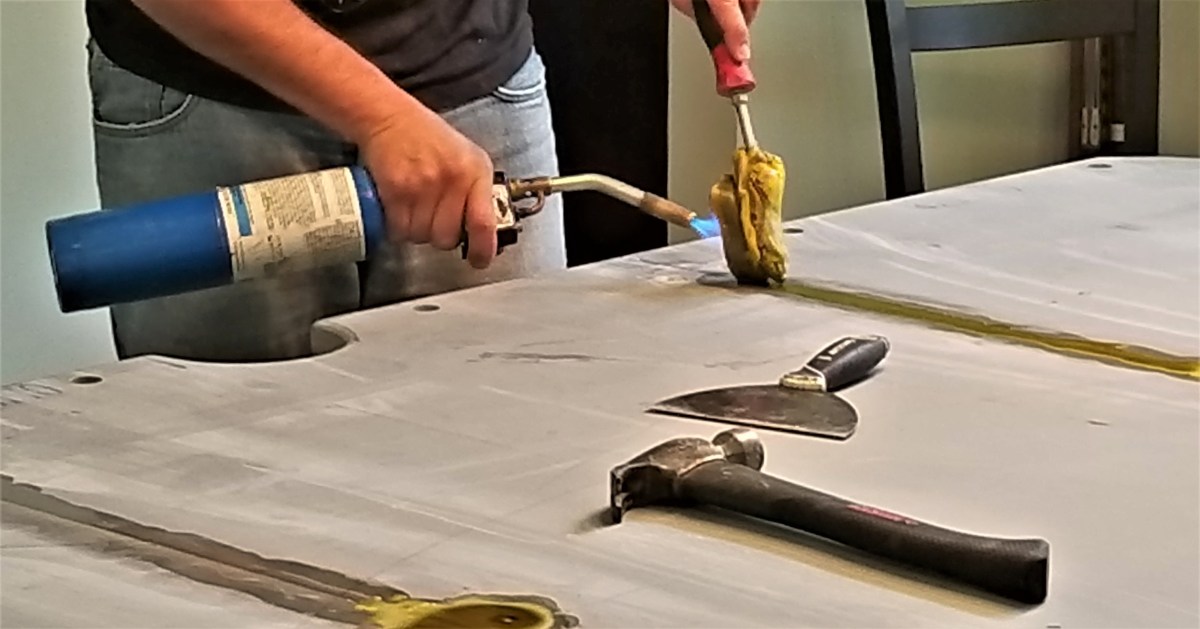
while Paul was joining the slabs together with sealing wax.

sealing the gaps with wax

Together, they finished felting the cushions.

felting the cushions

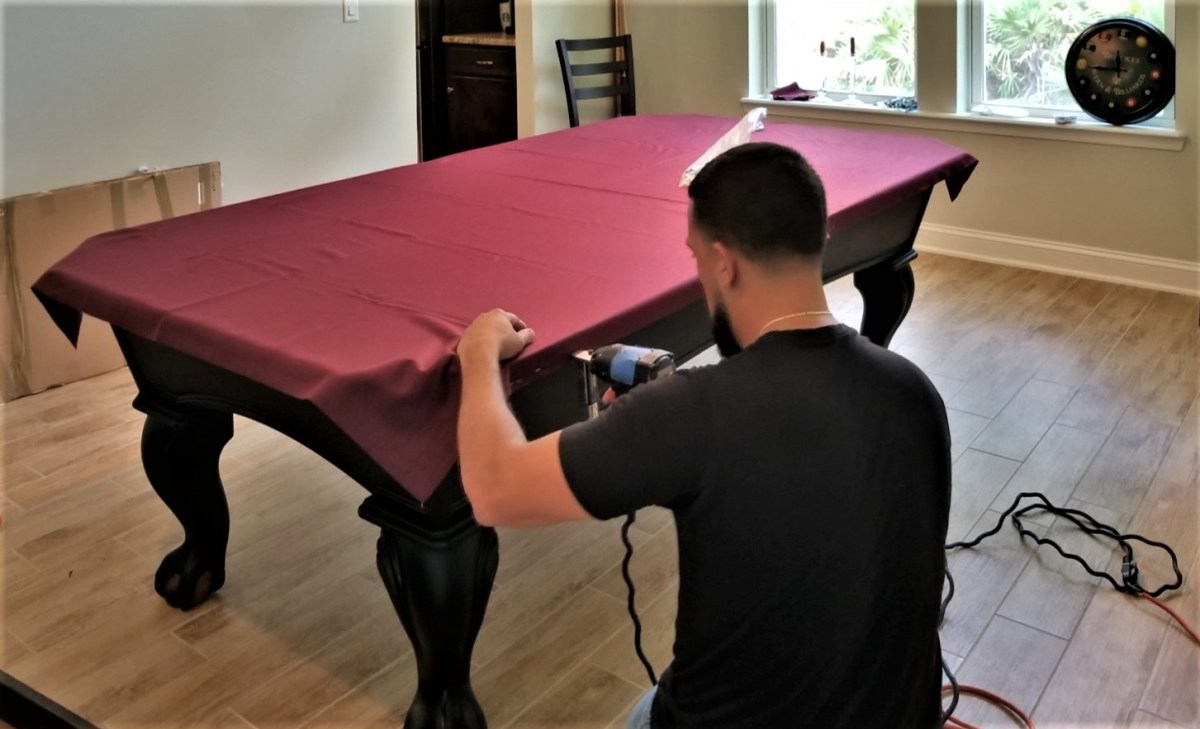
Soon it was time to stretch the wine-colored felt across the table–a quirky color that Leah and I felt was befitting the carved ball and claw table leg design.

positioning the felt (2)

After trimming the excess cloth, and attaching the rails…

attaching rails

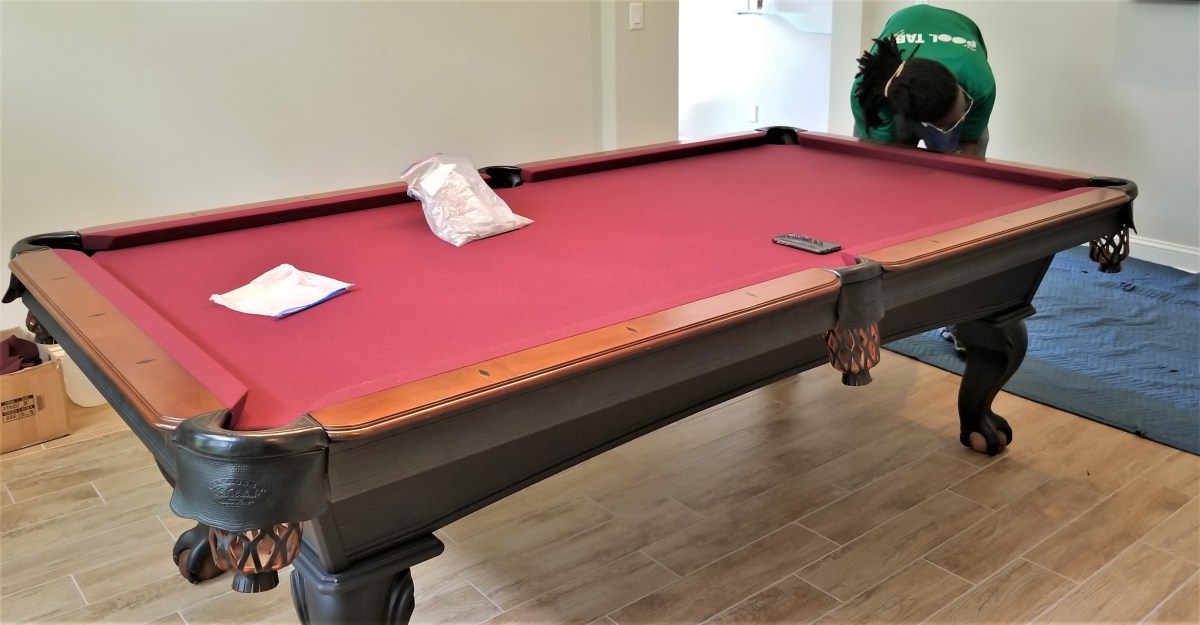
our Olhausen table was lit and ready for play. The entire process took 2½ hours, and the result–

end result

worthy of a picture, and many future hours of fun.

Rack ’em up. It’s my turn to break!


Wise Guys

It’s been one year since our visit to Mt. Rushmore, and what could be more American than re-posting this episode on Independence Day…

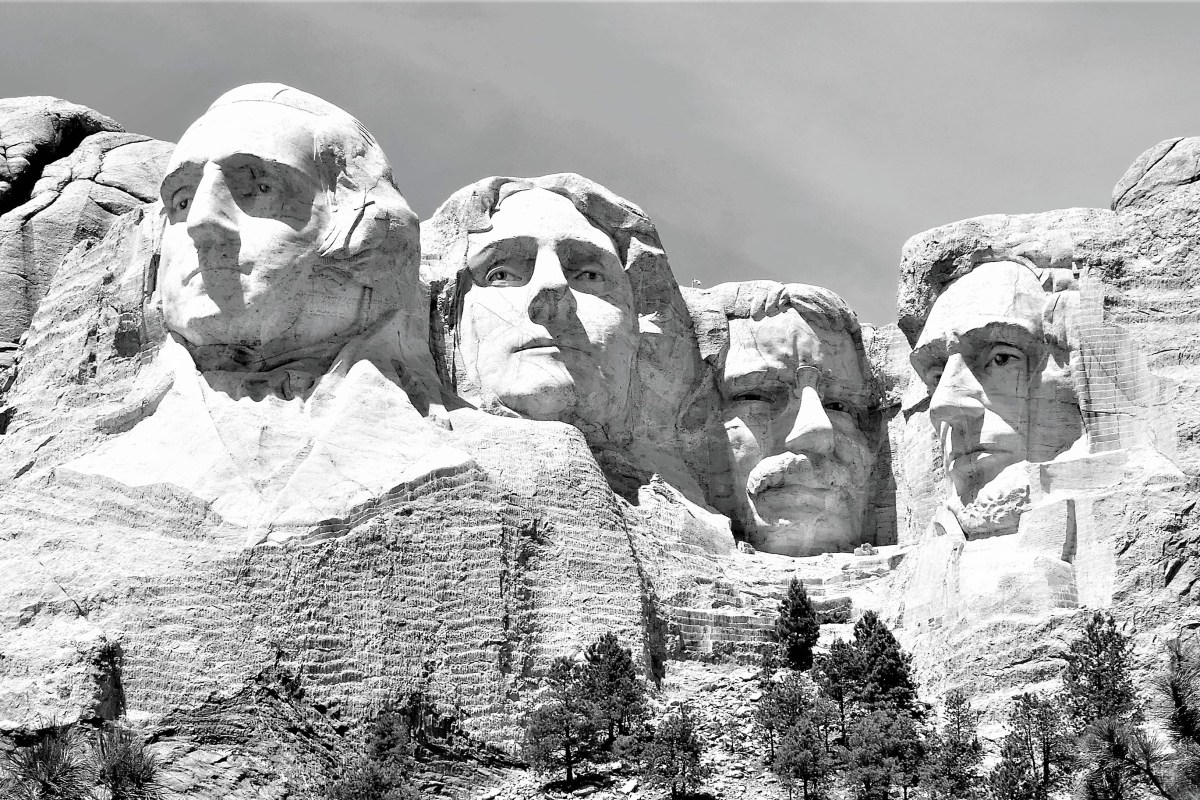
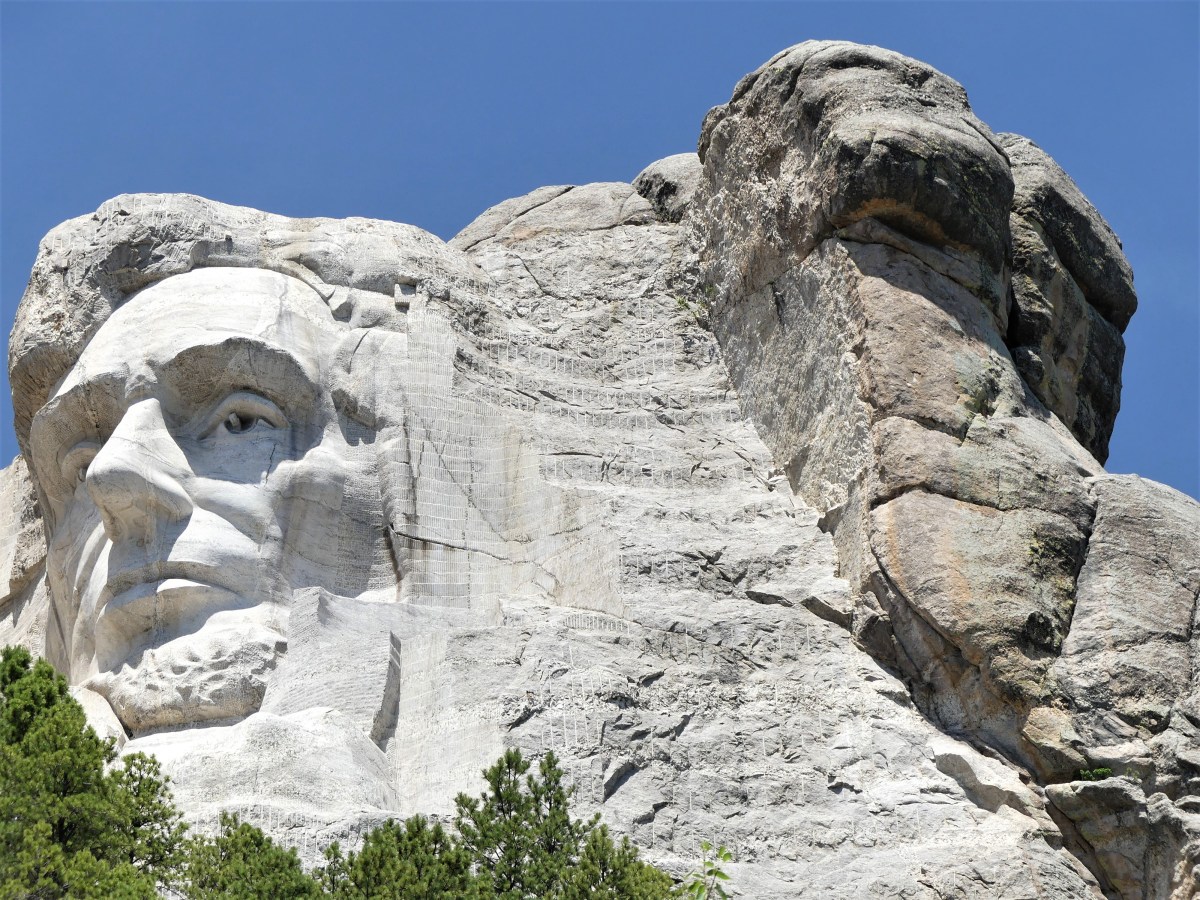
There’s no better way to celebrate the 4th of July, than a trip to Mount Rushmore and the Crazy Horse Memorial. Sure, the crowds were large; that was to be expected. But once the cars were garaged, the pedestrian traffic was easy to negotiate. And with everyone looking up at the mountain, the Presidents’ faces and intentions were never obstructed.

GW

Jefferson

Roosevelt

Lincoln

It was also a time to celebrate family. There were plenty of kids riding in strollers, hanging from moms in carriers, or balancing on dads’ shoulders. Generations of families–many of them immigrants–had gathered to pay homage to the principles of freedom that make our country a beacon for the oppressed and downtrodden.

Seniors were being escorted through the Avenue of Flags by their grandchildren. Extended families organized group pictures at the Grand View Terrace, unified by their love of democracy and their reunion T-shirts.

All expressed awe at Gutzon Borglum’s grand vision and remarkable achievement–the transformation of a mountain into a national symbol visited by approximately 3 million people every year.

long shot

The 14-year process of carving the rock began with dimensionalizing the Presidents’ portraits through Plaster of Paris masks, on view at the sculptor’s studio-turned-museum.

Sculptor's Studio

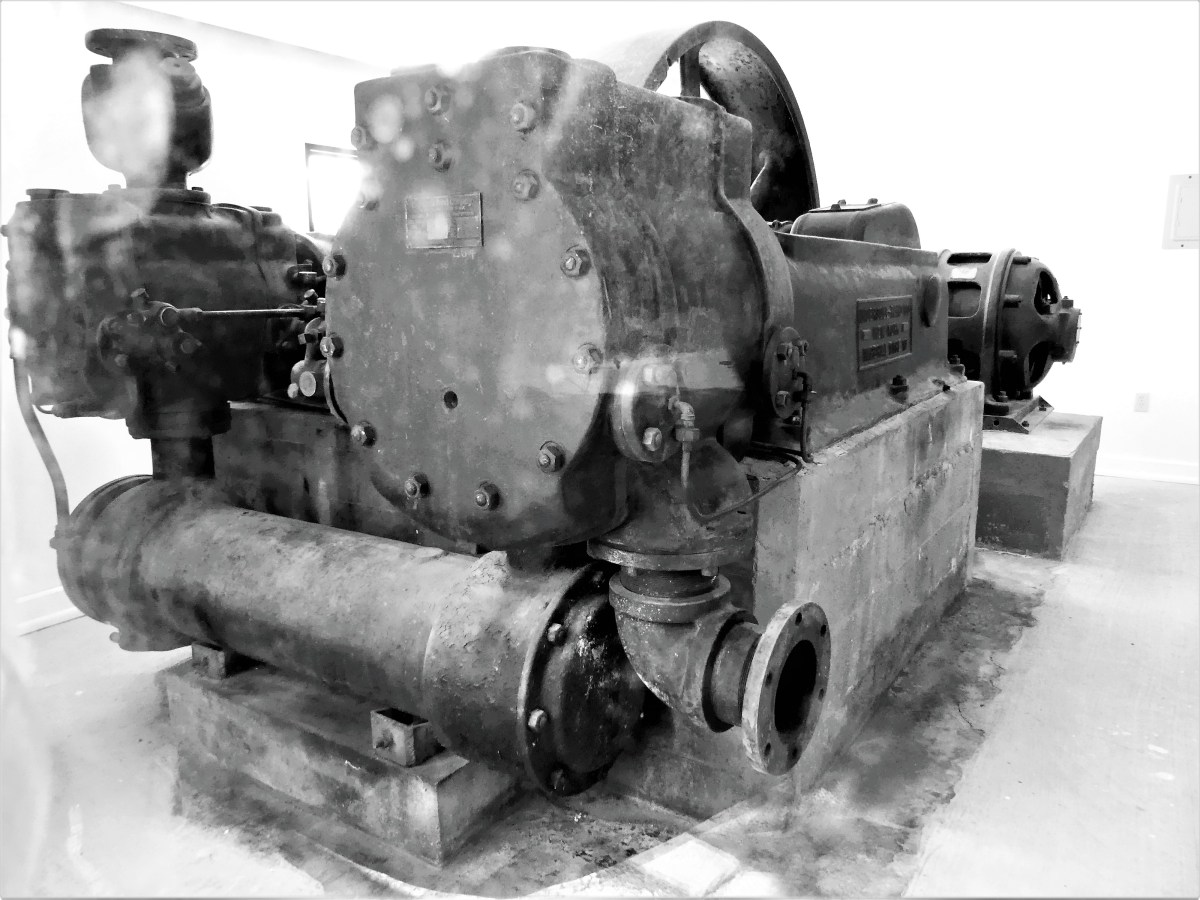
Additional exhibits detail the construction of the memorial, and the tools used by workers, like the original Rand & Waring compressor, which powered the jackhammers for all the finishing work.

compressor

A little known fact is that Mt. Rushmore was once intended to be a tribute to the “Five Faces of Freedom,” but funding ran short when the Congressional appropriation approached $1 million during the Great Depression. Hence, the unfinished carving of the Great Ape to the right of Lincoln serves as a reminder that we are never far from our true ancestors.¹

Planet of the Apes

No less ambitious, and equally as impressive, the Crazy Horse Memorial is a work-in-progress located 16 miles away in the heart of the Black Hills–considered sacred land by the Lakota people.

Crazy Horse LS

Conceived by Korczak Ziolkowski in early 1940s,

crazy horse model (2)

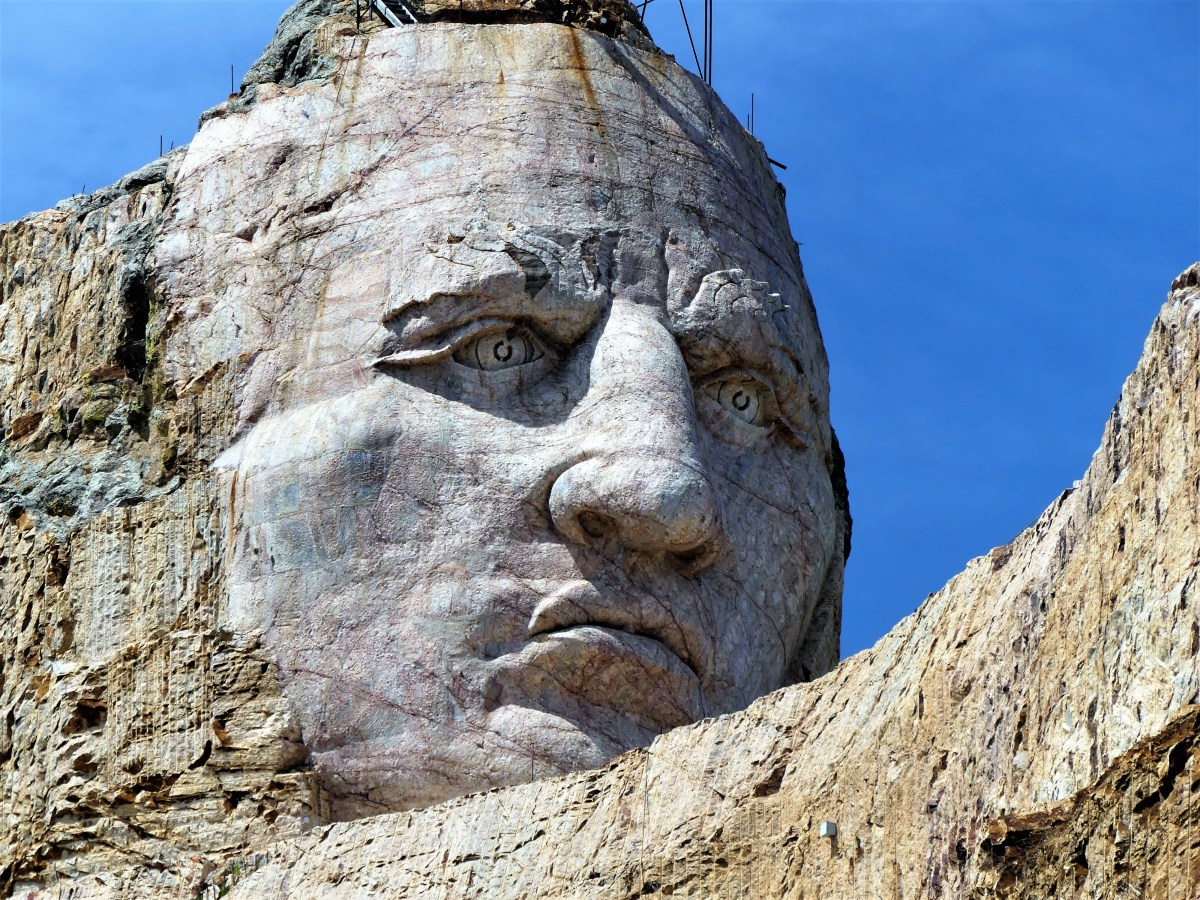
the memorial, when completed will stand 563 ft. by 641 ft. across, and is expected to be the largest sculpture in the world. Already, the completed head of Crazy Horse measures 60 feet tall…

Crazy Horse CU

…twice the size of any of the presidents at Mt. Rushmore. While the first blast was conducted on the mountain in 1947, the current prospects for the memorial are to complete the outstretched arm during the next twelve years. There is no completion date available for the finished carving, which has been financed entirely by private funding since its inception.

Mt. Rushmore was created by a Danish American. Crazy Horse was created by a Polish American. And visitors to both destinations manifest the melting pot that has brought us all together as Americans. It’s our diversity that makes us strong, our ambition and determination that makes us great, and our compassion and sacrifice that make us whole.

These are the values reflected from the faces we’ve immortalized in stone. Yet, we would honor them more by living according to these principles.

Happy Birthday, America!

fireworks1

¹ Just kidding, but the photograph is real and has not been retouched.

Dynamic Panoramics

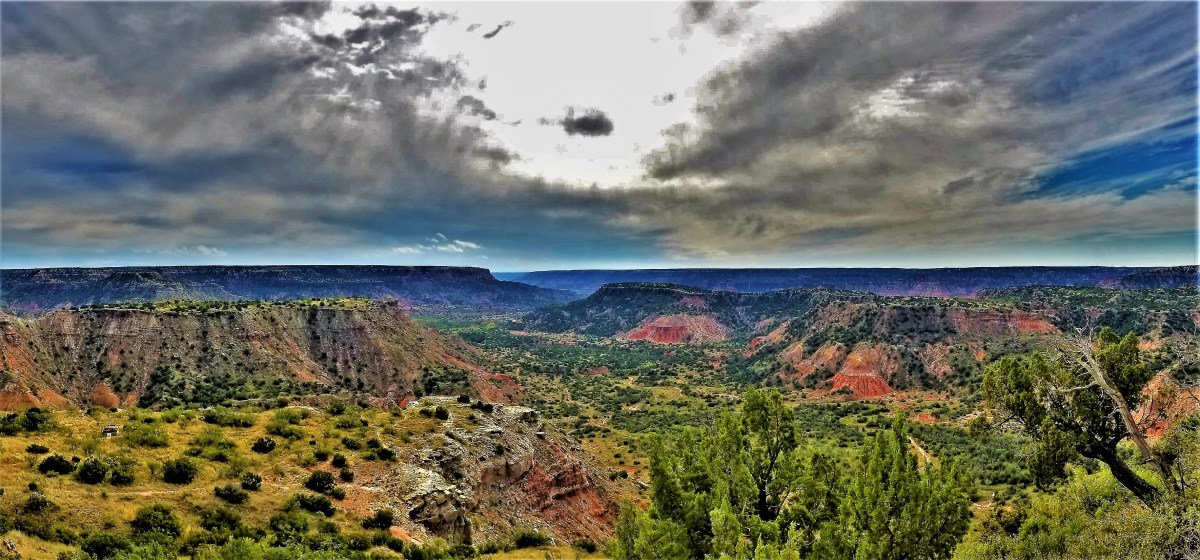
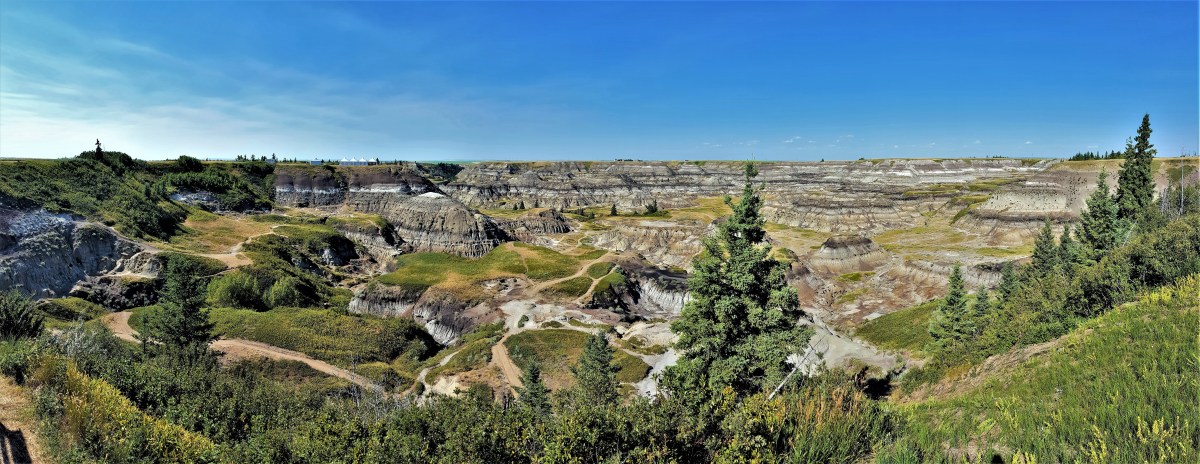
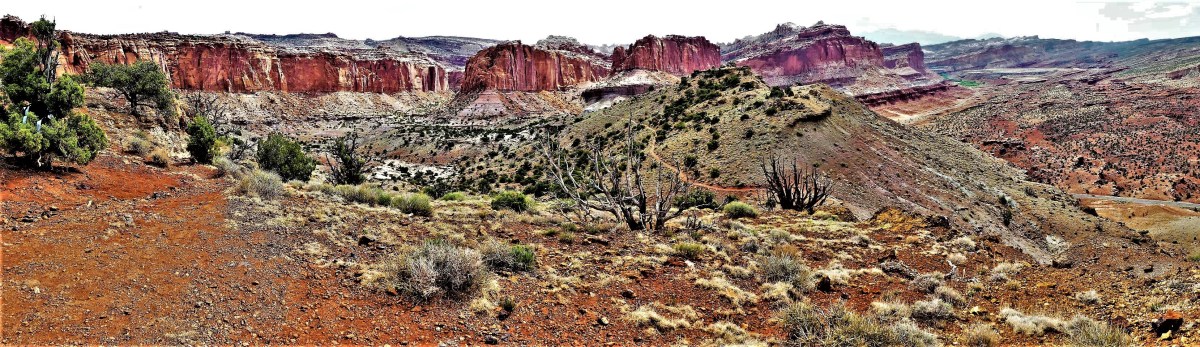
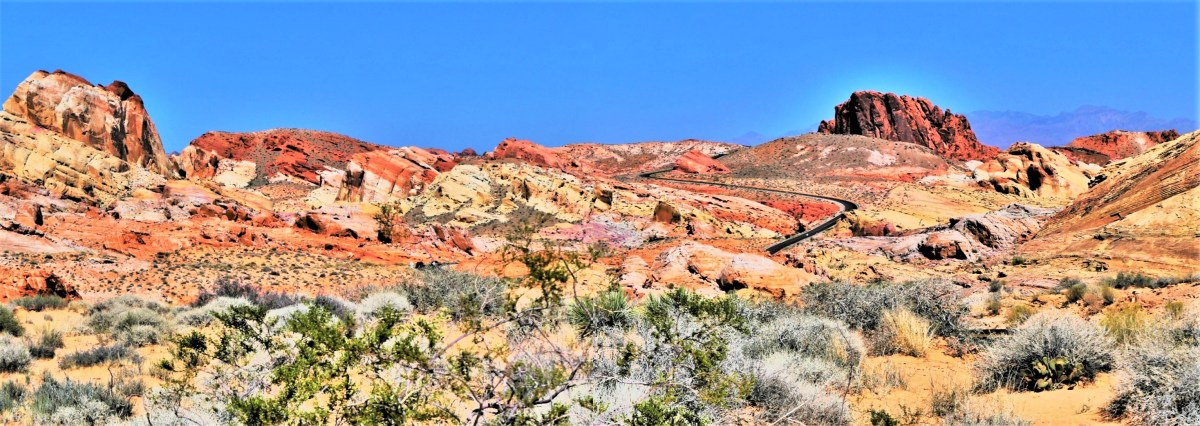
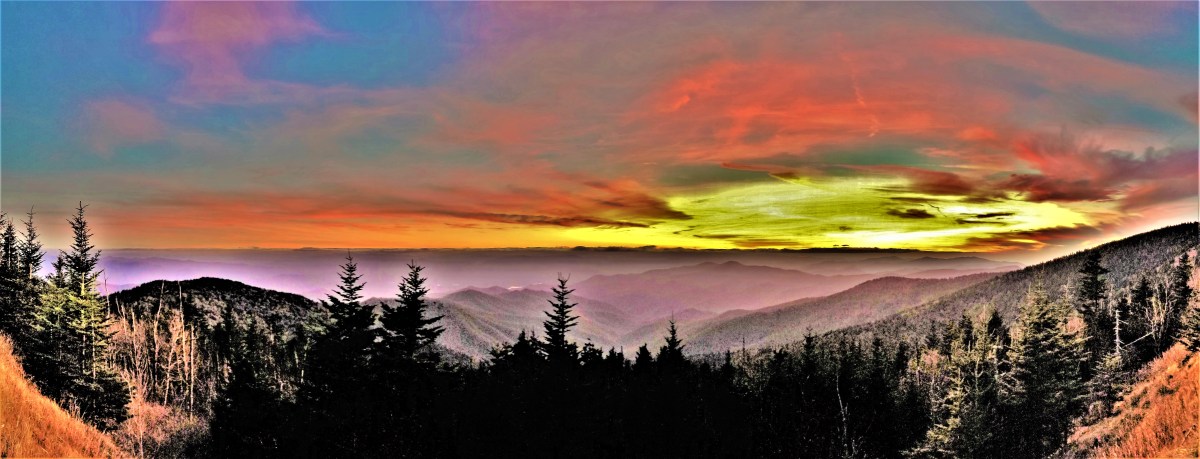
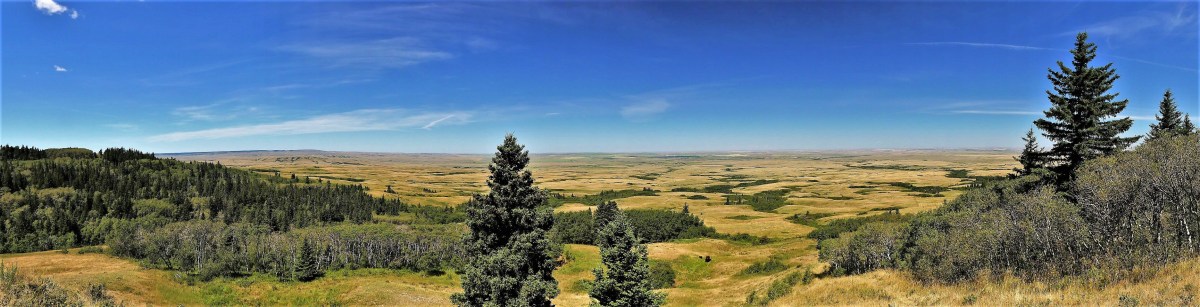
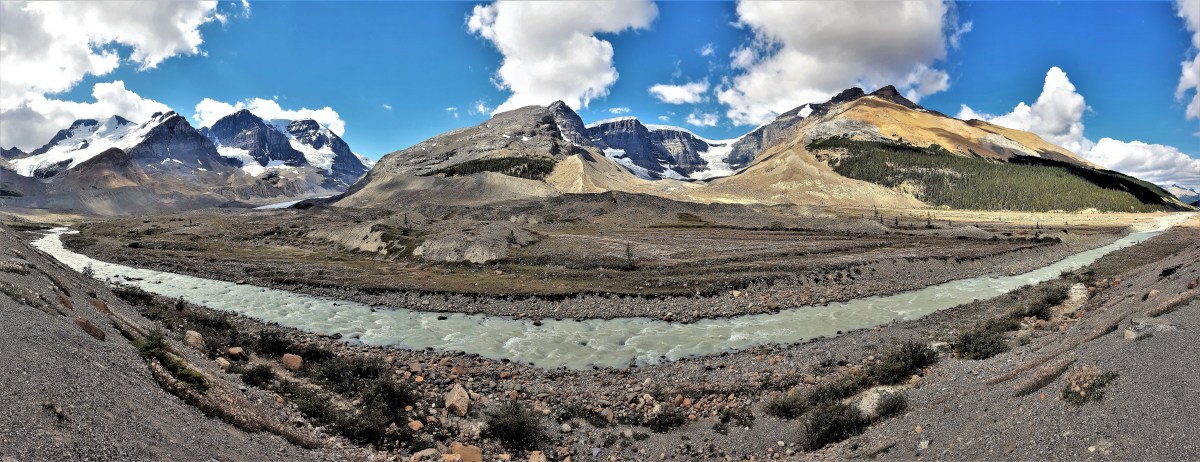
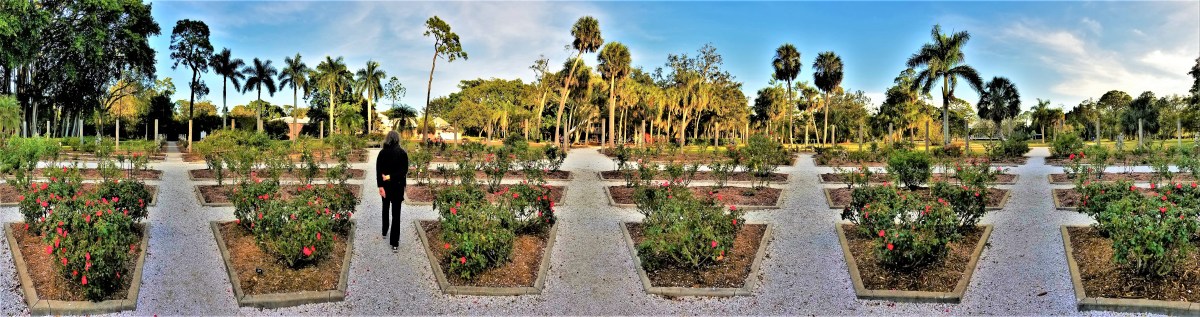
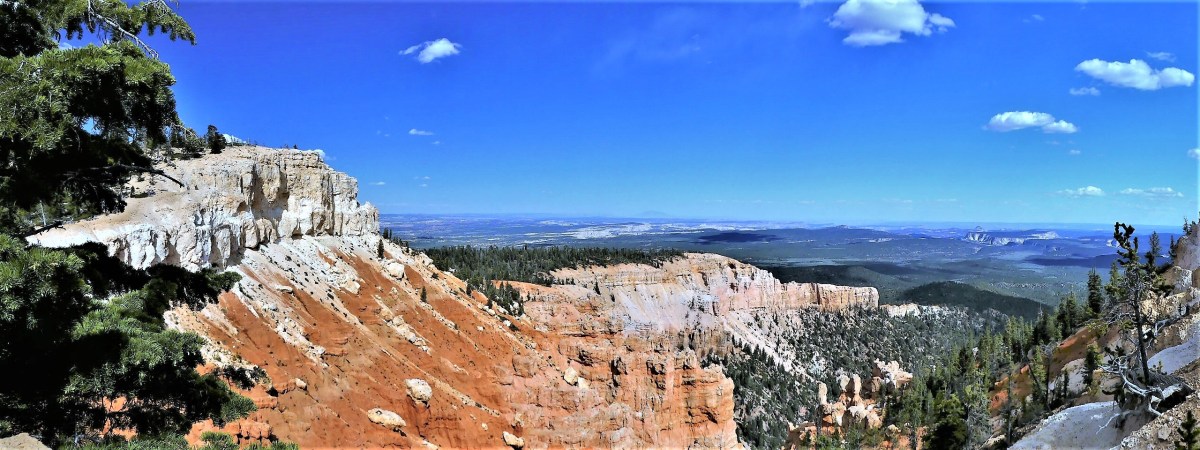
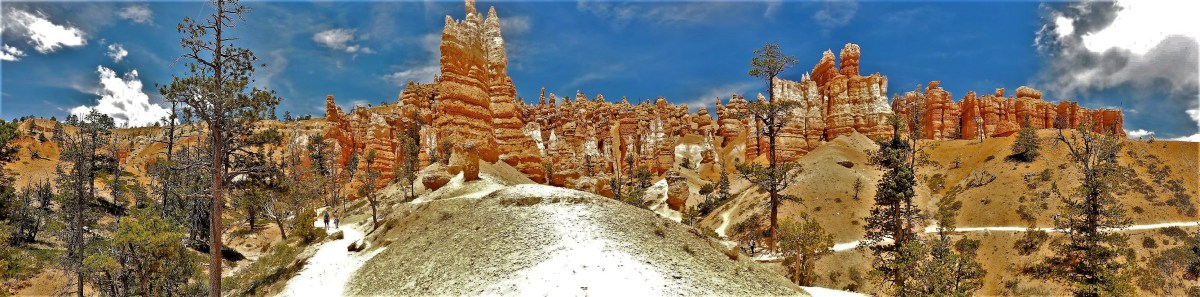
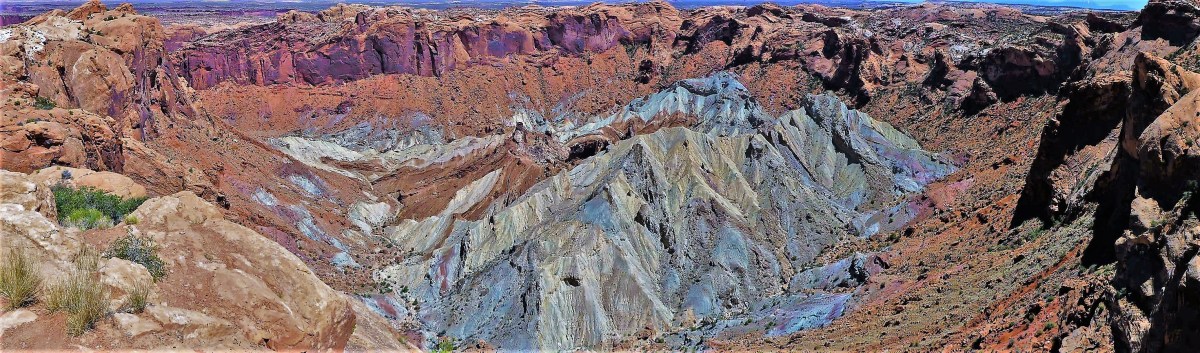
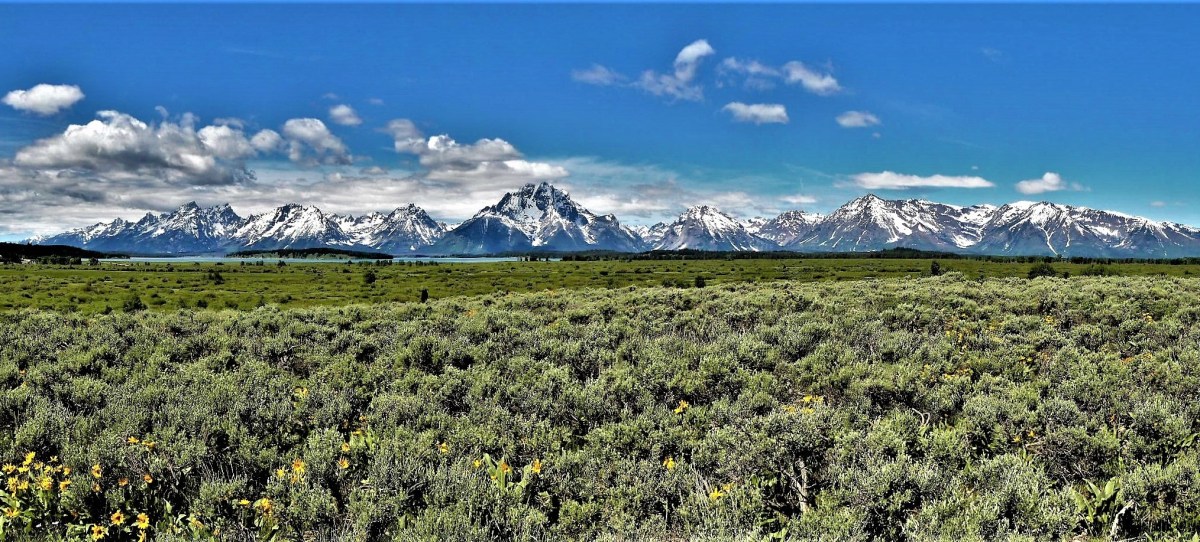
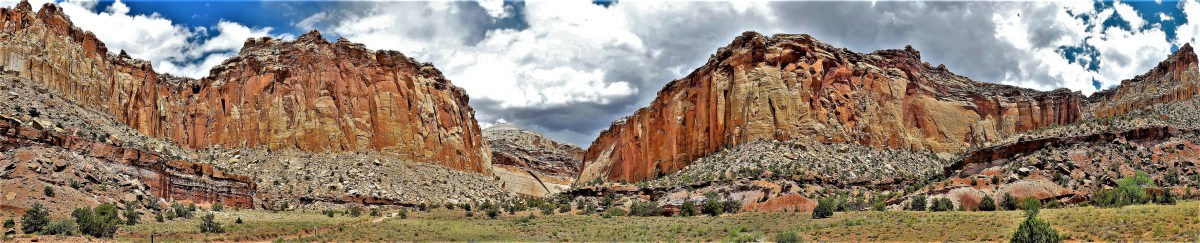
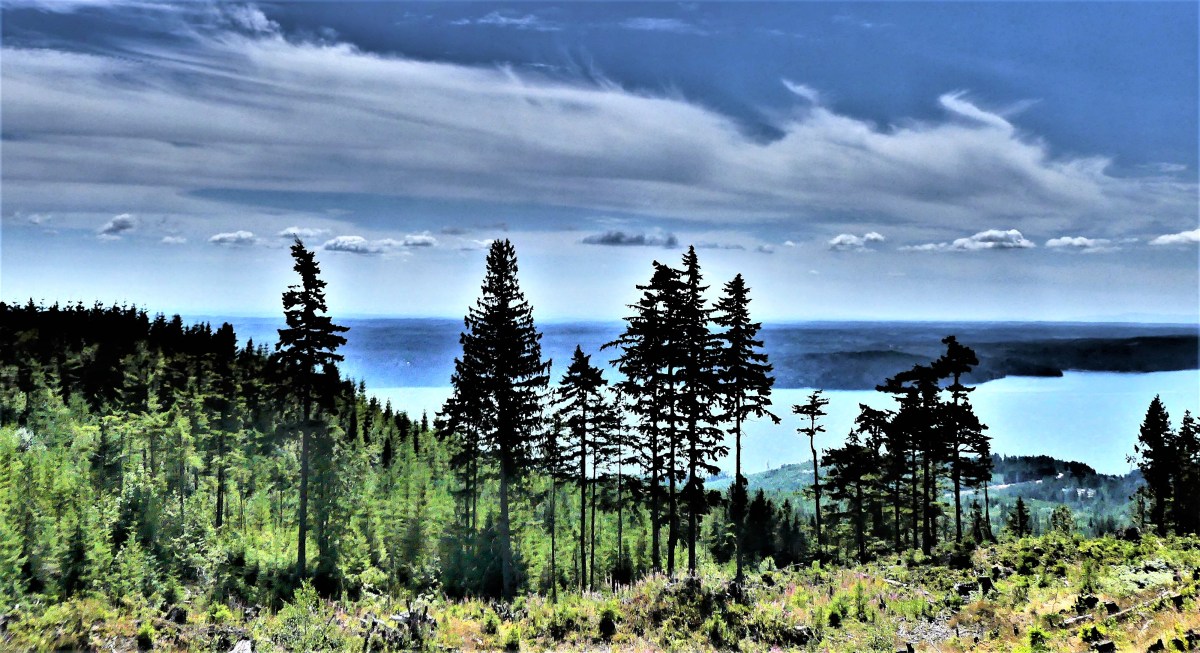
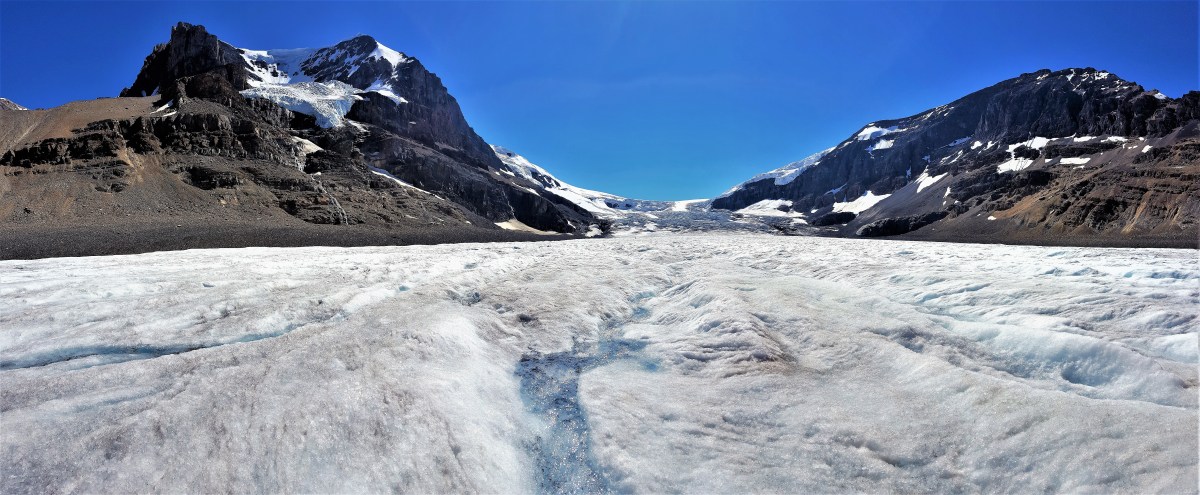
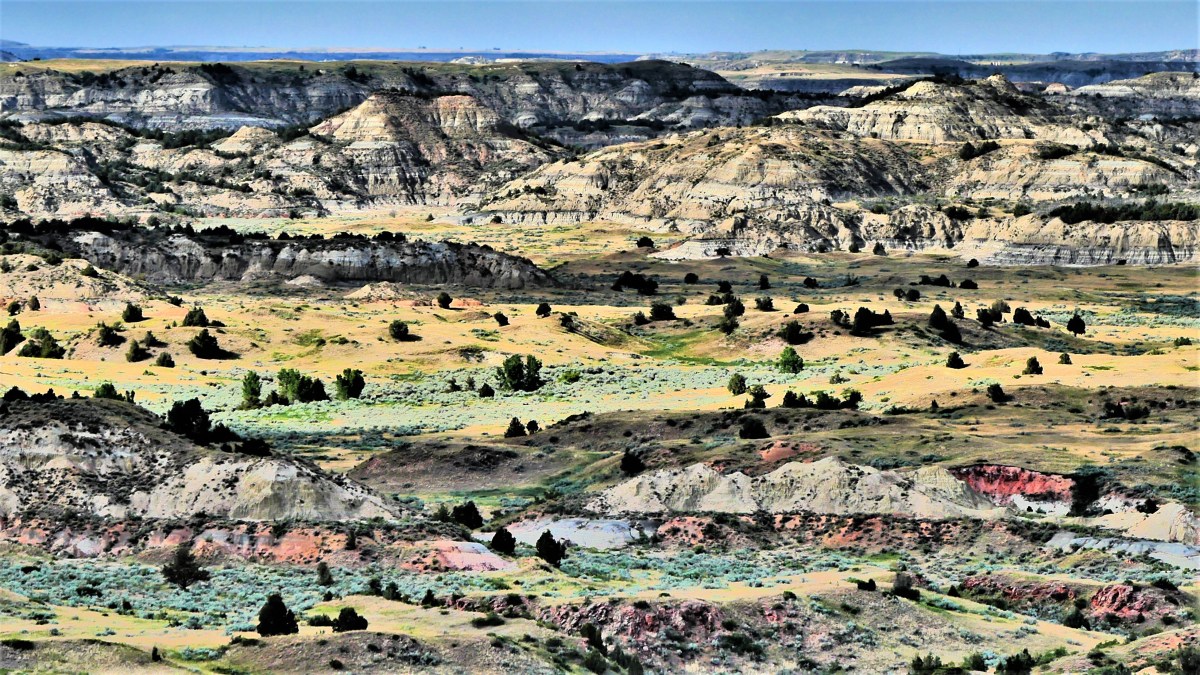
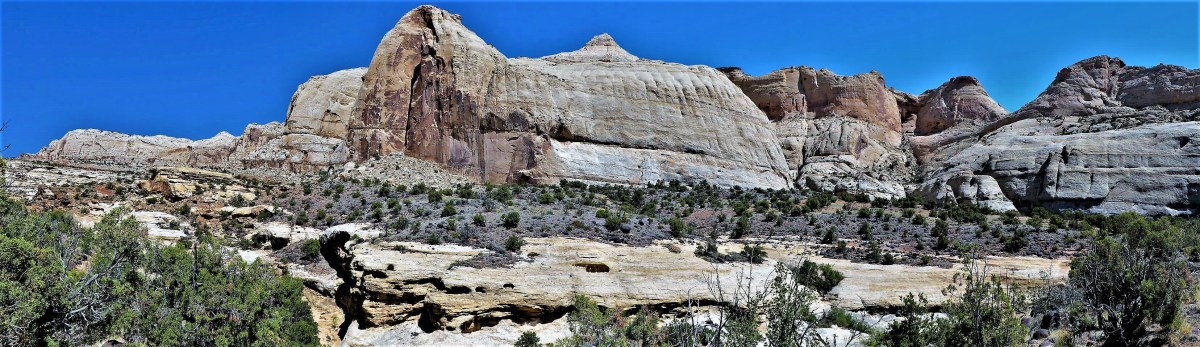
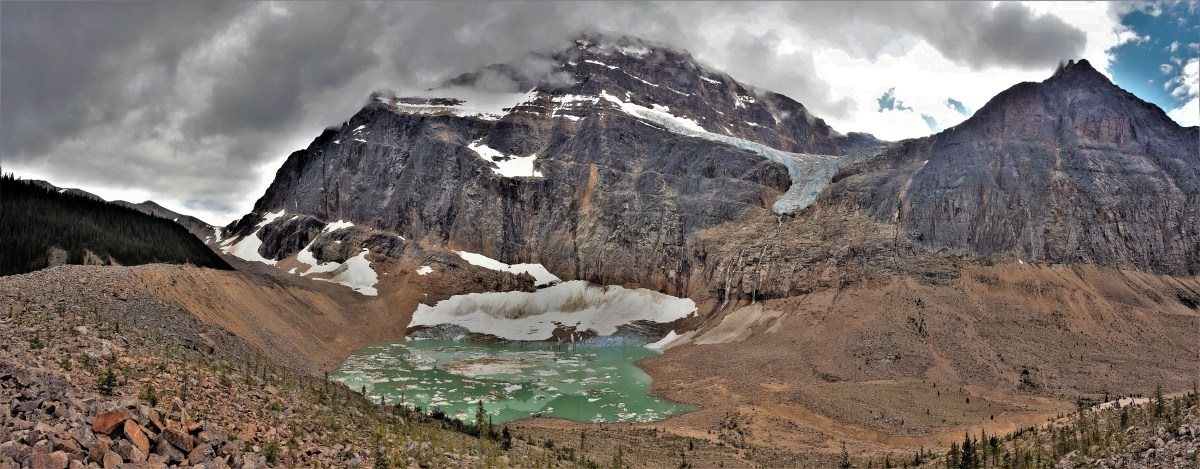
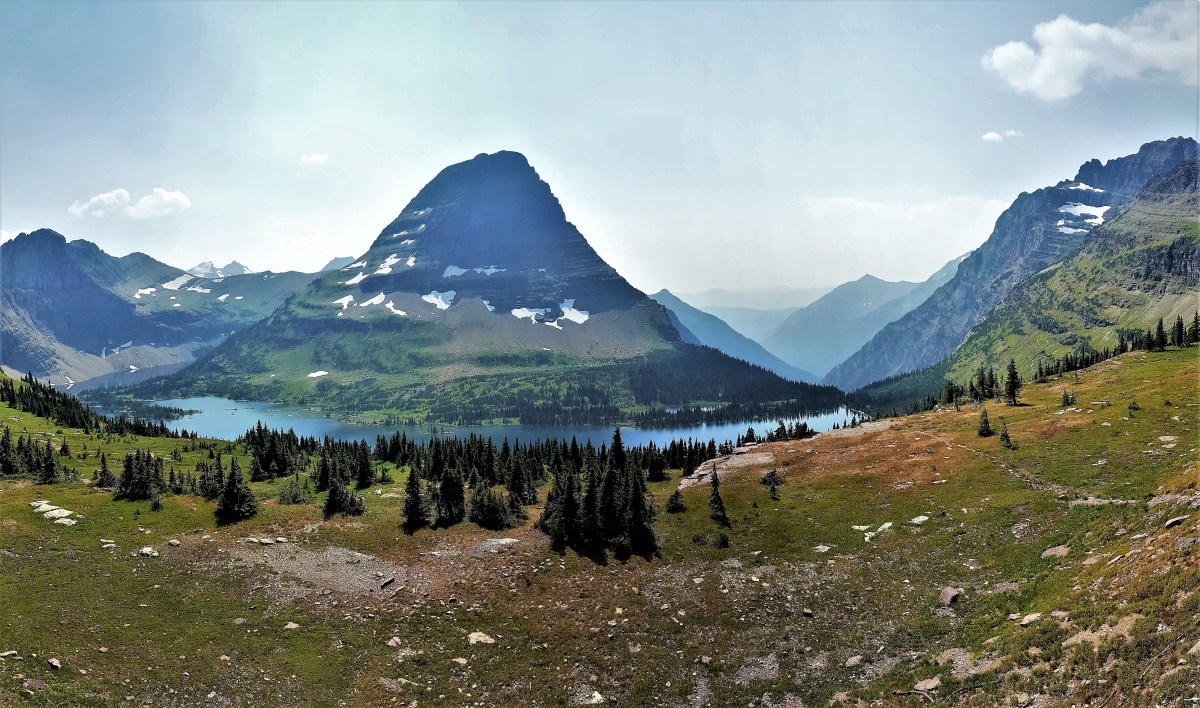
Every so often, when visiting many of the iconic vistas across America, I’d struggle to capture the overwhelming awesomeness of the landscape around me.

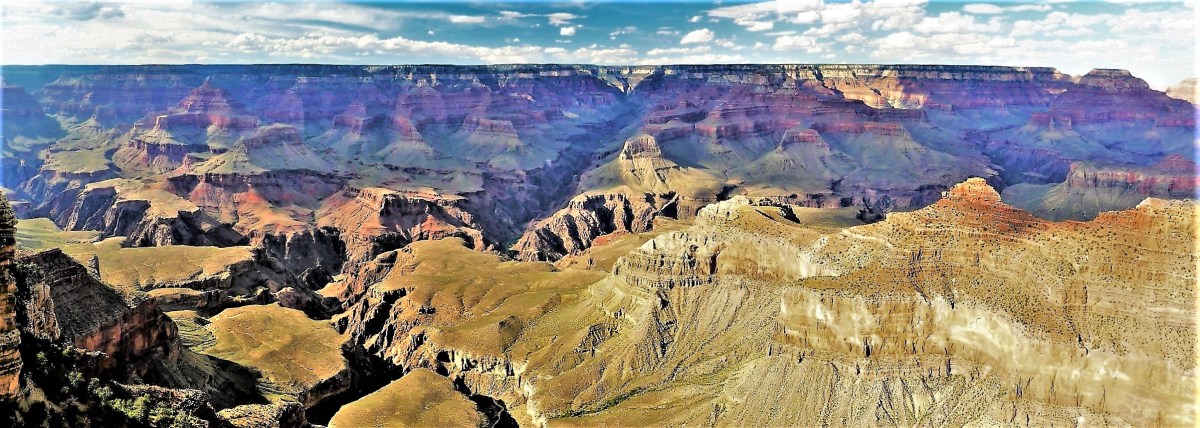
Grand Canyon NP
South Rim, Grand Canyon National Park

Framing the image through my viewfinder frequently posed a tremendous challenge to adequately represent the expansive angle of the surrounding landscape.

Palo Duro Canyon
Palo Duro Canyon, TX

That’s when I knew it was time to put down my Lumix and pick up my phone.

Mount Victoria, Banff NP
Lake Louise, Banff National Park

By turning to the panorama feature of my Samsung Galaxy S8,

Johnson Ridge, Mt. St. Helens National Monument

I found a tool that brought me closer to recording longer distances.

Zabriskie Point, Death Valley NP
Zabriskie Point, Death Valley National Park

By instantly and seamlessly stitching successive shots with integrated photo-manipulation software,

Iceberg Pass, Rocky Mountain NP
Iceberg Pass, Rocky Mountain National Park

I found another way to express the world around me.

Shenandoah Valley
Blue Ridge Mountains, NC

Panoramas provide an opportunity to share multiple perspectives simultaneously,

Horseshoe Canyon, Drumheller
Horseshoe Canyon, Drumheller, Alberta

gathering as wide an angle as the scene allows–

Watermark Vista, Capital Reef NP
Watermark Vista, Capital Reef National Park

–eliminating the frame lines and expanding the aspect ratio to maximum effect.

Rainbow Trail, Valley of Fire
Rainbow Trail, Valley of Fire, NV

When used appropriately,

High Bluff, Redwoods NP
High Bluff, Redwoods National Park

whether in color…

Great Smoky Mountains NP
atop Clingmans Dome, Great Smoky Mountains National Park

or black and white…

Mount Rushmore National Monument
Mt. Rushmore National Monument

there is no better way to establish a field of infinite view without sacrificing the integrity of the image.

Badlands NP panorama
Badlands National Park

Conversely,

Bald Butte, Cypress Hills PP
Bald Butte, Cypress Hills Provincial Park, Saskatchewan

a case can be made for showcasing the apparent aberrations and distortions that can arise from difficulty interpolating the multiple parallax points across a scene,

Cinder Cone Crater, Lassen Volcanic NP
Cinder Cone Crater, Lassen Volcanic National Park

thus creating something unique and/or imaginary.

Athabasca River, Jasper NP.jpg
Athabasca River, Jasper National Park

For instance, flattening a circular garden path…

Mable's Rose Garden of Ca'd'zan, Sarasota
Mable’s Rose Garden of Ca’d’Zan, Sarasota, FL

or warping a linear edifice.

Crescent Hotel, Eureka Springs, AR

Additionally,

Cedar Pass, Badlands, NP
Cedar Pass, Badlands National Park

by stepping away from the camera,

Bryce NP, Amphitheater
Amphitheater, Bryce Canyon National Park

and freeing oneself from the single-mindedness of staring,

Bryce NP, Yav Point
Bryce Canyon National Park

focusing,

Bryce NP, Queen's Garden
Queen’s Garden, Bryce Canyon National Park

composing through a viewfinder,

Canyonlands, NP Crater
Upheaval Dome, Canyonlands National Park

a feeling of liberation arises,

El Capitan and Cathedral Mountain, Yosemite NP
El Capitan and Cathedral Rock, Yosemite National Park

which can also deliver a moment of greater clarity of vision…

Waterfowl Lake, Jasper NP
Waterfowl Lake, Jasper National Park

and kinetic connectedness to the photograph,

Grand Tetons NP
Grand Tetons National Park

as the body slowly rotates to encapsulate the scene.

Rainbow Curve, Rocky Mountain NP
Rainbow Curve, Rocky Mountain National Park

What follows is a retrospective of panoramic images of some of my favorite places,

Painted Desert, Petrified Forest NP
Painted Desert, Petrified Forest National Park

in an attempt to convey the diversity,

panarama scenic canyon (2)
Capitol Gorge, Capitol Reef National Park

and beauty of wide-open spaces across America,

Olympia NP, Hood Canal.jpg
Hood Canal, Olympic National Park

albeit,

Athabasca Glacier
Athabasca Glacier, Columbia Icefield

with a word of advice:

Lake 4, Jasper NP
Lake 4, Jasper National Park

Although this post can be enjoyed on a mobile device,

Painted Canyon, Theodore Roosevelt NP
Painted Canyon, Theodore Roosevelt National Park

many of the images are rich in detail,

Olympia NP, Olympic Peninsula
Olympic Peninsula, Olympic National Park

and are best viewed on a larger screen…

Navajo Knob, Capital Reef NP
Navajo Knob, Capital Reef National Park

to better take advantage of the breadth,

Mt. Edith Cavell, Jasper NP
Mt. Edith Cavell, Jasper National Park

the scope,

Moro Rock, Sequoia NP
Moro Rock, Sequoia National Park

the scale,

Louise Lake, Mt. Ranier NP
Louise Lake, Mt. Ranier National Park

and enormity of the subjects.

Joshua Tree, NP
Joshua Tree National Park

Also,

Bearhat Mountain & Hidden Lake, Glacier NP
Bearhat Mountain & Hidden Lake, Glacier National Park

my apologies in advance to those who are downloading on slow networks,

Gooseneck Overlook, Canyonlands, NP
Gooseneck Overlook, Canyonlands, National Park

for the generous number of photographs with large data files…

Forest Canyon, Rocky Mountain NP
Forest Canyon, Rocky Mountain National Park

may make it seem like an eternity before everything eventually loads.

Garden Wall, Glacier NP
Garden Wall, Glacier National Park

But such is the case when shooting a photograph.

Custer Battlefield National Memorial

The virtue of patience…

Bryce Canyon
Yav Point, Bryce Canyon National Park

is ultimately rewarded…

Blue Mesa, Petrified Forest NP
Blue Mesa, Petrified Forest National Park

by the satisfaction of knowing that the final image can finally be appreciated.

Brokeoff Mountain, Lassen Volcanic NP
Brokeoff Mountain, Lassen Volcanic National Park