With Amarillo behind us, we were finally on our way to Albuquerque to visit Leah’s family. Earlier in the week, Leah had made preliminary plans with Carrie, her daughter to take the grandkids to Santa Rosa, NM to visit a popular water park the day after our arrival.
But not so fast!
We were driving on I-40 West with very light traffic, and had just crossed the border into New Mexico when a couple in a pickup pulled along side me and grabbed my attention. The woman in the passenger seat looked concerned. She mimed a circle with her finger while shaking her head, and pointed in the general direction of our Airstream before the pickup sped away.
“Oh, shit!” I grumbled. “There’s trouble back there.”
“What do you mean, trouble?’ Leah asked.
“I don’t think she was playing Charades…hopefully nothing serious” I answered.
I slowed to a crawl–pulling off the road to inspect our rig.
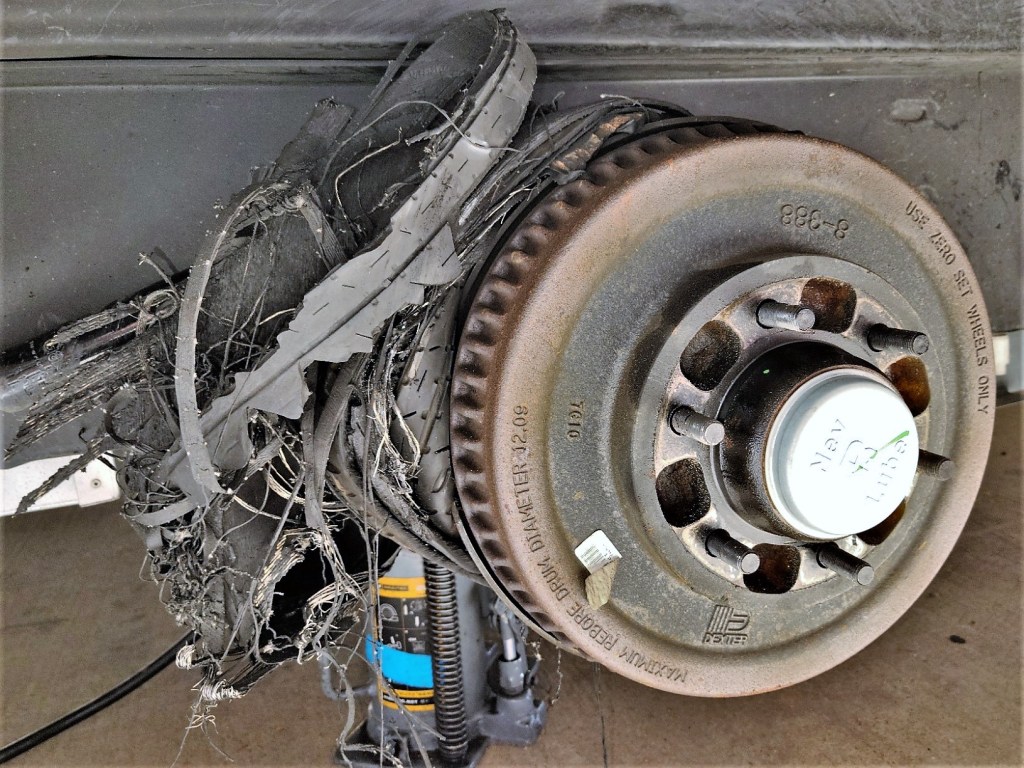
The original set of Goodyear Marathons looked nearly new upon general inspection, and I‘d only pulled the Airstream about 5,000 miles since starting out on our Great American Road Trip. Thank goodness for tandem axles. As for the blown tire, the tread was gone and the cord plies were shredded, but miraculously, the wheel and wheel well were still intact.
“We need a new tire,” I sighed. “The one that used to be there looks like spaghetti.”
“So now what? We’re in the middle of Bumfuck,” she panicked.
“Not exactly,” I tried to reassure.
“And on a Sunday to boot!” she continued.
“You’re not helping,” I advised.
Analyzing our location on GPS, I responded, “It’s showing that we passed a truck stop the moment we crossed the border.”
I called Russell’s Tire Center and learned that Cole was on-call. He agreed to meet us at the shop in half an hour. He also advised that he would be charging his travel time back to me at $95/hr. in addition to the emergency repair at $95/hr. It was a different kind of highway robbery, but I was out of options since I lacked the tools to lift a 7500 lb. trailer.
“There! It’s arranged,” I crowed. “We just need to get to the next exit and head back.”
“How are we gonna do that without a tire, genius?” she asked.
“Slowly and carefully,” I suggested.
It seemed like forever, but we limped along at 20 mph with flashers flashing until we approached the next westbound exit. Ironically, Jennifer (our GPS voice) routed our return along Route 66–parallel to I-40 West–as if she knew that slow-going was ill-suited for Interstate travel.
We got to Russell’s first and waited for nearly an hour when Cole arrived. He got straight to work. With the wheel off, I discovered what became of the tread. Luckily, no harm was done to the shock or the brake system.
Feeling insecure about using the spare under the Airstream, I opted for a new tire. When all the dust had settled, we were finally on our way to Albuquerque after a 2-hour layover and $300 in expenses. But I was feeling weary from the incident and wary behind the wheel, knowing that the other tires needed to be replaced.
90 minutes of drivetime took us to Santa Rosa, NM.
“Wait a minute! Aren’t we scheduled to drive here tomorrow with Carrie and the kids?” I asked.
“That’s right,” confirmed Leah.
“But we’re already here. Why on earth should I drive another 90 minutes to Albuquerque, only to return here the next day with your family,” I reasoned. “Why can’t they meet us here instead? They could even camp with us tonight if they want. Besides, I’m exhausted from this expensive mini-adventure.”
“Not a bad idea, Einstein,” she quipped.
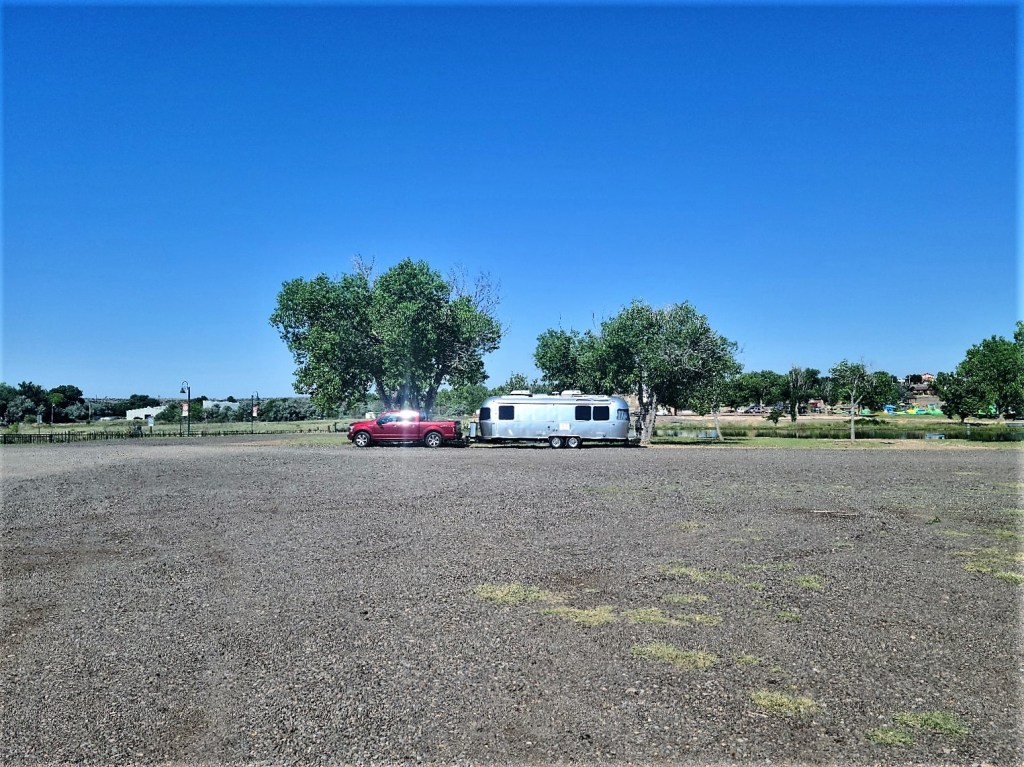
Good News! Google confirmed that 2 walk-in sites with services were still available at Santa Rosa Lake State Park. Jennifer navigated us to the park campground, where we looped around twice to locate the open sites as advertised. Turns out, one site was handicap reserved; the other site was reserved for camp host.
As with most self-help campgrounds, Leah put our payment in an envelope and dropped it into a paybox at the entrance kiosk. After plugging into the host site, it was a relief to finally kick back with a cold beer and a blast of A/C to melt my stress level.
But not so fast!
Two park rangers have approached Leah, and it didn’t go well. We have been evicted, unapologetically.
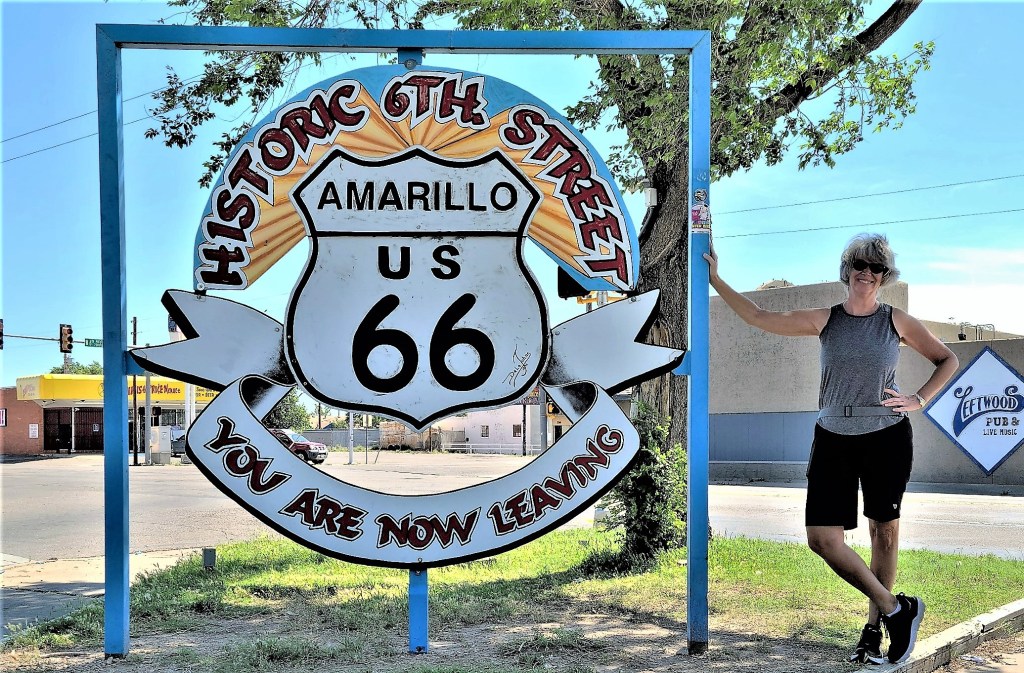
So we rolled back onto Route 66 and found an overnight spot at a local RV park. Leah made arrangements with Carrie, who eventually drove to meet us and spend the night car camping with Devin and Gabe outside our Airstream window.
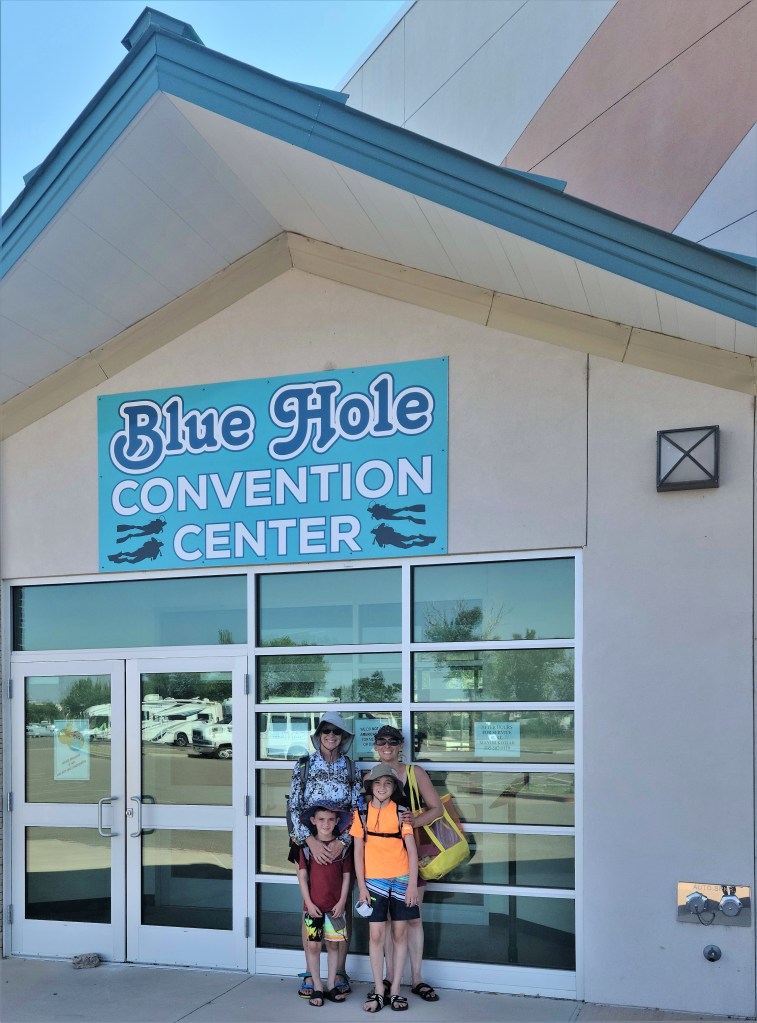
The next day, we drove to the Blue Hole—
–ready for excitement.
When we arrived, I had this nagging feeling of déjà vu.
“We’ve been here before,” I mentioned to Leah.
“I would have remembered this place,” she disagreed.
“I’m telling you, this place is very familiar to me,” I insisted.
“Maybe you were here with someone else,” she theorized.
“Nope! You were with me, and I can prove it,” I stated emphatically.
I scrolled through the picture gallery on my phone, as if by chance…until…
“There it is!” I insisted. “We were here on October 18, 2017! And here’s the picture to prove it!”
“Congratulations! You’re right again, as usual,” Leah said without conviction.
“We never went in the water,” I said, “But that’s about to change today.”
It took some coaxing, but eventually everyone braved the 61o F temperature…
except me. I was going for the whole enchilada.
I watched as several youngsters scrambled to the ledge 20 feet above the Blue Hole and jumped,
which was all the preparation I needed for my jump.
The water was freezing–enough to take my breath away. But at least I left with bragging rights.
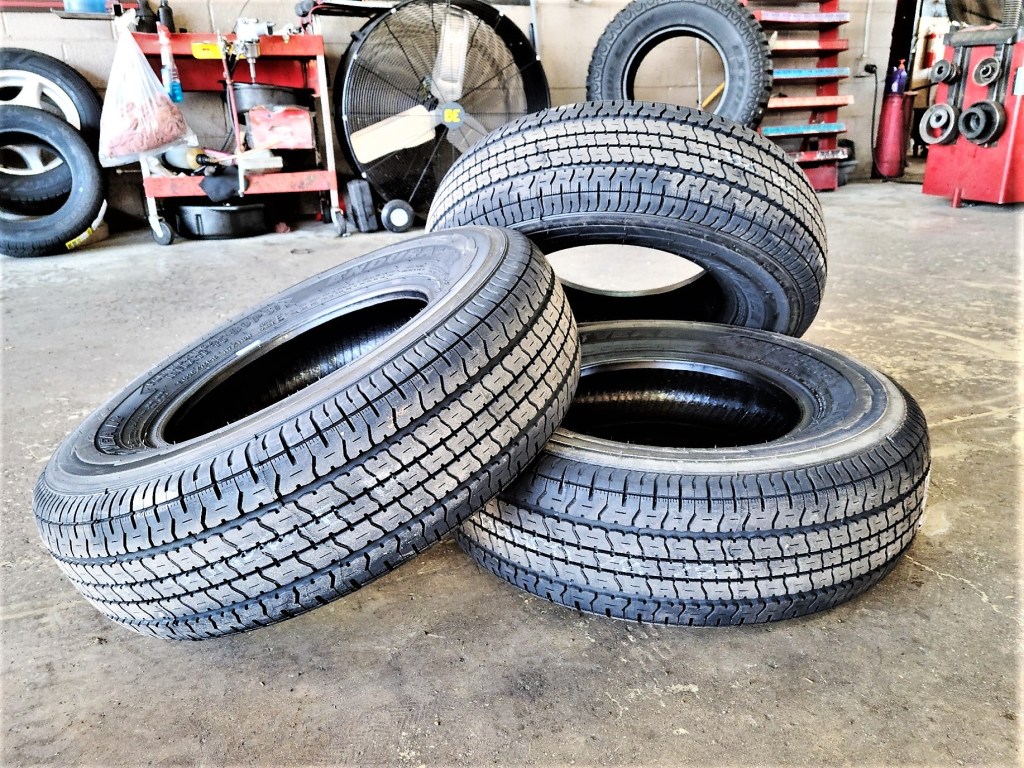
P.S. After we reached Albuquerque, our Airstream got a new set of shoes…
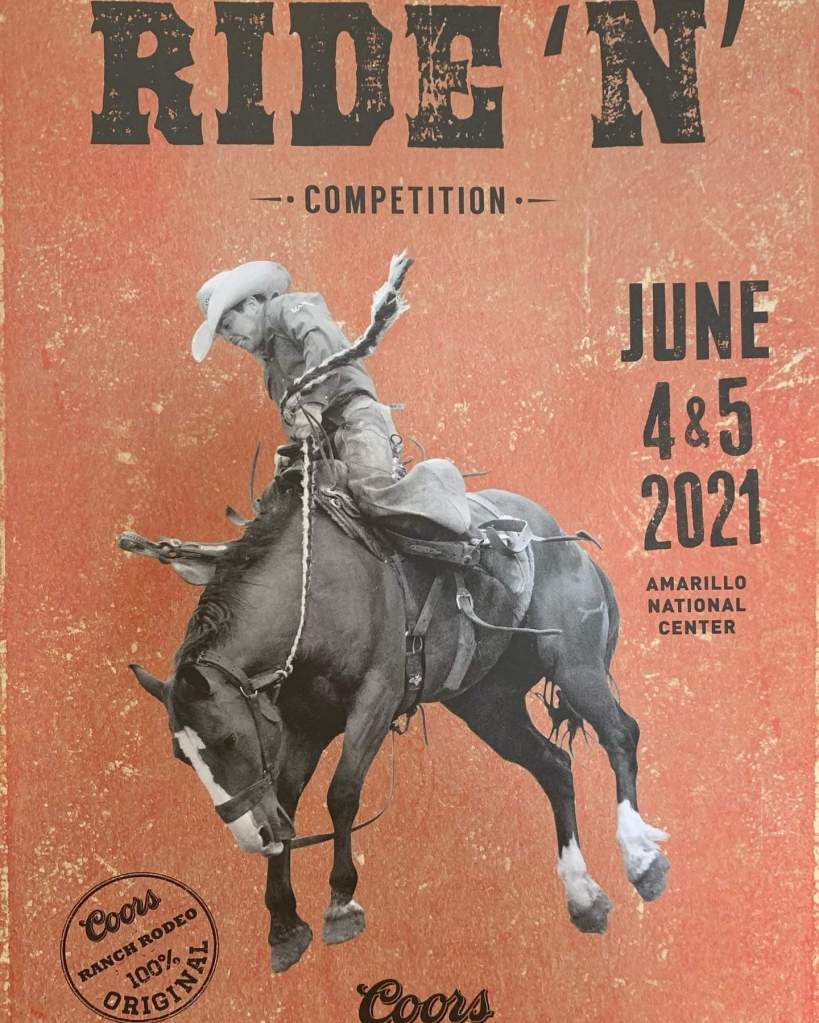
With one of the largest stockyards in the country, it’s no surprise that Amarillo, TX has its fair share of real cowboys. Every year these ranchers bring their cattle and horses to the Amarillo National Center to compete against each other in the Coors Cowboy Club Ranch Rodeo for bragging rights in Saddle Bronc Riding, Stray Gathering, Branding, Trailer Loading, and Wild Cow Milking.
The event officially started on June 3, with its annual longhorn cattle drive through downtown Amarillo. Although Leah and I arrived one day later, Dorinda Blease was there to capture the procession in her grand prize photo.
We cheered with the crowd as the same cattle were released into the arena on the second evening of the rodeo. They milled around for 15 minutes, acting rather nonplussed…
or feeling right at home…
before meandering to the other end of the arena and through the egress gates as future steaks.
After a yellow rose ceremony to memorialize the local cowboys and rodeo guardians who passed over to the Great Ranch in the Sky during the past year, the evening started with saddle bronc riding.
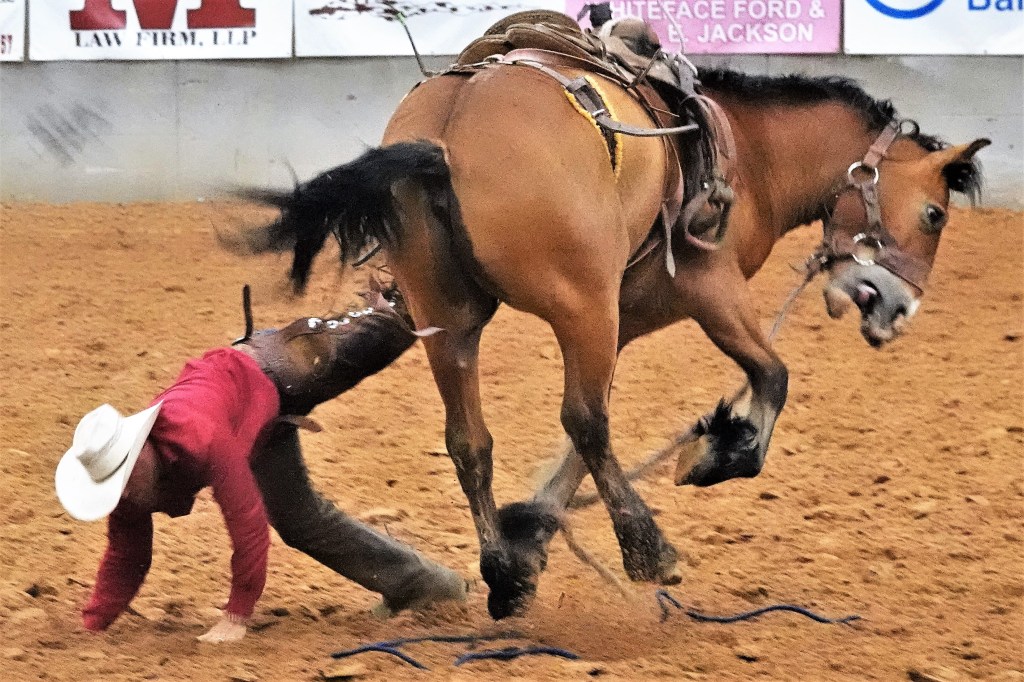
The crowd waits eagerly in anticipation as the horse and rider are carefully prepared in the bucking chute. The moment the gate is opened, the horse bursts free with the rider holding on for dear life and 8 precious seconds,
showing off his finesse, balance and agility…
or not!
A rodeo interlude for all the little cowkids (aged 4 to 7) who were brave enough to ride a slippery mutton buster kept us entertained…
and the sheep, as well.
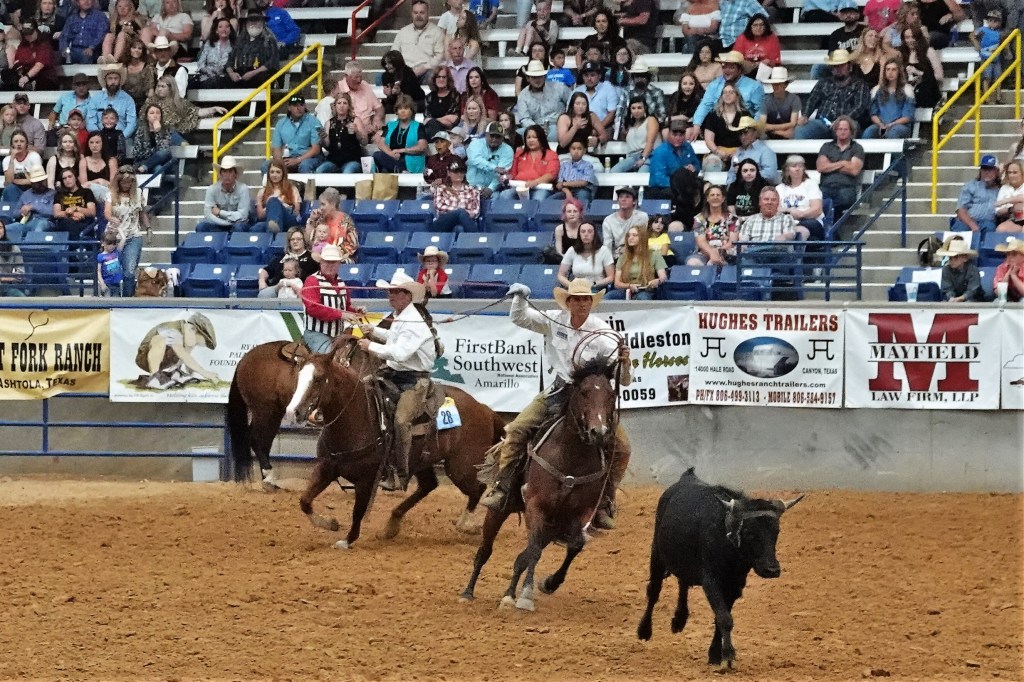
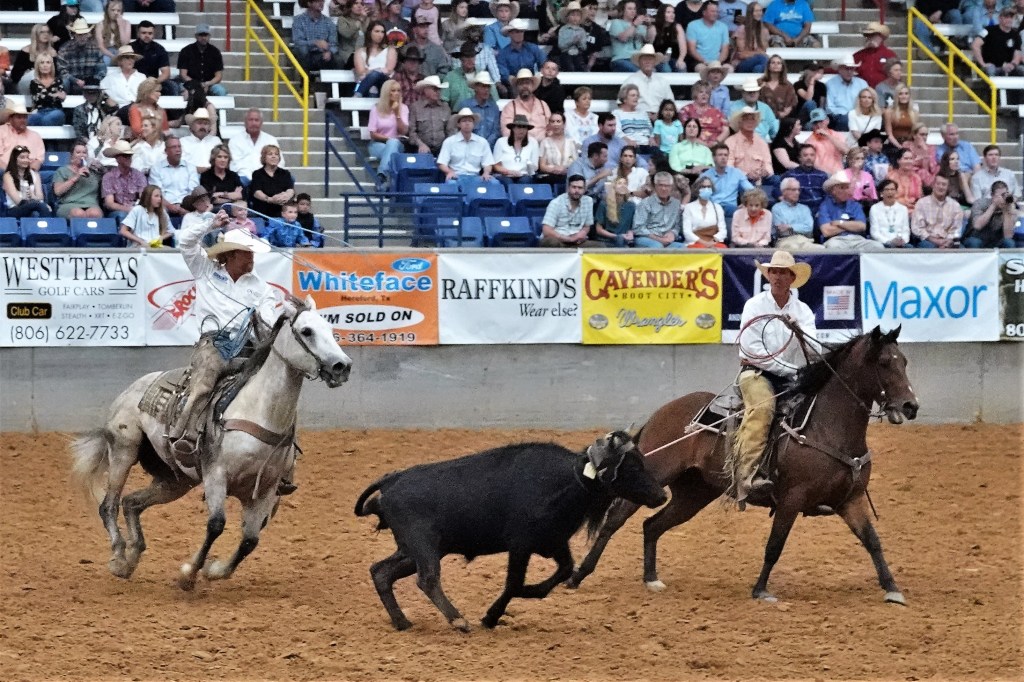
The cowboys also tested their roping skills, where they had to catch and wrangle a rogue steer to the ground before binding its legs.
With a dozen ranches competing against each other,
there were winners and losers for those keeping score.
But for me, the critters won the day.
And they could probably teach a thing or two to the guys who are pulling the wrong end for milk.
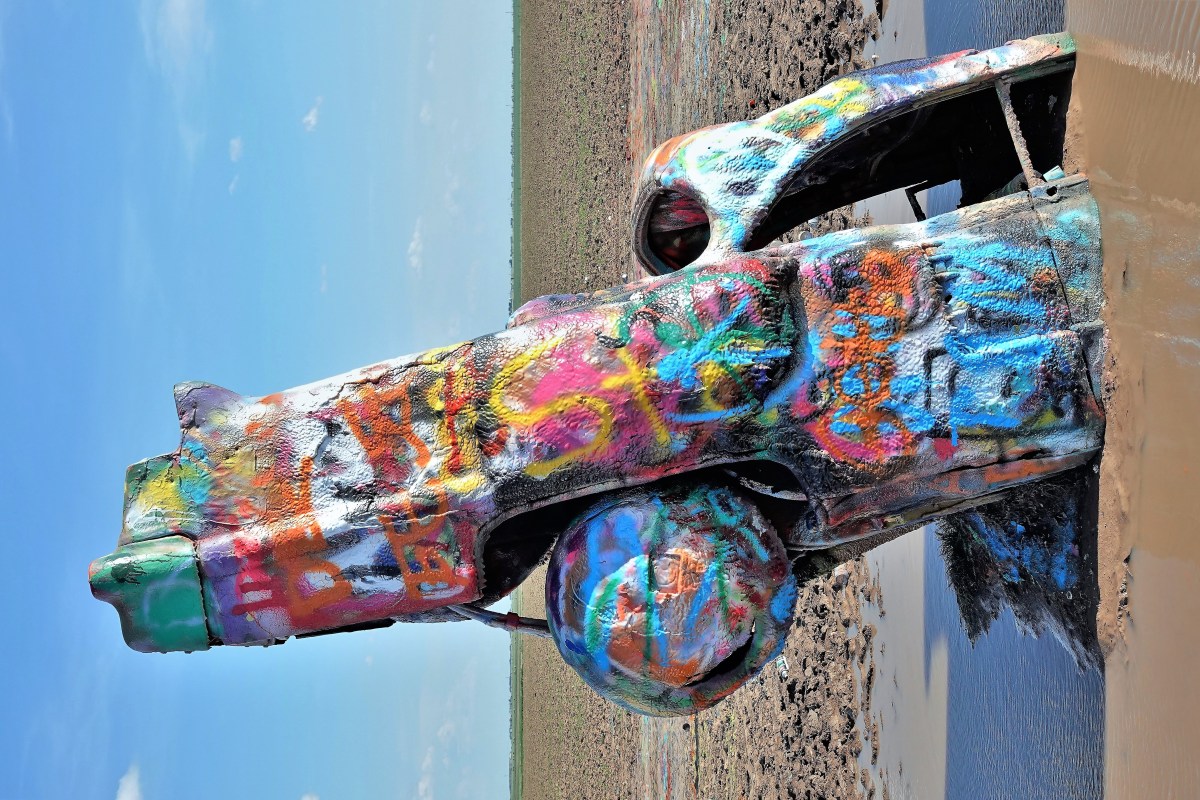
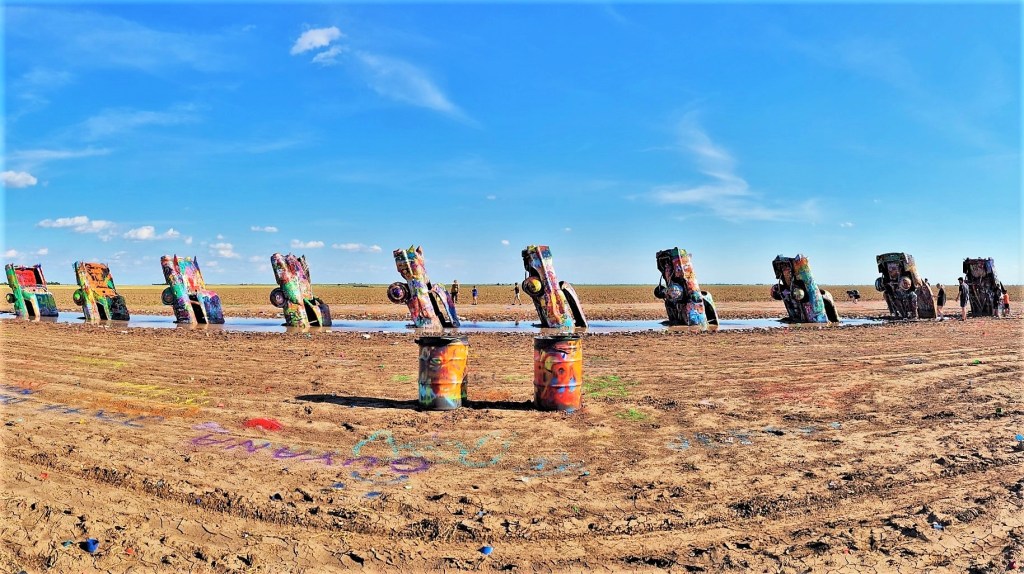
Few places on earth are more perfect for burying 10 aging Cadillacs nose first, than a hay field along I-40 East, just beyond the Amarillo, TX border.
Commissioned by Amarillo eccentric and millionaire, Stanley Marsh in 1974, Cadillac Ranch was the brainchild of Ant Farm, a San Francisco collective of architects whose counter-cultural take on consumerism inspired a Route 66 installation that’s still attracting tourists and future graffiti artists.
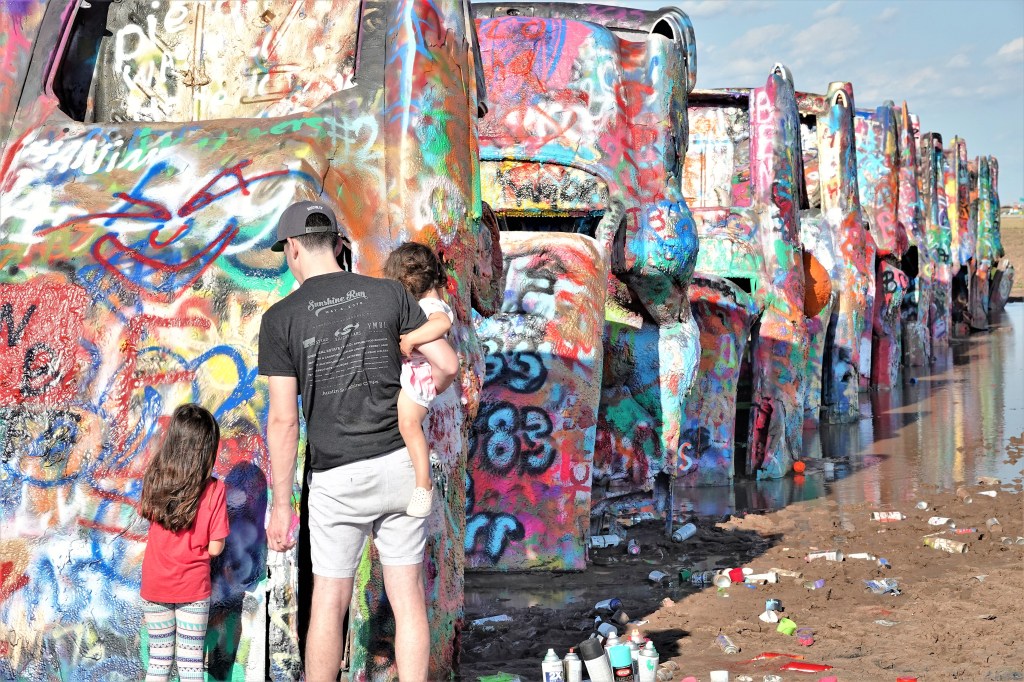
It was a carnival atmosphere when Leah and I arrived one late afternoon. Food trucks and vendors selling spray paint were parked inside the farm gates tending to families who had come to showcase their tagging talents…
albeit temporarily, since it never lasts for more than a moment when others are there for the same purpose.
Over time, the paint build-up has transformed the Cadillac shells into grotesque casualties of Rust-oleum polymers,
leaving behind a graveyard of cans…
atop freshly, blazed signatures.
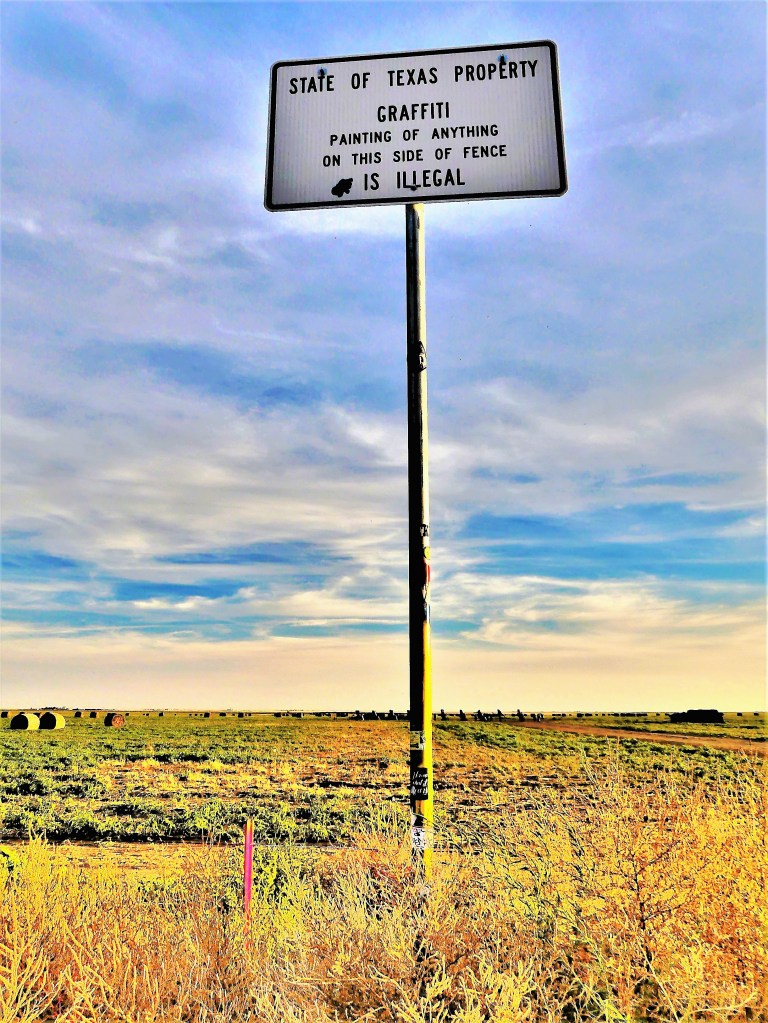
Fortunately, there are advisory signs directing people to act responsibly.
But signs are just a distraction from the real business at hand,
which is group participation in a colorful experiment of American culture and capitalism.
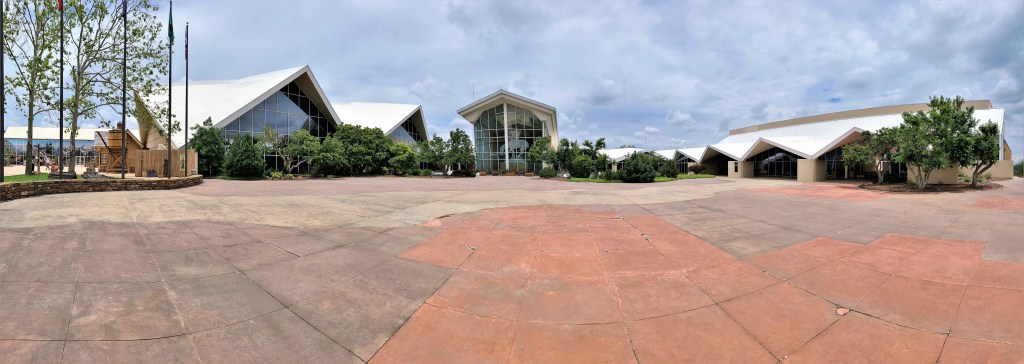
With rainy weather on the horizon in Oklahoma City, Leah and I opted for indoor entertainment, which brought us to the National Cowboy and Western Heritage Museum, home to the most extensive collection of art and artifacts of American West and American Indian culture. With more than 28,000 pieces in its collection, The National Cowboy Museum is an obvious choice for history buffs and art aficionados.
But not for Leah…
“I can’t believe we’re here, she lamented. “This is so ‘not me’.”
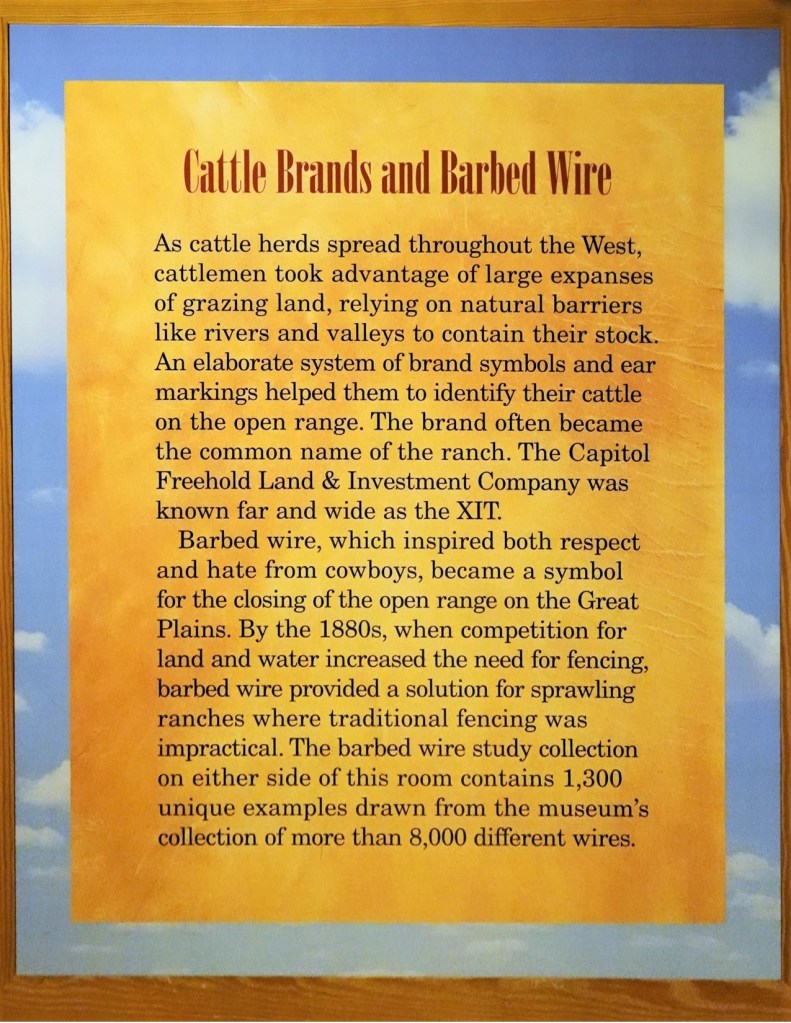
“You’re kidding me. We’re talking about a place with the largest barbed wire collection in the world! More than 8,000 different kinds.” I persuaded.
“Barbed wire isn’t really my thing,” she confessed.
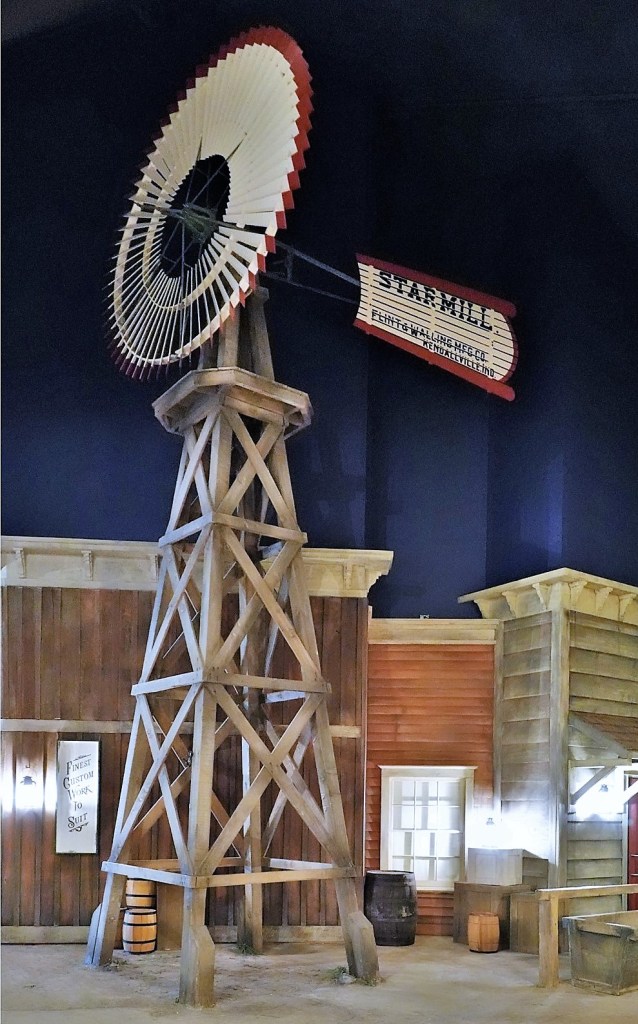
“Then how about the turn-of-the-century western town that’s been recreated indoors?” I implored.
“Certainly, you’d be interested in the structures along the simulated street that have been painstakingly rendered according to scale and design?” I wondered.
“This town may even be set up for some shopping,” I offered as an inducement.
“I’ll have to see about that when I get there,” she proposed.
“What about their Frederic Remington collection? I read that there’s an entire gallery devoted to his work,” I advertised…
“There are small bronzes…
Trooper of the Plains
Coming through the Rye
and large bronzes…
Frederic Remington: COMING THROUGH THE RYE, 1902
and paintings, too,” I hyped.
Frederic Remington: IN FROM THE NIGHT HERD, 1907
“That might be interesting,” Leah affirmed, warming up to the idea.
“Maybe we can stroll around the garden behind the museum,” I suggested.
“I believe the outdoor space might be as big as the museum galleries…
and we can pay homage to Buffalo Bill while we’re in the gardens,” I encouraged.
“That’s a possibility,” Leah conceded.
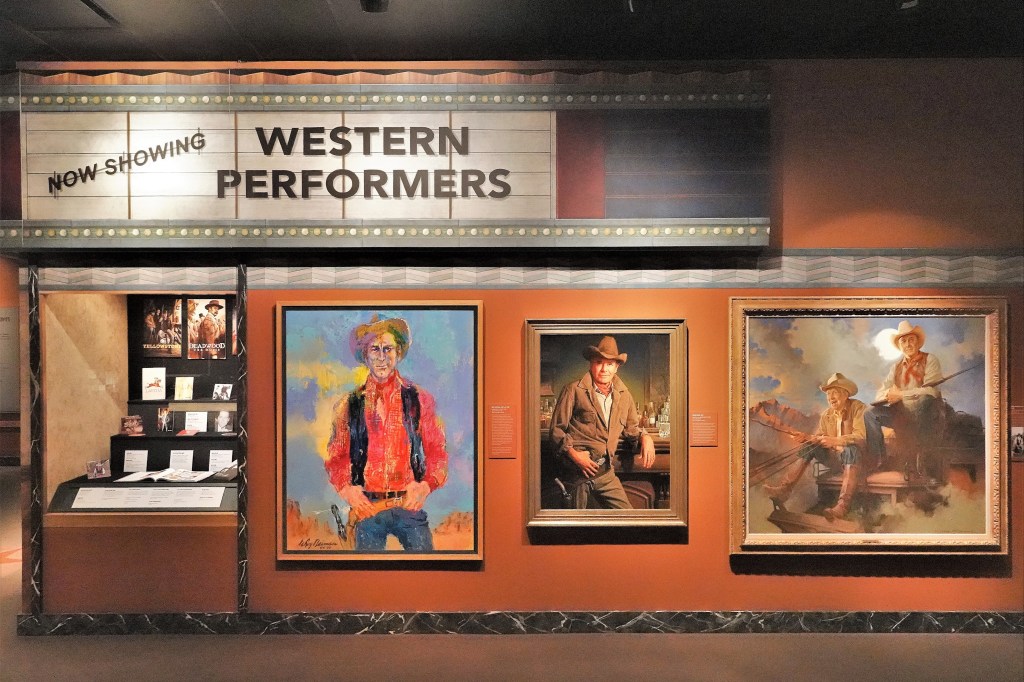
“We could also visit the Western Performers Gallery,” I recommended…
“Y’know, we’ll have a look around at all the memorabilia from our TV star cowboys,
and movie star cowboys,” I proposed.
“That could be fun,” Leah predicted.
“And let’s not overlook the western art created by all the great masters and contemporary artists,” I urged.
Charles Marion Russell: SMOKE TALK, 1924
Tom Lovell: THE HAND WARMER, 1973
William Robinson Leigh: LEADER’S DOWNFALL, 1946
Phil Epp: OUT OF THE BLUE, 2018
Clark Hulings: GRAND CANYON, KAIBAB TRAIL, 1973
Duane Breyers: TWO’S COMPANY, 1997
Wilson Hurley: WINDOWS OF THE WEST–WYOMING SUITE, 1996
Gerald Balciar: CANYON PRINCESS,1995
Martin Grelle: TELLER OF TALES, 2001
“Okay, okay! We may as well go through the place since we’re already here,” Leah admitted.
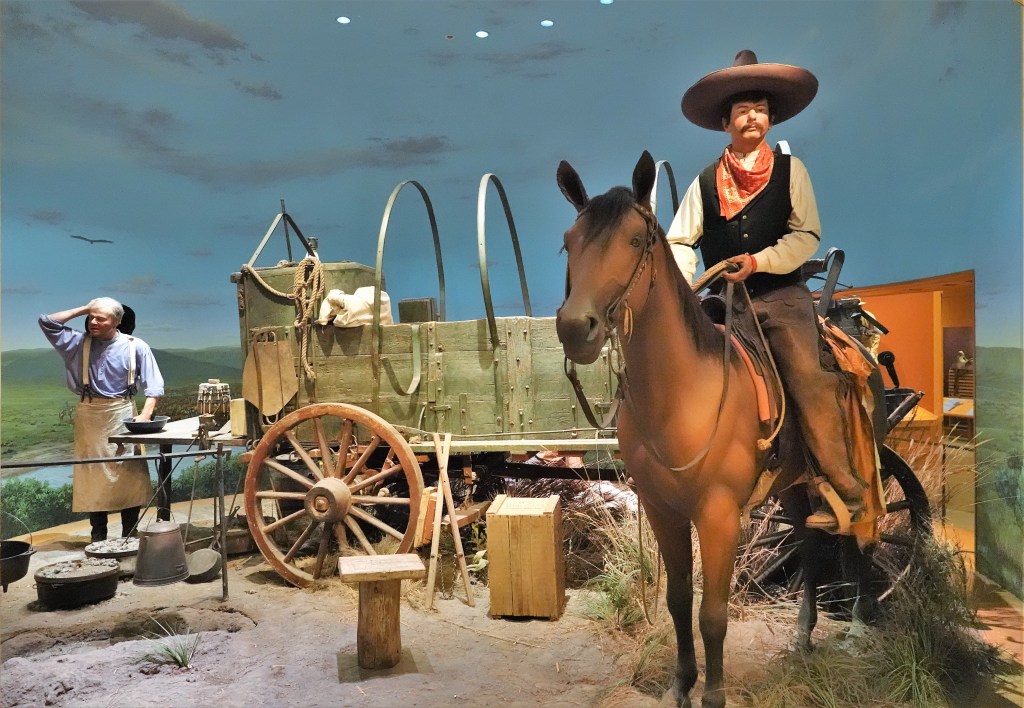
“Finally! So how about a photo of you in front of the wagon?” I suggested.
“Absolutely not!” she insisted.
Once through the entry vestibule, it was difficult to ignore the immensity of the space. Occupying a floor-to-ceiling, window-lit, cul-de-sac at the far end stood the plaster cast of End of the Trail, James Earle Fraser’s iconic 1894 image of a bowed Native American…
and his weary horse, symbolizing the defeat and subjugation of a people driven from their native lands.
“Wow, that’s impressive,” Leah remarked.
Turning the corner, we were met by an impressive stagecoach…and I could see Leah’s layers of resistance slowly fading.
We wandered past Abraham Lincoln,
James Earle Fraser: LINCOLN THE MYSTIC, 1929
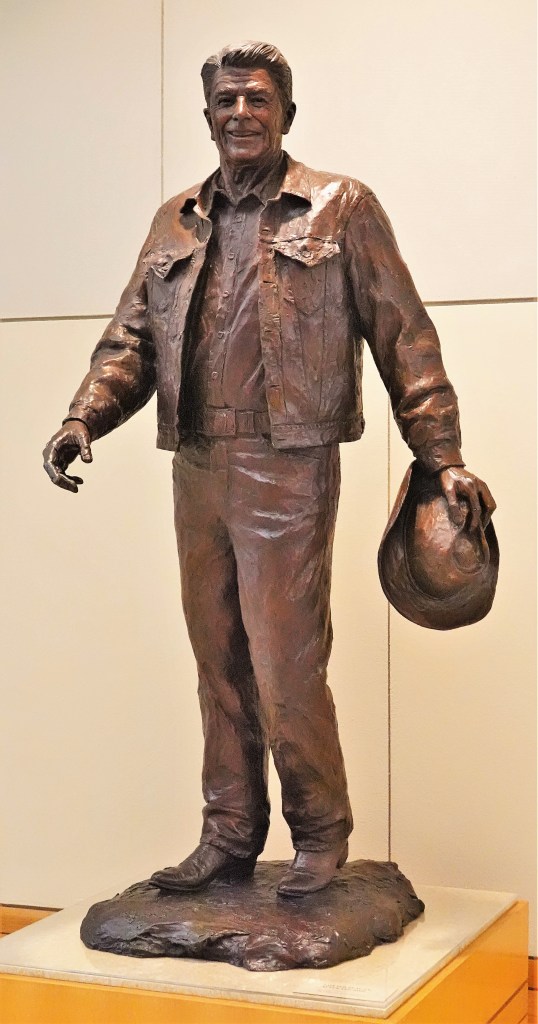
and Ronald Reagan…
Glenna Goodacre: AFTER THE RIDE, 1987
through rodeo trophy rooms, the Native American galleries, the Gallery of Fine American Firearms, the American Cowboy Gallery, and more…
and determined that this was two hours definitely well spent.
As we were leaving, I coaxed Leah once more, “Now can I get a picture of you by the wagon?”
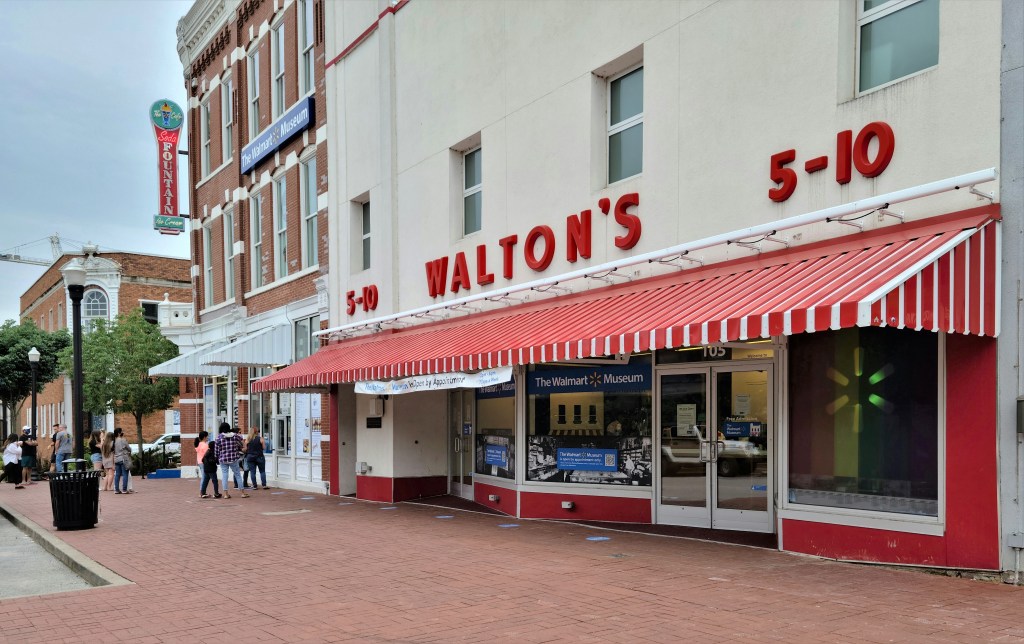
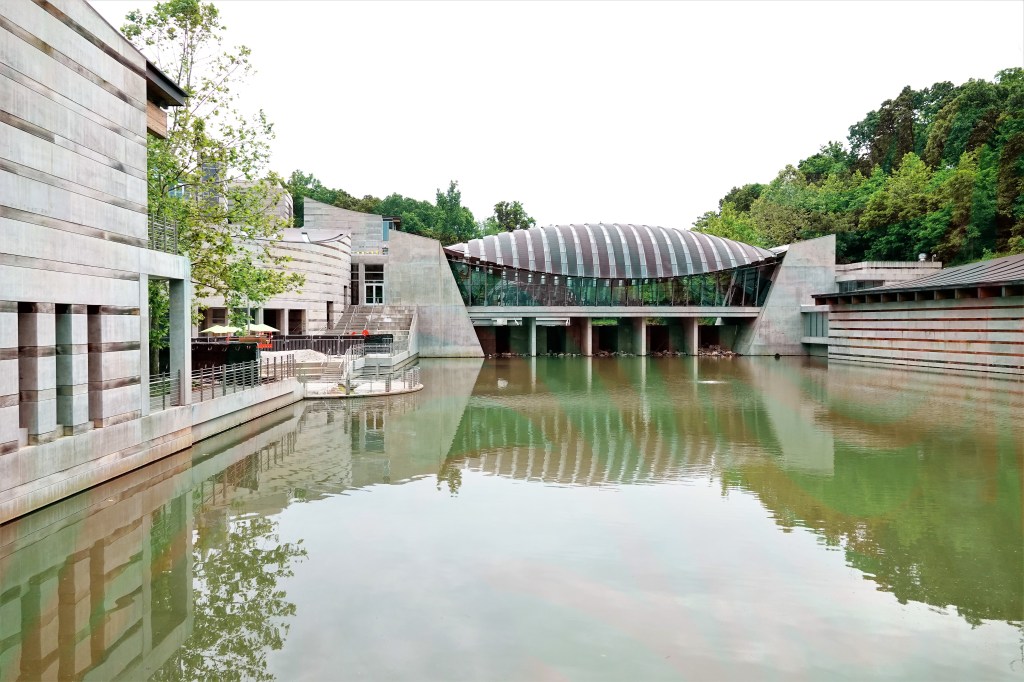
My buddy, Lee (who I’ve known since nursery school) escorted Leah and me to Crystal Bridges Museum of American Art, his local art museum in Bentonville, AR. Imagine, a world class museum in the midst of a population center of 50,000, courtesy of Alice Walton, heiress to the Walmart fortune.
Alice assigned renowned architect, Moshe Safdie to design a space, anchored by ponds and forest using generous amounts of glass and wood.
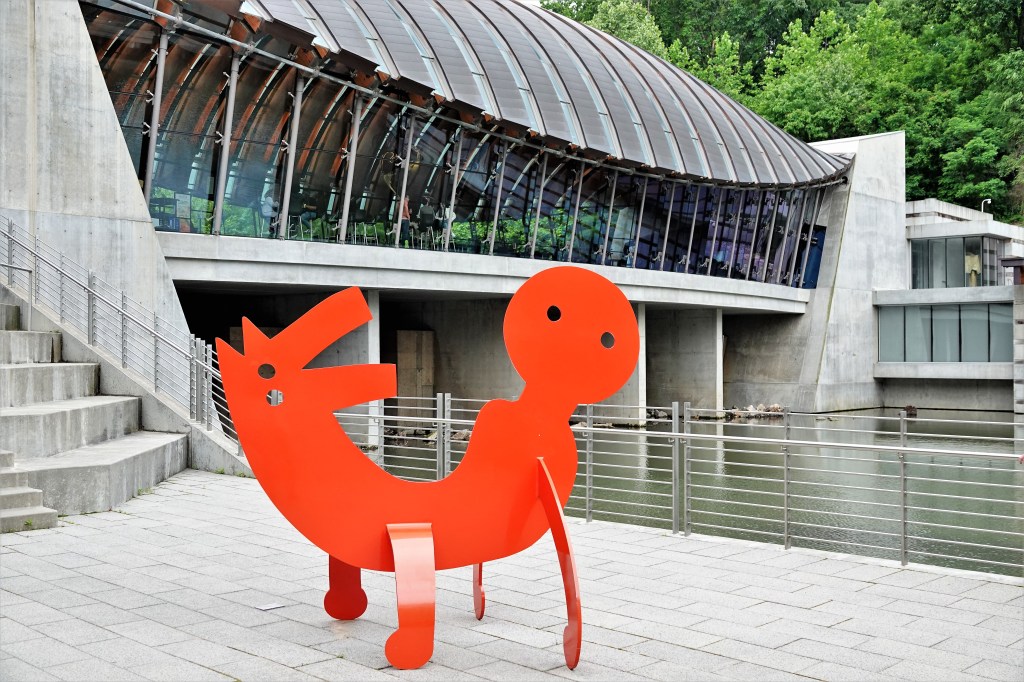
The 217,000 sq. ft. complex includes a sculpture garden,
Lowell’s Ocean by Mark di Suvero
Two-Headed Figure by Keith Haring
Fly’s Eye by Buckminster Fuller
galleries galore,
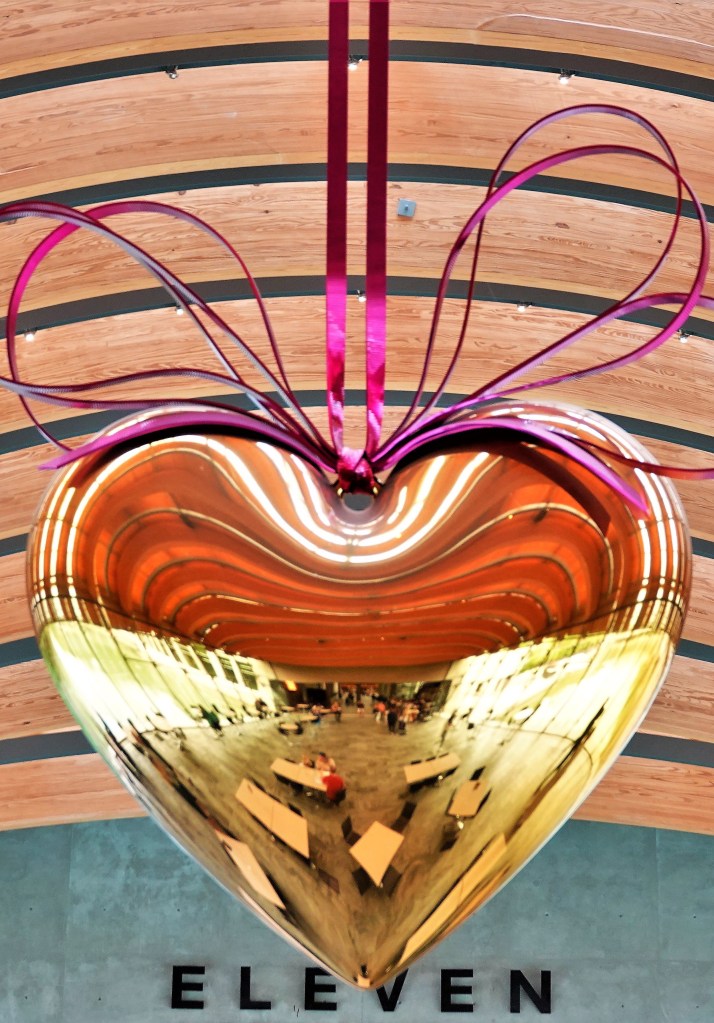
and a restaurant named Eleven, to commemorate the day the museum opened (11/11/11). And admission is free!
It quickly became apparent that there was so much to see that we could have easily spent days walking through the wings, just to take it all in; it was overwhelming. And some of the rooms had walls that were tiered with art from floor to ceiling. It’s no surprise that museum officials have recently announced plans to increase gallery space by an additional 100,000 sq. ft.
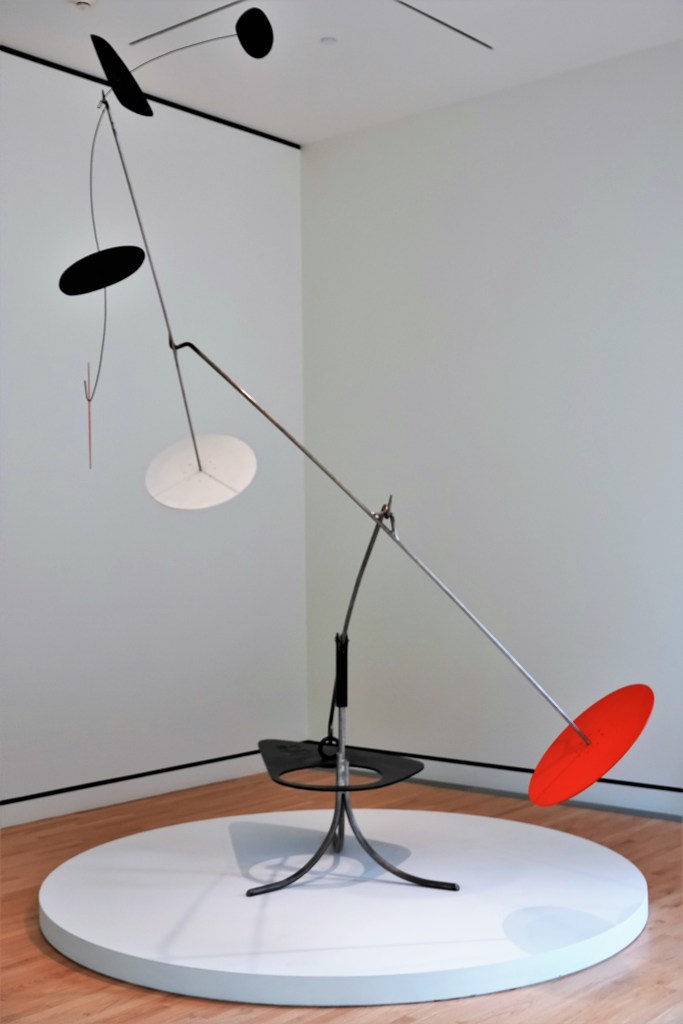
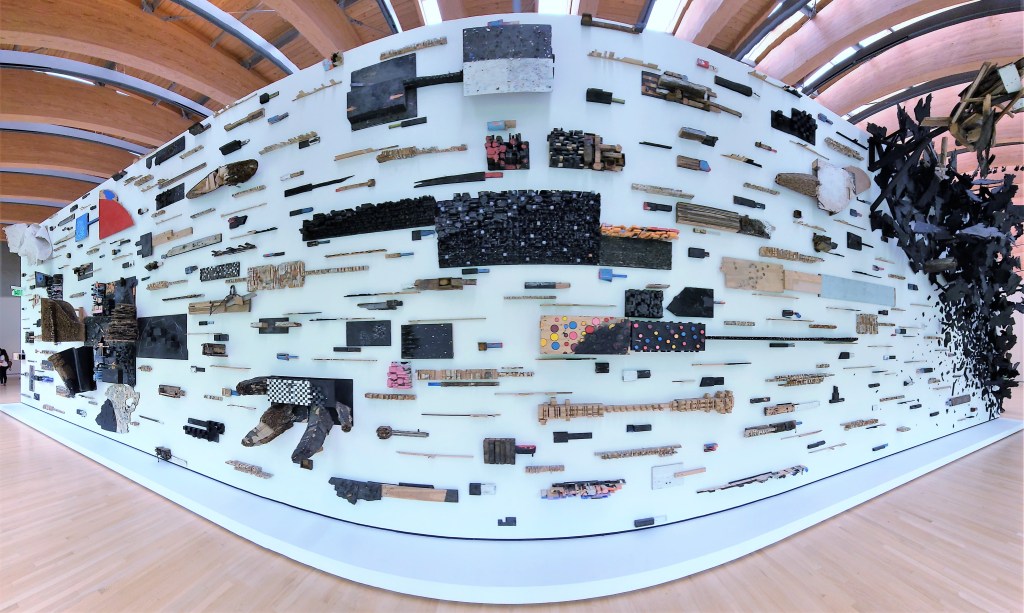
Wanting to see as much of the space as possible, we quickly steered through the exhibition halls looking and reflecting, before moving on to the next art moment. However, some of the art that caught my eye has been curated for this post (in no particular order).
As much as I enjoyed documenting the paintings, collages and sculptures within the museum, I found it impossible to ignore the fantastic geometry that surrounded us that was equally worthy of photographing, like the echo dome in the museum vestibule…
or the Fuller dome in the garden…
But the final shape I reserve for Lee and Deb for their Arkansas hospitality.
Humans have been taking baths for millennia. The practice of releasing toxins in hot springs dates back tens of thousands of years to the Neolithic Age, when nomadic tribes would soak in thermal waters they accidentally discovered when seeking relief from winter weather.
And there is archeological evidence from the 1900’s from Pakistan, where the earliest public bathhouses were discovered in the Indus River Valley around 2500 BC.
In, fact, every known culture around the world has demonstrated a special bathing ritual with roots in therapeutic cleansing of body, mind and soul.
No doubt, Native Americans enjoyed the 147o F waters that flowed from the lower western slope of Hot Springs Mountain in Arkansas. This area was first occupied by the Caddo, and later the Quapaw, who eventually ceded this territory to the U.S. government in an 1818 treaty.
70 years before the National Park Service was established by Teddy Roosevelt, Andrew Jackson declared Hot Springs the first federal reservation in 1832, intending to protect this natural resource.
Scientists ran measurements and evaluated the springs’ mineral properties and flow rate. In journaling their finding, they numbered the springs and rated them according to temperature.
Immediately after, bathhouses began springing up around town to indulge the many guests who would travel to Hot Springs to avail themselves of the water’s restorative powers.
But trouble was brewing closer to the mountain. Ral City emerged as a community of indigents who had no use for fancy bathhouses, and subsequently dug pools beside the springs so they might enjoy the thermal water.
But not before the government put a stop to that and instituted policy that “preserved” and regulated the springs. Fearing contamination, the reservation superintendent ordered the pools filled in, and the transients relocated to a distant spring to appease the bathhouse owners in town.
Enterprising businessmen like railroad magnate, Samuel Fordyce saw potential in Hot Springs, and invested heavily in the town’s infrastructure. He financed construction of the Arlington Hotel in 1875–the first luxury hotel in the area…
and vacation residence to every known celebrity, movie star and gangster of the era.
Fordyce also imagined an international spa resort that could rival Europe’s finest, and opened the opulent Fordyce Bathhouse in 1915.
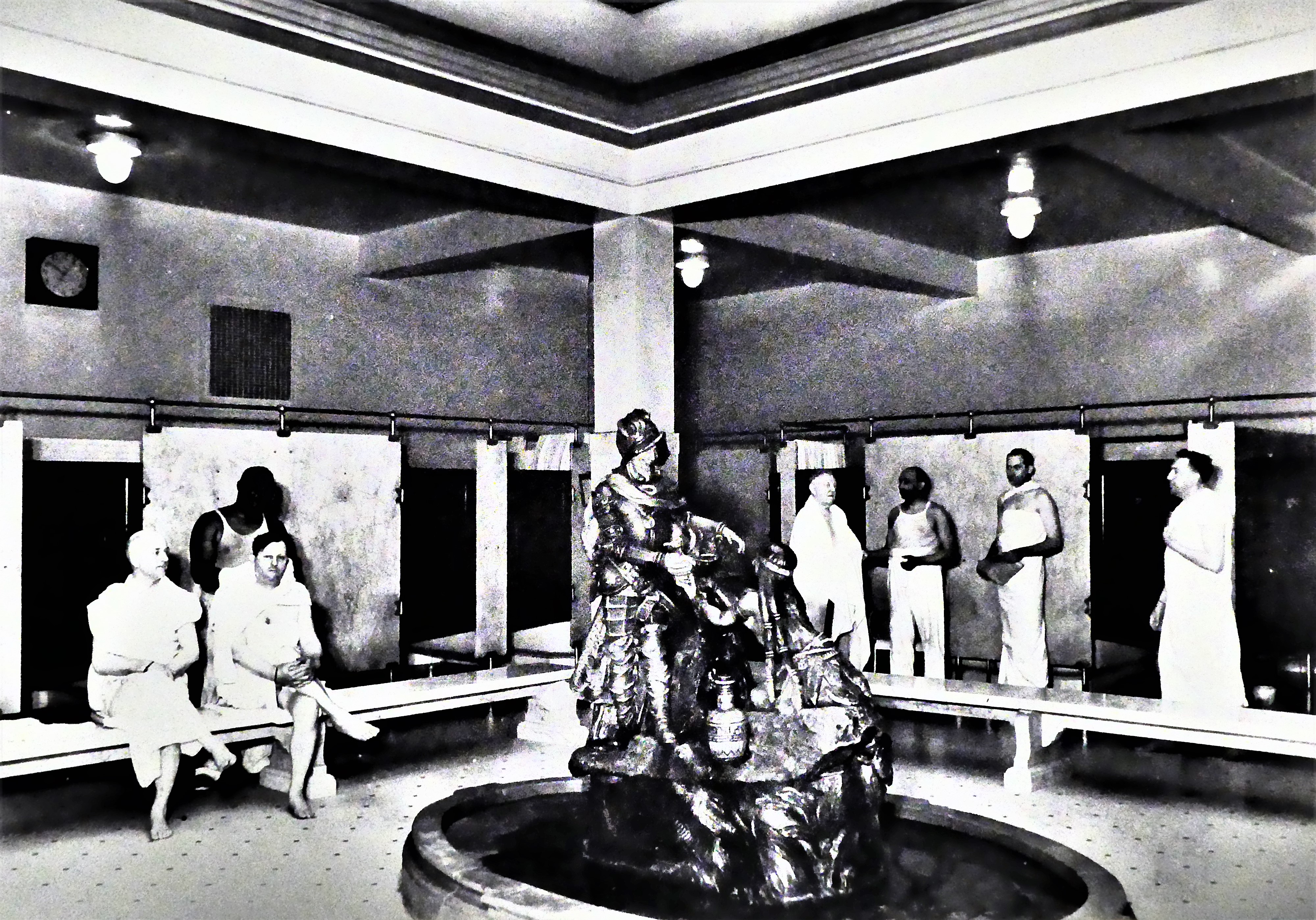
The National Park Visitor Center now occupies this bathhouse–which has been painstakingly restored to reflect the gilded age of health spas, and how turn-of the-century America tapped into Hot Springs’ healing waters to bathe in luxury and style.
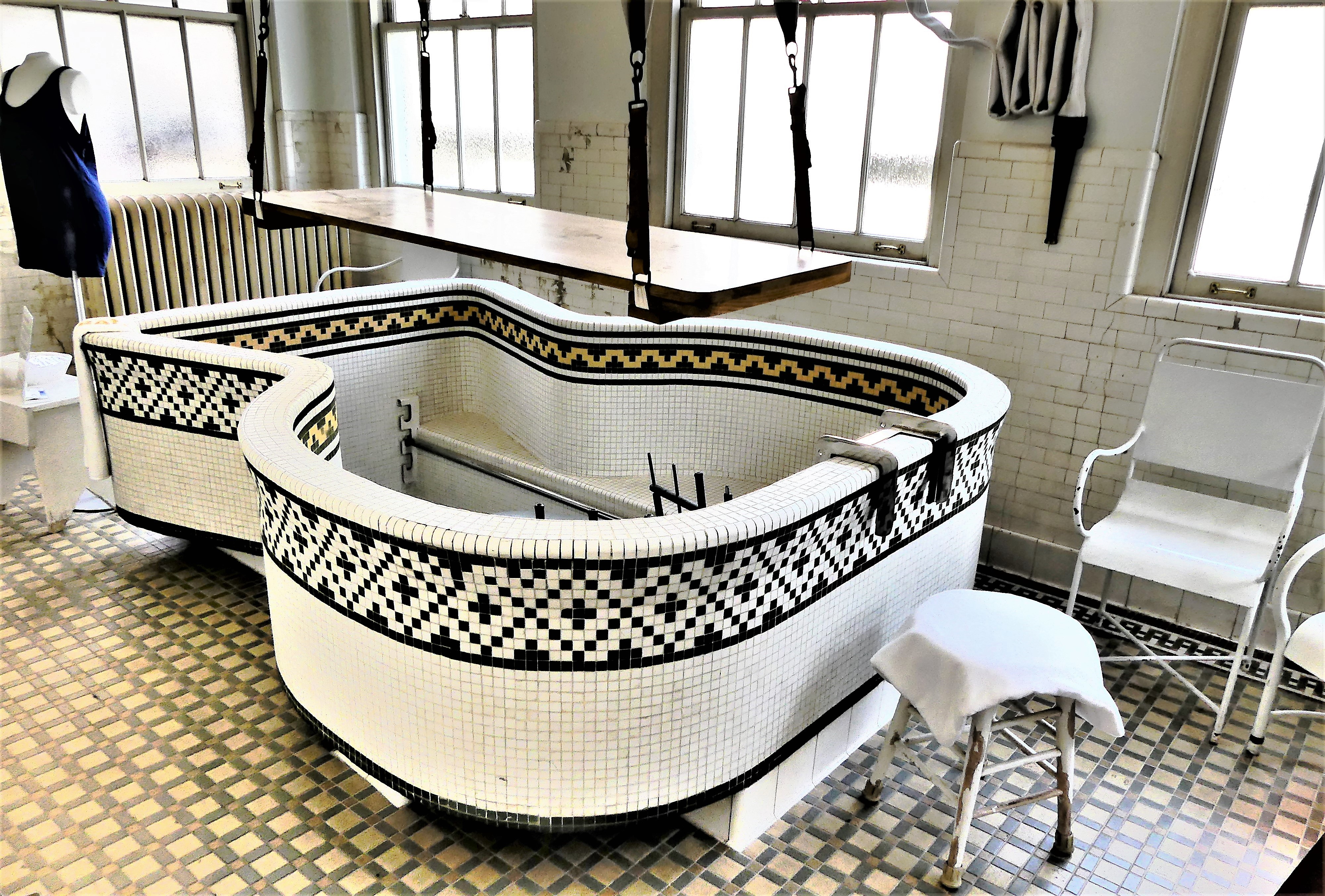
There were many different ways to indulge in water treatments…
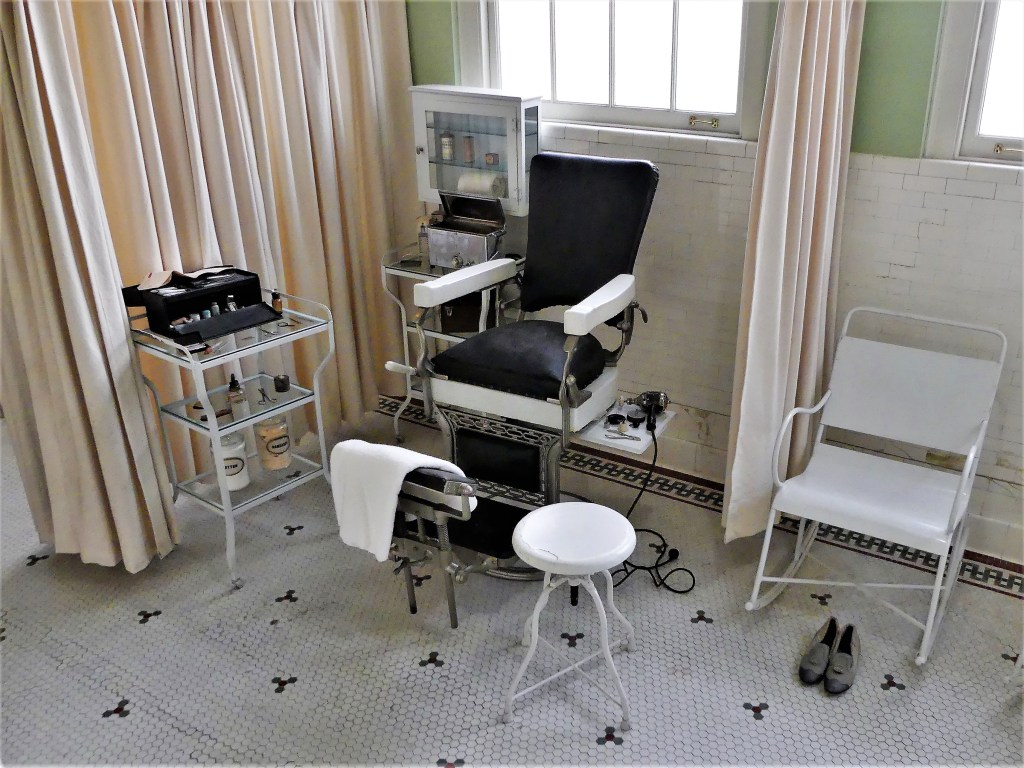
But a menu of ancillary services was also available, such as: massage, chiropody, facials, manicure/pedicure, and exercise, etc…
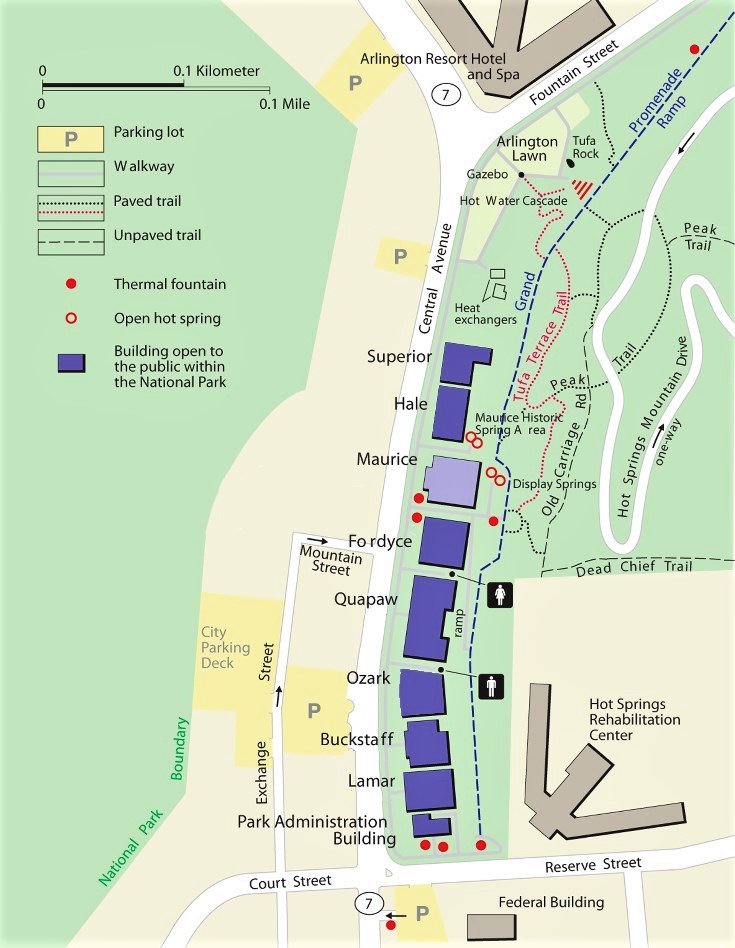
Bathhouse Row quickly filled with competition along Central Avenue,
each one designed with classic architectural details.
and anchored by Hot Springs Rehabilitation Center on the south end of the street.
Formally known as the Army-Navy Hospital, it was the site of the nation’s first general hospital for Army and Navy patients built after the Civil War–treating the sick and wounded through World War II. Subsequently, it became a residential resource center for training young adults with disabilities, but state of Arkansas shuttered the facility in 2019, and the building is now derelict and fallen into disrepair. Currently, it stands as the world’s largest raccoon hotel.
We visited Hot Springs during Memorial Day weekend, and the sidewalks were teeming with families and couples who were happy to return to the land of the living after a year of coronavirus hibernation. Businesses were enjoying record crowds, and the bath houses had finally reopened to the public.
Unfortunately, Leah and I were too late to the party; there were no spa reservations to be had. Water, water everywhere, and not a drop to drink.
So we took a hike up the mountain, spotted a turtle in the middle of the trail,
and continued to the Mountain Tower,
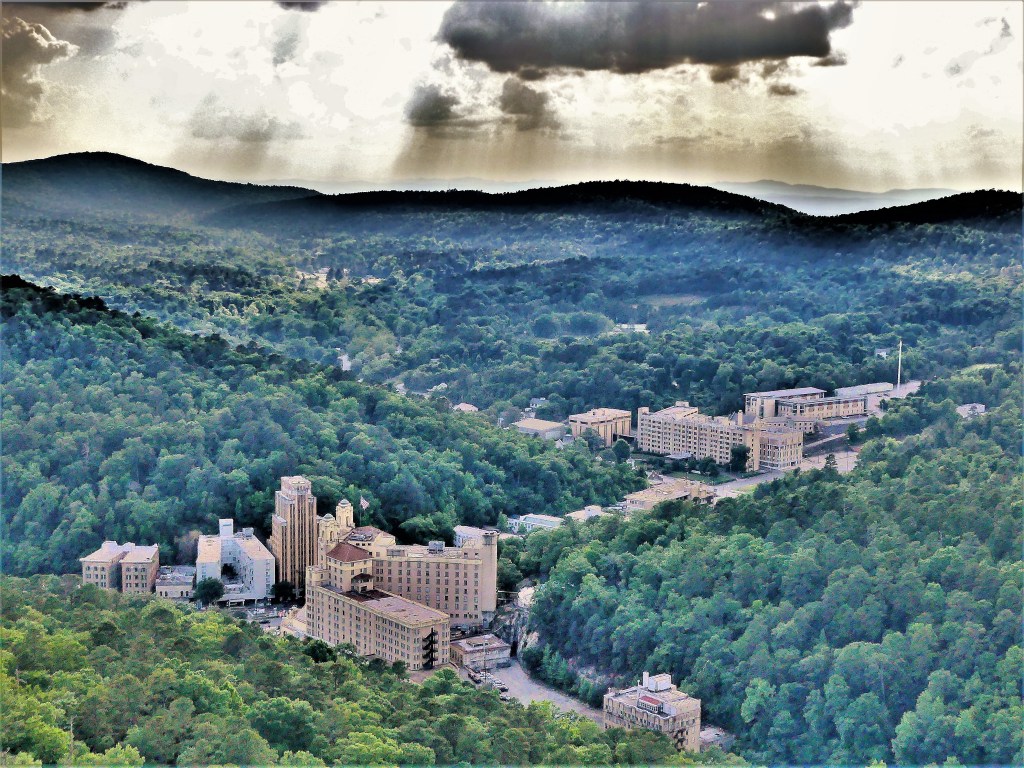
offering majestic, mouth-watering views of hidden springs beneath us, while we massaged each others’ neck and shoulders.
After motoring through half of America in our Airstream for the past 1 ½ months and reporting travel highlights along the way (http://streamingthruamerica.com),
I’m temporarily suspending the chronological order of my posts to confess that I’m not as young as I used to feel. I’m usually up for a reasonable physical challenge, but I have to admit that today’s climb did not go as easily as I wanted it to.
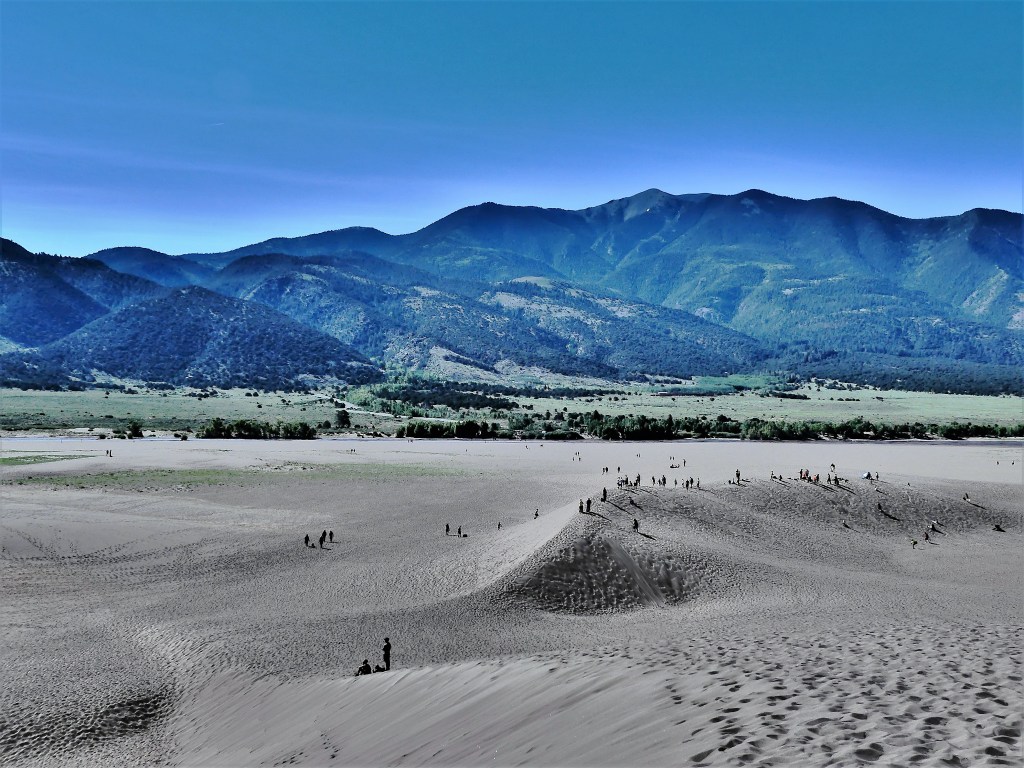
Yesterday, Leah and I crossed from Taos, New Mexico to Alamosa, Colorado, and settled in at Base Camp Family Campground by midday. After hiking in Taos the past 2 days, we thought we had acclimated nicely to the thinner air (more to be said on that later), but we were feeling our age after our arrival. We took an early siesta in air-conditioned comfort, followed by a 27-mile sprint to the Great Sand Dunes National Park Visitor Center just before it closed.
The park ranger suggested a climb to the top of High Dune (699 feet), but to keep in mind that tomorrow’s high will reach 92o F. He recommended a 9:00 am start time in order to reach the top of the dune by noon, and before the surface temperature exceeds 150o F. The ranger predicted the 2 ½-mile trek should average 2 hours, round trip.
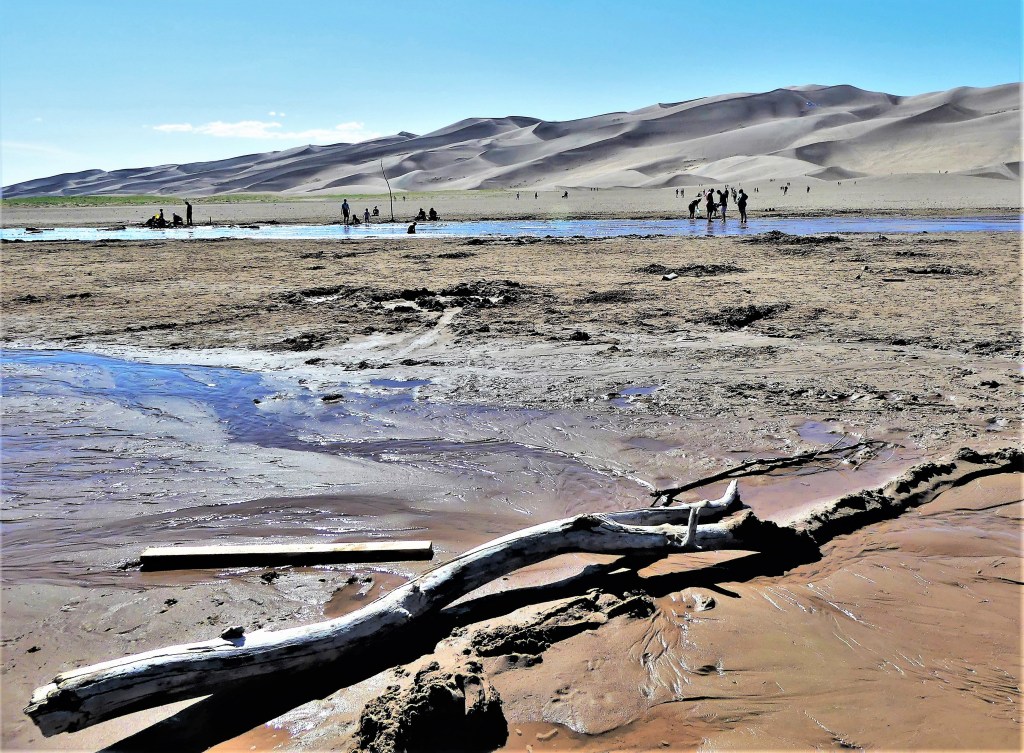
Since we were already at the park, we decided to have a look around. We found it very refreshing to glide through three inches of snow melt, ebbing and flowing from the Sangre de Cristo Mountains.
Considering it was a Sunday afternoon, and peak traffic was winding down,
there was still plenty of activity around us;
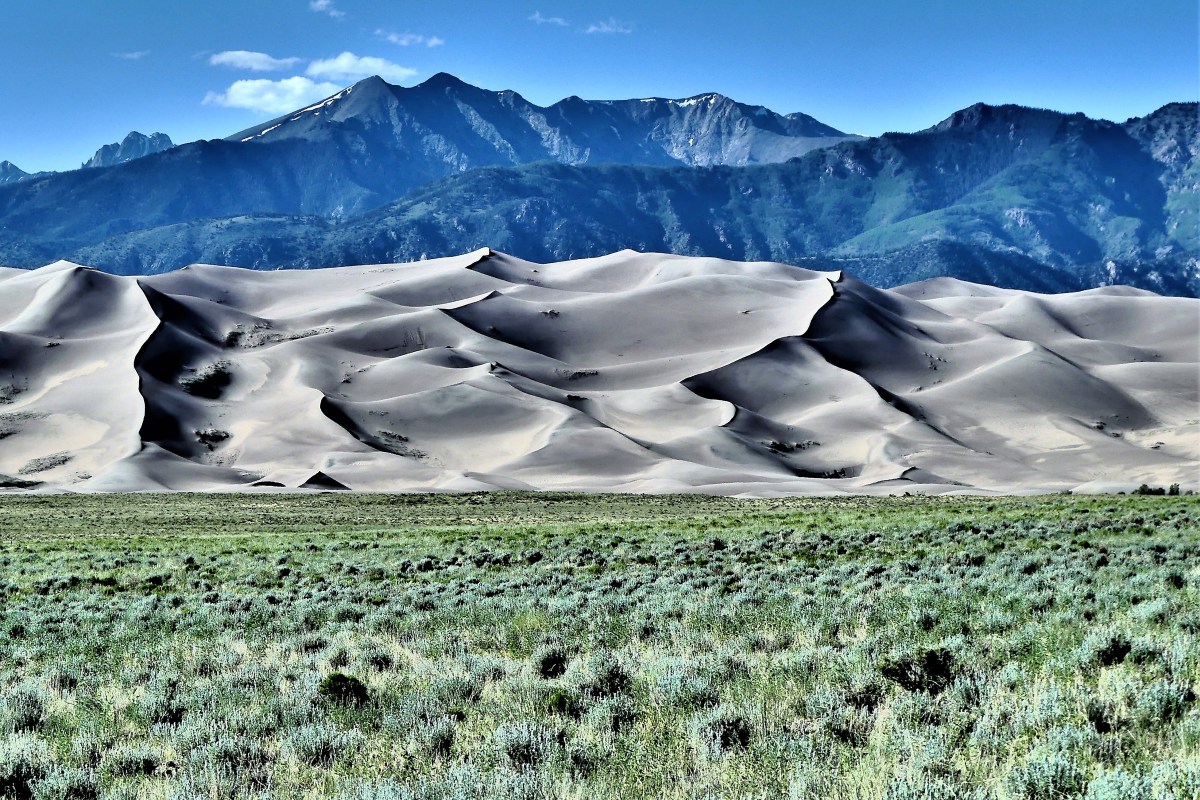
far too many interesting vistas to ignore;
and surprising driftwood sculpture to admire.
We arrived at the Dunes parking lot by 8:45 am the next day, and we were not alone. Many other families were already parked and trekking across the sand flats with sandboards in hand. Canopies and shelters were already sprouting up throughout and within Medano Creek, and kids were romping in the water and shaping wet sand castles.
We surveyed the 10,000 acres of dunes and plotted our course as there are no marked trails, but we followed along the ridgeline like most others.
Looking back gave us some satisfaction, because it reminded us of how far we trudged,
but looking ahead reminded us how much more we had to cover. The closer we crept to the top, the deeper our feet sunk into hot sand, slowing our progress.
We took a lot of breathers along the way,
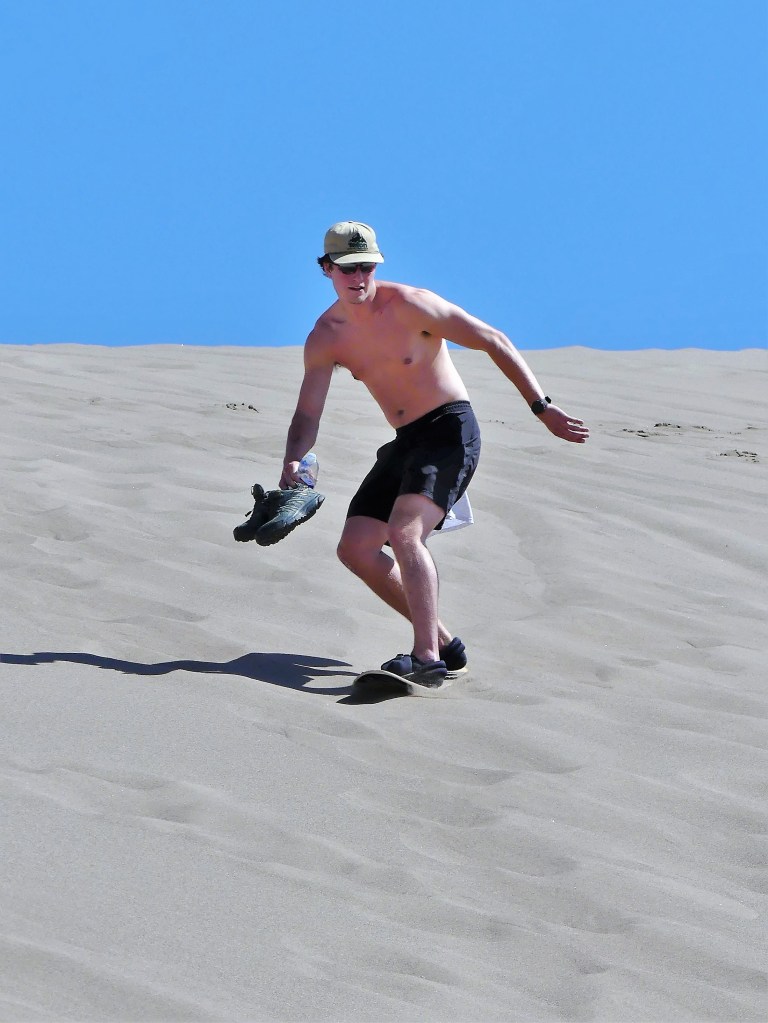
and rated the sand boarders as they attempted to carve out a run…
but mostly, it was uphill twenty steps, pausing to catch our breath, having a look around, sipping some water, and repeating the process. Slow and steady wins the race. Right?
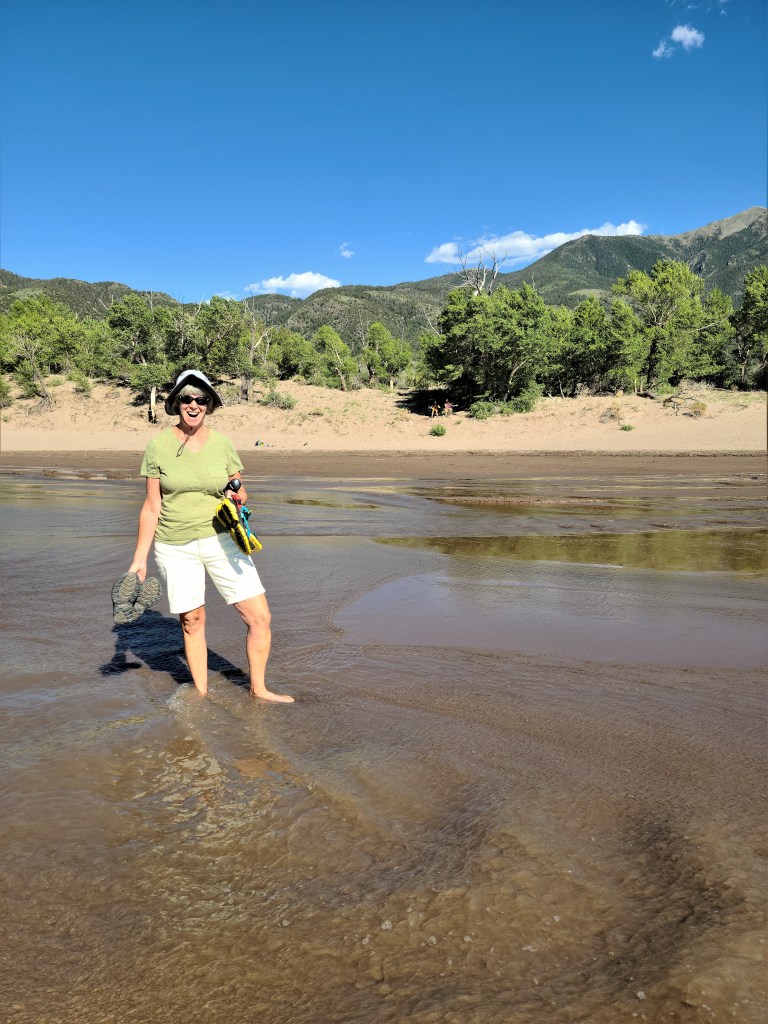
Many hikers passed us on the way down offering words of encouragement, but Leah–realizing her feet were about to catch fire–decided to mush down the sand slopes and soak her feet in the creek while I continued to the top.
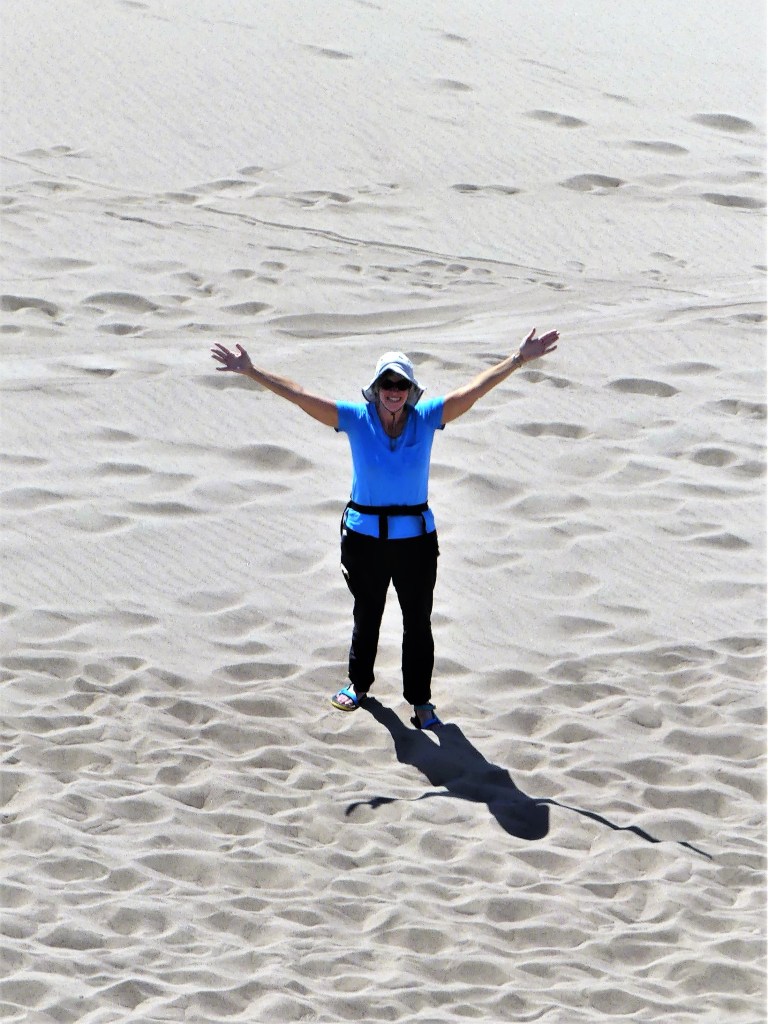
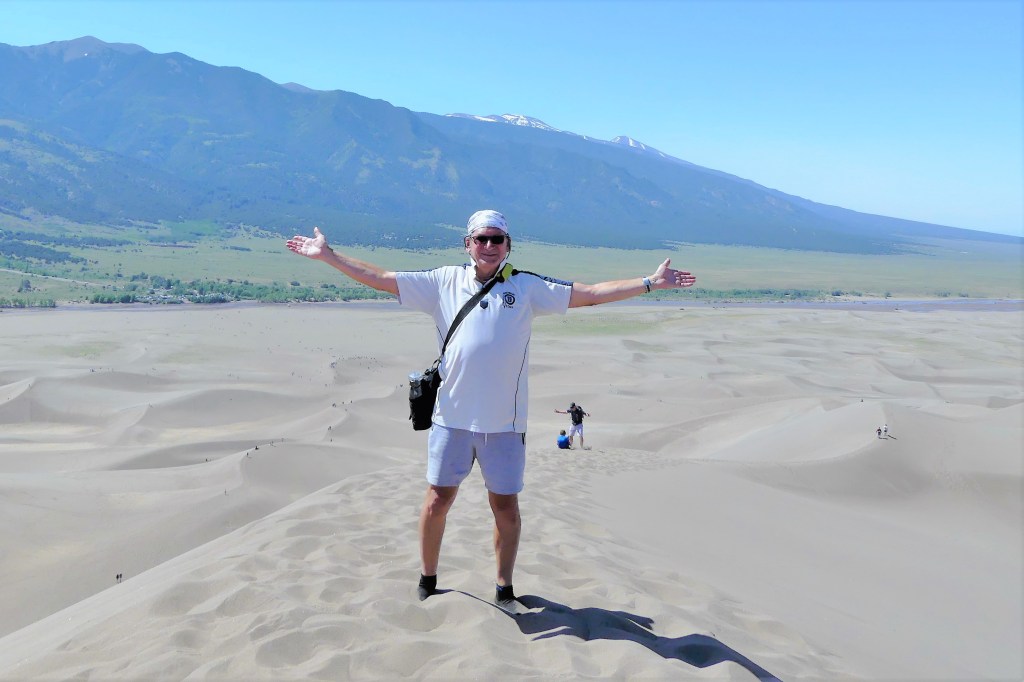
And so I pushed myself, and willed myself up the final ascent, foot by foot, grabbing air along the way, until I finally reached the summit with barely enough energy to greet the younger people who passed me on the way up, and wave my arms for Leah’s snap.
Perhaps it was self-gratification…
realizing that I can still push myself,
or maybe I needed to see the other side of the mountain.
Either way, it’s all good. Ironically, as I admit to myself that I’ve lost a step or two, to my surprise, I often find myself taking a victory lap. As I get older, I’ll eventually have to make do with being young at heart.
After a spin around Sun Records, Leah and I altered our orbit a couple of Memphis miles to the center of a parallel universe of talent, originally known as Satellite Records in 1957.
Inspired by the success of Sam Phillips, Jim Stewart–a banker by day and frustrated fiddler by night–decided he too could produce hit records despite no music industry experience. Upon realizing his need for professional recording equipment, he enlisted his older sister, Estelle Axton who mortgaged her home for an Ampex 350 console recorder.
In 1960, Satellite Records moved to a converted theater on McLemore Ave. and Stax Records (a fusion of their last names) was born.
Rufus and Carla Thomas recorded the new company’s first hit record, Cause I love You, in 1960…
which caught Atlantic Records’ Jerry Wexler attention and willingness to negotiate a distribution deal for all future Rufus and Carla recordings, and right of first refusal of all other Stax artists.
Steve Cropper also added to the early success of STAX.
Originally, his guitar playing fronted the Royal Spades, but Jim Stewart invited Cropper to Stax where the group was re-billed as the Mar-Keys and became the house band, playing sessions with newly signed artists as well as recording their own sounds, like Last Night, a 1961 hit.
Steve Cropper would leave the Mar-Keys to become head of A&R for Jim Stewart, but continued to play back-up sessions as needed, always a part of the Mar-Keys floating membership. One day, while awaiting a session, Booker T. stepped in for a turn on the Hammond organ, and Green Onions was instantly conceived in 1962.
The Mar-Keys had just morphed into the next Stax session band, a/k/a Booker T. and the M.G.’s,
Stax success continued when Otis Redding, driver for Johnny Jenkins’ took the microphone after Johnny’s dismal performance. Subsequently, Otis auditioned with Booker T. and the M.G.’s on accompaniment, and wowed everyone with his song, These Arms of Mine, released October 1962.
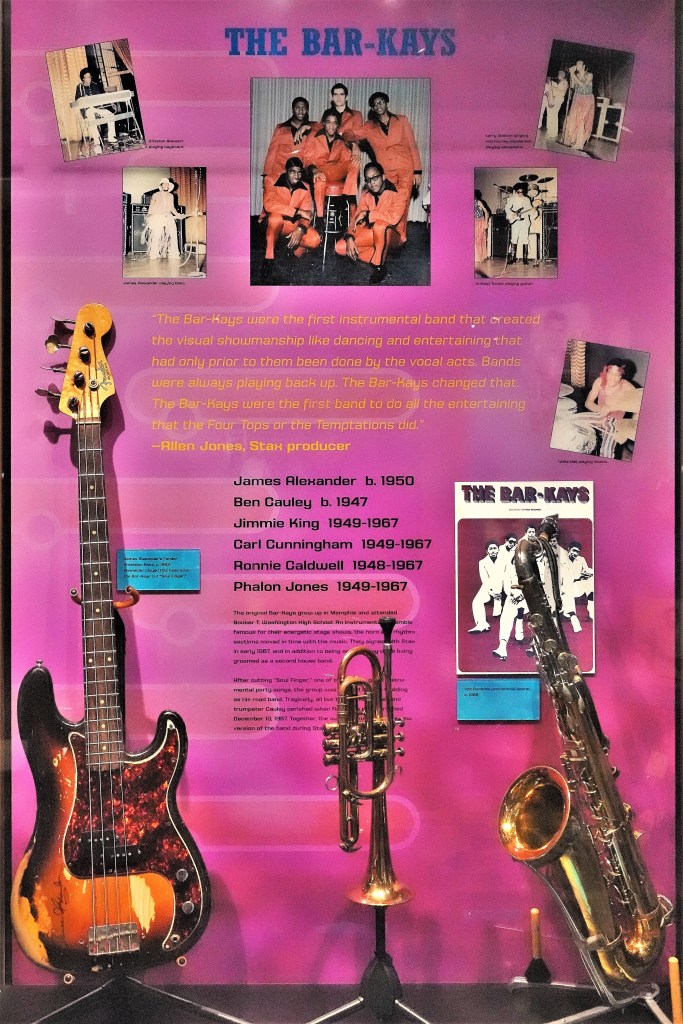
Otis Redding would become the label’s biggest star, continuing with hits: I’ve Been Loving You too Long; Respect; Just One More Day; and Try a Little Tenderness. But like Icarus, who flew too close to the sun, Otis and several members of the Bar-Kays lost their lives in a plane crash on December 10, 1967, enroute to a performance in Cleveland.
Only 6 months earlier, Otis was headlining at the Monterey Pop Festival, backed by Booker T. and the M.G.’s. At the time, he was fully aware of the opportunity and exposure. He said, “It’s gonna put my career up some. I’m gonna reach an audience I never have before.” He was 26 when he died.
(Sittin’ On) The Dock of the Bay, co-written by Steve Cropper was released one month later, and reached #1 on Billboard’s Hot 100.
In 1968, the wheels came off the Stax bus. They lost their distribution deal with Atlantic Records after Atlantic was sold to Warner Bros. Records in 1967. Warner Bros. also reclaimed the library of master tapes held by Stax, citing a clause in Atlantic’s contract that entitled them to “all right, title and interest, including any rights of reproduction.”
Adding insult to injury, Warner Bros. also reclaimed Sam and Dave, who were “on loan” to Stax from Atlantic.
And to make matters worse, the country was at war with itself after the murder of Martin Luther King, Jr. on April 4,1968 just blocks from the label’s headquarters.
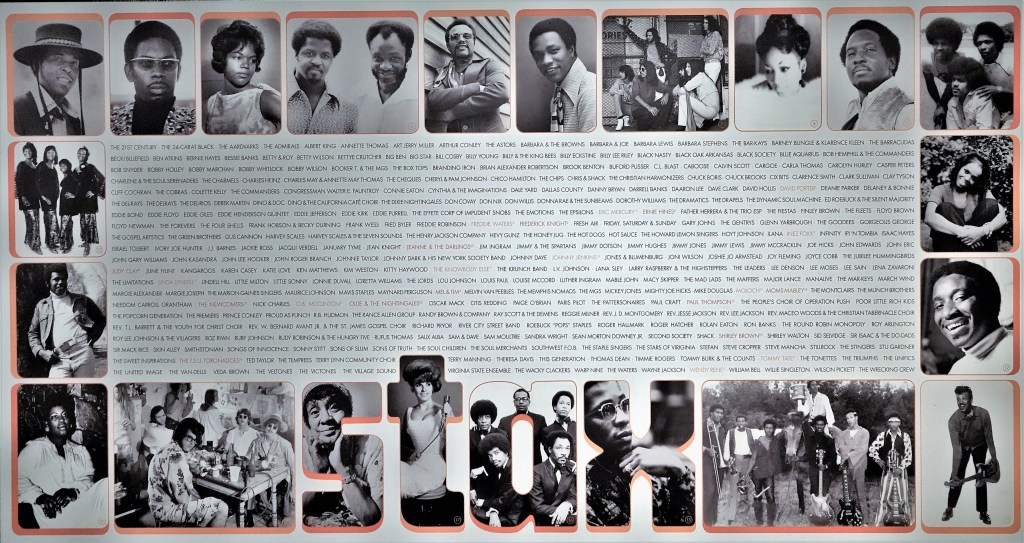
With their back catalog depleted and no distribution deal, Stewart sold his shares of Stax to Gulf & Western for millions, but stayed behind to continue running the company. Enter Al Bell, record producer and songwriter, who joined Stax in 1965 as director of promotions, and became co-owner and vice-president after buying out Estelle Axton. In 1969, Bell shepherded the “Soul Explosion,” generating 30 singles and 27 albums within eight months,
utilizing house talent like the Memphis Horns (an off-shoot of the Mar-Keys) and new talent like the Staple Singers.
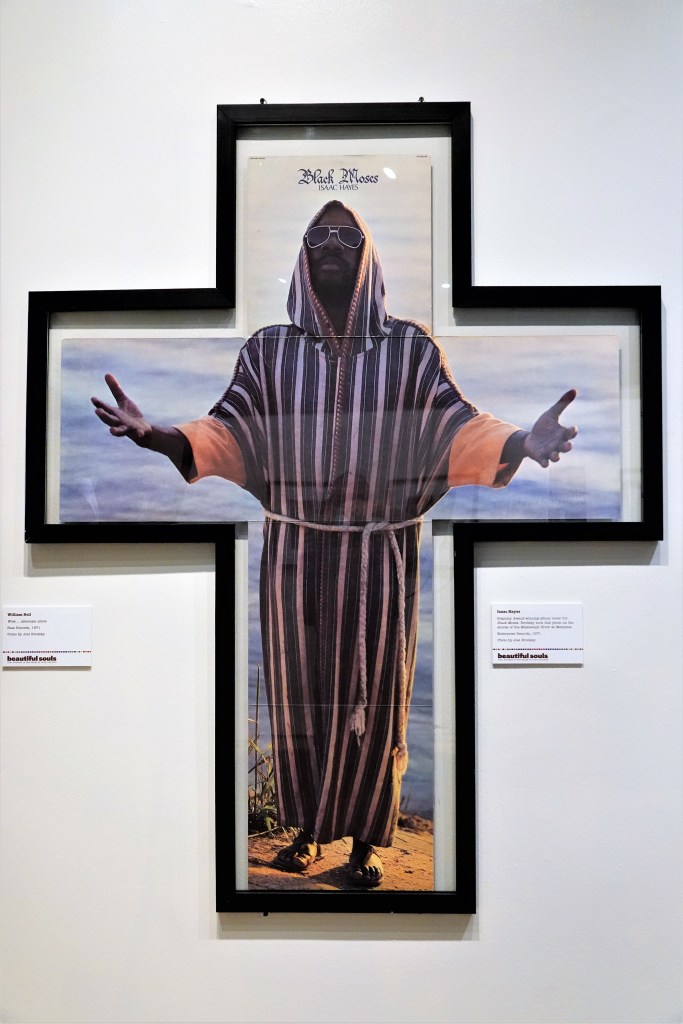
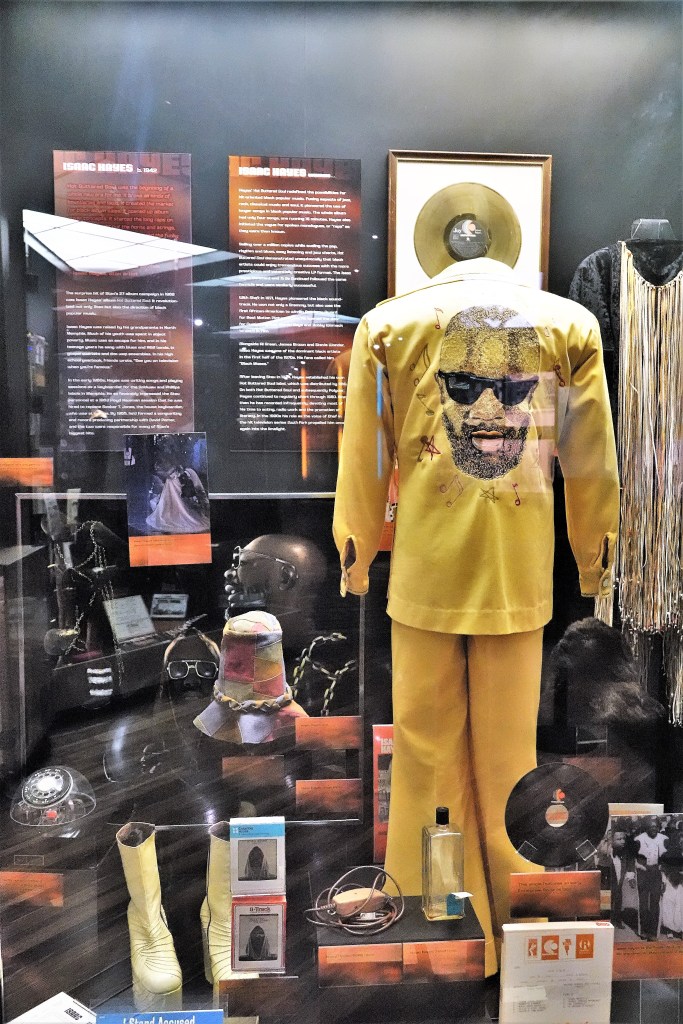
But musically, the resurrection of Stax records can be attributed to Isaac Hayes, the Black Moses.
In 1969, Isaac Hayes released Hot Buttered Soul, his four-song, soul-defining masterpiece which sold 3 million albums.
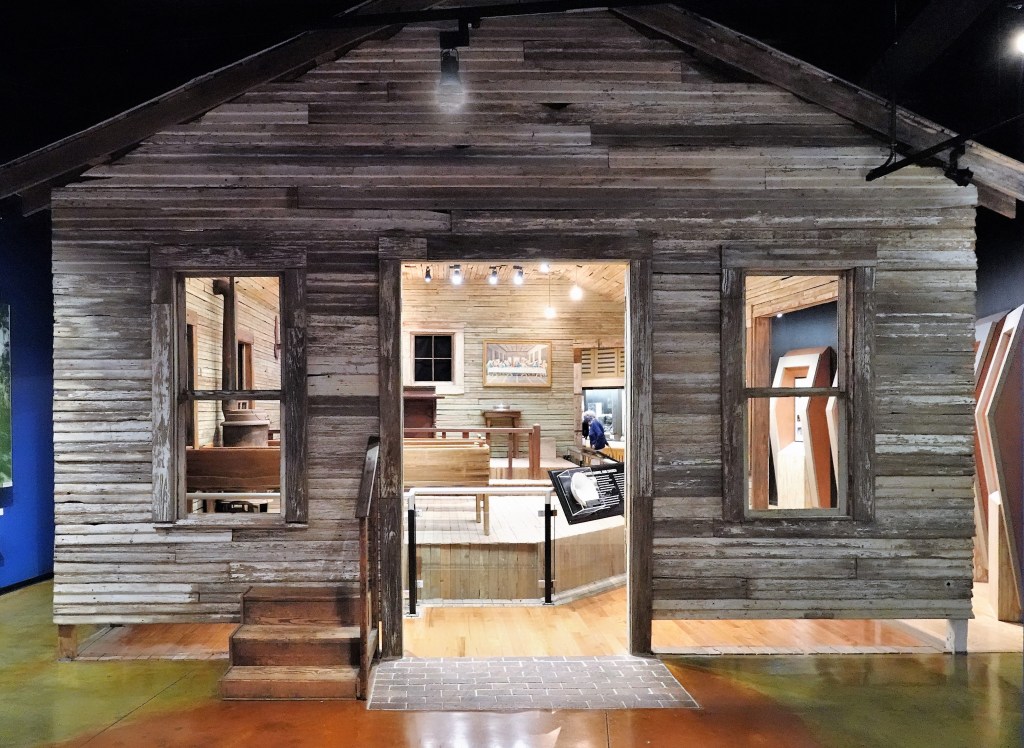
The Stax Museum has many alluring features and exhibits. There’s the reassembled Hoopers Chapel African Methodist Episcopal Church from Duncan, Mississippi built around 1906;
there’s also a disco dance floor, that ideal for busting a move and showing your groove;
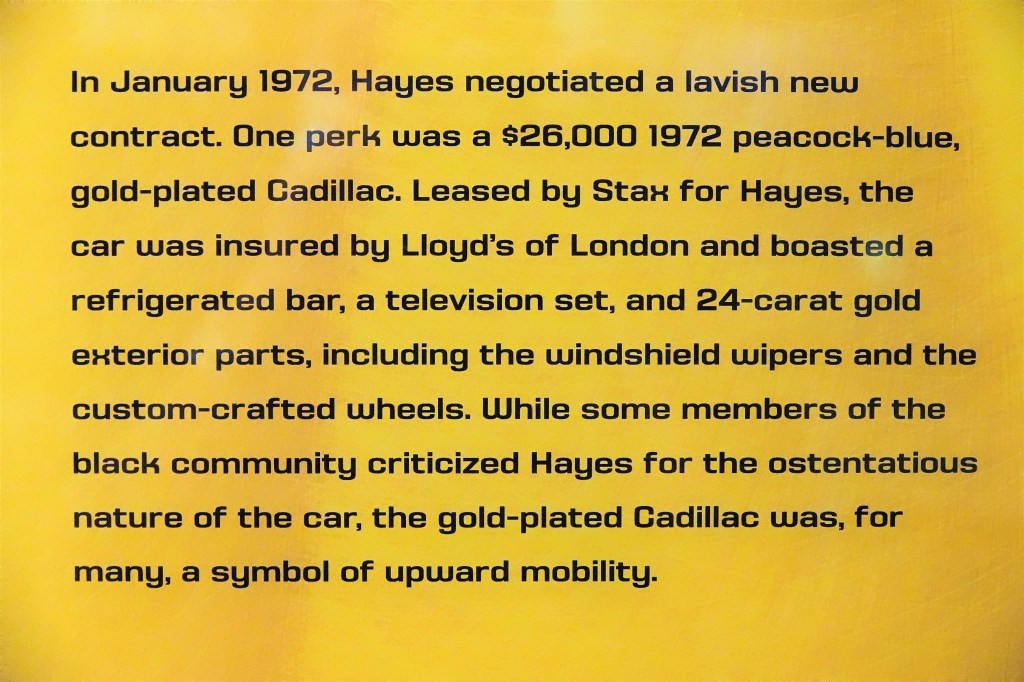
but the crown jewel of the collection has to be Isaac Hayes’ rotating 1972 peacock-blue, 24K gold-plated Cadillac.
The release of Theme from Shaft— which won an Oscar for Hayes for Best Original Song in 1971–
put Hayes in the drivers seat when it came time to renegotiate his contract…
In 1970, with the wind at their backs, Bell and Stewart repurchased Stax from Gulf & Western with borrowed money from Union Planters Bank.
In the summer of 1972, in pursuit of a wider audience, Al Bell brought an all-star revue to Los Angeles Memorial Coliseum–dubbed Wattstax–to commemorate the 7th anniversary of the Watts riots. The sold-out crowd of 100,000 fans spawned a highly regarded documentary film and a live double album of the concert highlights.
Stax archives recount the final years of Stax Records:
By 1971, Stax had grown from a family production company distributed by Atlantic Records, to a freestanding independent record company. Stax now manufactured, marketed and distributed its own recorded music in America and through licensees around the world. The racial harmonies that typified Stax’s early years was becoming an issue. Trust was an issue. Jim Stewart, producer-cum-chief executive officer was tired, disillusioned, and pushing paper instead of making records. He had not attended Wattstax. He told his partner Al Bell that he wanted out.
Change and challenge were pervasive after so much growth. One major problem became the theft of Stax property, including master tapes. Stax hired one of the country’s premiere white-collar crime investigative firms. Their search did uncover improprieties involving some employees, but Jim Stewart and Al Bell decided not to prosecute. Instead new security measures were designed and implemented at the McLemore Avenue and the Union Avenue Extended offices to specifically protect and preserve Stax masters, East Memphis copyrights and other valuable assets.
Al Bell was enjoying a Midas touch. Isaac Hayes, Johnnie Taylor, and the Staple Singers had all emerged as superstars. Rufus Thomas had entered the most successful era of his career. Albert King had broken through to the white rock album market. Mid-level artists such as Soul Children, Frederick Knight, Luther Ingram, and Mel & Tim were all hitting the charts. Bell was pushing company expansion in many different directions at once, issuing pop, rock, jazz, country, gospel, and comedy records in addition to its staple of classic soul tracks.
Though Stax thrived in the independent world, it had still not broken through in mass-market distribution venues like Sear and Roebuck. Seeking a buyer for his company’s other half, Al Bell kept that distribution goal in mind. He wound up, surprisingly, making a distribution deal with Clive Davis at CBS Records. CBS, though successful with many white acts, boasted no major black artists. “The company was” as Bell says, “larger that life white with no real knowledge of the black market.”
Stax and CBS each complemented the other’s weakness. Stax could help CBS reach the small, privately owned stores, and CBS could get Stax into huge chains. In 1972, through a complicated agreement, Bell bought Stewart’s half with money loaned from CBS. Jim Stewart, agreeing to remain with the company for five more years, received $2.5 million, up front, and millions more in payments to come.
Though the new relationship began well, a disaster occurred in May 1973: Clive Davis was fired from CBS. The deal he’d struck with Al Bell was full of nuance and personal commitment between two parties, and Davis’ replacement neither understood nor appreciated the arrangements.
Faced with a contract it felt was a mistake, CBS began systematically reducing payments to Stax for records sold, precipitating a tangle of legal battles and a shortage of operating funds. Stax was bound to CBS as its sole distributer, and could not get its product in to stores nor receive monies for records that had been sold.
To keep the company going, Stax founder, Jim Stewart secured operating loans with his forthcoming CBS payments as collateral. Going further, he gave Stax a personal loan and then personally guaranteed even more borrowed money. But CBS continued to withhold payments and Stax continued to hemorrhage.
Continuing:
By summer 1974, Stax defaulted on payments to Isaac Hayes, and was forced to relinquish the marquee artist. Around the same time, Stax gave Richard Pryor, in lieu of payment, the master tapes for his groundbreaking album That Nigger’s Crazy. Pryor took the album to Warner Brothers; it went gold and won a Grammy award. By the end of 1974 Stax had given 85 of its employees their pink slips.
Bell, Stewart, and Stax vice-president John Burton campaigned for capital to pay off both CBS and Union Planters Bank, from who, Stax had borrowed heavily. Leaving no stone unturned, they approached Saudi Arabia’s King Faisal, A tentative agreement was worked out, and Burton headed to the Middle East. Faisal was assassinated by his nephew on March 25, days before the meeting was to take place.
Stax persevered but times were increasingly turbulent. The nation itself struggled: Watergate led to President Nixon’s resignation. Recession gripped the U.S. economy. In Memphis, Union Planters Bank—which had loaned hundreds of thousands of dollars to Stax—struggled for its own economic survival.
Despite chart topping hits during late 1974 and 1975 by Stax artists including Rance Allen, Little Milton, the Staple Singers, young pop sensationalist Lena Zavaroni, Shirley Brown, Albert King, the Dramatics and others, distribution challenges perpetuated by CBS Records strangled Stax.
When Union Planters abruptly called in Stax’s loans and they were unable to pay promptly, the bank immediately and aggressively pursued the company. Stax’s daily operations were crippled. On June 8, 1975, the company basically ceased being able to pay anyone. In October, Stax officially laid off all its remaining employees. Many still continued to work for free. The battle between the bank and Stax was rancorous and bitter. Many believed that racism was the motivation which drove Union Planters pursuit while others believe that it was strictly a business decision.
For years, Stax had contributed to community efforts. In the company’s final days, the local community gave back. In latter 1975, when Stax could not pay its remaining employees, the proprietor of the College Street Sundry, Ms. Ethel Riley Flowers, regularly fed them at no charge. Merrit’s Bakery also gave food to the last employees “because,” in the words of William Brown, “she knew we didn’t have no money. These people were surviving on the love of each other. They weren’t surviving on waiting for that dollar to come around the corner. They knew it wasn’t coming!”
Unable to pay its bills, its artists, its loans, Stax was shut down on December 19, 1975, forced into receivership by an involuntary bankruptcy petition.
Union Planters Bank, that had helped Stewart and Bell buy back the company from Gulf & Western, moved to collect on personal guarantees given by Jim Stewart. He lost his fortune, his assets, and his home.
The Stax building was padlocked.
In January 1977, Stax’s assets were parceled out in a bankruptcy sale on the courthouse steps. The catalog of tapes was sold to a liquidating company, the office furniture to an auction company, and the recording equipment to an individual who hoped the magic would continue to work.
The Stax building was sold for ten dollars in 1980 to the Church of God in Christ (COGIC).
For Jim Stewart, it’s always been about the music.
He was inducted into the Rock and Roll Hall of Fame in 2002 for his important contribution to the music scene.
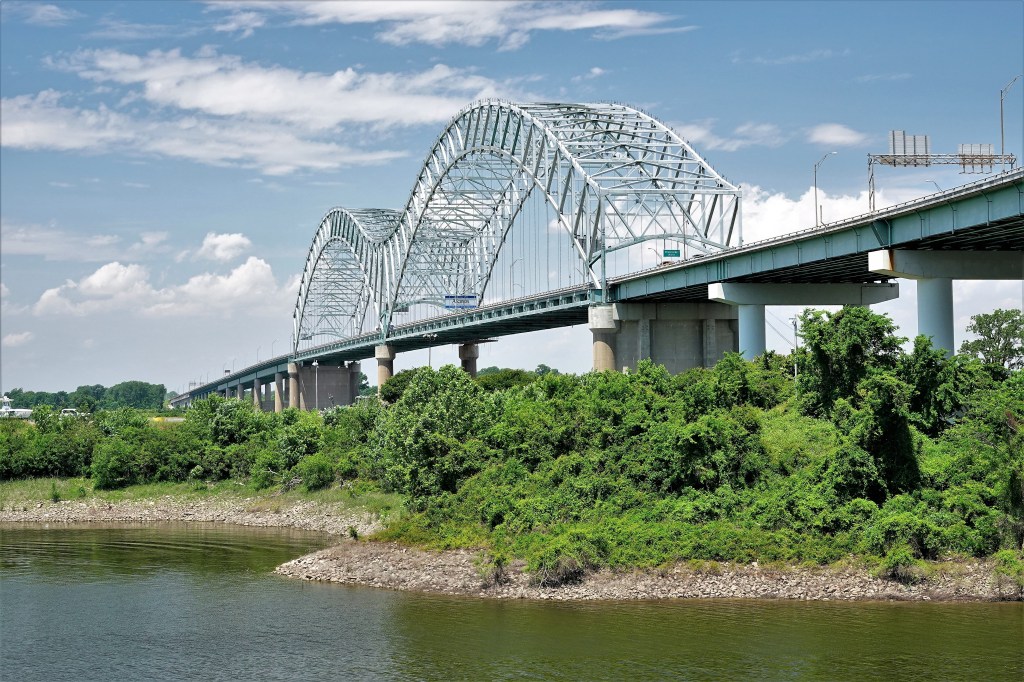
Rolling into West Memphis from Nashville to lay down 3-day roots wasn’t going to be easy. On May 11, the country learned that the I-40 bridge connecting Memphis, TN to West Memphis, AR was shut down after inspectors discovered a critical crack in a 900-foot beam that compromised the bridge’s structural integrity, and it would takes months to complete emergency repairs (oh, infrastructure…wherefore art thou).
All traffic was being rerouted through I-55–a less than desirable 4-lane crossing–that was now backing up for miles in both directions. Leah and I agreed that the only way to avoid traffic mayhem would be to relocate east of the Mississippi.
It was a snap decision with few available options, but we scored a shady site with electricity at F.O Fuller State Park, 2 miles downwind from a sewage processing plant.
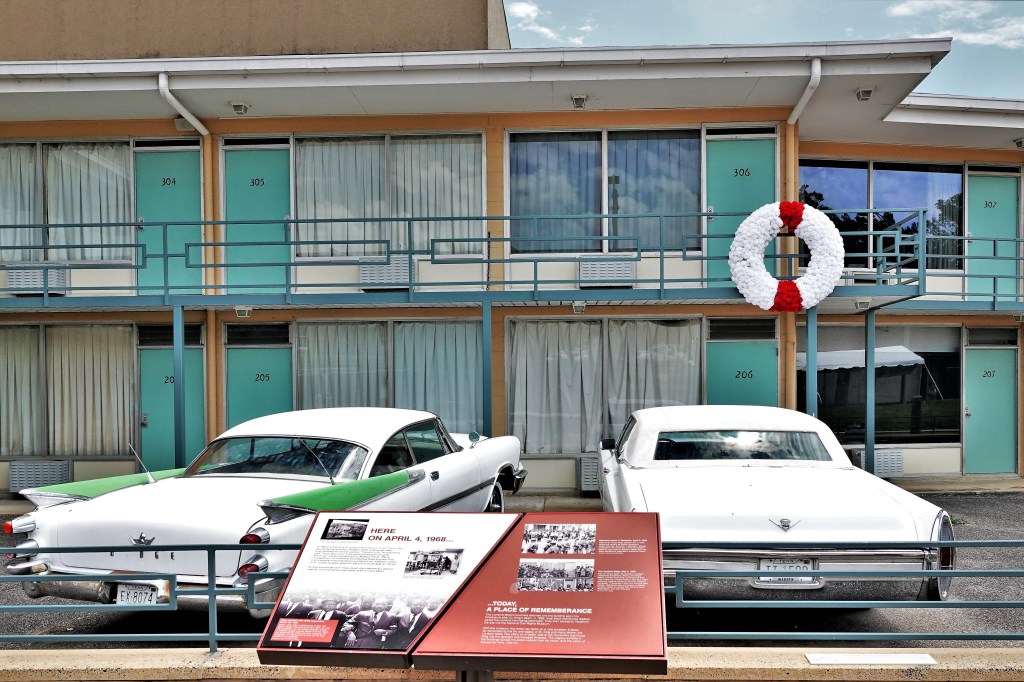
We had designs on visiting the National Civil Rights Museum built around the Lorraine Motel,
which was one of only a few hotels that hosted black entertainers of the era, like Cab Calloway, Count Basie, B.B. King, Aretha Franklin, and Nat King Cole.
Dr. Martin Luther King, Jr. was assassinated outside Room 306 on April 4, 1968, making the Lorraine Motel a symbol for the civil rights movement.
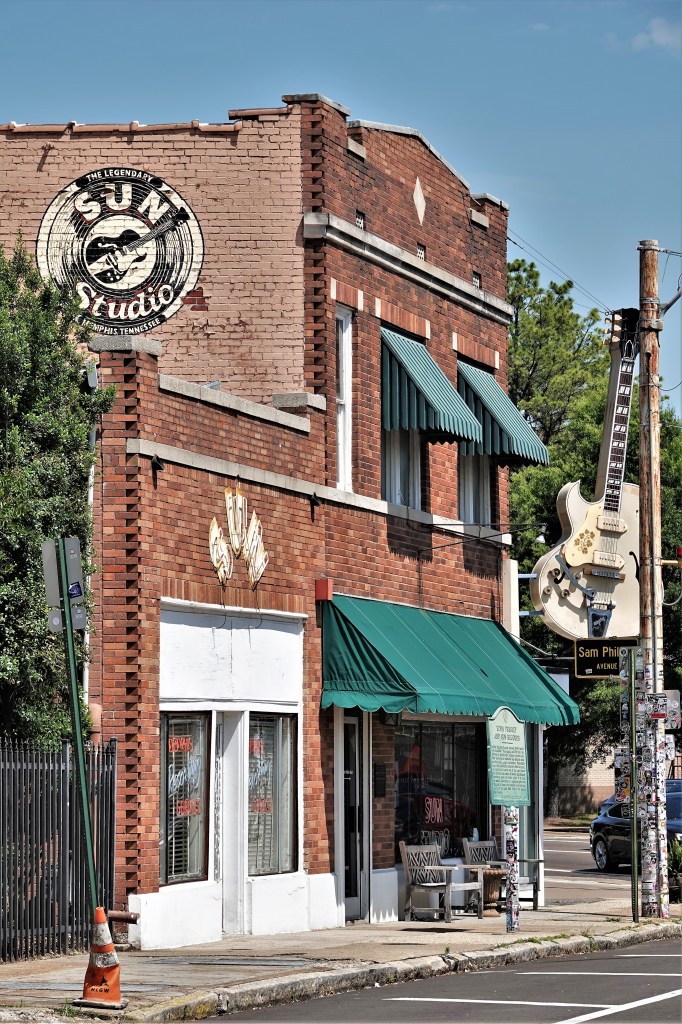
We would have liked to tour the museum, but it was closed. So off we went to Sun Studio…
to pay homage to a galaxy of recording stars whose origin stories are etched on acetate discs.
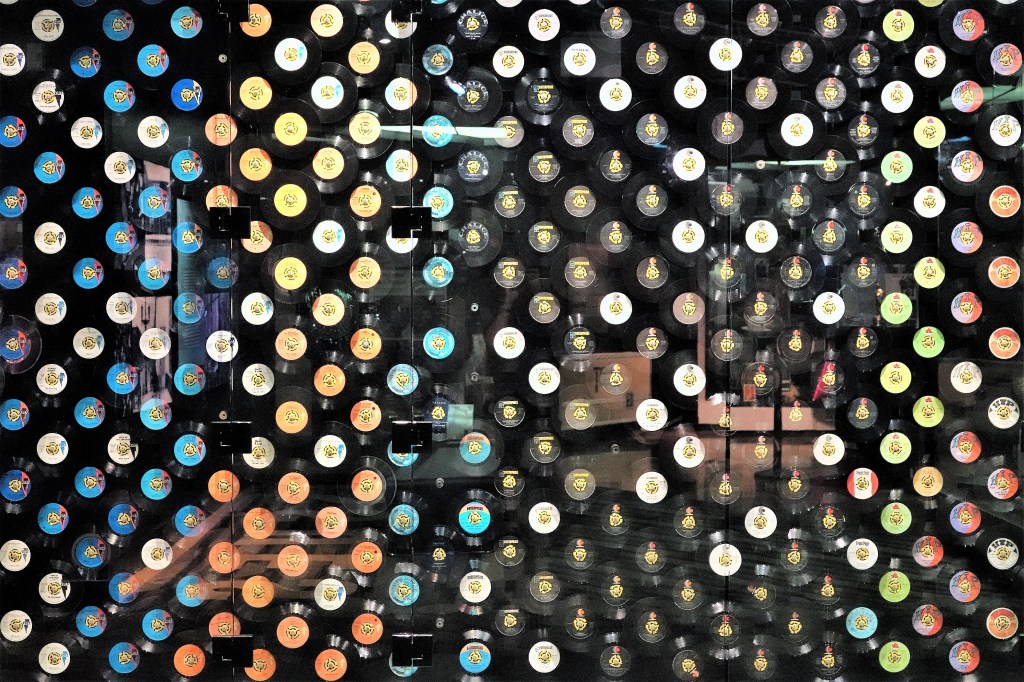
Patrons gathered inside the café waiting for the 45-minute tour to begin. It was a good opportunity to browse the weathered record collection and grab a cold drink.
The tour began on the second floor–at one time a flop house for disadvantaged musicians–where we learned about Sam Phillips’ humble beginnings,
and his role in producing arguably the first rock ‘n roll record in history.
But Sam Phillips was really looking for a white guy, someone who could bridge the gap, someone “with a Negro sound and the Negro feel.”
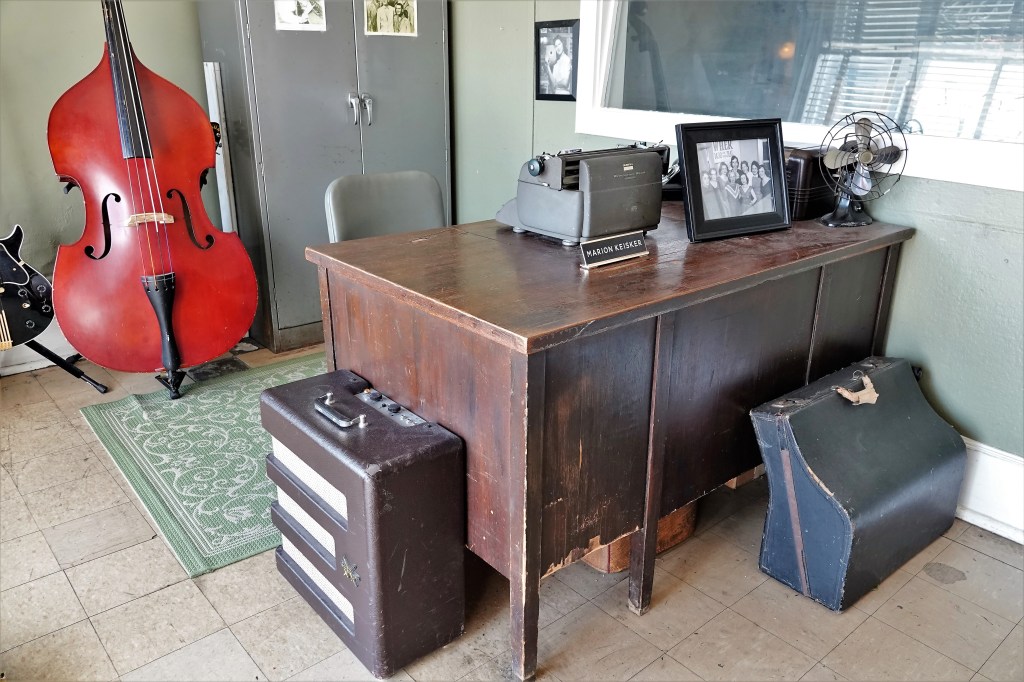
Fortunately, Marion Keisker, Sam’s business manager/lover was at her desk on July 18, 1953…
when a recent high school grad with long sideburns and a greasy ducktail hairdo walked into the studio with $4 to record My Happiness and That’s When Your Heartaches Begin as a gift for his mother, Gladys.
Being the only one present at the time, she took a turn at the console to record his demo–her first and only time–and she immediately knew that Elvis Presley was the real McCoy.
Nearly a year later, Sam called Elvis in for an audition supported by upright bass player Bill Black and guitarist Scotty Moore. After a few sessions of Elvis noodling around, singing different genres of music while strumming his guitar, he stumbled upon an up-tempo blues number by Arthur ‘Big Boy’ Crudup called That’s All Right (Mama).
The trio eventually worked out a raw arrangement for Sam, and the rest is history.
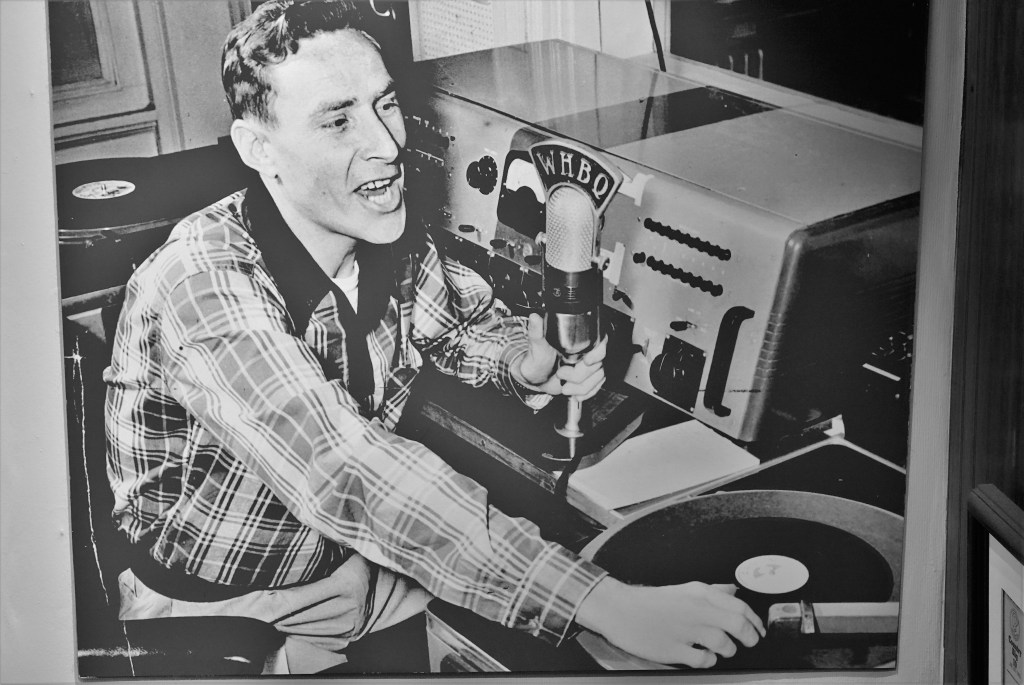
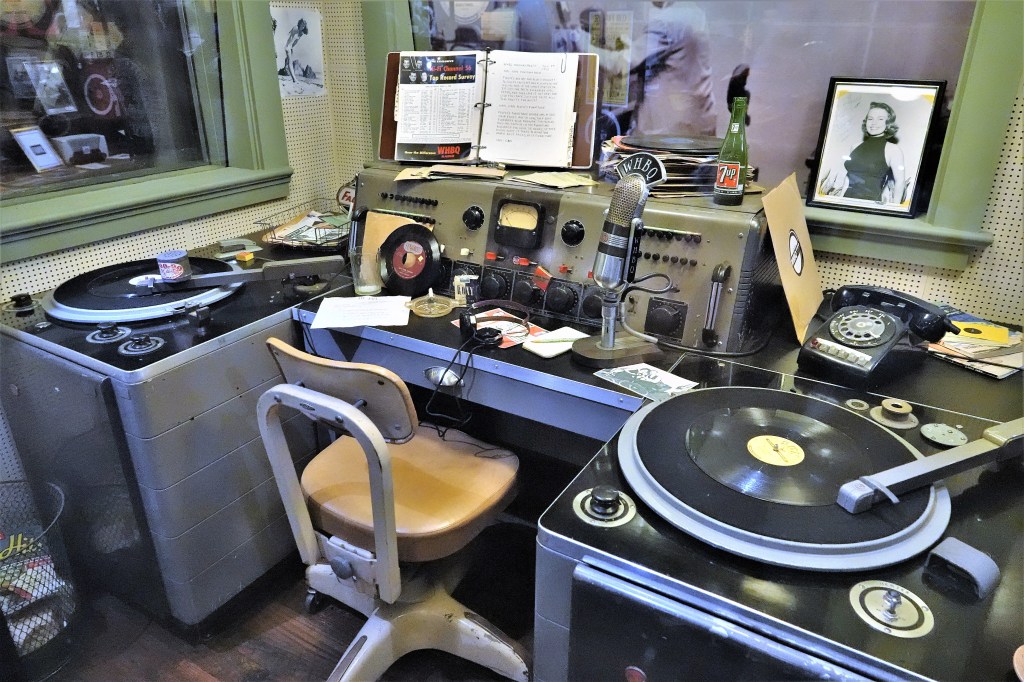
Next thing, Sam called local DJ Dewey Philips for radio support, and he obliged by playing Elvis’s record 40 consecutive times on WHBQ, at times singing along.
Of course, it was a smash hit…
The tour continued downstairs, inside the fabled studio–where not much has changed–that gave rise to so many legendary careers.
Our guide played refrains of famous tunes recorded at Sun. There was Carl Perkins warbling Blue Suede Shoes, Jerry Lee Lewis belting out Great Balls of Fire, Roy Orbison’s crooning Ooby Dooby, and Johnny Cash intoning I Walk the Line.
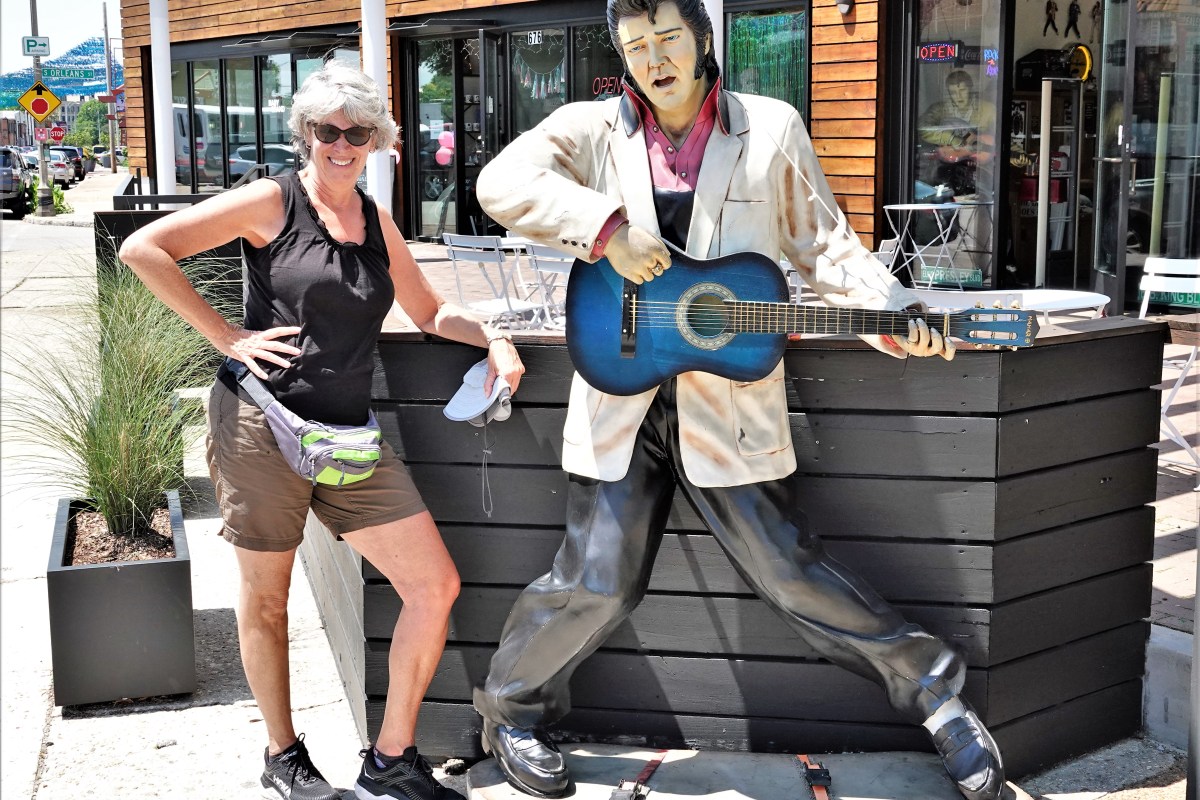
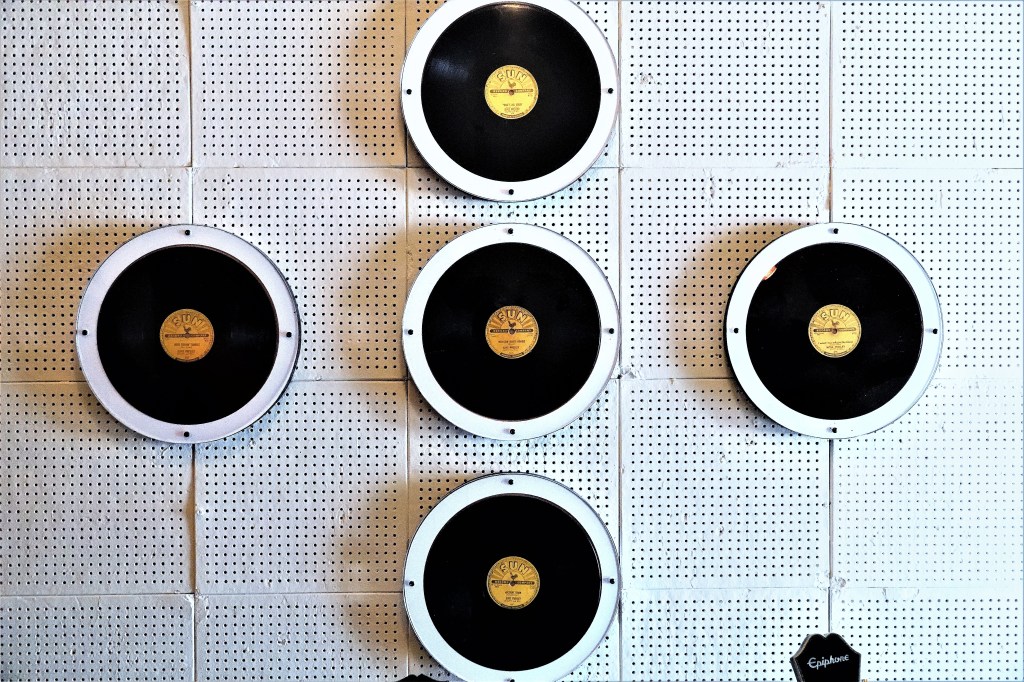
Elvis had five hits at Sun Studios: That’s All Right, Mystery Train, Milkcow Blues Boogie, Good Rockin’ Tonight, and I’m Left, She’s Right, You’re Gone, and they’re on display.
On November 20, 1955, Colonel Parker brokered a record-breaking deal between Sam Phillips and RCA Records for $35,000, with a signing bonus of $5,000 for Elvis.
A year later, on December 4, 1956, Elvis Presley, Carl Perkins, Jerry Lee Lewis and Johnny Cash reunited at Sun Record Studios for a seminal impromptu jam session dubbed the Million Dollar Quartet. It was history in the making, producing 3 reels of tape.
Our guide delights in telling the story of Bob Dylan’s visit to Sun Records.
It is widely known that Dylan was a huge fan of Elvis. The day he arrived in Memphis, he had a car drive him to Sun. Without ceremony, Dylan walked into the studio and asked if it was true that Elvis had stood on the mark on the floor during his recording of That’s All Right. Upon confirmation, Dylan knelt over the spot and kissed the ground, paying respects to his long lost hero.
It’s also been rumored that Dylan later licked the microphone once held by Elvis, but I’m probably not the best qualified person advising Leah when it comes to germs.
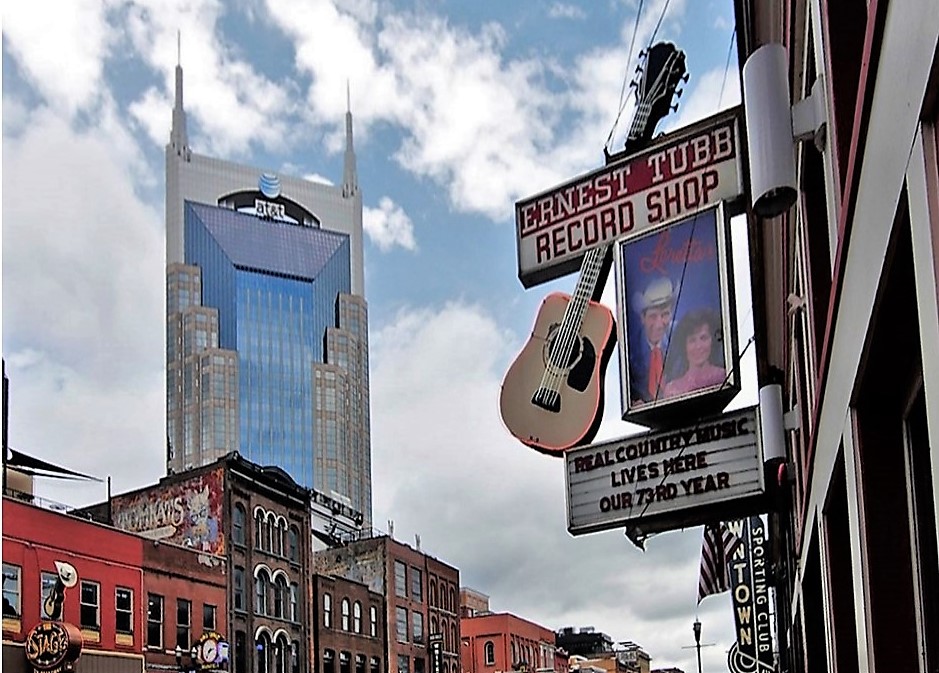
Minutes from Ryman Auditorium stands Ernest Tubbs Record Store, the nation’s first all-country record store located in downtown Nashville, welcoming visitors from around the world for the past 74 years.
But getting there always takes longer than it should because of all the distractions along the way:
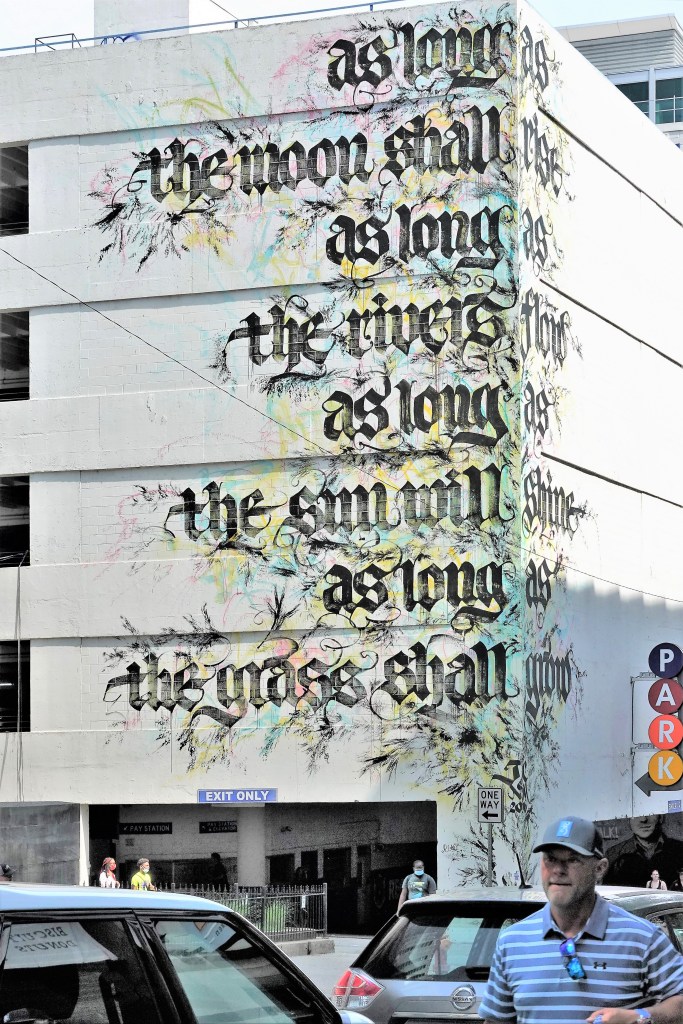
The first thing I see is a white-painted edifice with lyrics penned by Peter La Farge and performed by Johnny Cash.
It’s intended as a grim reminder of broken promises to Native Americans.
Continuing on foot, there’s bound to be a bridal party featuring a Bridezilla…
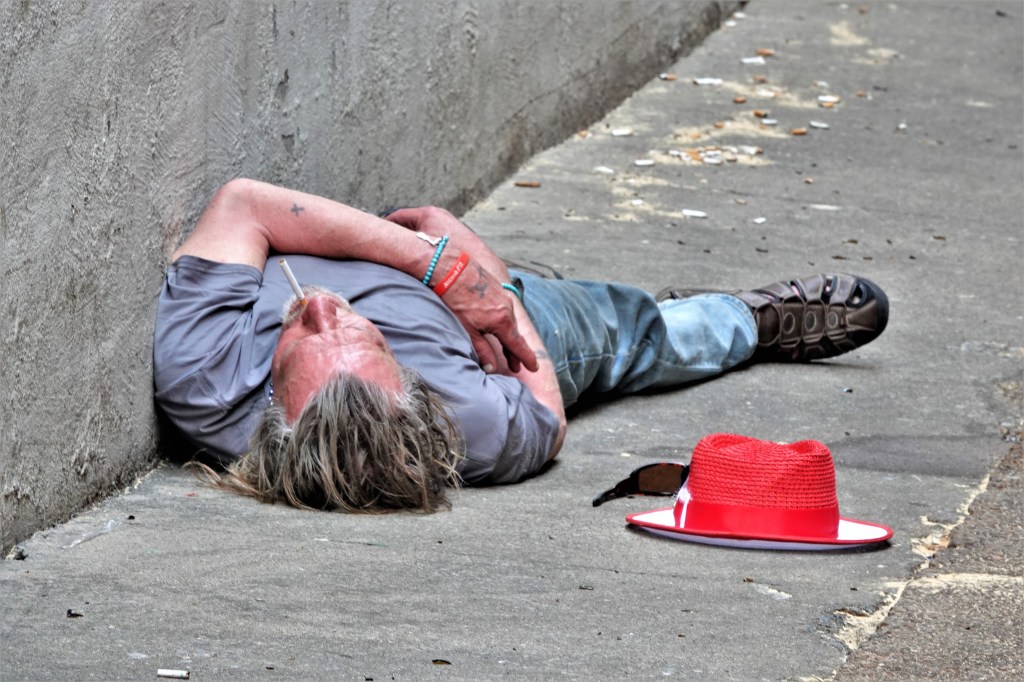
or a homeless prophet…
and a bunch of battered, drunken drivers…
or an overheated zealot…
and a mad hatter…
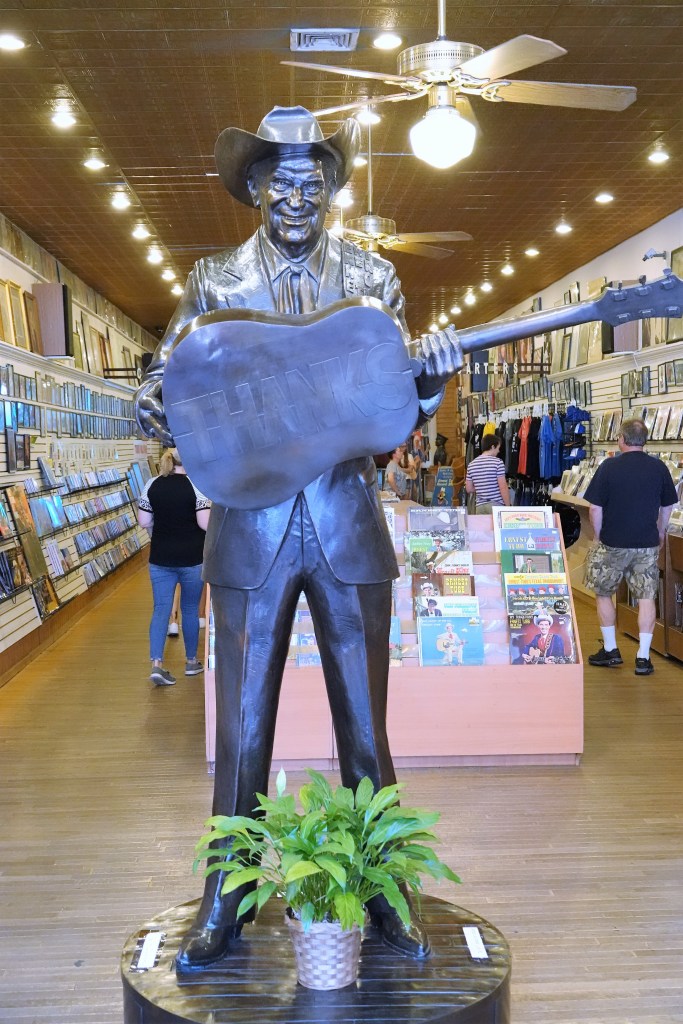
until you get to Ernest Dale Tubb, an influential honky-tonk singer-songwriter, Grand Ole Opry star, movie actor, and member of the Country Music Hall of Fame who began a record store in 1947.
And this is his testament.
The Midnight Jamboree hit the stage the following year, featuring Ernest Tubb and the Texas Troubadours...
and a slew of cowboys and up and comers shooting for the stars.
And that helped to sell a lot of records. It was a beneficial arrangement for everyone.
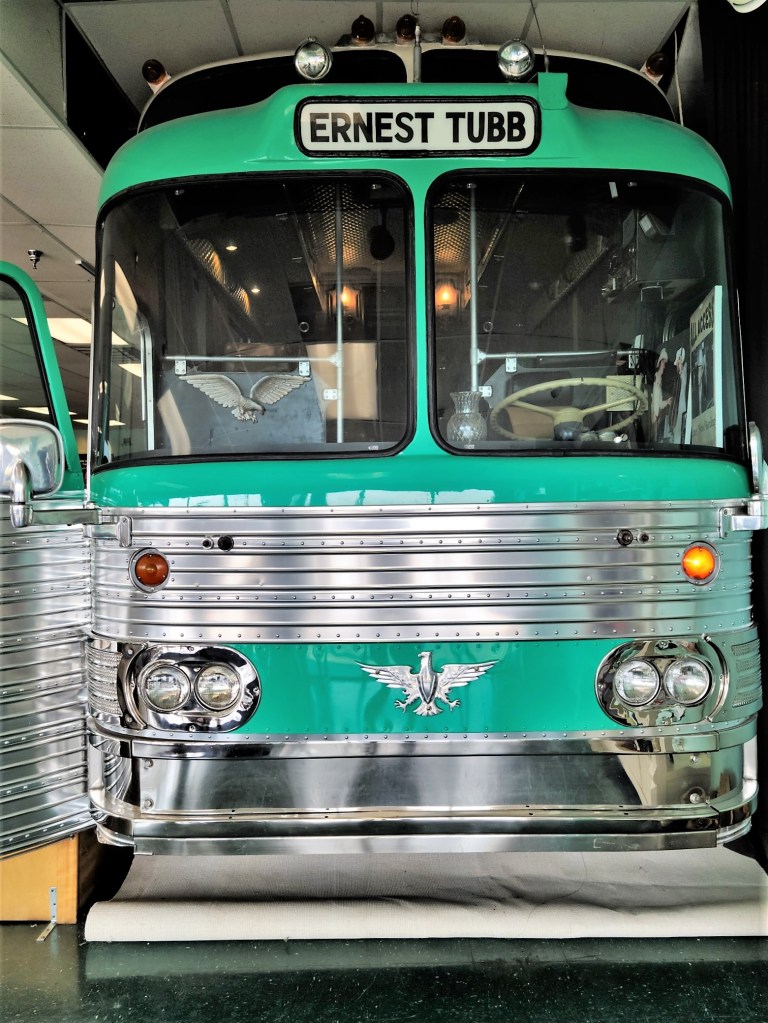
Ernest could also promote his famous bus tour. In 1970, Mr. Tubb purchased a 1964 Silver Eagle from Trailways Bus Company and dubbed it the Green Hornet.
For the next nine years, Ernest Tubb and the Texas Troubadours logged over 3 millions miles on the Green Hornet, hitting all 48 States and Canada.
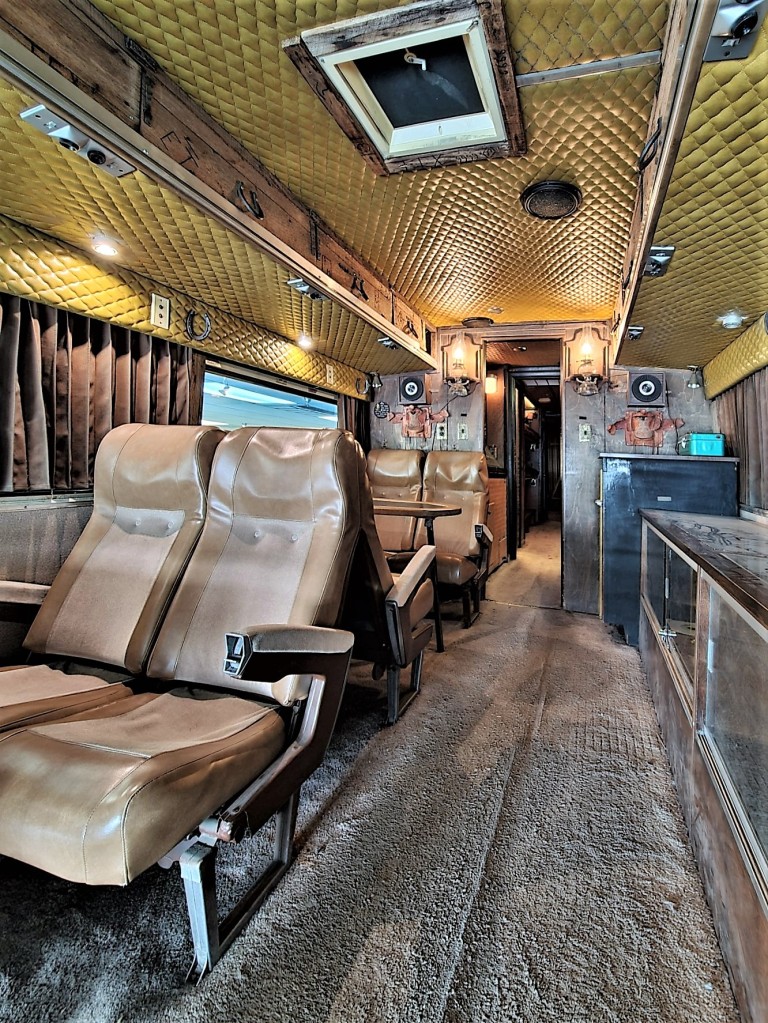
The coach accommodations included sleeping berths and a bathroom behind the wall,
while Mr. Tubb lived in the rear of the coach with a television mounted in the wall above his feet.
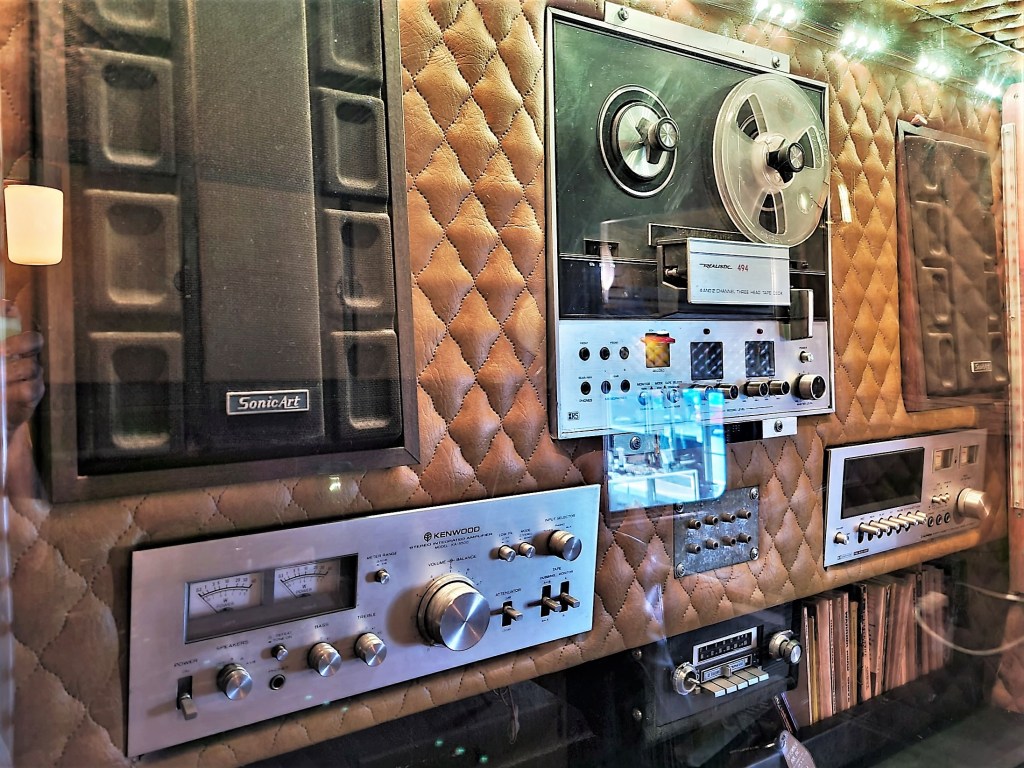
The middle compartment was equipped with a coffee bar and a sound system that ran the length of the corridor.
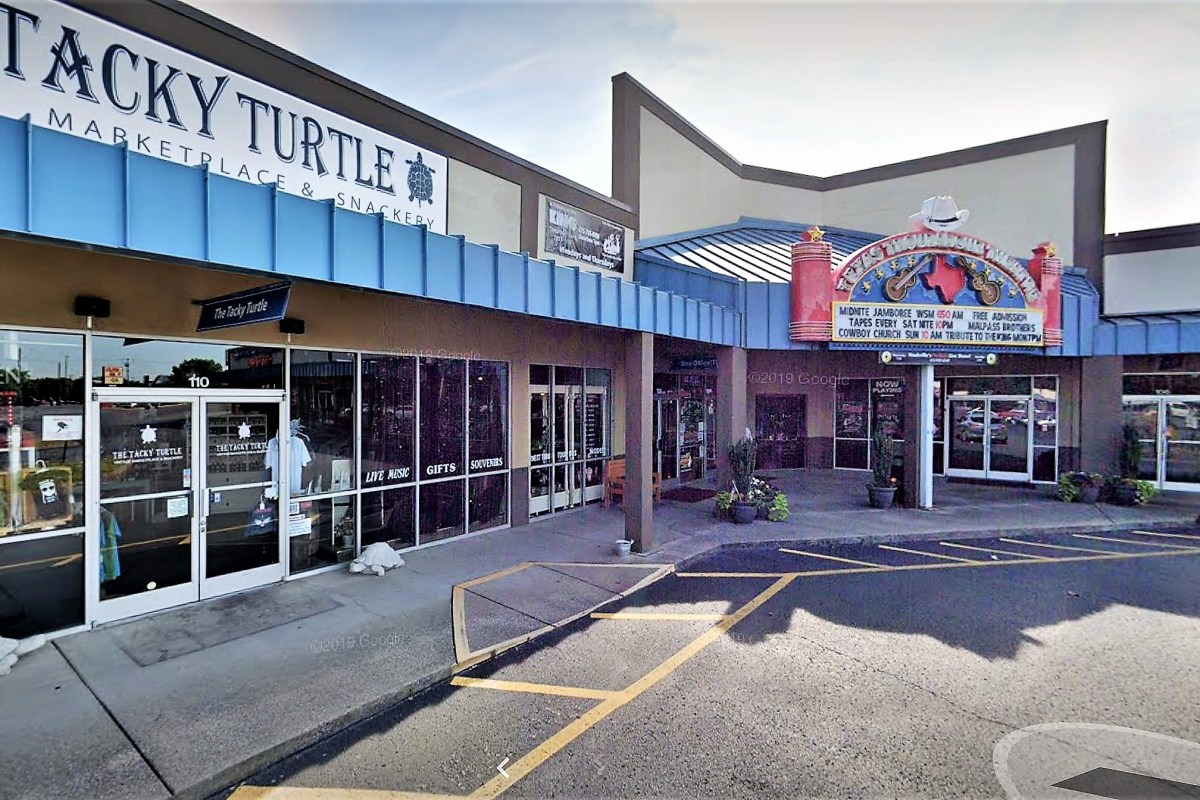
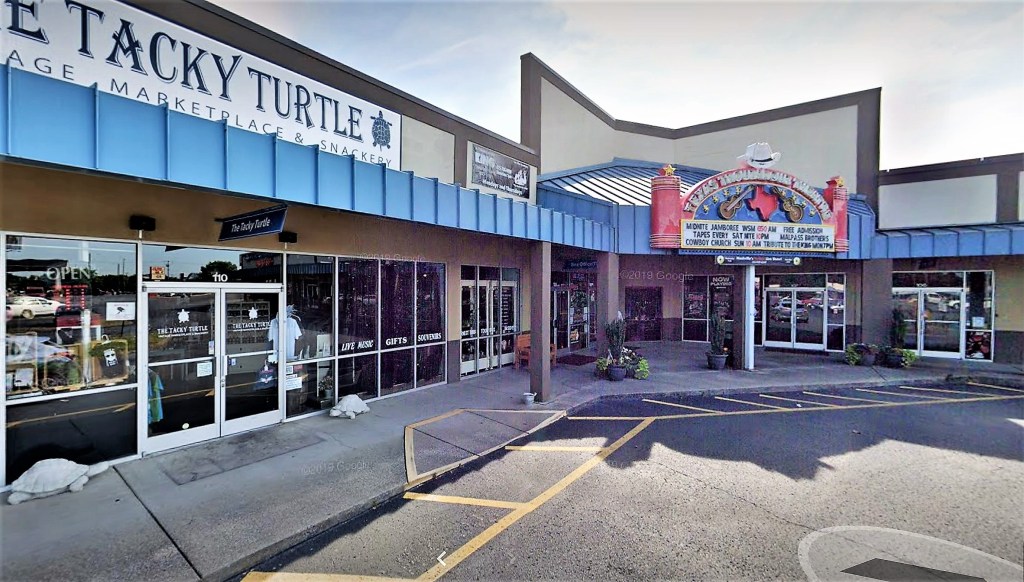
Mr. Tubb retired the bus in 1979 and donated it to the Ernest Tubb Record Shop for public viewing. In 1995, it was restored to its original state and was put on permanent display in what is now the Tacky Turtle, an exotic gift shop of tchotchkes and folk art.
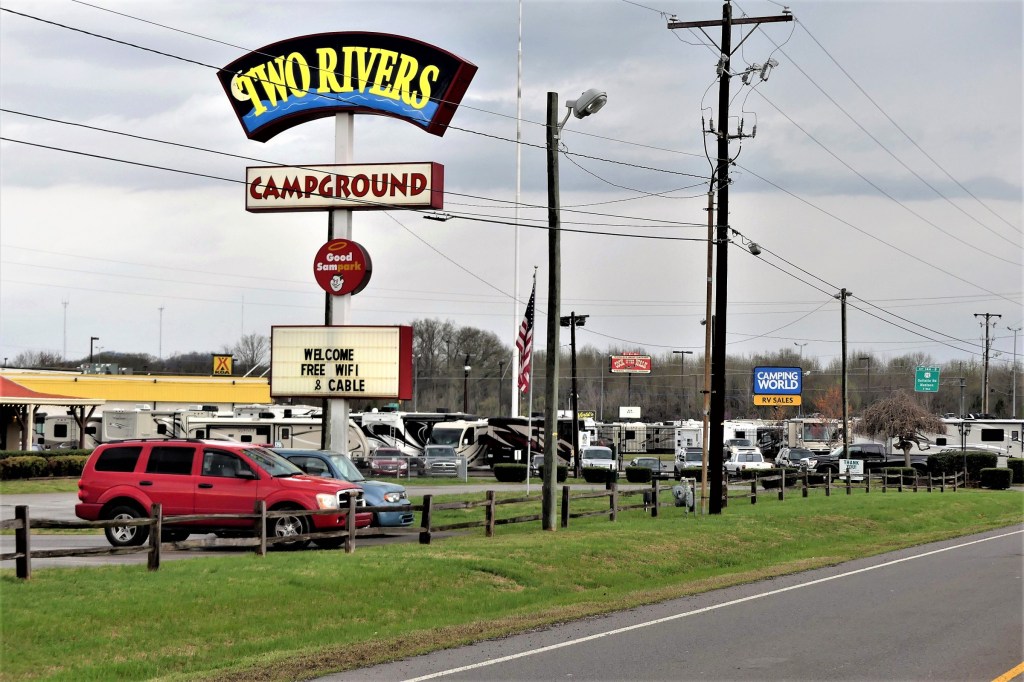
Leah and I went looking for it, initially unaware that it is just minutes from our RV campground.
We fed the coordinates to Jennifer and she directed us to a local strip mall featuring the Texas Troubadour Theater at the vortex of two legs, but it took two circles around the parking lot until I realized that the bus was hiding in plain site inside the gift shop. In fact, the mall was built as an enclosure around the bus!
We walked away enlightened, but disappointed having not heard a note, except the blare of mixed music bleeding from the Nashville bars.
But to our surprise, upon returning to the campground, we discovered a poolside concert by Tim Atwood, an 8,500-performance veteran of the Grand Ole Opry (old and new)…
with Jeannie Seeley in attendance to celebrate Tim’s 65th birthday.
Could it be, we finally beat the Grand Ole Opry curse? In the immortal words of Ernest Tubb, “That’s all she wrote.”
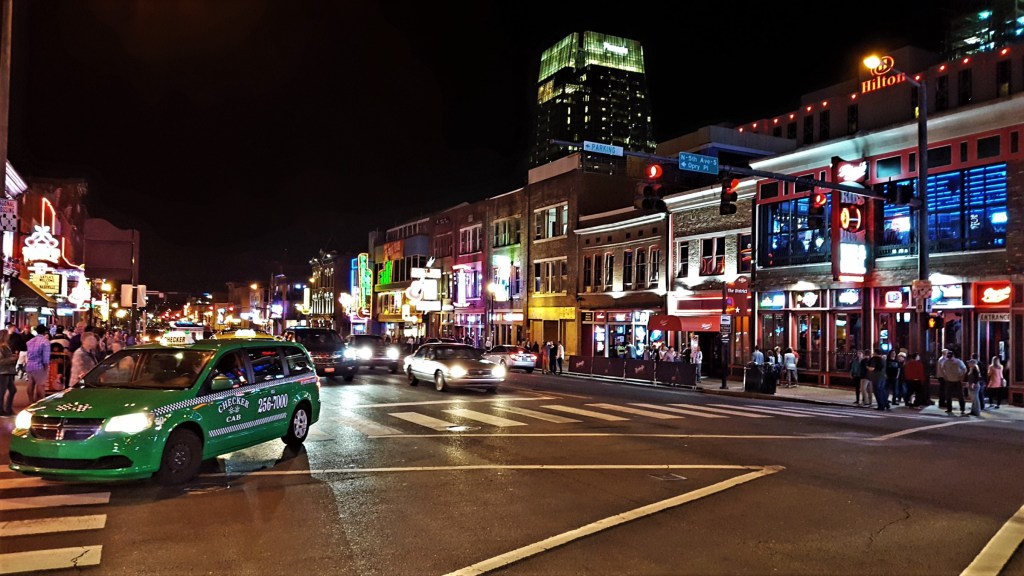
Nashville seldom disappoints, given the music, the Broadway scene, and the local history and flavor that makes Nashville such a go-to destination for letting loose.
But here we were in Nashville again for a third visit in as many years, and again, there were no concert bookings at Grand Ole Opry during our stay, just as before.
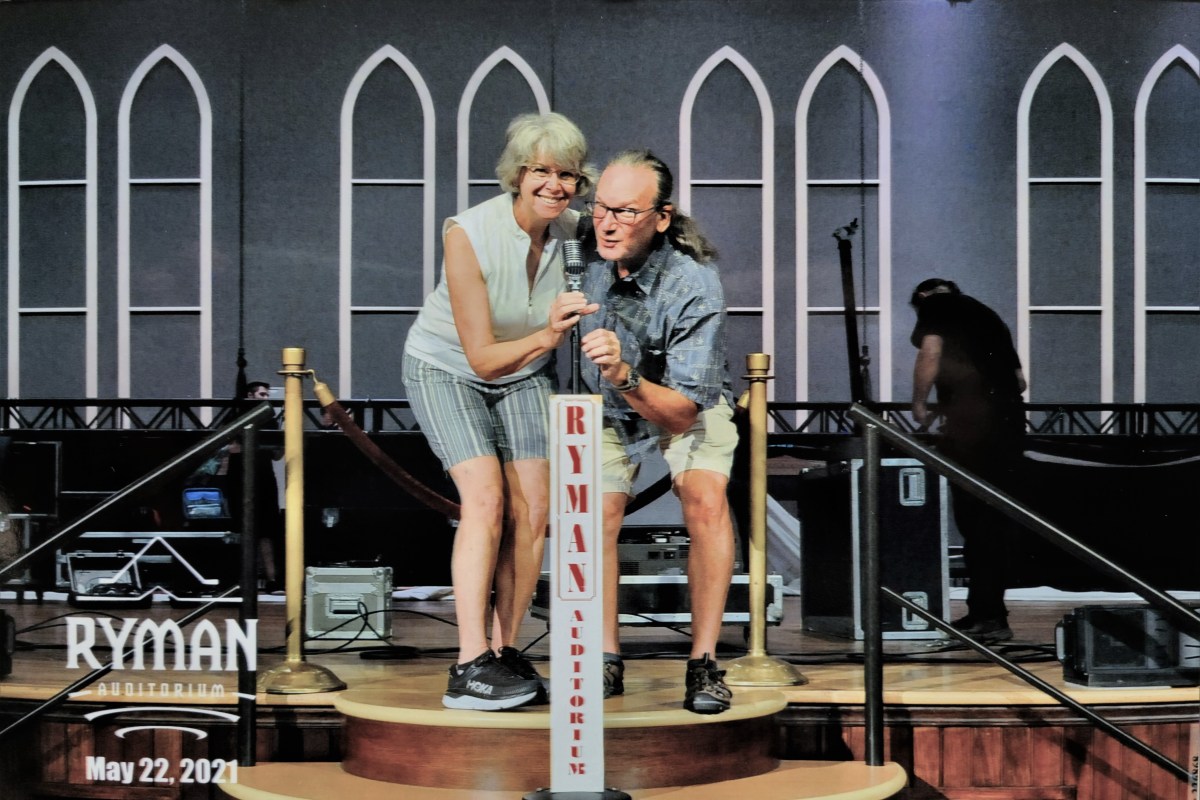
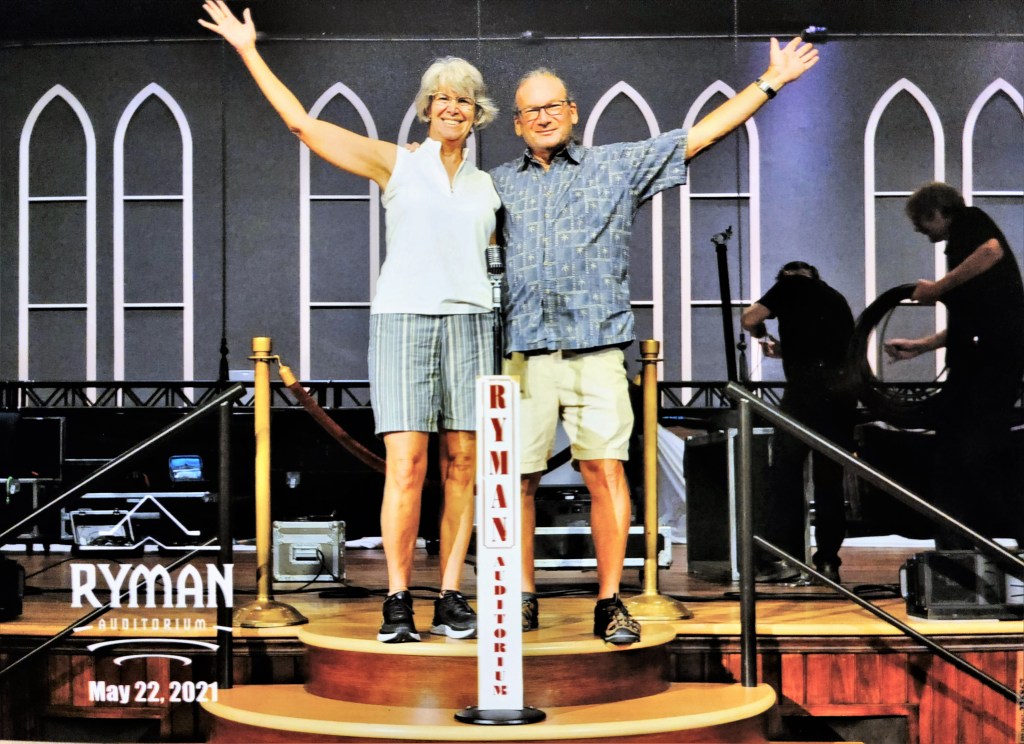
Perhaps, we should make our own music, although we would eventually take the stage at Ryman Auditorium like so many others,
by first taking a self-guided tour of the hallowed hall before having our picture snapped by the gift shop photographer.
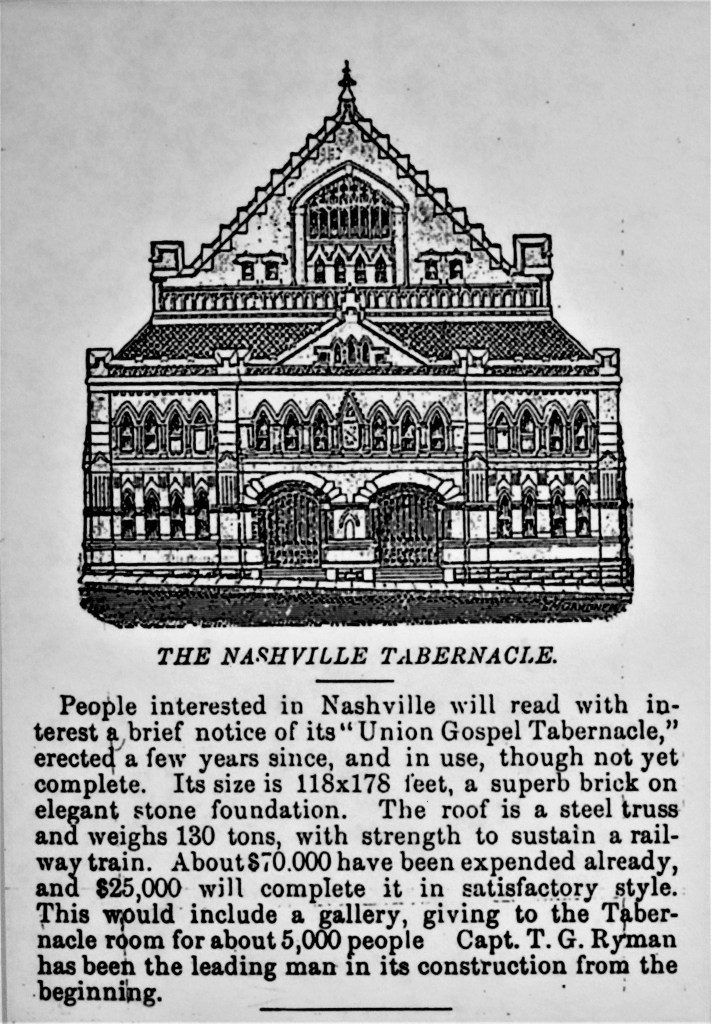
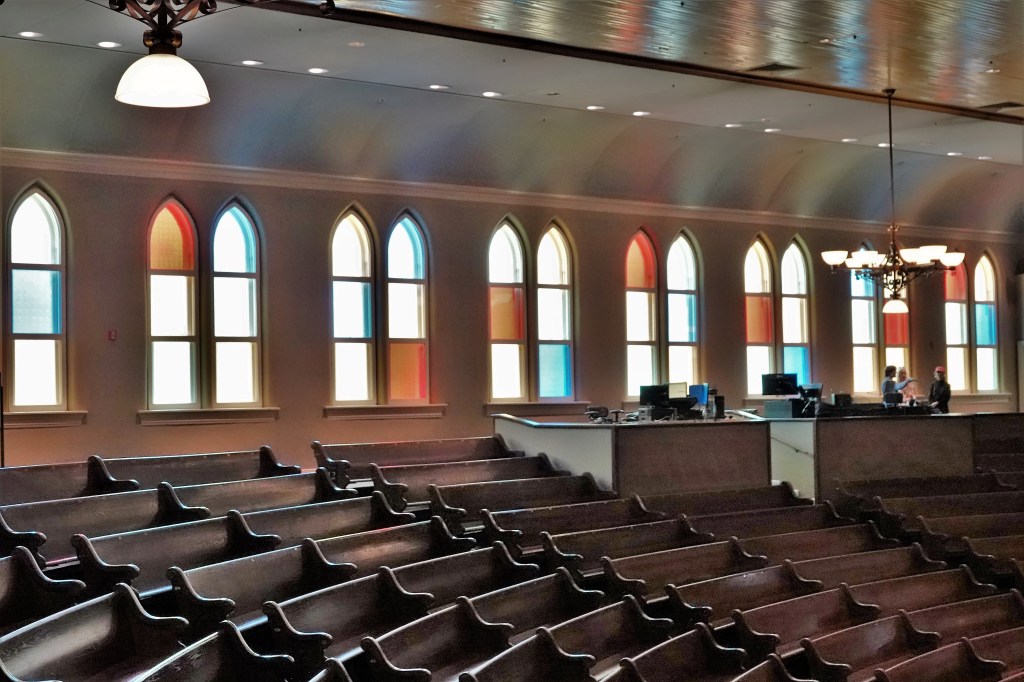
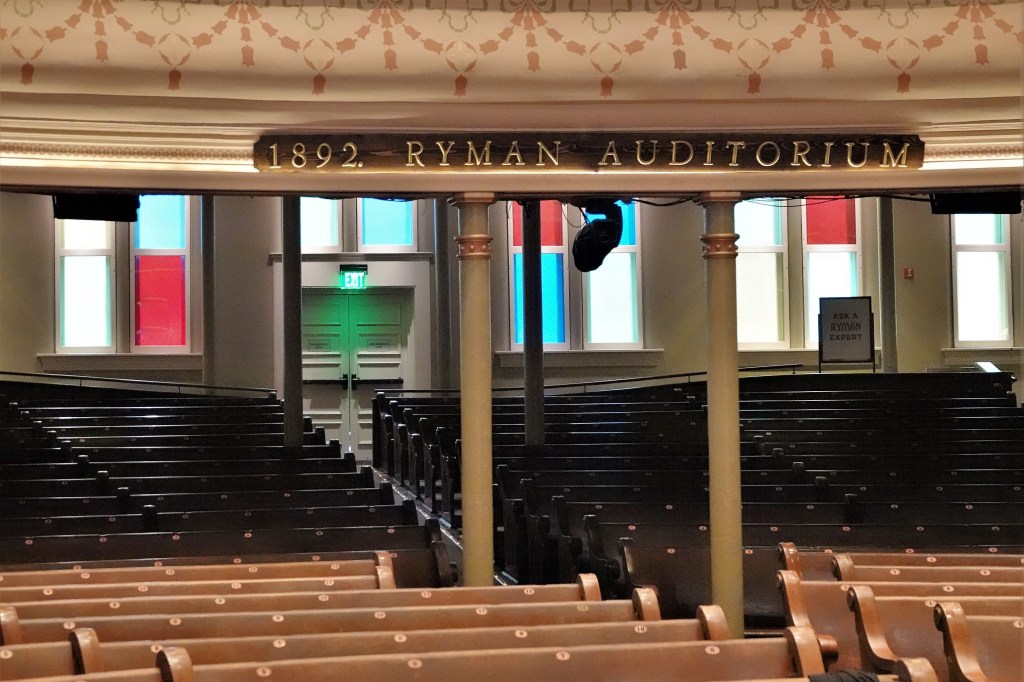
Very little has changed since Ryman Auditorium opened…
Ryman then
Ryman today
as the Union Gospel Tabernacle in 1892. Originally built as a house of worship…
by Thomas Ryman, who made his fortune from a bevy of saloons and a fleet of riverboats,
Ryman found God at a big-top revival, and vowed to build a tabernacle, allowing Nashville folks to attend large-scale revivals indoors.
The balcony opened in 1897, raising capacity to 6,000 worshippers.
Ryman died in 1904, and was celebrated inside his tabernacle. It was at his memorial service that Samuel Porter Jones, the preacher responsible for Ryman’s conversion, proposed the name change to Ryman Auditorium.
While Ryman Auditorium continued as a religious venue, it also opened its doors to popular culture and performing arts as a means of paying the bills, often hosting concerts, speaking engagements, dance recitals and theater, and earning its reputation as the “Carnegie Hall of the South.”
The Grand Ole Opry took up residency in 1943, and sold out its weekly shows for the next 31 years, becoming “The Mother Church of Country Music.”
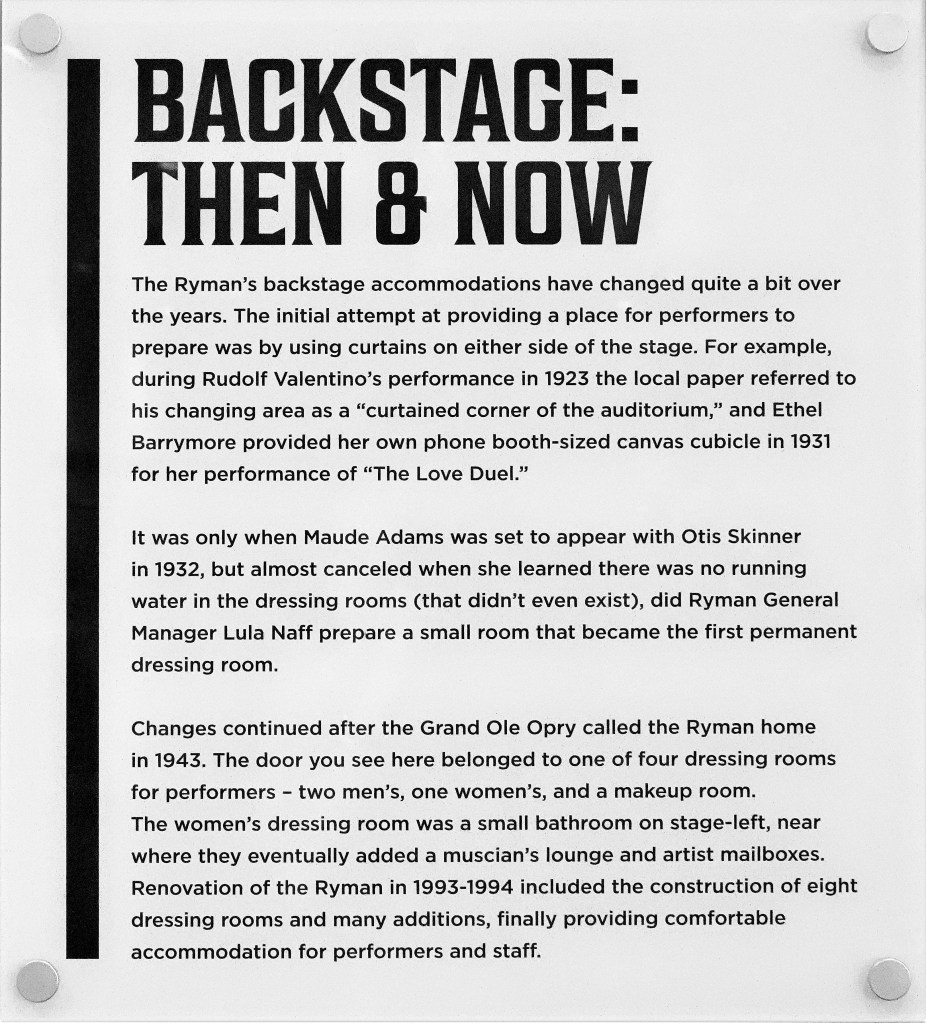
Country music acts performed in front of capacity crowds and reached audiences around the world through radio and television broadcasts, earning them large followings and superstardom. Artists were eager to appear despite the primitive accommodations.
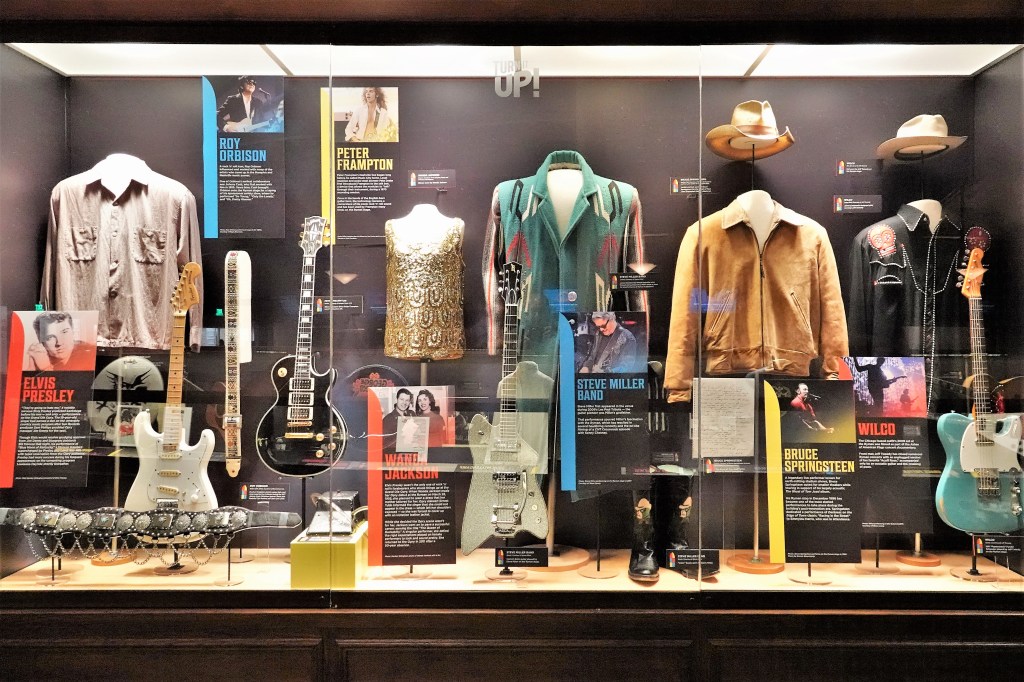
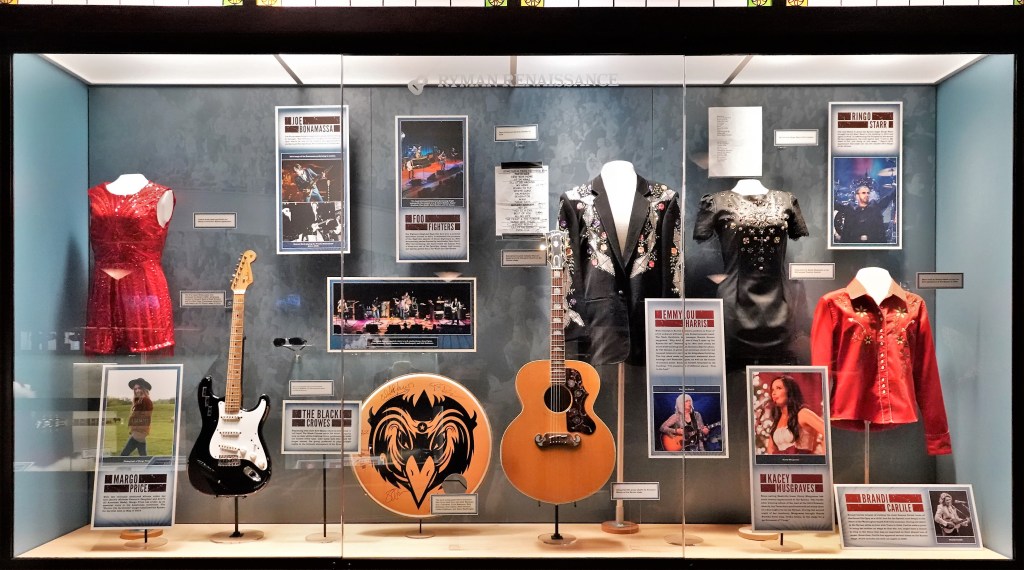
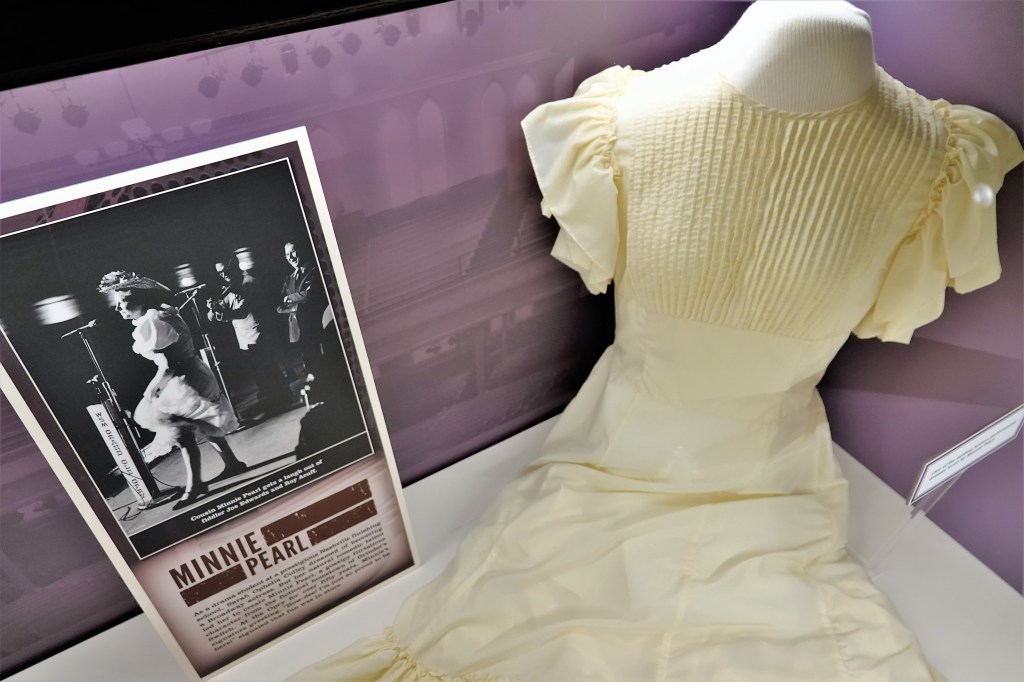
Leah and I took our sweet time as we perused the exhibits note by note, and studied the memorabilia from entertainment royalty…
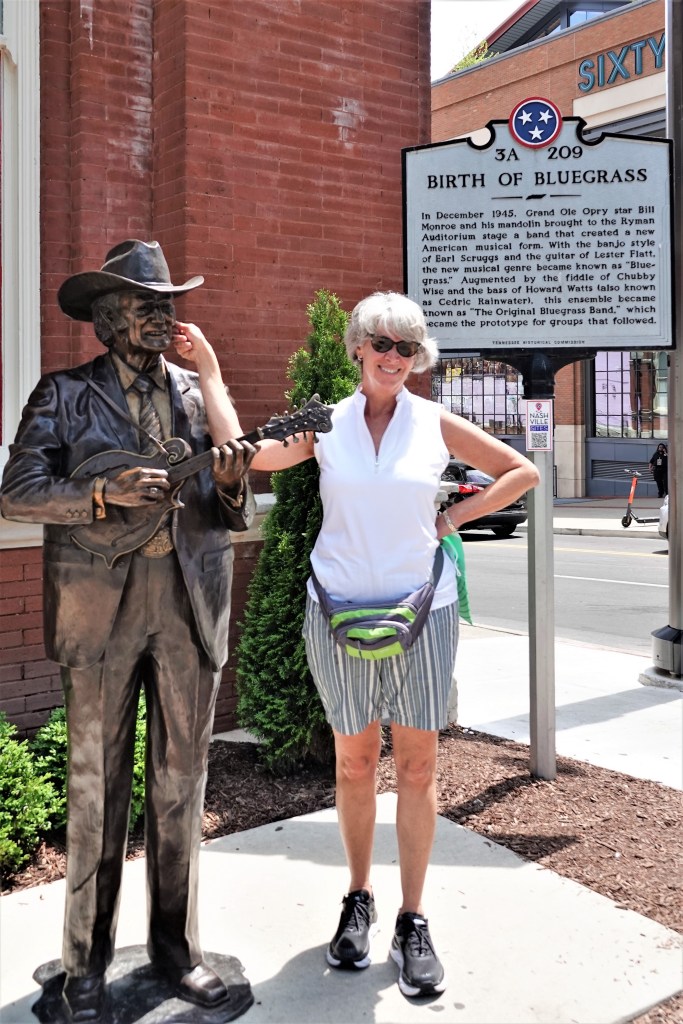
In 1974 the Grand Ole Opry shuttered its downtown location in favor of a larger, modern venue within a theme park setting, dooming Ryman Auditorium to the wrecking ball. But the historical importance of Ryman, known as the birthplace of bluegrass (and so much more) could not go unnoticed, until the preservationists prevailed, and Ryman was saved from demolition.
After a dormant period of 20 years and new ownership, the exterior was eventually rehabbed and the building’s interior was refurbished and modernized for artists and patrons, restoring it as a world-class concert hall that past and present music legends agree has some of the best acoustics in the world, only adding to Ryman’s mystique and continuing renaissance.
As for Leah and me, all that was left for us to do was smile for the camera and take our final curtain call…
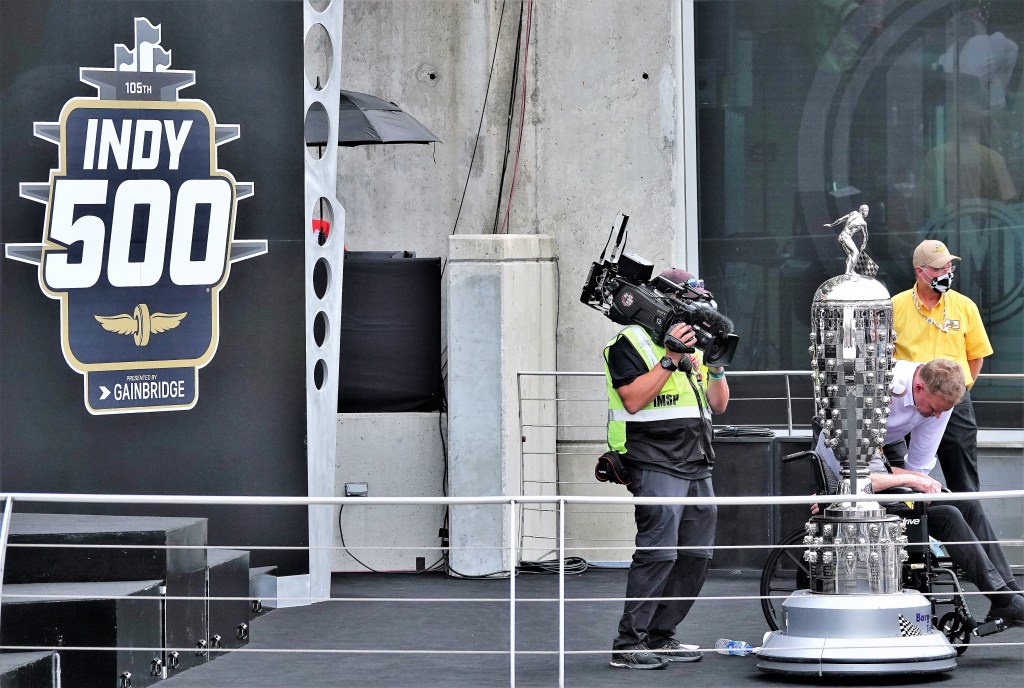
Motor sports awaits its biggest day on May 30, when 135,000 spectators will gather at the Brickyard for the start of the 105th running of the Indy 500. It will be the largest assembly of people anywhere for a single event since the coronavirus pandemic overwhelmed the country and the world.
Last year, the race was held without fans, but this year the Indianapolis Motor Speedway will accommodate 135,000 of 257,325 available seats, or 40% capacity. The number is staggering until the onlooker realizes that the curved rectangle is 2.5 miles long and occupies 559 acres,
with tiered grandstands reaching 7 stories on both sides of the track.
Having checked in at the Indiana State Fairgrounds for overnight accomodations,
we couldn’t help but notice the overwhelming noise coming from the nearby critter pavilions…
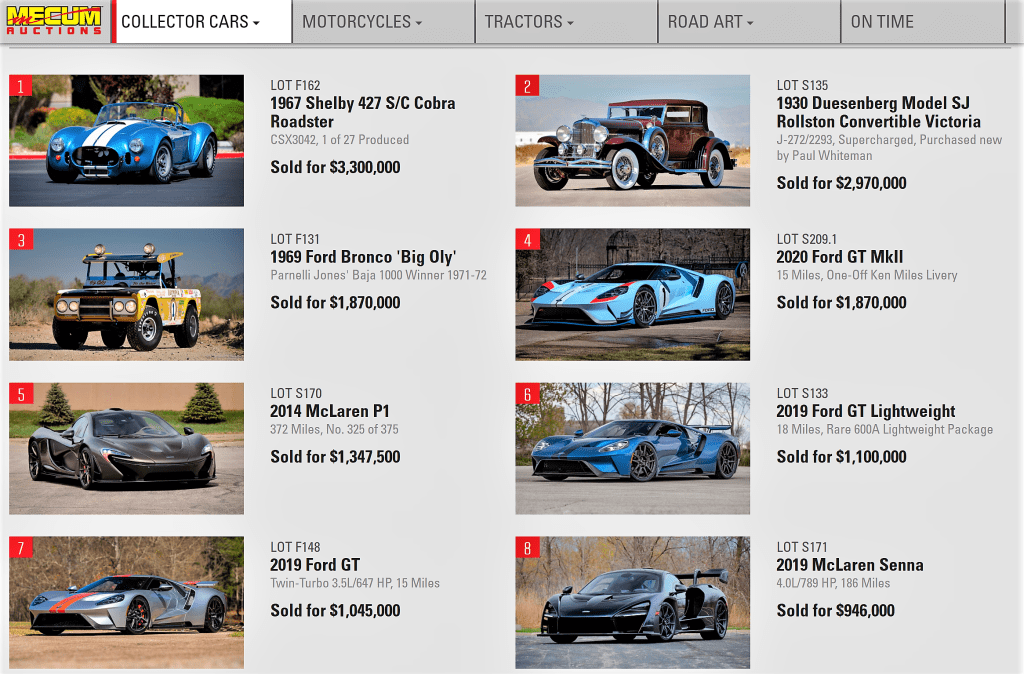
so off we went to follow the commotion, and found the source. Apparently, it was a tire spin-off to Mecum’s 2021 Indy Auction:
The Dodge Challenge
…an annual event that brings out the best and most coveted collector cars for bidding:
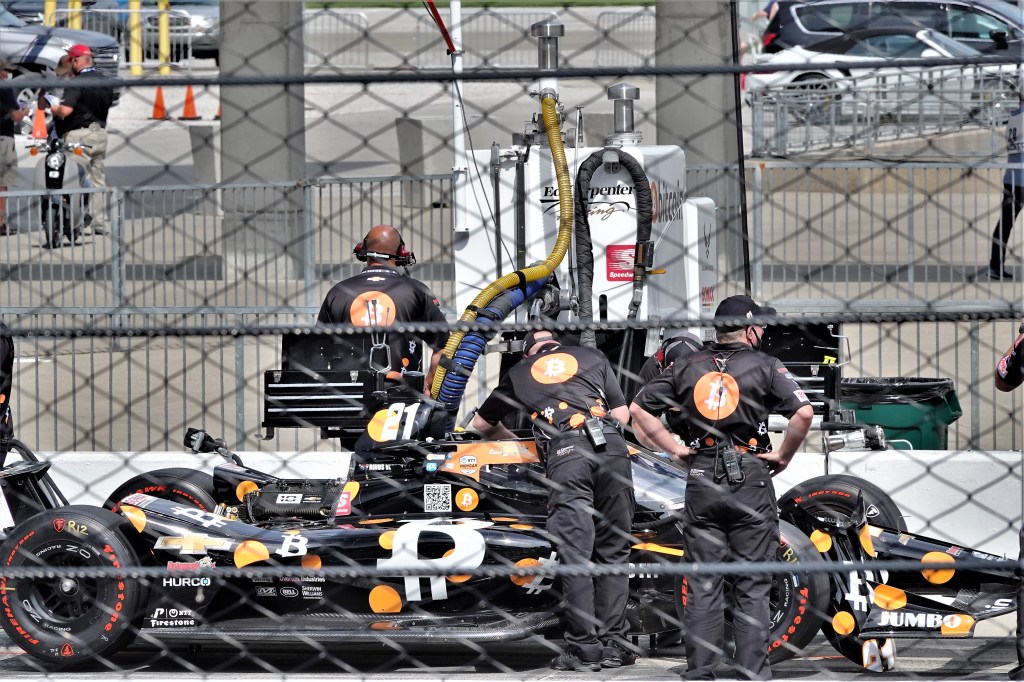
But Leah and I were in Indianapolis during the Indy 500 Practice to watch drivers rocket down the straightaways in their IndyCars at 240 mph,
in anticipation of bringing home the trophy and chugging a bottle of milk.
So off we went to the fabled racetrack, built in 1909 and mostly unchanged, until the addition of the Pagoda, completed in 2000.
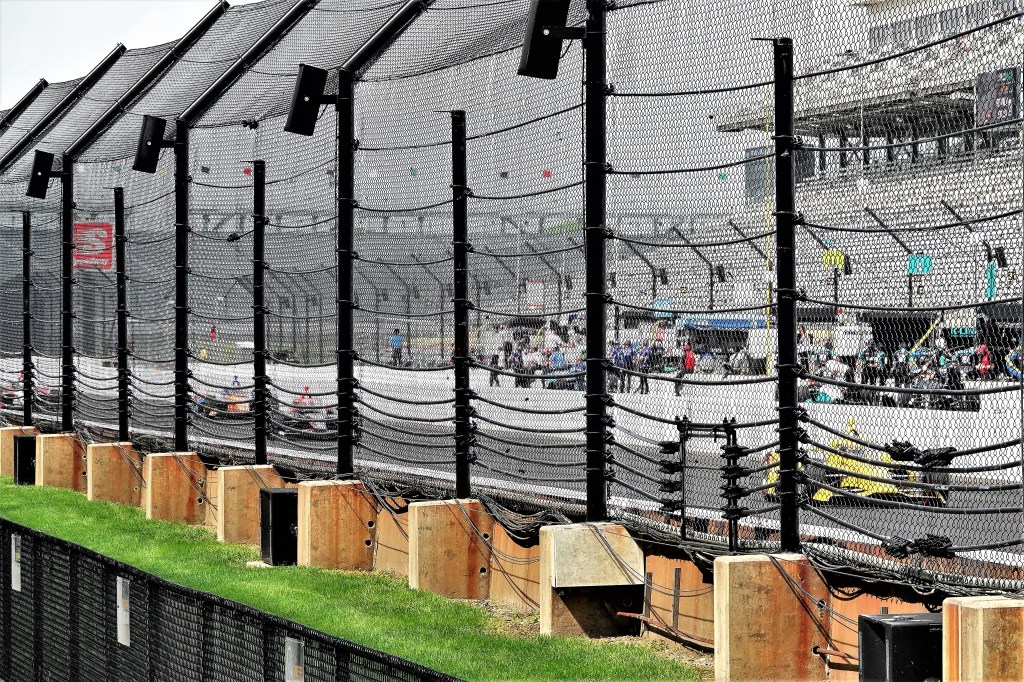
Trying to track the cars as they went screaming by in a blur…
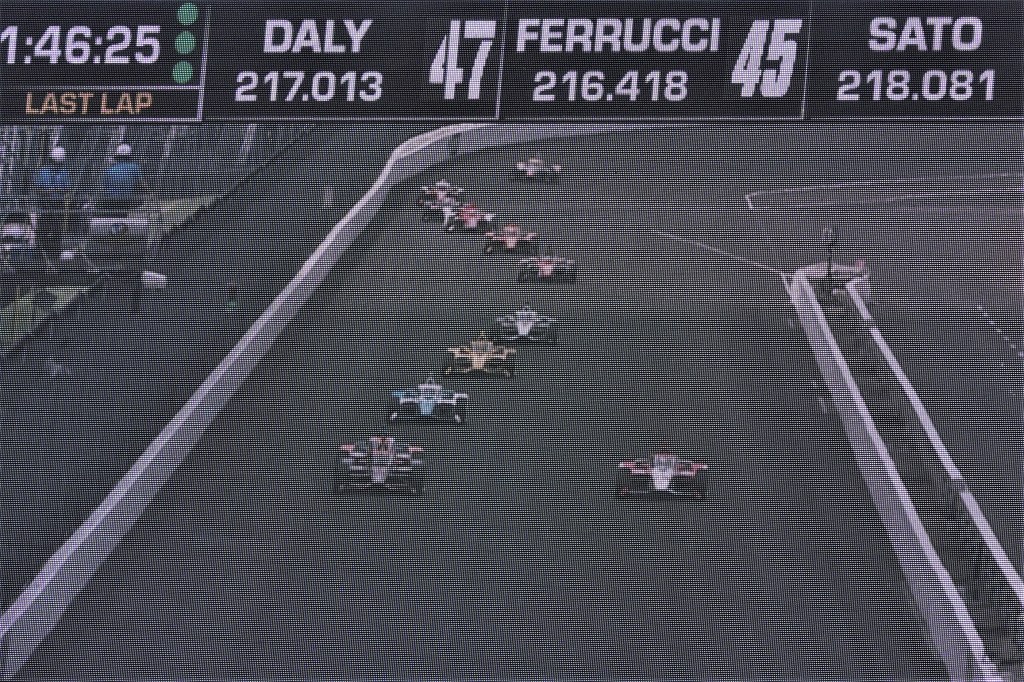
would have certainly resulted in whiplash if we continued watching with each passing lap, but thankfully, the video screen provided necessary neck relief.
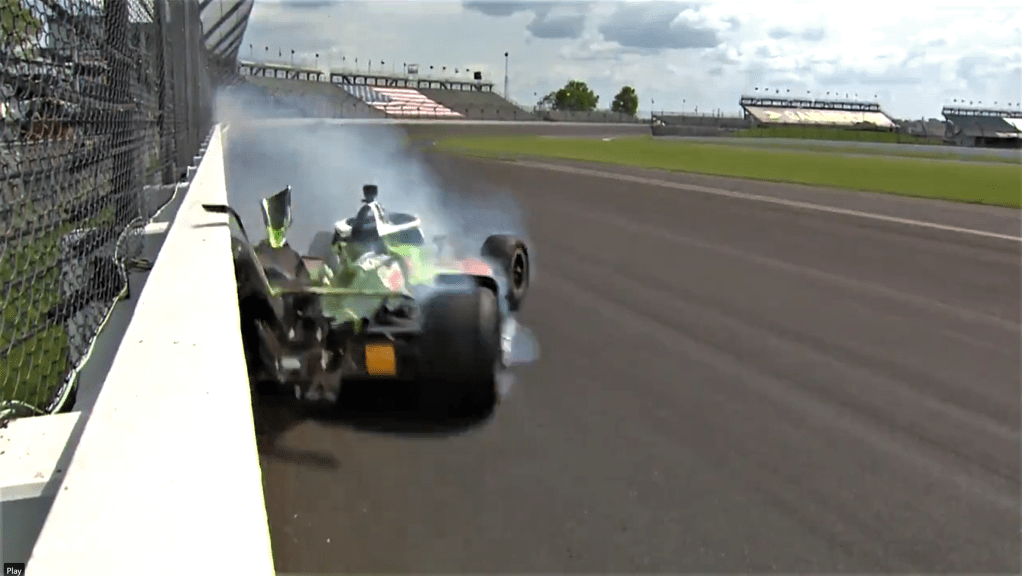
And then the unexpected happened…
With 1hr 44min left in the practice session, #45 Santino Ferrucci turning too early into the #2 corner careened into the wall,
and it was time for us to call it a day at the track.
Fortunately, Ferrucci escaped serious injury, and was taken to the hospital for observation.
He has subsequently been cleared to race on Sunday, qualifying for the 25th position in a field of 33 cars, with Scott Dixon enjoying the pole position at the start of the race.
I hope the winner likes milk!
UPDATE:
Helio Castroneves wins the Indy 500 for a record-tying 4th time, finishing ahead of Alex Palou by half a second.
Top qualifier, Scott Dixon finished 17th in the field after his car ran out of gas before his first pit stop, and Santino Ferrucci finished sixth.
Castroneves celebrated with a chilled bottle of 2% milk, but swapped that bottle out for some strawberry milk, which perfectly matched his hot pink and white fire suit and No. 6 Honda.
Living out of our newly acquired Airstream for the past few weeks has taught us a few things about durability and reliability when streaming through America across Eisenhower’s Interstate. Years of nasty weather and million-mile road wear (with subsequent band-aid repairs) have left our highways in tatters and our bridges at risk (more on this at a later date), which has a pronounced impact on any home on wheels, considering that bumps and ruts on the outside often translate to shakes and rattles on the inside.
It’s always surprising to see what’s on the cabin floor after a stint of driving between locations. Potholders frequently jump from their hooks, and occasionally, I’ll discover a rogue screw from who knows where, or an A/C vent that’s fallen. However, it’s more disconcerting to find a drawer on the floor or a cabinet door ajar because the locking mechanism has failed.
There was a time when a glass jar of spaghetti sauce was tossed out of the pantry during a rough ride and smashed to bits across the carpet runner that connects our living space to the sleeping space. Leah and I were finding spatter specks years later, stuck to walls, bedding, and curtains. We learned our lesson; today, we look for plastic containers.
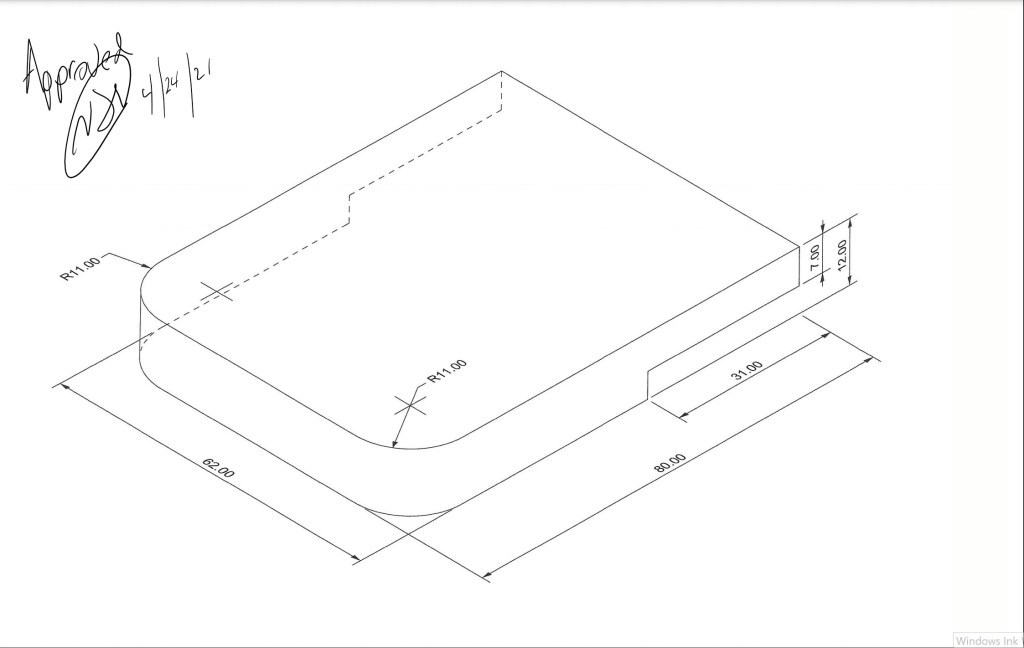
One of our more notable challenges as we prepared for this trip was finding an appropriate bedspread that had gone missing since the last owner. Because the queen-size mattress is rounded and shorter than usual–to accommodate the bedroom dimensions—Airstream charges $534 through their design store to replace it. Fuhgeddaboudit! There is no way any bedspread is worth that much. Yet, an exhausting internet search found nothing close to what we needed.
After continued research, I discovered Top Stitch, an old Airstream supplier, who promised to customize our bedspread for $199. Their first effort was a flat cover and a total flop, completely discounting the unique mattress design. However, after checking and double-checking measurements, and eventually signing off on a scaled drawing…
the project was successfully completed for a fraction of the cost. Hats off to Top Stitch!
Additionally, a stack of drawers under the galley sink—that should have been better secured—needs to be realigned to fit better and roll more smoothly; the left channel of the Polk audio system needs to reconnected; and a missing freezer door lock needs to be located and installed.
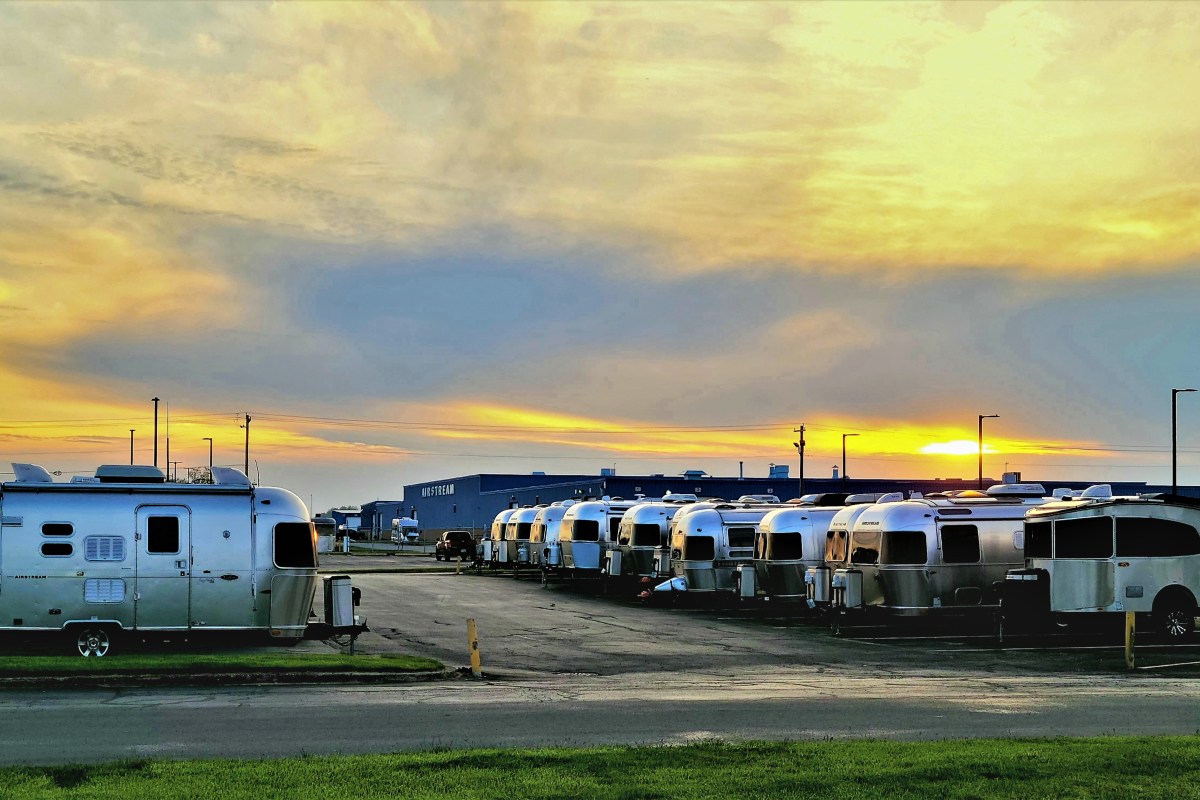
We were hopeful that a one-day stopover at Airstream’s Factory Service Center in Jackson Center, OH would satisfy our fix-it list, but only if we were willing to stay through September for the next available appointment.
Airstreams waiting for service
Uh…no! But we did stay through the night with full-service hook-up for $10.
The next morning, we were off to Indianapolis with Painter Tape across the drawers and freezer door to limit the number of surprises at our next stop.
Leah and I have been eager to weave family and friends throughout our Great American Road Trip–Part IV. This summer tour is more than escaping Florida’s summer heat, or seeing the sights and exploring the great outdoors; it’s about personally reconnecting with the world after a year of COVID-19 constraints. For all the good that Zoom has given us to put us in touch with each other across the internet, there can be no substitute for face-to-face.
And in this moment of recalibrated norms, we are craving the sensation of normalcy.
From Virginia, we continued north to New Jersey, where it was previously arranged by Leah and her daughter Danielle, that we would occupy her driveway, and safely distance inside the trailer.
While Danielle and her husband Matt have been vaccinated for some time, Lucy, at age fourteen has not–although CDC officials are now in agreement that all teenagers will be eligible for the shot. So as an extra precaution, Leah and I agreed to a rapid test.
Honestly, I thought the PCR test was overkill, as Leah and I have been fully vaccinated since January, but half an hour later, all was forgotten after getting hugs from Lucy.
Other couples in New Jersey have been less fortunate. Phil and Cheryl both tested positive in November, but Phil required a hospital stay while Cheryl remained asymptomatic. To this day, Phil still suffers long-haul effects of COVID-19, so his reluctance to host our visit was understandable. Certainly, our negative test results must have eased his mind, and it was good to see him feeling more relaxed.
Whenever we return to New Jersey, we always turn to our hiking buddies, Doug and Arlene, who remained healthy throughout the pandemic. We reprised one of our favorite hikes at Pyramid Mountain during the height of pollen season,
sneezing our way to the ridge for electrifying views of New York City.
Next, we were on to Philadelphia with a lunch detour in Vineland to visit Leah’s brother, Harvey who’s lived in a group home with four other adult men for the past 20 years. It’s been three years since our last visit (considering our move to St. Augustine, and de facto quarantine protocols), and relaxed New Jersey state restrictions now gave us an opportunity to take Harvey out for the day.
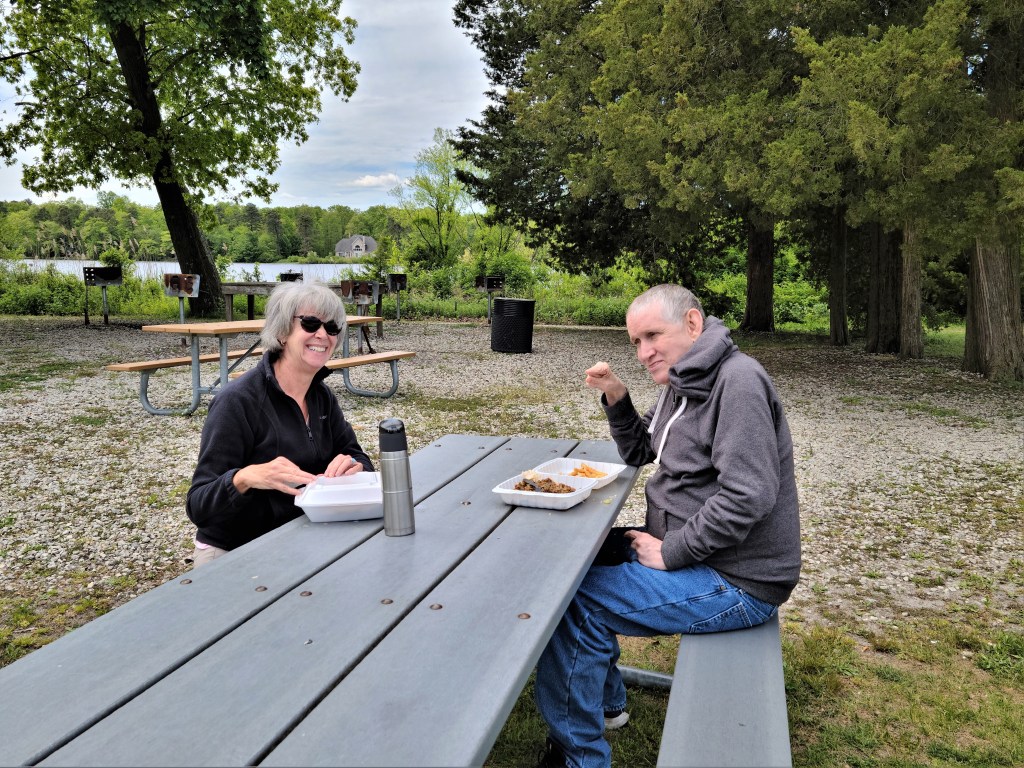
Ordinarily, we’d plan lunch at a nearby diner, but group house rules precluded indoor dining, so a take-out meal, although less than ideal…
followed by a very brief walk through a minefield of goose poop, gave us some much needed time together.
Next day, while camping in Hatfield, PA, we coordinated a day trip to Lambertville, NJ…
to reunite with my oldest son Noah,
who most recently had been tasked with rolling out two dozen mobile testing labs for COVID-19 across metro Philadelphia–making Philly safe “one test at a time”–and ironically testing positive two days after his first vaccine shot. His recovery was rapid, no doubt because of the vaccine.
We cycled the Delaware & Raritan Canal Towpath together…
until we reached Washington Crossing State Park, 8 miles north.
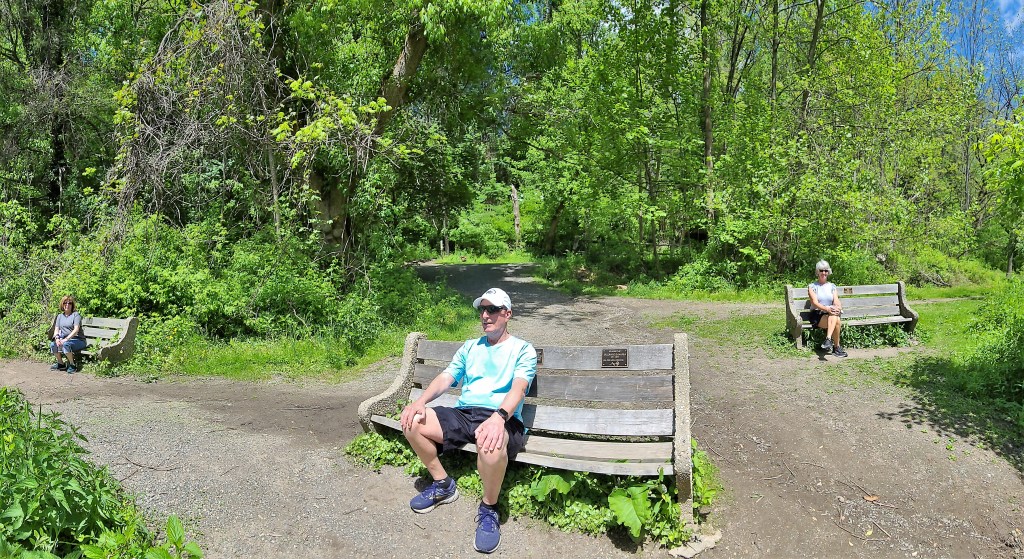
Leah and I wrapped up our Philly reunion with a hike along Wissahickon Creek…
with long-time friends Alan and Andrea, who diligently practiced social distancing for the better part of a year.
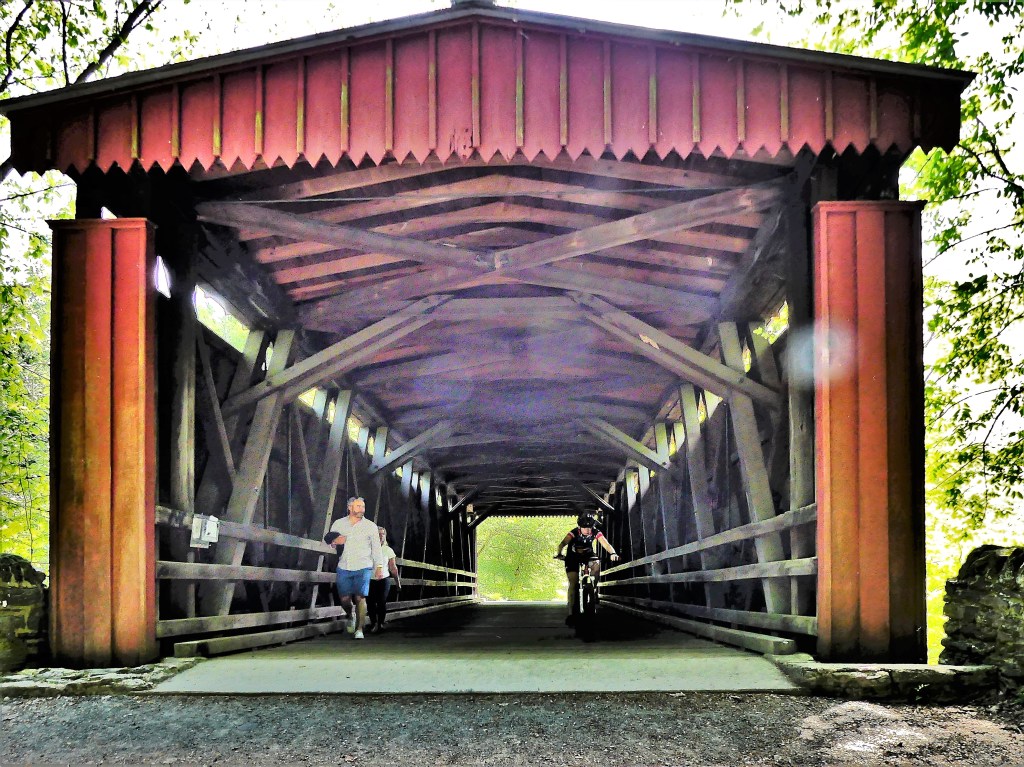
On our way to the Valley Green Inn for lunch, I spotted a garter snake enjoying a meal…
by the covered bridge.
Lastly, Leah and I made our way across the state to Pittsburgh, my hometown and my heartbeat.
Leah and I thoroughly enjoyed the hospitality of my first cousin, Sandy and his wife, Barbara, who allowed us to park our rig in front of their house. Our intention was to sleep inside the safety of our Airstream, but after learning that all of us were dosed by the Moderna vaccine, we were easily persuaded to accept Barbara’s invitation to chill at her 6,700 sq. ft., 100-yr. old resort with Sandy operating as executive chef.
To shed our extra calories, we pedal pushed through the hills of Pittsburgh on our manual bikes…
while our hosts cruised along on their e-bikes, assuring us that they were working just as hard as we were.
I don’t think so! From Point Breeze to Point State Park Fountain and back,
we reeled off 26 miles, and worked off some of the food and beer from the cousins’ reunion the day before.
Bottom Line: Leah and I have discovered that COVID-19 may have temporarily disrupted our families, but it’s also brought us closer together.
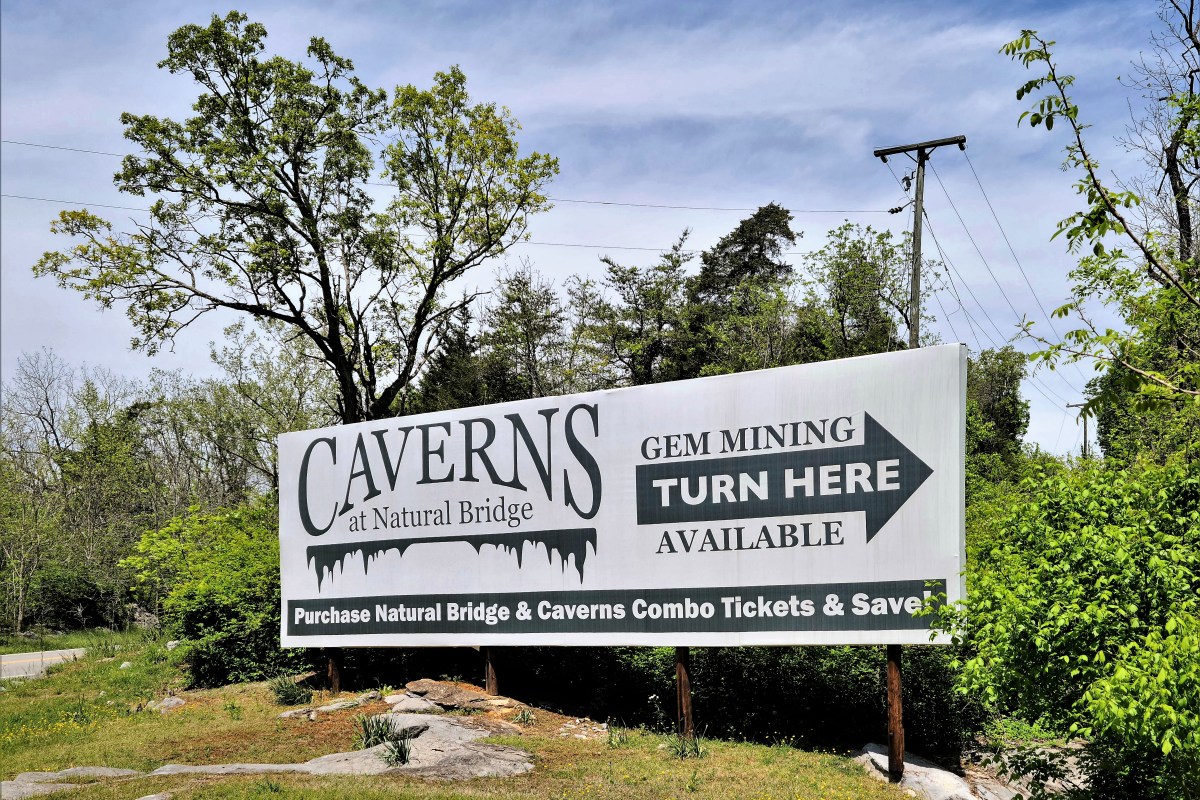
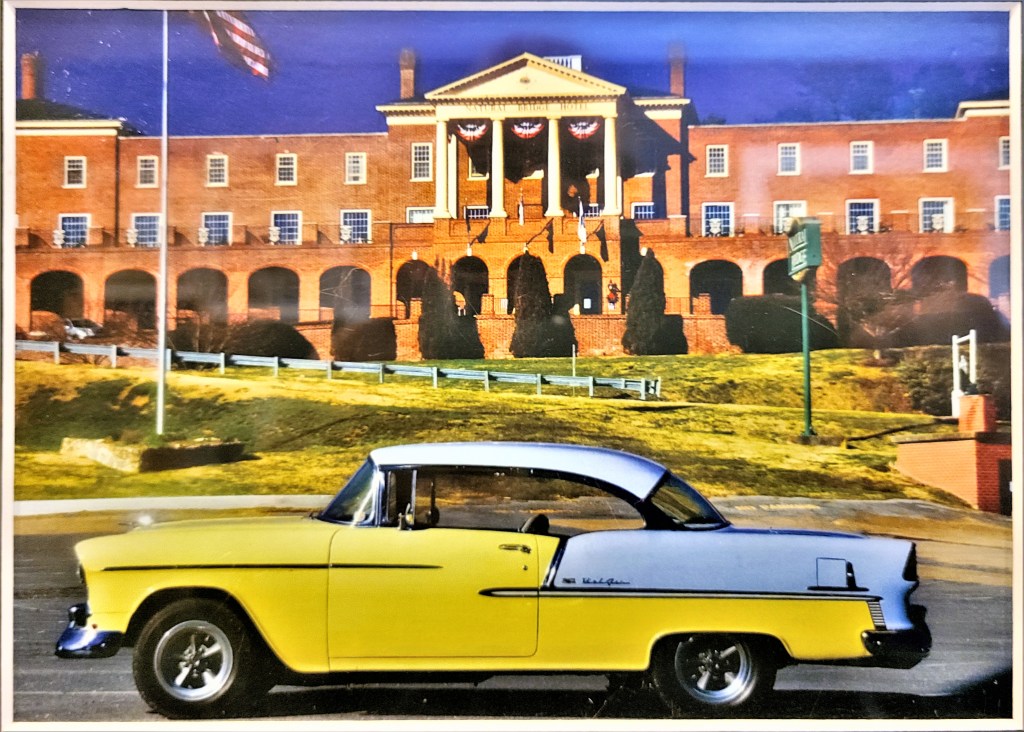
The Caverns of Natural Bridge can’t be more than a 15-minute walk from the Natural Bridge State Park parking lot. Along the way, it’s impossible to miss the Natural Bridge Hotel poised on it’s perch across the road…
where very little has changed as a popular destination for tourists since its rebuilding in 1964 after a doomsday fire.
Continuing up the road and around the corner, stands a rustic cabin set back from the parking lot that’s been open for business since 1977.
The attendant tells us that this is a quiet time for tourists–middle of the week, before Memorial Day–and that’s fine with us. In fact, so far, we are the only spelunkers to have signed up for the 2 o’clock tour. As the hour draws near, only two other women have joined us. But as a party of four, Brian, our guide assures us that we can linger longer at each attraction, since our group is so small.
We are descending into a wet cave (as opposed to a dry cave),
34 stories below the earth’s surface…
where an underwater spring still feeds the formation of speleothems (e.g. stalactites and stalagmites).
The temperature is a humid 54o F, and with masks on…
my glasses can’t help but fog with each breath I take. It’s never been so frustrating looking through a viewfinder to frame a photograph.
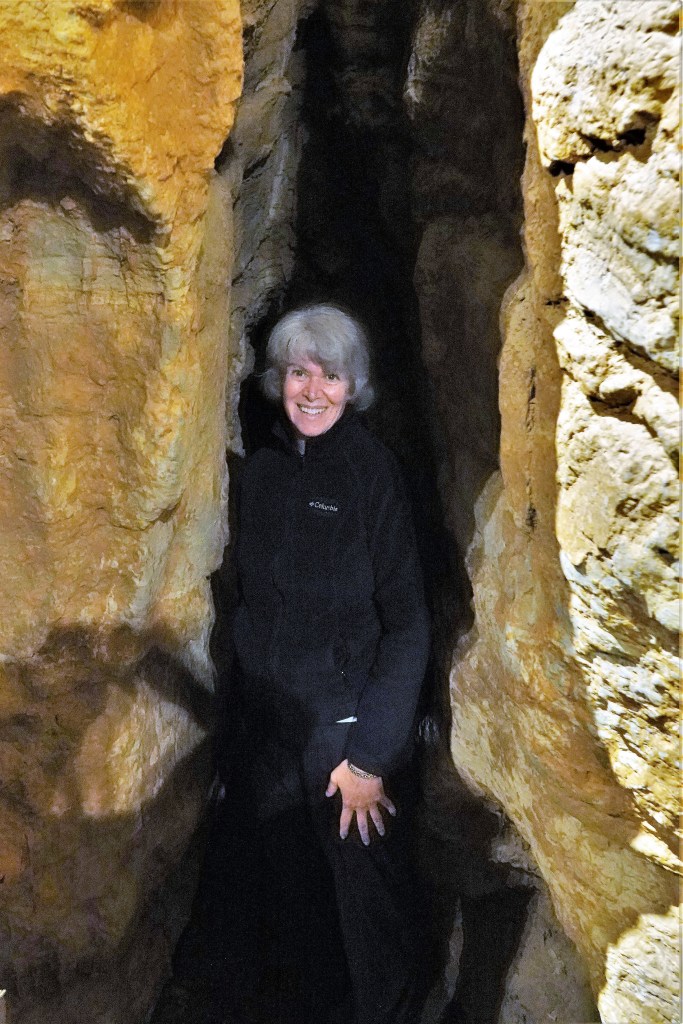
But as we snake our way through low overheads…
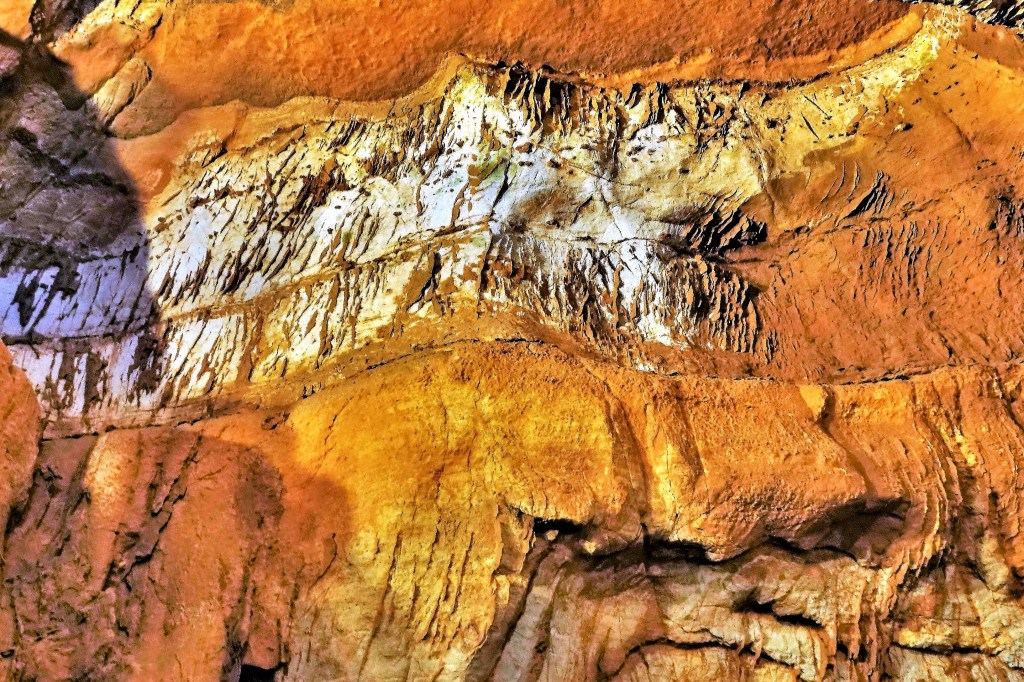
we are surprised to see boxwork, an uncommon, venous formation of calcite residue…
which forms when calcium carbonate dissolves within the cracks, resulting in unusual honeycomb patterns.
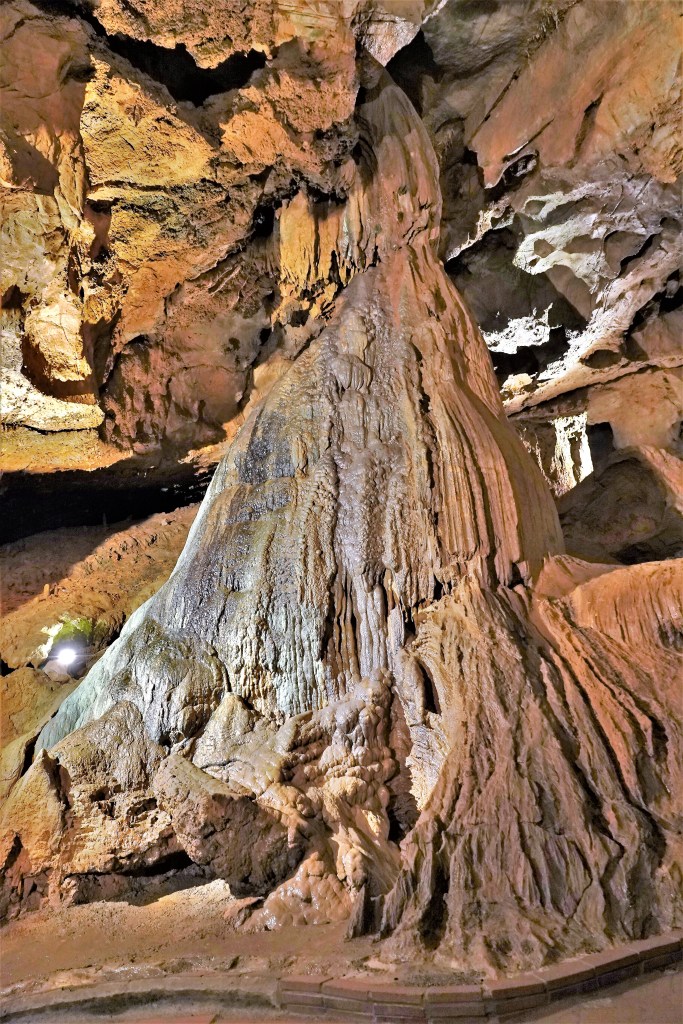
While not the biggest cave system (that belongs to Mammoth Cave), or the most ornate (that belongs to Carlsbad Cavern), Natural Bridge has a pleasant complement of columns…
and detailed domes,
and no shortage of surprises between the cracks and crevices.
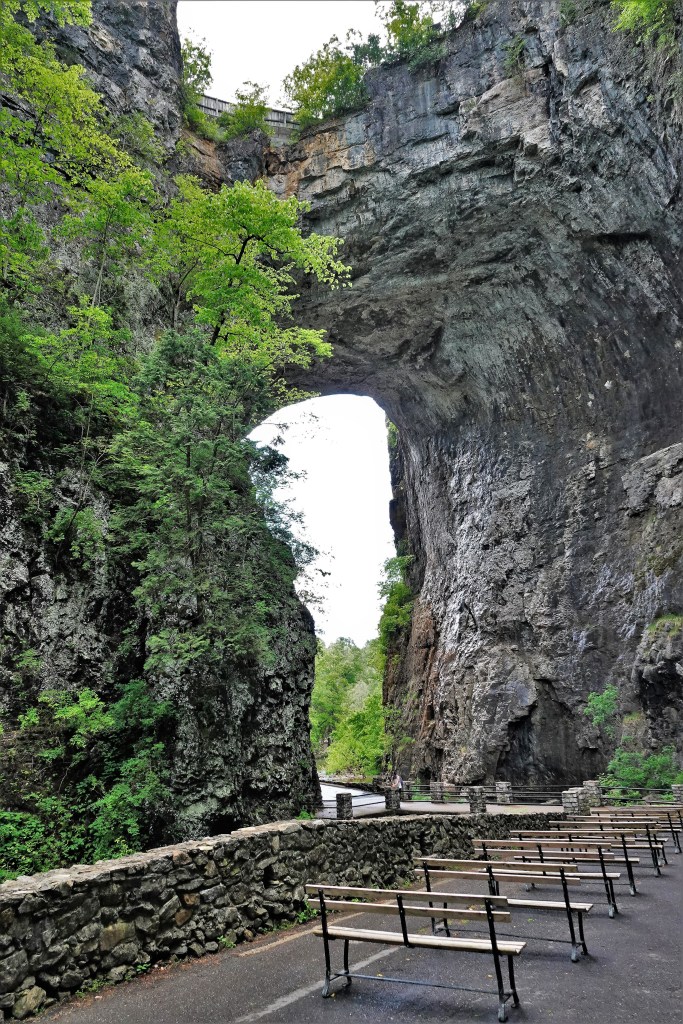
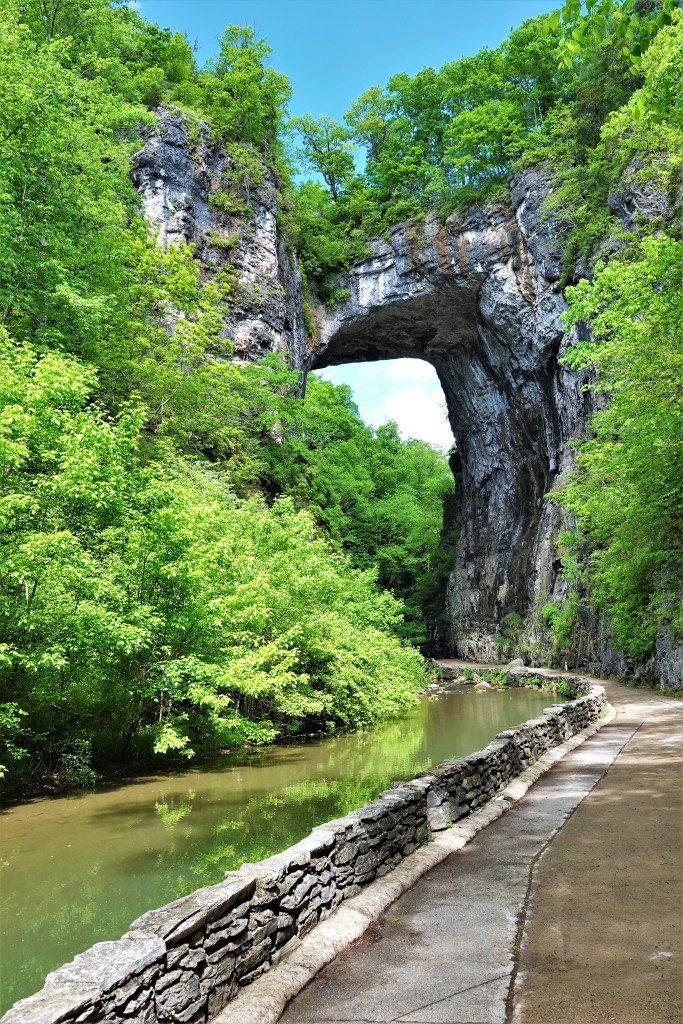
If you’re searching for a town that’s so proud of their community attraction that their town is named after it, look no further than Natural Bridge, Virginia. It’s an unincorporated town tucked within the Shenandoah Valley…
that unsurprisingly features a rock bridge of limestone located in Rockbridge County.
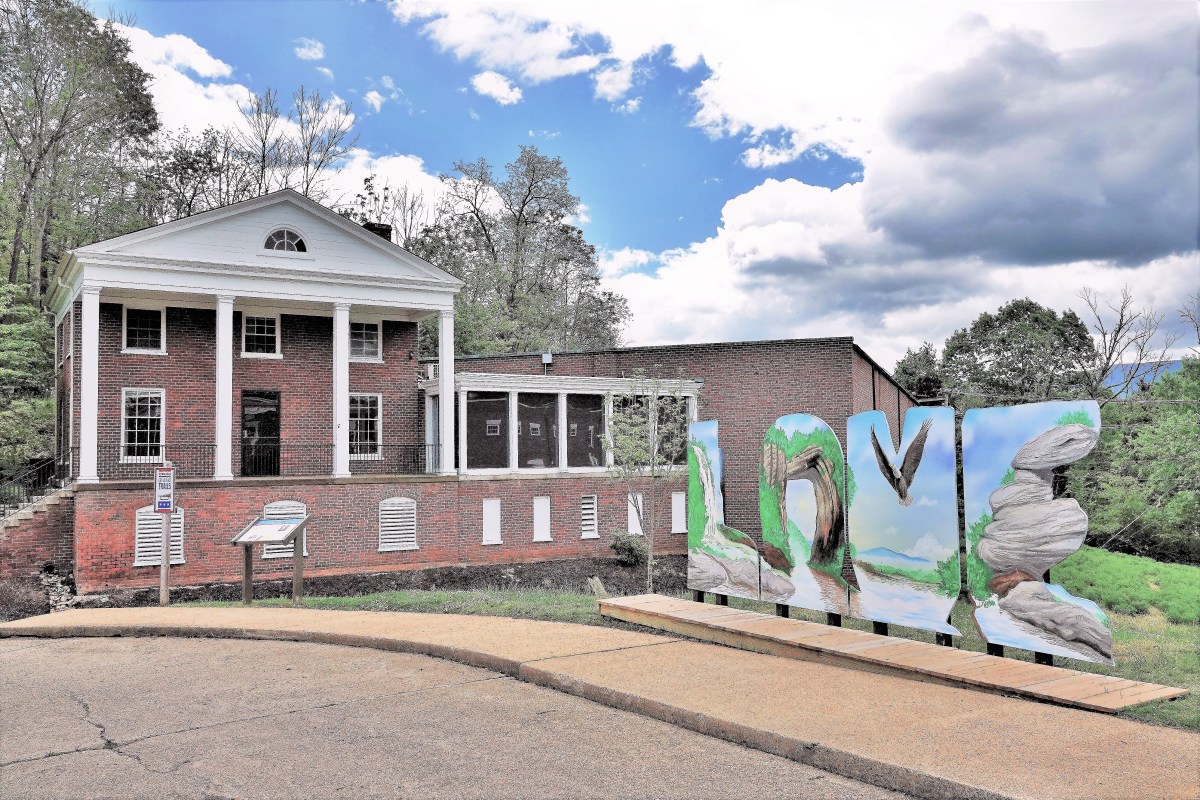
Leah and I masked up, and approached the Georgian-styled Visitor Center to surrender $18 to view this natural wonder.
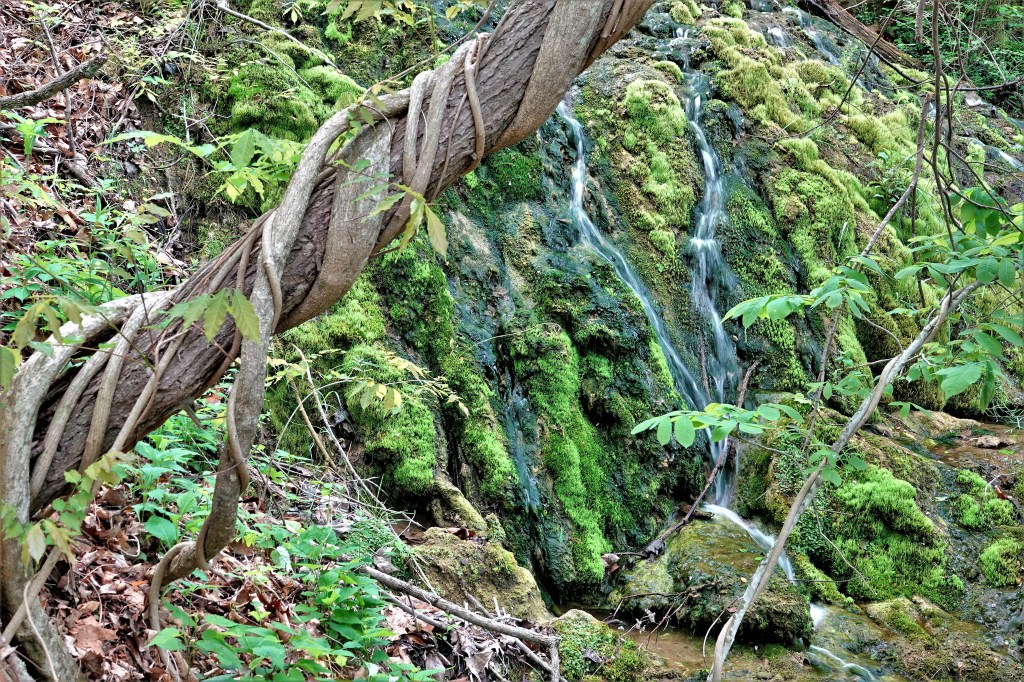
Our downward trail followed a moss-laden terrace of twisted roots and vines laced with wisps of water…
descending into enchanted dripping pools falling on flat rocks…
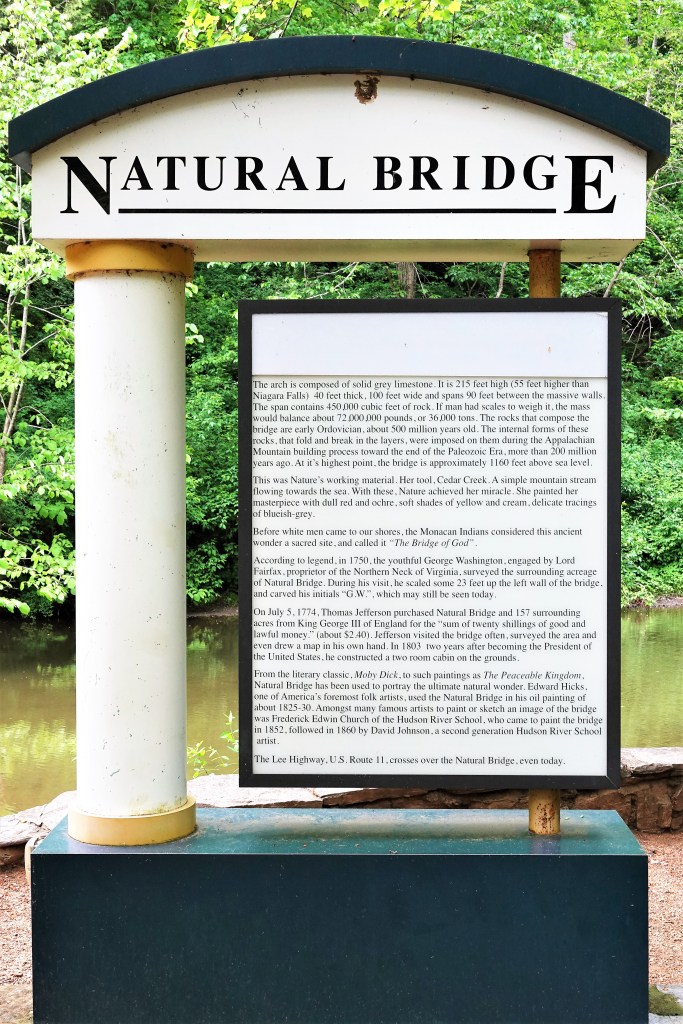
until we reached a T-shirt concession at rock bottom and an imposing graphic…
that tells the story of Natural Bridge:
The arch is composed of solid grey limestone. It is 215 feet high (55 feet wider than Niagara Falls) 40 feet thick, 100 feet wide and spans 90 feet between the massive walls.
Looking up at Natural Bridge
The span contains 450,000 cubic feet of rock. If man had scales to weigh it, the mass would balance about 72,000,000 pounds, or 36,000 tons. The rocks that compose the bridge are early Ordovician, about 500 million years old. The internal forms of these rocks that break and fold in the layers were imposed on them during the Appalachian Mountain building process toward the end of the Paleozoic Era, more than 200 million years ago. At its highest point, the bridge is approximately 1160 feet above sea level.
This was Nature’s working material. Her tool, Cedar Creek–a simple mountain stream flowing toward the sea. With these, Nature achieved her miracle. She painted her masterpiece with dull red and ochre, soft shades of yellow and cream, delicate tracings of blueish-grey.
Before white men came to our shores, the Monacan Indians considered this ancient wonder a sacred site, and called it “The Bridge of God.”
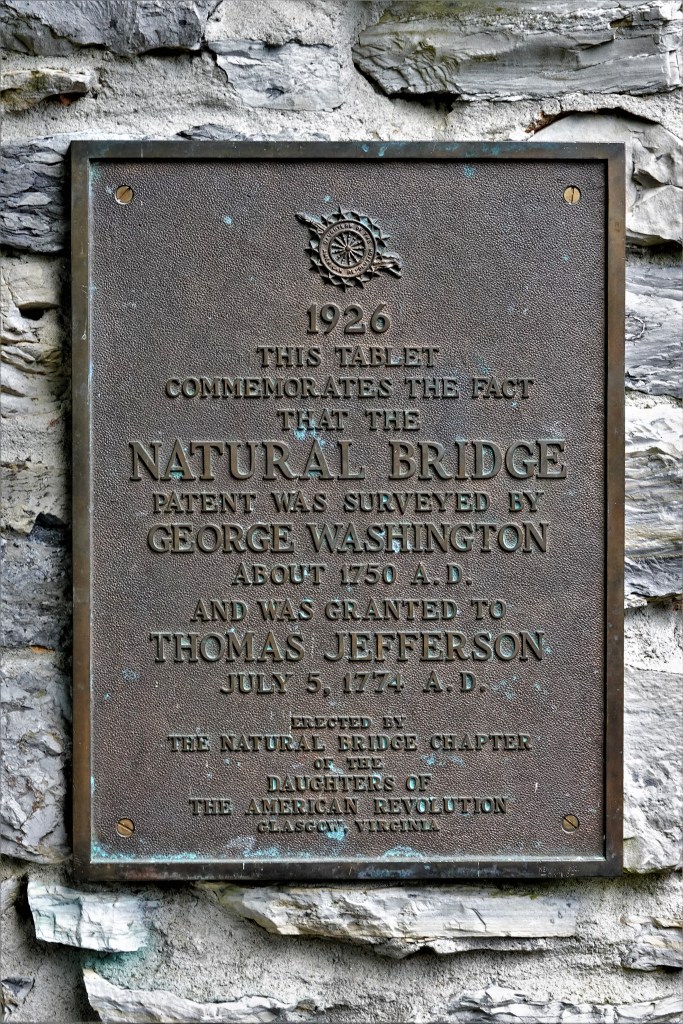
According to legend, in 1750 the youthful George Washington, engaged by Lord Fairfax, proprietor of the Northern Neck of Virginia, surveyed the surrounding acreage of Natural Bridge. During his visit, he scaled some 23 feet upon the left wall of the bridge and carved his initials, which may still be seen today.
On July 5, 1774, Thomas Jefferson purchased Natural Bridge and 157 surrounding acres from King George III of England for the “sum of twenty shillings of good lawful money” (about $2.40). Jefferson visited the bridge often, surveyed the area, and even drew a map in his own hand. In 1803, two years before becoming the President of the United States, he constructed a two-room cabin on the grounds.
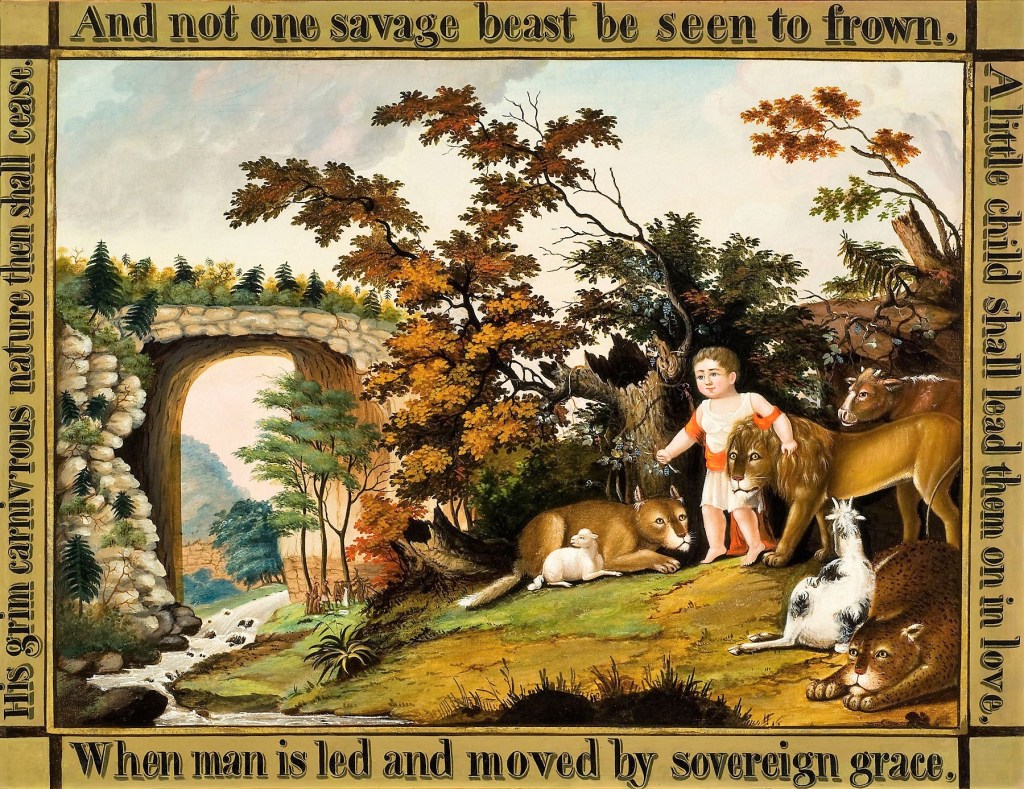
From the literary classic Moby Dick, to such paintings as The Peaceable Kingdom, Natural Bridge has been used to portray the ultimate wonder. Edward Hicks, one of America’s foremost folk artists, used the Natural Bridge in his oil painting of about 1825-30.
Amongst many artists to paint or sketch an image of the bridge was Frederic Edwin Church, followed in 1860 by Davis Johnson, a second generation Hudson River School artist.
In later years, Natural Bridge became a merchandising magnet.
Personally, I was equally as intrigued with Cedar Creek as I was impressed by the monolithic bridge…
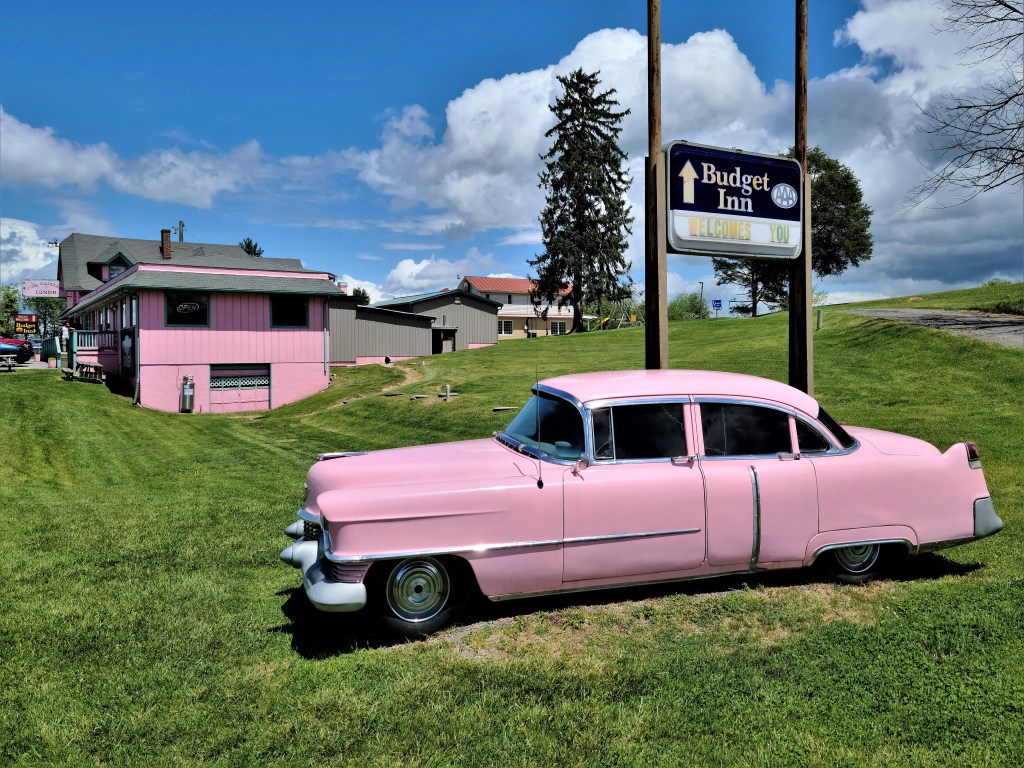
Even today, Lee Highway (U.S. Route 11) runs across the Natural Bridge, and that’s a very good thing, because we crossed many times to access our KOA campground down the road, and more importantly to visit Elvis at the Pink Cadillac Diner.
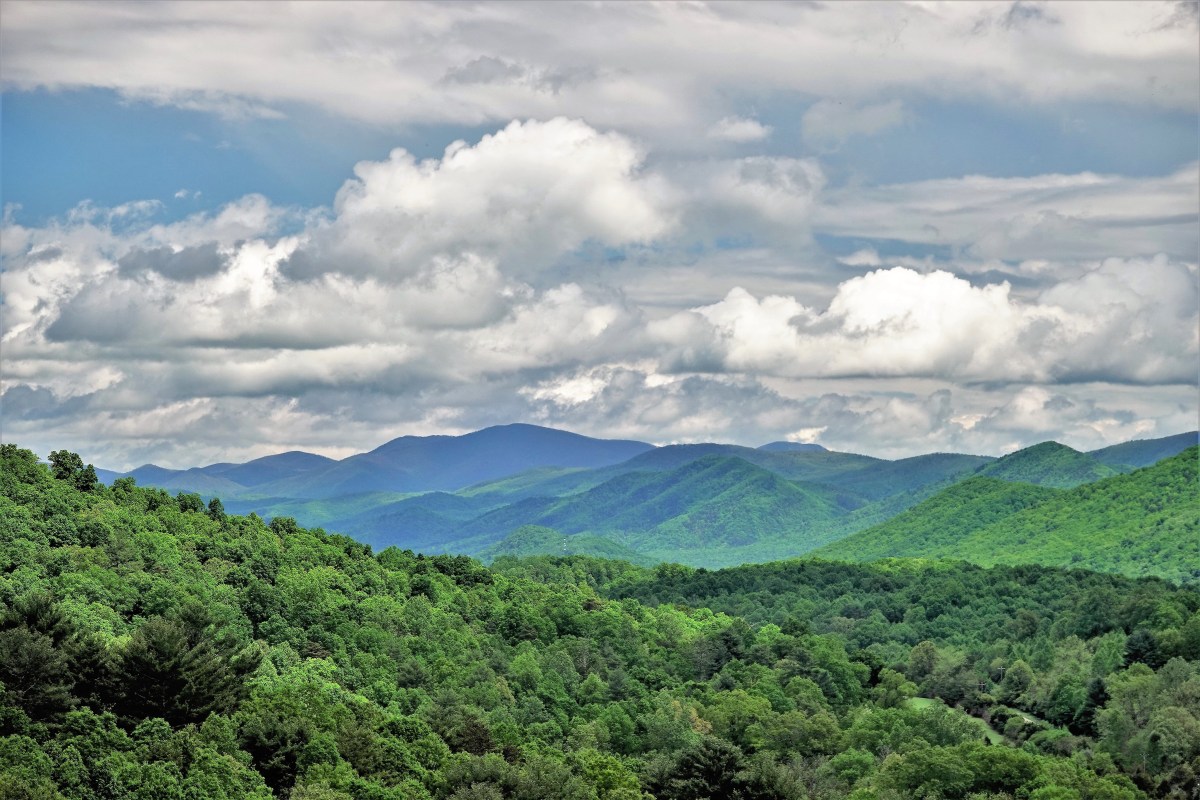
After driving hours upon hours of sameness along I-95 to I-26, Leah and I crossed the border into North Carolina, and rejoiced at our first sight at mountains in the past 9 months–the Blue Ridge. It was a sign that we were entering Pisgah National Forest and approaching Asheville, our first destination of the Great American Road Trip–Part 4.
Although the weather could have been more welcoming, we managed an urban bike ride through Carrier Park and by the River Arts District…
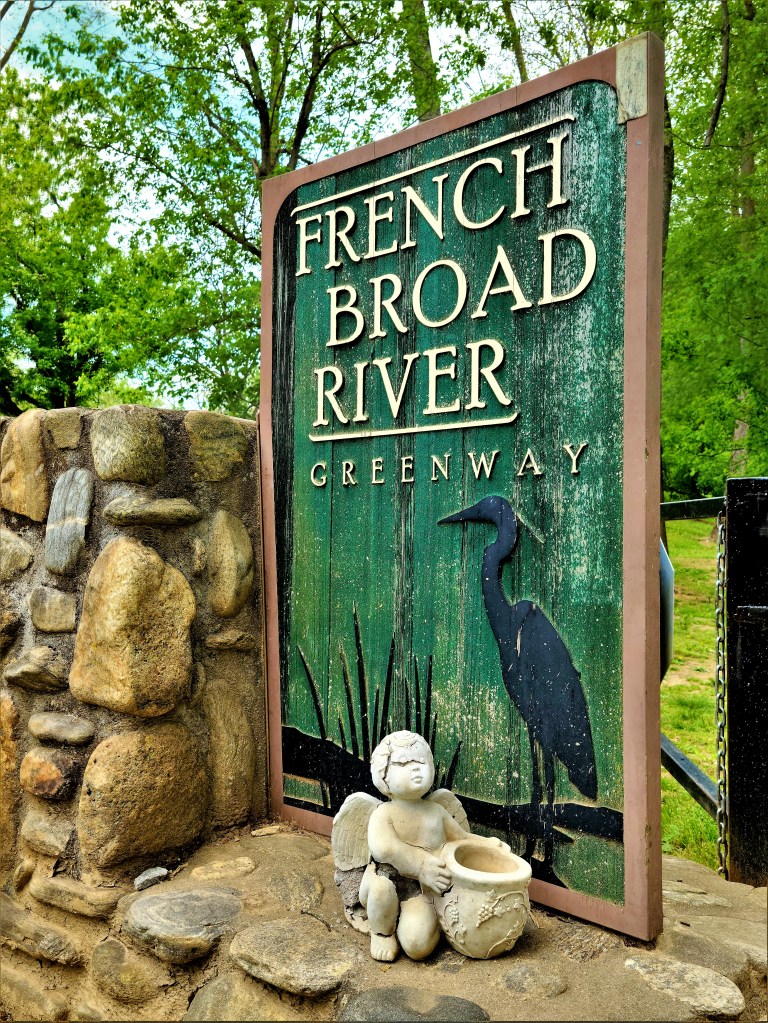
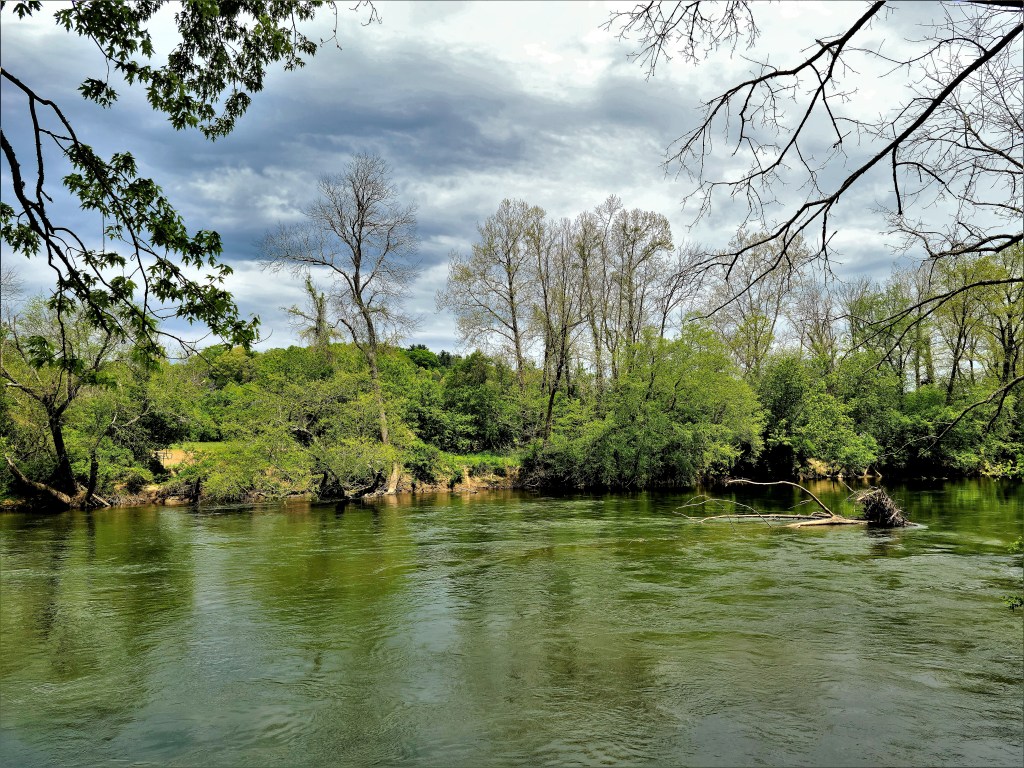
before doubling back along the French Broad River Greenway.
to admire the serenity of the lazy river.
Thank goodness for video downloads, because the incessant rain throughout the evening and into the following day kept us indoors–giving Smokey a much needed fire-watch break–
but preventing us from exploring our Lake Powhatan campground surroundings. Fortunately, by mid-afternoon, a partial clearing at the lakefront…
gave us an opportunity to loop around the water through mountain laurel archways…
Leah and I are on the road again, continuing our Great American Road Trip–part 4, with some significant changes and improvements.
Last year, during the summer of Trumpandemic, we took an abbreviated trip to upstate New York in search of open outdoor vistas with blue skies and limited exposure to crowds, which we found at Letchworth State Park.
Soon after, we rounded the top of New England to enjoy a requisite Maine lobster dinner…
to dip a toe in the Atlantic on Hampton Beach…
and to gawk at the wealthy from Newport’s Cliff Walk.
We hugged the coastline until we reached Chincoteague, Virginia…
in search of precious ponies…
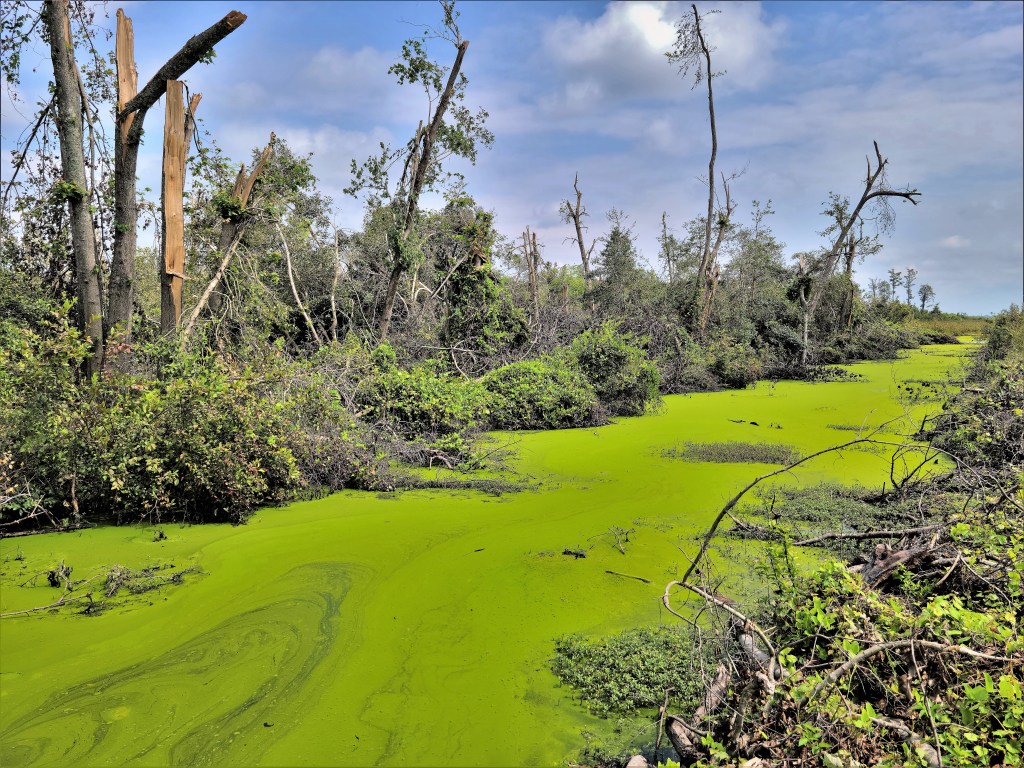
and to listen to the silence at the Great Dismal Swamp in Suffolk, VA.
The trip was short (only 5 weeks and far from our ambitious itineraries of past years) yet refreshing, and daring (for all the anticipated COVID closures) yet unremarkable with one notable exception…I wrecked the Airstream in Tarboro, North Carolina.
Halfway to Tignall, Georgia (our final destination) and needing a lunch break and a leg stretch, we stopped at a charming town boasting a historic district of 18th century and antebellum landmark homes recognized by the National Park Service. I parked the Airstream inches from the curb on a narrow residential road across from Blount-Bridgers House, an 1808 Federal-style mansion-cum-museum,
and returned an hour later to continue our journey.
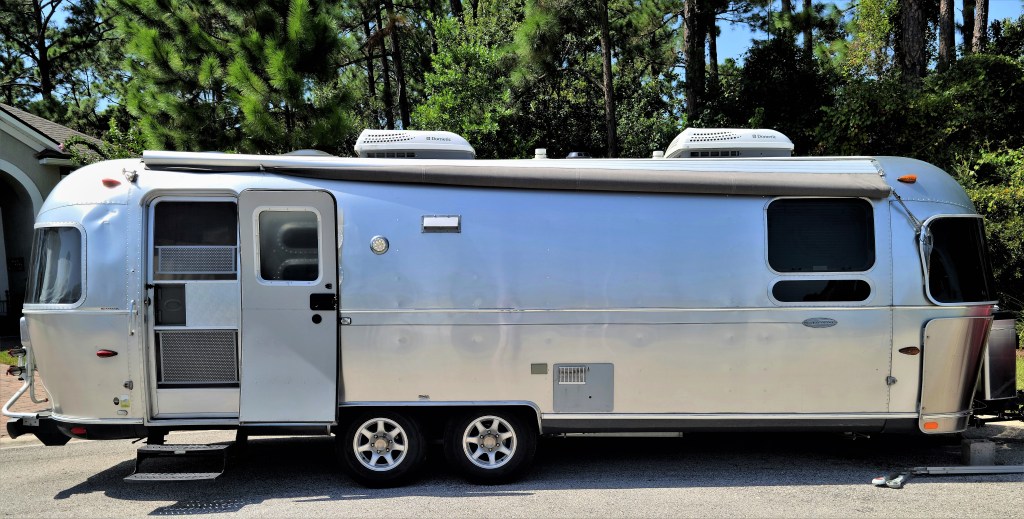
I casually pulled out, unaware that a protruding power pole ID tag had snagged the rear awning support and ripped all the cleats out from the aluminum skin, taking down the entire awning assembly and crushing the end caps to the tune of $17,000.
Thankfully, our insurance completely covered the damage. As we drove our beloved, but bandaged 27FB Flying Cloud to the Tampa Airstream dealer for repair, we considered the possibility of an upgrade should one be available. As luck would have it, a Florida family was trading a 2018 Globetrotter 27FB at the time, pending delivery of their new Airstream by February 2021.
We felt as if we had won the lottery. A deposit was offered on the spot, considering a total lack of previously owned inventory throughout the country.
The deal was sealed in April, when Leah and I picked up our reconditioned summer rig and took it for a dry run in Ruskin, FL in preparation for our summer adventure. We enjoyed the whisper-quiet, ducted AC; the ease of deploying the power stabilizer jacks; the convenience of rolling out the power awning; and the notion that our roof-mounted solar panels could provide us with increased boondocking possibilities.
Join us on the road as we explore 44 destinations (mostly new, sprinkled with some favorites) for the next 20 weeks:
May 1: Lake Powhatan/ Asheville, NC
May 4: Natural Bridge, VA
May 7: Vineland, NJ/ Northern NJ
May 12: Philadelphia, PA
May 15: Pittsburgh, PA
May 18: Jackson Center Airstream Factory/ Dayton, OH
May 19: Indianapolis, IN
May 21: Nashville, TN
May 24: Memphis, TN
May 27: Hot Springs/Little Rock AR
May 29: Eureka Springs, AR
June 1: Oklahoma City, OK
June 4: Amarillo, TX
June 6: Albuquerque, NM
June 10: Taos, NM
.June 13: Great Sand Dunes NP, CO
June 16: Rocky Mountain NP, CO
June 20: Cheyenne, WY
June 22: Flaming Gorge, UT
.June 25: Bear Lake State Park, UT
June 28: Craters of the Moon NP, ID
July 1: Morley Nelson Snake River Birds of Prey, UT
Florida manatees are in trouble and it’s troubling. Today, wildlife conservationists put their current census at around 6500 individuals–up from a few hundred in the 1970’s–
and have reclassified these docile creatures as “threatened.” However, the tide may be returning to “endangered,” given the increasing number of manatees at risk from boat strikes (averaging 100 every year), and the consensus that manatees are dying in unexpected numbers this year from extreme weather. Simply put, they are starving to death.
There’s a chill in the air, and the West Indian manatees of northern Florida have been scrambling to find warmer waters during winter months, where they usually huddle in large numbers, which assists in the yearly count.
Many coastal manatees migrate to Manatee Lagoon…
to bask in the warm-water discharges of FPL’s Next Generation Clean Energy Center at West Palm Beach,
while hundreds flee to Blue Springs State Park, in Orange City, Florida, where they find safe haven at a wellspring releasing 72° water year-round.
Others migrate to Silver Springs State Park,
where clear, calm, and temperate waters provide an abundance of sea grass for grazing.
But that’s not the case in many other places where manatees congregate. In recent years, massive toxic algae blooms accelerated by increased extreme weather have eliminated several hundred “sea cows” every year.
The Indian River Lagoon on the Atlantic side of the state accounts for the majority of manatee losses.
According to Indian River Lagoon guide Billy Rotne:
The raw truth of the matter is due to negligence of our storm water. We’ve had continual algal blooms over the past 10 years, which blocks out seagrass and kills it…so the manatees are starving to death.
And Patrick Rose, executive director of the Save the Manatee Club further connects the dots:
I believe that seagrass loss is making manatees travel farther to get food, often going into man-made canals where they are more exposed to boat traffic.
Manatees have no natural predators. Sharks, whales and alligators usually swim in different waters and pose no threat to them.
Only humans have the capacity to put manatees at risk, with at least 432 having already perished in the first two months of 2021, accounting for 5 times the number of deaths in recent years.
Even more disturbing, a boat charter captain trolling the Homosassa River in the western part of Florida observed a manatee with “TRUMP” etched along its back.
Perhaps we need to do a better job of protecting them, if they are going to survive our abuses.


















































































































































 Streaming thru America