After 3 days in Cairo, Leah and I were on the move!
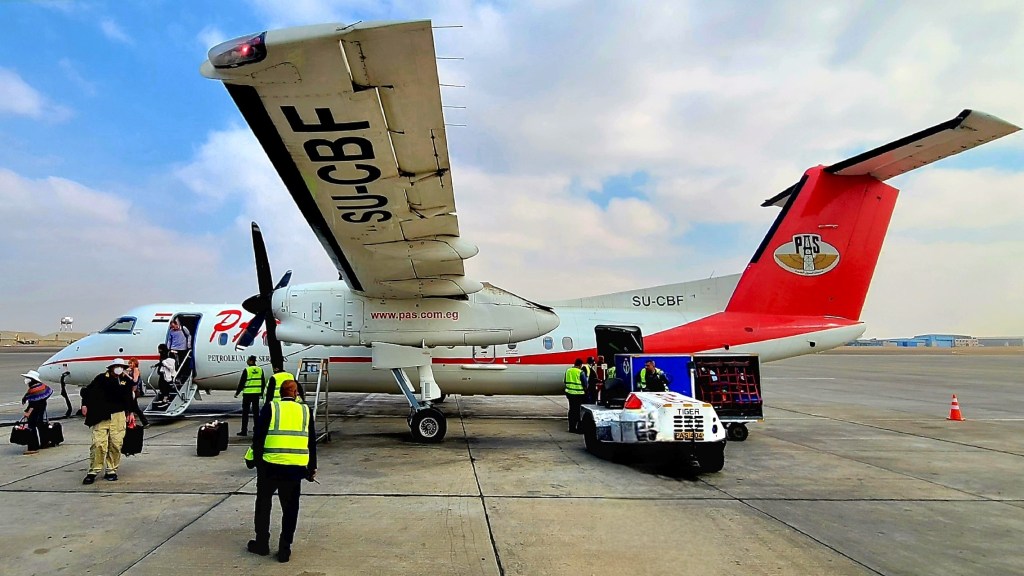
We boarded a chartered prop jet with our fellow river cruisers and flew to Luxor,
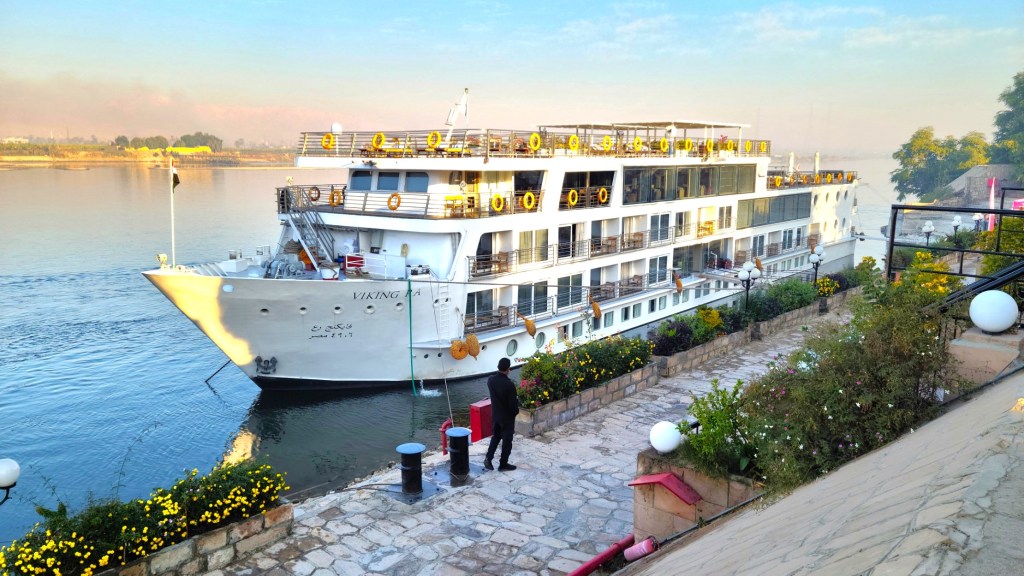
to greet the Viking Ra–currently tied up alongside the Nile’s east bank. Ra was to be our floating hotel through the following week.
After attending an obligatory safety briefing aboard Ra,
we were soon exploring Luxor and it’s ancient counterpart, Thebes–home to kings and queens from the Middle Kingdom (c. 2000–1700 BC) through the Ptolemaic Kingdom (305–30 BC)–spanning 15 centuries of rule, until Egypt surrendered to the Romans.
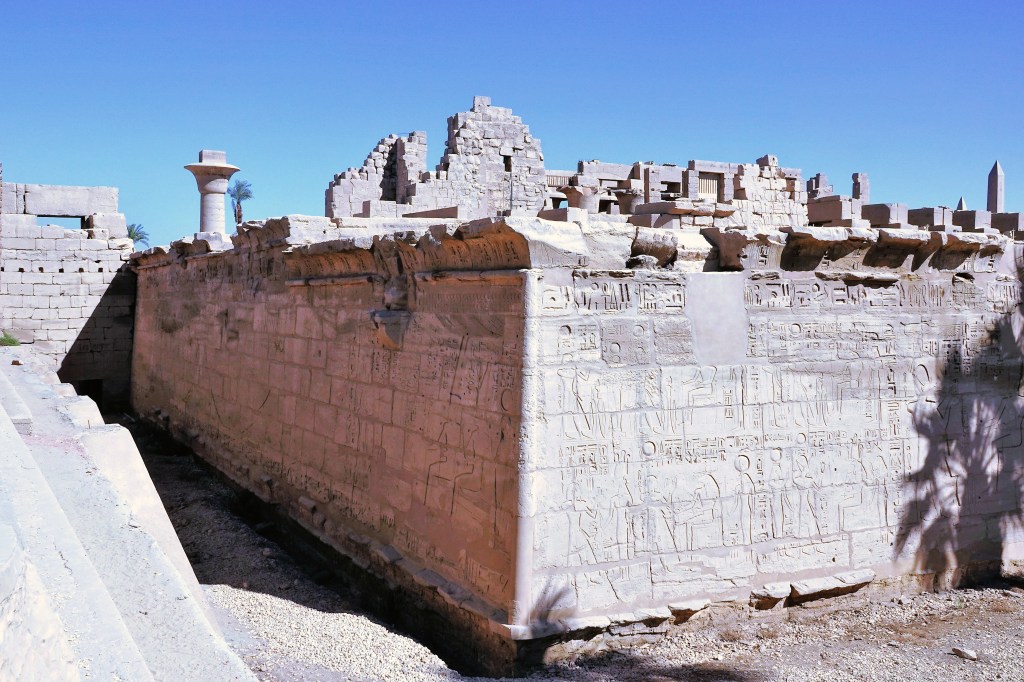
Our tour of Luxor began with a visit to the Karnak Temple Complex, encompassing 247 acres, and considered the largest religious structure ever built.
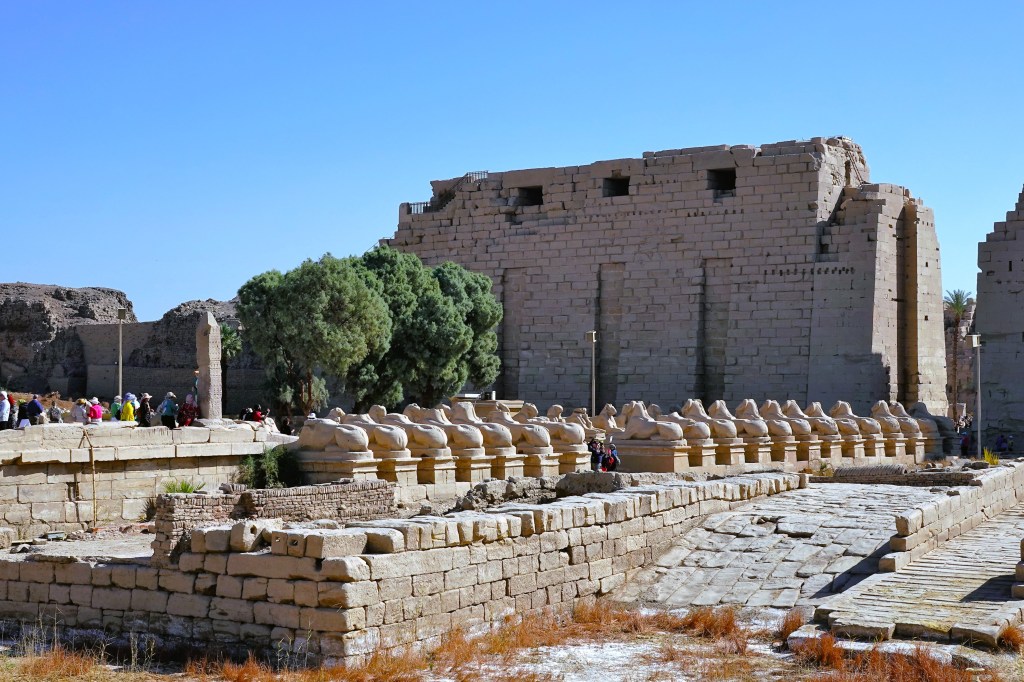
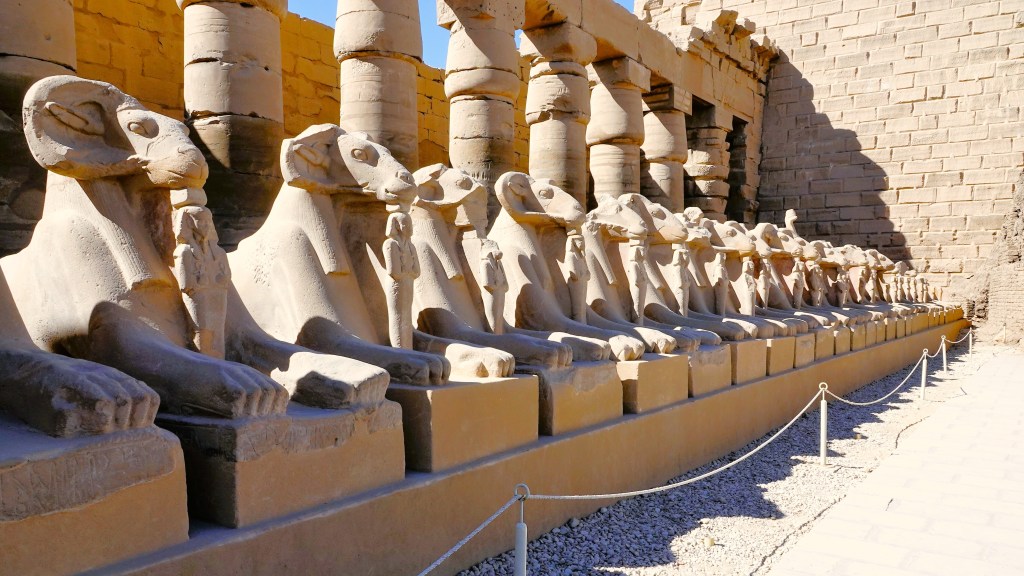
Ram-headed sphinxes (called criosphinx) adorn both sides of the avenue leading to the unfinished, first pylon to honor Amun-Ra, Egypt’s most powerful god and Thebe’s patron deity of the Great Temple of Karnak.
The criosphinxes continue inside the Ethiopian Courtyard (IX Dynasty)–each one cradling an erect statue of Ramses II (c. 1279-1213 BC) between its forelegs.
It flanks the entrance to the temple of Ramses III.
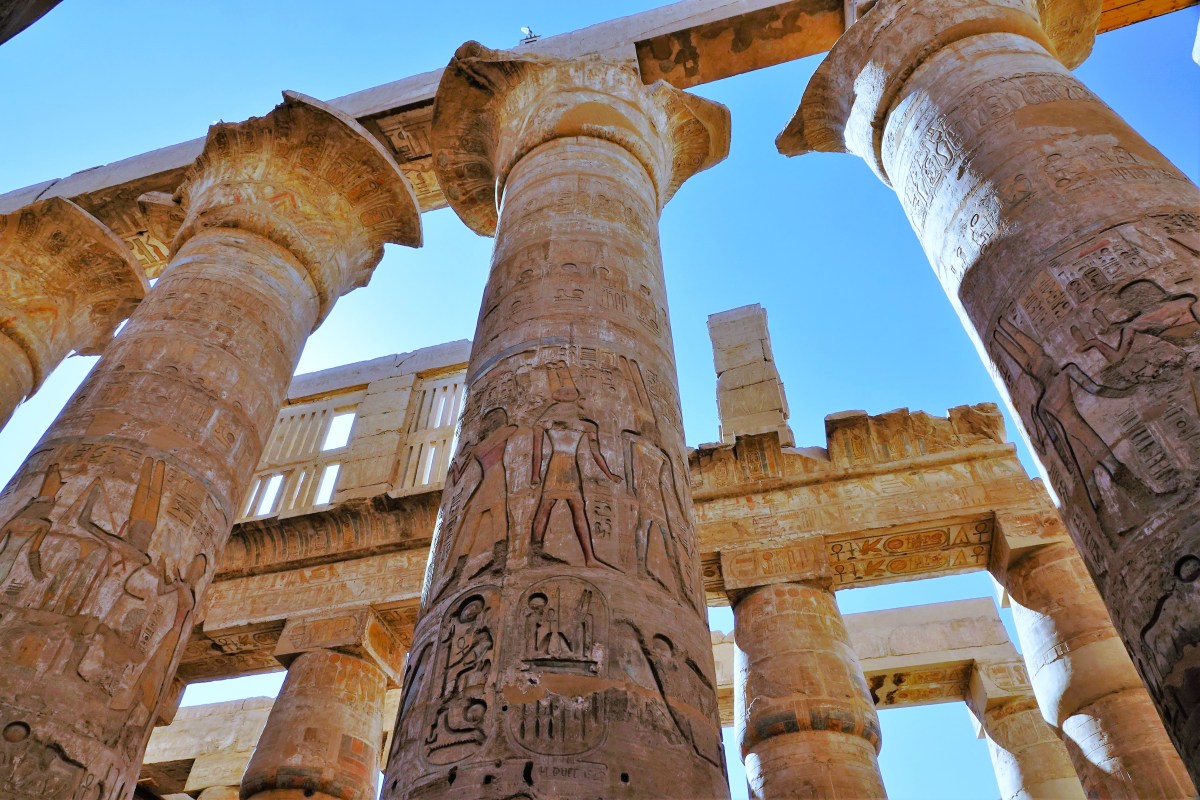
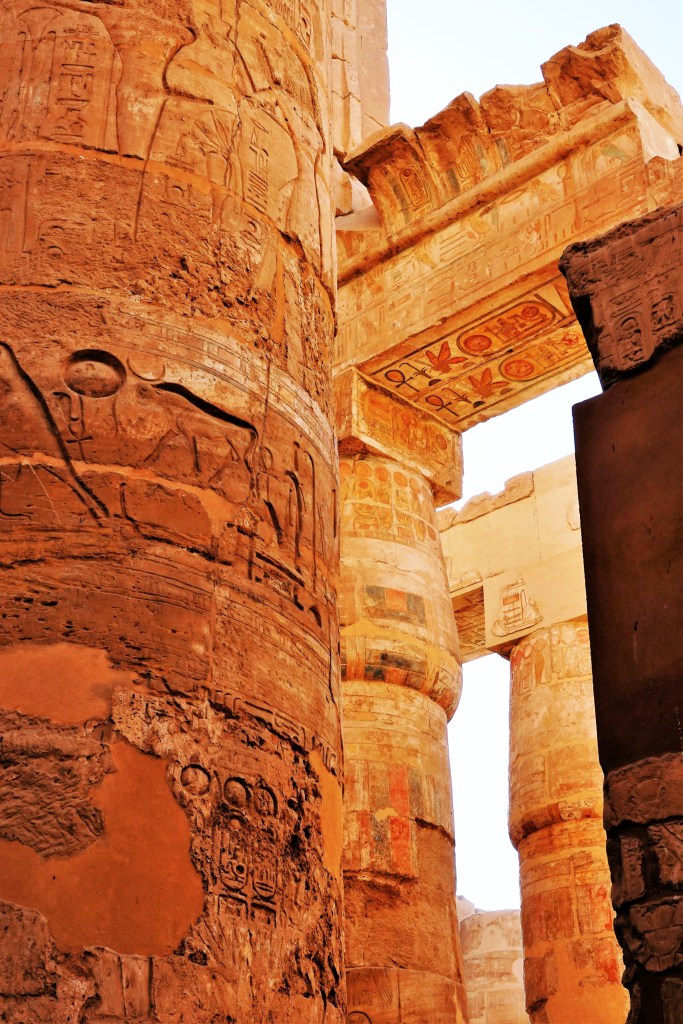
The most impressive feature of the temple of Amun-Ra is the Great Hypostyle Hall, a forest of 134 sandstone columns centered by 12 colossal columns soaring 69 feet,
which supports the remains of a stone roof enclosed by massive walls,
and features intricately carved relief sculptures and hieroglyphs of religious and historical significance…
to honor each of the 30 kings who once ruled the imperial city.
After 3300 years, the site remains substantially intact, yet benefits from painstaking restoration.
After listening to commentary from our onboard Egyptologist, Leah and I strolled the grounds of the ancient temple trying to imagine the enormity of its scope:
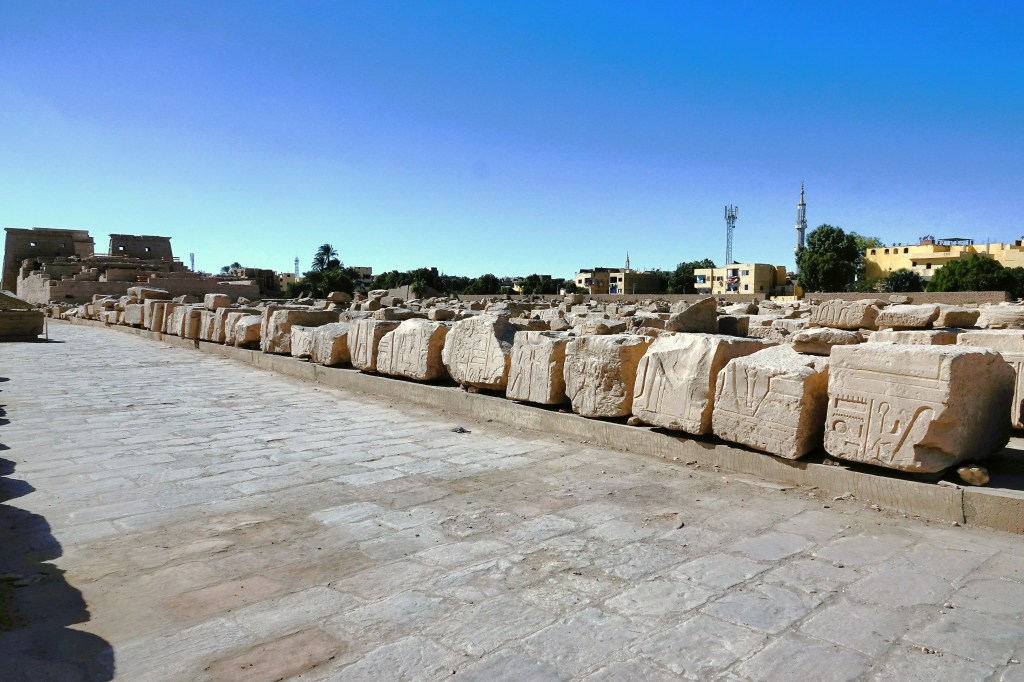
while realizing that 3 other sections–the Precinct of Mut, the Precinct of Montu, and the Temple of Amenhotep IV–are also part of Karnak, and still under excavation and reconstruction.
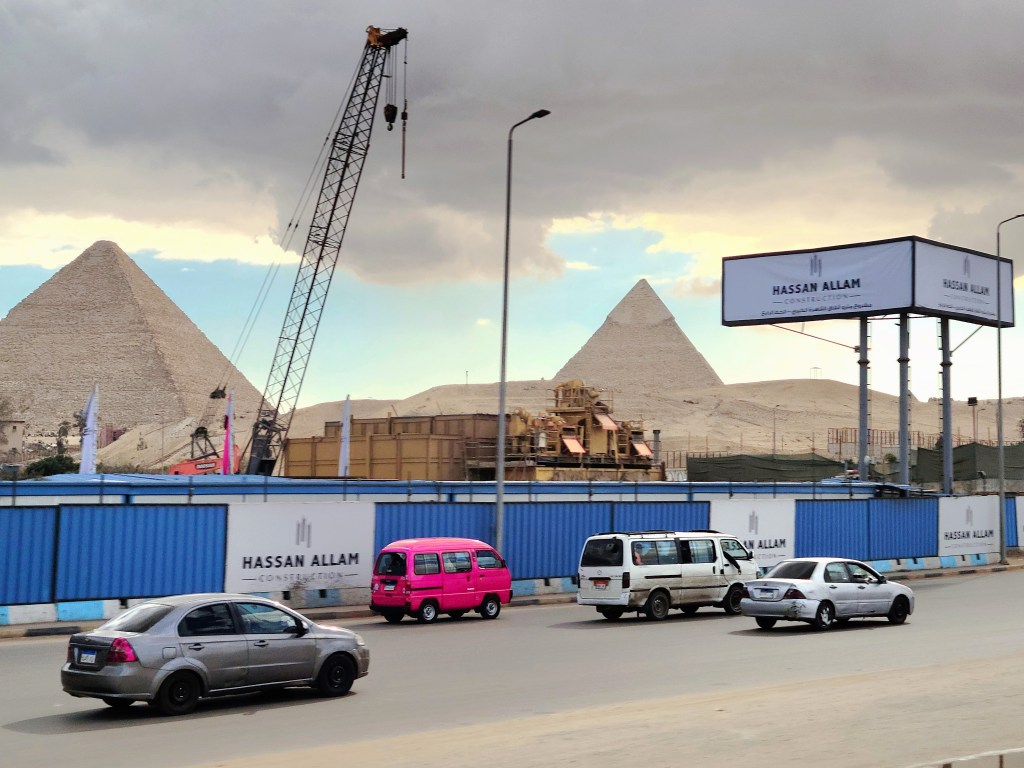
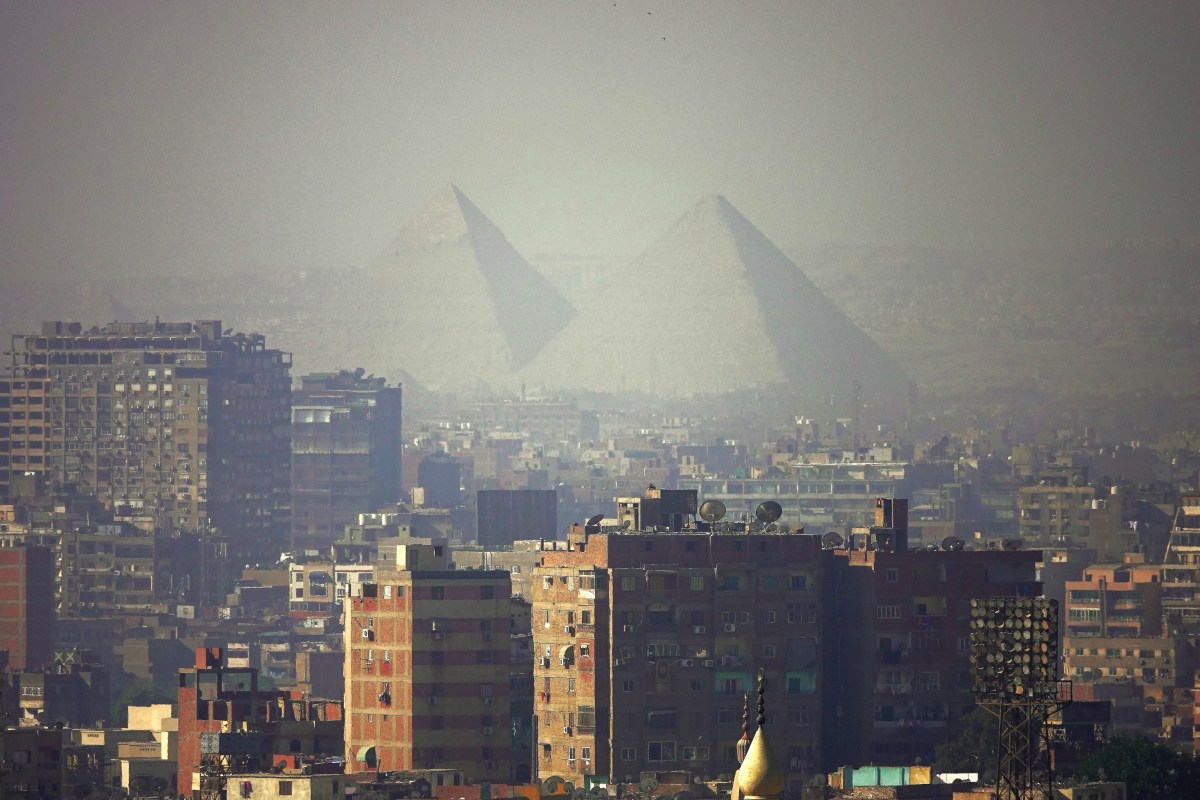
I’ve dreamt of visiting the Great Pyramids nearly all of my adult life, and now, as I gaze through the window of our Viking coach, I catch my first glimpse of these ancient wonders rising beyond a construction zone. Somehow, I can’t escape the notion that these ancient Wonders of the World are part of a half-baked theme park, given their scale and juxtaposition.
We entered the vast necropolis of Saqqara, which served as the ancient cemetery of Memphis,
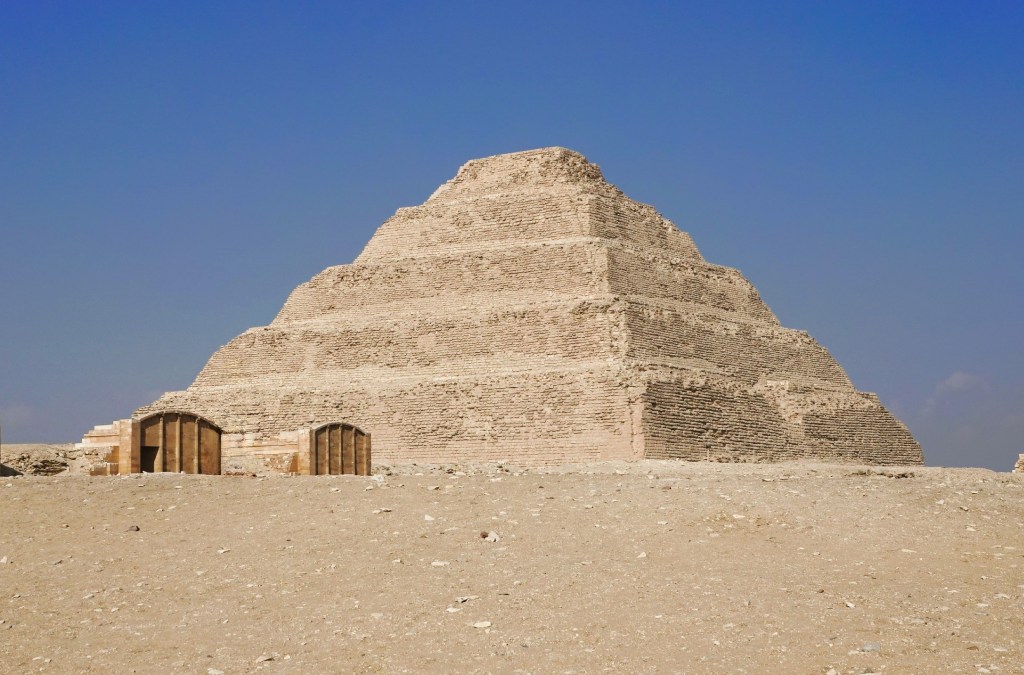
featuring the Pyramid of Djoser (frequently called the Step Pyramid), considered the world’s oldest known stone structure, constructed c. 2670–2650 BC. This 6-tier, 4-sided edifice rises 205 ft (62.5m).
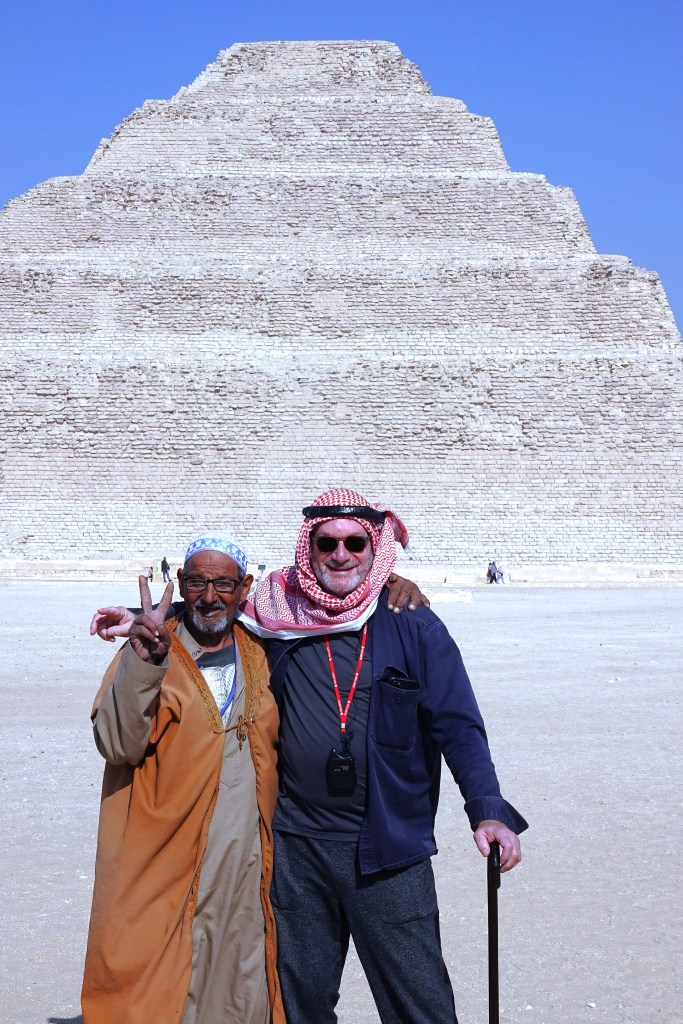
That’s where I met Abdul the Bedouin, regarded by locals as the honorary mayor of Saqqara.
What luck! Seeing Abdul broadly smiling against this epic backdrop, I knew this was an irresistible photo op… and he knew it too–for he was adding instant authenticity to my visual narrative.
Not long after pressing the shutter release, Abdul eagerly approached me and offered to have Leah take our picture together, but not until I was properly costumed.
But don’t be fooled! Despite his diminutive stature, this mild-mannered goat herder with Clark Kent glasses had a secret power. Abdul the Bedouin could hypnotize me into giving him money in exchange for wearing his shemagh.
He wrapped his arm across my shoulder. “Habibi, you’re going to make me very happy,” he whispered as Leah was composing the shot of us. “After all, I have five children to feed.”
Egypt is a poor country. Wages in Giza average between $500 and $750 per month.
Yet, as a Saqqara personality, Abdul was very good at his job–equal parts ham and shmaltz. And he managed to squeeze me for 5 bucks.
Leah and I resumed our tour of the Saqqara necropolis,
at the site of King Teti’s pyramid.
We followed a dark shaft down a narrow passage…
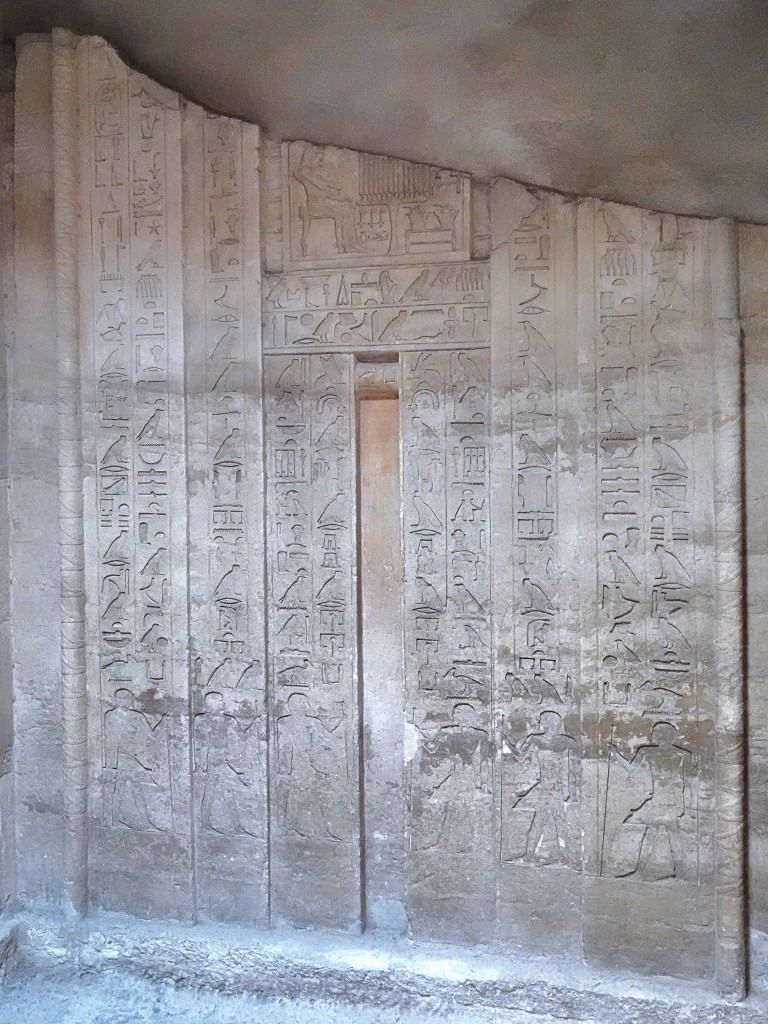
into the belly of his burial chamber, replete with impressive and very rare pyramid texts traced to c. 2300 BC.
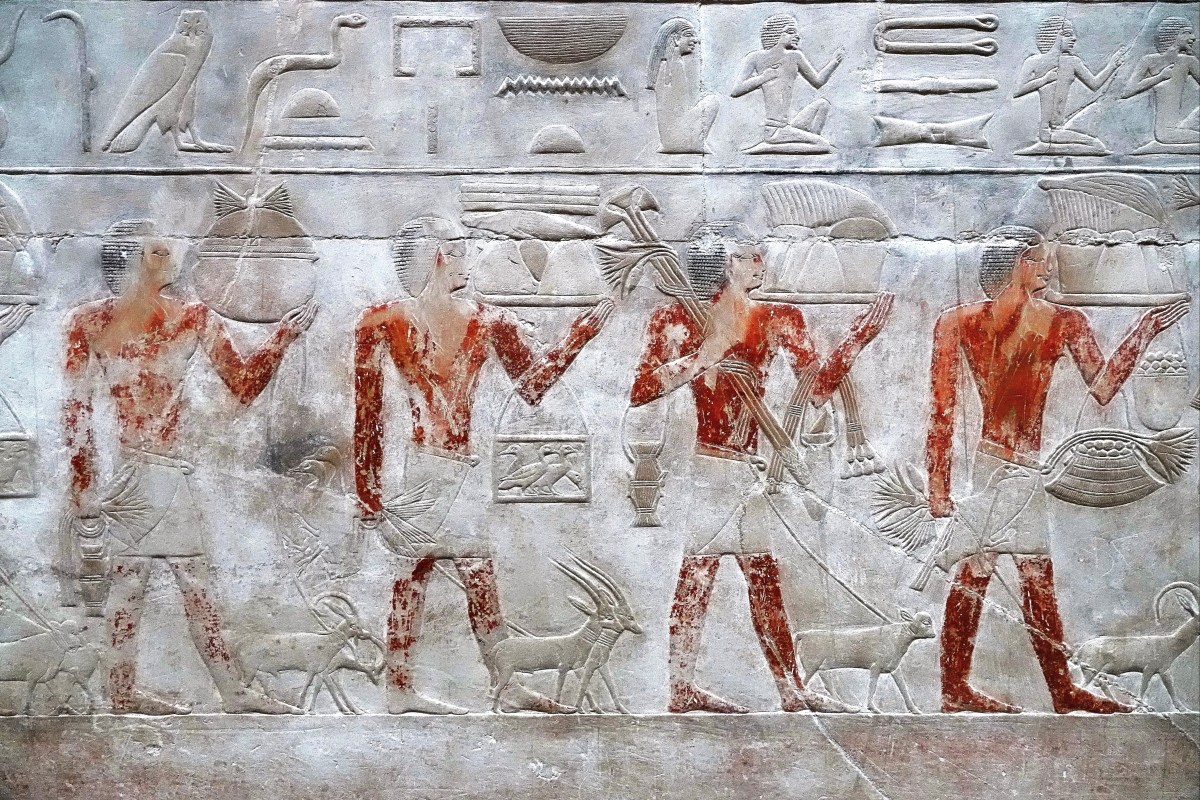
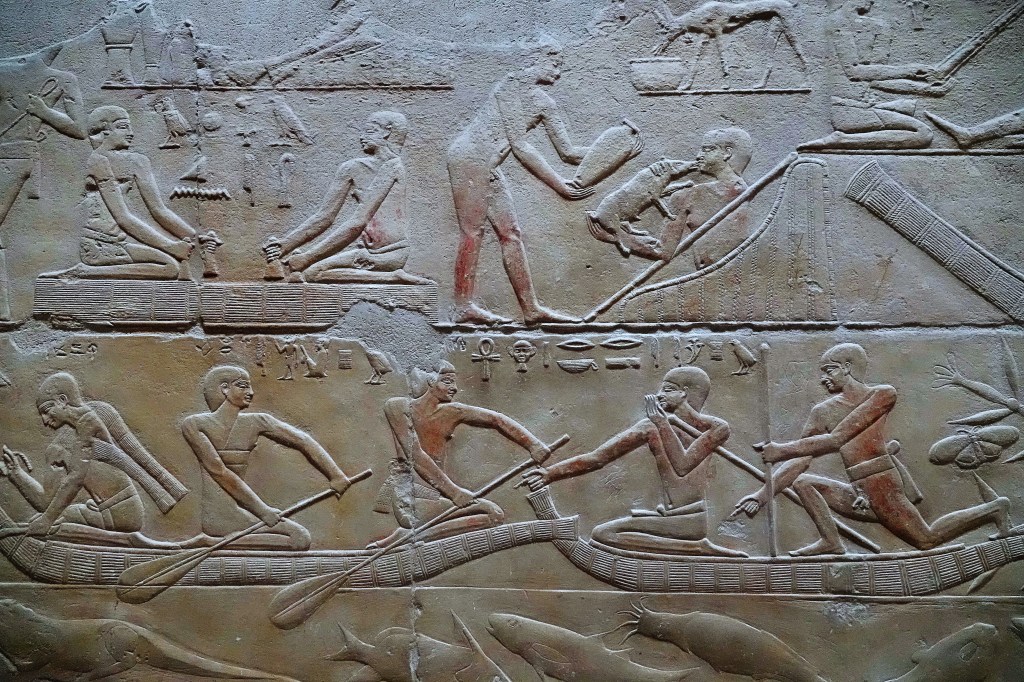
This led to an antechamber lined with relief engravings that showcased the preparations made by Teti’s royal staff in anticipation of his journey to eternity,
after having traveled beyond the alabaster alter to the kingdom of the dead.
Our next stop was the Great Pyramid of Khufu, the largest of the “big three,” standing 481 ft. and constructed c. 2570 BC. And what a site to behold!
Venders were omnipresent, with pop-up stalls surrounding the pyramid’s perimeter.
That’s where we met Mohammed and his camel. While chatting us up, he snatched my cellphone and insisted on taking our picture.
I paid Mohammed a $5 ransom for my cellphone ($1 for each of his 5 children), however, he expressed his disappointment knowing there’d be no camel ride, but only because another vendor was promised Viking’s business:
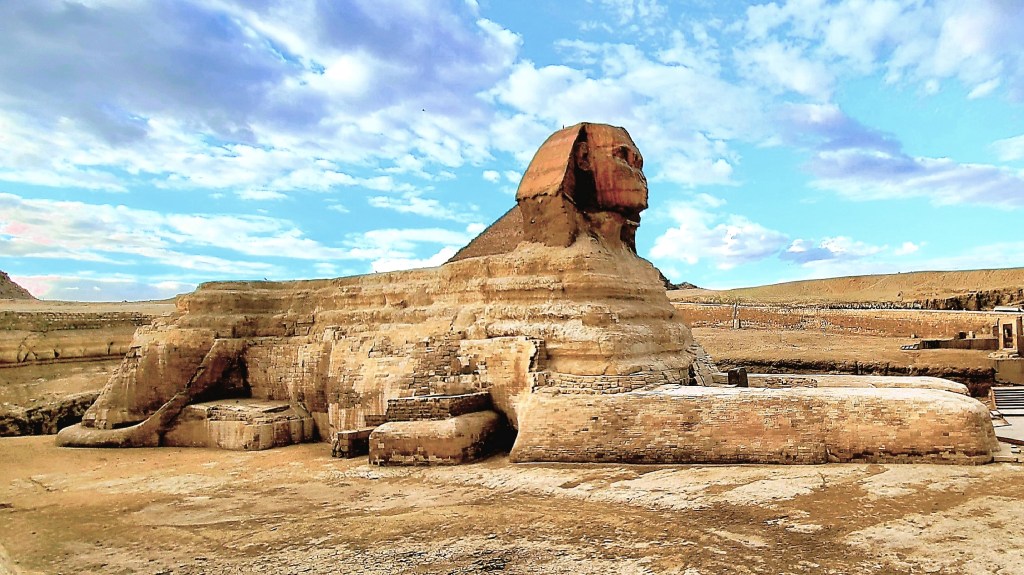
We ended our visit to Giza with a brief jaunt to the Sphinx…
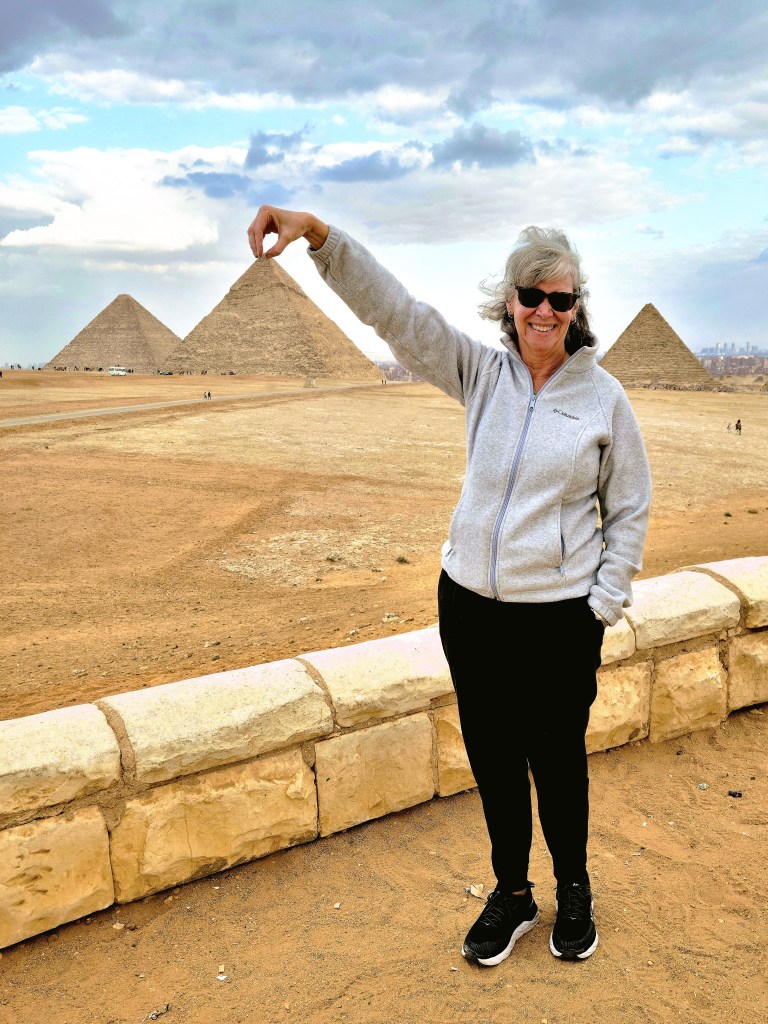
with still enough time for one last parlor trick before boarding the bus.
In a document dating back to 1434, traces of Dresden’s StriezelmarktChristmas Market’s existence were found. Additionally, the Turks tell us that the Grand Bazaar of Istanbul has been around since 1455.
Although proponents of both regions claim title to the oldest market (souk) in the world, 100 million Egyptians would beg to differ, because deep in the midst of historic, Islamic Cairo, stands the beating heart of city commerce–a pulsing and twisting labyrinth of passages that is Khan el Khalili–the world’s oldest continuously operating market since 1382.
Passengers of Viking Ra who elected to crowd surf through the Khan el Khalili, got a glimpse of life as it once was during the Mamluk dynasty (from 1250 until 1517), when self-pronounced sultans occupied Egypt after driving out the Crusaders. The souk was built atop the mausoleum of the Fatimid Caliphate, which founded Cairo as its imperial city in the 10th century.
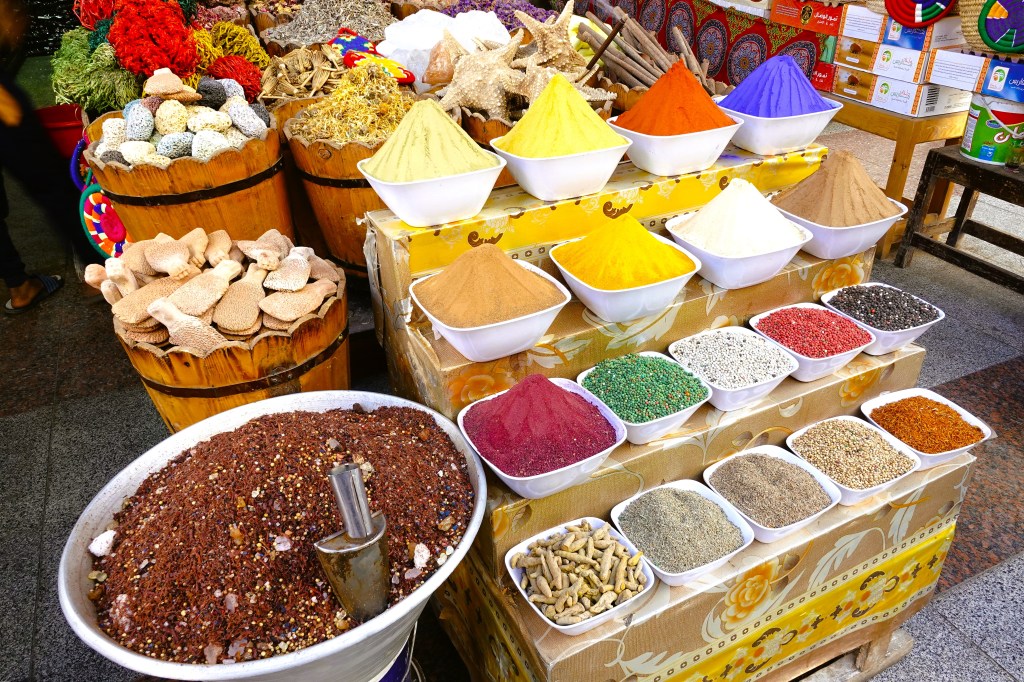
Once divided into distinct districts serving merchants trading copperware, gold accessories, and spices, the souk now balances its variety with every imaginable trinket and souvenir sold among competing vendors standing just a breath away from each other, forming an almost impenetrable wall of sounds, sights and smells…
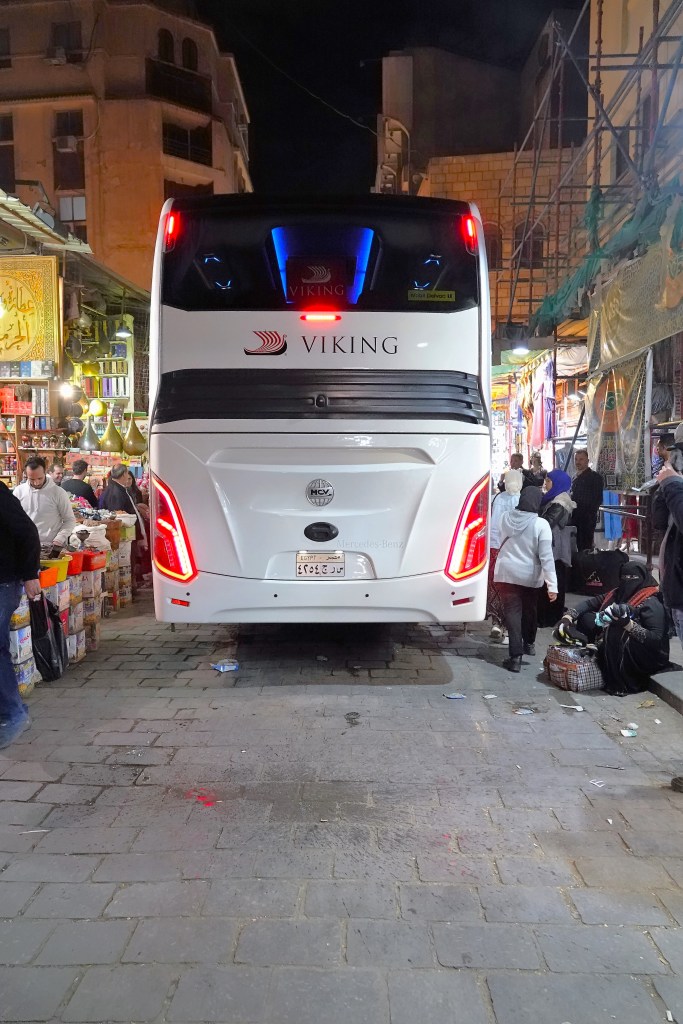
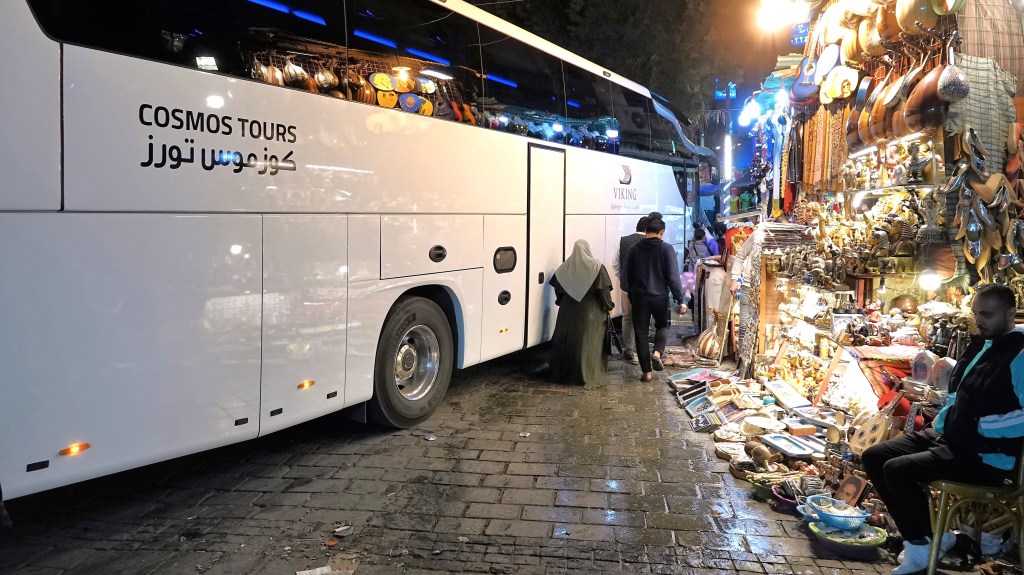
across alleyways that could barely accommodate our bus.
We disembarked from the bus and melted into a crowd of families strolling past aggressive venders hawking endless supplies of camel pants, pashminas, and pyramid paper weights to tourists,
with a variety of daily-living goods for locals.
For the informed collector, haggling generally starts at 40% off the suggested price, and somehow balances out in the negotiation.
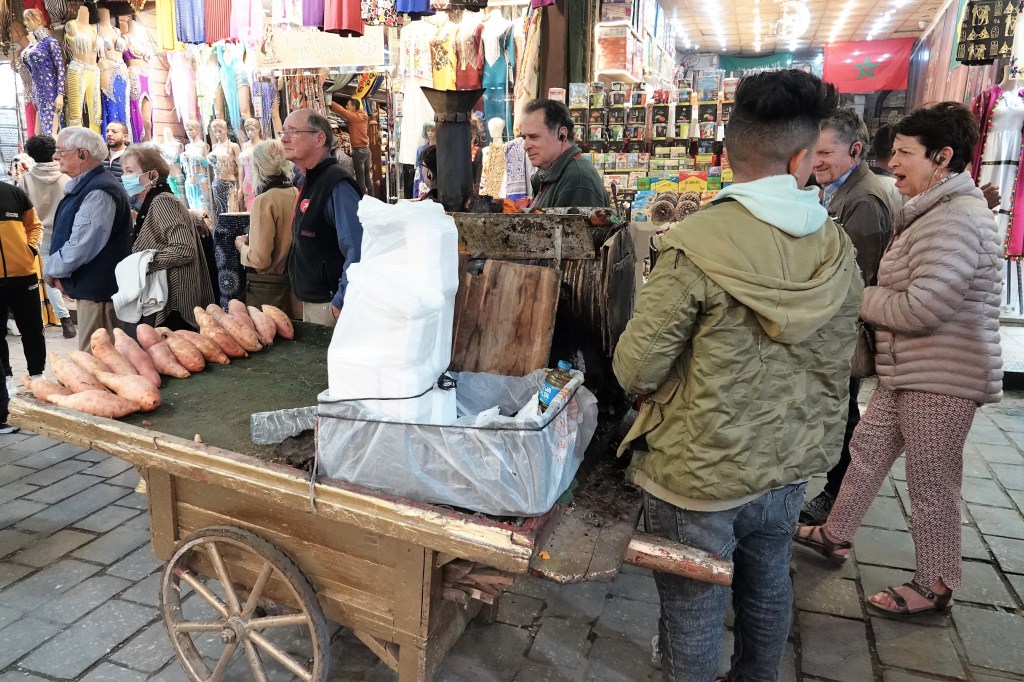
Hungry? No problem! How about a sweet potato…
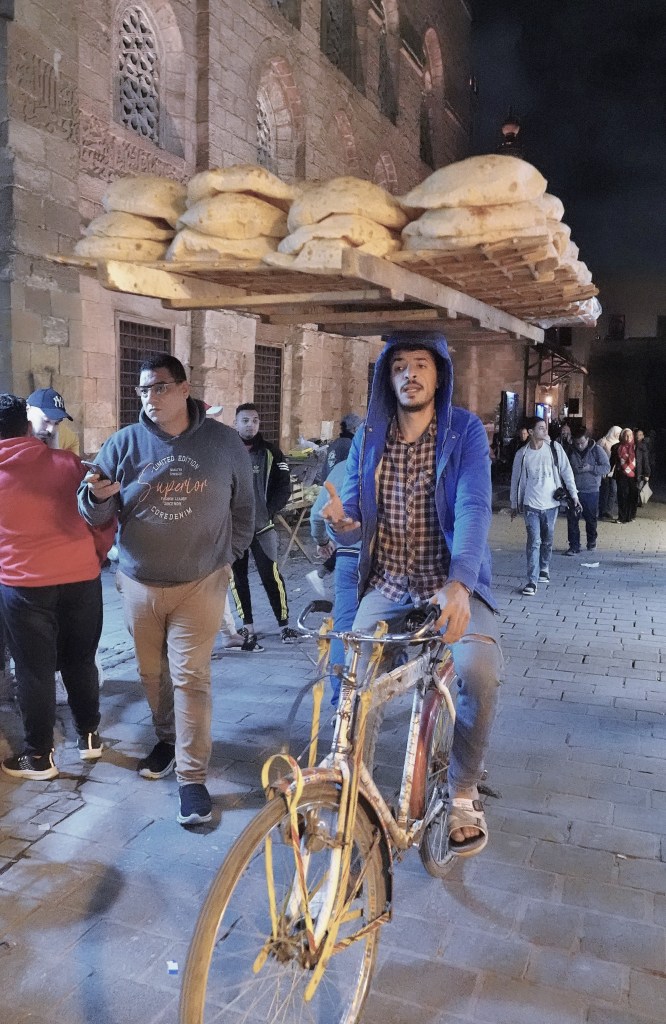
or fresh baked pita?
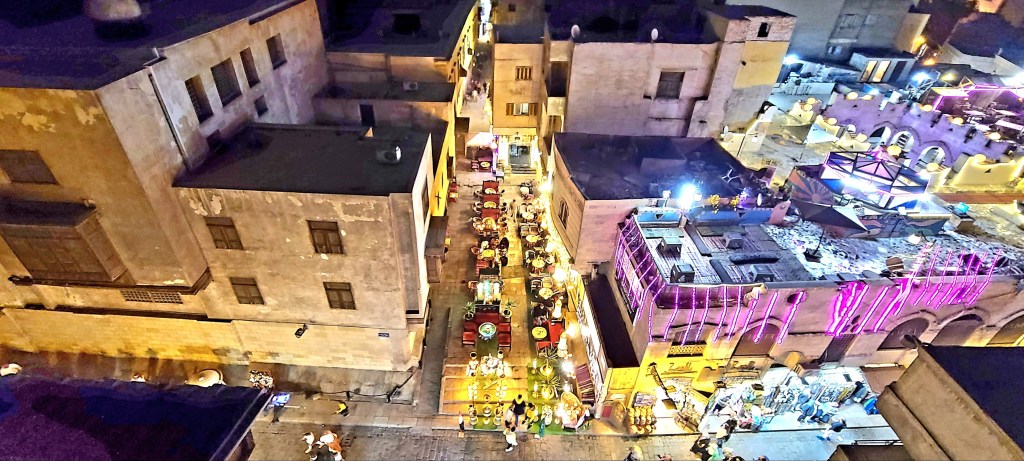
Our group enjoyed restaurant dining above the fray,
which was a pleasant respite from the tumult below us.
Leah and I arrived at the Egyptian Museum to dig a little deeper into some of the earliest and most significant discoveries of ancient Egypt.
Of course, we would have preferred touring the Great Egyptian Museum (G.E.M.), but the many delays since construction began (2012)–complicated by supply chain dynamics and coronavirus has pushed the official opening to sometime in 2023, optimistically.
However, when the museum eventually opens, it will be the world’s largest archaeological museum, housing 100,000 artifacts from hundreds of tombs and temples, and the entirety of the Tutankhamun collection.
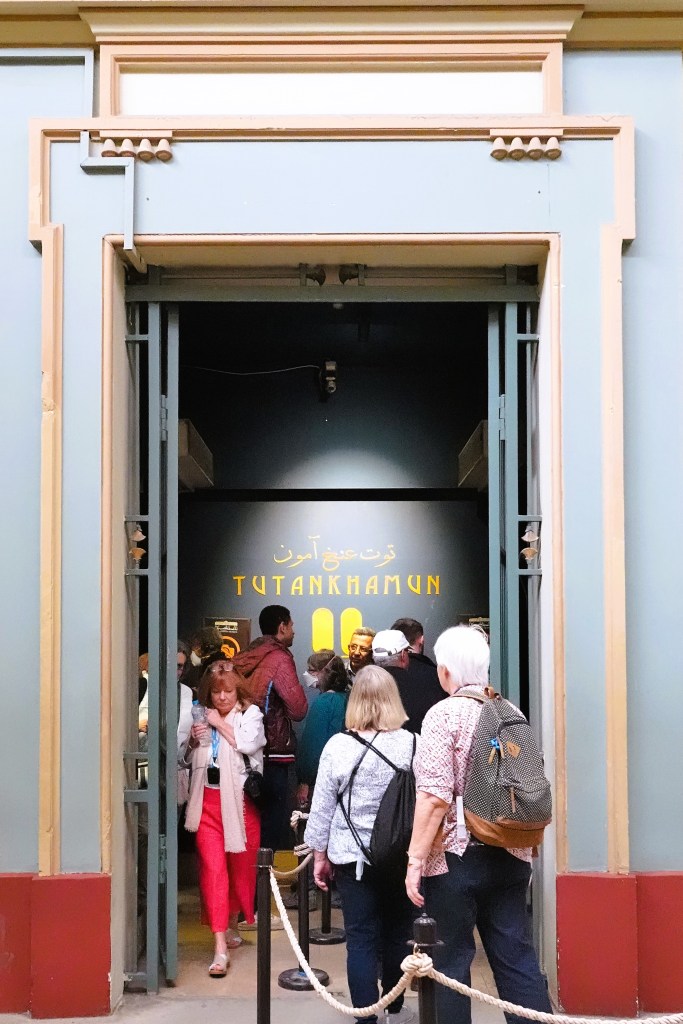
But for now, we must adjust our expectations by visiting the fabulous Egyptian Museum instead, where a smattering of the riches belonging to Tutankhamun’s tomb have been on view:
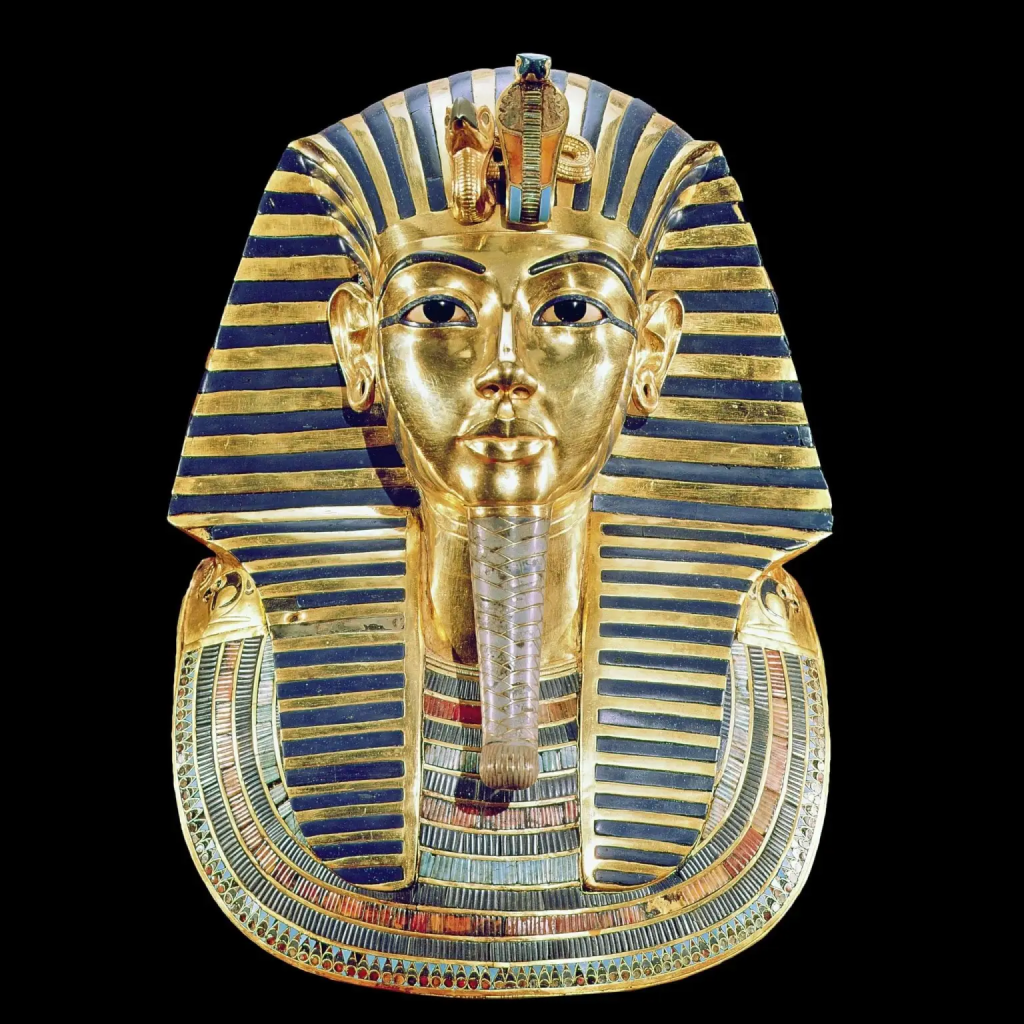
including his incomparable solid gold mask,
Photo credit, Egypt Museum
and triple coffins staged within his sarcophagus–yet unfortunately, all without the possibility of photography once we entered the special exhibition room.
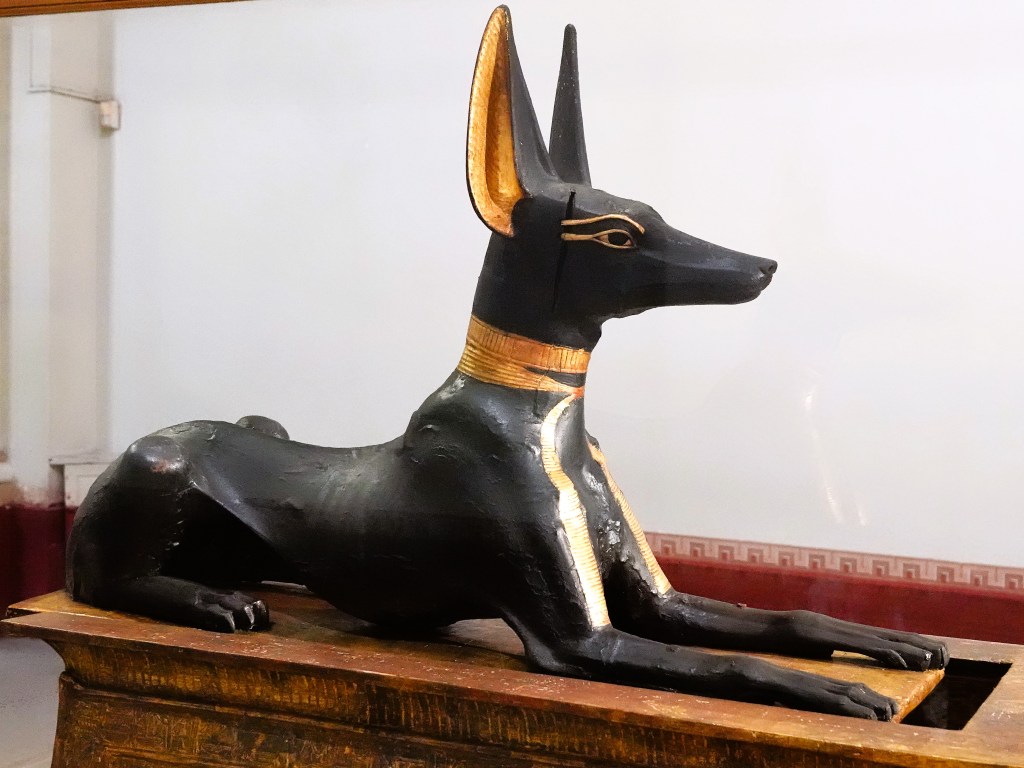
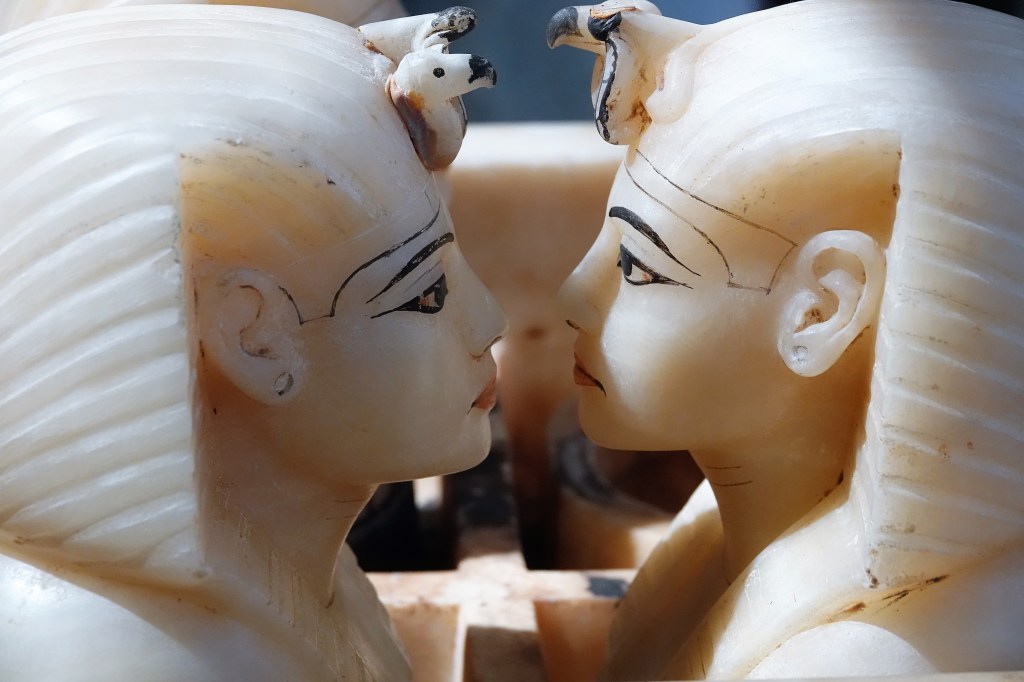
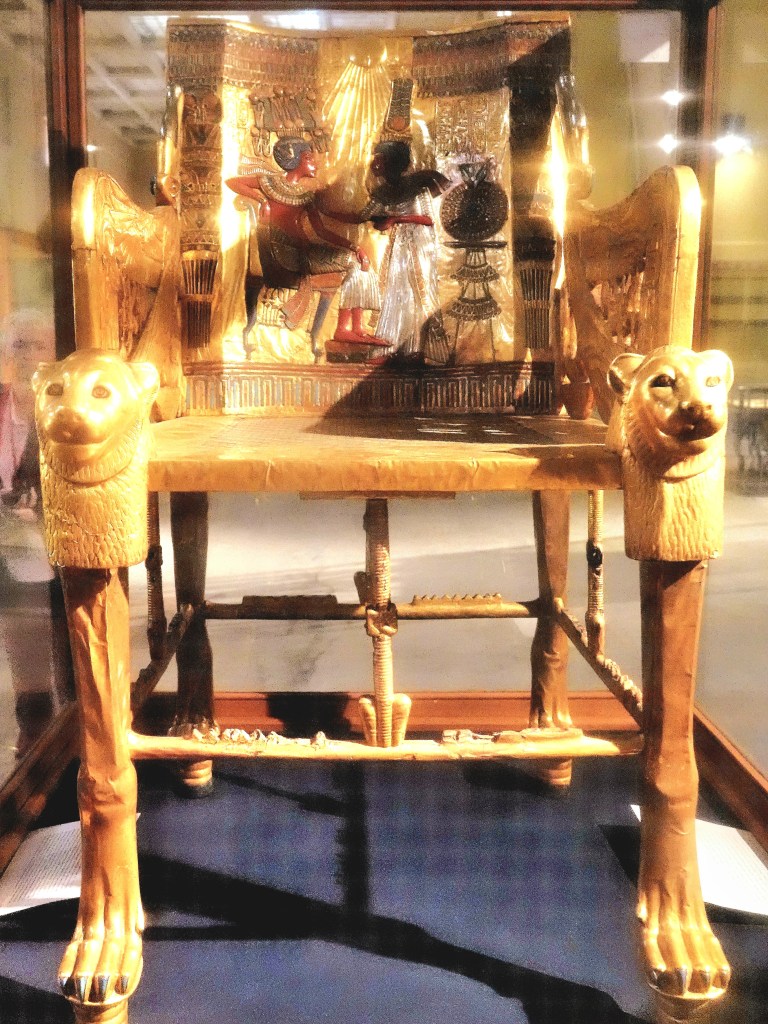
There were, however a few items from Tutankhamun’s tomb displayed in the general exhibition hall that were equally as impressive, including:
Anubis the jackal, who guards the cryptAlabaster canopic jars which held vital organs
A gilded throne beside an inlaid and painted ceremonial chair.
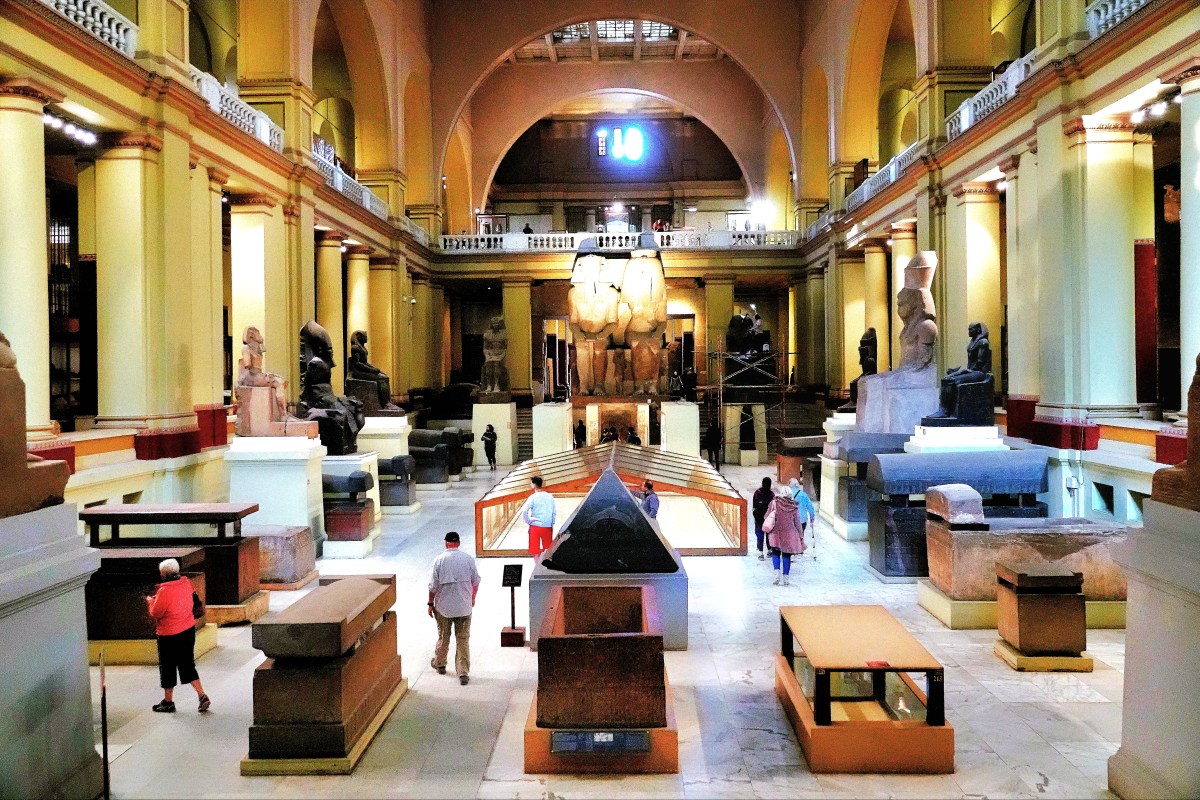
There were so many more treasures to appreciate beyond the towering entrance and throughout the wings of the cavernous exhibition hall.
From the moment we entered the building, we were confronted by a stone Colossus of King Merneptah, successor to Ramses the Great.
Along our stroll, we stopped to appreciate a 2-foot palette of some of the earliest hieroglyphics ever found.
This palette, with reliefs on both sides, commemorates the victories of King Narmer, who came from the south of Egypt to invade the Delta in about 3000 BC. It represents the most important evidence that the first political unification in the history of mankind occurred in Egypt. The two faces of the artifact are topped by the name of Narmer inscribed inside the Serekh, or rectangular frame. In hieroglyphic signs, the chisel reads mr and the catfish reads naar.
The upper section of the back side shows the king wearing the Red Crown of Lower Egypt, followed by his sandals bearer and preceded by his vizier and four standard bearers. Next comes a scene depicting the corpses of 10 beheaded men. In the middle section, two men are holding two felines with extremely long necks representing the people of the North and South under the control of the king and his men. The lower section shows a bull, representing the king attacking the walls of a northern city.
The Serekh is flanked by two female heads having the ears and horns of a cow, which could be the first representation of the goddess Hathor. The scene on the front shows the king, followed by his sandals bearer and wearing the White Crown of Upper Egypt, smiting a helpless foe from the North. The falcon Horus of Upper Egypt stands upon a bunch of papyrus plants holding a northern prisoner. The lower register, or scene, depicts two other northern enemies running away from the king. Inscribed upon their heads are hieroglyphic signs indicating their names or those of their localities.
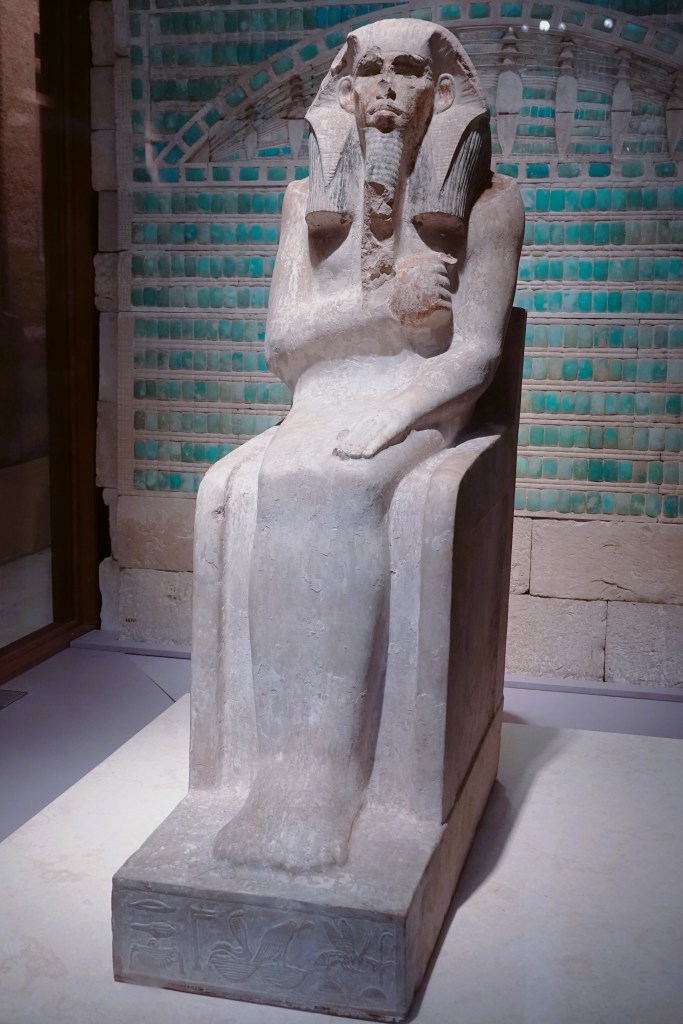
We stood in awe of the oldest known life-size statue found in Egypt.
It depicts King Djoser of the Third Dynasty seated on his throne and enveloped in a jubilee cloak. The statue was entirely coated with white plaster and painted. The deep-set eyes were once inlaid. The king has a ceremonial false beard and wears a black wig topped by the royal Nemes headdress. The front side of the pedestal is inscribed with hieroglyphic text, indicating the name and epitaphs of King Nethery-khet of Upper and Lower Egypt.
Next, we got acquainted with an exquisite 4600-year old polished, gneiss statue of King Khafra, builder of the second largest pyramid in Giza.
It was found in a pit in the antechamber of his Valley Temple in Giza. The king is seated on a throne flanked by lion heads. The two sides of the throne are decorated with the Sema-Tawy, symbol of the unity of Upper and Lower Egypt. Khafra wears the nemes headdress, surmounted by the uraeus, or royal cobra. He wears the royal pleated kilt. Attached to his chin is an artificial ceremonial sacred beard. He is protected by the god Horus, represented as a falcon, perched at the back of his neck.
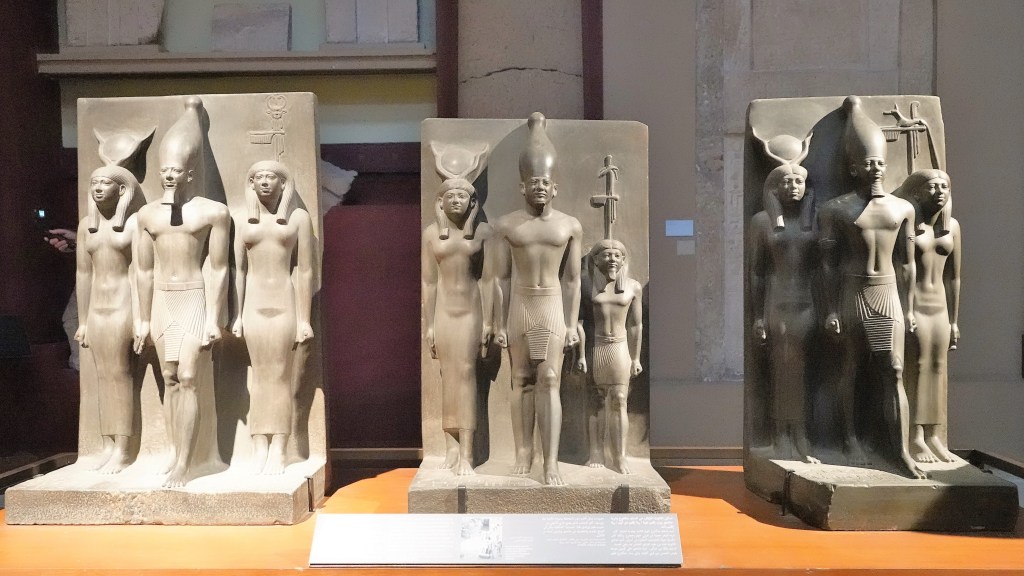
Nearby was a triptych of King Khafra’s neighbor, King Menkaure.
King Menkaure built the third and smallest of the Great Pyramids of Giza. The triad of Menkaure was intended to represent him with the personification of the nomes, in the presence of gods, especially Hathor. The king wished to enjoy resurrection and fertility from Hathor and endless offerings from the nomes. He is represented here in an idealistic form between Hathor, with her horned sun disk crown, and a figure of the personification of the nome of Diospolis Parva.
Sheikh el-Balad, Arabic title for the chief of the village, was the name given to this remarkable wooden statue discovered by the workmen of Auguste Mariette, the French archaeologist, because it resembled their own village chief.
The statue depicts Ka-aper, the chief lector priest, in charge of reciting prayers for the deceased in temples and funerary chapels. It is one of the masterpieces of the private statuary of the Old Kingdom.
The arms were separately modeled and attached to the body, a technique frequently used in wooden statuary. A wooden cane supported the left arm, made out of two pieces of wood joined together. The eyes are inlaid; the rim is made out of copper and the white is of opaque quartz, while the cornea is made out of rock crystal.
Also of interest is a small stone carving of Seneb, an Egyptian dwarf who was the chief of all the palace dwarfs, and charged with the care of the royal wardrobe.
He is seated on a rectangular seat together with his wife, Senetites, and his children stand before him. He has short black hair and wears a short white kilt. His wife rests her right hand on her husband’s shoulder and her left hand on his left arm in an affectionate pose.
Senetites, who held the titles of Priestess of Hathor and Neith, wears a black wig that reaches down to her shoulders and a long white tunic. The artist rendered her face with a smile to show the woman’s satisfaction at being depicted with her husband and children.
The son and daughter are shown standing in front of their father in the place where the legs should be. Here, the Egyptian artist succeeded in creating a balanced composition for the figures of the family.
Protected in a nearby glass box was another painted couple. Rahotep might have been a son of King Senefru and thus, a brother of King Khufu. He held the titles of High Priest of Ra at Heliopolis, General of the Army, and Chief of Constructions.
He is seen here wearing a short kilt, short hair, a fine mustache, a heart-shaped amulet around his neck, and inlaid eyes. Rahotep’s wife, Nofret, is described as “the one acquainted to the king.” She is seen wearing a shoulder-length wig, decorated with a floral diadem and a broad collar. Her natural hair can be seen under the wig.
We recognize the distinction in the skin coloring of the two statues: reddish brown for the man and cream wash for the woman. This was an artistic convention followed throughout ancient Egyptian history. The colors are well preserved and the faces have realistic expressions.
However, Queen Hatshepsut was a rare exception. She’s regarded as the most successful woman ever to rule Egypt as Pharaoh (18th Dynasty), and considered an equal among all kings. Hence, her skin color is always portrayed as reddish brown.
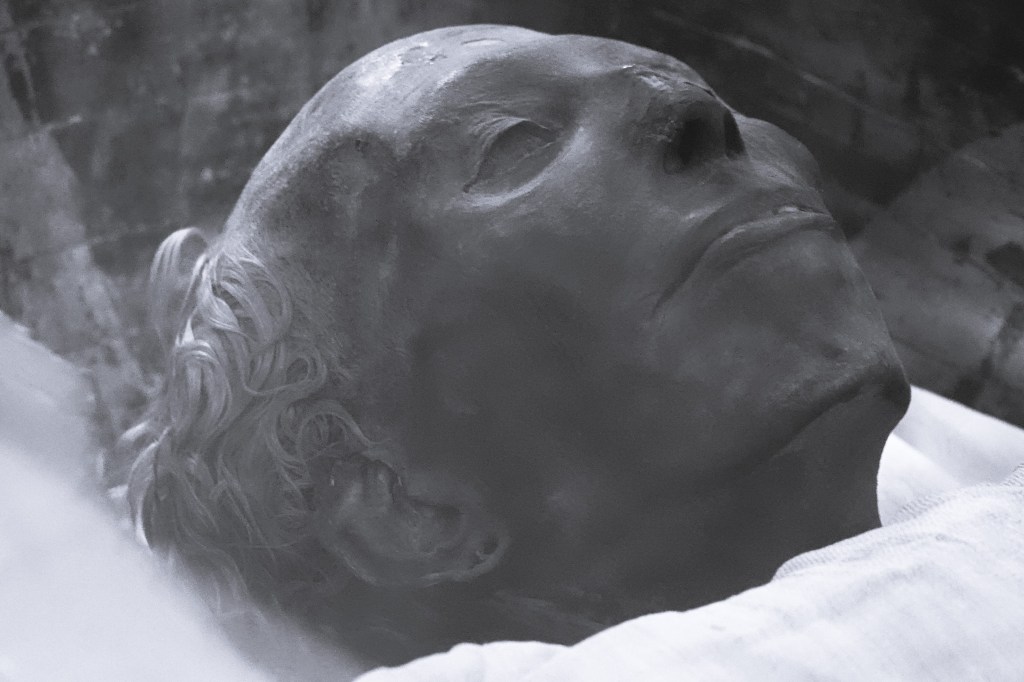
Advancing to the mummy exhibition, we were treated to the gilded plaster, funerary masks of Thuya and Yuya.
Yuya was the father of Queen Tiye, wife of King Amenhotep III, and husband of Thuya. Yuya came from the town of Akhmim, where he probably held estates, and where he was a priest of the Egyptian god Min, the chief god of the area, while Thuya held important religious titles, in addition to the title of the Royal Mother of the Great Wife of the King.
As part of the royal family, they were attributed royal burial rites and mummified, guaranteeing them an extraordinary eternity as museum masterpieces.
Leah and I later visited Yuya’s son-in-law, King Amenhotep III, and his daughter, Queen Tiye to share a moment of eternity inside his sarcophagus, under their protective gaze.
But remembering our plan for a night out at the market, we had to put our hereafter on hold.
When Leah and I disembarked from our Northern Lights cruise aboard the Viking Star on February 4, 2020, the entire cruise industry was sinking from the spread of COVID-19. And the travel industry was unable to forecast with any assurance whether or when it would be safe to cruise again. Nonetheless, Leah and I reserved passage on Viking’s Nile River cruise (risk free) 2 years ago, and patiently waited for the coronavirus tide to wane.
Fortunately, Egypt had been less affected than many surrounding North African countries, so we waived our cancellation guarantee 3 months ago, and finally embarked on our eagerly-anticipated journey.
After 2 airport layovers–with extended delays between 2 sunsets–we touched down in Cairo to experience what we hoped would be a trip of a lifetime. We also elected to tack on a 4-day extension to Jordan to experience the “Rose City” built into the pink sandstone cliffs of Petra. And we would finish our Middle Eastern adventure with 9 days in Israel on our own.
We also chose to travel with Viking for their immersive programming, delivered by two resident Egyptologists, Khadiga and Youmna, who offered comprehensive commentary every step of the way.
After a night of well-deserved sleep at the Sheraton Cairo Hotel and Casino, we awoke at 6 AM to the muezzin’s prerecorded call to morning prayer,
and began our tour with an excursion to Cairo’s Citadel of Saladin, the largest citadel in the Islamic world opened in 1176,
for magnificent views of the entire city–a massive sprawl sheltering nearly 22 million people within its metro borders, with what also seems as many stray cats and dogs–
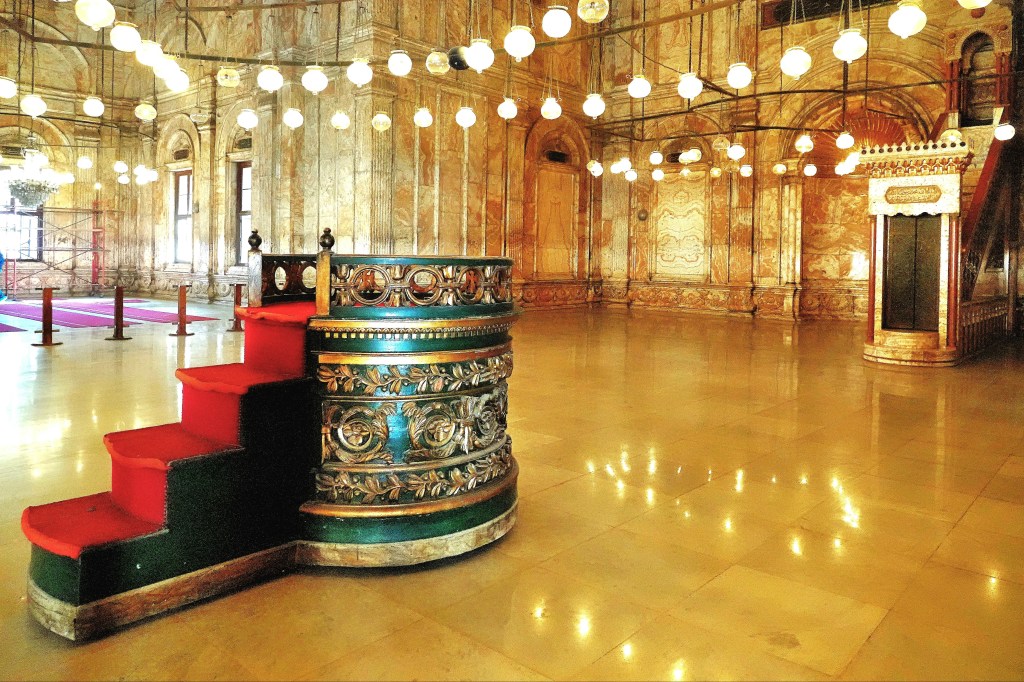
and access to the Mosque of Mohammed Ali Pasha, also known as the “Alabaster Mosque” built in 1848, with twin minarets reaching a height of 84 meters, the highest in all of Egypt.
The prayer hall inside can accommodate 10,000 worshippers under a large central dome surrounded by four semi-domes,
supporting a massive crystal chandelier that has recently been repaired after a 3-year restoration project by Egypt’s Supreme Council of Antiquities.
Across the marble tiles to the east is an adorned, gilded pulpit of carved wood for the chief Iman.
Within the center of the mosque’s massive courtyard of 47 arched doorways finished with 45 domes stands an elaborate alabaster fountain for requisite ablutions.
The copper-clad clock tower rising above the courtyard in the center of the south façade was a gift from Louis Philippe, the King of France in exchange for one of two ancient obelisks discovered at the Temple of Luxor that still stands in the Places de la Concorde in Paris.
Unfortunately, it was a bad trade for the Egyptians, as the mechanical clock is only accurate twice a day since never working properly after installation.
After roaming the courtyard,
it was time for our next excursion to the Egyptian Museum, where we motored by bus through the busy streets and circles of Cairo, while managing to avoid hundreds of pedestrians who habitually cross the roads in all directions, without any regard for traffic or life itself.
It took a few days of walking, cycling, and driving around Montréal before Leah and I found our bearings from atop Mont Royal.
We roamed the rues and parcs of the city in search of historic, cultural, and architectural significance–with an emphasis on good food…and we found it in many of the neighborhoods we visited.
Nouilles de Lan Zhou – Noodle Shop
We followed in the steps of 6 million annual tourists who stroll, bike, blade and run between Notre-Dame-de-Bon-Secours Chapel (1771),
and the Sailors’ Memorial Clock (1922) at the Vieux-Port de Montréal (Old Port).
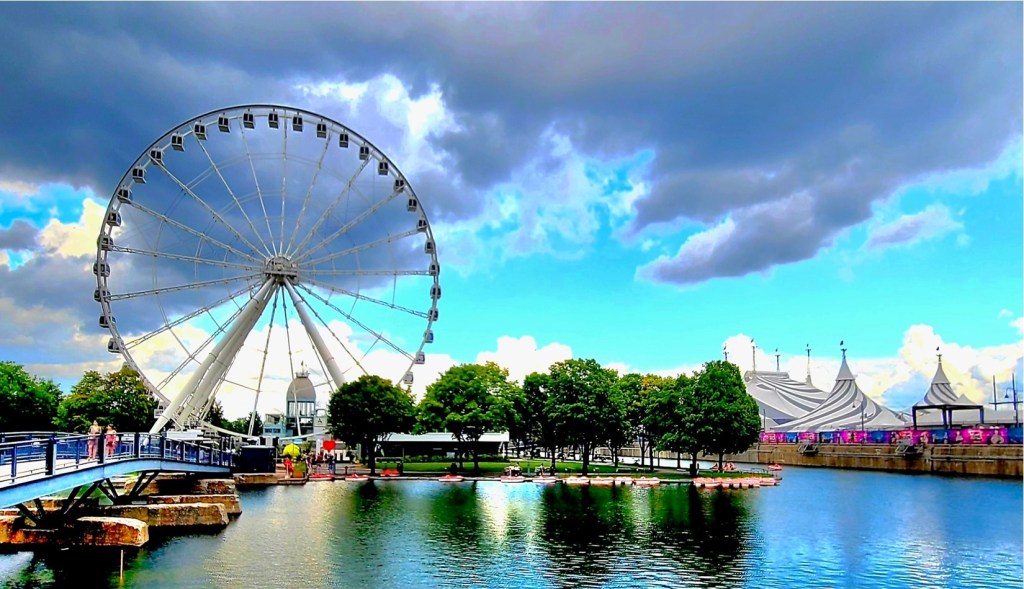
We shared a laugh after spotting yet another monster-sized Ferris wheel on the pier, but La Grande Roue de Montréal, erected in 2017 to celebrate Montréal’s 350th anniversary is one of several family attractions that appeal to tourists near and far.
In 1642, New France took root on the banks of the Saint Lawrence River, where French traders and the Crown established a fort (Ville-Marie) in support of a flourishing fur trade. Roman Catholic missionaries followed, intending to establish a North American parish that could convert the Iroquois to Christianity, and build a cathedral that was worthy of a New World capital.
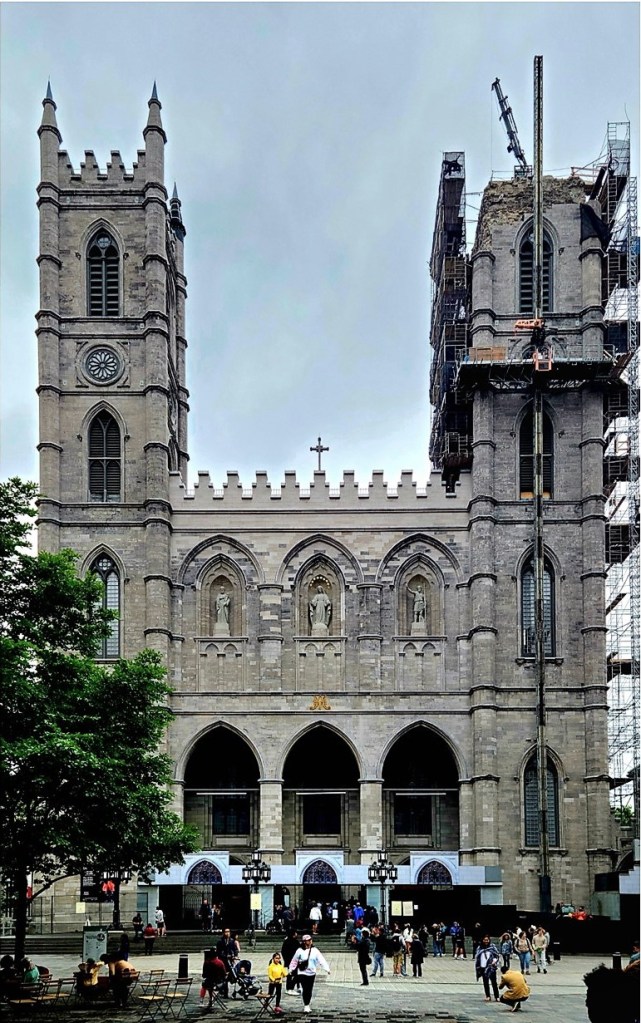
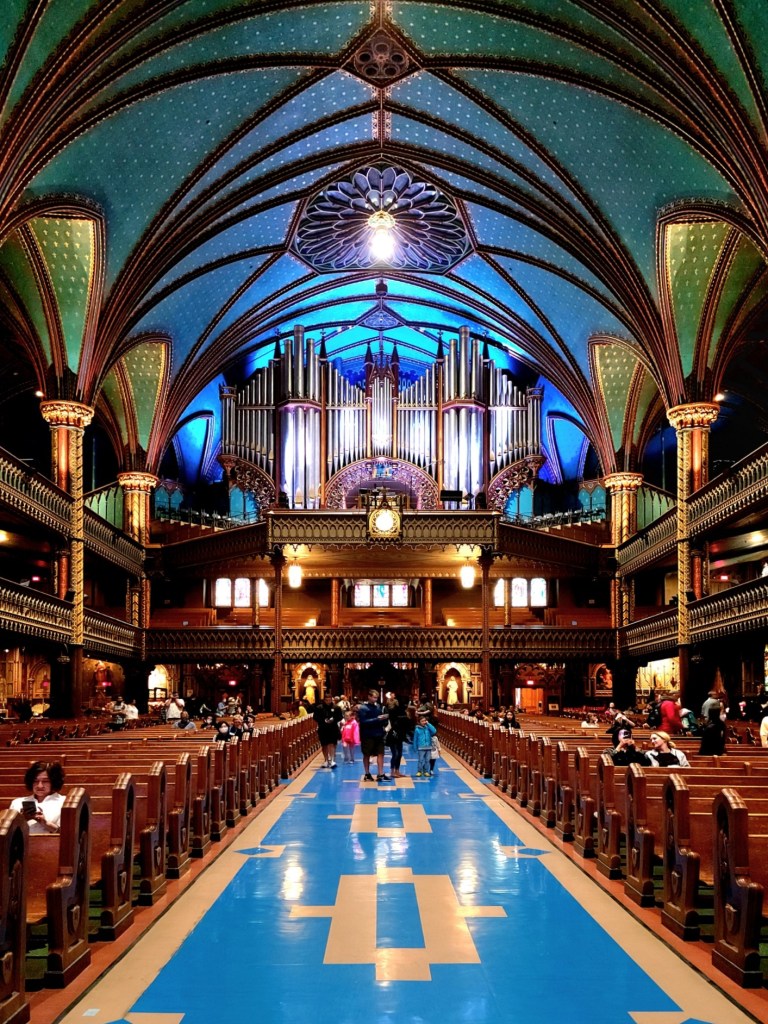
Notre-Dame Basilica was designed by James O’Donnell in a Gothic Revival style, and built behind the original parish church.
Robert Auchmuty Sproule (1799-1845)
The sanctuary was completed in 1830,
and the towers followed in 1841 and 1843.
The interior’s intricate stone and wood carvings were completed in 1879.
The pipe organ dates to 1891. It comprises four keyboards, 92 stops, 7000 individual pipes and a pedal board.
Arson destroyed the more intimate Sacre-Coeur Chapel in 1978, but it was rebuilt from original drawings, and finished with an immense bronze altarpiece by Quebec sculptor Charles Daudelin.
It’s a 5-minute Metro ride from downtown to Parc Jean-Drapeau, an island park surrounded by the Saint Lawrence River. Half the park is natural (Saint Helen’s Island) and the other half is artificial (Ile de Notre Dame), conceived with rock excavated from Montréal’s Metro tunnels.
The park is a fitting tribute and memorial for its namesake, Jean Drapeau. As mayor of Montréal (1954-1957, 1960-1986), he was instrumental in bringing Expo67 to his city. Drapeau is also remembered for securing the 1976 Summer Olympics for Montréal, as well as successfully lobbying Major League Baseball for a major league franchise during its 1969 expansion (Kansas City Royals, Montreal Expos, San Diego Padres, and Seattle Pilots).
Few pavilions from Expo67 remain on the island. Notably, the French pavilion has been repurposed as Canada’s largest casino.
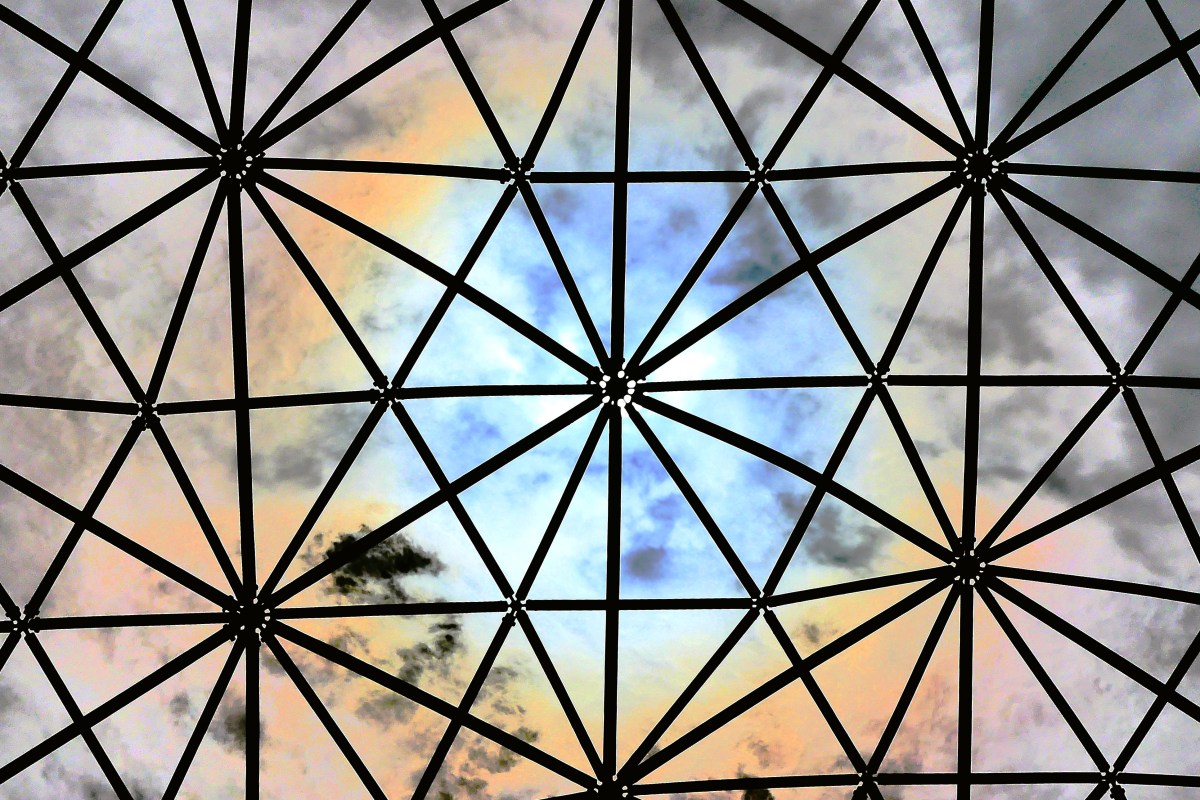
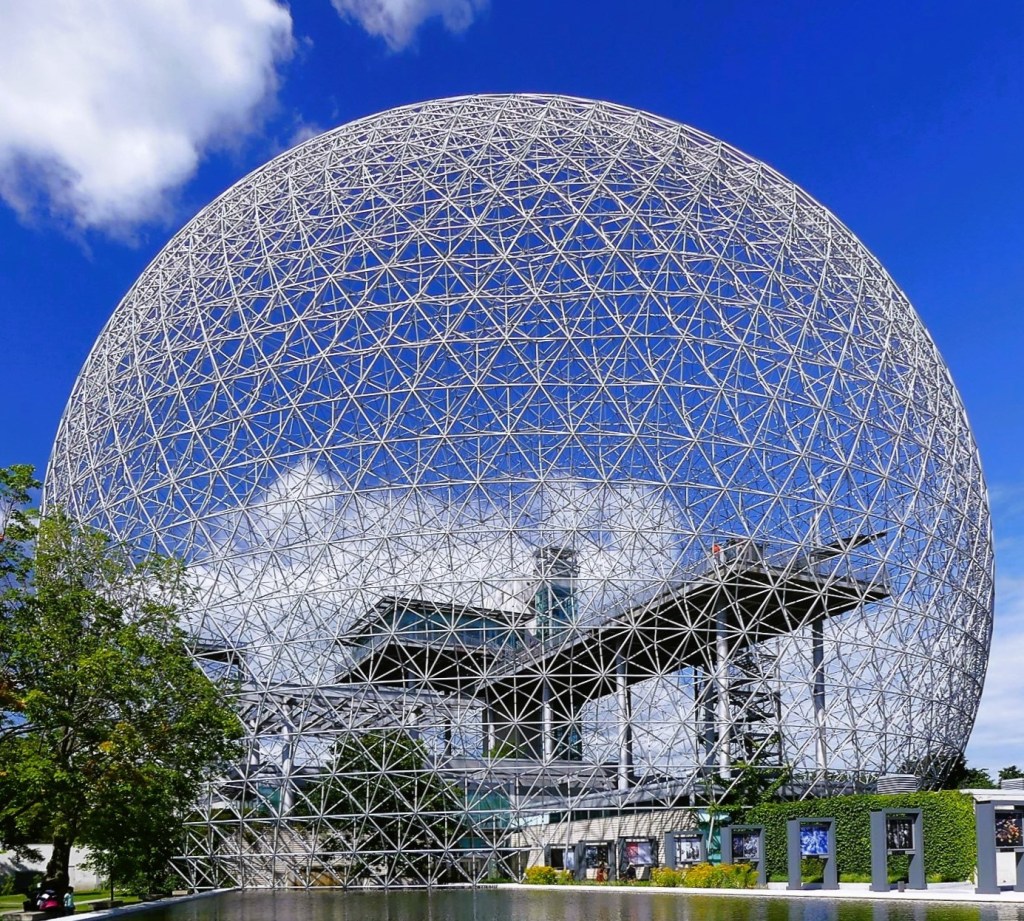
And the United States pavilion, featuring Buckminster Fuller’s geodesic dome has also been preserved, despite a fire in1976 that burned through the structure’s acrylic bubble, leaving only the steel trusses.
Fortunately, the exhibition space within the dome was spared, and has been transformed into an interactive museum named Biosphere, that tells the story of our environment through several rooms of multimedia presentations,
and a wraparound theater space.
But its the iconic geodesic dome that most visitors have come to experience. The New York Times picked the dome as one of “the 25 Most Significant Works of Postwar Architecture.”
Geometry majors may discover 32 triangles from the center of each vertex to the next vertex.
Montréal is also a culinary haven for foodies. We sampled wood-oven-baked bagels from St-Viateur, and smoked meat from Chez Schwartz in the Jewish Quarter. For dinner, Leah and I migrated to Chinatown to sample the fare with Jennifer, a dear friend in town for business.
We settled on a tasty meal of soup dumplings at Mai Xiang Yuan Dumpling, but wondered out loud about the long queue out the the door for Gol’s Lanzhou Noodle Shop.
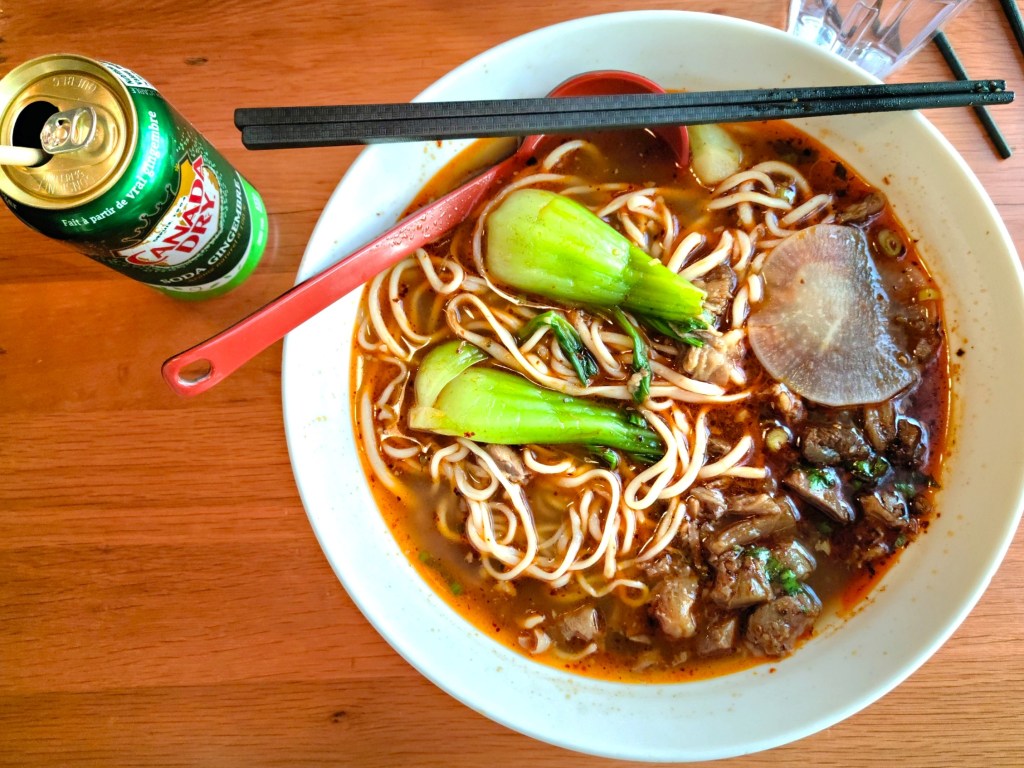
We made a mental note and returned to Gol’s the following evening, only to find another long line of future diners waiting patiently. I spent my wait time studying the noodle maker through the window…
and tasted his skillset in my meal when we were finally seated and served a tureen-sized portion of steaming heaven.
Authentic Lanzhou braised beef and noodles
These were beef noodles to stand in line for, whenever I’m back in Montréal.
By the time Leah and I were flying over Iceland, we were zombies.
Leah was outraged by the airline’s no-frills service. “Not even a tiny bag of pretzels,” she lamented, “Maybe I closed my eyes for one or two minutes.”
I was mostly pissed that my gummies were duds, but I thought the Icelandair pilot and jet did a commendable job of getting us to Iceland–crossing 4 time zones in 5 hours.
We arrived at Keflavik International Airport at 5:30am, found our bags, cleared customs, bought some duty free tequila, and got our bearings…
We have embarked on a 2-week road trip around Iceland, hopping from one hotel or guesthouse to another until we complete the circle, and we’re not too sure what to expect.
By the time we reached the reception atrium, half-a-dozen drivers were gathered by the airport entrance looking for a match. But none of the clients’ names on their iPads and iPhones matched with mine.
I approached one of the drivers and handed him my voucher. His English was perfect.
“I know this driver,” he said. “He’s the best! I think he’s running late on another trip, but I’ll call him for you.”
The phone call was brief. “He says he’s on his way.”
By 6:30am we were riding in an electric Audi SUV to Grandi by Center Hotel, discussing with our driver how Iceland’s road system is still too immature to support a fleet of EVs–plagued by insufficient charging stations and improper maintenance. The ride took 40 minutes.
“The hotel is full,” we learned from the on-duty desk clerk. “The earliest we may make a room ready for you is 2pm, and I will make it my first priority.”
Disappointed, we power-walked through a chilly spray under overcast skies from Grandi to Sandholt, a nearby bakery highly recommended by the desk clerk.
“What are we gonna do for 7 hours? I need sleep!” Leah groaned.
The streets were stone quiet this Sunday at 7am, except for a street cleaner and vacuum buggy attacking the trash along the alleys of a popular square filled with eateries.
However, one road along the way caught our attention…
We discovered that Iceland is regarded as one of the most LGBTQ-friendly countries in the world, having elected, Jóhanna Sigurðardóttir, an openly gay head of state in 2009, and Althing (Iceland’s Parliament–founded in 930 and one of the oldest surviving parliaments in the world) unanimously voting for same-sex marriages in 2010. Unsurprisingly, one-third of Iceland’s population turns out for the Reykjavik’s Gay Pride parade in August.
Leah was thrilled with her breakfast. She had an omelet and I had a waffle with fruit. It gave us the boost that we needed to explore the rainbow road to Hallgrímskirkja, Iceland’s National Church.
and Reykjavik’s iconic Lutheran landmark.
I would have liked to climb the tower for what is reputed to be the best lookout of the city, but we were too early.
View from the top of Hallgrímskirkja. Photo by Philippa via Flickr CC
And that’s true for most of the city, which doesn’t wake until 11am on Sunday, so shopping was also out of the question.
Begrudgingly, we returned to the hotel, admiring some of the charming homes,
and graffiti along the way…
and took possession of our room by 1pm.
After a 5-hour nap and an early dinner, we were ready for bed and ready for whatever new adventure awaits us in the coming days.
There was a time 10 years ago, when Scenic, South Dakota was for sale–yes, all 10 acres of the town and 36 acres of the not-so-scenic, surrounding property.
It was originally offered up for $3M by Twila Merrill, local rodeo legend who earned a tough-as-nails reputation for never being thrown from a bucking bronc from 1956 to 1963, but with her health fading, it was time to sell.
She eventually sold the whole kit and caboodle to a Filipino church group for just shy of $800,000 in August, 2011.
Ten years later, Scenic looks unchanged. There is scant evidence that parishioners ofIglesia ni Cristo (Church of Christ) are welcome at this ghost town, although the pastel-colored Adirondack chairs on the porch suggest that a resurrection of activity is possible.
Back in the day, Scenic was a thriving hive of entertainment, with a full-scale rodeo arena, a racetrack, a manicured baseball diamond, a theatre and a dancehall.
Main Street was home to a General Store,
and a requisite saloon which was thoughtfully annexed to the town hoosegow.
It should be noted that Indians were allowed inside Longhorn Saloon, but only after Twila bought the joint and painted over “NO” on the marquis.
Meanwhile, the culture crowd would gather at Sam 2 Bulls.
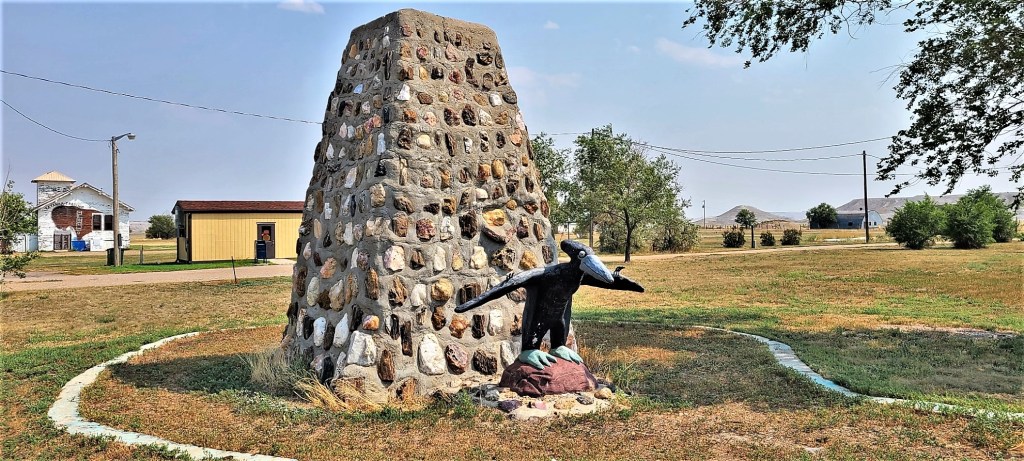
Off the main drag, there’s an assortment of incongruous buildings: a couple of standing churches, a few warehouses and barns, a defunct gas station, and a post office behind a dedicated monument featuring a pterodactyl that defies logic or explanation.
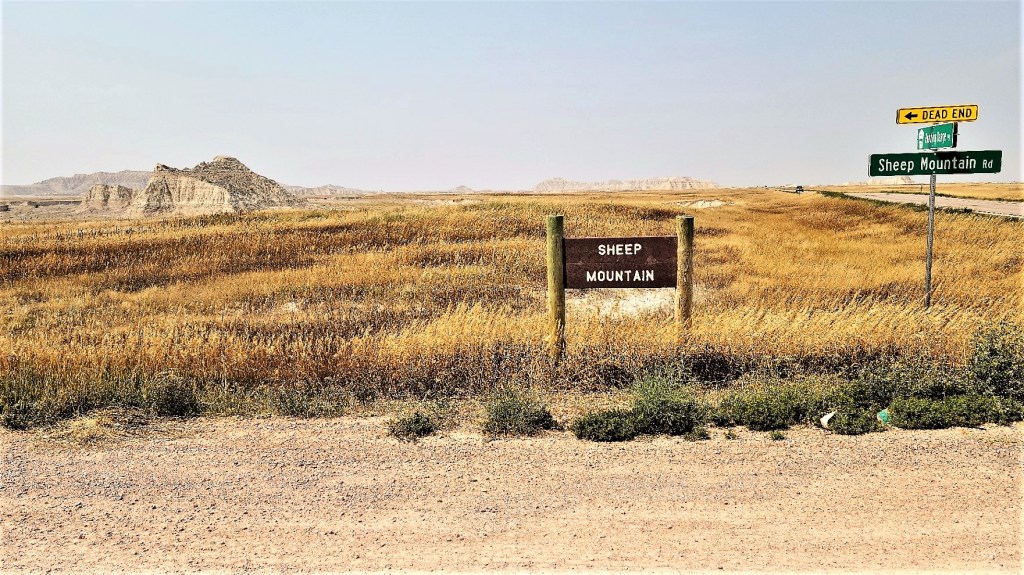
Leah and I rolled through Scenic, on our way to an outpost of Badlands National Park known as Sheep Mountain Table, located in the Stronghold Unit within the Pine Ridge Indian Reservation.
At 3,300 ft. elevation, Sheep Mountain Table is the highest point in the park.
The good news is that we could drive to the top.
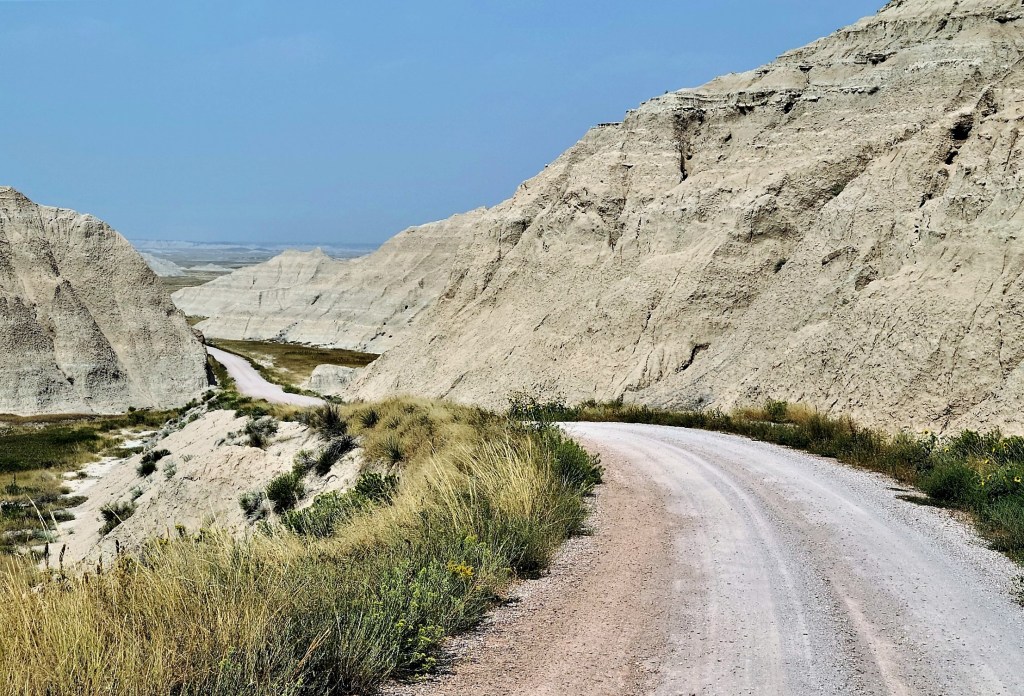
The 6.5 mile road was hard-packed and serviceable all the way to the top of the table, albeit a single lane and a handful of hairpins. Once we arrived, there wasn’t much to see on the surface except tall grass, road tracks and traces of spent and unexploded ordinance scattered throughout this one-time gunnery range used by the USAF and South Dakota National Guard. The wind was blowing furiously,
which kept us anchored a careful distance from the ledge overlooking the Cheyenne River Valley.
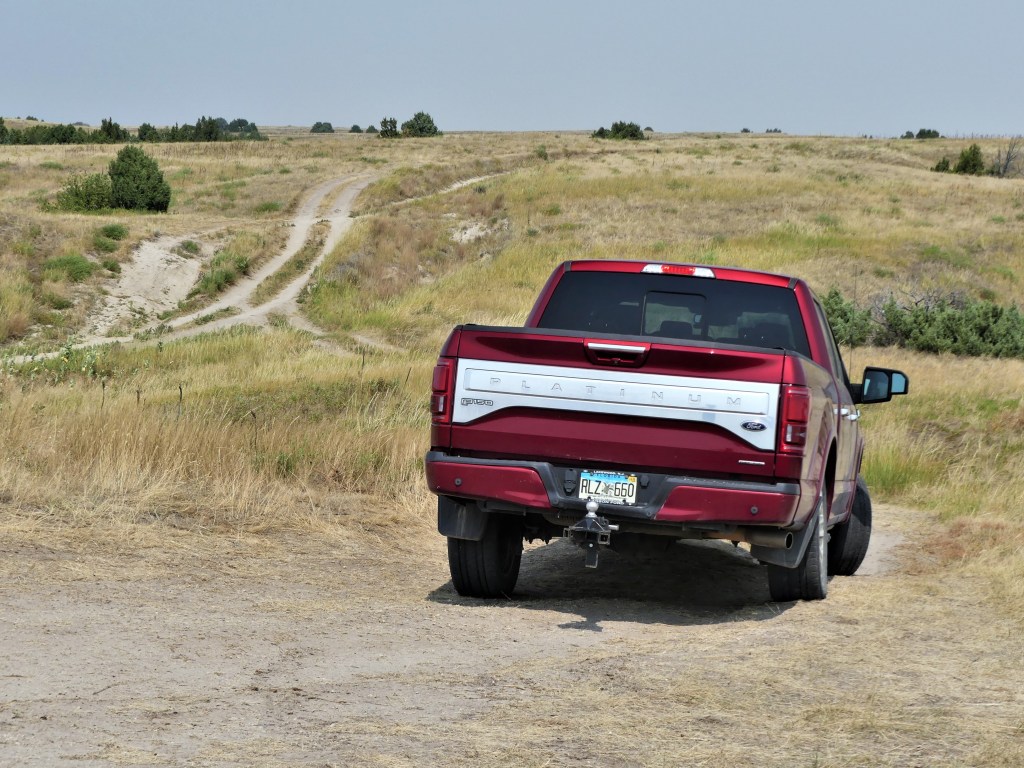
But there was much more to explore on the other side of the table, which we could reach by hiking 2 miles or driving the rutted terrain…
so I drove…pitching and rolling along…
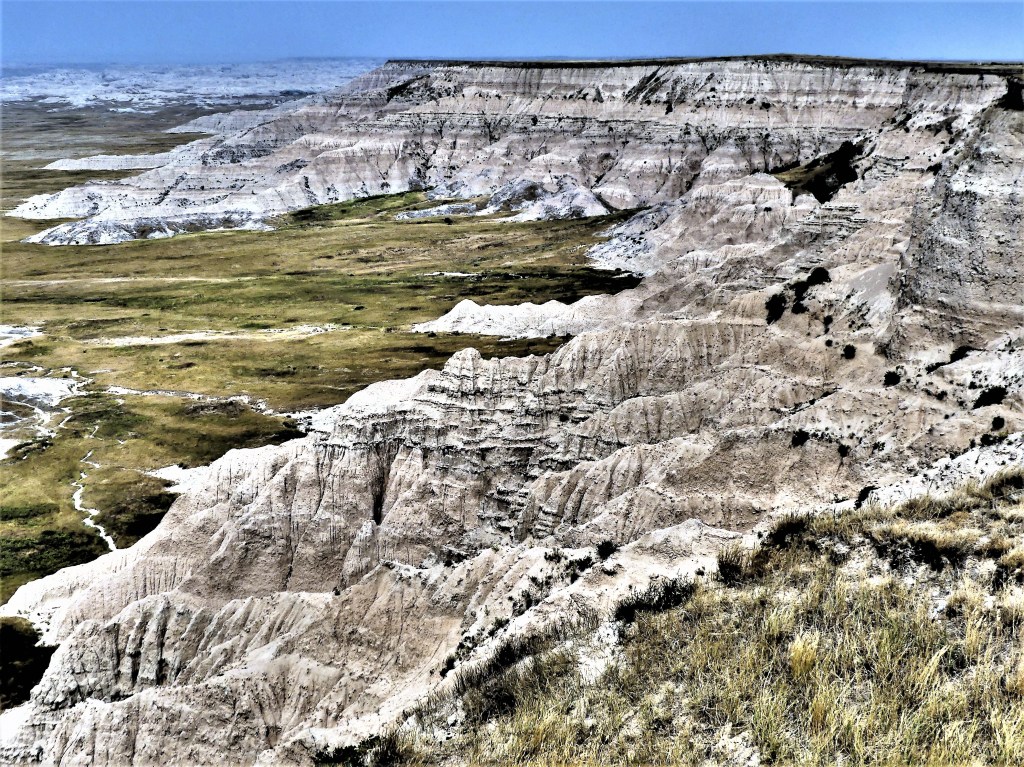
until we arrived at an open plateau with dramatic vistas to the west…
and the White River Valley to the east.
These Badlands were once considered sacred to young Sioux braves who would trek to the tables for prayer and self-reflection as they approached manhood.
That’s when it occurred to me that Scenic, South Dakota was rightfully named, not because of the town’s location, but because of the Badlands omnipresence and its omnificent landscape. And that may also explain why the Filipinos invested in Scenic.
Leah and I had a lot of ground to cover during our brief visit to the Oregon Coast. With so much to see and do before we moved on, there was little time to waste. We immersed ourselves in seaside activities until we were Ore-goners.
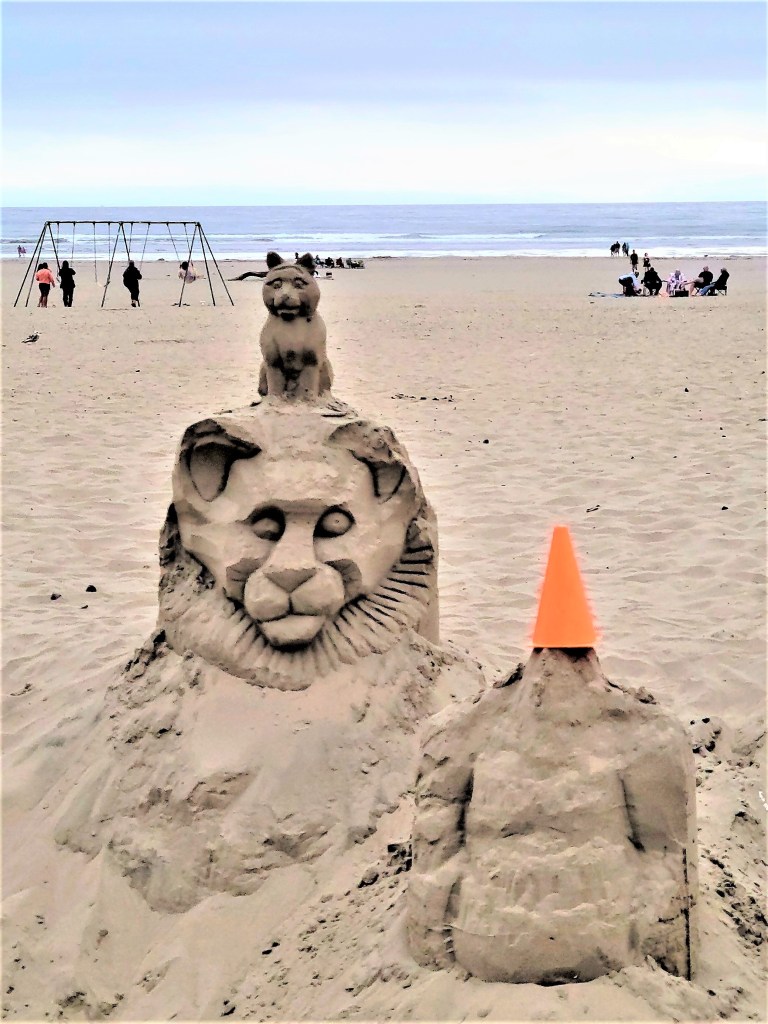
We set up our first camp site at South Beach State Park, and made a beeline to the beach. After 10 weeks and 9,000 miles on the road, we were finally celebrating “sea to shining sea.”
The following morning, we visited Yaquina Head to play in the tidepools;
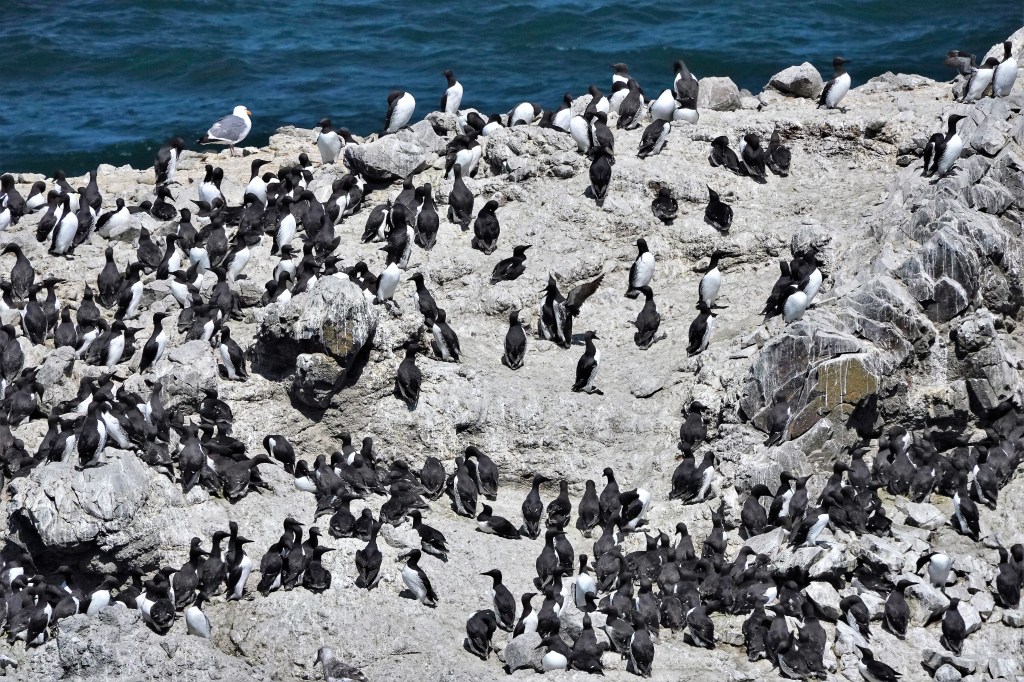
observe the seabirds,
study the sealions;
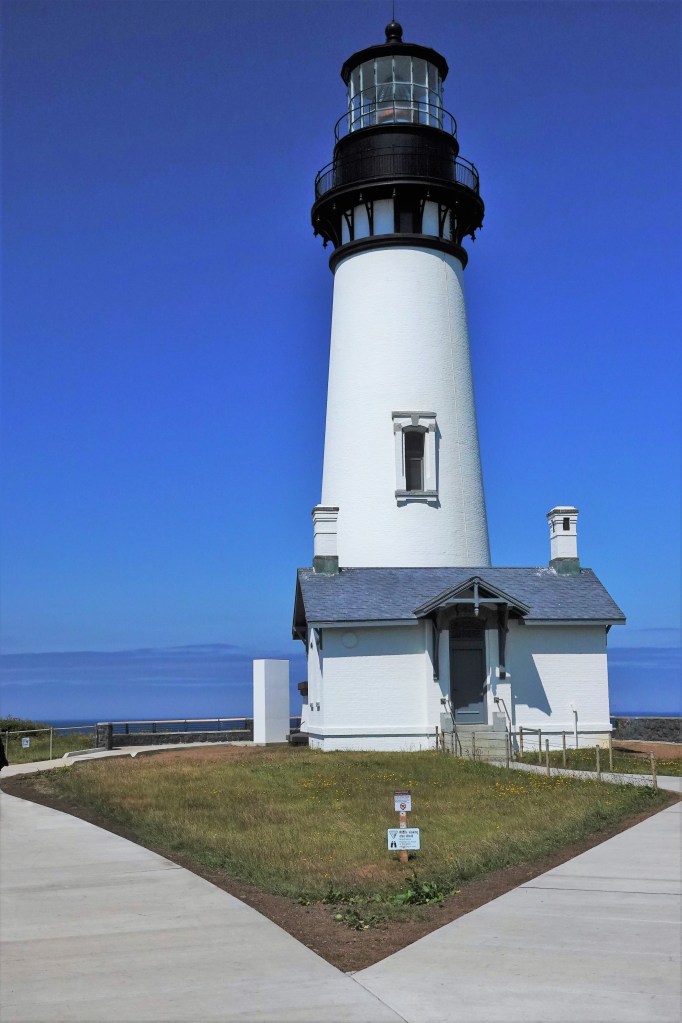
and visit Oregon’s tallest lighthouse (93 feet), projecting its light beam 19 miles out to sea since 1873.
And then we were off to Newport’s Historic Bayfront,
where we lunched with our safari buddies Brenda and Michael, who drove from Portland to join us for the afternoon.
On our last full day at South Beach, we played nature tourist. We gawked at Devil’s Punchbowl;
the Seal Rock;
and Cook’s Chasm.
We combed the black sand beaches, searching for sea glass gems;
and we were entertained by surfers braving frigid waters along Beverly Beach to round out our day.
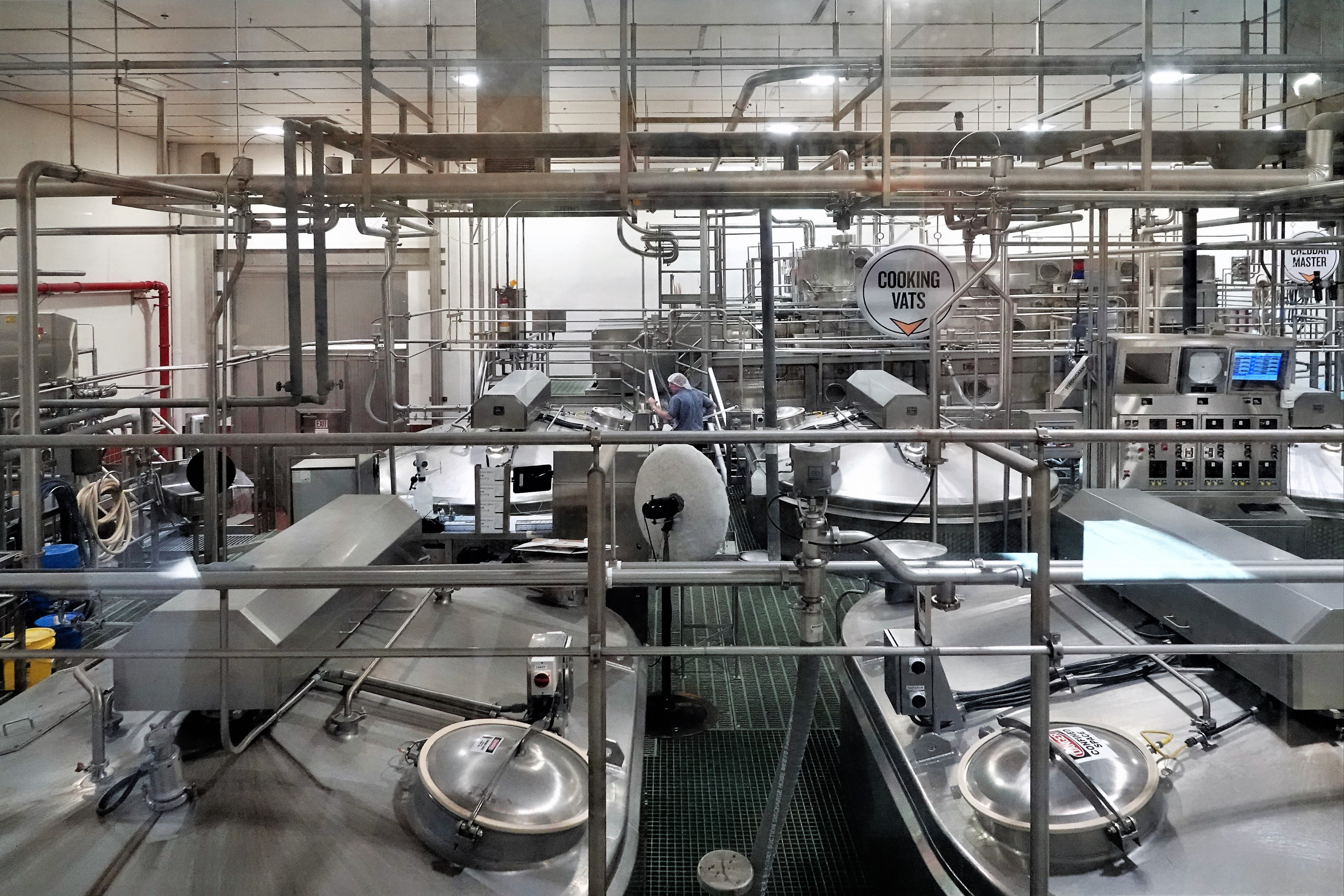
Typically on moving day, it’s clean-up, hitch-up and safety check before moving on to our next destination. Once in a while we’ll break up the drive by stopping for lunch at a roadside dive, but mostly we’ll snack in the pickup. However on this particular day, on our way up the Oregon Coast Highway to Cannon Beach, we were eager to stop at Tillamook Creamery.
And we were not alone. Hundreds were passing through the overhead exhibition windows with us…
before earning a taste of Oregon’s finest ice cream.
Once situated at camp site #2, we were free to roam the shore to explore a different kind of scoop, but still a rocky road…
along Ecola State Park.
Our evening was reserved for clam chowder at Dooger’s in Seaside, and then a walk along their lively beach at dusk.
The area is also filled with history. Leah and I spent the next day time climbing through the gunnery emplacements at Fort Stevens,
intended to protect the mouth of the Columbia River.
We also discovered the Peter Iredale, or what was left of the four-masted steel barque sailing vessel that ran aground in 1906 en route to the Columbia River.
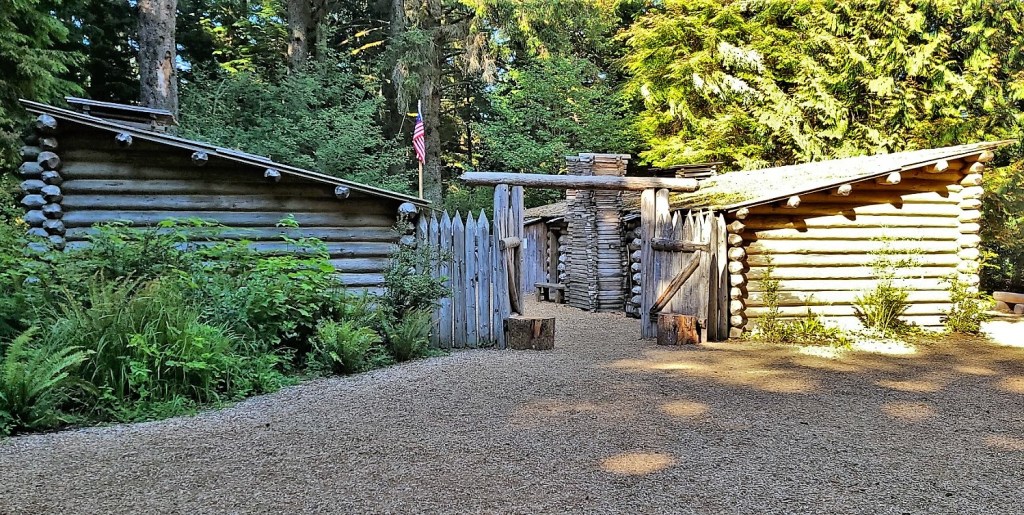
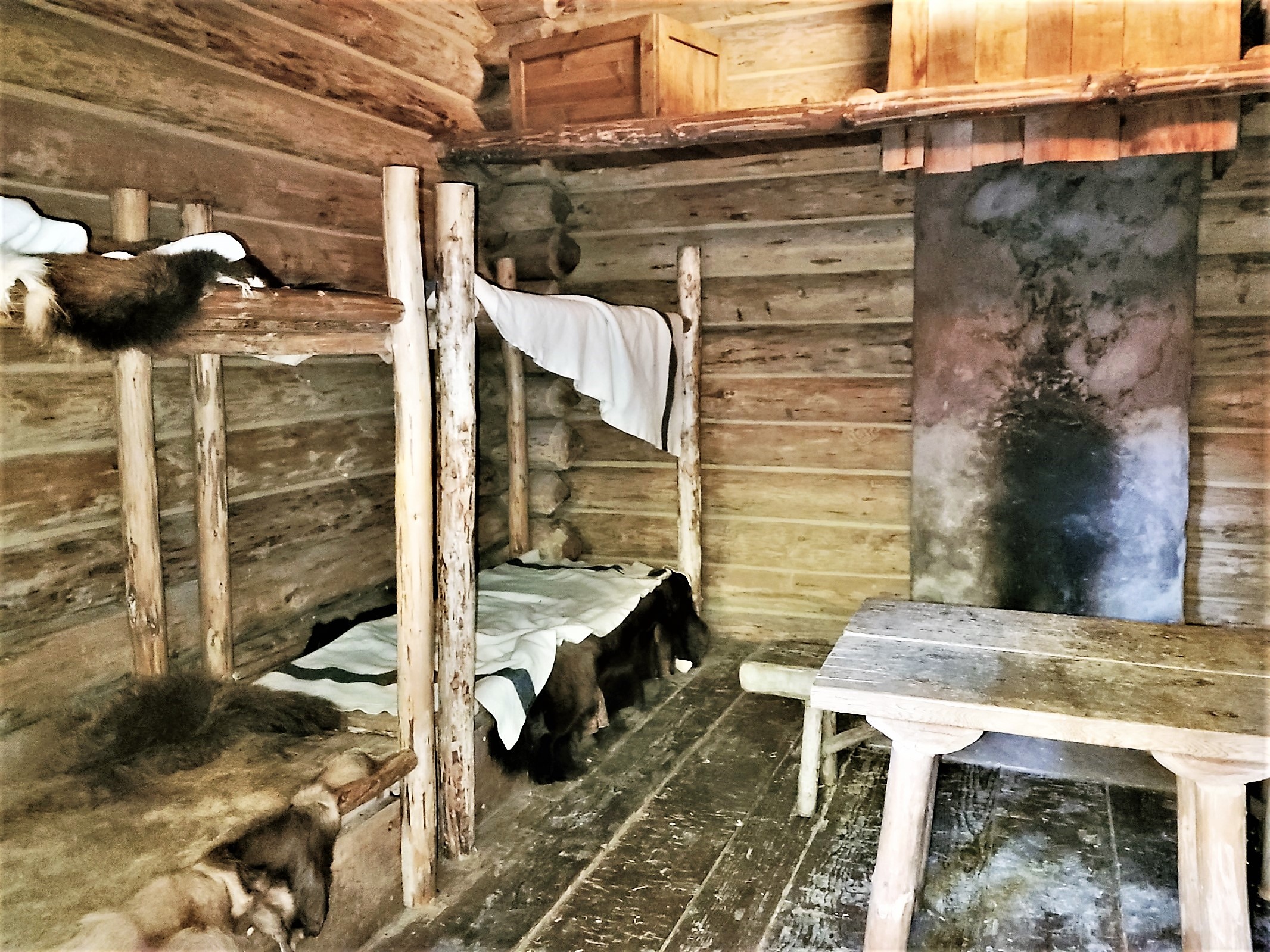
Nearby, the Lewis and Clark Historical Park offered a replica of Fort Clatsup,
and a glimpse of early 19th century housing for Capt. Meriwether Lewis and Lieut. William Clark,
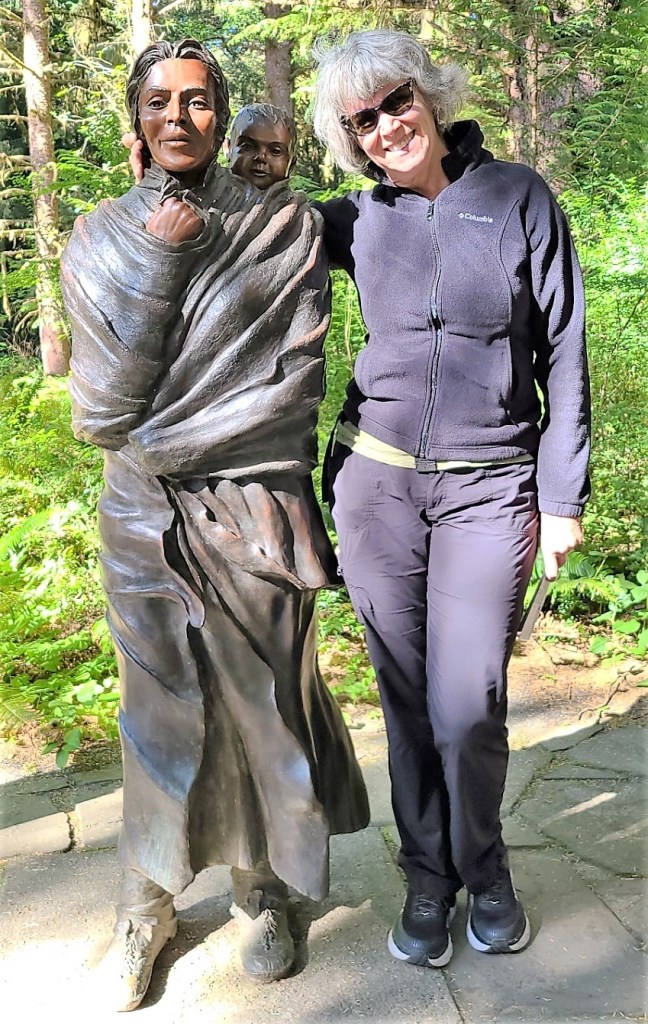
and their guide Sacagawea and son, Baptiste.
Finally, a day of walking through Astoria gave us wonderful examples of coastal living…
and coastal culture,
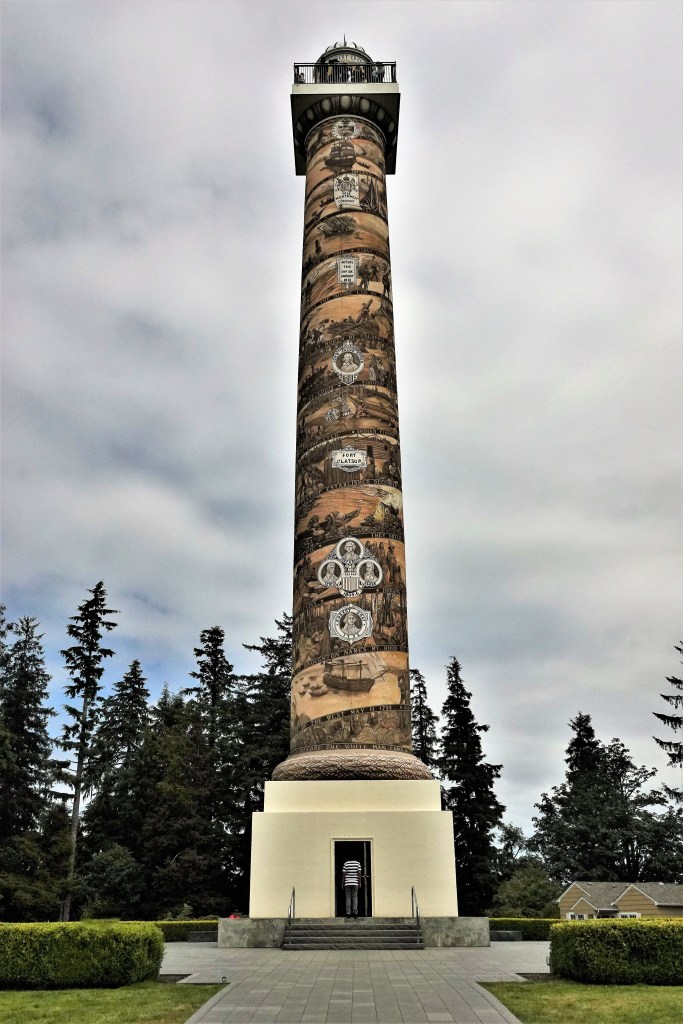
But a hike up 164 steps to the tower of the hand-painted Astoria Column…
offered us a scenic perspective…
that prepared us…
for our crossing to Washington’s Olympic National Park.
U.S. Marine Corps 1st Lieutenant Victor David Westphall III and 16 Bravo Company soldiers under his command lost their lives in an ambush at Con Thien (“Hill of Angels”), a combat base near the former Vietnamese Demilitarized Zone.
But Victor “Doc” Westphall shaped his grief differently than 58,000 other Gold Star families who were looking to find meaning in their child’s death from a senseless and unpopular war. He and his wife Jeanne would dedicate the rest of their lives working to fulfill their son’s legacy by honoring ALL victims of the Vietnam War.
When sons or daughters die in battle, parents are confronted with the choice of what they will do to honor the courage and sacrifice of that son or daughter. Following the death of our son, Victor David Westphall, on May 22, 1968, in Vietnam, we decided to build an enduring symbol of the tragedy and futility of war.
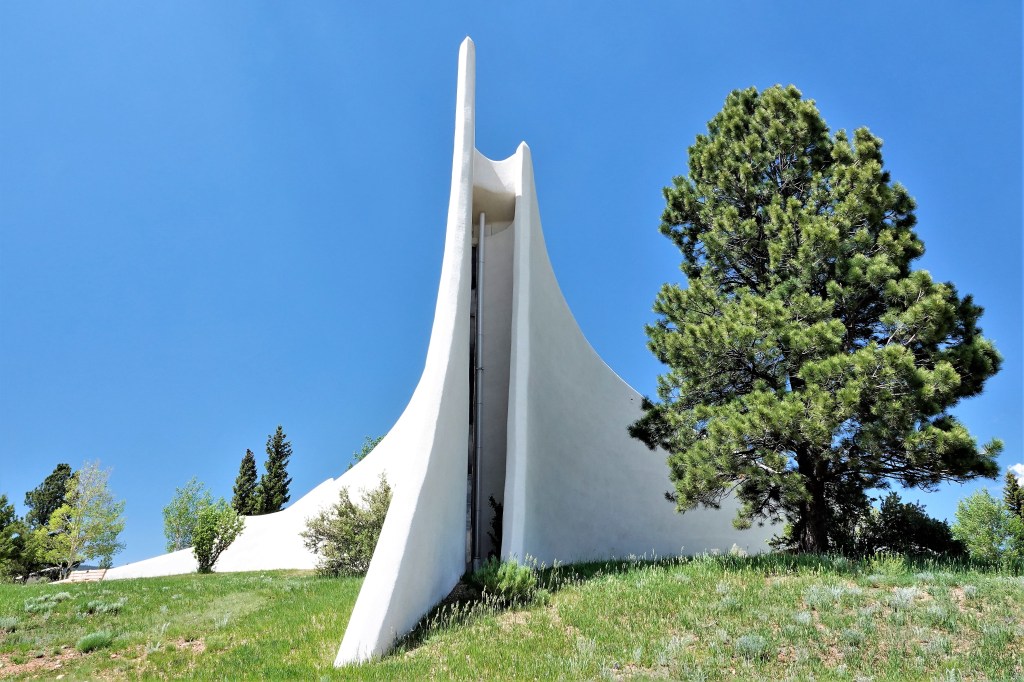
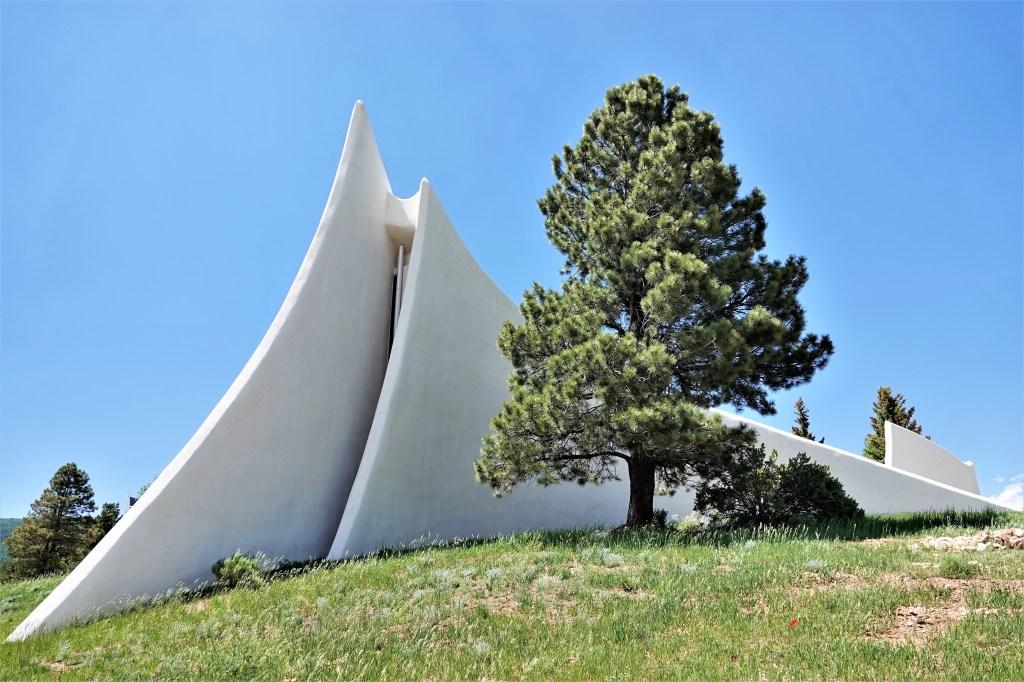
With $30,000 seed money from David’s life insurance payout and another $60,000 in savings, Doc commissioned Santa Fe architect, Ted Luna to design a chapel on his Moreno Valley hillside property off U.S. Highway 64 in Angel Fire, NM.
After three years of sweat equity, Doc presented the Vietnam Veterans Peace and Brotherhood Chapel…
to commemorate the loss of his son.
The spartan, triangular-shaped chapel was intended as a non-denominational sanctuary, with the exception of a towering cross-like torchiere at the vortex.
But Westphall’s vision was running on fumes; he needed $20,000 per year in maintenance expenses, and donations were in short supply, especially after Maya Lin’s national memorial (the Wall) was dedicated in Washington D.C. on November 13, 1982.
Fortunately, the Disabled American Veterans organization committed to funding Doc’s memorial, and ownership was transferred to their foundation. The Disabled American Veterans charity tended “Doc’s” dream till 1998–building a much-needed Visitor Center into the hillside in 1986, and acquiring an additional 25 acres for a buffer zone before reverting ownership back to the David Westphall Veterans Foundation (DWVF).
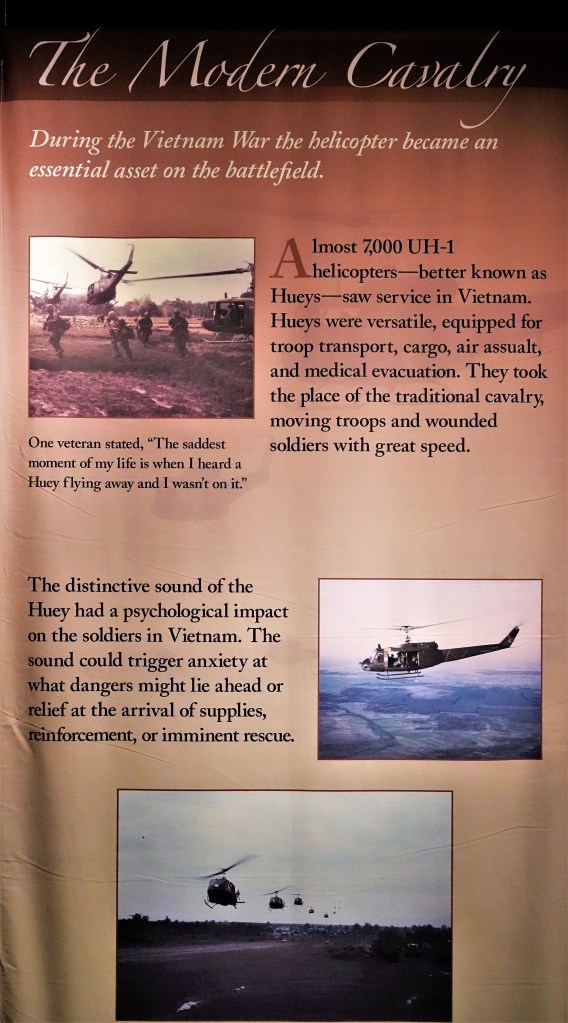
In 1999, DWVF inherited a decommissioned Huey for the Vietnam Veterans Memorial grounds from the New Mexico Army National Guard, acknowledging the impact that the Huey had in Vietnam combat assault, resupply, and medivac missions.
After 17 years of ground service at the memorial, their Huey was lovingly restored…
and returned to its hallowed perch.
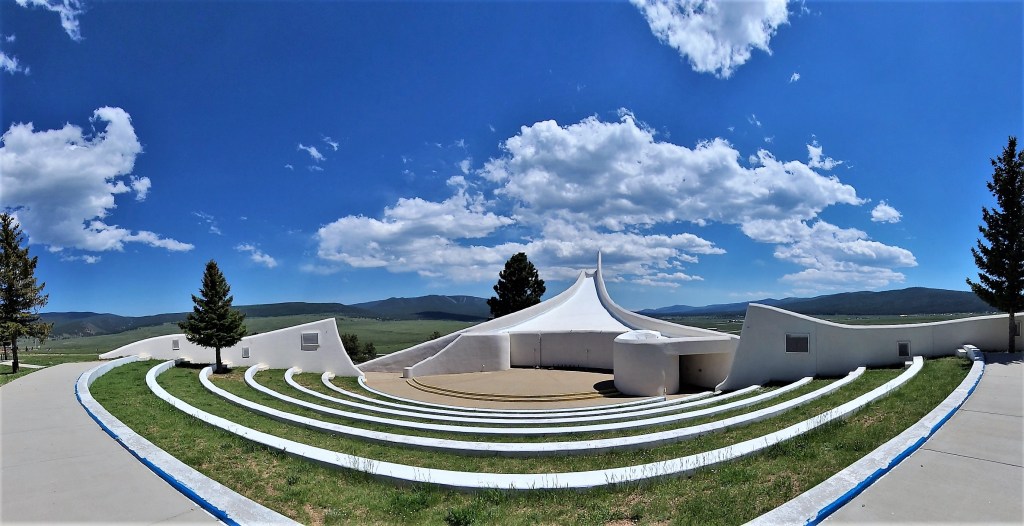
On Veterans Day 2005, Gov. Bill Richardson granted the Vietnam Veterans Memorial state park status, which secured state resources for needed renovations and a newly built amphitheater behind the chapel.
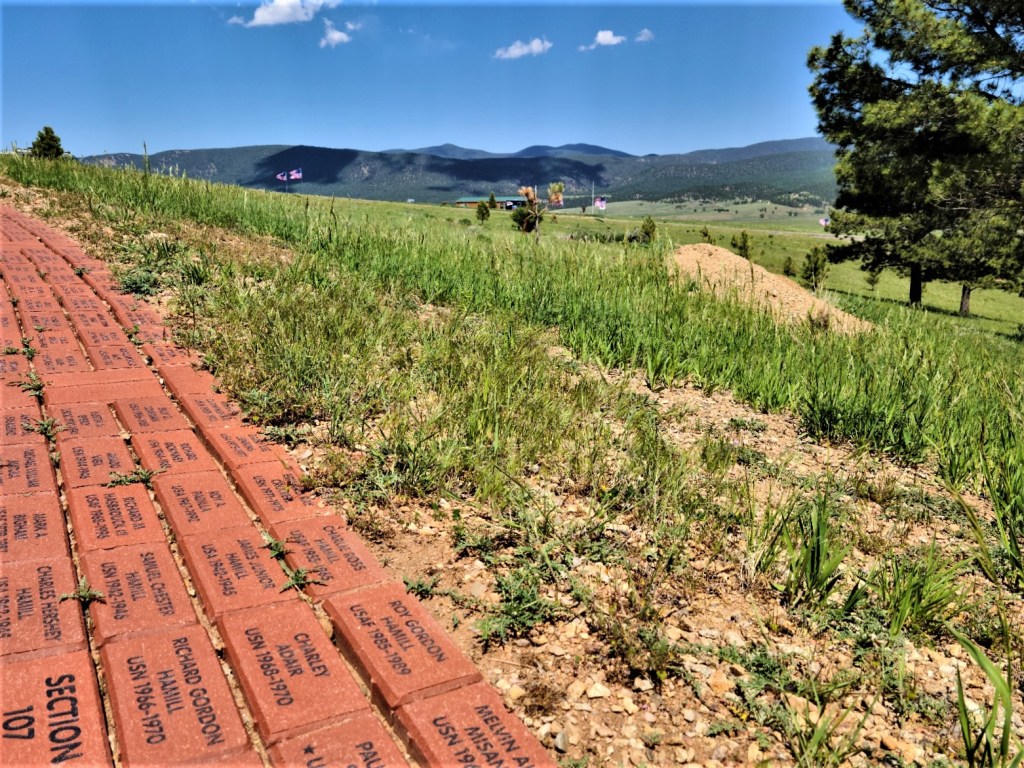
In 2007, a commemorative walkway was inaugurated for all U.S. veterans. The dates on the bricks-for-bucks signify the dates of service. Two stars denote the person was killed in action, and one star designates missing in action.
On July 1, 2017, management of the Memorial was transferred from the NM State Parks to NM Department of Veterans Services.
Doc Westphall died in 2003 at the age of 89, and his wife Jeanne died the following year. Both are buried at the memorial.
At the time–during the Vietnam War–I would have registered as a conscientious objector if necessary, as I had no taste for war. Lucky for me, I side-stepped conscription with a college deferment in 1970, and a high enough number (#181) in the Selective Service Lottery held on August 5, 1971. By then, Nixon had ordered phased withdrawals to coincide with Vietnamization. Consequently, fewer numbers were being called up to relieve the soldiers returning home, who received little fanfare and support from society at large.
Approximately 2.7 million men and women served in Vietnam over the course of 20 years without America ever realizing its objective–to thwart the spread of Communism in Southeast Asia.
So many young soldiers made the ultimate sacrifice to defend their country with honor, and so many paid the ultimate price with their lives. Moreover, far too many came back broken from their war experience. At the very least, we owe them all a debt of gratitude, and above all, our respect.
Thankfully, the Vietnam Veterans Peace and Brotherhood Chapel offers us a place to share our grief, heal old wounds, and bring us closer to awareness and acceptance of our past.
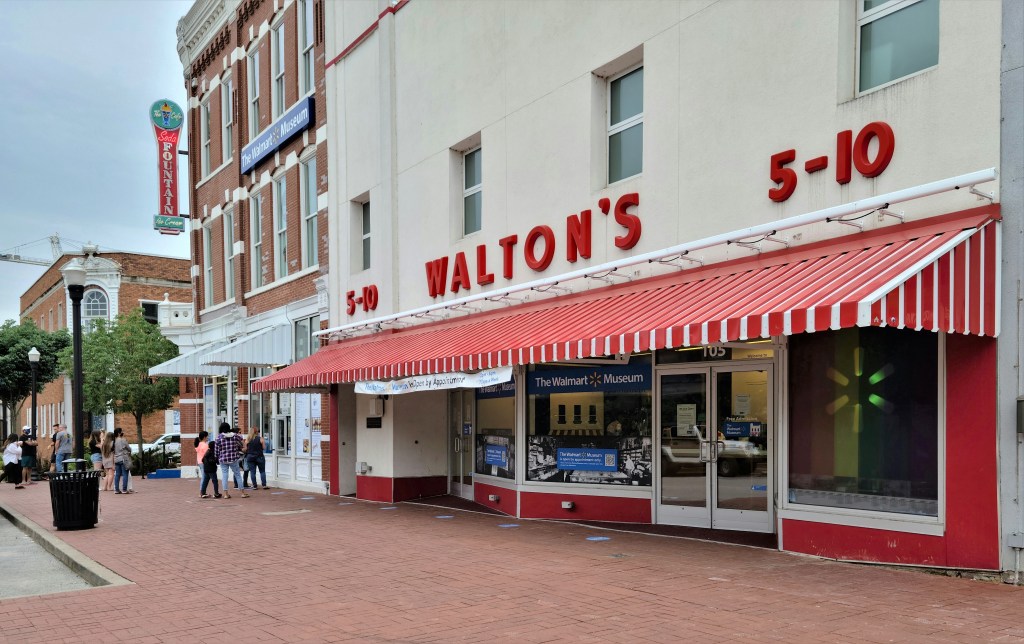
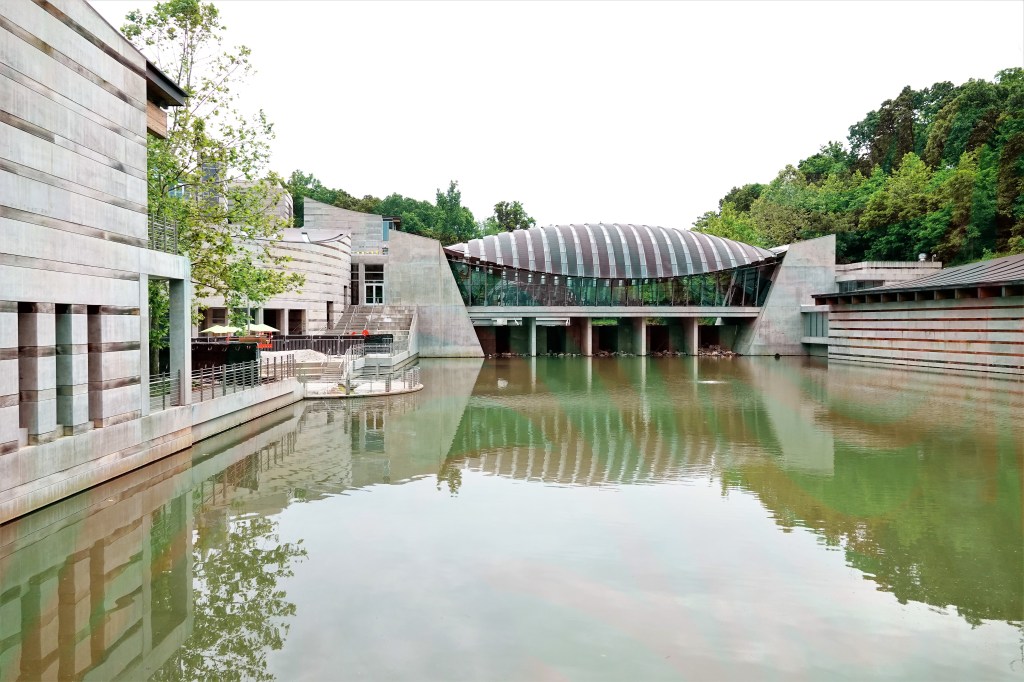
My buddy, Lee (who I’ve known since nursery school) escorted Leah and me to Crystal Bridges Museum of American Art, his local art museum in Bentonville, AR. Imagine, a world class museum in the midst of a population center of 50,000, courtesy of Alice Walton, heiress to the Walmart fortune.
Alice assigned renowned architect, Moshe Safdie to design a space, anchored by ponds and forest using generous amounts of glass and wood.
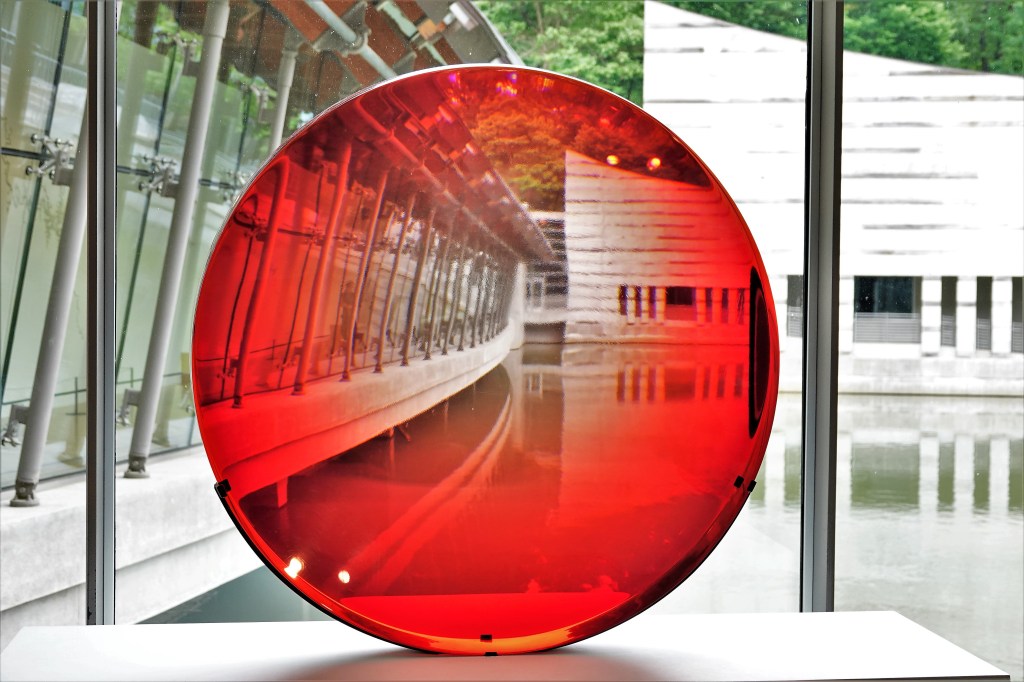
The 217,000 sq. ft. complex includes a sculpture garden,
Lowell’s Ocean by Mark di Suvero
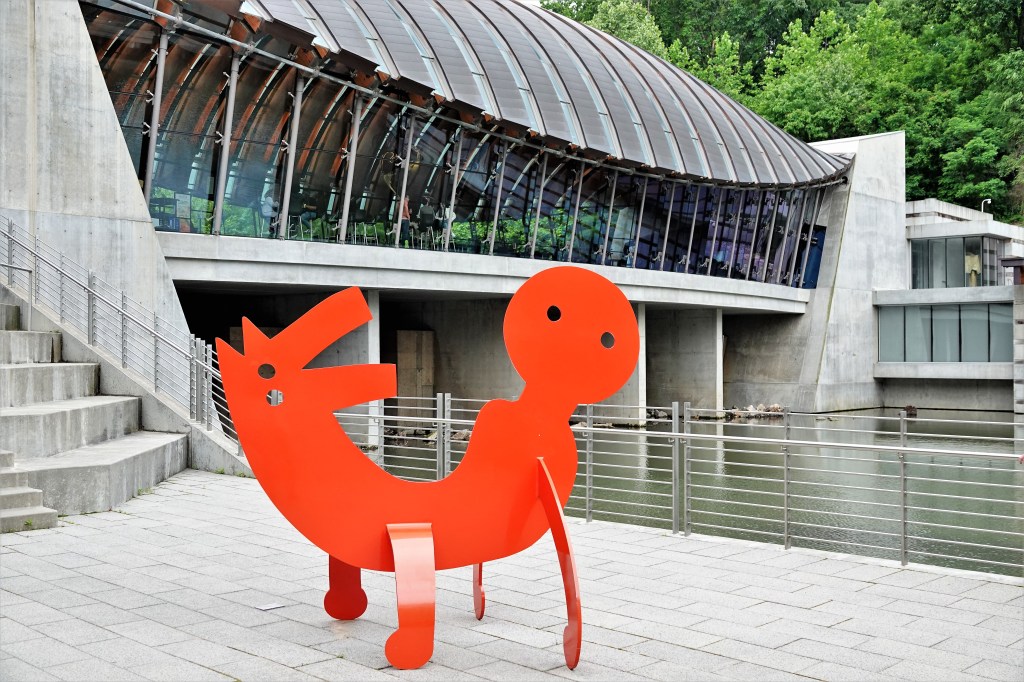
Two-Headed Figure by Keith Haring
Fly’s Eye by Buckminster Fuller
galleries galore,
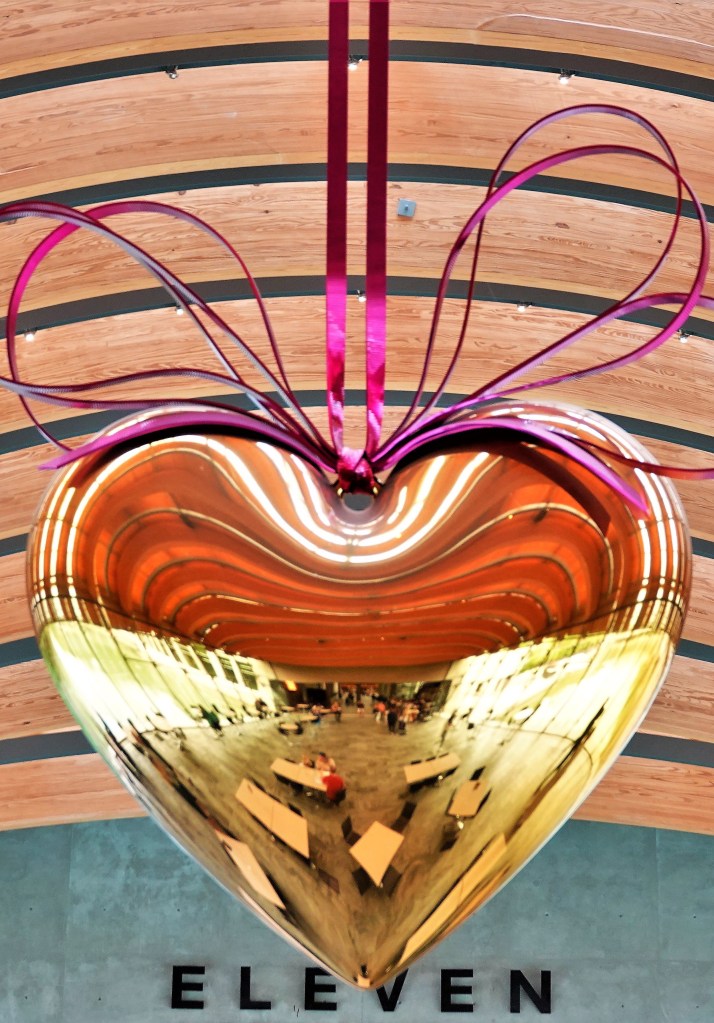
and a restaurant named Eleven, to commemorate the day the museum opened (11/11/11). And admission is free!
It quickly became apparent that there was so much to see that we could have easily spent days walking through the wings, just to take it all in; it was overwhelming. And some of the rooms had walls that were tiered with art from floor to ceiling. It’s no surprise that museum officials have recently announced plans to increase gallery space by an additional 100,000 sq. ft.
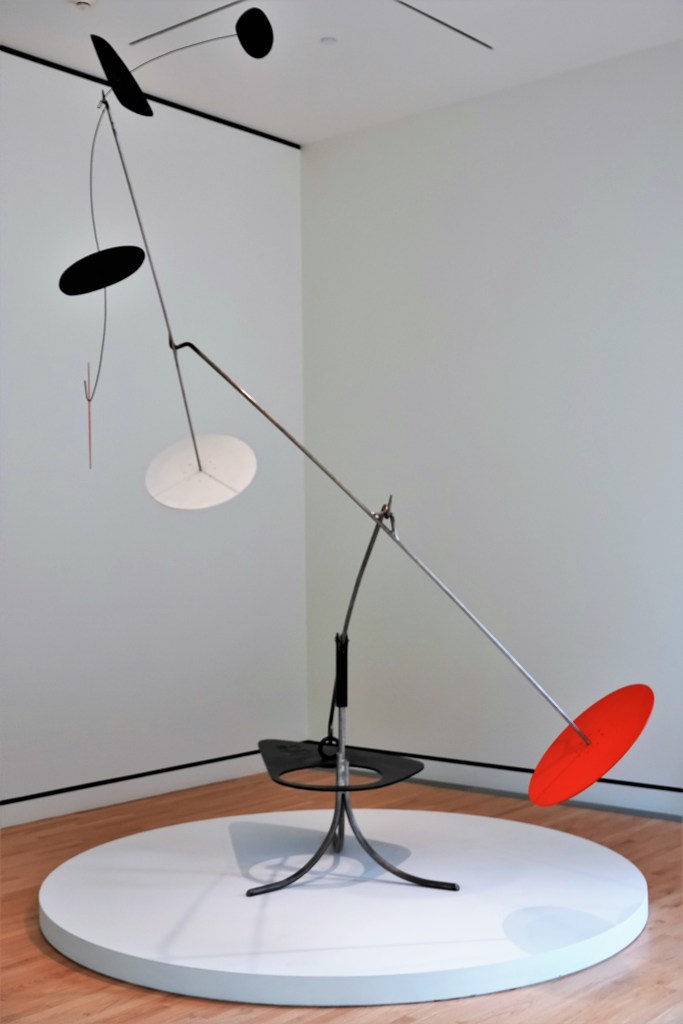
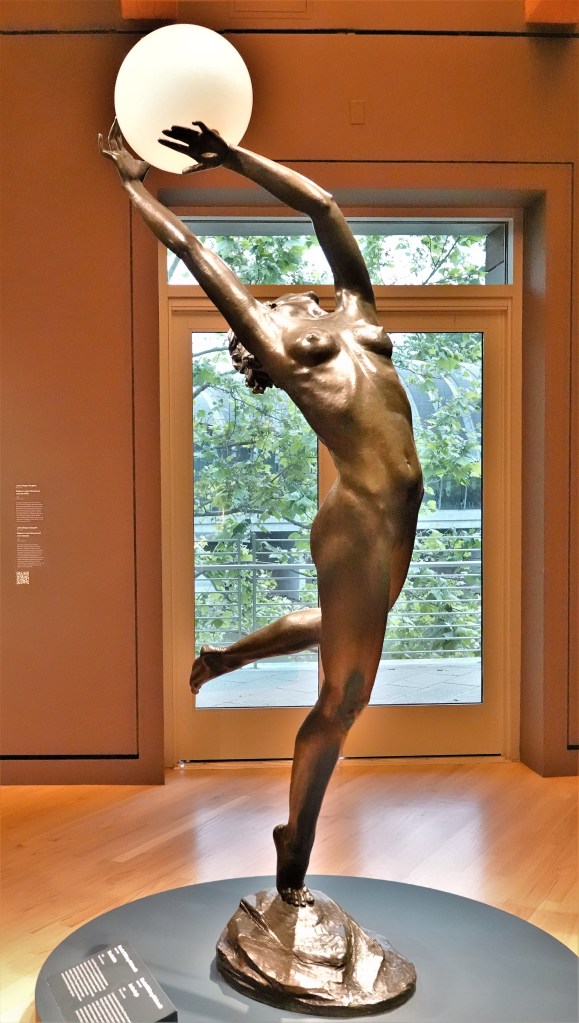
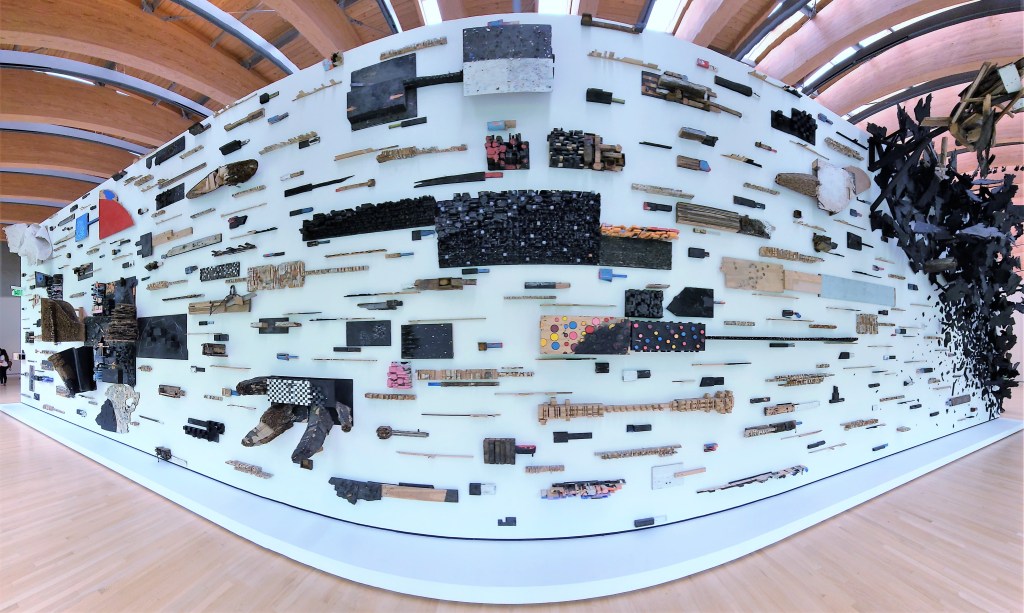
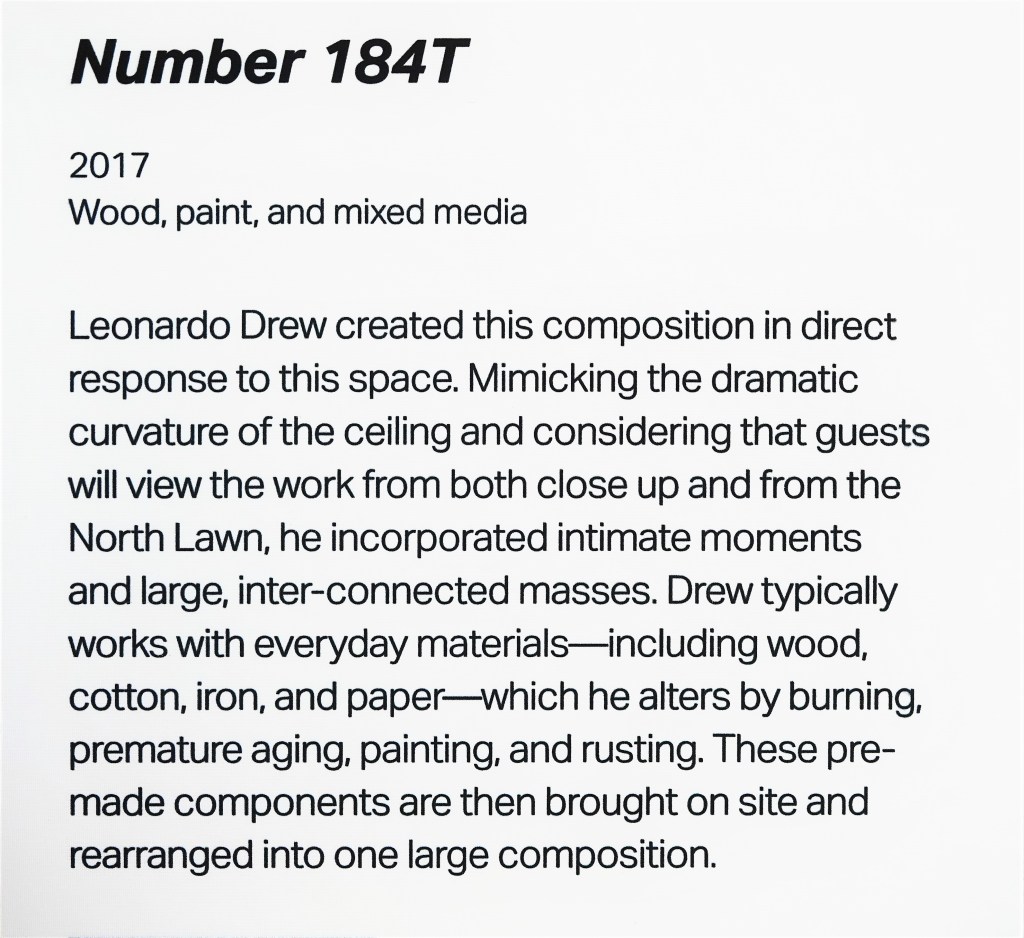
Wanting to see as much of the space as possible, we quickly steered through the exhibition halls looking and reflecting, before moving on to the next art moment. However, some of the art that caught my eye has been curated for this post (in no particular order).
As much as I enjoyed documenting the paintings, collages and sculptures within the museum, I found it impossible to ignore the fantastic geometry that surrounded us that was equally worthy of photographing, like the echo dome in the museum vestibule…
or the Fuller dome in the garden…
But the final shape I reserve for Lee and Deb for their Arkansas hospitality.
Humans have been taking baths for millennia. The practice of releasing toxins in hot springs dates back tens of thousands of years to the Neolithic Age, when nomadic tribes would soak in thermal waters they accidentally discovered when seeking relief from winter weather.
And there is archeological evidence from the 1900’s from Pakistan, where the earliest public bathhouses were discovered in the Indus River Valley around 2500 BC.
In, fact, every known culture around the world has demonstrated a special bathing ritual with roots in therapeutic cleansing of body, mind and soul.
No doubt, Native Americans enjoyed the 147o F waters that flowed from the lower western slope of Hot Springs Mountain in Arkansas. This area was first occupied by the Caddo, and later the Quapaw, who eventually ceded this territory to the U.S. government in an 1818 treaty.
70 years before the National Park Service was established by Teddy Roosevelt, Andrew Jackson declared Hot Springs the first federal reservation in 1832, intending to protect this natural resource.
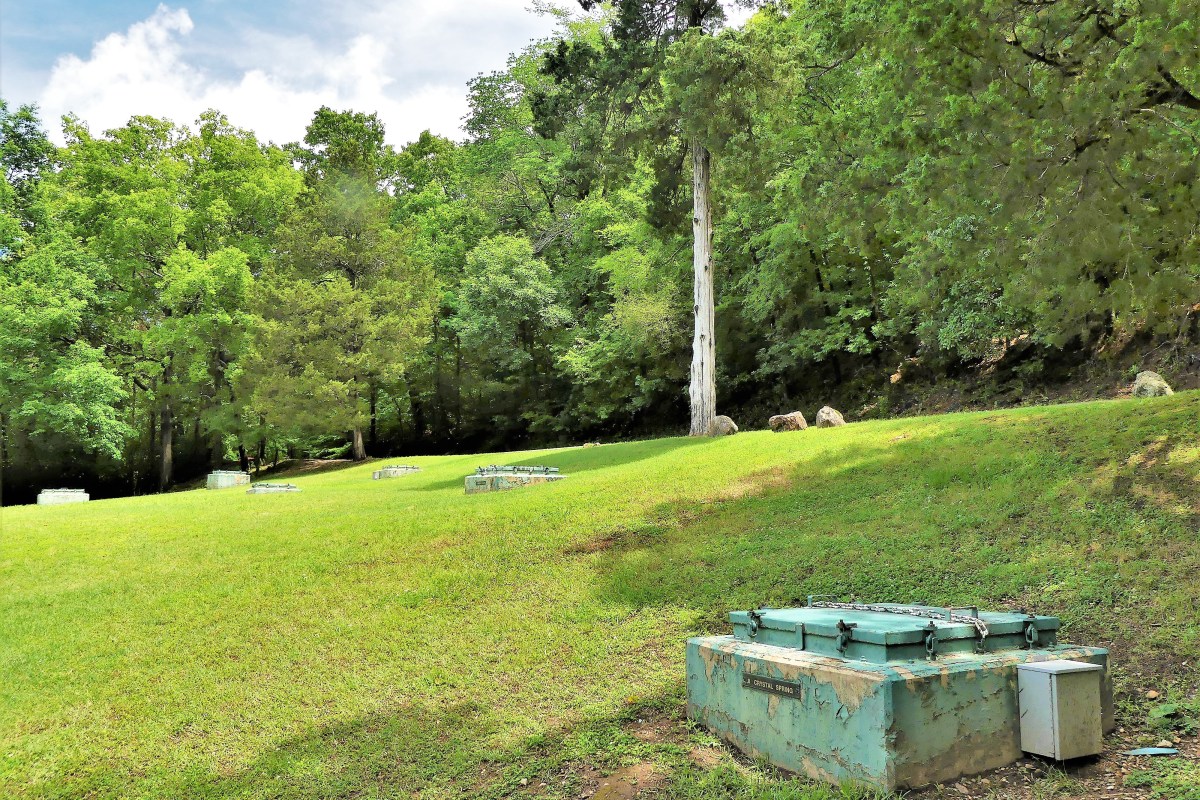
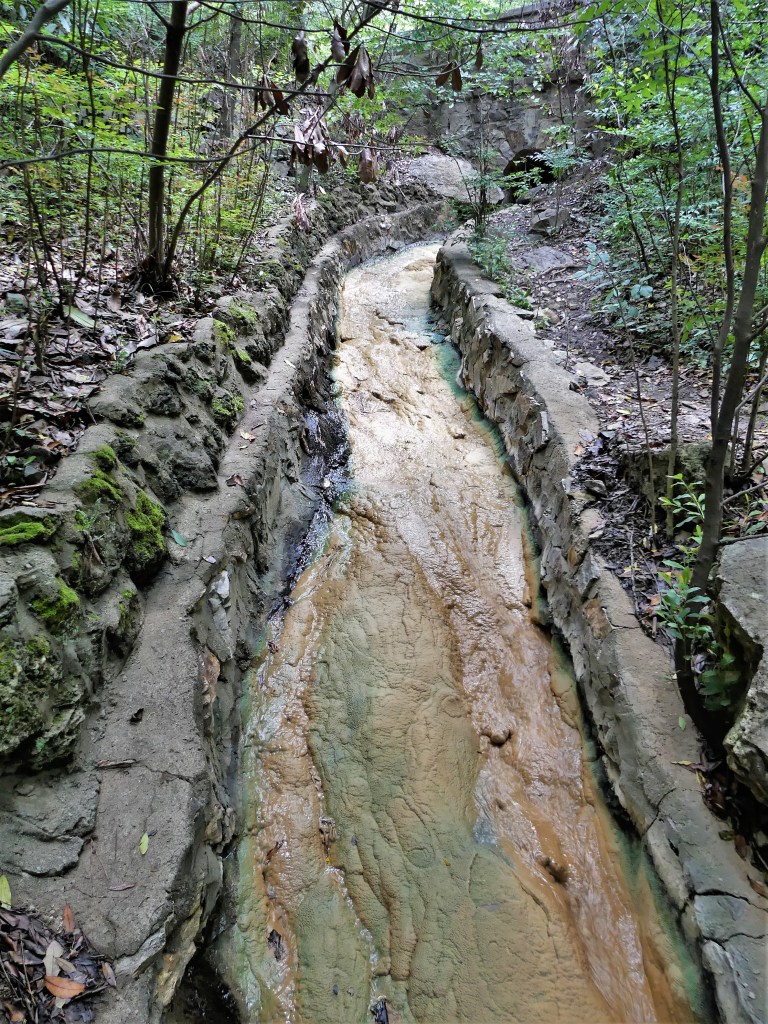
Scientists ran measurements and evaluated the springs’ mineral properties and flow rate. In journaling their finding, they numbered the springs and rated them according to temperature.
Immediately after, bathhouses began springing up around town to indulge the many guests who would travel to Hot Springs to avail themselves of the water’s restorative powers.
But trouble was brewing closer to the mountain. Ral City emerged as a community of indigents who had no use for fancy bathhouses, and subsequently dug pools beside the springs so they might enjoy the thermal water.
But not before the government put a stop to that and instituted policy that “preserved” and regulated the springs. Fearing contamination, the reservation superintendent ordered the pools filled in, and the transients relocated to a distant spring to appease the bathhouse owners in town.
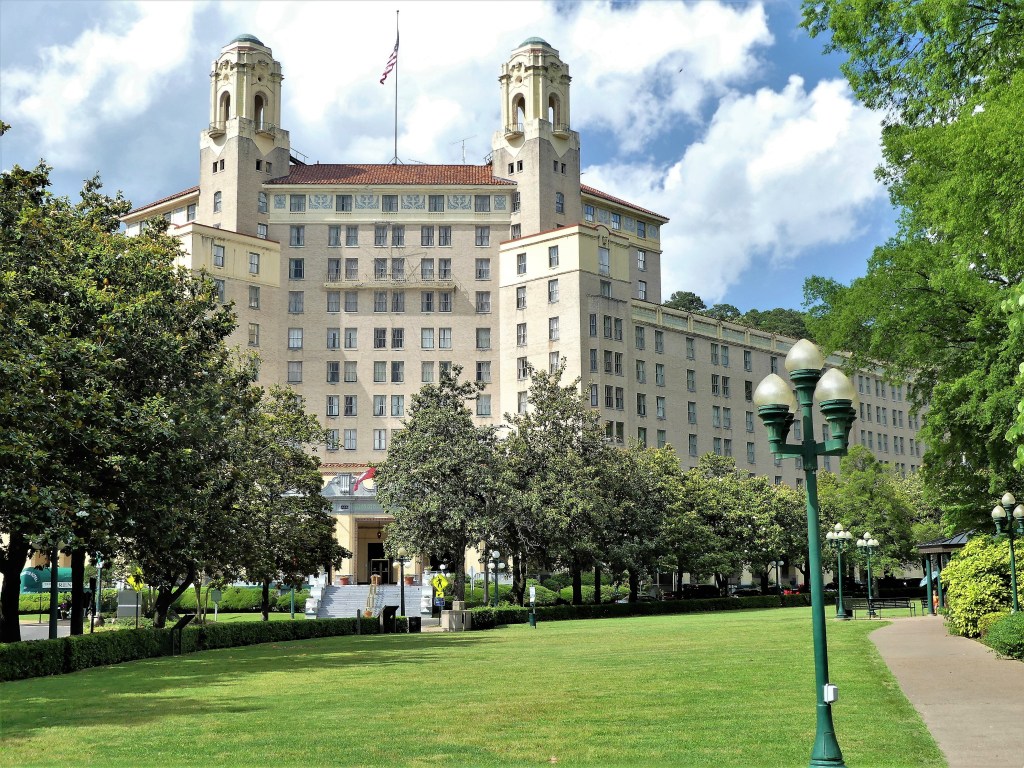
Enterprising businessmen like railroad magnate, Samuel Fordyce saw potential in Hot Springs, and invested heavily in the town’s infrastructure. He financed construction of the Arlington Hotel in 1875–the first luxury hotel in the area…
and vacation residence to every known celebrity, movie star and gangster of the era.
Fordyce also imagined an international spa resort that could rival Europe’s finest, and opened the opulent Fordyce Bathhouse in 1915.
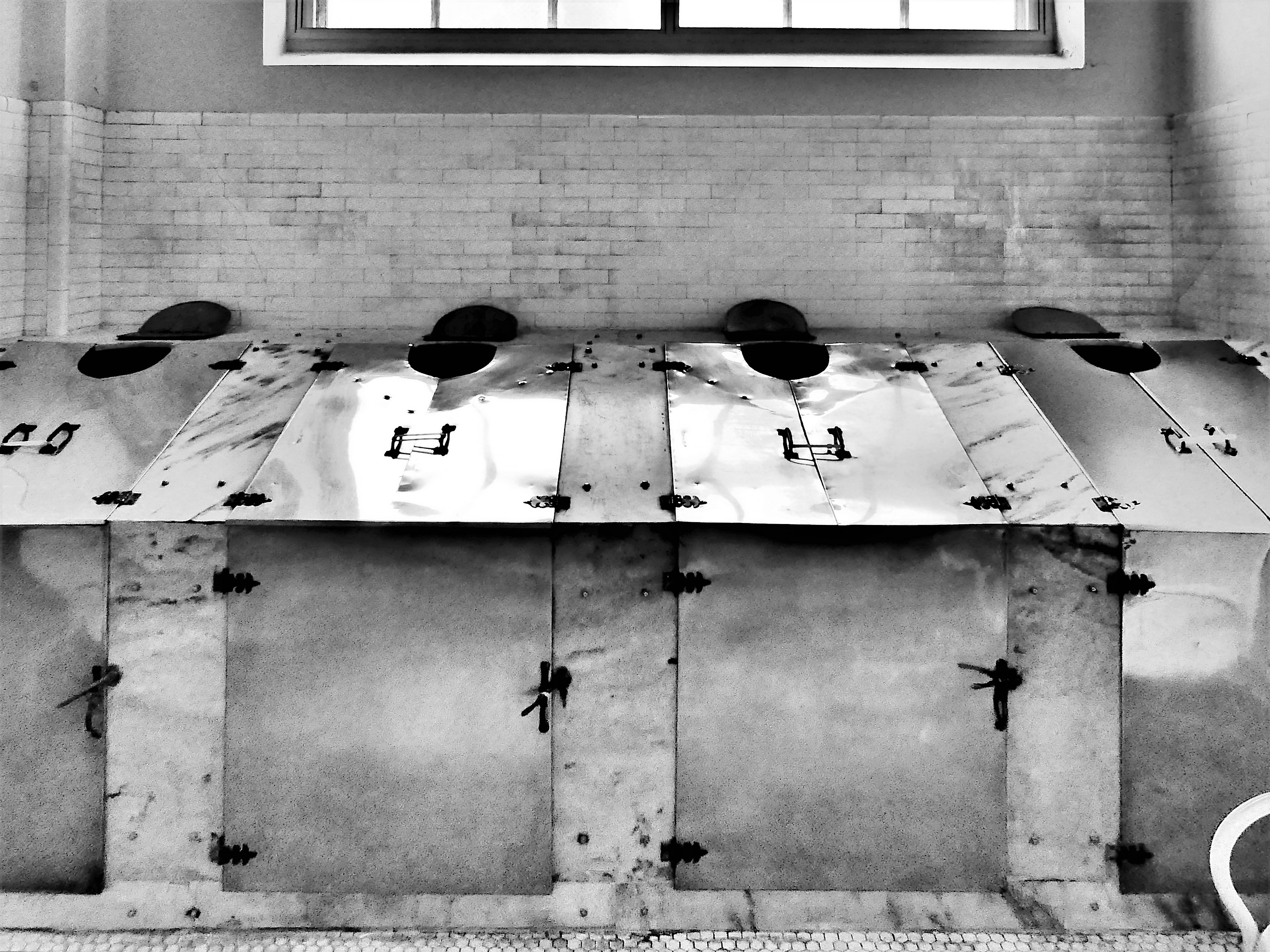
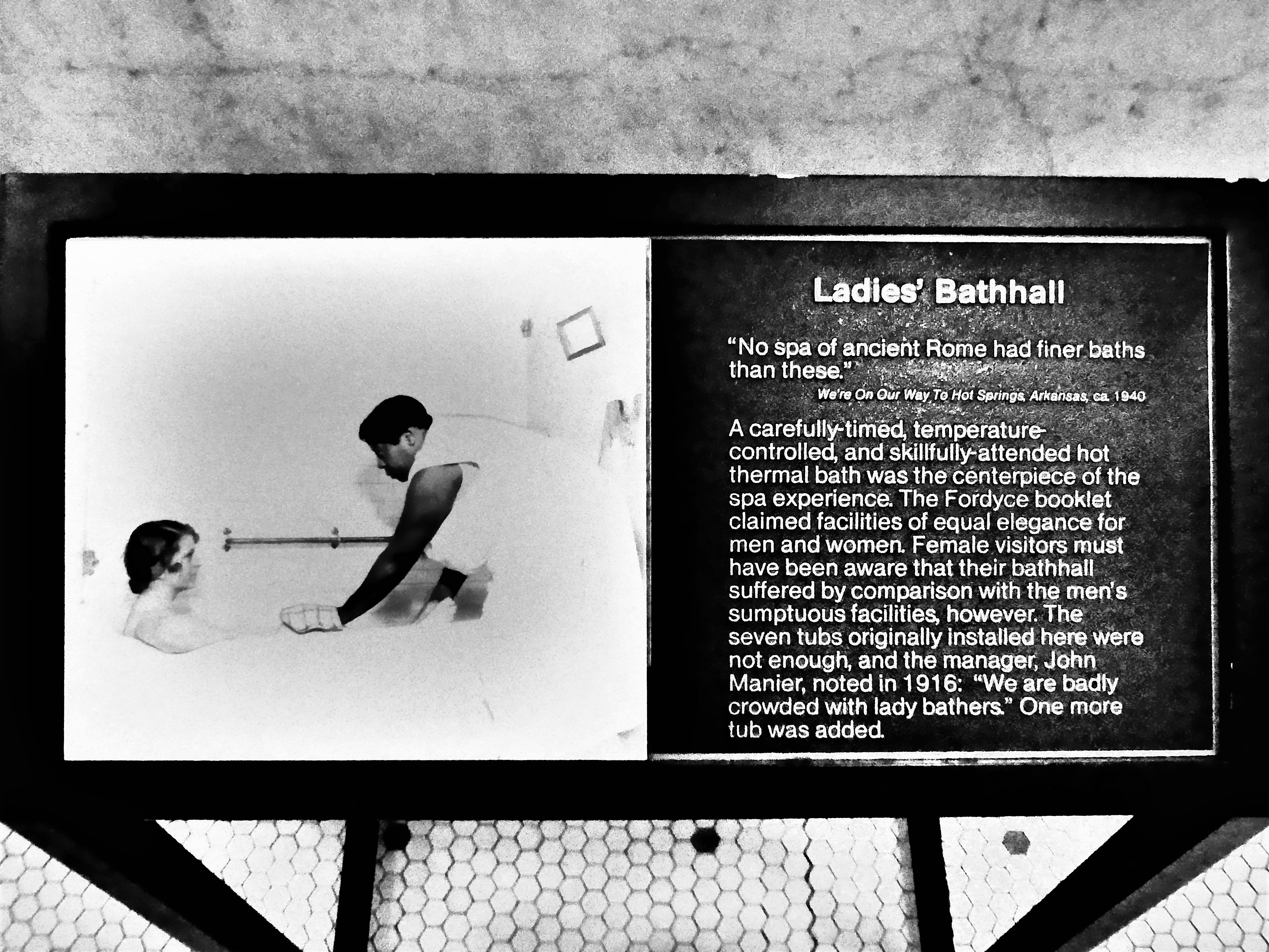
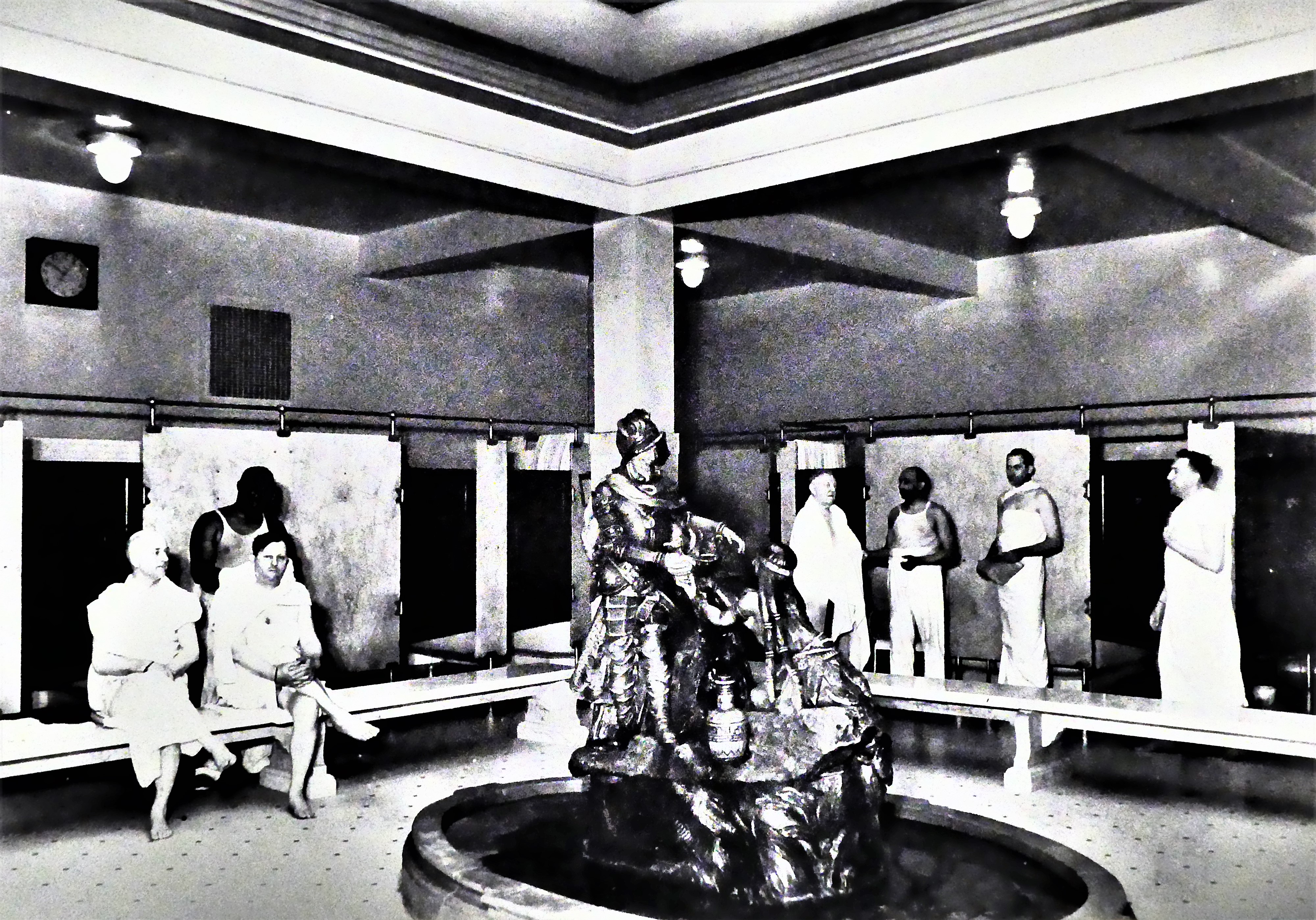
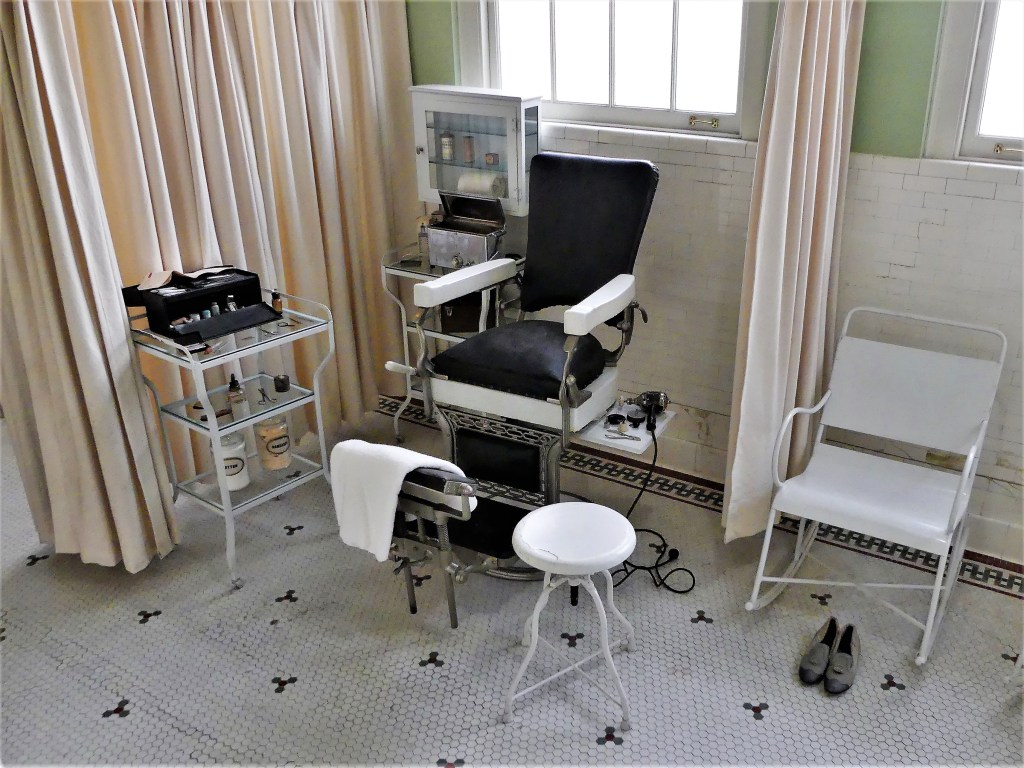
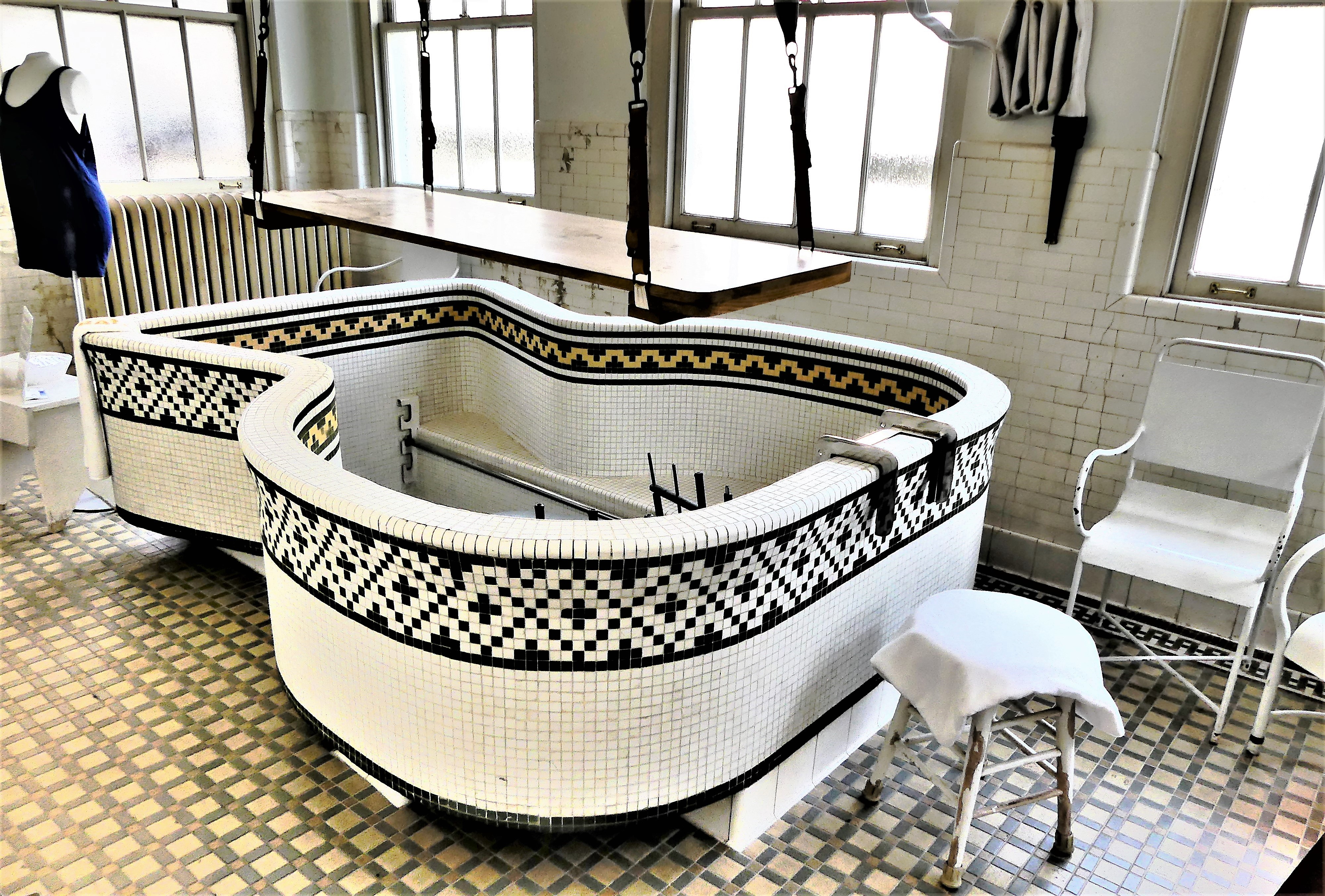
The National Park Visitor Center now occupies this bathhouse–which has been painstakingly restored to reflect the gilded age of health spas, and how turn-of the-century America tapped into Hot Springs’ healing waters to bathe in luxury and style.
There were many different ways to indulge in water treatments…
But a menu of ancillary services was also available, such as: massage, chiropody, facials, manicure/pedicure, and exercise, etc…
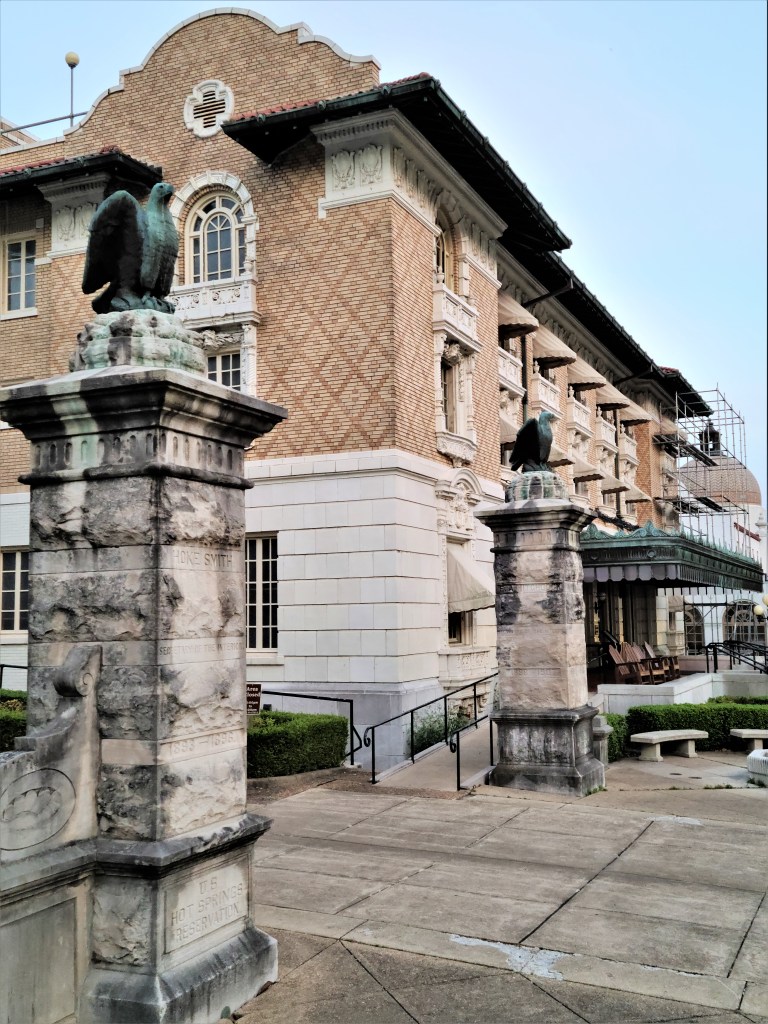
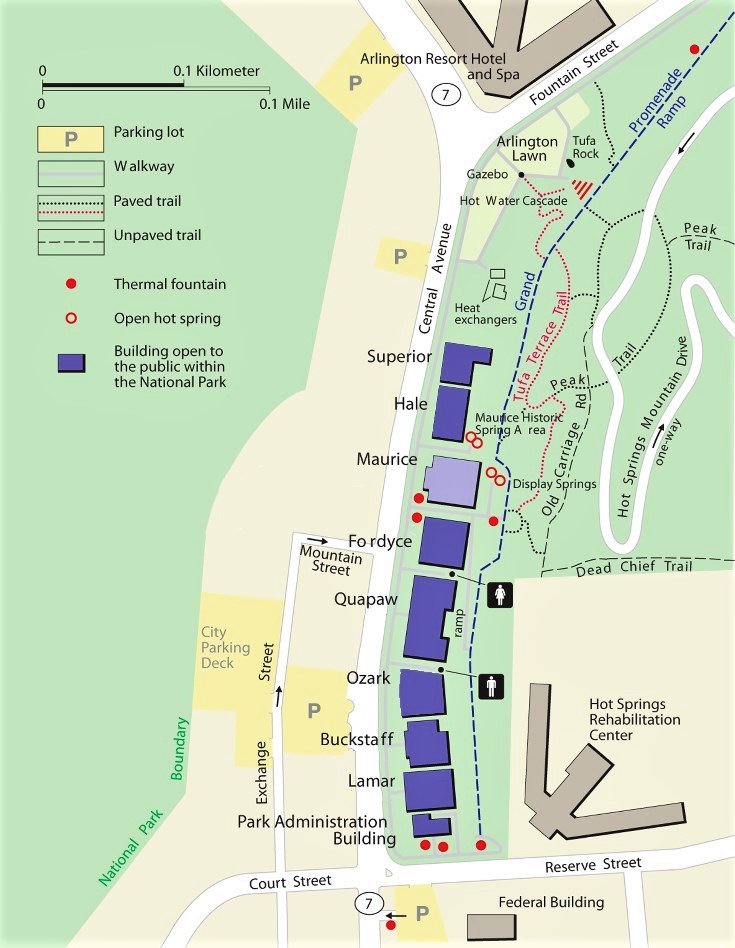
Bathhouse Row quickly filled with competition along Central Avenue,
each one designed with classic architectural details.
and anchored by Hot Springs Rehabilitation Center on the south end of the street.
Formally known as the Army-Navy Hospital, it was the site of the nation’s first general hospital for Army and Navy patients built after the Civil War–treating the sick and wounded through World War II. Subsequently, it became a residential resource center for training young adults with disabilities, but state of Arkansas shuttered the facility in 2019, and the building is now derelict and fallen into disrepair. Currently, it stands as the world’s largest raccoon hotel.
We visited Hot Springs during Memorial Day weekend, and the sidewalks were teeming with families and couples who were happy to return to the land of the living after a year of coronavirus hibernation. Businesses were enjoying record crowds, and the bath houses had finally reopened to the public.
Unfortunately, Leah and I were too late to the party; there were no spa reservations to be had. Water, water everywhere, and not a drop to drink.
So we took a hike up the mountain, spotted a turtle in the middle of the trail,
and continued to the Mountain Tower,
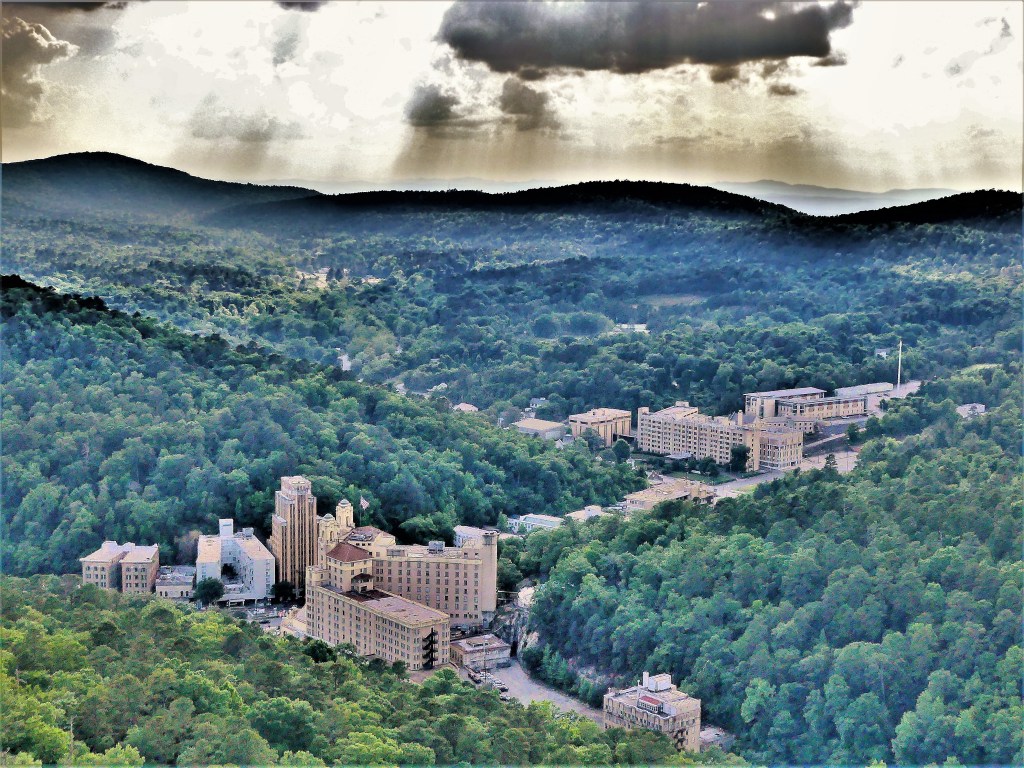
offering majestic, mouth-watering views of hidden springs beneath us, while we massaged each others’ neck and shoulders.
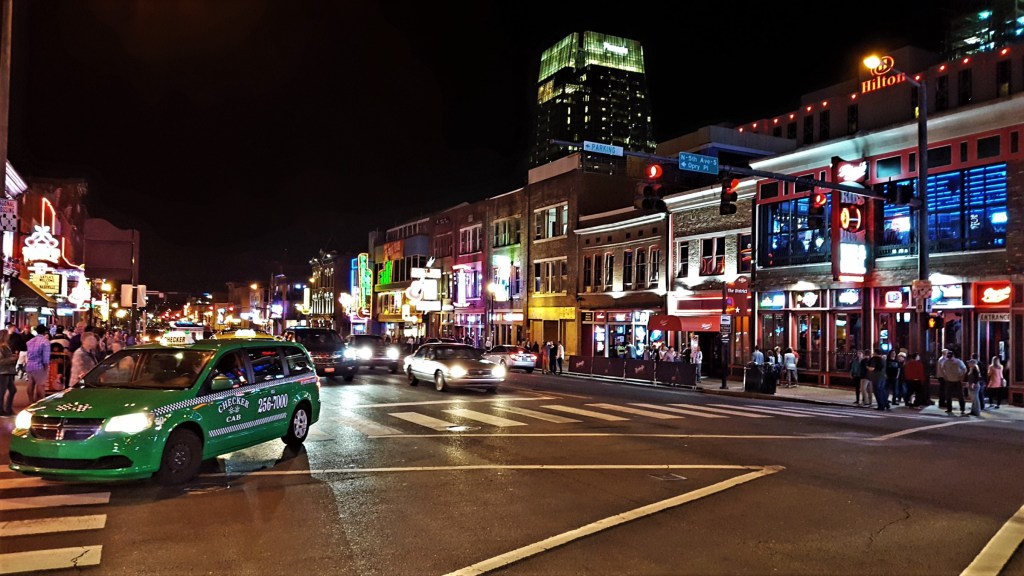
Nashville seldom disappoints, given the music, the Broadway scene, and the local history and flavor that makes Nashville such a go-to destination for letting loose.
But here we were in Nashville again for a third visit in as many years, and again, there were no concert bookings at Grand Ole Opry during our stay, just as before.
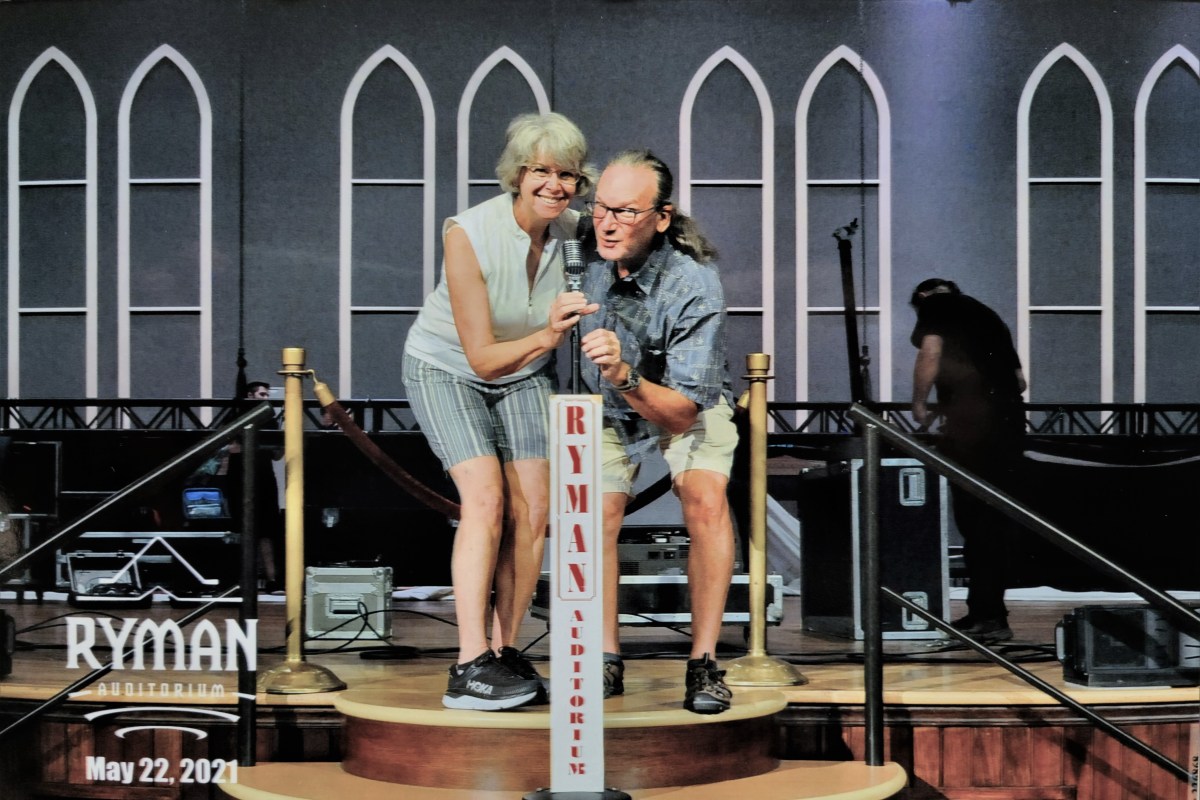
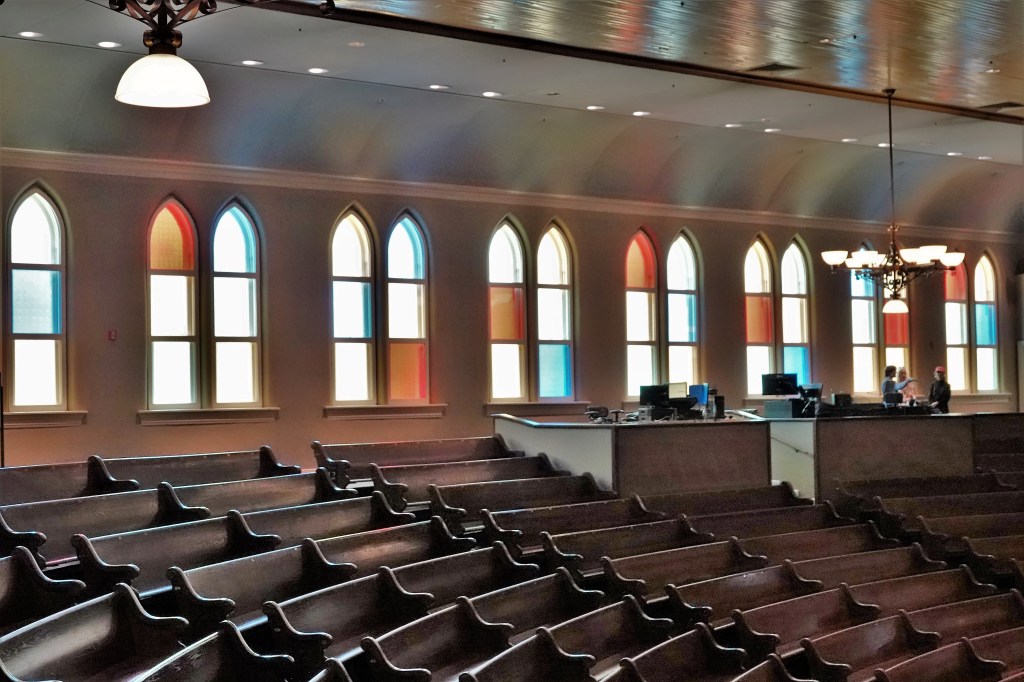
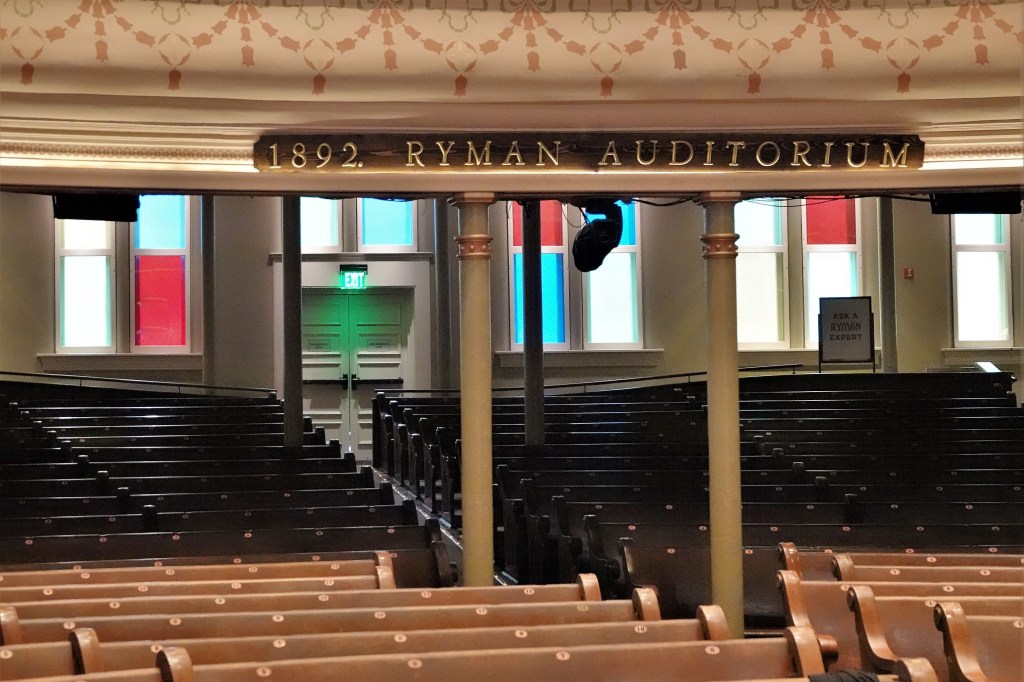
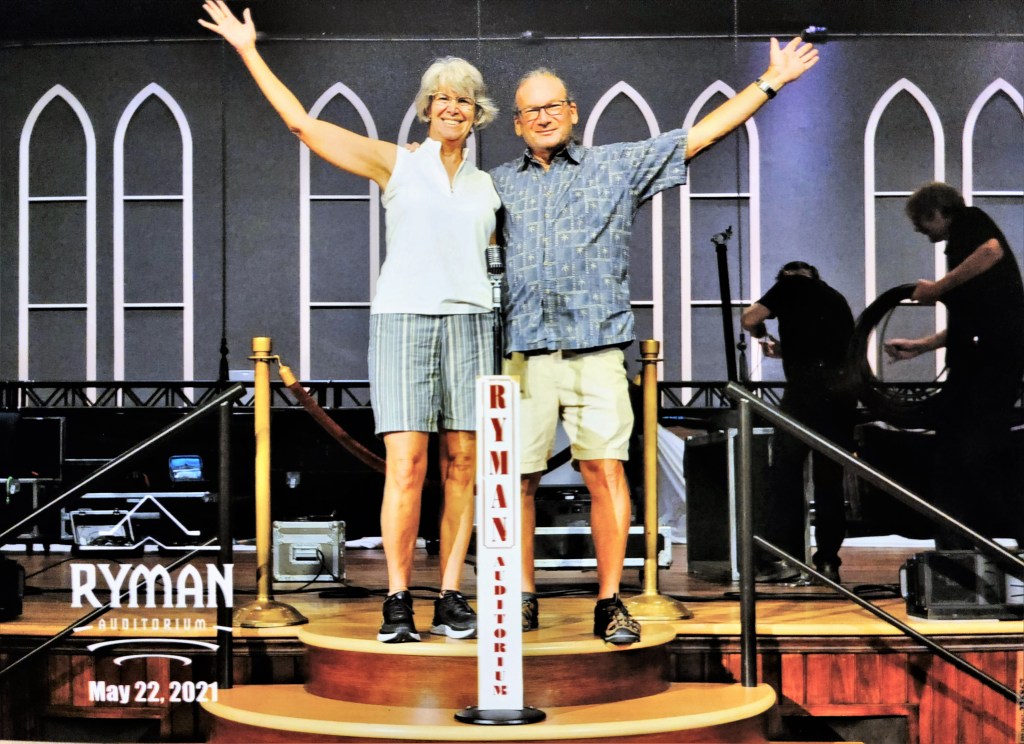
Perhaps, we should make our own music, although we would eventually take the stage at Ryman Auditorium like so many others,
by first taking a self-guided tour of the hallowed hall before having our picture snapped by the gift shop photographer.
Very little has changed since Ryman Auditorium opened…
Ryman then
Ryman today
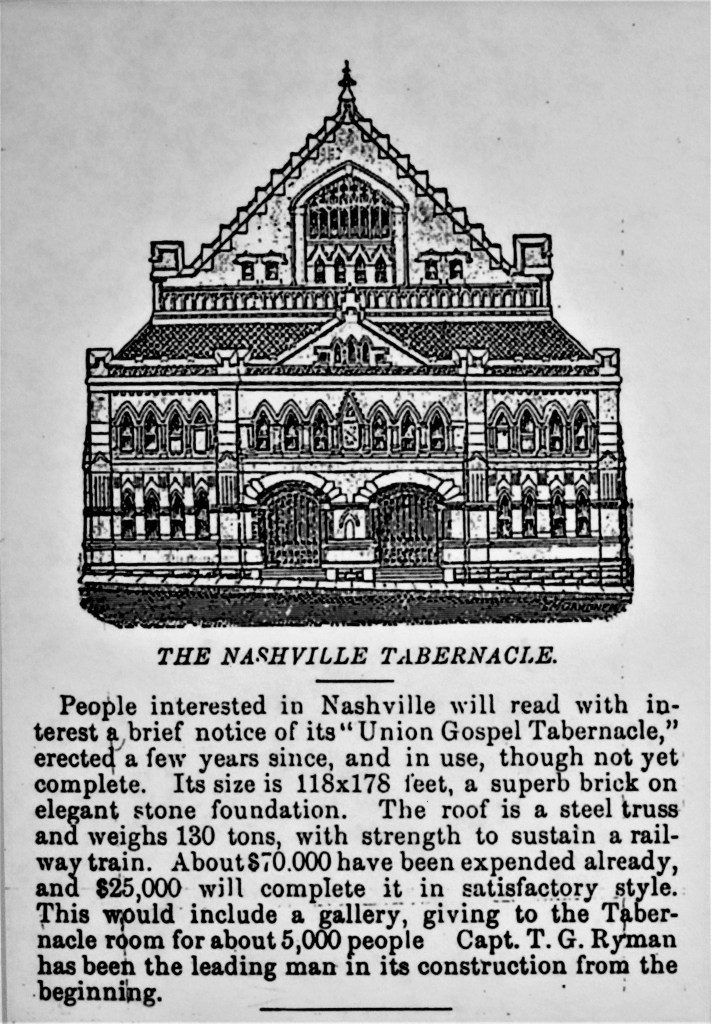
as the Union Gospel Tabernacle in 1892. Originally built as a house of worship…
by Thomas Ryman, who made his fortune from a bevy of saloons and a fleet of riverboats,
Ryman found God at a big-top revival, and vowed to build a tabernacle, allowing Nashville folks to attend large-scale revivals indoors.
The balcony opened in 1897, raising capacity to 6,000 worshippers.
Ryman died in 1904, and was celebrated inside his tabernacle. It was at his memorial service that Samuel Porter Jones, the preacher responsible for Ryman’s conversion, proposed the name change to Ryman Auditorium.
While Ryman Auditorium continued as a religious venue, it also opened its doors to popular culture and performing arts as a means of paying the bills, often hosting concerts, speaking engagements, dance recitals and theater, and earning its reputation as the “Carnegie Hall of the South.”
The Grand Ole Opry took up residency in 1943, and sold out its weekly shows for the next 31 years, becoming “The Mother Church of Country Music.”
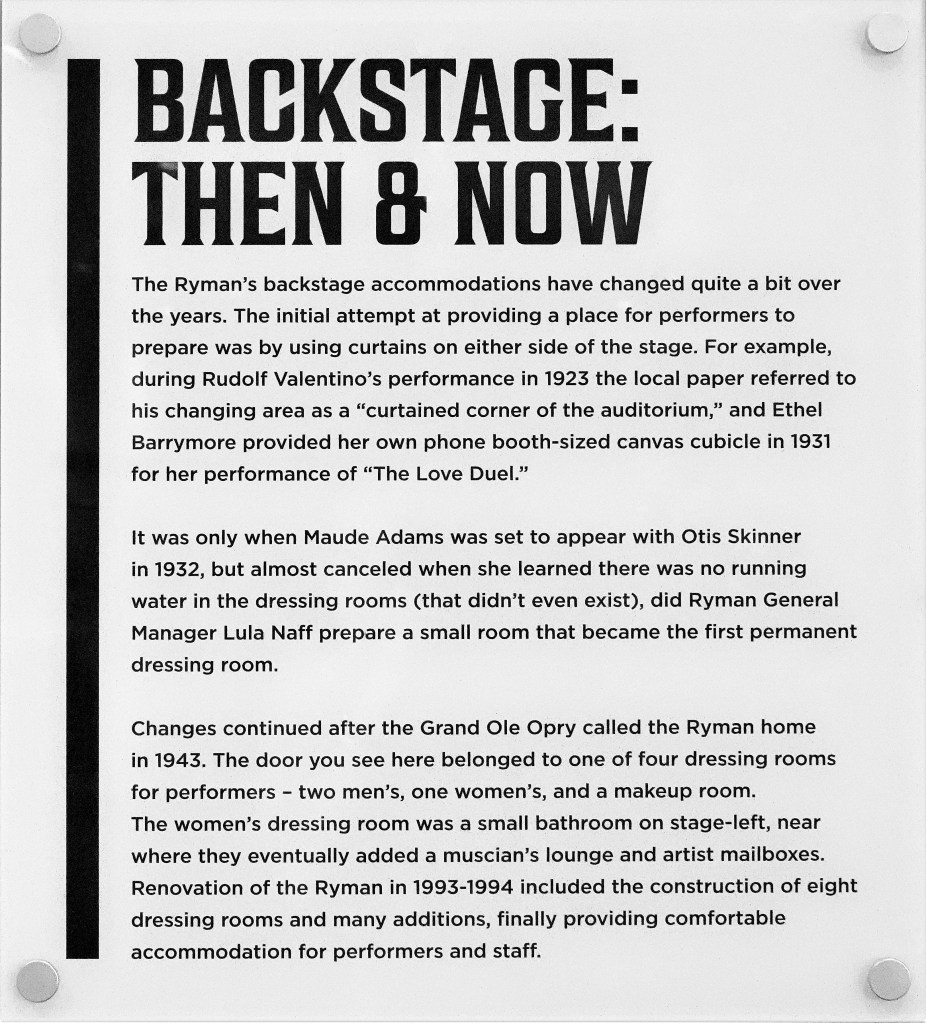
Country music acts performed in front of capacity crowds and reached audiences around the world through radio and television broadcasts, earning them large followings and superstardom. Artists were eager to appear despite the primitive accommodations.
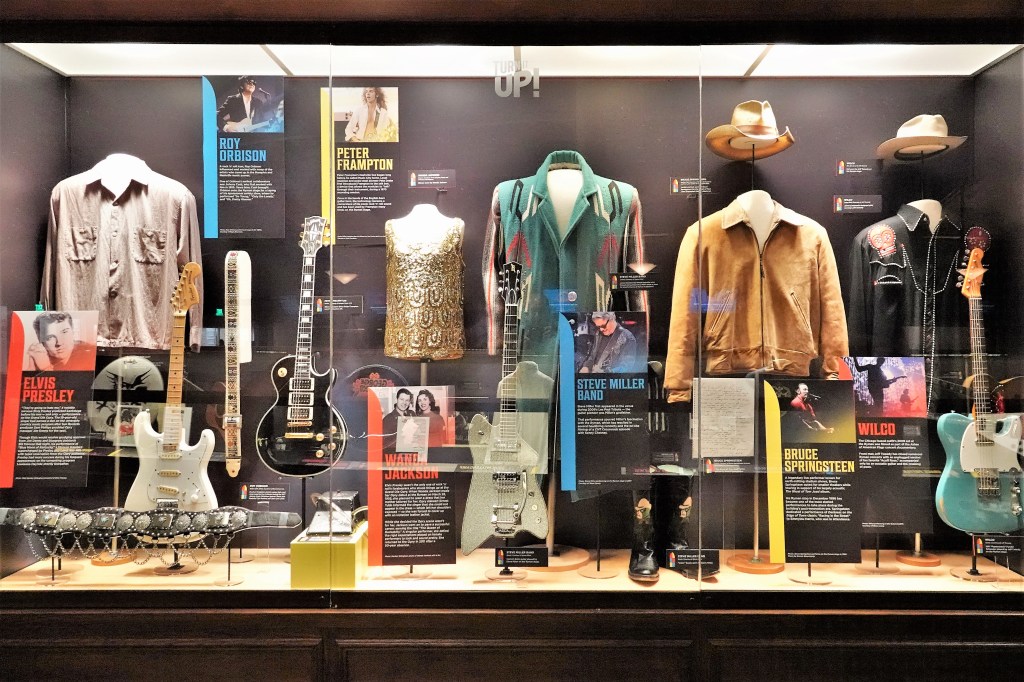
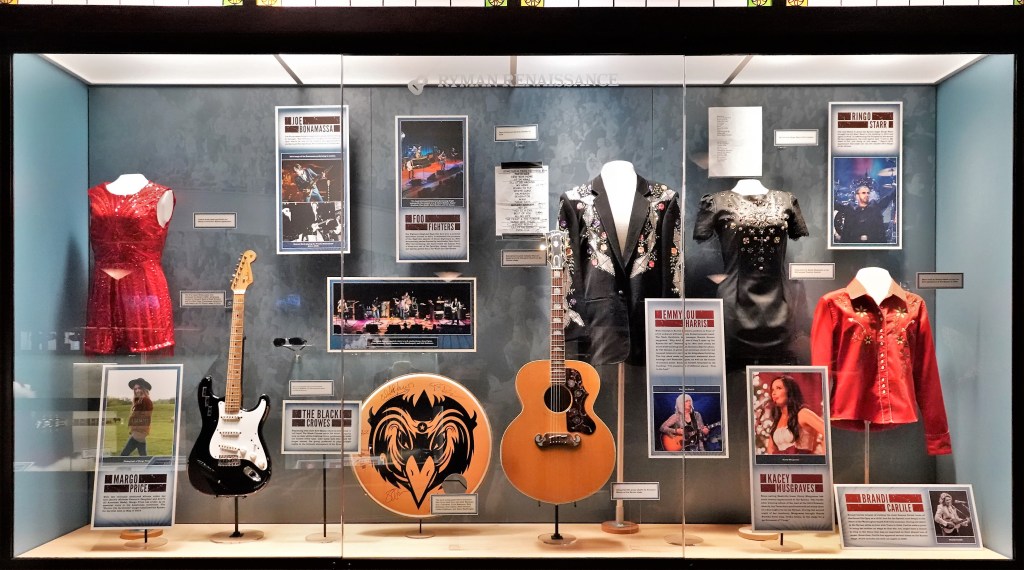
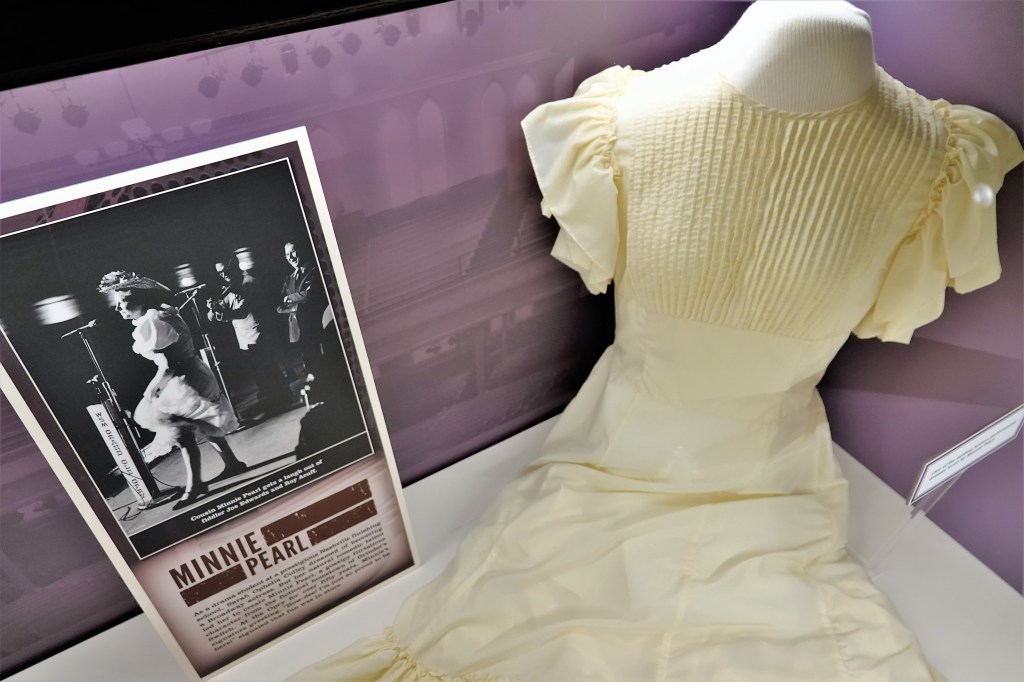
Leah and I took our sweet time as we perused the exhibits note by note, and studied the memorabilia from entertainment royalty…
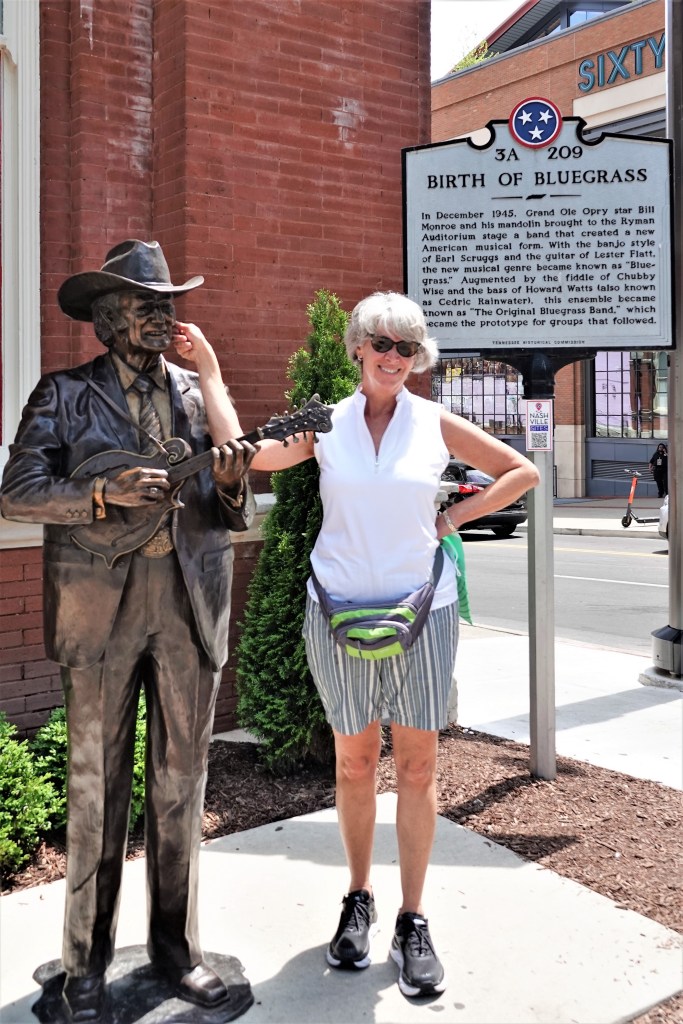
In 1974 the Grand Ole Opry shuttered its downtown location in favor of a larger, modern venue within a theme park setting, dooming Ryman Auditorium to the wrecking ball. But the historical importance of Ryman, known as the birthplace of bluegrass (and so much more) could not go unnoticed, until the preservationists prevailed, and Ryman was saved from demolition.
After a dormant period of 20 years and new ownership, the exterior was eventually rehabbed and the building’s interior was refurbished and modernized for artists and patrons, restoring it as a world-class concert hall that past and present music legends agree has some of the best acoustics in the world, only adding to Ryman’s mystique and continuing renaissance.
As for Leah and me, all that was left for us to do was smile for the camera and take our final curtain call…
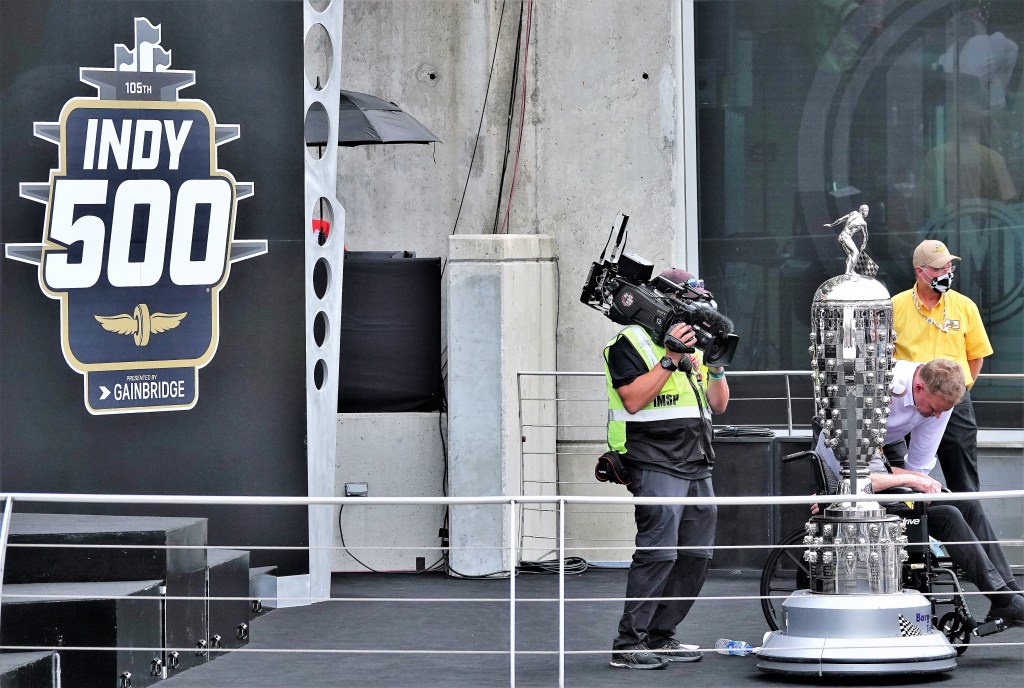
Motor sports awaits its biggest day on May 30, when 135,000 spectators will gather at the Brickyard for the start of the 105th running of the Indy 500. It will be the largest assembly of people anywhere for a single event since the coronavirus pandemic overwhelmed the country and the world.
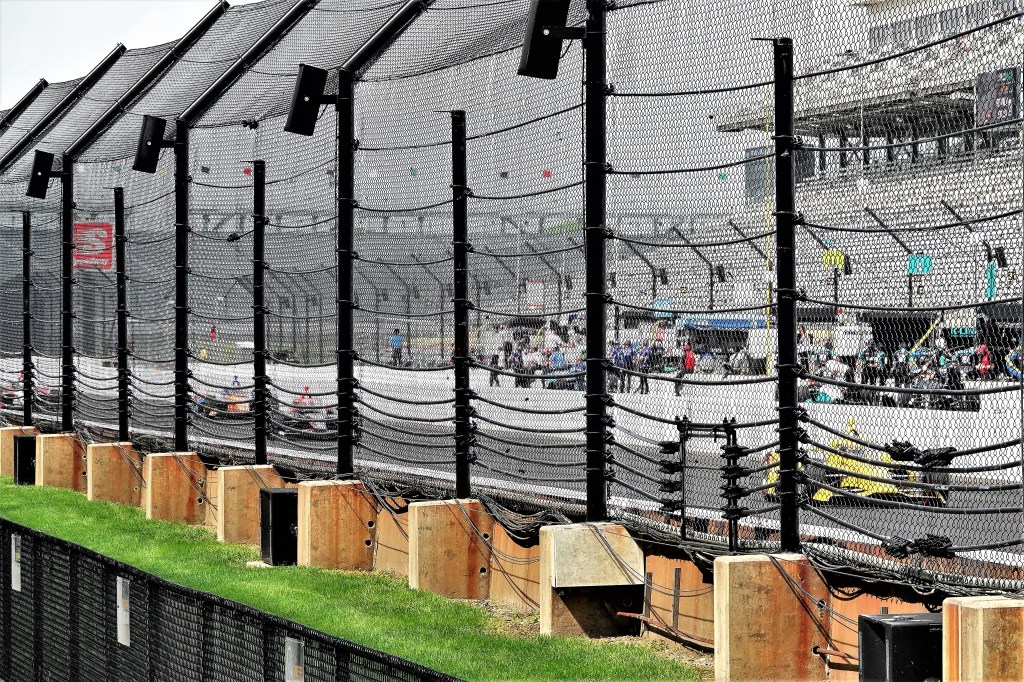
Last year, the race was held without fans, but this year the Indianapolis Motor Speedway will accommodate 135,000 of 257,325 available seats, or 40% capacity. The number is staggering until the onlooker realizes that the curved rectangle is 2.5 miles long and occupies 559 acres,
with tiered grandstands reaching 7 stories on both sides of the track.
Having checked in at the Indiana State Fairgrounds for overnight accomodations,
we couldn’t help but notice the overwhelming noise coming from the nearby critter pavilions…
so off we went to follow the commotion, and found the source. Apparently, it was a tire spin-off to Mecum’s 2021 Indy Auction:
The Dodge Challenge
…an annual event that brings out the best and most coveted collector cars for bidding:
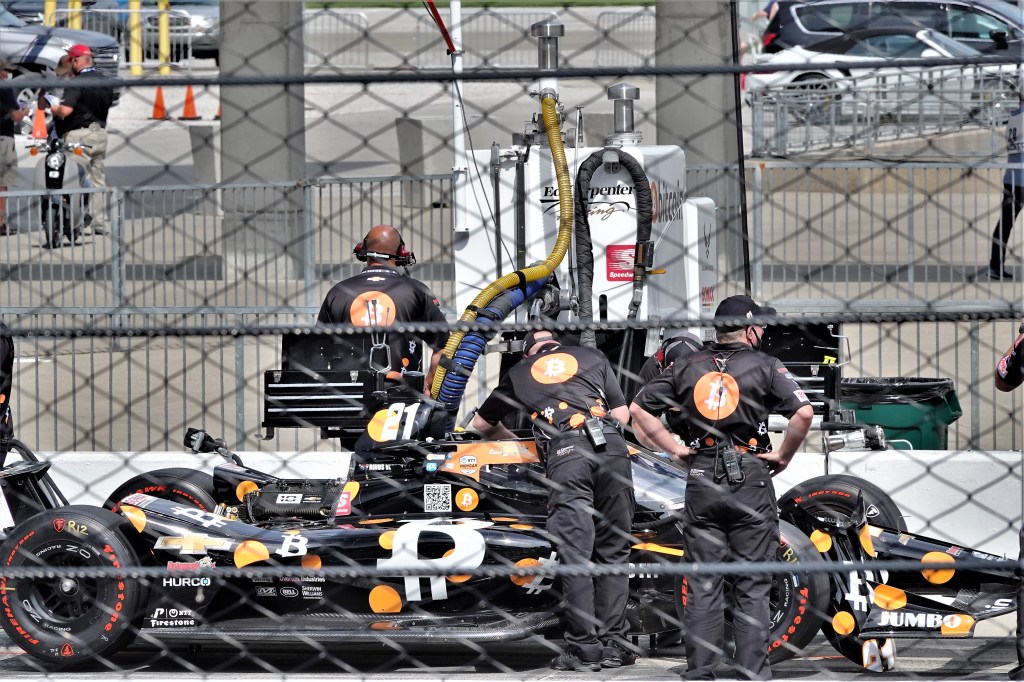
But Leah and I were in Indianapolis during the Indy 500 Practice to watch drivers rocket down the straightaways in their IndyCars at 240 mph,
in anticipation of bringing home the trophy and chugging a bottle of milk.
So off we went to the fabled racetrack, built in 1909 and mostly unchanged, until the addition of the Pagoda, completed in 2000.
Trying to track the cars as they went screaming by in a blur…
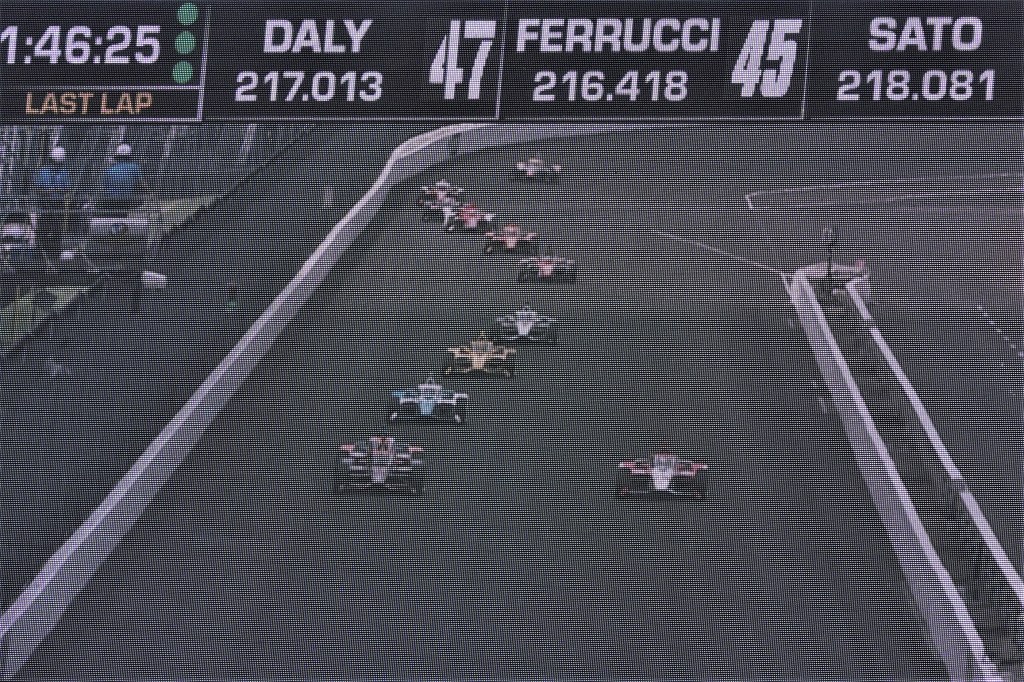
would have certainly resulted in whiplash if we continued watching with each passing lap, but thankfully, the video screen provided necessary neck relief.
And then the unexpected happened…
With 1hr 44min left in the practice session, #45 Santino Ferrucci turning too early into the #2 corner careened into the wall,
and it was time for us to call it a day at the track.
Fortunately, Ferrucci escaped serious injury, and was taken to the hospital for observation.
He has subsequently been cleared to race on Sunday, qualifying for the 25th position in a field of 33 cars, with Scott Dixon enjoying the pole position at the start of the race.
I hope the winner likes milk!
UPDATE:
Helio Castroneves wins the Indy 500 for a record-tying 4th time, finishing ahead of Alex Palou by half a second.
Top qualifier, Scott Dixon finished 17th in the field after his car ran out of gas before his first pit stop, and Santino Ferrucci finished sixth.
Castroneves celebrated with a chilled bottle of 2% milk, but swapped that bottle out for some strawberry milk, which perfectly matched his hot pink and white fire suit and No. 6 Honda.
Eastern State Penitentiary (ESP), designated a National Historic Landmark in 1965, returns to life each day as a Philadelphia museum that’s open to the public year-round.
Completed in 1836, the imposing, neo-Gothic-styled architecture by John Haviland was intended to strike fear in all who might consider committing a crime. At the time, it was the most expensive public construction project ever built in the country. Famous inmates included Al Capone and Willie Sutton.
Decommissioned in 1971, ESP now lays in ruin, but awaits all who are fascinated by its unique radial design, towering castle walls and folklore.
Photographer, Tiffani Burchett Nieusma first visited ESP in 2016 and was awed by the unexpected beauty of the decay. Her recorded images eventually paved the way for a future gallery show during September, 2021 with a companion monograph of her work to be published on the subject.
Tiffani is currently seeking written word submissions to complement her photography for exhibition and publication. The deadline is May 31, 2021.
Leah and I are on the road again, continuing our Great American Road Trip–part 4, with some significant changes and improvements.
Last year, during the summer of Trumpandemic, we took an abbreviated trip to upstate New York in search of open outdoor vistas with blue skies and limited exposure to crowds, which we found at Letchworth State Park.
Soon after, we rounded the top of New England to enjoy a requisite Maine lobster dinner…
to dip a toe in the Atlantic on Hampton Beach…
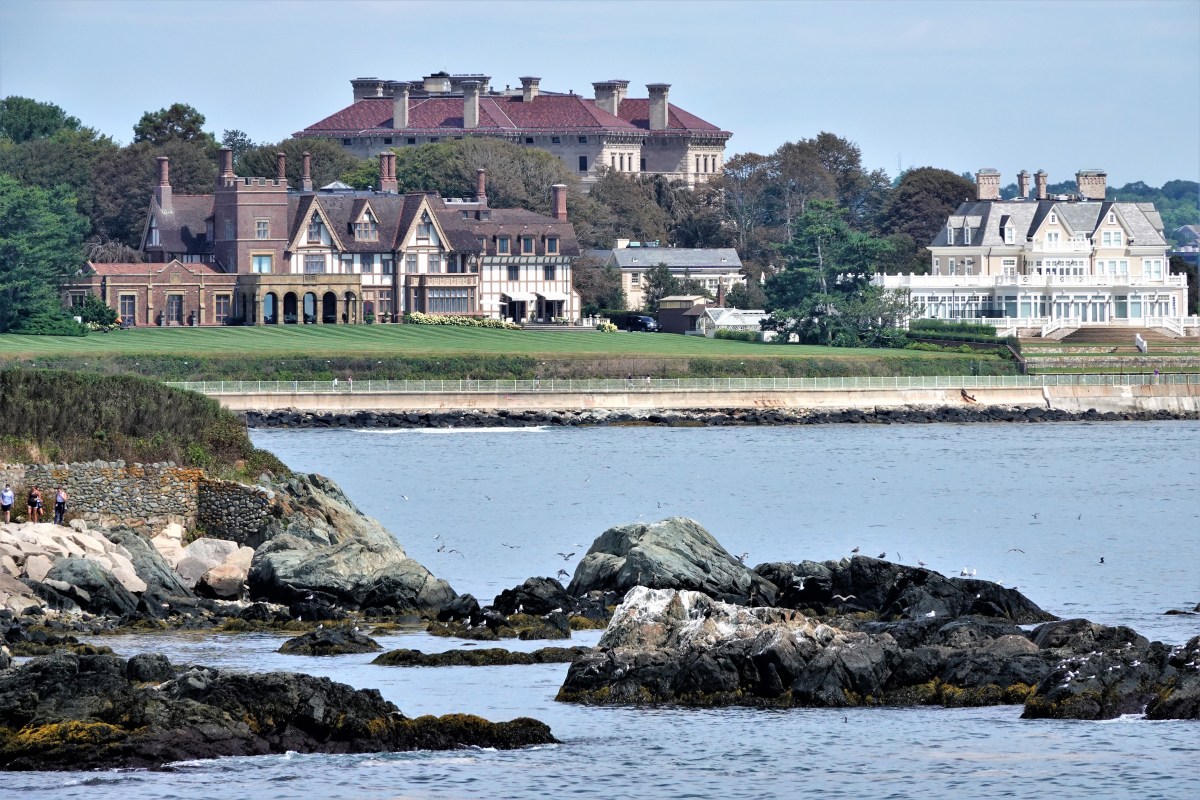
and to gawk at the wealthy from Newport’s Cliff Walk.
We hugged the coastline until we reached Chincoteague, Virginia…
in search of precious ponies…
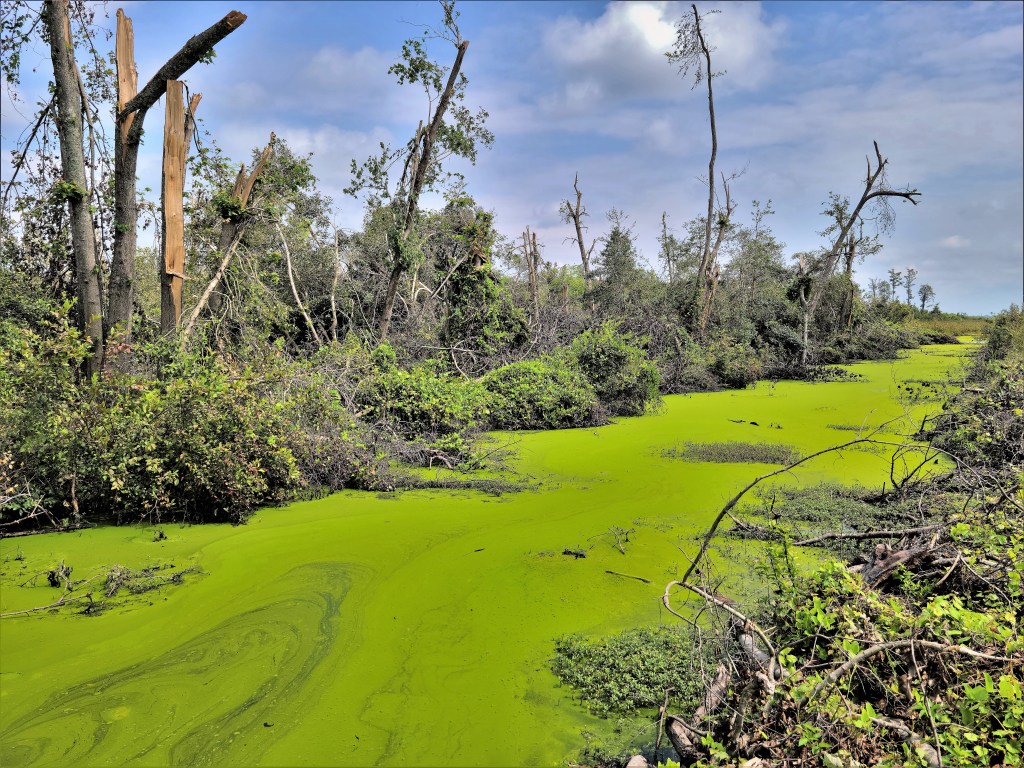
and to listen to the silence at the Great Dismal Swamp in Suffolk, VA.
The trip was short (only 5 weeks and far from our ambitious itineraries of past years) yet refreshing, and daring (for all the anticipated COVID closures) yet unremarkable with one notable exception…I wrecked the Airstream in Tarboro, North Carolina.
Halfway to Tignall, Georgia (our final destination) and needing a lunch break and a leg stretch, we stopped at a charming town boasting a historic district of 18th century and antebellum landmark homes recognized by the National Park Service. I parked the Airstream inches from the curb on a narrow residential road across from Blount-Bridgers House, an 1808 Federal-style mansion-cum-museum,
and returned an hour later to continue our journey.
I casually pulled out, unaware that a protruding power pole ID tag had snagged the rear awning support and ripped all the cleats out from the aluminum skin, taking down the entire awning assembly and crushing the end caps to the tune of $17,000.
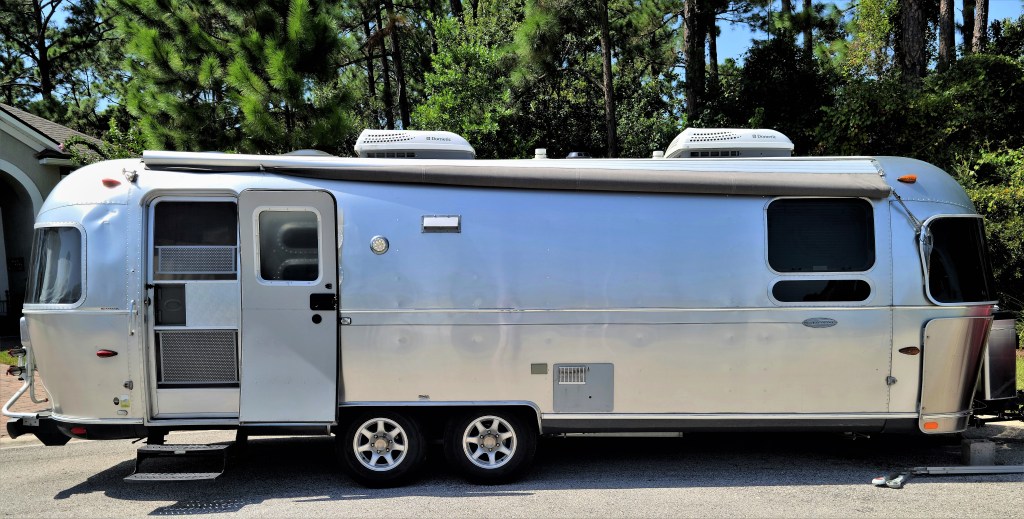
Thankfully, our insurance completely covered the damage. As we drove our beloved, but bandaged 27FB Flying Cloud to the Tampa Airstream dealer for repair, we considered the possibility of an upgrade should one be available. As luck would have it, a Florida family was trading a 2018 Globetrotter 27FB at the time, pending delivery of their new Airstream by February 2021.
We felt as if we had won the lottery. A deposit was offered on the spot, considering a total lack of previously owned inventory throughout the country.
The deal was sealed in April, when Leah and I picked up our reconditioned summer rig and took it for a dry run in Ruskin, FL in preparation for our summer adventure. We enjoyed the whisper-quiet, ducted AC; the ease of deploying the power stabilizer jacks; the convenience of rolling out the power awning; and the notion that our roof-mounted solar panels could provide us with increased boondocking possibilities.
Join us on the road as we explore 44 destinations (mostly new, sprinkled with some favorites) for the next 20 weeks:
May 1: Lake Powhatan/ Asheville, NC
May 4: Natural Bridge, VA
May 7: Vineland, NJ/ Northern NJ
May 12: Philadelphia, PA
May 15: Pittsburgh, PA
May 18: Jackson Center Airstream Factory/ Dayton, OH
May 19: Indianapolis, IN
May 21: Nashville, TN
May 24: Memphis, TN
May 27: Hot Springs/Little Rock AR
May 29: Eureka Springs, AR
June 1: Oklahoma City, OK
June 4: Amarillo, TX
June 6: Albuquerque, NM
June 10: Taos, NM
.June 13: Great Sand Dunes NP, CO
June 16: Rocky Mountain NP, CO
June 20: Cheyenne, WY
June 22: Flaming Gorge, UT
.June 25: Bear Lake State Park, UT
June 28: Craters of the Moon NP, ID
July 1: Morley Nelson Snake River Birds of Prey, UT
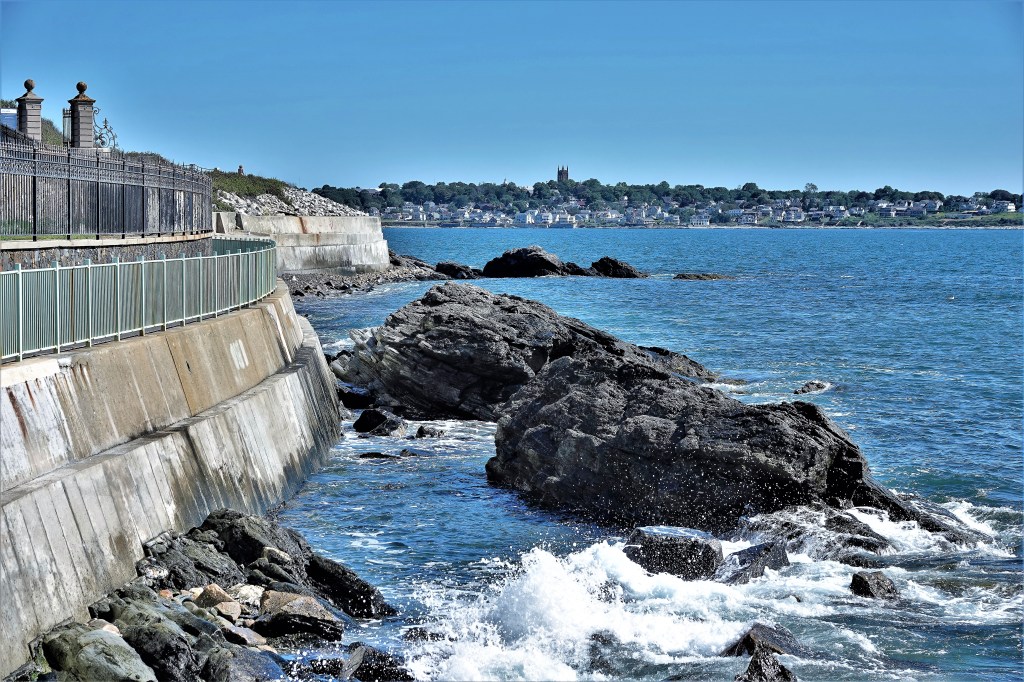
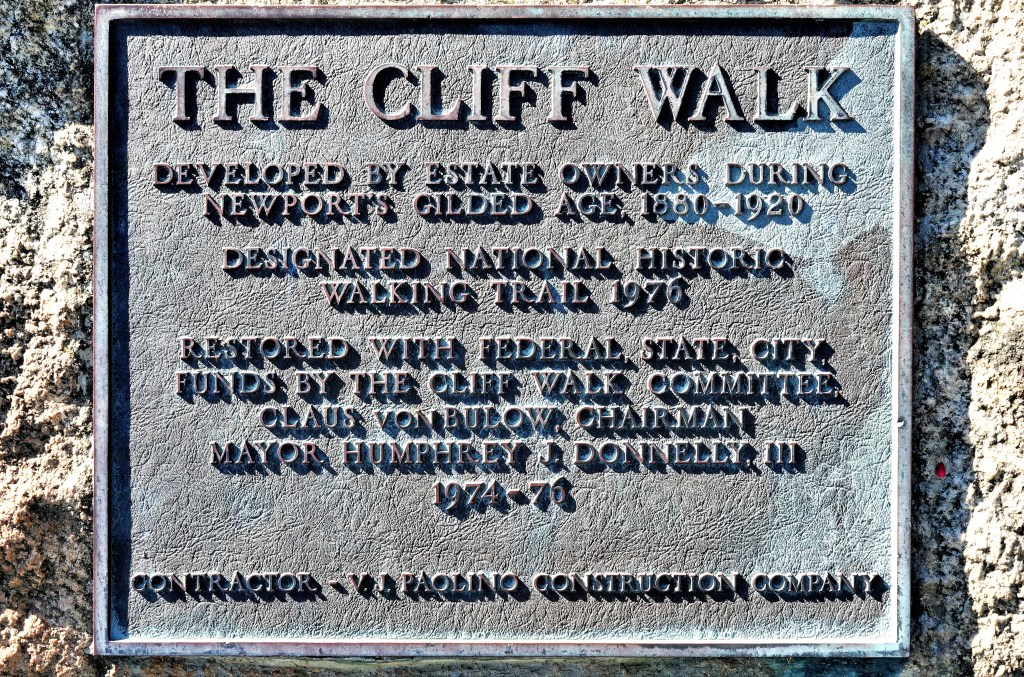
No tour of Newport, Rhode Island is complete without appreciating the summer “cottages” along the Cliff Walk. The walkway runs 3.5 miles along the Atlantic, offering panoramic views of crashing waves against a craggy seawall…
adorned with massive mansions belonging to America’s 19th-century titans of industry.
Leah and I parked at Easton’s Beach…
and followed clearly marked directions to the trail head,
for a walk through time to reflect on the splendor sponsored by owners during Newport’s Gilded Age.
Designed by a cadre of elite architects of the time, these summer homes represent the stylistic diversity of 200 years of architectural history in Newport, and offer a window into the world of its illustrious owners.
To date, many mansions like Rosecliff have been rescued by Newport Restoration Foundation after having been neglected for dozens of years, and threatened with demolition. Boasting the largest ballroom among its neighbors, Rosecliff has become a popular wedding venue.
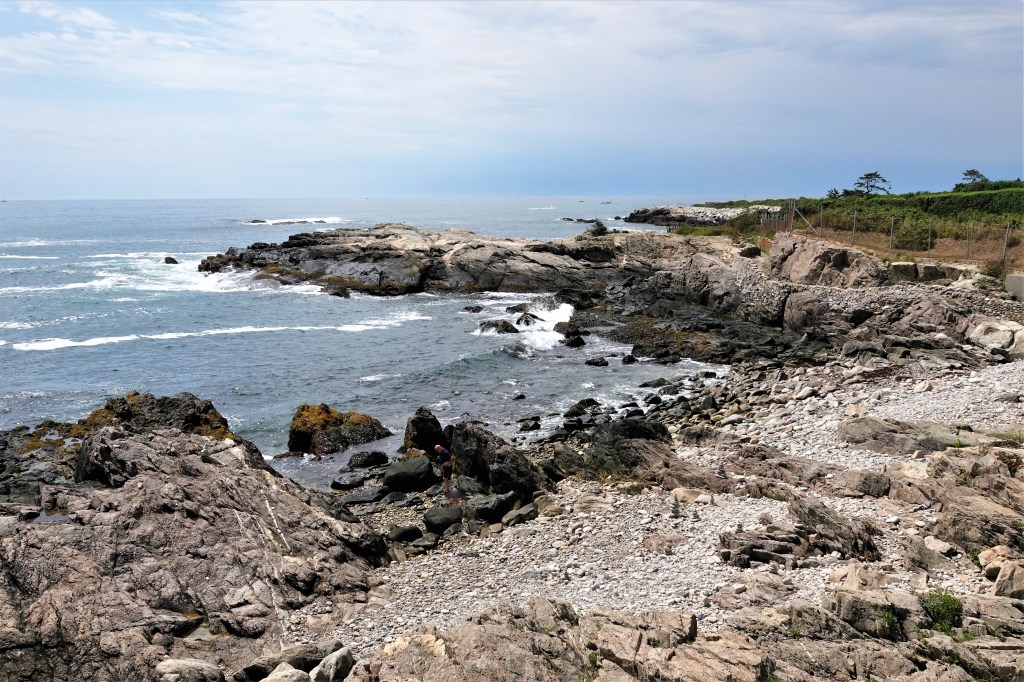
The Cliff walk is essentially a pedestrian hike, but can be challenging in places,
with rocky outcroppings…
and unlikely obstacles that require reasonable footwear other than flip flops.
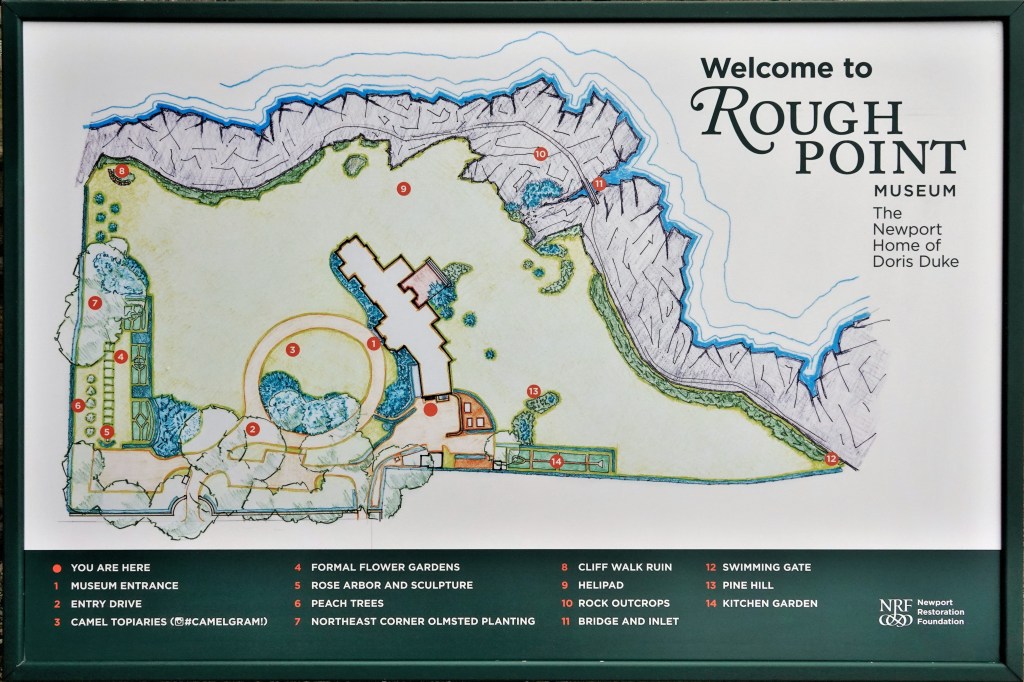
Of course, there are plenty of houses to ogle along 3.5 miles–some that have become museums, like Rough Point…
or repurposed as a Salve Regina University administration building, like Ochre Court…
or converted to condos, like The Waves…
while newer home owners along the walk eschew the notoriety.
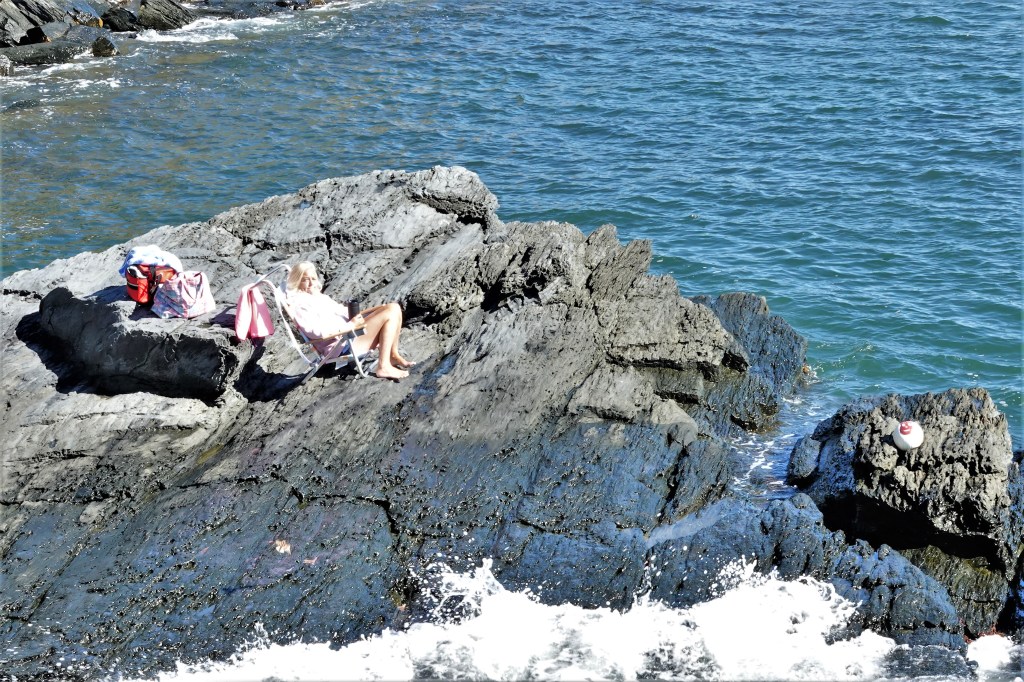
But the real entertainment comes from people met along the way–for instance, a sunbathing cliffhanger getting in touch with her inner mountain goat just beyond the 40 Steps marker.
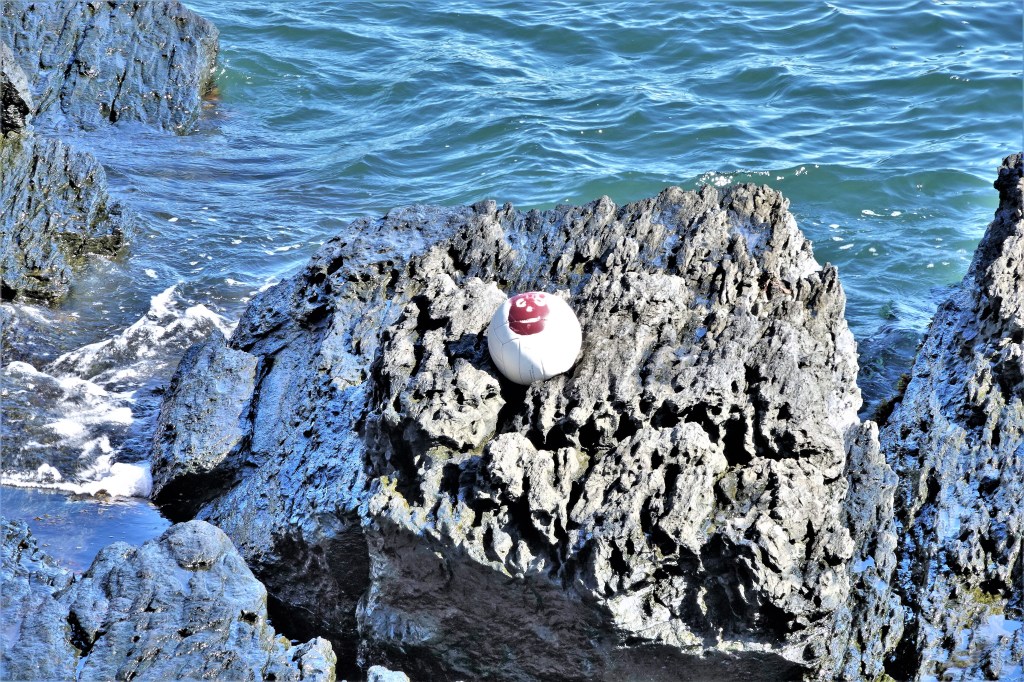
But she was not alone, as Wilson was seen lounging nearby.
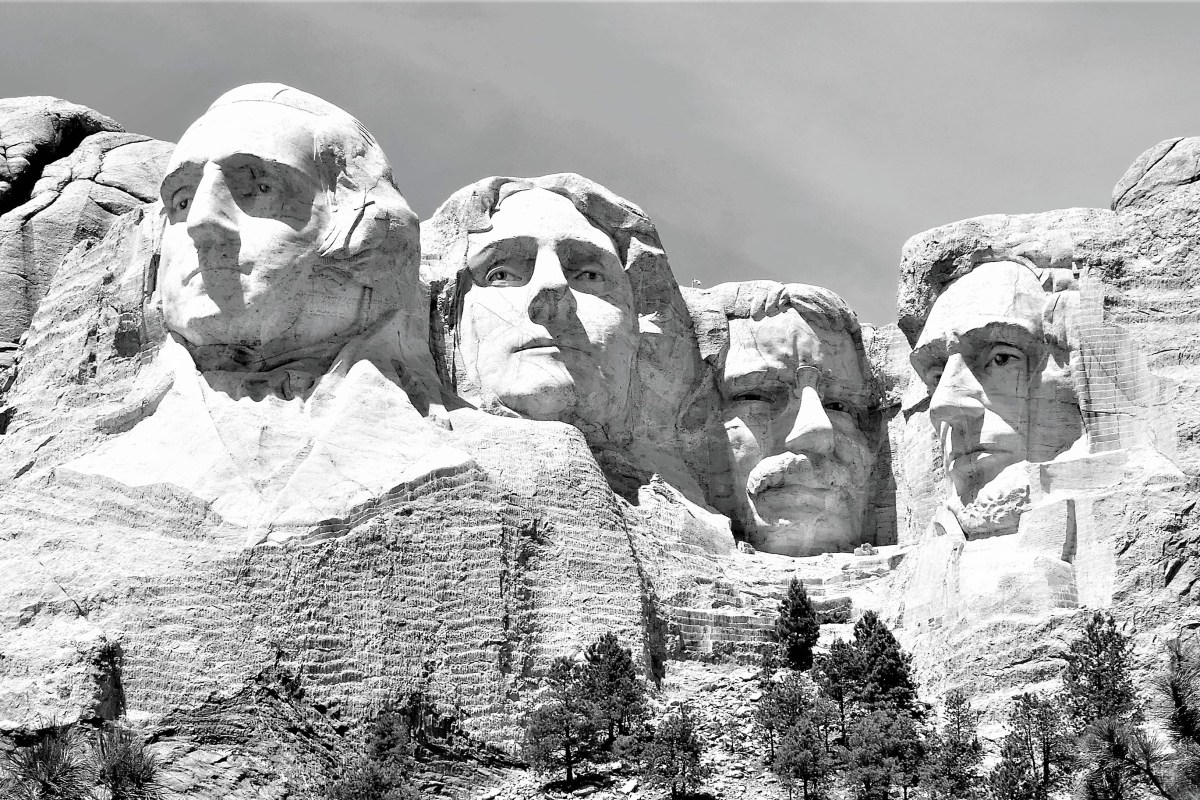
Despite the three years since Leah and I visited Mt. Rushmore, what could be more American than re-posting this visit on Independence Day? And still, there’s great turmoil within the country. A trip to Mt. Rushmore means many different things to different kinds of people. One person’s treasure is another’s abomination. To visit was once considered patriotic. Now it’s an act of partisan politics.
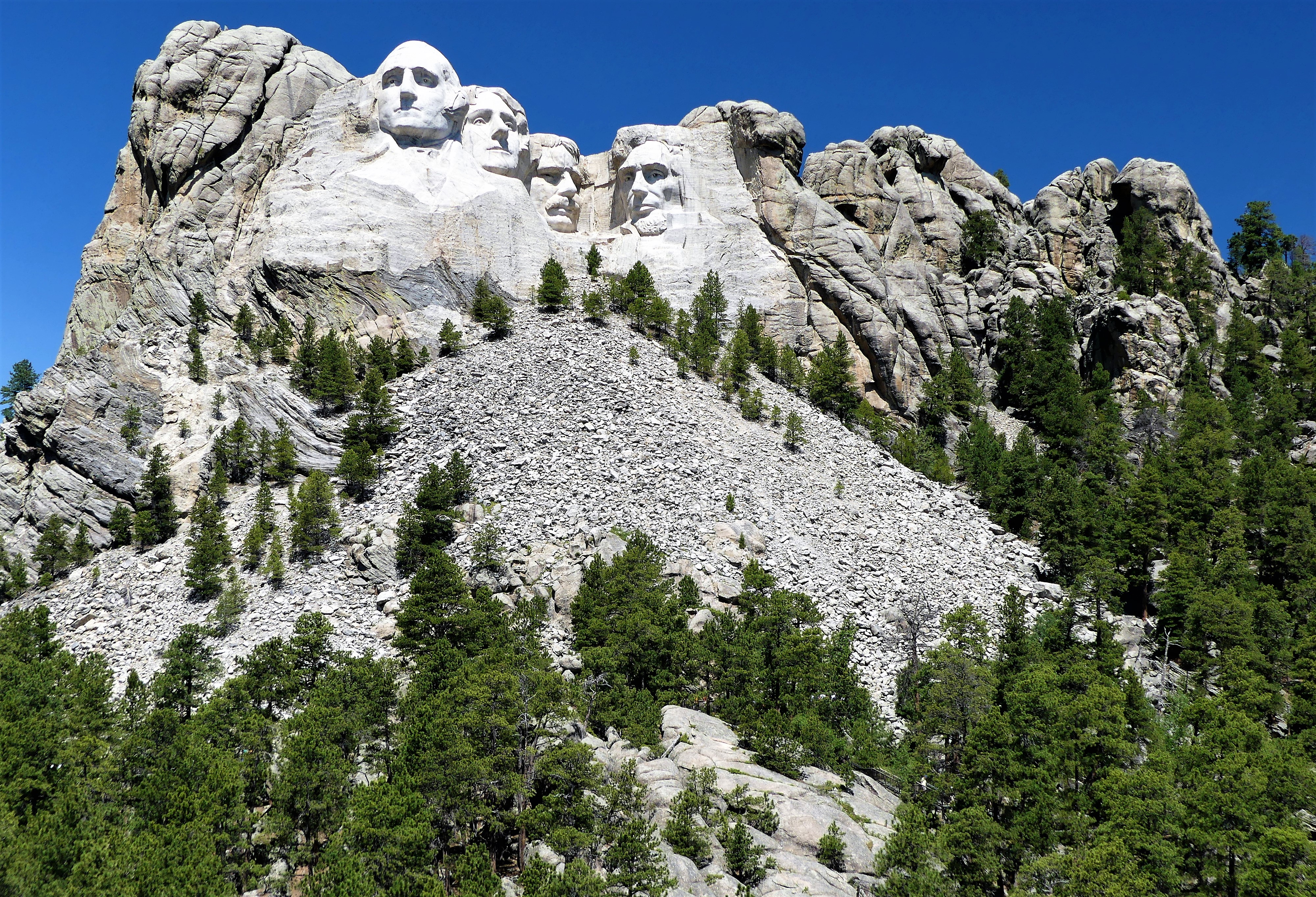
There’s no better way to celebrate the 4th of July, than a trip to Mount Rushmore and the Crazy Horse Memorial. Sure, the crowds were large; that was to be expected. But once the cars were garaged, the pedestrian traffic was easy to negotiate. And with everyone looking up at the mountain, the Presidents’ faces and intentions were never obstructed.
It was also a time to celebrate family. There were plenty of kids riding in strollers, hanging from moms in carriers, or balancing on dads’ shoulders. Generations of families–many of them immigrants–had gathered to pay homage to the principles of freedom that make our country a beacon for the oppressed and downtrodden.
Seniors were being escorted through the Avenue of Flags by their grandchildren. Extended families organized group pictures at the Grand View Terrace, unified by their love of democracy and their reunion T-shirts.
All expressed awe at Gutzon Borglum’s grand vision and remarkable achievement–the transformation of a mountain into a national symbol visited by approximately 3 million people every year.
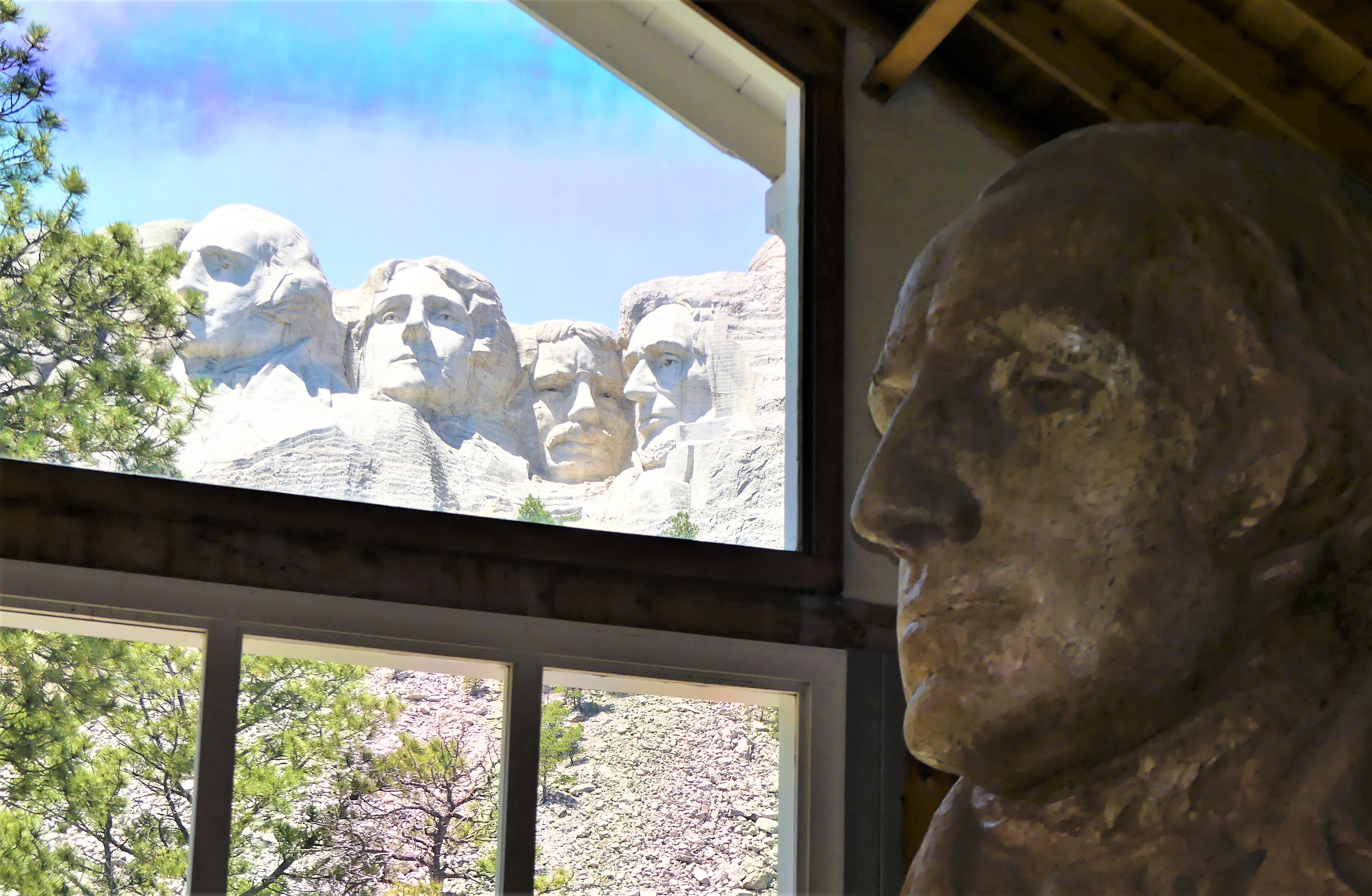
The 14-year process of carving the rock began with dimensionalizing the Presidents’ portraits through Plaster of Paris masks, on view at the sculptor’s studio-turned-museum.
Additional exhibits detail the construction of the memorial, and the tools used by workers, like the original Rand & Waring compressor, which powered the jackhammers for all the finishing work.
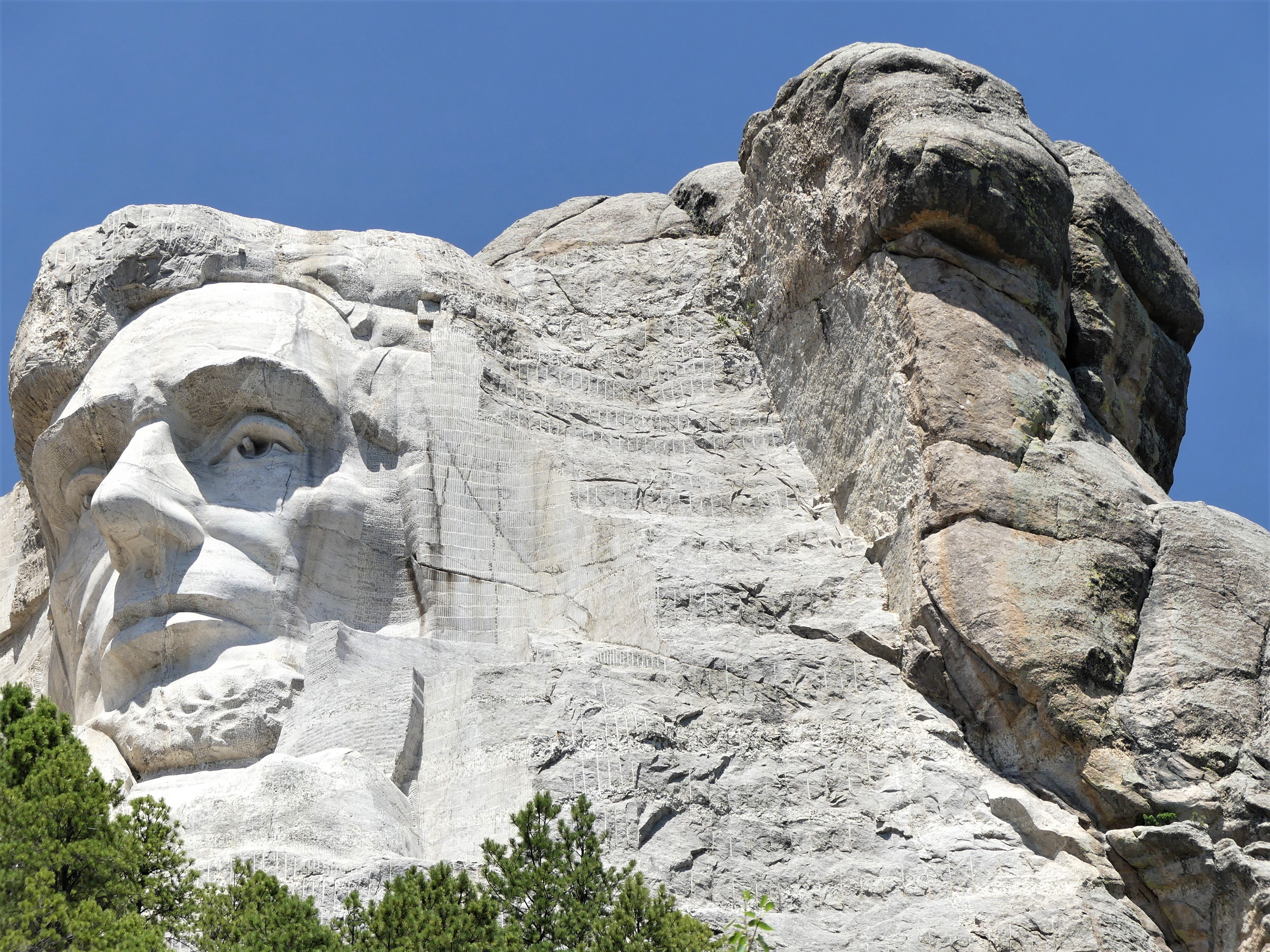
An overlooked fact–Mt. Rushmore was once intended as a tribute to the “Five Faces of Freedom,” but funding ran short when Congressional appropriation for the monument approached $1 million during the Great Depression. Hence, the unfinished carving of the Great Ape to the right of Lincoln serves as a reminder that we are never far from our true ancestors.¹
No less ambitious, and equally as impressive, the Crazy Horse Memorial is a work-in-progress located 16 miles away in the heart of the Black Hills–considered sacred land by the Lakota people.
Conceived by Korczak Ziolkowski in early 1940s,
the memorial, when completed will stand 563 ft. by 641 ft. across, and is expected to be the largest sculpture in the world. Already, the completed head of Crazy Horse measures 60 feet tall…
…twice the size of any of the presidents at Mt. Rushmore. While the first blast was conducted on the mountain in 1947, the current prospects for the memorial are to complete the outstretched arm during the next twelve years. There is no completion date available for the finished carving, which has been financed entirely by private funding since its inception.
Mt. Rushmore was created by a Danish American. Crazy Horse was created by a Polish American. And visitors to both destinations manifest the melting pot that has brought us all together as Americans. It’s our diversity that makes us strong, our ambition and determination that makes us great, and our compassion and sacrifice that make us whole.
These are the values reflected from the faces we’ve immortalized in stone. Yet, we would honor them more by living according to these principles.
Happy Birthday, America!
¹ Just kidding, but the photograph is real and has not been retouched.
With our Norway cruise behind us, Leah and I had designs on extending our Northern European adventure. Unfortunately, our plan to visit St. Petersburg hit a fatal snag after we neglected to apply for Russian visas in a timely fashion.
Originally, our flight from Bergen to St. Peterburg required a transfer through Helsinki, so Helsinki became our default destination for the next four days. Although my dream of touring the Winter Palace and Hermitage was temporarily dashed, Helsinki seemed like a worthy safety net and exciting city to explore.
But something about Helsinki was off. Ordinarily, Helsinki during winter months would be blanketed in snow with the harbor frozen over…
but during our visit, the landscape was fully thawed.
In fact, residents hadn’t seen a trace of snow since winter’s arrival, although they were experiencing one of the wettest and gloomiest seasons on record.
And that’s exactly how it felt to us as we wandered through Helsinki’s city streets, taking in the cultural setting and the vibe.
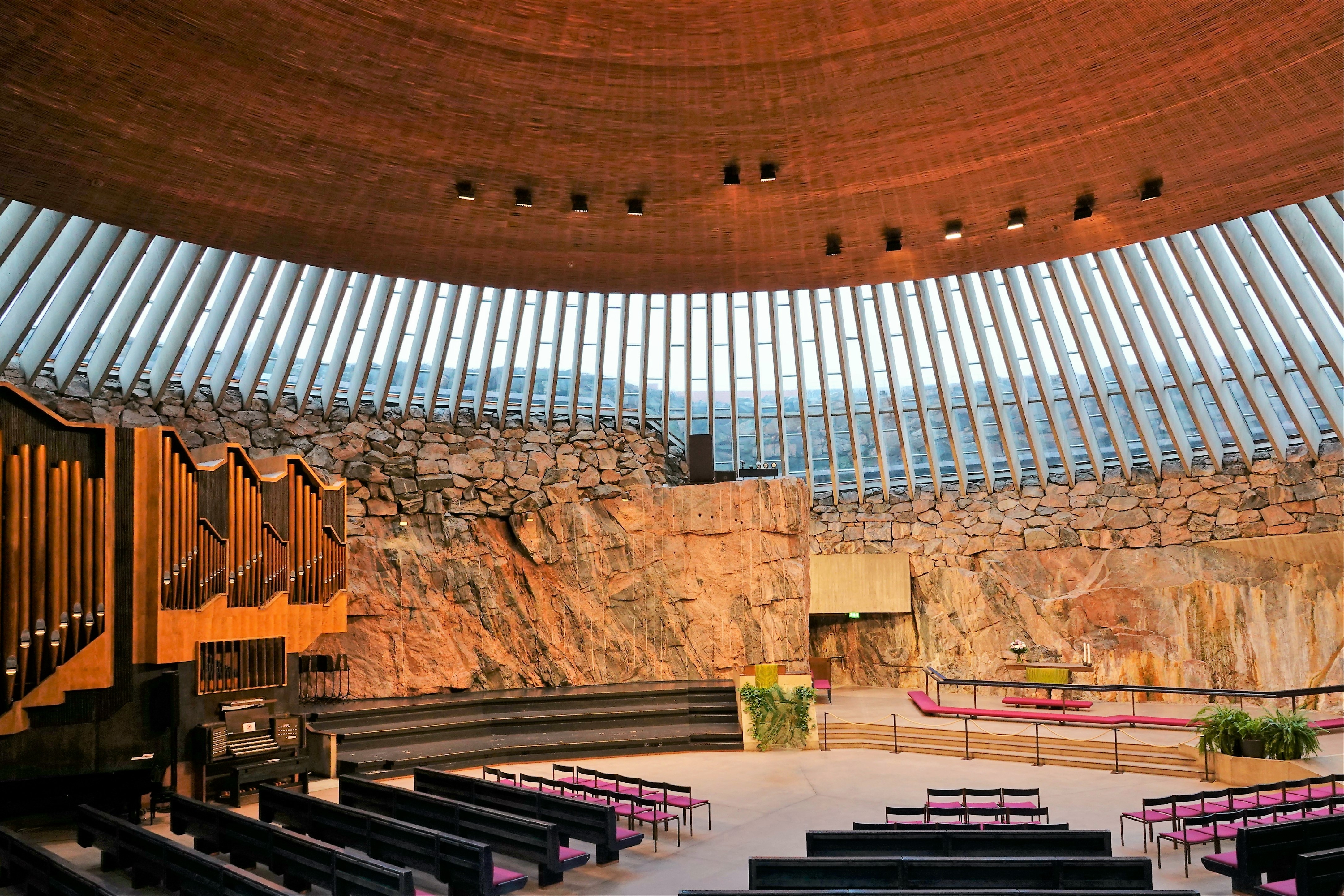
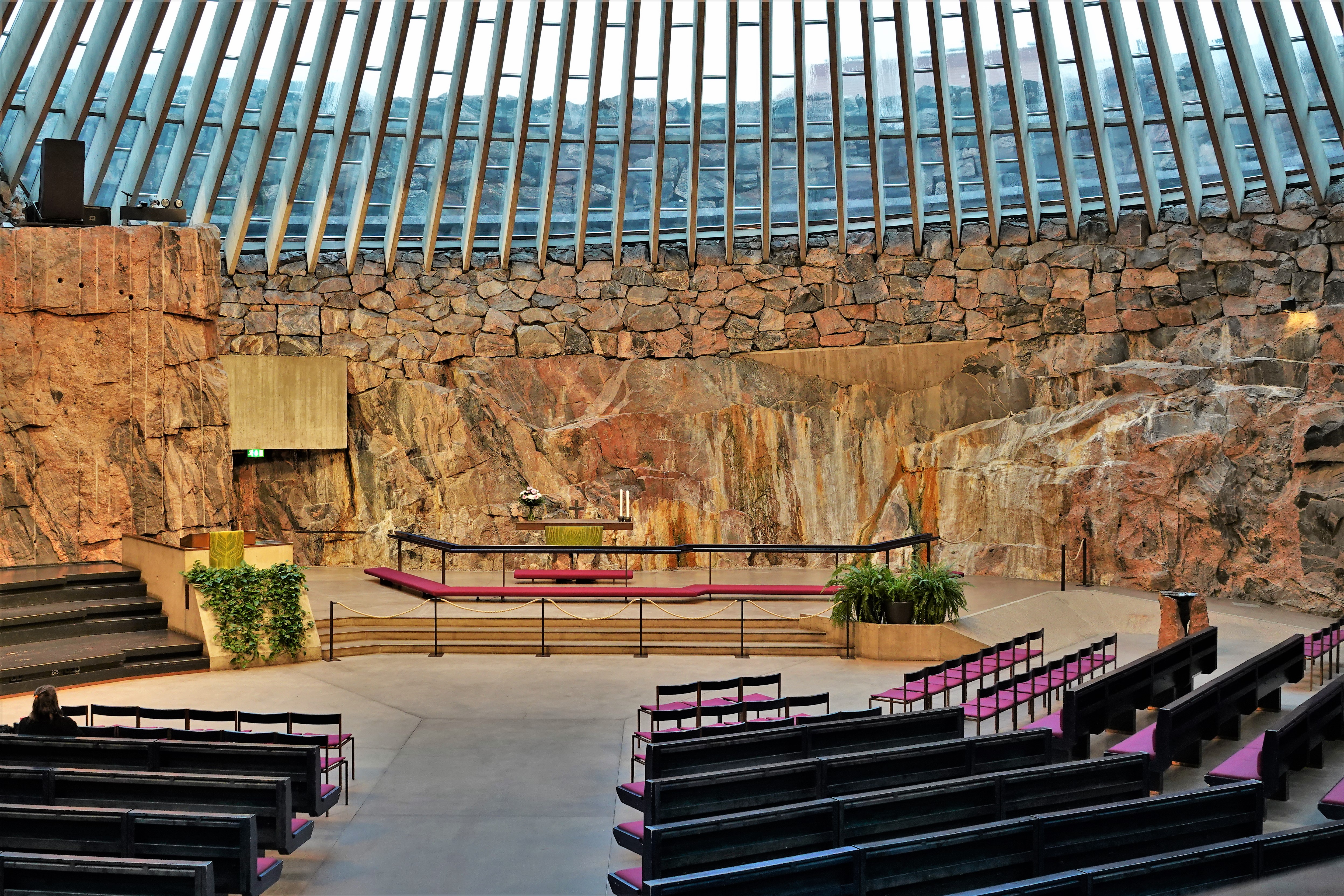
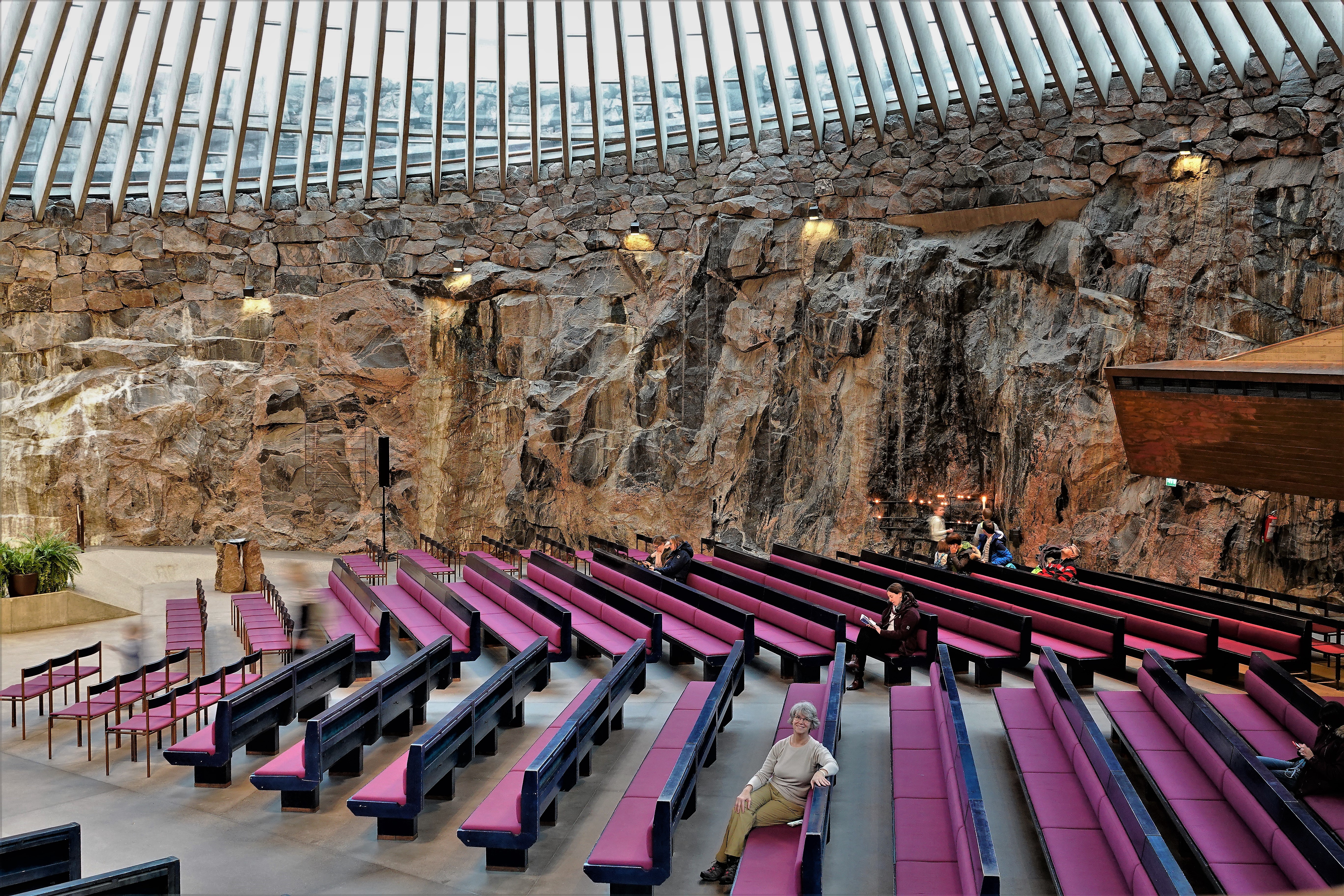
On our first day of touring, the rain and wind was relentless, but we were undeterred. In the end, we punished our umbrellas, and rendered them useless. But they saved us from a soaking and protected my camera as we found our way to Helsinki’s 50-year old landmark, the Church of the Rock–
embedded in bedrock,
and capped by an oval dome of skylights and copper.
In 1961, Timo and Tuomo Suomalainen–Finnish brothers and architects–conceptualized a church excavated from solid rock amidst Helsinki’s Töölö district, and were awarded the commission by a jury of their peers.
Ultimately, budget constraints and construction delays prevented the project from getting underway until February 1968, but the brothers saw their vision consecrated in September 1969.
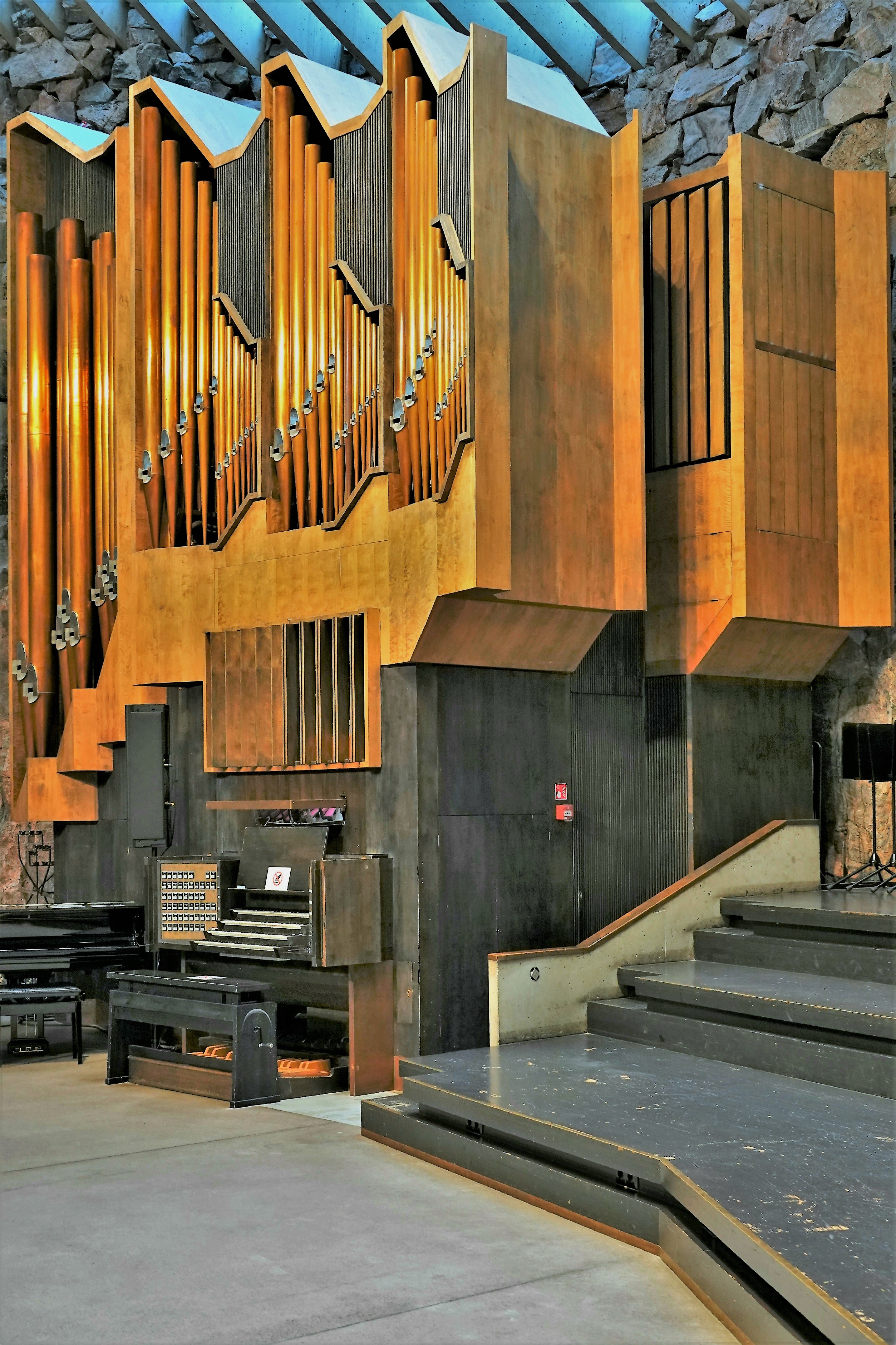
The church became an instant mecca for concerts,
after sound engineers determined that exposing the rough-hewn rock walls could deliver an acoustic nirvana.
More than half a million visitors a year flock to Church of the Rock for worship, wedding celebrations, and meditation.























































































































































 Streaming thru America