Quesions Without Answers

1)  Why do airport terminals have grouted tile floors?

A cacophonous display of roll-away suitcases towed by weary travelers, hiccup along the tiled Albuquerque concourse, sending clickety-clack vibrations through telescoped luggage handles during late evening hours. Each bag resonates with a signature “smooth-bump-smooth-bump” beat against an uneven surface–punctuated by a variety of passenger walking tempos–producing a discordant movement with no beginning or end.

But why not a smooth floor without bumps? Would it be any less durable? Would it be so terrible if towing a suitcase didn’t have to be such a “groovy” experience? Or would pulling a bag along a steady line be too disquieting that passengers would run for their Ativan?

2) Why do airlines spend so much time and money guaranteeing that their fleet flies straight, but they neglect replacing the concave cabin seats that passengers have flattened after millions of ass-miles?

What’s more uncomfortable than saddling into a posterior pancake for hours “on end”, knowing that “cramping quarters” within cramped quarters is cruel and unusual punishment? Shouldn’t airlines be required to pad their seats for the privilege of padding their profits?

3) Why would an airline board a red-eye flight at the last terminal gate, when the airport is all but shut down and all the closest gates are empty?

Stay tuned…there are so many more Qs without As down the road.

What Time Is It?

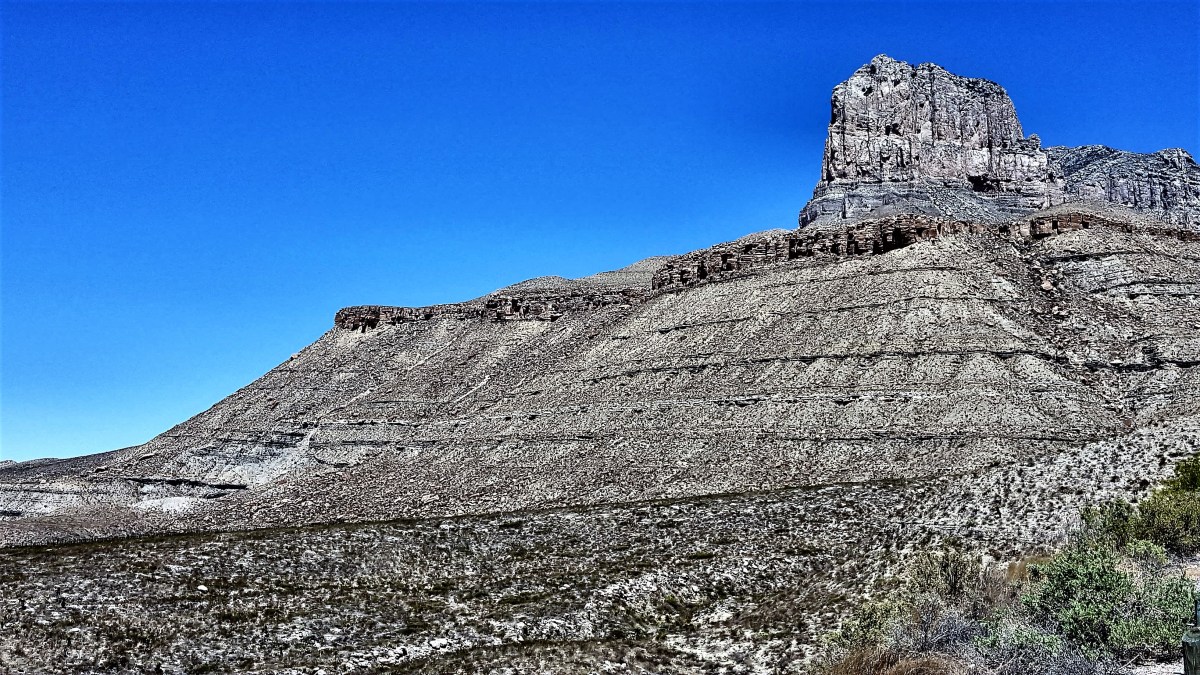
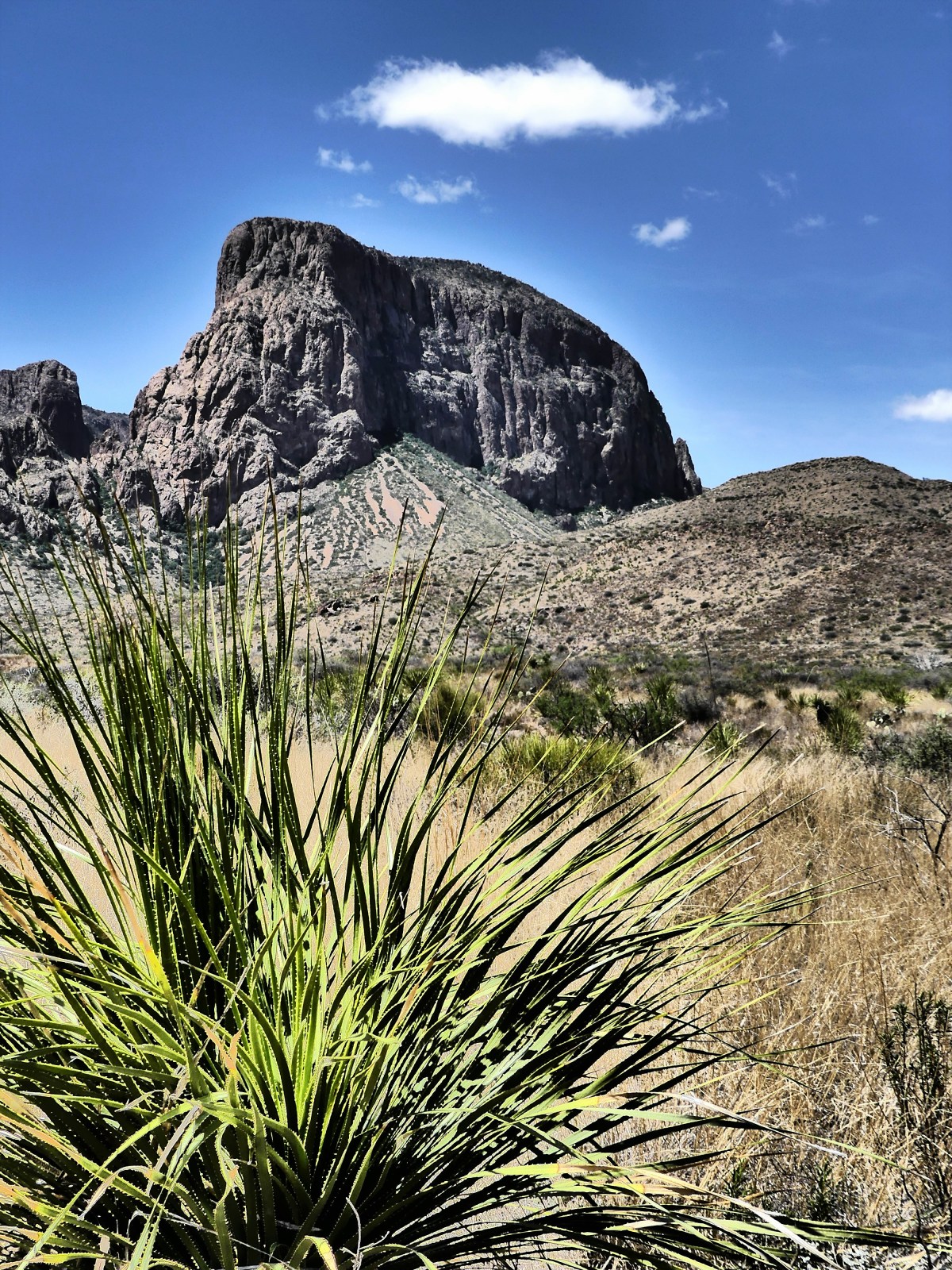
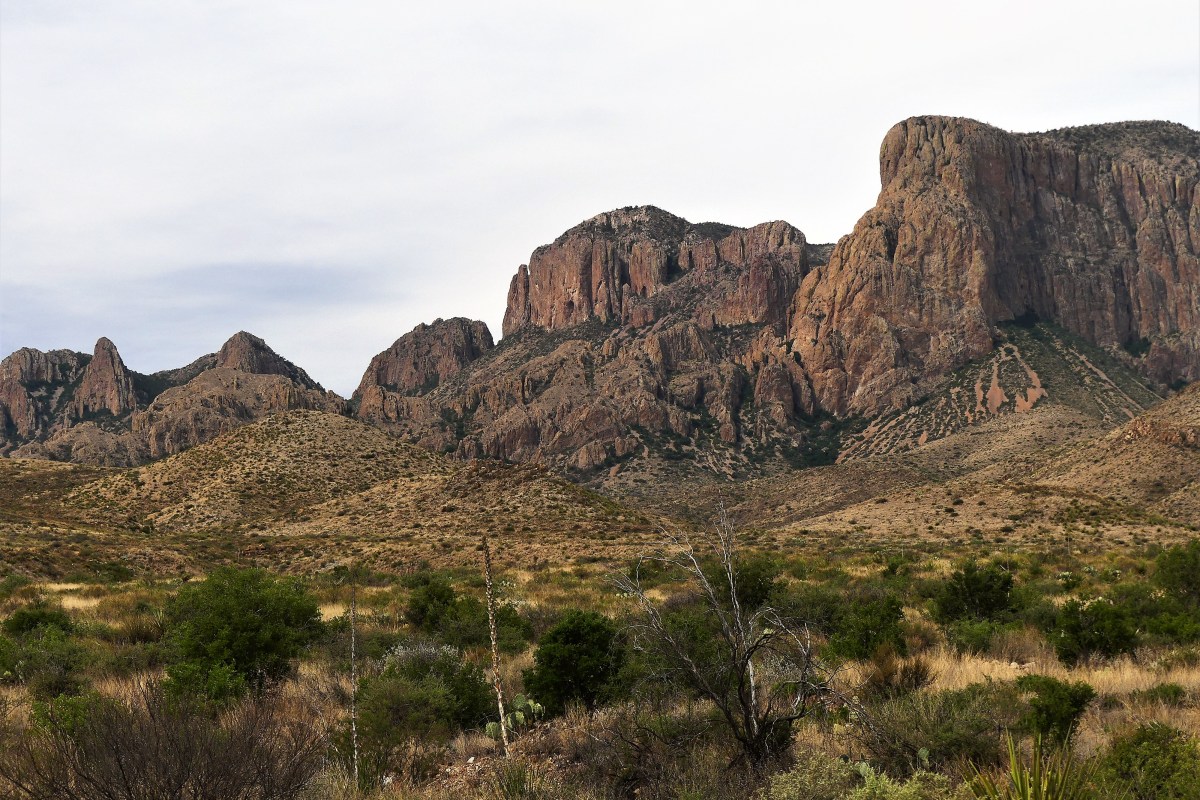
Camping inside Guadalupe Mountain National Park is notable for the dramatic setting presented to travelers sharing the trail head to Guadalupe Peak, the highest peak in Texas at 8751 feet elevation–fronted by El Capitan, it’s foremost surveyor’s point.

El Capitan

Access to the park is available to limited numbers of tents, trailers and RVs behind the Pine Springs Visitor Center, where the Guadalupe Mountains fan out in a protective panorama. Reservations are unavailable, as it’s first come, first served dry camping that is best described as boondocking in narrowly aligned asphalt stalls, where utility hook-ups and dumping stations are non-existant.

It was a crap shoot, but after a four-hour drive from Marfa, we score one of twenty available RV sites that are quickly filling up around us. An abundance of solar cell arrays dot the parking lot-with thirsty batteries soaking up sun rays needed for later use–while I, in turn, crank up the Honda 2000i generator to attend to our personal energy needs.

Our new neighbor, Mr. and Mrs. Salt and Pepper from the Sunshine State pull up beside us just as I disengage the F-150 from the Airstream, in search of the turn-off from the Guadalupe Pass that services the McKittrick Canyon Trail.

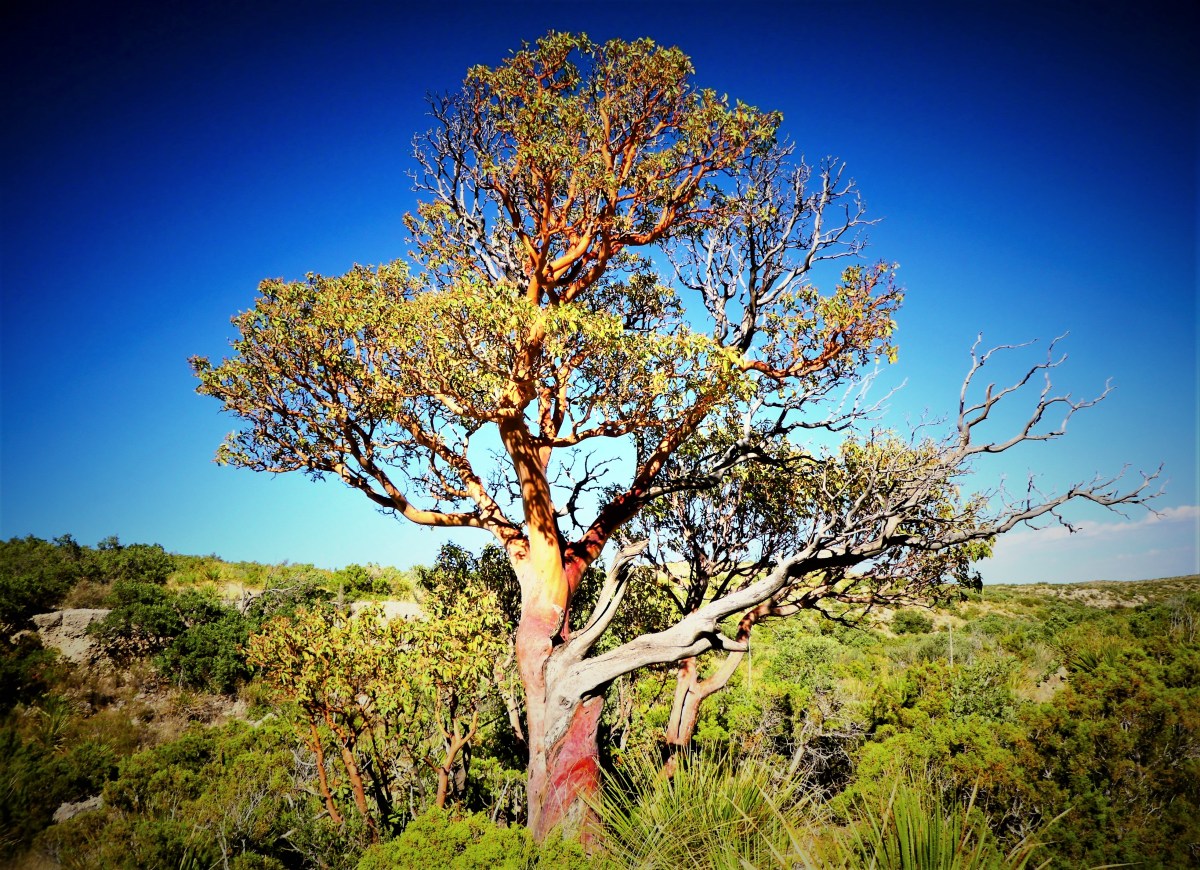
During our late-day hike, our marginal shade is supported by occasional juniper pines and Texas madrone…

Tree of Lifeas we cross several dry river beds…

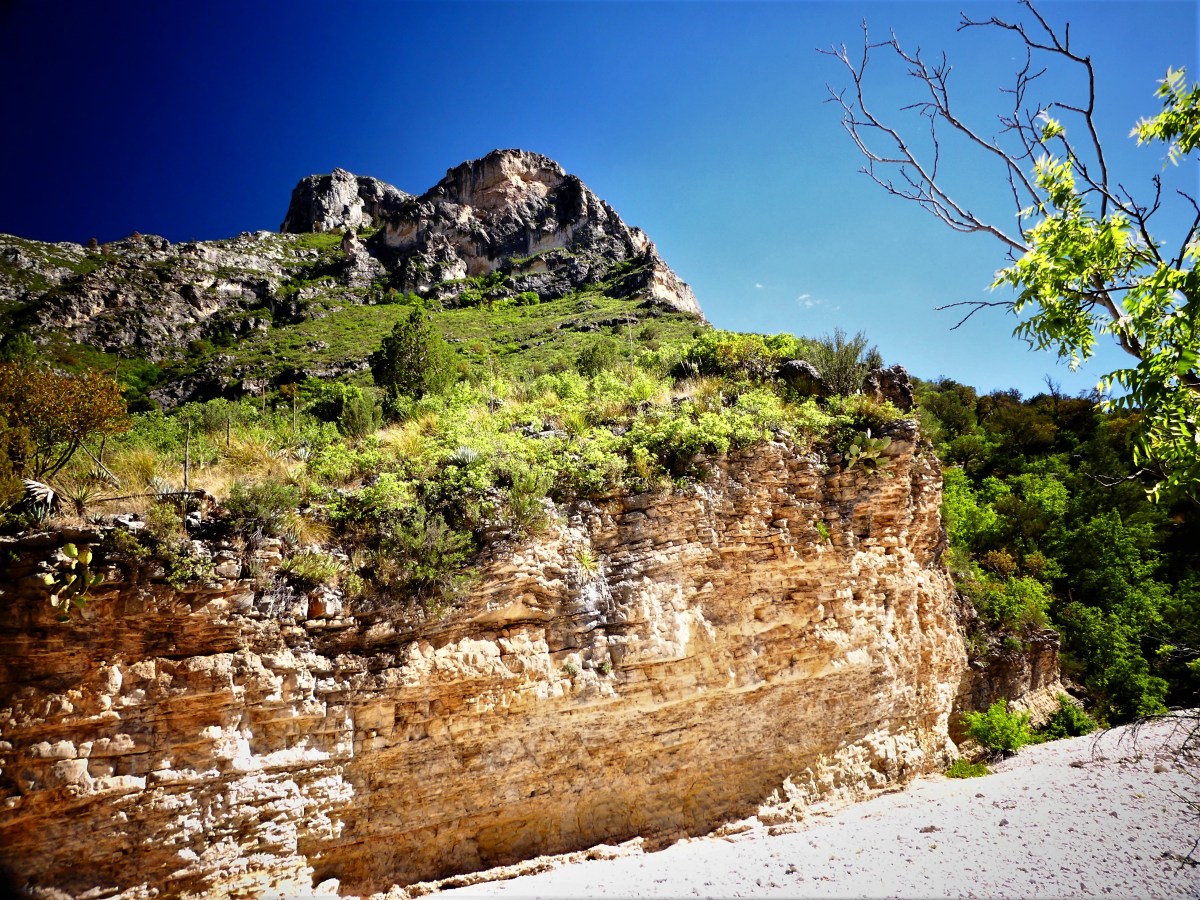
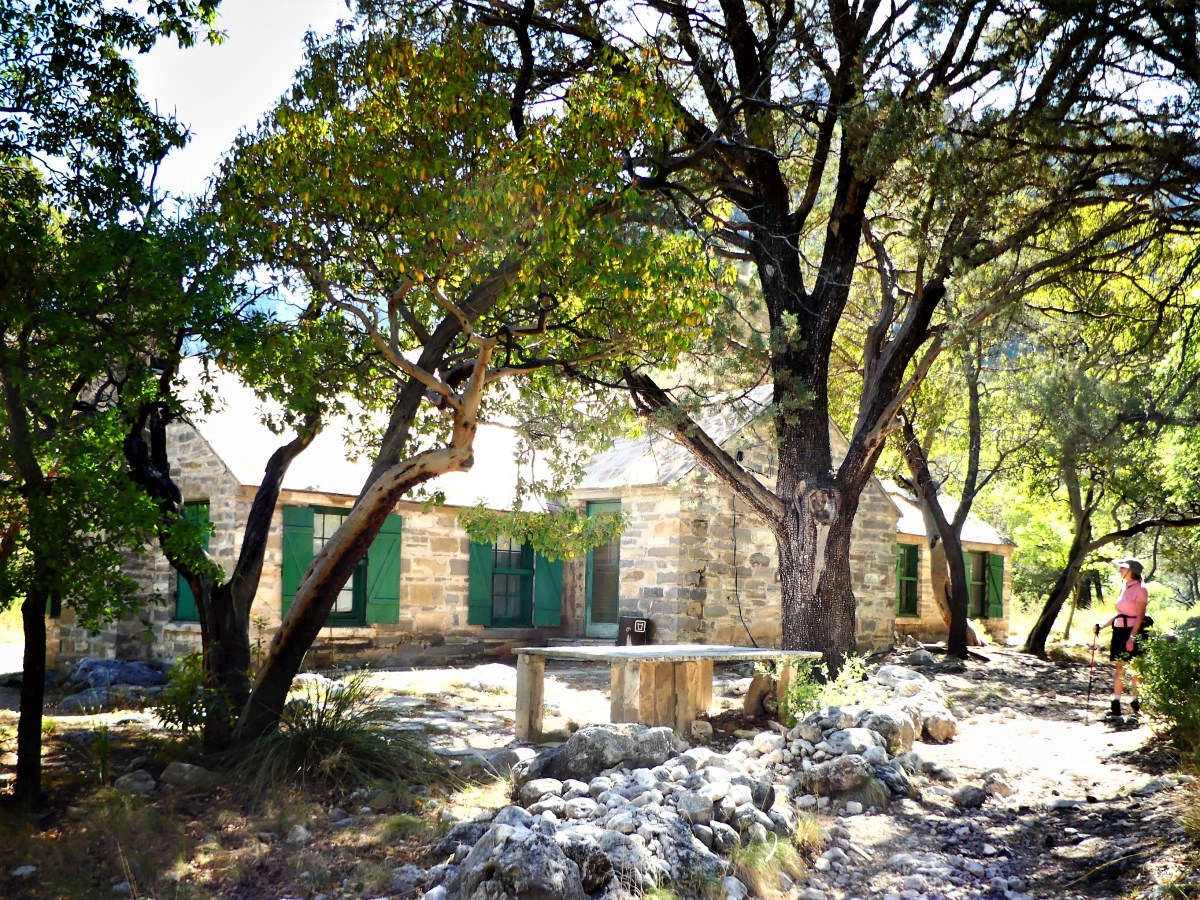
canyon wallalong the arroyo to Pratt Cabin, a Depression-era structure built entirely of stone.

Pratt CabinRocking chairs under a cool porch provide perfect respite from the simmering sun.

porch

Upon returning to the Airstream, we follow parking lot protocol with dinner preparation plans en masse, prompting Mr. S&P to cautiously knock on our screen door.

“Howdy, neighbor,” I announce through the screen with all good intentions. “What’s up?”

Holding back, but clearly annoyed, he addresses me in a veiled voice. “I hope you’re aware of the rules about running your generator,” he reprimands.

Gauging his tone, but uncertain of the point he’s trying to make, I answer, “Okay?”

“So were you planning on turning that thing off anytime soon?” He is more ordering than asking.

“Well, sure,” I try to reassure him, “but it’s only 7:30. I still have half an hour before quiet time.”

“I don’t think so,” he challenges, pointing to his watch.

He’s now flanked by his wife, who’s approached the Airstream to reinforce her husband’s position, and it becomes clear that he’s been put up to the task.

“Did you tell them about the rules?” she intervenes. “Tell them to read the rules by the bathroom.”

“I did, dear. He knows all about it,” her husband relents.

Now looking pointedly at me, she asks, “So why’s that thing still running? It’s 8:30, you know, and you’re out of time.”

“Look,” I start out. “I think you’re mistaken about the time. As I mentioned to your husband, I still have half an hour to go.”

“Not according to my phone,” she insists, waving her iPhone.

Leah joins me at the door to even the playground odds. “Then you must’ve forgotten about the time change,” Leah interjects. “We just crossed the border from Central to Mountain time, and you forgot to turn back your clocks.” Rubbing it in, “Didn’t you get the park memo?” she says smugly.

“Sounds reasonable,” she shrugs. Are you certain?” doubts Mrs. Salt and Pepper.

“You can’t rely on your phone,” Leah tutors her. “For some reason it’s not showing up yet.”

Mrs. S&P nudges her husband, teasing, “I can’t believe you didn’t know that.”

“Shit happens,” I announce, side-stepping the S&P’s on my way down the Airstream stairs. “While time is still on my side, please excuse me while I tend to the chicken on the grill.”

Walking away, Mrs. S&P mutters to her mate, “I feel like such a fucking idiot!” Then, calling out to me, “By the way, that smells sooo goood.”

Returning to their RV box, I overhear Mr. S&P lament, “I told you not to bother them.”

I remain exalted in my vindication. At precisely 8:00 pm, I cut the generator din, restoring tranquility to the campground community where I’m no longer the menace of Guadalupe Mountain.

And I am absolved when the quiet of the thin mountain air carries the collective sigh of my next-door neighbors through their hollow RV wall.

Carlsbadland

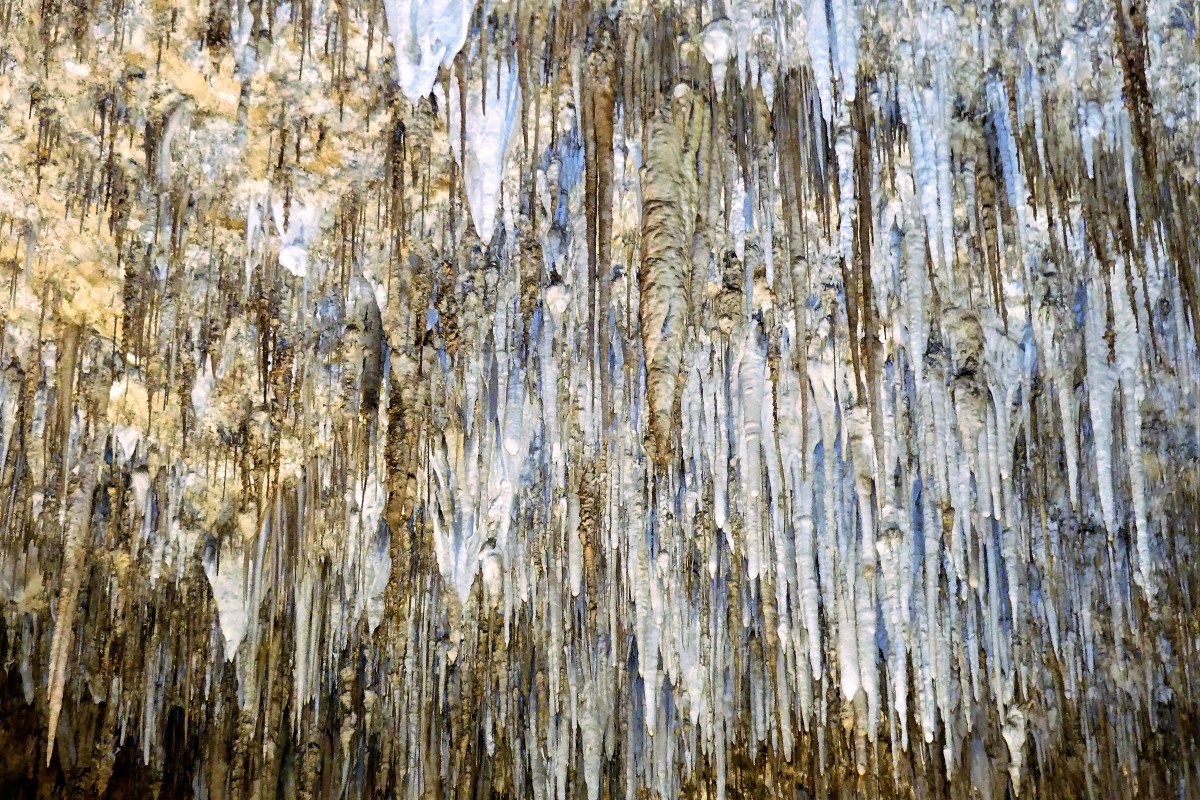
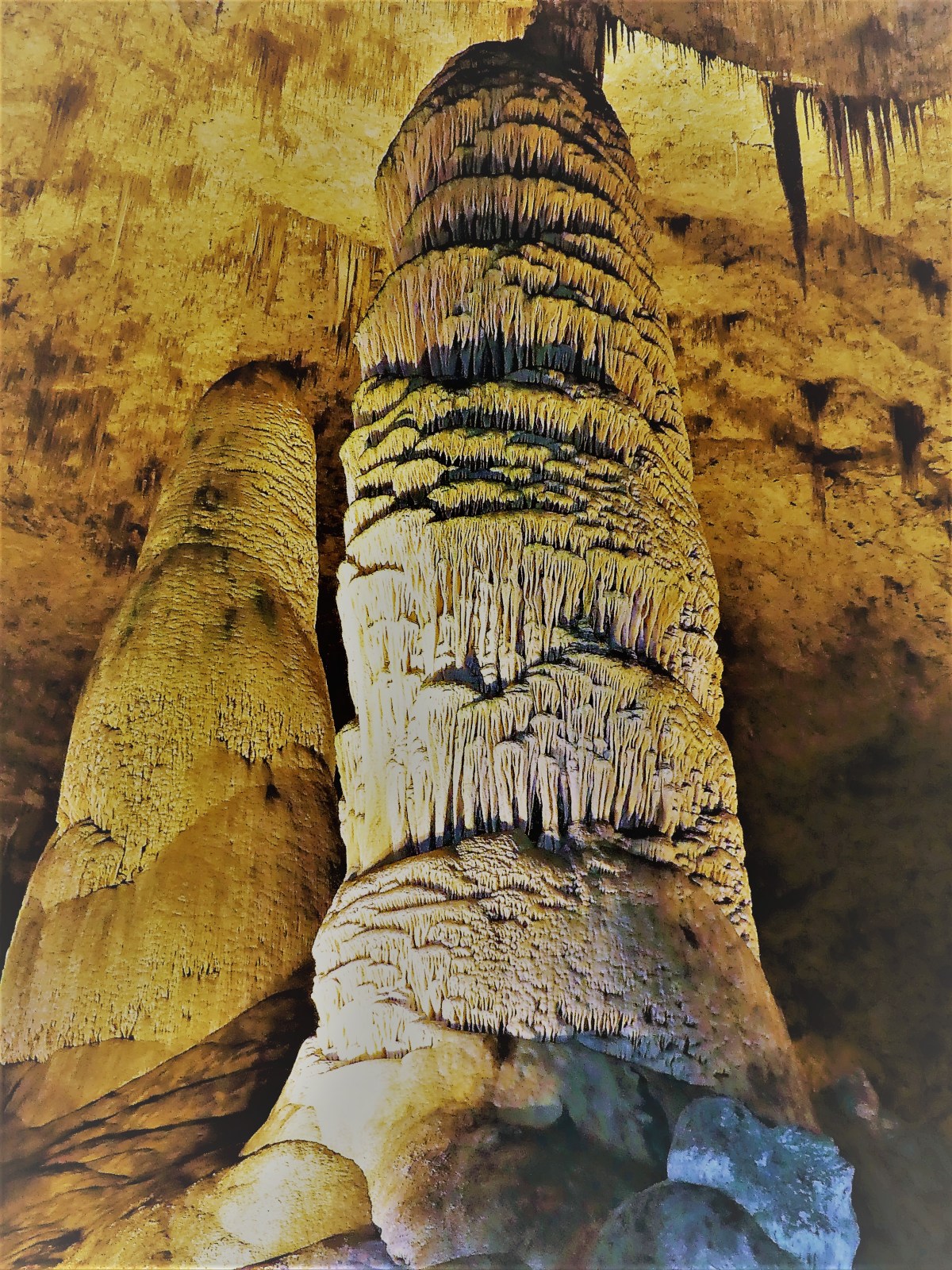
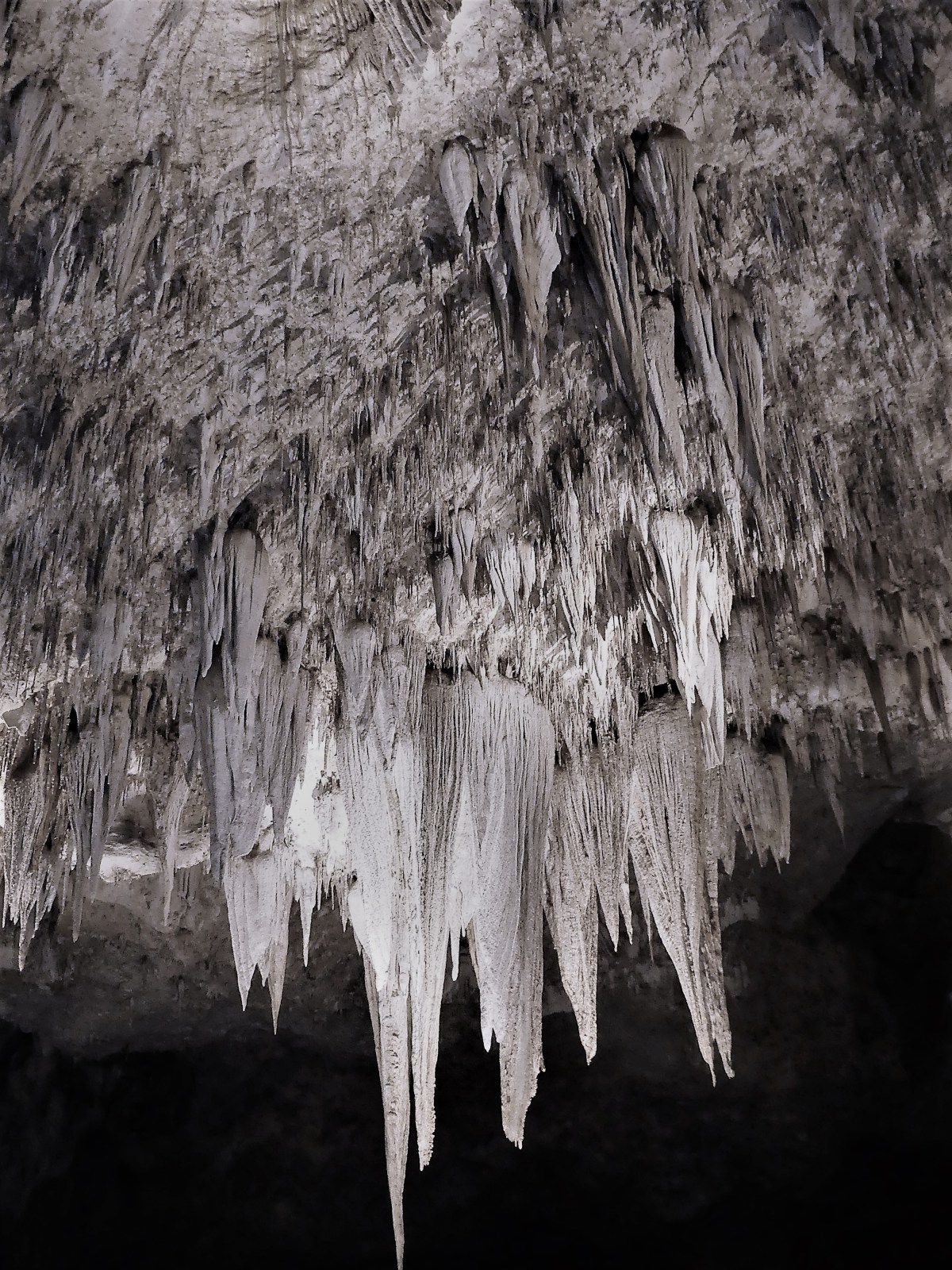
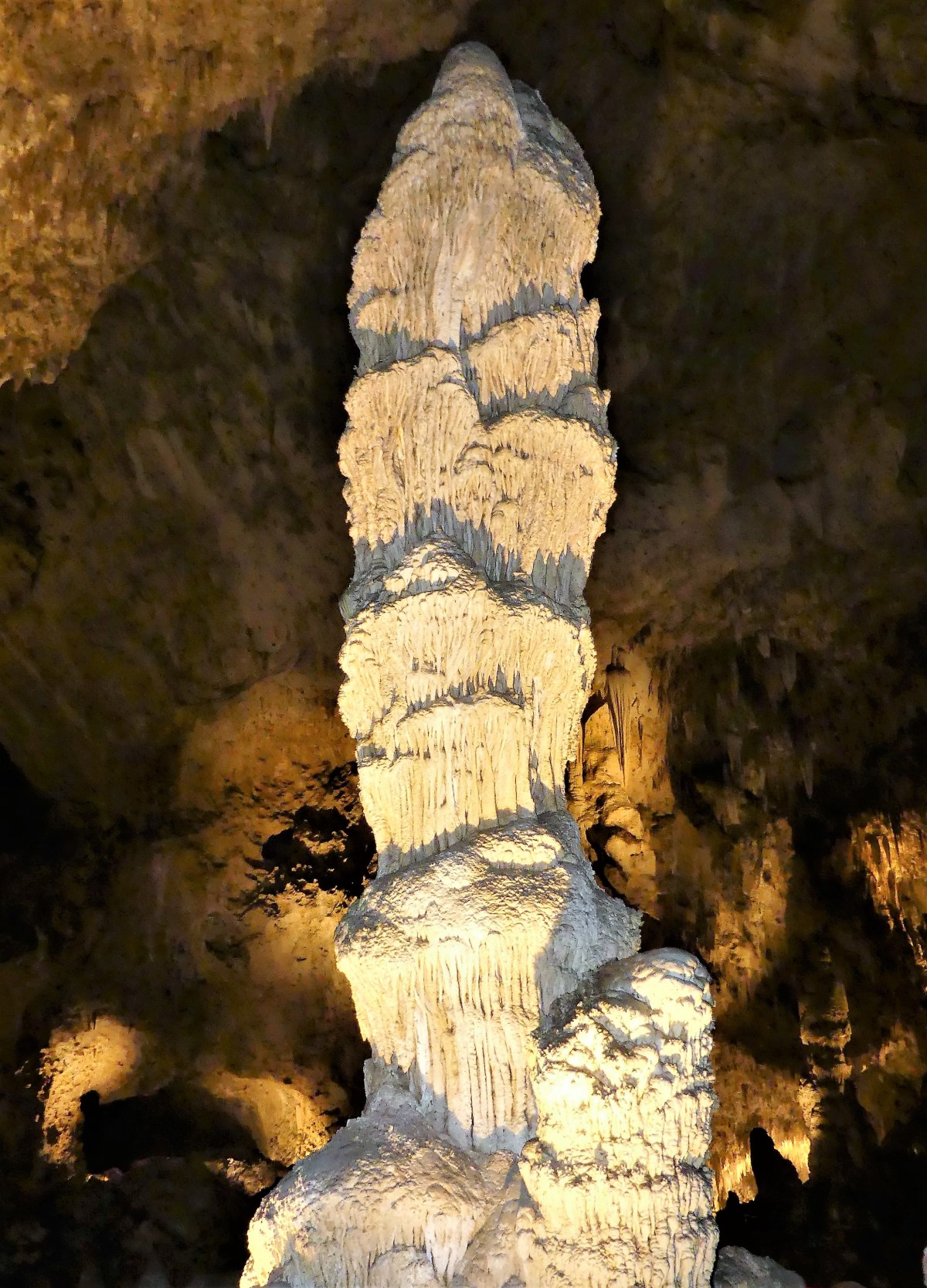
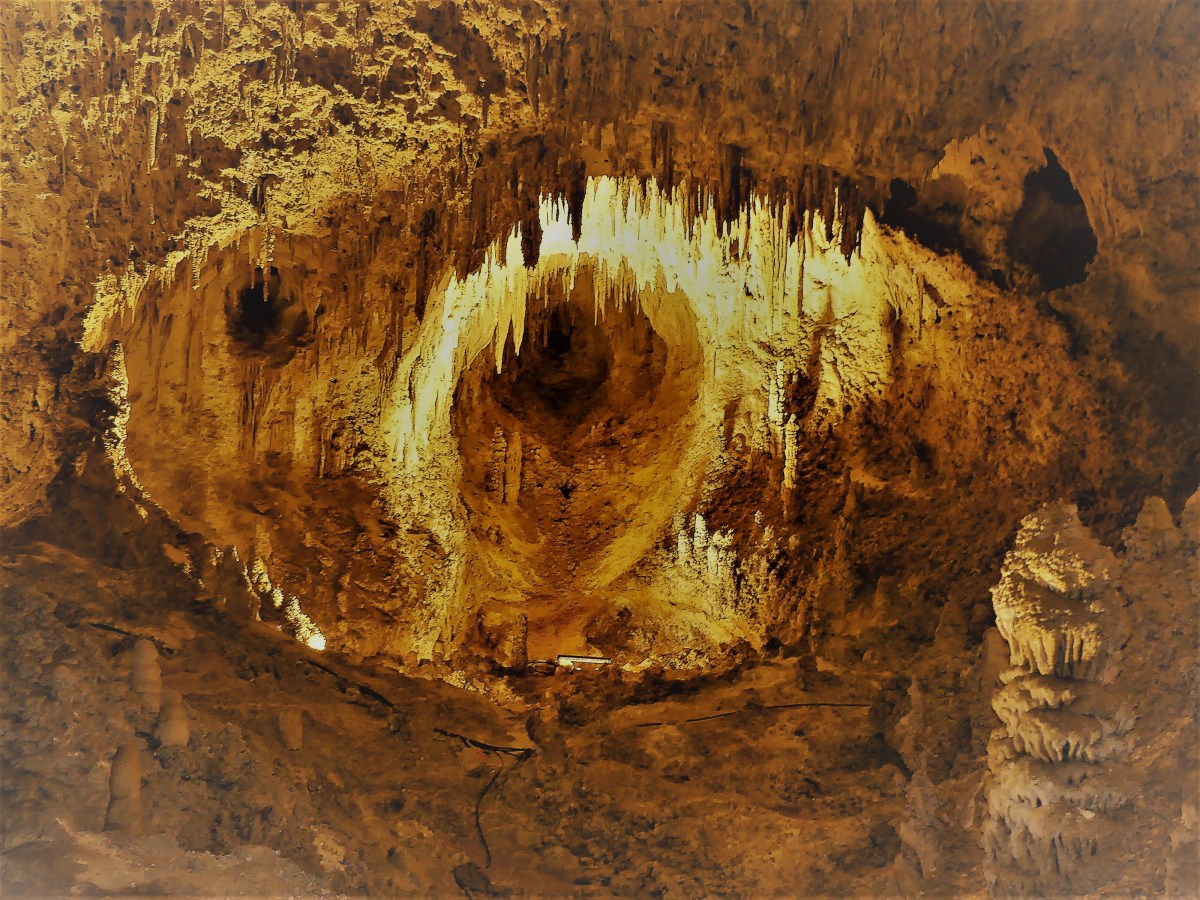
If Disney were to design a cave attraction, he couldn’t do any better than Carlsbad Cavern, for deep within the Guadalupe Mountains of southeast New Mexico lies an enchanted forest of mysterious-looking limestone formations.

long ears (2)

The journey begins at the ticket counter, where for the price of admission, a visitor can access the cave from a nearby switchback path, or take a high speed elevator 800 feet down to an exploration crossroads that leads directly to a food concession stand.

elevator

While there are a few adventure hikes below the surface for limited numbers of ardent spelunkers, a majority of the nearly 3,000 visitors a day (on average) are content to follow a one-mile self-guided tour of the Big Room along a narrowly paved walkway, where featured formations are illuminated by hidden spotlights and protected from access by stainless steel handrails.

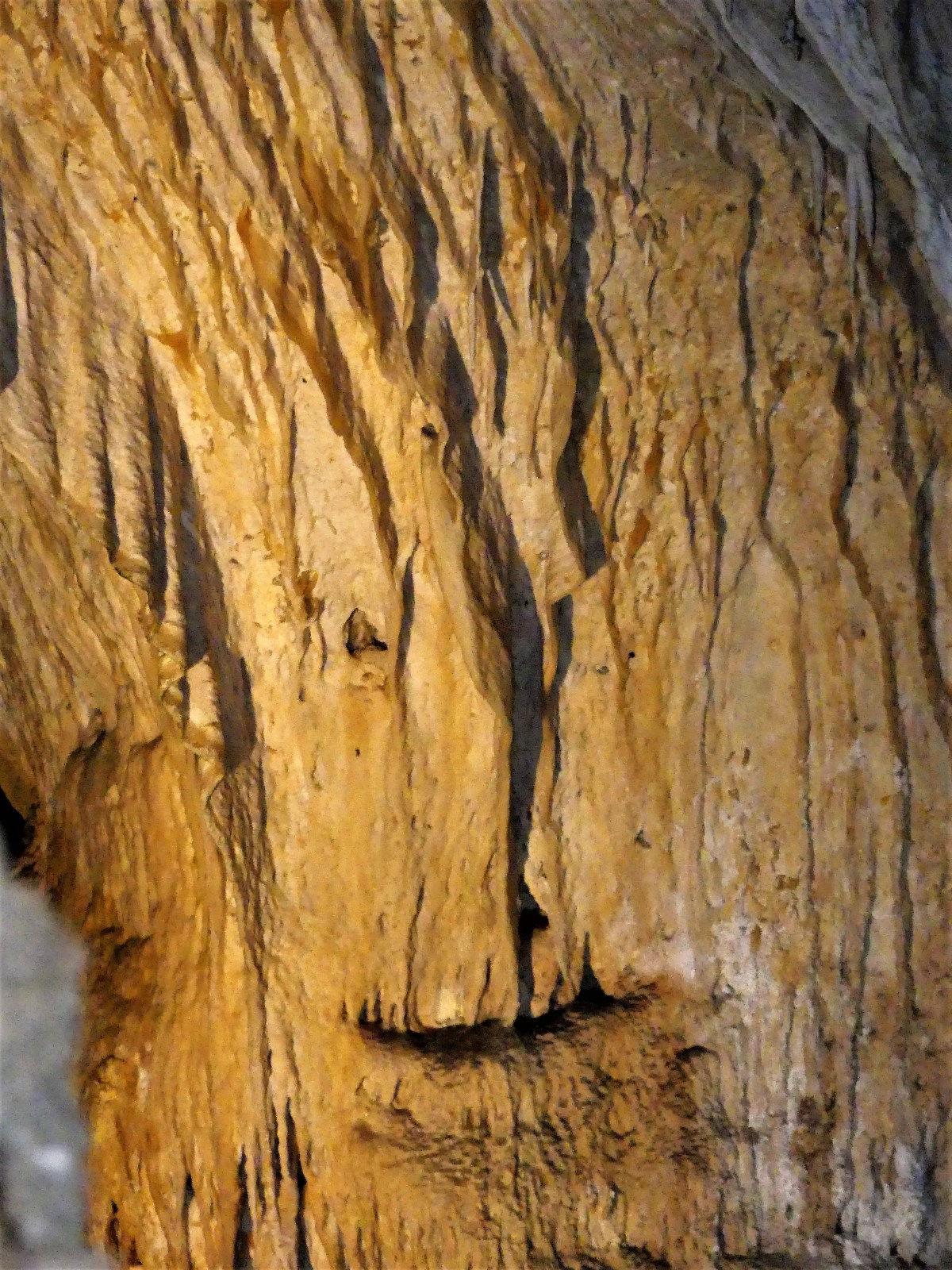
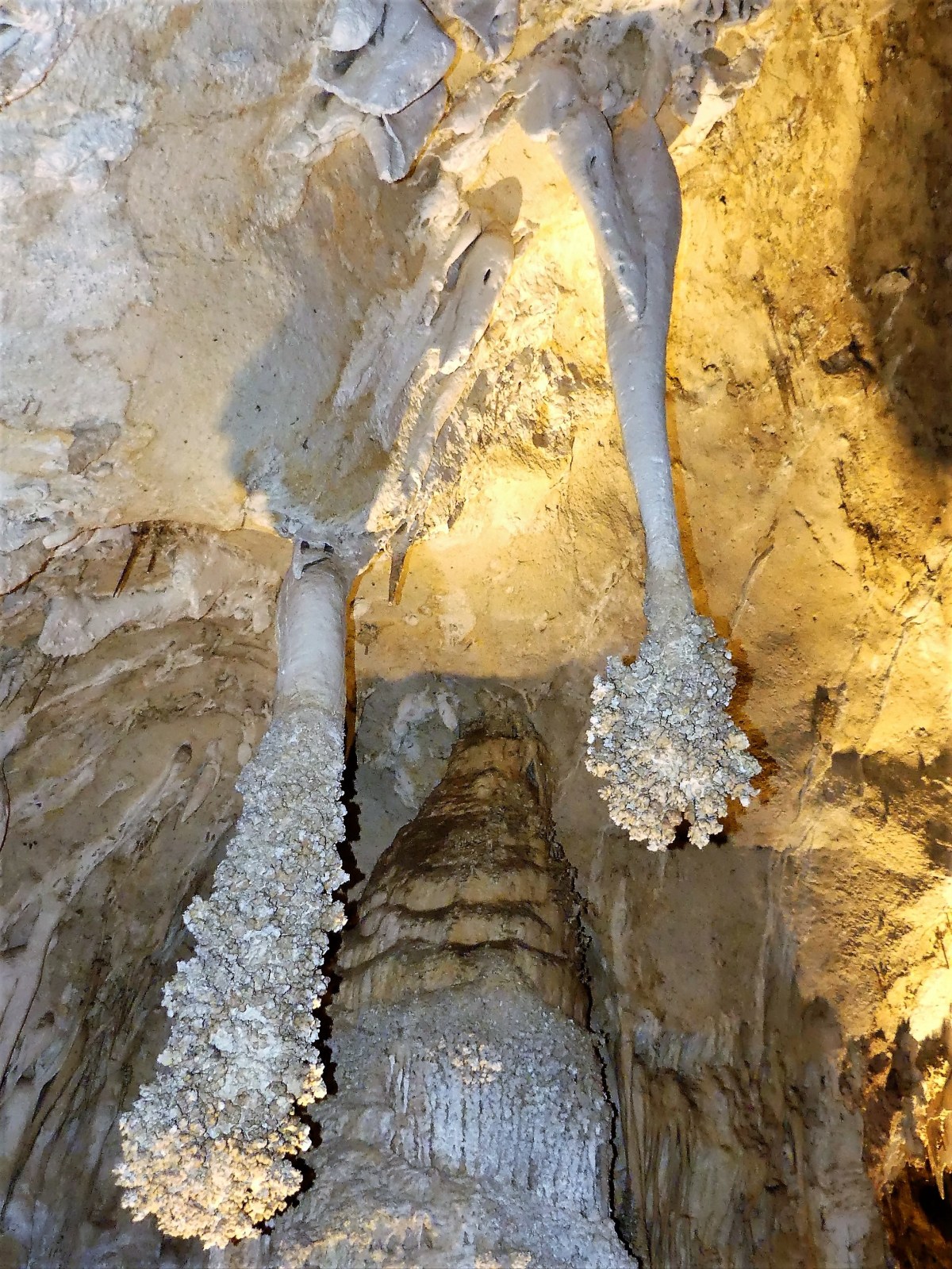
To the casual observer, the speleothems (e.g. stalactites and stalagmites) look like random thousand-year-old mineral deposits. But to the trained eye, many of the formations–whether disguised within wall recesses…

faces

Groot

or standing straight and tall in plain sight–

Chinese emperor (2)

double as custodial creatures who stand guard by rock castles,

castle on the rock

brocoli

and towers…

double dicks (2)

to protect them against invaders who are so fascinated by their structural beauty, that they must scale their delicate walls.

Like vintage Disney design, the spectacle that is Carlsbad Cavern is overwhelming to the senses. Whether it’s looking up at the lion tails,

lion tail (2)

and the crystal chandelier…

chandelier

or looking at popcorn streams beneath rippled water…

natural stream (2).jpg

…it’s difficult to imagine not being seduced…

shaft (2)

by all the stunning eye candy.

eye candy (2)

Dune Not Disturb

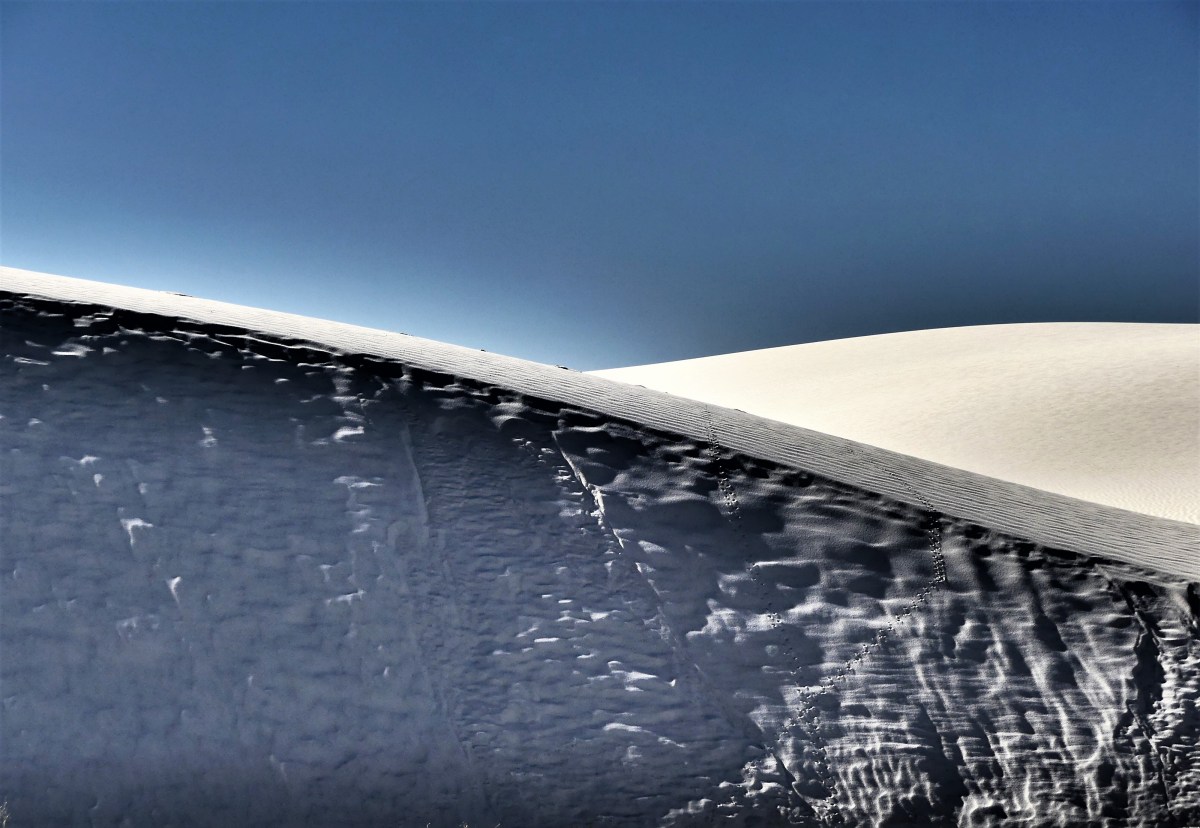
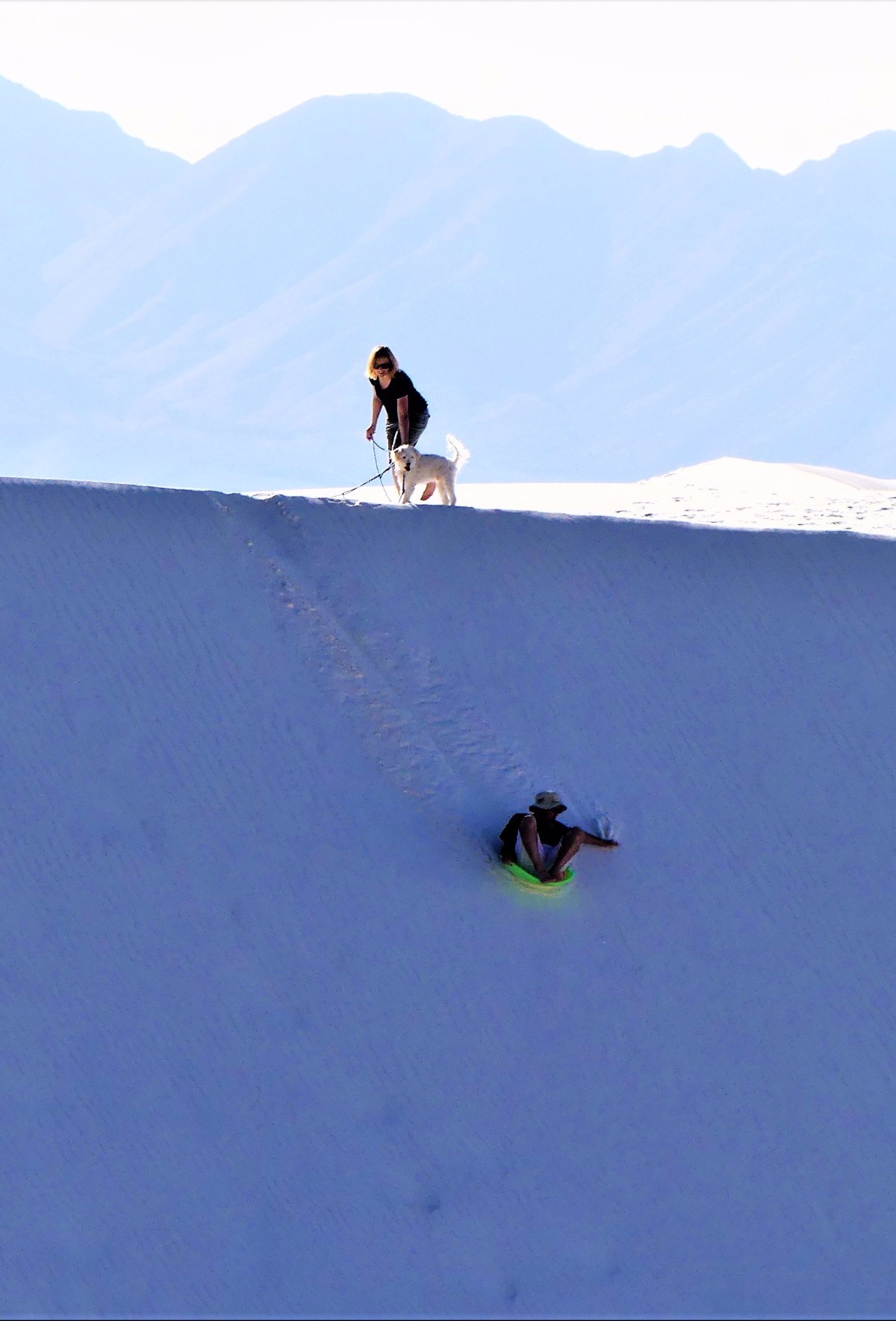
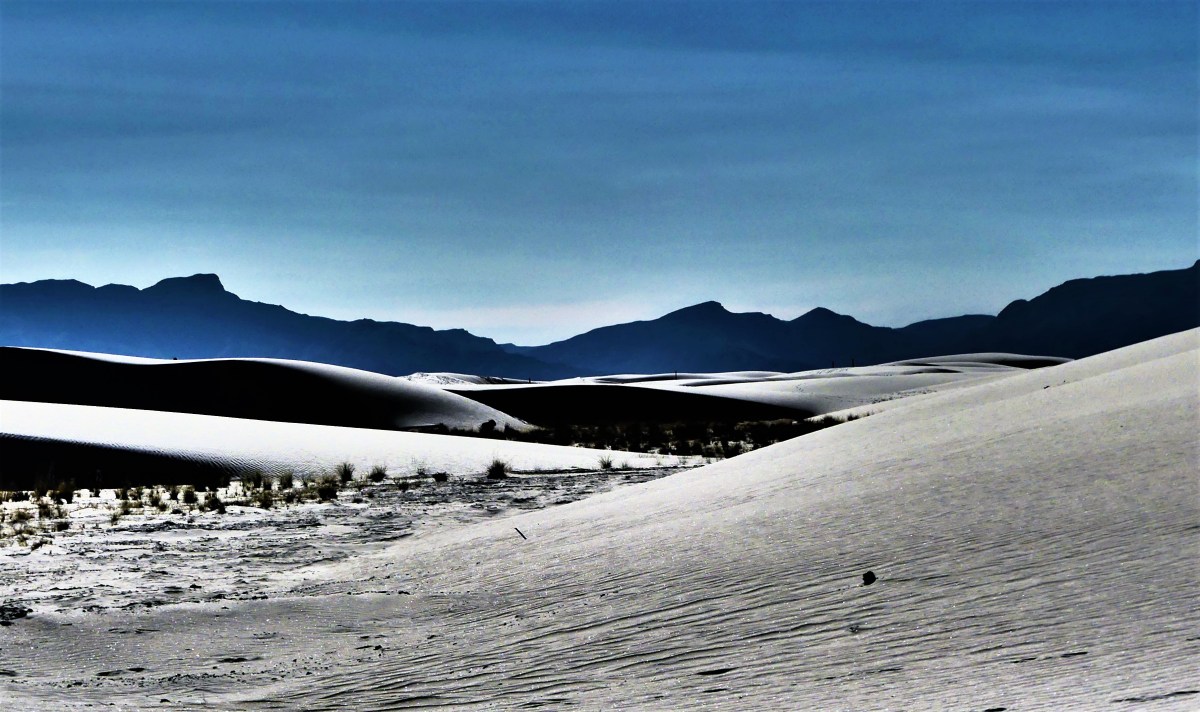
White Sands National Monument can only be described as other-worldly.

yin yang dune

The thrill of scrambling through the dunes,

dog-sled.jpg

and leaving temporary footprints in the soft white sand…

footprints

is humbling in the presence of its vastness.

dunescape

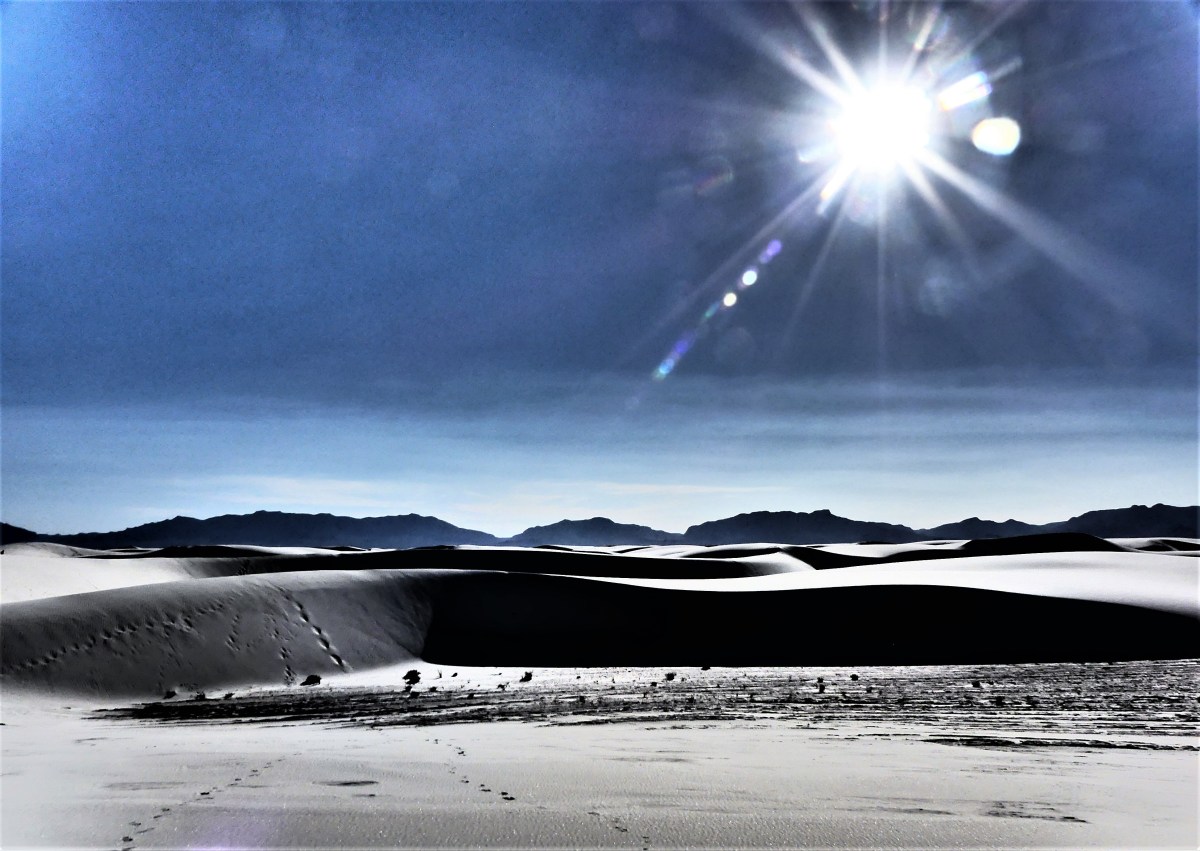
The ethereal gypsum dunes sweep across 275 square miles of the Tularosa Basin,

dune and sun

forming a complex yet delicate ecosystem…

beetle

…that supports the constant shape-shifting caused by precipitation and wind.

texture

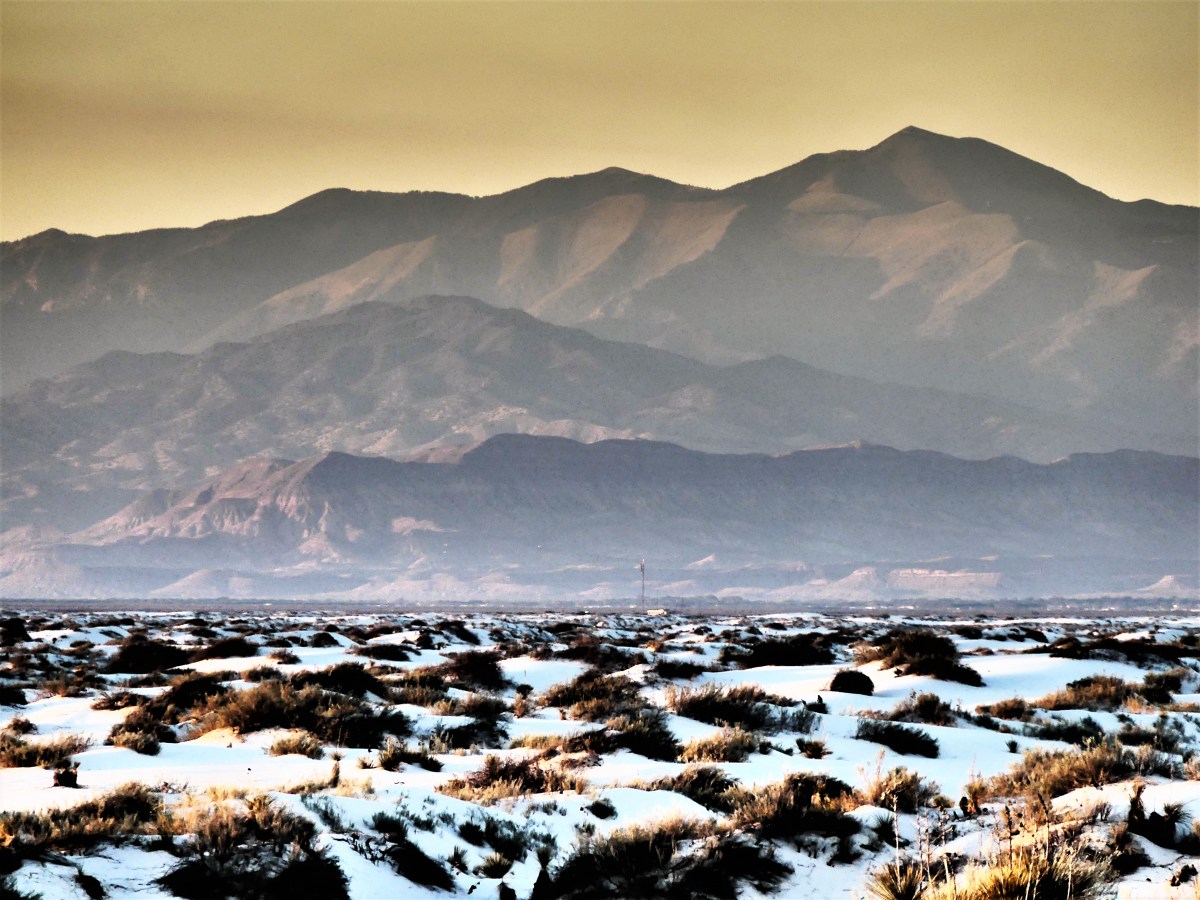
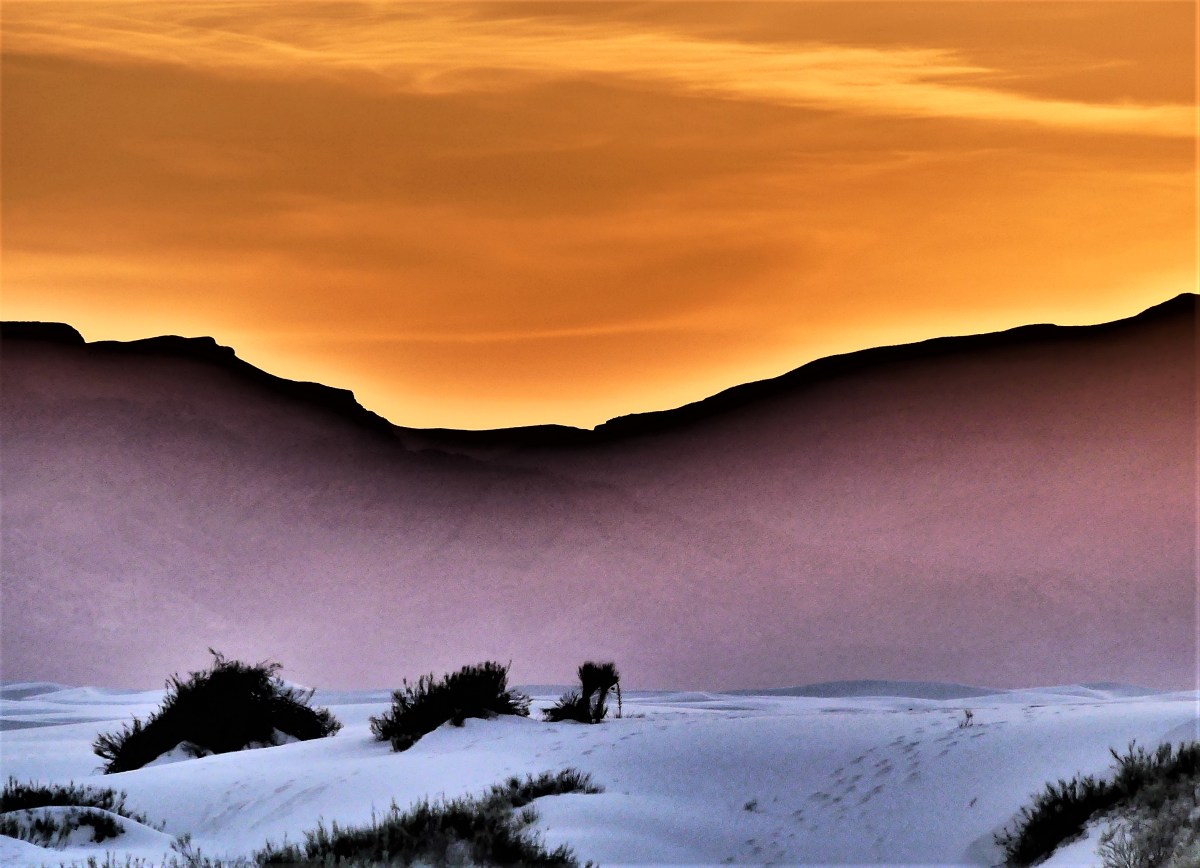
But the surrealism that surrounds the spectator…approaching sunset

intensifies when the sun dips below the horizon of the Sacramento Mountains…

mountain silhouette

quickly cooling the sand beneath one’s feet,

desert glow

awakening the magic that ignites the desert glow.

cactus glow

Hiking Hat Trick Completed

Tracking back through Lajitas and Terlingua into the Maverick Junction entrance of Big Bend National Park took us an hour, and put the time at 3:00 pm. Opting for a backcountry tour of the Chihuahuan Desert, we turned south onto Old Maverick Road, and turned up the dust behind our wheels on our way to scenic Santa Elena Canyon.

Two miles into our 13-mile drive, a Chevy 4X4 approached us head on. Rather than play a game of off-road chicken, I pulled over to allow him right-of-way. When the truck stopped parallel to me instead of passing, and the driver, a middle-aged graying male signed his interest in communicating, I lowered my window to satisfy my curiosity.

“I wouldn’t go down there, if I was you,” he advised.

“Is there something wrong with the road?” I asked.

“Well let’s just say that I been on this road for over an hour already, and I can’t wait for it to be over. It gets much worse down there, and I don’t know if you wanna do that to your truck. This here Chevy is for work, so I don’t give a shit what happens to it, but it’s your call,” he said.

“Thanks for the warning,” I said, and he drove away.

After the encounter, Leah and I sat in silence for a brief moment. “Wow,” I exclaimed, “Do you believe that? He thinks we should turn back.”

“I’m not gonna say,” Leah offered. “I’ll do whatever you want to do. At least we know how long it will take”

“Then fuck it! We’re moving forward,” I declared. “I’m not turning around because of him. Let’s see what this truck can do! All I ask is that you turn off the alarm (see: Ouch! and Ahhh!–Part One).”

“I can do that,” Leah promised. “But we’re on a mission and we’re running out of time, so you need to limit your stops.”

I wanted to agree in principle, but it seemed so unreasonable to pass up so many photo opportunities.

peak with cactus

desert

cactus flower

prickley pear blossom

However, Leah had a point. We still had a canyon hike ahead of us.

The road was as pitted and rutted as expected, but not the deterrent we anticipated. The truck suspension was very forgiving, and handled the rocking and swaying without a slip. What took the Chevy over an hour to travel, took the F-150 only 45 minutes to complete. (This testimonial should in no way be considered an endorsement for Ford, unless Ford is willing to pay me. I hope you are reading this, Ford!)

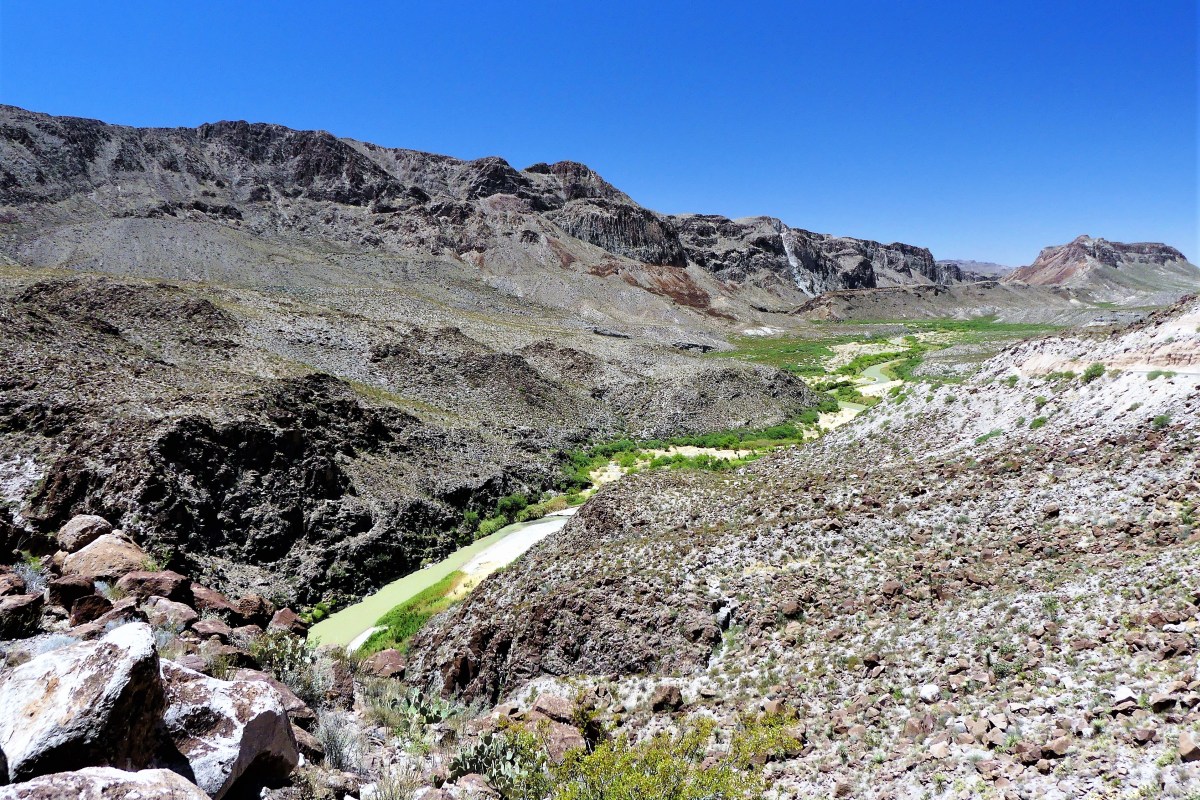
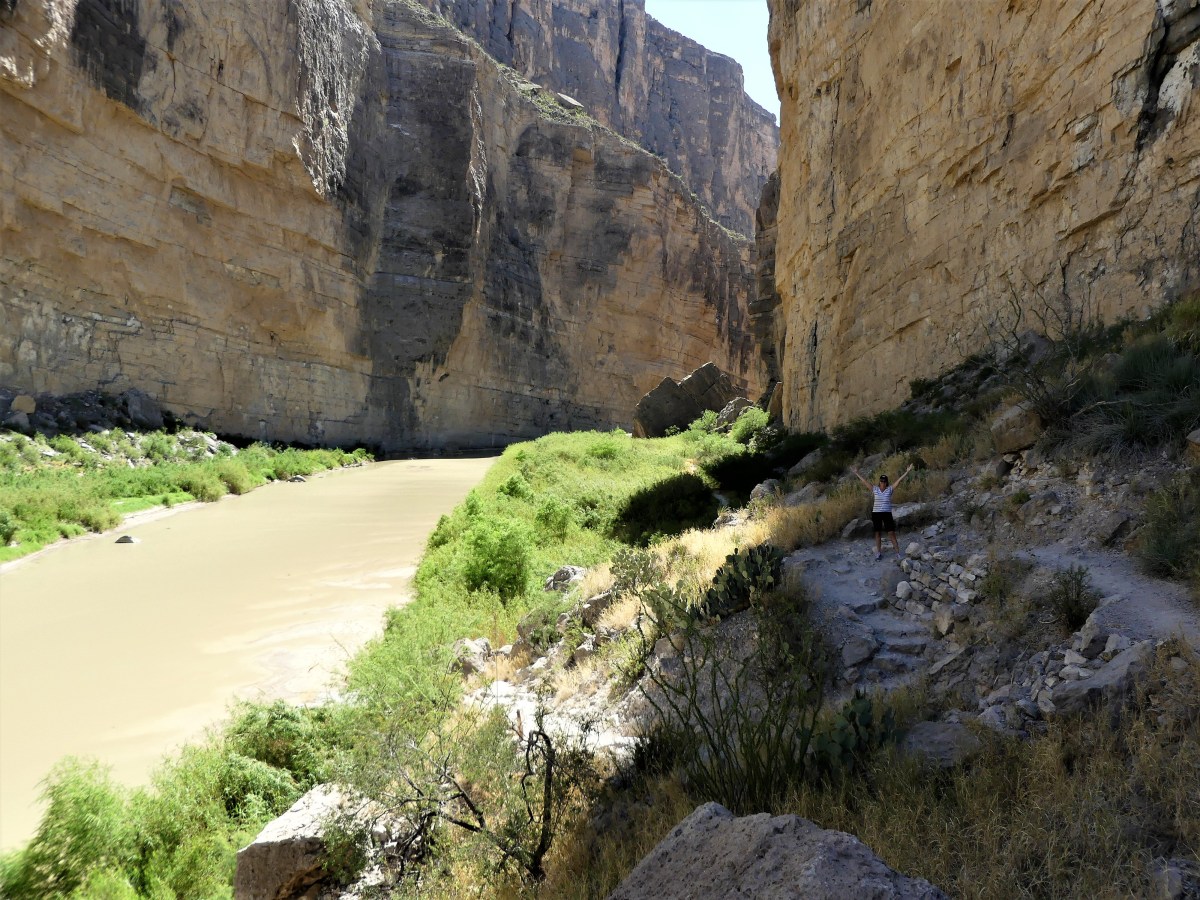
We arrived at Santa Elena Canyon parking when most visitors were leaving.  A slotted boardwalk led us to the river flats where the canyon opened into an expansive arroyo,

Santa Elena Canyon opening

where only a trickle of the Rio Grande diverted around a sandbar merging with the Terlingua Creek.

canyon wall

The hike into the canyon along the northern wall follows an observation path of concrete-slab switchbacks outlined with occasional handrails. The vista at 100 feet is sufficiently rewarding to most visitors who tend to take a few snapshots before returning to their cars.

observation trail

But the true reward awaits the hiker who takes the trail deeper into the canyon for a more immersive experience,

Leah and SEC

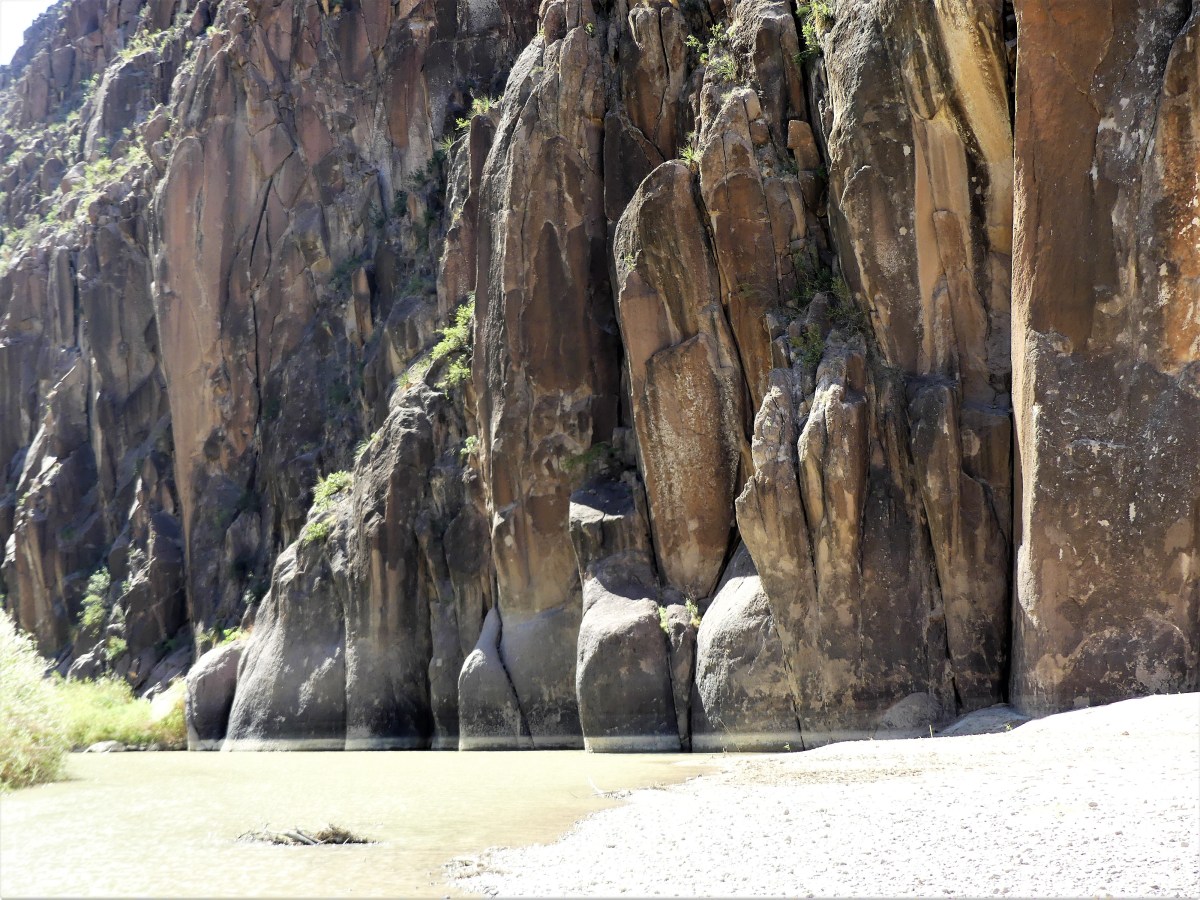
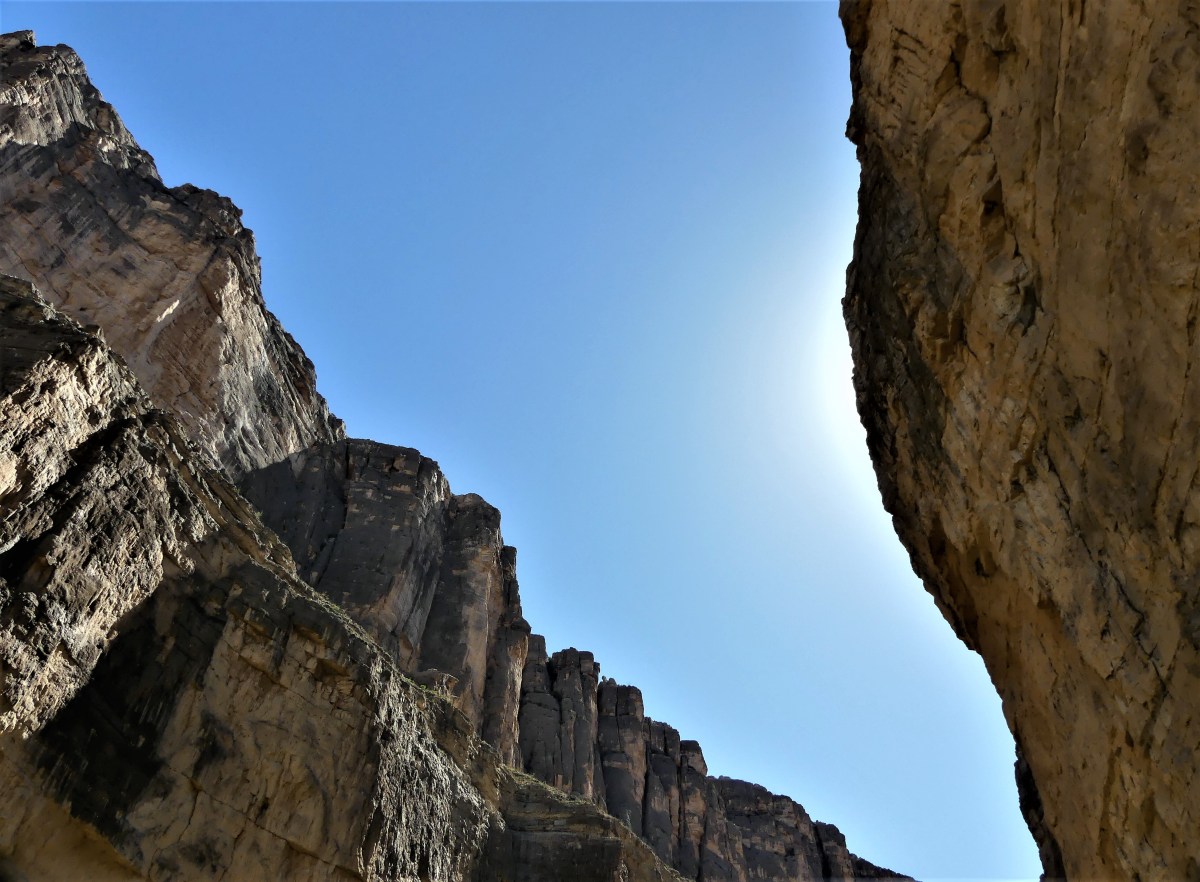
and a greater appreciation of the scale of the 1500 feet sheer walls,

cliffs

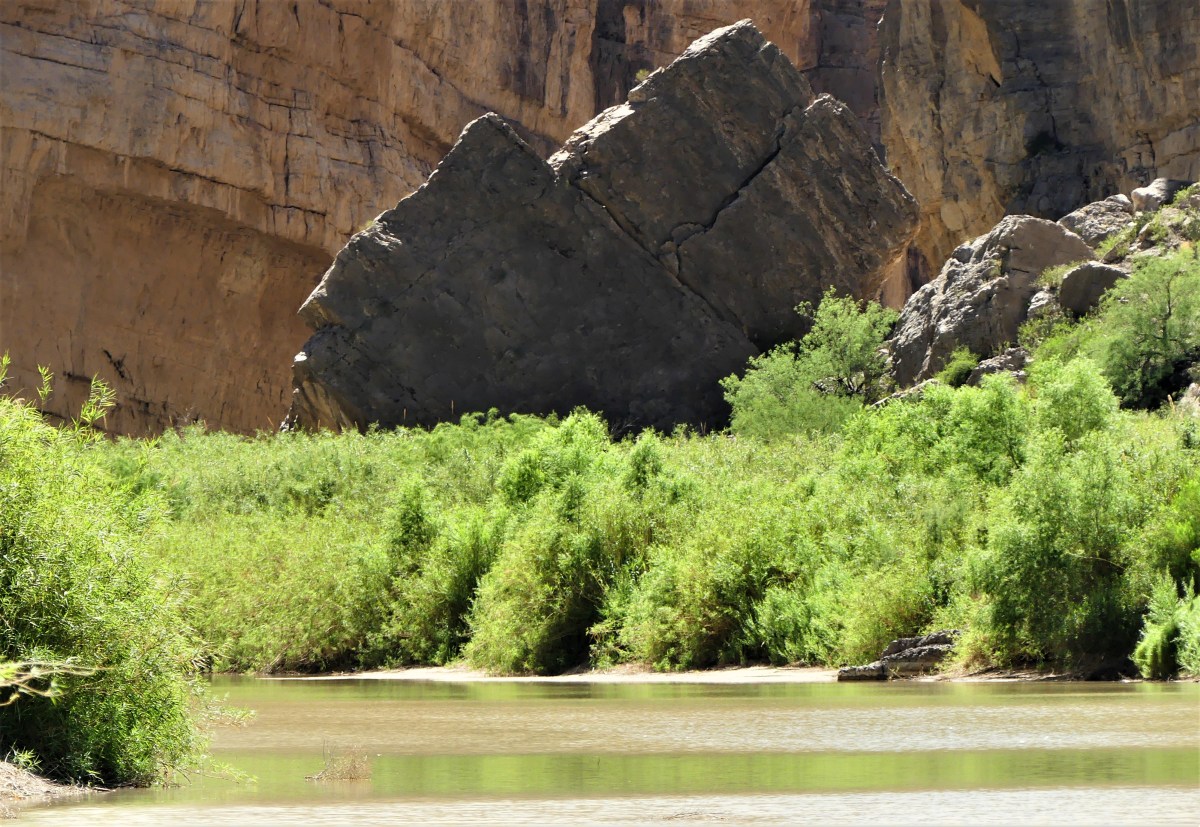
and the house-size rocks that have tumbled from the clifftops.

fallen rock

We took shade whenever we could, and drank the requisite gallon of water per day to avoid dehydration, yet we always seemed to be thirsty. By the time we reached the trailhead out of the canyon, we had drained our resources, but felt confident that the 13 miles to the store at Castolon Visitor Center—on the way to Ross Maxwell Scenic Drive—would allow us to resupply…or not.

The store was closed more than an hour before we arrived.

Disappointed and thirsty, we climbed into the truck, and drove the 22-mile route around the backside of the Chisos Basin to admire the ever-changing landscape. If we weren’t so parched, we might have lingered longer to take in the views, but I drove as fast as the hairpin turns would permit.

Not that I was completely indifferent to scenery. There were a few occasions that demanded I stop and allow the natural beauty to wash over me.

far view

mules ear

what a butte

Another 13 miles past the junction intersection, and we finally completed the western loop around the park. While Leah napped, I struggled with the final 20 miles from the park gates to Lajitas. It took every last bit of will power to make it home, knowing that a well-deserved ice-cold Dos Equis would be waiting in the fridge, demanding I “Stay Thirsty”.

It was 7:00 pm when we finally opened the Airstream door, only to collapse.

We had completed 10 hours of non-stop activity, gratified by the experience, overwhelmed by the grandeur, and elevated by the notion that two old farts could still last the whole day.

Hiking Hat Trick—2nd Goal

The ride to Closed Canyon Trail, the only slot canyon in Big Bend Ranch State Park, took us past the park picnic area, revered for its iconic teepee overhangs.

picnic tpsThe road continued another 7.5 miles up and down multiple grade changes, curling in and around exposed mountain walls, and mimicking the serpentine lines of the Rio Grande, making it a driver’s delight and a passenger’s revelation. It’s little wonder that El Camino del Rio has consistently ranked as a “ten-best” scenic drive in America.

road viewThe signage throughout the State Park suffers because of its immensity (300,000 acres) and limited resources, so having Mike as lead proved advantageous, since it would have been so easy to overshoot the trail head in favor of the surrounding vistas and roadside scenery.

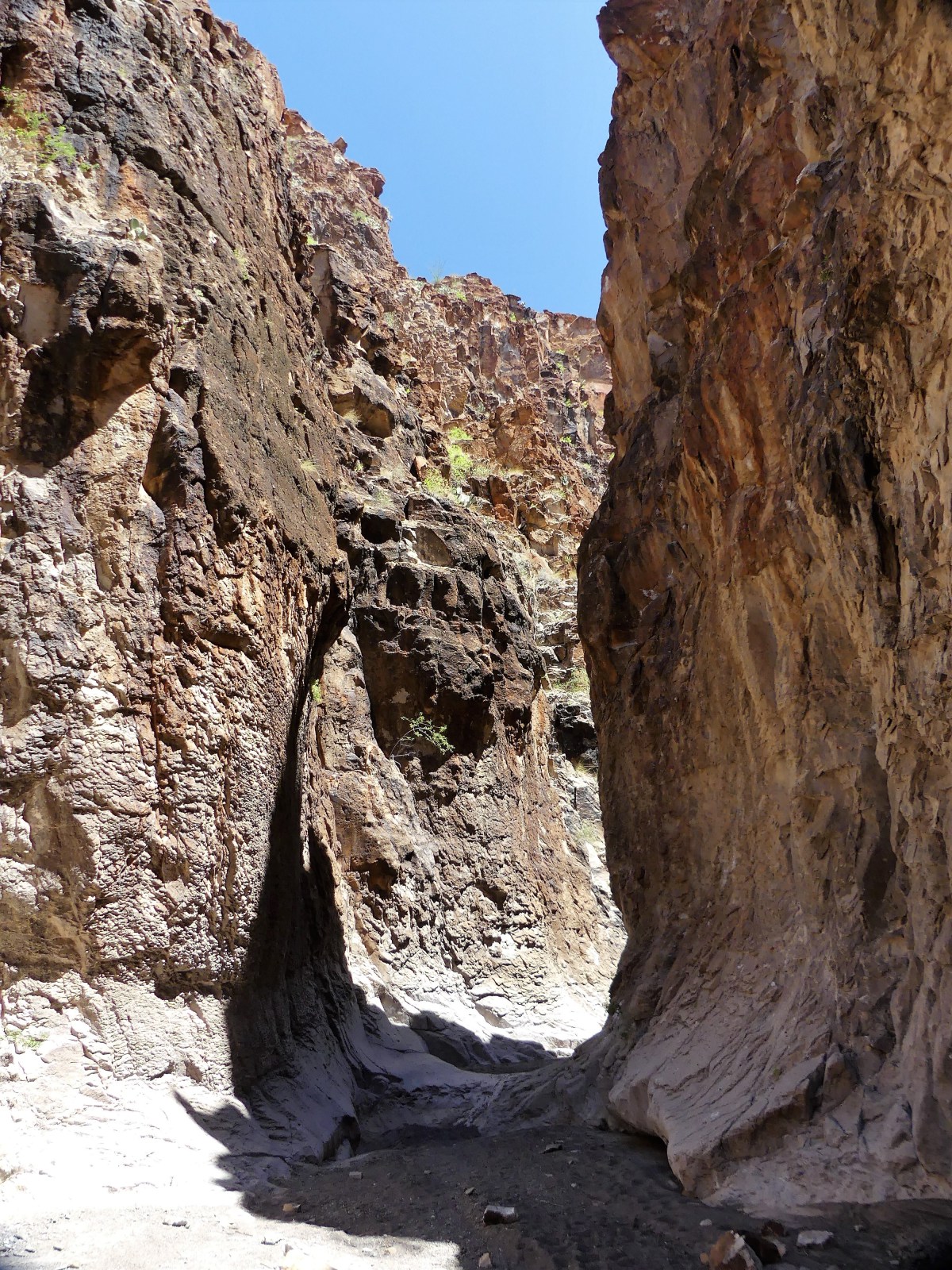
The approximate geologic age of the calderas (a collapsed volcano) which formed the Colorado Mesa is 28 million years. The slot canyon evolved from millions of years of water erosion, steadily carving into the Colorado Mesa until it split in half, resulting in a canyon trail that runs 1.5 miles until it drops into the Rio Grande.

“Be careful where you walk,” advised Mike.

High cane grass lined the approach to the trail making us wary of Western diamondback rattlesnakes. We mindfully walked a short distance down a small hill into an arroyo to access the mouth of the canyon. The sandy floor was littered with boulders.canyon mouth“Anything we should watch for?” I asked.

Mike thought a minute before responding, “It’s doubtful we’ll see a mountain lion, although they hang out in this area, but maybe we’ll get to see some javelina.”

“I doubt we’ll see anything at all,” Leah sighed. “Animals, for some reason, seem to avoid us.”

“Here, gator gator gator!” I jested.

Leah to Mike, “It’s an old joke.” (see Where Have all the Gators Gone? (Long Time Passing…)

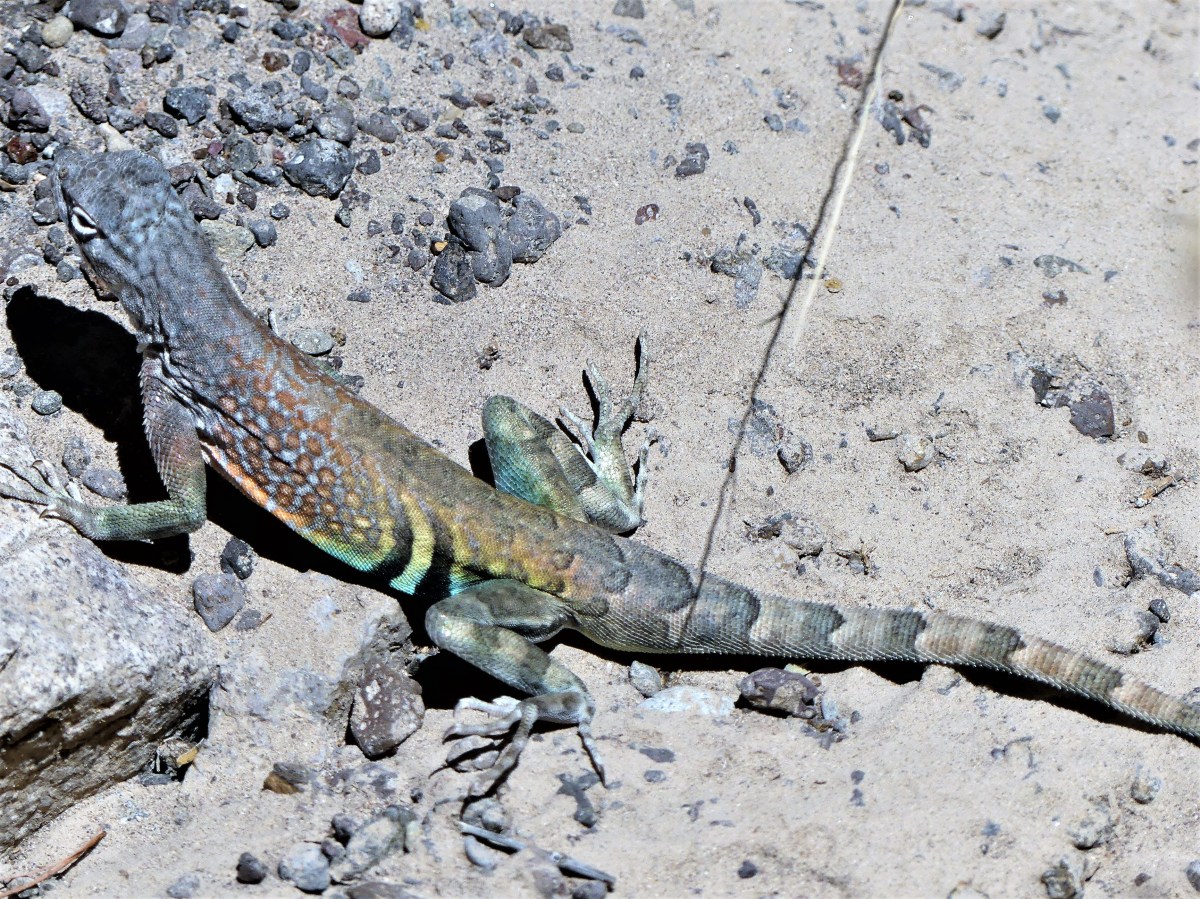
But then—as if on cue—our conversation was no doubt overheard by a greater earless lizard, who darted across the canyon bottom and froze, waiting for its close-up.

lizardWhile the wildlife sighting reanimated us, Leah wasn’t sufficiently satisfied.

Thinking it was an omen, Leah roared, “Here, lion lion lion, here lion,” her voice echoing inside the chamber walls.

Mike and LeahUncertain of Mike’s politics, I lobbed him an ICE-breaker. “Any chance,” I subtly inquired, “we’ll have a Mexican sighting?”

“Unlikely,” he started out. “The canyon ends with a vertical drop to the river that requires climbing gear. But during monsoon season, this place flash floods, and all that water shoots out over that ledge into the river.”

“So technically, you could ride through here in a kayak?” I asked.

“It might be cool to do if you’re into danger,” he answered. “In fact, it would be tricky, but I would be into it!”

Mike was still avoiding the premise of my question, so this time I was more blunt. “But do you think building a wall out here would do any good?”

“Are you kidding?” Mike answered. “Obviously, they would have to build it on the Texas side, but that would keep everybody who comes here from enjoying the water. And besides, why would anyone want to spoil this amazing landscape?”

canyon opening

canyon wall 2No argument from me. We worked our way further into the slot, scrambling over, around, and down water-polished rock, sometimes stopping to avoid the many tinajas–potholes of jaundiced water of undetermined depths scattered across the canyon bottom.

slot canyon puddleAfter an hour on the trail we reached an impasse. At this point, the canyon walls were narrow enough to touch with both arms extended, but the tinaja before us was too deep to ford, and too wide to bypass. All we could do was turnaround and hike out.

We savored the moment that brought us our second goal, and relished the notion that there was still more to see and do before the day was done.

Hiking Hat Trick–First Goal

At the risk of becoming too comfortable with scheduling only two activities a day during our destination stay, our last full day before moving on from Big Bend presented an opportunity to squeeze in three. That’s right…we were going for the hiking hat-trick!

By rights, we were being overly ambitious—biting off far more than we should ever chew—but as we’ve found since starting out, time is not our friend. Not to be melodramatic, but we may never pass this way again…and if we do (whether in this life or as Shirley MacLaine), it may not be with the same get-up-and-go. So, while we still can, we will continue to fool our bodies into believing we are first-round draft picks.

Typically, before dropping anchor, we’ll have researched most meaningful possibilities in our area. Then we’ll cherry pick around our common interests based on associated cost (we’re on a budget!), reasonability (is it safe and sane?), and time (is there enough of it?). By adopting this strategy, we’ve managed to stay focused and in sync.

But on this particular day, we agreed, “Who cares what it costs! This is totally insane! We’ll never have enough time! So, let’s do it!” On this day, we would canoe down the Rio Grande and hike through Slot Canyon while at Big Bend Ranch State Park, then return next door to Big Bend National Park for a backcountry drive to Santa Elena Canyon, hike the Santa Elena Canyon Trail, and return through the Ross Maxwell Scenic Drive.

Two days earlier, we reserved with Angell Expeditions for a Sunday float. For many, the holy grail is to raft through Santa Elena Canyon in the shadow of its 1500 feet canyon walls while attacking Class IV rapids. However, local outfitters were eschewing the Santa Elena junction put-in due to historically low water levels.

waders vertical

Instead, we agreed on a canoe trip through Dark Canyon in the State Park—not nearly as dramatic as the former—but at least we’d be floating on water, rather than pulling our boat across it.

We put in at Madera Canyon at 10:30 am.

River access

Angell ExpeditionsAnd found we had the whole river to ourselves.
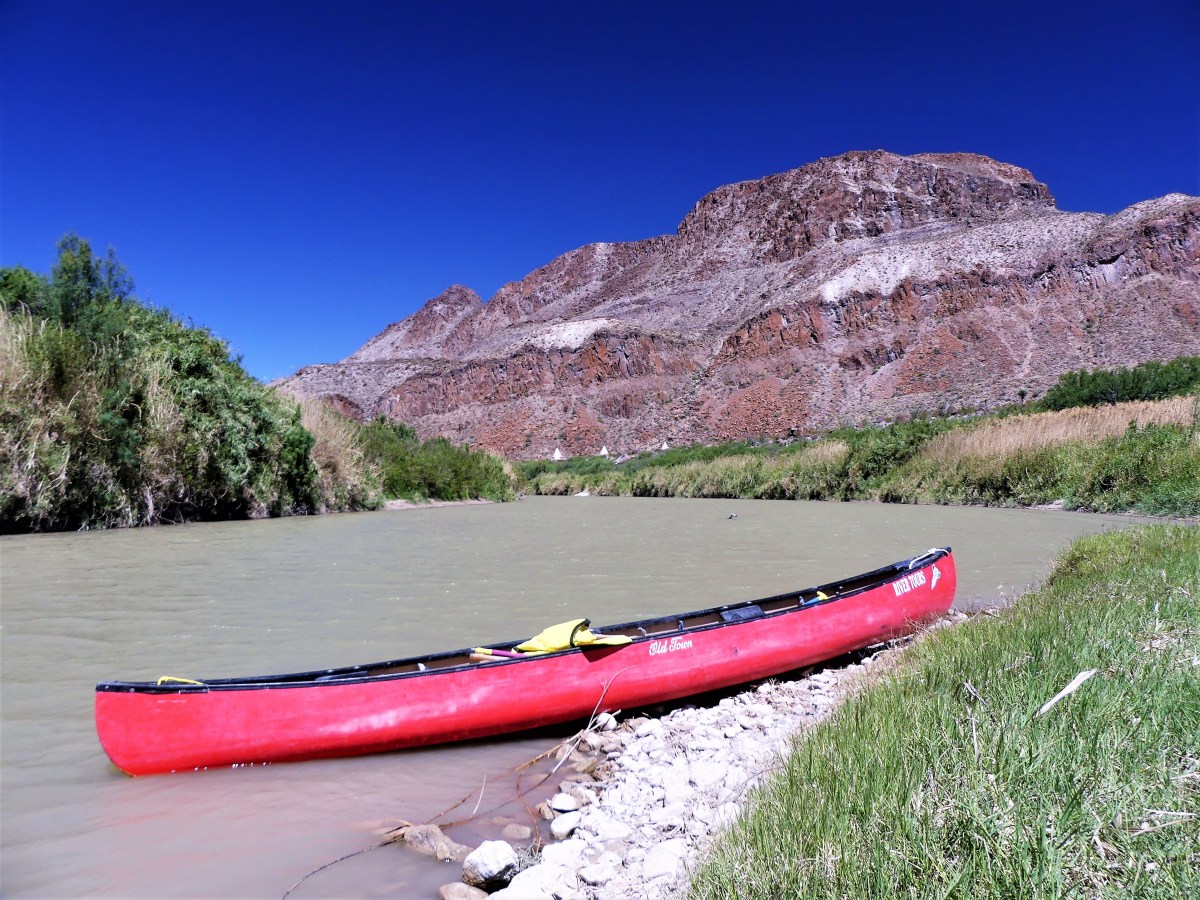
3 tps in the distance w canoeIt was Mike, our river guide in one boat and us—with Leah at the bow and me at the helm—in the other.
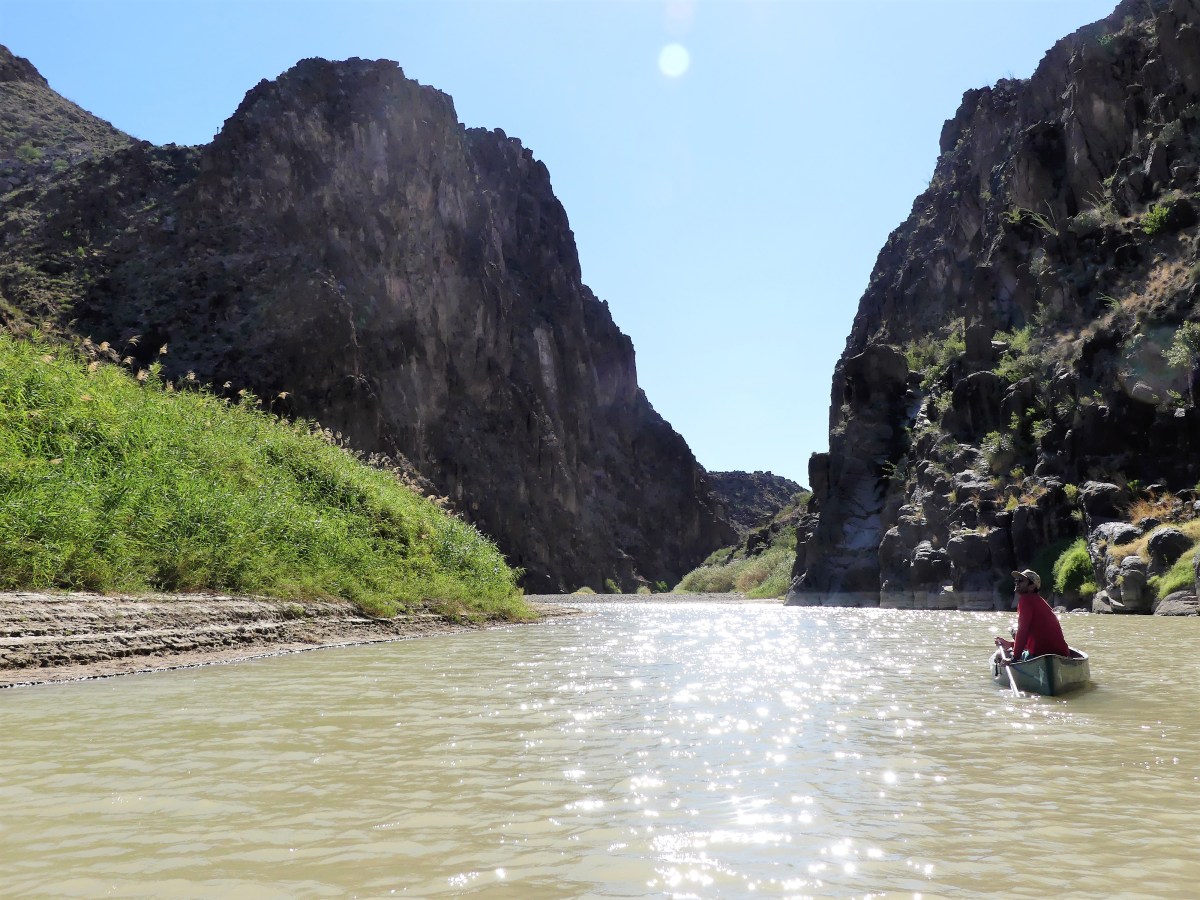
Mike on the riverThe air temperature was equal to the water temperature at about 75°, and the wind was at our backs. It could not get any better, or be any easier…until we reached the first of three technical skill zones.

While not exactly Class IV water, the rocks and current still made the run challenging and fun. To avoid tipping the canoe, Mike had us stop each time to survey the water. We walked the shoreline, and watched how the fast-moving water was running in order to plan our route. After easily demonstrating the turns in his own canoe, Mike ceded the river to us to try for ourselves.

First time out, Leah panicked. “I’m not doing that. It’s too soon to go swimming. I’d rather walk it.”

“C’mon, Leah,” trying to encourage her. “It’ll be fun.”

“Not with you steering, it won’t!” she bellowed. “I’m not getting wet. Why don’t you do it with Mike.”

Mike agreed. With me in front, and Mike at the helm, we glided between the rocks, and sailed through the water effortlessly.

“See,” I crowed, “that wasn’t so bad.”

“Sure thing.” Leah was unimpressed. “I’ll do the next one,” she offered with uncertainty.

After 30 minutes of lazy floating, it was show-time yet again. We repeated the same set-up procedure as before, and Mike made it look just as easy as before, but these rapids were faster and rockier, and required more finesse.
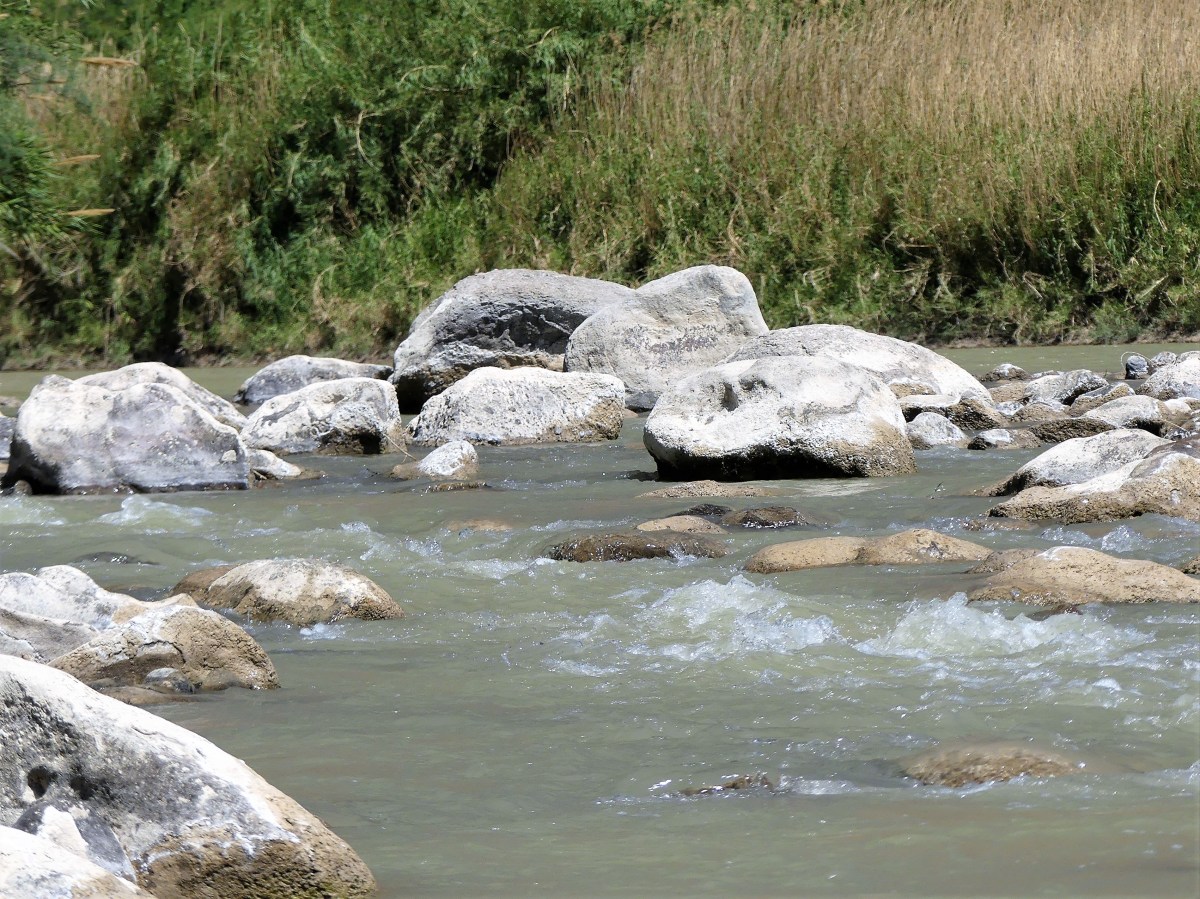
fast water“With this one,” Mike warned, “it’s very easy to capsize, so if you feel the boat tipping, just step out onto the rocks.

“No problem,” I mustered.

“Yeah, right!” Leah mocked.

We valiantly headed into the white water, picking up momentum, and following all of Mike’s directions perfectly.
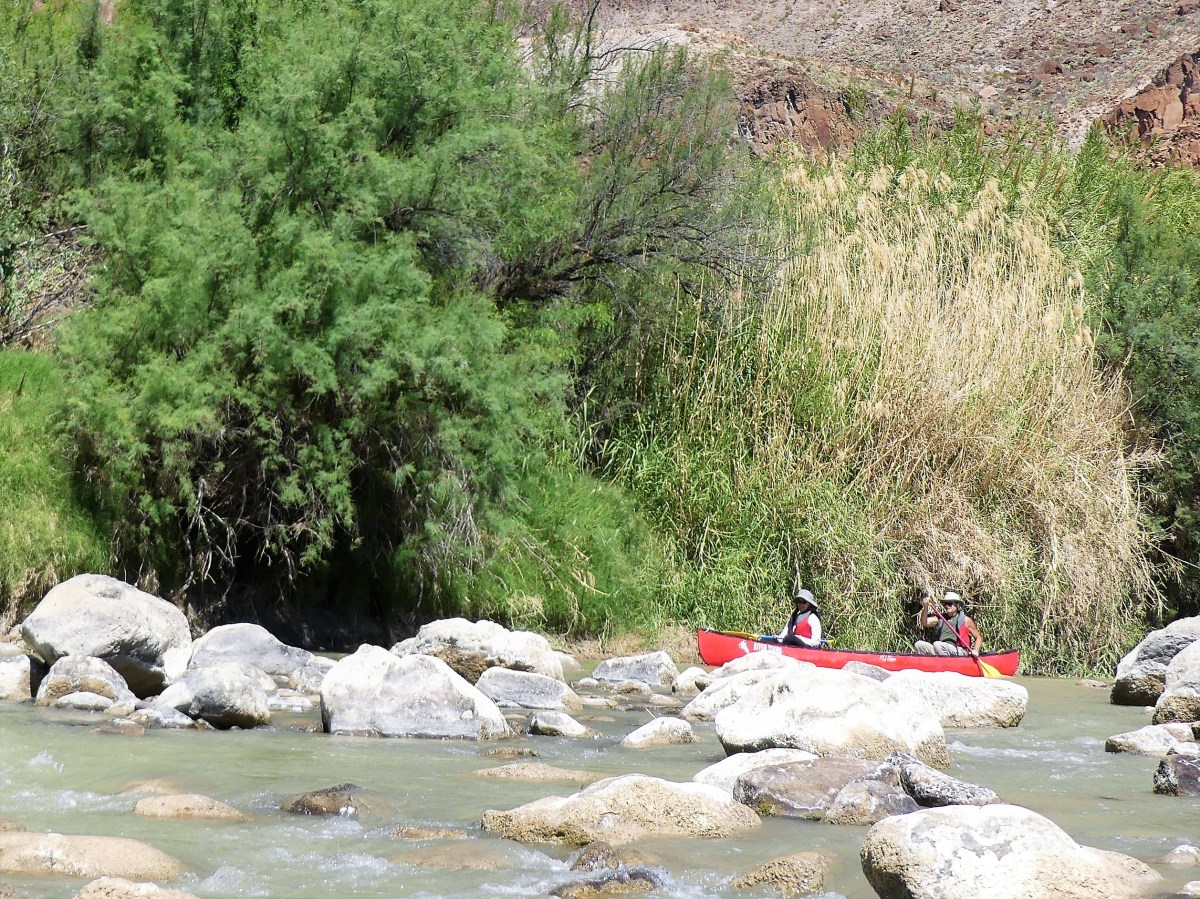
negotiating fast water“I don’t know about this,” Leah yelled.

“Just keep your paddle out of the water, and I’ll guide us through,” I yelled back.

Neal Leah rapidsI zigged when and where I was meant to zig, and zagged at the appropriate time and place, until…

“LOOK OUT!” Leah screamed.

…a very large boulder suddenly jumped directly in the path of the canoe, spoiling my perfect run. The boat got caught up on the rocks, turning it sideways just as Mike predicted, and the rushing water was forcing the boat over.

“DO SOMETHING!” Leah screamed.

So, I stepped out as instructed—keeping the boat steady—and pushed it through the last turn, while Leah traveled like Cleopatra.

“I’ll have you know that I had nothing to do with that. You told me to keep my oar out of the water, so it’s not my fault.” she gloated.

“It must be nice to be blameless and dry,” I said to myself.

With the wind gusting at 20 mph, we were quickly approaching the take-out area, yet it was only 12:30 pm. The tailwind had cut our expected float time in half.

Fandango location

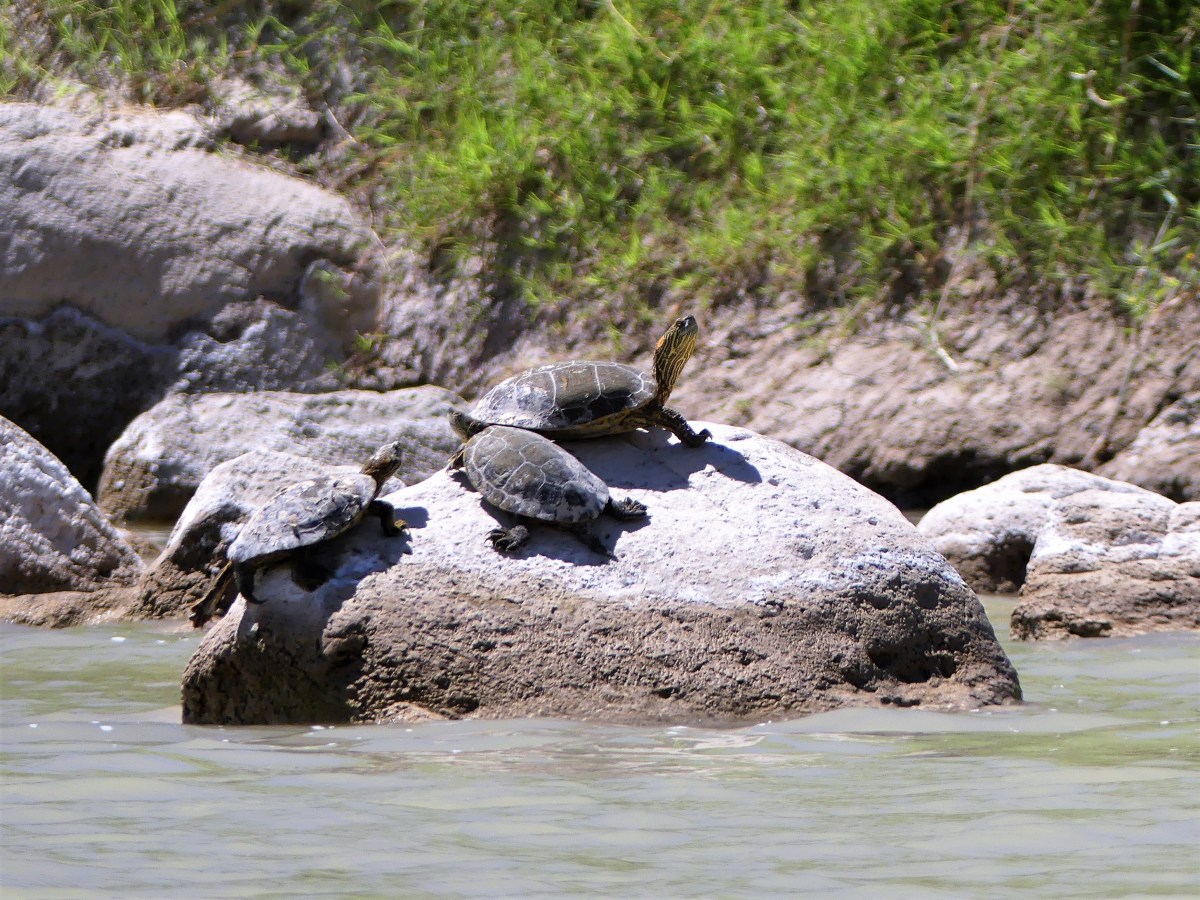
Basking turtles“Is that it?” asked Leah.

“End of the line,” confirmed Mike. “This is where the truck is parked.”

Feeling badly, Mike added, “I know it seemed like a short trip, but if you’d like, we could head up to Slot Canyon and do a hike. It’s not like it’s out of my way.”

Leah and I exchanged glances. We had intended to hike the canyon on our own anyway.

“Absolutely,” said Leah.

So, we got in the truck and followed Mike over the mountain, on the way to our second goal.
 

Ouch! and Ahhh!–Part Two

*For those who are reading postaday blogs, please see Part One first to follow the narrative. Sorry for the inconvenience.

Previously on Streaming thru America… (see Ouch! and Ahhh!–Part One, previously published)

Neal and Leah were both feeling the effects of the heat–both inside and outside the F-150. Temperatures had climbed to 103º on the trail, while the mood had turned icy in the truck. Additionally, Neal had aggravated an old knee injury, and Leah was feeling tired and dehydrated.

And now, Streaming thru America is pleased to present…

Part Two: Ahhh

After the hike, it became necessary to regroup at the Airstream. It was our last day in Big Bend and it was only 4 pm. Both of us agreed that we weren’t yet finished for the day. If we could rally after our siesta, then we could pull off one more hike.

But we needed a rejuvenation tonic—a game-changing elixir that would fuel our core and boost our disposition. And given the state of our limited supplies, it had to help us clear our head, yet give us the false sense of security we needed to fool ourselves into thinking that we could endure another adventure. Bottom line—we made frozen strawberry margaritas. Who knew they could be so energizing?
Timing was everything. With the sun expecting to set at 8:30 pm, a light dinner got us out the door and back on the road towards Hot Springs Trail, part of our Big Bend bucket list. Thankfully, not a long drive, it was only ten minutes to the turnoff from Rio Grande Village, and another four miles in to the trail head, but what a drive!

Halfway through the white gypsum track, the road split into two extremely narrow one-way hairpin switchbacks that hugged a striated canyon wall for the balance of the journey.

rock strata

It was a race against time. With the sky expecting to produce a saturated sunset, and the time it would take to traverse this obstacle course, I folded my mirrors in toward the truck, and held my breath as I cautiously moved forward.

It was harrowing yet exciting. The view out my window was nothing but air, while Leah, if so inclined, could reach out her window and file her nails against the cliff. But to her credit, she never said a word about my driving, as she braced herself against the armrest, in anticipation of a catastrophe. Or maybe her silence was driven by my encouraging words as we approached the switchbacks:

“Don’t say another word,” I loosely suggested, not trying to control her.

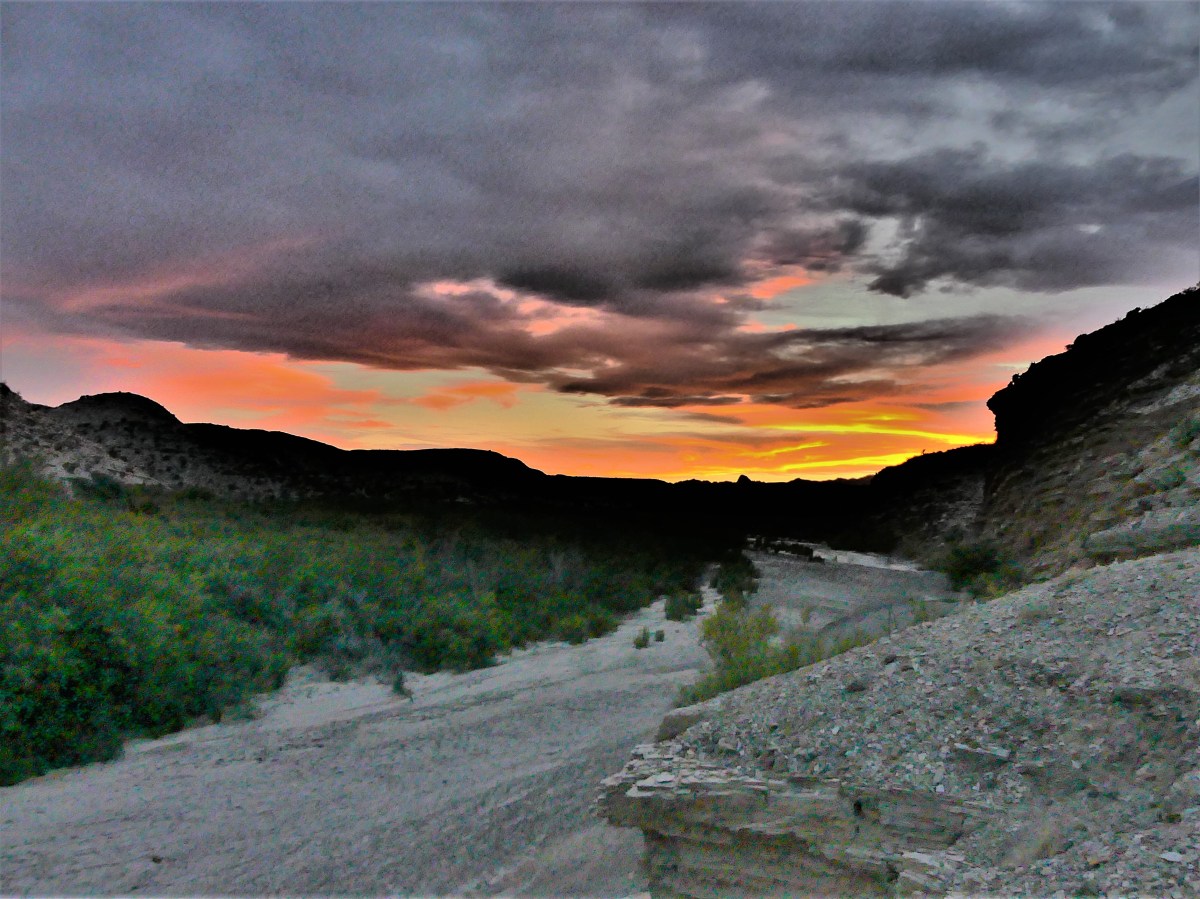
I successfully negotiated the F-150 into a parking lot occupied by other three cars. Wanting alone time with Leah, it was a bit of a letdown seeing company, but my new objective was to catch the sunset. I sprinted up a small hill with my camera swinging, to gain enough of an advantage over low rising trees just as the sky exploded into colors. I took in the view and my knee didn’t hurt a bit.


sunset

I also had time to capture the ruins of a limestone block cabin, that once served overnight visitors who had come to benefit from the healing properties of the mineral waters that Leah and I were about to experience.

Langford House

“Now the trail to the water will be dark,” Leah lamented, “because you had to take so long taking pictures.”

“I have a remedy for that,” I declared. I switched on the flashlight and lit our way down a lush reed-lined path, half a mile along the river, until we stood at the fallen foundation of a bathhouse spa built by J.O. Langston in 1912.

We eased ourselves into the 105º water currently shared by four other visitors. Everyone present had finished a hike in the blistering sun earlier in the day, and was eager to soak their aches and pains away in a hot oasis of salts and minerals.

Langford Hot Springs1

Langston had reported in his autobiography, “A Homesteader’s Story”, that by bathing in the spring water, and drinking it as prescribed by local Indians, he had completely regained the strength he lost from several debilitating bouts of childhood malaria. Claiming deed to the spring, he eventually moved his family from Alpine, TX and developed the property into a successful health attraction and trading post.

The remains of the bathhouse only adds to the character and allure of the location. While the Rio Grande flows on one side of the foundation wall, a floor vent on the other side is releasing over 200,000 gallons of geothermal water a day, pushing the overflow into the river–perhaps, an early rendition of now-popular infinity pools. Strategically sitting in the cool river while leaning against the hot spillover produces the strangest sensations and the best “Ahhh” results.

A break in the trees along the trail to the parking lot revealed a quarter moon and a black sky accented by millions of stars. Our fellow hot-tubbers neglected to bring a flashlight, so they followed our flashlight beam as we all walked back together. A college coed from the pack identified herself as a Langford, and thought she might be somehow related to the spa patriarch, thinking she could claim the spring for herself.

“But it’s a National Park, dear,” I reminded her. “It belongs to all of us.”

It was a perfect finish to a long day, and I had to admit that my knee never felt better.

*For those who are reading postaday blogs, please see Part One first to follow the narrative. Sorry for the inconvenience.


Ouch! and Ahhh!–Part One

Big Bend kicked my butte today, but it also offered the perfect remedy.

Part One: “Ouch!”

Just beyond the Chisos Basin turnoff, I pulled the F-150 onto Grapevine Road, a rocky and powdery six-mile approach to the trail head of our next adventure: Balanced Rock. Far from smooth, but never boring, the ride to the trail head was a struggle between watching where I was going and watching the ever-changing landscape through the driver-side window.

Grapevine Rd

“Watch where you’re going,” Leah warns. To my ears, it sounds more like an admonition.

Over the past two month, I believe I’ve finally adjusted to driving the F-150–becoming more comfortable with its size; more reliant with its ability to haul and tow; and more familiar with all the technology built in by Ford. However,   unknown to me at the time I bought the truck is a pot-hole alarm that keenly scans the road terrain and sounds off when approaching a rough patch ahead; it’s a cool feature that’s intended as an alert to slow down and avoid the upcoming ditch when needed. While it’s worthwhile and dependable most of the time, the only way to disable it is to tell Leah to close her eyes.

Even through we’ve been off-roading for over a month now, I have hoped that Leah’s anxiety and criticism about my driving would have subsided by now. My defense is always the same.

“You’re welcome to drive anytime you like,” I offer, knowing how intimidated she is of the rig size.

“That’s not my job, that’s your job,” she always counters.

“So why are you complaining? We always manage to make it back alive, and in one piece!” I protest.

And her familiar rejoinder is always ready. “Well, maybe you won’t be so lucky next time!”

“Luck has nothing to do with it,” I say to myself.

Nevertheless, the ride is distinguished by all the outcropping of rocks so close to the road. There is so much to see that is awesome, that awesome becomes the new ordinary.

crazy face

We soon arrive to a smattering of 4 X 4-worthy vehicles parked on a plateau beside the road. Not wanting to crowd the trail, I elect to drive by and continue on Grapevine Road to see where it leads.

“You missed the trail head,” Leah advises. Her tone now borders on admonishment.

“I know, I answer, “I just want to explore to the end of the road. It’s not that far from here.”

“How are you gonna turn around if the road’s too narrow?”

I am completely unaware of the “narrow road alert” feature on the truck until now. “I’m certain there will be a turnaround at the end of the road.”

“But you don’t know that for sure,” Leah continues.

“Just a little bit of trust, please,” I manage, “and a little bit of credit to the civil engineers who built this road.”

When we get to the turnaround at the end of the road, we notice an occupied campsite with a blue pop-up tent and a folding chair. We both agree that this kind of camping is far too remote for the both us, and just like that, we’re on equal footing again.

us

I’m pleased to see that trail head parking has thinned out upon our return. The hike is considered moderate—a mild incline of desert terrain with a steep eighty-foot ascent at the end—but my right knee is acting up from a twelve-year-old skiing accident, and two subsequent arthroscopic interventions. All I can do is keep pushing forward, watching where I step and how I step.

“I thought you were gonna take some Aleve before you left,” Leah offered.

“But that’s not an option now, is it?” I say to myself. I never realized until now that the truck’s warning system comes with a mobile app extension. “I’ll just have to manage,” I reply aloud.

listing rock

We arrive at the uphill finale, which is not as terrible as I had imagined. While rock scrambling is inevitable, the footing is reasonable.

the thinker

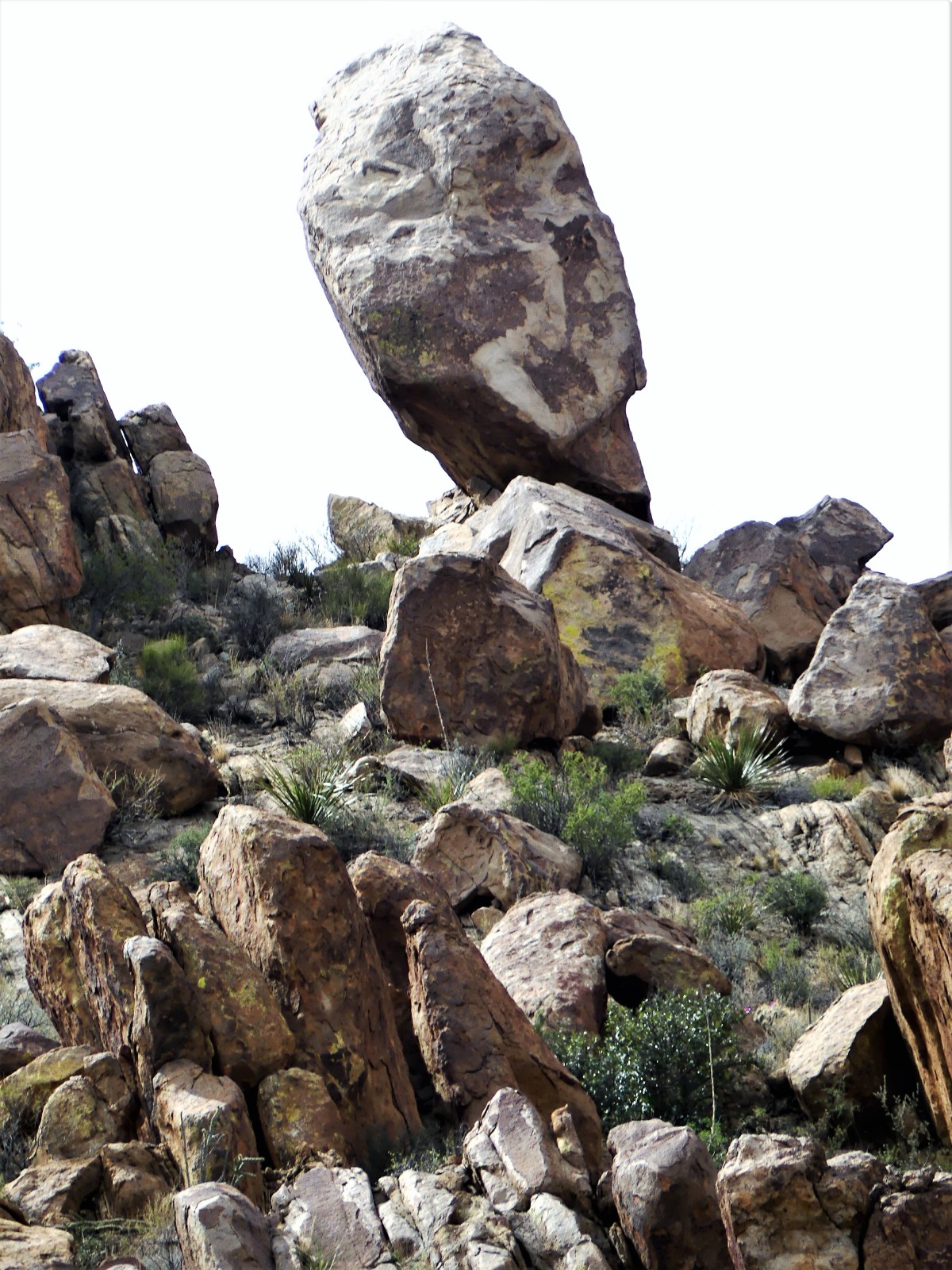
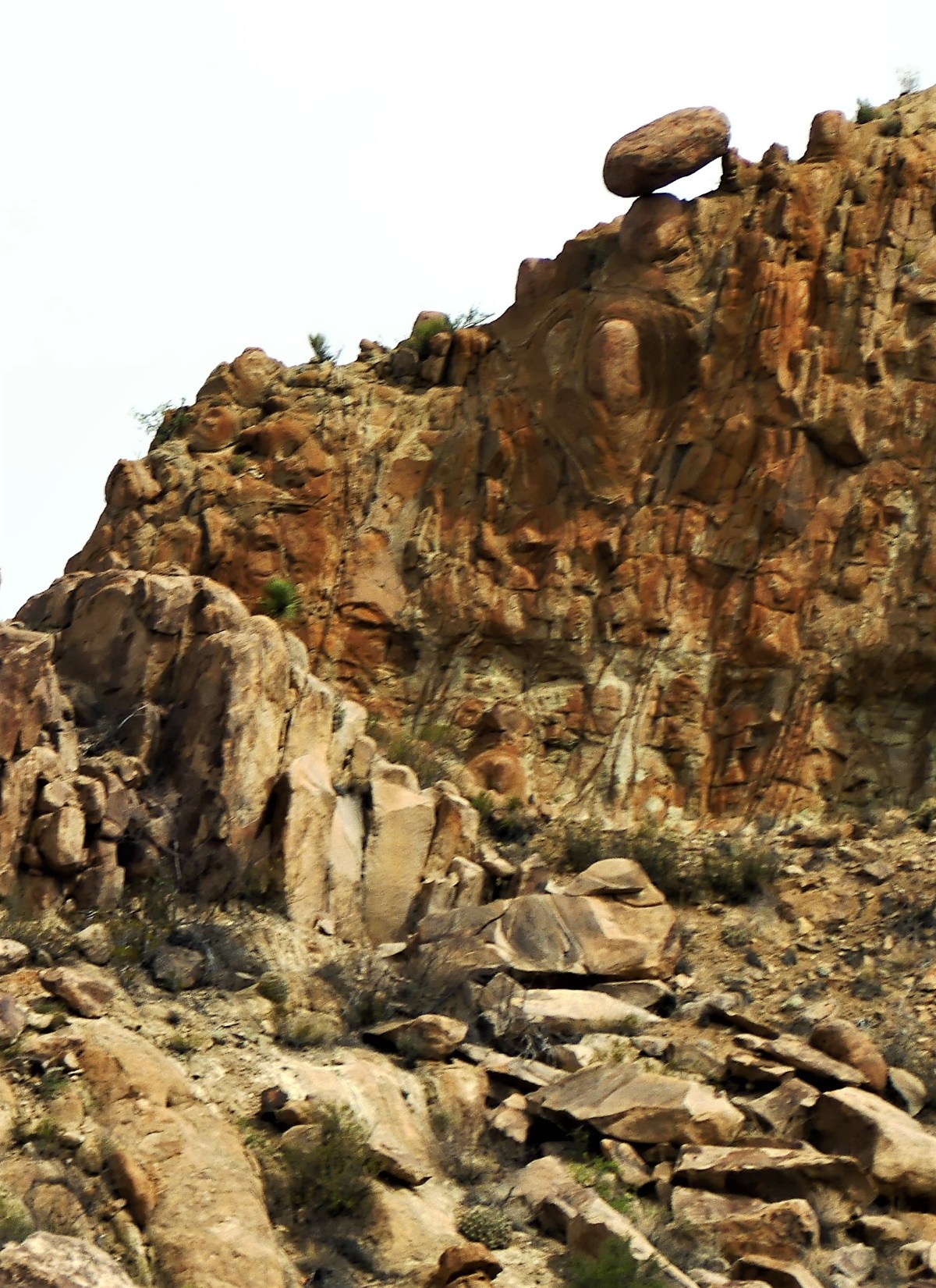
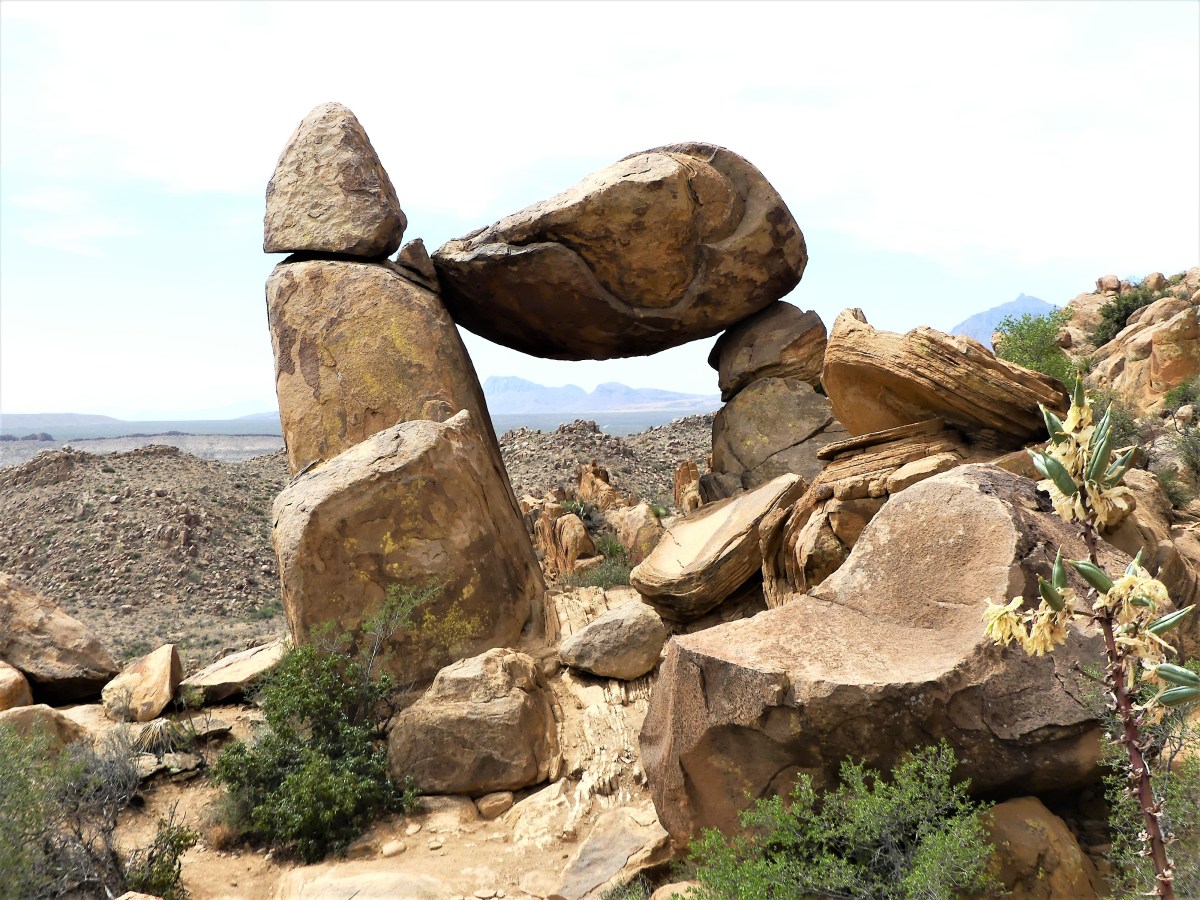
Interestingly, the pain seems more tolerable the closer I get to the hike’s payoff, which in this case is spectacular—a distant mountain vista framed by a window of balanced rocks,

balance rock

…and a new twist on an old cliché:  NO GAIN, NO PANE!

Stay tuned for Part Two: “Ahhh!”


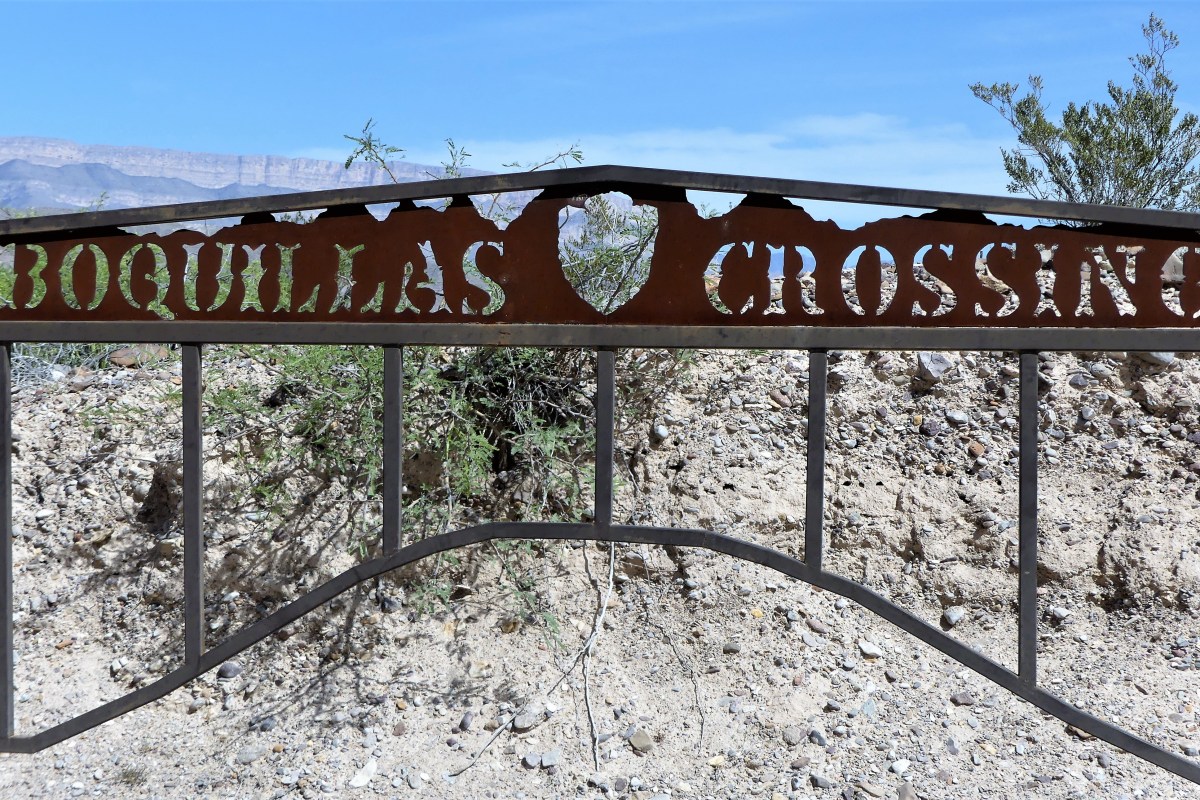
Boquillas Crossing

Today I met a national park service ranger by the name of A.L. Weimer who wore a bulletproof vest and carried a police-issue sidearm. While there are daily sightings of mountain lions and black bears throughout Big Bend National Park, I think his handgun has less to do with keeping the animals in line, and is more intended as a show of force in case any renegade Mexicans or Islamic terrorists get any big ideas about invading the U.S. through Mexico.

If so, Ranger Weimer, who manages the Boquillas Crossing, then becomes our first line of defense. Of course, thanks to our 2nd Amendment, I’m certain that many park visitors would rally in defense of our great nation, and arm themselves with the requisite arsenal of spatulas and Swiss army knives, or whatever else they could muster from their tents and RVs to hold off a foreign attack on American soil.

regulation sign

Leah and I decided that a reconnaissance mission was in order. To get to the other side, documents are first presented to Ranger Weimer, a dour-faced, no-nonsense bulldog, who makes sure there is no misunderstanding about the prohibition of alcohol or tobacco from abroad.

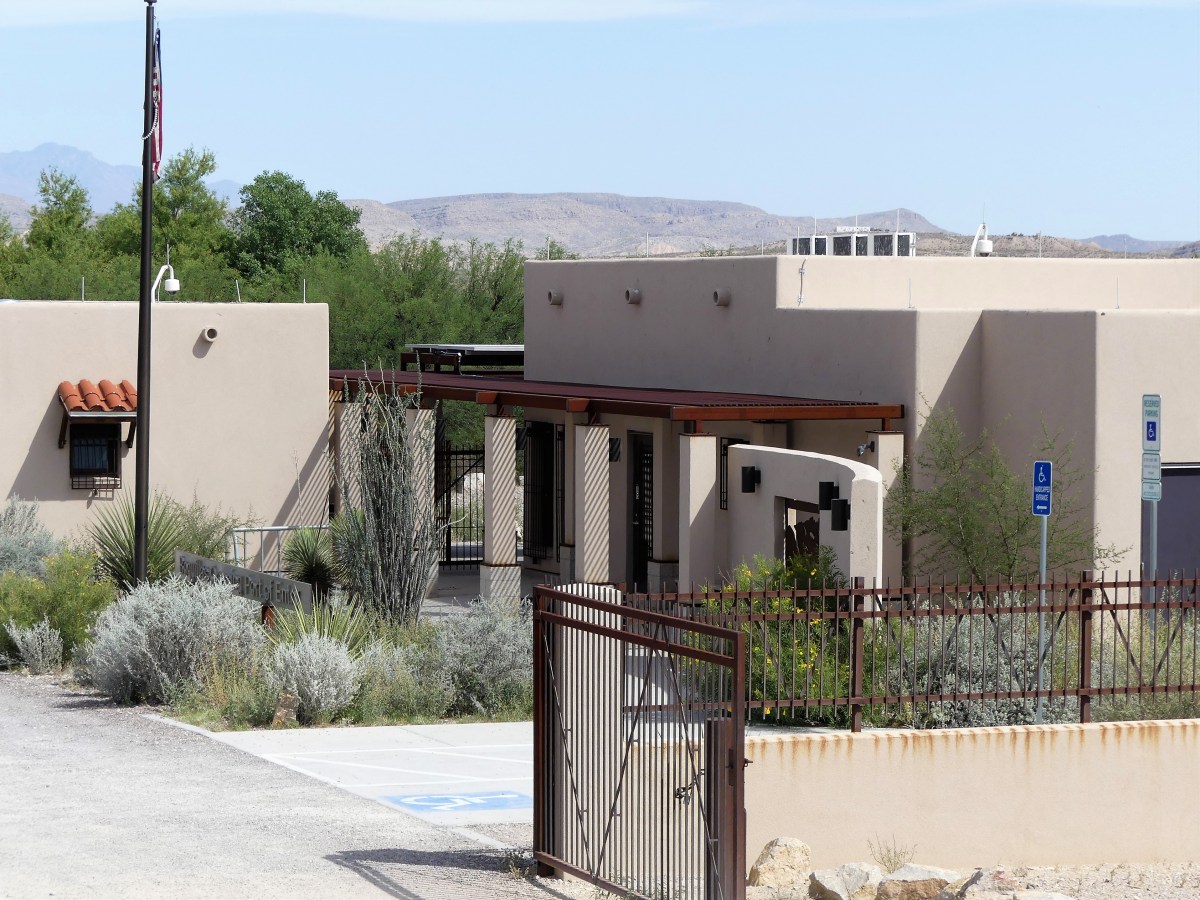
Walking through the customs house gate to the waterfront along a garden trail takes only five minutes.

Custom houseThe trail ends at a sandbar where eager Mexicans negotiate with Gringos to ferry them across the river by rowboat. Five dollars is generally the agreed upon price.

ferryHowever, with the Rio Grande water levels so low, Leah and I found it cheaper to wade across fifty feet of knee-deep water to the other side.

Leah crossingLand transportation comes from Uber burros, charging five dollar fares to cover the dusty and shit-laden ¾-mile trip…

burro ride…to a white trailer check-point surrounded by cyclone fencing on the edge of the village. It was a treat to sit in Boquillas’s only air conditioning for a few minutes to escape the 100◦ heat, while our identities were checked against a drug cartel database.

Once Leah and I were cleared as respectable American citizens, we opted to lunch at the Original José Falcone’s Restaurant and Bar, the largest of two eateries in town…

Jose Falcon's…with an overlook of the Boquillas Canyon.
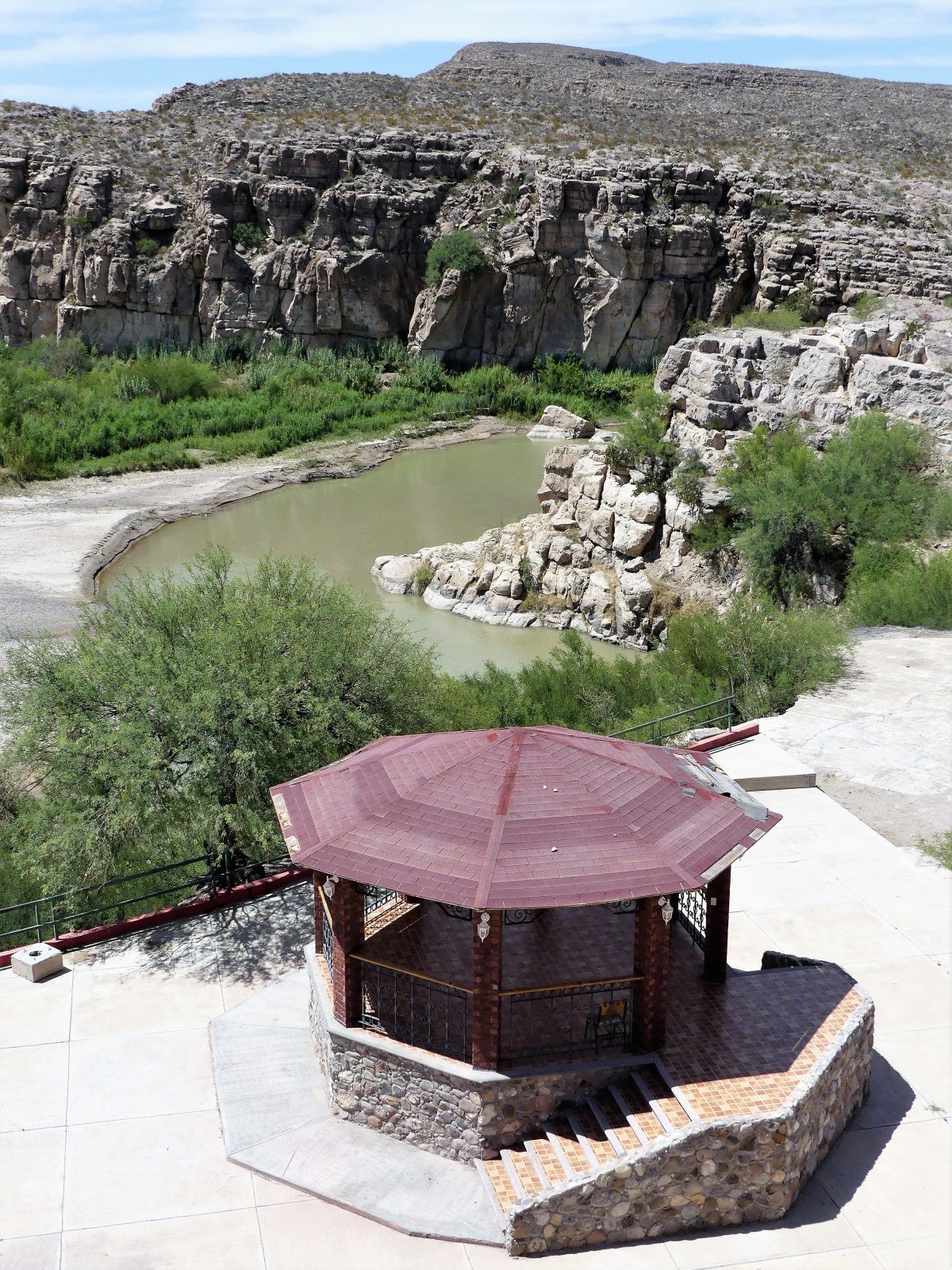
Bouquillas canyonMama Falcone was sitting on the patio in her kitchen apron working on a future needlepoint tapestry that would soon display in the family curio shop next door, while her nephew Renaldo brought us menus and took our order—chicken quesadilla for Leah, and beef burrito for me. Meanwhile, a family of three from South Carolina sat at a nearby table chatting it up with Mama’s daughter, Lillia.
Lillia was explaining that her father opened the restaurant in 1973 after a pickup truck accident put him in a wheelchair for the rest of his life. The restaurant was a big hit among locals and tourists, with Mama serving bean tacos and burritos, and Papa schmoozing the guests. Thanks to the unofficial crossing, villagers were accustomed to serving up to 200 Big Bend visitors a day—mostly tourists looking to enhance their park experience by buying food and souvenirs.

After Papa died in 2000, Mama and Lillia continued the business until the U.S. closed the border in May, 2002 in response to 9-11. Consequently, the town’s tourist trade dried up, and businesses failed without customers.

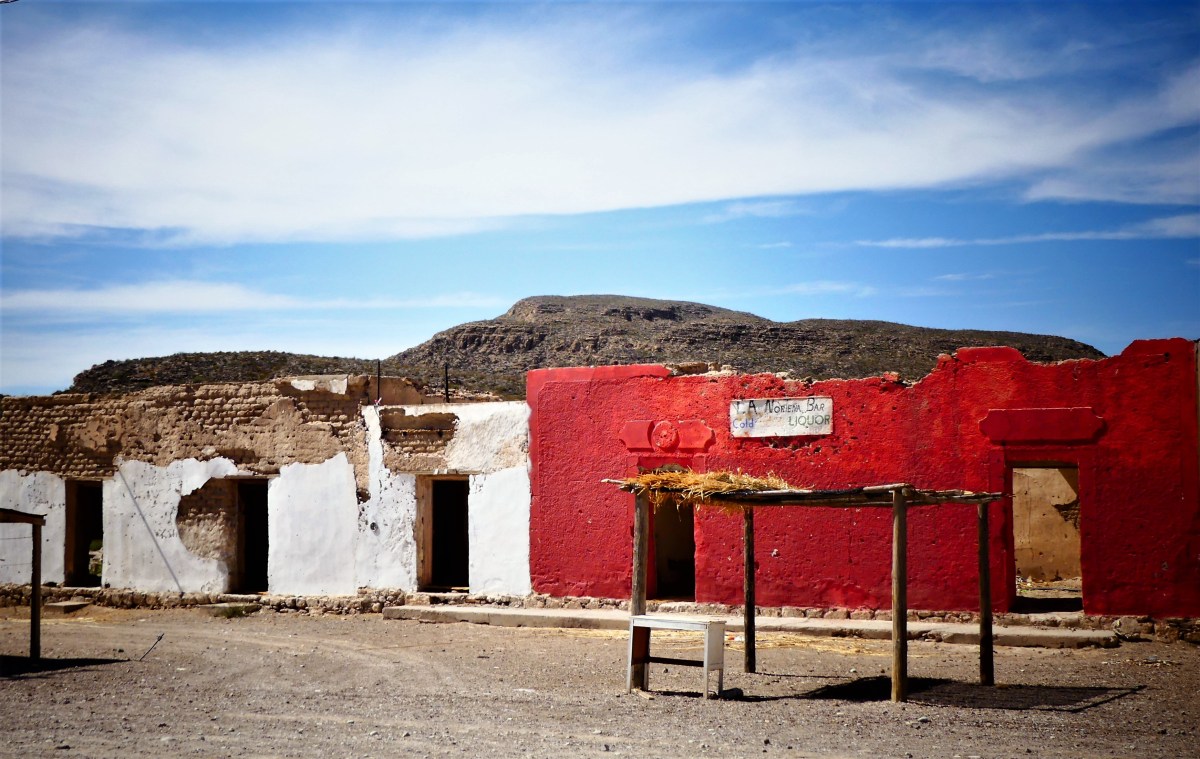
red barThe town population shrank from three hundred to one hundred adults and children, with many leaving for Muzquiz—the nearest Mexican city, and a seven-hour bus ride away. Eventually, Mama and Lillia found work in the States, but returned home to the restaurant after the crossing officially reopened in April 2013.
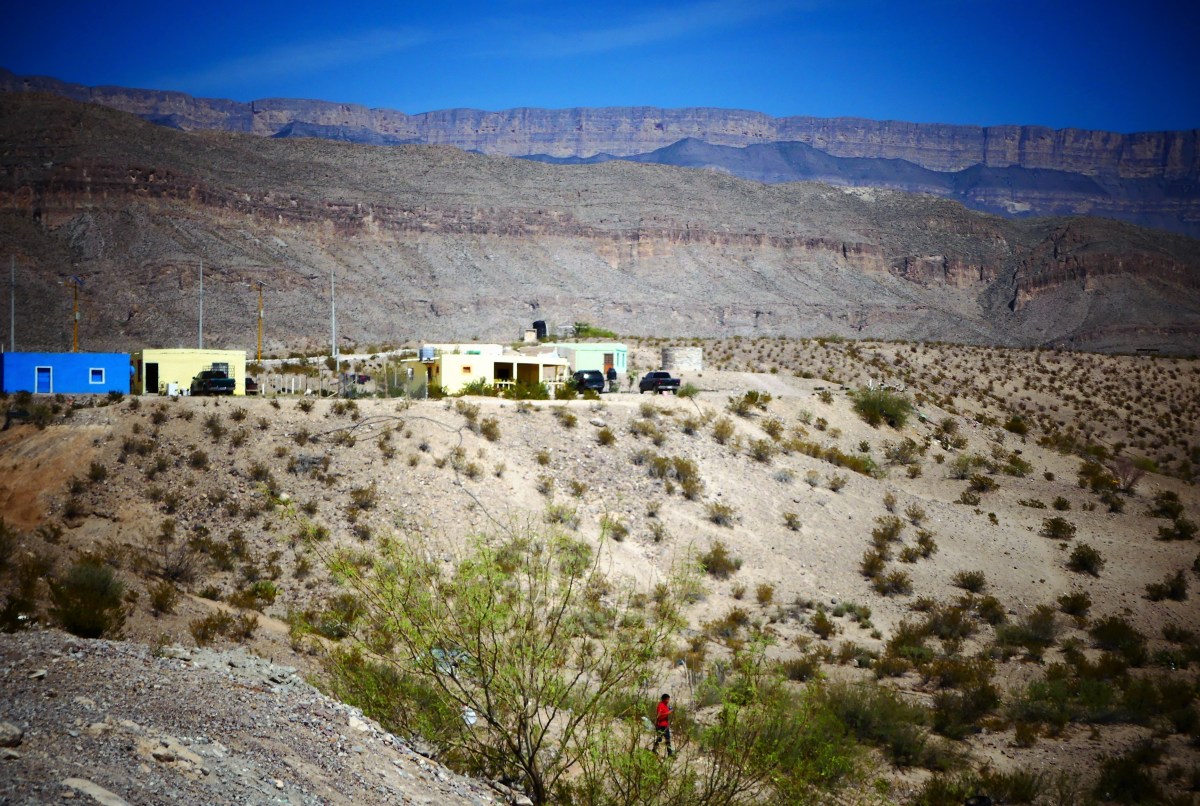
townThey are hopeful for an economic recovery, but the town is in shambles, and it will take many more Americans to salvage Boquillas’s economy.
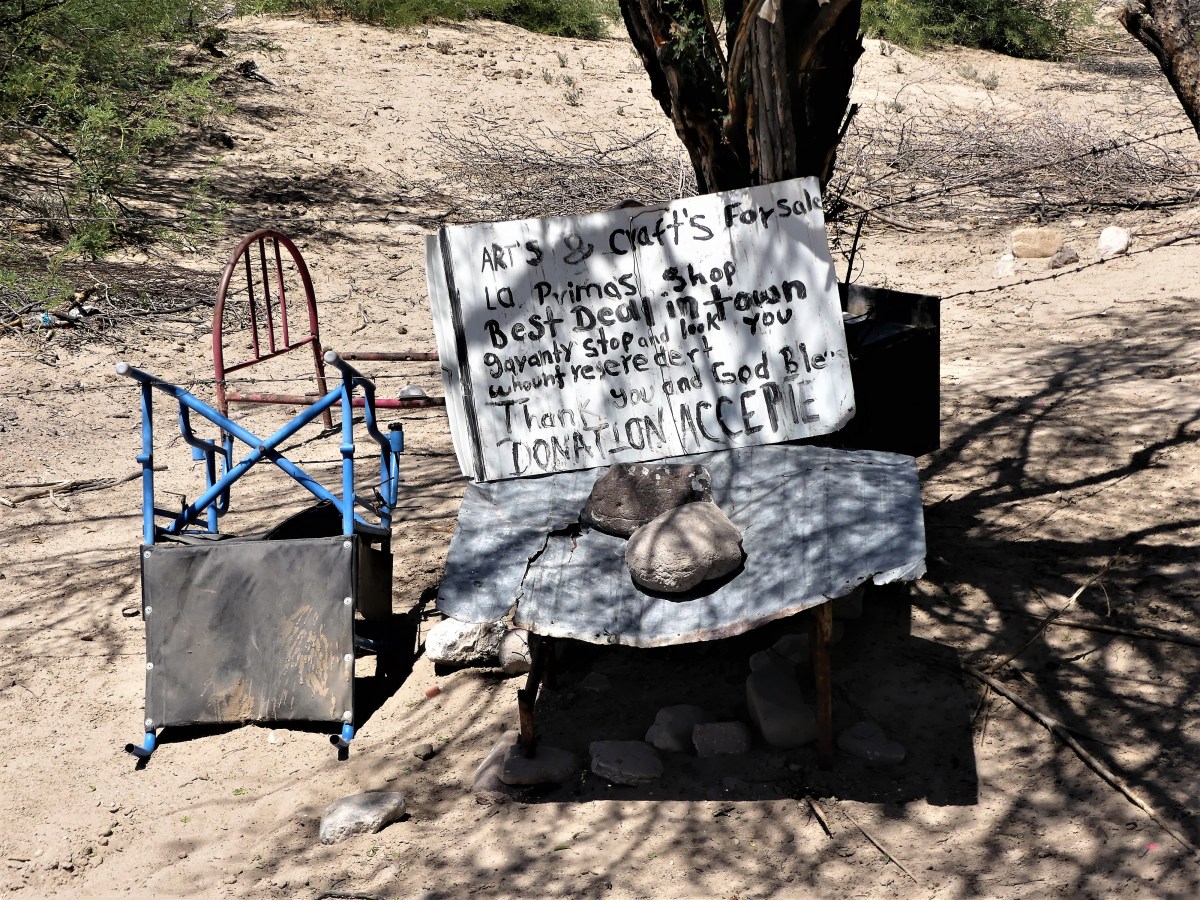
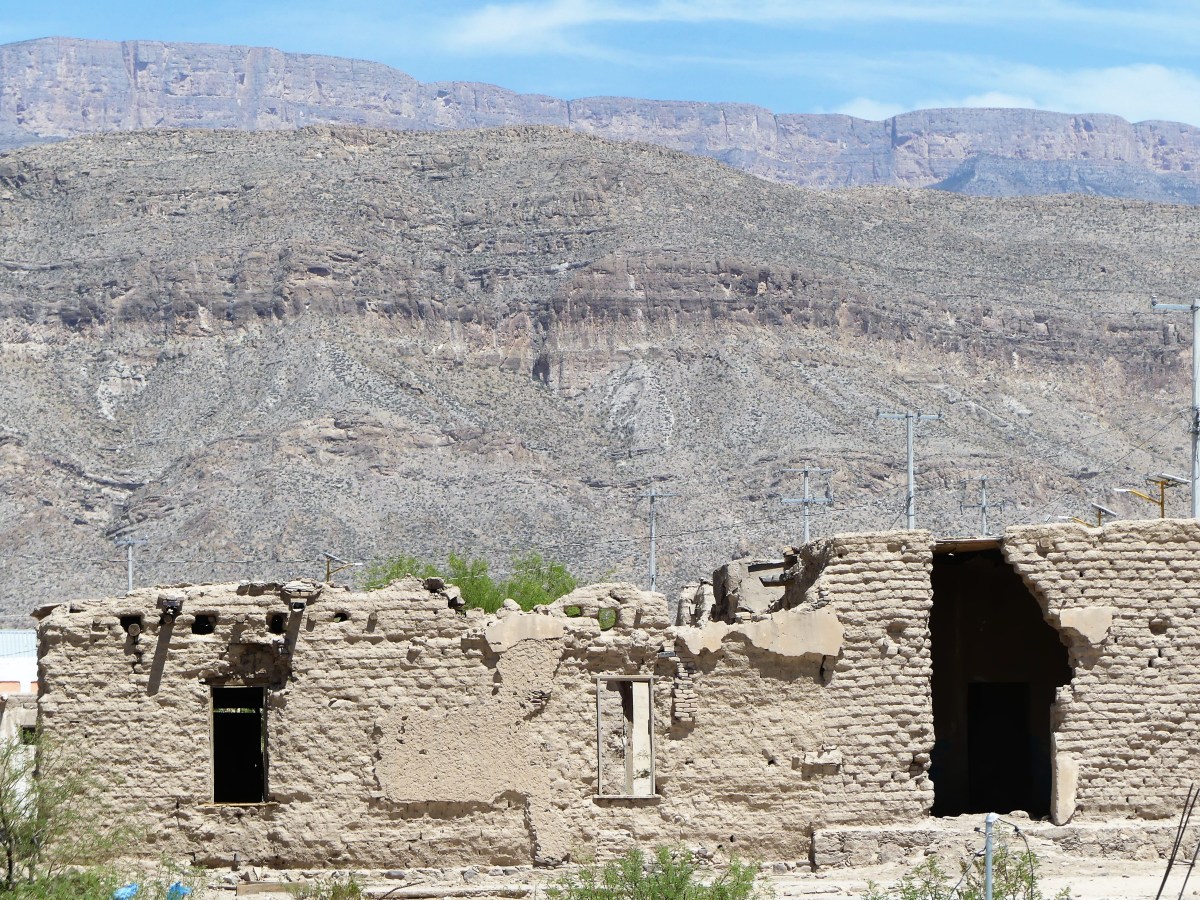
gift stand

burned out hut


After lunch, Lillia volunteered Chico to drive us back to the landing in his beat-up Chevy Silverado. Chico was born and raised in Boquillas, and although his two brothers have moved on, he has never left.

“I like it here,” he admits. “It’s very quiet.”

When Chico isn’t shuttling visitors between the restaurant and the water, he bartends for the only bar in town, usually serving up beer to the locals. “Cervezza is cheap, but gas,” he explains, “is very expensive and hard to come by since Boquillas has no gas station. However, American friends are willing to fill five gallon containers from the park store, and send it over by boat.”

It occurred to me that Chico was giving us good intelligence about his situation, which would be useful should tensions ever flare between the U.S. and Mexico. And I believe that given the chance, Carrie Masterson and I could turn Chico into a valued asset. We tipped Chico five dollars for the ride and the invaluable information.

Leah and I crossed back the way we came—by wading through the Rio Grande. We acknowledged Ranger Weimer upon our return, who ushered us to a virtual customs station, where we submitted our credentials electronically and spoke by phone to an invisible agent who scanned us by remote camera.

“Take off your hat, remove your sunglasses, and stand behind the yellow line,” barked the long-distance voice.

After answering a few routine questions, like “Are you bringing any raw fruits or vegetables into the country?”, we were safely readmitted to America.

Turning to Ranger Weimer, I asked casually, “So how do you feel about Trump building a Wall down here?

He looked at me sternly, and answered in a stoic voice, “Sir, we’re not allowed to express an opinion about that matter.”

But I wasn’t done yet. “But do you think these people are dangerous?”

He was becoming annoyed, answering more emphatically, “Like I said, sir; I have no opinion on the matter!”

I left Boquillas Crossing completely satisfied by our cultural exchange, and reassured that we would be safe from bad hombres from the other side. Fortunately for us, the citizens of Boquillas del Carmen are hard-working people. They are a small and subdued militia of struggling entrepreneurs who depend on us, and are more interested in fighting for their livelihood than picking a fight with their neighbor.

museumI have met the enemy face to face and I do not fear them. Their rowboats and mules would be no match against our ships and tanks.
 

“We’re on the Road to Nowhere”

After spending the day roaming through wide-open spaces at Big Bend National Park, we returned to our relic of an RV park at Stillwell Ranch–just outside the Persimmon Gap Visitor Center–to cool off under a revitalizing blast of AC running inside the Airstream.

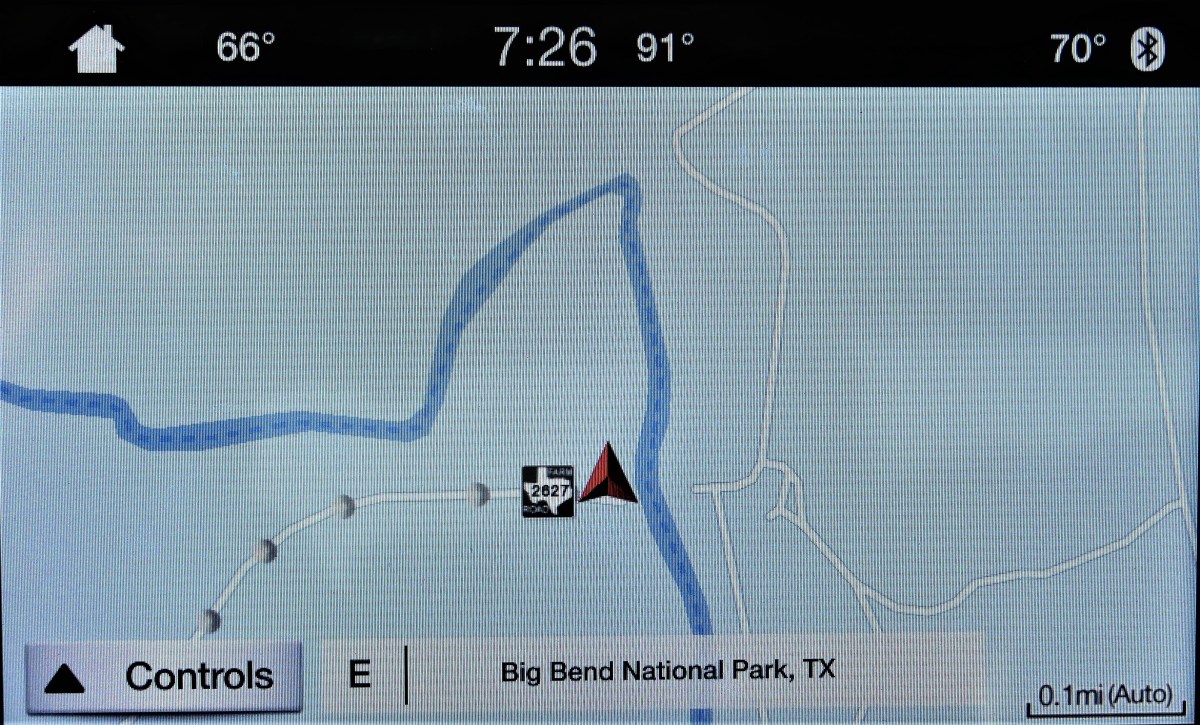
The glaring sun and punishing heat of the day had taken its toll on us, although we were grateful for sustained winds of 20 mph, which seemed to make the temperature more tolerable. By 7:26 pm, temperatures had cooled down to 91◦, and we were ready to explore the road less traveled.

Navigation screenEarlier in the day, border patrol had sped past our campsite from the southern border, causing us to speculate whether an ICE officer had just interdicted an illegal border crosser. And so, with the sun at our backs, and our batteries recharged, I fired up the F-150, turned right on Texas FM (farm-to-market road) 2627, and headed due south in search of bad hombres. The radio god immediately synchronized his playlist with our mission, and delivered David Byrne belting out the lyrics to “We’re on the Road to Nowhere”.
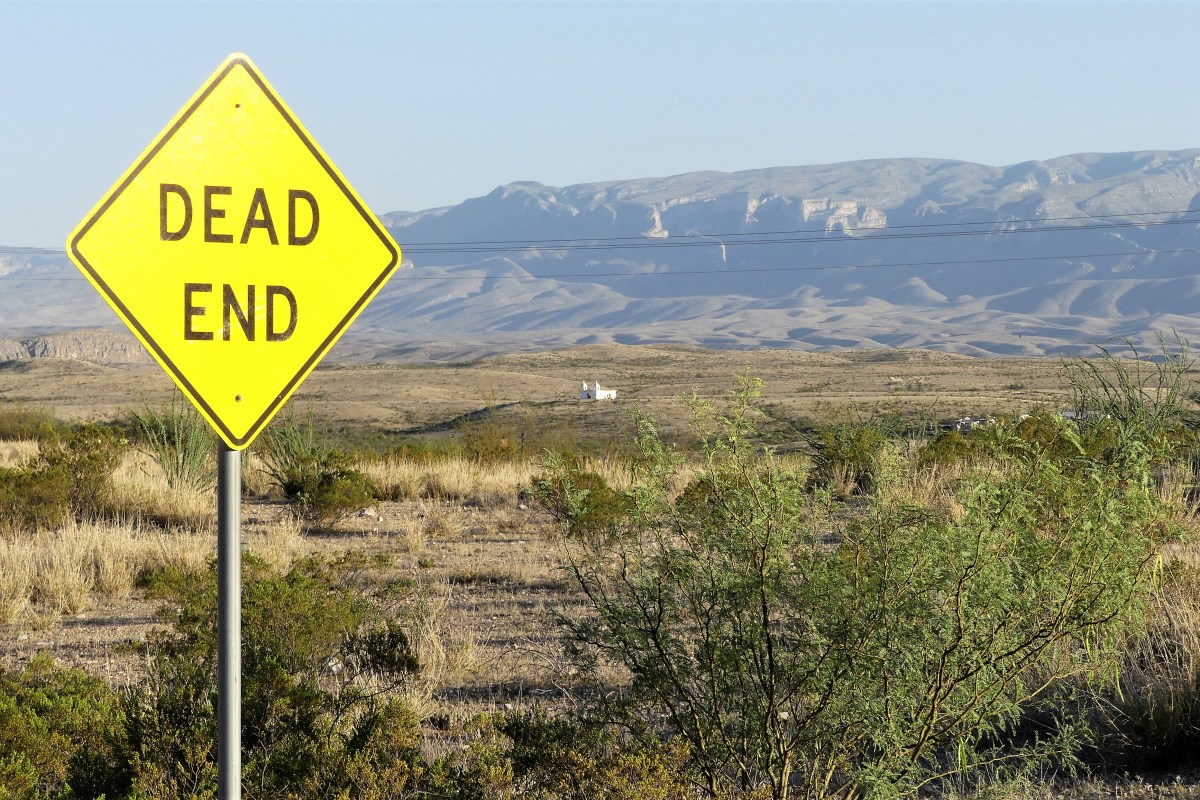
From Stillwell Store, the 22-mile trip to the Rio Grande passes through Black Gap WMA (Wildlife Management Area), a 100,000-plus acre expanse of back-country wilderness—desolate and barren to the eye, but home to wandering black bears, mountain lions, white-tailed and mule deer, and javelina (think desert pig). The dusty two-lane road dips and pivots like a rickety roller coaster as it hugs the rugged foothills of the Sierra Larga range across the vast Chihuahuan Desert, until the DEAD-END sign appears.

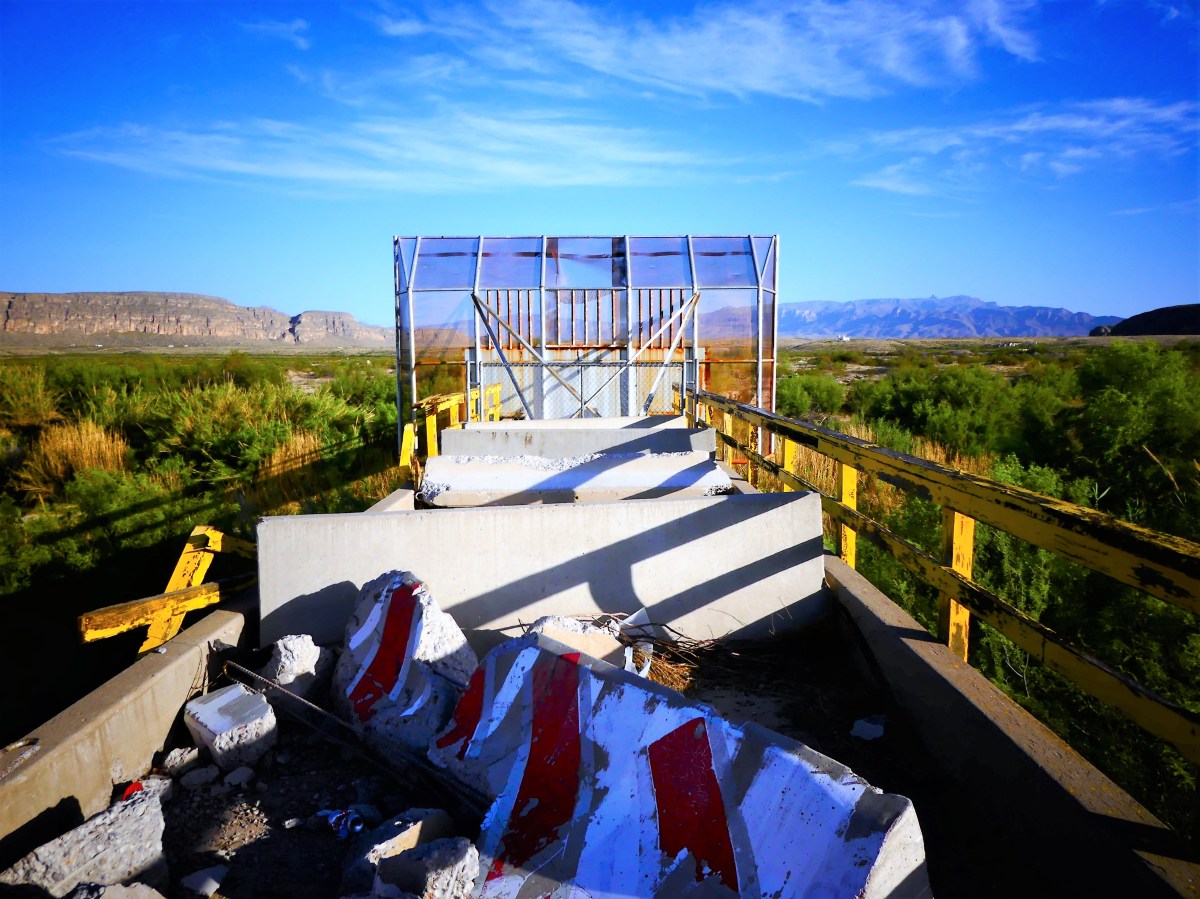
Just around the corner lies an impassable single-lane border crossing known as the La Linda International Bridge, doomed and defunct for the past 20 years. Broken pieces of barricade and rubbish line the roadbed, with a reinforced batting cage wrapped around the guard rails. It looks like a free-standing prison door resting on a concrete pile.

bridge detailHistorically, the bridge was constructed by Dow Chemical in 1964 to transport fluorite from Coahuilan mines across Heath Canyon to America. But U.S. and Mexican authorities shuttered the bridge in 1997, suspecting drug smuggling. Other reports cite the murder of a Mexican customs official as the reason behind the bridge closure.

The setting surrounding the bridge is eerily reminiscent of any post-apocalyptic scene from “The Hunger Games”. Except for a few pesky flies, the area is lifeless, and the quiet is disturbing.

bridge overview.jpgAcross the border stand the remnants of a faded factory.
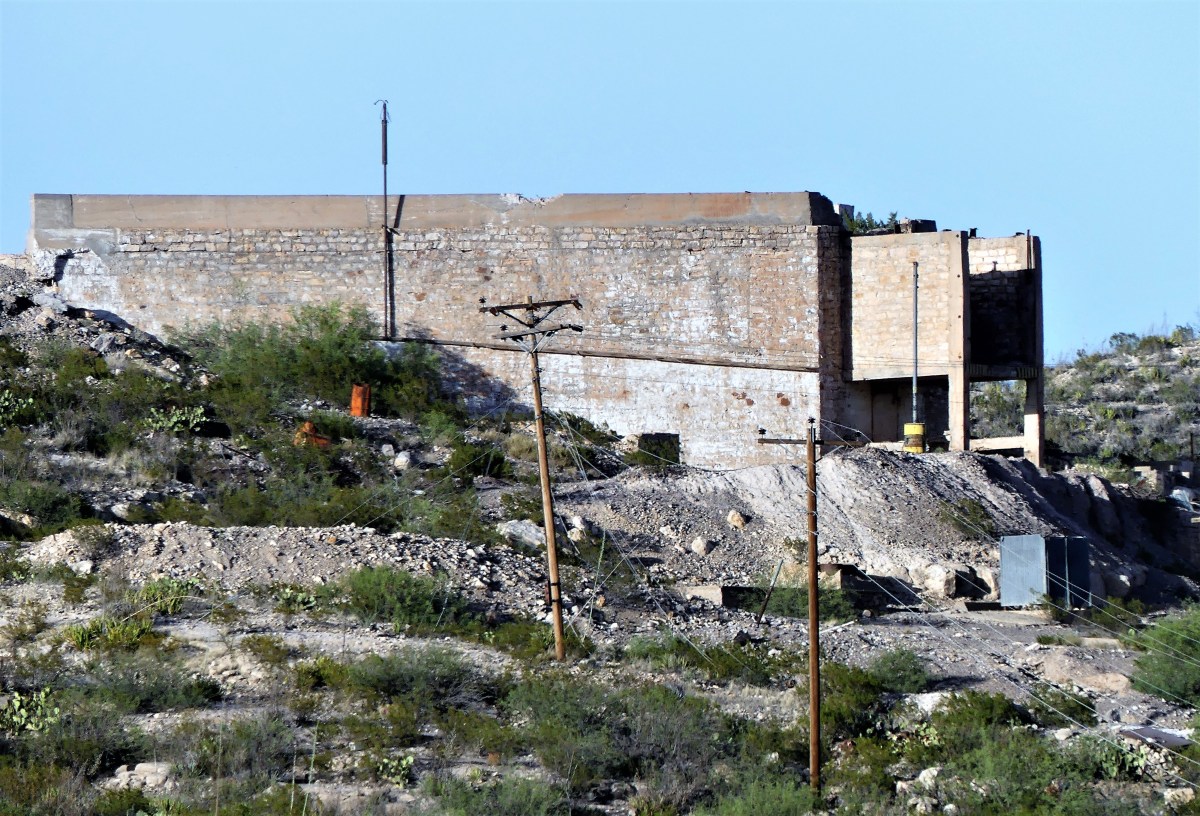
MineBroken buildings and slanted warehouses survive in silence against a brown mountain backdrop.
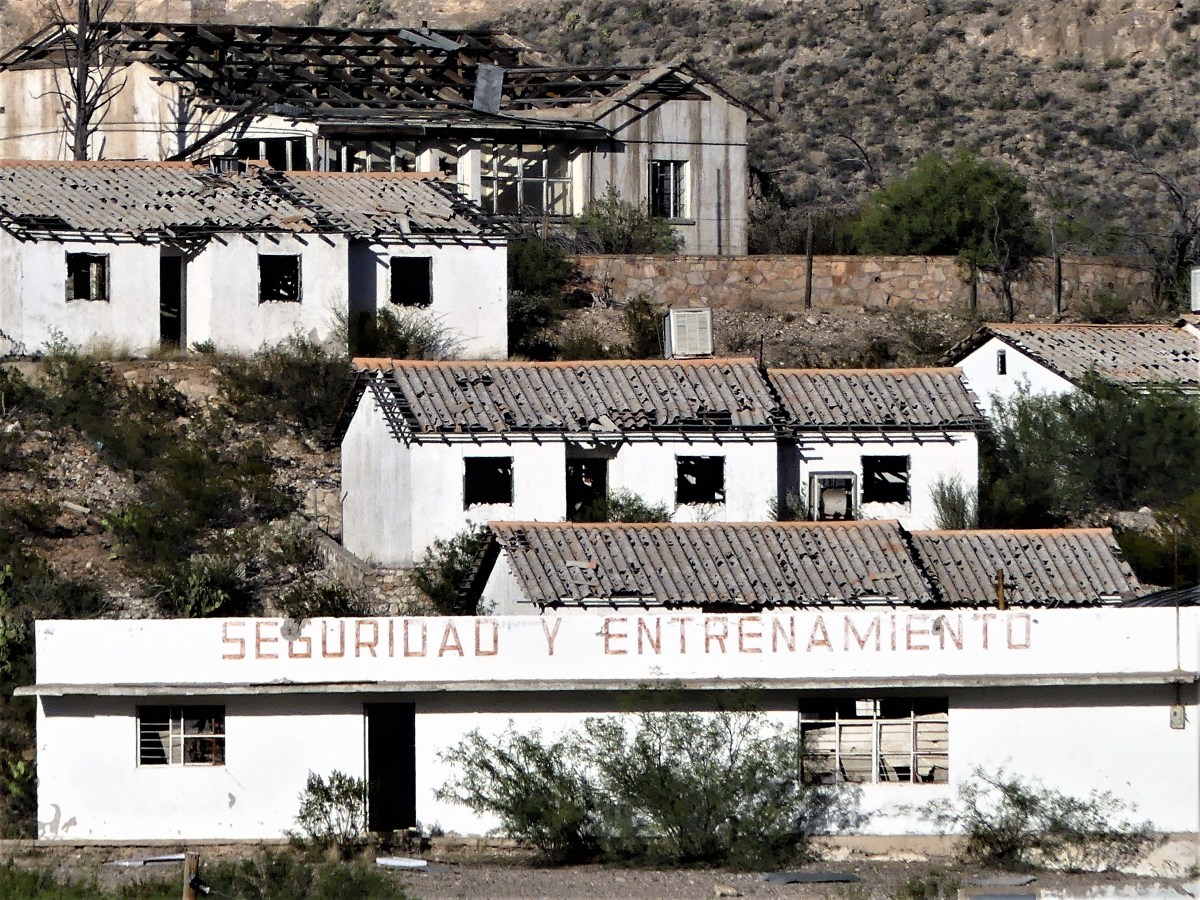
Safety and SecurityYet in the distance to the right of the river, La Linda mission stands alone—its double towers dwarfed by nature’s majesty, and its church doors removed for a purpose higher than God.
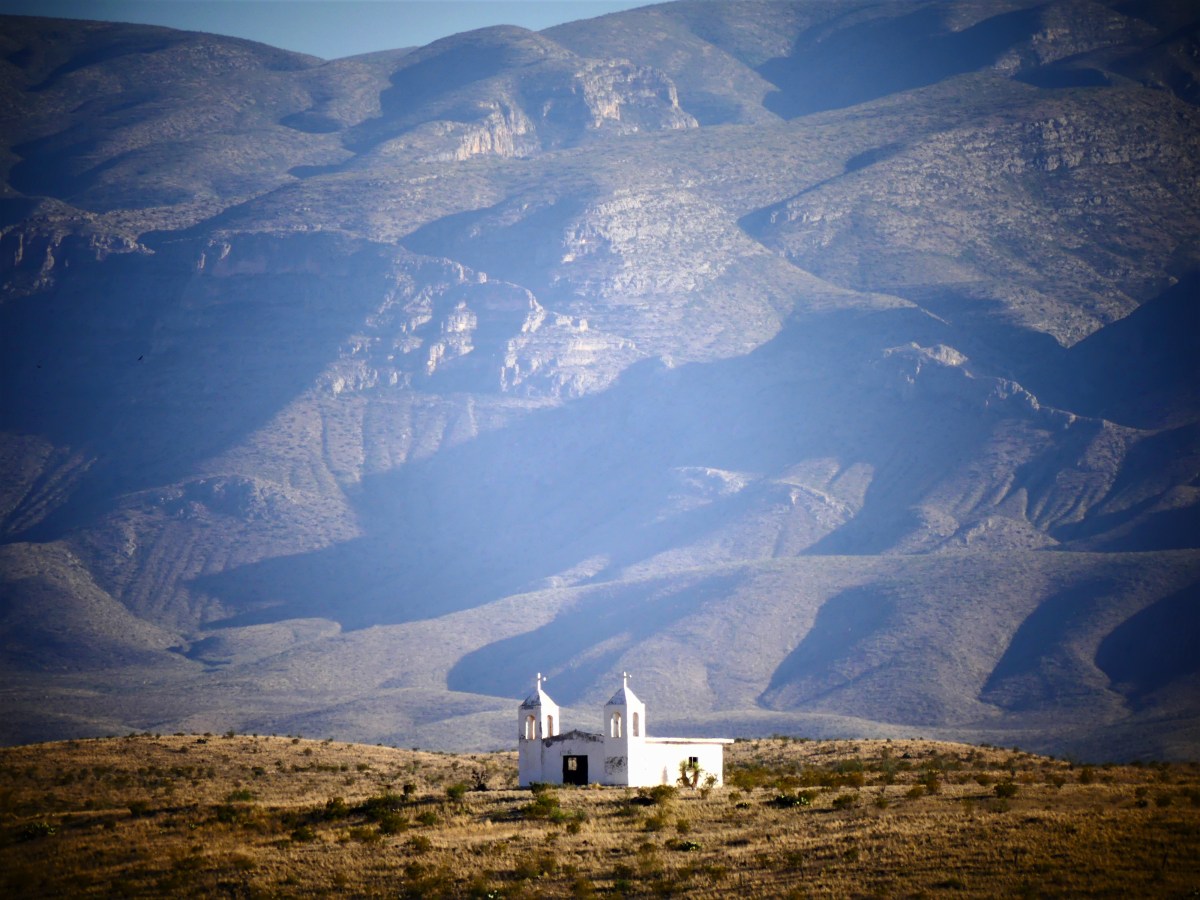
La Linda MissionThere are those who would welcome a return to the border crossing.

border obliskCommittee meetings and feasibility studies on both sides of the river argue the benefits of potential tourism and ease of crossing without traveling to either Del Rio or Presidio. Currently, a legal crossing to La Linda would take nearly 10 hours by car versus 10 minutes by illegal foot path. But there are no travelers today, or at any other times. It’s just too remote.
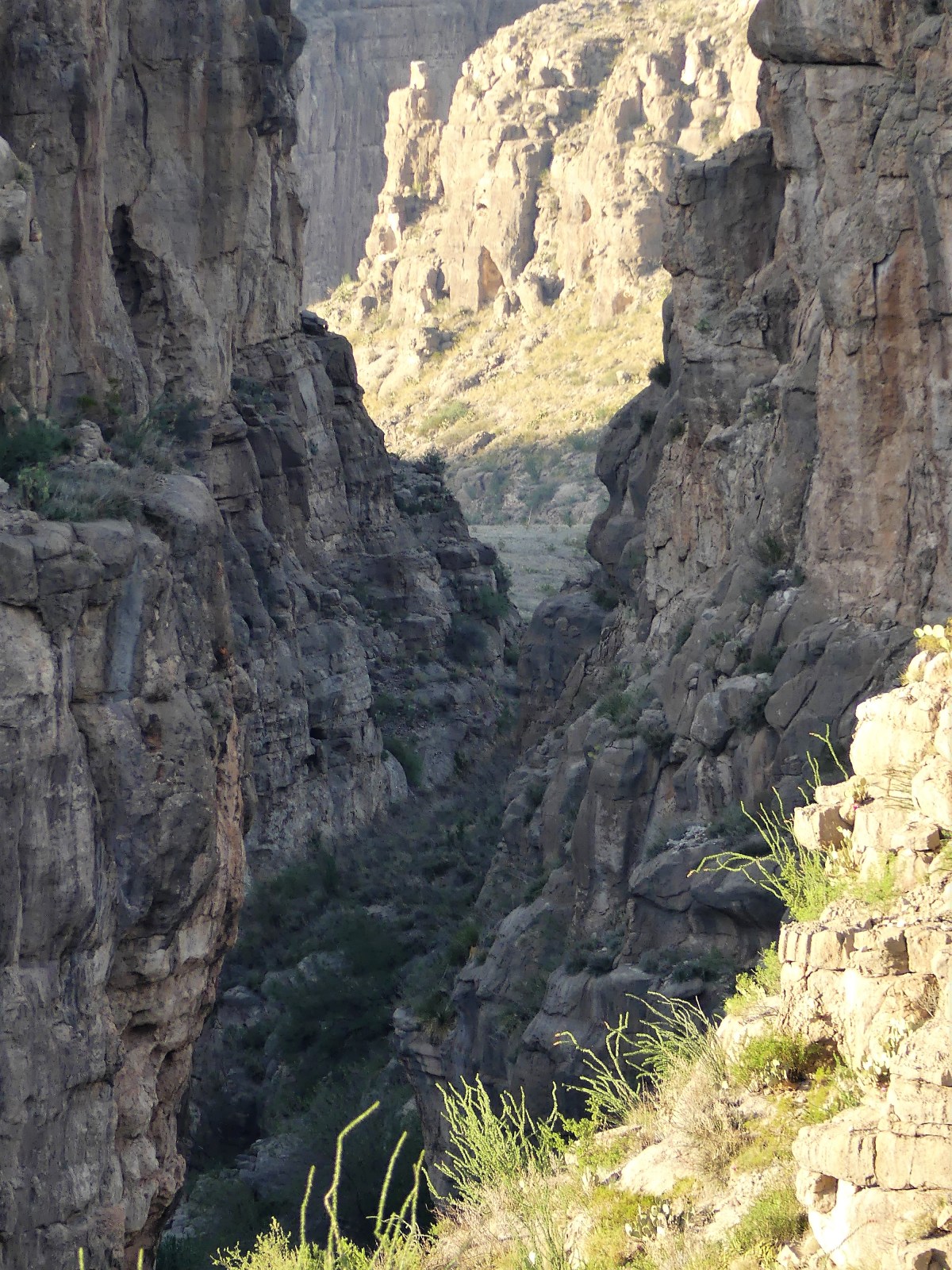
canyon CU
U.S. on the left, Mexico on the right

The thought of running a wall through the middle of La Linda International Bridge brings a smile to my face, knowing that in securing our border, we would be protecting and defending America against Mexican solitude and desolation.

David Byrne’s prophetic words still echo with irony:

“They can tell you what to do
But they’ll make a fool of you
And it’s all right, baby, it’s all right.”

Here T(w)oday, Guano T(w)omorrow–the Sequel

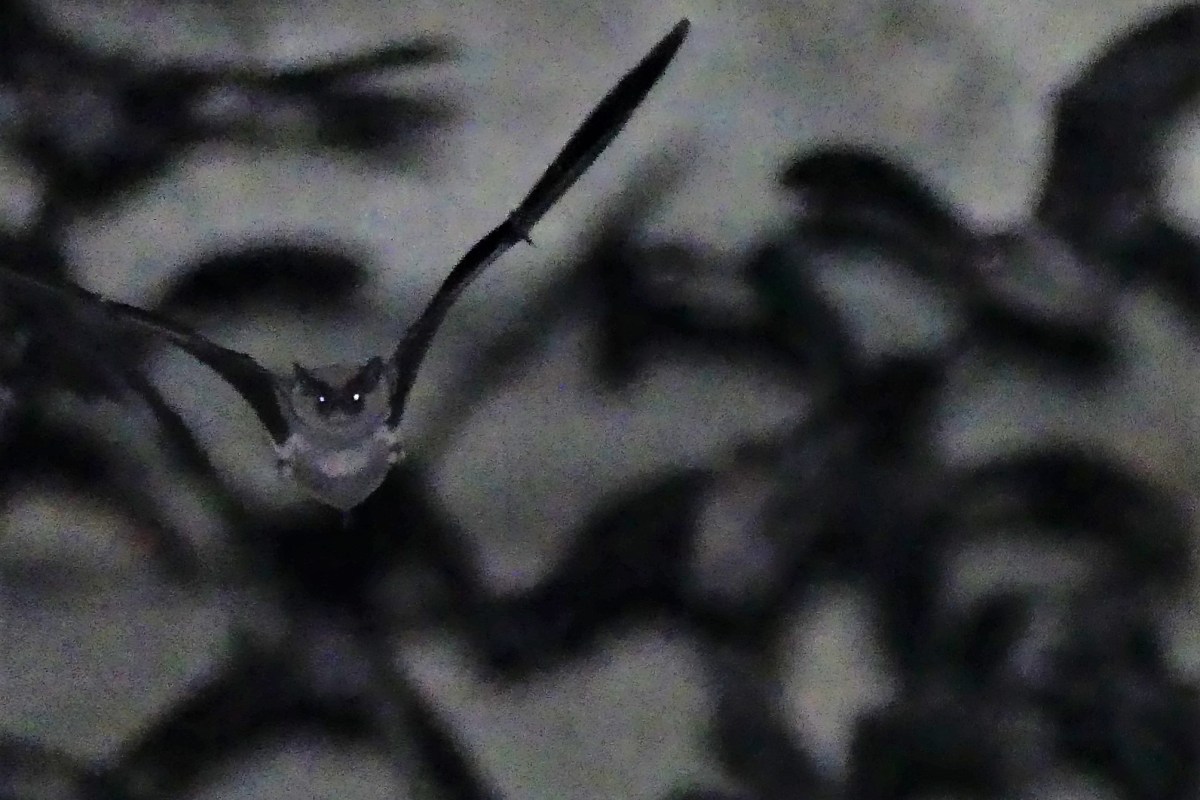
If you love the smell of ammonia (and who doesn’t), then Stuart Bat Cave in Kickapoo Cavern State Park should be on your bucket list. When approaching the entrance, the acrid smell of guano is omnipresent, and for good reason, since Stuart Bat Cave is home to 1 million Mexican free-tailed bats from spring through fall.

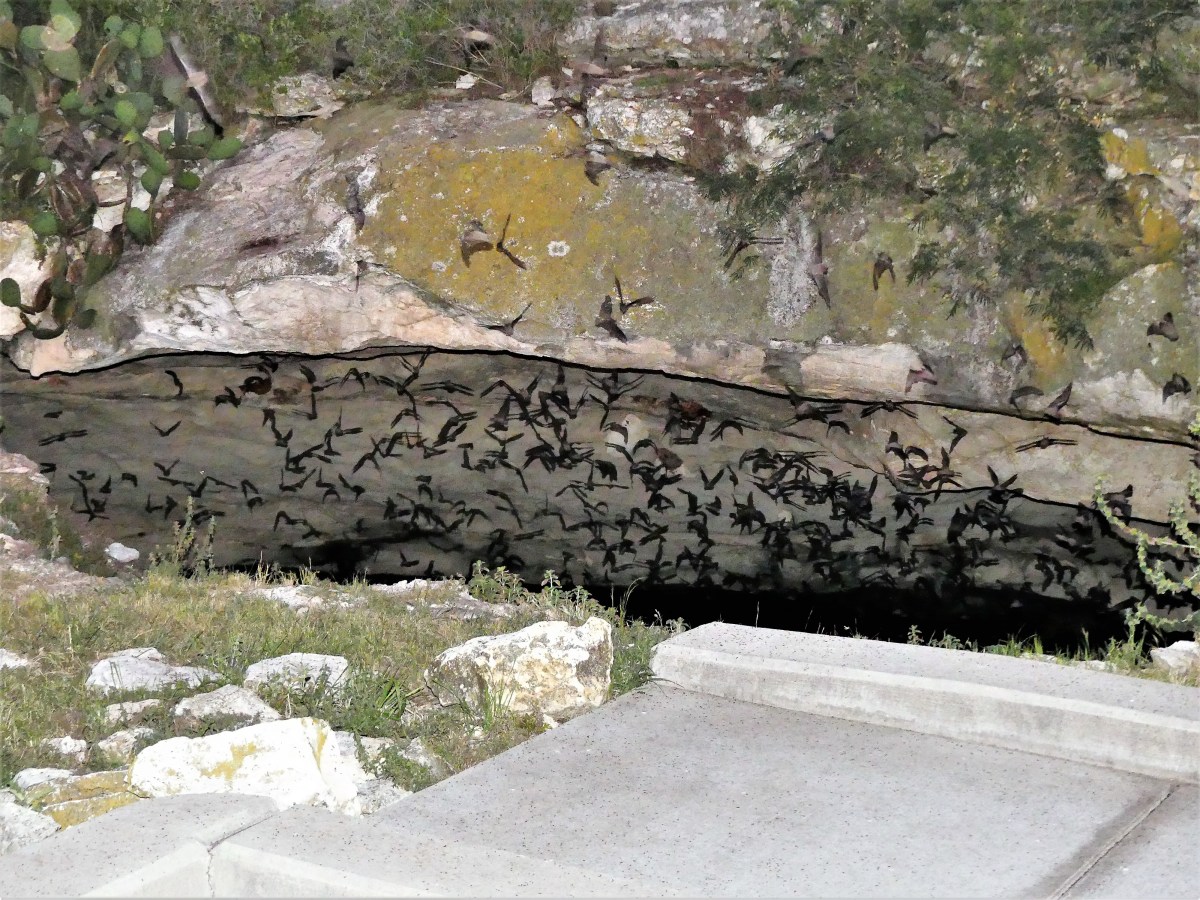
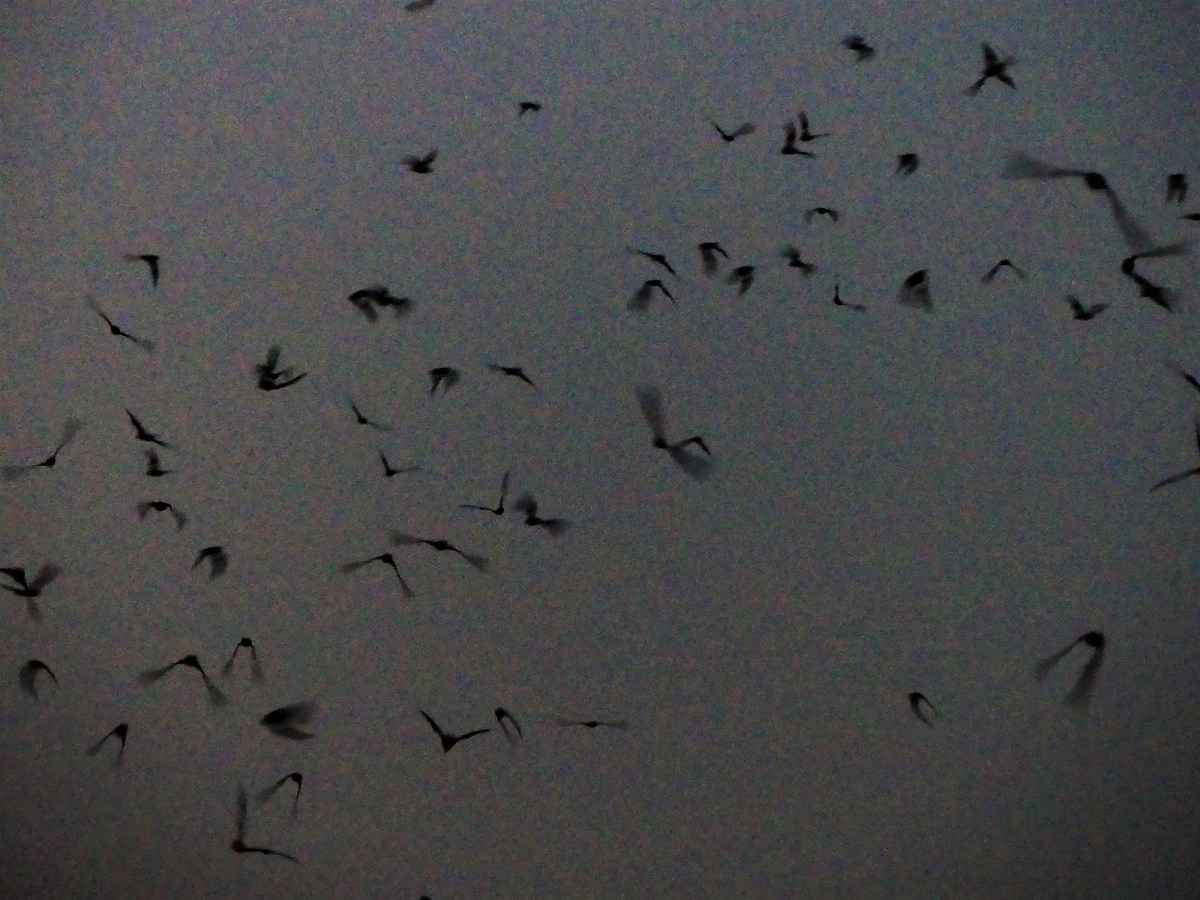
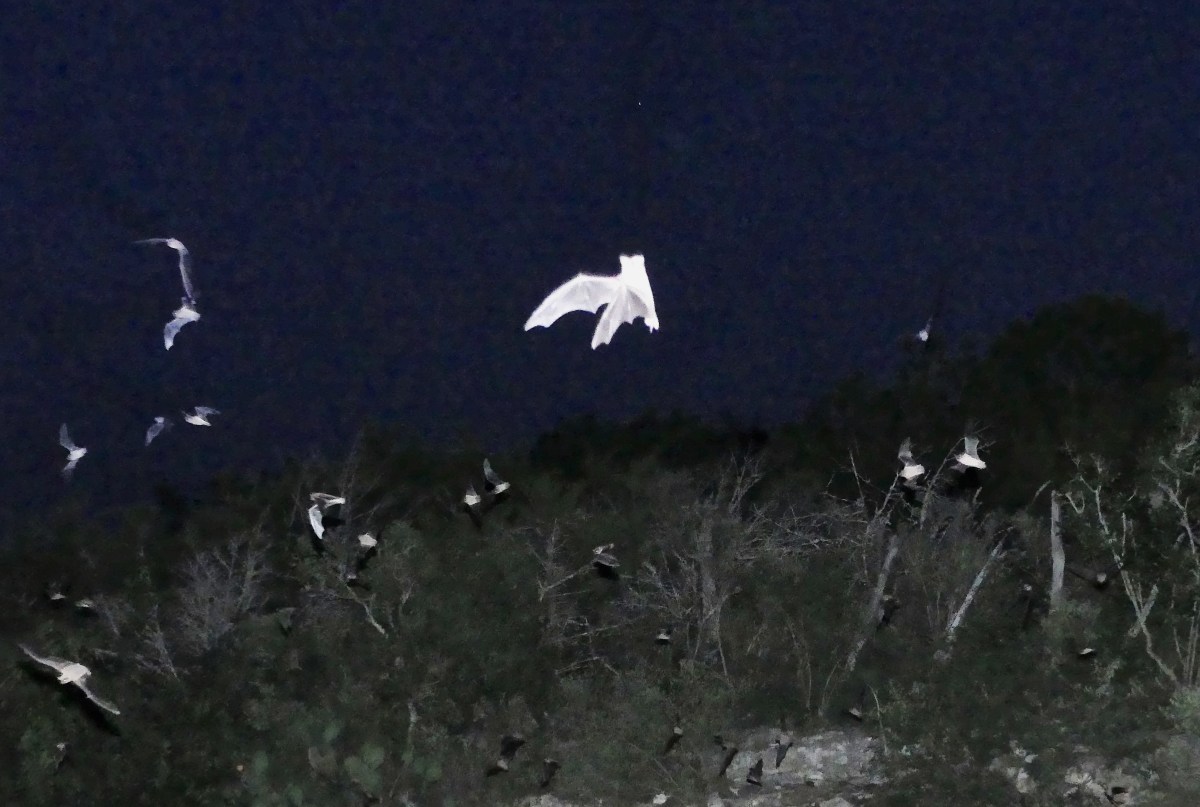
Each day at dusk, a stream of bats can be seen circling the mouth of the cave– approximately 25 feet across–around and around and around, accelerating to speeds of 60 mph until they explode from the darkness…

co4.jpgbat hole (2).jpg

best bat2.jpgand into the twilight, fluttering en masse, up and over the trees.

Bat sky wide.jpgA continuous and frenzied swarm pours from the cave in a procession that could last up to two hours.

Bat silhouette.jpgWith the exception of some rogue bats that fly off in scattered directions, the mother lode hooks right and follows a path 50 miles due east to Uvalde in search of mosquitoes and corn earworms, a tasty moth that wreaks havoc on a number of Southern crops.
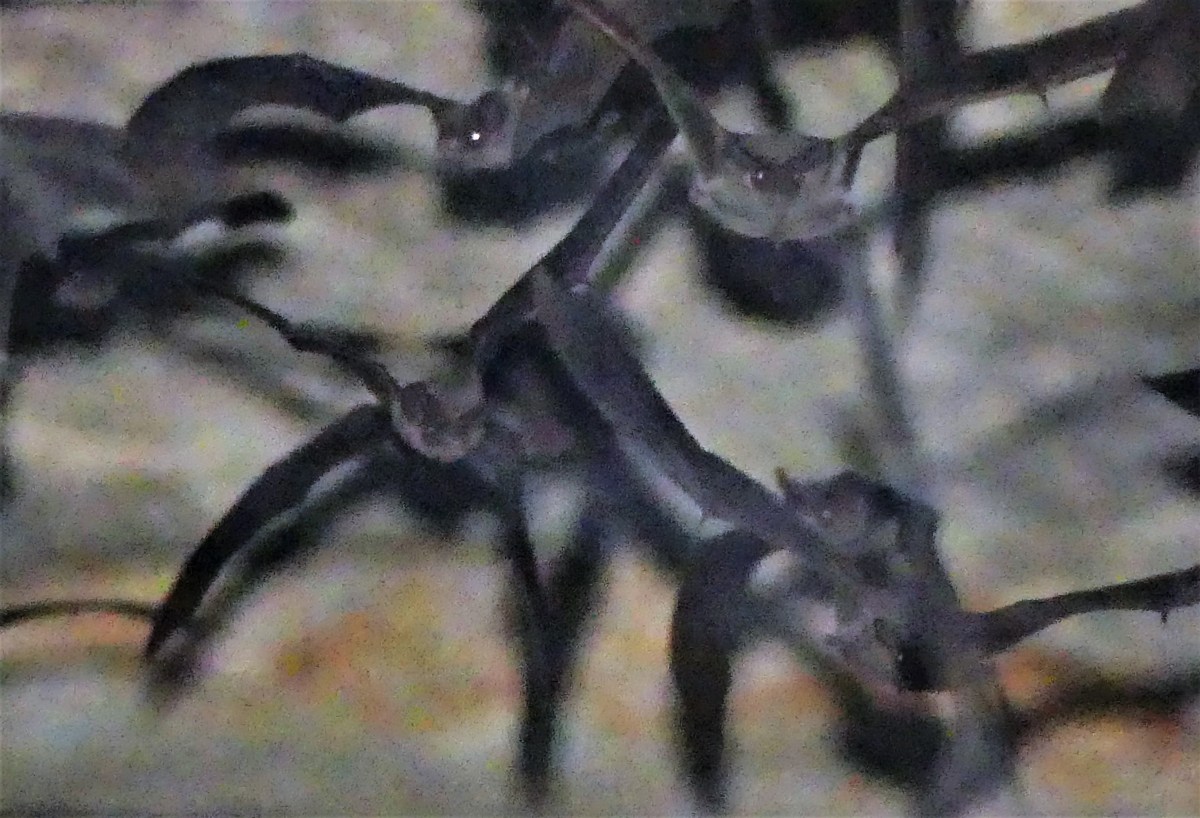
By the time they return at dawn, each bat will have eaten up to three-quarters of its body weight, which is collectively equivalent to 10 tons of insects, and easily explains the pungent odor by the cave.

Best 3.jpgHistorically, the Sergeant family, who farmed this property from the early 1900’s, protected the cave entrance with fencing in order to mine the accumulated guano, which provided important income to the ranchers until 1957 when sold as premium fertilizer and an explosive constituent.
bat sky.jpgHaving over-nighted for three days in the park, I can testify that there is no shortage of annoying bugs here. Not to be selfish, but I’d like to propose that some of the bats stay behind and clean up inside the park’s perimeter. If the bats only knew that they could dine closer to home–forsaking the 100-mile round-trip–then I could better enjoy my outdoor dinner plans as well.
flash bat (2).jpg

Peekaboo, Kickapoo!

With a name like Kickapoo Cavern, you would think that a regional Texas Indian tribe named Kickapoo would have discovered this cavern, thus elevating the cavern’s official name with a rich historical context and record. But you would be wrong.

Geologists and archaeologists who have mapped the cave have yet to find any artifacts or any other evidence to prove that prehistoric Native Americans used this cave for daily living or ceremonial business. However, a large mound of burned rock and chipped stone nearby suggests that Native Americans were familiar visitors to the area.

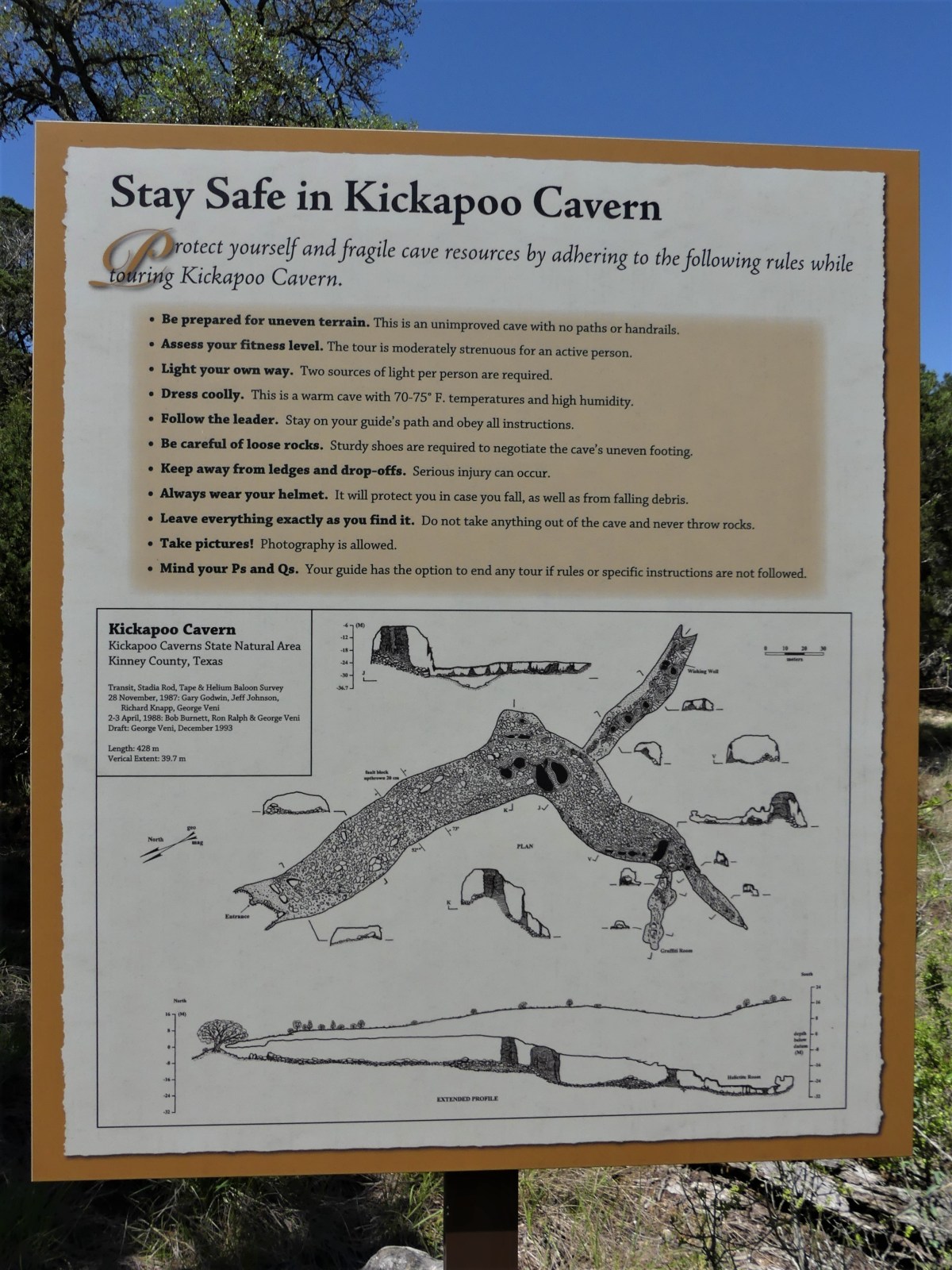
poster1poster2After listening to Ranger Matt’s presentation, I have a personal theory why natives might have avoided the cave. It seems that during the cold winter months, the cave acts as a warm weather haven for Indiana Jones’ worst nightmare. Only until the weather heats up outside, and all the good snakes wind their way out of their cozy cave den is it safe for humans to explore the inner depths, and that’s where master spelunker Ranger Matt was taking us.

Leah and I boarded a dirty white pint-sized school bus named Bertha with nine perfectly-mannered teenage girls and their two chaperones. The bus, created in 1986 had seen better days. Leah and I were commenting on the duct tape upholstery when Matt mentioned that we were riding in a retired Kinney County prison bus.

Bus int.2“That explains the bullet hole in the windshield,” I presumed.

Bus int..jpgBertha had been given a pardon, only to be reincarnated as a park bus. For some reason, I was reminded of a road sign I spied on the way to Kickapoo that read: DO NOT PICK UP HITCHHIKERS. THEY MAY BE PRISON ESCAPEES.
Our driver returned us to the park entrance where she steered Bertha onto a poorly-marked, tipsy-turvey, hippity-dippity dirt path that severely challenged her suspension, prompting memories of “The Little Engine That Could”. And so could Bertha!

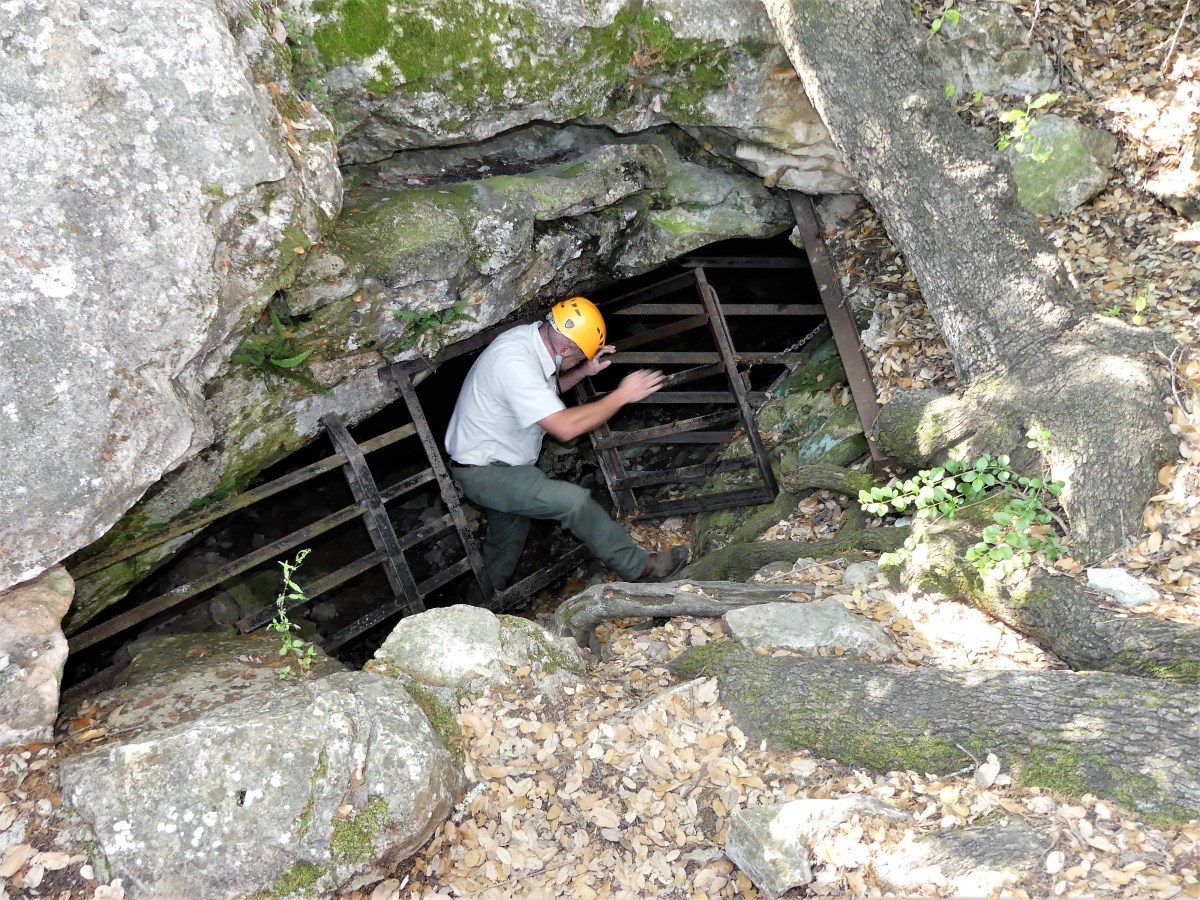
After donning colorful hardhats and checking flashlights for brightness, Matt led the way to the cave entrance…

matt 1stchecking for varmints before allowing us to climb through a small crack in the ground,

girls enteringwhere we found ourselves standing on the collapsed ceiling of a limestone rock pile measuring 130 feet thick. The mouth of the room was big enough to park a Cessna if you could figure a way to get it inside.

Matt explained that according to carbon dating, we were standing where Devils River once flowed 105 million years ago. He directed his flashlight 40 feet overhead to reveal an embedded fossil of a nautilus–common during the Paleozoic Era–embedded in the ceiling…

nautilus fish fossiland more recent remains of an unfortunate sheep or goat littering the floor

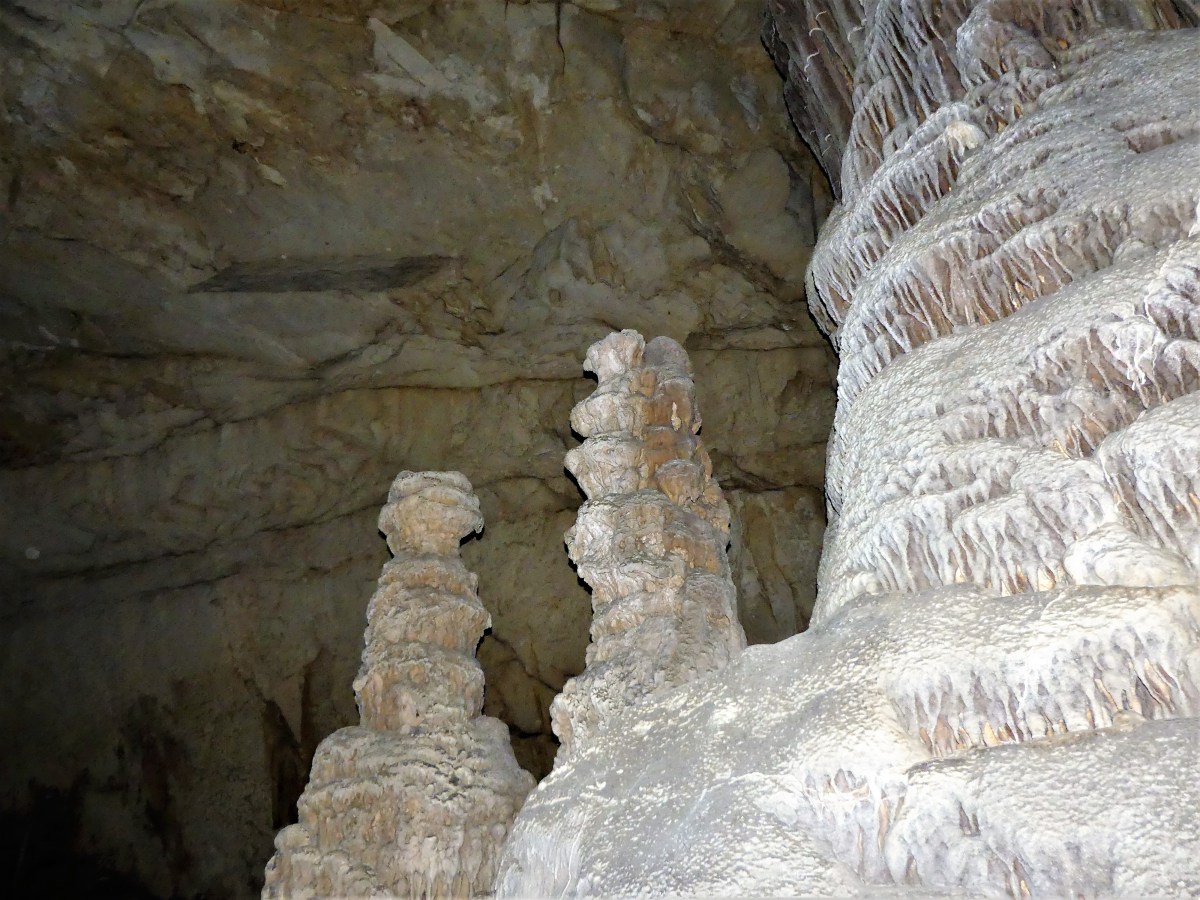
animal bonesFrom there we dropped approximately 40 feet, scrambling over ledges of flat rock and boulders, on our way to survey the three largest columns (when a stalactite meets a stalagmite) in Texas. How apropos that along the way, we would pass a formation of stalactites that managed to aggregate into the shape of the Lone Star state.
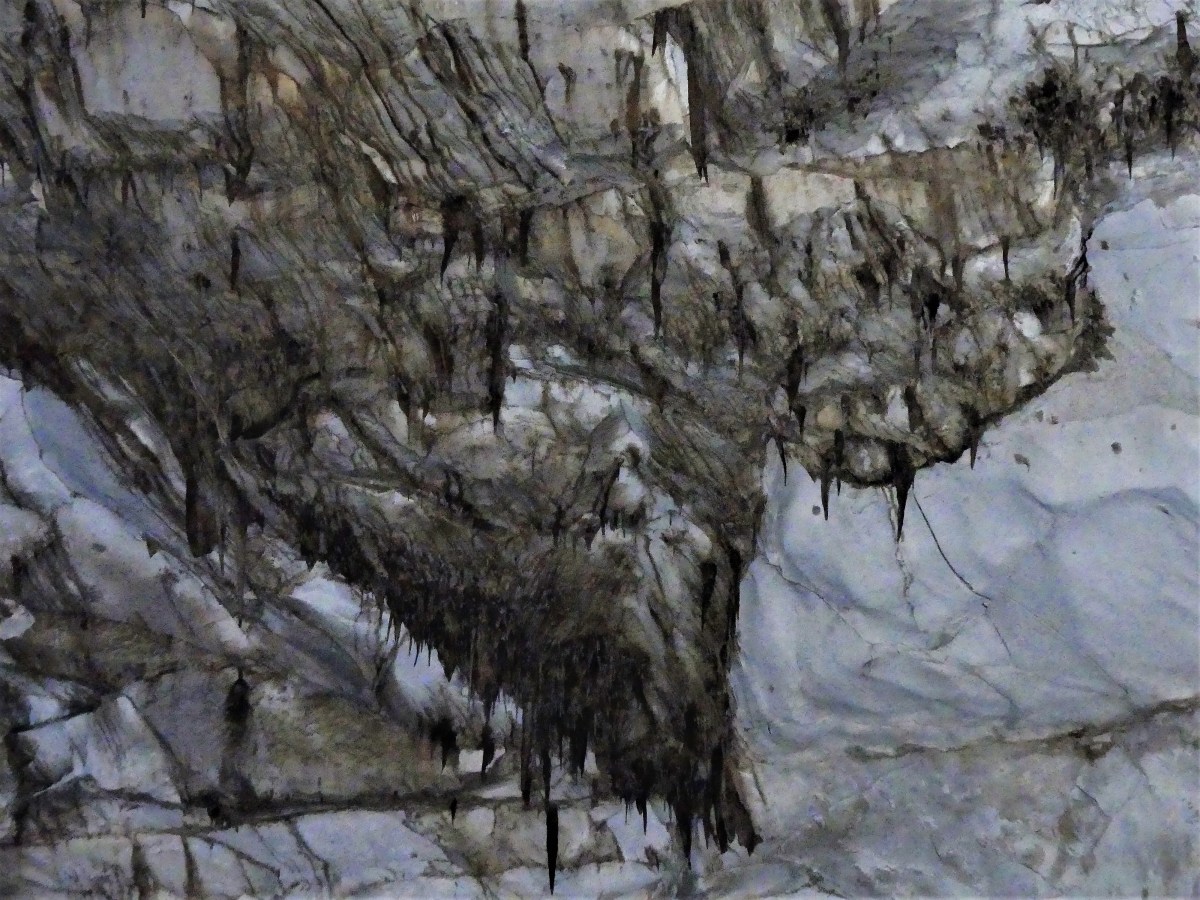
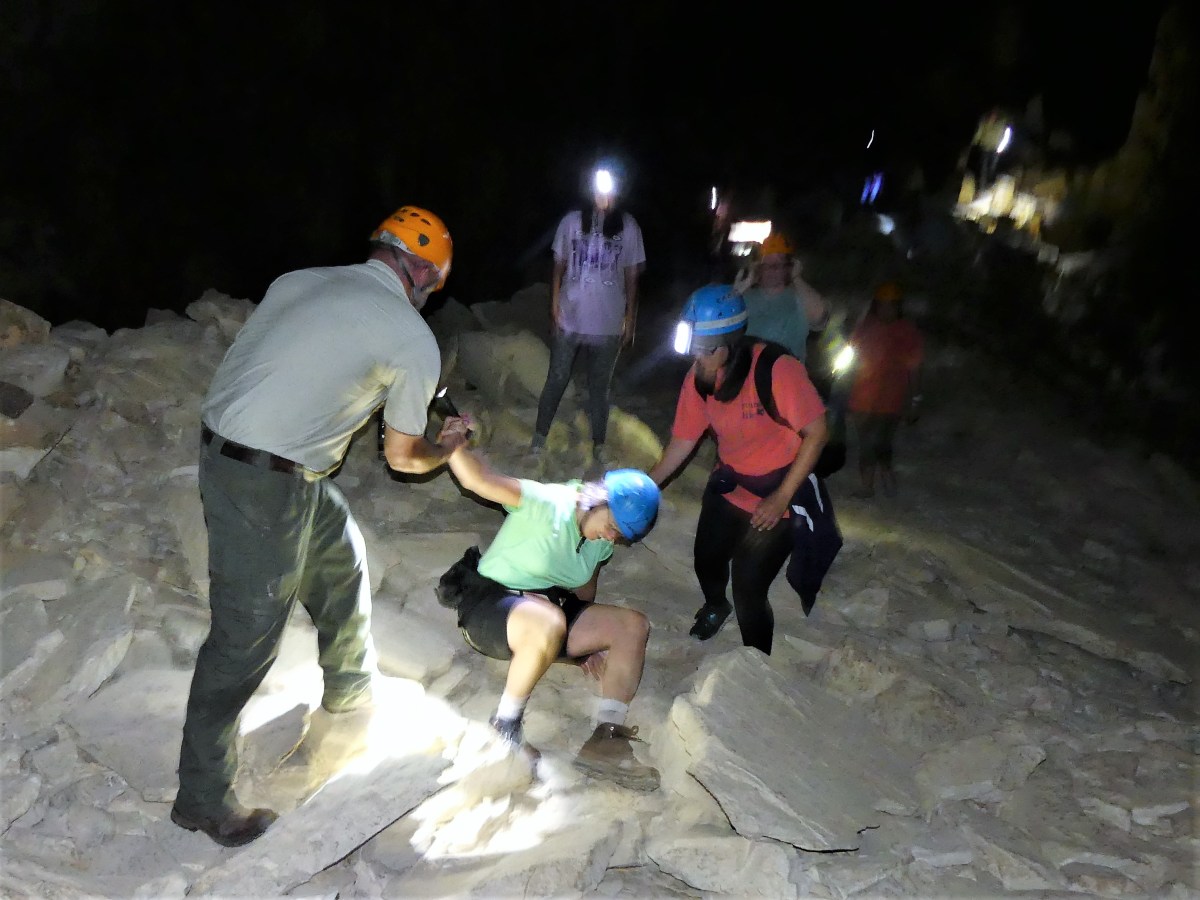
Texas shaped stalactitesThere was no meaningful trail. Every step was a floating rock, see-sawing under our weight. That’s when I heard Leah go down hard behind me. I swung around to see her flat on her back, saved by her fanny pack.

leah downAnd Matt was there in an instant.

Leah gets help“I’m alright,” she declared. “I just lost my balance on the rocks.” It was good news to my ears. For some reason, Leah and caves are not on equal footing, and rarely without incident (see “A Hole in the Head” post),
She brushed herself off and we continued along, safely negotiating the terrain while admiring scenery the likes of Yogi and Boo Boo, immortalized in stone.

Yogi and Booboo

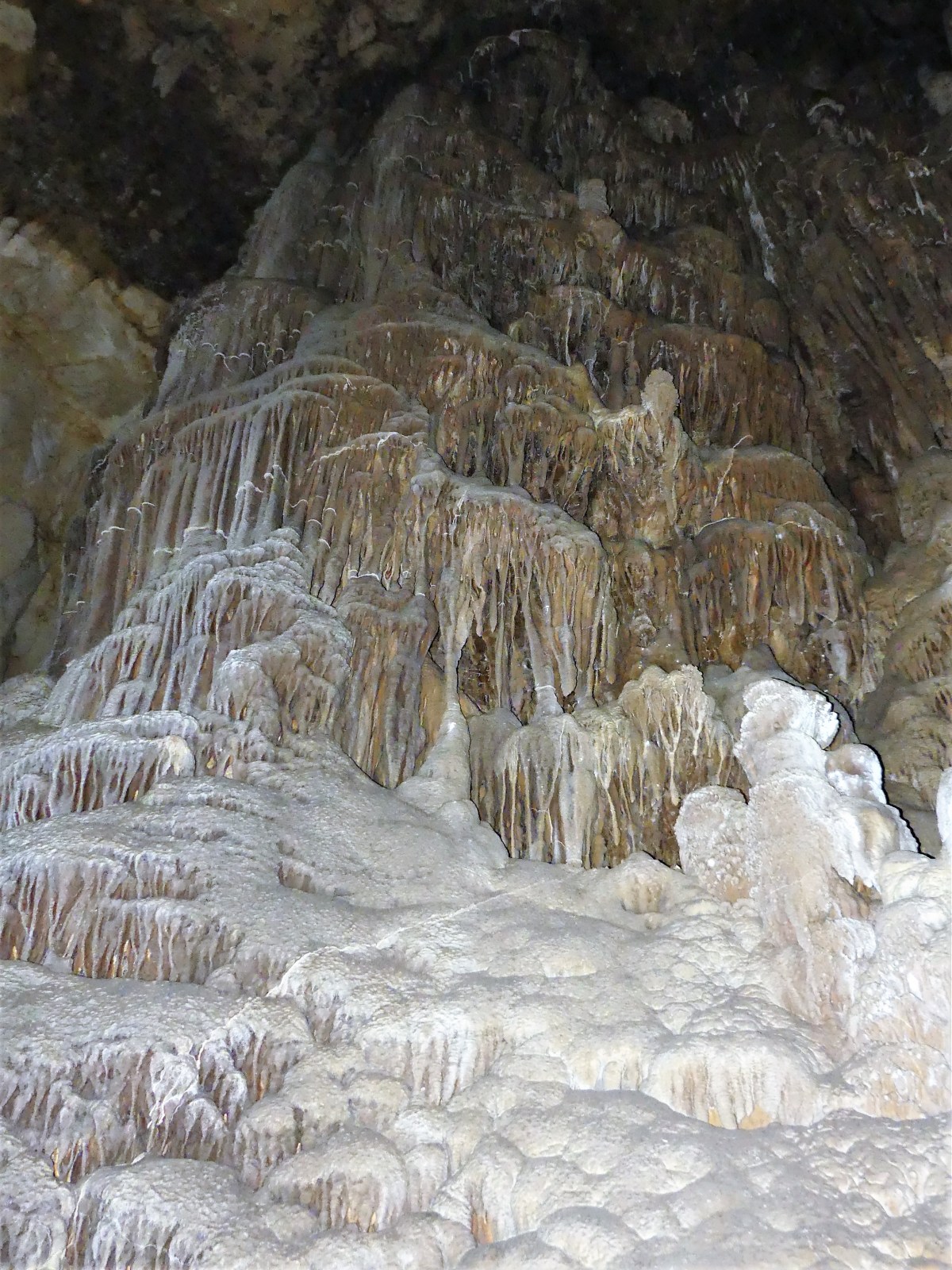
Yogi and Booboo2We turned the corner and the room opened up. The ceiling vaulted higher to accomodate the caves’s largest column.
snow on rocks“Don’t be afraid to touch anything,” announced Ranger Matt. “We’re not like most of those other parks that have guard rails and ropes, and psychedelic lights with church music playing.” He was preaching to my choir.
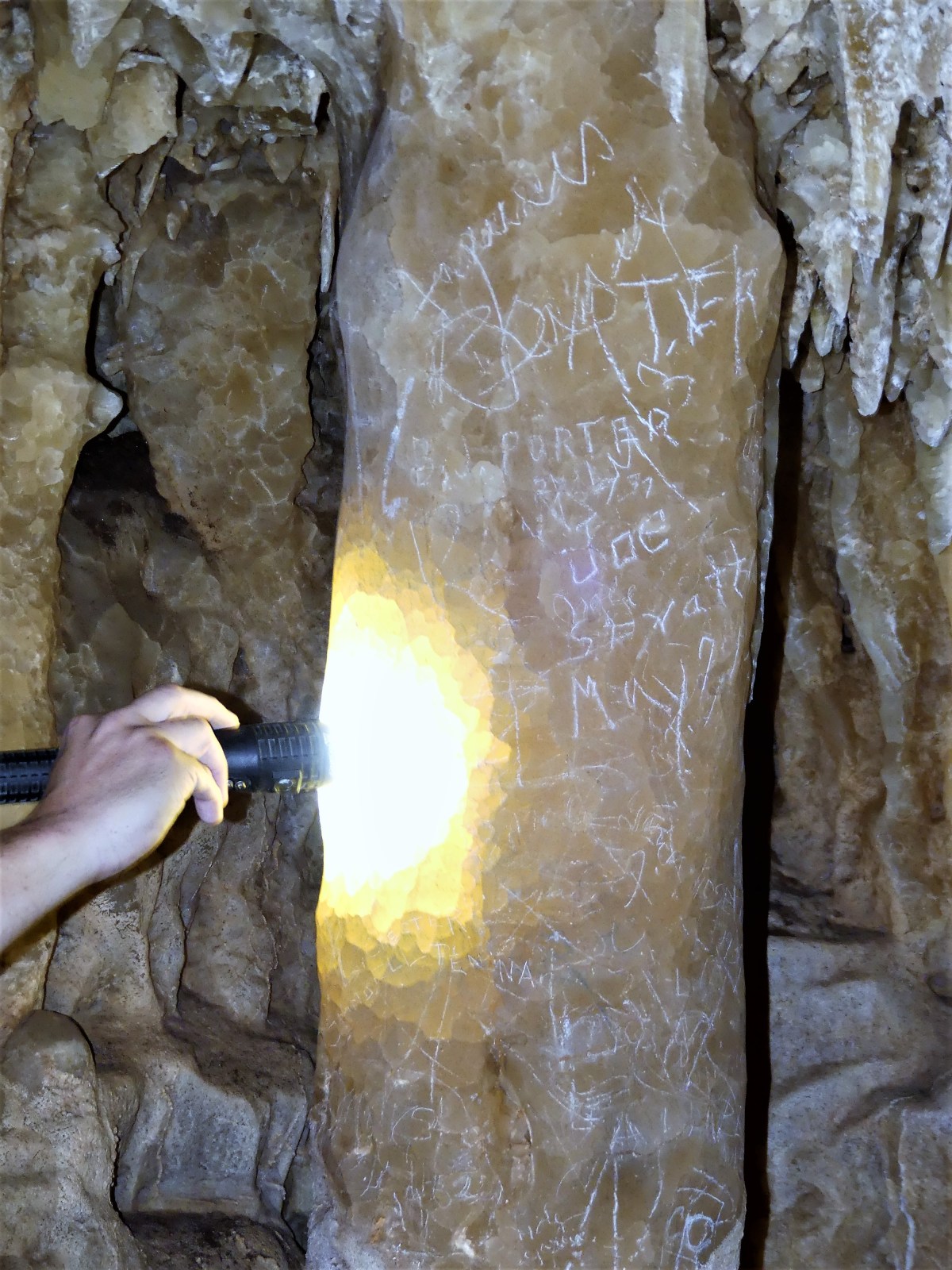
“Just don’t carve your name on anything unless you’re willing to pay for the crime. We have little patience for graffiti here.”

glowing column with graffiti“Like this one over here?” suggested a blond coed, pointing to a name scratched into the calcite that dated back to 1887.

Robinson graffiti“Ah, good ol’ C. Robinson,” Ranger Matt explained, “He was one of the early ones. But there’s older graffiti in this cave that predates Mr. Robinson–written with torch soot–but that’s in a room that’s off limits because it’s still developing.”
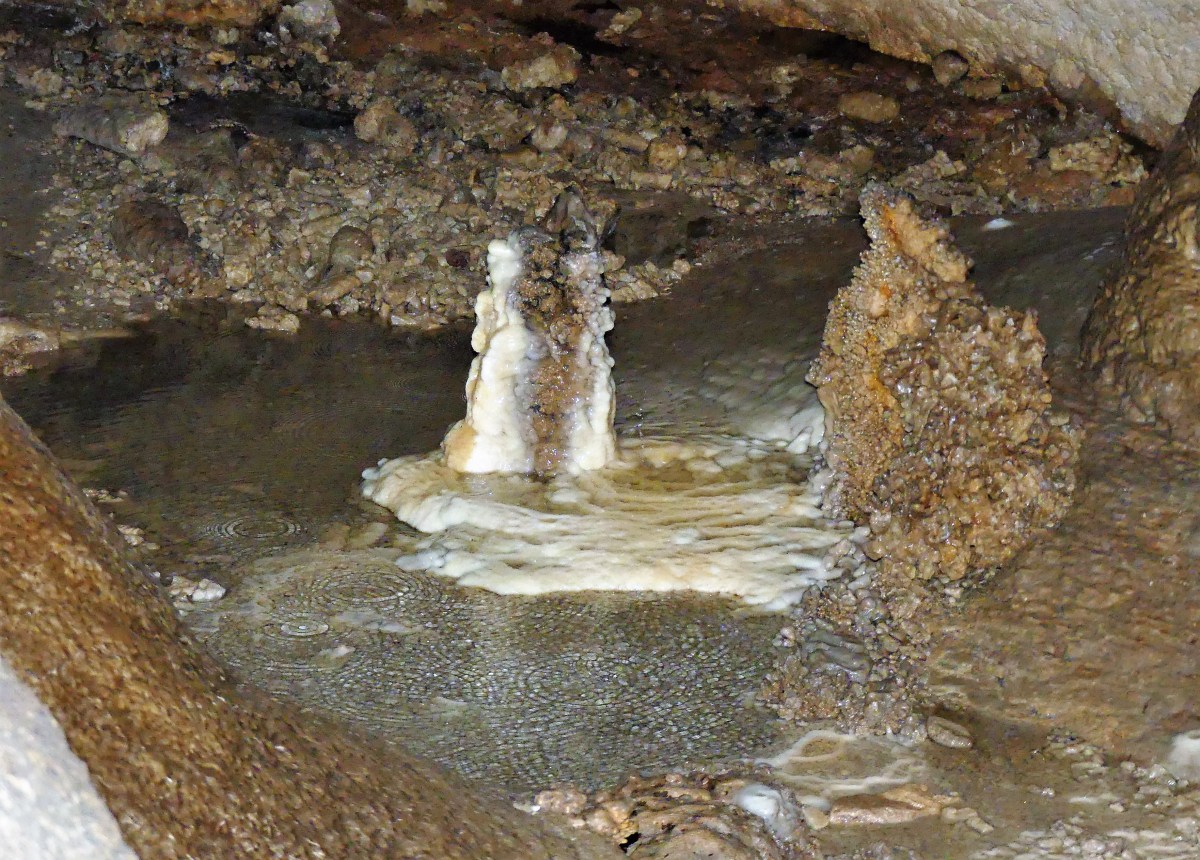
He was referring to parts of the cave that continue to evolve, thanks to rhythmic water droplets falling from ceiling tendrils onto budding mounds below.

“Are you sure we can’t see it,” I asked?  The tour was exceeding the pre-determined time limit, but I was eager to explore more.

Ranger Matt agreed to take us further in and 40 feet deeper to give us a peek, but only if we were willing. Half the group was ready to call it a day, but the other half of us who pledged our lives to Jules Verne was ready for anything, so we descended deeper still.

“Just remember,” Matt forewarned as he led, “the deeper we go, the longer the climb out.” There were no objections and no complaints. Each of us found our own way down. When we reassembled at a flat area, we were given a new set of instructions: NO TOUCHING, and STAND AWAY FROM THE RIDGE which plunged another 120 ft. below.

wishing wellWe solemnly wove our way around the space, beholding the nascent natural beauty that will one day become a future column.

water drop

Indebted to the Internet

BREAKING NEWS: Three days at Kickapoo Cavern State Park in Brackettville, TX without cell service or WiFi signal…

“Really?”, I asked the ranger upon check-in, afraid of her confirmation.

“That’s right,” she responded. “Who’s your carrier?”
“Does it make a difference?” I didn’t want to belabor the point. “Verizon?”

“Then you’re screwed,” she said emphatically. “The only reason I asked,” she continued, “is if by chance you had AT&T, then maybe there’s a slight chance that if you hike to the ridge, you might get a weak signal.

“Great!” I conceded with resignation. I noticed a “FREE WiFi” sign by a monitor playing video of the park’s activities, and I think I felt a bit of a rush.

“What about WiFi?” I asked eagerly.

“Well, yeah, there’s WiFi here during the day when the ranger station is open and it’s not raining. Otherwise, you can probably pick up the signal at the bathhouse, and nowhere else,” she proclaimed.

My heart sank. The purpose behind this trip was to enjoy the outdoors when the weather allowed. But after learning that the park’s internet connection would be available at precisely the same time when I should be out experiencing nature, I am left to choose between which of the two necessaries is more meaningful. While not as devastating as “Sophie’s Choice”, I know I must surrender one for the benefit of the other.

I had psychologically prepared myself for this situation; it was inevitable. I knew that once we headed into wide-open spaces of rural Western states, there would be limited or no service. And where we are now certainly feels remote. After 40 miles on a winding road without traffic, we reached the park’s welcome sign. Another four miles in and we reached our true destination. This place is a rolling bust-line of shrub and sagebrush-covered hills. But best of all–for the first time in a month there is ABSOLUTELY NO SOUND OF TRAFFIC!

As I type this on my laptop on a picnic bench in view of the Airstream, I glance at the WiFi icon sitting on the left side of the task bar. As a lark, I position the cursor over the icon, and up pops the message, “WiFi connections available”. Incredulous, I click on it and sure enough, I have the option of opening a channel called “TPWD—PUBLIC”.

I waste little time activating the signal. I am immediately redirected to the Texas Parks and Wildlife Wireless Acceptable Use Policy (Effective date: December 15, 2005). I am ordered to read the entire policy before proceeding.

Accordingly, in order to utilize wireless services, I must hit the “I Agree” button at the bottom. Criteria to consider before agreeing are: Content Prohibitions, Content Harmful or Offensive to Third-Parties, Unlawful Content, Infringing Content Impersonation, Content Interference, Deceptive Content or Spam, Unapproved Promotions or Advertising of Goods or Services, Off-Topic Content, Content Harmful to Other Systems, Network Usage.

After perusing all the “CYA” jargon that Texan lawyers are obliged to disclose, I hold my breath and push the “I Agree” button. I figure if Trump can get elected, then surely I can get a connection to internet. By the way, wasn’t that part of his platform–improving infrastructure across America?

Behold! The clouds part, the planets align, the angels sing, and a faint and intermittent internet connection is born! Hallelujah!!

So what’s the point of this post if I no longer have to measure the merits of being cut-off from the main-streaming world?

A lot! I NOW HAVE CONTENT TO PUBLISH!!

Remembering the à la Mode

April 20 represented a milestone in my life. It was officially the first day of my retirement. It also coincided with a counter-culture connection to cannabis consumption (known in hippie parlance as “420”), and it was the carnival kick-off for Fiesta San Antonio. Of course, it wouldn’t have been a celebration without participation in both events, all topped off by fireworks.

I have worked at many jobs spanning many different careers and found all of them gratifying in one way or another. Each job seemed to prepare me for the next one, even though the steps in-between were uneven and varied, or complete leaps of faith. I suppose I attribute my jack-of-all-trades mentality to a restlessness that overcame me by travelling throughout Europe the summer after my sophomore year in college.

When I returned to school, I abruptly changed my major from political science to sociology and photography, hoping that an understanding of people and pictures would carry me to different places.

My last job/career as a special education teacher in New York City’s high schools for the past eleven years came close to realizing that dream, as I taught inner city teenagers about the world around them through words and images. But the time was right to put it all behind me, and resume my quest for some kind of redemption by reducing my footprint and refining my senses. It was time to travel again… although this time, in style.

At precisely 4:20 pm, the ceremonial lighting of a glazed metallic iguana pipe set the mood for what was to become an epic evening in downtown San Antonio, made easy via a VIA bus shelter conveniently located directly across the street from Traveler’s World RV Resort. (The bus runs every half-hour, and costs just $1.30 a piece to carry us to the party zone.)

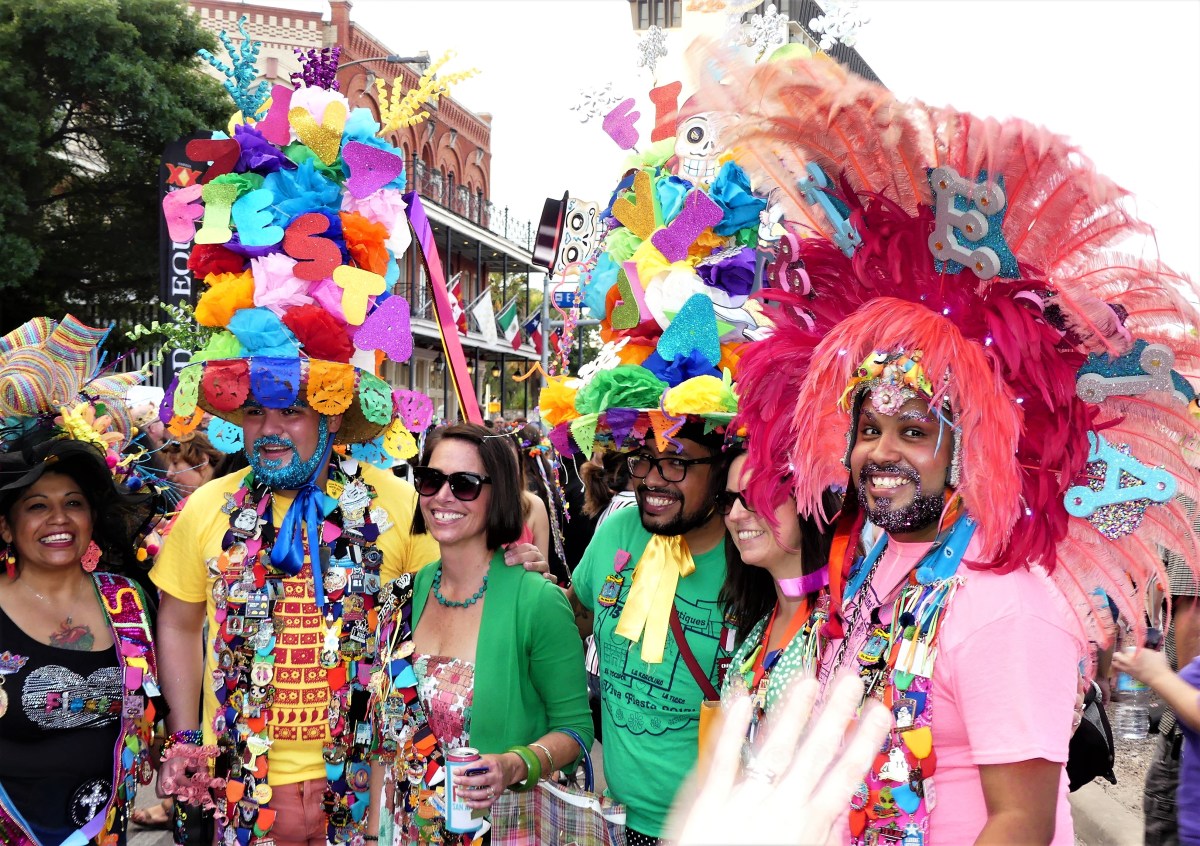
Once there and navigating through the thick stew of resident revelers, it becomes apparent that three things matter most to fiesta folk: medals, eggs and hats. Sashes, vests and tallis-like scarves provide opportunities for collecting even more medals and pins on an already crowded chest. Bragging rights belong to the San Antonians who would collapse under the weight if wasn’t for the support of others to hold them up.

royalty.jpg
King Antonio and his Court

Equally as important are confetti-filled eggs (drained and decorated cascarones) available by the dozen for the sole purpose of smashing them over the heads of adoring neighbors, and showering them with good luck. Even the cops showed signs of confetti dandruff, making police assault okay for the day.

egg smash.jpg

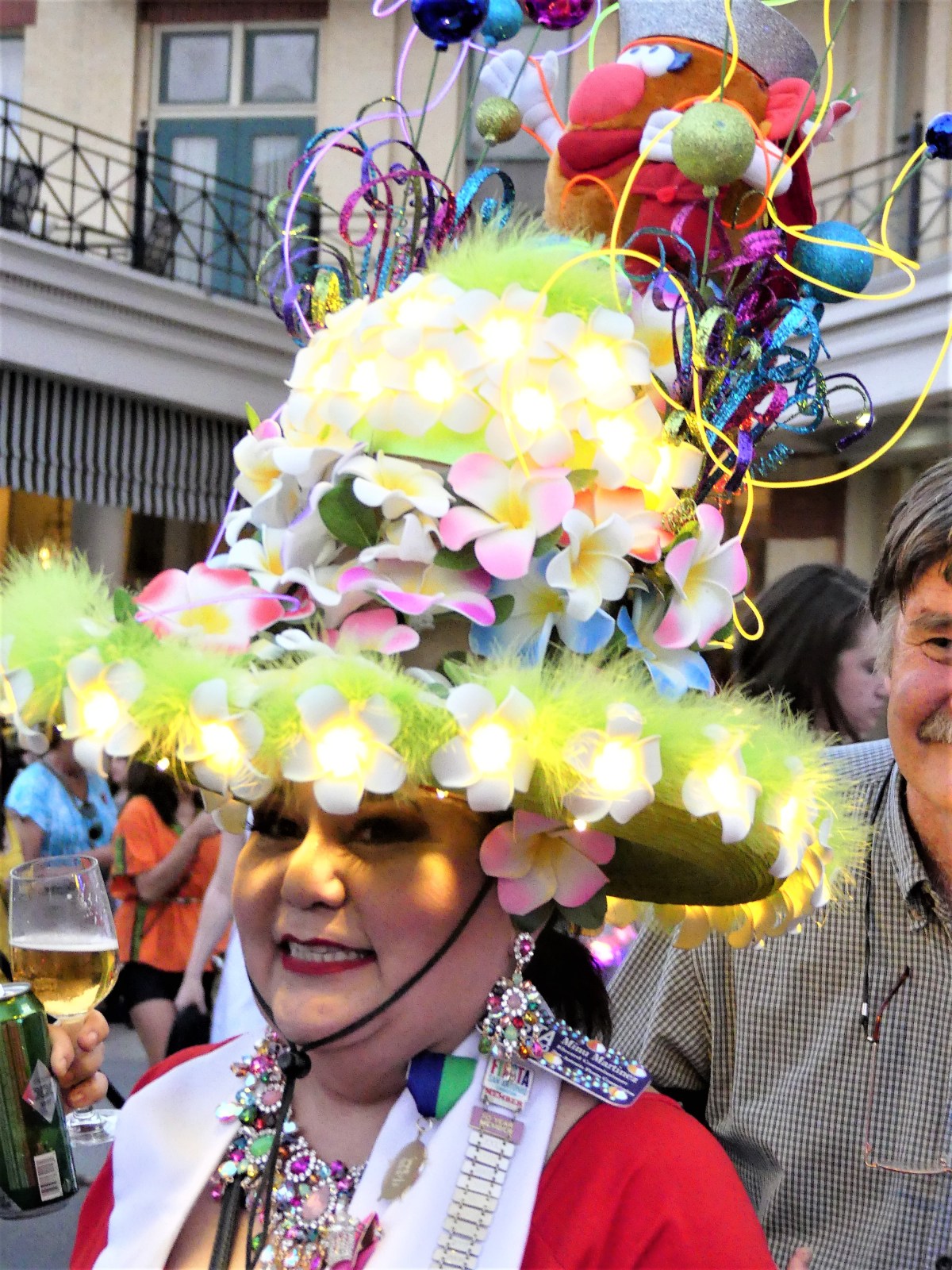
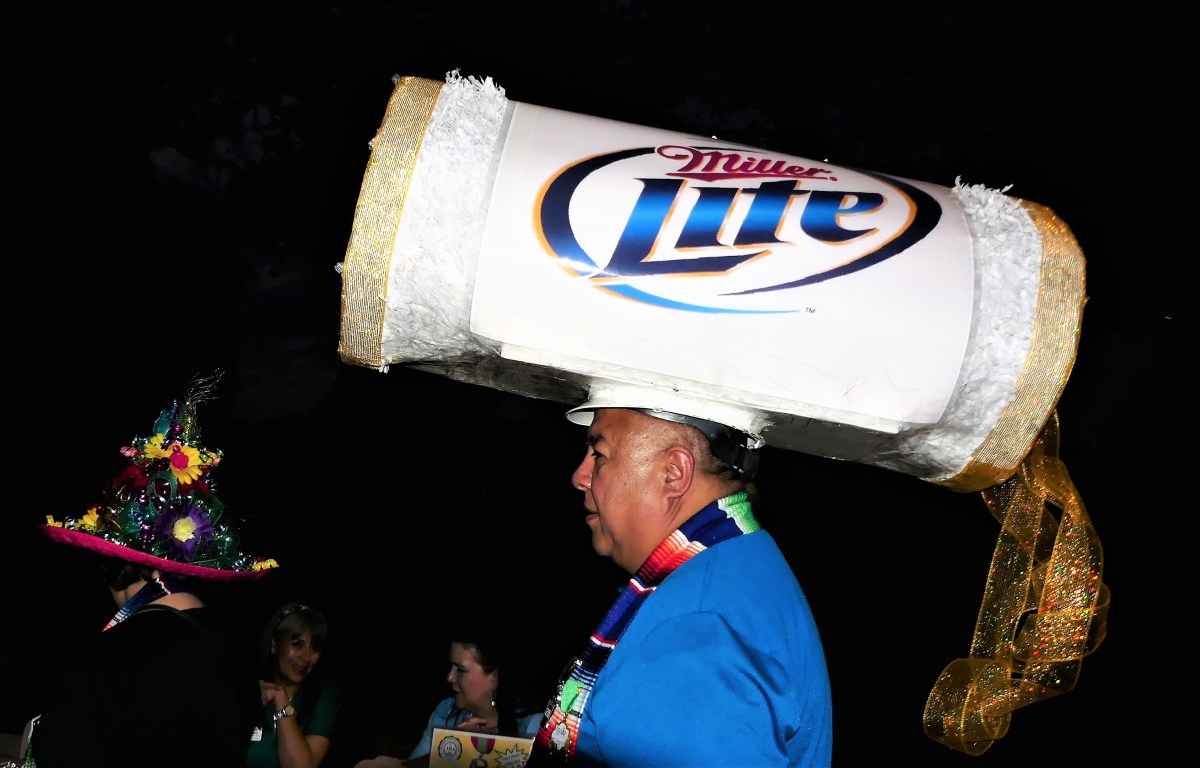
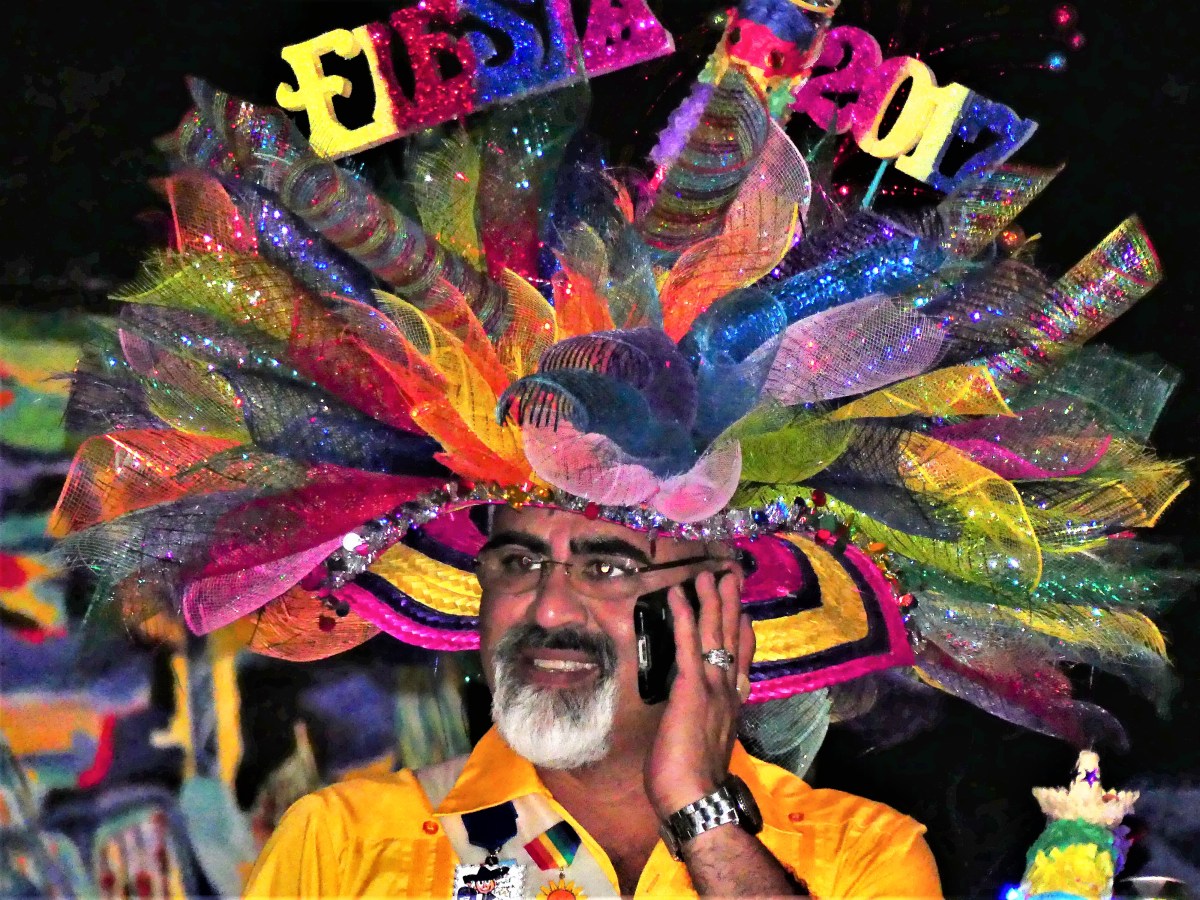
Lastly, thematic hats of all shapes and colors are easily the most conspicuous sign of extroverted behavior at the Fiesta with a special nod to “size matters”. This is a post-Easter parade gone sideways, where the most ridiculous rule. Carmen Miranda awards for the day go to the following:

3 some hat.jpg

butterfly hat.jpg

flower hat.jpg

potato head hat.jpg

spurs hat.jpg

beer hat.jpg

phone man .jpg

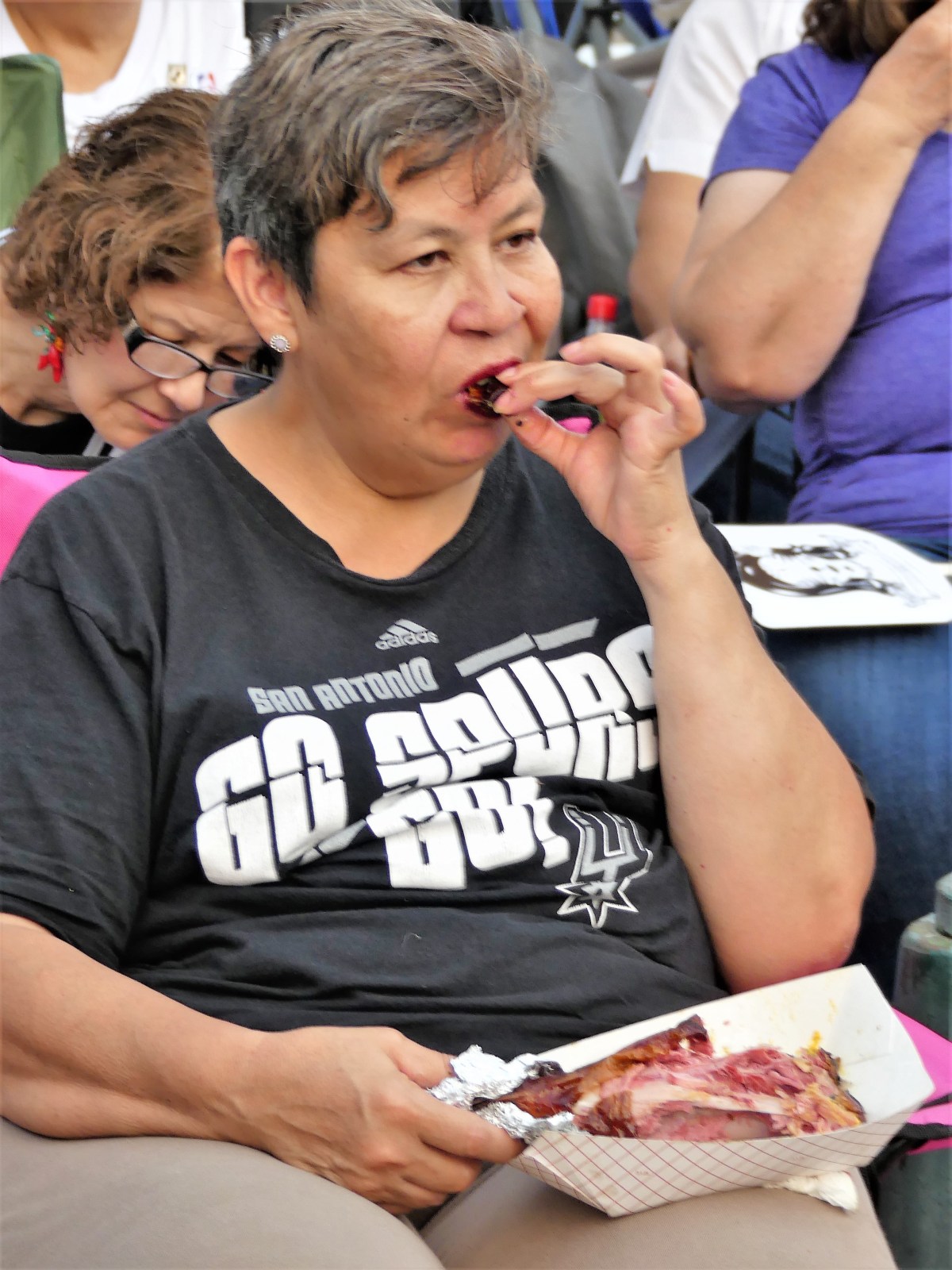
Food is also an important part of any fair. Vendors with tents and trucks tempted the hungry with long lines for tacos, tamales and turkey legs.

turkey lady.jpg

taco man.jpg

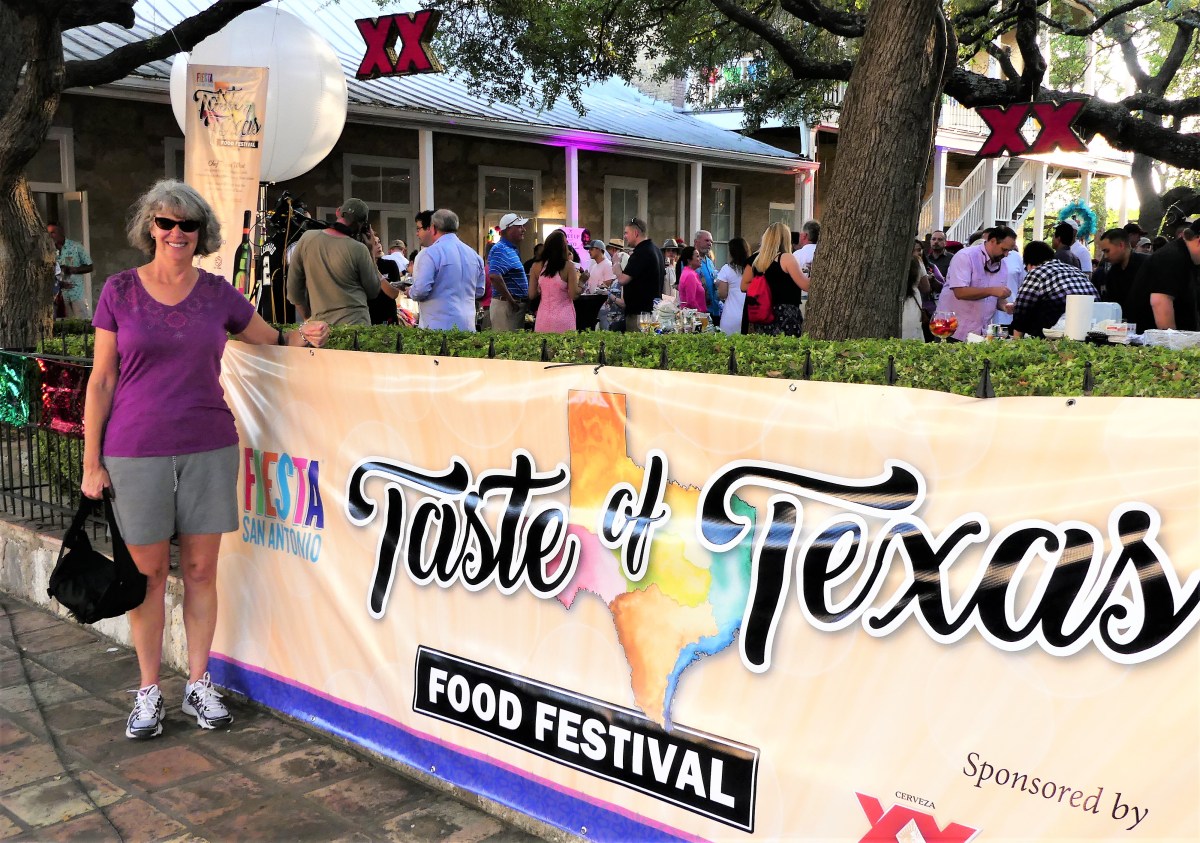
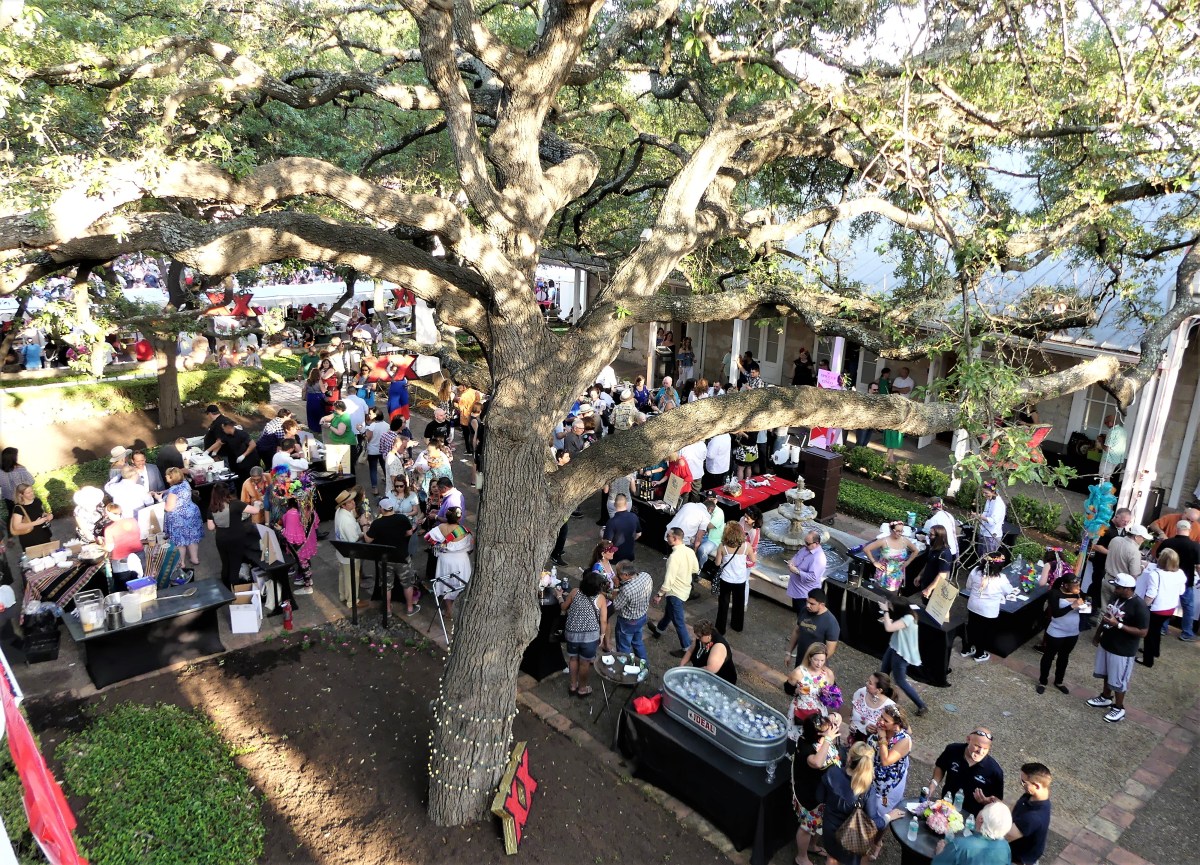
Yet somehow, Leah and I managed to circumvent the lines by inadvertently crashing the Taste of Texas, a VIP event for those willing to shell out $100 per ticket for tasty tapas.

taste of texas.jpg

We noticed a sophisticated crowd of people in a courtyard behind a hedge who were enjoying themselves, and thought to check it out, unaware–until we crossed over an ivy walkway–that wristband entry was required. It was easy pretending that we belonged with our hands in our pockets.

T of T ariel.jpg

We even got the chance to mingle with Fiesta royalty.

king.jpg

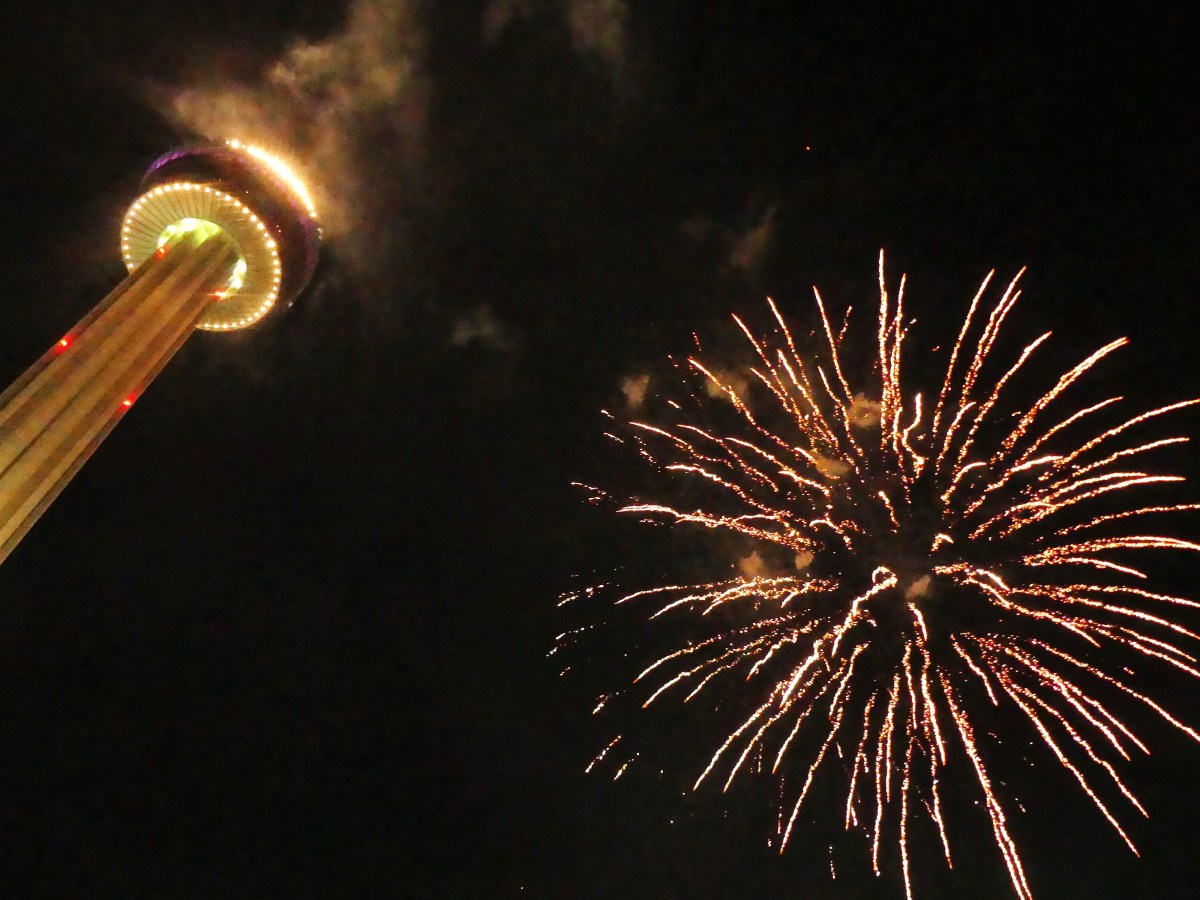
The evening ended with a fireworks display in the presence of the Tower of Americas, San Antonio’s tallest lookout, which dates back to the 1968 World’s Fair. It was definitely the icing on the cake, and the cherry on the sundae.

FW 1.jpg

FW2.jpg

FW3.jpg

It was Alamo à la mode!

Deep in the Heart of Taxes

I have a confession… I got a little bit stressed today. Some call it bringing “tsuris” on yourself. I should have seen it coming, but I was caught off guard. It was more than a senior moment. It was like getting your senior period.

I admit to becoming distracted, because Leah and I were busy enjoying our road trip. We were transitioning from Austin to San Antonio–when out of the blue, I was abruptly reminded that the deadline for filing federal tax returns was approaching.

My personal returns were finished long ago. I wasn’t taking that headache on the road with me. Yet, somehow that didn’t matter.

My conniption started with a late evening call from someone who should have known better, but nevertheless, waited until the last minutes to file returns regardless of repeated reminders to get it done earlier. And now I was supposed to fix everything and have all the answers.

I could have handled it better; I should have anticipated the call. Then I wouldn’t have felt like I was being yanked back to my old reality when I answered the phone.

The notion that somehow there was enough emotional distance between New Jersey and Texas was only a distraction, because there is no escaping the intersection of government and personal responsibilities.

Of course, I provided whatever answers I could muster for my delinquent taxpayer, attempting to put out a long-distance fire through a chain of emails. But after a cold beer and a swim in a quiet pool under a hot San Antonio sun, I came to my senses, and the stress lifted from my body like a hot air balloon.

My journey continues uninterrupted… until the next call.

Lady Bird! Lady Bird! Fly Away Home

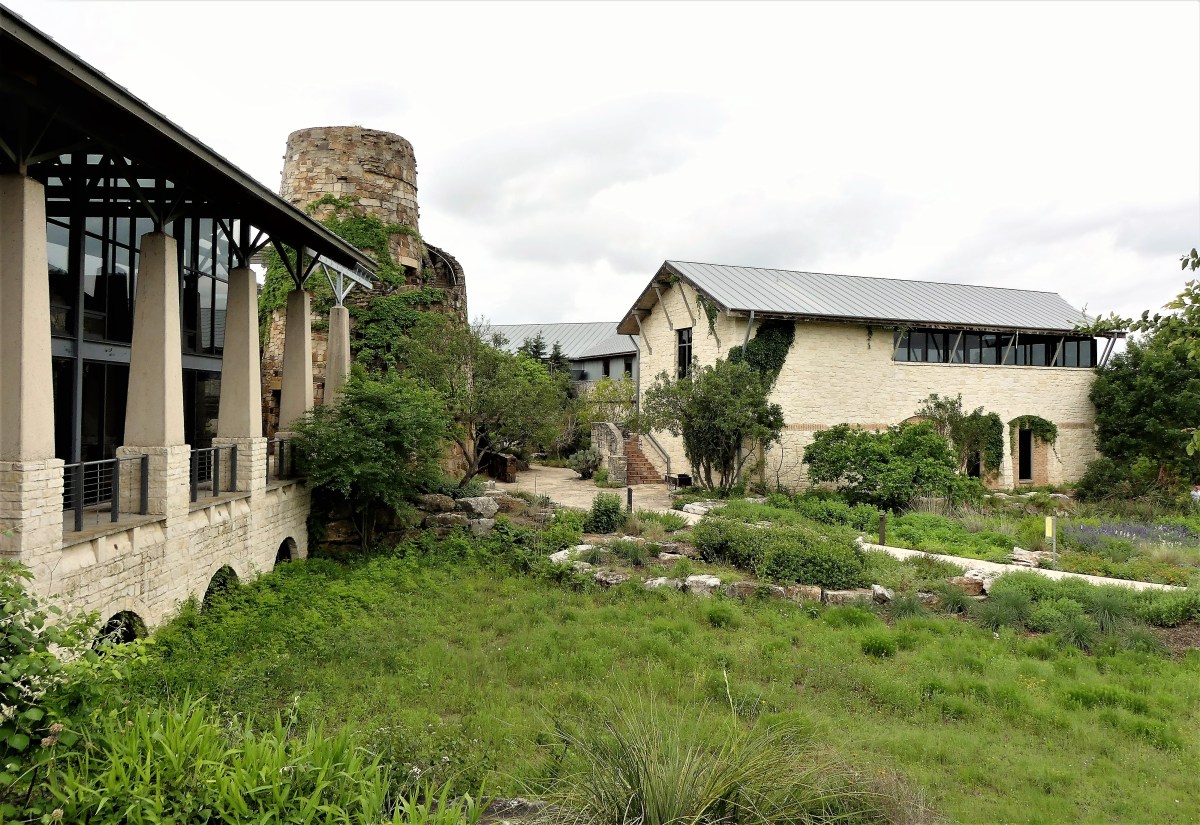
A photo essay with pops of colors under gray skies at Lady Bird Johnson Wildflower Center…

bdlg exterior.jpg
Observation tower
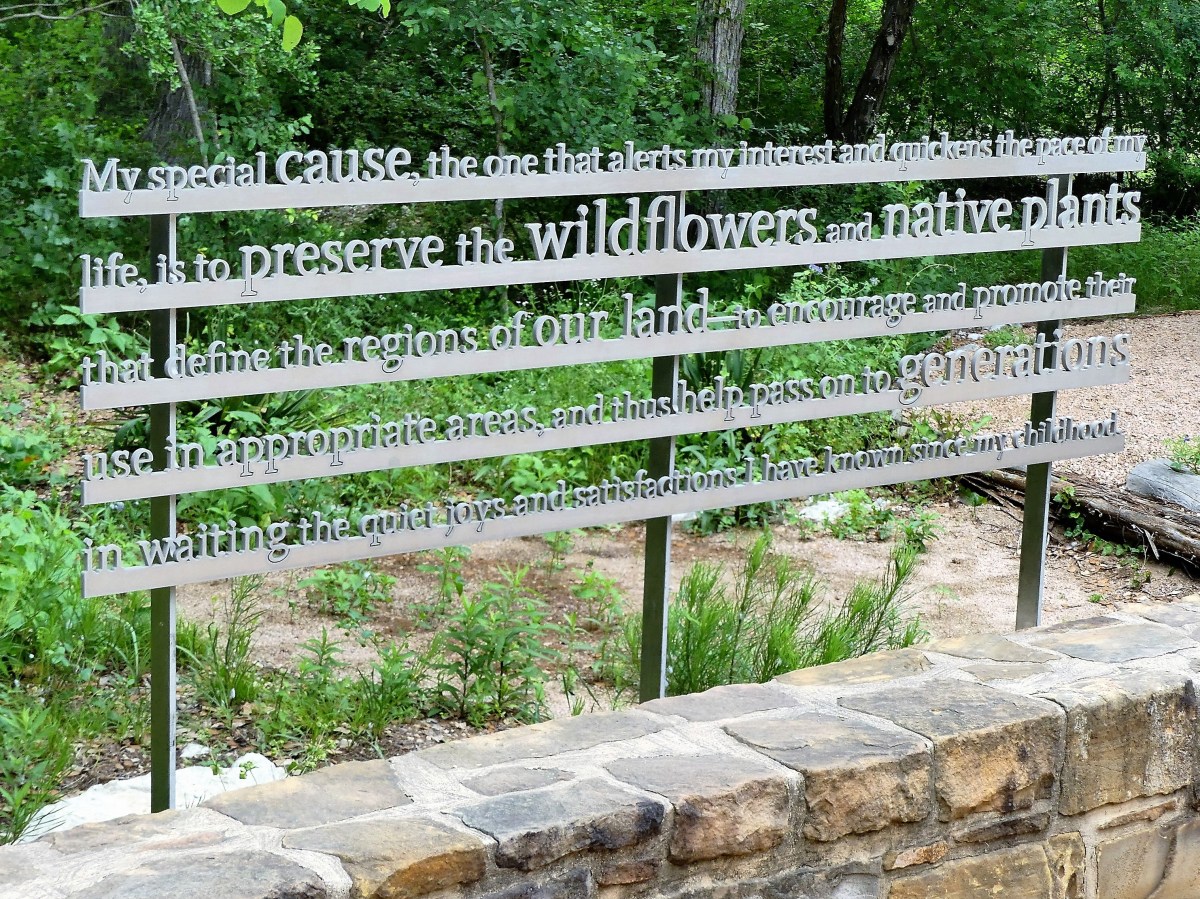
Mission statement
LBJ mission statement
fountain.jpg
Serenity Fountain
Bluebonnet.jpg
Purple Bluebonnet
Antelope horns
Antelope horns
lace cactus.jpg
Lace cacti
winecups.jpg
Winecups with African daisy
butterfly.jpg
Gregg’s mistflower
cactus flower.jpg
Prickly pear
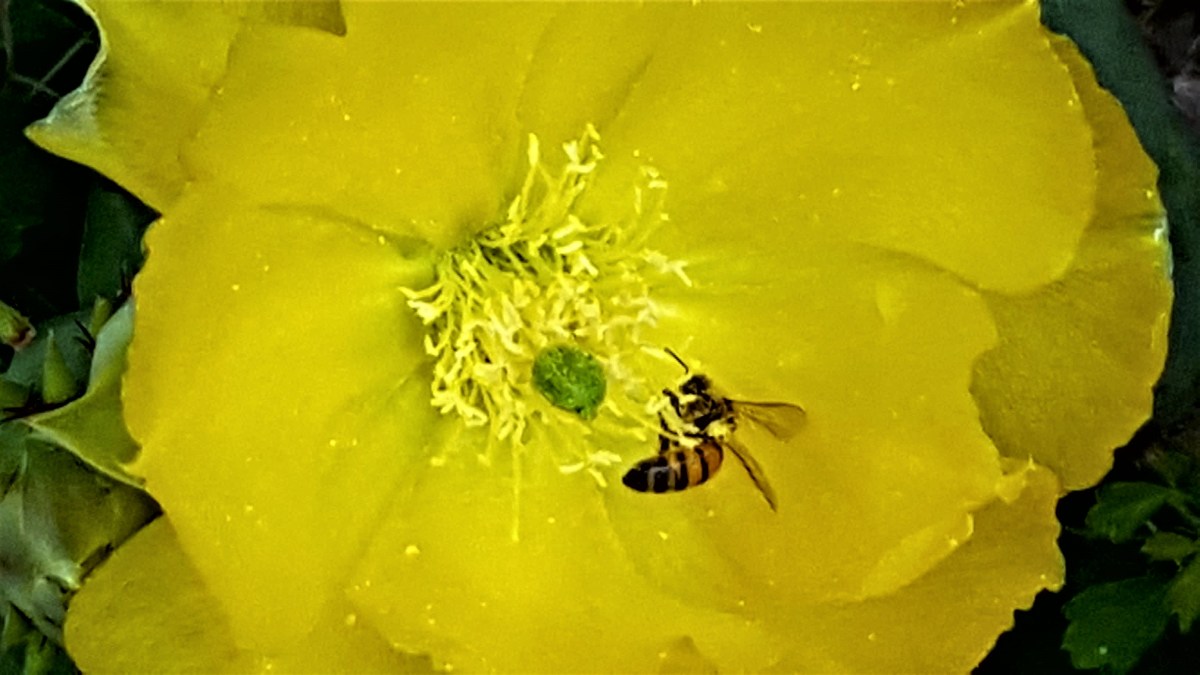
cactus bee.jpg
Prickly pear blossom and honey bee
Texas bluebell.jpg
Texas bluebell

Here Today, Guano Tomorrow

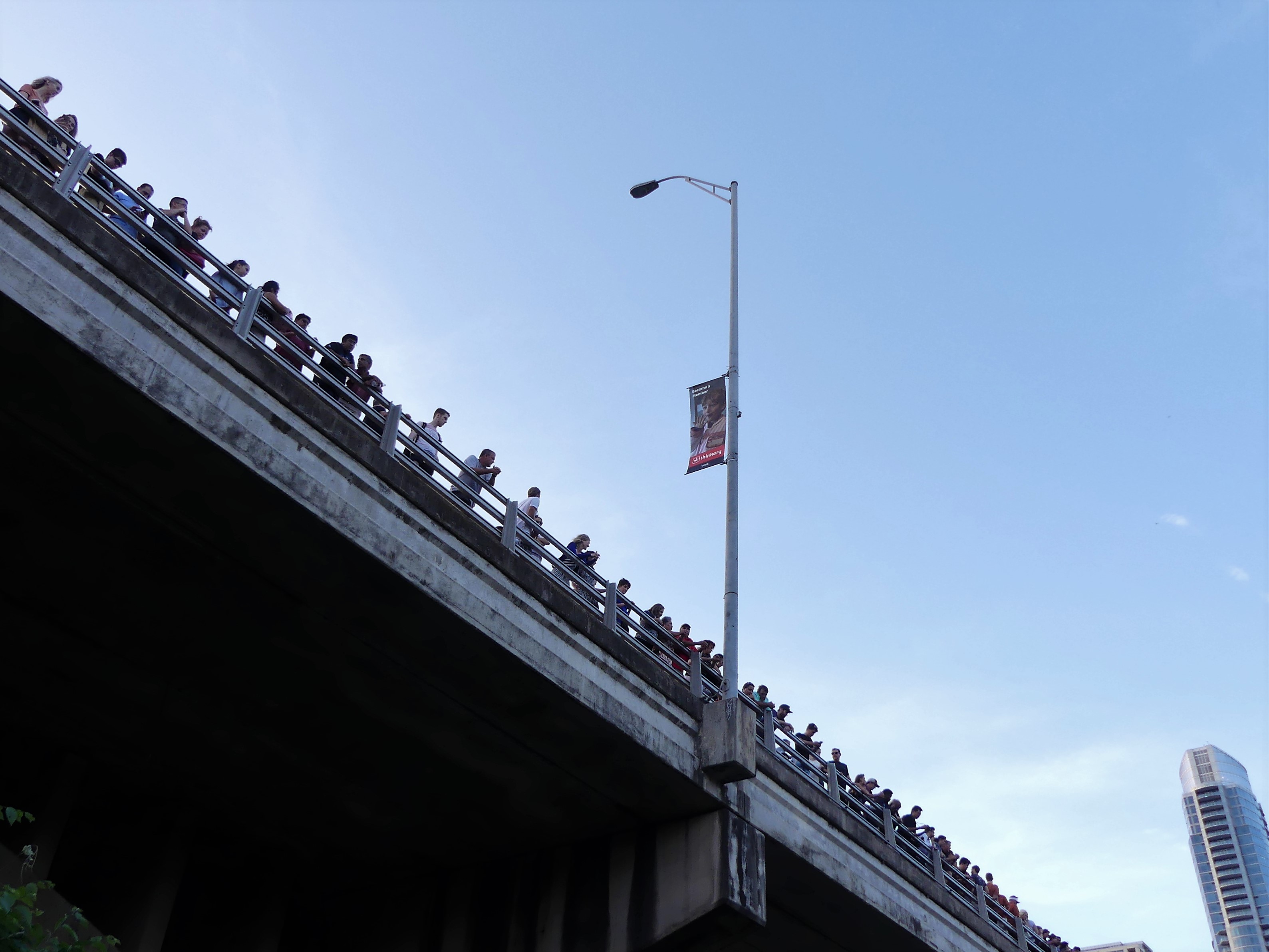
Hundreds of people are standing on or below the South Congress Bridge in Austin, TX and waiting for sunset, which is expected at 8:20pm tonight. Most are tourists with cell phones or bulky cameras, eagerly anticipating the torrent of bats soon to emerge from their roost under the bridge.

The atmosphere is circus-like. Everyone is talking excitedly about the upcoming attraction. Young and old stand shoulder to shoulder;

people on bridge.jpgor find a blanket-sized parcel of grass to relax and watch the sun go down;

Lawn for bats (3).jpgor pull up in a boat to wait for showtime.

kayak.jpgOne fellow standing behind me seems to be mystified by the whole experience. “Are they gonna fly outta that sewer hole over there?” he wonders out loud.

P1010402.JPGHis misconception is immediately corrected by a 10-year old standing nearby. “Hey mister, this isn’t Batman, y’know! They come out from under the bridge where they live,” says Einstein boy.
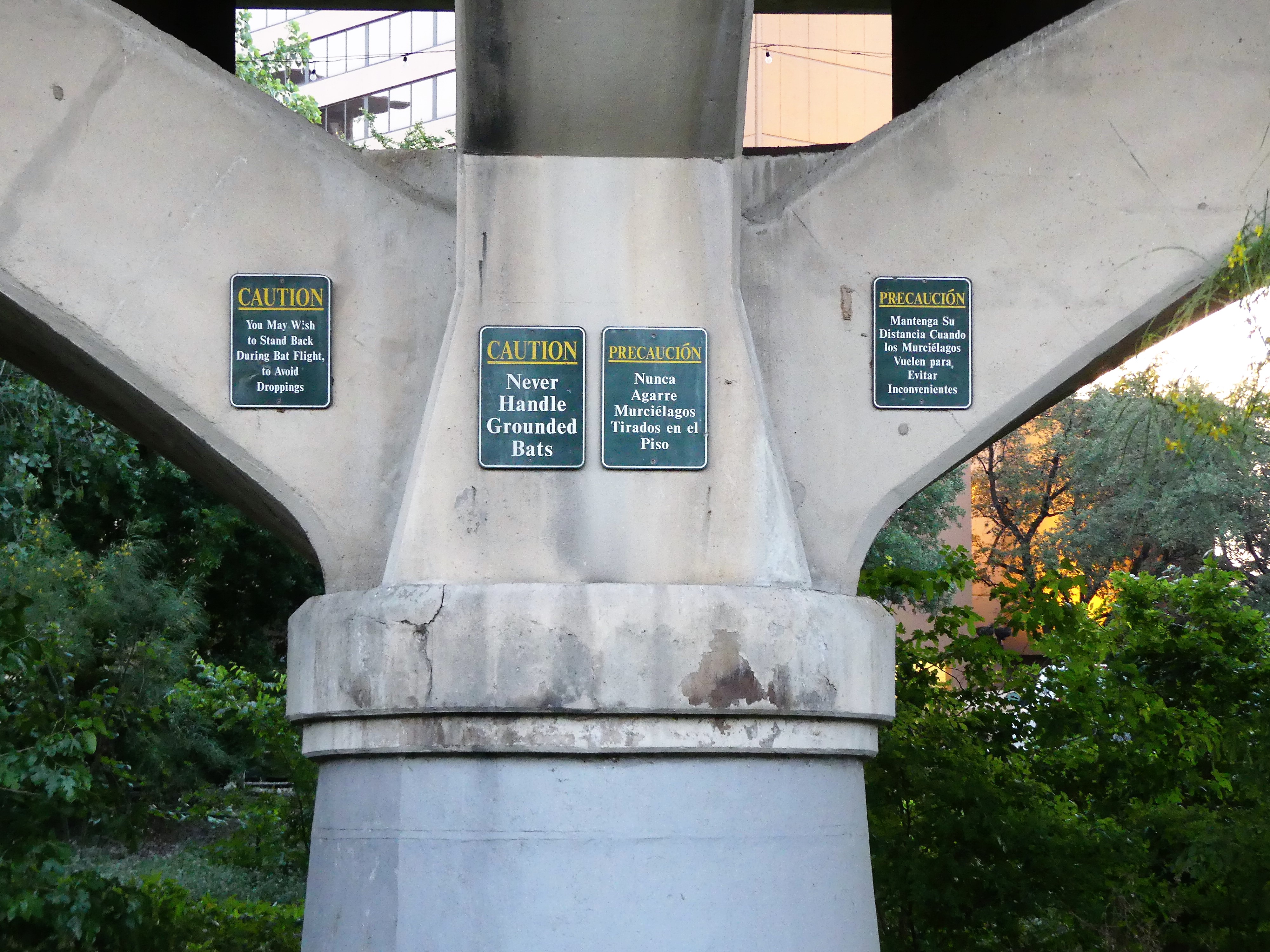
“I hope they don’t come around me…that shit is poison,” says sewer man.

bat warnings.jpgI too am excited to catch the bats in flight, but I’m also interested in doing something different with my Lumix, which I’m still learning to use. I’m determined to capture the bats in motion!

As twilight approaches, the throng fills the empty spaces of lawn and becomes more animated.throng.jpgThe moment arrives when the first bats emerge, and the crowd gets giddy.

bat flight1.jpgAnd moments later, the floodgates open, and the bats streak across the night sky by the thousands–

bat flight2.jpga migration wave of epic proportions that approaches a feeding frenzy.
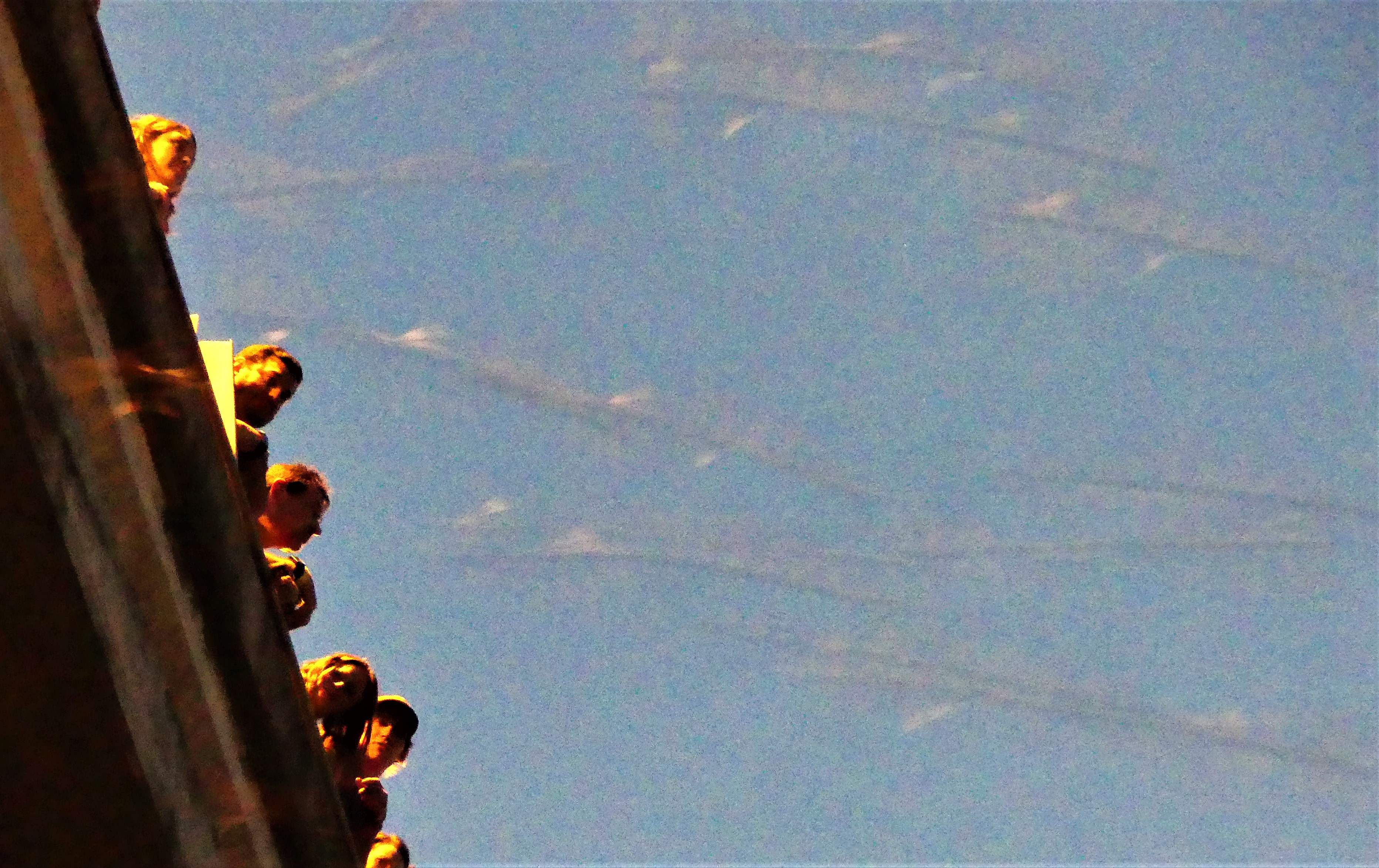
bat flight3.jpgI confess that the photos are experimental. However, I understand that there are traditionalists who need to see things as they are, versus my interpretation of the event. So, in fairness to those whose vision is less oblique than mine, I’ve increased the camera’s shutter speed to give a more accurate representation of the bats’ flight path…

Blue Angels.jpgsuch that even Meat Loaf would be impressed.
Road Toad

Driving across vast terrain of boring interstate highway can easily give rise to a semi-serious anxiety disorder called scenery-itis. It can make a person wistful and cranky after extended exposure, and at worst, it can turn other drivers into road toads–a chronic condition of a different sort, where motorists believe they can leap and fly.

Researchers have been studying this condition for as long as Sears & Roebucks have been offering driving licenses to the blind, yet they have very limited data to advance the science. Nonetheless, there are some fascinating behaviors they have chronicled to date.

For instance, three tell-tale signs commonly associated with scenery-itis that can trigger an onset are: disinterested animals grazing on roadside pastures; personal injury lawyers predominating the signscape with same-number telephone numbers (call me at 666-6666); and pecan pie outlets competing with beef jerky huts as the only available proteins.

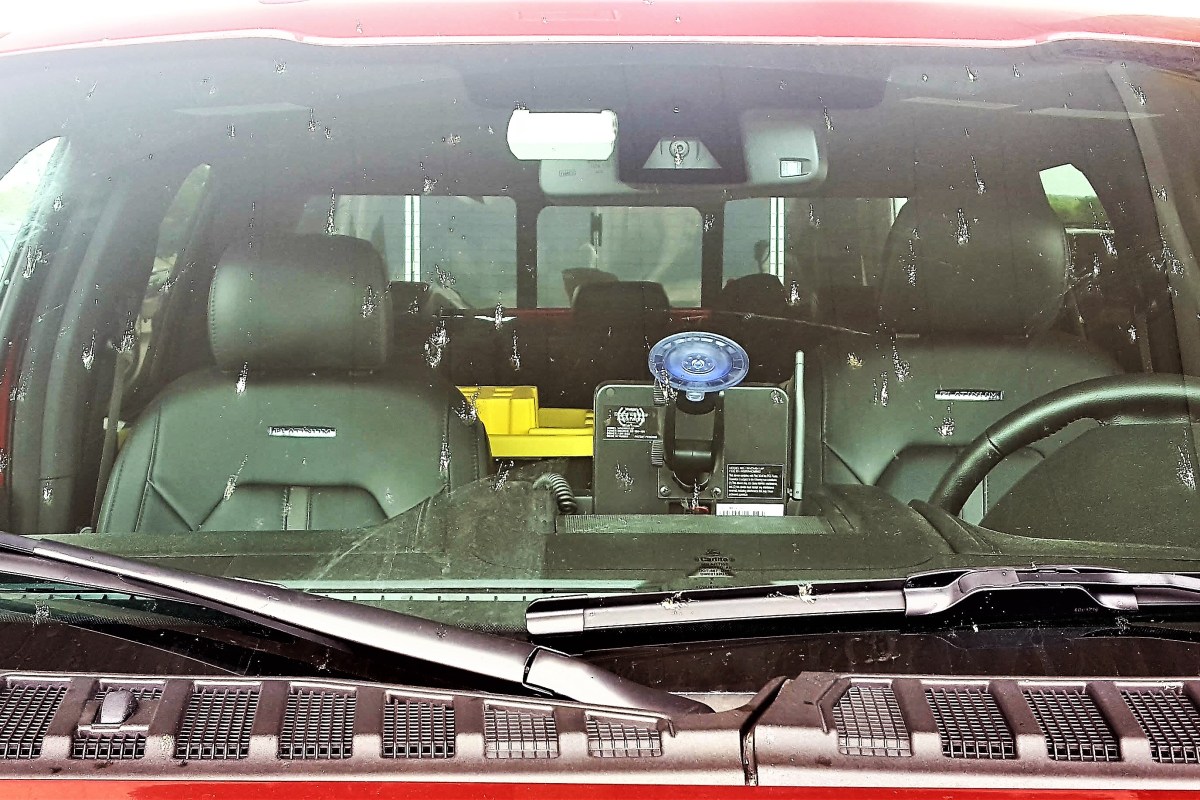
Symptomatic drivers should pull off the road immediately after experiencing bouts of excessive yawning, blurry vision, and an inclination to count the bugs that kamikaze into their windshield.

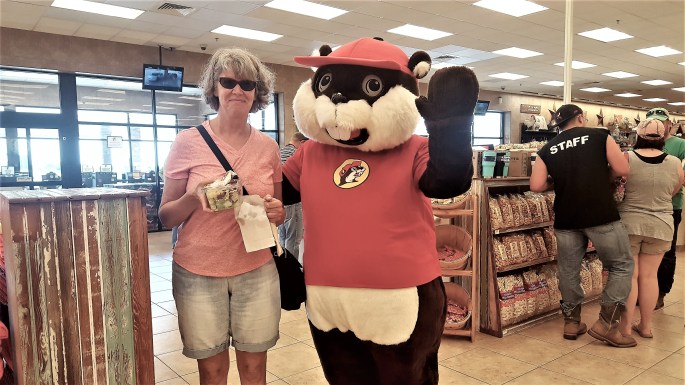
There are two known variations of the disorder. One is called Buc-ee’s-osis, which is a knee-jerkey fixation with gas station mascots when your vehicle needs fuel.

buc ee's.jpgThe other condition is a more common affliction commonly known as drifting-into-ditch-itis.

Unfortunately, the only known cure is driving through Utah, which does little good for a driver in Texas.

Donations are now being accepted at this blog to get me to Utah as soon as possible.