Where Have all the Gators Gone? (Long Time Passing…)

Traveling the Gulf coastline across Alabama, Mississippi, and Louisiana during the past week has brought us closer to Creole and Cajun cuisine, crawfish, casinos and country music, but alas, no crocodilia. Having driven nearly five hundred miles of state and county highways, and cruising endless back roads and bayou causeways, we have yet to see an alligator, which begs the question: Where have all the gators gone?

Not that we haven’t come close to spotting one. Mind you, there have been several vicarious sightings so far. For instance, yesterday we were driving/walking through Jungle Gardens, a 170-acre habitat on Avery Island with exotic palms, sculpted lagoons,

algae.jpg

scores of majestic oaks with gnarled and expansive limbs draped in Spanish moss,

Leah pose.jpg

a 10th century Buddha housed in a glass-walled pagoda,

Buddha.jpg

a bird sanctuary that hosts thousands of snowy egrets,

egret.jpg

and purportedly a family of alligators that have bred on the property since Ned McIlhenny introduced them almost 100 years ago. By the time Leah and I reached Bird City on the tour, we were lucky to meet a woman who had already come across six alligators in two separate locations. It warmed our hearts to be basking in her reptilian aura.

Then there was the time we stayed at Davis Bayou National Seashore in Ocean Spring, MS. We walked a half-mile-long nature trail that meanders around a leg of swamp fed by the Mississippi Bayou. Posted at the trail head is an easy-to-read sign that prohibits all alligator snacks.
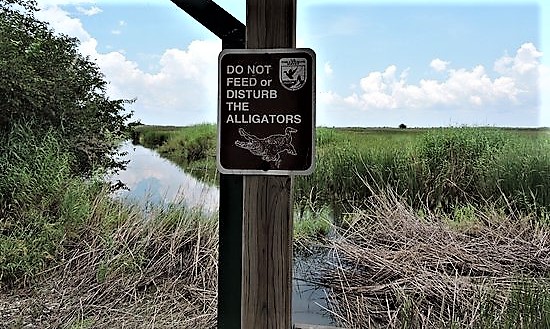
no feeding gators (2).jpgSurely, there must be gators here. Why else would they post a sign, we wondered. Yet we saw no alligators. However, another hiker told us that she was told by a park ranger who had heard from another ranger that a resident gator was spotted earlier in the day crossing the road in front of our campground–the very same road where we towed our Airstream, so that should count, right?

The next day, we pedaled to the boat launch where the same warning signs were posted, and Leah claimed to have seen a stick in the water that when hit by the sun at a certain angle during a specific time of the day closely resembled an alligator’s head.

We wondered if there was an art or a science to attracting alligators, so we created an alligator call just in case they were listening. It went something like, “Heeere, gator gator gator; heeere, gator!” Once, our calling was overheard by an older couple who gave us a strange look, but that’s because they probably didn’t understand English. Regardless, the gators never came; either they weren’t listening, or they were avoiding us.

We joked about going to an alligator petting zoo. It wouldn’t be too far out of our way, since we could easily see it from the road. But then we realized that it would be a waste of our time, surmising that it would be hard to decide who has fewer teeth–the alligator or the proprietor.

I know that alligators exist because I’ve seen them on TV and in zoos. And I can still recall that little boy who tragically lost his life near a Disneyworld lagoon while his father looked on in horror.

Yet the anecdotal evidence is overwhelming and doesn’t lie: there seems to be a serious shortage of alligators interested in meeting us–making it painfully obvious to any amateur herpetologist–that gators are playing hard-to-get… or maybe they’re just shopping around for a better agent.


Some Like It Hot

Down on Avery Island–in the thick of Cajun country, just up some from the Atchafalaya Delta–is a place where mosquitoes explode if they bite you. At least, that’s what they tell you on the company tour.

tabasco museum.jpg

It’s where the McIlhenney family has been making Tabasco Sauce the same way since 1868.

early years.jpg

It’s an interesting process that has much in common with fine wine or Kentucky bourbon, but doesn’t require an ID to buy it or try it. Although, some common sense should dictate how much you pour to invigorate your étouffée or gumbo.

The sauce begins with a special strain of tabasco pepper seed that sprouts in a greenhouse nursery before it’s transplanted into rich and fertile alluvial soil.

pepper plant.jpg

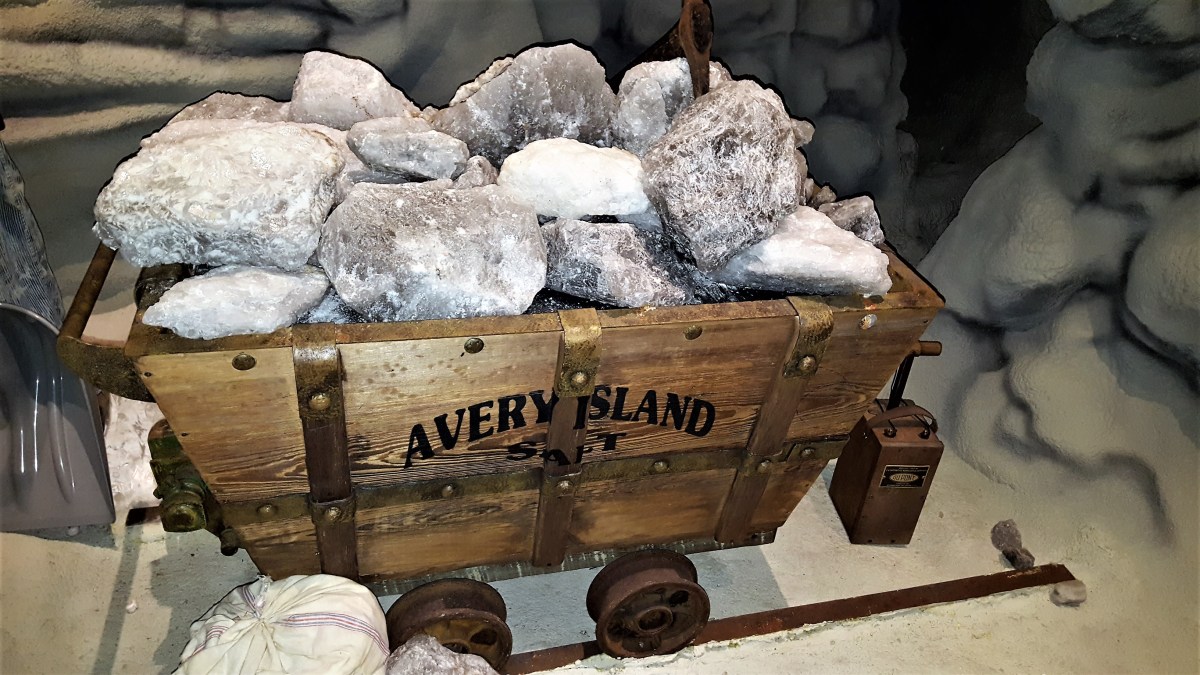
A graduated color stick determines the precise shade of the ripened red pepper before it’s properly picked by Peter, and crushed into a mash mixed with salt mined from the family property.

salt mine.jpg

Company coopers prepare and sanitize 60-gallon white oak barrels reinforced with forged iron bands…

barrels.jpg

where the mash is stored and sealed with crusted salt, and left to age for up to three years for the traditional heat, and between eight and ten years for the “reserve” collection. It was dizzying, just standing by the storage shed to take a photograph and inhaling the pungent aroma of fermenting peppers.

wall to wall barrels.jpg

When the mash is “ready”, it’s sent to the production floor free of peel and seeds. then combined with pure white vinegar, and monitored for three weeks before quality control personnel determine that it’s ready for the bottling plant.

add vinegar.jpg

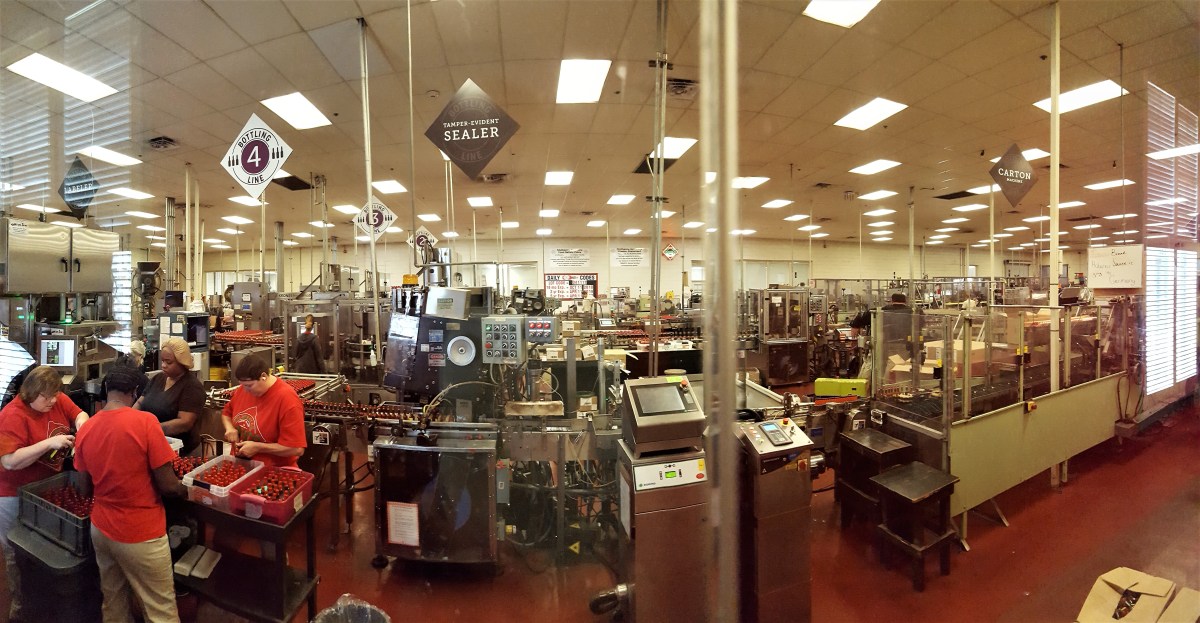
Automation will carry out the packaging under watchful eyes at a rate of approximately 220,000 bottles per day to keep up with world-wide demand,

bottling1.jpg

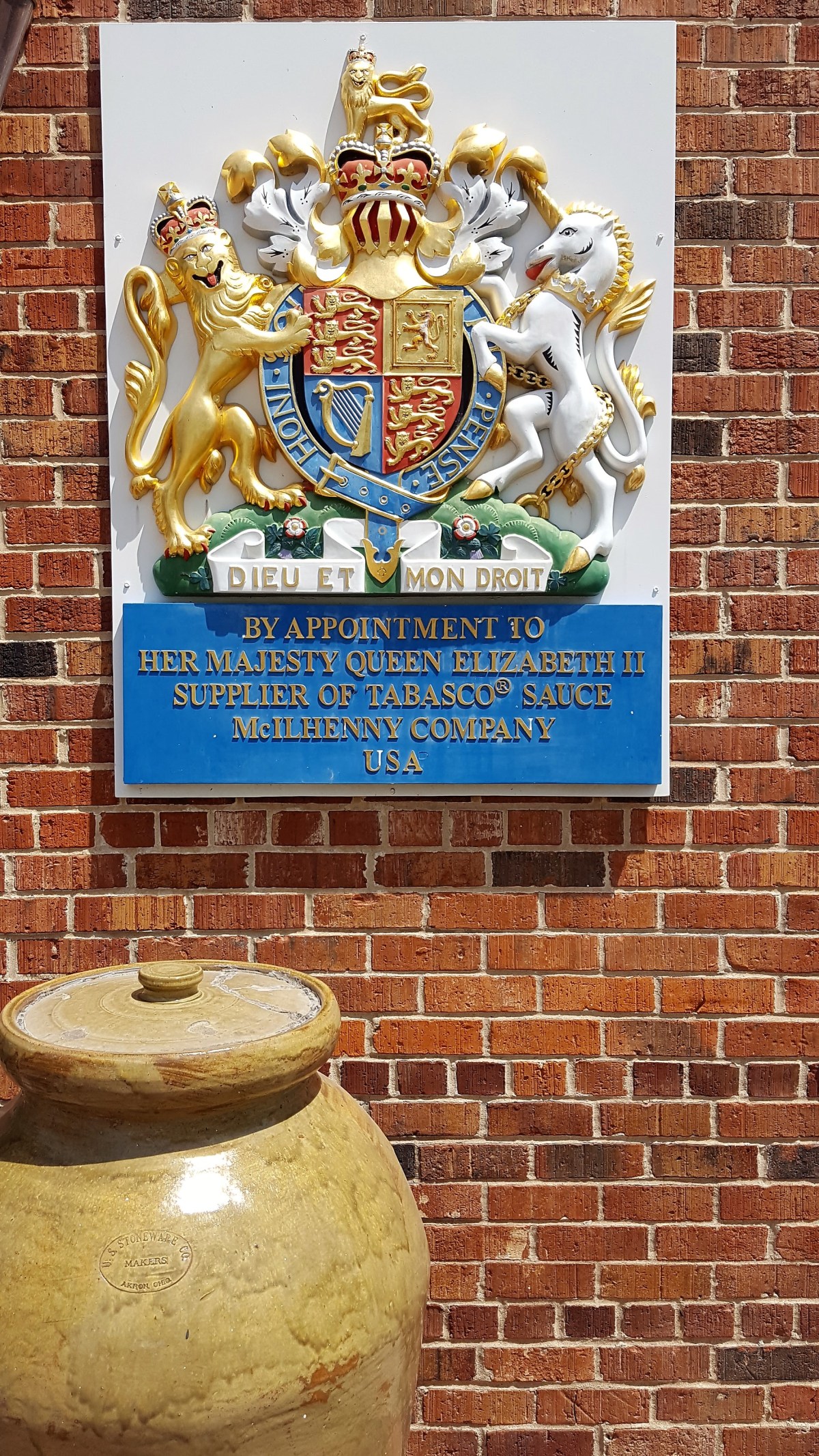
and a very demanding clientele.

queen crest.jpg

It’s been 150 years since Edmund McIlhenny poured his potent pepper sauce into recycled cologne bottles, but the five generations that followed have been loyal to the original recipe, and have grown accustomed to the savory taste of success.

Mad Mad Money

Stepping through the warehouse doors of Blaine Kern’s Mardi Gras World is like stepping into a “Roger Rabbit” movie, where out-of-towners are dwarfed by larger-than-life “Toons” sculpted from layers upon layers of paper machéd Styrofoam, and painted in comic book colors.Bart.jpg

With 400,000 square feet of working and storage space on the port side of the Mississippi,

MGW exterior.jpg

a treasure trove of floats waits to be recycled in preparation for next year’s Mardi Gras parade just moments after masked marauders have tossed the last strand of beads.

Cat and heads.jpgSince 1934, four generations of Kerns have been perfecting the art and business of celebrating Carnival, always managing year after year to surprise the public with fresh ideas infused with craftsmanship and technology.

Kiss.jpgKern Studios works with dozens of carnival organizations (known as krewes) who finance their own parades through member dues and fund-raising to offset expenses for:

Chicken and man.jpgfloat warehousing, designing, sculpting, construction, decorating, tractor pulling, audio, lighting, and parade route security–all routinely costing $100,000 or more for each 28 foot display on wheels.

Queen.jpgBut what’s a krewe to do if they eschew the usual bayou reissue? The Krewe of Bacchus commissioned Blaire to produce extravagant figures and floats on a more grandiose scale. He obliged them with 18 feet replicas of King Kong in 1972, and Queen Kong in 1973.
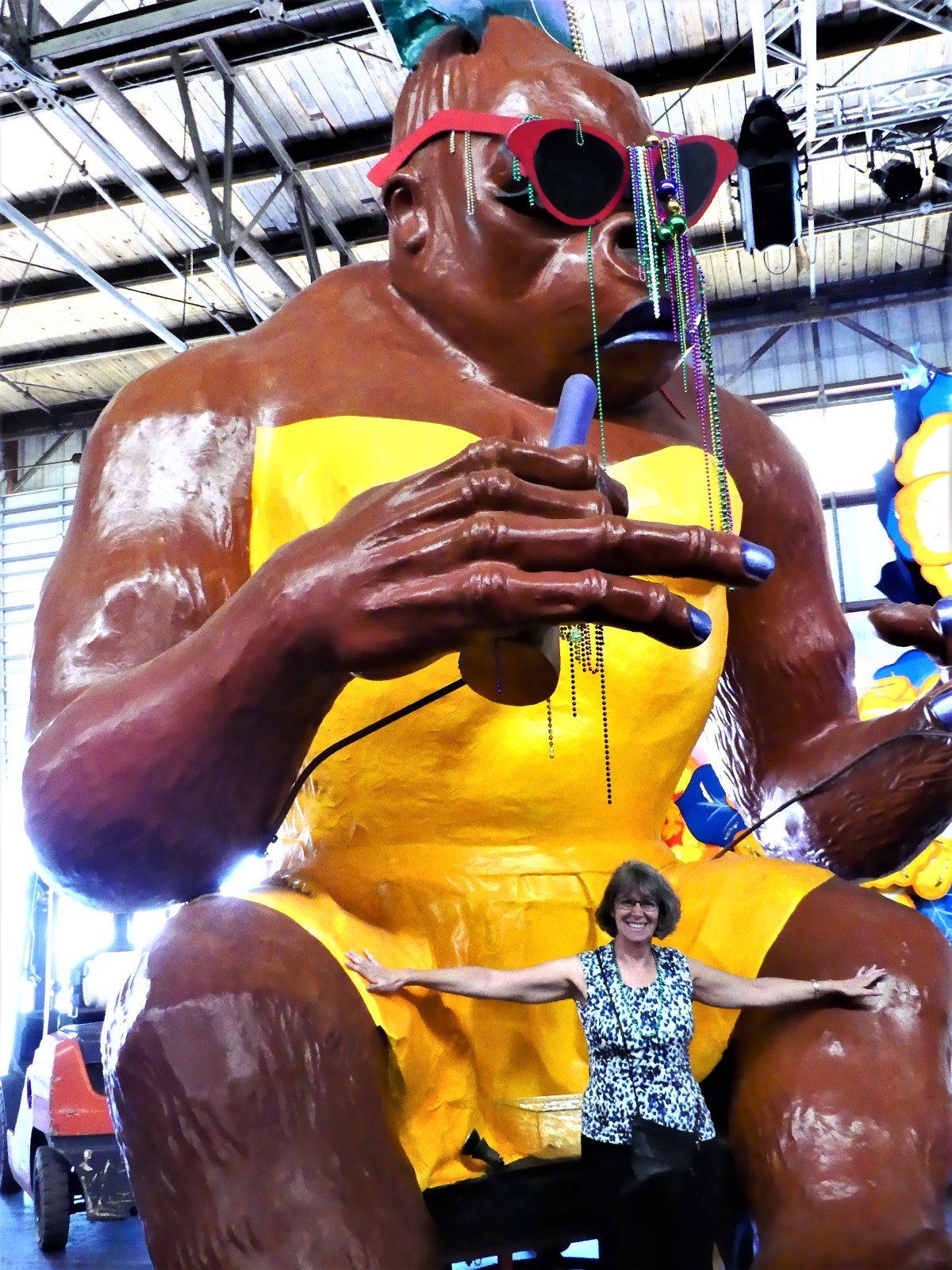
King Kong.jpg

Mrs Kong.jpg

In later years, a Bacchus signature float extended to 105 feet, accommodating 86 riders.

Muses and Leah.jpg

This year, the Krewe of Rex, Mardi Gras’ longest-standing parade organization (since 1872) launched 27 floats for their 134th parade. And with 70 different parades running this season, Kern produced over 450 floats for them and others…

witch.jpg…which makes it (big) easy to see why Mardi Gras is such a cash cow for New Orleans, and Blaire Kern,

General Budha.jpgunless you’re a Buddhist.

Biloxi Bounty

“It will be forty minutes before I can seat you,” announced the hostess.

“So what was the point of making a 7 pm reservation?” I protested.

An entitled-looking woman strode up to the seating station, interrupting my conversation.

“Any idea how much longer?” she fumed. Residual cigarette smoke left a trail after her words.

The hostess was poised and ready with an answer. “I promise to text you as soon as your party’s table opens up.”

Emphatically, “Nevermind. We’re going to the Hard Rock location across the street,” she huffed, and strode away.

The hostess, not missing a beat, returned to me. “So your wait time has now been cut to thirty minutes. If I could just have your phone number?”

“Is it always this busy?” I asked, already anticipating the answer.

“Everyday and all the time,” she shrugged.

Leah and I are waiting to be seated at the Half Shell Oyster House in Biloxi, MS, the second of seven locations spread throughout the Gulf coast, and everyone says it’s well worth the wait. The shucker at the raw bar claims that on average, he will prepare eight sacks of a dozen dozen oysters for weekday diners.

When I briefly taught English at the New York Harbor School, I learned about the Billion Oyster Project launched on Governors Island, whose 20-year mission is to reclaim the New York Harbor habitat by seeding new oyster beds around the island in hopes of restoring a vibrant aquaculture to the area–a dream only made possible after passage of the Clean Water Act of 1972, which prohibited dumping raw sewage and toxic waste into the Harbor.

Since many Project volunteers are high school interns from the Harbor School on Governors Island, faculty staged an end-of-semester celebration where hundreds of oysters were opened for hundreds of curious inner city students, many who have never seen, touched, or smelled, let alone tasted an oyster. Watching the kids’ faces was priceless. For those who dared to try one, it was a warm and naked oyster. If they only knew there was a better way to enjoy a bivalve.

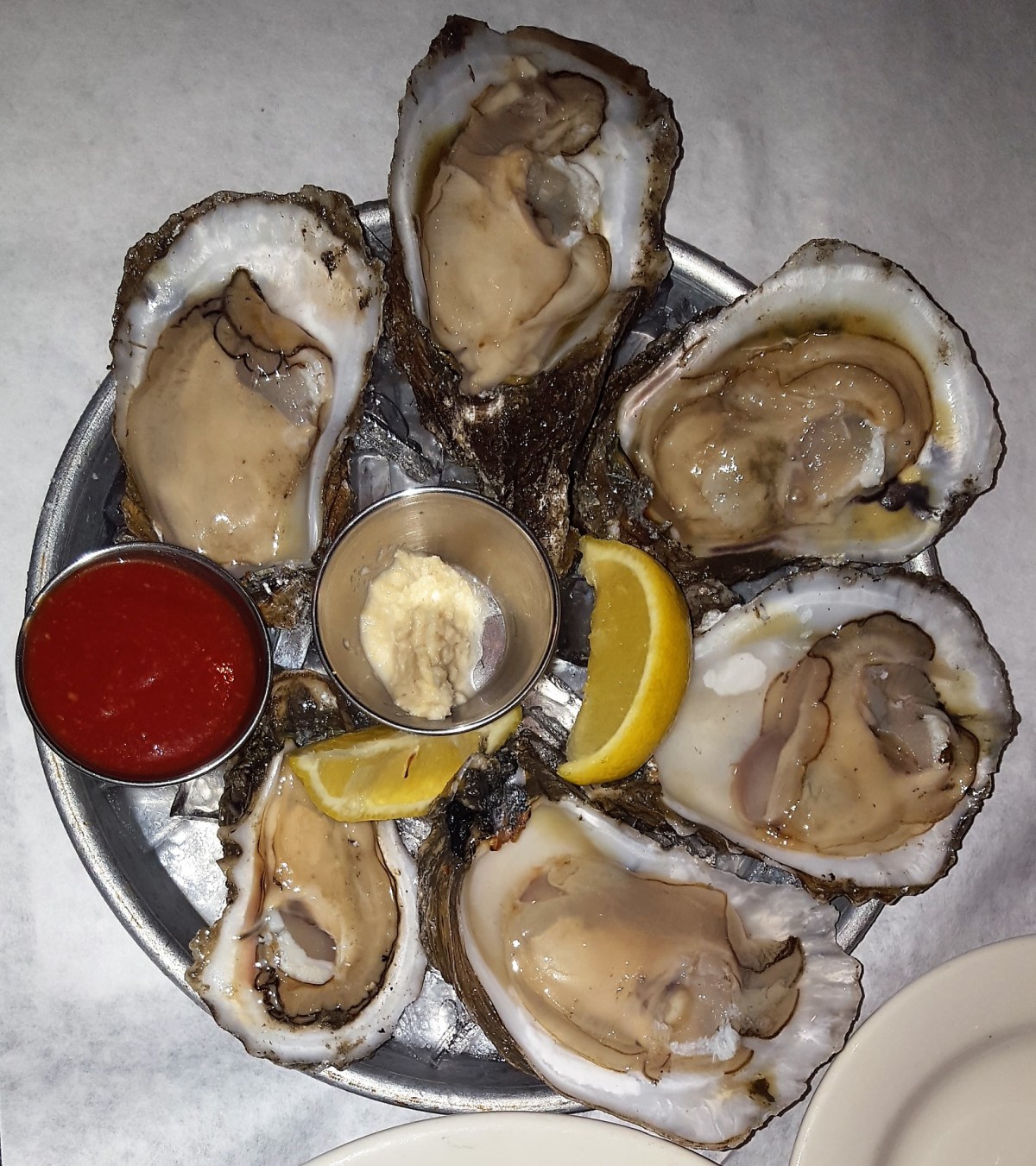
On the other hand, the Oyster House does it with culinary correctness. The half dozen half shells that arrived to the table were so plump, they were pushing each other off the icy plate. Each one was swimming in its briny soup, and glistening with freshness.

oysters.jpg

“C’mon, Leah,” I advertised, “you’ve got to try this. These are amazing,”

Neal and oyster.jpgLeah was horrified. “Eww, no! I don’t know how you can eat that,” she objected. “It looks like it’s still living.”

“And that’s why it tastes so good,” I slurped.

The entrees were equally as tasty. We both had royal red shrimp different ways; Leah enjoyed a 1/2 lb. of peel and eat shrimp…

peel shrimp.jpg

while my shrimp were prepared Orleans style–in a hot Cajun butter sauce–with jalapeno hush puppies on the side. The beverage du jour was iced cold vodka and ginger beer. Wow!!

Shrimp Orleans.jpg

Afterwards, we walked across the road to the Hard Rock Casino,

Hard Rock.jpgbut that’s another story.

For the whole enchilada on half shell info, check out:

http://www.inahalfshell.com/bivalve-curious/

and for more on the Billion Oyster Project, see:

https://www.billionoysterproject.org/


Living with Less

As an outgrowth of downsizing, I have routinely reflected on the virtues of the  mimimalist mantra of less is more.

Robert Browning is credited with creating the phrase, which was later mainstreamed by architect Mies van der Rohe to explain his philosophy of design. It appears to be a contradiction of quantitative terms, and as such, represents an apparent oxymoron. But the quote also has a number of practical as well as esotetic applications.

Less is more is a cause and effect–an itch that requires a scratch, but in an opposite kind of way. So, if less is more, then what is it more than, or more of?

For instance, if less is a number, like income, then what logically follows is more frugality or poverty. And if the number relates to temperature, then less heat requires more clothing or blankets, and lower temperatures may certainly create conditions for greater risk of frostbite.

Insurance actuaries will tell you that less risk assures more surety.

Musically, less noise produces more clarity. Conversely, less clarity produces more confusion.

For dieters, less food intake results in more weight loss. Additionally, doctors will tell you that less exercise results in more illness.

Donald Trump would benefit from considering that less diplomacy promotes more hostility; that less suspicion builds more trust; and less insight produces more ignorance.

Personally, traveling in a road home has taught us certain restraints. The less water we use, the more space we conserve in our disposal tanks. Limited storage between the truck and trailor means making do with less clothes, and consequently, more laundry time. Most importantly, the less Leah argues, the more peaceful things are.

And so I open up the discussion to the blogosphere. How many examples can my readers come up with. Record your thoughts in the comments box for all to share.

After all, it was never my intention to create an exhaustive list, since less is more.

Tightening My Bible Belt

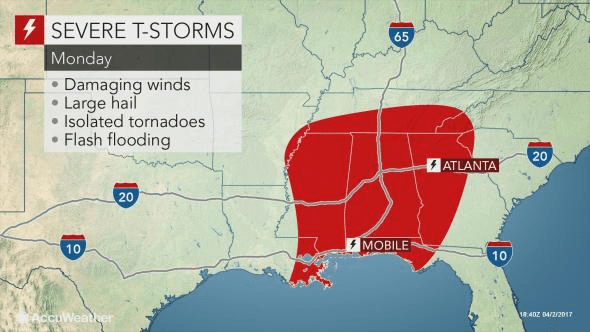
If the idiom “raining cats and dogs” refers to heavy rain, then we drove through a storm front this morning on our way to Montgomery, AL that must qualify as “cougars and dingoes”.

So violent was the weather–bringing bouts of apocalyptic lightening and cataclysmic road floods–that I celebrated the opportunity to pull into a rest stop for 10 minutes just to catch my breath and clear my head. Texted news reports of tornadoes across Alabama border states kept us on high alert. Continuing south, the punishing winds played havoc with the Airstream, despite its aerodynamics. Keeping it centered between the lane lines had to be as challenging as today’s Supreme Court confirmation of Neil Gorsuch.

This is not the game plan we had prepared for yesterday. The Airstream was all hooked up and ready to roll from the night before. Our easy and early departure from Talladega was intended to give us a head start in advance of the storm, so that our arrival at Gunter Hill Park would coincide with the worst of the weather. But as my late Grandma Straws was so fond of saying in her heavy Slavic accent, “You kenen nit makhn a contract miten de veter.”¹

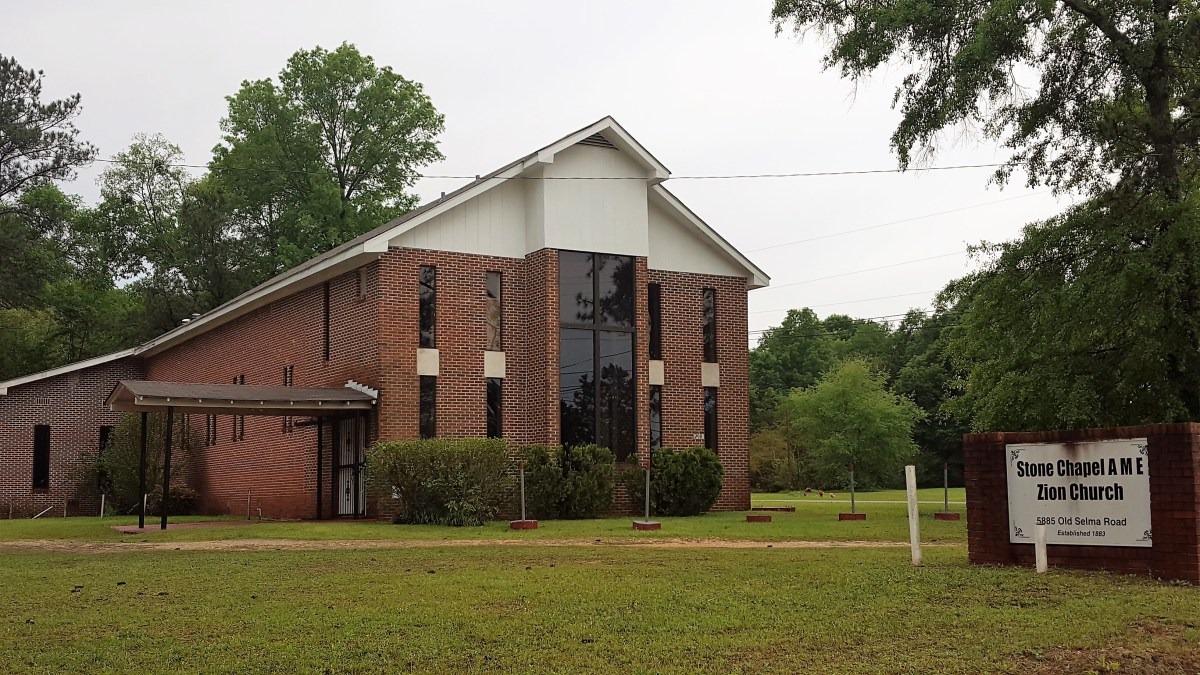
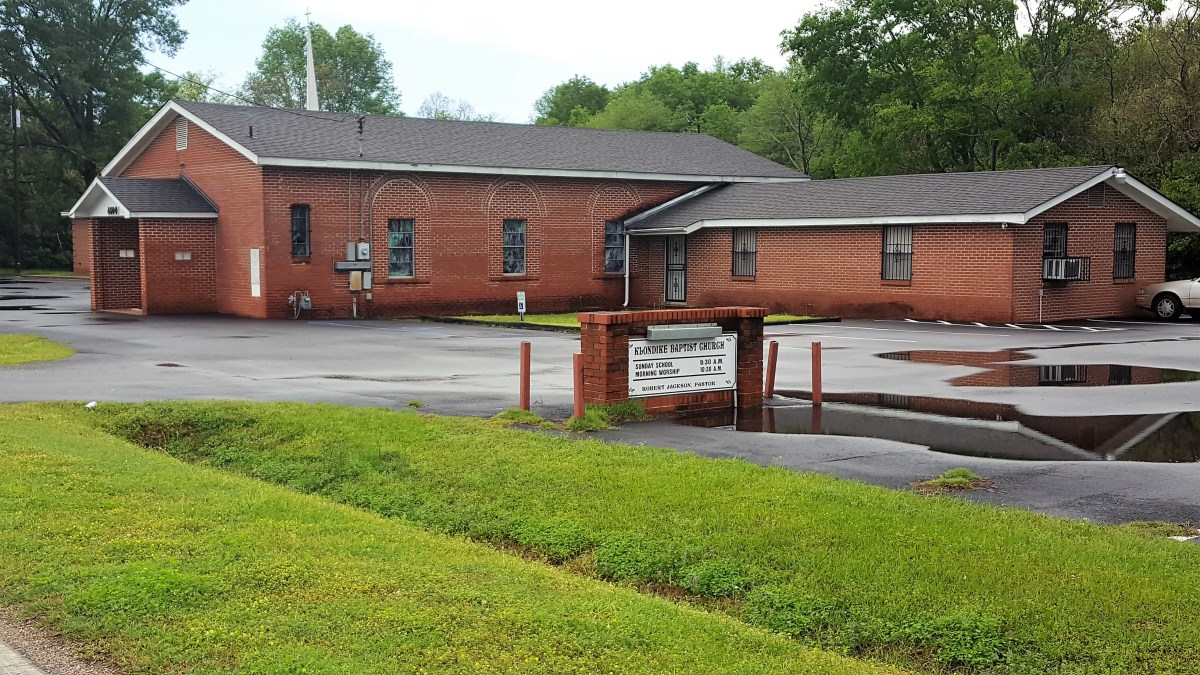
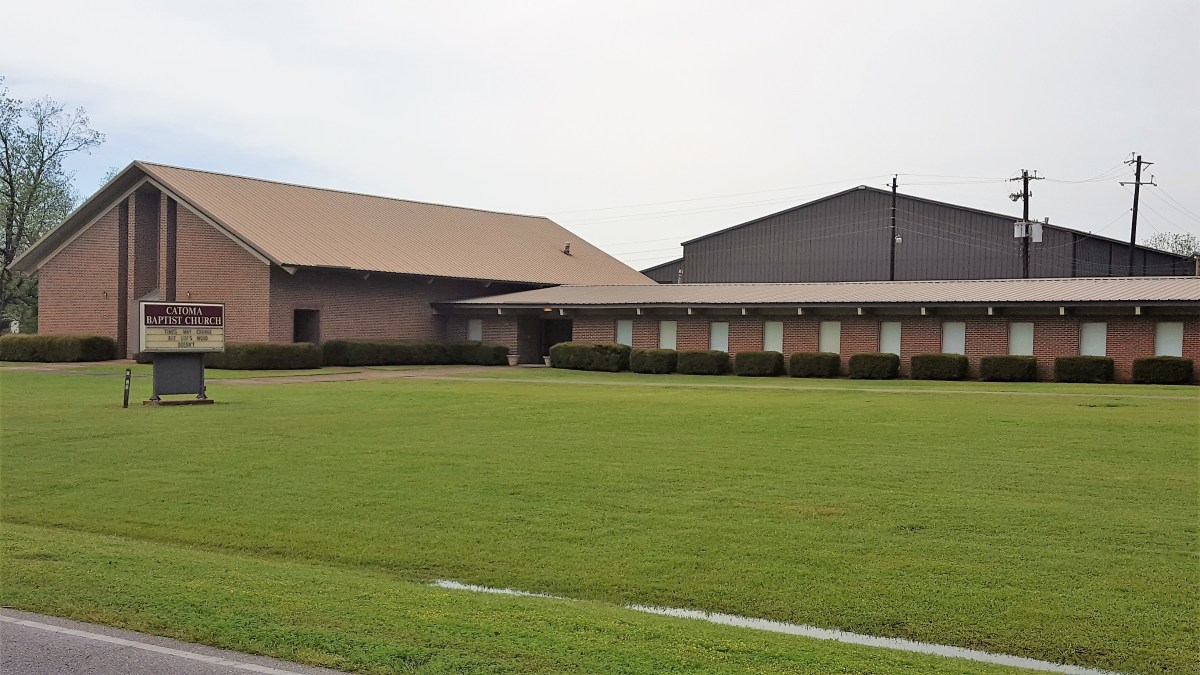
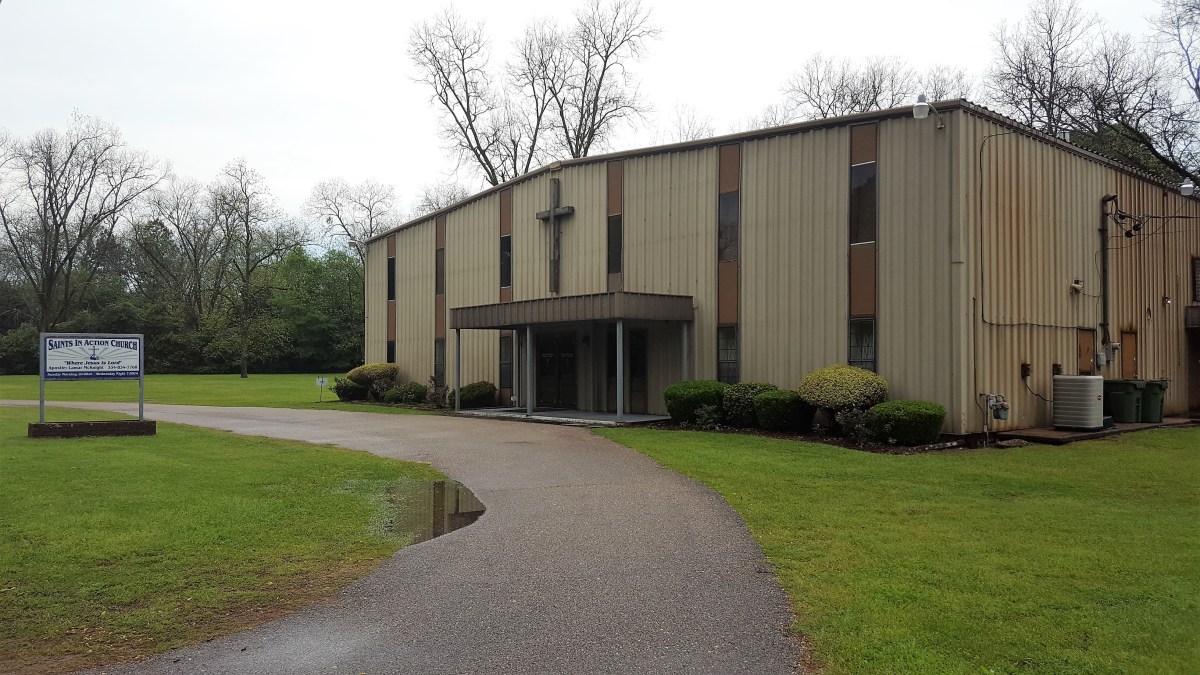
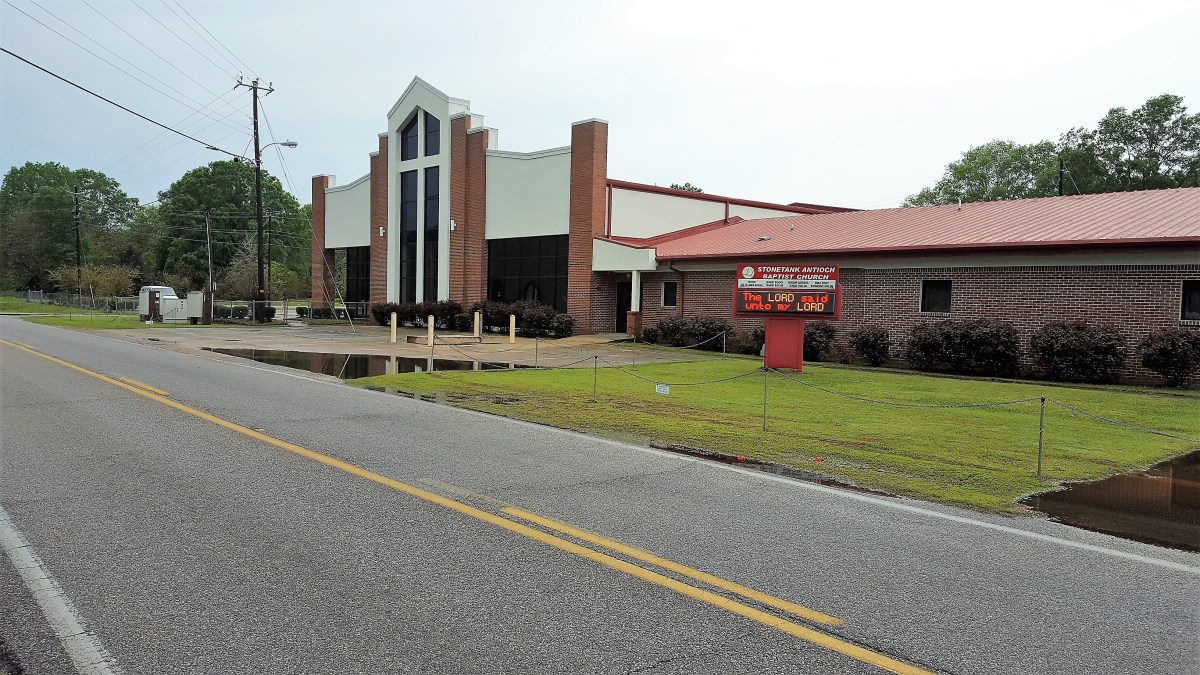
What a relief it was when the squall finally weakened as we exited the highway and turned onto Old Selma Rd. in search of our campground that I may have muttered a “Hallelujah”. If we were grateful to God for arriving without incident, there was no shortage of venues to Praise the Lord. It turns out that eight different churches lined the five-mile route–all of them captured below.Church2.jpgchurch3.jpgchurch4.jpgchurch5.jpgchurch6.jpgchurch7.jpgchurch8.jpgchurch1.jpgIf salvation is part of your endgame, it seems that Old Selma Rd. is one of the most God-fearing stretches of asphalt in all of Montgomery, and the place I know where you should go, to save lives lost at any cost.
Or at the very least, buy a bag of boiled peanuts and shelled pecans from the roadside vender who looks as old as Moses.

¹Translation: “You can’t make a contract with the weather.”

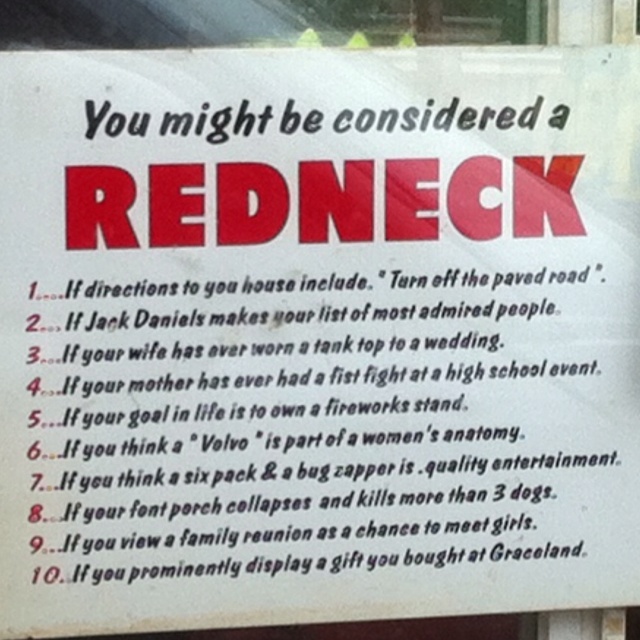
Redneck Nation

Today I washed my truck. What worries me most is that tomorrow’s forecast calls for rain. Not that I’m worried about it raining–it’s that I knew it might rain tomorrow, and I washed my truck anyway.

And then there was Leah reminding me, “Why would you wash your truck when it’s only going to rain tomorrow?”

“I’m aware,” I confessed, “but it really needs cleaning. Y’know, I think I might be turning into a redneck.”

Just earlier in the day, my newest neighbor, a pipe welder from Checotah, OK and I had a serious conversation about truck engines and air brakes. I mean, I would never have had a conversation about truck engines and air brakes ever with anyone in my past life, and yet it seemed so natural today.

From the looks of things, I had a valued opinion on the benefit of driving a V-8 with a greater payload capacity, versus Ford’s highly touted twin turbo-charged V-6 that promises 10% more torque–a specification I was willing to sacrifice in favor of schlepping more junk in the trunk. And the pipe welder listened with interest, giving me that “I-know-whatcha-mean” nod.

It’s true that the truck was filthy. Yesterday, we were off-roading on a ridiculously narrow ridge road along Cheaha Mountain, Alabama’s highest peak at 2411 ft., and it was dirty fun.

“SLOW DOWN!!,” Leah reiterated a dozen times, gesturing wildly.

In my defense, I was only doing 25 mph, but maybe it felt faster to her given the road was badly rutted and had no guardrails to protect against the hairpin switchbacks. Each turn was met with “Oh, God!” by Leah.

When we returned to the Airstream, I noticed that a fine silt had infiltrated the closed bed of the truck through its weep holes, and coated everything with an asthma-inducing dust.

So today, everything had to come out of the back of the truck and be wiped down. Then, I took a hose to the sandy-colored Alabama particulate that coated the floor, and washed it all away. That’s when I got the itch to finish the job, and wash the exterior too. The weather couldn’t have been better–cloudless blue skies and 82 degrees, and it was refreshing working in a tank top and shorts. Surprisingly, Leah got swept up in the activity, and the two of us made short work of the task.

The pipe welder looked out from across the lawn. He was studying for a 100-question re-certification exam on April 20 between occasional tobacco chew spits.

“She sure looks purdy when she’s clean,” he gushed.

I realized I was becoming the person who I referenced in an earlier post (Rig or Mortis), and I was showing off my truck’s shine.

After writing this post, I stopped inside to freshen up, and I couldn’t help but notice my reflection in the overhead vanity mirror. Sho’nuff, my shoulders and neck had gotten plenty of color.

Transitioning to Home

You’ve entered a place between time and space, where time slows down and place takes hold.

What was familiar and old no longer competes against the news of the day, or the sound of early morning commutes.

Peace and quiet can be found between voices listening for what comes next–

Stopping for a moment to find context in a world that embraces meaning, but defies reason;

To connect with basic needs, where less is required, and more is inspired;

And giving up the drive, only to arrive at a point where you are already there.

As such, much more may come from wanderlust.

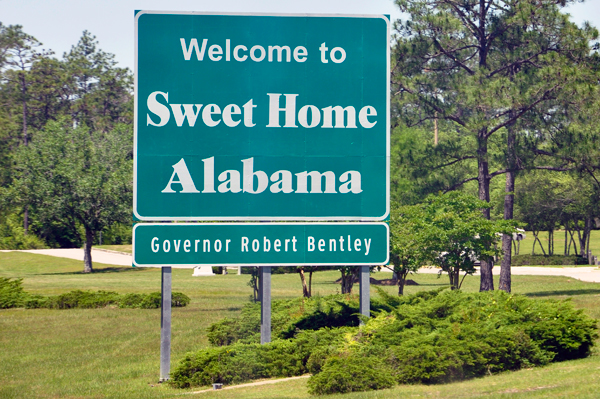
Sweet Home Alabama

Leaving Memphis at 9:30 am for a 285 mile jaunt to Coleman Lake in Talladega National Forest, AL was expected to take 5 1/2 hrs. That was the only thing certain about this leg of our trip. Where we would set up residence for the next three days was the biggest question mark.

Our design was to camp at the lake, and take advantage of the Department of Agriculture’s generous $10 site fee with electric and water hook-up provided. We monitored the vacancy prospects from the road, since there is no reservation system, unlike the Park Service, which operates through the Interior Department.

From the time we started out, we knew from Louise, a central office clerk that we were competing for seven coveted slices of real estate. Midway through our trip, a phone call confirmed that only five sites remained. And by the time we reached Birmingham–which was one hour away from our piece of Eden–the odds started working against us, when we learned that only 3 spots remained. It was time to consider contigency plans.

A quick scan of the internet was less than promising, considering we were looking to escape to an area that was off the grid with limited availability. Fortunately, we wandered across an obscure RV park with decent reviews just outside the forest within Heflin city limits that according to Lawrence still had three sites available for $30 a night.

We proceeded as planned, moving closer to staking our claim as we pulled into a Shell station off Exit 199 on I-20. A phone call to Louise produced a small panic attack; there was only one site left, and we were within striking distance. Could we, would we make it there in time? Gassing up the truck would put us behind by 15 minutes, but with 12 miles to empty, there was no doubt that this was time we needed to allow.

Once we started rolling again we were committed to the bitter end, now that cell service was interrupted by the beautiful forest scenery. The trees were filling in with seasonal green, and the switchbacks and narrow roads were becoming more challenging. We held our breath (not literally) during the last 10 miles of our journey up the mountain. We exhaled (literally) turning the corner into the campground; we had arrived to uncertain news. The campground steward met us at the truck.

“Are we in time?,” Leah blurted out.

“Are you the one’s been callin’?,” he wondered, “Cause last time I checked, I got one space left, B-37 I think, and you’re welcome to follow the road around ’til you come to it, and we’ll settle up after you get settled.”

Leah and I exchanged “we-just-won-the-lottery” grins, and chugged out in search of B-37. The site was almost a full circle around the ring road, up a steep embankment on the left with enough room to hold two trucks, a trailer, a pop-up tent, three bicycles, and seven interlopers. Gramps was busy hand-cranking the camper to a level position, while Granny was herding the kids.

“Are you shitting me?,” I asked nobody in particular.

We immediately resorted to Plan B, driving back down the mountain road while struggling with inputting a new GPS address. We got Lawrence on the phone when we were free and clear of our traitorous natural surroundings, and returned to 3-bar civilization.

“I got three spaces left,” he offered.

“We’ll take it,” Leah yelled. “We’ll be there in half an hour.”

An hour later, after setting up and rewarding myself with a cold beer while sitting in my burnt orange-colored travel chair atop a woven Navajo-patterned polyester mat, two massive 5th wheels with slide-outs pull in close on both sides of our Airstream, threatening to swallow us. While setting up on my right, Mr. Proximity turns to me.

“Hey, didn’t I see you at Tom Sawyer’s earlier today?”

As a matter of fact he did. We spent the last three nights trailering at Tom Sawyer’s Mississippi River RV Park in West Memphis, AR. But the only people we spoke to were a retired couple from Ringwood who saw my truck plates, and that led us to playing Jersey geography. It turns out their son, Jeff and Leah’s daughter, Carrie are Facebook friends who graduated from Lakeland Regional High School together. Other than that, I had no connection to the people moving in beside me.

“Wow, I’m impressed you remembered my Airstream. I hope you’re not stalking us,” I kidded. “We were on our way to Coleman Lake, but got turned away last minute, so now we’re here.”

“Us too,” he said. “Can’t beat the $10 fee up there. We was passin’ through Talladega last Monday. Pretty sites an’ all, but between the highway traffic an’ the train whistles, I’d just as soon stay here where it’s quiet. Besides, we’ll be gone by morning.”

I liked the sound of that.

Hail Lisa Marie, Full of Graceland

The Graceland mansion tour allows visitors to gawk at garish furnishings that are fit for a king throughout the year except on Thanksgiving and Christmas.

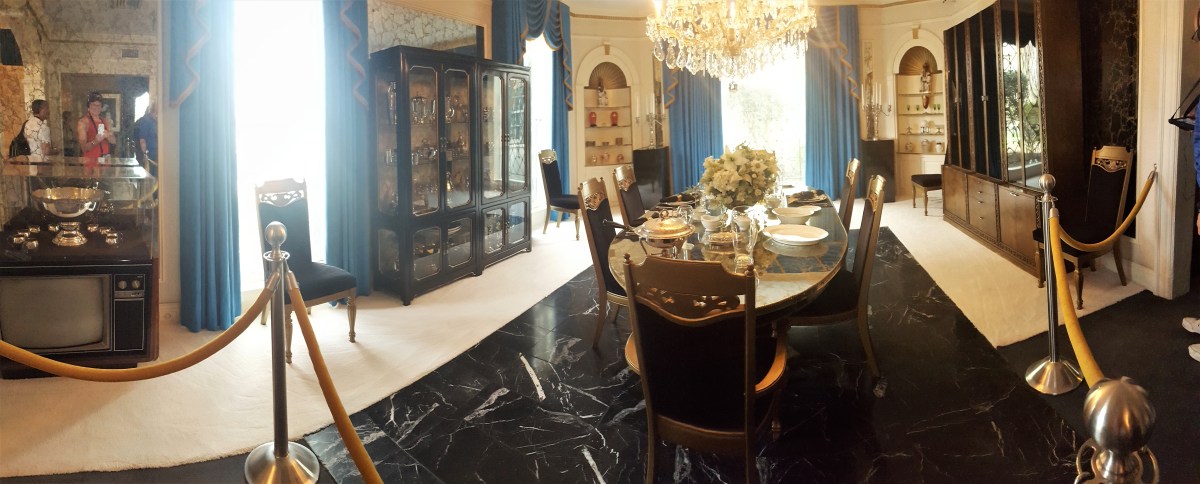
On those two days and afterhours, Lisa Marie (as sole heir) and her family are certain to emerge from their second floor retreat (which is strictly off limits to everybody else) and romp about the downstairs–perhaps to enjoy dinner in the dining room without the roped stanchions,

Graceland dining room.jpg

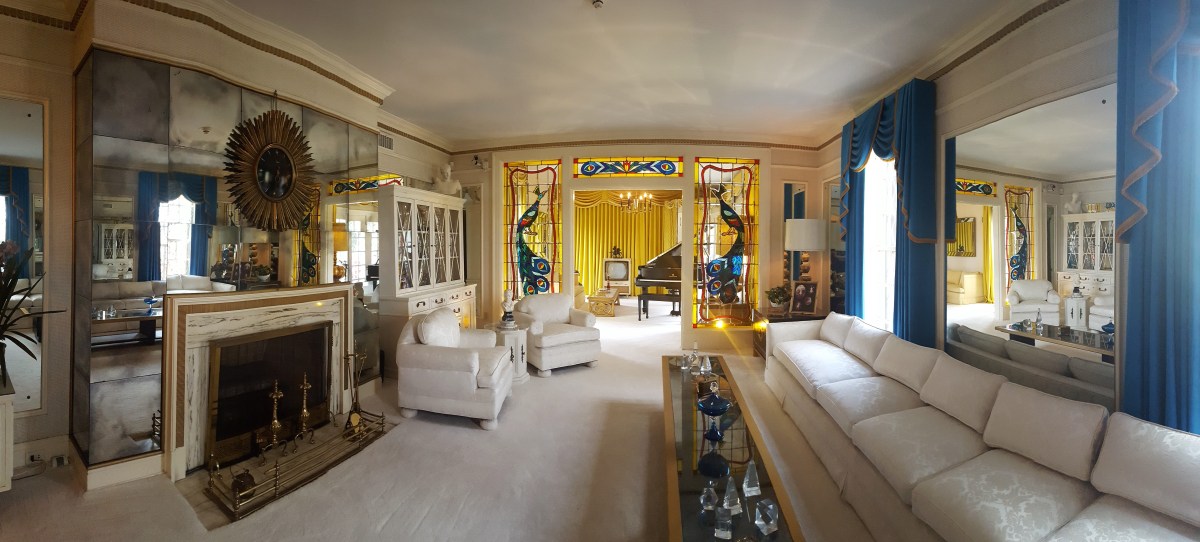
or take coffee in the living room.

Graceland living room.jpg

A private tour guide was overheard discussing Lisa Marie’s comings and goings, which have become more frequent now that she resides in Nashville. So it’s not uncommon that she’ll visit with her 8-year-old twin girls.

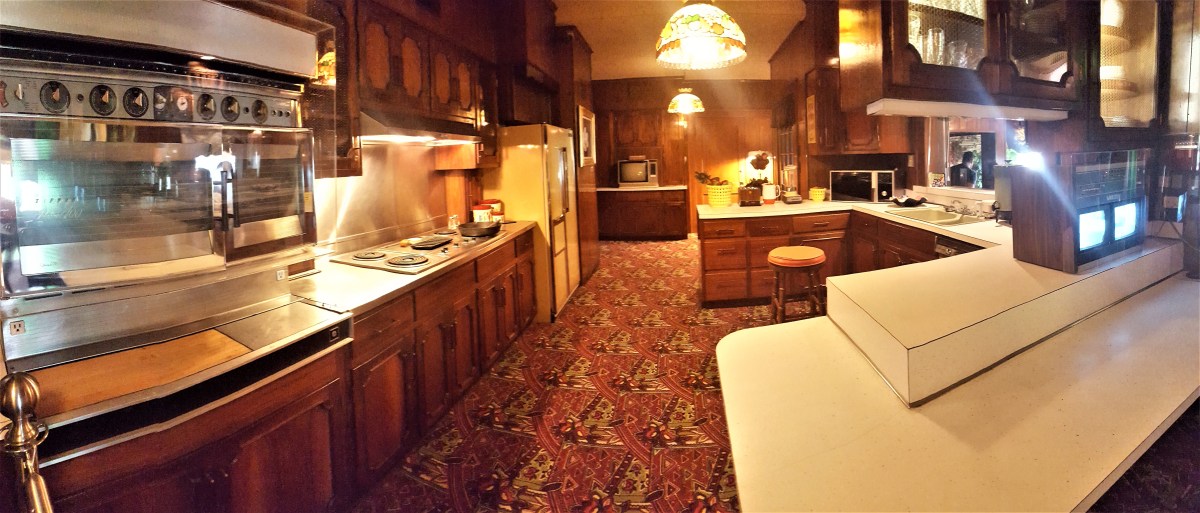
Since the kitchen is surrounded with display glass to preserve the $750 microwave oven Elvis bought in 1972, I asked if a kitchen existed on the second floor for family use during the day.

Graceland kitchen.jpg

Sources have confirmed that only a refrigerator exists in the living quarters, but if anybody is hungry–for instance when the twins requested McDonalds the other day–the Graceland staff was more than willing to bring it back, helping Lisa Marie avoid the paparazzi, and maintain anonymity.

“She could be upstairs right now,” said the VIP guide, “lookin’ down at you through that window, and you wouldn’t even know it.” That sounded creepy to me.

Lisa Marie fondly recalls the childhood years she spent in the Jungle Room while growing up in Graceland–feeling the green shag carpet under her feet, and snuggling in the plush barrel chair by the waterfall, usually while she watched TV (one of 16 on the property).

Graceland Jungle room.jpg

In fact, her father, Elvis so adored TV, that like LBJ at the time, he maintained a media room in the basement so he might watch 3 side-by-side TVs at once.

Graceland media room.jpg

And while the house is a triumphant tribute to gaudiness, like the pool room,

Graceland pool room.jpg

it pales in comparison to the on-site gift shop, where the public can take home an endless supply of in memoriam memorabilia.

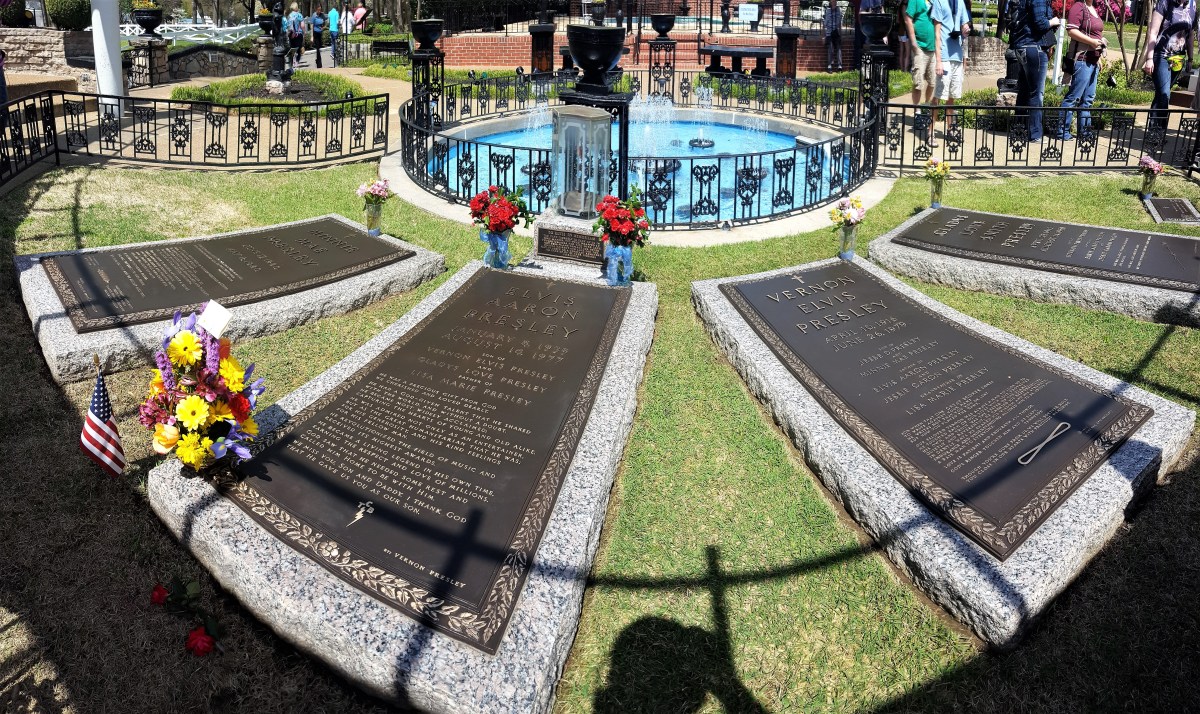
Graceland graves.jpg

Because, Elvis by design, according to Lisa Marie, is all about taking care of business (TCB).

Elvis socks.jpg

Elvis wear.jpg

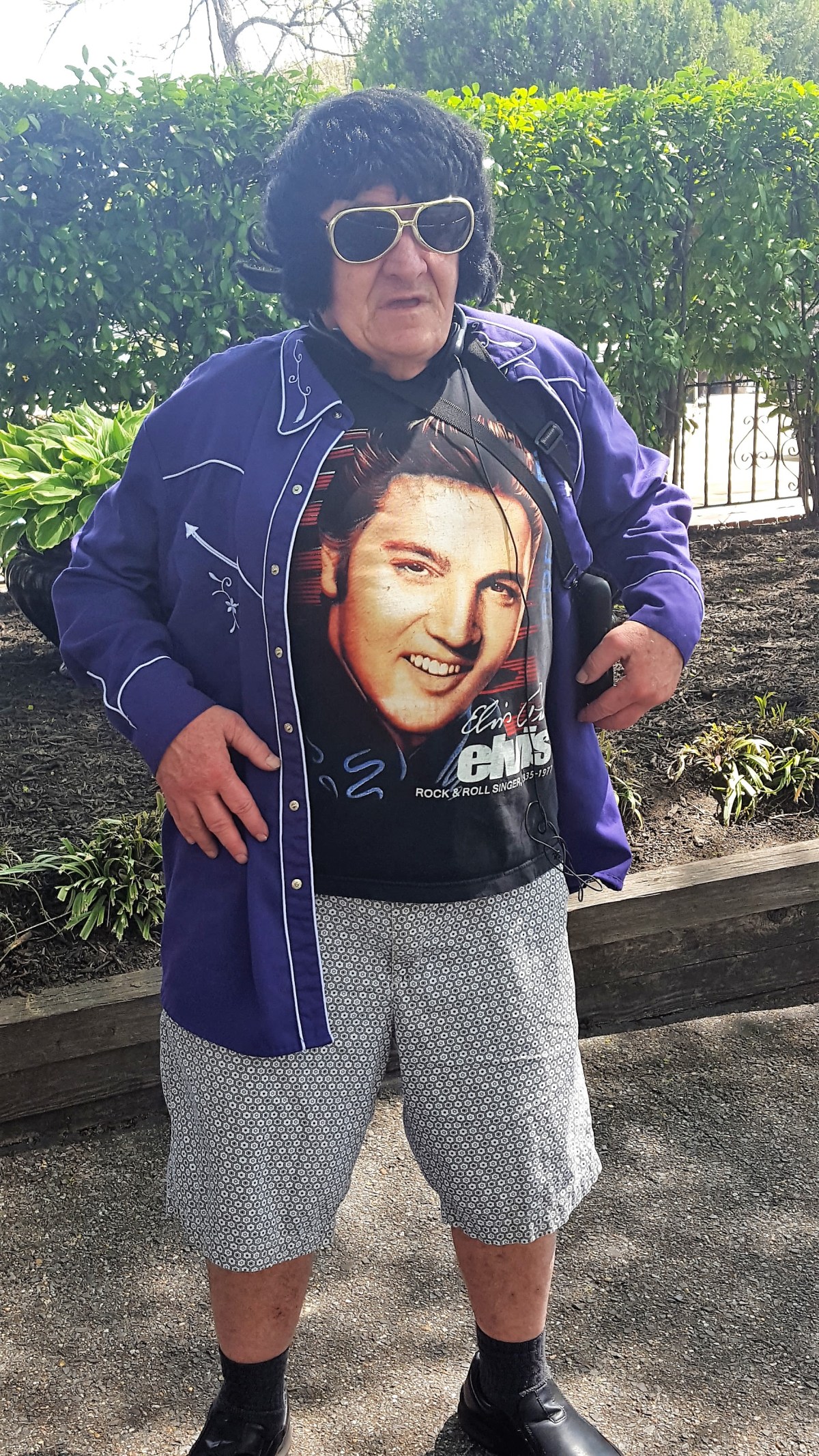
And at the end of the tour, long after the last pre-recorded note has been sung, and the last of the 2,000 guests per day has been bussed away, there can be little doubt, regardless of what you’ve heard, that Elvis is definitely still in the building.

Elvis impersonator.jpg

Smoked Meats

Memphis is the best thing to happen to ribs since Adam’s grand gesture to Eve. As one of the four great BBQ pilgrimages (including Carolina, Texas, and Kansas City) Memphis stands out among all the others given its sheer volume of first class BBQ eateries scattered throughout the city. Whether it’s a joint, shack, restaurant or food truck, the holy trinity of meats–pork, beef and chicken–are all represented here in Memphis and consumed in biblical proportion.

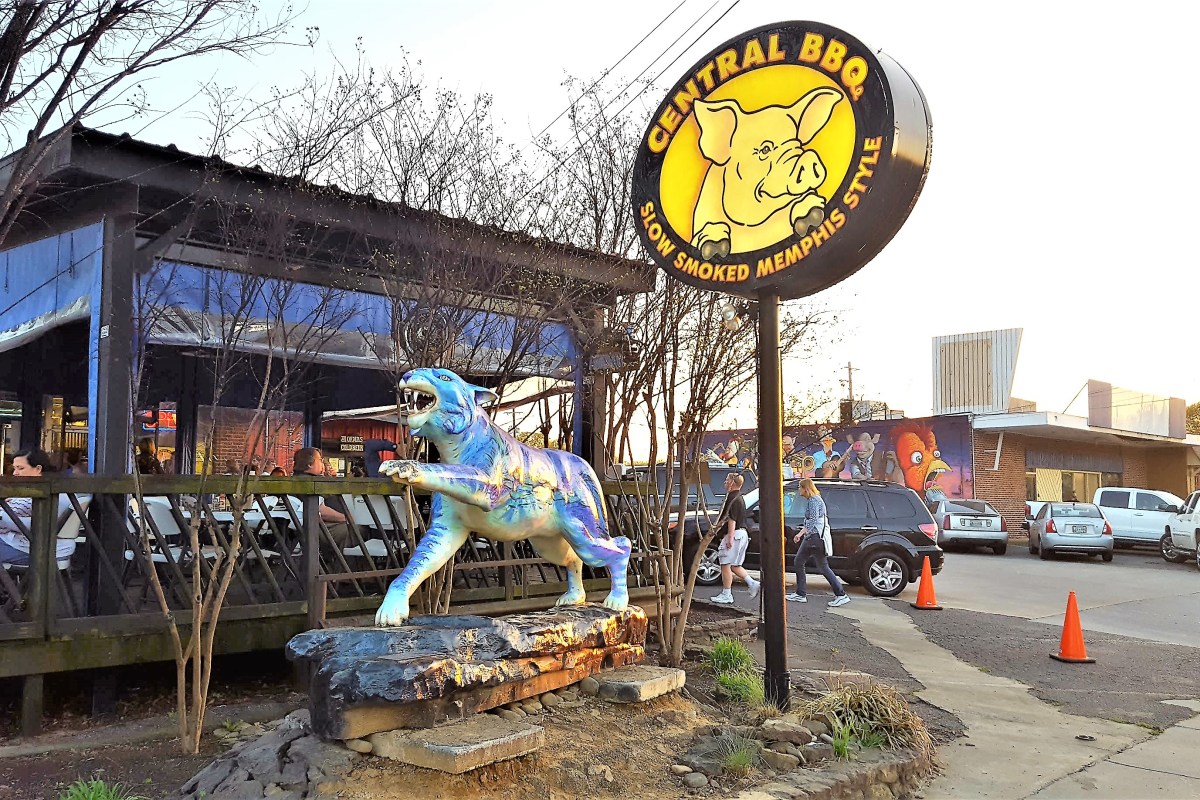
With so much to choose from, we went to the internet to narrow our options. Realizing our propensity for gnawing on bones, and weighing the opinions of the millions who came before us, we settled on a full slab with 4 sides from Central BBQ, a relative new-comer who has already expanded to 3 locations in its 15-year history, and a perennial favorite at the Memphis in May World Championship Barbecue Cooking Contest.

We arrived at 7 pm to overflow parking and a lengthy line out the door. A covered outdoor dining room with family-style seating bustled with a blend of first-timers, students, families, and business types. Eventually, we approached a counter to place our order. We exchanged money for card #23 and sat ourselves, waiting for our food to be delivered 10 minutes later.

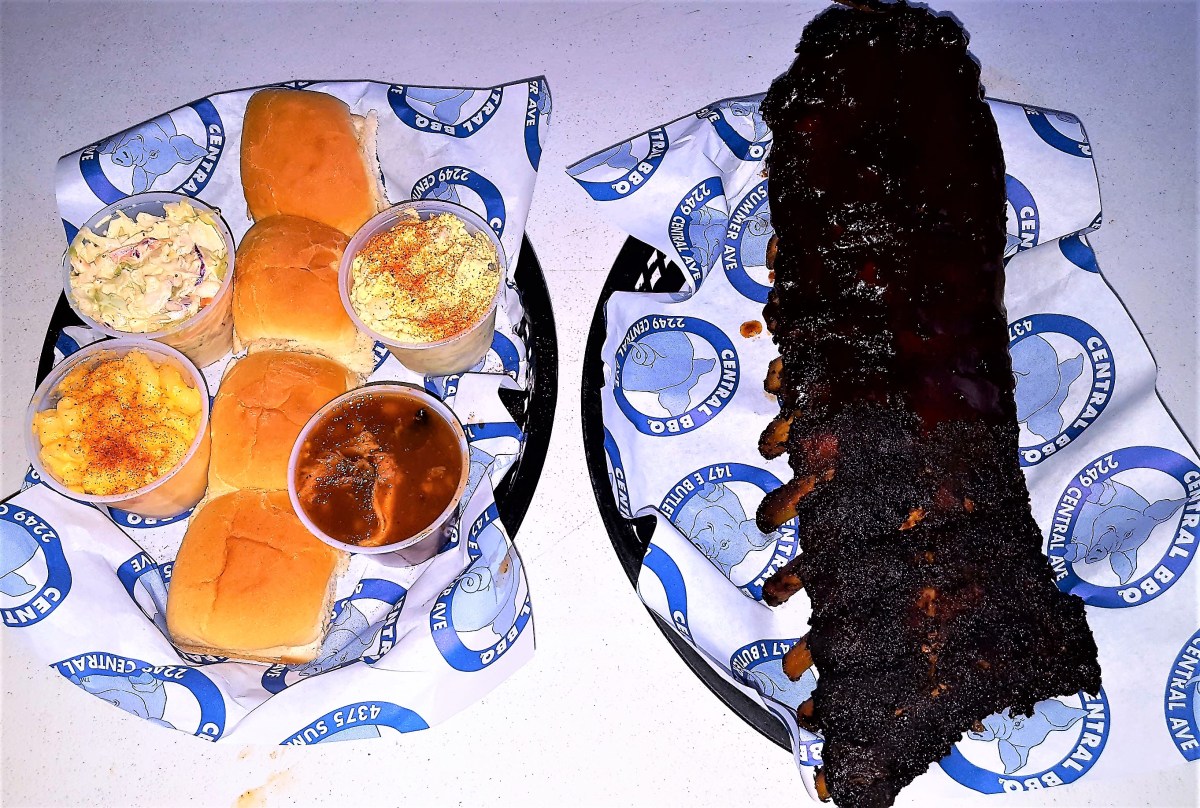
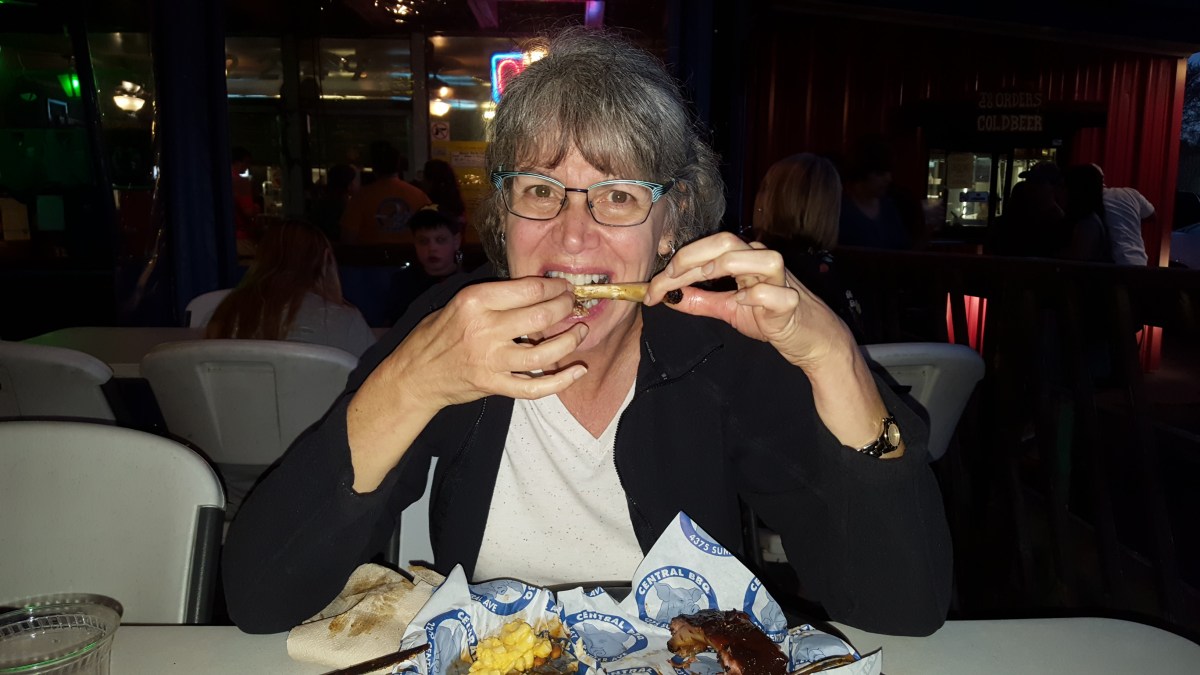
20170328_192658.jpgOur rack-for-two was prepared as 1/2 “wet” and 1/2 “dry”. The wet half was basted periodically with a rich tomato, molasses, and vinegar sauce laced with heat, while the dry half was rubbed in brown sugar and spices, rendering a caramelized crust during it’s 12 hour slow cook.
20170328_193637.jpg

Leah and I debated which half we liked better, and unanimously elected the dry rub as our favorite, which also gave us the value-added option of dipping our ribs in: Mild, Hot, Mustard, Vinegar, Hot Vinegar or Sweet Heat barbecue sauce.

Our sides included tasty mac ‘n cheese, coleslaw, baked beans, and potato salad with 4 rolls, all washed down with a pint of Ghost River Grindhouse, a highly regarded local Memphis brew.

20170328_191659.jpg

By 8:30 pm, the dining-in crowd had thinned, but the take-out window was still cranking out orders. It seems the local population knows exactly where to go for its smoked meat fix.

Rig or Mortis

If looking at people’s pet(s) can tell you a lot about their personality, then it stands to reason that their RV rigs are no different. RVs come in all shape and sizes–as do their owners–and it’s a challenging game matching up who belongs to which rig, because looks are deceiving.

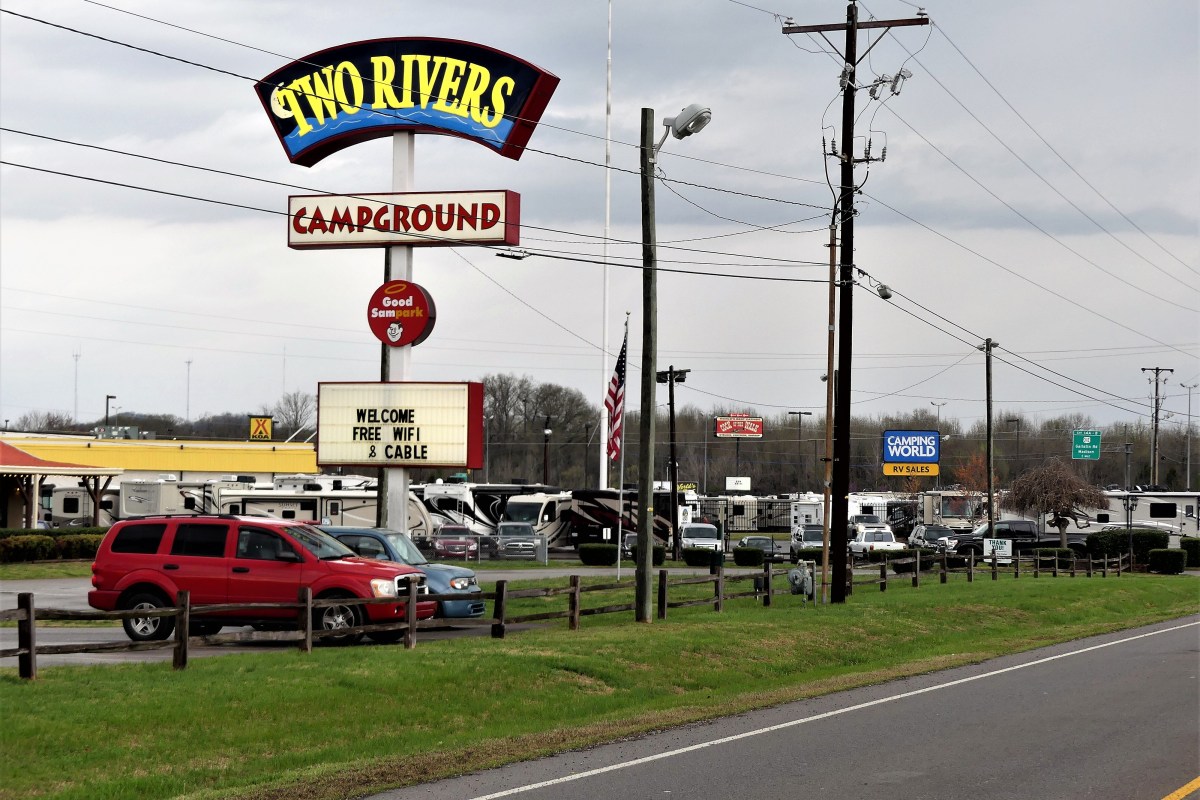
Fortunately, there are no shortage of contestants at Two Rivers RV Campground in Nashville, TN, just down the road from the Opryland, so there’s plenty of entertainment to be had.

To call this place a campground is ironic, as nobody looks like they’re camping here (no tents are allowed). Purists would call this cheating, as there doesn’t appear to be a close connection to the great outdoors, because everyone here is parking.

But it would be inaccurate to call this place a parking lot. Two Rivers RV Campground is really a make-shift community participating in a wonderful experiment called neighboring, where people are forced to live in close quarters and in close proximity to each other.

New acquaintances are made daily, but they are fleeting. Everybody says hello, and acts friendly, but “Here today, gone tomorrow” is our casual mantra.

Nevertheless, looking around, it’s easy to see people sharing tools, detergent, stories and most importantly, lots of advice: who to consult; what to see; when to visit; where to shop; how to fix something; and why to navigate on certain roads. Know-how is the most valued currency for those of us on the road, and it’s usually free for the asking.

People from all income streams participate simply by paying $42 a night at this location, which gets you a semi-level pad equipped with electricity, water, sewage, and cable TV provided you bring your own power cord, garden hose, flexible tubing and co-axial cable. Just in case you’re unprepared, there’s always Camping World for all your accessory needs, and it’s no accident that Camping World is right next door within walking distance.

Walking through the aisles of an RV supermarket can easily rouse a variety of deadly sins. First, there’s gluttony—that insatiable feeling that everything in the store would make life much better or easier if only I could fit it all in my storage-deprived Airstream.

Next, is pride—given the unlimited combinations of cleaning and polishing products on the shelves that will bring a super shine to your tiny home. In fact, my next-door-neighbor spent half the morning wiping down his 34 ft. 5th wheel toy hauler, only to watch it pour later in the day.

Lastly, it’s difficult to ignore the many expensive and over-sized rigs crowding the campground, creating little doubt that there is an RV pecking order associated with ownership, which could easily bring about a costly disease otherwise known as RVNV (RV envy).

It seems that RV living is trending higher every year. 2016 saw record growth in RV sales with 430,000 units (trailers and motorhomes) sold, and a 2017 forecast expected to exceed 500,000 units.

It seems that the dream of traveling has become more competitive.


There’s a Bunker in the Hill, and It’s Revolutionary!

Dave was our guide for the 90-minute bunker tour below The Greenbrier in White Sulphur Springs, WV.

Hallway (3)

It was Dave’s 532nd tour in the two and one-half years since he retired from selling Chevys in town. His wife had begged him to go out and do something that will keep him away from her while keeping him fit. Always a fan of history and meeting people, Dave now claims he’s found the perfect job since it requires walking just over I mile per tour while he lets us in on a secret withheld from the public for thirty years.

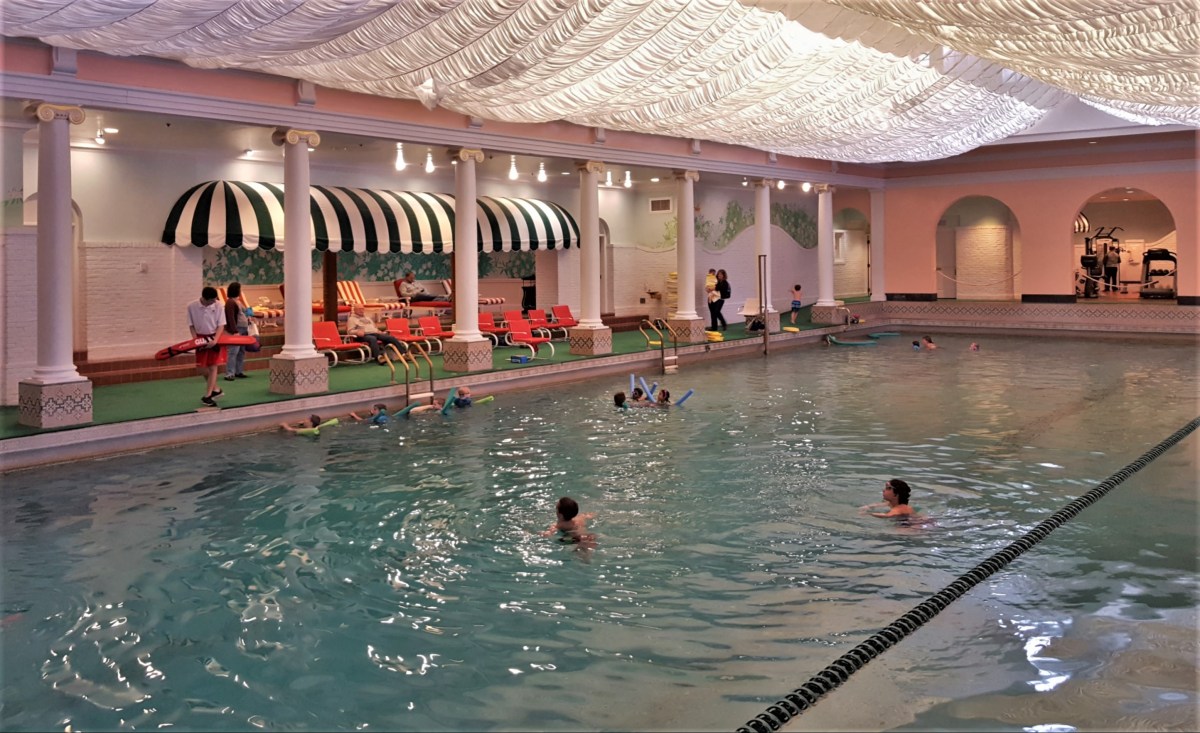
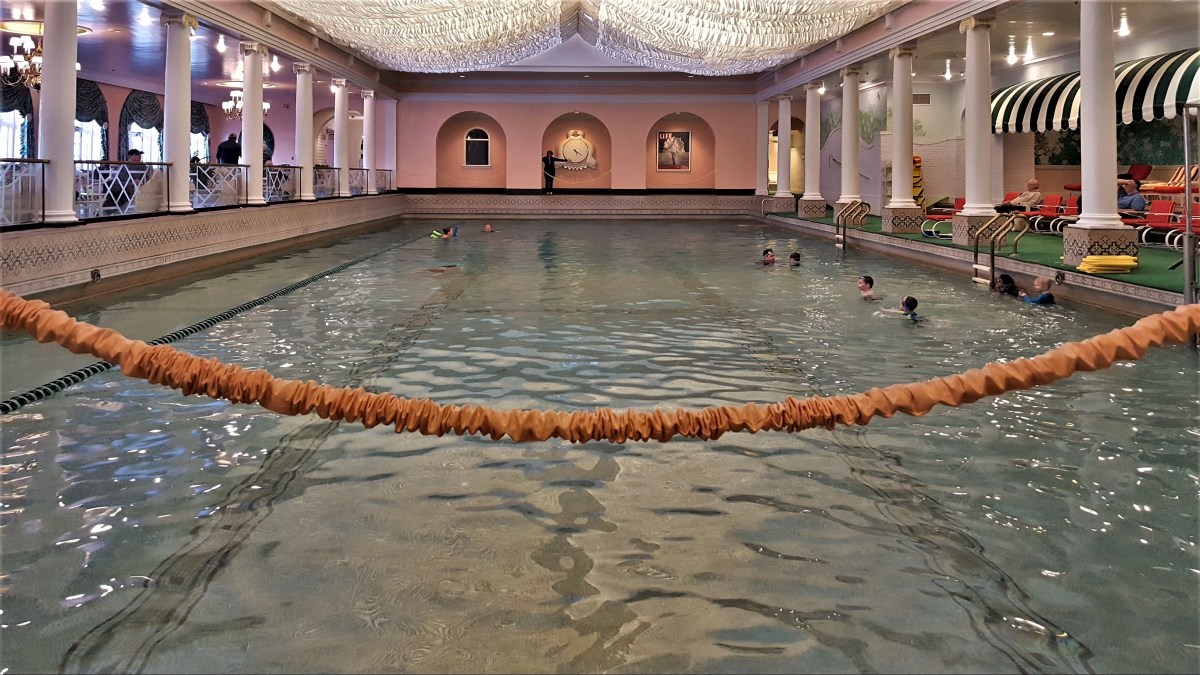
Dave led us past the hotel indoor swimming pool, built in 1914,

pool.jpg

and considered the largest of its kind, built at the turn of the century.

pool end

Dave revels in the trivia.

“Do you know,” he asserts us, “that this pools has exactly 961,000 individual tiles set into the pool walls and floor, and I challenge you to tell me otherwise.”

“Exactly 961,000?” I contest.

“Exactly!” Dave reaffirms. “Don’t believe me?…Then count them yourself!”

Dave leads us through the ballroom,

ballroom.jpg

and towards the newer wing.

Dave explains that Ike commissioned the clandestine bunker during the height of the Cold War so Congress could be sequestered in the event of a nuclear attack on DC. While it would not withstand a direct hit since it was only 60 ft. below ground, it could seal and protect against radioactive fall-out. The 2-level 112,00 sq. ft. bunker was built between 1958 and 1961, 720 ft. into the mountainside beneath the newly conceived West Virginia wing of the opulent hotel, so as not to attract public attention.

The bunker was readied daily–just in case–by attendants who masqueraded as TV repairmen, and remained secret until the Washington Post broke the story in 1992, calling a halt to Project Greek Island.

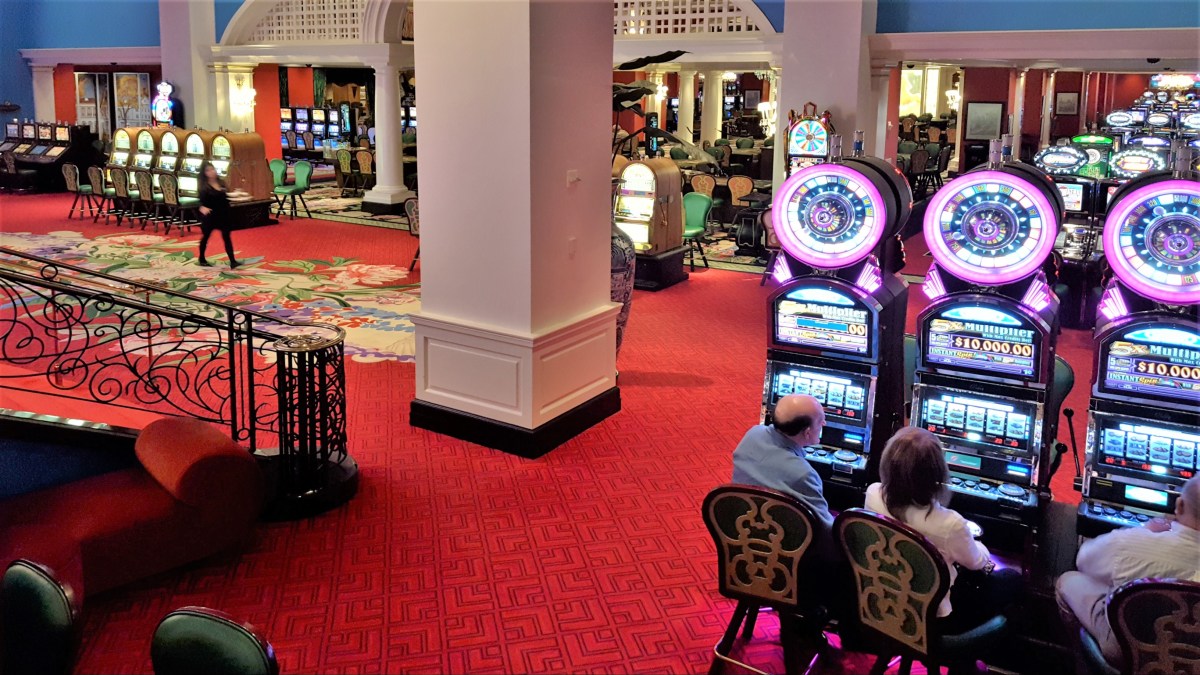
Dave also speaks highly of white knight, billionaire Jim Justice, who owns the hotel and also occupies the governor’s mansion in Charleston. Despite being a Democrat, Justice was elected last November with 49% of the vote in a self-funded campaign, despite Trump carrying the state by nearly 70%. Justice rescued the Greenbrier from insolvency in 2009, and spent $100s of millions on refurbishing, including a casino that required a county referendum to pass.

casino.jpg

A final thought: While I understand the principle behind building and supplying the bunker back then to preserve and protect Congress for the continuity of our democracy, there’s no way that I could justify a safe refuge for today’s elected Representatives and Senators. There’s no way they deserve to survive us all.

Notes:

The breaking story that put an end to the bunker that was hiding in plain sight:
http://www.washingtonpost.com/wp-srv/local/daily/july/25/brier1.htm

The Greenbrier boasts about itself:


Blogger’s Preamble

This trip has been in the planning stages for the better part of two years, but it’s been a vision of mine for over 30 years. Two things I realized early on: I’d have to wait until I retired, and I’d have to find someone compatible enough to join me on this wacky adventure. I’m happy to report that both conditions have been met.

Most importantly, Leah and I have been together for nearly 12 years because we forgive each other’s most embarrassing moments and tolerate each other’s most defining idiosyncrasies. We have become formidable collaborators regardless of our separate opinions and talents. Our curiosity knows no boundaries, and our appreciation of the “great outdoors” is a driving force to explore the outer limits.

We spent four weeks together last summer romping through Alaska and Yukon in preparation for this trip. Our objective was simple: to still be talking to each other by the time we returned home. While there were some tense moments along the way, it was always the laughter that eased every crisis. By passing this test, it allowed us to set our sights on bigger goals.

Of course, all of this became possible by my retiring from the NYC Department of Education after eleven years of teaching high school to students with special needs. Teaching Special Education was not a calling; it was an assignment. By enrolling and being selected into the 2006 cohort of the Teaching Fellowship, I was introduced to an urban population of teenagers that collectively knew the struggles of academic failure, the isolation of being different, the limits of parental/guardian support, and the epic challenge to be better than everyone’s expectations.

It wasn’t easy. There were a few victories along the way, but way too many disappointments made more disappointing by a system that lost its way. Too often, colleagues of mine were reminded by administrators that “It’s all about the kids,” yet the rhetoric always exceeded the reality. I’ve seen my share of budget misappropriations, bully pulpit principals, invisible discipline accountability, and city denial. I’m sure it wasn’t always this way, because I’ve met so many great teachers during my tenure who would do anything for their students, and leverage their students’ successes in order to continue teaching. Yet, it was enough to make me weary and yearn for more.

This trip is all about yearning for more. It’s about discovery, reflection and purpose.